The Orbit 2017 Year in Review

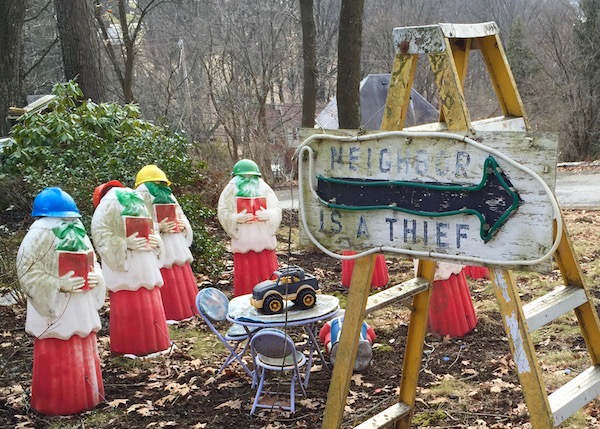
Handmade wooden sign with arrow reading "Neighbor is a Thief" with choir member lawn ornaments missing heads, Ross Township, PA

“Neighbor is a Thief” sign, the headless choir, and a whole lot more in Bill Ansell’s Ross Township Christmas display

Stodgy Orbit editors still prefer the old-school train wreck. It’s clear, though, that with the change in political administration America has officially moved-on from this tired railroad-age metaphor to the more immediate (if ultimately less tragic) dumpster fire. Maybe this was this was year our fears moved from the cataclysmically abstract and right into the alley behind the house.

Yeah, 2017 was a mess. The “hyper-local” Orbit focus didn’t really cross paths with either presidential politics* or #metoo, but it’s interesting that our most-read stories of 2017 trade in their own form of controversy, despair, and isolation. Of course, these themes are always current.

Anyway, as is our year-end tradition, below are lists of the most-read Orbit stories of 2017 along with some “editor’s favorites” from the bottom of the list.


The Hits

1. Ansell Regrettal: A Ross Township Donnybrook (March 6, 2016)
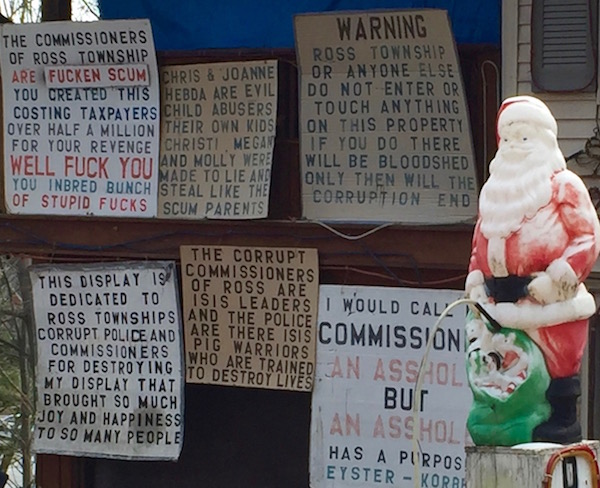
Santa Claus lawn ornament with protest signs against Ross Township leadership

Merry Christmas from Ross Township

That’s right. The Orbit‘s #1 story for 2017 was published in 2016–early 2016, at that. Maybe it’s because we’ve had not one, but two Christmas seasons since this one first ran, or maybe it’s just that people can’t get enough of the heartbreaking and terrifying tale of Ross Township’s Bill Ansell–a man who just wanted to spread his love of Christmas until his neighbors and the township shut him down. Then his thoughts turned from giving to killing.

2. Into the Forgotten: Clairton’s Ghost Neighborhood (Feb. 22, 2017)

abandoned house with spray-painted graffiti "Into the forgotten", Clairton, PA

A house on Lincoln Way, Clairton

Lincoln Way was a quiet dead-end street of pre-war single-family homes until the groundwork for an expansion of the Mon-Fayette Expressway sacrificed the little hollow neighborhood to connect the highway to Rt. 837. What’s left is a sad, vacant, and fascinating stretch of former homes now in various purgatory states between dilapidation and demolition.

3. A Graveyard for Gravestones (May 9, 2017)

dismantled mausoleum in unruly pile, Pittsburgh, PA

The graveyard for grave stones

Where do grave stones go to die? One tends to think that the carved granite and marble markers for cemetery plots will be there forever–but that’s not always the case. Headstones are removed and replaced for all sorts of reasons and they end up here, in the cemetery’s work yard for ultimate processing and disposal.

We got into a lot of trouble over this one with neighbors coming up with some wild theories about what’s going on in there. Ultimately, though, it became a great teachable moment for some of the behind-the-scenes, nuts-and-bolts business of cemeteries.

4. The Front (and Back) Yard Marys of Bloomfield, Part 2 (May 19, 2017)

statuette of Mary in grotto, Pittsburgh, PA

Mary, Ella Street, Bloomfield

A post-long mea culpa on the false assumption that we’d located every (street-visible) Front Yard Mary in Bloomfield with our first go-around. This one includes another sizable handful of Her Blessedness peering back at us through chainlink fence and alley walls. What can we say? The Orbit loves Mary!

5. Water’s Gone Cold: An Elegy for Tea Bag’s (Feb. 12, 2017)
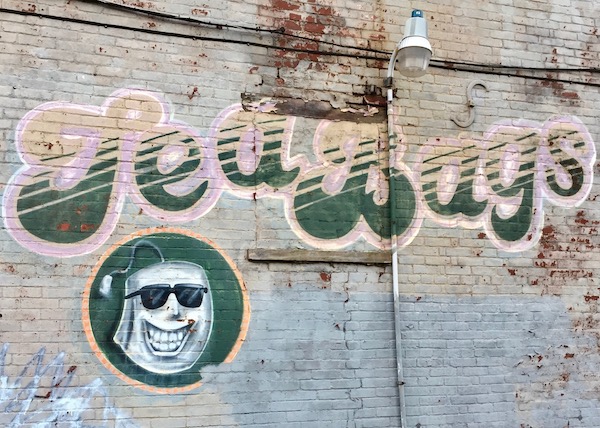
brick wall painted with logo for Tea Bags bar, Pittsburgh, PA

(Former) side wall of Tea Bags with logo/mural, Lawrenceville

Tea Bags grinning, sunglasses-wearing logo, painted on the visible side of its brick building in Lawrenceville/Bloomfield has been a constant neighborhood presence for the last several decades. That all ended at the beginning of the year when the dive bar went the way of Michalski’s and A.J.’s, Salak’s and Ed’s.

By all reports, Tina’s (which just opened in the same space after a lengthy renovation) looks like a pretty nice place with an old-school record-playing jukebox and windows that  actually let customers see daylight from inside the bar. We hope to get there soon. They’ve also amazingly left the old Tea Bags logo/mural on the outside–repainting everything else–so hats off to Tina’s!

6. “Wild Animal” on the Loose in Bloomfield! (Feb. 28, 2017)

"Wild Animal" art piece made from construction cones and panoramic photographs

Anonymous “Wild Animal” artwork, Edmund Street, Bloomfield

A brilliant, surprise piece of elaborate street art arrived on little Edmund Street in the middle of winter. Despite being right up against the Bloomfield PNC Bank branch, no one disturbed the tableau of a road cone-formed wild cat emerging from a photographed forest for nearly a week. We still don’t know who created Wild Animal (no attribution was left), but we’d love to find out.


The Sleepers

If there can be six hits this year, there can be six sleepers too…right? Sure. Like past years-in-review, here are some stories from the last twelve months that didn’t get the level of attention  like the ones above. Our editors thought these stories deserved a second shot at getting a first look.

Mondo Menorah! Menorahmobile Models Measured (Jan. 10)

mini van with rooftop menorah and "Happy Chanukah" banner, Pittsburgh, PA

Our attempt to cover the bicycle menorah parade this year fell victim to an untimely arctic blast and a (likely-related) participation dropout from the riders. We’ll get them next year (hopefully)!

In lieu, we can throw in this plug for The Orbit‘s coverage of Chabad’s 2016 Grand Menorah Parade in which our writers got acquainted with the array of options available for those who wish to sport a car top, light-up menorah for the family minivan. They come both commercially-available and also in a uniquely-Pittsburgh painted PVC pipe design.

Hold the Cheese: A Pi Day Salute to Ghost Pizza (March 14)

neon sign reading "IZZA" (the letter "P" is burnt out), Natrona Heights, PA

unknown pizzeria, Natrona Heights

It was a novel way to recognize “Pi Day.” Everyone loves pizza and Pittsburghers really love pizza. But even with that favorable business climate, not every pizza shop manages to survive. The unique landscape of many former pizzerias plus general vacancy leads to an ideal climate for what we call ghost pizza–the leftover signage, iconography, and architecture of independent pizza shops that are now shuttered.

Pain’t That America: The Front Yard Patriotism of Gary Thunberg (July 16)

handmade wood cut American flag lawn decorations, Beaver, PA

One of Gary Thunberg’s many homemade American flags

Gary Thunberg is holiday crazy. Four times a year, he pulls out elaborate sets of homemade lawn decorations that cover the front, side, and rear yards of the Beaver Township home he lives in with his mother. We happened to run into him right around Independence Day, so we were treated to red, white, and blue American flags, eagles, crests, and bombs bursting in air. We sadly missed the Halloween display and we’ll have to hustle to catch Christmas. Learn from our mistakes and catch up with the Fourth of July.

The Orbit’s Summer Vacation Part 1: Considering Portland and Part 2: Coming Home (Sept. 24/Oct. 1)

two men wearing black-and-gold kilts and Steelers jerseys at Heinz Field, Pittsburgh

Steelers fans at a pre-game, Heinz Field

Eight days vacation in lauded, lampooned, and local/organic Portland, Oregon was the prompt for a pair of posts on a bunch of nuts-and-bolts city things they’re doing right out there and a follow-up coming-home love letter to what we love about Pittsburgh.

An Urban Hike: William Street, Mount Washington (Oct. 22)

view of downtown Pittsburgh from Mt. Washington

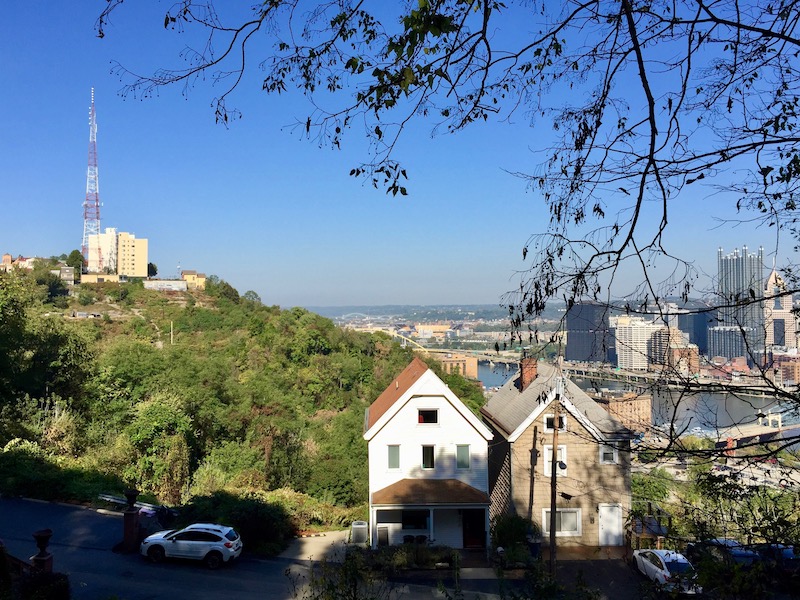
View downtown and the Smithfield Street Bridge from William Street, Mount Washington

We didn’t cover as many nature stories/tales of the city steps this year, but this was a good one. Little William Street snakes down the side of Mount Washington in a way that both rewards the hiker with several terrific views of downtown and a heady dose of that uniquely Pittsburgh sensation of being way out in the woods when you’re still right in the middle of the city.

James P. Leaf Mausoleum, Beaver Cemetery (Nov. 5)
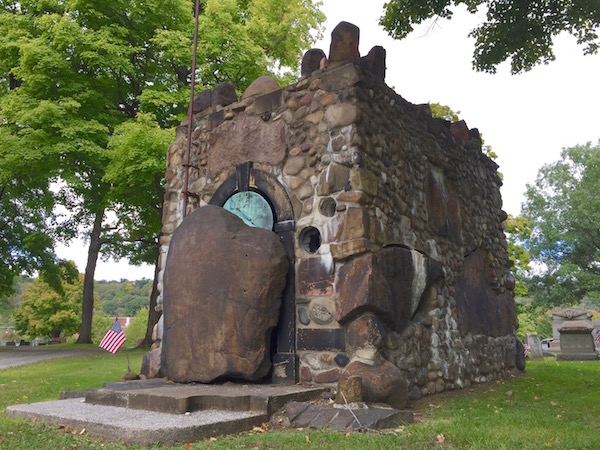
James P. Leaf mausoleum in Beaver Cemetery, Beaver, PA

Colonel James P. Leaf mausoleum, Beaver Cemetery

There’s an old saw that if you haven’t had a “Geraldo moment,” then you’re not blogging. The Leaf Mausoleum was ours. There’s just got to be a great story behind the nutty collection of  rocks assembled to entomb Beaver County civil engineer James P.  Leaf, but after a year of searching, we couldn’t figure anything out.

Regardless, it was still a fascinating construction to go dig around for, observe in a couple different seasons, and ponder on the hows and whys–plus, you’re right across the street from Gary Thumberg’s house! Let us know if you figure something out.


* A notable exception would be our post-inauguration piece “On Making America Great … Again” (Pittsburgh Orbit, Feb. 19, 2017).

A Four-Point Program for Snow-Shoveling Scofflaws

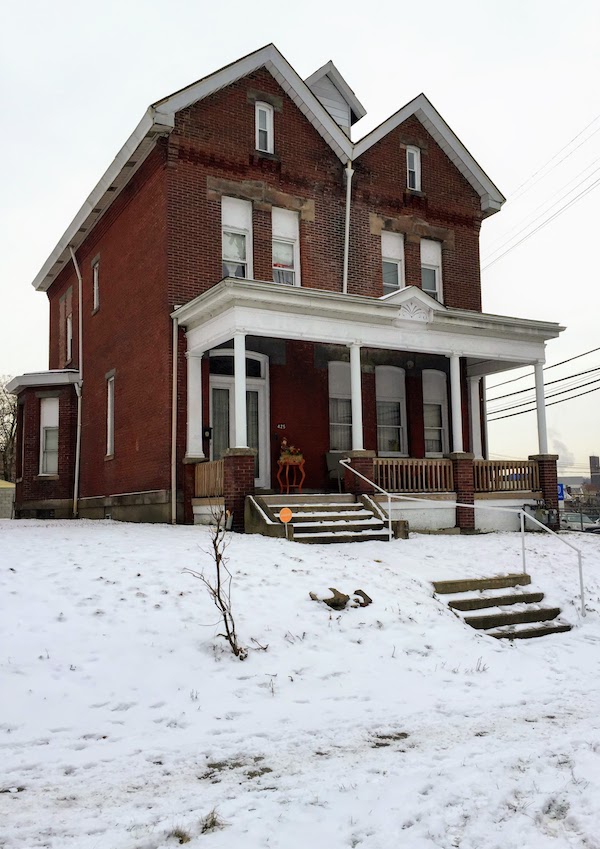
large Queen Anne-style house with snow-covered sidewalks, Pittsburgh, PA

Such a pretty house! It’s a shame the owners can’t afford a show shovel. Harriet Street at Fairmount/Roup, Friendship.

Winter. Whether it’s a pox for the seasonally-depressed, a brief, rosy-cheeked window into Yankee fortitude, or a no-questions-asked excuse to stay inside, drink hot chocolate, and watch British detective shows is up to the individual. Regardless–and despite the last two years’ near complete absence of winter–you’re going to have to deal with it sometime.

For the record, The Orbit has no problem with the season. Sure: it’s cold and it’s dreary, but there’s a lot to recommend it too. In any case, the worst thing about winter is undoubtably its potential for calamity. When trodden-on sidewalk snow turns to ice, a simple walk to the bus stop or coffee shop becomes a death-defying task. This no-so-balanced pedestrian has personally twisted ankles, thrown out hips, and landed plenty of (quite literal) pains in the ass on uncleared ice. There’s basically been at least one of these painful falls every year of my life.

Twisters Ice Cream shop with snow-covered sidewalk, Pittsburgh, PA

This ice is neither gourmet nor Italian. Twisters: you don’t get to take the season off–clean up your act! Bloomfield.

But it need not be this way! If just one person from every household simply pulled out the snow shovel and put in ten or twenty minutes at the appropriate times, the city’s sidewalks would exist in a perpetual walk-friendly state–it’s not that hard. We live in a climate that gets snow–we all know it’s coming. Shovel it once just after the snow stops falling, maybe throw on some rock salt, and nature will take care of the rest…until the next snowfall.

Plenty of people do a great, diligent job, but it is remarkable how many households refuse to make any effort in cleaning their walks. This is far from a mere nuisance, irritant, or old-guy “get off my yard” rant–it’s an extremely dangerous public health situation. Every year, people die from falls on ice and they sure as heck break a lot of bones and twist a lot of joints. Older neighbors and people with disabilities are especially at risk.

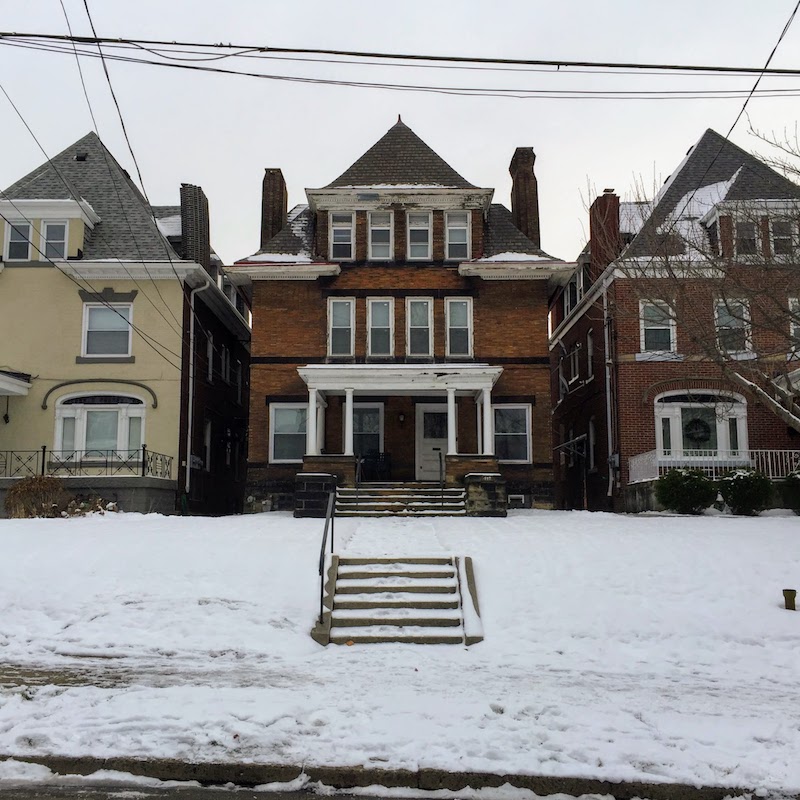
large brick Victorian house with snow-covered sidewalks, Pittsburgh, PA

Friendship, maybe. Caring about fellow human beings, not so much. Evaline Street at Harriet, Friendship.

This year, The Orbit is fighting back–and we hope you do too. Here is the Four-Point Program for Snow-Shoveling Scofflaws we’ll be implementing this season:

1. We’re watching you.

This blogger doesn’t stop walking when it gets cold, nor does he let a little snow get in his way. But, as mentioned above, it does become a huge hassle when the walks aren’t cleared and sidewalks turn to ice.

I’ll have my little notebook and an adequate pen that writes in sub-freezing temperatures. Addresses, dates, and a record of failure to clean walkways will be recorded. If you try: you’re off the hook. No shoveling: you’re in the book.

“I was out of town,” and “I had the flu,” and “I don’t own a snow shovel” are not acceptable excuses. This is why God invented teenagers. If you physically cannot do the work (or just don’t want to), there are always plenty of neighborhood snow-day youths roaming the streets, shovels and salt in hand, looking to make a buck. Flag one down and you’ll have semi-reliable snow service until he or she heads off to college. Likewise, if you have elderly or infirm neighbors, make the effort to help them clear their walks. The city’s “Snow Angels” program helps pair volunteers with homeowners for exactly this purpose.

large brick house with snow-covered sidewalk, Pittsburgh, PA

House on the hill, snow on the sidewalk. Winebiddle Street, Friendship.

2. You’ve been served.

Lest anyone think snow shoveling is merely the neighborly thing to do, rest assured it is absolutely the law of the land (err…the city). As officially stated in the City of Pittsburgh Snow Removal Ordinance:

§ 419.03 REMOVAL OF SNOW AND ICE

Every tenant, occupant or owner having the care or charge of any land or building fronting on any street in the city, where there is a sidewalk paved with concrete, brick, stone or other material shall, within twenty-four (24) hours after the fall of any snow or sleet, or the accumulation of ice caused by freezing rainfall, cause the same to be removed from the sidewalk.

To this end, I have prepared a handbill that contains the pertinent citation details and will be carrying a stack of these wherever I go. The guilty will receive a letter of justice they’ll not soon forget!

large brick house with snow-covered sidewalk, Pittsburgh, PA

Winebiddle, whine-a-lot. Friendship.

3. I’m calling your ass in.

The city’s 311 Response Center exists “to help with any non-emergency City of Pittsburgh concerns.” Believe you me, they’ll be getting an earful–or perhaps an In Box full–from this tax-payer! Like Ol’ Saint Nick, we’ll be recording who’s been naughty. Unlike Santa, however, we don’t deal in coal–we’ll just go straight to the po-po. I’m going to be that pest that lets 311 know every snow-dodging ne’er-do-well and feet-dragging layabout on my beat. We’ll see if you can’t clean your walk after that first citation comes in, Jack.

snow-covered sidewalk in front of brick house in Pittsburgh, PA

“No sidewalk parking.” Apparently no sidewalk walking, either. This serial offender on Main Street has not shoveled snow from his or her sidewalks in the last 17 years. Lawrenceville

4. Public shaming.

Just in case the response to that 311 call is either slow, unheeded, or ineffectual, the “nuclear option” is to do what the Internet does best: public shame! Now, normally I’m against this brand of hot-headed anonymous vengeance, but desperate times call for desperate measures–we’re dealing with people’s lives, here! It’s time to get on the neighborhood NextDoor group and flyer the telephone poles. Heck, maybe we’ll get a big billboard on Bigelow Boulevard like Billie Nardozzi! Let’s all hope it doesn’t come to that.

large brick house with snow-covered sidewalk, Pittsburgh, PA

Shady/side, snowy/walk. Bayard Street, Shadyside

A note on the photographs: These pictures were all taken the same day, Friday, Dec. 15, roughly 48 hours after our first real snow the previous Wednesday. It wasn’t a big one and was followed-up by a warming up melt-away over the weekend, so everybody’s getting off clean…this time. The weather may not be so cooperative with our next snow, so consider this a warning.

Black-and-Gold: Steelermobiles

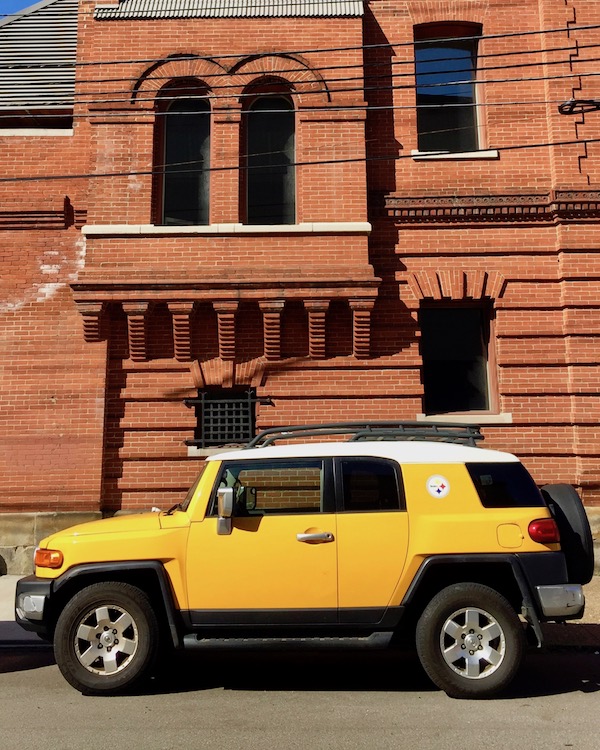
car painted gold with black trim, Pittsburgh, PA

Type B: Heinz Field

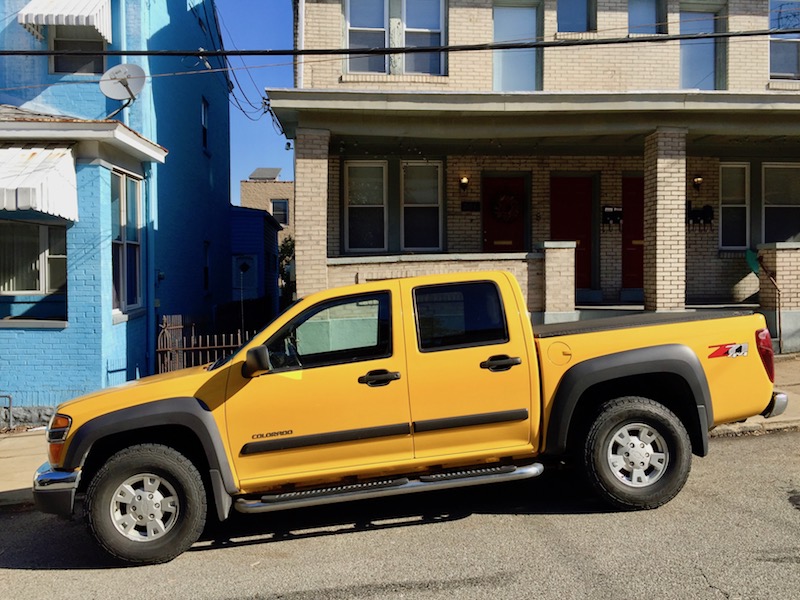
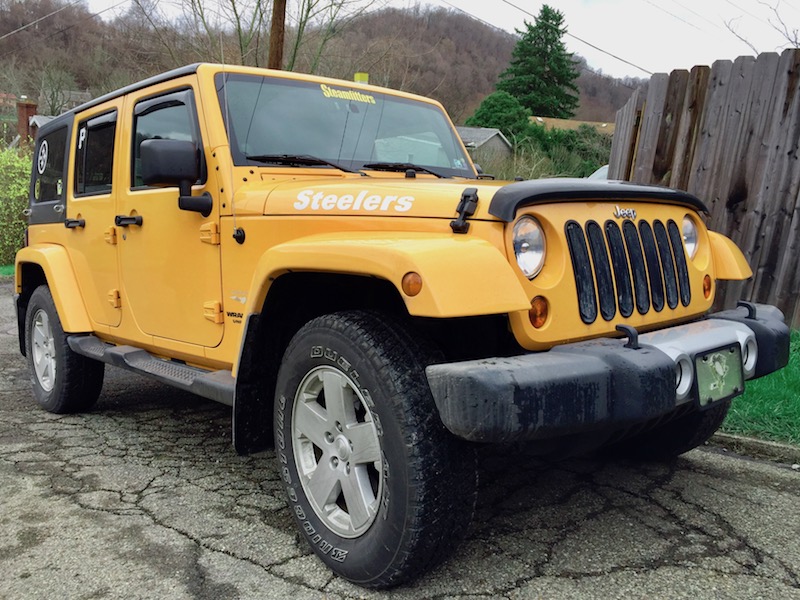
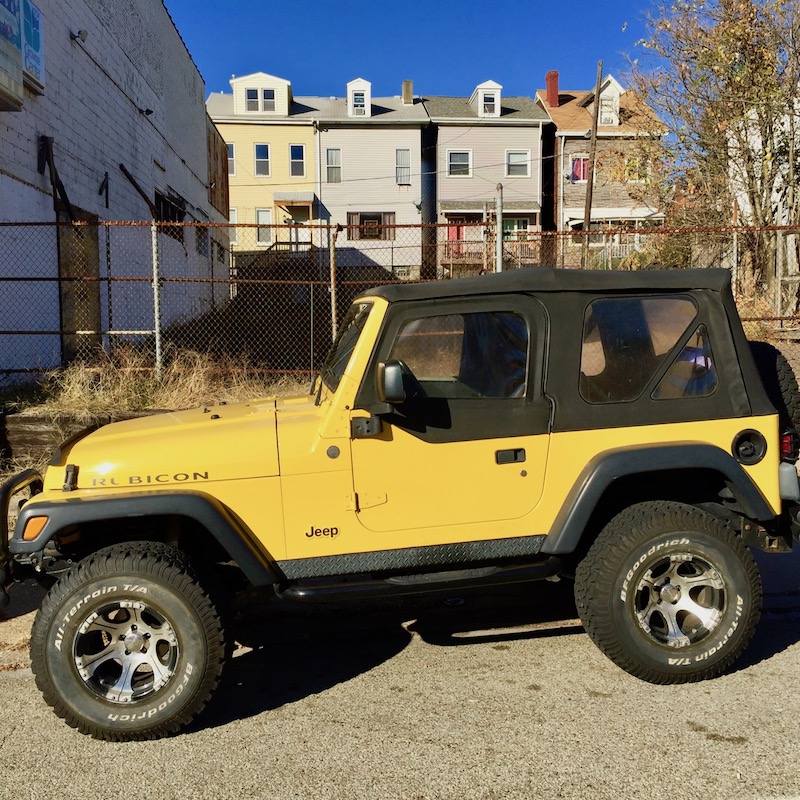
PANTONE: PMS 1235 C. The bright color is undeniably in the yellow family, but it’s a deep-hued, bold, traffic-stopping yellow. It appears in street lane markers and yells loudest when you really need to pay attention. It’s also rich and warm with a lot of orange–not like those namby-pamby lemon yellows, canaries, and daisies.

Around here, the color is better known as Steelers gold (never “yellow”) and an outsized portion of Pittsburgh’s motorists have special-ordered it from car dealers, then washed, buffed, and shined it in their driveways to preserve maximum luster.

Collectively, these vehicles are Steelermobiles and there exist three distinct categories of dedication.

black SUV decorated with Pittsburgh Steelers and Pirates stickers

Type A: Strip District

black and gold SUV with Pittsburgh Steelers logo

Type A: South Side

Type A: Certified Steelermobiles

The prototypic, incontestable, four-wheeled Steeler machine. These are black-and-gold hot rods, pickups, and sport utility vehicles so clearly decorated for Steeler fandom there can be no confusion or argument to the mission of their decoration. These cars exist to win professional football championships–or, at least to convey die-hard Steeler fans to the region’s purveyors of malted beverages, jalapeño poppers, and loaded nacho platters.

To fit this category, the vehicle must be fully painted in the Steelers black-and-gold color scheme. Typically there’s a base coat of one with significant detail accents in the other. These often take the form of sporty racing stripes to reinforce the athleticism of the Durango or PT Cruiser.

Additionally, the owner needs to have decorated his or her ride with the team name, insignia, and/or other after-market über-fan branding in a (semi-)permanent fashion. Those clip-on game day window flag attachments ain’t going cut it.

black and gold Hummer in front of single-family frame houses, Arnold, PA

Type B: Arnold

black and gold Ford Mustang in front of gray wall, Arnold, PA

Type B: Arnold

Type B: Black-and-Gold Road Warriors

These vehicles are almost entirely of the Steeler gold color, but with enough black detail work that we can assume the color selection was no coincidence. They must also be outfitted with Pennsylvania plates and be located in metro Pittsburgh or be spotted in one of the Heinz Field parking lots. Otherwise, it just starts to get too iffy.

Type B Steelersmobiles won’t, however, have the explicit labeling that’s required to be A-1 prime. We imagine that’s where a lot of spouses have drawn the line. Honey, you can have the bright yellow color, one might say, but you don’t get to put your football stickers all over my brand new Grand Cherokee. If only congress could achieve this level of compromise.

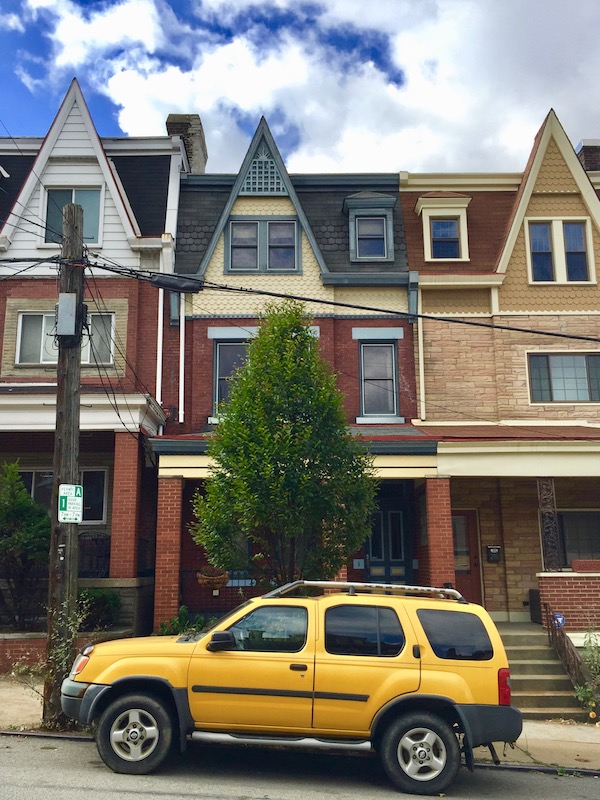
black and gold vehicle, Pittsburgh, PA

Type C: Friendship

convertible Volkswagen Beetle painted gold, Pittsburgh, PA

Type C: Steelers Beetle, Bloomfield

Type C: Goldenrods

The vaguest of the bunch. Type C Steelermobiles are painted predominantly in our old friend PANTONE 1235, but with no other identifying visual. In any other metropolis, the lollygagging ne’er-do-well spotting this vehicle on the street would simply remark on its garish electric orange-yellow paint job and move along. But in metro Pittsburgh, that particular color takes on a very special meaning.

This one brings up all sorts of psychological questions. Did the owners of these vehicles choose the color simply because they like bright yellow? Or instead because they’re die-hard football fans? Would they consider themselves in the category of the former, yet be subconsciously swayed to the latter by the pure osmosis of Mike Tomlin’s juju? It’s a heady subject, indeed.

black and gold Smart car, Pittsburgh, PA

Type B: Mendelson “Steeler Heaven” mobile, East Liberty

Smart car painted black and gold for A-1 Transit, Pittsburgh, PA

Type A: [Steelers logos on other side], East Liberty

As we know, correlation is not causation. Also, there are plenty of gold/yellow cars owned by people outside of Allegheny County who couldn’t give a damn about professional football. Some will dispute this whole theory. It’s a pretty weak frame to hang an investigation on, sure, but hear this blogger out.

The sheer volume of local cars and trucks tricked-out in electric Steeler gold makes this a phenomenon worth our attention. The dozen or so photos collected here are but the tip of the iceberg–there are so many Steelermobiles around town that we simply stopped bagging them after a while due to the incredible overload of options.

black and gold sport utility vehicle, Pittsburgh, PA

Type B: Lawrenceville

Ford Mustang painted gold with "Serious Issues" decal, Pittsburgh, PA

Type C: “Serious Issues 2”, East Liberty

Gone are the days (sigh) where the true faithful hand-painted their pop-up campers and shaggin’ wagons in team colors for the Sunday ritual. [Yes: we’re doing our best to collect these as we see them, but they’re few and far between.]

Like the players on the field, the bleacher crowd has moved on to a whole other level of box seat business professionalism now–factory-perfect paint jobs, mass-market team-official decals, license plate holders, and trailer hitch covers. Like punk rock apparel sold in chain stores at the mall, the fans have come out of the closet and parallel-parked their fleet of high-gloss war machinery right out front for everyone to see it.

black and gold pickup truck, Pittsburgh, PA

Type B: Lawrenceville

gold pickup truck, Pittsburgh, PA

Type C: Lawrenceville

Ram pickup painted in Pittsburgh Steelers black and gold

Type A: [with “Lord of the Rings” license plate frame and team logo trailer hitch] Bloomfield

Jeep painted gold with black details and Steelers decals, Hyde Park, PA

Type A: Hyde Park, PA

Jeep painted gold with black convertible top

Type C: Route 28, headed south

Jeep painted gold with black convertible top, Pittsburgh, PA

Type C: Bloomfield

front grill of a 1970's Cadillac with "DUBL YOI" Virginia license plate

Type B: DUBL YOI [Tribute to late former Steelers broadcaster Myron Cope], Schenley Park

All Rite Now: Simeon Larivonovoff, Painter of Icons

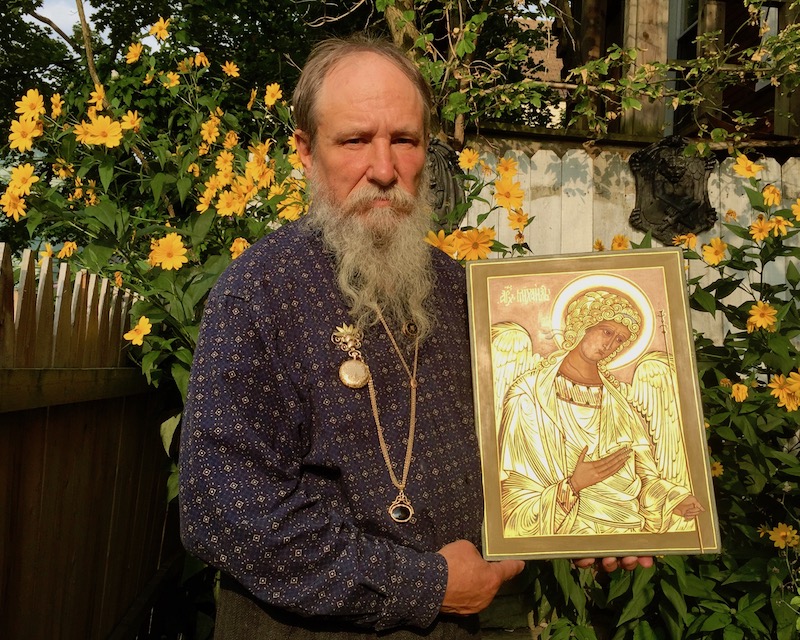
icon painter Simeon Larivonovoff holding a glowing icon of the Arcangel Michael

“An icon is a prayer in color. It is a window to paradise that shows you how to be transfigured.” Simeon Larivonovoff with icon of “golden hair” Archangel Michael

Waaaay longer than most of us can conceive of. Longer than the United States of America has existed; earlier than the Europeans landing at Jamestown and Plymouth Rock; a hundred years before Columbus was born–let alone sailed the ocean blue.

Six hundred and fifty-nine years. That’s how long the continuous line of Russian icon painters goes back. For seven centuries, the ancient devotional practice of creating highly-formal prayer paintings has been passed from father to son [yes: they have all been men]. That uninterrupted legacy may come to an end here, in Pittsburgh, with Simeon Larivonovoff.

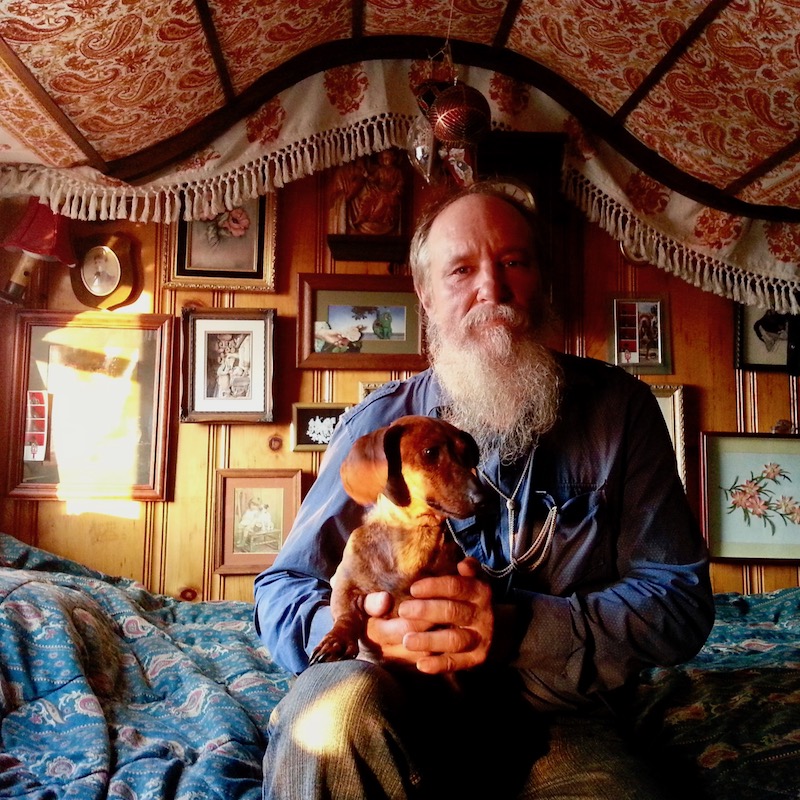
icon painter Simeon Larivonovoff sitting on a bed with a small dog on his knee

“You don’t mix cabbage with peas.” Simeon with one of his “doggies” in his bedroom/workroom.

A blast of sensations–I’ll warn you they’re not all pleasant–will arrive early and often. Visiting Simeon’s modest Polish Hill home begins with the raucous barking of his six dogs which completely nullifies any need for a doorbell. Simeon refers to these pooches with the diminutive “my doggies” or “my puppies,” even though they’re all full grown–several in a very big way. At least one member of the pack will be a constant companion–on the lap, by his side in the garden, or taken out on a leash sporting a jaunty kerchief as companion on Simeon’s frequent walks over the Bloomfield Bridge to the Shur-Save, or up Liberty Avenue.

The musky smell of animal fur–there are also a pair of house cats–mixes with the splinters of unfinished wood floors, stiff knotted area rugs, furniture polish, and antique brass. But it is the evocative omnipresent flicker of lamp light refracted through glowing cut glass and its partner aroma of smoking paraffin oil that will color your memory hours, days–weeks even–after departing. It may also be the best analog for Simeon’s world.

icon painter Simeon Larivonovoff lighting oil lamp

“Electric light is not needed,” Simeon lighting one of the dozens of oil lamps that light his home

The well-meaning speculative journalist faces a challenge photographing inside Simeon’s home. “Electric light is not needed,” he says while igniting the wick of an ornate, retractable, ceiling-mounted oil lamp–one of dozens of different models throughout the house–“these [lamps] are not in today’s society.”

Simeon is a member of the Russian Orthodox “Old Believers”–a sect of Greek Orthodoxy that preserves church practices going back to the 1600s, along with many of the lifestyle habits that go with it. “We pray in a pure 17th century style, before reform. We are non-conformists,” Simeon says. He further describes the group as “The Amish of Russian Orthodox.” The analogy–right down to the long beards and rejection of (most) modern technology–is pretty apt. On life in the 21st century: “I deal with the world, but I’m not influenced by it.”

That said, Old Believer practices also seem to overlap with that other locally-familiar brand of strict orthodoxy, Judaism. There is a weekly day-long, sundown-to-sundown sabbath in which no work may be done. “To cook a meal, to sew a button…no. A lot of people won’t answer the door on Sunday,” Simeon says of his fellow Old Believers. There is also a Kosher-like diet that forbids many of the same food sources: shellfish, eel, and octopus, pork and blood sausage.

partial icon for St. Praskevia with only the face and hands painted

“We don’t look at icons–they’re looking at us.” St. Praskevia icon (in process)

A visit with Simeon falls somewhere between Sunday school and Psychedelic Shack; as much Waiting for the Sun as waiting for The Son. “An icon is a prayer in color. It is a window to paradise that shows you how to be transfigured,” Simeon says of the goal of his artwork. “You ask the saint to help–you are not an artist, you are the medium.”

Simeon began painting icons at the age of nine, born into the family practice. “My father: you were his student,” Simeon says, “You had to learn a lot–prayers, colors.”

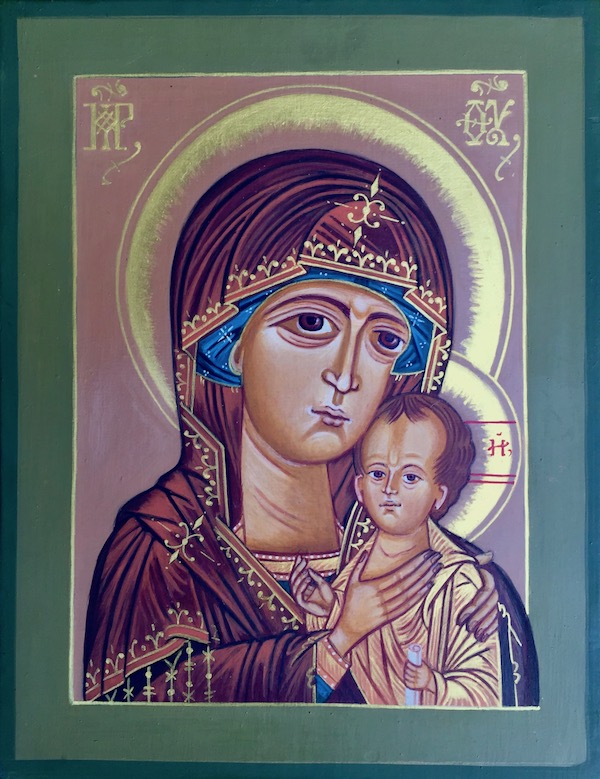
in-process icon of St. Kazanskya by Simeon Larivonovoff

“Our Lady of Kazan”, Kazanskya icon (in process)

There certainly was–and is–a lot to learn. There was the practice of grinding his own paint pigments from natural sources [the tan color in the photographed icons comes from sycamore bark] and learning to read and write in church Slavonic (aka old church Bulgarian) with its 63-character alphabet. Icon painters must have “a library of icons in their head–the mind, heart, and hand are on the same level.”

Iconography follows a strict canonical representation of each saint. “You don’t dare deviate from the form,” says Simeon, “theology does not change.” Small details and colors may be chosen by the individual painter, but, according to Simeon, the main outline of an icon may never be altered between versions, renditions, and artists. Finished icons are never framed because “You cannot put God in a box.”

Certain details are crucial: the relation between forms or seemingly small elements–the number of curls in a beard or an eyebrow raised, finger positions or the clutch of a scroll. “How you portray hands on icons is very important,” says Simeon, “The hand of Daniel is very big to show you the prophesy.”

icon of St. Petrovskya by Simeon Larivonovoff

“An attainable salvation.” Icon of St. Petrovskya

Simeon’s knowledge of Russian church history and the world of iconography runs very very deep. So deep it’s no small challenge for the interviewer to keep up with the artist’s barrage of names, dates, liturgy, and riddle-like koans that densely fill each conversation like the icons that decorate his walls.

In our multiple meetings, I took a bunch of notes from Simeon’s monologues on subjects like St. Sergius Radonezh, sabbath practices, and The Schism. But with bon mots falling like beeswax drips from a prayer candle–“Falling in the mud is one thing, being of the mud is something else” or “An icon is a pilgrimage from one holy place to another…between heaven and earth to see glimpses of paradise” or “We don’t look at icons–they’re looking at us”–well, you should probably go to the history books when you’re really ready to dig in.

wall with dozens of traditional Russian Orthodox icons painted by Simeon Larivonovoff

“The wall of icons are witnesses interceding to God for you.” Simeon’s bedroom/workspace.

Simeon’s own history gets a little murkier. When and why he emigrated to America was dismissed with a wave of the hand, “You don’t mix cabbage with peas.” [I believe this was analogy about religious persecution.] The dates and ages that get thrown around freely are a little squishy, too. That 659 years we mentioned above was a mere 647 years in a previous meeting. The very precise histories of antique oil lamps and furniture? Well, they’re all plausible. An ancient Russian prayer book of psalms or “chants” may or may not be in demand from The Smithsonian.

Regardless, Simeon is absolutely devoted to his craft. “This is the sole reason for my existence–to paint icons,” he says. And paint he has. Simeon estimates he’s painted between three and four thousand icons in his lifetime for an audience both within his local communities and around the world–some devotional, others are private collectors. Now he’s down to creating around 50 a year with eight or ten in process during our meetings. “I’m getting old,” Simeon says.

icon painter Simeon Larivonovoff with icon of St. Hodogitria

“You ask the saint to help–you are not an artist, you are the medium.” Simeon with icon of St. Hodogitria, “She who takes you by the hand, she who shows you the way.”

As strict a regimen as Old Rite Russian Orthodoxy seems to this outsider–its denial of compact fluorescents, crab cakes, and rock-n-roll seems like a heavy price for salvation–that’s not the way Simeon sees it. “We are a joyful religion…sunset is a new day beginning,” he says.

It’s a lovely way to look at the world–the early extinguishing of light in these darkest December days as not the trigger for seasonal affective disorder, but rather the beginning of a new possibility. That we are of the mud, transfigured, and on our tip-toes, trying to get one of those glimpses of paradise. Just don’t mix your cabbage with peas.


Bonus material! Back in 2011, local filmmaker Julie Sokolow made a short film of Simeon where you can see the man in motion. The lamp-lighting, dogs, and challenges of shooting in a home without electric light are all there.

Stamp Collecting: Getting Down to Brass Plaques

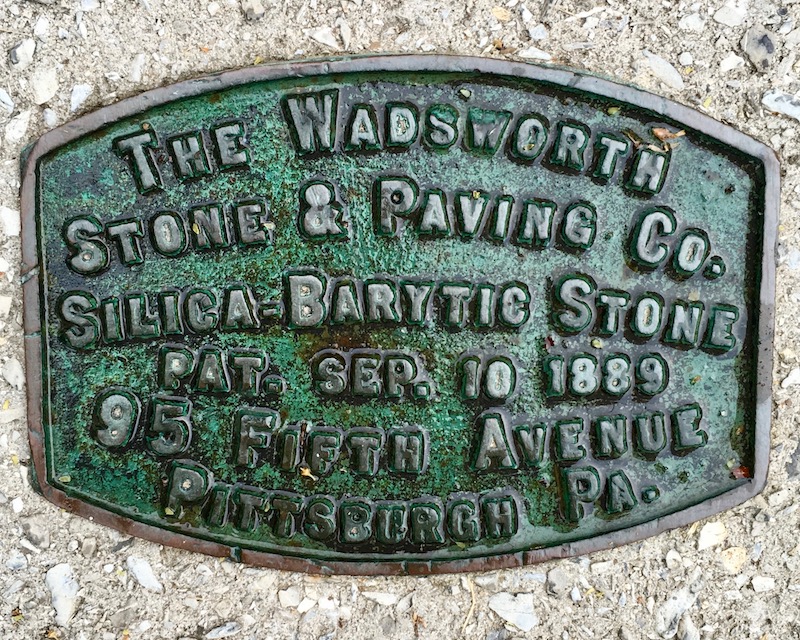
brass plate embedded in sidewalk concrete advertising Wadsworth Stone & Paving company, Pittsburgh, PA

Wadsworth Stone & Paving Co., Friendship*

Friendship. The little neighborhood–surely one of the smallest in the city by acreage–is full of stately turn-of-the-century homes and an enviable location adjacent to Bloomfield, Garfield, and East Liberty. It’s also home to nice, walkable sidewalks on quiet, tree-lined blocks that are–by Pittsburgh standards–relatively easy on the feet. Bargain grocery shoppers in the East End know Friendship as the neighborhood with two Aldi stores. But to The Orbit, it’s sidewalk stamp Nirvana.

You’ll find all the regular players here: DiBucci, Pucciarelli Brothers, Spano, Baleno–heck, one of the folks from A. Ciriello parks a branded red work truck right out front on Friendship Ave. There’s also a bunch of one-offs, old and new, including the inimitable, no-last-name-needed Jerry [more on these, later]. All this said, where Friendship really walks the walk is in the ultra-rare field of brass sidewalk plaques.

brass plaque for the Wadsworth Stone & Paving Company, Pittsburgh, PA

Wadsworth Stone & Paving Co., Friendship [photo: Paul Schifino]

The computer Internet contains very little information regarding the history of The Wadsworth Stone & Paving Co. In fact, all this Googler could locate was a single historical photo taken on a winter day in 1911 showing the company’s big industrial building on Hamilton Ave. in Larimer.

Regardless, Wadsworth literally left their mark around town in the form of several different designs of brass sidewalk plaques. Friendship is fortunate enough to have no less than three different variants–the most glorious containing the company’s name emanating from a rising sun over rugged mountains, now appearing green from the oxidation of the copper (above). These two markers are of a generation before the term concrete appears to be in common use–the designs are just-the-facts basic, but contain the alluring details describing “silica-barytic stone” in one and “artificial stone” in the other.

brass sidewalk stamp for The Wadsworth Stone & Paving Co., Pittsburgh, PA

The Wadsworth Stone & Paving Co., Friendship

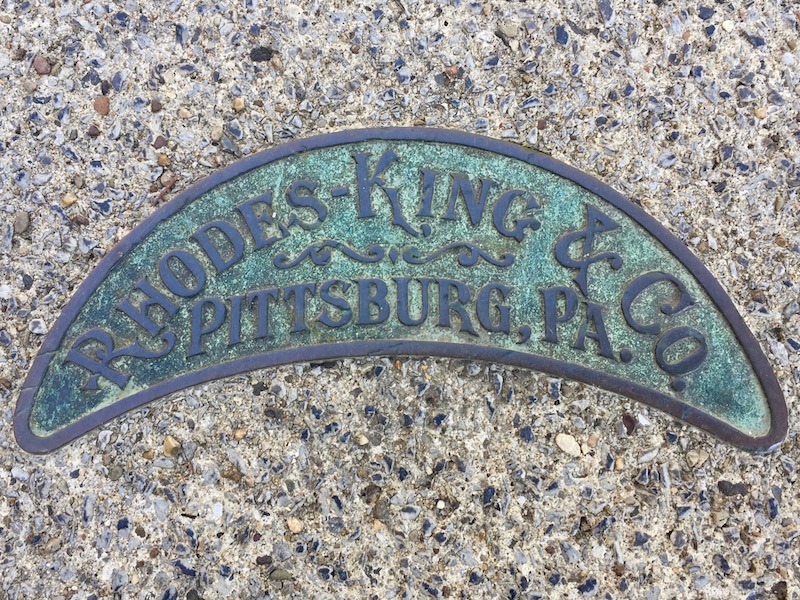
brass plate embedded in sidewalk concrete advertising Rhodes-King & Company, Pittsburgh, PA

Rhodes-King & Co., Friendship

Friendship, of course, does not hold exclusive rights to anything–even in the superlative quaintness of its name. That is, at least, not while Fairywood is still on the map. So we see brass plaques throughout town, just not with the same block-for-block density we get between Baum Blvd. and Penn Ave.

Millvale and Lawrenceville both turn in paired sets of great old-school sidewalk markers. E. Martina’s can be roughly dated with the 1950s-era named telephone exchange Everglade (EV) 1-8022 in the embedded phone number of the plaque’s triumphant shield shape.

brass sidewalk plaque for E. Martina, Contractor, Millvale, PA

E. Martina, Millvale

brass sidewalk plaque for J.A. Hotnich, Millvale, PA

J. A. Hotnich, Millvale [photo: Paul Schifino]

Speaking of dating these plaques (and the sidewalk jobs around them), several of the designs here contain the apparent misprinted city name Pittsburg (sic.)–without the H. That’s no error, though. For a little over twenty years (officially, 1890-1911) the city’s name was changed to this shortened, streamlined spelling.

That would seem to be a pretty clear approximate date for these sidewalks but every source seems to suggest the alternate spelling was used both before 1890 (leading to the initial confusion that required official action) and for several decades after repeal (people can be obstinate). It’s hard to imagine any piece of pavement could last through more than a hundred Pittsburgh winter freeze-thaw cycles…and these may not actually have done so.

brass sidewalk plaque for J.K. Wymard, Pittsburgh, PA

J.K. Wymard Paving, Lawrenceville [photo: Paul Schifino]

round steel sidewalk plaque with letter "G", Pittsburgh, PA

G, Lawrenceville

The mysterious G! This example is such an outlier–it’s steel, not brass and it doesn’t contain any identifiable name or contact info–one almost wonders if it’s actually a marker for a gas line or other underground infrastructure. With that thought in mind, it’s clearly a single embedded piece with no valve opening or other obvious utile function. Maybe someone just wanted to mark a gas line, or maybe “G” just liked to keep things simple.

brass sidewalk plaque for Nick Scotti, Concrete Contr., Pittsburgh, PA

Nick Scotti, Concrete Contr., Oakland

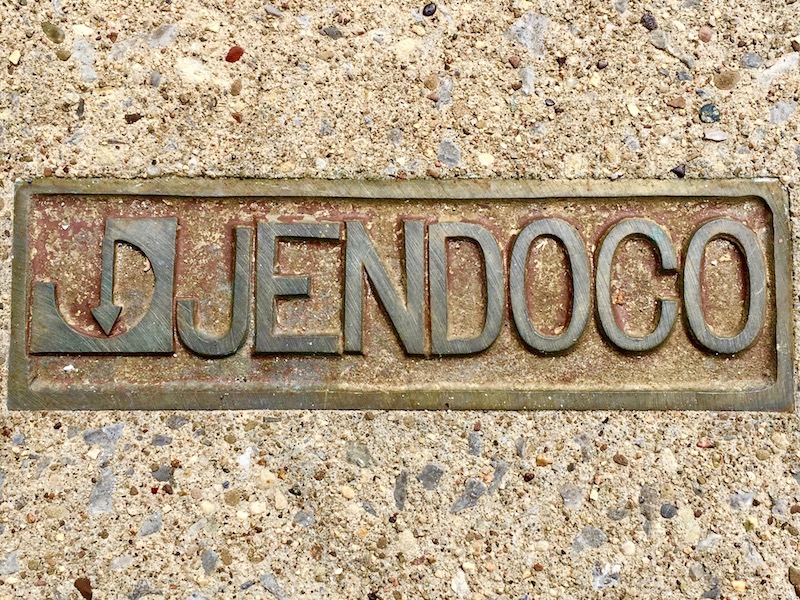
brass sidewalk plaque for Jendoco, Pittsburgh, PA

Jendoco, East Liberty

On the new end of the spectrum come two from Nick Scotti–who we first saw in Larry Kramer’s original sidewalk stamp piece [“Stamp Collecting: More Pittsburgh Easter Eggs, Set in Concrete“, Pittsburgh Orbit, May 5, 2017]–and a much more modern-looking one from a corporate parking lot poured by Jendoco. While these aren’t quite as exciting as a weathered Wadsworth, it’s great to see current contractors keeping up the tradition.

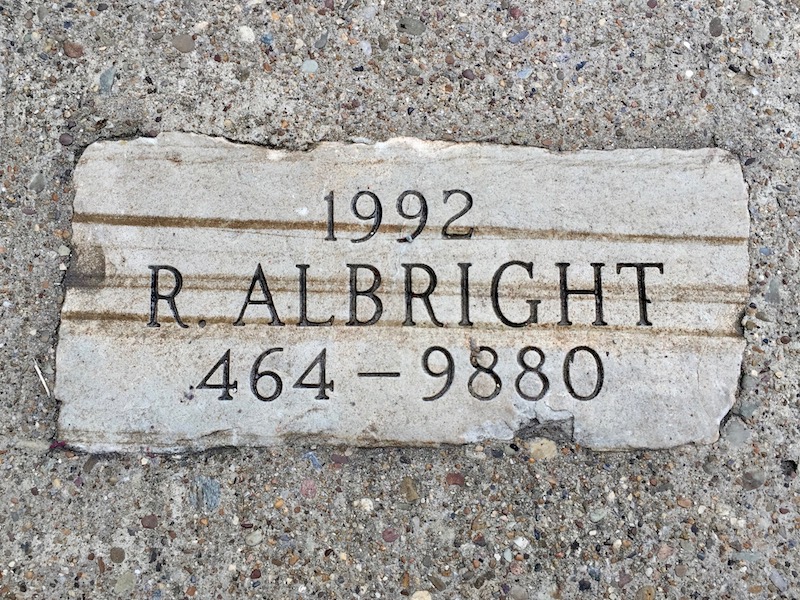
sidewalk mason engraved stone plaque for R. Albright, Pittsburgh, PA

R. Albright, The Run

A few other interesting tidbits. Mason R. Albright created a unique piece the likes of which we’ve not encountered elsewhere. Albright has apparently had his name, phone number, and an installation date etched into stone which was then set into the poured concrete of a sidewalk on Saline Street in The Run (above). It ain’t brass, but it’s still very much of the calling-card plaque variety, so we’re including it here.

Alternately, just one sleepy intersection–the corner of Lytton and Parkman Aves. in the Schenley Farms section of Oakland–has these embedded brass street names oriented for pedestrians. They’re neat, but seem like they would have been part of a larger strategy of infrastructure design that either was never adopted on the wider neighborhood, or (more likely) are the last remnants after other sections of sidewalk were replaced due to damage or the installation of accessible curb cuts, etc. Sadly, we may never know.

brass letters spelling street name Lytton Ave., Pittsburgh, PA

Lytton Ave., Schenley Farms/Oakland

brass letters spelling street name Parkman Ave., Pittsburgh, PA

Parkman Ave., Schenley Farms/Oakland

Many thanks to ace sidewalk-stepper and detail-procurer Paul Schifino with his contributions to this story.


* This same terrific Wadsworth rising-sun-over-mountains plaque has also been spotted in East Liberty and Millvale.

Going Postal: Cap Man Fever, Part 2 OR Whither, Cap Man?

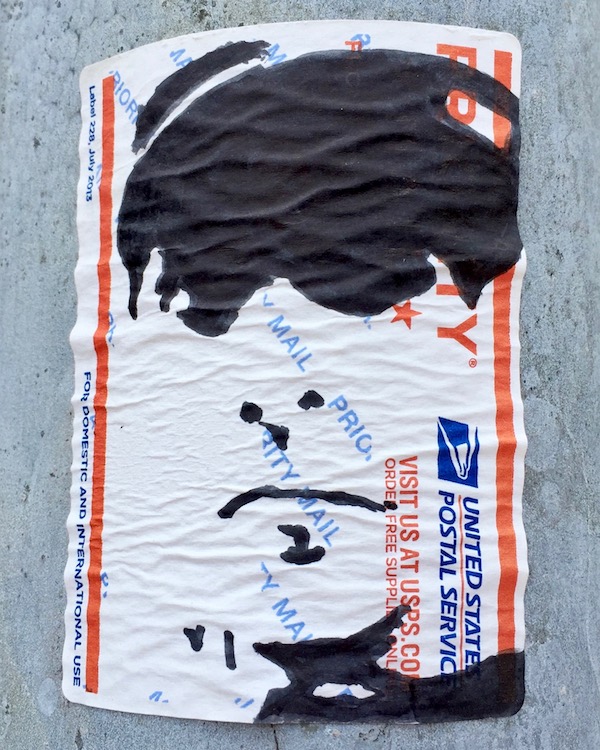
postal slap on light pole with portrait of young man in baseball cap, Pittsburgh, PA

Cap Man #12, Forbes Ave.

Cap Man has left the building.

More accurately, he’s likely left Pittsburgh entirely*. The possibility also exists that the young “postal slap” artist who decorated the lamp posts and traffic signage of central Oakland over the past year has just moved on to another less public hobby. But we doubt it.

postal slap with portrait of young man in baseball cap, Pittsburgh, PA

Cap Man #10, Neville St.

Let’s back up. Over the summer, we reported on the serial application of hand-created Sharpie-on-postal label artworks throughout the greater Craig Street and Forbes Ave. area of Oakland. A lot of folks use this medium, but few work in portraiture. [See “Going Postal: Cap Man Fever”, Pittsburgh Orbit, June 11, 2017.] These little sticker pieces were committed by an unknown, anonymous artist who appeared to be (perhaps overly) obsessed with literally plastering his face all over town.

No sooner had we published our second, tangentially-related story [“Going Postal: Rogues Gallery”Pittsburgh Orbit, July 30, 2017] than a new salvo of Cap Man (self-)portraits began appearing, including a nice run down mostly-residential Neville Street in Oakland.

postal slap with portrait of young man in baseball cap, Pittsburgh, PA

Cap Man #9, Neville St.

The image was unmistakably our guy–the same upturned, tagged, and jauntily off-center ball cap; the same flat expression and deep-seated eyes on a familiar young white guy face–so we bagged them. [Observant Orbit readers will note our photographs are from a point after some heavy mid-summer rains soaked the stickers thoroughly, leaving the dried artifacts crinkled, but still color-rich.] Then we waited for more…and waited…and waited.

But, as we learned from the years counting the seconds for Chinese Democracy to drop, there’s a point where it’s healthiest to just let go. This then may be a final goodbye as well as a thankful tribute to Cap Man. For whatever brief period, he made the sidewalks of Oakland a little more interesting and the art of the postal slap a little more creative.

postal slap with portrait of young man in baseball cap, Pittsburgh, PA

Cap Man #11, Neville Street

So what’s become of Cap Man? Our original hypothesis–a Pitt student who slapped his way across Oakland in the daily commute from a bus stop on Fifth and/or Craig Street to his campus classrooms–still holds water. Perhaps even more so, considering the termination of the ink portraits roughly coincides with the end of the university’s summer term.

That said, it’s safe to say there’s a fair chance we’ll just never know what was up with this dude. Cap Man may well have taken his business or computer science degree back to Philadelphia,  New York, or Washington, D.C. and is now safely installed running the numbers or pushing digits far from the telephone poles of central Oakland and the bus shelters of Bloomfield. Hopefully he’s still got his collection of Sharpies and they’re not just used for addressing large packages and system diagraming on large conference room brainstorming tablets.

Wherever you are and whatever you’re up to, godspeed, Cap Man.

postal slap with portrait of young man in baseball cap, Pittsburgh, PA

Cap Man #12, Forbes Ave.


* A little gender assumption here, yes, but as explained in the earlier post, Pittsburgh Orbit believes these are self-portraits of a young man.

James P. Leaf Mausoleum, Beaver Cemetery

James P. Leaf mausoleum in Beaver Cemetery, Beaver, PA

James P. Leaf mausoleum, 1949. Beaver Cemetery.

This blogger has spent a lot of time in the boneyard. So much time, we dare say, that we’ve hung out more than some cemeteries’ (newer) full-time residents. To visit one is a whole enchilada experience: you get to be outside in the introvert’s version of Kennywood–usually alone, in near silence, on beautifully-cared-for grounds that feel like a wild city park. Often there are the deer and crows and opossums to back it up. But it’s a park alive (ironically) with stories and history, carved images and statuary. Any cemetery has way too much to take in for just a single visit.

James P. Leaf mausoleum in Beaver Cemetery, Beaver, PA

Have you seen the back? Large boulders embedded in the Leaf mausoleum.

What these hallowed grounds don’t tend to feature so often is the touch of the human hand. Typically, gravestones are professionally-cut, perfectly-engraved, production line affairs. They’re marvels of precision stone-cutting and restrained grace, symmetry and classical iconography.

Rarely, however, does one encounter a grave marker that was hand made by the grieving family. [An obvious exception to this is the “DIY gravestones of Highwood Cemetery” (Pittsburgh Orbit, Oct. 30 and Nov. 1, 2015).] It is especially rare to see a stone or tomb that looks like his or her bats-in-the-belfry aunt or brown bottle flu uncle would have built it.

large stone blocking entry to mausoleum entry, Beaver Cemetery, Beaver, PA

Leaf mausoleum, entry (detail)

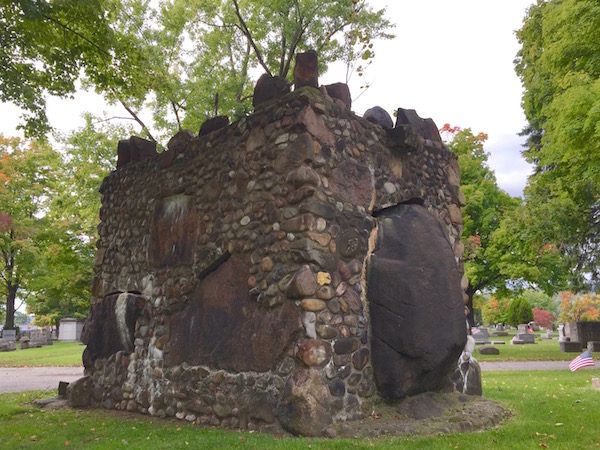
That, however, is exactly what Beaver Cemetery’s James P. Leaf mausoleum looks like. At approximately the size of a one-car alley garage, it’s definitely the right scale for your typical double-crypt couple’s tomb–but it sure doesn’t look like one. There are none of the straight lines, white stone, or classical features we normally see. Mr. Leaf didn’t even receive the customary stained glass rear windows like we peeked in on in Allegheny Cemetery.

Instead, the monument has clearly been constructed by hand, from an oddball collection of irregular stones. These range from the size of a cantaloupe to huge boulders that would crush a house in their falling path. One of these massive rocks has been set to entirely block the front entrance to the tomb, leaving only an oxidized copper Leaf nameplate visible awkwardly above. Water-smoothed river pebbles have been used to create decorative features within the mortar walls and vertically-places stones sit on top to resemble crude castle battlements.

There is a maybe too-good-to-be-true story that the mausoleum was built with stones pulled from each of Pennsylvania’s 67 counties that appears in several sources, all unsubstantiated.

mosaic detail made from pebbles, James P. Leaf mausoleum in Beaver Cemetery, Beaver, PA

Detail: pebble mosaic

James Pinney Leaf (1866-1949) seems an unlikely soul to spend eternity in such a ramshackle final resting place. The son of an engineer, Leaf followed in his father’s footsteps, earning a degree in engineering, serving in the U.S. Army Corps of Engineers during World War I, and working on projects and surveys in Rochester, PA, the Ohio canals, Pymatuning Reservoir, on Lake Erie, and along the Ohio River.[1]

So how did a lifelong builder and engineer end up in a cattywumpus backyard barbeque of a crypt like this one? There’s got to be a great explanation here.

view into crypt interior, James P. Leaf mausoleum in Beaver Cemetery, Beaver, PA

View into crypt interior

Spoiler Alert: We don’t know! The Orbit sat on this story for an entire year, dug into the books with the crew at the Carnegie Library’s Pennsylvania Room, consulted professional archivists, talked to Beaver Cemetery staff, and … Zilch. Goose egg. Bubkes. “Nothing burger”.

Who James P. Leaf was is well documented–Hillman Library has a huge collection of family papers–but it’s a total mystery how such an esteemed veteran, builder, and prominent community member ended up with this pile-of-rocks mausoleum.

James P. Leaf mausoleum in Beaver Cemetery, Beaver, PA

One of these memorials is not like the rest. Leaf mausoleum, Beaver Cemetery.

It was a rough week–emotionally and physically. Nobody wants to hear about all that, but you’ll no doubt respect the need to just move on and let a mystery be its own mysterious self. Maybe by having this story out there someone who actually knows what’s up with the Leaf tomb can enlighten us and we can finally set the record straight.

Currently, we’re in the apex of leaf-changing glory. If you’re looking for a destination to get your fall colors on, you could do a lot worse than the fun drive out Route 65, past Punks Ice Cream and the murals of the Sewickley Speakeasy, to lovely little Beaver Cemetery. See what you can find out for ol’ Orbit, will you?


[1] University of Pittsburgh Library System, Leaf family papers.

An Orbit Obit: The Bloomfield Bridge Tavern

mural for Frankowski family with people holding giant pierogie, Bloomfield Bridge Tavern, Pittsburgh, PA

It takes a village to raise a pierogi. Frankowski family coat-of-arms.

This one’s personal.

Over at Orbit headquarters, we wailed into the night over the loss of Chiodo’s–it with its dusty, historic underwear hanging from the ceiling and the Mystery Sandwich haunting our dreams. We took it easy with the Casio beats and flared collars of The Casual Approach (R.I.P.) who defied gravity every weekend at Dormont’s Suburban Lounge (also R.I.P.). Letter-writing campaigns begged our congressmen to turn The Chart Room into a national monument and there should have been so many more piano sing-a-longs at Moré. The days of dollar pints and four-bit “lady drafts” at bygone Lawrenceville watering holes like Michalski’s, A.J.’s, and Salak’s feel like ancient history–but it wasn’t actually that long ago.

The loss of these iconic, convivial, rowdy barrelhouses are all just eyewash to the earthquake that music-making/beer-drinking/pierogi-eating/squirt-gun-shooting Pittsburgh felt last week. The “Polish party house in the heart of Little Italy,” has bled the grease from its deep friers, removed the ceramic stein collection, carved wooden stage bear, and pictures of the pope. They’ve powered down the spotty PA system and shooed out the last late-night booze hounds. The Bloomfield Bridge Tavern has closed forever.

gated front door for the Bloomfield Bridge Tavern, Pittsburgh, PA

Closed forever, sigh.

[Cue: shimmering soft focus and a one-two polka beat.]

The year was 1996–some time in November. Arriving from The South with its still-turning mid-fall leaves and pleasant, temperate climate, Pittsburgh was soaking in several inches of days-old dirty street slush as a steady freezing rain dripped from the unrelenting overcast gray-black sky. Needless to say, this blogger-to-be had found a new home.

By pure chance–we’re talking pre-Internet tourism here–The Bloomfield Bridge Tavern was the very first place he spent a nickel. It was on a Polish Platter, and I’m pretty sure it still cost just $5.95 at the time. Carbs are pretty cheap in The South–but they don’t come with names like golabki and kluski. Although my middle-aged metabolism can’t demolish a plate like it used to, the food was as delicious just a few weeks ago as it was all the way back in the ’90s.

plate of Polish food including pierogi, kielbasa, golabki, haluski, and kluski, Bloomfield Bridge Tavern, Pittsburgh, PA

Oh, how I will miss you. The Polish Platter (“Red”): pierogi, kielbasa, golabki, haluski, and kluski

For the next, gulp, twenty-one years the Bloomfield Bridge Tavern has been the most long-running, consistent presence in this transplant’s Pittsburgh experience. The doctor only prescribes Polish Platters a couple times a year [yes, I know: find a new doctor!] but it’s been rare to go more than a couple months without receiving an audio-visual screening from BBT’s musical stage.

Typically, these are administered by local bands. [Full disclosure: the author is sometimes playing in one of them.] But despite BBT’s tiny size, cramped quarters, and DIY show-running [bands were responsible for collecting at the door, setting up the PA system, and running their own sound], the bar has played host to amazing run of touring players too numerous to list here.

Weird Paul Rock Band performing at the Bloomfield Bridge Tavern, Pittsburgh, PA

Weird Paul Rock Band at BBT, August, 2017

You think that’d be it, right? It’s a tavern: there’s beer, bar food, and weekend rock-and-roll–what else do you need? Well, you may not need much more, but the BBT plays into a legacy of Pittsburgh culture so deep we may take years–decades, even–to dig out from the loss.

Back in the day, then-city councilman Jim Ferlo held an annual Pittsburgh Marathon party in BBT’s side parking lot, complete with polka bands, a hot dog buffet, and cold beer. A highlight of the event was seeing exhausted runners, just hitting “the wall” at the marathon’s 23-mile point, veer straight off Liberty Avenue and plunge into the soft welcoming foam of a free Iron City Beer. Every local politician made it a point to stop by the BBT’s temporary parking lot stage to dole out cash “prizes” for things like “best dancer” and “cutest puppy”. Across the street, Foodland’s electronic weekly specials sign would be programmed to read the jingoist message Go runners. Beat Kenyans.

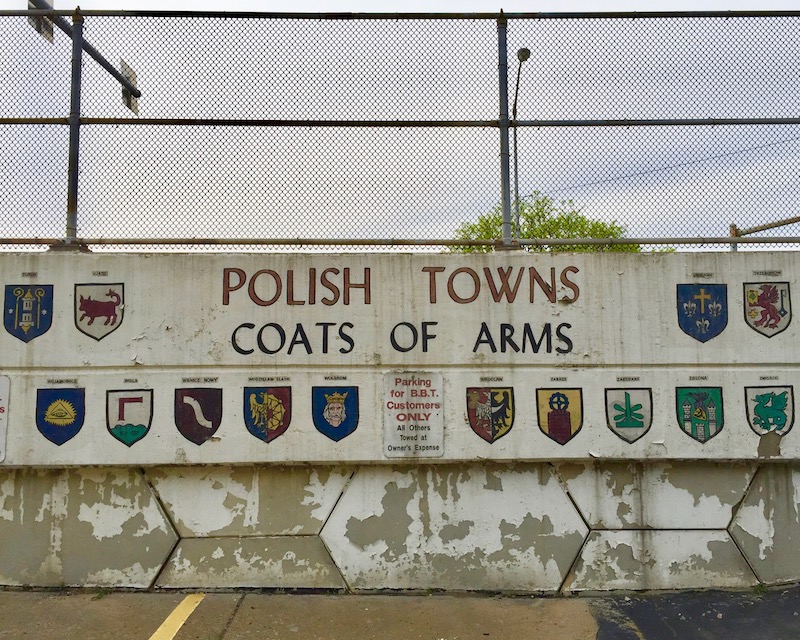
mural of Polish towns coats of arms painted on parking lot wall, Bloomfield Bridge Tavern, Pittsburgh, PA

Polish towns coats of arms, BBT parking lot

And then there are those murals. Dozens–maybe a hundred–different coats-of-arms of Polish towns you’ve probably never heard of. Crests with identifying names like Głowno, Szczecin, Gryfów Ślaski, and Żywiec ring the inside of BBT’s short concrete parking lot wall and come decorated in all manner of old world imagery–castles, bulls, red stags, and green griffins; kings, knights, mermaids, the sun & plow.

It’s gone now, but an earlier generation will forever associate the exterior of the bar with both the wonderful potted-flower Bloomfield mural/sign and [BBT founder/patriarch] Stan Frankowski’s wall-sized polemics attacking local politicians, anti-union foes, and corporate corruption. After Stan’s passing in 2005, his sons Steve and Karl took over the business. They kept up all the other traditions–including the annual day-after-Easter Dyngus Day party–but toned-down the see-it-from-the-suburbs politics. The updated red-and-white paint job, side screened porch/smoker’s lounge, and Polish falcons still look great.

coats of arms for Rodom and Radlin painted as murals on parking lot wall, Bloomfield Bridge Tavern, Pittsburgh, PA

Coats-of-arms from Rodom and Radlin

I didn’t make it out to the final night at the BBT–the body just wouldn’t let me. Luckily, Mike Shanley gave us all a pretty good scene report plus a slew of his own reminiscences in this week’s City Paper.

That said, news began to circulate about the (then-future) closing of the bar back in the late winter, so 2017 became a kind-of year-long living goodbye to venue. I played a last show there, saw a (different) last show there, and yes, ate a last Polish Platter. For the piece on his recent book of poetry, we interviewed Scott Silsbe over Strawb ambers in BBT’s breezy side porch on a lovely day in May.

mirrored wall behind the bar and patrons at Bloomfield Bridge Tavern, Pittsburgh, PA

BBT near the end: bevelled mirror bar, blood red ceiling, and big cats on TV.

As much as I’ll personally miss the place, I don’t fault the Frankowski brothers one bit for the decision to move on. Running a bar has got to be really tough work full of long, late hours dealing with no small amount of jerks, deadbeats, drunkards, and bodily fluids. Hats off to anyone who can put up with all that and still keep smiles on their faces the way Stan, Steve, Karl, and Sheila always did.

The Orbit certainly hopes the Frankowskis find a good new owner for the building and business so they can finally relax on the weekends without the sound of electric guitars ringing in their ears. Hopefully, the next tenants at 4412 Liberty Ave. will understand the legacy and history they’re dealing with–maybe they’ll even keep up the outside murals.

exterior of Bloomfield Bridge Tavern with Polish red and white flag and logo, Pittsburgh, PA

Hallowed ground. Bloomfield Bridge Tavern.

A final note. “New” Pittsburgh: if you’re out there listening and planning the next local, organic, hop-infused culinary venture, please–sweet Jesus–consider adding a Polish Platter to the menu. I’m sure I won’t be the only one pining for the taste and willing to pony up every chance I get–at least as much as the doctor allows.

metal window cover painted with message "The worst form of failure is the failure to try.", Bloomfield Bridge Tavern, Pittsburgh, PA

An Urban Hike: William Street, Mount Washington

downtown Pittsburgh seen through silhouetted trees

Ghost City. Downtown Pittsburgh as seen through trees on William Street, Mt. Washington.

If Rod Stewart is to be believed, every picture tells a story. This one’s a doozy.

In the photograph, the camera lens is roughly eye level with the tallest buildings in downtown Pittsburgh. They’re not “skyscraper” material, but we’ve got a collection of 40-, 50-, and 60-story towers that can legitimately feel “big city” if you pick just the right block to look up in. But here, it’s hard to actually see them–the distant office buildings of Grant and Smithfield Streets are heavily obscured by a foreground scrim of silhouetted trees clustered awkwardly, bent by nature, and leaning with no perceptible pattern.

The city scene is so background, washed-out, and featureless behind the crisp black tree line that it’s nearly unrecognizable if you don’t know what to look for. The storyline writes itself–Pittsburgh: the illusion of a big city within the reality of Appalachia.

single-lane road surrounded by trees in Pittsburgh, PA

big city living: William Street, about half way up

The bummer in taking a hike–if there is one–can be just getting there. As a person who’d rather not be in a car, the irony that one must drive to take a walk is befuddling and frustrating. It’s like purchasing new trash bags to just put them straight in the waste bin. Sure, you could live in a mountain cabin and hike right out the front door, but then you’d have to get in the car to buy your provisions–what a mess!

Not so in Pittsburgh. There are, of course, terrific woodsy trails in the city parks (especially Riverview and Frick), but one needn’t stop there. Between the up-and-down topography and relative sparseness of the hilltop communities, there are ample urban hikes just a bicycle ride or bus transfer away.

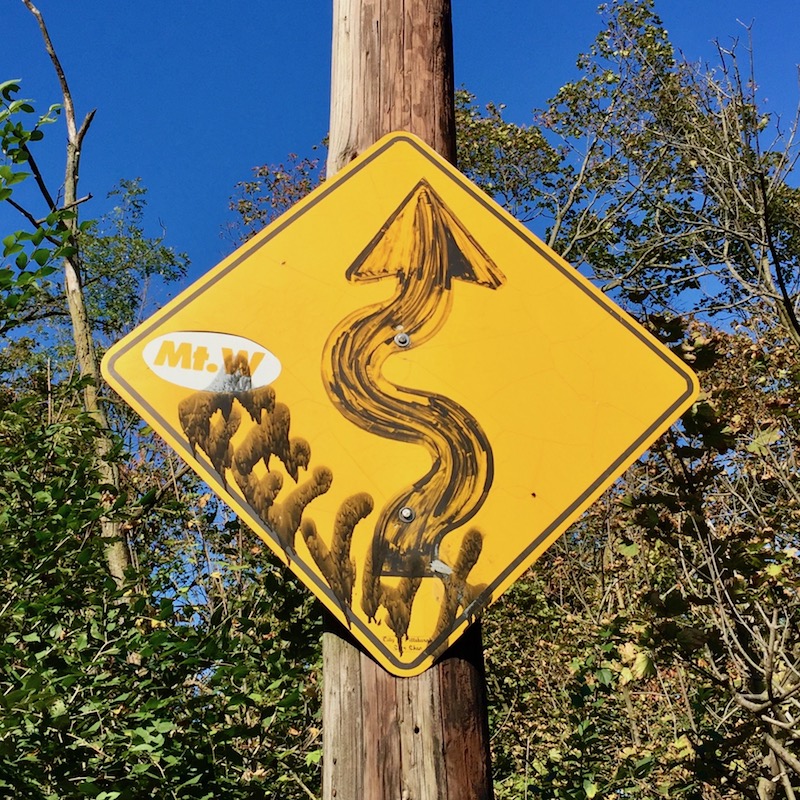
hand-painted road sign with multiple curves, Pittsburgh, PA

they ain’t kidding: curves ahead on William Street

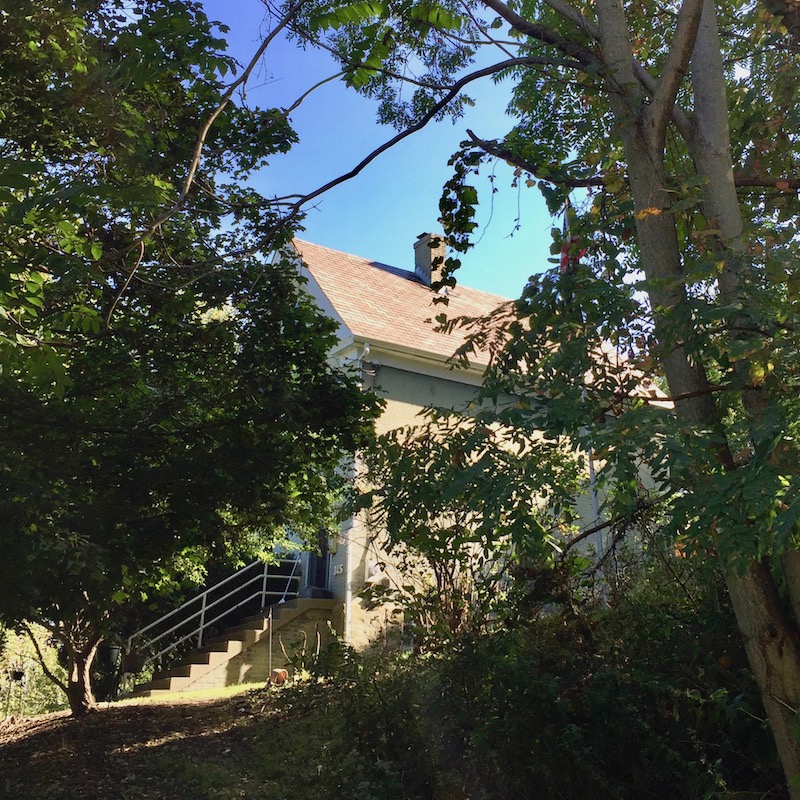
Like the old joke, “I went a to a fight and a hockey game broke out,” we arrived at William Street  last week on journalistic assignment and a hike happened. We were up on Mount Washington to track down and photograph the childhood home of [bygone football hero] Johnny Unitas. [For more on that, see last week’s story “A Football Team That Wanted Him: Johnny Unitas and the Bloomfield Rams” by David Craig.] Oh, we located the house–but we found so much more too.

sun coming through trees in Grandview Park, Pittsburgh, PA

uphill to Grandview Park

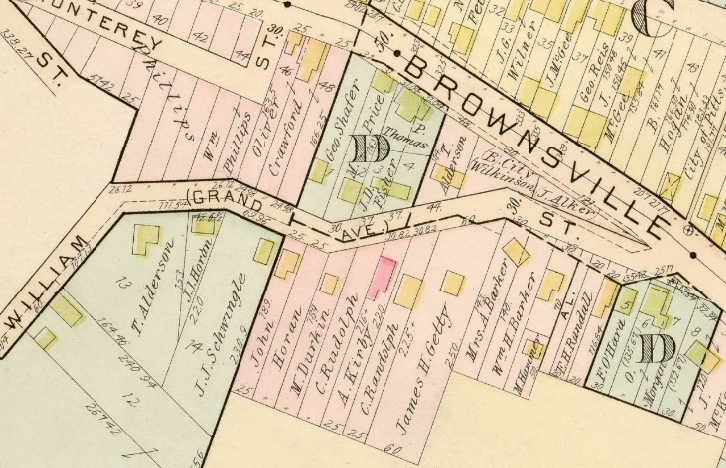
There would have been a lot more homes up here in young Johnny U’s day–frankly, it’s a bit of a surprise the Unitas house is still standing. William Street, which descends as a snake-slithering one-lane/one-way from Boggs Ave. down to Arlington Ave., has few remaining buildings today. A 1901 map, however, shows us how many homes once stood along the road. Whether that’s because the residential plots were requisitioned to create the surrounding park land or if it just got too difficult and expensive to maintain houses in a holler on the side of a mountain is unknown. Maybe one was a convenient excuse for the other.

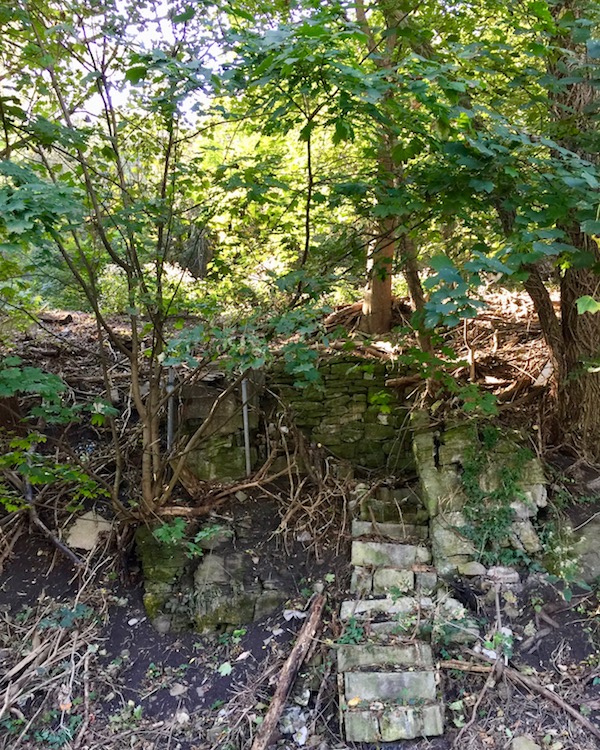
In any case, the signs of life are still here. Like any self-respecting city steps hike, the amateur archeologist is rewarded with nature-without-man trees growing through basements, layered stone foundations, felled chimneys, and still extant front steps edging right up to the roadside–all this as the sun’s halo casts a rich, dappled light through the lush greenery of Grandview Park.

stone steps and house foundation on hillside in Pittsburgh, PA

forgotten foundation and entry steps, lower William Street

detail of William Street from a 1901 map showing many former houses on the south and east sides of the street

detail: lower William Street c. 1901 showing many former houses on the south and east sides of the street (G.M. Hopkins & Co. map collection)

There’s a line that every Pittsburgher has a favorite view of the city–the West End Overlook, Grandview Avenue, or St. John’s Cemetery in Spring Hill, for example. The richness of options on this one little path make a fair case for William Street as two or three different best views.

Near the top, there’s a unique look north-northwest to the side of Mount Washington proper–the big broadcast tower at the end of Grandview is an easy beacon. You also get the oddball collection of both traditional and uber-modern houses on little Cola Street in the foreground, plus a glancing shot at downtown and The Point. In the same general area, one can bag a nice sight line across the Smithfield Street bridge to the whole of downtown.

view of downtown Pittsburgh from Mt. Washington

William Street, north view: downtown, Smithfield Street Bridge, Cola Street

view of downtown Pittsburgh from Mt. Washington

William Street, view north-northwest: Grandview Ave. (with broadcast tower), houses on Cola Street, downtown

Further down, as William bends to more of an east-west layout, there are vantage points looking directly down the Liberty Bridge and off-angles from either side. Here, you’ll get eyes on the jail, Uptown, Duquesne University, and all the way across two rivers to Troy Hill and Spring Hill on the north side of the Allegheny.

view of downtown Pittsburgh from Mt. Washington

William Street, view north-northeast: Liberty Bridge, jail, and Uptown

William Street is not without its perils. One big section of the road has begun to crumble off the hillside. Other parts are so narrow there’s not a lot of margin for error. These are mainly concerns for the motorists rolling the dice as they travel downhill, but you’ll want to keep your wits about you.

Citizen-hikers should take note: William is an active city street and cars will slowly edge by you while pumping their brakes. That said, it’s just not that busy–in the full climb up and back on a Saturday morning, we probably encountered less than ten vehicles.

wooden steps descending to wooded trail, Pittsburgh, PA

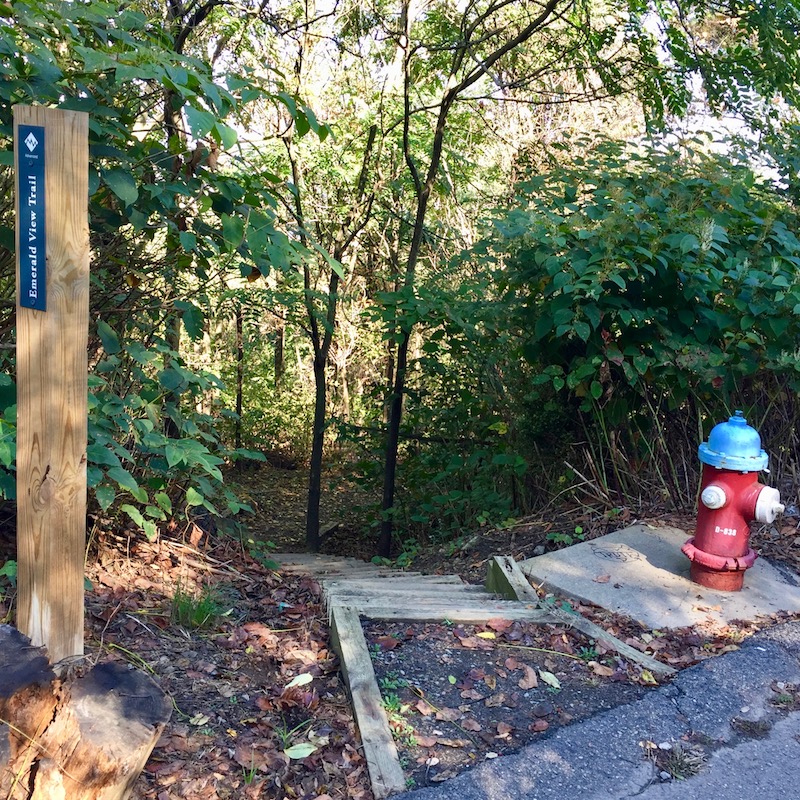
entrance to Emerald View Trail from William Street

The street even provides for the folks who don’t consider a walk on pavement to be a “real” hike. Climbers have the option to sneak off the asphalt and into the woods near the top of the hill. There, the terrific Emerald View Trail runs right across the street on its route from Bigbee Field/Grandview Park above to the woods around McArdle Roadway below.

These are Pittsburgh’s salad days. Crisp, jacket-weather mornings followed by lush, unrelenting blue sky afternoons full of turning leaves, pumpkin-spiced and decorative gourd fall fantasias, plus a seeming mass conviviality we never quite achieve the rest of the year. Get out there and enjoy it.

A Football Team That Wanted Him: Johnny Unitas and the Bloomfield Rams

Paul J. Sciullo II Memorial Field, Pittsburgh, PA

Paul J. Sciullo II Memorial Field (neé Dean’s Field), Bloomfield. Johnny Unitas’ Bloomfield Rams practiced here in the 1950s.

Editor’s note: Back in April, we wrote a piece for our cross-continental sister blog The Portland Orbit[1]. In exchange, Orbit poobah David Craig offered to file a story for us during football season. Here you go.

by David Craig

When I think about Johnny Unitas, I think Colts football, his battle against Namath, and the Super Bowl victory that cemented his reputation. The Colts’ overtime victory in the ‘58 league championship is known as “the greatest game ever played” and helped pro football gain its immense popularity. I didn’t know he was born in Pittsburgh and was surprised to find out that he initially broke into the league when he was drafted–and then cut–by the Steelers.

book cover for "Pro Football Heroes" by Steve Gelman

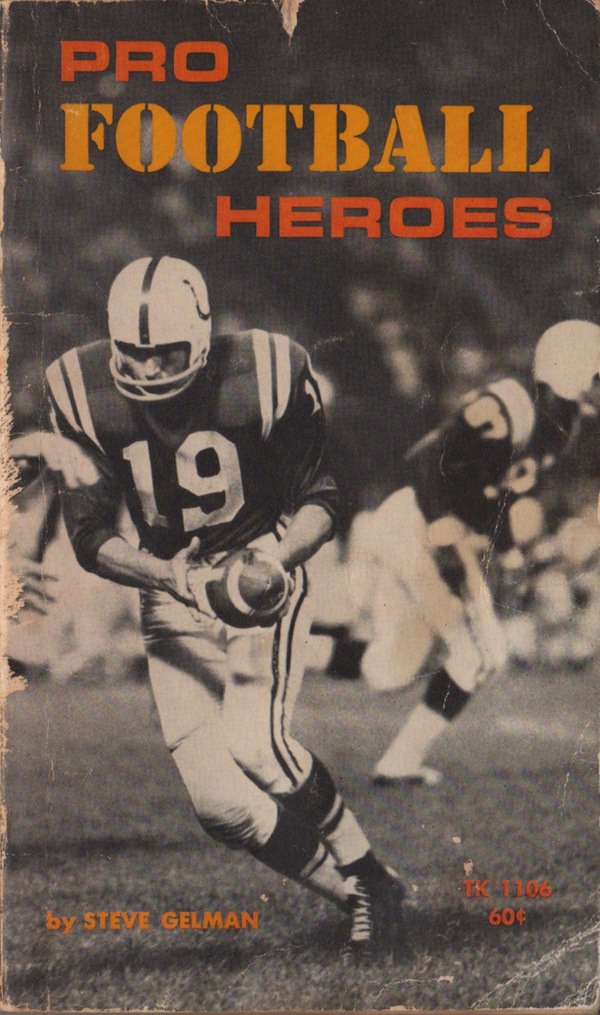
Cover star Johnny Unitas perfects the hand off. “Pro Football Heroes” by Steve Gelman.

It was a 99 cent purchase made at a Goodwill Store that led to another Unitas discovery. How I came to own the book Pro Football Heroes by Steve Gelman escapes me, but the book opens with a chapter on Unitas describing the detour on his road to football glory after the Steelers released him in 1955:

“Convinced now that he couldn’t get into pro football until the next year, Johnny took a job as a pile driver on a construction gang. Meanwhile, to stay in shape for his next pro football tryout, he began playing with a semi-pro team, the Bloomfield Rams.”

From my knowledge of Pittsburgh I recognized this as a city neighborhood. Reading more confirmed this:

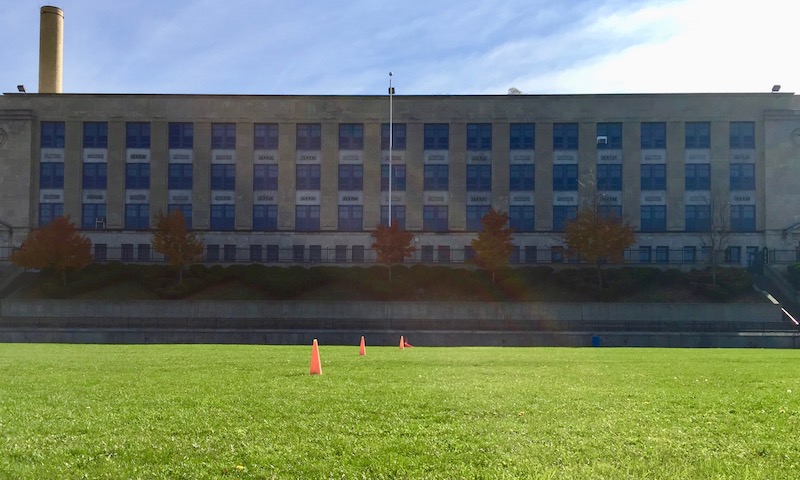
“The Rams played every Thursday night at the Arsenal Street School playground in the Bloomfield section of Pittsburgh.”[2]

Arsenal Middle School in Pittsburgh PA with a large green playing in front.

Arsenal Middle School, Lawrenceville. The Bloomfield Rams played their home games on this field. Now more grass than glass.

It intrigued me that Unitas began his storied career in Bloomfield before becoming “pro football’s last hero,” as Lou Sahadi called him in his book Johnny Unitas, America’s Quarterback. From an early age, Johnny lived for football. In Johnny U: The Life and Times of Johnny Unitas by Tom Callahan, Unitas’ mother talked about returning from the funeral home after his father died to find her then five-year old son throwing a football with friends. It seemed especially poignant that he sought comfort in the game after the loss of his father.

childhood home of Johnny Unitas, Pittsburgh, PA

Unitas family home, Mt. Washington

Unitas confided in a substitute teacher at school that he wanted to be a professional football player when he grew up. His sights were set on an athletic career but after failing the entrance exam to the University of Pittsburgh and being turned away from his hometown school, Unitas knew his professional chances would be nonexistent if he didn’t play in college. Another failed entrance exam found him starting his college career at the University of Louisville on academic probation. He did what he had to do to keep his dream alive.

Getting sacked by the Steelers was tough but he had been in a no-win situation. There were three other quarterbacks in camp that year, the most notable being Ted Marchibroda, who had better job prospects as a coach than a quarterback. Unitas was never able to show what he could do in preseason. Cut too late to join another team, he was forced to sit out a season and remained in Pittsburgh working construction to pay the bills.

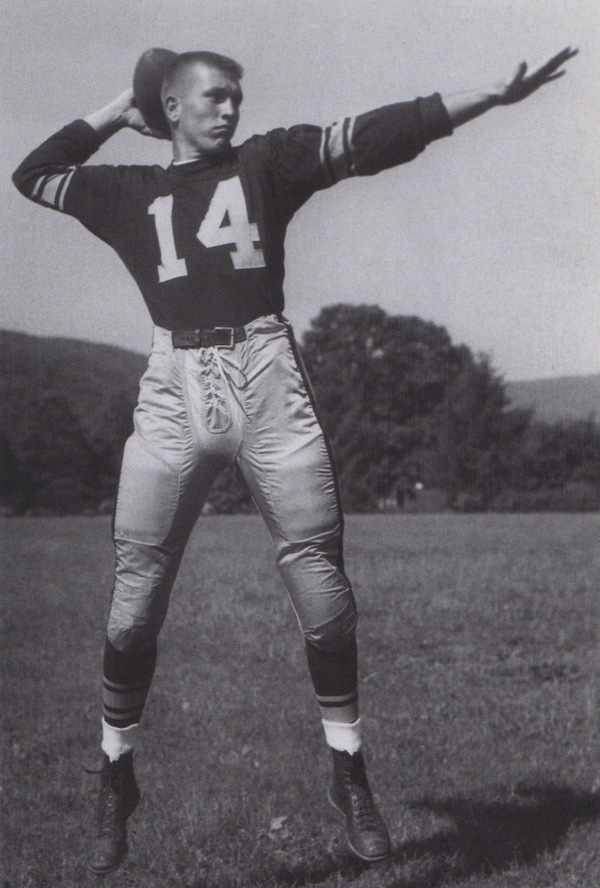
At Steeler training camp, Unitas conducted a lesson in the “Hail Mary.”

When his old friend Fred Zangaro asked Johnny to join him on the Bloomfield Rams, Unitas had concerns about getting hurt. The team needed a quarterback but he didn’t want anything to get in the way of playing professionally. Unitas conceded, and played what he described as “sand-lot ball.” Explaining in a 1959 Look magazine article, “it was football and I was able to keep in practice.”

In the books by Callahan and Sahadi, the authors emphasized subpar playing conditions. The field was more dirt, rock and glass than grass and had to be sprayed with oil and water to keep the dust down. The equipment was ratty. Unitas had to search through piles of old gear to suit up. Players wore army boots instead of cleats. Unitas faced derision for being a college boy, a Steeler’s draftee and someone who dared dream of playing in the NFL. In his ebook The Best There Ever Was, Roland Lazenby describes a team, like Def Leppard, playing without a full set of limbs:

“…a roster loaded with steel-mill workers, many of them disabled. The offensive line alone featured just seven arms.”

Unitas in a rare Bloomfield Rams photo when he played both offense and defense. Courtesy Chuck “Bear” Rogers.

Later in the Look article, Unitas described an improvisational game plan that sounded like plays were diagrammed in the dirt as the team huddled.  “You had to take punishment,” was his simple description of the challenge of receiving pass protection from 140 pound linemen. Unitas led the Rams on an eight game winning streak and a conference championship. He experienced the satisfaction of winning–something that hadn’t happened much in his college years. The Bloomfield Rams offered him a sense of championship football he brought to his NFL career.

The Rams played in the Steel Bowl Conference against teams like the Pittsburgh Cubs, Arnold A.C., and the Nanty-Glo Blackhawks, along with teams from Shaler and McKeesport. The financial aspects of the league were small by today’s standards[3]. Unitas was paid $6 a game–money he was happy to turn over to his wife for groceries. By the end of the season, his winning ways earned him a pay bump of $15 a game. Opposing teams liked playing the Rams at Arsenal Field because the games there attracted crowds of anywhere from a few hundred to 1,000 people, each paying a $3 admission which meant a $500 pay out. After expenses, Coach Chuck “Bear” Rogers had a budget of about $350 to pay Ram’s players. His policy of fining players $3 for missing practice meant some guys had to play for free.

Johnny Unitas at Steelers training camp in a uniform he never got to wear on the field.

Johnny Unitas at Steelers training camp in a uniform he never got to wear on the field.

In considering Unitas as the father of great Western Pennsylvania quarterbacks, I wondered if the others had idolized him. An obiturary/tribute to Unitas written by Chuck Finder for the Pittsburgh Post-Gazette revealed the always quotable (Beaver Falls native) Joe Namath had considered Unitas “my football inspiration, my hero.” I imagine that the other western Pennsylvania quarterbacks knew enough about Unitas to think that if he could make it, they also had a shot. Lou Sahadi made a case for the western Pennsylvania quarterbacks describing the mentality that fueled them:

“John was first of those lunch-bucket quarterbacks to come out of western Pennsylvania. Later on came Joe Montana, Jim Kelly, Joe Namath and Dan Marino. They were all the same. Guys who didn’t have anything. Guys who knew it was back to the steel mills or coal mines if they didn’t get the job done.”

historical plaque honoring Johnny Unitas that reads "(1933-2002) Pittsburgh native & Pro Football Hall of Fame inductee, 1979. Here Unitas quarterbacked semi-pro Bloomfield Rams to a Steel Bowl Football Conference championship, 1955. Signed with Baltimore Colts, 1956, leading them to an NFL championship, 1958.

historical plaque in front of Arsenal Middle School, Lawrenceville

At this point this post should have the feel of a very late night AM radio sports talk broadcast. Imagine bursts of static and a distant echoing theremin whine as I sermonize about the early playing days of the great Johnny Unitas. I focused so much on his brief time in Bloomfield that I never got around to exploring the rest of his playing career. My sense is, if only on a subconscious level, his brief foray in semi-pro football offered a foundation that made him the player he became. No matter the pressure, weather, or game situations he faced, he could always draw on the challenges of his primitive Bloomfield days.

The experience must have given him an appreciation for quality teammates, decent equipment and reasonable practice facilities but it’s important to remember the Bloomfield Rams were there when Unitas needed them. He expressed this in Lou Sahadi’s book explaining that what had mattered most about playing for the Rams had been the feeling that there was a football team that wanted him.

I’ll leave it up to the Pittsburgh Orbit‘s head honcho Will Simmons to track down the Bloomfield Rams old 1955 Steel Bowl Conference trophy. I’m imagining his relentless pursuit in knocking on doors as he looks up players from the ’55 Ram’s roster, guys like Jim Deglau, Jacko Cray, Red Celender, Fred Zangaro, or even Coach Chuck “Bear” Rogers, if he’s still around, to get the full story of what it was like to play football with Johnny Unitas in Pittsburgh. That will have to wait until next season.


[1] “The Louie Files: The Greatest Moment in Rock-and-Roll,” Portland Orbit, April 6, 2017.
[2] Of course, this was actually down the hill in Lawrenceville at what is today Arsenal Middle School on Butler Street. There’s a historical plaque there to prove it.
[3] Editor’s note: This pay rate may actually not be that different from present-day. If any members of the [currently-active semi-pro teams] Passion, Rangers, Colts, or Wildcatz would like to comment, we’d love to hear from you.

Bibliography:

Tom Callahan, Johnny U The Life & Times of John Unitas, Crown Publishers
Lou Sahadi, Johnny Unitas, America’s Quarterback, Triumph Books
Roland Lazenby, Johnny Unitas: The Best There Ever Was, Triumph ebooks
Steve Gelman, Pro Football Heroes, Scholastic Book Services