Vex Ed: A Contest for a New Pittsburgh City Flag!

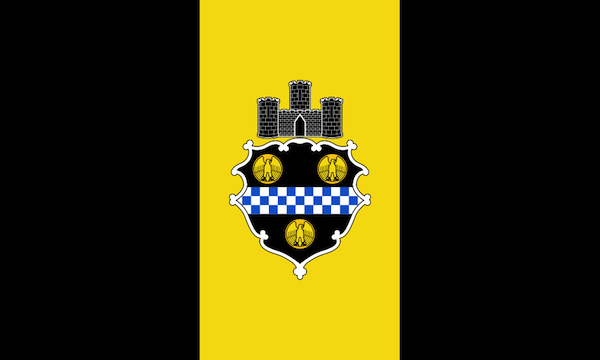
flag of the City of Pittsburgh

(Current) flag of the City of Pittsburgh. Can we do better?

The flag–any flag–should be a glorious, triumphant emblem that trumpets the twin messages this is who we are and you’re here now. It’s raised high above government buildings and hangs formally inside legal chambers. And–if you get it right–the public takes the flag into their own hands.

With a good flag, loyalists adopt its design as their own–flying it freely from front porches and attaching plastic decals of it to windows and bumpers; they paint it on garage doors and wear it in the form of track suits. Kindergarten teachers will instruct young patriots in the art of creating facsimiles from finger paint and popsicle sticks.

American flag made from recycled wood, Apollo, PA

No one makes these for the city flag. Homemade 28-star American flag, Apollo

When we talk about the flag of the City of Pittsburgh, we’re clearly not at this level of either fandom or familiarity. Do you know anyone not named “the mayor” who owns a Pittsburgh city flag? Do you ever see it flown in your neighbors’ yards or waved at public events the way people hoist the rainbow flag, Steelers banner, or the Jolly Roger? If we hadn’t included the image Pittsburgh’s flag [above] would you even be able to describe what it looks like?

My guess is you’ll answer no to each of these questions–and that’s a shame. Pittsburghers love their city and we should have a city flag we’re equally proud of.

flag pole with miniature flags of Italy, USA, and Pittsburgh

Hey: somebody’s flying it! Flags of Italy, USA, and Pittsburgh, Panther Hollow

So what’s wrong with the flag we have? Let’s start with the colors. In Pittsburgh, we accept high-contrast black and gold as natural bedfellows–like french fries and ketchup, or french fries and sandwich meat, or french fries and salad greens. The extra addition, however, of the blue and white detail in the central checkerboard crest is what really sends this palette from reckless driving into fatal collision. Nowhere should these four colors intersect–not even in Cleveland.

While the background black/gold/black vertical sections are a nice, simple, bold presence, they’re directly at odds with the completely useless design-by-committee noise in the middle of the flag. Here, a cartoonish tri-turreted castle–looking like the packaging for a child’s play set–awkwardly either floats above or balances tenuously atop the curlicue formality of the city crest.
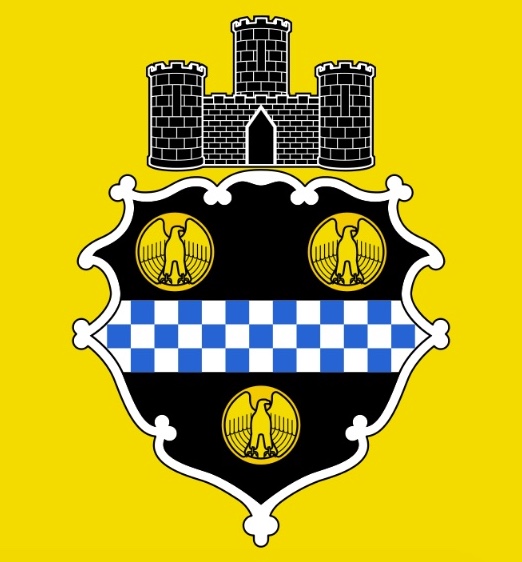
detail of the center design in Pittsburgh's city flag including three-tower castle and crest with eagles and blue-and-white checkerboard

Detail: “A triple-towered castle masoned Argent” and “a fess chequay Argent et Azure, between three bezants bearing eagles rising with wings displayed and inverted”

Putting aside questions about why the City of Pittsburgh is represented by a medieval European-style fortress, its pairing with an embellished coat-of-arms inherited from William Pitt is particularly dissonant. [These are referred to as “a triple-towered castle masoned Argent” and “a fess chequay Argent et Azure, between three bezants bearing eagles rising with wings displayed and inverted,” respectively.]

This combination creates chalk and cheese design elements that not only have nothing to do with each other and are scaled in odd proportion, but look like they were rendered by entirely different hands. Mercifully, there isn’t any text to not be able to read in the crest, but from any distance I dare you to find anyone who can make out those “eagle-fronted bezants” flapping in the breeze.

Less is more. Same flag, less crap.

Less is more. The same flag, without the crap.

Pittsburgh Orbit will never advertise itself as a design shop, but even without the background and very limited fake-Photoshop skills, the simple removal of the junk in this flag’s trunk–that being the ridiculous castle and crest–seems like an enormous win. We’d fly that thing off the H.M.S. Orbit with pride. Further streamlined down to the bare minimum square of one each black and gold halves may be even better.

flag of the City of Pittsburgh with center details removed and reduced to two vertical black/gold sections

Even less is even more…maybe. Two-tone black/gold square.

Something clearly needs to be done around here. There were grandiose plans: a design contest! with celebrity judges! a big-reveal gala event! we could even pitch it to the city! Meetings were taken with, you know, a media partner and real designers. But…ah, hell–that’s a lot of work and you try finding a local expert in vexillology. Heck, just try pronouncing it!

All that said, the simple goal remains to come up with a banner that Pittsburghers will recognize, identify with, and fly proudly from their eves and stitch to the seats of their pants.

SO, here’s where you, dear reader and creative acquaintances of dear reader, come in. We’d love to see your submissions for a redesigned flag for the City of Pittsburgh. This blogger has no idea whether The Orbit‘s audience would support such an effort, but we’re crossing fingers and, like Casey Kasem, keeping our feet on the ground, and reaching for the stars.


Note: This contest has ended, so we’ve removed the submission details. You can see the results at our follow-up story Vex Ed: Designs for a new Pittsburgh flag (Oct. 8, 2017).
proposed flag with gold planet on black field with text "ORBIT"

Hey, it’s an option!


Background/further study:

This Way Out: Arrow Collecting

yellow arrow painted on weathered plywood, Pittsburgh, PA

Esplen

A designer knows he has achieved perfection not when there is nothing left to add, but when there is nothing left to take away.*

Antoine de Saint-Exupery

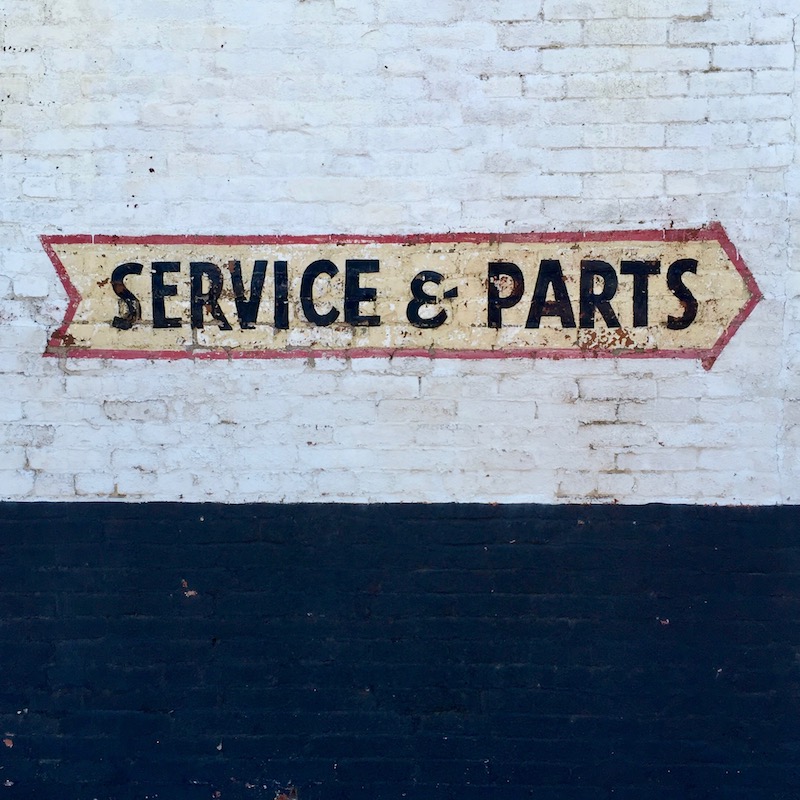
"Service & Parts" sign painted in shape of an arrow on brick wall, Pittsburgh, PA

Service & Parts, Manchester

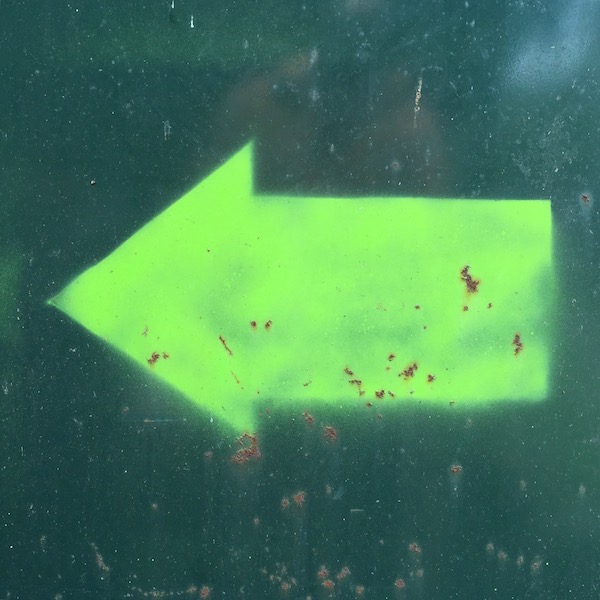
day-glo green arrow painted on dumpster, Pittsburgh, PA

dumpster arrow, Shadyside

Oh, how much simpler life would be if we all just had a little more clear direction. Go that way. Do this thing. It’ll all be O.K.

The arrow is likely the boldest, simplest, and most direct (in a couple different definitions of the word) of visual statements; it is this magic voice from above. Where to go, what choices exist, how to find our way in the world. Without the arrow, we’d all be lost…literally.

tile building facade with number 223 and arrow directing around the back, Homestead, PA

Have you seen the back? 223, Homestead

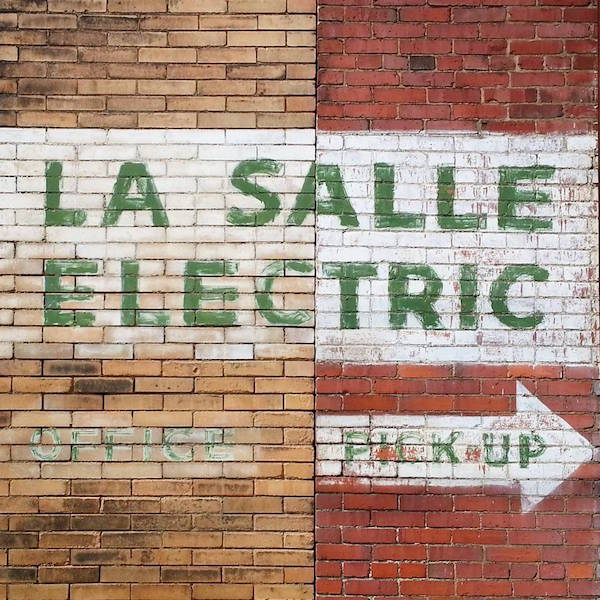
ghost sign for former La Salle Electric, Pittsburgh, PA

Office this way / Pick-up that way. Former La Salle Electric building (now demolished), Manchester

Constructed with your choice of just three simple lines or as the beefier triangle + rectangle, the form is geometry at its most basic, graphic design boiled down to the last essential elements, universal in both meaning and comprehension. Go that way.

It’s also visually arresting. For such a simple shape, the arrow represents both incredible movement and a certain level of violence. It’s based on–and named after–the form of a projectile weapon, after all. Conflict is inevitable when the point of the spear impacts its target. The inherent tension in this implied collision charges every depiction of the mighty arrow.

detail of arrow painted on the wing of an airplane

airplane arrow, Boeing 737

arrow painted on white brick wall, Pittsburgh, PA

East Liberty

In a news week dominated by talk around the president’s embrace of Nazis, the alt-right, and his no-teleprompter invention of an “alt-left”, we thought it’d be as good a time as any to seek a little clear direction. [For the record, The Orbit has always considered itself alt-down-and-out.]

Here then, are some fine area examples of that most noble of graphic forms: the arrow. May you all get where you’re going.

white arrow painted on brown brick and cinderblock wall, McKeesport, PA

Down and out in McKeesport

sign for brewery entrance with directional arrow painted on bridge support, Pittsburgh, PA

Brewery Entrance, Lawrenceville

red brick house shaped like an arrow, Pittsburgh, PA

arrow house, West End

ghost sign for former Penn Bowling Lanes, Pittsburgh, PA

Penn Bowling Lanes, Downtown

red arrow painted on exterior column, Pittsburgh, PA

Manchester

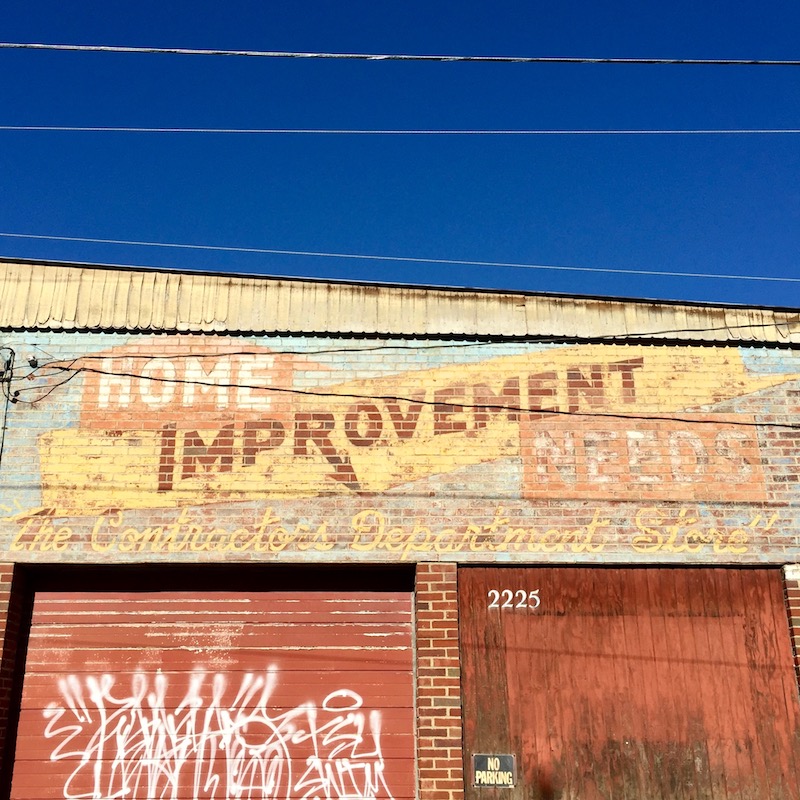
ghost sign on former hardware store, Pittsburgh, PA

multiple arrow ghost sign: Home Improvement Needs, “The Contractor’s Department Store”, Hill District

detail of store entrance with arrow shape, Etna, PA

store entrance arrow, Etna

former school bus in field of wildflowers painted to advertise F&V Fireworks, Enon Valley, PA

F&V Fireworks, Enon Valley, PA


* Yes, someone needs to enlighten Mr. de Saint-Exupery that it may be she who is making the design decisions.

Highway to Hell: The House of Hades “Toynbee” Tiles, Part 2

House of Hades "Toynbee Tile" imprinted on city street, Pittsburgh, PA

House of Hades “Toynbee Tile” #4 (detail), Blvd. of the Allies, downtown

A cautionary tale: Whenever one thinks she or he has reached the end of the metaphorical line and is dangling by the very last fibers above the abyss, know that if you’re successfully converting oxygen to carbon dioxide, you’ve still got a fighting chance. Heck, maybe one day we’ll finally get the high-quality hemp rope N.O.R.M.L. promised us back in the ’90s.

Just a few months back, we bagged what we thought were the very last “Toynbee tiles” in Pittsburgh. Those two little street artworks, both found on Blvd. of the Allies downtown, are actually courtesy of the equally-mysterious House of Hades, which is believed to be either copycat or super-fan, depending on one’s viewpoint. [Our handful of “real” Toynbee tiles are, sadly, long gone.]

linoleum art of city scene at night, imprinted on city street, Pittsburgh, PA

city at night tile (detail), Blvd. of the Allies, downtown

And so, as we said in that post, that was all she seemed to write…err, carve into linoleum and press into the street.

But (yes: there’s always a big but) how wrong a blogger can be! Within mere blocks of those two specimens, we encountered yet another pair of wayward street tiles–apparently from the very same hands. The first of these is on Smithfield Street, right before the bridge; the other just around the corner and up a block on the Boulevard (at Cherry Way).

The former (we’re calling it House of Hades tile #3) includes the exact same message as tile #1 from the previous post: House of Hades / One man versus American media in society ‘2012. This one also has the added ominous zinger To punish them all.

House of Hades "Toynbee Tile" imprinted on city street, Pittsburgh, PA

House of Hades tile #3, Smithfield Street at First Ave.

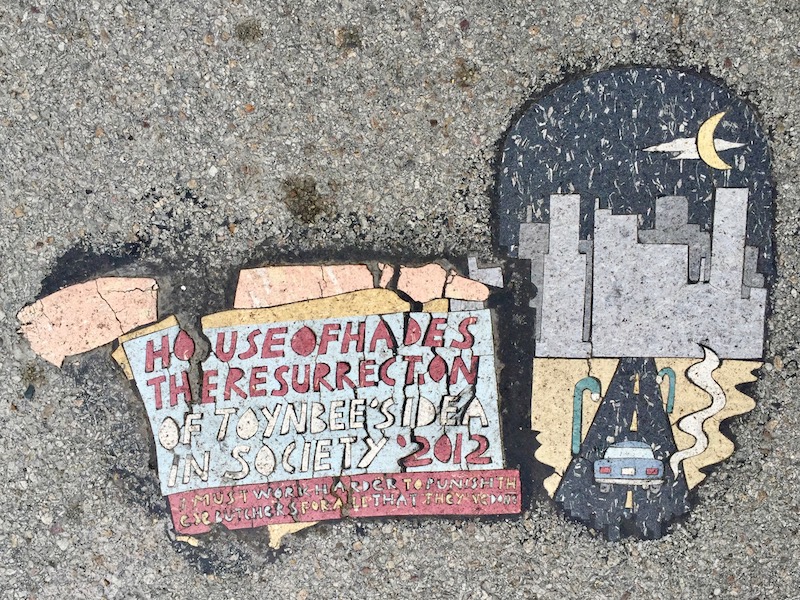
Tile #4 is a little more difficult to parse. The Toynbee half of it contains what we’ve come to recognize as a naked lady’s shapely gam across the top (there was probably a right leg to go with this left, but it’s gone now), plus some of the familiar big headline text: House of Hades / The resurrection of Toynbee’s idea in society ‘2012. It also contains an extra stanza in relative fine print with the disturbing message I must work harder to punish these butchers for all that they’ve done.

The most unusual thing about #4, though, has to be that it’s also immediately abutting/overlapping yet another linoleum street tile of an entirely different mood and design. This one, vertical in composition with rounded corners, features a night scene in one-point perspective of a car driving toward a stylized big city skyline [notably not Pittsburgh]. A crescent moon hangs overhead against the star-speckled black sky.

It’s probably safe to say this nightscape is not the work of either the Toynbee or House of Hades folks. Aside from the medium itself, it just has none of the tell-tale style elements or apocalyptic messaging. That said, it sure is curious that the two ended up where they did. With all the available, naked pavement out there, how do two road tiles lie nearly right on top of each other? Can’t we all get along!

House of Hades "Toynbee Tile" imprinted on city street, Pittsburgh, PA

The full scene. House of Hades tile #4/nighttime city scene, Blvd. of the Allies at Cherry Way

Are these really the last of the Toynbee (inspired) tiles in Pittsburgh? We sure hope that isn’t the case and we’ll not make the mistake of trying to declare such a truth again. Fool me twice, as they say.

Plus, like that desperate hero watching the fraying strands of her lifeline unspool from its anchor above, we like to think there’s a little more life left in these streets and–with it now legal in 30 states–hemp is on the way. We haven’t given up just yet.


See also: Highway to Hell: The House of Hades “Toynbee” Tiles: (Pittsburgh Orbit, April 9, 2017)

Going Postal: Rogues Gallery

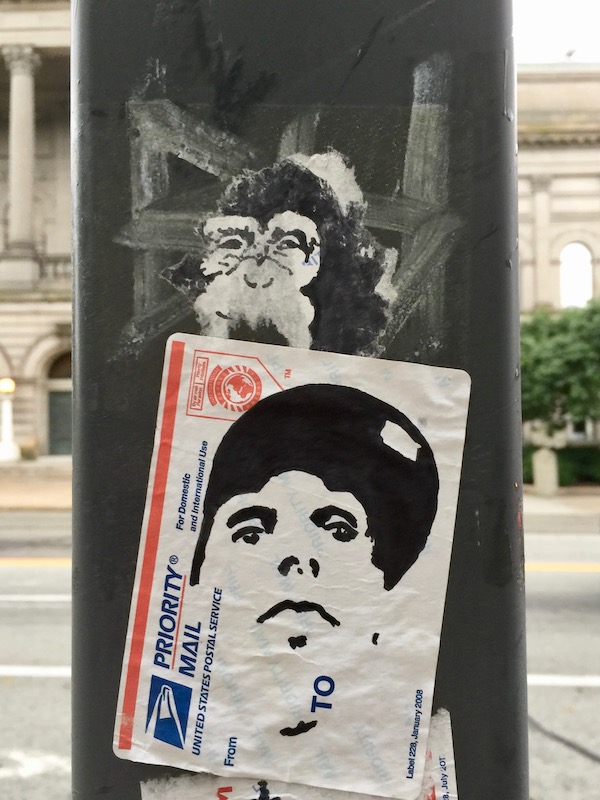
portraits of naked women holding their breasts drawn on US postal service mail labels and stuck to steel light pole, Pittsburgh, PA

Mail-order brides, Bloomfield

Tiny one-of-a-kind artworks decorate a bus shelter, steel light poles, a cross-walk signal, and the back sides of street signs. Pictured on them are the faces of fading-from-memory pop culture figures, a couple buxom babes, and a kind of high school outsider iconography we hope is never lost. More than any other subject, though, are the bad guys.

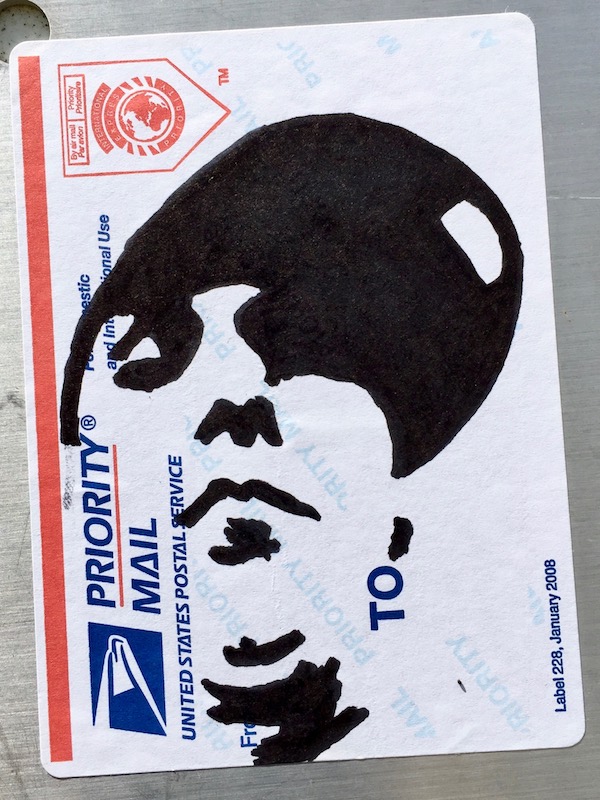
The little ink portraits, drawn in heavy black felt tip on repurposed U.S. Postal Service “228” sticky-back shipping labels, are never signed. That said, the common medium, subjects, style, and presentation locale, lead us to believe they’re all the work of a single actor. The fact that new pieces just stopped all at once earlier this year suggests the artist has moved-on–either to other media or, more likely, literally out of the greater Bloomfield-Oakland area where all these examples were spotted.

"mug shot" portrait of man holding arrest sign drawn on US postal service mail label and stuck to glass bus shelter, Pittsburgh, PA

Mug shot, Bloomfield

portraits of criminals drawn on US postal service mail label and stuck to glass bus shelter, Pittsburgh, PA

Rogues gallery, Bloomfield

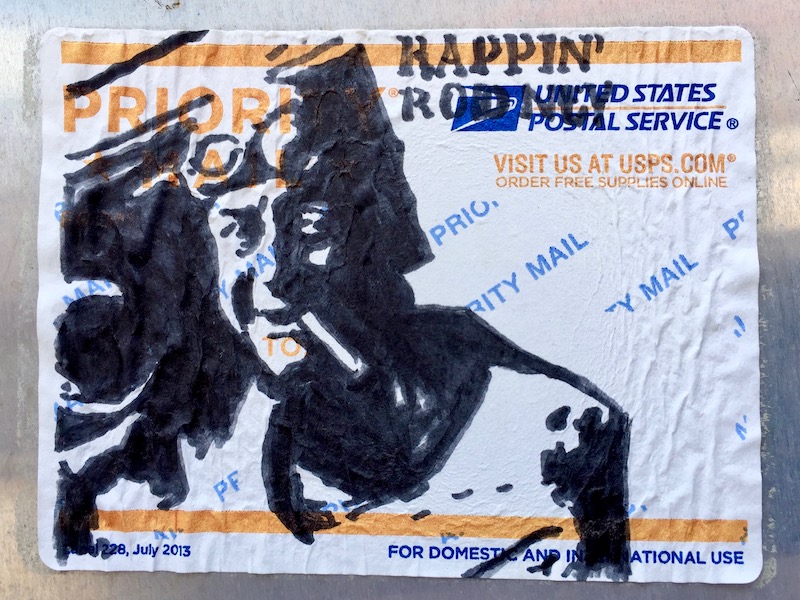
We don’t know who did these, but we’ve watched enough Luther and The Fall to consider ourselves well-prepped for psychological profiling. The subject matter here–kitschy demi-celebrities Gary Coleman, Rodney Dangerfield, and Moe from the Three Stooges, the skull-and-headphones of a Hot Topic silk screen, and criminal anti-heroes like Al Capone and David “Son of Sam” Berkowitz–just feels a little too on-the-nose to deny. We’re definitely making an assumption, but this is the work of young man.

postal label with ink artwork of skull wearing headphones, Pittsburgh, PA

Skull & headphones, Oakland

portrait of person with head in hands drawn on US postal service mail label and stuck to glass bus shelter, Pittsburgh, PA

Head in hands, Bloomfield

The other thing we’ve got on this theory is “Cap Man“. Our story on the string of (apparent) self-portraits committed in awfully-similar medium and style ran earlier this year. In that, we saw the same “postal slaps”–also penned in black Sharpie, stuck to street signs in the vicinity of Craig & Forbes–very close to all of the Oakland specimens here. The Cap Man drawings, however, are not based on previously-published photos, but rather appear to be self-portraits of a young, white, ballcap-wearing male.

US postal service priority mail sticker with black ink portrait of Rodney Dangerfield, Pittsburgh, PA

Rappin’ Rodney Dangerfield, Oakland

US postal service priority mail sticker with black ink portrait of Gary Coleman, Pittsburgh, PA

Whatchutalkinbout, Orbit? Gary Coleman, Oakland

What became of Cap Man? In the earlier piece, we theorized that he’s a bus rider, taking the 54C from Bloomfield to Oakland–perhaps even drawing his portraits right there in the back seats, his telephone and Google Images as visual reference, one-a-day on the short 10-minute ride.

If so, his destination was likely central Oakland and Studentland, U.S.A. If so, he’s got umpteen different explanations for taking his big markers home for the summer and allowing the post office to restock its supply of blank shipping labels. Maybe–just maybe–Cap Man will return for another season of infrastructure decoration in the fall.

drawing of Moe from the Three Stooges on US Postal Service address label stuck to bus stop sign, Pittsburgh, PA

Moe, Bloomfield

faded US postal service priority mail sticker with black ink portrait of Moe from the "Three Stooges", Pittsburgh, PA

Faded Moe, Oakland

mail label graffiti, Pittsburgh, PA

likely copycat, Oakland

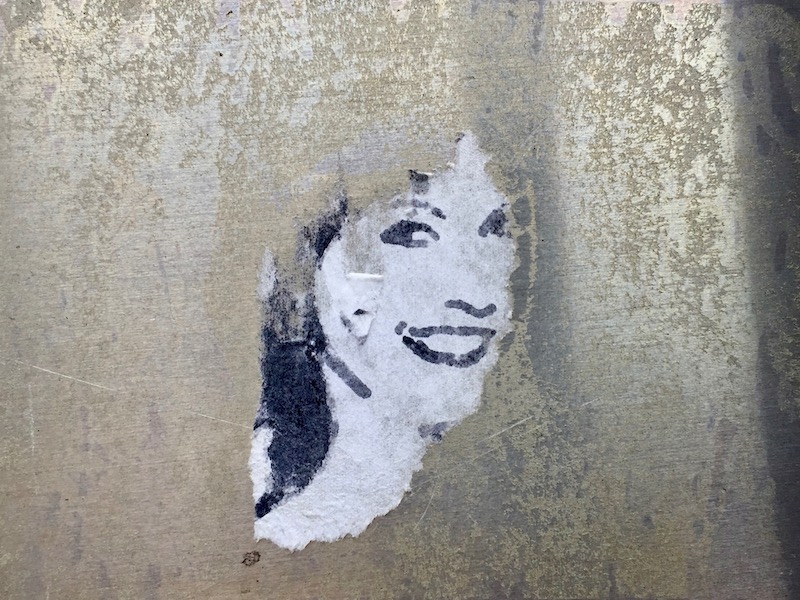
US postal service priority mail sticker with black ink portrait of smiling woman, Pittsburgh, PA

Ghosting postal: woman (partial), Oakland


The Serpentine Similar: Prop Rocks and Flood Stones

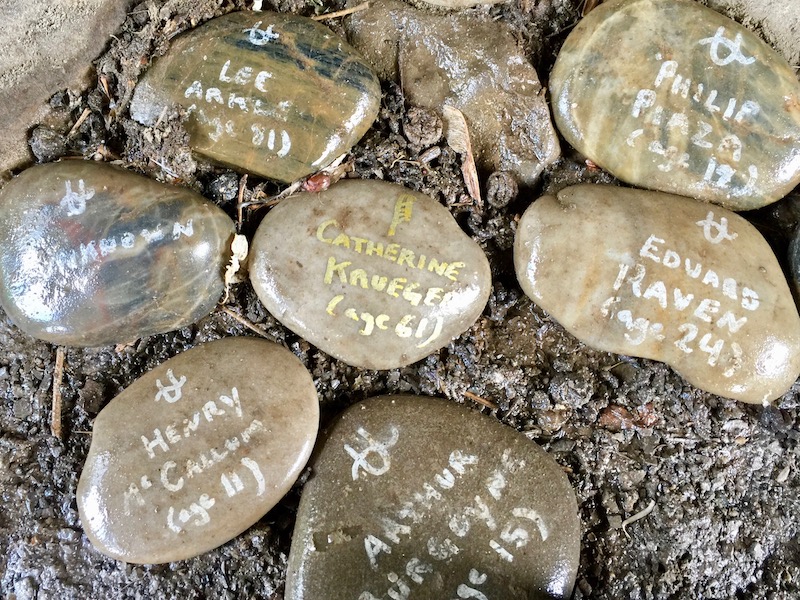
river stones labeled with peoples names and ages, Pittsburgh, PA

This is one obscure rock group. The Serpentine stones.

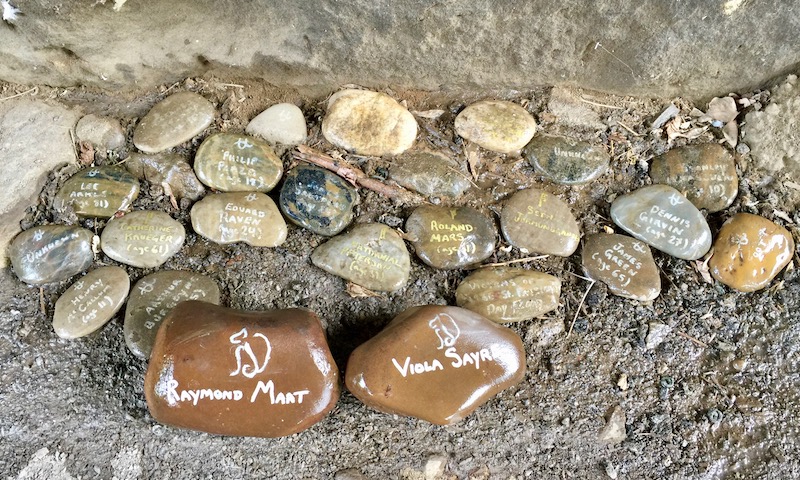
A most unique thing to find in the dirt. Twenty-some river stones, each inscribed with a person’s name, age, and mystery glyph. The collection is carefully laid out so all the written-on surfaces are upright, readable, and may be consumed from a single vantage point. Like the work of a patio builder, the flat stones have been arranged to interconnect gracefully with a minimum of negative space, but also just barely touching so as to avoid any awkward overlap.

Someone wanted these totems to be found, to be read, to be thought-about. But they didn’t want to make them too obvious either. Far enough off the bicycle trail, camouflaged against the stone foundation of a bridge support, darkened in the underpass, and dusted with months (years?) worth of grime, we only stumbled across them because there happened to be a new piece of intriguing stencil graffiti just above on the adjacent wall.

river stone painted with white text reading "Raymond Maat", Pittsburgh, PA

Rock star Raymond Maat

From any distance, the only legible names are the big ones out front: Raymond Maat and Viola Sayre. Written in white paint pen, each of names appears on its own, larger, burrito-sized brown stone. Even from several paces, the ink/background contrast was enough to catch this blogger’s ever-roving eye.

The Orbitmobile (Orbicycle?) never goes far without a couple bottles of water and it’s lucky we had them on this day. It would take gently emptying both containers to rinse off the thick layer of blown dirt and dropped bridge debris to get the stones to a point where they were reasonable to read (and photograph). Even so, we still could have used another bottle.

collection of river stones with barely-legible text written on them, Pittsburgh, PA

The collection as it was discovered (pre-rinsed)

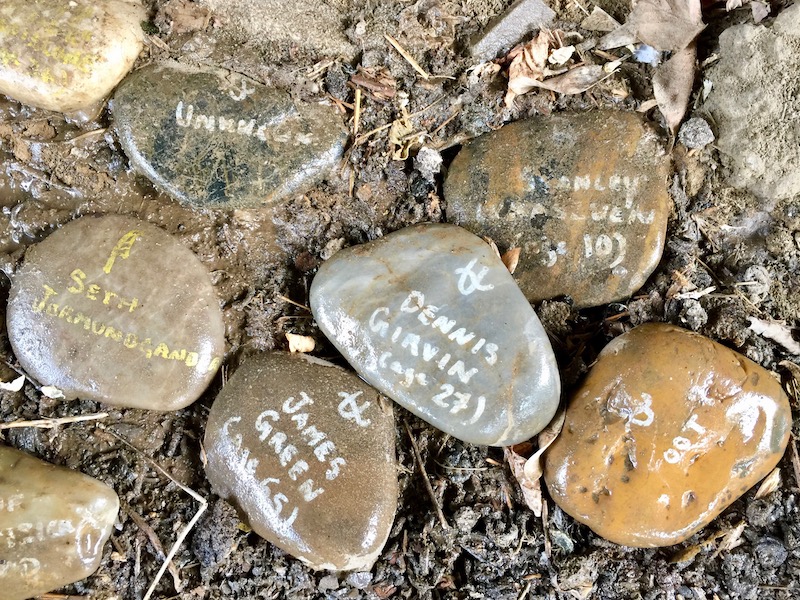
It was only getting up close that would reveal the many other details. Henry McCallum (age 11)Catherine Krueger (age 61)Eduard Raven (age 24)Dennis Girvin (age 27), and a dozen or so more like them, each with one of a couple different symbols. Some have what appears to be feather; others an invented rune, shaped like a capital letter U with an extra wavy line bisecting the verticals. Two of the stones simply read unknown.

river stones labeled with peoples names and ages, Pittsburgh, PA

Henry McCallum (age 11), Catherine Krueger (age 61), Philip Piaza (age 19), Eduard Raven (age 24)

And then, there it is! Placed right in the center of the pack, its painted-on text further worn away than the rest of its buddies. A single stone has what appears to be an explanation for this obscure rock group: Victims of the 1936 St. Patrick’s Day Flood.

With that, it seemed so obvious. Stones–likely pulled from the river just feet away and smoothed by its waters–placed just at the riverbank like a sacrificial altar. This spot is well within the flood plain if (and when) the big one ever strikes Pittsburgh again. What a delightful, hidden, reverent memorial to one of worst natural disasters to ever befall the region.

river stone painted with white text reading "Victims of 1936 St. Patrick's Day Flood", Pittsburgh, PA

Victims of 1936 St. Patrick’s Day Flood

… or is it?

We don’t know what bloggers did before the computer Internet came along, but luckily The Orbit is well-acquainted with The Google Machine and we worked our index fingers to the bone hunt-and-pecking around for info.

It turns out “Raymond Maat”, “Viola Sayre”, and “Seth Jormundgander” (at least) were all characters created for an alternate reality game/immersive theater production called Serpentine put on by Uncumber Theatrics in 2016. It is entirely unclear from Uncumber’s web site what actually happened in the game or how these painted stones may have figured into it–but that’s likely on purpose. I guess you had to be there, man…and we weren’t. [Yes: we have added this one to our lengthy list of life regrets. Readers: if you played/participated in Serpentine we’d love to hear about the experience in the comments.]

river stones labeled with peoples names and ages, Pittsburgh, PA

Seth Jormundgander, James Green (age 65), Dennis Girvin (age 27)

Regardless of whether we got had or had the hadders, we love the fact that Uncumber made the unlikely choice to just leave this elaborate handmade prop right out in the open–hidden in plain sight, as it were. Those of us who might happen across it, scratch our heads, and take the time to think about the plight of poor Roland Mars (age 31) and Nathanial Peterson (age 39) can still get a little contact high off Serpentine‘s medical-grade Maui wowee. Does it matter if real people’s names were used for theatrical sport? What if they were simply invented entirely as color elements to move along the game’s narrative?*

We don’t have the answers to the questions. In the spirit, however, The Orbit has made the decision not to tell our readers any specifics on where to find the Serpentine stones. There are plenty of clues here (and elsewhere) if you want to go looking for them yourself. Or, just go out–anywhere–poke around, and keep the peepers open. Something will come into view soon enough.

river stones painted with white text reading "Nathanial Peterson (age 39)" and "Roland Mars (age 31)", Pittsburgh, PA

Nathanial Peterson (age 39), Roland Mars (age 31)

UPDATE (24 July): Like this blogger’s waistline, the plot has officially thickened. Astute reader–or perhaps, inside operative–“Fourth River Fortean” pointed us to a 1981 Pittsburgh Press article that details the death of one Dennis Girvin (age 27) who “drowned while partying and swimming” in the Allegheny River.


* We were unable to locate an actual list of the victims of the St. Patrick’s Day Flood to compare these names against, nor did Googling the names from the stones reveal any connection to the flood of 1936.

Pain’t That America: The Front Yard Patriotism of Gary Thunberg

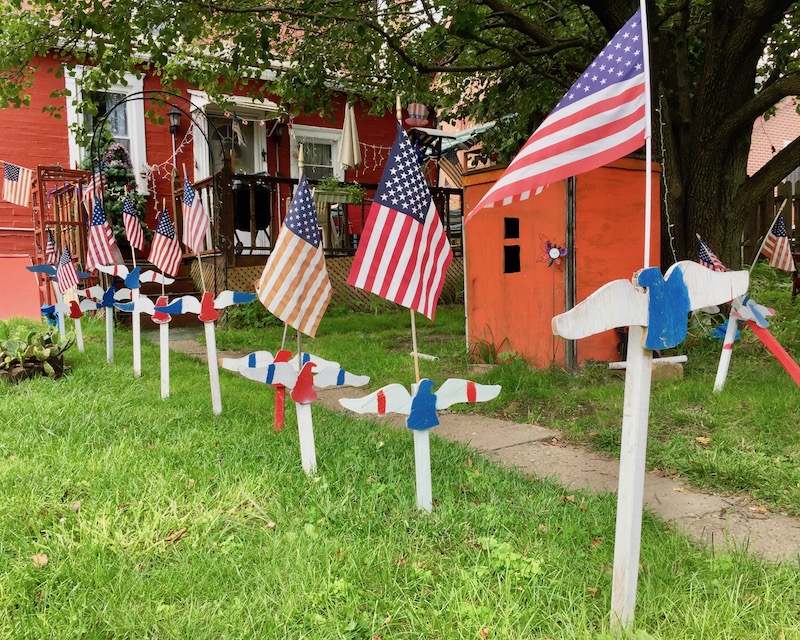
brick house with many handmade wood cut Independence Day lawn decorations, Beaver, PA

Little America: Thunberg house, 3rd Street, Beaver, PA

It’s a cliché, sure, but you can’t miss it.

No, the sweet, pre-war two-story brick home would look a lot like many others found in Pittsburgh’s down-river boroughs but for the wealth–some might say overload–of red, white, and blue homemade patriotic holiday displays that fill every inch of its front, side, and rear yard space. Together, they lift this house from small town charmer to an explosion of full-on Yankee Doodle Dandydom.

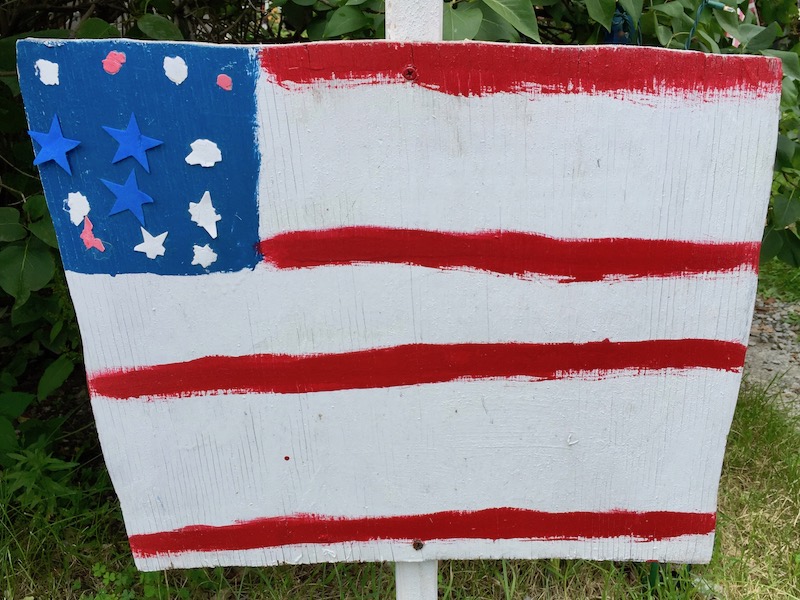
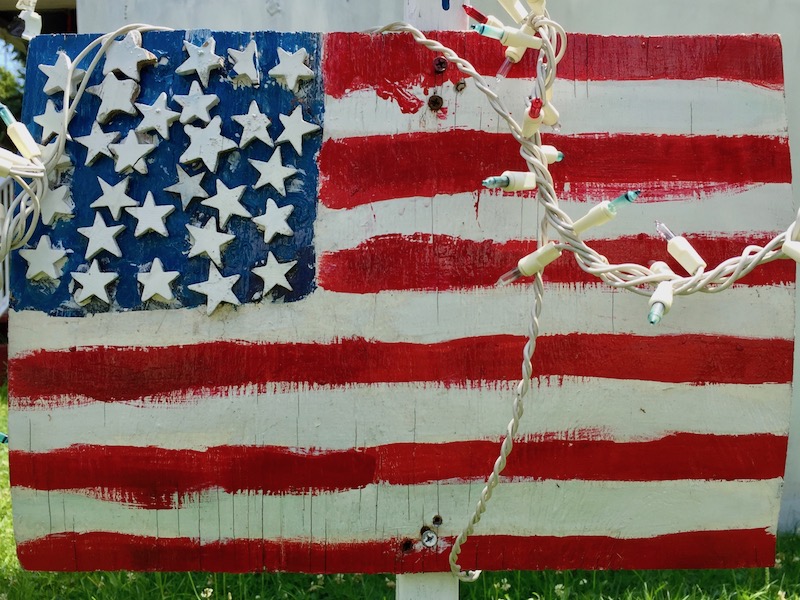
handmade wood cut American flag lawn decorations, Beaver, PA

American flag

Beaver, PA. A picture-perfect embodiment of quaint. The town’s wide streets, stately manors, well-groomed lawns, and fancy boutiques look more country posh than the (ex-)industry brownfields and empty storefronts of almost all its Ohio Valley neighbors[1]. But it’s a pleasant, accessible, middle-class midwestern posh, rather than its harder-to-take New England old money cousin.

There was long bit about taking a bike from Monaca to Rochester and then here to Beaver, but our editor told us to cut the crap. Suffice to say, there are a bunch of interesting things in town and River Road is both aptly-named and bicycle-perfect. If you take it almost all the way around and then back to the main drag, your ride-around will conclude up on 3rd Street with the great homemade holiday decorations of Gary Thunberg.

Gary Thumberg with his handmade wood cut Independence Day lawn decorations, Beaver, PA

Gary Thunberg by his alley cannon and flags

Some of the displays may be what you’re expecting. There are dozens of eagles, their wings spread in majestic mid-flight glory and bodies brightly marked like sports jerseys. A couple of them have been framed in lumpy ovals to appear as if in an official seal. Uncle Sam is here–the red, white, and blue literally oozing out of him–as are many, many American flags in different sizes and variants.

handmade wood cut Independence Day lawn decorations including flags, eagles, and star flowers, Beaver, PA

side of Thunberg’s house with flags, eagles, and star flowers

In The Orbit‘s annual Independence Day post, we mused about why it’s so difficult for homemade flag-painters to get the 50-star count right. On this matter, we need to eat some Corvus brachyrhynchos (that’s all-American crow).

With so many homemade flags created by the same two hands, it’s exciting to see the umpteen different expressions that Gary Thunberg has come up with. For sure: flags that are near the exact design you’ll see flying above the courthouse are featured in the yard. But so are seven-striped models of minimalism, gestural two-star tree-hangers, and reverse-color mind-benders.

handmade wood cut American flag lawn decorations, Beaver, PA

American flag

handmade wood cut American flag lawn decorations, Beaver, PA

American flag

In addition to these familiar forms, the lawn display also includes some other interesting takes on America’s favorite color scheme.

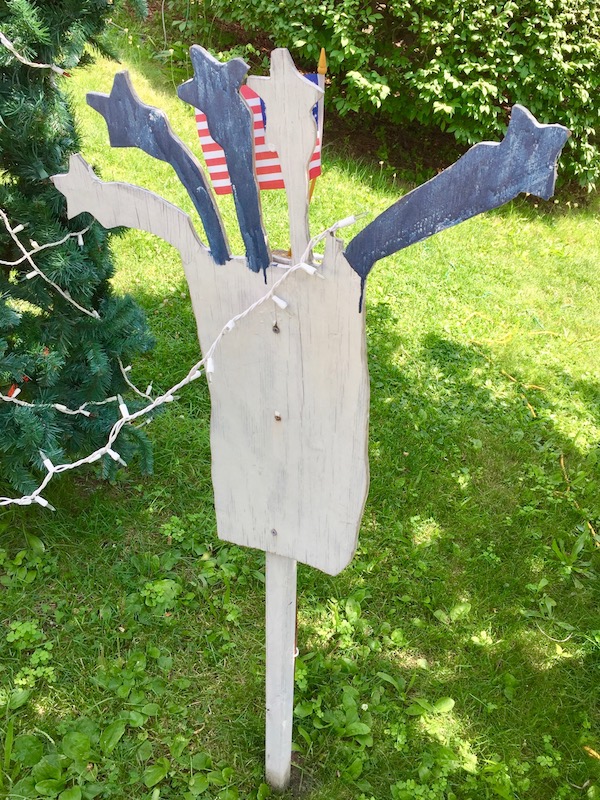
Thunberg attacks the most effervescent of holiday imagery in his captured-in-time fireworks explosions. These wooden cut-outs–complete with smoke trails and star blasts–are repeated several times with different paint jobs. The image is perhaps Thunberg’s most impressionistic form–a daring move to represent so much motion and light, sound and fury in two dimensions, staked in grass.

handmade wood cut fireworks lawn decorations, Beaver, PA

fireworks

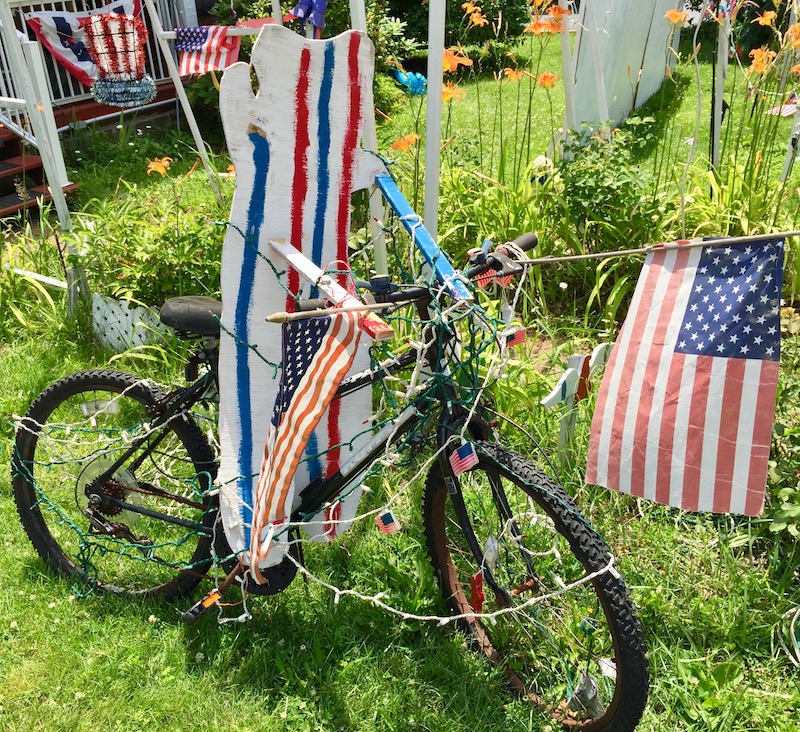
The most unique of Thunberg’s choices has to be a large teddy bear form that appears multiple times around the property[2]. How these relate to the declaration of independence, we don’t know–and didn’t think to ask at the time–but we’ll go with it. The bears are standing up for America with no identifiable facial markings and just the vertical red/white/blue stripes of the season. A human-sized teddy bear is out front riding a (real, decommissioned) bicycle.

handmade wood cut teddy bear lawn decoration on bicycle, Beaver, PA

show me what democracy looks like: patriotic teddy bear on bicycle

handmade wood cut Independence Day lawn decorations including teddy bear, fireworks, and Uncle Sam, Beaver, PA

patriotic teddy bear, fireworks, Uncle Sam

You’d think the 4th would be enough, but Gary Thunberg is holiday crazy. Independence Day is just one of four annual occasions that prompt the sixty-something year-old Thunberg to shuffle the contents of his storage shed/workshop/garage–taking in the previous event’s decor and prepping for the next.

With a holiday every season [Halloween, Christmas, and Easter are the others] and the weeks of work it takes him to remove the old, bring out the new, patch, paint, and repair any trouble spots, and finally lay out and line up everything for display, the decorations are a (nearly) full-time side occupation.

handmade wood cut eagles lawn decorations in back yard, Beaver, PA

back yard eagles and flags

The family came to this house on 3rd Street over 40 years ago, and Gary’s passion for holiday decoration goes back almost as long. The painted plywood decorations are all cut out by Thunberg with a jigsaw using various paper patterns or templates. From here, they’re sanded, painted, and hammered into the ground. The majority of the display is saved, stored, and brought back out again each year, but Gary tries to add one or two new pieces each season. Neighbors have gotten into the act by donating lights, wood, paint, and brushes.

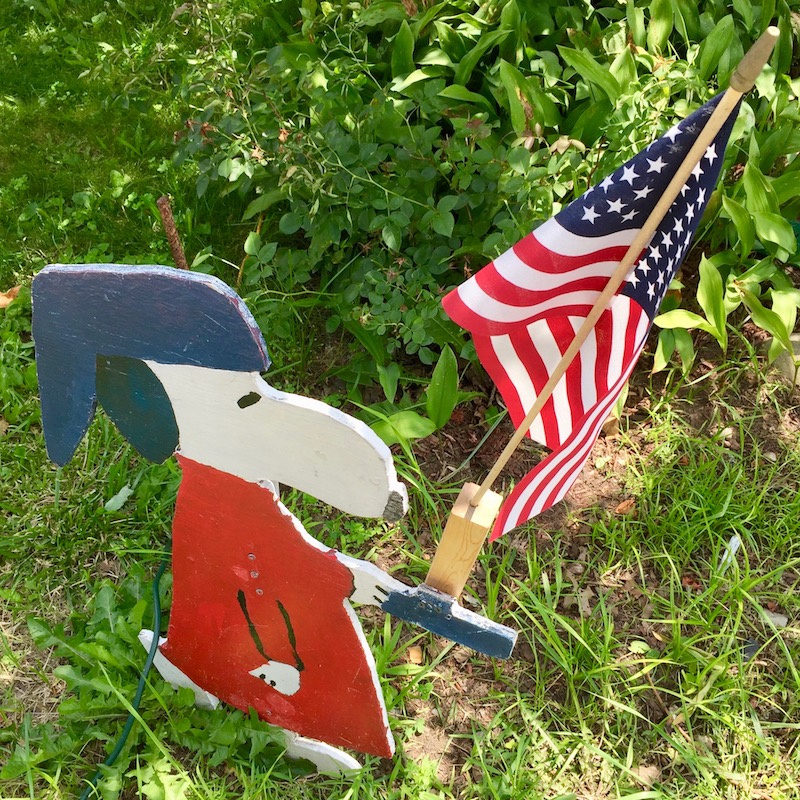
handmade wood cut Independence Day lawn decoration of red, white, and blue Snoopy, Beaver, PA

Snoopy

The Thunbergs–Gary lives with his lovely 87-year-old mother Doris–want you to stop by and see Gary’s work. A guest book out front encourages visitors to sign in and leave their thoughts. Doris has volumes of past years’ entries with signees coming from every state in the country and all over the world.

Catching this blogger photographing the side of his house, Gary came out to say hello and led me around, acting as tour guide to the full display, which extends into the back yard and out to the alley. Then I got invited into the house, phone numbers were exchanged, and we were invited back.

We will be back–for sure. We’ll see you guys at Halloween, if not sooner.

handmade wood cut American flag lawn decorations, Beaver, PA

American flag


[1] Yes, Sewickley is the other obvious exception.
[2] We weren’t sure what these shapes actually are, but Gary Thunberg confirmed them as teddy bears.

Go On and Take a Free Ride: The Tarentum History Mural

mural of rail car with famous natives of Tarentum, PA

famous Tarentum natives: Evelyn Nesbit Thaw, Henry Marie Brackenridge, Capt. J.B. Ford, “Uncle Billy” Smith, Sam Kier, and J.W. Hemphill

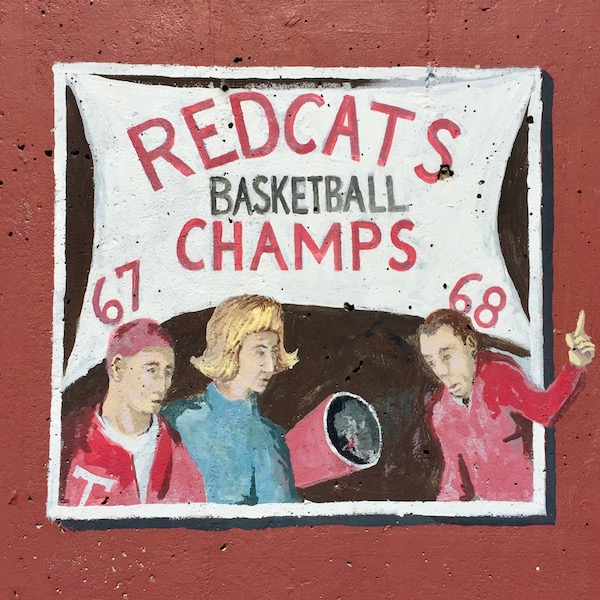
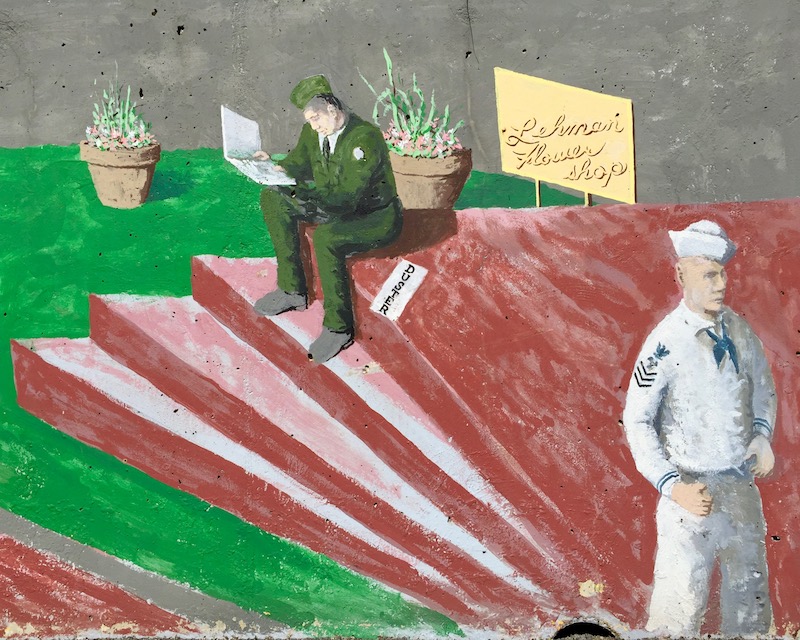
A rearing horse bucks at the sight of a beautiful woman through a rail car’s passenger window. High school sports fans celebrate championships of the Tarentum Redcats and Highland Rams. A pair of bonnet-wearing homesteaders share an emotional goodbye with a departing Union soldier headed off to war. Mercantile goods are unloaded from a flat-bottom riverboat to the R. McAyeal General Store. A Vietnam veteran dances with a mysterious one-armed monochrome man[1].

These very public Norman Rockwell by-way-of David Lynch scenes come to us from the dedicated hands–and seriously overworked paintbrush–of one Wally Sommer. They all play out upriver, over the bridge, and downtown, in Tarentum.

mural detail of high school students with banner reading "Redcats basketball champs '67 '68", Tarentum, PA

Redcats basketball fans

mural detail of Vietnam War veterans dancing and "Welcome to RAM LAND" sign, Tarentum, PA

Welcome to RAM LAND, dancing vets

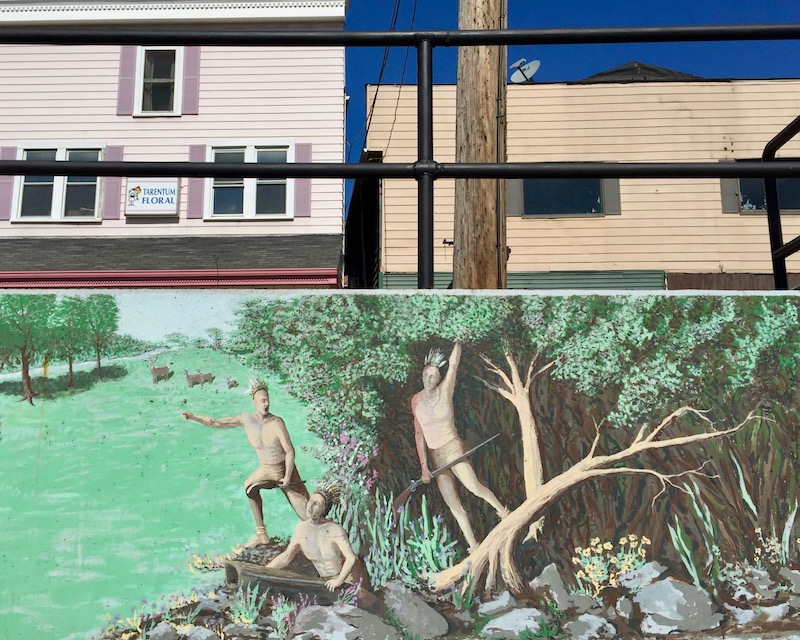
The history of Tarentum–from the native Shawnee Indians on undeveloped Allegheny River banks to present-day football fans tailgating before a Steelers game–is chronicled in an amazing right-to-left time-traveling mural spanning the equivalent of an entire city block in the Allegheny Valley borough’s downtown.

The long concrete retaining wall has been painted in one epic, continuous 180-foot scene that takes the spectator through more than two hundred years of borough history. Starting with native Americans in unspoiled lush summer lea, the viewer is taken on a multi-century journey through colonial-era mercantile settlement, Tarentum’s industrial heyday[2], connections to U.S. war efforts, social change, famous natives, leisure, and business.

mural of army tank on train car with soldiers, sailors, and WACs on train station platform, Tarentum, PA

Tarentum’s contribution toward World War II

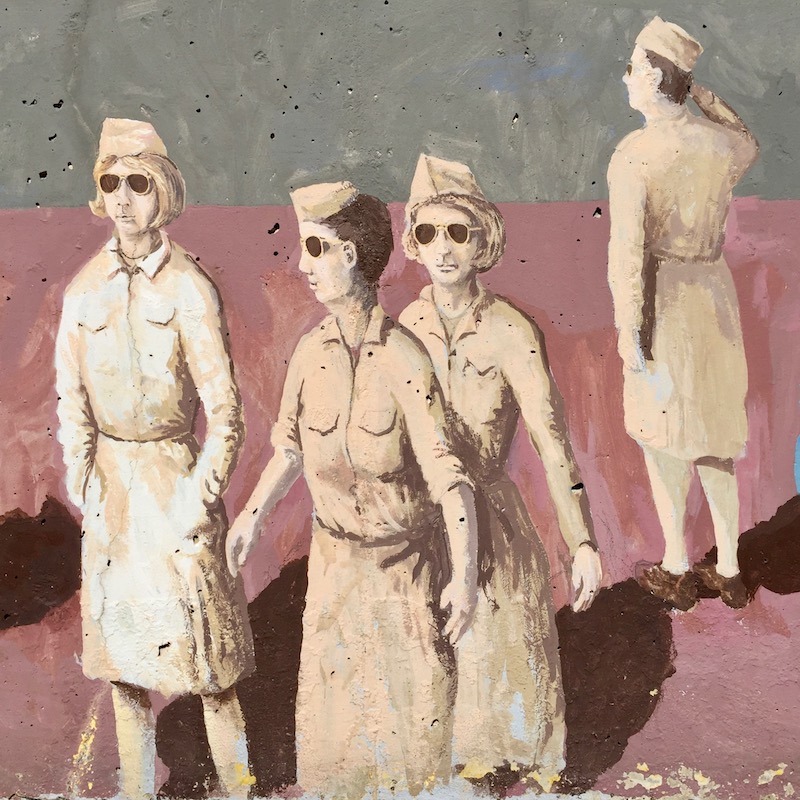
mural detail of World War II WACs, Tarentum, PA

WACs

That this magnum opus was created by just one person–an unpaid, 61-year-old (at the time) volunteer who “runs a family-owned auto repair shop” at that–is pretty incredible. A 2010 TribLive article profiles the work of Sommer as he was still currently one year into the painting process. At that point, the artist estimated he’d already put 500 hours into the massive work, hoping to finish another six months later. [No word on when the piece was actually completed.]

Sommer may be an amateur painter, but he’s clearly got both talent and technique. Sure, there are some funny proportions and odd angles, the backgrounds get a little splotchy when you get in close and there’s a John Kane-like flatness to some of the larger scenes. Overall, though, it’s really quite an impressive feat that stands up against similar pieces by “real” artists and rewards close looks at the many tiny details Sommer has included.

mural of native Americans with land that would become Tarentum, PA

(Shawnee?) natives of lower Allegheny River

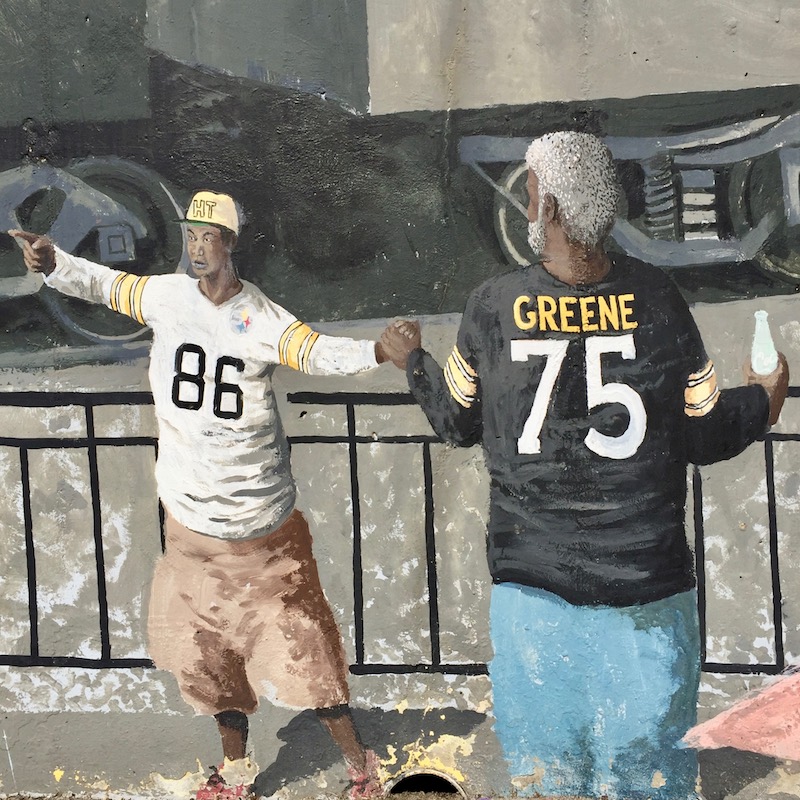
mural detail of two men in Pittsburgh Steelers team jerseys, Tarentum, PA

Steelers fans

The thematic device of a single multi-use train spanning a couple hundred years of local history was not without its bearing in immediate reality. Tarentum Borough, twenty miles northeast of downtown Pittsburgh, is bisected by prominent east-west train tracks that parallel the river and separate the town into distinct sections. Below are river flats with most of the commercial and industrial buildings. Above the tracks are largely residential slopes full of single-family detached homes, schools, and churches. The retaining wall-turned-history mural is just below East 6th Ave. and directly behind the old 1913 downtown depot, now home to JG’s Tarentum Station Grille.

mural detail of 19th century rail worker and draft horse in field, Tarentum, PA

rail worker and draft horse

mural detail of soldier reading letter and sailor waiting at Tarentum, PA train station

soldier and sailor at Tarentum station

You won’t find a passenger train that stops in Tarentum anymore (sigh), but as a freight route, the tracks that parallel the Allegheny River still get plenty of daily use. Tarentum, like many of its sister riverfront (ex-)factory towns, has “seen better days”. According to Wikipedia, the town’s current population of 4,500 is less than half its peak in the 1940s[3]. So it’s easy to see why a large public artwork that celebrates a history of making things, winning wars, and establishing a nation would be appealing. But it’s also encouraging that this spirit still persists in the work of Wally Sommer. There’s no comparable mural project in, say, Clairton or Ambridge or right across the river in New Kensington.

mural of early American settlement with general store, farmers, and river boat, Tarentum, PA

early mercantile Tarentum general store and river boat

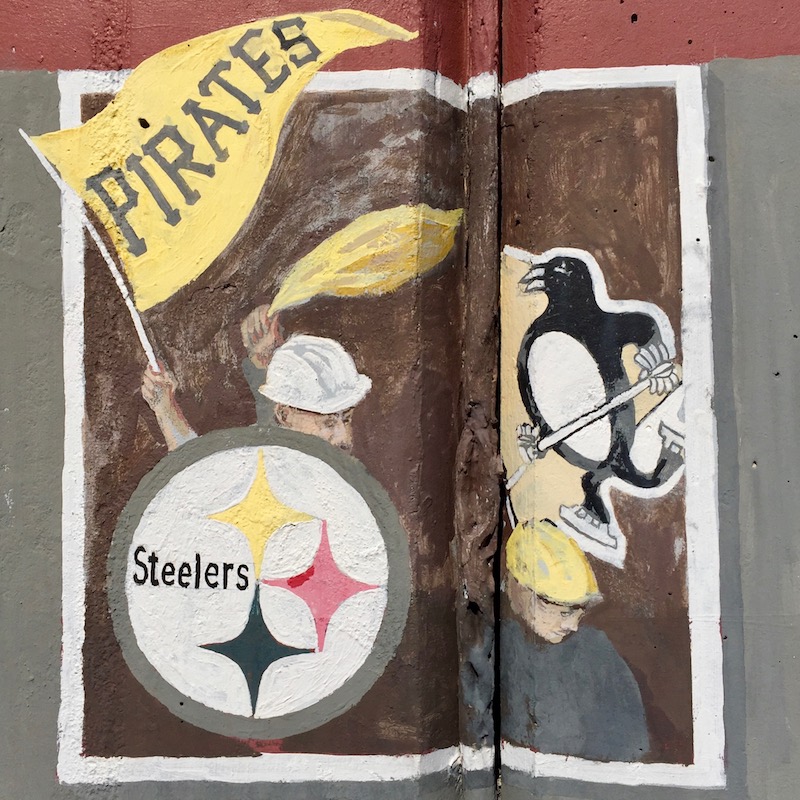
mural detail of Pittsburgh Steelers, Pirates, and Penguins logos, Tarentum, PA

Pittsburgh sports and the hardhat-wearing fans who love them

This blogger has opined on both the virtues and perils of large, public artworks in these virtual pages before. Unlike the Sewickley Speakeasy or Images or Rankin, however, Tarentum’s mural really feels built to last. It won’t take the daily roadside abuse of the former and we imagine a more invested maintenance plan than the latter. It also has the feel of a real we’re-all-in-this-together town centerpiece that will be watched-over, respected, and loved. Seven years on, the painting still looks fresh, vibrant, and as alive as the day Sommer finally laid down his brush. So far, no teenager with a can of spray paint has defiled the piece. Let’s hope it stays that way.

mural detail of Union army soldier with two women in Victorian dress at Tarentum, PA train station

Union soldier leaving from Tarentum Station

mural detail of train car windows showing man with A-1 Rental equipment, Highlands High School students, fraternal organization logos, Tarentum, PA

(present-day) mural sponsors, businesses, and civic groups are well-represented: A-1 Rental, Highlands High School, fraternal organizations


[1] We suspect the dancing partner is a fellow veteran of a more recent desert war–Kuwait, Iraq, or Afghanistan–but it is unclear from the painted depiction.
[2] The Big Steel era of the mural was sadly in heavy shade on the super sunny day we visited, so we chose not to include any of the substandard photos from this section.
[3] https://en.wikipedia.org/wiki/Tarentum,_Pennsylvania#Demographics

Going Postal: Cap Man Fever

mail label portrait of man with baseball cap, Pittsburgh, PA

Cap Man #8, Schenley Plaza

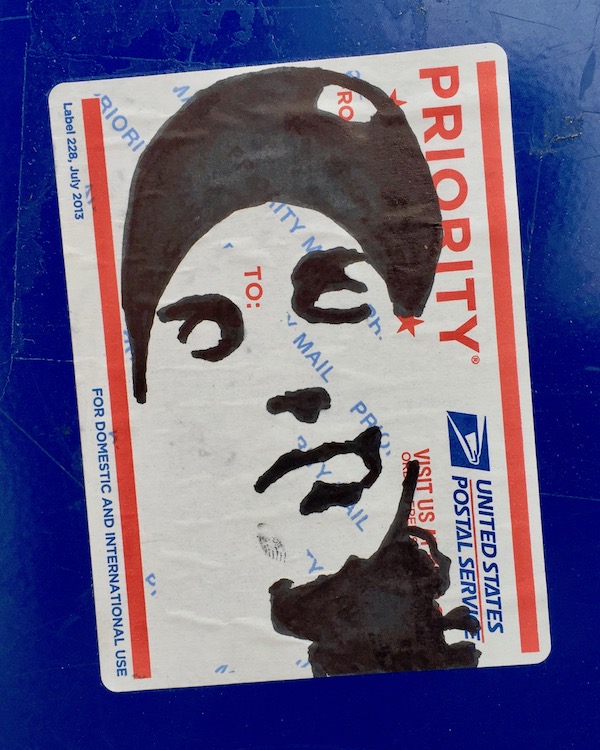
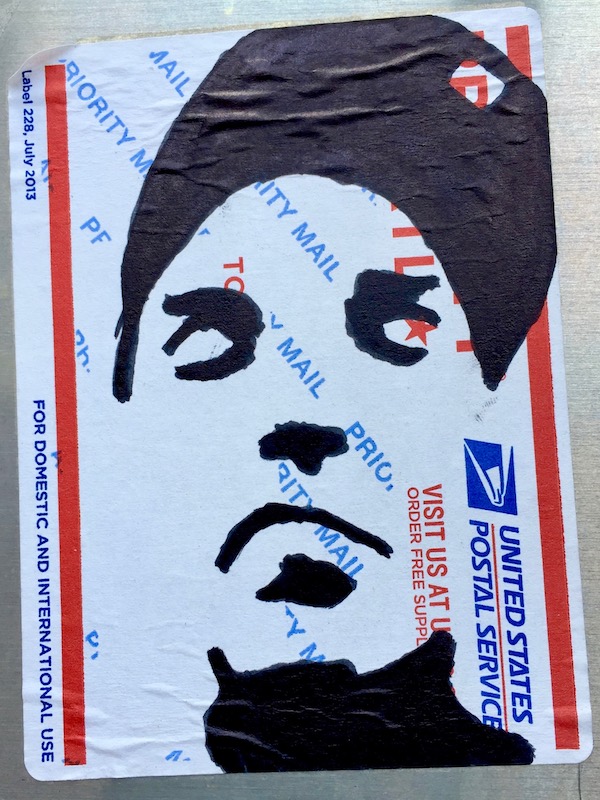
The ball cap is cocked high, resting on the back of the head at a jaunty just-off-center angle. Its bill is pure black, minus a small rectangular label on the inside brim. When you can see the man’s eyes, they stare directly back with a cold, dispassionate expression. More often, though, they’re shrouded in the heavy shadows cast by his supraorbital ridge.

Cap Man–our name for this anonymous figure–is the subject of a series of tiny artworks currently on view for a limited time* in the general vicinity of Craig Street and Forbes Avenue in Oakland. You’re going to have to work a little to find them.

portrait of man with eyes closed wearing a baseball cap drawn on US postal service mail label and stuck to blue free paper box, Pittsburgh, PA

Cap Man #1, Forbes Ave.

US postal service priority mail sticker with black ink portrait of man with baseball cap, Pittsburgh, PA

Cap Man #2, Craig Street

Both the medium and presentation for the Cap Man portraits are as DIY and proletariat as they come–thick black felt tip ink drawn on repurposed U.S. Postal Service “228” priority mail labels. The little stickers have been peeled off and applied haphazardly to a free publication bin, an electrical box, street poles, and–clearly the venue of choice–the back sides of metal street signs.

Cap Man’s creator certainly isn’t the first to use this medium. Alternately going by the general term sticker art or the more specific postal slaps, you’ll see similar pieces littering mailboxes and light poles all over the city and (apparently) across the country. Typically, though, they’re filled with either bright big-lettered tags that look like studies for future spray paint work or blunt messages like the series of FUCK TRUMP stickers around town. The Cap Man original ink portraits are something a little more interesting.

US postal service priority mail sticker with black ink portrait of man with baseball cap, Pittsburgh, PA

Cap Man #3, Craig Street

US postal service priority mail sticker with black ink portrait of man with baseball cap, Pittsburgh, PA

Cap Man #4, Bellefield Ave.

We don’t know who this person is–either artist or subject. It’s probably safe to assume, though, that the two are one in the same–self-portraits of a young man on the move. The angle of the image seems to suggest the artist is working from a lap-held mirror, or (more likely) his phone.

A theory: The proximity of where the stickers have been left suggests the possibility the perpetrator is riding the bus to Oakland, getting off at Fifth & Craig (or thereabouts), and then tagging the first bare surface he or she encounters on the ensuing walk down Craig Street and around the corner, heading toward the museum maybe, or Pitt.

In this scenario, the drawings may even be inked right there in the aft seats of the 54C or the 93A, a daily discipline perfect for the 10-minute hands-free commute. The shaky nature of this workspace would also help to explain why a couple of the portraits are clearly off–as if the otherwise competent hand that drew them was jostled mid-stroke…but this may just be a romantic pipe dream from a blogger who reads too many detective stories.

mail label portrait of man with baseball cap, Pittsburgh, PA

Cap Man #5, Forbes Ave.

mail label portrait of man with baseball cap, Pittsburgh, PA

Cap Man #6, Forbes Ave.

Let’s face it: ball caps look pretty dumb on anyone who’s not either twelve years old or actively playing baseball at that moment. That said, we’re glad Cap Man has given his stark two-tone/big negative space portraits something distinctive to, uh, hang his hat on. As a visual element, it makes his head stand out, provides structure, and frames the top of the drawings. It also provides a nice thematic grouping for the current exhibition in Oakland.

We suspect Cap Man’s old-school selfies aren’t the only street-facing work of this artist. Bloomfield is currently host to another pretty distinct series of postal slaps that look like they may have come from the very same hands. That, however, is a subject for another post on another day. Until then, a tip of the hat to you, Cap Man, it’s been a good time finding your tiny pictures.

mail label portrait of man with baseball cap, Pittsburgh, PA

Cap Man #7, Forbes Ave.

mail label portrait of man with baseball cap, Pittsburgh, PA

Cap Man #8 (detail), Schenley Plaza


* Limited, but unspecified: sunlight, rain, or graffiti cleanup efforts will eventually claim these pieces.

Easter Special: You Can’t Make an Omelet Without Finding Some Eggs

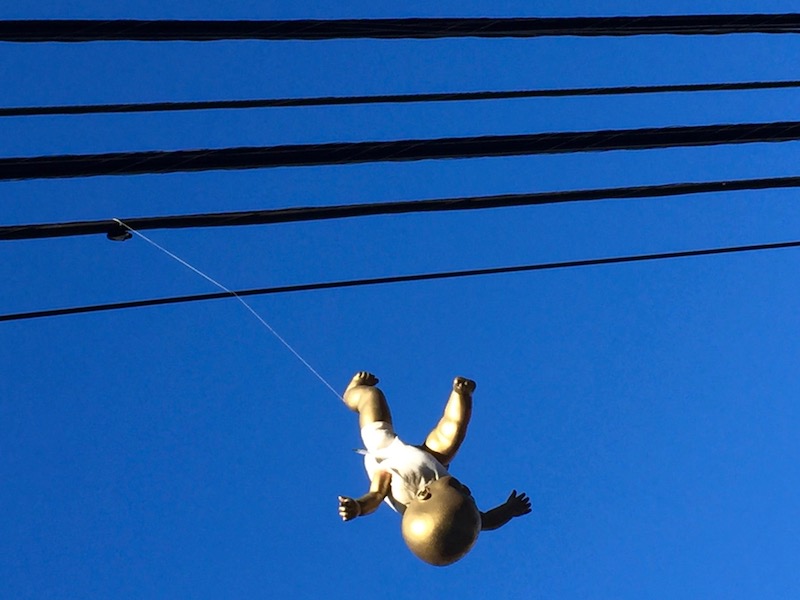
baby doll painted gold and hanging from telephone wires, Pittsburgh, PA

Golden baby, Lawrenceville

Matched ceramic salt and pepper shakers, ruby glass, bobbleheads, Hummel figurines, cookie jars–people collect all kinds of goofy stuff. Bakelite AM radios, Santas, and state plates, World’s Fair trinkets and glass insulators from telegraph lines. David from our West Coast rival Portland Orbit has some unique collections: cans of knock-off Dr. Pepper, eyeglass stems found on the street, other peoples’ grocery lists.

Easter may come only once a year, but every day can be the Orbiteer’s figurative egg hunt–which is really just the primordial collecting impulse–and it doesn’t cost a penny or take up any room on your shelves. Spotting is a lifelong and year-round habit: take the alley, poke behind the bushes, look down at the pavement and up in the telephone wires. [Oh, Golden Babies, how we pray we haven’t seen the last of you!]

Today, whether you’re a committed church-going, brunch-eating Easter reveler or full-on dance-naked-by-the-bonfire pagan, we celebrate some of the Orbit‘s favorite any-time/all-year-long city egg hunt targets.

protractor glued to metal driving barrier, Pittsburgh, PA

Pittsburgh protractor, Allegheny River Trail, Millvale

Pittsburgh Protractors are the easy money, chump change, fish-in-a-barrel of local urban collecting. In that way, though, they’re a great entry point–the gateway drug–to hardcore egg hunting. Either way, you have to respect the work of the protractor perpetrator(s) and we couldn’t not include the protractors in the list. There are just so damn many of the little plastic doo-dads glued all over the place that if you’re in bicycle-accessible city limits and keep your blinkers open, you’ll probably spot a few even if you’re not really trying.

ghost sign for "Arsenal Brand Meat Products" painted on side of brick building, Pittsburgh, PA

Ghost sign: Arsenal Brand Meat Products, Hill District

Sal’s MeatsHipCo BatteriesMother’s Best FlourOwl Cigar. Who are these vendors and what is the business arrangement that traded a (presumably) single payment into a long-after-life of marketing products that may no longer be purchased?

The hand-painted, brick wall advertising of yesteryear was all put out of business (we assume) by the arrival of big, purpose-built billboards with their larger display areas, darkness-defying flood lights, targeted sight lines, and monthly rates. That’s part of what makes so-called ghost signs so enjoyable for the egg hunter: it’s pretty obvious that there won’t be any more of them[1], and what’s left is often fading fast.

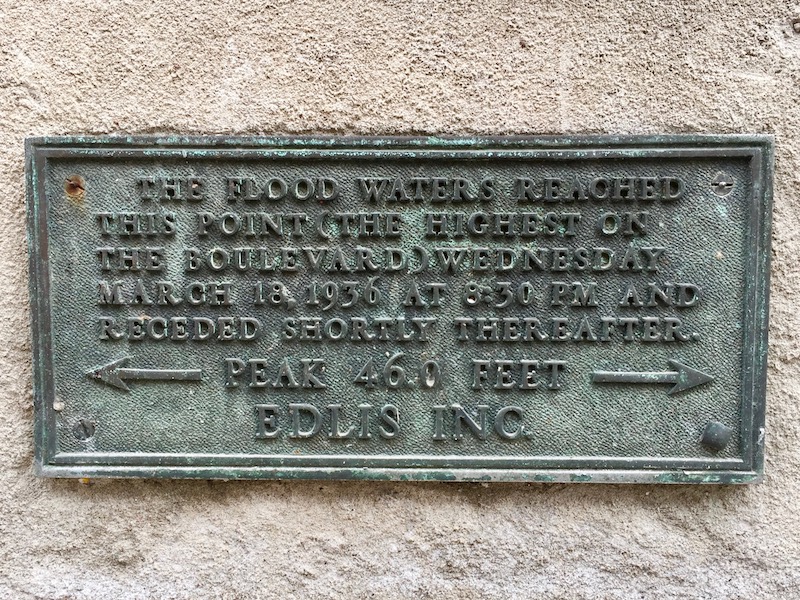
brass marker showing the 46.0 high water mark for the March 18, 1936 flood of downtown Pittsburgh, PA

1936 flood marker, Blvd. of the Allies, Downtown

Waaaay back when, the very first story committed to these virtual pages concerned a cryptic message painted around two faces of an old brick building in Manchester. That [SPOILER ALERT!] turned to be a marker for the most famous rising of the waters in Pittsburgh’s history–the 1936 St. Patrick’s Day flood.

We’ve found a handful more of them around downtown and on the North Side, but surprisingly few considering the immensity of the event and the age of our building stock. That just makes the hunt all that much sweeter when we zero in on previously unseen prey.

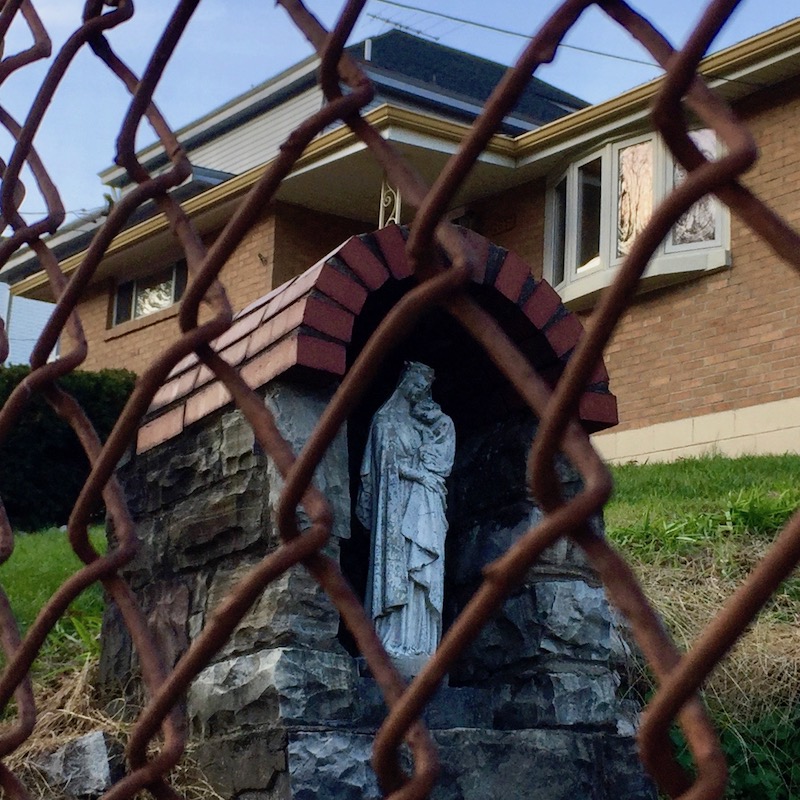
Mary statuette in homemade grotto, Pittsburgh, PA

Front yard Mary and grotto, Arlington

The blessed mother, hands spread with her palms open in a welcoming embrace or–far less often–the pietà image of Mary cradling the dead body of Jesus or holding the once-and-future as a baby [see above]. Whichever way we encounter the statuary, this is Front Yard Mary [even if she’s in the side or back yard] and we’ll take her any way we can get her.

There are so many Marys out there that we’ve got separate future features planned for South Oakland, Homestead, and the South Side Slopes (at least), which hardly makes Mary the most difficult egg to hunt. That said, this is ostensibly an Easter feature…

painting of woman with three eyes by Clohn Art, wheatpasted to wood, Pittsburgh, PA

Clohn Art, Downtown

Clohn Art is the nom de plume–or perhaps nom de paintbrush–of one John Lee, whose crude extra-eyed men, women, and animal paintings are executed on the placemats of Chinese restaurants and unfurled brown paper bags. They’re found wheatpasted at construction sites, alley walls, and, in at least one case, a rusty bus shelter in Homestead.

Wherever we happen to see the artist’s distinctive little paintings, they always pop off the wall surface and bring a twisted smile to our merely two-eyed faces. Mr. Lee declined The Orbit‘s request for a feature interview [John: we’re still interested!] so we’re left to troll the back streets, hoping to grab another of those rarest of eggs: a fresh, new Clohn to nestle in the wicker basket.

teddy bear and plastic flowers left on curbside, Pittsburgh, PA

Reasonably happy-looking sad toy, Fairywood

Like some mangy old teddy bear, dropped casually from a toddler’s stroller and forced to spend purgatory face-down in the weedy berm, Al Hoff brought the concept of “sad toys” into this blogger’s life and then cruelly left us by the side of the road to fend for ourselves.

Stuffed animals with their fur matted, flattened, and filthy; a basketball, punctured and concave in an oily culvert; doll parts dismembered and jettisoned like the work of a Lilliputian serial killer. So much pathos in such tiny candy-colored doses! It’s almost too much to bear…almost. But when we find them–and these are truly both the most random and the most reliable, renewable resource of today’s eggs–we can’t help but bag them.

outline of previously-existing "ghost house" against larger brick building, Pittsburgh, PA

Ghost house, North Side

Ghost houses–the imprint of one, now-extinct building upon its still-extant neighbor–is hardly a concept unique to Pittsburgh, but we’ve got the perfect environmental conditions to produce them here. Older building stock constructed right up against each other in a previous era when the density supported a pedestrian-based workforce, coupled with decades of “benign neglect” that demolished many–some falling all on their own–and landlords caring little about fixing-up the weird negative spaces on their vacant lot-facing windowless walls.

Like many of the other ova that occupy our oculi, ghost houses are special because–like a petrified forest, or the career of Steve Guttenberg–they’re the result of such a peculiar series of historic events, circumstances, and (non-)actions over a great period of time that we’ll likely not encounter the same perfect storm here again.

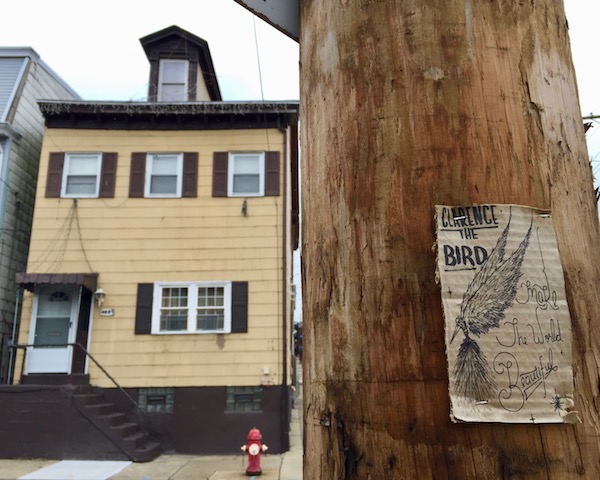
Clarence the Bird artwork stapled to telephone pole, Pittsburgh, PA

Clarence the Bird pole art, Bloomfield

With Clarence the Bird, the egg hunt changes parameters. Like picking up pawpaws, where there’s one of his handmade, ink-on-cardboard Make the World Beautiful instances, there tend to be a lot. Find a Clarence and you can safely spread out–looking up and down at the adjacent-blocks’ neighboring telephone poles and bulletin boards–and you’ll likely spot more.

So far [to our knowledge], Clarence has stuck to the greater Lawrenceville-Bloomfield-Garfield-Friendship portion of the East End, but that may just be where we’ve crossed paths with his big wings and pointy beak. I’m sure if we do see his trail elsewhere, we’ll see it everywhere.

poems of The Dirty Poet taped to a lamp post, Pittsburgh, PA

Poems of The Dirty Poet, Oakland

To call locating the telephone pole and street lamp verse of The Dirty Poet “egg hunt” material is a little bit of a stretch. His Dirtiness (yes: the writer is a he) wants the short, dittoed poems he authors to be read, after all. They’ve been taped and stapled at eye level on prominent foot traffic corners for just that purpose.

Regardless, it’s still neat to run across the prickly prose and lurid lines of the Bard of the Backstreets, knowing that one is literally standing in the creator’s footprints, inhaling his boozy breath, and shimmering in what’s left of his groovy vibes. To you, Whitman of the walkways, Dickinson of the downtown, Angelou of the who are you? may we always encounter your offspring sunny side up.

Toynbee Tile reading "Toynbee Idea in movie '2001' resurrect dead on planet Jupiter"

Toynbee Tile (no longer present), Downtown

It almost feels like cheating to include the so-called Toynbee Tiles in the list–we ran a feature on the House of Hades tiles just last week. But when you get lucky enough to spot one of the remaining, legit, first-generation street pieces, well, it’s a good day indeed.

As we reported, it is The Orbit‘s conclusion that none of these still exist in metro Pittsburgh and we’re left with a pair of ersatz Hell-bound tributes. But you never know! What does Easter–and, by association, spring–offer but the arrival of new hope, possibility, and opportunity. It is a new season: the sun is shining, birds are chirping, and flowers are popping with their tiny blasts of color across late winter’s gray-brown backdrop. Go out there and get you some eggs!


[1] There are, however, several efforts out there to restore/repaint old ghost signs as new mural projects. There’s a big one on Penn Avenue in Garfield and several in Braddock that we know of.

Highway to Hell: The House of Hades “Toynbee” Tiles

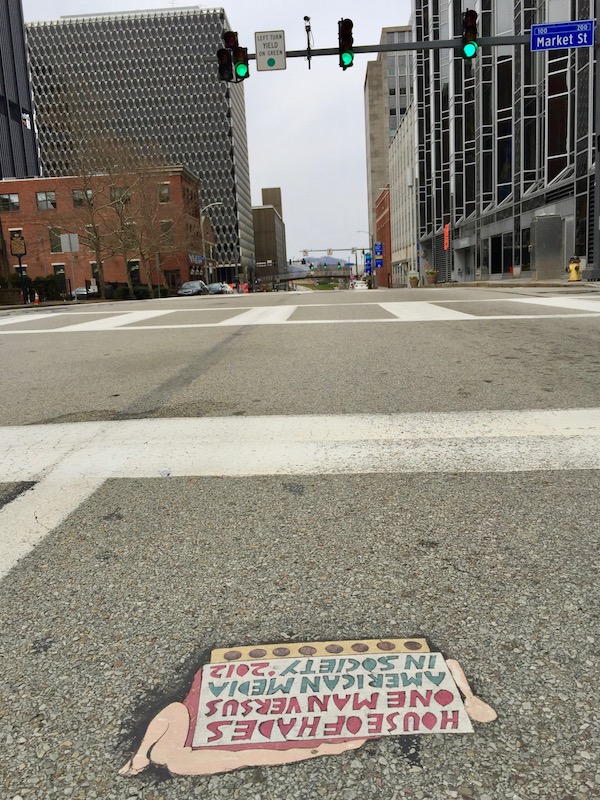
Street art "Toynbee tile" reading "House of Hades, one man versus American media in society: 2012", Pittsburgh, PA

Pennies for your paranoid thoughts. House of Hades tile #1, Blvd. of the Allies at Market St., Downtown.

The style is exactly the same: linoleum tile, constructed in reverse, and embedded as mosaic into a tar base that is applied directly to road surface. Ultimately, the piece will fuse with street macadam given enough over-rolling traffic to force it into the pavement. Arch messages are cut into rough block capital letters and have a familiar cryptic apocalyptic tone with phrases like House of Hades and Media must be reduced to ash in society.

We know these–they’re the so-called “Toynbee Tiles”…right? The (very literal) street art/paranoia phenomenon has emanated from center city Philadelphia outward for several decades now. They’ve been featured in their own investigative documentary film [Resurrect Dead: The Mystery of the Toynbee Tiles (2012)], and–at least at one time–decorated a bunch of streets in the Golden Triangle.

Street art "Toynbee tile" reading "House of Hades, media must be reduced to ash in society: 2012", Pittsburgh, PA

House of Hades tile #2, Blvd. of the Allies at Wood St., Downtown

But…not so fast. For one thing, pretty much every legitimate Toynbee tile in downtown Pittsburgh has vanished from this earth[1]. We chronicled a bunch of these in our stories on The Toynbee Tiles of Smithfield Street and its follow-up Orbit obit to The Last Toynbee Tile on Smithfield Street a year later. The all-things-Toynbee site toynbeeidea.com has a Google map that includes pinpoints for eight different tiles that used to exist on Smithfield, Forbes, Oliver, and Commonweath Place. Under Orbit due diligence, our bicycle- and sidewalk-based researchers criss-crossed downtown and couldn’t locate a single extant tile from this set.

Second, the pair of tiles that arrived on Blvd. of the Allies (photographed here, but not currently on toynbeeidea.com’s map) aren’t strictly “Toynbee”. Whether they’re the work of a copycat, tributes to the original, or just plain doing their own thing (using the same visual language), is a matter of some debate. What’s clear, though, is that these House of Hades tiles have been left by a different crew than the person Resurrect Dead researcher/filmmaker Steve Weinik calls The Toynbee Tiler (“TTT”).

map of downtown Pittsburgh with locations marked for former locations of Toynbee tiles

Red dots mark the former locations of eight Toynbee tiles in downtown Pittsburgh–now all are gone. [map: toynbeeidea.com]

The ominous warning One man versus American media in society certainly comes off as incredibly timely given the current political climate. But in fact these messages go back well before Steve Bannon’s elevation to the White House. Both pieces contain the date 2012. This may or may not be accurate to the time of installation, but that’s around when we first remember tripping across them.

Information on this “House of Hades” is scant. Is it the message or the maker? As these things go, there’s no P.O. box to send your S.A.S.E. into or 800 number to call for a free brochure. ToynbeeIdea.com claims the tiles started appearing in Buffalo some time in the oughts and “look nice, but don’t last long”[2]. That’s not our experience, though. The pair on Boulevard remains nearly perfect five (or more) years on. Of course, we probably don’t have the volume of Philly traffic they’re comparing them to, but it’s still impressive.

street art "Toynbee tile" and buildings of downtown Pittsburgh, PA

Regardless, we’ll re-issue that old Orbit saw and simply say, House of Hades–who- or whatever you are–we’re glad somebody’s still out there carving wacky words, spoons, and lady legs into street decoration and we’re glad you dropped enough morsels in downtown Pittsburgh for us to chew on for a while. If it stops us in our tracks–possibly with oncoming travel barreling forward–makes us wonder, and gives the noodle a twist, well, you’re all right by us.

Oh–and one more thing: while The Orbit may technically qualify as part of “the media” [in its loosest, most pathetic usage], please don’t reduce us to ash just yet. We’ve still got some things we want to cover.

street art "Toynbee tile" and buildings of downtown Pittsburgh, PA


[1] That we know of…but The Orbit is pretty sure this is it. If you know of any other remaining Toynbee tiles in the city, please educate us.
[2] http://www.toynbeeidea.com/house-of-hades/


See also: Highway to Hell: The House of Hades “Toynbee” Tiles, Part 2: (Pittsburgh Orbit, August 6, 2017)