Something Fishy: Angling for the East End Dangler

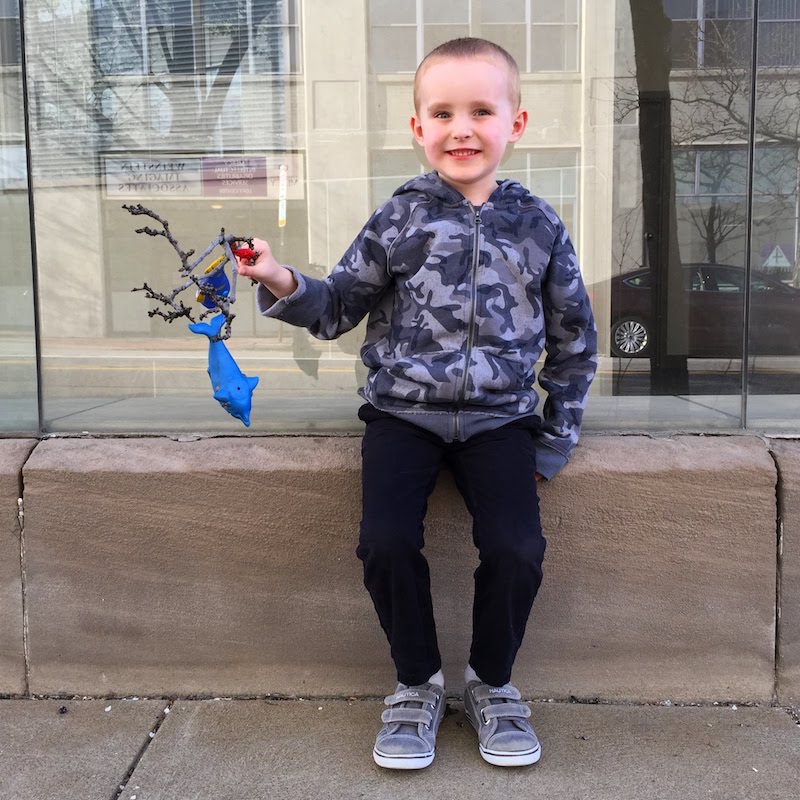
boy with tree twig and strand of toy fish

The littlest Dangler angler with another clue from the trail, East Liberty

It started, as these things do, with just a single incident. Back in the early fall, out on an afternoon constitutional, the crew came across a curious sight. Tangled in the mid-level branches of a street tree on Centre Avenue was a six-inch plastic tiger shark, hanging by a length of rough twine tied around her tail fin. Following the string led to a purple dolphin, then a starfish, and so forth. Six miniature sea creatures in all, very much out of water, and awkwardly tossed into the leafy undergrowth just above head level.

strand of plastic toy fish tied together with twine and hanging from tree branches, Pittsburgh, PA

exhibit #1 aka “two sharks,” as found in East Liberty, Sept. 2017

As we’ve mentioned before, Orbit staff maintain a strict do-not-disturb policy when it comes to street art, pranks, and other happenstance findings in the public sphere. Our interns do not always abide by the same code of conduct.

Such was the case on this day, as cub reporter Lee extracted the string of toys from the overhead branches and brought it back home for further examination. While that felt very much like disturbing the scene of a crime way back in September, it would prove eerily prescient. It was only just recently that we became aware this was no isolated incident.

That’s right: Pittsburgh has a repeat offender on a loose and he, she, or they have struck enough times to warrant serial status. The East End Dangler walks among us, covertly decorating the city’s flora with strange garlands of (mostly) plastic fish.
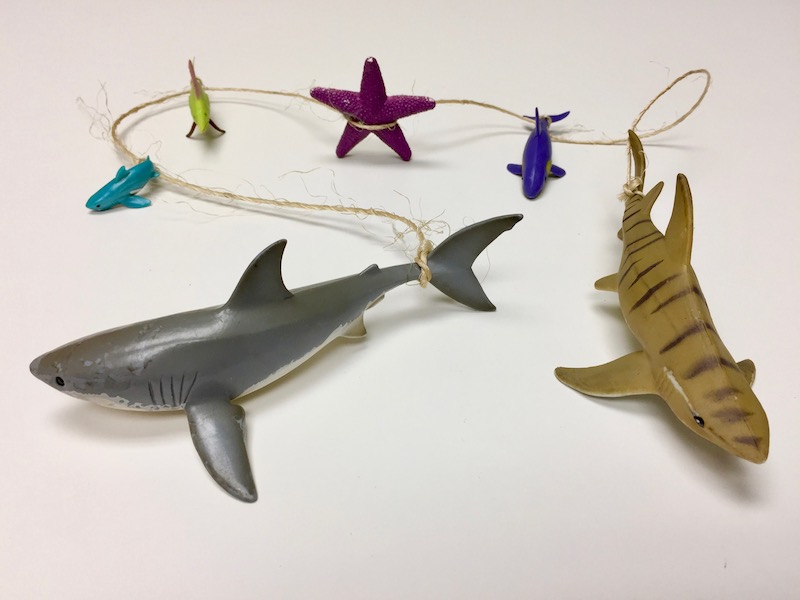
6 plastic sea creature toys connected by twine

exhibit #1 aka “two sharks,” found on Centre Ave., East Liberty

Nearly seven months after that initial encounter, we were certainly in for a surprise. Walking back to the office on a chilly early spring afternoon–the belly still reeling from a lunch of huevos con chorizo con tortillas con frijoles con arroz y unlimited chips–to see a tiny die-cast aeroplane poking its propeller schnoz out of the newly-cut grass. On retrieval, we found the same tell-tale twine knotted around the plane’s tiny tail and rudder. It wasn’t until just this moment that the connection between aircraft design and sea life anatomy became so perfectly clear–but let’s stay on topic.

Our very same cub reporter not only identified the toy as “Dusty Crophopper” from Disney’s Planes but also spotted a tiny rubber fish nearby. The squishy little fellow was dislodged from the strand when its tail broke off, but in an unlikely and gruesome turn of events, the dismembered body part was still caught in the twine to confirm the relationship.

toy airplane on string of twine

exhibit #3 aka “Dusty Crophopper,” (partial) found on Centre Ave., East Liberty

The revelation that the string of sharks was not a one-time deal would have–should have–been enough, but we were in for a couple more shocks. Mere feet away–O.K., maybe one or two hundred of them–was another bare tree with another set of dangling fish. In this case, two bug-eyed, cartoonish blue fish and one tiny red-orange fellow. Unlike the previous two marks of The Dangler, this trio was connected by wire (not twine) and thrown way up high, out of arm’s reach, but well within eyesight.
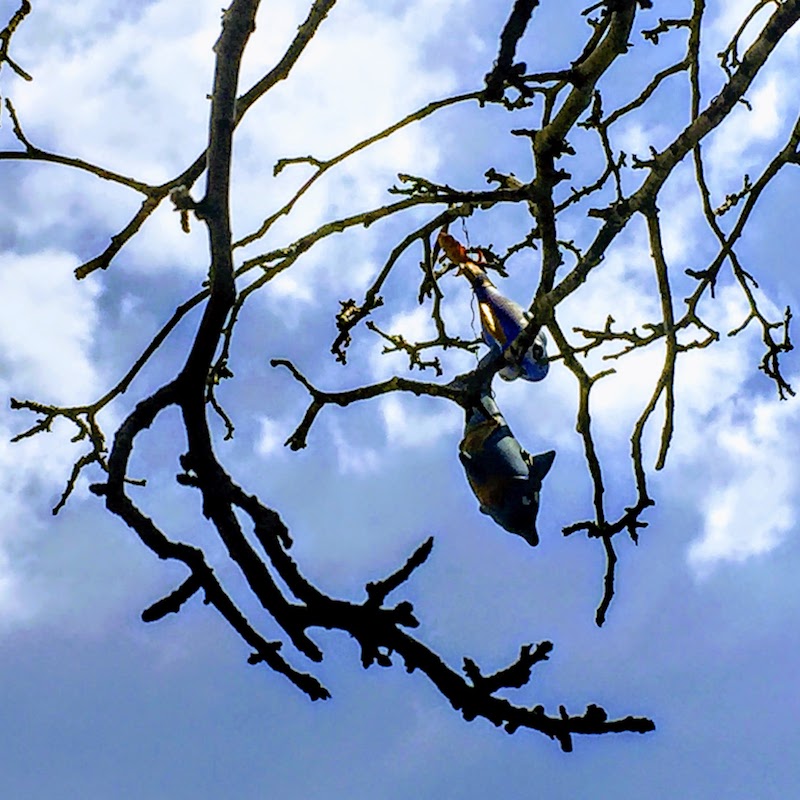
plastic fish toys strung together with wire and hanging from tree limb, Pittsburgh, PA

exhibit #4 aka “blue fish,” as found in East Liberty, April, 2018

Attentive readers are already yelling at their mobile devices, hopefully not in public restrooms. How did you jump from exhibit #1 to exhibits #3 and #4? What kind of amateur-hour investigation are your running around here?

Ah–that’s where the plot thickens! Lee had already bagged exhibit #2 (aka “orange fish”) and just never filed his paperwork. Way out of the relatively-small perimeter we were working, this yang to “blue fish’s” yin [three fish, the little one in the middle, single color scheme, wire connector–orange and blue are even opposites on the color wheel!] hung from a tree along Browns Hill Road, miles from Centre Avenue.
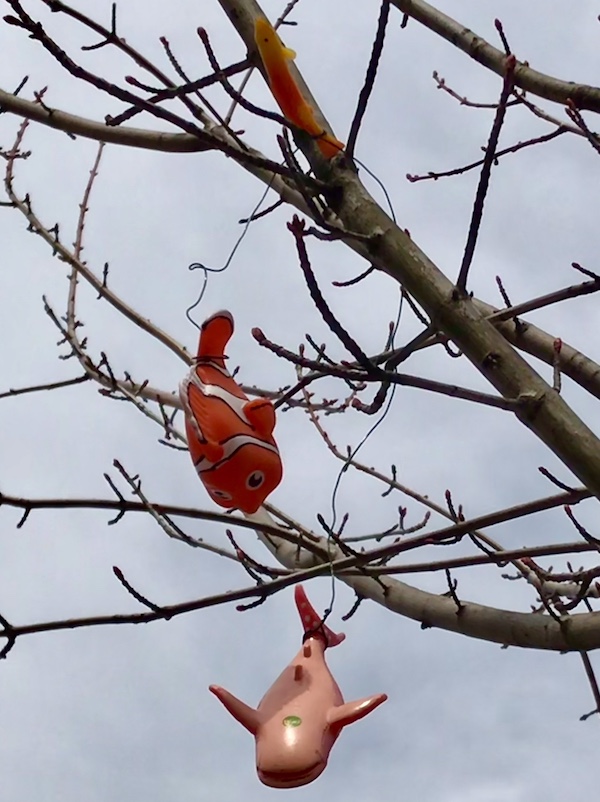
three plastic fish hanging from wire in a bare tree

exhibit #2 aka “orange fish,” as found on Browns Hill Road, April, 2018 [photo: Lee Floyd]

Like Ed Gein and Ted Kaczynski, Rudy Giuliani and Pauly Shore, we may never know what motivates The East End Dangler to do what they do. In lieu of any hard evidence on the person behind the dangling, we’re left with just the physical items: toys–specifically fish toys–and location.

On that first point, one popular theory holds that the perp is a parent, the child or children having aged out of their fish phase and into teenage alienation. What to do with those leftover sharks, goldfish, and neon tetras but string them up and throw them in city trees? A little goofy, but more unlikely events happen around us every day.

3 toy fish connected by wire

exhibit #4 aka “blue fish”, found on Centre Ave., East Liberty

These may also be the work of a prankster or frustrated conceptual artist. The nearby Goodwill on Centre likely offers an ample supply of second-hand toys at by-the-pound prices. If decorating trees with Happy Meal castoffs is your thing, it can be done easily and at bargain rates. As art? Well, it beats spray paint tagging.

A third opinion holds that we’ve got deeper symbolism here–something very specifically fish-related. All three of the Centre Ave. finds are within rock-tossing distance of the East Liberty Whole Foods; “orange fish” was spotted adjacent to the Hokkaido Seafood Buffet restaurant. It doesn’t take Hercule Poirot to connect these particular dots. Whether the Dangler might be addressing mercury in the food chain or the Pacific Ocean’s plastic vortex is unclear, but lines can certainly be drawn.

3 toy fish connected by wire

exhibit #2 aka “orange fish,” found on Browns Hill Road

We may never know…or this may just be the beginning of the conversation. If you’ve noticed the work of The East End Dangler (literally) hanging around a tree you frequent, please let us know. Until then, to paraphrase Casey Kasem, keep your feet on the ground, and keep reaching for the fish in the trees.


BREAKING NEWS: On the eve of going to press, The Dangler dropped another bombshell on us. There, in those same Centre Avenue street trees hangs yet another dangled concoction. This one appears to be just two toy airplanes, one a bulbous, cartoonish propeller; the other, a second Dusty Crophopper. As of this writing, the dangled bits remain tree-side.

toy airplane hanging from wire in tree limbs

exhibit #5 as found in East Liberty, May, 2018

Art Opening: Garage Door Murals

garage door murals of giant cat head and abstract lines and stars, Pittsburgh, PA

Lawrenceville

Garages, man. The mythological backyard birthplaces of great art and invention–from Thomas Edison making light bulbs to The Kingsmen banging out those three chords to Steve Jobs and “The Woz” inventing Pac-Man (or whatever they did).

While little structures to park your car in exist everywhere, there is something quintessentially and uniquely American about the garage. Our obsession with the automobile, along with the affluence to afford the extra real estate–let alone, the sport SUV–and America’s young history, unencumbered by precious Medieval ruins, ancient bazaars, or sacred bones–makes all land fallow ground for building home for our cars.

While the three-bedroom split-level house with its integrated two-car garage has become synonymous with twentieth-century suburbia, there are plenty of interesting alleyway garages serving retail storefronts, row houses, and gingerbread Victorians all over the city. It is this collision of circumstances that, uh, opens the door (sorry) to great garage murals.

garage door covered with plywood painted with colorful bridge and hills, Pittsburgh, PA

Garfield

Mural painted on garage door of man on motorcycle with the Pittsburgh skyline behind him and a banner reading "Gone but not Forgotten"

Gone but not forgotten, Homewood

Some of these many retractable, roll-up doors have been gloriously decorated with large-form artwork. That makes perfect sense–the garage door is such a nice, big canvas–sixty square feet at the minimum; much much more when you get into two-car widths and double-door arrangements. Plus, the street- (or, more often, alley-) facing arrangement guarantees an audience of neighbors, scavengers, and garbage collectors as they trundle down the hill, possibly to or from their own garages.

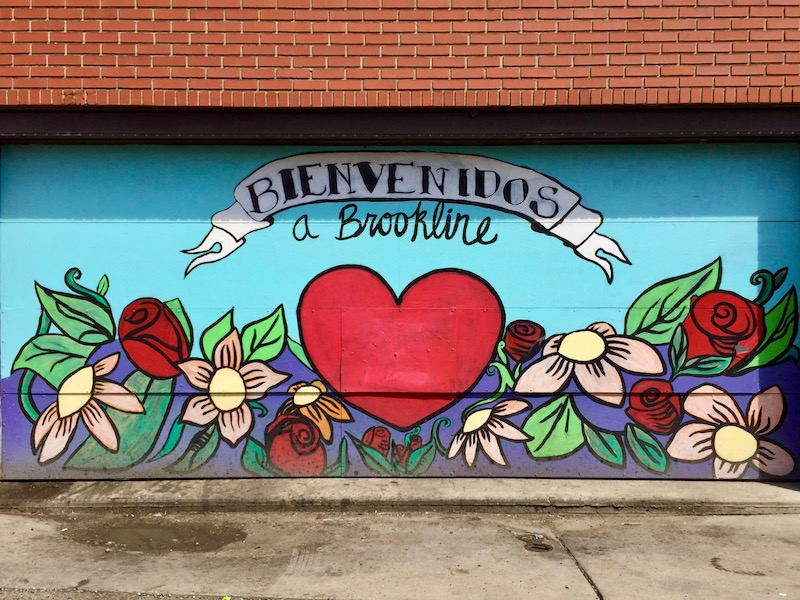
garage door mural of heart and flowers with text "Bienvenidos a Brookline", Pittsburgh, PA

Bienvenidos a Brookline, Brookline

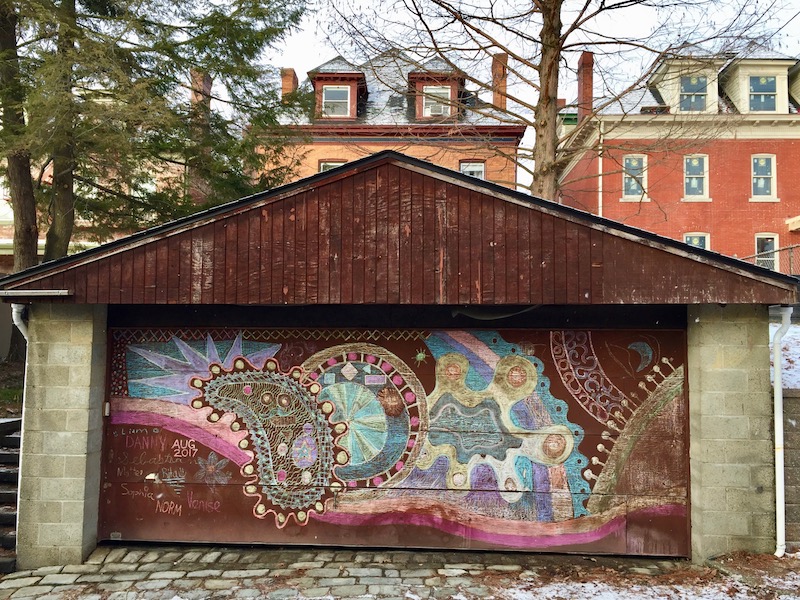
colorful abstract mural on garage, Pittsburgh, PA

Friendship

It’s an interesting opportunity. Most property owners don’t paint such wild, loose scenes on the exterior brick and stucco walls of the main house. But the garage seems to have a different set of rules–no one considers it sacred space, crucial to the visual integrity of the home. The neighborhood may look like Peyton Place from the street, but it’s Dazed and Confused in the back alley.

mural of colorful furry cartoon character painted on garage door, Pittsburgh, PA

Lawrenceville

garage door painted with crowd of people, Pittsburgh, PA

Garfield

garage door opening covered in plywood and stenciled with birds and birdcages, Pittsburgh, PA

Friendship [1]

brick wall over former garage painted with elaborate tag, Pittsburgh, PA

Garfield

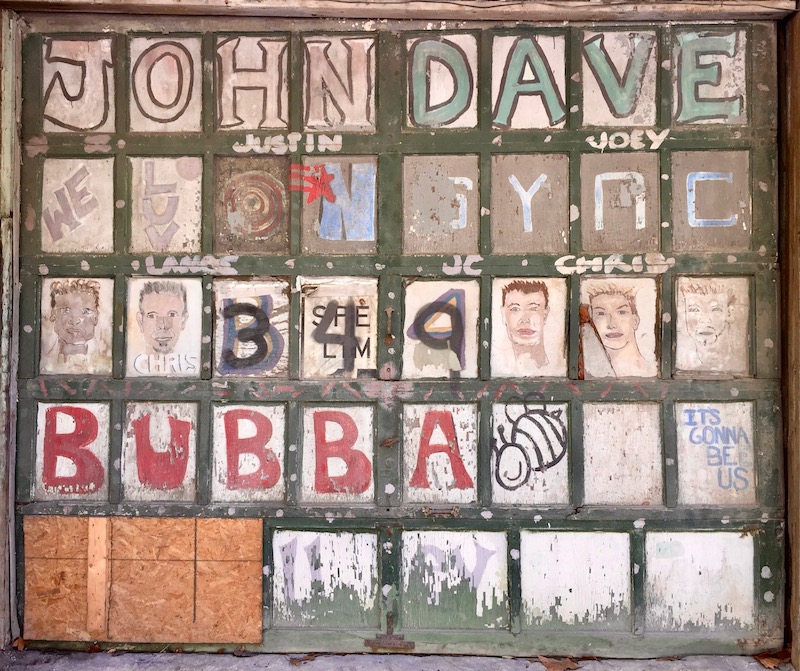
An interesting sub-genre of the garage door mural shows up in these artifacts from a long-over radio station contest around pop group ‘N Sync. I was unable to locate any mentions of this on the computer Internet, but from our small sample size, it looks like participants were required to paint a garage door in tribute to both the singers and [defunct radio station] B-94, with the names of on-air personalities John, Dave, Bubba, Shelley and band members spelled-out. The one from Aliquippa (below) is particularly great for its crude renderings of Justin, Lance, J.C., and the gang.

garage door painted by fans of N*Sync for radio contest, Aliquippa, PA

B-94 ‘N Sync mural, Aliquippa [2]

The B-94/’N Sync murals would make a great subject for its own post, but we have no confidence we’ll ever see any more of these. [If you know of any, hook us up!] The contest probably ran right around 2001 at the height of ‘N Sync’s popularity and while it may have had many teenagers decorating the family car park back then, turn-of-the-millennia middle/high school students are now in their 30s and should have moved out of the house by now. We imagine even the most supportive and/or nostalgic parents took the opportunity to whitewash over these alley-facing memories.

garage door painted for radio station content as tribute to N*Sync, Munhall, PA

B-94 ‘N Sync mural, Munhall [photo: Lee Floyd]


[1] Given the quantity of both the stenciled bird and birdcage images around town, this particular artwork was likely not created by the property owner–nor is it a full mural. Regardless, it’s still garage door art, so we included it here.
[2] Shelley’s name is partially-covered in plywood and otherwise faded/worn away in the bottom row of panels.

Sci-Fi Sidewalks and Apparitions in the Alley: Fantasy Stencils

stencil image of Frankenstein's monster painted on steel door, Pittsburgh, PA

Frankenstein, South Side Slopes

There he is: deep-set eyes shaded under the world’s most famous supraorbital ridge. The giant cranial dome, smashed-flat schnoz, and lifeless mouth could only be one…humanoid. Yeah, it’s ol’ bolts-for-brains, Frankenstein–or Frankenstein’s monster, if you must–but we’re all friends here, right?

Mary Shelley’s enduring science project-run-amok turns up here in Pittsburgh at least a couple times–on the South Side Slopes and back-alley Bloomfield. It’s nice to fantasize this is a bicentennial tribute–Shelley’s Frankenstein; or, The Modern Prometheus was first published in 1818[1]. We’re pretty sure that’s merely a coincidence, though–these spray paint portraits go back at least a couple years.

Regardless, Frankenstein finds himself in good company. He’s but one member of an impressive rogue’s gallery of desperate monsters, enormous insects, gun-toting pandas, faeries, robots, and one flaming Eye of Providence.

stencil image of Frankenstein's monster painted on concrete wall, Pittsburgh, PA

Frankenstein, Bloomfield

stencil image of monster's head painted on brick wall, Pittsburgh, PA

monster, Garfield

stencil image of man's face painted on brick wall, Pittsburgh, PA

refugee from the planet Krylon (or maybe Lou Reed?), Garfield

Someone in greater Bloomfield/Garfield–maybe a whole gang of people–is real handy with an X-Acto knife, stiff card stock, and enough shook-up cans of Rust-Oleum to color most of the spectrum. There are a ton of little stenciled artworks decorating or defacing (your pick) the East End’s alleyways, retaining walls, street signs, and retail backsides.

The majority of these pieces are a single layer, allowing the underlying surface to provide random background color–red brick, silver aluminum, and whatever color the utilitarian cinderblock wall happened to get painted. There are also some really impressive two- and three-color jobs that show a real deft of craft in both preparation and execution in the medium.

stencil image of a flea painted to the back of a street sign, Pittsburgh, PA

“Flea Apparitions”, Bloomfield

stencil image of pink tyrannosaurus rex painted on concrete wall, Pittsburgh, PA

hot pink T-Rex, Oakland

graffiti stencil of bear standing up with a pistol in each paw, Pittsburgh, PA

“This is a stickup, give me all your honey.” Panda bear with pistols and Hawaiian shirt, Strip District

… but is it art or public menace? One the world’s most un-answerable perennial questions! How I’d love it if some street-wise Séraphine dressed-up our alley fence with a long-locked faerie or ambivalent robot. At the same time, if some stupid spray paint smear were to cross the front of the house, I’d be irate–what a hypocrite! Decorate every alley, sheet metal warehouse, and fast food restaurant and I’ll be happy man, but keep your nozzle off the nice brickwork of private homes and old institutions.

They’re not listening to The Orbit–that’s for damn sure–but stencilers seem to have pretty sound judgement in what subjects are fair game, and where to lay off. The targets here are almost all vacant, unseen spaces and discarded infrastructure. That may be as self-serving as it is respectful–people are just a lot less-likely to take action on a trash-strewn alley behind Family Dollar or the former entrance to a condemned building.

stencil image of fairy painted on cinderblock wall, Pittsburgh, PA

faerie, Strip District

stencil image of cartoon robot painted on bridge, Pittsburgh, PA

robot, Millvale Street Bridge

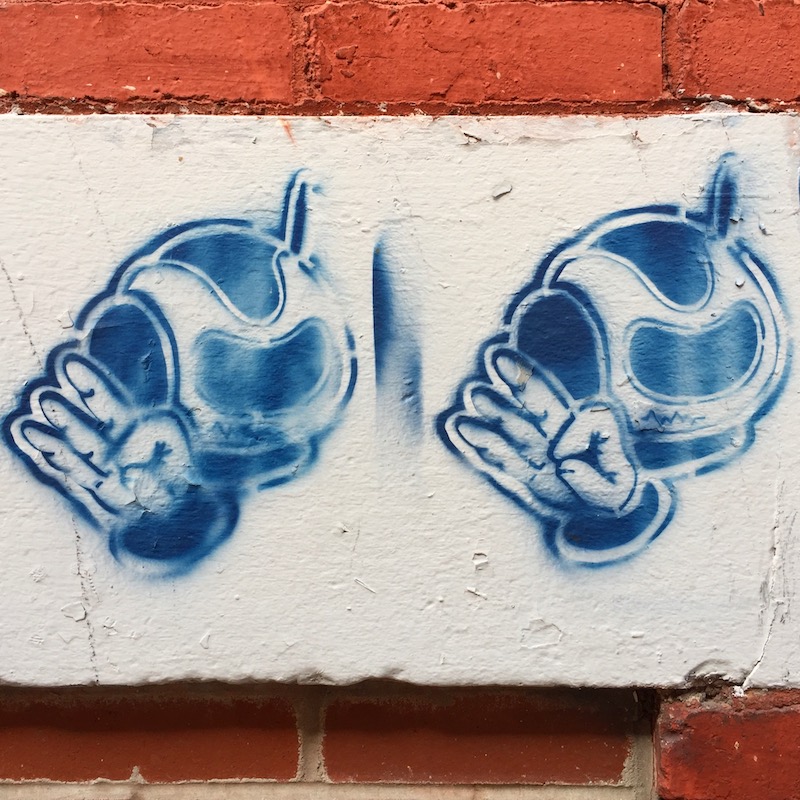
graffiti stencil of astronaut giving "OK" hand signal, Pittsburgh, PA

astronaut OK, Strip District

stencil image of pyramid with eyeball on fire painted on cinderblock wall, Pittsburgh, PA

flaming Eye of Providence, Strip District

The Eye of Providence–the mystical cyclops pyramid image that shows up on the dollar bill–supposedly represents God watching over humanity[2]. We don’t know what it means when it’s on fire. Regardless, God seems to give passes to all these back-street Basquiats and cinderblock Cézannes who ply the paint and stencil the swine right under his or her watchful eye.

If it were up to The Orbit [it is not] the lord or lady who tattooed the anonymous wall behind an electrical transformer with an out-of-control, Hawaiian shirt-wearing panda bear–two pistols raised in a threatening display of firepower–would get the bee line straight to heaven, no judgement from above. Whether these particular stenciled artifacts do that for their creators, we don’t know–but we’re cheering for you.

graffiti stencils of skull and crossbones and pig heads on cinderblock wall, Pittsburgh, PA

skull & crossbones/pig heads, Bloomfield

stencil image of person cradling a bomb painted on cinderblock wall, Pittsburgh, PA

stop worrying and love the bomb, Bloomfield


[1] https://en.wikipedia.org/wiki/Frankenstein
[2] https://en.wikipedia.org/wiki/Eye_of_Providence

Born Again: The Babyland Totems

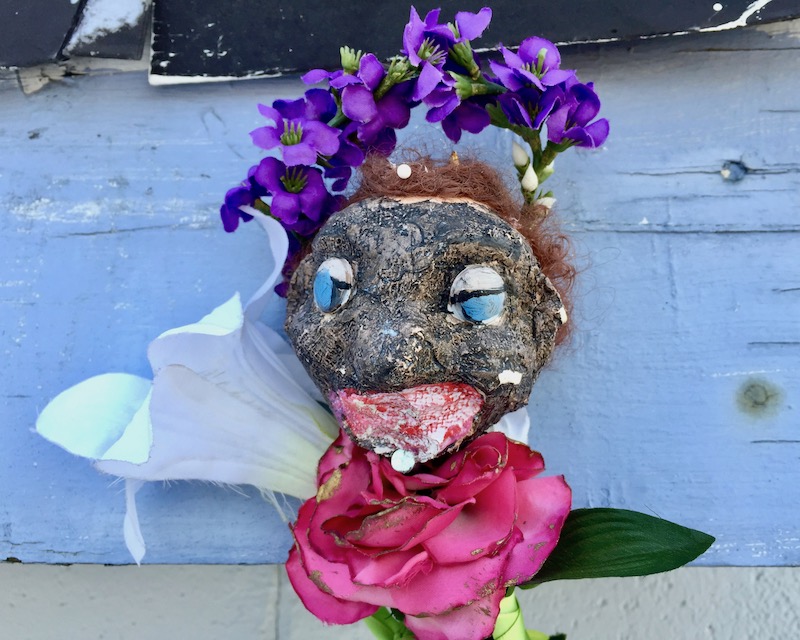
sculpture of black plaster head with fake white hair and flowers attached to utility pole

street totem by twilight

Those eyes! Wide open, wild as the wind, staring straight back at–no, through–you. The steely glare cuts right into the cold, dark, February night. Evocatively–as if arranged by set designers on a commercial shoot–the ice blue of those peepers echoes the color of rain-slicked Negley Avenue reflecting the deep indigo sky above. It’s only just six o’clock, but it may as well be midnight.

sculpture of black plaster head with flowers attached to wood

bean baggie baby on board

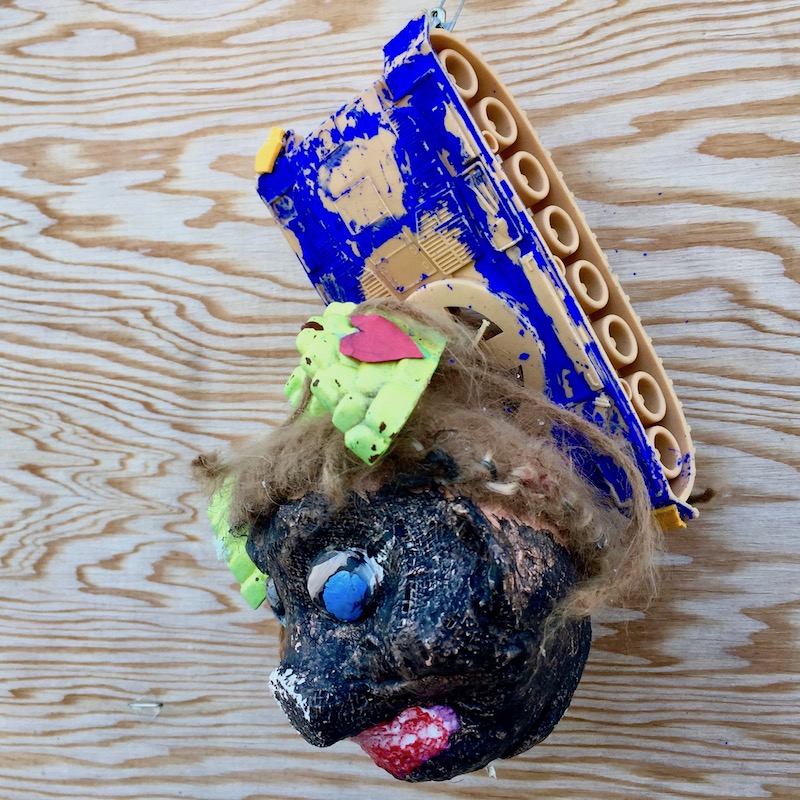
The Babyland Totems don’t always look quite so startling. But even in broad daylight they’re an exciting and unnerving collection of figures to come across purely by accident. Most of the little objets d’art feature plaster cloth-formed humanoid faces, painted either black or brown, and decorated with curly hair, red lips, and, of course, those pale blue eyes.

Each of the softball-sized heads projects from a bundle of colorful fake flowers within a decorative cloth wrap that serves as the little icon’s body. Random accessories–a beanbag, plastic barrettes, a toy army tank–make their appearances, too.

sculpture of black plaster head with fake flowers

verbena tiara

The effect is very much that of the youngest babies, released from the womb, wrapped in swaddling clothes, and surrounded by the magic and love of a new life. It’s hard to tell how content these little fellows are–some appear to be smiling, for sure, but others are mid-scream. We’ve all seen real-life infants taking the same wide range of emotions.

plaster head with fake flowers resting on brick window ledge

window ledge widow’s walk

At the same time, one cannot help but think of these as memorials. Close one eye, tilt your head, and almost every one of the totems takes the form of a simple cross. That familiar shape, the reverent individual attention, and those pink, white, and purple flowers remind us of fresh decorations on grave markers or the all-too-common roadside crosses that appear seemingly out-of-nowhere on the berms of highways and grassy undergrowth along busy through-streets.

The Orbit has spent enough time in and around graveyards to know that grounds crews routinely flush these kinds of plastic flowers–along with the accumulated teddy bears, deflated balloons, and past-date holiday decorations–a couple times a year. If some of Allegheny Cemetery’s fall cleanup ended up here–instead of the landfill–well, we can’t think of a better (re-)use of the material.

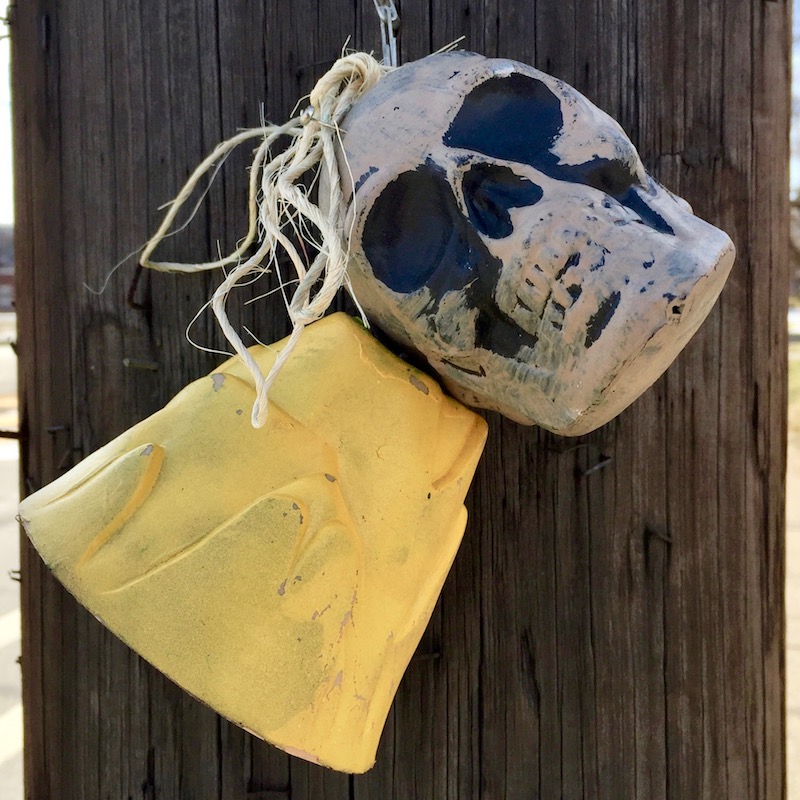
skull and bell attached to utility pole

skull’s out for summer

Babyland, the all-things-newborn supply shop, served Pittsburgh’s East End for over sixty years[1]. For anyone who was in the area before, say, the late oughts, you’ll not soon forget the circular cartoonish images of babies pulling their own diapers down that used to decorate the outside brickwork. Those were replaced by actual photos of super cute tykes not too long before the business closed in 2012. The squat retail space at the corner of Penn and Negley has been sitting vacant ever since.

Unlike some places in town, this will inevitably change fast–in fact, it’s amazing the little building at this prominent intersection hasn’t been razed for the next set of Legoland condos or a fluorescent-lit fast casual chain restaurant already. Development has come loud and hard to East Liberty and the Penn Avenue corridor and we all know there’s plenty to memorialize even where it hasn’t actually happened…yet.

sculpture of black plaster head with golden hair and flowers attached to utility pole

totem/pole

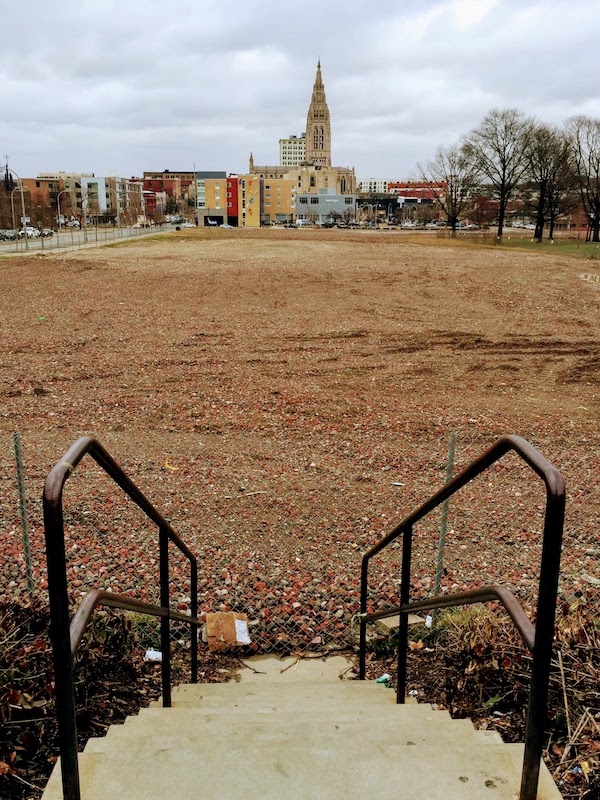
The other obvious–and most important–side to all this is the continuing story of displacement and eviction of East Liberty’s population. From the old Babyland location, one merely has to look east, across Negley Ave., to see a completely denuded landscape where the big Penn Plaza apartment complex stood for the last 50 years. The fallow ground is now an otherworldly red-brown as crushed brick mixes roughly 50/50 with barren soil.

Had the Babyland artist wished to eulogize Penn Plaza instead, he or she couldn’t (at least, not in the same way)–there’s nothing left to even hang a piece of artwork on. [In fairness, there is one set of steps, their handrails, and a full perimeter of chain link fence–but you get the idea.]

stairway leading down to large empty lot

former Penn Plaza apartments lot, East Liberty

In the last two years, Penn Plaza has gone from a large, lived-in pubic housing complex to a mountain of upturned brown brick to the big muddy field it is today. For those of us who didn’t live there, the transformation may have been startling, but we see this kind of ruthless, scorched-earth demolition and redevelopment happening all over.

But for the S’Libertarians whose friends and loved-ones moved away, who saw their community disintegrate, or worst of all–personally suffered the loss of a family home–the upscaling/gentrification/whitewashing (take your pick) of East Liberty has got to pack the same savage punch as a hurricane or tornado blowing through other parts of the world, dismembering the lives in its path.

sculpture of black plaster head with plastic toy tank attached to wood

Babyland: tanks for the memories

Without any better information to work from[2], all we can do is speculate and enjoy the Babyland totems while they’re still around–and they probably won’t be here for long. Like the former retail building they’re installed around or the old Penn Plaza apartments, something will take them sooner or later. Whether that’s a designated city clean-up crew, street art souvenir hunters[3], or just a heavy blast of rain, we can’t predict. But it’s another of life’s constant reminders that everything–even a big multistory brick and steel apartment complex–is really just here for a snap of the fingers or a blink of one of those haunting baby blue eyes.

playing cards wrapped in twine hanging from cowbell

the old Babyland, hanging by a thread

A note on the photos: These pictures were all taken on Feb. 13 (daytime) and Feb. 14 (evening), 2018. We have it on good authority that at least one more totem was part of the original installation, but it had disappeared by the time we got on the scene. Within a few days of the 14th, the two pieces from the plywood over Babyland’s Penn Ave. entrance [“bean baggie baby on board” and “tanks for the memories” (our labels), above] were also removed.

sculpture of black plaster head laying on wet sidewalk concrete

head down to Babyland! [4]


[1] “Longtime East Liberty business Babyland to close and move”, Pittsburgh Post-Gazette, June 8, 2012.
[2] In the course of reporting this piece, we located the artist who created the Babyland totems and made several offers to discuss the work. The artist declined to be interviewed for this story and since there’s no attribution on the individual pieces, we’ve decided to preserve that anonymity.
[3] The Orbit adheres to a strict code of preservation of street art so we do not condone taking pieces such as these for personal consumption.
[4] After finding this lost noggin on the sidewalk, we did our best to reattach it to the rest of the piece using a twig to join the two. How long that lasted is unknown.

Groundhog Gonzo! Fur and Clothing on the Punxsutawney Groundhog Trail

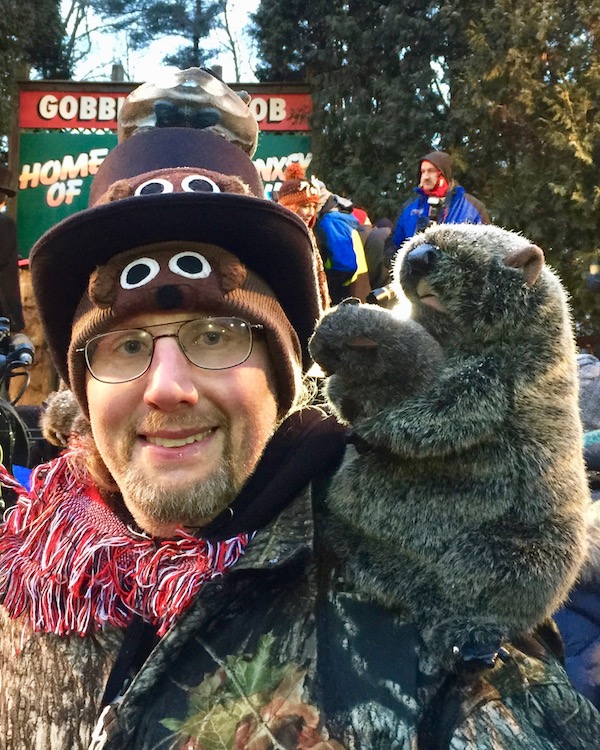
homemade hat with stuffed groundhogs

The world’s coolest…er…coldest fashion show: Groundhog Day at Gobbler’s Knob

Everything you think you know about Groundhog Day is wrong. It’s not about predicting the weather or keeping up some quaint old world tradition–though both of those definitely do happen. It’s not even really about the namesake woodland creature, but you can be excused for thinking so. If most of your information comes from the eponymous Bill Murray/Andie MacDowell movie, I’m afraid you’ve been even further deceived.

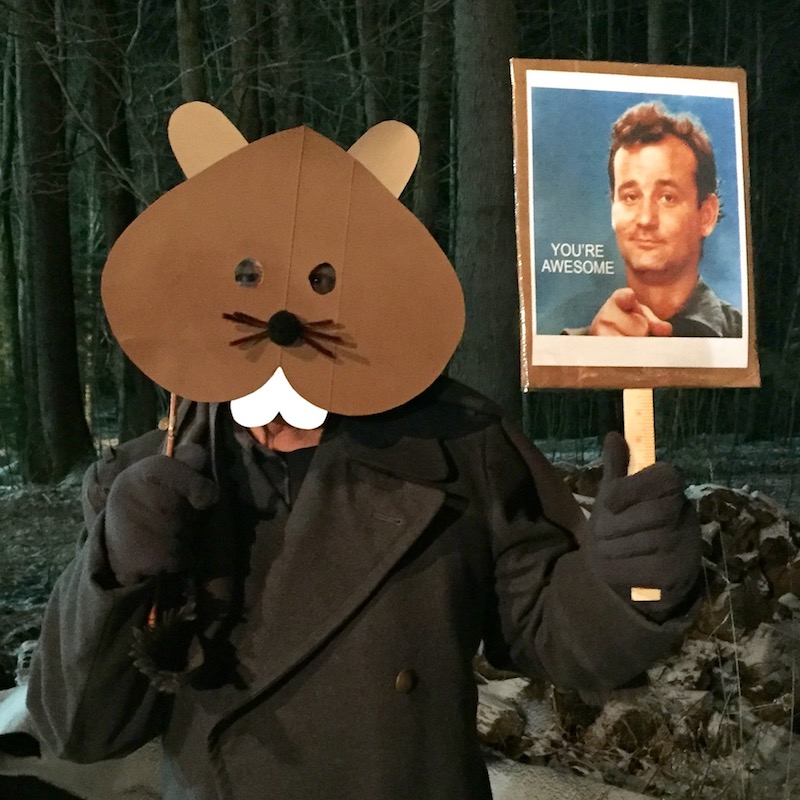
man with groundhog mask and Bill Murray hand sign

Who knew Punxsutawney Phil was a “Stripes” fan?

O.K. Maybe “everything you know is wrong” is an exaggeration. I’ll speak for the rest of the world in saying the basic facts outsiders understand are that on February 2 each year, a committee of local citizens pulls a groundhog (always named “Phil”[1]) from a stump in Punxsutawney, Pa. in an attempt to predict–in the vaguest possible terms–the end of winter and coming of spring. Inexplicably, the season’s future hinges on whether or not the little guy “sees his shadow.”

The Groundhog Day tradition goes back well over a hundred years–even longer if you consider its German roots–and is regular fodder for end-of-broadcast feel-good chuckles between hosts on the evening news. This much is all true.

Man with custom-made Groundhog Day hat

“This is my 11th year!” Super fan from Youngstown, Ohio.

Of the many things Groundhog Day, Harold Ramis’ 1993 feel-good fantasy/comedy, gets wrong[2] is that Bill Murray’s cynical weatherman Phil Connors can’t just roll out of bed at 6:00 AM, chit-chat with Ned Ryerson, and amble across the town square to file his report.

No no no. First of all, you can bet the local network affiliate isn’t ponying up for surge-priced B&B rates on the single day when every lodging in greater Punxsutawney has been sold out for a year. When our crew arrived at 2:00 AM, there was an imposing fleet of satellite-equipped TV trucks already camped-out in the parking lot. All the major networks were there, along with a handful of cable new outlets, plus The Weather Channel and AccuWeather. Big engines were humming and news crews had clearly napped–as best they could–right there in their bucket seats and were already mainlining black coffee to get through the long morning.

news reporter and cameraman filming segment at Groundhog Day, 2018
Phil Connors never got up this early. News crew “doing it live” around 4 AM.

More importantly, though, the movie–filmed not in Western Pennsylvania, but in Woodstock, Ill.–makes it out as if the event takes place in the center of town, on a square surrounded by local businesses. There, a couple hundred people gather to watch Phil do his thing in the broad daylight.

The real Gobbler’s Knob is around a mile–as the crow flies–from Punxsutawney’s equally-charming, but differently-shaped downtown. It sits in the basin of a wooded area–sort of a natural amphitheater–with a large stage and some unobstructive railing to keep the crowds from pushing in too close when things get crazy.

There is not nearly enough parking to accommodate the mass of Phil faithful, so participants arrive through the night and into the early morning on one of a non-stop series of school buses literally moonlighting as town-to-Knob shuttles. The hardier and/or more impatient hoof it up a curling back road from the east side of Punxsy.

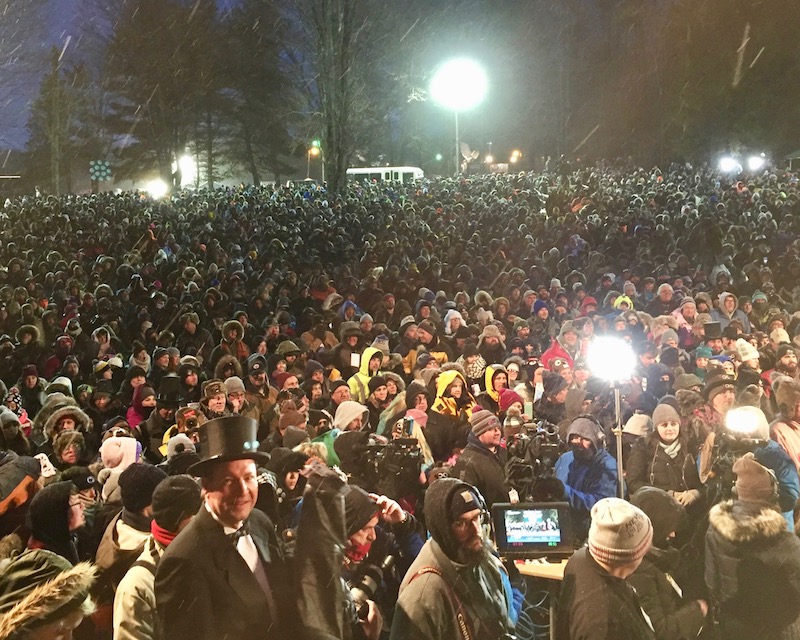
Groundhog Day has become a massive draw for little Punxsutawney. The town of around 6,000 attracts way more visitors than that number to the event. Varying estimates put recent crowd sizes between twelve and thirty thousand people[3].

large crowd assembled at Gobbler's Knob for Groundhog Day, 2018

View from the stage, around 6:45 AM. Umpteen-thousand “hog heads” at Groundhog Day, 2018

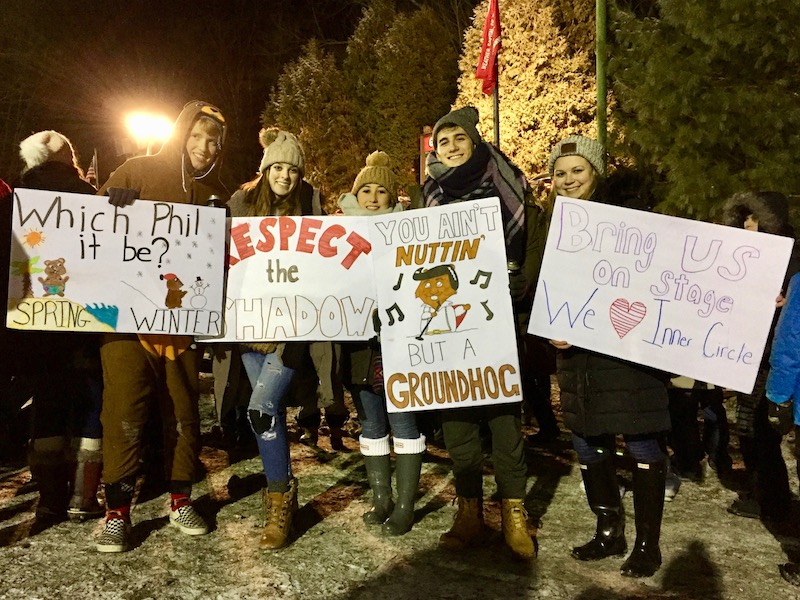
Groundhog Day may be the world’s coldest, darkest D.I.Y. fashion event. This first-time visitor had no idea that so much of the audience would arrive in various degrees of groundhog attire and tribute. There were groundhog masks and groundhog puppets, groundhog t-shirts and super-fan signage, stuffed groundhogs, and full-body groundhog suits.

woman holding groundhog cutout labeled "Erika"

Who’s Erika? Lady groundhogs with colorful skirts.

But it is the hats that really mark this festival. Custom-made toppers of all designs–stacked hog heads like faces on a totem pole and dainty scenes of Phil frolicking in a bed of feathers, pearls, and wispy notions. There are countless renditions of The Punxsutawney Prognosticator either emerging-from or sitting atop his stump and all manner of knit caps featuring cartoonish eyeballs, buck teeth, and little ears.

How many of these are fan-created vs. purchased in downtown Punxsutawney’s groundhog gift shops we do not know (yet!) but any way you slice it, the sheer breadth of Phil-themed headwear was incredible. Orbit staff did its best to get around and document what we could[4], but please realize the photos included here are but a tiny proportion of the actual outfits.

two women with custom-made Groundhog Day hats

“We go everywhere in costume.” Friends and first-time attendees from Virginia with made-for-the-occasion hats.

two men wearing novelty top hats with light-up "PHIL" letters for Groundhog Day

Phil Heads

woman with groundhog hat

Ain’t that America. Patriotic Phil and stump hat.

two women with groundhog hats holding homemade signs for Groundhog Day

Fans from Ft. Lauderdale and Chicago.

five young people with homemade signs for Groundhog Day.

Signs o’ the times. Young fans.

two women holding a sign reading "Smitten with Phil from the Michigan mitten" at Groundhog Day

Sister-fans from Michigan in front of the Groundhog Club’s Philmobile.

Women dressed in colorful Hawaiian shirts, skirts, and leis for Groundhog Day party

The Phil-ettes Dancers before their 5 AM hula routine.

… and then there’s daybreak. My goodness, you’ve never experienced the glory of a sunrise until you’ve spent an entire evening in 12-degree blackness. It was as if natural light did not exist. The feeling of the first rays of a new dawn filtering through spindly tree trunks of a snowy, Jefferson County wood are to be born again, to be showered in light, to feel the absolute glory of being alive.

It is at this precise moment–the event is tightly coordinated to apex at daybreak–that The Inner Circle makes its solemn approach. Twelve (fifteen, maybe?) men [yes: they are all (white) men] in black top hats, long coats, pants, and dress shoes take the stage and perform a variation on the same Groundhog Day ritual that goes all the way back to 1887.

Five men dressed in black pants, long coats, and top hats walk through winter woods

Members of The Inner Circle make their approach at daybreak.

That makes the whole thing sound overly serious–it’s not. There’s a little razzle-dazzle, some corny jokes, and a bunch of good-natured playing-to-the-crowd shenanigans. Phil proceeds to tell us all our future–at least the next six weeks’ worth–relayed through an Inner Circle member who “speaks Groundhogese” with the aid of a weathered walking cane allegedly passed-down from generations of previous Inner Circle insiders.

This is important: it is completely unclear where the whole “sees his shadow” bit comes from. Phil was presented not with options toward and away-from the low-angle morning sunlight, but instead with two tiny scrolls, unfurled, read aloud for the audience, and laid out before his discriminating paws. It turns out the groundhog is not some freaked-out wimp, scared of his own shadow, but instead one who appreciates the winter as a good time to catch up on his reading and make a thoughtful decision.

Punxsutawney Phil raised aloft in Groundhog Day ceremony

Phil’s moment in the sun [photo: Greg Lagrosa]

The uninitiated cynic–especially one from a warmer, more sun rich environ–might imagine Groundhog Day as a group of shivering bumpkins, inanely praying for a rodent’s divination to the end of their long, cold suffering. Move to Florida! they smugly think to themselves, resting their sunglasses to tend the hibachi. But that shallow reading misses everything.

No, the holiday is not a prayer for sunshine; rather, it’s a defiance of winter. Participants don’t just go out in the cold for fun–as skiers or Christmas shoppers might–but rise in the middle of the night, staying out through the longest, darkest, and coldest hours of the year in total communion with the groundhog. It’s flaunting woodchuck fashion with signs asking for–nay, demanding—more winter!

The roar of applause that greets the news of six more weeks of the cold stuff is a hardy people’s collective nose-thumbing (note: not middle finger–this event is as wholesome as they get!) at the notion that fun is inextricably bound to sun.

It is not. The clean-cut, hopped-up, groundhog-crazy crowd at Punxsutawney proves exactly that. To Ol’ Man Winter–just like Phil, George W. Bush, and that fleet of Hollywood cheerleaders before us, we say, bring it on.

Two men wearing groundhog hats in front of Gobbler's Knob stage on Groundhog Day

A couple Phil Phanatics, post-announcement

woman with groundhog hat

In line for a photo with Phil

Getting there: Punxsutawney is about an hour and a half drive northeast of Pittsburgh. The gates to Gobbler’s Knob open to the public at 3 AM on Groundhog Day, February 2 of each year. In 2019, this will conveniently fall on a weekend–just sayin’.


[1] The legend goes that there is only one Punxsutawney Phil, a groundhog imbued with everlasting life–but this is a subject way to broad to cover in this post.
[2] For the record, this blogger still thinks Groundhog Day is a terrific movie–it’s just not factually accurate to the experience in Punxsutawney.
[3] In fairness, the high attendance at Groundhog Day (the event) over the last 25 years is largely attributed to the lasting popularity of the movie. Crowd sizes in 1993 (and earlier) were likely much smaller than today.
[4] No thanks to our cub reporter staff! Thirteen other people in The Orbit‘s posse and not a one turned in a hat photo. Don’t come looking for recommendation letters, you slackers!

Tin Can Pole Art

tin can lid painted with heart and text "I love you Pittsburgh. Goodbye." nailed to telephone pole. Pittsburgh, PA

“I love you Pittsburgh. Goodbye.” Lawrenceville

Such a lovely farewell kiss. The severed lid from a steel can–it looks like it was from one of the big 28-ouncers like you get tomatoes in–tacked into the rough wood of a Lawrenceville telephone pole. Painted onto the flat surface is a decorative white heart with the simple, touching message I love you Pittsburgh, Goodbye.

Less romantic, hypochondriac Orbit readers may get hung up on the totem as a sharp-edged breeding ground for tetanus–but don’t fall for it. The anonymous artist has left this Easter egg high enough off the street and applied it securely to the pole in a way that no one will be injured, unless they’re really trying. On the contrary, this little rusting love letter may just save a life.

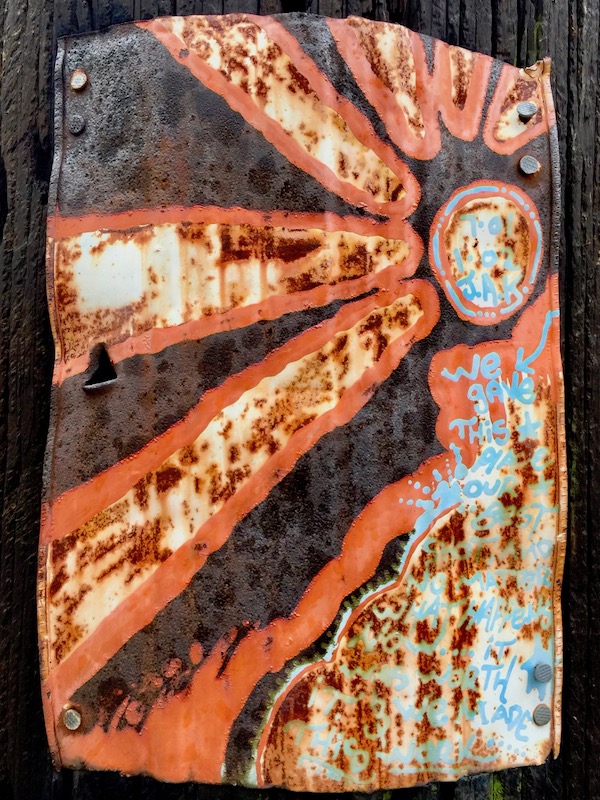
abstract painting on unrolled steel can with message "We gave this place our best shot and no matter what happens now ... it was worth it & we made this work.", Pittsburgh, PA

“We gave this place our best shot and no matter what happens now … it was worth it & we made this work.” Shadyside

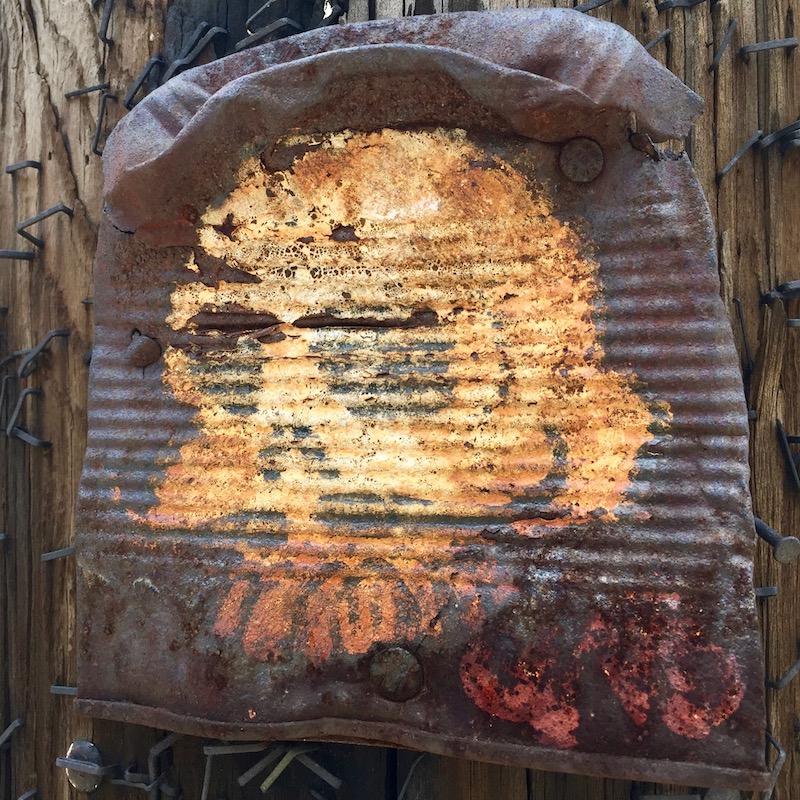
rusted tin can with painting of a skull, nailed to telephone pole, Pittsburgh, PA

skull can, Oakland

Someone’s out there, taking those most lethal occupants of the recycling bin and having a fine time dismantling the component parts, flattening them into two-dimensional work surfaces, and turning the little pieces into cryptic pictograms and coded messages, hidden-in-plain-sight curios and tiny objects d’art.

You may have walked by some of these a hundred times and never noticed. At just a couple inches wide, the little artworks are especially well-camouflaged against the deep brown tarred wood of the telephone poles they’re displayed upon, quite often out of eye level at the peak of arms’ reach.

tin can flattened and painted, nailed to telephone pole, Pittsburgh, PA

A Friday night “to-do” list: love, anarchy, the devil, and a martini, Bloomfield

Cut tin can painted with text and nailed to telephone pole. Text reads "Back then, if it exploded, we laughed", Pittsburgh, PA

“Back then, if it exploded, we laughed”, Shadyside

Whether we’re talking about one lone assailant or a whole gang of tin candidates is anyone’s guess. Besides a few name-like tags [J.A.K.; KYT; Nick (damn); Leroy…are these real people?] there is no attribution here to work from.

That said, many of these specimens have common elements. First, let’s just start with the genre. It’s a niche market, for sure–ex-food container nailed to telephone pole. Second, there’s proximity–all the ones we’ve encountered are in the same one or two square miles between East End neighborhoods Shadyside, Bloomfield, Garfield, and Lawrenceville.

Most importantly, though, the apparent paint pens, handwriting, style of dotted lines, arrows, and indecipherable messages is even more precise. Several of the tiny artworks contain the same iconography of a glowing martini glass, heart, anarchy circle-A, and devil figure.

small painting on steel can of devil with the text "I choose...", Pittsburgh, PA

“I choose…”, Shadyside

small painting on steel can with text "to follow my heart...up the mountain, or...", Pittsburgh, PA

“to follow my heart…up the mountain, or…”, Shadyside

There are some definite outliers in the field. Another large can lid spotted in Shadyside is painted with a night scene featuring a blue river valley between green fields and trees (below). The original pastoral feel has now been accidentally transformed into a scarier, menacing landscape as seasons of rust creep through to the surface. It’s also worth noting that this lid was attached with a pair of Phillips-head screws rather than the full-perimeter flat tacks we found on the other pieces.

painting on steel can lid of night landscape, Pittsburgh, PA

night scene with river, trees, and green grass, Shadyside

tin can lid painted with text "Me vs. Time, KYT, '02" nailed to telephone pole, Pittsburgh, PA

“Me vs. Time”, Garfield

Lastly, there’s even a sub-genre to this already arch form. In a couple places, we came across the big steel can lids with their flared attachment edges and gaping mouth holes that make them look like absurd anthropomorphized flowers. We imagine these come from five- or ten-gallon bulk-size containers of asphalt sealant or roofing tar–but haven’t actually ID’d them yet.

It’s a considerably larger canvas to work from. The wider-than-the-pole size likewise shouts out at the passer-by, where a soup can is more of a whisper. I’m not sure these two examples (below) tell us much about the form, other than we like the possibilities and we’d love to see more of them in action, out in the wild.

round metal lid painted with long string of text nailed to telephone pole, Pittsburgh, PA

“You spin me right round…”, Duck Hollow

cardboard "Clarence the Bird ... Make the World Beautiful" artwork stapled to telephone pole, Pittsburgh, PA

big lid painting [plus Clarence], Friendship

Out on the Tiles: Bill Miller, Lord of Linoleum

linoleum collage artwork depicting a steel mill with city in the distance by Bill Miller

“Steal Mill”*

The image is burned into the DNA of America. Even if you were too young to experience it as it happened, you’ll recognize the figure kneeling on a wide campus footpath. The young woman’s arms are extended to either side and her mouth is agape in what may either be a cry for help, scream of rage, or wail of mourning–perhaps all three. Around her, dazed college students seem to have lost all mooring on reality. Laying face-down on the hard concrete is one of the four slain victims of the 1970 Kent State massacre.

linoleum assemblage artwork representing Kent State massacre, 1970 by artist Bill Miller

“Eager Children Cry”, 2010*

This version, however, is different. The black-and-white photo you’re familiar with now appears in a vibrant array of colors–green fields and bright scarlet classroom buildings, blue jeans and red blood. Also, the layers don’t stand still. Rich, swirling grass seems to be in turbulent sea motion under each of the participants; clothing is alive with texture; every detail–hair, shadows, sidewalk–has an optical illusion-like quality that manages to be both flat and with an inverted depth that places any figure on just about any plane, if you look at it the right way.

artwork of woman's face made from cut linoleum by artist Bill Miller

PABCO woman

When we bought the house, the two rooms of Chez Orbit‘s top floor were covered in a pair of space-age “boomerang modern” mid-century designs completely out-of-place in a 19th century brick row house. The linoleum–a pattern with colorful geometric curved squares intersecting and overlapping all manner of sci-fi cubes, circles, and squiggles–had been installed way back in 1955. Yellowed back pages of The Pittsburgh Press from that year formed a thin barrier between the pine floor boards and the unrolled, wall-to-wall tile and served to precisely date the installation. The linoleum had some scuffs and tears for sure, but the material held up.

When we finally decided to work on the third-floor space, this can’t-throw-anything-away blogger dutifully held onto both the Jetsons-style floor covering and the innocuous news of the day for way longer than he had any reason to. Why? Well, the linoleum just seemed really cool and somebody should do something interesting with it.

artist Bill Miller holding his linoleum portrait of George Harrison in his Pittsburgh art studio

Bill Miller (with linoleum portrait of George Harrison) in his North Point Breeze studio

That somebody, we found out way too late, is Bill Miller and for the last twenty-some years he’s been slicing and peeling, tearing and rearranging the nation’s discarded high-performance floor covering into a terrific body of artwork.

Both pastoral and industrial, historic and fantastic, Miller’s (re-)use of the material manages to look both backward and forward, to be sentimental and transcendental, to be both calming and unnerving. It’s sprung from the artist’s imagination and–like the take on Kent State–totally reverent to a real, shared history of America in the 20th Century.

collection of small artworks on Bill Miller's studio wall, Pittsburgh, PA

Studio wall with Donald Trump portrait

“I count on the material to be exciting,” Miller says, “for the linoleum to feed the work.”

The linoleum is exciting. Surrounded by heaped cardboard box-loads, piles stacked from the floor, and work tables full of sliced bits and bobs, Bill Miller’s North Point Breeze studio has a hundred attics’ worth of somebody-else’s memories just waiting to move from the floor and up onto the wall.

There are geometric mid-century designs like the ones we used to have upstairs, along with wood grains, ersatz Oriental carpets, floral arrangements, psychedelic swirls, and designs for children’s playrooms. The particulate from a century’s worth of disintegrating linoleum peppers the air as a dozen different simultaneously-in-process artworks lay on work tables waiting for their next addition on the road to doneness.

in-process linoleum collage artwork by Bill Miller

untitled / in-process studio piece

Don’t worry, though–it’s all natural, non-toxic stuff. Linoleum is made from linseed oil applied to a burlap or canvas backing. The flooring had its run from the late 1800s through the mid-20th century when cheaper, more durable vinyl took over the market. Miller doesn’t mess around with PVC. “Only the old stuff–pre-World War 2,” he says.

Given the age, you’d think there would be a dwindling supply of (re-)usable material out there, but that hasn’t been the case. Just like our top floor, Pittsburgh–and the rest of America–is chock full of old houses with stores of linoleum still in use and gradually getting removed as young whippersnappers move into those old houses and fix them up. “Getting the material out of people’s homes is really powerful,” Miller says, “people have a real connection to the linoleum.”

linoleum artwork depicting the sinking of the Titanic by Bill Miller

“Titanic”, 2014

As one might expect, there are certain colors, shapes, and patterns that either don’t exist or just don’t show up that often in the recycled linoleum supply. True black is particularly rare, Miller says, and he almost never comes across purple.

Other patterns speak to Miller immediately. “The material is part of the composition,” he says. A speckled red and blue on an off-white background was so obviously birch tree bark that it had only one purpose. Looking at it now, laid out on on a work table and (nearly) fully-composed, it’s hard to imagine what the raw piece looked like before it got trimmed down to tree trunks–it’s just so perfect in its final composition.

artwork of forest scene featuring birch trees made from cut linoleum by artist Bill Miller

untitled/in-process (birch trees)

… and then there’s the rock-and-roll. This interview got majorly side-tracked when both parties started geeking out on record shopping, music fandom, Bob Dylan’s radio show, The dBs, and Sonic Youth.

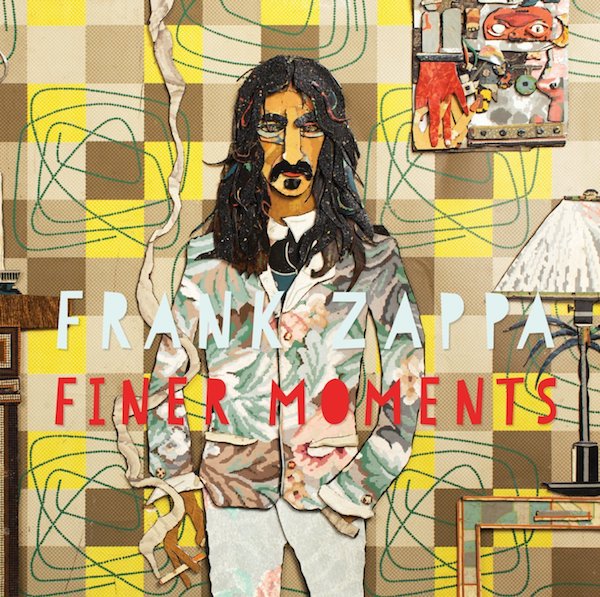
This is only really relevant because Miller is very obviously a huge music fan who fulfilled a personal dream in hooking-up with the Frank Zappa estate to produce album cover artwork for two of the musician’s posthumous releases. The live compilation LP Finer Moments (Zappa, 2012) and spoken-word/congressional testimony CD Congress Shall Make No Law… (Zappa, 2010) both feature Miller’s renderings of Frank Zappa created specifically for each of the records: one, early ’70s Zappa, long-haired and smoking; the other, mid-’80s suit-and-tied, talking with the press.

Miller has converted linoleum into numerous tributes to music icons including The Beatles, Bob Dylan, Mahalia Jackson, David Bowie, Maybelle Carter, Hank Williams, and Brian Eno. Among the collectors of his work are musicians Neko Case, Dave Matthews, and The Eagles’ Timothy B. Schmit.

Album cover for Frank Zappa "Finer Moments" LP, artwork by Bill Miller

Frank Zappa, “Finer Moments” LP, album cover artwork by Bill Miller*

Frank Zappa, "Congress Shall Make No Law..." CD with album cover artwork by Bill Miller

Frank Zappa, “Congress Shall Make No Law…” CD, album cover artwork by Bill Miller*

Oh, there’s a lot more that could be said. There are Miller’s depictions of American history in the form of Abraham Lincoln, the sinking of the Titanic, landing on the moon, and the Kennedy assassination, along with more conceptual/impressionist pieces around urban/industrial life and personal reminiscences of his childhood and family life growing up in Cleveland…but that’s something for another story.

It would be great to end this piece with an invitation to view Miller’s work at an upcoming show, but…he’s got nothing scheduled for Pittsburgh in 2018 (sigh). For now, we’ll just say that Bill Miller’s inclusions in the 2016 Re:NEW Festival/DRAP Art show were a major revelation. We’re so glad we were able to track him down and that he took the time to welcome us up to his studio and into the linosphere.

To see more of Bill Miller’s linoleum artwork, check out his web site billmillerart.com, or follow him on Instagram at @billmillerart.


* Photos courtesy of Bill Miller / billmillerart.com. All other photos by Pittsburgh Orbit.

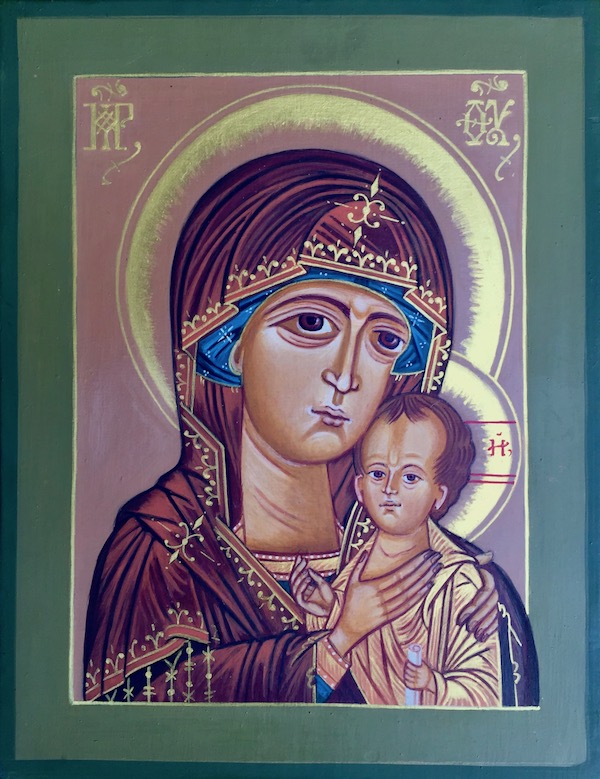
All Rite Now: Simeon Larivonovoff, Painter of Icons

icon painter Simeon Larivonovoff holding a glowing icon of the Arcangel Michael

“An icon is a prayer in color. It is a window to paradise that shows you how to be transfigured.” Simeon Larivonovoff with icon of “golden hair” Archangel Michael

Waaaay longer than most of us can conceive of. Longer than the United States of America has existed; earlier than the Europeans landing at Jamestown and Plymouth Rock; a hundred years before Columbus was born–let alone sailed the ocean blue.

Six hundred and fifty-nine years. That’s how long the continuous line of Russian icon painters goes back. For seven centuries, the ancient devotional practice of creating highly-formal prayer paintings has been passed from father to son [yes: they have all been men]. That uninterrupted legacy may come to an end here, in Pittsburgh, with Simeon Larivonovoff.

icon painter Simeon Larivonovoff sitting on a bed with a small dog on his knee

“You don’t mix cabbage with peas.” Simeon with one of his “doggies” in his bedroom/workroom.

A blast of sensations–I’ll warn you they’re not all pleasant–will arrive early and often. Visiting Simeon’s modest Polish Hill home begins with the raucous barking of his six dogs which completely nullifies any need for a doorbell. Simeon refers to these pooches with the diminutive “my doggies” or “my puppies,” even though they’re all full grown–several in a very big way. At least one member of the pack will be a constant companion–on the lap, by his side in the garden, or taken out on a leash sporting a jaunty kerchief as companion on Simeon’s frequent walks over the Bloomfield Bridge to the Shur-Save, or up Liberty Avenue.

The musky smell of animal fur–there are also a pair of house cats–mixes with the splinters of unfinished wood floors, stiff knotted area rugs, furniture polish, and antique brass. But it is the evocative omnipresent flicker of lamp light refracted through glowing cut glass and its partner aroma of smoking paraffin oil that will color your memory hours, days–weeks even–after departing. It may also be the best analog for Simeon’s world.

icon painter Simeon Larivonovoff lighting oil lamp

“Electric light is not needed,” Simeon lighting one of the dozens of oil lamps that light his home

The well-meaning speculative journalist faces a challenge photographing inside Simeon’s home. “Electric light is not needed,” he says while igniting the wick of an ornate, retractable, ceiling-mounted oil lamp–one of dozens of different models throughout the house–“these [lamps] are not in today’s society.”

Simeon is a member of the Russian Orthodox “Old Believers”–a sect of Greek Orthodoxy that preserves church practices going back to the 1600s, along with many of the lifestyle habits that go with it. “We pray in a pure 17th century style, before reform. We are non-conformists,” Simeon says. He further describes the group as “The Amish of Russian Orthodox.” The analogy–right down to the long beards and rejection of (most) modern technology–is pretty apt. On life in the 21st century: “I deal with the world, but I’m not influenced by it.”

That said, Old Believer practices also seem to overlap with that other locally-familiar brand of strict orthodoxy, Judaism. There is a weekly day-long, sundown-to-sundown sabbath in which no work may be done. “To cook a meal, to sew a button…no. A lot of people won’t answer the door on Sunday,” Simeon says of his fellow Old Believers. There is also a Kosher-like diet that forbids many of the same food sources: shellfish, eel, and octopus, pork and blood sausage.

partial icon for St. Praskevia with only the face and hands painted

“We don’t look at icons–they’re looking at us.” St. Praskevia icon (in process)

A visit with Simeon falls somewhere between Sunday school and Psychedelic Shack; as much Waiting for the Sun as waiting for The Son. “An icon is a prayer in color. It is a window to paradise that shows you how to be transfigured,” Simeon says of the goal of his artwork. “You ask the saint to help–you are not an artist, you are the medium.”

Simeon began painting icons at the age of nine, born into the family practice. “My father: you were his student,” Simeon says, “You had to learn a lot–prayers, colors.”

in-process icon of St. Kazanskya by Simeon Larivonovoff

“Our Lady of Kazan”, Kazanskya icon (in process)

There certainly was–and is–a lot to learn. There was the practice of grinding his own paint pigments from natural sources [the tan color in the photographed icons comes from sycamore bark] and learning to read and write in church Slavonic (aka old church Bulgarian) with its 63-character alphabet. Icon painters must have “a library of icons in their head–the mind, heart, and hand are on the same level.”

Iconography follows a strict canonical representation of each saint. “You don’t dare deviate from the form,” says Simeon, “theology does not change.” Small details and colors may be chosen by the individual painter, but, according to Simeon, the main outline of an icon may never be altered between versions, renditions, and artists. Finished icons are never framed because “You cannot put God in a box.”

Certain details are crucial: the relation between forms or seemingly small elements–the number of curls in a beard or an eyebrow raised, finger positions or the clutch of a scroll. “How you portray hands on icons is very important,” says Simeon, “The hand of Daniel is very big to show you the prophesy.”

icon of St. Petrovskya by Simeon Larivonovoff

“An attainable salvation.” Icon of St. Petrovskya

Simeon’s knowledge of Russian church history and the world of iconography runs very very deep. So deep it’s no small challenge for the interviewer to keep up with the artist’s barrage of names, dates, liturgy, and riddle-like koans that densely fill each conversation like the icons that decorate his walls.

In our multiple meetings, I took a bunch of notes from Simeon’s monologues on subjects like St. Sergius Radonezh, sabbath practices, and The Schism. But with bon mots falling like beeswax drips from a prayer candle–“Falling in the mud is one thing, being of the mud is something else” or “An icon is a pilgrimage from one holy place to another…between heaven and earth to see glimpses of paradise” or “We don’t look at icons–they’re looking at us”–well, you should probably go to the history books when you’re really ready to dig in.

wall with dozens of traditional Russian Orthodox icons painted by Simeon Larivonovoff

“The wall of icons are witnesses interceding to God for you.” Simeon’s bedroom/workspace.

Simeon’s own history gets a little murkier. When and why he emigrated to America was dismissed with a wave of the hand, “You don’t mix cabbage with peas.” [I believe this was analogy about religious persecution.] The dates and ages that get thrown around freely are a little squishy, too. That 659 years we mentioned above was a mere 647 years in a previous meeting. The very precise histories of antique oil lamps and furniture? Well, they’re all plausible. An ancient Russian prayer book of psalms or “chants” may or may not be in demand from The Smithsonian.

Regardless, Simeon is absolutely devoted to his craft. “This is the sole reason for my existence–to paint icons,” he says. And paint he has. Simeon estimates he’s painted between three and four thousand icons in his lifetime for an audience both within his local communities and around the world–some devotional, others are private collectors. Now he’s down to creating around 50 a year with eight or ten in process during our meetings. “I’m getting old,” Simeon says.

icon painter Simeon Larivonovoff with icon of St. Hodogitria

“You ask the saint to help–you are not an artist, you are the medium.” Simeon with icon of St. Hodogitria, “She who takes you by the hand, she who shows you the way.”

As strict a regimen as Old Rite Russian Orthodoxy seems to this outsider–its denial of compact fluorescents, crab cakes, and rock-n-roll seems like a heavy price for salvation–that’s not the way Simeon sees it. “We are a joyful religion…sunset is a new day beginning,” he says.

It’s a lovely way to look at the world–the early extinguishing of light in these darkest December days as not the trigger for seasonal affective disorder, but rather the beginning of a new possibility. That we are of the mud, transfigured, and on our tip-toes, trying to get one of those glimpses of paradise. Just don’t mix your cabbage with peas.


Bonus material! Back in 2011, local filmmaker Julie Sokolow made a short film of Simeon where you can see the man in motion. The lamp-lighting, dogs, and challenges of shooting in a home without electric light are all there.

Going Postal: Cap Man Fever, Part 2 OR Whither, Cap Man?

postal slap on light pole with portrait of young man in baseball cap, Pittsburgh, PA

Cap Man #12, Forbes Ave.

Cap Man has left the building.

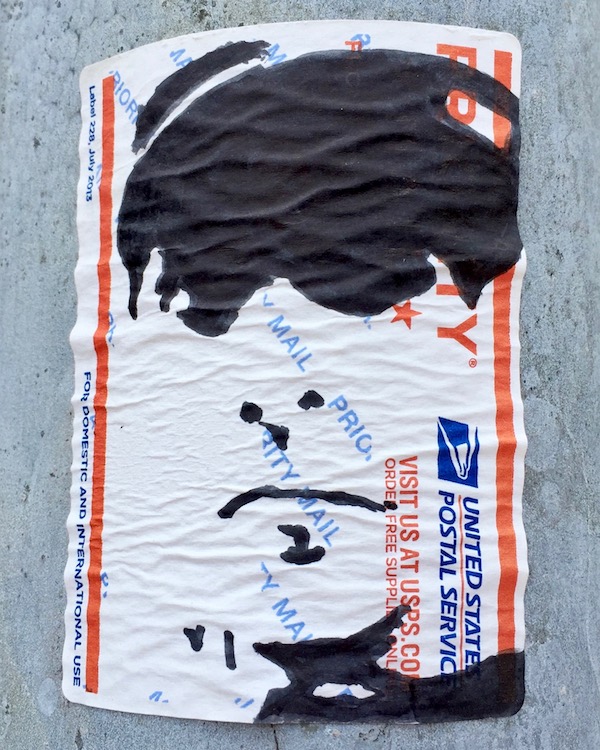
More accurately, he’s likely left Pittsburgh entirely*. The possibility also exists that the young “postal slap” artist who decorated the lamp posts and traffic signage of central Oakland over the past year has just moved on to another less public hobby. But we doubt it.

postal slap with portrait of young man in baseball cap, Pittsburgh, PA

Cap Man #10, Neville St.

Let’s back up. Over the summer, we reported on the serial application of hand-created Sharpie-on-postal label artworks throughout the greater Craig Street and Forbes Ave. area of Oakland. A lot of folks use this medium, but few work in portraiture. [See “Going Postal: Cap Man Fever”, Pittsburgh Orbit, June 11, 2017.] These little sticker pieces were committed by an unknown, anonymous artist who appeared to be (perhaps overly) obsessed with literally plastering his face all over town.

No sooner had we published our second, tangentially-related story [“Going Postal: Rogues Gallery”, Pittsburgh Orbit, July 30, 2017] than a new salvo of Cap Man (self-)portraits began appearing, including a nice run down mostly-residential Neville Street in Oakland.

postal slap with portrait of young man in baseball cap, Pittsburgh, PA

Cap Man #9, Neville St.

The image was unmistakably our guy–the same upturned, tagged, and jauntily off-center ball cap; the same flat expression and deep-seated eyes on a familiar young white guy face–so we bagged them. [Observant Orbit readers will note our photographs are from a point after some heavy mid-summer rains soaked the stickers thoroughly, leaving the dried artifacts crinkled, but still color-rich.] Then we waited for more…and waited…and waited.

But, as we learned from the years counting the seconds for Chinese Democracy to drop, there’s a point where it’s healthiest to just let go. This then may be a final goodbye as well as a thankful tribute to Cap Man. For whatever brief period, he made the sidewalks of Oakland a little more interesting and the art of the postal slap a little more creative.

postal slap with portrait of young man in baseball cap, Pittsburgh, PA

Cap Man #11, Neville Street

So what’s become of Cap Man? Our original hypothesis–a Pitt student who slapped his way across Oakland in the daily commute from a bus stop on Fifth and/or Craig Street to his campus classrooms–still holds water. Perhaps even more so, considering the termination of the ink portraits roughly coincides with the end of the university’s summer term.

That said, it’s safe to say there’s a fair chance we’ll just never know what was up with this dude. Cap Man may well have taken his business or computer science degree back to Philadelphia,  New York, or Washington, D.C. and is now safely installed running the numbers or pushing digits far from the telephone poles of central Oakland and the bus shelters of Bloomfield. Hopefully he’s still got his collection of Sharpies and they’re not just used for addressing large packages and system diagraming on large conference room brainstorming tablets.

Wherever you are and whatever you’re up to, godspeed, Cap Man.

postal slap with portrait of young man in baseball cap, Pittsburgh, PA

Cap Man #12, Forbes Ave.


* A little gender assumption here, yes, but as explained in the earlier post, Pittsburgh Orbit believes these are self-portraits of a young man.

Vex Ed: Designs for a New Pittsburgh Flag

proposed Pittsburgh city flag by "Goob" with abstracted design based on Pittsburgh's three rivers

“Three Rivers”, Goob

In a word, rivers. That’s what people–at least, the people who took up The Orbit‘s flag redesign challenge–thought most represented the City of Pittsburgh. Map-perfect renderings of the Mon, the Allegheny, and the Ohio are colored a fantasy blue we’ll never actually see in the murky waters around here. Rivers represented by the most simple wavy-lined icon-style rippling wave forms got there too.

Last month, we introduced a contest to see if readers could come up with a new Pittsburgh flag that would avoid some of the design woes and visual no-nos in our current banner while having a bit of fun thinking about what other options might be on the table. The deadline has passed, those submissions are in, and we’ve got the results for you–right here and right now.

All the flag designs we received are good, but we really love Goob’s[1] “Three Rivers” (above)–a perfect abstracted layout of Pittsburgh’s waterways in broad gold strokes on a solid black field. It’s not city hall official, but the design is so simple and powerful that we could totally imagine this as a sort-of alternate “people’s flag” sold in street stalls in the Strip next to Cleveland Still Sucks and Heath Miller Time: The Champagne of Tight Ends t-shirts.[2] At least, we’d happily fly a version of this from the front porch of Chez Orbit.

proposed Pittsburgh city flag by Ian Finch with gold triangle and black river waves imitating the Pink Floyd "Dark Side of the Moon" album cover

“Dark Side of the Mon”, Ian Finch

proposed Pittsburgh city flag by Erik Schauer with blue river river design on existing black/gold/black tri-color background

current flag, enhanced by rivers, Erik Schauer

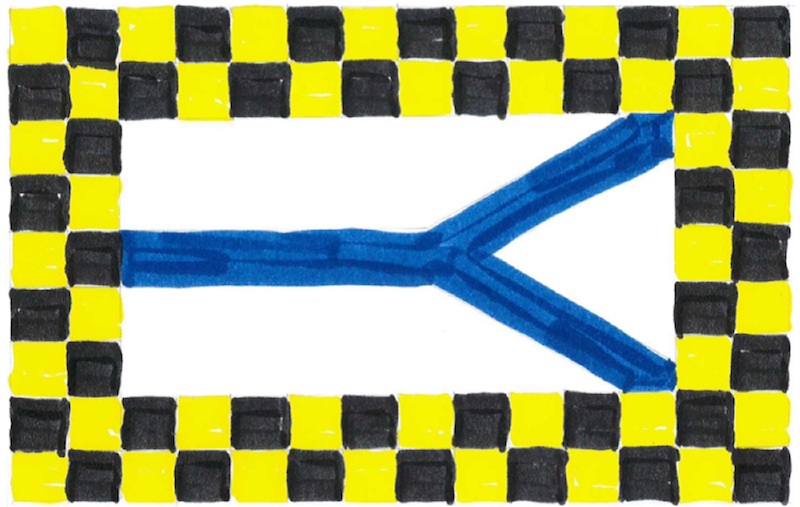
design sugestion for new Pittsburgh flag by Ray Strobel with blue wavy river lines

“Argent, a pall wavy issuing from sinister azure, within a bordure checky or and sable”, Ray Strobel

Several of our entrants also mind-melded on the idea of abstracting the general path and arrangement of the rivers as well as the division of the North Side/South Side/East End land masses as angular trapezoidal geometry.

Of these, River Dolfi’s submission is particularly effective as a simple, highly graphic three-color affair with an interesting symbolic narrative. Dolfi explains:

“A flag incorporating the traditional Pittsburgh black and gold. The area of the flag is split into three sections, reflecting the way the three rivers split the real city. These divisions also represent the past/our steelmaking heritage (black), the present golden triangle (the golden triangle), and our blank-canvas future (white).”

proposed Pittsburgh city flag by River Dolfi featuring gold triangle with black and white other sections

Pittsburgh past/present/future, River Dolfi

design sugestion for new Pittsburgh flag by Ray Strobel with black lines to represent the three rivers and three black hypcycloids on a gold field

“Or, between a pall issuant from sinister, three hypocycloids sable”, Ray Strobel

design sugestion for new Pittsburgh flag by Ray Strobel with blue lines representing the rivers

“Argent, a pall issuing from sinister azure, within a bordure checky or and sable”, Ray Strobel

Ian Finch, a graphic designer by day and apparent Pittsburgh ex-patriot, has turned in three cheeky numbers that are all fun. “Dark Side of the Mon” (above) falls into the river category by parodying Pink Floyd’s similarly-titled 1973 stoner/headphone classic. In Finch’s hands, the original album’s prism and light rays cover art becomes a golden triangle separating two bodies of water–one placid; the other gentle rippling waves.

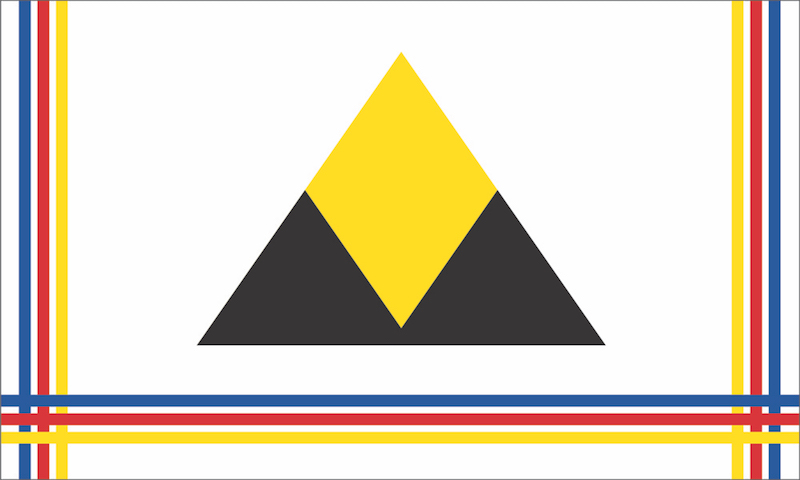
“Mount Worshington” manages to jag on Pittsburgh pronunciation, one of the city’s iconic hilltop neighborhoods, and an old-school patterned tea towel to dry your hands off after all that worshing up.

While Bruce Willis and Sarah Jessica Parker have put 1993’s Striking Distance long in their rearview mirrors, Pittsburghers conjure it every time they “take Bigelow” or lead the police on a high-speed chase that ends up taking out a truckload of Iron City beer barrels. Finch’s tribute is a little harder to parse–and probably not what we as a city want to hang our hat on–but still gets marks for its clever use of the golden triangle blended with police/military stripe imagery.

proposed Pittsburgh city flag by Ian Finch with black and gold triangle mountain and cloth-woven border in blue, red, and gold

“Mount Worshington”, Ian Finch

proposed Pittsburgh city flag by Ian Finch of military-looking gold triangle and angled black stripes

“Striking Distance”, Ian Finch

“We all know that Pittsburgh is about many things, but little separates us from other towns like our abundance of bridges and pierogies,” says Paul Schifino about his pierogie-bridge flag. “Is it a bridge? Is it a pierogie? The answer is yes. My goal was to create something graphic with a simple message: We Are Pittsburgh.”

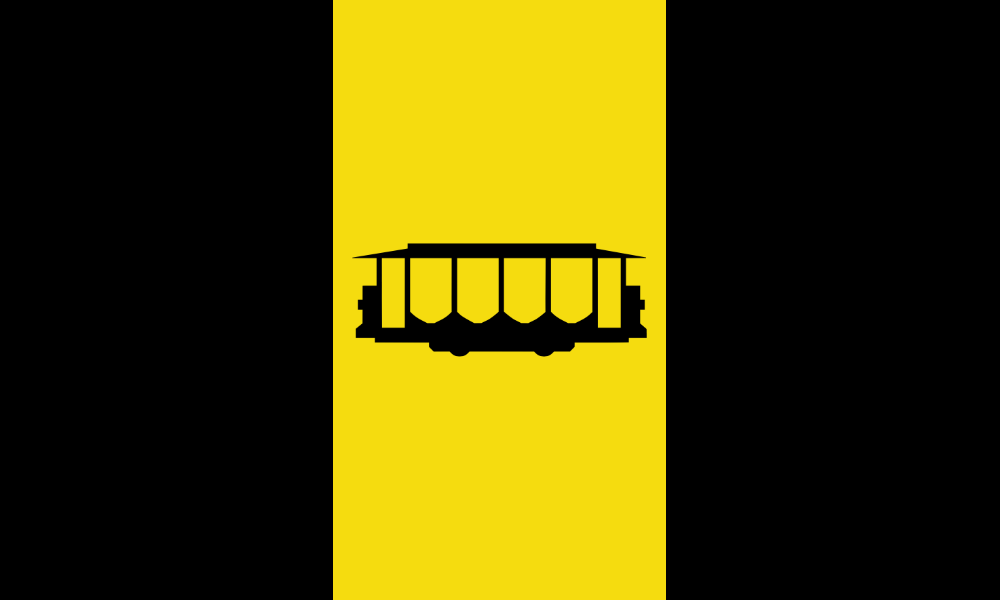
Also in this other category is another entry from Goob–this one taunting us with Pittsburgh’s history of great streetcar lines, mercilessly ripped-out in the 1960s and ’70s to everyone’s continued dismay. Sigh. Oh yeah, maybe it’s also a Mr. Rogers thing.

Ray “Ain’t Gonna Happen” Strobel thinks Pittsburgers would rather look at a big-ass insect than the current city flag. But, like Ian Finch, he’s really just riffing on the Pittsburghese n’at / gnat … we think.

proposal for Pittsburgh city flag by Paul Schifino with image of pierogie shape and bridge elements

“Is it a bridge? Is it a pierogie? The answer is yes.”, Paul Schifino

proposed Pittsburgh city flag by "Goob", with silhouetted trolley car against existing black/gold/black tri-colored background

“Trolley”, Goob

design sugestion for new Pittsburgh flag by Ray Strobel with a drawing of a gnat on a gold field

“Or, a gnat proper. (Say it. C’mon… say it. Get it? Get it??)”, Ray Strobel

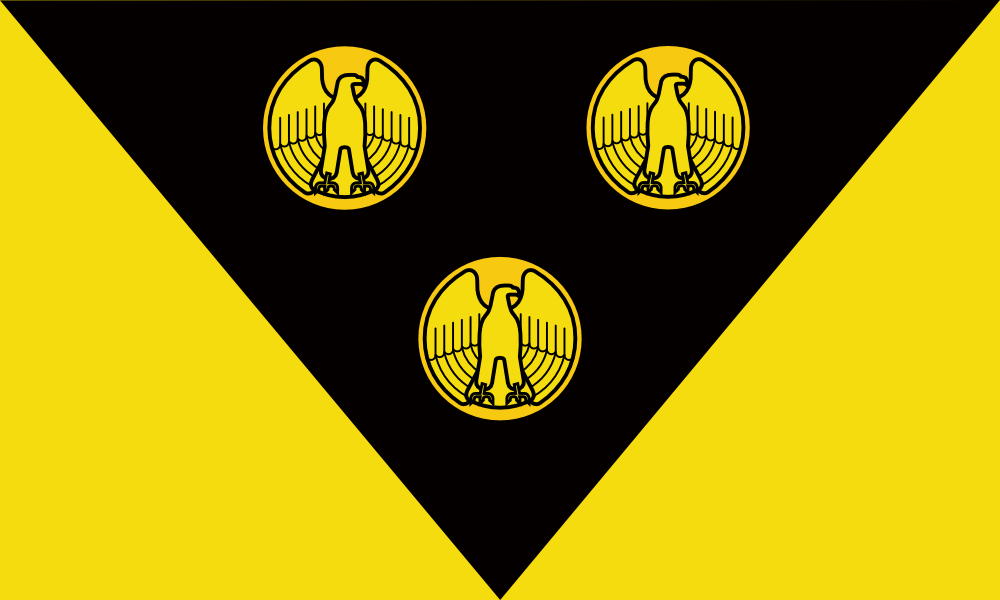
The over-achieving Goob turned in two additional entries, both working from Pittsburgh’s 1925 city ordinance that brought us the current design.[3] “Three bezants bearing eagles rising with wings displayed and inverted Or,” reads the passage which describes this general arrangement of antique golden coins on a black, triangular background.

These two of Goob’s entries are probably the most legit as far as satisfying the original flag definition and something you could actually imagine hanging in the courthouse. That said, we still don’t have either the “fess chequay Argent et Azure” or the “triple-towered castle masoned Argent” that got us into this mess in the first place. So the powers that be would probably throw these entries out on a technicality, but we like them.

proposed Pittsburgh city flag by "Goob", with gold eagle-fronted coins on black triangle on gold field

“Triangle Coins I”, Goob

proposed Pittsburgh city flag by "Goob", with gold eagle-fronted coins on black triangle on existing black/gold/black tri-colored background

“Triangle Coins II”, Goob

One thing about getting into vexillology: you’re going to learn some new vocabulary. We’ve already tripped across bezant (an old Roman/Byzantine coin), sable, argent, and or (the heraldic colors black, white, and gold, respectively).

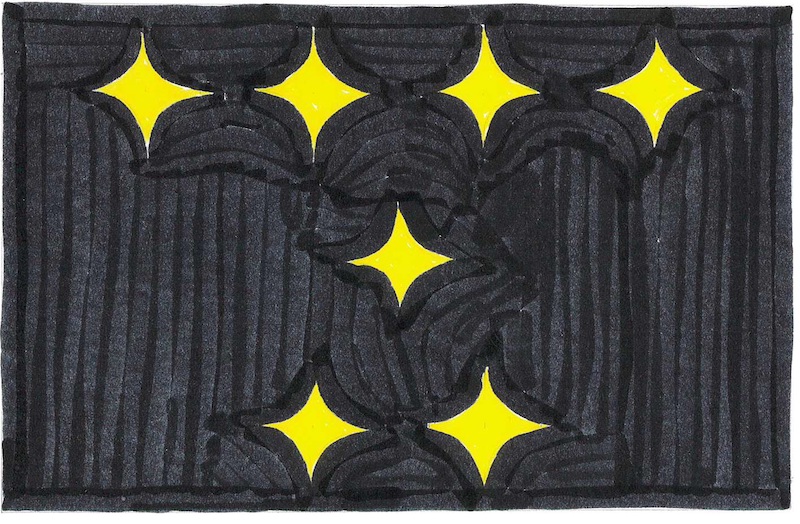
Ray Strobel, who in the high-stakes poker game of Vexillology Stud saw Goob’s four designs and raised that another two, drops this kind of lingua flaga with wild flag-bearing abandon. While it would take a whole glossary to get through descriptions like “Sable, in fess on a hypocycloid or a penguin proper, two leg bones in saltire argent,” the world-wise Orbit reader will get the idea with just a good look at the pictures.

design sugestion for new Pittsburgh flag by Ray Strobel with combined logos of Pittsburgh sports teams

“Sable, in fess on a hypocycloid or a penguin proper, two leg bones in saltire argent”, Ray Strobel

design sugestion for new Pittsburgh flag by Ray Strobel with seven gold hypocycloids in rows of four/one/two on a black field

“Sable, seven hypocycloids or, four, one, and two”, Ray Strobel

Finally, Brett Yasko turns in a design that reads like a Zen koan and breaks every rule of flag design. [Brett: don’t you know not to put words on a flag? how’s that thing going to read when it’s 50 feet in the air and there’s no breeze to stretch it out??] That said, what red-blooded cat owner doesn’t like animated gifs?

This one probably stands zero chance of reaching a city council floor vote, but that doesn’t mean we don’t agree with the sentiment. It’s the ones we love that can make us uniquely insane. For anyone–perhaps everyone–who’s grown up in, spent time around, or committed-to Pittsburgh, you’ll probably share some level of understanding how the city drives you crazy because you care about it so much.

The Orbit is doing its thing–and you may well be reading about it–because we love the city that much. Whatever flag you may be flying for the city of Pittsburgh–literally or figuratively–let’s raise it high.

flag that just includes the text ""Sometimes I really hate Pittsburgh because I love it so much" by Brett Yasko

“Sometimes I really hate Pittsburgh because I love it so much”, Brett Yasko

Many thanks to all who participated in the flag redesign challenge–this was really fun. Maybe we’ll do another one along these lines in future.


[1] Presumably not his or her real name, but the anonymity has been preserved at the request of the entrant.
[2] Goob: you and me are going to make so much money! [But we’ll need a real name to make the checks out to.] [Maybe we could do one of things where I drop a manilla folder full of cash into a trash can in the park and you send an innocent rube to pick up the “drop”.] [Ahh, I don’t know if that will really work, but don’t worry–we can figure out the details.]
[3] Flag of Pittsburgh, Coat of Arms and Seal. https://en.wikipedia.org/wiki/Flag_of_Pittsburgh#Coat_of_arms_and_seal