Lawrenceville Stencil Graffiti

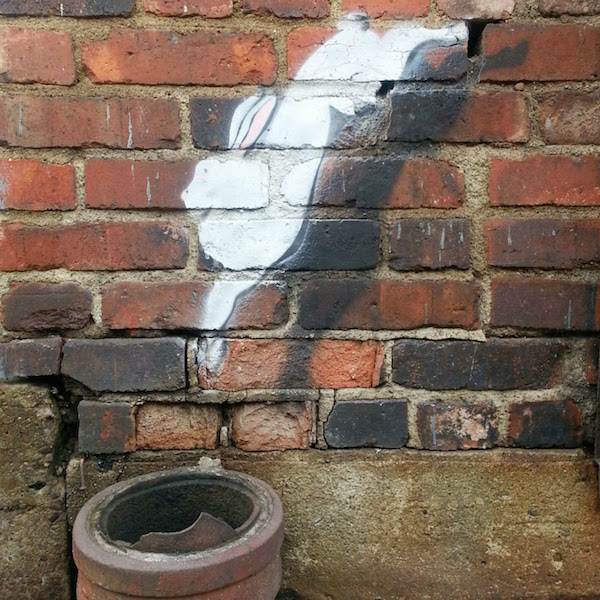
stencil graffiti of rabbit jumping, Pittsburgh, Pa.

This law-abiding blogger has never committed an act of graffiti in his life–but that doesn’t mean he doesn’t think about it! All the time, as a matter of fact. If I were going to get into the wall-scrawling business (don’t get your hopes up: the chances are extremely low), I’d follow a very strict code of ethics: I wouldn’t touch anyone’s personal property, I wouldn’t write some dumb, regrettable message or invent a cheesy “tag” like, say, 0rbi7, I’d make damn sure the graffiti was only an improvement to the visual landscape, and I’d perpetrate with a stencil.

Why a stencil? I’m glad I asked for you. Mostly because if they’re created with any dignity, stencils just look uniformly good, without looking uniformly, uh, uniform. They have the beauty of any hand-run print process that provides great repetition of image, but with each rendition some warm distortion and subtle variation.

All of these stenciled pieces come from a relatively small area of Central Lawrenceville–mainly 42nd and Harrison Streets (I think). I’m sure there are plenty more where these came from, so hopefully The Orbit can get a few more pulls out of this particular template.
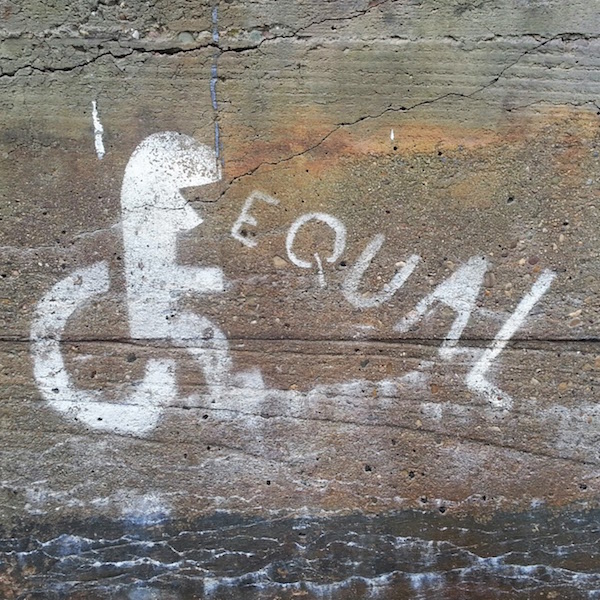
stencil graffiti of figure in wheelchair with the word "equal", Pittsburgh, Pa.

Equal

With all due respect to The Orbit‘s female, LGBT, and people-of-color brothers and sisters, the disability community is the minority group that has by far the least public exposure and the largest and longest denial of basic human rights. No Hollywood stars are lining up around accessible transit issues, Iggy Azalea is not getting uninvited from any giant downtown deaf pride events, and no one is burning retail stores over the unemployment rates of blind people. I’ve seen these Equal graffiti splashes in Lawrenceville, Polish Hill, and Bloomfield, which is a great sign of some small amount of awareness at a very literal street level (and my wife reminds me that there are a lot of very positive changes happening in this space). Now, why the person in the wheelchair looks like Pac-Man with a torso…
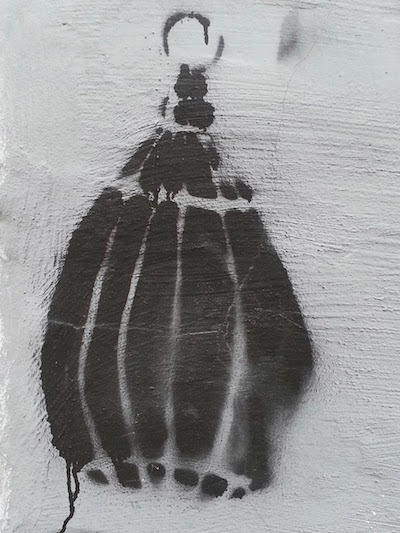
stencil graffiti of hand grenade, Pittsburgh, Pa.

Hand grenade (?)

This one violates my above-stated personal rule against “bombing” personal property. But if I was the owner of the row house whose cement foundation wall had this illicitly added, frankly, I’d be fine with it. [That is not an invitation!] So far, no one has busted out the Zinsser to cover it up, so perhaps these neighbors are on the same wavelength. Bonus points for the paint run (the stenciler’s equivalent of a beauty mark) in the bottom left corner.
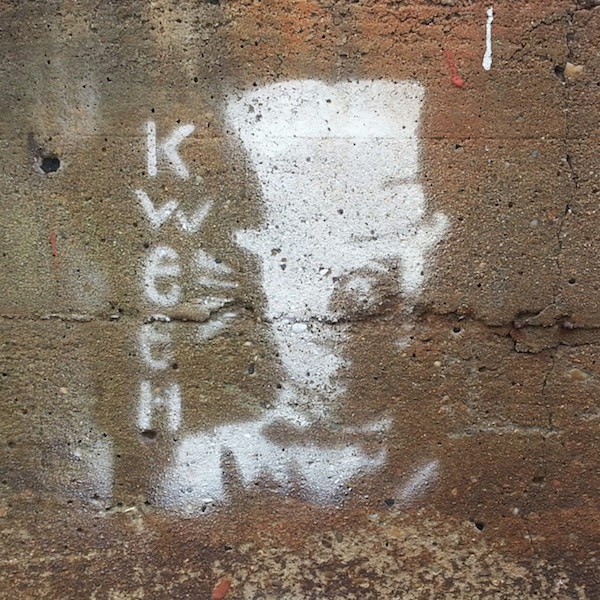
stencil graffiti of man with top hat and the word "kween", Pittsburgh, Pa.

Kween

According to the computer internet, “Kween” can mean umpteen different things, none of which we’ve ever heard of. So it’s hard to know what the profligate who sprayed this one was going on about. [Enlightened Orbiters: straighten us out.] But sure: top hat, weird spelling, stencil on concrete–that’s good enough for us.

stencil graffiti of a dove on a street pole, Pittsburgh, Pa.

Dove

Lay a flat stencil on a round surface and you’ll lose line definition somewhere. Whoever committed this one got that and more with a blurred leading edge so fuzzy it looks like this particular winged creature has just engaged hyperdrive. That, coupled with some oxidization and the pre-existing copper-colored lines it’s competing with and the results are a really beautiful addition to this particular streetlight pole.


Vacation notice: If you’ve gotten this far (and I’ll bet you have!) then, Mom: call me! No, seriously, Pittsburgh Orbit will be on a week-and-a-half vacation break wherein we’ll try to figure out what to do when we get back on Pittsburgh time. In the words of the late, great George Willard, “All of the sudden, her eyebrows were too intense.” Be good.

Flag Post: A Very Orbit Independence Day

detail of door painted like the American flag, Pittsburgh, Pa.

Shur-Fine America, Bloomfield

From the mountains to the prairies and from an alley in Bloomfield all the way to a men’s room in Bloomfield, it’s Independence Day in America (aka “The Fourth of July”) and we’re going to celebrate that with a flag post.

We see a lot of American flags this time of year, and that’s no easy experience for the eyes. Red, white, and blue are not colors that naturally look great together–at least, not when served up in the kind of equal doses Old Glory delivers. So for this amateur vexillologist, it can be a challenging holiday. It’s a blitzkrieg to the corneas, a D-Day for the optic nerve, and no laughing matter for the vitreous humor.

Graphically, we’d be a lot better off with just the red and white stripes or just the white stars on the blue field. We know The Orbit wields no small amount of international influence. Fortunes have been made and men (yes: and women) destroyed with the simple addition of key tag or a righteous repost. But a rebranding of The United States of America may be out of even this blog’s enviable powers.
So what are we to do? It’s our flag and whatever one thinks of it symbolically, it’s one of the great constants in any American’s existence. We at The Orbit find that the flags rendered by actual American hands have a whole lot more charm and humanity than their perfect (if cheap) cousins that show up on doorsteps and grave markers, waving at parades and discarded or packed-away by Summer’s end.

Through absolutely no forethought or planning, almost all of these flags were picked up when we thought we were photographing something else.  Super fans may cry “rerun!” but, c’mon–there’s good new stuff here! We’ll brand this a six-month “roll-up” to highlight some stories may be not everyone got to the first time. Happy birthday, America!

American flag made out of wooden fence

Fence flag, Highland Park

We came across this fine flag when we reported on Chet’s Tiny Backyard Dream World last month. Aside from the fact that Chet created this piece from old fence posts, I love that it both ended up slanted at this odd trapezoidal angle, and that it only has nine stripes and thirty stars. There is something so slyly seditious (if, likely, unconscious) about having patriotic art that is factually incorrect.

American flag made from popsicle sticks

Popsicle stick flag, Munhall [photo: Lee Floyd]

Lee sent in this photo of a flag constructed of painted (?) popsicle sticks hours before going to press, so we frankly don’t have time to get all the details on it. What we do know is that just like Chet’s, the popsicle stick flag eschews the standard 13 stripes/50 stars arrangement in favor of a more loose interpretation. Whatever the artist’s intention, we like what we’re seeing from this American!

American flag sticker, scratched and graffiti'd

Sonny’s Tavern, Bloomfield

This flag begs the question: Which is more (or less) patriotic? To paste an American flag sticker above the urinal of a men’s room in a dive bar or to (fail to) properly remove/destroy it? Are all representations of the flag sacred?

American flag behind cypress bushes

Cypress flag, Highland Park

We came across this interesting flag/hedge combination when we were in Highland Park photographing the Heidi Houses back in May. The owner/tenant of this house used a huge flag to cover the entire front porch of the house, draping it between the gutter and scraggly cypress bushes. Like the men’s room above, this is a very questionable way to honor America. I love how the unmistakable red and white stripes blast out out from behind the green shrubs.

In retrospect, this photo‘s red, white, and green would have made an excellent inclusion in our Italian Colors story (and inevitable sequel!) from a while back. Magari la prossima volta.

exterior wall of a former V.F.W. painted like the American flag, Pittsburgh, Pa.

(Former) V.F.W., Bloomfield

All right–we did a whole story on the murals of the Bloomfield V.F.W. a couple months back, so this one you’ve pretty much seen before. But not this side and not from this angle! I had to climb out on a wall, leaning back against the top of an eighteen-wheeler at the Shur-Save loading dock to get any shot of this, the only side of the V.F.W. that just has flag painting (and no representational war fantasy). Also notable here is the odd choice to paint the flag on its end–with the stars at the bottom and the stripes at the top. Whatever that was about, the veterans obviously wanted big flag and they got it–covering three sides of the building. And then the club closed. Sigh.

Frankie Files: Where’d You Go, Joe?

St. Michael Church, Munhall sans statue of Saint Joseph the Worker

St. Michael Church, Munhall sans statue of Saint Joseph the Worker

Superfan-turned-Munhall Bureau Chief Lee Floyd files his first story for The Orbit with a classic Pittsburgh who-done-it? and where-did-it-go? on a great piece of religion-meets-industry history from the former steel capital of the world.


As a tot, I was cruisin’ around Munhall in Cathy (my mother’s third-owner Cordoba) and watching the power lines move like waves with each pole we passed. Suddenly, I exclaimed, “There’s the Statue of Liberty!” Wrong state, wrong artist, wrong blog! I said it, and my family never let me forget it.

While he didn’t create anything quite as well-known as Lady Liberty, Frank Vittor (1888-1968), Italian-born sculptor and artist, has at least 50 works in and around the Pittsburgh area, including the prominent icons of Schenley Park and Bucco Field. The piece that many Steel Valley residents remember most-fondly is the statue of St. Joseph the Worker. High atop St. Michael’s bell tower, he was certainly hard to miss by anyone passing through the area.

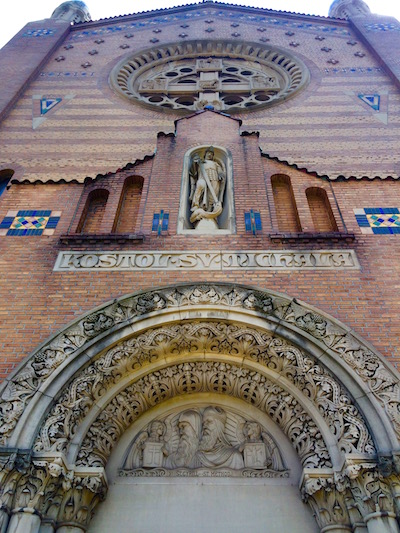
Front of St. Michael Church featuring tympanum, figure in a niche, and rose window

Front of St. Michael Church featuring tympanum, figure in a niche, and rose window

The Slovak St. Michael Parish built the eponymous church in 1927. Though adorned with beautiful sculptures and architectural details, it was not until 1967 that the church acquired the statue of St. Joseph the worker for its impressive bell tower.

Six parishes, including St. Michael, merged to become St. Maximilian Kolbe in ’92. Eventually, the building closed beneath him and the statue ended its 44-year lofty exhibition in January 2010. Though he ended up about a mile away at the new home for the St. Max parish, some people may have thought he skipped town. Now I’ve heard that a saint’s feet don’t touch the ground, and while that my technically be true in this case, one could argue that his pedestal shouldn’t either.
Saint Joseph the Worker statue by Frank Vittor

Saint Joseph the Worker by Frank Vittor in its new location at St. Maximilian Kolbe

“After designing a six-foot-tall plaster model, Vittor sent it to the Bruni Foundry in Rome for casting in aluminum and then to the Vatican for a papal blessing by Pope Paul VI. The sculptor viewed this final statue as another permanent tribute to the working man that he so admired. When Vittor passed away two years later, his Saint Joseph the Worker capped a prolific career…” (Iorizzo, Rossi 153)

I can’t think of a better tribute to the working man of Pittsburgh than what appears to be ladles of molten steel dumpin’ dahn on the world with flames shootin’ aht da back. Typically Joe carries a small wooden L-square and a woodworking tool or staff of flowers. In this case, Vittor fitted him with a badass riveted bar of steel and modern working boots. Now you should also roll up your sleeves and get back to work.

Photos and text by Lee Floyd.

St. Joseph the Worker statue detail of steel cauldron

Why the equator is hot


An Orbit side trip: Reading Lee’s piece and seeing the molten steel pour down on the globe, we couldn’t help but think of one of our favorite, beautifully unfortunate corporate identities: Sherwin-Williams Paint’s old “Cover the Earth” image that perversely renders nearly the entire globe dripping with blood red Sherwin-Williams paint, as if this were an ideal world to strive for.

According to the Sherwin-Williams history/timeline, the concept goes back to the 1890’s, so we can’t claim they were biting Frank Vittor (although Frank may well have been aware of Sherwin-Williams). A special side note to this side trip is that “The paint…is not pouring over the North Pole, as we tend to assume, but over Cleveland, Ohio, the center of the paint universe.” No comment.

Sherwin-Williams "Cover the Earth" identity showing a can pouring dripping red paint on the earth

Sherwin-Williams “Cover the Earth” identity

Sources:

Public Art: The Howard Street Line Painting Tests

Street line test (detail)

Street line painting test (detail), North Side

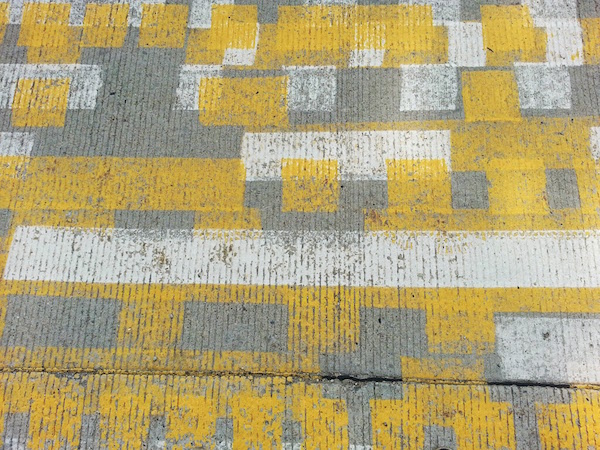
The Orbit doesn’t know what it likes, but it knows art. And we’re going to go out on a limb here and say that this fair city’s very best piece of public art is one that almost no one ever sees, tucked away on a dead-end street on the North Side*. Yes: it’s more exciting than the french fry sculpture, or the Tomb of the Unknown Bowler, or that red paperclip-looking thing, or even Dippy the dinosaur (yes: better than a dinosaur).

Street line test (detail)

Street line painting test (detail)

Back in February, The Orbit did a story on the Toynbee Tiles of Smithfield Street wherein we had the gaul to claim that “it doesn’t get much more ‘street art’ than [the tiles].” Well, this blogger is not too proud to admit when he has erred. The giant Howard Street painting was created right there on the street, by road workers, with special street line painting machines. This time we really mean it: you really can’t get much more “street art” than that.

We can only assume the city Department of Public Works (which has a facility right at the end of Howard Street) created the painting as some kind of test area for applying street directional/lane marking lines in white and gold. Whatever prompted it, the final creation is totally beautiful.

Street line test (detail)

Street line painting test (detail)

What’s miraculous about the piece is that the crew that laid it down stuck to a very particular fifty-or-so foot stretch of road surface, testing back-and-forth, on top of and just next to the previous runs. Howard Street is probably three quarters of a mile long, completely void of any houses or traffic, so the workers could have stretched their tests out lengthwise if they wanted to, but for whatever reason they chose to concentrate their dense repetitions on one contained area, approximately the width of one lane of traffic.

Street line test (detail)

Street line painting test (detail)

The result is a hypnotic series of dot-dash blocks of a common width, but with the off-register overlap of a cheap silkscreen job. Colors fade and flare irregularly where layers intersect, the grooved pavement cracks, and time and tide have done their various things. The big blocks suggest the abstraction of intense pixelization or a more figurative image refracted through raindrops. Staring at them long enough, letting your eye focus go soft, could easily work as a kind of Rorschach test.

Street line painting tests

My only regret is that I didn’t have one of those big Genie lifts on hand to take me up thirty or forty feet in the air to get a proper photograph of the whole enchilada. If I were running the Carnegie International, I’d be tempted to just exhume the whole road surface and bring it in to the big architecture hall. Or maybe they should just hold the International right there on Howard Street. That’d show ’em.

street with line painting tests, Pittsburgh, Pa.

In context: Howard Street line painting tests, North Side

* The Orbit sadly acknowledges that the bar is extremely low for this particular category.

You Ain’t Seen Nothin’ Yetta: The Mosaic Houses of Spring Hill

A row of frame houses with mosaics covering the basement/foundation walls, Pittsburgh, Pa.

The mosaic houses of Spring Hill

It’s been said that Pittsburgh is place where you can have a basement apartment with a view. In Spring Hill, you have to actually take some steps up to reach the basement–and what a view!

By the time I got up there, it had been a workout. First, up and down, back and forth through the aptly-named Hill District looking for remaining traces of the Jewish Hill District. But the Hill was only the appetizer–scaling the steep Itin Street incline to Spring Hill proved to be the main course.

Stairway between houses with mosaics, Pittsburgh, Pa.

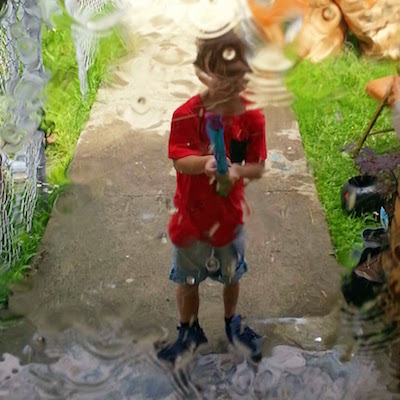
This panting blogger’s wiener was apparently too appealing a target for one four-year-old with a brand new water cannon. As his parents sorted through the poison ivy looking for a rose bush, their youth made it rain–on my short trousers. And let me tell you, he may be a little guy, but Max’s aim is true, his judgement unsparing, and he yields no mercy to the winded cyclist.

So when Kate gave me the tip to continue on even further up the hill (OK, just one short block) to Yetta Street for the checking out of a set of mosaics, it was time to go.

Yetta Street mosaic detail

And rewarded we were! There aren’t quite enough of them to justify this as a “neighborhood thing,” but with three clearly-related mosaic-bedecked houses in a row, plus one more down the block, it’s at least some inclination of a movement that will hopefully grow into said thing.

The styles and subjects range from groovy blasts of abstract color and shape to more recognizable scenes of gardens, flowers, and undersea life. One section may or may not be a loose impressionistic map of downtown Pittsburgh and its surrounding rivers. The Basilica of San Vitale this is not, but they’re quite nice.

Yetta Street mosaic detail

The mosaics are all set into the basement walls added under the front porches of the houses on the north (up hill) side of Yetta. The prim Victorian frame houses above with the scattershot artwork below give a terrific kind of business upstairs/party in the basement effect. This kind of decorative anachronism probably drives the historical crowd to hysteria, but, you know, live a little.

Victorian house in Pittsburgh, Pa. with mosaic on basement walls

Business upstairs/party in the basement

Yetta Street mosaic detail

I’d guess they all came from the same set of hands, but there wasn’t anyone around when we visited to ask. I’d love to know how recently these were added, if more neighbors are signing on, how the whole thing got started, etc. So we’ll have to wait for a subsequent trip up to Spring Hill to try again. I’m sure young Max is reloading as I type.

boy holding a super-soaker squirt gun

Watch your trousers: Max and his super-soaker

UPDATE (6/3/2015): The eagle-eyed and impressively-associated readers of The Pittsburgh Orbit quickly alerted us that the Spring Hill mosaics are both the work of Linda Wallen and that there are more of them in the neighborhood that we missed. Hopefully we’ll get a chance to talk with Linda and get the full story.

A Tiny Castle in The Strip District

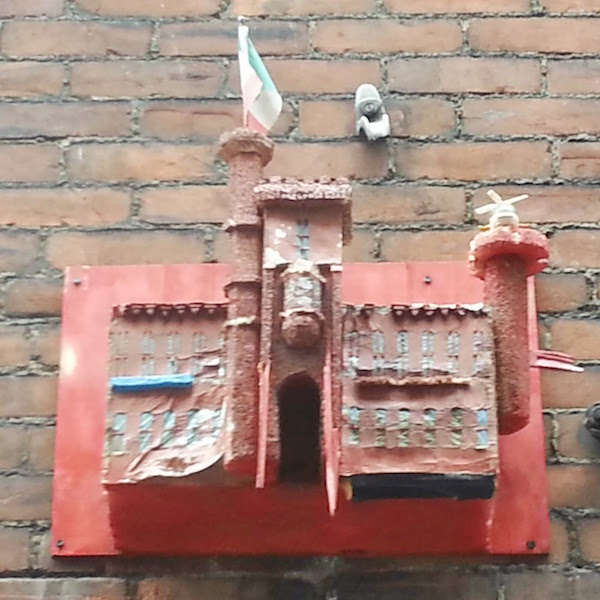
homemade model of a castle mounted to a brick wall

A tiny castle on a wall in an alley in the Strip District

Man, can The Orbit ever haunt some alleys. Some days it seems like all the good stuff turns up in them. It was that way recently when this blogger found himself headed home from downtown, rolling through Spring Way (the long alley between Liberty and Penn in the Strip District). There I was, minding my own business*, not a care in the world**, when something quite literally popped-out from the brick wall high over head causing one citizen-journalist to nearly eject himself from his bicycle seat with the hasty application of a desperately in-need-of-repair set of brakes.

What could possibly demand this kind of reckless photo-pseudo-journalism? Well, the astute reader has probably already divined that there was a mysterious red castle fixed to a painted piece of wood and screwed to the wall. The piece is high over head (I’d say maybe twelve or fifteen feet off the ground?)–so unnaturally out-of-sight and out-of-mind that less reputable bloggers and side-street walkers wouldn’t even have noticed its presence.

Ha! It’s this kind of attention-to-detail that hopes to land Pittsburgh Orbit as your go-to news source. Look no further! But where was I? Oh, yeah–the castle.

We have very few clues to tell us what this is all about. I’m calling it a castle, but it could just as easily be a prison, maybe a school, or some other institutional building with turrets and large porticos. The model has what appears to be a flag of Mexico affixed to the high central parapet, but it’s up too high to make a positive ID. There’s also a dramatic helipad with a tiny yellow chopper seated in place.

homemade model of a castle mounted to a brick wall

In context: the tiny castle affixed above window/door height

“Real” castles may last for hundreds (thousands!) of years, but this objet d’art d’alley will not. It’s made of some combination of particle board, foam, paper, and paint and is already showing some serious deterioration. I doubt it will make it through more than one harsh Pittsburgh winter—and that’s assuming the man doesn’t take it down before then.

Getting there: For all these reasons, if you want to see the tiny castle, you shouldn’t wait too long. Those headed to Penn-Mac for their Fiore Sardo or to Stan’s Market for cheap peppers this long holiday weekend should take the extra couple minutes to walk around the corner. The castle is located in Spring Way on the block between 21st and 22nd Streets, approximately behind Luke Wholey’s Wild Alaskan Grill. Look up.

homemade model of a castle mounted to a brick wall

Note: An Orbit apology for the photo quality here, which does not meet our usual standards, but it’s the best we could do under the circumstances. The piece was so high I had to get way back to snap it and the ol’ camera phone just doesn’t do too well with the zoom.

* Nebbing into every possible window, conversation, open loading dock, etc.
** Skating on the thin ice of crippling self-doubt, guilt, and regret

Art All Night 2015 Round-up

warehouse in Pittsburgh where Art All Night 2015 was held

Outside Art All Night’s home for the last couple years

Art All Night.  That most democratic of all one-day, all-night, anything-goes art “happenings.” It’s one of the reasons The Orbit took up shop in Lawrenceville some fifteen years ago and, at least for the moment, it’s still going strong.

This past weekend was Art All Night’s eighteenth year.  We were there seventeen years ago for event #2 in the former G.C. Murphy’s on Butler Street (now Rent-a-Center).  Back then, that medium-sized retail space was over-large for the hundred-some pieces of artwork that walked in the door and the couple hundred event-goers there to check them out. The art was hung, as I recall, on old Murphy’s pegboard, before the advent of the now-standard OSB and 2×4 panels.

Even in its embryonic state, this blogger-to-be was hooked.  We bought our house right up the hill a year later and I was volunteering for the event the year after that. My contribution has dwindled to just the big build-out day, but my conscience won’t let me not show up at all.

Art All Night is in the weird position of being a victim of its own success.  The elephant in the warehouse-sized room is that the event won’t be around forever; Lawrenceville is just running out of the kind of giant, vacant real estate that can still accommodate thousands of visitors. This year’s building is slated for (at least partial) demolition and redevelopment, which is sad, but also makes perfect sense.

industrial warehouse interior with paint slingshot targets

Paint slingshot targets

I didn’t take any big group shots of the thousands of people who packed the massive five-bay industrial building where the event took place this (and last) year, nor did I try to capture any of the many performers (some 40+ musical acts, dance, improv comedy, live painting, a guy trying to set a world record for human beat-boxing, etc.) or wacky crowd figures (Abe Lincoln, “The Cowboy,” the rubber men, guy with Christmas lights under his furry coat, etc.).

There are many great things about Art All Night, but ostensibly, the event is about the thousand-or-so objets d’art that manage to make their way into the space that afternoon and up on the panels, or along the walls, or spilled along the floor for the world to see mere hours later.

There is great art, for sure, but in the shotgun blast of raw expression, joke art, quirk, deviance, desire, and beauty that is rushed onto the particle-board panels, it’s the ones that scream the loudest that seem to make the event the most memorable.

It is in that spirit that I thought I’d just feature some great examples of what we consider “classic Art All Night”–whether that speaks to cliche or repetition or simply some base human mode of expression is up for debate. Presented are individual examples of this year’s entries and the various itches they scratch.  Enjoy.  I know I did.

artwork of Pittsburgh skyline in cut paper

Pittsburgh skyline

painting of steel worker with steel mill in background

Steel mills/steel industry

painting of two football players on the field

Sports art/Steelers

painting of Jerry Garcia with a glowing third eye

Skip a little rope, smoke a little dope

line drawing of intertwining pipes

Time to wash the hands (again)

This is nothing to those halcyon days of the early oughts when a guy could cover an entire 8′ x 4′ display panel with an imaginary city, complete with all transit routes and street names, mapped out on graph paper and executed in mechanical pencil.

artwork showing challenges and options for women today

Thought-provoking/statement

Under-represented this year were the big poster boards loaded up with (literal) ripped-from-the-headlines newspaper clippings (another casualty of the death of print!).  These would often be accessorized by a top layer big message: WAR? or Progress? or Justice? There were some nice sentiments on the evils of bearing children (one complete with a dangling flaccid condom), but it just wasn’t the same.

sculpture of human torso with world map glued to it

Maps/torsos OR “That’s not my belly-button!”

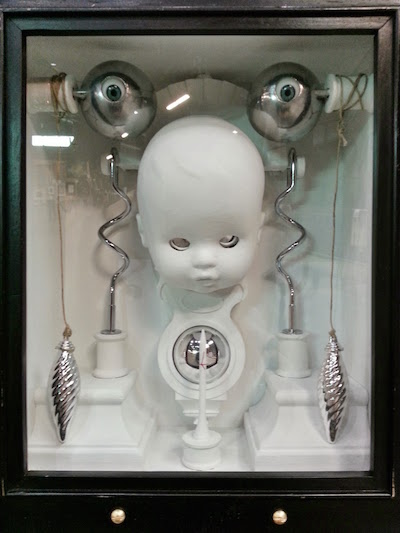
assemblage artwork including a baby doll's head

Doll head/parts assemblage

The doll parts genre this year was impressively (if disappointingly) tasteful. Typically there are numerous crude entries, oft splattered with red paint, grafted in vulgar ways to stray objects, etc.  Sigh.

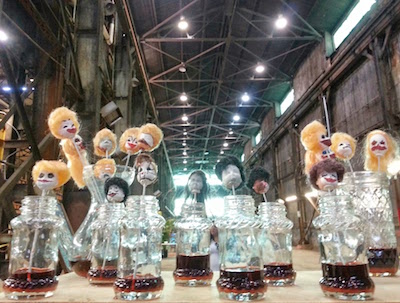
artwork with tiny clown heads on sticks in jars with mysterious liquid

Science art/tiny clown heads on sticks in jars with mysterious liquid

I love the pseudo-science entries–and this was a fine one–but the genre lacked quantity this year.

two large-size sculptures of robots

Big robots

Artwork with a mannequin dressed like a queen in a clothes washing machine

Mannequin/English royalty/appliance-related

painting of Spock from Star Trek

science fiction

Spoke from Star Trek rendered on an Etch-a-Sketch

Etch-a-Sketch

sculpture of zombie hand and grave stone in dirt

The evergreen: Pittsburgh loves zombies

painting of female monster eating a human head

Monster/horror

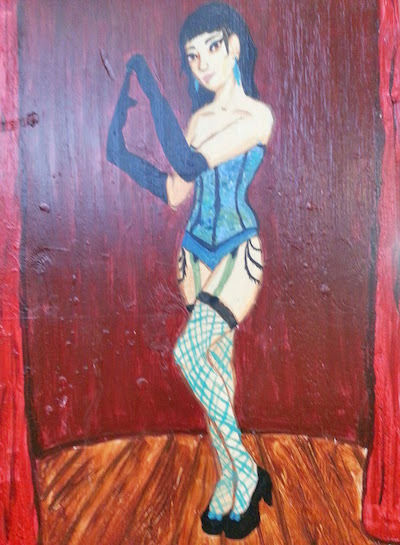
painting of woman in her underwear removing a long black glove

Naughty ladies (and the men who like them)

This year’s naughty/nudie art count was way down from any previous event.  In fact, the normally stocked “porn art” entrants must have just sat on their flesh- and boudoir-colored paint cans this year, as there was nary a stray wang or cooter to bat an eye at.

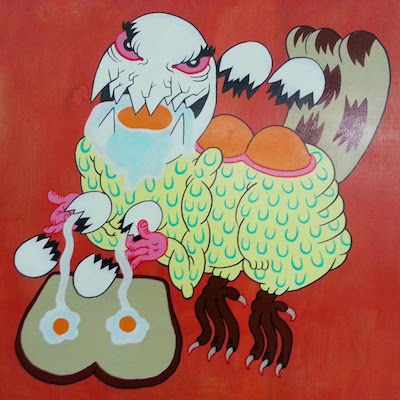
painting of a strange part chicken/part egg creature

Which came first: the chicken or the … ah, jeez

sculpture of woman's head and hand surrounded by silver foil

???

I heard a number of people remark that it felt like the total amount of art was down from previous years. Maybe that’s true, or maybe it’s just the way the space and panels were used. Either way, my remarks above definitely include a lot of sentiments around missing some old friends.  Ah, well, maybe next year.

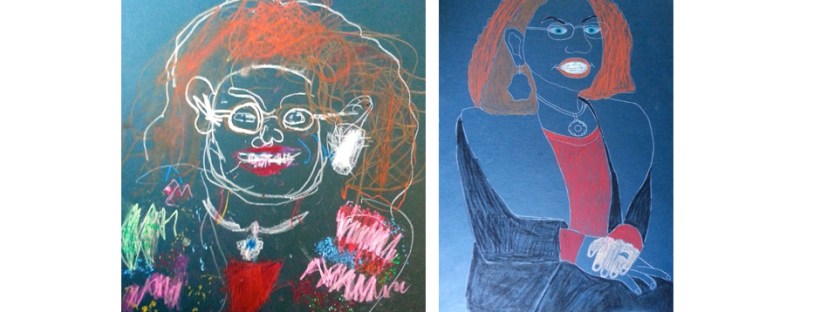
Now You See Me: Portraits by Creative Citizen Studios Students at the Greater Pittsburgh Arts Council

We couldn’t have said this better ourselves! Literally–we don’t know some of these words!

Tonight is your last best chance to see the “Now You See Me” portrait show as part of the downtown gallery crawl. Do yourself a favor and get your kiester to the GPAC building and see the full show up close and personal.

Alexandra Oliver's avatar

Those who know me know my outrageous affection for student art. Yes, student art is less developed than professional art, less focused, less sure of itself. It’s the kind of thing that expects to receive a grade, not a review. Much of it is predictable. But just as often it is fresh and ambitious. So here I am, reviewing a student show and even recommending it. The show is Now You See Me: Portraits, all works on paper by the students of Creative Citizen Studios and installed in GPAC’s downtown offices. Not only is this an exceptionally strong showing of student work, it was also a standout when it opened during the last gallery crawl. It will be open again during this Friday’s crawl, so now is your chance to see what I’m raving about—and make up your own mind as to whether I’m raving with reason, or…

View original post 916 more words

Easter Special: Lawrenceville Window Displays

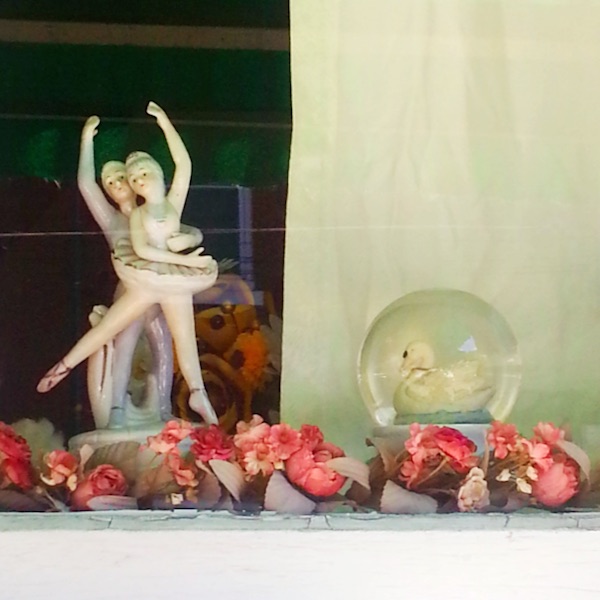
row house window diorama

Guest blogger Kirsten Ervin has long watched the evolving window displays of our neighbors in Lawrenceville.   For our Easter special, Kirsten takes us for a look around the seasonal offerings on this fine finally-feels-like-Spring holiday weekend.


row house window artI have long been intrigued by the window art of Pittsburgh row houses. These are the windows of working class houses in Bloomfield, Lawrenceville and Polish Hill, neighborhoods once dominated by the steel mills.


Easter bunny in door window

Here you’ll find tableaus of religious figures mixed with cartoon characters, stuffed animals, kids artwork and Steeler fandom. It’s common to see Jesus and Mary mingling with cheerful trolls and frogs, nestled up to Andre Fleury and Sidney Crosby.

These shadow boxes face the street, on display for the pedestrian, giving a glimpse into those who live inside. “We love spring!” declares one, or “We are faithful!” shouts another, or even, “We haven’t given a shit about anything since Halloween!” says a third.


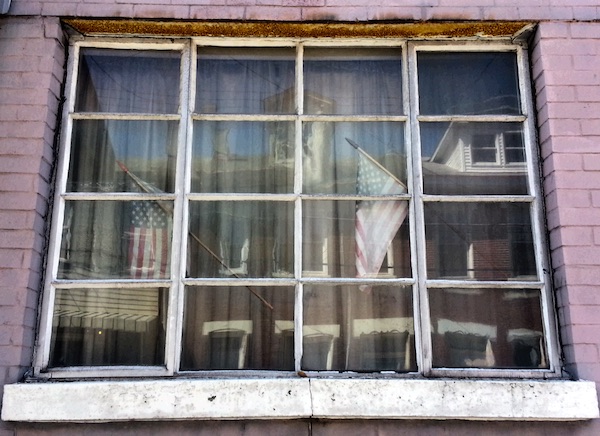
row house window art

They remind me of the assemblages of Joseph Cornell, that solitary American artist of the mid century, who created achingly beautiful, surreal arrangements while living in Queens and eating most of his meals at the automat.

What happens when objects are placed under glass in a box? Do the contents seem more precious, more significant? One is reminded of religious shrines of course, and the powerful combination of color, glass and light, framed.

row house window art

For the viewer of Pittsburgh window art, another dimension exists, the reflection of the opposite side of the street. Add the layered images of branches, other houses, street signs, and electrical lines, and the tableau shifts again.

It is touching to recall that one of Joseph Cornell’s last exhibitions was created especially for children, his boxes hung at child-friendly height, with cake and soda at the reception. Here too, is everyday art, meant for the everyday spectator, a chance to show the passerby who you are and what you care about.


Photos and text by Kirsten Ervin.

row house window art


row house window art

Murals of the Bloomfield V.F.W.

Detail of mural on the Bloomfield V.F.W. showing returning sailor kissing a nurse

The Kiss

The murals popped-up probably ten or twelve years ago and just like the scenes depicted in them, for Foodland’s (now Shur-Save’s) customers it was like a bomb had dropped in the parking lot.  Seemingly overnight, the nondescript backside of the windowless cinderblock Bloomfield V.F.W. was suddenly transformed into an electric war fantasy where a battleship caricature drifts next to haggard Vietnam G.I.s, a chopper hovers in air support.  World War I-style trench warfare plays out next to a rendering of the famous photo of the V-J Day Times Square kiss.  An evil black stealth bomber soars overhead.

The single large mural covers two sides of the building and features a collection of the most iconic images from each of the last century’s big wars (Korea and Kuwait don’t seem to have made the cut).  The scenes are all John Wayne glory without any of suffering, tragedy, or boredom that the actual veterans inside the post must have experienced.  I suppose that’s to be expected, and yet things can’t have been all that great for every V.F.W. member.

I don’t know when or why the Bloomfield V.F.W. closed, but now that time has passed and the murals have faded and physical structures decayed, they’ve lost at least some of their gun-toting braggadocio and taken on a new air of sadness and absurdity.

Why is the Times Square couple in front of a wall of breaking waves?  Many of the wave crests are literally breaking as the four-foot retaining wall deteriorates under them. Why does the battleship have hundred-yard-long cannons? (Ladies: don’t answer that one.) And why is there a flag-colored curtain exposing the scene as if it is a literal theater of war?

The Vietnam section suffered either a most inept act of vandalism or an unfortunate spill from someone working on the roof. The gas mask-wearing warrior looks out from a trench immediately behind more crashing waves.

I don’t know what will become of the former V.F.W. or its murals and for once I don’t even have a rooting interest either way.  Godspeed.

Detail of mural on the Bloomfield V.F.W. showing battleship with exaggerated cannons

It’s not the size of your cannon…

Detail of mural on the Bloomfield V.F.W. showing Vietnam soldiers and helicopter

“The Shit”: ‘Nam

Detail of mural on the Bloomfield V.F.W. showing World War I trench warfare

Beach/trench warfare