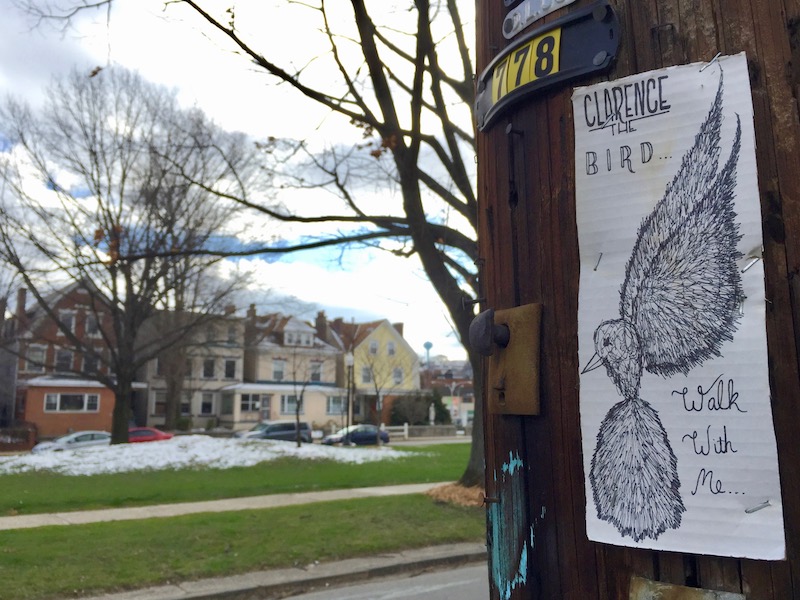
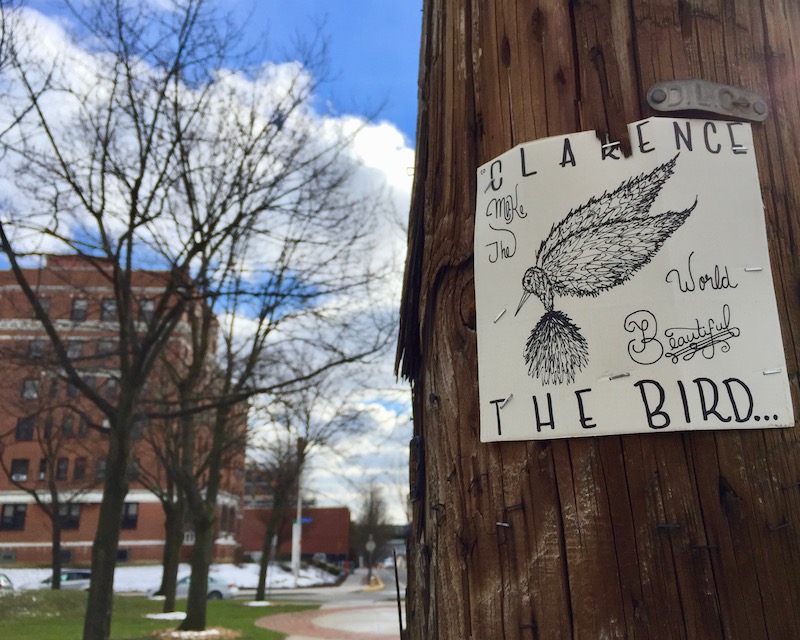
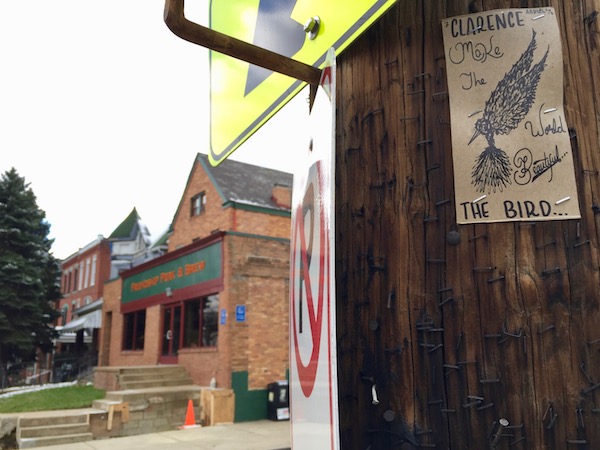
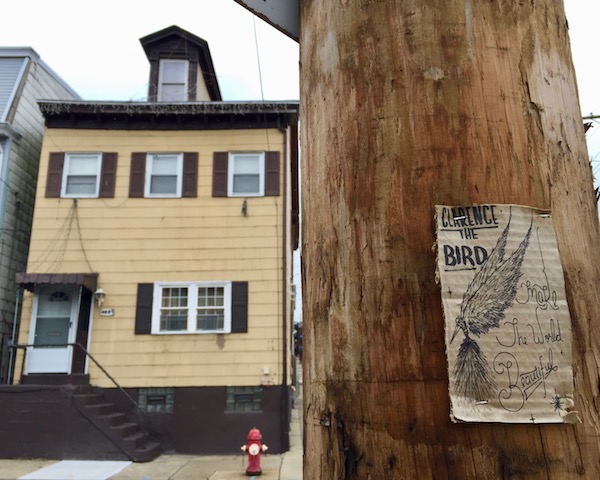
Clarence the Bird Takes Bloomfield! Part 2: A Beautiful Friendship

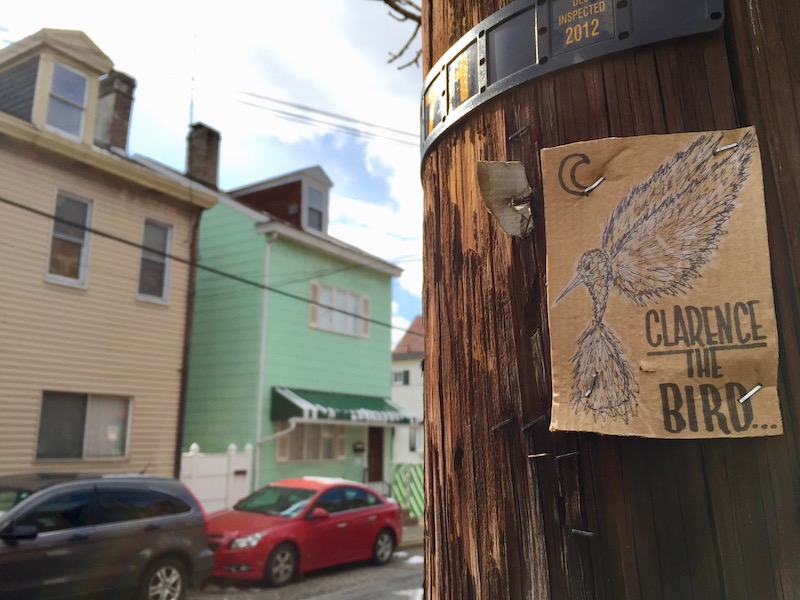
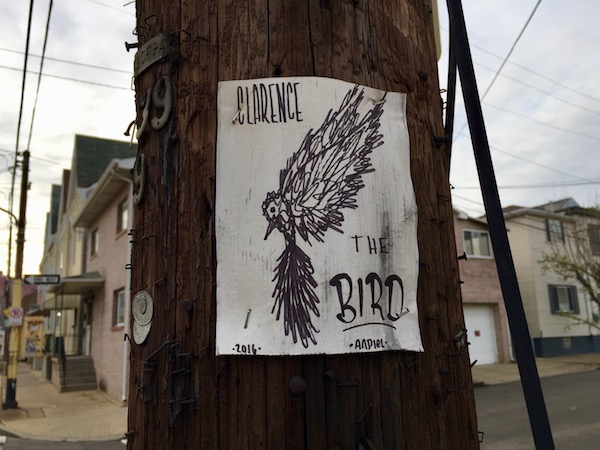
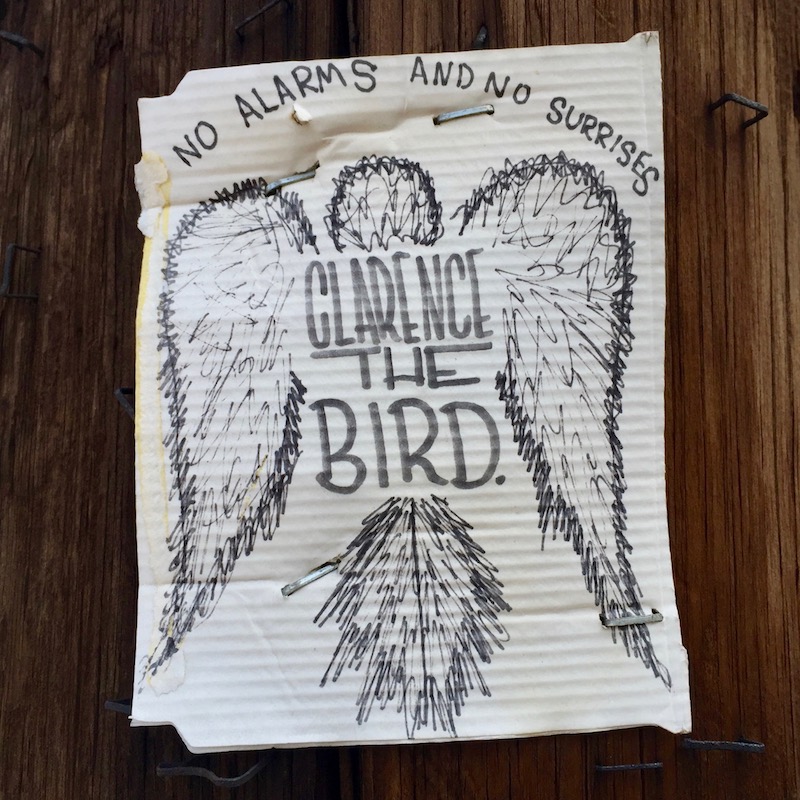
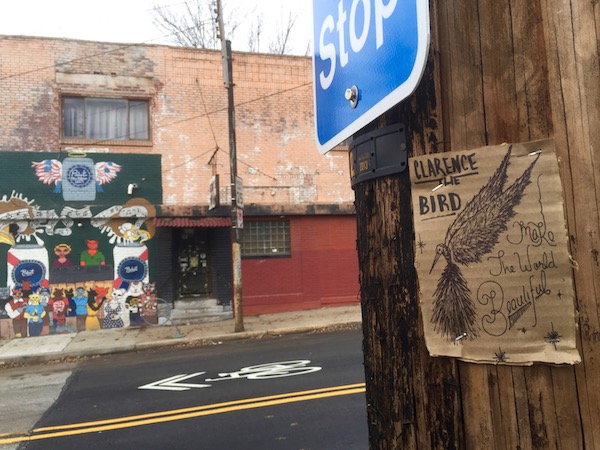
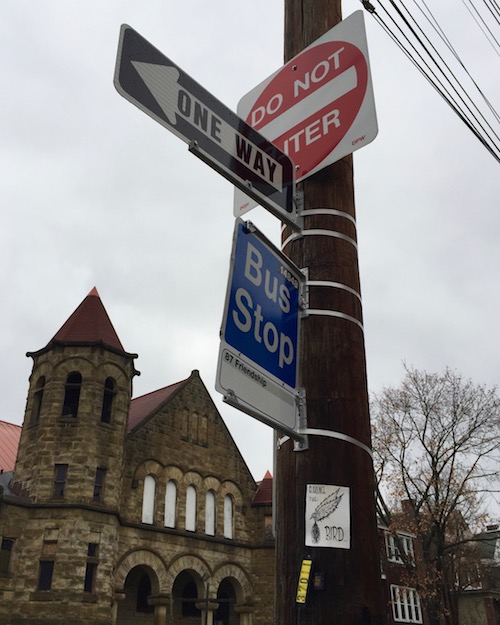
"Clarence the Bird" hand-drawn artwork stapled to telephone pole, Pittsburgh, PA

Friendship at Gross

Nevertheless, the bird persisted.

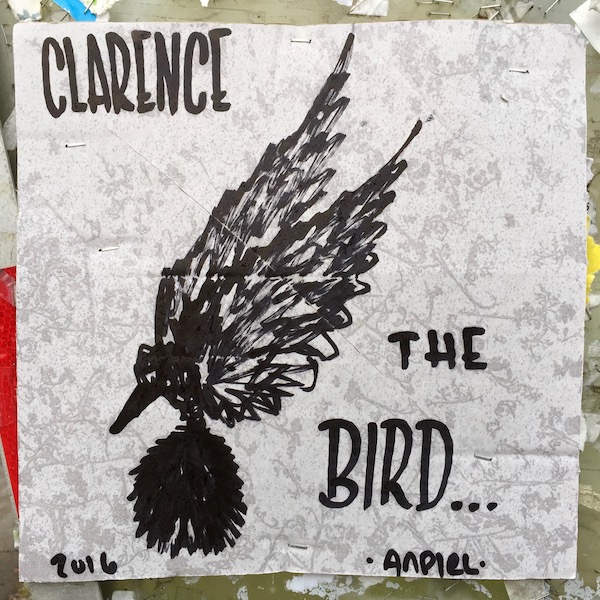
Call the little guy flighty, fragile, scrawny, left-leaning (or, at least, always left-facing), single-minded–heck, even a broken record! Sure, he could stand to put on a few ounces and what’s with that damn flipper-flapping all the time–give it a rest! Whatever you do, though, you’ll not call Clarence the Bird anything less than thorough.

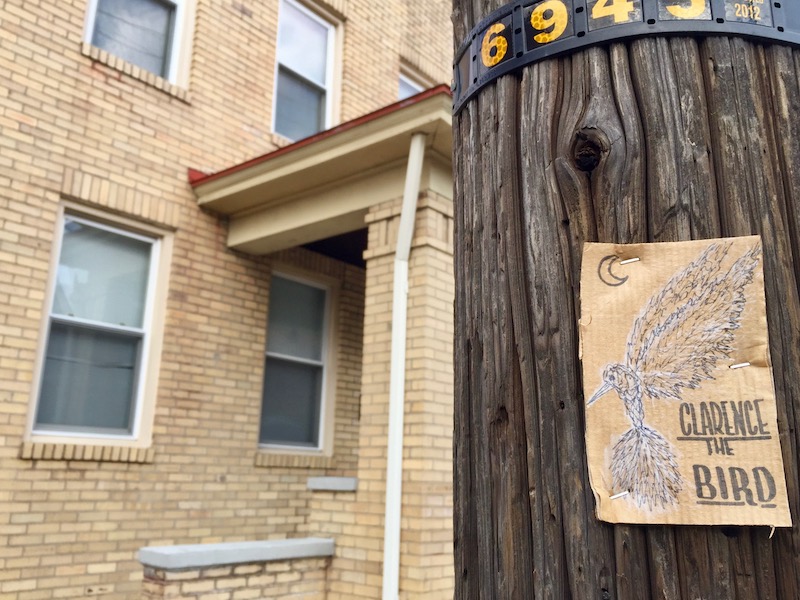
"Clarence the Bird" hand-drawn artwork stapled to telephone pole, Pittsburgh, PA

Friendship at Stack Way

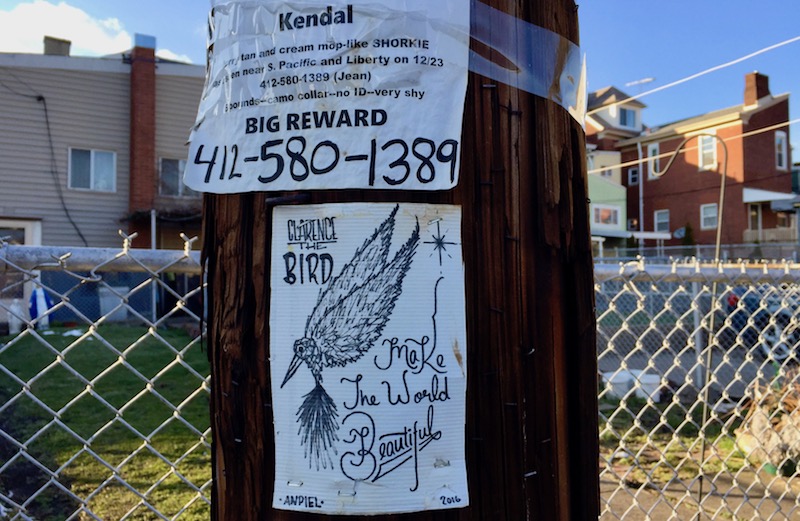
"Clarence the Bird" hand-drawn artwork stapled to telephone pole, Pittsburgh, PA

Friendship at Choate Way

When last we left the little fellow [Clarence the Bird Takes Bloomfield! Part 1: Millvale and Beyond, Pittsburgh Orbit: March 19], Clarence’s spring fever was in overdrive, nesting his feathers and pointing his beak throughout Bloomfield–down Millvale Ave., in the warren of cattywumpus alley-streets west of Edmond, and up by the Penn Avenue Aldi.

Impressive, for sure, but those sightings were merely the appetizer for the grand buffet that is Clarence’s A Beautiful Friendship campaign.

"Clarence the Bird" hand-drawn artwork stapled to telephone pole, Pittsburgh, PA

Friendship at Ella

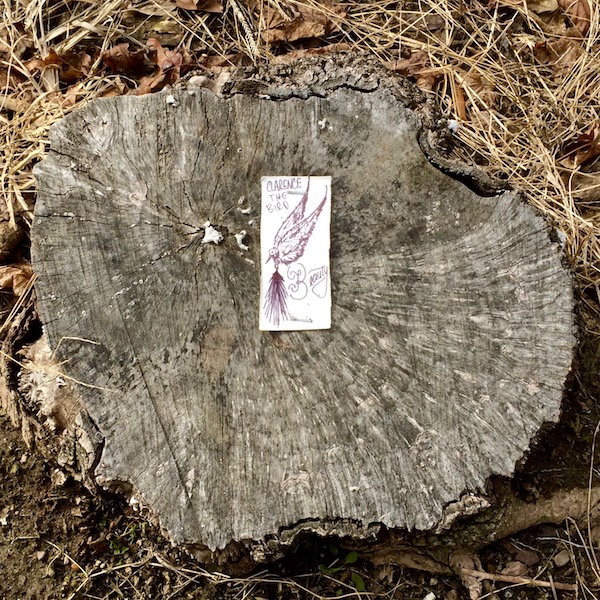
tiny paper drawing of Clarence the Bird stapled to tree stump, Pittsburgh, PA

Friendship between Ella and Dupont Way

"Clarence the Bird" hand-drawn artwork stapled to telephone pole, Pittsburgh, PA

Friendship at Dupont Way

From the dense row house heart-of-Bloomfield all the way out to where Friendship Avenue becomes Friendship neighborhood, Clarence has left a bread crumb trail in cardboard and paper stock, fine-tipped ink pen and crude Sharpie. The tiny original artworks have been stapled, tacked, faded, torn, and (I’m sure) disattached and absconded-with. But the pieces still hanging-around–and there are a lot–look great covering (nearly) every single block up and down the long street.

Here then is the latest from The Orbit‘s Clarence Tracker 2000TM logging of Mr. The Bird’s Friendship Avenue activity, starting on the Penn Avenue/Children’s Hospital end and working east as far as South Pacific.

Clarence the Bird artwork stapled to telephone pole, Pittsburgh, PA

Friendship at Taylor

"Clarence the Bird" hand-drawn artwork stapled to telephone pole, Pittsburgh, PA

Friendship at Dryden Way

"Clarence the Bird" hand-drawn artwork stapled to telephone pole, Pittsburgh, PA

Friendship at Dryden Way

Clarence the Bird artwork stapled to telephone pole, Pittsburgh, PA

Friendship at Pearl

"Clarence the Bird" hand-drawn artwork stapled to telephone pole, Pittsburgh, PA

Friendship at Pearl

"Clarence the Bird" hand-drawn artwork stapled to telephone pole, Pittsburgh, PA

Friendship at Edmond

Clarence the Bird original artwork stapled to telephone pole, Pittsburgh, PA

Friendship Park

Clarence the Bird original artwork stapled to telephone pole, Pittsburgh, PA

Friendship at Mathilda

"Clarence the Bird" hand-drawn artwork stapled to telephone pole, Pittsburgh, PA

Friendship between Mathilda and Edmond

"Clarence the Bird" hand-drawn artwork stapled to telephone pole, Pittsburgh, PA

Friendship at Millvale

"Clarence the Bird" hand-drawn artwork stapled to telephone pole, Pittsburgh, PA

Friendship between Winebiddle and Gross

"Clarence the Bird" hand-drawn artwork stapled to telephone pole, Pittsburgh, PA

Friendship at Winebiddle

"Clarence the Bird" hand-drawn artwork stapled to telephone pole, Pittsburgh, PA

Friendship at Winebiddle

"Clarence the Bird" hand-drawn artwork stapled to telephone pole, Pittsburgh, PA

Friendship at Winebiddle (partial)

"Clarence the Bird" hand-drawn artwork stapled to telephone pole, Pittsburgh, PA

Friendship at Evaline

"Clarence the Bird" hand-drawn artwork stapled to telephone pole, Pittsburgh, PA

Friendship at Pacific

Note: There are even more Clarence the Bird “droppings” on the eastern end of Friendship Ave., between Pacific and Roup (at least), but the ones we found there were previously reported on in our story Birdwatching: Clarence the Bird Watching [Pittsburgh Orbit: Jan. 5, 2017].

Clarence the Bird Takes Bloomfield! Part 1: Millvale Ave. and Beyond

Clarence the Bird artwork stapled to telephone pole, Pittsburgh, PA

South Pacific Ave.

Talk about a one-track mind! Freakin’ Clarence the Bird–him with his beaky-ass schnoz and big pointed wings looking more like fur than feathers. You try changing out of your gym clothes in that get-up–young fowl are merciless! Ah, Hell–he’ll get over it. All the dude has on his tiny noodle is trying to make the world a little nicer place, and he’s not afraid to tell you that…over and over and over again.

Clarence may be thinking big picture, but he sure follows through by, as they say, acting local. Lately, the little guy has been choosing to spend most of his time in just a short one-mile stretch of Bloomfield and on towards Friendship.

Clarence the Bird artwork stapled to telephone pole, Pittsburgh, PA

Millvale Ave.

Clarence the Bird artwork stapled to telephone pole, Pittsburgh, PA

Millvale Ave.

We first caught wind of his latest pole-tagging spree down at the south end of Millvale Avenue, right by Sonny’s Tavern and the bridge to Oakland. It turns out Clarence was working his way north with almost one occurrence every block up to Dog’n’Burger. A second jag took Ol’ Big Wings down Friendship Avenue, even stopping for a tiny taste of sidewalk stump. (A stump!) Yes, a stump. [We’ll get to Clarence’s full-on assault of Friendship Ave. in part 2.]

There’s not a lot more for this blogger to say, except Clarence: we’re with you, dude. Keep on doing your world-beautiful avian thing. We’ll keep looking out for you and you know The Orbit‘s got your little bird back.

Clarence the Bird artwork stapled to telephone pole, Pittsburgh, PA

Millvale Ave.

Clarence the Bird artwork stapled to telephone pole, Pittsburgh, PA

Millvale Ave.

cardboard Clarence the Bird drawing stapled to telephone pole, Pittsburgh, PA

Millvale Ave.

paper Clarence the Bird drawing stapled to telephone pole, Pittsburgh, PA

Millvale Ave.

"Clarence the Bird" hand-drawn artwork stapled to telephone pole, Pittsburgh, PA

Torley Street

cardboard Clarence the Bird drawing stapled to telephone pole, Pittsburgh, PA

Elk Way

Clarence the Bird drawing stapled to telephone pole, Pittsburgh, PA

State Way & Lima Way [note the bonus back yard Marys!]

Clarence the Bird art on telephone pole, Pittsburgh, PA

Edmond Street

All the wing-flapping and telephone pole loitering must work up a mighty hunger–even a tiny bird’s gotta eat too, right? C. the B. must have the same hankering for foo-foo brunch every other hung-over dog-chewed playboy and day-glow choreographer seems to get. Hey–eating seed is for the birds! Whatever.

We spotted a couple-a-three recent-ish Clarences down on Lawrenceville’s main drag, including a pair of very nice two-color (black-and-white) drawings on brown bag (?) and one of his rare, text-only Make the world beautiful signs. Go ahead and get you another plate off the buffet, Your Birdness–it’s been a busy couple months and this gloomy world could use a fresh coat of paint.

"Clarence the Bird" hand-drawn artwork stapled to telephone pole, Pittsburgh, PA

Butler Street

Clarence the Bird artwork stapled to telephone pole, Pittsburgh, PA

Butler Street

Clarence the Bird artwork stapled to telephone pole, Pittsburgh, PA

Butler Street


See also:

Street / Art [or] The Street as Art: Serially Accumulated Mural (Masonry #9)

concrete sections of road stacked neatly in a pile, Harmar, PA

Sky / wall / earth, “Serially Accumulated Mural (Masonry #9)”, Rt. 28, Harmar

What happens when things “go away”? Isn’t a wall just a road in another form? How can we replace the very ground beneath our feet?

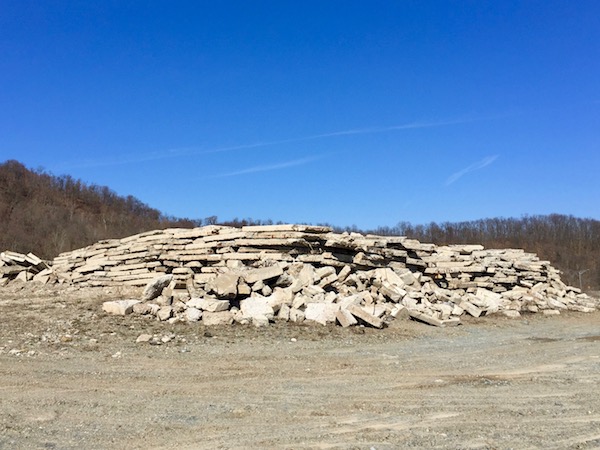
Serially Accumulated Mural (Masonry #9)*, the awesome deconstructed and reconstructed public installation artwork just outside of town asks these questions, and many more. The sculpture, consisting of hundreds–perhaps thousands–of four- to eight-foot sections of decommissioned highway is spread over several acres of barren berm within the graceful curl of a Route 28 on-ramp. Road is lifted into the blue sky and lets the participant view it alternately as both compact, well-ordered stacks and chaotic, post-catastrophe fallen landscape.

concrete sections of road stacked neatly in a pile, Harmar, PA

The viewer will inevitably first encounter the piece from a distance, likely traveling at high speed. Its huge mass and gentle shape echo the rolling hills of the Allegheny Valley in which it resides. In fact, were it not for its treeless surface, the installation might be mistaken for merely another mound of earth, another hill rising up from the river.

But to approach the work as it really must be seen–up close, on foot, with time to wander, poke, and explore–is to experience the tremendous weight (quite literal, that) of our built environment. One imagines a skyscraper collapsed, an entire small town collected and swept in the corner, a border wall separating the righteous from “bad hombres” who seek to breech its crevasses in a bloodthirsty quest for our dollars and our women.

top view of giant pile of road sections, Harmar, PA

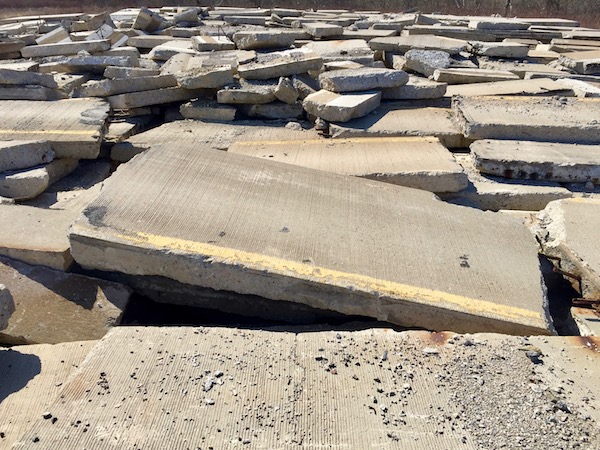
Atop the piece, [access points are provided at the participant’s own caution] it is a different story entirely. The ordered, neatly stacked piles of Masonry‘s south end contrast with the topsy-turvy, patchwork firmament of its expanse. The structure is unmistakably formed of ex-roadway–the omnipresent worn yellow center lines and fine-textured concrete surface give that away. It forces us to confront the disorientation of disaster. This, the artwork suggests, is what the big one feels like…if we’re lucky enough to still be here when the earth stops shaking.

Like Duchamp’s Fountain before it, visitors to Serially will never mistake where they are or what they’re looking at. But with a world bent, flat lanes severed, split, and tumbled, and the rushing highway traffic reminding us of exactly where these raw materials came from, we’re asked to look deeply at the disposable nature of the most durable of goods. If 10-inch thick, rebar-enforced concrete can be discarded by the side of the road with the same casualness as a paper coffee cup or flicked cigarette butt, what chance have we in this world?

detail of broken road sections showing painted yellow line, Harmar, PA

The Orbit has eaten its hat more than once over the suggestion of locating the ultimate street art. First, it was the tantalizing Toynbee Tiles of Smithfield Street (R.I.P.), the artwork embedded directly into the macadam, fused by the force of the traffic that overruns each of the tiles. But then we got tipped off to another PennDOT collaboration–the road sign murals up in Meadville.

Finally, it seemed like the crown was clearly taken by the Howard Street Line Painting Tests. How could you get more “street art” than painting directly on the street, with street-painting equipment, performed by the Department of Public Works road crews?

Well, as we found out here, I’ll tell you how: you take an actual stretch of roadway right out of the ground, rack it, stack it, and compact it, and then display it to the very travelers who drove across it in its previous life, viewable right out their passenger-side windows as they whiz by. If that doesn’t get your noodle spinning, well, I don’t know what will.

concrete sections of road stacked neatly in a pile, Harmar, PA

Getting there: PennDOT’s Serially Accumulated Mural (Masonry #9) is along Route 28, south-bound, right by the Harmarville on-ramp. As they say, you can’t miss it.


* Charles Rosenblum contributed to this article.

“Wild Animal” on the loose in Bloomfield!

"Wild Animal" art piece made from construction cones and panoramic photographs

Anonymous “Wild Animal” artwork, Edmund Street, Bloomfield

Caught mid-step, body poised, steely eyes focused on unseen prey, its mouth is agape in carnivorous anticipation. The electric day-glow orange creature steps from an autumnal forest scene of tall pines and fallen leaves directly onto the hard concrete of a salt-stained Bloomfield side street walkway.

The animal’s genus is unclear. It has the triangular pointed ears, whiskers, and jowls of a great cat. Maybe it’s the woodland backdrop, but–if it’s not too confusing a metaphor–a fox seems like a dark horse. There could even be a little Billy “Bigmouth” Bass in there, too. The visible screws holding this fellow together give it a major Frankenstein vibe–so it may well be all of the above…and more.

"Wild Animal" art piece made from construction cones and panoramic photographs

Top view with description placard

For a city neighborhood, Bloomfield certainly has its share of wild animals. This blogger has crossed paths with feral dogs and cats, rats and mice, squirrels, chipmunks, and opossums. We’ve spotted wild turkeys as near as Bigelow Blvd., Allegheny Cemetery, and Friendship Ave. Clarence the Bird may or may not be domesticated, but he’s no stranger to these streets.

That said, this particular Wild Animal is something we’ve not seen before. Pittsburgh certainly has a fair amount of exciting street art–and Bloomfield could be considered one of the more likely spots to trip across it–but this piece is no mere wheatpaste poster or stenciled graffiti–it’s a fully-formed one-of-a-kind object d’art of the most remarkable sort.

"Wild Animal" art piece made from construction cones and panoramic photographs

Whoever put Wild Animal together [no attribution is given] didn’t spare any effort in the process. The piece’s large-scale full-color photographic backdrop, freestanding title placard, and deconstructed/reconstructed traffic cone-turned-woodland creature would sit perfectly well in an art museum, gallery, or last year’s terrific DRAP-ART show/Re:NEW Festival.

To deposit such a piece outside on little Edmund Street is a tremendous act of cultural generosity–one that Pittsburghers seem to have largely respected. The artwork has been allowed to remain intact several days into its original placement*. That this much effort was put into a work that could very well be swept up by PNC Bank’s security crew mere hours after drop-off is a strange gift and a great leap of faith. We’re glad we were lucky enough to see it.

Let’s hope this particular wild animal isn’t an endangered species–we’d love to see more of its kind around these parts.

"Wild Animal" art piece made from construction cones and panoramic photographs

In context: the Edmund Street side of PNC Bank’s Bloomfield branch


* By our estimation, Wild Animal was installed some time either Thursday, Feb. 23 or the early hours of Friday, Feb. 24. It was amazingly still in place, untouched, as of press time the following Monday evening.

Water’s Gone Cold: An Elegy for Tea Bags

brick wall painted with logo for Tea Bags bar, Pittsburgh, PA

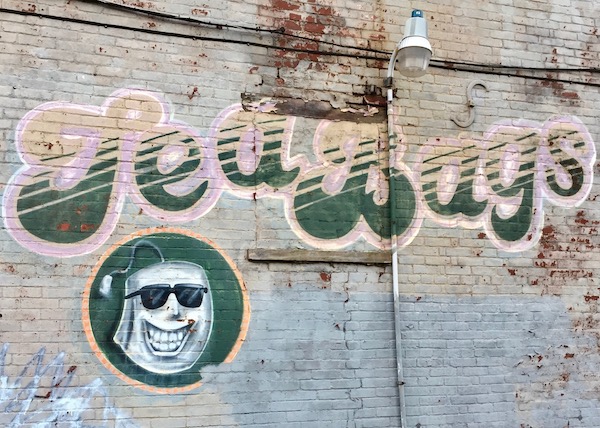
Side wall of Tea Bags with logo/mural (and painted-over tag line), Lawrenceville

Once, I’m told by my lifelong Lawrenceville neighbor, Butler Street included a bar whose sign advertised No TV, but a fight every night. Mark claims the message was no exaggeration–just pure statement of fact. That space is now V3 personal (fancy) pizzas. There’s still no television, but it’s doubtful there’s an equal amount of trouble.

Another friend talks about a saloon in Michigan called The Home Bar, so named because “no matter what you did, you can always come back”. The Home Bar is apparently still around, allowing Kalamazoo’s citizenry back in some thirty years on.

Tea Bags bar logo of anthropomorphized tea bag with sunglasses and toothy grin, Pittsburgh, PA

Advertising one’s establishment as a source of a certain amount of calamity seems like a strange business model, but it obviously works…enough.

Always in hot water has been Tea Bags goofy salacious tag line for at least a couple decades. It used to be featured in big scrolling letters under the rest of the bar’s alley side mural, but was sadly painted over a few years ago*. The slogan remains etched into the custom behind-the-bar mirrors, but they won’t last long…and you probably can’t get in to see them anyway.

The Main Street Lawrenceville/Bloomfield corner bar has yelled its final last call, packed up its Cherry Master machine, green bar stools, large jars of alcohol-soaked cherries, and loaded them into a box truck directed to who-knows-where. The process to transfer Tea Bags liquor license to new owners is well underway.

mirror behind bar with "Tea Bags - Always in Hot Water" logo, Pittsburgh, PA

A well-stocked bar: soaked cherries, potato chips, Handi-wipes, paper plates.

The new, yet-to-be-named business taking over the space [assuming all the paperwork goes through] will be a fair departure from Tea Bags’ nuts-and-bolts no-frills corner bar. From Bloomfield Development Corp.’s posting of the business plan:

“The bar/restaurant is a price friendly location for those who seek educated bar-man ship (sic.) and well crafted cocktails, with an approachable yet notable beer selection, and easy yet technique driven menu items. Pop culture, art, music and skateboarding nuances will account for the subtle design details to create an easy feeling atmosphere that is appreciated by the local 25-35 age range.”

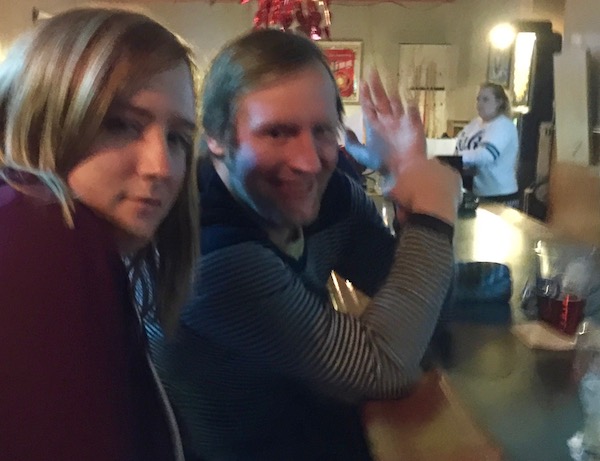
man and woman at bar with bartender looking on, Tea Bags, Pittsburgh, PA

Looks like somebody’s in hot water! The kind of typical skateboarding Millenials who will inevitably gravitate to the new bar’s “easy-feeling atmosphere”.

Call this blogger an old, non-skateboarding fuddy duddy**, but it’s painful to see oneself demographically excluded from a new place in the neighborhood before they’ve even selected a name.

It’s becoming a sad, repeated refrain–even right here in the virtual pages of Pittsburgh Orbit. The old place catering to every(wo)man closes from declining business or gets bought-out or someone just retires. The new owners want to get them some of that Google and Uber dough. Why eke out a living on dollar Jello shots when you charge six bucks for an I.P.A. and ten for a hamburger? It makes economic sense–if you can sell it–but feels like a little part of the city is dying with every one of these upsell transitions.

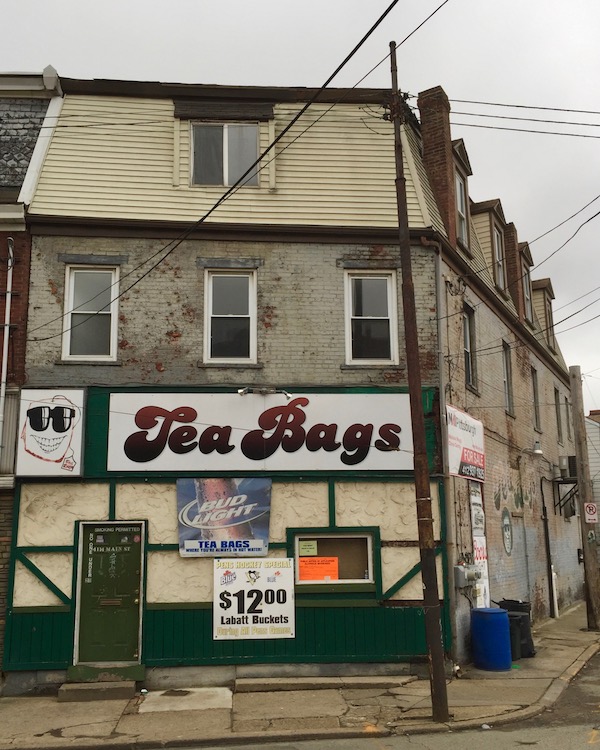
3-story brick building with Tea Bags bar on first floor, Pittsburgh, PA

Not an optical illusion: Tea Bags trapezoidal shape

This blogger won’t claim to have been a regular at the bar [so maybe I’m part of the problem!] but he’s slanted a few in its smoky, natural light-defying confines over the years. Along with Wilson’s Pharmacy, Sunoco, and the 54C, Tea Bags has been the most constant presence in the general Penn & Main crossroads for the last twenty years. I must have walked, ridden, and driven past the bar thousands of times by now–pretty much every single day. Even with that frequency, seeing the big-toothed grin on the sunglasses-wearing anthropomorphized tea bag never fails to bring a smile.

If it were up to Pittsburgh Orbit, we’d extract the entire Woolslayer Way mural wall and preserve it forever in a sacred, public place–just like Romare Bearden’s glorious “Pittsburgh Memories” mosaic in the Gateway Plaza T station.

That probably won’t happen, though. So take a little advice from us and get thee over to Main Street to check out Tea Bags’ smiling tea bags while you still can. The water’s cooling down mighty fast.

mural detail of anthropomorphized tea bag wearing sunglasses and with wide toothy grin, Tea Bags bar, Pittsburgh, PA

Grinning tea bag logo (detail)


* The reason is unknown, but we assume graffiti cover-up as the likely explanation.
** Not to mention grammar snob. Whoever wrote this business plan needs to learn how to deploy a hyphen correctly!

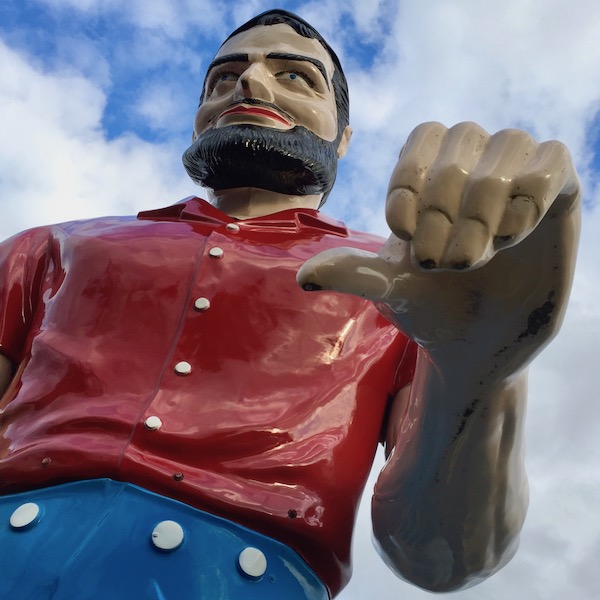
Muffler Man: Mr. Tire, Uniontown

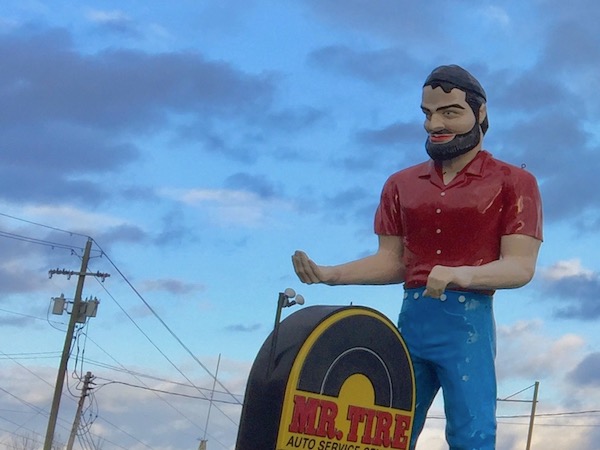
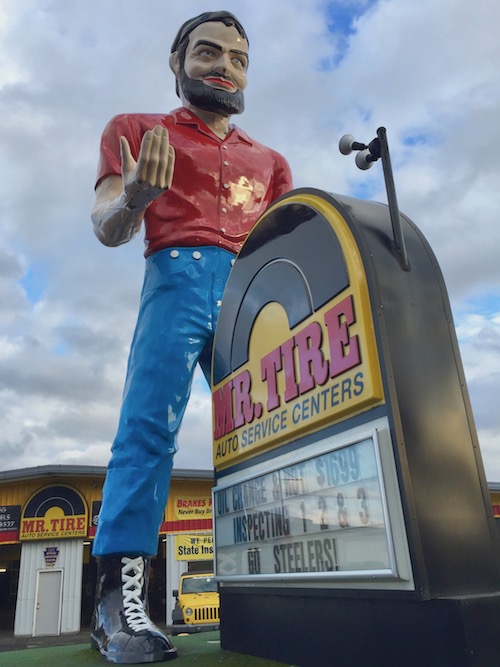
the muffler man of Mr. Tire, Uniontown, PA

King of the skyline: Mr. Tire muffler man, Uniontown

On a week that belongs to the ladies*, it would seem a strange choice–even callous, confrontational, “aggro”–to run with a testosterone-fueled post like one focused on the Mr. Tire Muffler Man, but hear this blogger out.

There we were–Mrs. The Orbit and her fella–heading to Our Nation’s Capital to defend Democracy. You’re welcome. But with a few extra ticks on the clock and taking any excuse to avoid the turnpike, we opted for the slightly longer trajectory via Rt. 51 and had a chance to check in with Mr. Tire himself in his home base in Uniontown.

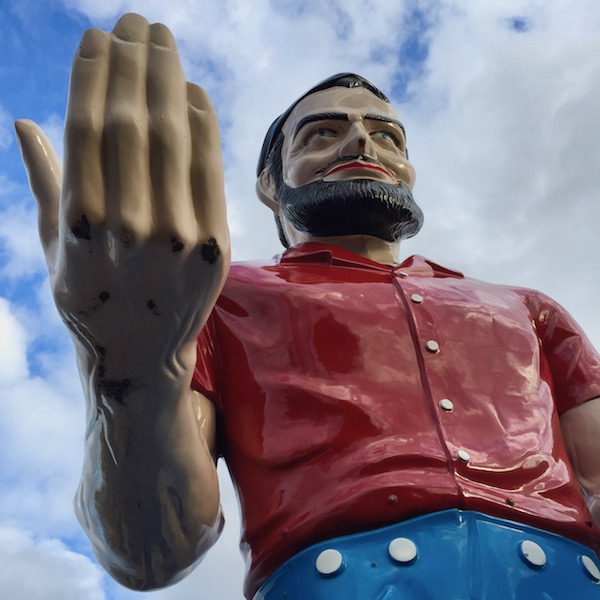
detail of the muffler man of Mr. Tire, Uniontown, PA

No one suggests Muffler Man has tiny hands

The picture of male virility, Muffler Man isn’t fooling around. Mr. Tire stands much larger than life [he’s around 30 feet tall, not including his stone pedestal]–biceps tensing the short sleeves of his work shirt, steely eyes on an emotionless face, close-cropped Just For Men facial hair, and a brimless cap that says “I was a lumberjack in a previous life; now I’m a tire guy.”

Muffler Man possesses all the classic qualities–or, at least, fantasy stereotypes–we’re led to believe men were, you know, back when America was “great”. He’s tall, dark, strong, and silent; a man of action who’s ready to put his giant hands to work. This seems all the more appropriate in the first hazy rays of the new dawn of America.

detail of the muffler man of Mr. Tire, Uniontown, PA

NOT like. Muffler Man’s thumb ain’t up.

Muffler Man isn’t the kind of guy who stays up all night sniping petty insults on the computer Internet. No, most days he pulls a double with an evening appointment to look under Mrs. Tire’s hood, make sure the engine’s still purring, and maybe check out her tailpipe. If he does his job, she’ll be leaving in the morning as a satisfied customer.

This working man ain’t the high-tech type–you can call him at the phone on the wall or catch him at the bar after his shift. Muffler Man doesn’t talk a lot, but when he does, he’d rather deflate all eighteen wheels than tell a lie. Liars don’t last long in Mr. Tire’s town.

the muffler man of Mr. Tire, Uniontown, PA

Recently, we’ve heard a whole lot about our new “tough guy”-in-chief and the “forgotten men” he speaks for. That whole notion can seem both a little absurd and totally apropos in the face of millions of protesters–a majority of them women of every imaginable demographic–filling cities across the country (and the world) last Saturday. Maybe it’s time for some of those tough guys to finally learn something from the ladies–and even from Muffler Man. Stand up, shut up, roll up your sleeves and get to work doing the right thing.


Getting there: Mr. Tire is at 350 Pittsburgh Street, Uniontown. If you come down Rt. 51, just keep going straight and you definitely can’t miss it.

Related: Muffler Man: The Cadet CowboyPittsburgh Orbit, May 22, 2016.


* Let’s hope it’s actually a month, a year, or time going forward, but that remains to be seen.

Birdwatching, Clarence the Bird Watching

Clarence the Bird artwork stapled to wood covering empty storefront, Pittsburgh, PA

Penn Avenue, Garfield

Traditional birdwatching likely takes place at a more inviting season. Not only is it nicer for the spectator to be outside in a warmer, drier climate–one filled with the bright colors and in-bloom flora of the other three-quarters of the year–but (we assume) there simply must be a lot more birds to look at.

This blogger imagines typical northern birders–just like baseball fans–consider winter the long dark off-season. Weather and the absence of fowl require avian fanciers to temporarily retire binoculars and sun visors, instead spending their time curled up by the fireplace leafing through back copies of Birder’s World magazine and plotting strategies to snare an up-close photo of the green-winged teal, surf scoter, or greater white-fronted goose when the season turns.

Clarence the Bird artwork stapled to empty storefront, Pittsburgh, PA

Penn Avenue, Garfield

Clarence the Bird artwork stapled to telephone pole, Pittsburgh, PA

Friendship Avenue, Friendship

So it’s a right fine unexpected treat to spot the friendly face and outstretched, oversized wings of Clarence the Bird peering back at you as a fellow makes his or her rounds throughout the day. There he is, tacked to a telephone pole on a residential throughway and mingling with the high-minded street art on Penn Avenue.

For the most part, we didn’t get too close. Not wanting to scare poor Clarence out from his various perches, we caught him here in the wild, hiding amongst the traffic signs, crumbling plaster, and effluvia of street handbills and stray graffiti.

Clarence the Bird artwork stapled to former storefront, Pittsburgh, PA

Penn Avenue, Garfield

cardboard sign with pen drawing of a bird and the text "Clarence the Bird...", Pittsburgh, PA

Main Street, Lawrenceville

This blogger knows what you’re thinking: Someone sure missed the memo on that whole flying south for the winter thing, right?

Certainly, even in these darkest, gloomiest, and most dreary of days, Clarence the Bird eschewed a sun-filled January of jello shots in Daytona Beach or working up a savage tan in Belize to instead rest his wings right here at home in the East End. Whether Clarence is a loyal Steeler fan hoping for the best in the playoffs or just too lazy to make the trip south, we don’t know. Either way, we’re betting he’s regretting that decision right about now. That said, The Orbit is selfishly very happy he stuck around.

Clarence the Bird artwork stapled to telephone pole, Pittsburgh, PA

Penn Avenue, Garfield

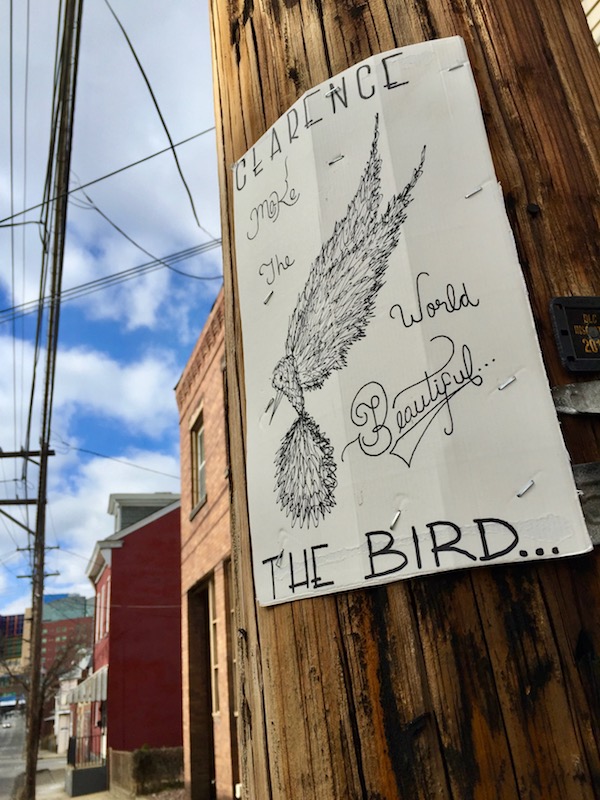
cardboard "Clarence the Bird ... Make the World Beautiful" artwork stapled to telephone pole, Pittsburgh, PA

Friendship Avenue, Friendship

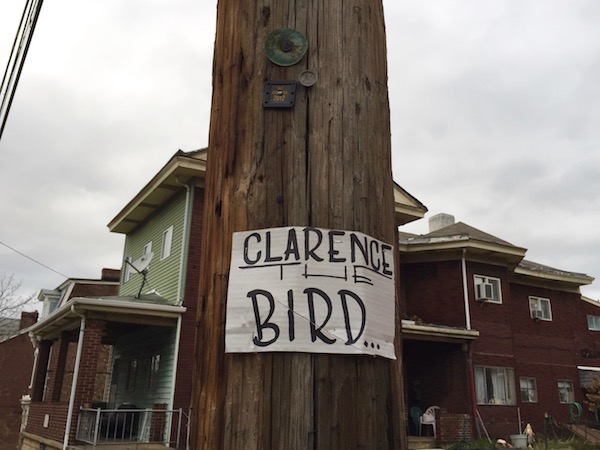
Like the Pittsburgh protractors–or men wearing Zubaz–once you start looking out for Clarence, he’s everywhere. On cardboard with crude Sharpie and in fine lines on card stock and curlicues, Clarence gets around. This most urban of avian creatures loves to nest in the protective plywood covering abandoned store fronts on Penn Avenue, mingling with wheat pasted street art and course slurred graffiti. On one Main Street pole, Clarence isn’t even present but has left us a bold-faced title card with his name followed by a tantalizing ellipsis begging the question where is Clarence the Bird and what is he up to?

Clarence the Bird artwork among collage on empty storefront, Pittsburgh, PA

Penn Avenue, Garfield

cardboard sign with the words "Clarence the Bird..." stapled to telephone pole, Pittsburgh, PA

Main Street, Lawrenceville

The last time we crossed paths with Mr. The Bird he was urging us to Make the World Beautiful in three of four consecutive Butler Street telephone pole hang-outs. After migrating up the hill to greater Garfield/Friendship*, Clarence seems to have both cloned himself many times over and abandoned the explicit message almost entirely. [The one photo included above is the only exception we spotted.]

While this blogger still agrees with the sentiment–and misses Clarence’s fine calligraphy in the inscription–it’s safe to say that actions speak louder than words and Clarence is out there doing his best to decorate the landscape without ever having to brag about it. You go, bird!

Clarence the Bird artwork stapled to info kiosk, Pittsburgh, PA

Fourth Presbyterian Church, Friendship

Clarence the Bird artwork stapled to info kiosk, Pittsburgh, PA

Fourth Presbyterian Church, Friendship (detail)


* The way Lawrenceville rents are going, we can’t blame the guy.

Look Out Loretto, Part 2: He’s Dead, Wrapped in Plastic

detail of marble headstone with embedded ceramic photograph of young man protected by purple plastic cover, Loretto Cemetery, Pittsburgh, PA

unknown (detail)

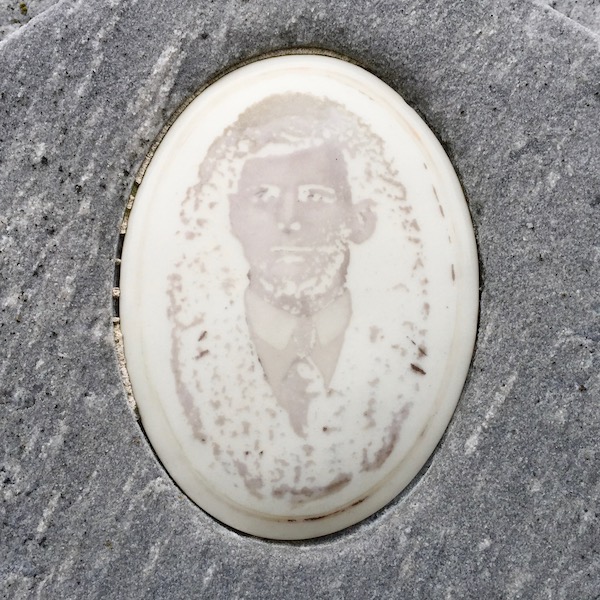
He stands bolt upright, looking straight into the camera. The man is young–probably in his early twenties–dressed formally in jacket and tie with a corsage pinned to the lapel. Black hair is combed flat and parted hard to one side with a pair of troublesome locks springing loose across the forehead just above his eyebrow. The facial expression is curious: fixed formal, let’s-get-this-right sternness appears just on the edge of breaking to a suppressed, forbidden smile. This may have been his wedding day.

The small rectangular photograph is preserved in thick, transparent violet-hued Lucite and has one transverse crack across the man’s chest. A handful of small dings decorate the surface as if an assailant has taken to it with a crude weapon but gave up before doing any real damage. Otherwise, it is in fine shape.

The combined piece is about the size of a deck of playing cards and mounted to a beautiful marble headstone featuring Jesus on the cross, a pointed arch shape like a cathedral window, and a fading old-world cross-and-sun image we’re not familiar with. [Pious Orbit readers: help us out here–what is that thing?]

marble headstone with embedded ceramic photograph of young man protected by purple plastic cover, Loretto Cemetery, Pittsburgh, PA

unknown

detail of marble headstone with embedded ceramic photograph of middle-aged man encased in plastic, Loretto Cemetery, Pittsburgh, PA

unknown

The irony of the photos mounted to headstones at Loretto Cemetery–most preserved on ceramic discs as we discussed in the previous post, but this and one other encased in thick acrylic–is that for so many, we don’t even know the names of the deceased.

What’s unique among the vast majority of photo markers here is the complete absence of identification remaining. At one time, the de rigueur details–name, birth and death dates, perhaps an epitaph or Lahke mu Zamlja inscription–almost surely filled the flat faces of the stones. But now on all but a few, they’ve been completely wiped-clean.

ceramic photograph with image almost completely disappeared on headstone of grave, Loretto Cemetery, Pittsburgh, PA

unknown

detail from marble headstone with embedded ceramic photograph of young man, Loretto Cemetery, Pittsburgh, PA

unknown

How this came to be, we can only speculate on–but that’s what this blogger does best! It seems likely the cause has to do with the underlying material (marble? fieldstone?) and what was literally falling from the sky around Pittsburgh through most of the twentieth century. With the Jones & Laughlin steel mill occupying both sides of the river just downhill from Loretto Cemetery until the 1980s–not to mention plenty more like it up and down each of the rivers–regular doses of acid rain had to do a number on all the headstones made from susceptible materials.

This is a noteworthy turn of the tables for an environment where typically all we know are names and dates, forever left to wonder who these people were.

marble headstone with embedded ceramic photograph now broken, Loretto Cemetery, Pittsburgh, PA

unknown grave with faded and broken photo

detail from marble headstone with embedded ceramic photograph of woman, broken, Loretto Cemetery, Pittsburgh, PA

faded and broken ceramic photo (detail), unknown

In Part 1 of this story we looked at a bunch of these headstone photos where the name of the deceased may or may not be known, but at least we got a pretty good (literal) picture of him or her. In almost all cases the ceramic has weathered with irregular cracking throughout the piece, but the image survives with enough clarity to get a sense of the person below the earth.

Not all these photos fared as well, though. First of all, at this point there are roughly an equal number of empty oval cutouts in headstones where the photos simply don’t exist any more. It’s impossible to know if these were stolen or vandalized or simply dropped out of their markers through a century of freeze-and-thaw cycles.

But even the ones that are still here aren’t necessarily all here. The sun had faded a number of the South-facing photos to mere ghosts represented in strange gray negatives. One of the pieces (above) has been broken with only the bottom half remaining. The detail is all gone, leaving just a vague outline of the woman’s face and basic description of the house dress she wore in the photo.

ceramic photograph with image almost completely disappeared on headstone of grave, Loretto Cemetery, Pittsburgh, PA

faded ceramic photo, unknown

detail from granite headstone with embedded ceramic photograph of man in military dress, Loretto Cemetery, Pittsburgh, PA

Joseph Andreucci

Consider the plight of Joseph Andreucci (above) whose loved-ones ponied-up for a beautiful deep red and black granite that never suffered the erosion present on so many of the other stones. All this only to have his photo in military dress attire worn- or scraped-through to the iridescent green of oxidizing copper underneath.

The poor fellow below is not only unknown in name, but unknowable as image. It appears that some miscreant took a hammer directly to the photograph, rendering it completely unrecognizable. All that remains is a hint of combed, dark hair above the damage and a suit with jaunty floral accent below.

ceramic photograph with image vandalized on headstone of grave, Loretto Cemetery, Pittsburgh, PA

unknown

If it’s possible to end both on a high note and six feet under, we’ll wrap this whole thing up with the big smile and voluminous curly locks of Anna Vensak. Her passing in 1996 is decidedly outside of the early century/between-the-wars window where we find all the other headstones in the series. But it seems notable for inclusion by virtue of its proximity here at Loretto Cemetery and the monument-maker’s continued use of the technique–certainly antiquated by the 1990s–deploying the oval-shaped photo, mortared directly to an inset cutout in the stone.

detail of granite headstone with embedded ceramic photograph of woman, Loretto Cemetery, Pittsburgh, PA

Anna Vensak

In an age where photographs are so immediate, disposable, and omni-present as they currently are, it’s fascinating to think of a time not that long ago when a single image may be all that remains of the legacy of a human being’s time here on earth. For that one last opportunity to reach beyond this mortal coil to end up cracked, faded out entirely, or lost in the weeds of Arlington Heights is humbling at best and reaches to full-on existential crisis at worst. Either way, The Orbit will still be here, looking out for you.

Look Out Loretto, Part 1: Lahka Mu Zamlja

detail of marble headstone with embedded ceramic photograph of a young girl and baby, Loretto Cemetery, Pittsburgh, PA

unknown

The first thing you’ll notice are the names: Kolesar, Zgurich, Csajka, Lippl, Knezevic. Any cemetery in Pittsburgh–certainly any older cemetery associated with a Catholic parish–will have its share of Eastern Europeans as long-term residents, but this one’s different.

Sure, there’s a couple token Irish and Italian names loitering among the stones–we spotted a Finnegan, a DiBlasio, and an Andreucci–but you’ll not any find any Smith, Jones, Williams, or Davis buried here. Kusmircak, Blosl, Czegan, Fabijanec, and Kuchta are the rule, not the exception.

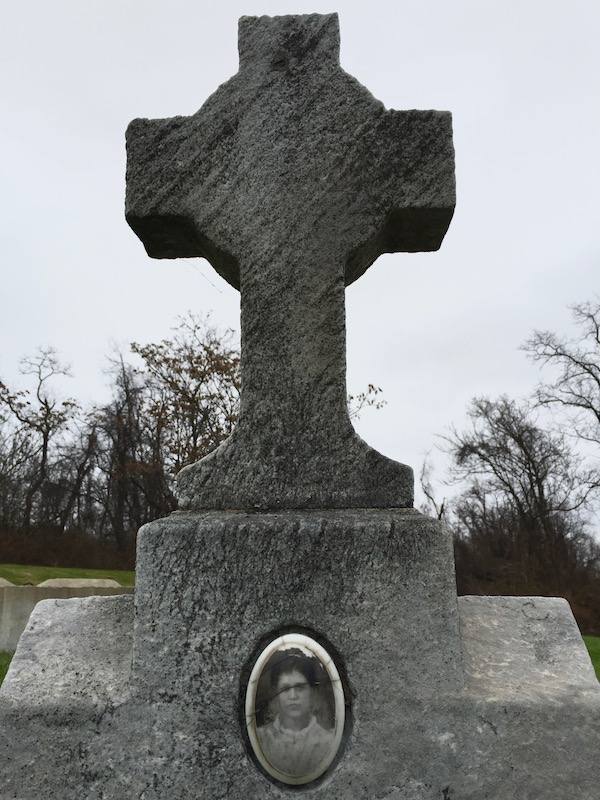
marble headstone with large cross and embedded ceramic photograph of young man, Loretto Cemetery, Pittsburgh, PA

unknown

detail of marble headstone with embedded ceramic photograph of young man, Loretto Cemetery, Pittsburgh, PA

unknown

Loretto Cemetery rests at the very easternmost end of the big mount that rises above the South Side. Far below, but difficult to see from the steep angle, is an S-shaped crook in the Monongahela as it snakes between Hazelwood and the South Side. It’s an enviable location: quiet, vacant, and with terrific long views across the river to Oakland and Greenfield on the other side.

We hadn’t come here looking for the dead, but any new cemetery is worth a poke-see when you trip across it. When we did, those names–Cvetkovic, Vnencsak, Mlinac, Turkovich, Opacic–just popped right out like candy on the shelf. Something interesting would surely await.

detail of marble headstone with embedded ceramic photograph of young man, Loretto Cemetery, Pittsburgh, PA

Toni Poljak

detail from marble headstone with embedded ceramic photograph of baby in high chair, Loretto Cemetery, Pittsburgh, PA

unknown

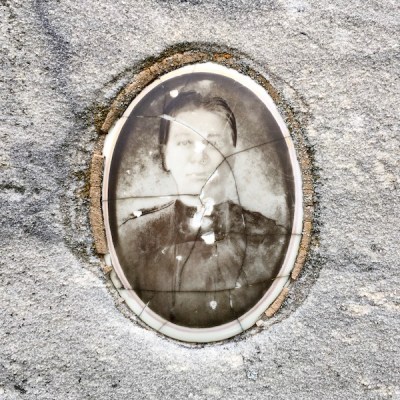
That something came in the form of a small black-and-white photograph, cast onto an oval-shaped ceramic disc and inset directly into one of the tower-like headstones. The posed portrait was of a middle-aged woman, “Mother” Antonija Komlenić, Victorian in both high-necked formal dress and dour, no-fun-allowed expression.

The colored mortar used to anchor the piece in stone is half chipped-away, eroded by a century of industrial mill exhaust and harsh Western Pennsylvania weather[1]. The image is all there, but it’s faded and scored by sharp cracks awkwardly bisecting Komlenić’s face and torso.

headstone for Antonija Komlenić, Loretto Cemetery, Pittsburgh, PA

Antonija Komlenić

detail of ceramic photograph on headstone for Antonija Komlenić, Loretto Cemetery, Pittsburgh, PA

Antonija Komlenić (detail)

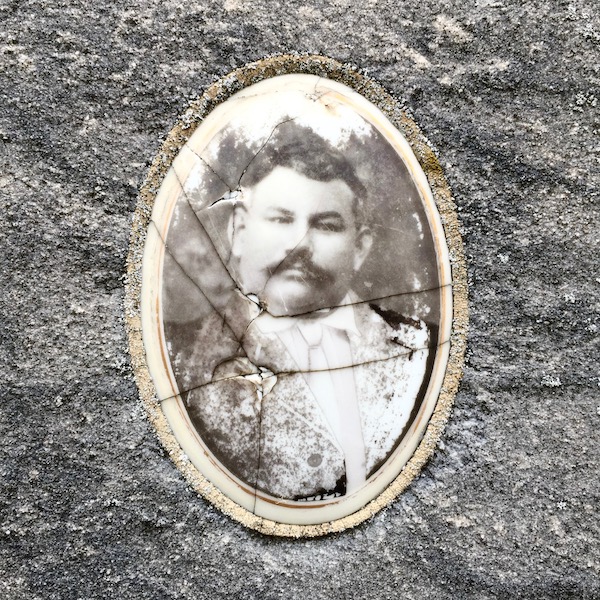
Looking around a little closer now, another headstone is embedded with the same kind of oval-shaped photo just steps away. This one features a large man in suit and tie, his head is cocked and he wears a kind of bushy mustache that hasn’t been in vogue for a very long time. Both the deep black of his dress jacket and the shade of the photo’s backdrop have worn away significantly. There’s an angled crack through the ceramic just under the deceased’s chin suggesting a sinister garrote, but the man’s face is calm–bored, even–and remarkably untouched by the hands of time.

Suddenly aware and on the lookout for more, the grave photos are all over–on stones tall and thin, mounted below marble crosses and flat on granite. There may be a couple dozen in total, scattered across the sections closest to Loretto’s entry gate on Devlin Street. At least as many feature an empty cutaway in the stone where the inset image is no longer present; its former tenant stolen or broken, weathered or vandalized long ago.

detail of marble headstone with embedded ceramic photograph of older man, Loretto Cemetery, Pittsburgh, PA

unknown

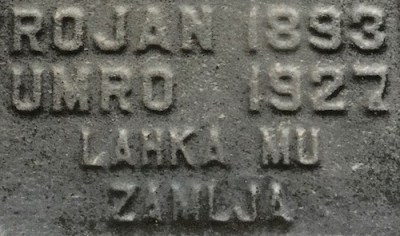
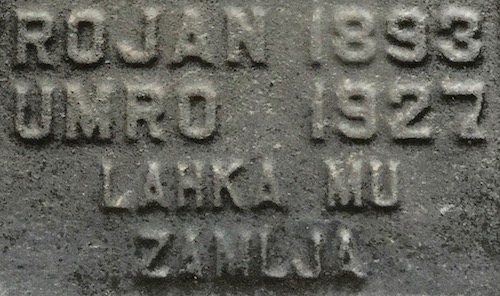
detail from headstone reading "Rojan 1893 - Umro 1927 - Lahka mu zamlja", Loretto Cemetery, Pittsburgh, PA

Lahka mu Zamlja

Lahka Mu Zamlja (alternately Laka Mu Zemlja), the Internet informs us, is either a Serbian or Croatian (perhaps both?) expression of condolence that translates to “may the black earth be easy on him.” Confirming this with Google translate was not very successful–it came up with preposterous gropes in the dark such as “easy land of mu” or “light mu country”[2]. But as this is likely an arcane idiom, it seems a pretty safe Balkanization of Rest in Peace.

We found this phrase on quite a number of Loretto’s graves, including some of the very ones with the inset portraits. While it’s impossible to know how “easy” the black earth was on each of these folks, the atmosphere above ground has taken varying degrees of torture out on their memorials. The photos here labeled unknown aren’t for lack of note-taking–there simply isn’t any text still readable on the headstones.

weathered marble headstone in the shape of a cross with embedded ceramic photograph of young woman, Loretto Cemetery, Pittsburgh, PA

unknown

detail of marble headstone with embedded ceramic photograph of young woman, Loretto Cemetery, Pittsburgh, PA

unknown

The Orbit has spent considerable time in a whole lot of bone yards over the years and we’ve written quite a bit on the subject already. It’s nothing special to see more recent headstones with all manner of high-tech integral photos, bas reliefs, and digital engravings of the deceased, his or her family, loved ones, hobbies, and The Pittsburgh Steelers. But these hundred-year-old…ish[3] photographs-turned-grave ornaments are new to this blogger. Even if I have encountered other late Victorian/pre-war ceramic photos on headstones before, it certainly wasn’t with the quantity or density found in Loretto.

They’re something special, for sure. For one, simply because of the number that are still here [and that’s even more remarkable by the obvious number that are not]. More than that, though, it may be the context or the unpredictable deterioration they’ve been through, but the people in these photos seem to look right through you with a dark, foreboding wisdom of time and fate.

Old photos are almost always interesting. In these, though, there’s somehow a deeper presence. “Wife” Maria Miklin died in 1941, but her sepia-toned portrait as a young woman–scored, chipped, and cracked across the face and torso–seems to defiantly say is that all you got? Just wait ’til you get here, Jack. Lahka Mu Zamlja, indeed.

detail of marble headstone with embedded ceramic photograph of woman, Loretto Cemetery, Pittsburgh, PA

Maria Miklin

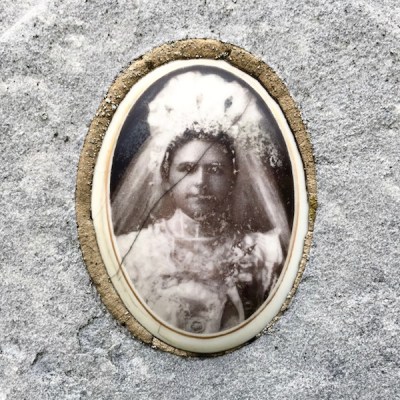
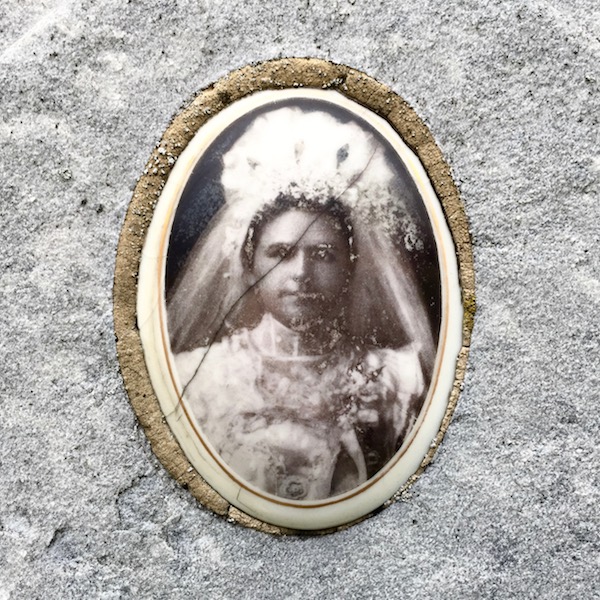
detail from marble headstone with embedded ceramic photograph of a woman in bridal gown, Loretto Cemetery, Pittsburgh, PA

unknown

If existential blogging is what you’re looking for, The Orbit is qualified to satisfy. This whole bag conjured up all kinds of deep thoughts on memory and preservation and forever–luckily, we’ve also got a bunch more interesting photos to back that up. We’ll get to all that in Part 2.

GETTING THERE: Loretto Cemetery is in Arlington Heights and can be reached by going all the way to the east end of Arlington Ave. until it curls around to become Devlin Street. If you want a great hike, though, The Orbit recommends starting on the South Side at the base of the Oakley Way steps and making the journey all the way up and over on foot.


[1] In this case, literally a century; Antonija Komlenić died exactly one hundred years ago, in 1916.
[2] Note to Google: when you get tired of mucking about with driverless cars, see if you can translate “mu” from Croatian!
[3] An incredible number of these headstones have no remaining legible text, but the ones that do date from the 1910s to 1940s.

Step Beat: Oakley Dokeley, The Oakley Way Rehab

Detail of public steps with mosaic decoration of a woman's head, Pittsburgh, PA

It’s a cruel reality: when you’re working the city step beat, there ain’t a lot of news to report. No, most of the stories we run end up being about going to visit steps that inevitably won’t be around for long, occasional Indiana Jones-style heroics to hike them, or the historical curiosities of infrastructure ruins that were once so vital and now–all too often–go nowhere and serve no one.

So it is with no small amount of glee that The Orbit goes to press with a story on not only the complete rehabilitation of a set of core city steps, but the genuine newsy news that they’ve been wonderfully dressed-up in brand-new full-color mosaic tile.

public steps with mosaic decoration including houses, sky, a fox, a bird, sun, and stars, Pittsburgh, PA

Oakley Way Steps, top mosaic section

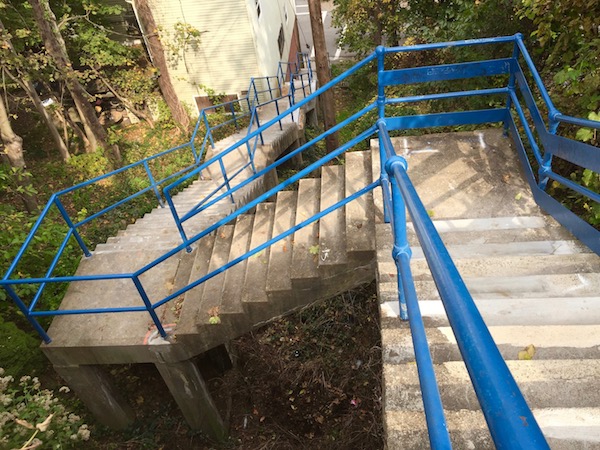
Oakley Way is one of the many climbs that create access points from the South Side Slopes above to the flats below (and vice-versa). The street is actually seven short (but mostly vertical) blocks long–part city steps/part steep road-with-steps sidewalk. The bottommost stretch (from Josephine to McCord) is the only section that’s received the mosaic treatment, but some of the upper sections have also been nicely rehabbed with patched concrete and fully repaired and repainted blue handrails.
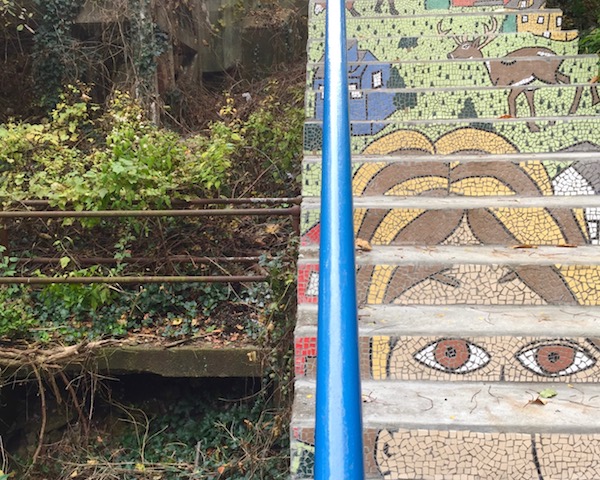
Artist Laura Jean McLaughlin led a group of volunteers in the design, construction, and installation of the mosaic risers. That process was covered in a recent Post-Gazette piece that only scooped us because we got side-tracked by Fairywood and tryptophan and shelved the post for a month. Fooey!
looking up Oakley Street city steps, Pittsburgh, PA

Looking up: the Oakley Way steps

Spread across seventy-seven consecutive risers, the mosaic’s central figure is a tall red-booted woman in a checkered skirt who–based on the proportional size of the river, bridge, and factory building also in the piece–must stand about the height of the US Steel tower. Also decorating the lush scene are Slopes homes, grass, flowers, a fox, a bird, the sun and stars.

If you’ve seen any of McLaughlin’s other local projects you’ll recognize her loose, cartoonish, and earthy signatures. A lesser blog might invoke the term “whimsical,” or even (shudder) “funky”. The Orbit won’t stoop to that level, so we’ll just say they’re fun, very Slopes-centric, and a great compliment to the D.P.W.’s fix-up work.

Oakley Street city steps, Pittsburgh, PA

View down the bottommost section of Oakley Way (from McCord Street)

We’ve argued in these very virtual pages that Pittsburgh’s network of public steps is a city asset unlike any other–part transit route, part jungle gym, part historical oddity, and what should be a big draw for tourism*. It’s encouraging to see any set of steps getting much-needed maintenance, but it’s especially great to see them dressed to thrill with such a wonderful addition as McLaughlin’s mosaic.

There’s at least one other similar project out there and completed. Linda Wallen’s mosaic work at the base of the steps off Itin Street in Spring Garden isn’t nearly as ambitious as Oakley Way, but it’s still a great twinkling beacon in the great constellation of city step dark stars. May these two heroic projects guide step freaks to a new, golden dawn of altitude adjustment, wide perspectives, and throbbing calf muscles.

public steps with mosaic tile decoration of woman's head with houses and deer in the background, Pittsburgh, PA

Old and new: remnants of an earlier, defunct passage under the rehabbed Oakley Way steps


* Visitors who don’t want to lose their breath climbing dozens of flights of steps to dilapidated neighborhoods with spectacular views should consider lodging other than Chez Orbit’s fold-out sofa.