Hail, Mary! Front Yard Mary Roundup

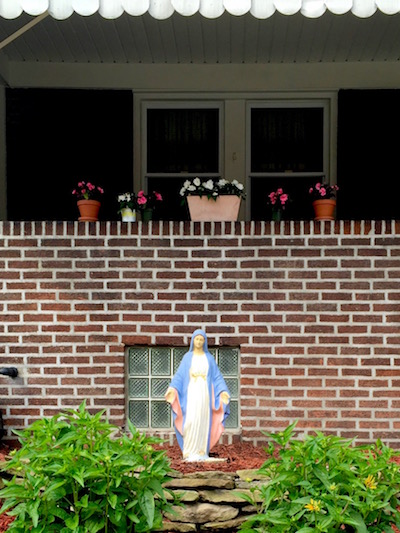
grotto with statue of Mary in front yard, Pittsburgh, PA

Deluxe grotto Mary, Spring Hill

With apologies to James Rado and Jerome Ragni:

Don’t ask me why, I’m just a Mary guy
I’m Mary noon and night, Mary, she’s a sight
I’m Mary high and low, don’t ask me why, don’t know

Not really expecting Mary to fly in the breeze, get caught in the trees, or provide a hive for the buzzing bees, we’ll end this frivolity right now–there’s big Mary business on the docket!

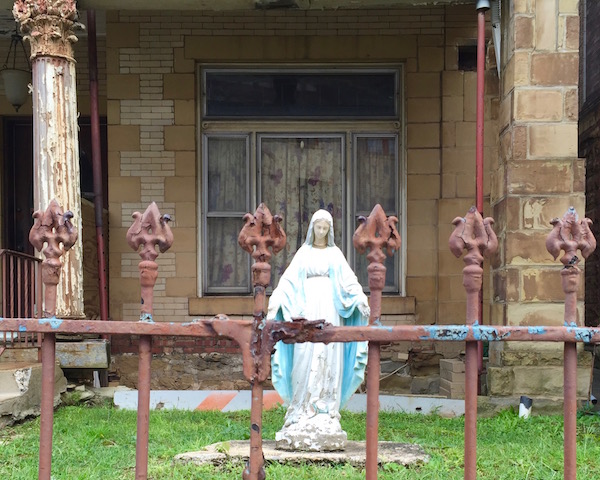
Mary statuette in front yard grass, Pittsburgh, PA

The Run

More Marys! In super-deluxe retaining wall grottos, bedecked in spinners and lights, obscured by Halloween decorations, enveloped in the deep-fry aromas of Big Jim’s, and standing alone in shame like a misbehaving student at recess.

The Orbit was not at all sated the by The Front Yard Marys of Bloomfield. No, that June, 2016 scene report just whet an appetite that inspired us to climb mountains, ford streams, and canvas for Hillary Clinton to slake this curio-religious thirst. Drink up.

Statuette of Mary in front yard, Homestead, PA

Homestead

Mary statuette in front of brick house, Pittsburgh, PA

Stanton Heights

Mary statuette in front yard, Pittsburgh, PA

Morningside

statue of Mary in front of older pink frame house, Pittsburgh, PA

Oakland

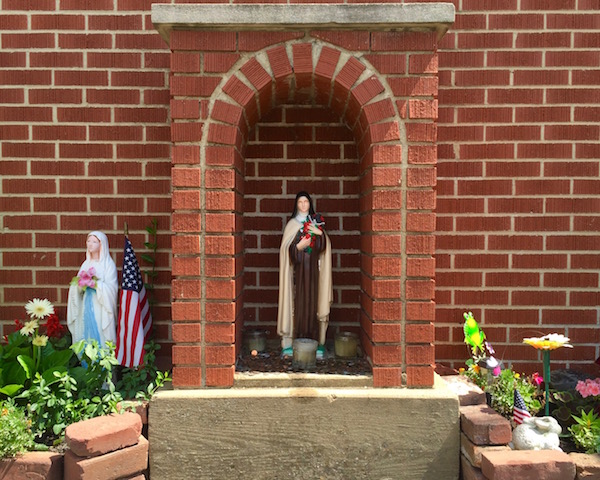
front yard Mary in grotto with a separate front yard Mary, Pittsburgh, PA

Big Jim’s Marys, The Run

Front yard Mary, Pittsburgh, PA

Lawrenceville

Mary statuette in wooded yard, Pittsburgh, PA

Mary of the Wood, South Side Slopes

Mary statue in grotto in front of frame house, Pittsburgh, PA

Halloween Mary, Spring Hill

statuette of Mary in front yard of house, Pittsburgh, PA

Allentown

Three statuettes of Mary in front yard of home, Pittsburgh, PA

Trio of Marys, Stanton Heights

statue of Mary in homemade grotto, Pittsburgh, PA

Back yard Mary, Lawrenceville

Castle Damas

retaining wall on hillside constructed to look like medieval castle, Pittsburgh, PA

Castle Damas, Spring Hill

Rick Sebak’s inevitable future Pittsburgh history documentary Great Retaining Walls of Allegheny County should begin right here, in Spring Hill.

Castle Damas[1], a medieval fortress whose turrets and battlements were formed from mortar and stone rises with a spectacular view of the lands it holds dominion over–through the valley, down to Spring Garden, and across the river to the Strip District.

That these impenetrable walls should stand just up the block from the Spring Hill spring is no accident. The first settlers of Damas Street wisely selected an optimal site for defense, visibility, quality of life, and its free-flowing supply of life-sustaining cleanish natural spring water[2].

house with retaining wall on hillside constructed to look like medieval castle, Pittsburgh, PA

The keep and battlements of Castle Damas

Given the news of the week, we can assume we’ll all be getting a little more familiar with wall-building. On our recent visit, we were fortunate enough to meet the lord or this particular manor, who’s probably got as much wall experience as anyone. This day, our regent was engaged in maintenance of the structure, giving his naves a precious Saturday off and pulling weeds from the parapets himself. Lord Damas [Swiss cheese-for-brains failed to record the homeowner’s given name] told us his hilltop house was built in 1926 and its first owner, a baker, began construction of the elaborate wall around 1933.

Perhaps because it hasn’t been around quite as long as its European cousins, the castle wall and its bungalow-style keep are in impressive condition. Our liege told us he’d had to rebuild the top left half of the battlements and after pointing it out, the different colored mortar makes that somewhat obvious–but there’s enough variance in the stonework that this masonry-challenged blogger probably wouldn’t have noticed otherwise.

figure of an owl created with concrete and reflectors, Pittsburgh, PA

The owl of Castle Damas

Brendan Gill, (then) architecture critic for The New Yorker, famously wrote “If Pittsburgh were situated somewhere in the heart of Europe, tourists would eagerly journey hundreds of miles out of their way to visit it.”[3] This blogger’s about as crazy cuckoo coconuts on Pittsburgh as anyone, but even he can recognize hyperbole when he trips on it.

That said, when just any old anonymous hillside street gives us these cross-city views, this public spring, and a terrific faux castle/retaining wall overgrown in beautiful wildflowers and fall colors, birds–even a guard owl–well, who are we to argue?

retaining wall on hillside constructed to look like medieval castle, Pittsburgh, PA

Castle Damas


[1] “Castle Damas” is Pittsburgh Orbit‘s name for the construction–don’t bother looking it up (at least, not by that name).
[2] We’ll note that the construction of the uphill houses on Damas Street was considered a contributing factor to the discoloration and impurity of the sping’s water.
[3] In the same quote, Gill also claims “The three most beautiful cities in the world are Paris; St. Petersburg, Russia; and Pittsburgh,” but if the guy has never even been to Akron, take it with a grain of salt.

Day of the Dead: Susan Hicks, Uber Alles

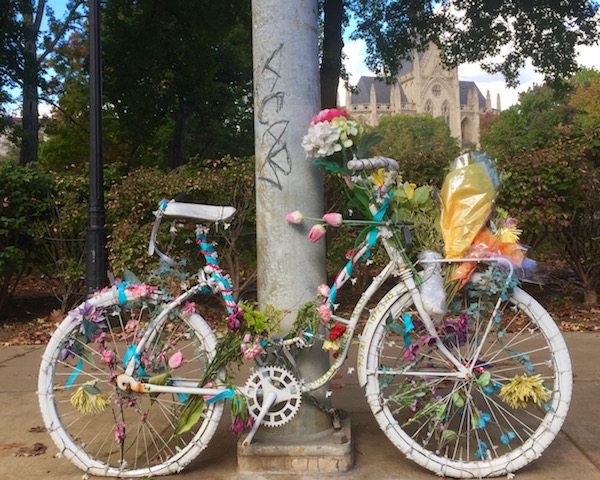
bicycle painted completely white and decorated with flowers and lights, Pittsburgh, PA

Ghost bike memorial for Susan Hicks, Oakland

Last week marked the one year anniversary of Susan Michelle Hicks death. This blogger didn’t know her personally, but Ms. Hicks was “friends of friends” who commuted–and was killed–riding her bicycle on a stretch of Forbes Avenue in Oakland where I ride all the time. Quite literally, it could have been me.

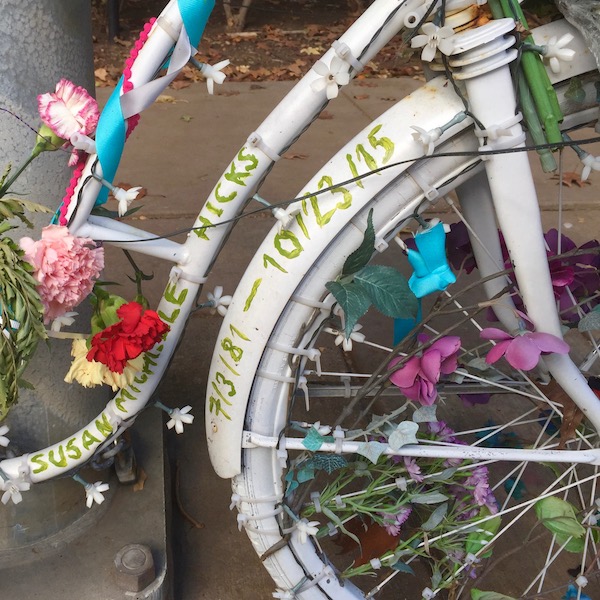
Very near the tragic spot where Ms. Hicks died, just across the street from Dippy the Dinosaur and the Carnegie Music Hall, is a so-called “ghost bike” memorial. Chained to the pole of a stout street lamp, it’s a decommissioned older bicycle, painted completely white, draped in flowers, ribbons, personal messages, and a strand of solar-powered lights. A felt-tipped pen left on the seat invites visitors to ink inscriptions to the fallen–many have done so.

The effect of seeing the Hicks ghost bike–or any other–is incredibly moving. It’s both beautiful and haunting, arresting, sombre, and reverent. It’s also encouraging that this obviously-un-sanctioned memorial has been allowed to remain intact; city works crews choosing to leave it alone–now, for over a year–in this very public, well-travelled spot instead of treating it as an act of litter or vandalism.

detail of ghost bike for Susan Hicks, Pittsburgh, PA

Statistically, Pittsburgh is among the very safest U.S. cities to be a bicycle rider/pedestrian. This is, perhaps, surprising given our severe infrastructure challenges, but according to some numbers collected by Bike PGH, the city’s rate of 1.8 fatalities per 10,000 commuters is way down the list of American cities. As comparison, the bottom of the collection contains Ft. Worth, Detroit, and Jacksonville, all with an average of 40 to 50 fatalities on the same scale.

That said, it’s sadly no surprise this particular tragedy happened in the heart of Oakland. Any Pittsburgh cyclist will tell you what a nightmare it is to navigate the neighborhood on two wheels. It’s nearly impossible to feel safe riding from, say, Neville to Atwood, or CMU to Pitt without either breaking some kind of law or going way out of your way–and this is a part of town with 40-some thousand college students! I get mad at the kids riding on sidewalks, but what alternative do they have?

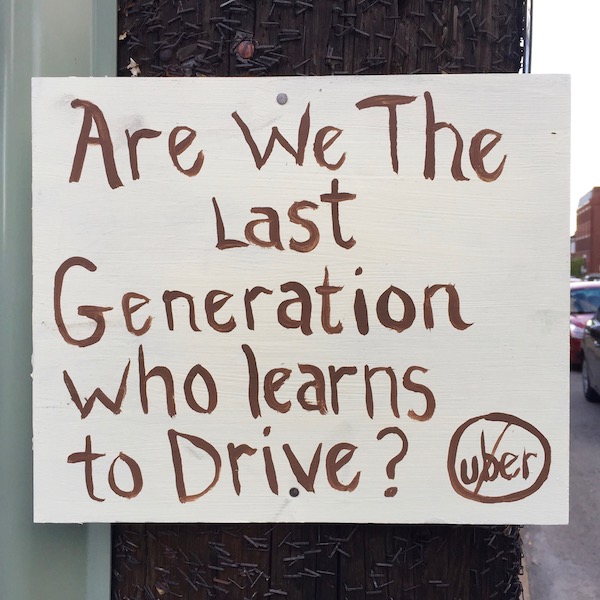
Handmade sign reading "Are we the last generation who learns to drive?", Pittsburgh, PA

Anti-Uber sign, Oakland

On a recent ride home from work, I came across a batch of wooden signs nailed to telephone poles. On each was a hand-scripted message: Are we the last generation who learns to drive? read one on Craig Street, and Humans crave community, not isolation another. The messages continued in Bloomfield:  Automation smothers natural beauty and awe and Deep in your humanness, your heart longs not to be mechanized.*

If you’ve spent any time in the East End over the last half year, you know where these are coming from. Uber self-driving cars are being tested all over the city–we see them every day**. It’s a technology that’s not without controversy, but surprisingly little considering the potential societal implications. Overall, opinion has felt more like a collective ho-hum.

collage of photos of Uber self-driving cars being tested on Pittsburgh city streets

Uber self-driving cars testing in Pittsburgh [photos, clockwise from top left: P. Worthington, M. Hertzman, A. Hoff, K. Barca]

The full point of these guerrilla signs is not entirely clear, but each contains Uber’s name in a crossed-out circle. We can assume the opposition to the ride-sharing company is the anonymous sign-poster’s major thesis, but there are also messages around community, beauty, and “humanness”.

Is Uber being accused of colossal corporate takeover? Or is the issue that they’re developing self-driving technology? Assuming the latter, how does changing the way a car navigates “smother natural beauty and awe”? [We did a pretty good job of this way before Uber came along.] Plenty of people drive alone every day–why do these vehicles create any more isolation than any other solo car trip?

If we’re worried about the number of Uber (and other) human drivers who may be put out of work by this technology, that’s legit. But let’s not assume that’s the only sociological possibility for self-driving vehicles. There is the very real likelihood that autonomous cars will be much safer on the road than humans. They certainly won’t drive drunk or fall asleep at the wheel. They won’t show off to impress the girls in the back seat and won’t take their eyes off the road when their phones light up. There are a whole lot of people with disabilities who can’t wait for an alternative to Access.

Handmade sign reading "Automation smothers natural beauty and awe", Pittsburgh, PA

Anti-Uber sign, Bloomfield

Bicycle riders are not saints. There are a lot of dangerous people out there, and we come across them every day–treating sidewalks as bicycle lanes, recklessly jack-rabbiting through traffic, ignoring traffic lights, signaling, and stop signs. Cyclists who take off without a helmet or foregoing lights in the dark are just plain foolish.

These are condemnable actions that frankly burn this biker’s breeches–you guys give us all a bad name! That said, it’s nothing compared to the regular behavior we see from drivers toward cyclists. I’ve never been hit by a vehicle driven by a computer; the same can’t be said for humans. In my years (ahem, decades) on two wheels, I’ve been spit on, had trash thrown at me, yelled-at, cat-called, and aggressively hip-greased more times than I can recall. Drivers routinely drift absent-mindedly, park in bicycle lanes, and wildly swing open their parked doors without first consulting their mirrors. While driving, they eat and drink, talk on the phone, apply lipstick in the rearview mirror, and, of course, are constantly texting.

Given all this, I’ll take my chances with the robots. If they’d been deployed to Oakland last year at this time, maybe Susan Hicks would still be with us and on the road today.

bicycle painted completely white and decorated with flowers and lights, Pittsburgh, PA

Ghost bike for Susan Hicks, Oakland


* If anyone has seen more of these, we’d love to know about them.
** So far, always with a human in the driver’s seat.

Union Dale Cemetery: The Lamb Lies Down on Baahway

iron grave marker of a lamb, Union Dale Cemetery, Pittsburgh, PA

(unknown)

Union Dale Cemetery‘s Division Three, Section b (yes: that’s a lower-case b) lies waaay in the back, at a high point in the park, bordered by treelined fencing that separates the property from nearby Presley Ridge School. Section b is so far removed that it doesn’t even appear on the cemetery’s online maps*.

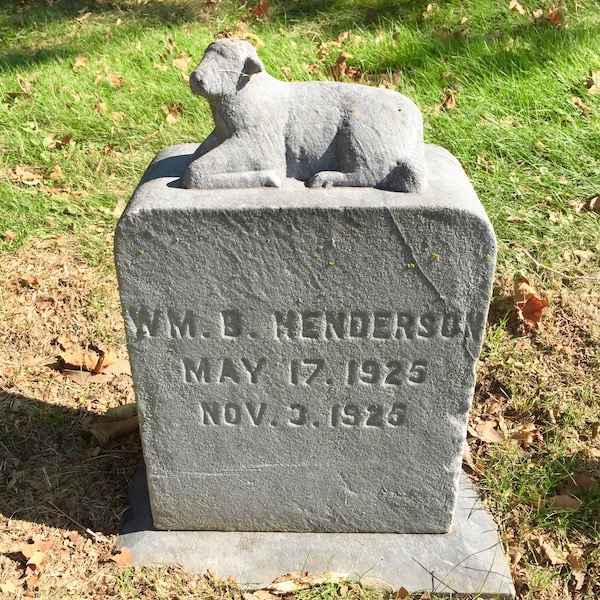
But if you can make it out to Union Dale’s far northeast outpost, the tell-tale shapes of lambs popping up on gravestones and laying down in the grass will tell you you’ve reached the right spot. The creatures will be calmly resting, their little lamb ears pointing out at the sides. Each one of them will face the same direction.

weathered gravestone with lamb, Union Dale Cemetery, Pittsburgh, PA

Wm. B. Henderson

weathered gravestone with lamb, Union Dale Cemetery, Pittsburgh, PA

Jane Lee Blumfeldt

Listen here: when we shoot the sheep, we’re not talking about any jive-ass 2-D cutaways or bas relief lambs, either–though there’s plenty of those loitering on newer stones in the same neighborhood. No, this is full-on, worn-to-nubs marble and granite lambitude.

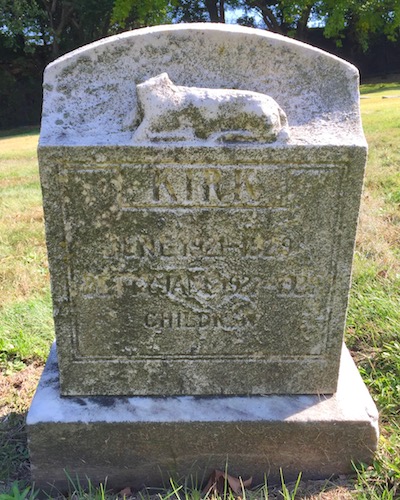
Two of the specimens (Kirk and Klein, photos below) seem to be the same general make and model, but otherwise each gravestone is unique. That’s not to say the lambs don’t look alike–they do–but there’s enough variance here to suggest these weren’t simply off-the-shelf lamb-on-a-box markers.

weathered gravestone with lamb, Union Dale Cemetery, Pittsburgh, PA

Kirk

weathered gravestone with lamb, Union Dale Cemetery, Pittsburgh, PA

Ralph A. Klein

Jennie Benford, our Concierge to the Dead, says “The lambs were very popular but almost exclusively for children’s markers.” The Internet backs her up on this claim, as does the anecdotal evidence of the dates we can see on the (still-legible) stones here. The deceased were all between months and just a few years old when they arrived at Union Dale and given the concentration in this one small area, we have to wonder if Section b was earmarked as plot for children.

The association of lambs with the death of children has a number of explanations, but the most common seems to this passage from the Bible:

The next day John seeth Jesus coming unto him, and saith, Behold the Lamb of God, which taketh away the sin of the world.  — John 1:29

weathered gravestone with lamb, Union Dale Cemetery, Pittsburgh, PA

(unknown)

weathered gravestone with lamb, Union Dale Cemetery, Pittsburgh, PA

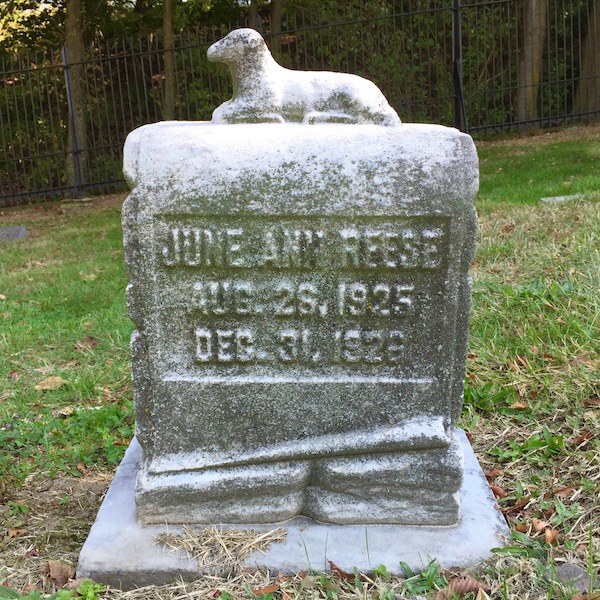
June Ann Reese

There are other similarities. Every one of the markers (that we’re able to read) is dated from the same decade. Jennie assures us “The lamb stones are not strictly 1920s–I’ve seen them used much earlier than that and for some time after,” but it’s an interesting data point.

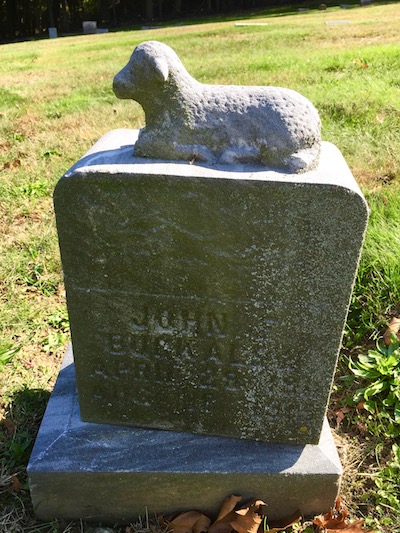
The lamb is always sculpted alone and awake, but in a resting position with its legs folded underneath. I imagine there is a practical aspect to this–sculpting those spindly legs from delicate marble is likely very expensive and accident-prone. That said, one has to accept that the feeling of innocence is even more pronounced with the gentle creature in repose. What could be more harmless and vulnerable than a kneeling fluffy white lamb?

Perhaps most curious, every single lamb faces to the left (as the visitor faces the stone)**. Now, that may just be a coincidence in our small sample, but if so, it’s equal to flipping “heads” ten times in a row. Still, reading any dramatic symbolism into facing left vs. right seems like a major stretch. Left, in this case, is also north, since all the stones face the same direction–west, or downhill and towards the only small access road. Again: likely not a planned coordination.

weathered gravestone with lamb, Union Dale Cemetery, Pittsburgh, PA

(unknown)

weathered gravestone with lamb, Union Dale Cemetery, Pittsburgh, PA

Catherine Achey

Union Dale Cemetery is an intimidating place to explore. It covers a huge area–likely equal to the size of Allegheny Cemetery or many (larger) city neighborhoods. The full plot is divided by Brighton Road and Marshall Avenue/Rt. 19, which effectively turns the park into three separate cemeteries. [Union Dale labels each of these a division.]

It’s hard to imagine there’s any best or worst way to take in Union Dale for the newcomer. That said, like so many things in life–or, it seems, in death–there’s nothing wrong with ending up at Plan b.

weathered gravestone with lamb, Union Dale Cemetery, Pittsburgh, PA

John Buckalynn


* Section b should not be confused with Section B, right by the entrance. Also, it looks like Union Dale’s PDF maps may have a page 2 that just didn’t make it to the web site.
** Two of the markers photographed are simply freestanding sculptures without an engraved headstone, so there is no left or right.

Allegheny Cemetery: Mausoleum Stained Glass

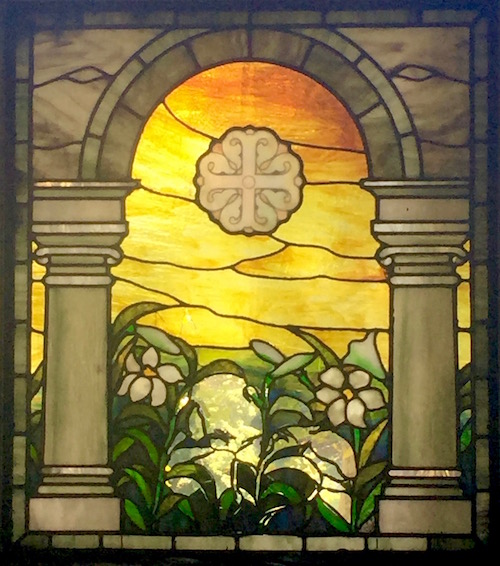
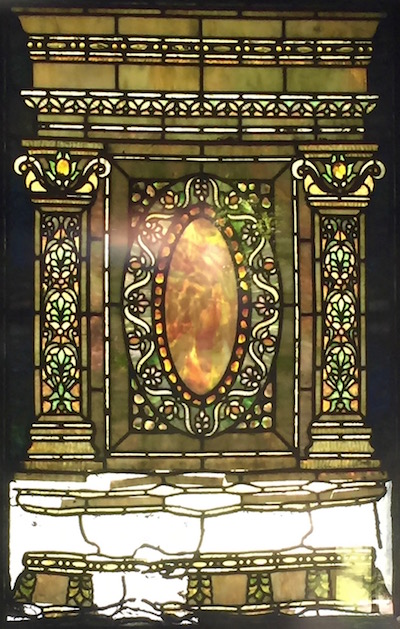
mausoleum stained glass with pentagram, Allegheny Cemetery, Pittsburgh, PA

Sproal-Splane

Seeing the world through the Orbit eye. Those words came to us a while back from superfan Lee, and we accept it as the ultimate compliment. Lee still requires corrective eyewear–so be warned that Pittsburgh Orbit is no substitute for Lasik–but we think we know what he was getting at.

If Orbit “reporting” has taught us anything at all, it’s to always take another look. Lose the expectations and open up the senses. Point those peepers everywhere you can: down the alley, around the corner, on the pavement, up in the telephone wires, and through the crack in the window. Like Irene Cara said: take your pants off and make it happen. What a feeling, indeed.

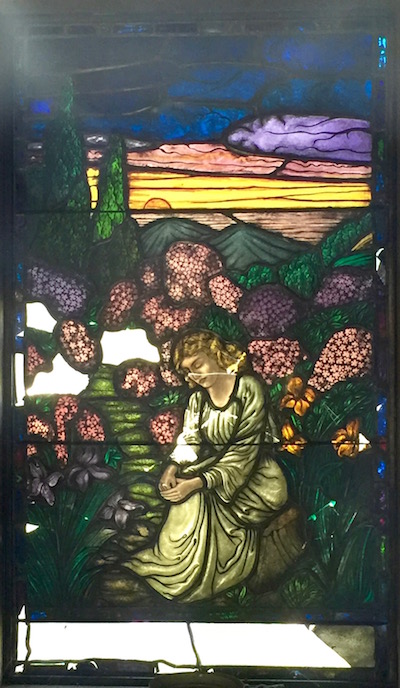
broken mausoleum stained glass with sitting woman and field of flowers, Allegheny Cemetery, Pittsburgh, PA

James M. Miller

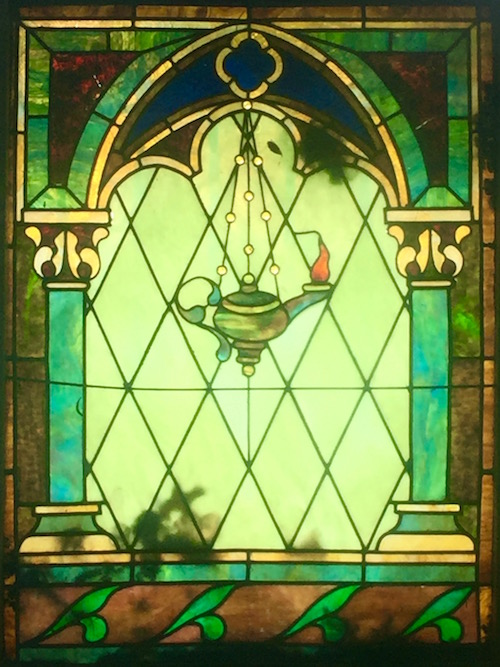
mausoleum stained glass of oil lamp hanging in arched window with columns, Allegheny Cemetery, Pittsburgh, PA

Unknown (possibly Krey, based on nearby cenotaph)

One of those spots, attentive Orbit readers will have anticipated by now, is through the thick barred grates, cobwebbed glass, and musky air of the ornate mausoleums at our historic cemeteries. Pittsburgh is sitting on a bunch of these.

This blogger has walked through, bicycled around, picnicked in, and shutterbugged Allegheny Cemetery literally hundreds of times over the last couple decades. Allegheny’s collection of mausoleums isn’t quite as spectacular as the rock star ones we toured with Jennie Benford last year at Homewood, but it’s nothing to scoff at.

The mausoleums act as both beacons and exclamation points on the rolling landscape and much of the art deco and faux-Egyptian architecture is really astounding. But for whatever reason, we rarely ever took the opportunity to shade the eyes and poke the schnoz in to check out the interior spaces.

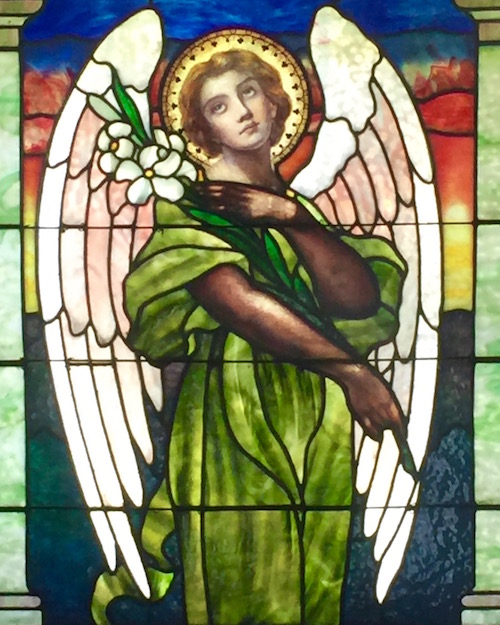
mausoleum stained glass with angel, Allegheny Cemetery, Pittsburgh, PA

Unknown (detail)

mausoleum shelves with trophies in front of colored glass, Allegheny Cemetery, Pittsburgh, PA

Sheets

I’ll tell you: it’s not an easy thing to do. The average mausoleum–in Allegheny Cemetery, at least–seems to have a pair of thin, highly-decorated entry doors, each behind some version of vertical iron bars or decorative scrolled metalwork. Half the time, the original door locks are still in use, if not, there’s an awkward after-market steel chain and padlock lashed around whatever it can grab ahold of.

If you can see much inside, it’s typically a narrow passage, just wide enough for a person to turn around in, flanked by the celebrated residents’ crypts. Sometimes there’s just one of these on either side; others are stacked floor to ceiling. At the rear of almost every mausoleum is a stained glass window providing the only natural light outside of the shaded entry doors.

So to look inside a mausoleum is to peer through several layers of obfuscation, from the outside daylight into a darkened interior that may have had a hundred years since its last human visitor.

broken mausoleum stained glass with architectural design, Allegheny Cemetery, Pittsburgh, PA

King

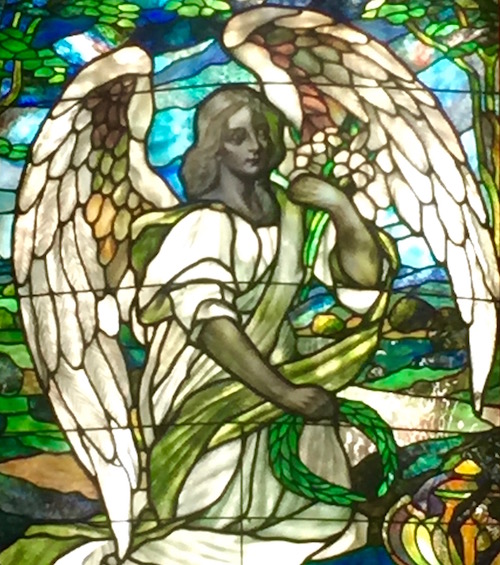
mausoleum stained glass with angel in green tunic, Allegheny Cemetery, Pittsburgh, PA

Wettengel (detail)

And what do we get to see in the stained glass? In a word: flowers–lots and lots of flowers. Flowers in vases, flowers in gardens, ornamental flowers, and flowers held by angels; lillies of the valley and daffodils of the foothills. We only included photos for a few of these; the flowers are quaint, but they’re just not that exciting.

Beyond the flora, however, there’s some pretty neat stuff. An old-school oil lamp dangles under an arched cathedral window with ghostly leaf shadows backlit from the outside; angels appear with painted-on faces, doe-eyed and calming; and, of course, in that chestnut of mortal symbolism, the sun sets over and over again in Mausoleumville.

There are also the broken panes. Windows whose heavy weight, coupled with a hundred years of un-climate-controlled Pennsylvania weather, eventually overburdened the lower sections. Individual colored pieces have popped out and cracked, leaving the windows looking like incomplete paint-by-numbers; the unimpeded sun’s glare the brightest element in the tiny space.

broken mausoleum stained glass with arch and white flowers, Allegheny Cemetery, Pittsburgh, PA

Lillian Russell Moore

Is it worth a trip? Well, Allegheny Cemetery is absolutely worth all the time you can give it–even if you don’t want to squint into (silent film star) Lillian Russell‘s final repository. But while you’re there, yeah, you should neb into whoever’s crypt you can. The Sheets and the Kreys and the Sproal-Splanes don’t seem like they’re coming around anymore, but don’t worry; we’ve got that Orbit eye looking out for them.

Re:NEW Festival: DRAP-ART

Chinese temples made by artist Gao Yansong from recycled boxes

Gao Yansong “The Chinese Dream Marlboro” and “The Chinese Dream NIKE”

It can’t be easy to light up a brand new festival. Why, you’ve got to do a bunch of planning, organize volunteers, negotiate with venues, talk people into doing umpteen different things, write a grant, create a logo, secure a domain name, and then when the day–or month–finally rolls around, you can only cross your fingers and hope that somebody–anybody–is willing to give your goofy idea a shot. It’s exhausting just thinking about it.

The folks that cooked-up this year’s Re:NEW Festival* weren’t mucking about. The festival spans a full month across a dozen different downtown venues, features a slew of staggered events, long-run gallery shows, lamppost banners, glossy printed materials, and of course, printed t-shirts. Oh, yeah–they also decided to stage the North American premier of a world-renowned international recycled art festival/organization, just so you’ll know they aren’t slacking.

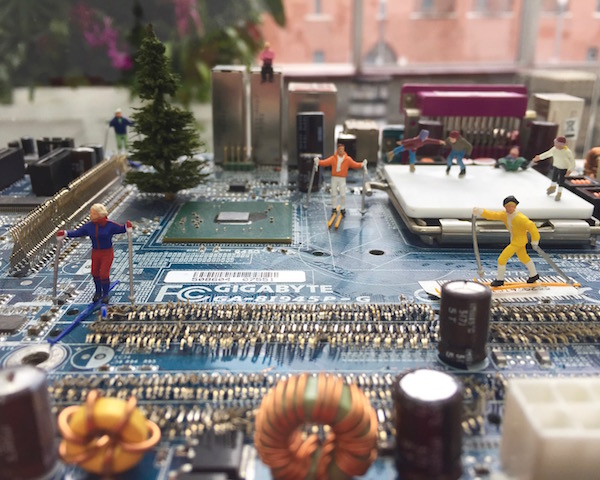
sculpture of tiny skiers on lanscape of recycled circuit board by artist David Martin

David Martín “Ski” (detail)

pendant lamp created by artist Imanol Ossa from piano keys

Imanol Ossa “Piano XL Lamp”

From its web site, DRAP-ART is a Barcelona-based “association of artists who have chosen trash to be their material and/or conceptual resource.” Whether you want to call it recycled or repurposed or straight-up trash, (a term DRAP seems to have embraced) the non-standard (typically) mixed media is front-and-center in almost every piece in the show.

Bic pens and piano keys dangle from pendant lamps, a woman’s mod-inspired go-go dress is created with the pop-tops from aluminum cans and sewn with plastic bag “thread”. There are robots made from deconstructed office equipment and a school of tin can-fashioned fish. Phonograph records are laser cut into birds on telephone wires and brown paper bags become the canvas for ashen drawings of industrial Detroit. Bill Miller [the only local in the bunch and one of just two Americans] turns in an incredible wall-sized mosaic/collage of cut linoleum flooring.

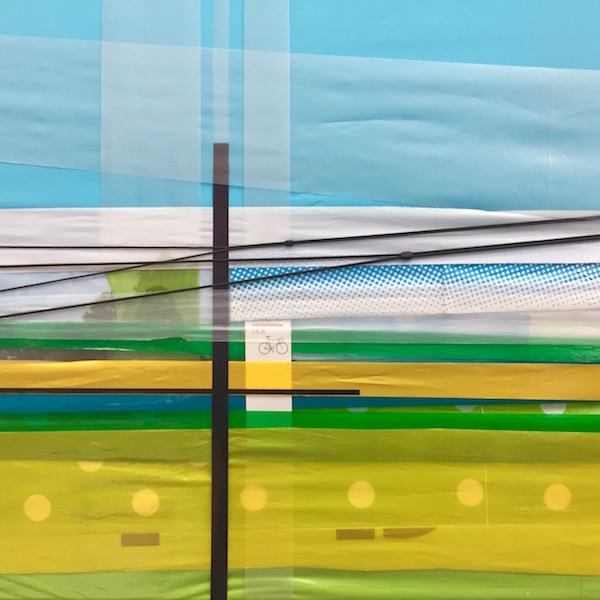
landscape by Irene Wölfl created from recycled plastic

Irene Wölfl “Irgendwo” (detail)

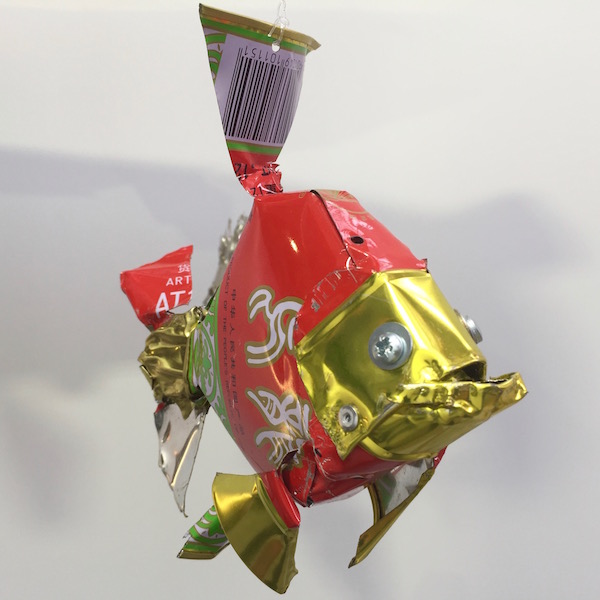
sculpture of red fish created from recycled metal can by artist Orson Buch

Orson Buch “Red Fish”

Artists do this kind of stuff all the time, but what makes the DRAP-ART show so out-of-this-world is the level of craft and the deep exploration of the various recycled media. In these artists’ hands, the use of the discarded materials is no gimmick, but rather act as really great prompts to build truly extraordinary new and fantastic things.
We could go on, but suffice to say, it’s a fantastic and truly inspirational show that is thoroughly Orbit-approved. To use the hoity-toity argot of art academia, it’s a real sock-knocker-offer. In fact, right after seeing the show we ran out to buy some new socks. It’s that good.

detail from large mosaic by Bill Miller created with recycled linoleum flooring

Bill Miller “Steal Mill” (detail)

pendant lamp created from recycled Bic pens by artist Héctor Escudero

Héctor Escudero “PENcil”

Back to those festival organizers. This blogger knows it must have been a huge undertaking to put on and we have no insight into whether attendance and sponsorship made all that worthwhile. That said, not all successes can be measured with a calculator. So we’d just like say we sure hope this first Re:NEW festival can itself be renewed next–or, at least, some future–year. It’s a great idea for an art festival and Pittsburgh is a great place to host it. We hope the public is enjoying it as much as we are.

The Orbit will even go as far as to suggest a title for the come-back: Re:NEW : Re:DUX. Don’t even say anything. By the time you’re ready, it’ll sound great.

three-piece sculpture of square boxes with recycled fencing and bamboo by artist Felip Gaig

Felip Gaig “Els Horts de Sant Vicens”

portrait of Mary Cassatt made from egg cartons by artist Verónica Arellano

Verónica Arellano “Mary Stevenson Cassatt”

A note: We included way more photos in this piece than we normally do in a post, just because there is so much great stuff we’re excited about**. Even so, this is just a small portion of what’s actually set up, beautifully-presented, and even for sale over at the Wintergarden. The show ain’t over yet, but you need to shake a leg–it ends this Saturday. Get your kiester down there and see it for yourself while you still can.

Re:NEW Festival’s DRAP-ART show is at the PPG Wintergarden (PPG1, downtown), through next Saturday, Oct. 8. Admission is free.

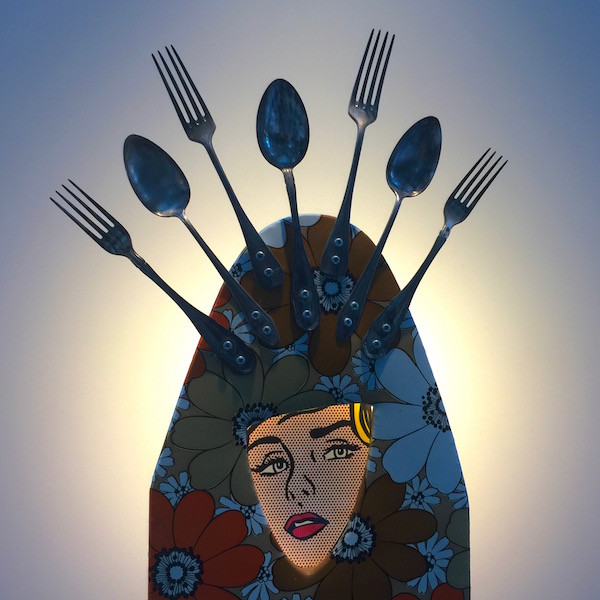
sculpture made from recycled ironing board, silverware, and advertising image by artist Karol Bergeret

Karol Bergeret “Camarera” (detail)


* A large-scale collaboration between city arts, tourism, downtown, and reuse organizations including the Greater Pittsburgh Arts Council, Carnegie Museum of Art, Andy Warhol Museum, Visit Pittsburgh, Downtown Pittsburgh Partnership, Pittsburgh Center for Creative Reuse, Construction Junction, Goodwill, etc.
** And had a hard time not including yet another half dozen photos, but that would just be ridiculous.

Behold the Hands of Holtz

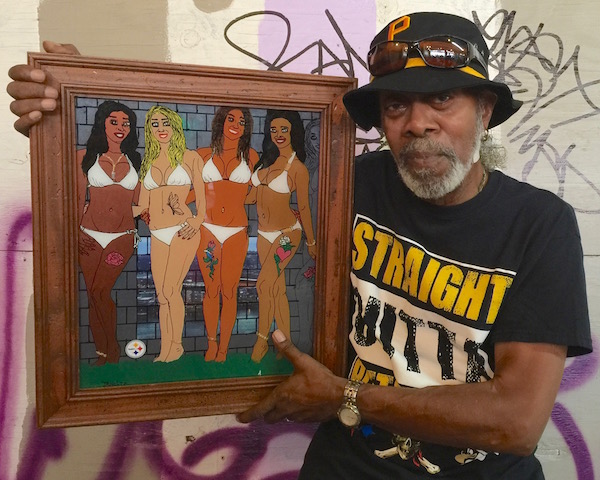
Artist JR Holtz holding a painting of four women in bikinis

Artist J.R. Holtz with some of his sexy ladies

You may have run into J.R. Holtz just like we did (or do, quite often), out on the street. He sets up on Penn Avenue for the monthly Unblurred art crawls and every Saturday at the Artisan Market in the Strip District. At either location, you’ll find him camped out with an eight-foot folding table covered with dozens of his small- and medium-sized paintings. Each one comes in a repurposed picture frame–or even an entire wooden window–and they’re all for sale at extremely reasonable prices.

several small, framed paintings by artist JR Holtz

Holtz’ recent artwork for sale in the Strip District

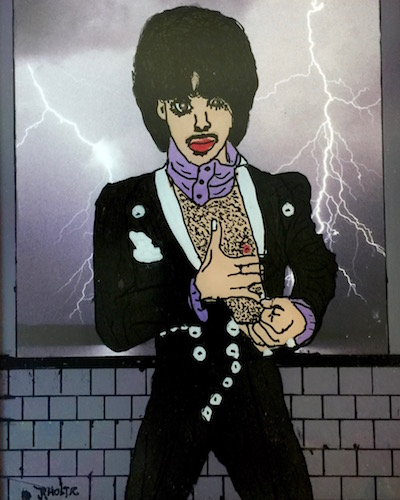
J.R., who creates under the moniker Hands of Holtz, tells us he paints every day and he’s been at it since the mid-1980s. His subjects are all across the board: cartoon characters, superheroes, pop culture figures, nature images, family scenes, science fiction, and Pittsburgh sports. On our most recent visit, there were portraits of Prince, Jimi Hendrix, and Muhammed Ali; likenesses of Mighty Mouse, Captain America, and Wonder Woman. Several scenes from Star Wars made their way to Holtz’ glass panes, as had fad-du-jour Pokemon creatures.

painting of Prince in front of an open window with a purple sky and lightning by JR Holtz

Prince/purple lightning

2-color painting of Star Wars characters by JR Holtz

Star Wars

But let’s cut the crap: you’re going to notice the sexy ladies first. It’s hard to focus on Spider Man when there’s this much bare skin going around. Not since the glory days of Cinemax or those weird shaving cream ads they used to run during hockey games has there been semi-public soft-core erotica on display like this.

J.R. is the first to admit “I like the ladies!” and it’s safe to say he isn’t lying. There are strong warrior-princesses, tattooed big-boobed sports fans, tawdry hoochie-mamas, yoga posers with naughty underwear, and lots and lots of smiling, bikini babes–often with added glitter details and bonus Steeler emblems, just for good measure.

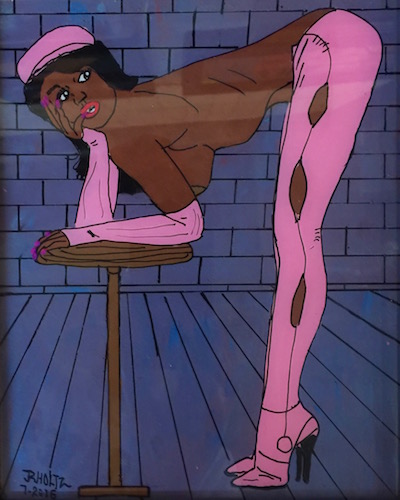
painting of woman wearing pink hat, gloves, boots, and skin-tight pants (but no shirt) bending over by JR Holtz

Pink Lady

Many of the images are taken from existing photographs, but Holtz says some of the ladies are friends who pose for pictures knowing they’ll be turned into future paintings. Individual requests and interests of the models are incorporated into the artwork, as are other extra bedazzled features including color-changing paints, glitterized jewelry, and inset photos.

I asked Holtz what the reaction is when unexpecting Saturday shoppers accidentally browse across the decidedly PG-13 content. “Some of them start walking real fast,” he chuckles.

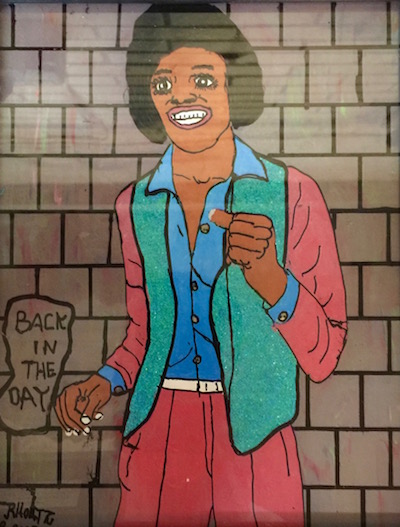
Painting of man in 1970s clothes with caption "Back in the Day"

Back in the Day

J.R. describes his own artwork as novelty, and it’s tempting to overlook it as such. He paints directly on glass which gives the final images a glossy, finished look–almost like when you see framed “cels” from animation. The subject matter is as populist as it comes–you could imagine some of these pieces on sale in a turnpike gift shop. Matthew Barney or Damien Hirst, this ain’t.

But with the flat perspective, heavy black outlines, and single-color schemes, the end result reminds us of a different art superstar on the very other end of the spectrum, Howard Finster. Like Finster, Holtz’s style appears untrained or “naive”, but there’s a beautiful honesty to it–even when the subject is Jedi Master Yarael Poof*.

JR Holtz standing in front of his paintings for sale, Pittsburgh, PA

JR Holtz with more of his recent paintings, Strip District

Holtz is also one of the kindest and nicest artists you’ll meet. He wouldn’t ape for the camera, but don’t believe it–every time we’ve talked with him, J.R. is all smiles, high energy, positive vibes, and can’t wait to tell you about his work.

This blogger doesn’t know what he likes, but he knows art. We probably wouldn’t chose to decorate Chez Orbit with any of the beach babes–at least, we haven’t picked any of those up yet–but we especially love many of his portraits and simpler two-color work. When J.R. hits, it’s as serious as a heart attack and as true as an arrow.


* Not pictured, but among The Orbit‘s small collection of Holtzs.

Golden Babies: Strange Things Afoot!

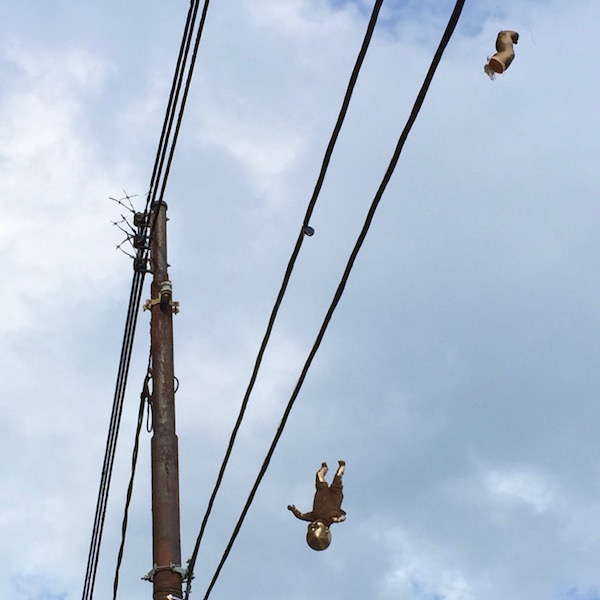
golden baby and baby foot hanging from wires in front of row houses, Pittsburgh, PA

Dismembered foot of Penn Baby with Penn Baby 2, Lawrenceville

Regrettably, The Orbit had accepted the mystery around the Golden Babies–like the Kennedy assassination, or where real babies come from–would likely never be solved.

But then a tip of the reddest and hottest variety came in: “MAJOR new development in the golden babies,” it began. What followed was a pair of plot twists to this ongoing street art narrative that both flipped our collective wig and, like Michael Phelps waking from his doobie-smoking Subway bender, re-lit a fire underneath this blogger that fans had thought long extinguished in the purple haze of five dollar foot-longs.

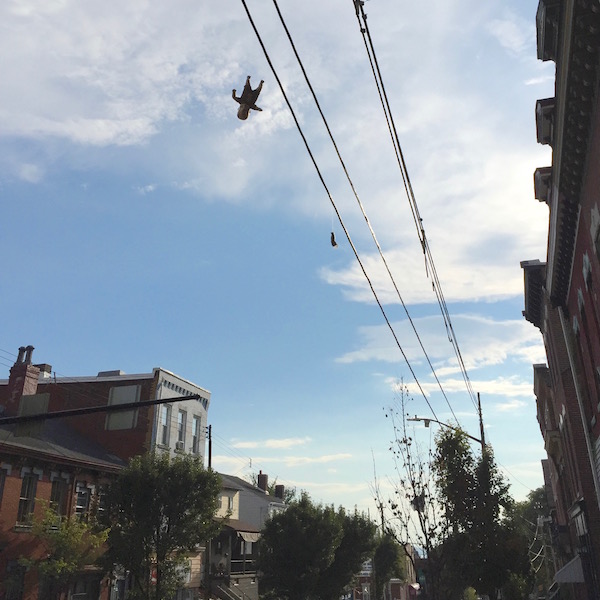
golden baby and baby foot hanging from wires, Pittsburgh, PA

Golden baby has a leg up on other street art

Faster than you can say quasi-respectable news source we hoofed it up to Constellation Coffee. The café sits right where our first-sighted golden baby (“Penn Baby”) appeared. Here, we could confirm the tip–and also enjoy a delicious cup of coffee*.

The story, right from the baristas at Constellation, goes like this: one Sunday morning, a concerned citizen phoned in a complaint to the city. Apparently the golden baby, dangling by his ankle from the wires on the 4000 block of Penn Ave., was just too much. The substance of the concern is not known, but we’ll take a wild guess that the baby was deemed “offensive,” “creepy,” and/or “weird.” Fair enough, I suppose**.

Penn Avenue, Pittsburgh, PA with golden baby hanging from wires

View down Penn Ave. with golden baby and loose foot.

With nothing more substantive ablaze, the fire department was dispatched to remove the offending infant from the airspace over Penn Avenue. For whatever reason, they were unable to either undo the baby’s hanging wire or just cut it off, so the crew made the bizarre decision to instead saw through its tiny plastic leg. This allowed the removal of most of the kid, but left one stray golden foot, ankle, and calf dangling from the telephone wires.

Side note: This action begs a number of questions. Among them: Is leaving a disembodied leg really less offensive than the whole baby? and How is it that a street artist/prankster has a longer ladder than the fire department? and If I’m in the third floor of a burning building should I just accept fate and kiss my feet goodbye?

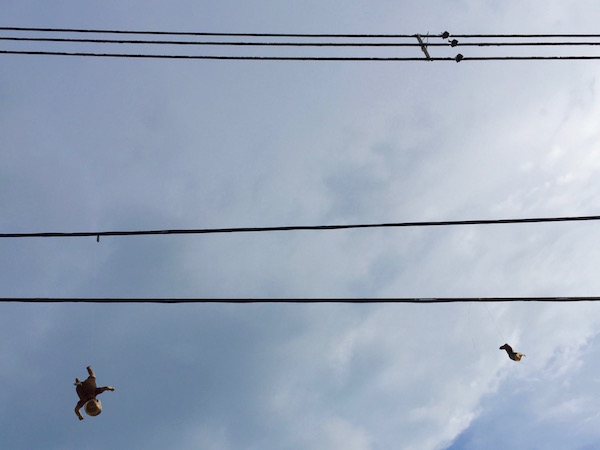
golden baby and baby leg dangling from wires, Pittsburgh, PA

Golden baby: foot loose and fancy free

Strange? Sure is! But what happened next will blow your mind! [That is, unless you’ve already looked at the pictures.]

In less than 48 hours, a brand new golden baby went up on the same stretch of wires–within mere feet of the foot. “Penn Baby 2” generally looks the same as the other golden babies, but with the key differences that s/he’s clothed in a red onesie (the others are white) and that garment appears to be stamped or silk-screened with some mystery insignia (the others are plain/unadorned).

close-up of golden baby in red onesie, Pittsburgh, PA

Penn Baby 2. Note the red onesie with cryptic insignia.

If blogging teaches us anything, it’s to not rest on one’s assumptions. The strange circumstances of Penn Babies 1 and 2 only prove that black is white, up is down, child is father to the man, and therefore, baby is, uh…older sibling to the child? Ah, hell.

This story is not over yet–no, not by a long shot. There’s one very important piece of evidence still in dispute–the whereabouts of the footless and foot-loose Penn Baby. Sources say it’s in the possession of Constellation Coffee–secured in a drawer right on the premises. But when the subject came up during The Orbit’s interrogation of the staff, the aforementioned “friendly” baristas clammed up tighter than a set of quad toms at a Sun Devils half-time show. Believe you me: their guilty eyes have got no rhythm.

What are they hiding? O.K., we think we know what they’re hiding, but why are they hiding it? You can bet we’ll get to the bottom of this…or at least to another cup of that delicious coffee.


* Constellation makes a damn good cup of coffee.
** If only a phone call could have the much more offensive Crocs stripped from the feet of our citizenry so easily.

Off the Rails: An Orbit Awakening in Boxcar Tagging

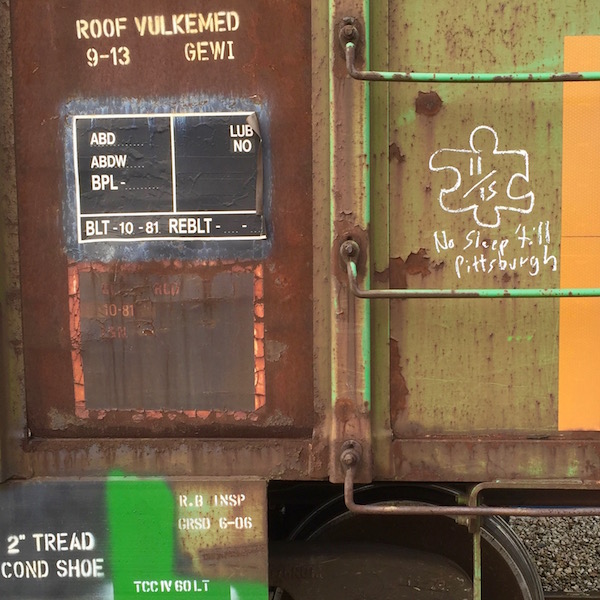
detail of boxcar with graffiti of puzzle piece reading "No sleep till Pittsburgh"

No sleep ’till Pittsburgh

What a pleasant surprise! To wake up to a subculture that’s been around forever[1] and yet somehow completely eluded any level of popular consciousness. At least, this blogger was totally ignorant of its existence until some time not too long ago.

Whether you pay attention or not, you’ve seen the big, spray-painted graffiti that either decorates or defiles freight trains, depending on one’s point-of-view. The same sort of multi-color highly-stylized calligraphs of tagger names and inside jokes that show up under bridges and the back sides of commercial buildings end up on the large steel canvases provided by Norfolk & Western and the Chessie System.

yellow boxcar with graffiti of a cartoon man smoking cigarette

Cash & Carry / Got head? / Sluto

But look a little closer–you usually have to get right up on the boxcars to see them[2]–and there’s a whole world of much more subtle human interaction with the trains. Here, there are small, simple line drawings, monikers, arch messages, and coded insignias, dates, and locations created (we assume) by an entirely different type of graffiti writer and likely intended for a very different audience.

Is this just street tagging on a different surface or is there something more going on here? Are these committed by train-hoppers, hobos, or just bored teenagers who live near train yards? Maybe the tags equate to an American form of trainspotting–more punk respectable and less trenchcoat nebbish?

detail of boxcar with graffiti of grave stone with message "The Ghouls"

The Ghouls

Almost always, the tags include three- or four-character numerical codes: 11/15 or 8/10 or 6/08, for example. We assume these are abbreviated month/year dates, but who knows? If so, apparently Y2K’s lesson in the need for full four-digit years doesn’t apply to these folks–they’re “future proof”.

It turns out that entire academic theses have been written on the subject. We haven’t read them (at least, not yet), so we certainly can’t answer these questions. But The Orbit likes to imagine the train cars become both the largest and most random of bottles to which these writers toss their messages to exchange whereabouts, news, and rail-riding one-upmanship in a very analog, low-tech manner.

yellow boxcar with graffiti of a mountain range

Retribalize, back to sea level / Lovely Spring / (unnamed)

Even in our extremely limited survey, one tag kept reappearing. In it, the sun is rising over a barren mountain, squiggly cloud gestures float in the sky, and the text Retribalize / adios – mutha is written in loose cursive over an arced train track/arrow. In each case, there’s an additional bonus message: Back to sea level or E.B. Creep – Co. or Wish you were here… A version of this particular scrawl showed up on so many cars that we didn’t even include all the photos of ones we found. A cruise around the Google machine proves this is no anomaly–the Retribalizer may or may not get around, but his or her tags sure do.

boxcar graffiti of mountain, sunrise, and train tracks with text "Retribalize, adios-mutha 10/5"

Retribalize, E.B. Creep

boxcar graffiti of mountain, sunrise, and train tracks with text "Retribalize, adios-mutha, wish you were here 6/08"

Retribalize, wish you were here…

boxcar graffiti of a jug with a hat and the message "Retribe's spot!"

The response: Retribe’s spot!

A final note: we have it on some decent authority that the Packaging Corporation of America, whose plant in the Strip District provided such convenient access to a weekly new supply of boxcars, is moving out of the city (to Cheswick). If that’s the case, and there are no longer any train cars on Railroad Street (sigh), that will definitely be a bummer. But we won’t stop collecting tags–we may just have to work a little harder to find them.

Until then, in the eloquent, bilingual words of Retribalize, adios – mutha”!

boxcar graffiti of old man with hat and text "here today, gone tomorrow"

Here today, gone tomorrow


[1] At least, around as long as hobos have been jumping trains.
[2] It goes without saying, be safe: make sure the trains are not in motion if and when you take a look.

Photo Grab Bag: Ghost Sign Roundup

ghost sign with layered text, McKeesport, PA

(unknown), McKeesport

Longtime readers know The Orbit is in the business of making dreams come true–and business is good. It was pointed out by super fan/sometime contributor Lee that probably a lot of folks don’t see the loose photos that end up on The Orbit‘s artsy dark and/or snarky narc pages and maybe we should roll them up into an actual blog post once in a while.

So here you go. Like Cheech and/or Chong, we’ve pulled out the gatefold copy of Fragile and are rounding up and rolling out a first collection of non-specific pictures from the last year or so. Here, they’re grouped on the pseudo-theme of ghost signs. Don’t inhale too deeply.

ghost sign/advertisement for Hipco Batteries, Pittsburgh, PA

Hipco Batteries, Manchester

It’s a bold claim, but the Hipco Batteries ad has to be the city’s greatest ghost sign. The incredible painted image has some classic “vernacular typography”, one giant old school No. 6 dry cell battery, and a sadistic, grinning red devil, his tongue wagging like a pervert from his open, fanged mouth. He’s very excited, with one hand reaching out, palm up, and the other employing a Hipwell flashlight to no doubt look for trouble in the dark.

This begs the question: do devils really need flashlights? Well, we know this one does. Unlike the subjects of every other photo in this post, the Hipwell Manufacturing Company, founded in 1887, amazingly still exists and continues to manufacture a line of flashlights (but no longer batteries) right in this big old brick building on West North Avenue[1].

ghost sign for former La Salle Electric, Pittsburgh, PA

La Salle Electric, Manchester

The pair of conjoined industrial buildings that once housed La Salle Electric, just off Brighton Road in Manchester, were torn down earlier this year. Now there’s just a re-grassed vacant lot where they used to be. Whatever prompted that action, it’s sad for a lot of reasons–mainly that we’ve got a limited supply of this kind of late 19th century industrial buildings out there and it’s a bummer to lose two of them in one fell swoop.

Here, we can only focus on the relatively minor loss of this great ghost sign, painted across the point where the two buildings met. You can see the red brick side appears to have shifted ever so slightly, distorting the alignment of the white background and breaking the A in “Salle”. And what a great pair of arrows! The office is that way, you can pick up your stuff on the other side. Ugh. I mean, the office used to be that way…

ghost sign for former Regent Sportswear Shop, Pittsburgh, PA

Regent Sportswear (and Wig Shop?), East Liberty

The rear entrance to the former Regent Sportswear Shop doesn’t have what we usually consider “ghost signs”, but still seems like it ought to count. Regent’s 3-D sign, the typeface in Wigs, and the multi-color blue/gray/white brick treatment all suggest a 1960s/70s makeover to a building that probably goes back to the very early 1900s. Somewhere out there is a person who bought a terrycloth track suit or tried on someone else’s hair at Regent’s and we sure hope this last reminder in the Kirkwood Street alley makes him or her feel something. Hopefully that feeling is not, you know, “itchy”.

ghost sign reading "Sal's Meats Since 1921", Ambridge, PA

Sal’s Meats, Ambridge

Sadly, Sal’s Meats, like most of the businesses in Ambridge, ain’t there any more. But at least we’ve still got this great ghost sign. Painted signs don’t get any graphically stronger than bold red text on a white background, painted fifteen feet across on a deep red brick wall. Sal’s Meats, since 1921. ‘Nuf sed.

ghost sign for former Penn Bowling Lanes, Pittsburgh, PA

Penn Bowling Lanes, Downtown

What a time when the downtown worker could bowl ten frames over a lunch break! This literal back alley entrance on Exchange Way (between Liberty and Penn, downtown) suggests the bowling may have taken place in the basement, but who knows? Heck, maybe those wooden lanes, pin-setters, ball returns, and beer taps are all still down there, covered in forty years of dust. Either way, we’re glad no one felt the need to paint over this incredible patchwork wall with its reminder of old Pittsburgh.

ghost sign for Dr. D.E. Earley, Optometrist, New Martinsville, W. Va.

Dr. D.E. Earley, Optometrist, New Martinsville, W. Va.

Last winter, we made a special stop for the mind-boggling buffet at Quinets Court in the fine little West Virginia town of New Martinsville (about 90 minutes from Pittsburgh–and well worth the trip)[2]. The inevitable post-gorge belt-loosening constitutional yielded some fine views of the Ohio River and a bunch of great little oddities in the four-block downtown stretch. This ghost sign for Dr. D.E. Earley, Optometrist looks like it could go back a hundred years. That’s a long time to wait to get your eyes examined and glasses fitted, but then again, you’ve got a steam tray full of Quinets cobbler two blocks away. I can think of worse ways to spend a century.

Former storefront for G's Restaurant and Pizzeria, Pittsburgh, PA

G’s Restaurant and Pizzeria, Downtown

Bathed in low winter sunlight, made awkwardly diffuse by scaffolding and construction fence, this photo of the former G’s Restaurant and Pizzeria on Forbes Ave. got shoehorned into an update story on the last remaining Toynbee Tile on Smithfield Street and the face of a rapidly changing downtown Pittsburgh. But we felt like there was a little more to say here.

G’s Restaurant, along with the former Honus Wagner Sports building next door, were razed earlier this year. Point Park University is building a big new performance arts building/theater on the property. This will no doubt be a great cultural asset, but The Orbit‘s going to miss this pair of early 1900s terra cotta storefronts, each with their own goofy mid-century add-ons.


[1] See article: In The Spotlight: Hipwell Manufacturing (Pittsburgh Post-Gazette, Nov. 10, 2002) for the full story.
[2] The Orbit actually needs to make the trip to Quinets again for a full review–or even if just for that eggplant parm, and the kielbasa and kraut, and the fried chicken, and the haluski, and the brown sugar sweet potatoes, and the butterscotch pie, and the…