The Orbit 2015 Year-in-Review, Part 1: The Hits

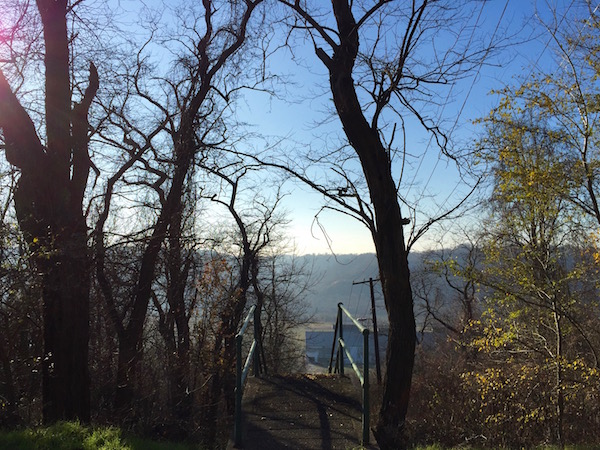
View from Rising Main city steps, Pittsburgh, Pa.

Half-way up Rising Main, the longest set of Pittsburgh city steps

Statistics, man. People get a computer and suddenly everybody cares about their numbers. Phooey.

It is the final days of 2015 and ’tis the season for geese-a-laying–not to mention year-end lists-a-making. We decided to finally peek at The Orbit‘s digits and find out what people were checking out (and not checking out) and turn that insight into a little two-part year-in-review on what happened over (most of) the last twelve months.

To talk about actual numbers would be truly pathetic, so we’ll generalize here. In Part 1 we’re looking at the ten most popular Orbit blog posts for 2015, based on WordPress site statistics for individual post-views. We’ll follow-up on Wednesday with staff picks of some of the more, ahem, under-appreciated stories from the year.

1. Step Beat: Rising Main, The Longest Steps (June 14)

People love the steps! That is totally gratifying! Years ago, this urban hiker’s first attempt at blogging was going to be a site entirely devoted to mapping, photographing, and yes, blogging about Pittsburgh’s 750-ish sets of city steps. That fine plan, just like Cop Rock, fizzled all too quickly–and it probably deserved to. The steps are great, but there’s just not enough to go on about for a new story every week.

But at Pittsburgh Orbit we’re able to include some good city step stories without (we hope) having to dredge the river. These seemed to make their way out into Pittsburgh’s bicycle and pedestrian communities and two of them turned up in the top reads of the year, so that suggests the people are with us on this one. The Orbit‘s #1 story for 2015 is about Rising Main Way, the longest set of city steps in Pittsburgh, and one of the longest sets of urban steps in the country.

2. You Ain’t Seen Nothing Yetta: The Mosaic Houses of Spring Hill (June 3)

A row of frame houses with mosaics covering the basement/foundation walls, Pittsburgh, Pa.

Every man, woman, and child–not to mention gopher, raccoon, and honey bee–in Spring Hill seems to have dialed-in The Orbit to read this story on the terrific little set of old-school wood frame Victorian houses with custom mosaics embedded in their Yetta Street foundations.

We can only assume that artist Linda Wallen has a lot more friends than this blogger does. It’s her mosaics that decorate the Yetta Street houses–as well as other infrastructure–in Spring Hill. On our (long) list of to-dos is to get back there and find out what she’s up to for next year.

3. Graceland North: The Antignani Estate Sale (Nov. 4)

mural with naked male and female figures, tree with snake wrapped around its trunk, and a stag

The true tale of mystery couple Arthur and Alfreda Antignani proved to be a big draw for those, like The Orbit, that first discovered them via the over-the-top posthumous sale of their North Hills estate. The Antignanis lived large–and loud–in a shag-carpeted, gilt, mirrored, leopard printed, tchotchke-bedecked, and go-go mannequin-inhabited Bacchanalian suburban pleasure palace that would have made Elvis blush. Take a last look here.

4. Allegheny Cemetery: The Shark Grave (Feb. 6)

Shark grave marker, Allegheny Cemetery, Pittsburgh

A tip for our fellow bloggers: if you want to up your visitor rate, start posting about something you can legitimately tag with #jaws or #sharkweek. The story of Lester C. “The Shark Grave” Madden’s Jaws-shaped grave marker turned into a feeding frenzy for the “fin freaks” who ate up this story like a great white hopped-up on chum, eyeing a bonfire’s worth of Martha’s Vineyard teenagers. And just like big teeth, they never seem to get enough (and ol’ Quint ain’t around stick ’em this time).

5. Unread: The Record Label Next Door (Sept. 2)

Chris Fischer, Unread Records & Tapes

Chris Fischer has been pressing the Record and Play buttons while cassette spools roll and mailing the results out in manilla envelopes for a couple decades now (he started young). Along the way, he’s encouraged, promoted, and influenced a generation of guitar-wielding scratchy folk…like…ish lads and lasses to lay their souls down on magnetic tape and black plastic. We sat down with him and talked about Unread Records’ epic recent Public Coffin release.

6. Step Beat: Romeo & Frazier (May 17)
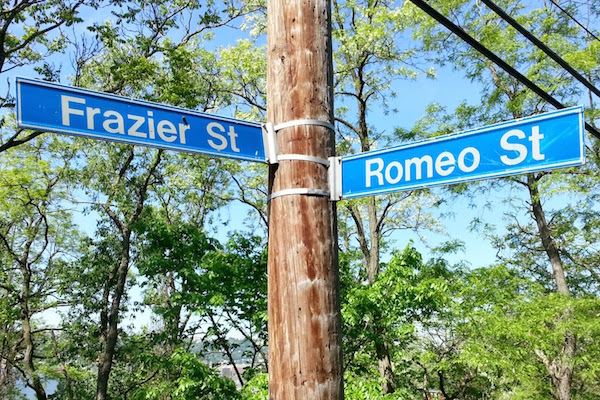
Street signs for Romeo and Frazier Street intersection, Pittsburgh, Pa.

More city steps! The intersection of Romeo and Frazier Streets in South Oakland features a street lamp, road signs, two sets of city steps, and a whole bunch of trees, vines, and weeds (but no cars). The Orbit opines on the nature of what makes a “street,” the changing utility and value of city steps, and casts some serious aspersions on how much rope may be skipped at a house with Tibetan prayer flags hanging on the front porch.

7. Nun of the Above: Corita Kent at The Warhol (Feb. 26)

Someday is Now: The Art of Corita Kent show at The Andy Warhol Museum, Pittsburgh

Sister Corita Kent, the radical art nun whose big tent quasi-religious messages questioning war and materialism via pop-art product manipulation and screen printing has very little to do with Pittsburgh except that The Andy Warhol Museum hosted an absolutely terrific career-spanning show of her work early in the year. We checked it out on the opening night, raved about it, and (we can only assume) The Warhol’s re-postings ended up sending a lot of people into Orbit.

8. An Orbit Obit: Where the Buffalo Roamed (Dec. 2)

sidewalk painting of purple and white buffalo with painted fence

This summer, Jeremy Reymer painted a series of buffalos on the sidewalks around the front and side of his Lawrenceville home. Before we could even run a story about the proud creatures, they were gone with the power-washing force of the city’s Graffiti Busters unit. This Orbit obit laments the loss of this fine collection of street art and muses about why the neighbors would have been offended enough to call it in, as well as the not so simple philosophical question what is graffiti?

9. A Wooden Street! (Aug. 30)

Section of wooden street in Pittsburgh, PA

That’s pretty much what this one is about: the very rare sight of a street made entirely of wooden blocks (plus us winging about having been scooped by local public radio). It’s the last wooden street in Pittsburgh and one of the last handful in the United States. Roslyn Place is also right off Ellsworth Ave. in Shadyside. So, if you’re like this blogger, you’ve probably been within feet of it (or, at least, driven past it) many times without ever knowing it was there or stopping to check it out. Here’s another chance to make that right.

10. A Tiny Castle in the Strip District (May 22)
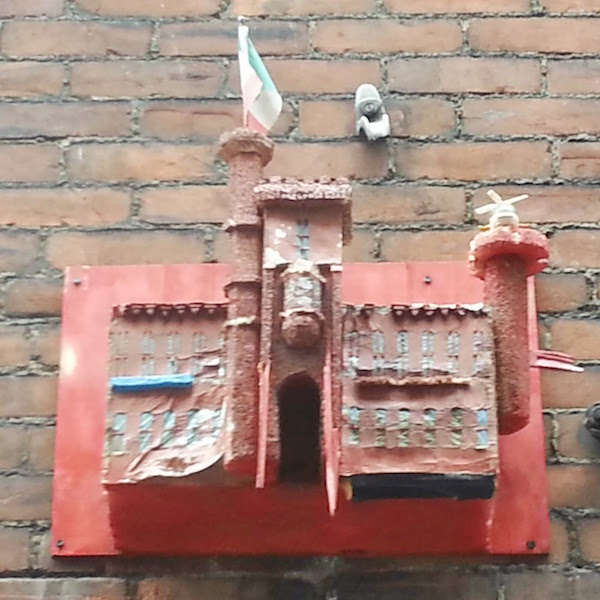
homemade model of a castle mounted to a brick wall

One tiny red castle, complete with a helipad and Mexican flag, mounted high on a brick wall in an alley in The Strip District. We’re not sure what it’s about or who came up with it, but a whole lot of people e-stopped by to check it out. It’s still there (although predictably weathered since this story ran in May), so, you know, get down there and check it out while you can.


Check back on Wednesday for The Orbit’s 2015 year-in-review, part 2: “The Sleepers.”
 

Osteo-Mysterioso: Carnegie’s Giant Mystery Bone

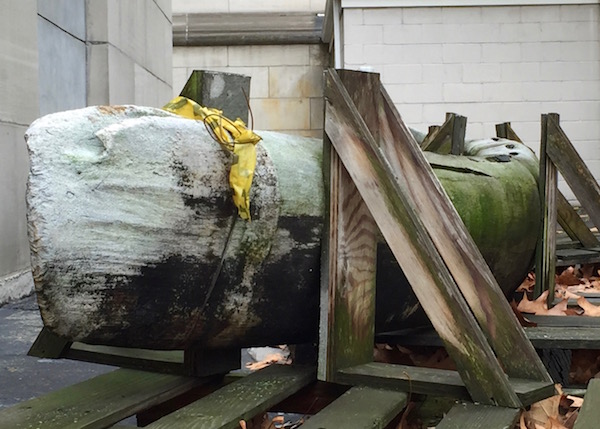
close-up of one end of the mystery bone spanning four shipping pallets, Carnegie Museum of Natural History, Pittsburgh, PA

Mystery bone, as close as we could get

Two immediate questions strike the nebby passer-by: What is it? and Why is it out here?

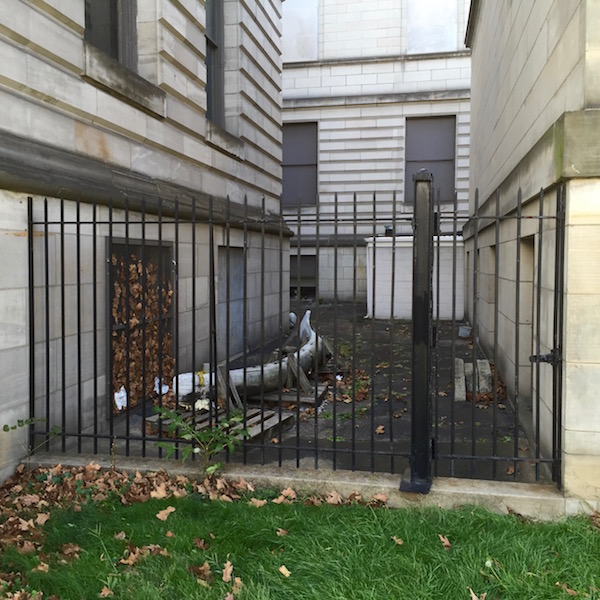
Around the back of the Carnegie Museum of Natural History in Oakland, between the entrance to the lecture hall and the pedestrian bridge-ramp to the parking deck behind the art museum, is a small, gated outdoor space that is clearly not meant for public inspection. The volume of people traffic on this walkway is light to begin with, and likely very few of them stop and check out the lifeless little negative space within. But that’s a shame, as it contains one very large, bone-shaped mystery object.

external gated area of the Carnegie Natural History Museum with mystery bone on shipping pallets, Pittsburgh, PA

In context: the Carnegie Museum’s mystery bone outdoors, around back.

What is it?

It is enormous–at least twenty feet long and a foot-and-a-half thick. It has the gentle curve of a rib, or a boat’s hull. I can only imagine how much it must weigh–certainly hundreds, possibly thousands of pounds. The big bone rests on four separate wooden shipping pallets (with space in-between) and vertical bookend-shaped supports.

The bone’s far end splays out as if it once joined to some greater structure, or guided supporting tissue. The near end tapers to a gentle point, again resembling an enormous mammalian chest bone. But if this is indeed a rib, the creature it came from would be the size of King Kong.

image of King Kong terrorizing actress Fay Wray in the 1933 movie still

One possible source of the Carnegie mystery bone

So, we set out to answer this mystery. Using only the most rigorous of modern identification techniques, we put together our years of hard journalistic acumen, consultation with the most brilliant minds in marine mammal science*, and, yes, “our gut.” Through this, we’re pretty sure we came up with a winner. The mystery bone appears to be one of a pair of lower jaw bones from a whale–likely a blue whale, the largest animal ever known to have lived on Earth. [Take that, Dippy!]

blue whale skeleton

That looks like a match to me! Blue whale skeleton [photo: Canadian Museum of Nature]

Why is it here?

Now, this blogger doesn’t have a lot of room to talk. His small back yard is a de facto dumping ground for household detritus he should be dealing with instead of reporting on stories of somebody else’s mystery bones. That said, Pittsburgh Orbit is not a 120-year-old giant regional cultural institution with a large number of paid staff (at least, not yet). Hell, we’d be ordering our interns to stow the mystery bone in the hall closet or sell it cheap on Craig’s List. Put that on your resume! [Note to self: get some Orbit interns and have them clean up the back yard.]

side view of mystery bone spanning four shipping pallets, Carnegie Museum of Natural History, Pittsburgh, PA

Mystery bone, side view [note second mystery bone peeking out from around the corner]

The most plausible answer is simply that there just isn’t any place to put the giant bone. It’s too damn big and heavy to move, and as a weird standalone–without the rest of its blue whale parts–it may not make a lot of sense to exhibit.

But this leads to a follow-up question: if The Carnegie values this asset enough to keep it around, why not protect it a little bit more? It seems like an easy enough task to at least send one of those interns out to wrap it in plastic [Laura Palmer got better treatment!] or throw a tarp over the whole thing–and maybe get some Fantastik® and clean that green algae off while you’re at it. I realize bones are pretty tough, but put one through enough Pittsburgh snow, ice, and rain**–not to mention radical temperature and humidity shifts–and it’s hard to imagine it preserving that well–it’s already splitting! Ah, hell–that’s why we’re bloggers and not mystery bone scientists.

top view of mystery bone spanning four shipping pallets, Carnegie Museum of Natural History, Pittsburgh, PA

Mystery bone, top view


* Google.com
** Not that it looks like we’ll get any this year

Christmas Under the Bridge

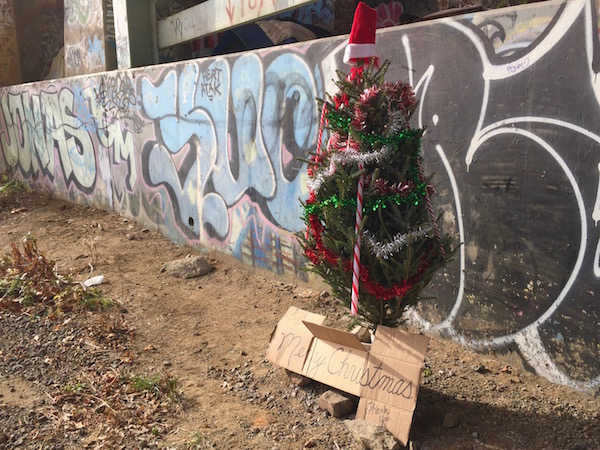
Allegheny River trail Christmas tree #2 (under 31st Street Bridge)

Allegheny River trail Christmas tree #2 (under 31st Street Bridge)

We are, if the clever Orbit reader has not already divined, kerchief deep into Christmas season. It’s the all-consuming megalopolis of a holiday whose red and green, pine cone-encrusted, jingle-bell-adorned, egg nog-slurping tentacles reach so deeply that even Casey Kasem is banished from the airwaves until after the new year rolls around. Sigh. What to do when a blogger can’t even get any Hot Chocolate with his hot chocolate?

We expect this–and certainly know it’s coming–but had no idea that Ol’ St. Nick’s lords-a-leaping, geese-a-laying influence would extend all the way down under the bridges of the North Side, and yet it does. But we’re here to say that, just like Scrooge, even this bah-humbugging blogger can turn around to The Christmas SpiritTM when and where he never expected he would.

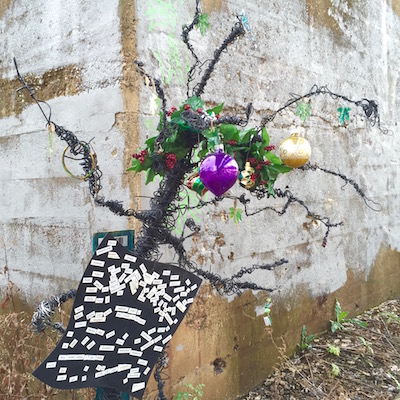
Allegheny River trail Christmas tree #1 (under 33rd Street railroad bridge)

Allegheny River trail Christmas tree #1 (under 33rd Street railroad bridge)

Yet another lovely sun-drenched December weekend day and another healthy afternoon two-wheeled constitutional. [Weather gods: why hath thou forsaken this blogger? How long must he wait for 45 degrees and drizzling?] This time the ride took us across the 40th Street Bridge and down to the Allegheny River trail.

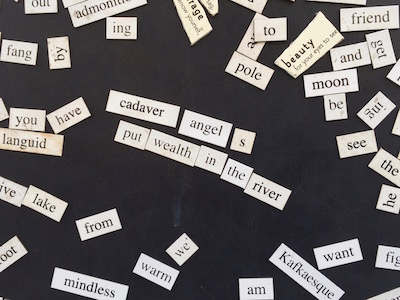
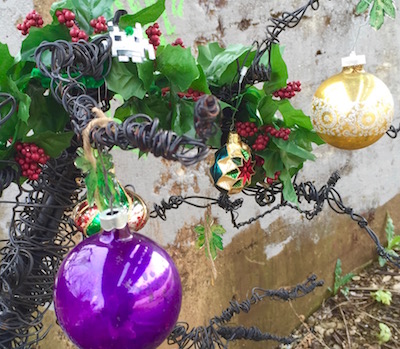
It was a most curious surprise to come across. Against the tremendous concrete support for the railroad bridge that spans the Allegheny near Millvale Riverfront Park, rests a spindly, homemade Christmas tree-like sculpture, made of thick wound black wire, a discarded metal stake, and plastic holly. The tree is sparsely decorated with a handful of traditional ornaments, something that looks like a space invader, and one full set of refrigerator poetry. The current offering reads cadaver angels put wealth in the river. We poked around, snapped a few pics, went right down to the water’s edge. It was a fun little surprise, but then we were back on our way.

Refrigerator poetry from trail Christmas tree #1 reading "Cadaver angels put wealth in the river."

It’s beginning to look a lot like Christmas. Refrigerator poetry, Allegheny River trail Christmas tree #1

So yet another trailside Christmas tree popping out at us just another minute or two further down the trail was starting to feel like a legitimate yuletide miracle. Here, under the 31st Street Bridge, is a medium-size Douglas fir, decked out in red, green, and silver garland, with giant candy cane ornaments, and one drug store Santa hat for a topper. A simple unfurled piece of cardboard includes the cursive Sharpie message Merry Christmas, Thank you.

Allegheny River trail Christmas tree #2 (under 31st Street Bridge)

Allegheny River trail Christmas tree #2, detail

Here I met M.J., one of a number of people who camp under the on-ramp to the 31st Street Bridge. We talked for a while and I got some of the story on the tree and the group that lives here. The tree was brought in, along with a full Thanksgiving dinner spread, the week prior.

I saw a bag of apples and was heading to The Strip anyway, so I asked if I could pick up some food for the group. Surprisingly, M.J. explained that they were actually doing O.K. with food thanks to regular deliveries from the same organization that provided the tree and turkey dinner. [M.J. didn’t have a name.] I asked what the group’s other greatest needs are and he told me that he wished he could get battery-operated lanterns for everyone. He also mentioned bedding and tarps. So far, this blogger has struck out locating the kind of lanterns M.J. described, [and believe you me, he has tried] but it isn’t Christmas yet!

Allegheny River trail Christmas tree #1 (under 33rd Street railroad bridge)

Allegheny River trail Christmas tree #1, detail


Related: Bridgette Wright’s blog post for Bike Pittsburgh details a couple of coordinated efforts to bring “care packs” to Pittsburgh’s homeless communities over the Christmas holiday. They’ll be using bicycles to deliver the packages to locations like this one under the 31st Street Bridge that are inaccessible by automobile.

Step Beat: When Tullymet Sylvan

View from the top of the Tullymet St. city steps, Pittsburgh, Pa.

View from the top of the Tullymet Street city steps, Hazelwood

It is around this time of year that the intrepid city climber has usually packed-away his or her step-hiking boots and can but merely dream of a fast-forward to warmer temperatures, de-iced stair treads, and the re-greening of hillsides. But this particular season’s relentless run of glorious late fall weather has kept the traditionally cold, gray, and wet days at bay. There’s been nary a snow flurry, freezing rain, or frosty morn to even hint at the inevitable winter days to come. The bewildering number of perfectly blue sky days is something rarely seen around these parts.

And so it was this past weekend. We seized the opportunity to embark on an up-and-down* bicycle-based reconnaissance of the Greenfield and Hazelwood neighborhoods which led us to a happenstance trip up Tullymet Street, a most excellent set of city steps heretofore unexplored by this blogger.

Tullymet city steps, Pittsburgh, PA.

Steps as far as the eye can see. The longer stretch of the Tullymet steps, from Sylvan Ave. up to Gladstone St.

Hazelwood’s long, curving riverfront was once home to the enormous Jones & Laughlin steel mill and it is one of the many city neighborhoods that used to primarily house the industry’s huge local workforce. Like a number of its peers, there is no longer that much to walk down to anymore–the mill is gone, as is most of the commercial activity on Second Avenue.

Unlike those other neighborhoods–say, Troy Hill or Fineview or The West End–there’s also not that much to walk from up the hill. Gladstone and Sylvan are quite long streets that clearly used to contain many homes, (you can see this both in old city platte maps and evidence from the extant foundations that remain) but are now almost completely vacant. Today, there might be just one house every hundred yards up here–and half of those appear uninhabited.

Concrete house foundations with trees growing through.

Nature without man. Foundations of felled houses, seen from the Tullymet Street steps.

It’s a curious thing, as I could imagine it being quite a terrific place to live. The location is right there in the city (it’s probably three miles to downtown, as the crow flies), just around the corner from bustling Squirrel Hill, and an easy ride to Oakland. These particular streets are completely surrounded by nature, spectacularly quiet, and with lovely views all the way across the river–at least by this time of year, when the leaves have all fallen to clear the sight lines.

Oh, sure–it’s probably hard to get a pizza delivered up here and I imagine you’d get snowed-in pretty easily being the only one left on a half-mile dead-end street, but people pay top dollar for that kind of isolation in other places. Imagine the possibilities!

Street sign for Tullymet St. and Sylvan Ave., Pittsburgh, PA.

This is where Tullymet Sylvan

Whether or not you’d consider moving in, it’s well worth an afternoon visit–especially if you get another it-ain’t-winter-yet day like this one. Tullymet’s two sets of steps probably contain 250-300 actual stairs (I didn’t count), so it’s a good run any way you cut it. But numbers aside, I can’t stress enough how fantastic it was to be right there, on the edge of the center of the city, in eyeshot of the Monongahela River, in absolute tranquility; the only sounds the chirping of birds and the rustling of fallen leaves.

View of late fall trees and vines from the Tullymet St. city steps, Pittsburgh, Pa.

Hillside view from the Tullymet St. steps

And I realized what a mistake it was to consider the post-fall colors period to be down time for a step hike. What’s left of Pittsburgh’s lush spring/summer viney overgrowth, denuded in the cold weather months, creates an eerie, otherworldly science-fiction landscape when struck against the impossibly bright blue sky and low winter sun. How fortunate are we to have these magical landscapes right here, open all year ’round.

Tullymet city steps, Pittsburgh, PA

Looking down the shorter stretch of Tullymet steps, from Sylvan Ave. to Chance Way


* “Up and down” is no joke. This blogger’s fancy phone informed him that he climbed the equivalent of 131 flights of steps over the course of Saturday–this is roughly a hundred flights more than the average day.


Two Great Tastes: Get Write with God

wall painted with "Jesus is the answer", Pittsburgh, PA

Watch that first step: it’s a doozy. “Jesus is the answer,” Homewood

He measured it on the four sides; it had a wall all around, the length five hundred and the width five hundred, to divide between the holy and the profane. (Ezekiel 42:20)

Back in the early Spring, we inaugurated the Two Great Tastes series with a piece on how snow and trains just naturally look (and photograph) great together. We also included a bunch of other pithy two-fers involving things like French cop movies, Zubaz, and fried fish sandwiches. This blogger certainly can’t predict when another one of these terrific combos will come along, but believe you me: The Orbit knows it when we see it.

And see it we did! Or do. Or keep on seeing as we come across the seemingly incongruous one-two of (Christian) religion and street graffiti. It might seem weird to take up both scripture and Rust-Oleum, but, you know, it’s the greatest story ever told and these colors, like true faith and decent exterior enamel, definitely won’t run.

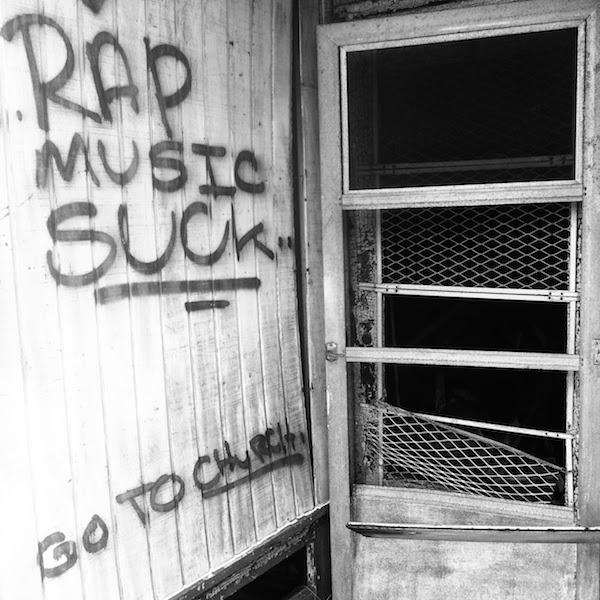
Abandoned storefront with graffiti reading "Rap music suck. Go to church."

The door’s open but the ride ain’t free. “Rap music suck. Go to church.” Clairton

Generalizations about entire musical genres aside, it’s hard to understand the connection between the relative quality of rap music and the commandment to attend church. We know correlation is not causation as one might just as inaccurately assume spray paint-wielding taggers would be unlikely in a house of the lord on Sunday.

Church stair rail with graffiti reading "God is dead, Devil is everywhere"

Crossed the deserts bare, man. “God is dead, Devil is everywhere.” Millvale

Is God dead? Is The Devil really everywhere? At least one troubled soul sure felt strongly enough about it to render this haunting message in black Sharpie on the stair rail of the great Holy Spirit Parish Catholic church in Millvale. We have to assume that, like the song says, “people are cracking up all over.” And when reaching out to the mental health system involves vandalizing church property, well…we’ve still got a ways to go.

Tell him what you want. “Jesus rides freight trains.” Strip District
Another questionable assertion, this one on a boxcar in the Strip District. I don’t know if Jesus rides freight trains, but they’re probably more reliable than AmTrak. That said, if Jesus really wants to commune with the in-transit laity there are going to be a lot more of them on the Greyhound or MegaBus (not to mention the DMV). And let me tell you something: some of those bus riders could learn something from a good ol’ monastic vow of silence!

Graffiti on tile wall reading "The Devil made me do it the first time ...", Pittsburgh, PA

Out on the tiles. “The Devil made me do it the first time …” Lawrenceville

So many questions: What is it? Who made you do it the next time? How many times did you do it? Did you ever get tired of it? Why do I need to hear about it? We’ll likely never know what TSU was going on about here, but hopefully admitting it was a least a first step to reaching a better place.

Brick wall with graffiti reading "What if the only things God blesses you with tommrow is what u r thankful for today"

He would / Die 4 / U. “What if the only things God blesses you with tommrow is what u r thankful for today,” (sic.) Manchester

The Orbit‘s copy-editing team is having a fit with this one, but relax, guys: everything’s cool. The suggestion (we can’t actually locate a Biblical reference for this one) that the salvation we’re waiting for in the future is here right now strikes this frequent grass-is-greener blogger as actually quite profound. The statement speaks to both live for today and be grateful for what you have sentiments, and also that the (presumably) afterlife-believing perpetrator wants us to be happy, right here in this world. Amen.

An Orbit Obit: Where the Buffalo Roamed

sidewalk painting of purple and white buffalo with painted fence

Last photographic evidence of the now-extinct sidewalk buffalo of lower Lawrenceville, Summer 2015

The lore will be passed-down for generations to come. It was a time when proud giants strode the streets (err…sidewalks) of lower Lawrenceville; their brilliant purple, red, white, and gold colors shimmering and electrifying the drab, weed-cracked concrete blocks. Mere mortals freely walked foot-to-hoof with these legendary lords of the great plains. Every one of the animals was rendered in its own style–the group less herd and more party of like-shaped individuals; each creature with its own agenda. Though trampled underfoot, they still managed to stand tall–at least if you stood back far enough to get the angle right.

sidewalk painting of purple, red, and white buffalo

Purple pain: one big hombre

If you find yourself at the corner of 35th and Charlotte Streets in Lawrenceville’s sixth ward, you won’t miss Jeremy Raymer‘s house. The otherwise standard-issue two-story Pittsburgh rowhouse is covered–foundation to soffit–in big, eye-popping mural portraiture. Around the side, a gray, picket fence is more loosely painted in an ever-evolving array of icons. The closest telephone pole is covered in an odd assortment of push-pinned offerings. [More about all of this, hopefully, in some future Orbit story.] The one thing you won’t see anymore is the fantastic parade of buffalo that roamed freely on Raymer’s sidewalks just weeks ago.

sidewalk painting of purple and white buffalo

Lascaux-a-go’alo: caveman street buffalo

It was a surprise to see them disappear so quickly. Street art is by its very nature temporary/ephemeral, but we hope the good stuff will get a little time in the sunshine before the man sends in the clouds. Having just taken these photos in August, we arrived back at the same intersection a mere couple months later with nothing but the faintest outlines of the great beasts remaining. It was a sad reminder of both how fleeting grace can be and also how potentially on-the-verge-of-dissolution pretty much everything is. The great American street bison is clearly no exception.

sidewalk painting of purple, red, and white buffalo

All wound up: mechanique’alo

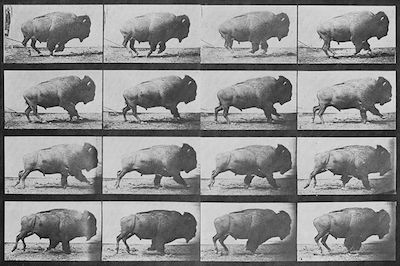
We got in touch with Mr. Raymer to ask about the sudden extinction of his herd. He verified that indeed he was the perpetrator (the buffalos were loosely based on series of photographs by Eadweard Muybridge taken in late 19th century), planning to make them last, Raymer painted the buffalos in Montana Gold spray paint, and that a neighbor filed an official complaint about the sidewalk paintings. The city’s Graffiti Task Force was called-in and was therefore obligated to power wash them away. (Apparently the city would not have acted but for the formal complaint.) Raymer would like to re-paint his sidewalks with a new to-be-decided theme at some point in the future, but this time he’ll go through official channels to do so.

Sequence of a buffalo (American bison) galloping. Photos taken by Eadweard Muybridge (died 1904), first published in 1887 at Philadelphia (Animal Locomotion).

Eadweard Muybridge’s photographic sequence of a buffalo (American bison) galloping, 1887

The whole thing raises an interesting series of questions. Sidewalks are this curious blend of public and private space and the letter of the law doesn’t necessarily add up logically. Technically, one’s sidewalks are part of the property lot and the homeowner (not the city) is legally responsible for the care and maintenance, including weed, snow, and ice removal, patching and replacing cracked concrete, etc. Sidewalks are undeniably public thoroughfares that everyone uses and are absolutely essential to a healthy urban environment. They also offer great opportunities for expression.

Shouldn’t Raymer (or anyone else) be allowed to decorate his own property–that he’s legally responsible for maintaining–in a way he chooses? Why is he allowed to paint the public-facing fence, but not the adjacent sidewalk, which is inches away and just as visible? If the same neighbors objected to his wall murals, would the city be in power to act on those complaints? And if one is painting his or her own property, does it really count as graffiti?

sidewalk painting of purple and white buffalos

Then: corner buffalo (and friend)

faded outline of a buffalo painted on sidewalk, Pittsburgh, PA

Now: the same corner with the last traces of the once-proud herd of Lawrenceville’s sidewalk buffalo

The Orbit does not pretend to have answers to these questions, nor do we want to vilify the residents who objected to the paintings. That said, this hardcore all-seasons blogging pedestrian would like to see the neighbors of Lawrenceville put that same keep-the-sidewalks-clean enthusiasm put into clearing the inevitable mini glaciers of snow and ice that will arrive any day now.

Maybe down on 35th Street they don’t have this problem, but just a few blocks away I sure do! Every year I slip on un-shoveled winter sidewalks. Most years there is at least one ugly fall that ends with a bent knee, a twisted ankle, or a very literal pain in the ass. These buffalos may look threatening, and they may not be Raymer’s neighbors’ idea of art, but it’s hard to imagine they were really offending anyone. It’s the coming ice age that may do us all in.


To see more of Jeremy Raymer’s work, check him out on Instagram @jeremyMraymer.

The Mystery of the Tip Top Chop Shop

Wooded hillside in early fall

There’s cars in them thar hills. Looking up at the former hillside chop shop location.

It’s a truth among bloggers that if you haven’t had your “Geraldo moment” then, you know, welcome to amateur hour: you’re not really blogging, dude. This citizen-journalist/new media shaman (err…shamed man) is here to say he’s been through the eye of the needle and is back to tell the tale.

We certainly didn’t expect our Waterloo to arrive on a glorious sunny fall morning, the echoes of a classic Casey Kasem American Top 40 from ’72 still ringing in the ears. [What a great era when “Popcorn” by Hot Butter could chart! You try catching Moog-based instrumental proto-disco on “terrestrial radio” nowadays.] But there we were, on a pristine wooded hillside, high above Turtle Creek (the actual creek, not its namesake town). This post, its lack of sound and/or fury, may forever mark The Orbit’s Little Big Horn, our little corner of the blogosphere’s Mystery of Al Capone’s Vaults.

white wall tire in wooded area

The first evidence: that looks like a whitewall to me!

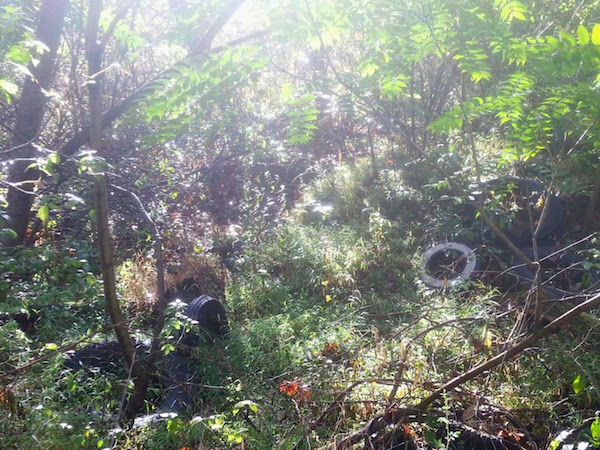
The promise was spectacular and had Orbit written all over it: an untouched fifty-year-old automobile graveyard in about as improbably inaccessible a location as one could imagine–a thick wood up a steep hillside outside Monroeville. The junkyard had been abandoned for half a century leaving a rusting collection of stray Hudsons and Studebakers, Packards and DeSotos as far as the eye could see. Trees had grown up, over, and through the spent carcasses. Pickers and plunderers had pulled everything of value. Nature had reclaimed what she could.

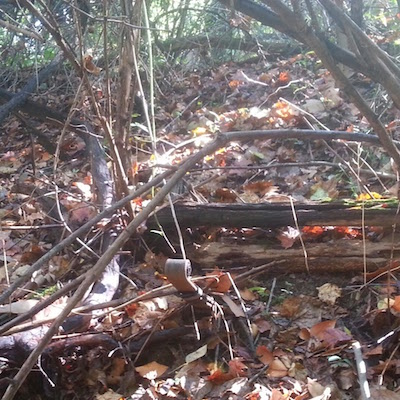
rusted leaf spring from an old car among fallen leaves

Model T-era leaf spring among fallen leaves

WOW! Sounds incredible, right? I know! So naturally The Orbit‘s dawn patrol caught the first suitable morning light to high tail it out The Parkway East  to meet our native guides, Moskal & Son. I’d been told that “We’ll have to take you there–you won’t be able to find this place yourself.” Truer words were never spoken. The journey involved one twisty-turny car ride, some combination of bridges, train tunnels, and one climb up a still-soaking-from-rain-the-night-before hillside.

The story goes that in the 1950s and ’60s an underworld operation existed that stole automobiles off the streets of Pittsburgh, drove them way out here to (pre-Squirrel Hill Tunnel/pre-suburbia) Monroeville/Wilkins Township, and somehow hoisted them all the way up the hill to this secluded location. There, this crew ran a woodland chop shop for the cars’ re-salable parts. At some point in the 1960s the location was discovered and the whole ring busted, crooks were sent to the big house, and their spoils were just left in the woods to rot. Pa Moskal had been to the site several times since the ’60s, but as a pair, father and son hadn’t been up the hill in twenty years–the younger but a wee Moskal at the time–so we’d have to do some tromping around to find the right spot.

window handle crank and rusted metal in fallen leaves

Window crank and door panel

Let me tell you something: if you want to see two grown Moskals and one still-figuring-things-out blogger brought to tears, just put them this deep in unspoiled nature. The three of us climbed, hiked, and trudged–hell, we located walking sticks and were on verge of singing mountain songs! How is one supposed to remember his or her troubles in this degree of mid-autumn pleasantness? The dappled sun streaming through the still-changing leaves; the only sounds, the chirping of birds and babbling of brooks. Very disheartening.

rusted automobile metal in wooded area

One big rusted carcass

Well, we know it is darkest before the dawn and even at this moment of greatest despair, like Geraldo unearthing that alleged bathtub gin bottle, we tripped across our first evidence. It’s certainly not unusual to find discarded tires in the woods, but the whitewall that popped out was something that looked older than your garden-variety illegal dump site. It was followed by a distinct leaf spring–the kind found on the suspension of very early automobiles–protruding from a pile of downed foliage. Next: an unmistakable door panel with its window crank still attached. Just one giant rusted steel carcass appeared: itself so twisted, decomposed, and enwrapped in thick vine that its original shape was completely lost.

We never found the hundreds of car bodies we were hoping to see–they’re long gone–but at least we knew we had the right place.

Bob and Mike Moskal in Monroeville woods

Our intrepid guides Moskal & Son

So what happened to the acres of autos? Pa Moskal’s theory is that the railroad owns the land and cleaned it out when they put in the (newish) gravel access road we came across. I looked for a news story on a Monroeville-area illegal junkyard clean out some time in the last couple decades, but came up with nothing.

In the end, maybe it doesn’t matter. Geraldo never found any buried bodies in Chicago and he ended up O.K. At least we got a little rust.


If you have any information on either the history of the Monroeville Tip Top Chop Shop or its cleanout, please get in touch. We’d love to hear about it.


Ghost House: Nabbing a Strip District Two-fer!

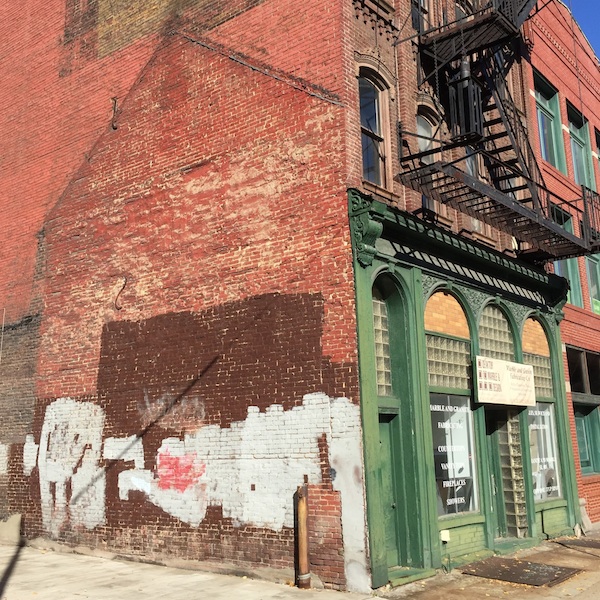
outline of 2-story "ghost house", Pittsburgh, PA

Ghost house (East), Strip District

We’d been after this pair for a while and yeah, we bagged them. It was a ghost house hunter’s ultimate score–side-by-side impressions of the same disappeared structure left right (and left/right) next to each other. With a little imagination even a dime store gum shoe could put the pieces together. The whole picture is right there in front of you, guilty as the day is long.

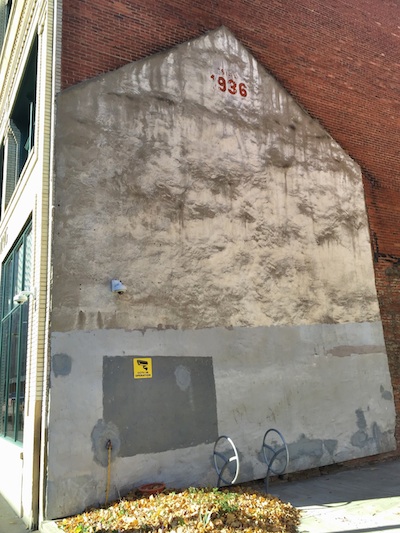
Cruise down Penn Ave. from the Strip to town and you can’t miss the western-facing member of this pair. She’s a platinum figure built like a brick (row)house, answering to this mathematician’s favorite dimensions: 24′ x 24′ x 36′. The dirty gray, ruffled skirt told us everything we needed to know about how the last century had treated her. Centered in what must have been one lovely attic space is an intriguing 1936, tattooed in red and beginning to flake away.

Her old man didn’t have the same distinction but the outlines were all there. The bruises across his midsection told us the block had been around him more than a few times and he could give as good as he got. On top of his pointy head sat a bonus ghost sign so far gone it’s now just a blur.

outline of 2-story "ghost house", Pittsburgh, PA

Ghost house (West), Strip District

Even though we’ve been down this particular stretch of road a zillion times, it was never quite the right time to make the grab. Some bozo would leave a car right in my shot [“Get out of the way, you bozo!”] or some dude would be parallel-parked on Penn Ave. and throw off the foto shui (look it up) of the bigger scene [“Beat it, pal!”].

But who’s this blogger kidding? These pictures ain’t for the museum, and they’re not getting pinned up in some teenage hair-farmer’s gym locker. No: we’re here to put this couple up on the blog wall faster than you can say “son now here’s some little something”.

Catching ghosts turns about to be a lot like nabbing bad guys. You order up some take-out coffees [“Black for me; two creams for my partner.”], get giant sandwiches from a place called Sal’s [“That bastard owes me!”], and then you wait [“I’ll take first watch. You get some shuteye.”].

And wait we did. Days, weeks–hell, it was months sitting on these perps. Just biding our time until they made a move. Oh, and what move they made. Another perfect, glorious, unseasonably warm November day; the sky so deep and blue it looked like the water from the prow of a skipjack off Dewey Beach. Me: all the time in the world to set ’em up and knock ’em down. Yeah, The Orbit got the collar. Put it in the books, Jack.

4-story brick building with outline of 2-story "ghost house", Pittsburgh, PA

Bonus (unreadable) ghost sign above the ghost house!

An Orbit Obit: The Toynbee Tiles of Smithfield Street

Toynbee Tile reading "Toynbee Idea in movie '2001' resurrect dead on planet Jupiter"

Resurrect dead while you can. The last remaining Smithfield Street Toynbee Tile, Downtown.

It was not that long ago (February, to be exact) when Pittsburgh Orbit filed one of its earliest stories on the great run of five “Toynbee Tiles” that were imprinted on Smithfield Street, approximately one per block from Boulevard of the Allies to Sixth, downtown.

This blogger likes to think The Orbit come a long way since those nascent days of yore, [Only two paragraphs of text? Who was doing the photo editing?] but looking back on this very recent history, it’s also a reminder of how rapidly (and drastically) things can change in the city as a whole. [Young people: for good or bad, back in the ’90s/early aughts, the words “Pittsburgh,” “rapid,” and “change” were never bundled in the same text.]

I’ve gotten in the habit of eyeballing and taking inventory of the Toynbee Tiles every time I ride through downtown, inevitably on Smithfield’s relatively-convenient route from the South Side to the great new Penn Ave. bike lane. It’s news to no one that there’s a tremendous amount of development happening in town right now–you see giant cranes, construction fencing, and torn up pavement everywhere you look. But I was startled to find that as of this past weekend–less than a year after that early blog post–only one out of the five Toynbee Tiles was still intact. The sole survivor (pictured above) is at the corner of Smithfield and Oliver Way.

It doesn’t seem like there was any malice involved here or that the tiles were actively removed in a clean-up effort. [Let’s hope not: the city has far bigger infrastructure-shaped fish to fry.] There just seems to be that much digging up of streets and running new, uh, things under them. The block of Smithfield from Sixth to Seventh has been totally resurfaced.

terra cotta storefront for former G's Restaurant and Pizzeria, Pittsburgh, PA

(The former) G’s Restaurant and Pizzeria on a torn-up Forbes Ave., Downtown

Fifteen years ago, me and a whole bunch of other concerned citizens drank a lot of beers and ate a lot of fried zucchini at The Chart Room in the name of not having downtown Pittsburgh eaten alive (or something like that) (hey: it worked, didn’t it? sort of?). The Chart Room is long gone (heavy sigh), but at least the building didn’t get torn down. [Sadly we can’t say the same for the old nickel bingo parlor across the street.]

No, The Chart Room got mangled by choice, in private hands, without needing any help from eminent domain. It’s strange to have lived through that extreme “Hail Mary”/desperation-style urban planning only to wake up in an entirely new world where big money comes in and builds big things all on its own. It’s different in a whole lot of important, structural ways, but still strangely the same as it seemed like it might have turned out to be. Resurrect dead, indeed.

Ah, hell. If you want The Orbit’s advice, go check out the last Toynbee Tile on Smithfield Street while you still can. It won’t be there forever.

Hey, Porter: Daria Sandburg and Pittsburgh’s Baggage Claim

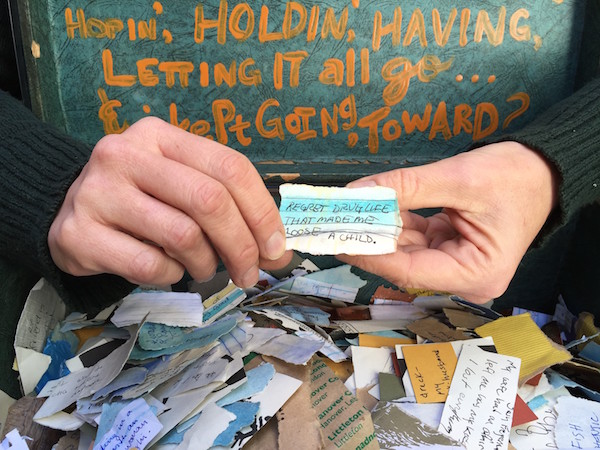
Hands holding scrap of paper with the writing "Regret drug life that made me loose a child" (sic.)

“Regret drug life that made me loose a child” (sic.) Just one small piece of Pittsburgh’s baggage.

It’s a strange weight to carry–both metaphorically and very literally. The worn, shiny metal case (it was built to carry roller skates) is painted with a series of intriguing messages. A quote from Kate Tempest: “That thing you weep for, leave it,” and one from Carl Sandburg: “What is this load I carry out of yesterday?” The ends of the case have the instructions Got baggage? Leave it here.

The Orbit encountered this unique piece of luggage attached to the arm of one Daria Sandburg who has been toting it through our fair city streets, to events and happenings for a couple years now. Sandburg honors every one of the case’s painted instructions with an invitation for whoever accepts to leave their messages (“Pittsburgh’s baggage”) in the form of short hand-written notes on scraps of multicolored paper. A separate, smaller inset box contains “possibilities,” which people are equally encouraged to submit. Ask nice and Sandburg will convert your hand-written note into cut, stamped metal. Over the last year, hundreds have taken Sandburg up on the offer.

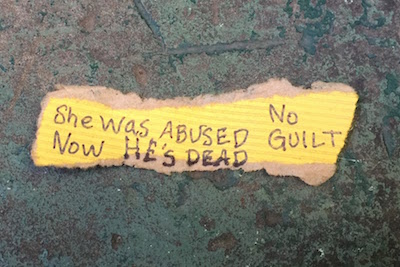
torn paper scrap with the writing "She was abused, now he's dead. No guilt."

Heavy baggage: one of the hundreds of hand-written claims

The baggage claim tickets cover the full gamut of guilt, regret, fear, and much much more. Markers of love and love lost, admissions of poor choices, addiction, and anxieties of every shade are stowed in the case. And while there’s a level of repetition and predictability to many of the entries, the format of one real human having submitted her or his expression in their own hand, in person, directly to Sandburg’s protective case makes each one unique, special, and often tragic.

Even the most prosaic of messages–Being forgotten or My ex or Uncertainty–somehow carry a greater weight when you know the author was right there, among us. Logically, we know everyone has these feelings, but somehow it’s hard to accept, or to believe. The volume of tickets expressing some level self doubt is staggering.

When the claims get deeper, more personal, they can be outright devastating. Take my lies, one reads, or My father’s suicide, or Letting where I missed be the measure of my life, or She was abused, now he’s dead. No guilt. It’s good the slips are so small or these could turn into major therapy sessions on both ends of the paper.

Daria Sandburg and her open case of Pittsburgh's baggage.

Daria Sandburg and her open case of Pittsburgh’s baggage.

All told, it’s a heavy load to carry around. I asked Sandburg if she feels the project, open-ended and unresolved by design, could, ironically, become her own personal baggage. Could she be trapped under the weight of needing to collect and store ever more of the limitless pool of strangers’ personal issues?

The response was remarkably upbeat, positive, and forward-looking. She doesn’t feel married to either the suitcase or the project, especially after the completion of a recent show combining the baggage claims with Sandburg’s original art (inspired by the submitted claims) at Boxheart. [The project required a greater-than-normal commitment to baggage collection.] But at the same time, there are no immediate plans to suspend her regular forays out with the box.

hand stamped metal with the text "I wish I wasn't afraid of doing literally everything"

One of Sandburg’s by-request hammered metal claim tickets.

Sandburg is leaving soon to take the case out for a week-long working/collecting trip to the greater Art Basel Miami (and its associated shows/events) for that annual art/schmooze megalopolis as part of Boxheart Gallery‘s travel team. [Boxheart is participating in the alternative Fridge Art Fair.] There, she’ll be collecting South Florida’s baggage, and yes, mixing it with our own. This blogger predicts more regrets around taking on extra calories or the perils of imperfect abs and less decades-old nightmares around the Mark Malone and Bubby Brister regimes. But maybe we’ll find out that everyone really has the same baggage, even if Miami’s comes well-tanned and wrapped in vintage alligator.

Daria Sandburg holding metal case with painted words "Got baggage? Check it here."

Follow Daria Sandburg and the Baggage Claim project on Twitter and/or Instagram for regular updates on incoming claim tickets–or just look out for the lady with the cool hand-painted metal case. She encourages meeting interested strangers: “Happenstance is what really makes the project wonderful.” If you do spot her, say hello, and maybe consider leaving that thing you weep for.