Just Enough: Duck Hollow

community of Duck Hollow, Pittsburgh, PA

Duck Hollow (foreground)

To call the tiny neighborhood of Duck Hollow “cut off” is an understatement–there is only one way in or out. A short unnamed one-lane bridge spans the point where little Nine Mile Run creek spills into the river and acts as the sole gateway for motorists and pedestrians alike. The creek wraps around the neighborhood’s north and west sides; above it up the hill sits the suburban-feeling slag heap redevelopment Summerset. To the east, there is a steep hill and thick wood.

The Monongahela river forms the neighborhood’s southern border, but you can’t actually see it–train tracks elevated on an earthen berm block all direct access to the river. Walking in on little McCarren Road, a repurposed wooden headboard-turned-welcome sign informs visitors they’ve arrived: Duck Hollow, Population: “Just Enough”.

wooden bed headboard with the text "Duck Hollow. Population: 'Just Enough'", Pittsburgh, PA

Population: “Just Enough”. Duck Hollow welcome sign.

single-lane bridge crossing Nine Mile Run creek, Pittsburgh, PA

One way in, one way out. Bridge to Duck Hollow.

“Just enough” is as subjective as terms come. It’s probably fair to say that for many fellow Pittsburghers, Duck Hollow wouldn’t really feel like city living. Those with a healthy penchant for walking can leg it up the 3/4 mile hill to reach the strip mall-like IHOP/dry cleaner/Hokkaido Seafood Buffet complex on Browns Hill Road, but there are no commercial buildings in Duck Hollow proper, nor is there evidence there ever were. We counted eighteen total houses (plus a number of freestanding garages, sheds, and outbuildings). What does that add up to–maybe sixty or eighty people at most?

Telephone pole with Christmas wreath and cardboard sign reading "Merry Christmas Duck Hollow", Pittsburgh, PA

Merry Christmas Duck Hollow

ceramic cherub figurine on garage roof, Pittsburgh, PA

The garage cherub of Duck Hollow

We’d heard tale of winter seagulls taking up residence in our fair city, but never having crossed paths with them, it felt a lot like urban legend. Well, it turns out Duck Hollow in January is the place to catch them.

Vastly outnumbering the human population of the neighborhood–not to mention the sizable collection of the hollow’s namesake ducks congregated on the loose riverbank–seagulls do their seagull things: standing around together all facing the same way and then getting excited and all taking to the air at the same time, singing their seagull songs.

I was told by more than one fellow bird-watcher these are “Lake Erie gulls” who fly south every winter when it gets too cold up there. Considering the particular non-winter we’re in, it seems like maybe they’re working off a calendar rather than a thermostat. Either way, we’re glad you guys made the trip down.

seagulls over the Monongahela River, Pittsburgh, PA

Seagulls of Duck Hollow

Monongahela River and Homestead Bridge from Duck Hollow Trail, Pittsburgh, PA

Monongahela River and Homestead Bridge from Duck Hollow Trail

Though small, Duck Hollow is not without its cultural amenities. There is an extremely high participation in lawn decoration–light-up deer, ceramic angels, cherubs, baubles. Figurines must outnumber people by a large margin. During our couple visits–the first on New Year’s Day and then again mid-January–the Christmas decorations, candy canes, and polar bears were out in full force.

A well-tended vacant lot sits at the center of the neighborhood and one imagines it as Duck Hollow’s town square. The rectangular plot features a flag pole that held no banner but does have a nice pole-sitting Mary statuette guarding its base and blessing The Hollow. Opposite is a strange arrangement of large river rocks topped by a discarded tire; the whole assemblage has been placed just-so and painted white. This blogger doesn’t know what he likes, but he knows art–and he thinks that’s what this might be…maybe.
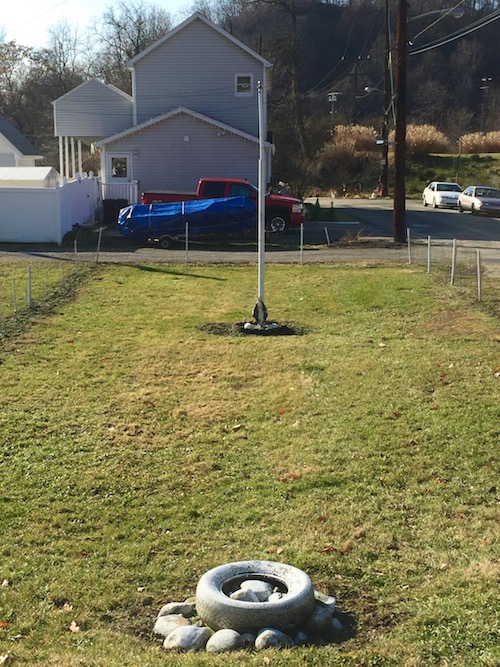
green lot with flag pole and stone pile, Duck Hollow, Pittsburgh, PA

Duck Hollow town square with flag pole Mary and objet d’art

round metal lid painted with long string of text nailed to telephone pole, Pittsburgh, PA

Pole art

Duck Hollow doesn’t even appear on the city’s list of officially-defined neighborhoods*. That’s probably because it’s just too small to qualify, so they’ve likely bundled it in with one of its nearest neighbors–presumably Glen Hazel or Greenfield.

But it is so not either of those places. It’s just too physically isolated–down the long twisting Old Brown’s Hill Road, through the Nine Mile Run green space, over the bridge. That seems like a long way to go when you’re still well within city limits. But then again, maybe it’s just enough.


* This hasn’t stopped Pittsburgh Orbit from including it as unique entity in the 90 Neighborhoods list/project.
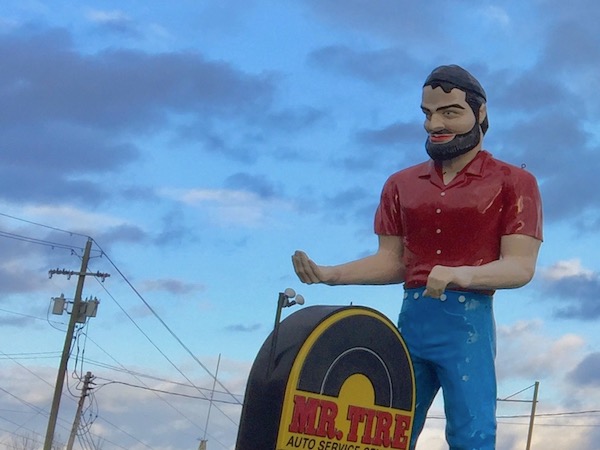
Muffler Man: Mr. Tire, Uniontown

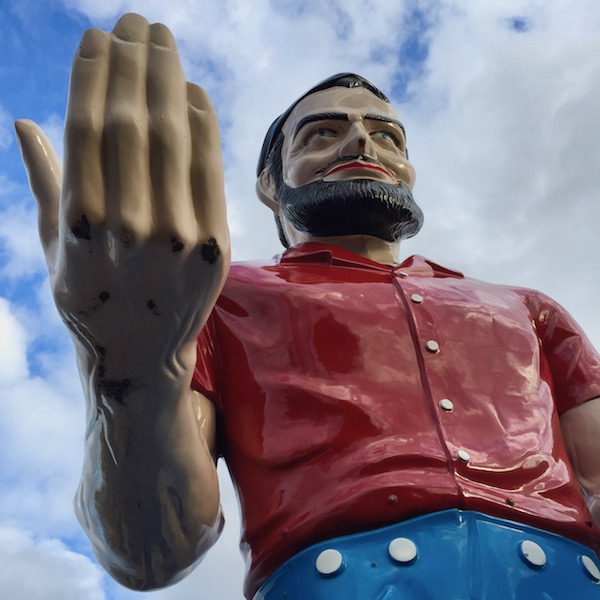
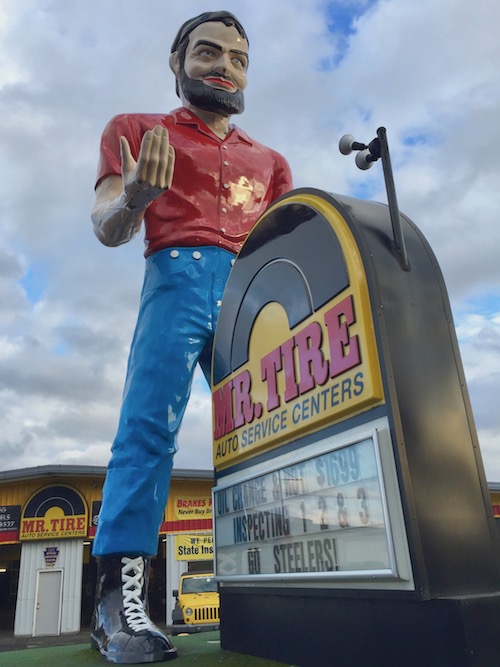
the muffler man of Mr. Tire, Uniontown, PA

King of the skyline: Mr. Tire muffler man, Uniontown

On a week that belongs to the ladies*, it would seem a strange choice–even callous, confrontational, “aggro”–to run with a testosterone-fueled post like one focused on the Mr. Tire Muffler Man, but hear this blogger out.

There we were–Mrs. The Orbit and her fella–heading to Our Nation’s Capital to defend Democracy. You’re welcome. But with a few extra ticks on the clock and taking any excuse to avoid the turnpike, we opted for the slightly longer trajectory via Rt. 51 and had a chance to check in with Mr. Tire himself in his home base in Uniontown.

detail of the muffler man of Mr. Tire, Uniontown, PA

No one suggests Muffler Man has tiny hands

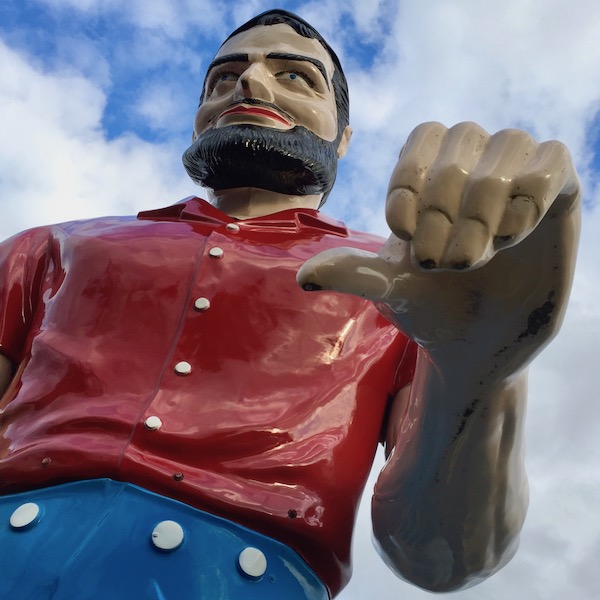
The picture of male virility, Muffler Man isn’t fooling around. Mr. Tire stands much larger than life [he’s around 30 feet tall, not including his stone pedestal]–biceps tensing the short sleeves of his work shirt, steely eyes on an emotionless face, close-cropped Just For Men facial hair, and a brimless cap that says “I was a lumberjack in a previous life; now I’m a tire guy.”

Muffler Man possesses all the classic qualities–or, at least, fantasy stereotypes–we’re led to believe men were, you know, back when America was “great”. He’s tall, dark, strong, and silent; a man of action who’s ready to put his giant hands to work. This seems all the more appropriate in the first hazy rays of the new dawn of America.

detail of the muffler man of Mr. Tire, Uniontown, PA

NOT like. Muffler Man’s thumb ain’t up.

Muffler Man isn’t the kind of guy who stays up all night sniping petty insults on the computer Internet. No, most days he pulls a double with an evening appointment to look under Mrs. Tire’s hood, make sure the engine’s still purring, and maybe check out her tailpipe. If he does his job, she’ll be leaving in the morning as a satisfied customer.

This working man ain’t the high-tech type–you can call him at the phone on the wall or catch him at the bar after his shift. Muffler Man doesn’t talk a lot, but when he does, he’d rather deflate all eighteen wheels than tell a lie. Liars don’t last long in Mr. Tire’s town.

the muffler man of Mr. Tire, Uniontown, PA

Recently, we’ve heard a whole lot about our new “tough guy”-in-chief and the “forgotten men” he speaks for. That whole notion can seem both a little absurd and totally apropos in the face of millions of protesters–a majority of them women of every imaginable demographic–filling cities across the country (and the world) last Saturday. Maybe it’s time for some of those tough guys to finally learn something from the ladies–and even from Muffler Man. Stand up, shut up, roll up your sleeves and get to work doing the right thing.


Getting there: Mr. Tire is at 350 Pittsburgh Street, Uniontown. If you come down Rt. 51, just keep going straight and you definitely can’t miss it.

Related: Muffler Man: The Cadet CowboyPittsburgh Orbit, May 22, 2016.


* Let’s hope it’s actually a month, a year, or time going forward, but that remains to be seen.

All the Way: The Arthur and Alfreda Antignani Mausoleum

Arthur and Alfreda Antignani mausoleum, Allegheny County Memorial Park, Allison Park, PA

Arthur and Alfreda Antignani mausoleum, Allegheny County Memorial Park, Allison Park

The granite mausoleum stands alone inside a marquee plot surrounded by a thin circular cemetery road. A long stretch of musical staff wraps the perimeter with twenty-some bars of melody notation spelled-out; vertical fence posts serve double-duty as measure lines.

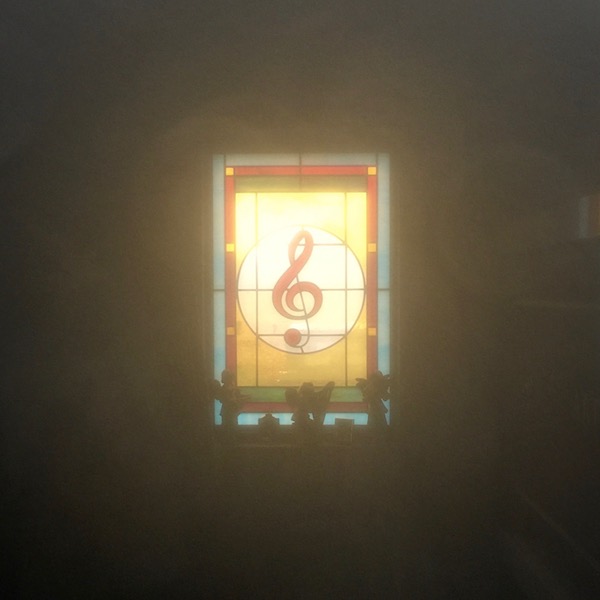
Two six-foot-tall ornamental saxophones flank the doorway; a third marks the crest of the roof. Palm to forehead, one can squint through the gauzy haze inside to the mausoleum’s stained glass window. There, a backlit treble clef symbol glows where one might normally expect the image of an angel or flowers[1]. The footpath out front is yet another gigantic saxophone, this one rendered minimally in two dimensions on red-brown granite tile. The entrance step is engraved “All the Way”.

detail of giant saxophone ornament on the Arthur and Alfreda Antignani mausoleum, Allegheny County Memorial Park, Allison Park, PA

Saxophone ornament, Antignani mausoleum

All the Way could–and should–be the title of Arthur and Alfreda Antignani‘s bio-pic. The couple lived large in a Hampton hilltop property they built for themselves and named Skyvue Estate. Our story on what remained of that shag-carpeted, double-bedazzled, rhinestone-encrusted, tchotchke-strewn, twenty-four hour party palace and its grounds [Graceland North: The Antignani Estate Sale, 4 Nov. 2015] is one of the most-read Orbit stories of all time. Though the Antignanis have left this particular stage, we thought it was high time to call for an encore and visit this fascinating couple in their final resting place.

stained glass window with treble clef symbol, Arthur and Alfreda Antignani mausoleum, Allegheny County Memorial Park, Allison Park, PA

Mausoleum stained glass window

That the Antignanis loved music should come as no surprise. Every inch of Skyvue Estate–from the guitar-shaped patio to the band of frog figurines jamming on the credenza–confirmed as much. So it is fitting that as Alfreda spent the very the last years of her life designing and planning the memorial[2], she’d want the imagery of music–especially Arthur’s tenor saxophone–featured prominently.

The touch to include actual musical notation on the small fence–as opposed to any old clip art approximation of stray notes on a staff–was an inspired design decision. If you haven’t guessed by now, the melody is, of course, “All the Way”.

detail of saxophone-shaped tile walkway at the Arthur and Alfreda Antignani mausoleum, Allegheny County Memorial Park, Allison Park, PA

Saxophone-shaped tile walkway

“All the Way”, the Sammy Cahn/Jimmy Van Heusen standard made famous by Ol’ Blue Eyes (among many others) is a classic tear-jerking ballad of life-long love. It may be a songwriting cliché, but a lyric like “Through the good or lean years, And for all the in between years” speaks not to the eros of so many pop songs and rom coms, but to the pragma and philia of a couple that spent over half a century together[3] in what we can only imagine as one of the great eccentric long run romances of our time.

To Arthur and Alfreda Antignani, may you rest in peace, all the way.

Arthur and Alfreda Antignani mausoleum, Allegheny County Memorial Park, Allison Park, PA

Art & Al, R.I.P.

Getting there: The Antignani mausoleum is in Allegheny County Memorial Park, 1600 Duncan Ave., Allison Park. The cemetery has very few above-ground average-sized headstones (possibly none?) so the handful of large memorials/mausoleums stand out really easily–you won’t miss it.

[1] For comparison, see Allegheny Cemetery: Mausoleum Stained Glass, Pittsburgh Orbit, Oct. 12, 2016.
[2] “In life and death, eccentric Hampton couple makes beautiful music together”, TribLive.com, Dec. 5, 2015.
[3] The Antignanis were married and 1959 and Arthur died (first) in 2011.


Mondo Menorah! Menorahmobile Models Measured

Grand Menorah Parade lineup, Rodef Shalom, Pittsburgh, PA

Grand Menorah Parade lineup, Rodef Shalom, Oakland

“Do you want to know the secret? My brother made all of those.”

The speaker [I’m afraid I was moving too fast to get any names] is a genial, middle-aged man leaning up against a plain white passenger van that sports a glorious gold-painted menorah on its roof. Across the middle of the piece is a placard with stenciled letters: Happy Chanukah. The ornament is clearly custom-crafted and has sibling menorahs of the same exact design on dozens of other vehicles across the lot.

man posing in front of white van with rooftop menorah, Pittsburgh, PA

“Do you want to know the secret? My brother made all of those.”

When you start ogling menorahmobiles–vehicles decorated with oversize ornamental electric menorahs for the Jewish holiday of Chanukah–you’ll find there are four basic models, distributed in roughly equal proportions.

There’s the plastic, light-up magnetic roof-topper made by Magnet Menorah. It basically looks like a similar-sized adjunct to the delivery car for a corporate pizza chain, only it’s got the image of nine candles, a phalanx of dreidels, a pile of gelt (gold coins), and the scrolled text Happy Chanukah in place of the Domino’s or Pizza Hut logo. This one may satisfy obligations–and is certainly convenient with minimums of both muss and fuss–but it’s got no soul. I was told “Those don’t count” by one, and even as both novice and outsider, I have to agree.

car with plastic rooftop menorah, Pittsburgh, PA

“Those don’t count.” magnet menorah by Magnet Menorah

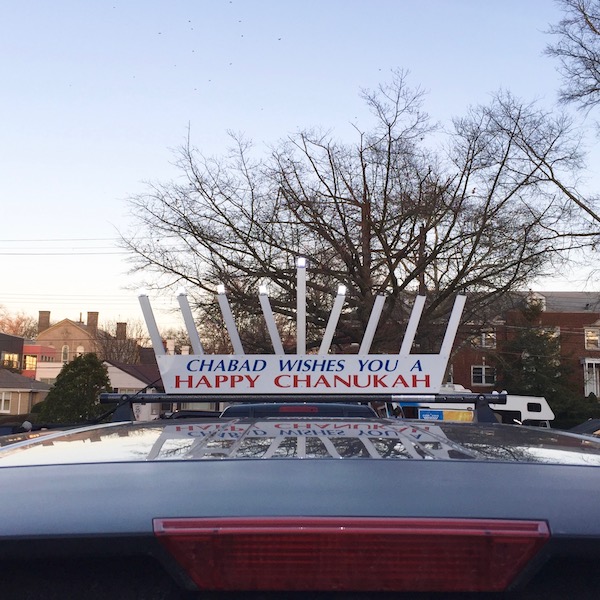
Also commercially available is the competing, stainless steel model from CarMenorah.com. It features the eight daily Chanukah candles (each a separate, switchable LED light), four angled outward in one direction and four in the other, plus the tall center shamash. This design doesn’t have the convenient magnets, but it’s mounted to a roof-spanning bar that lashes discreetly for a nice tight side-to-side presentation. CarMenorahs come with one of a few optional professionally-printed wrapper-bases with messages like Happy Chanukah and Chabad wishes you a Happy Chanukah.

Simply by virtue of its choice in materials, CarMenorah’s design looks a lot nicer than the light-up plastic taxi topper offered by Magnet Menorah, but it still lacks any real individuality.

car with rooftop menorah reading "Chabad wishes you a happy Chanukah", Pittsburgh, PA

Stainless steel and LED CarMenorah.com design

Once you get past these mail-order, pre-fab car menorahs, we get to the good stuff.

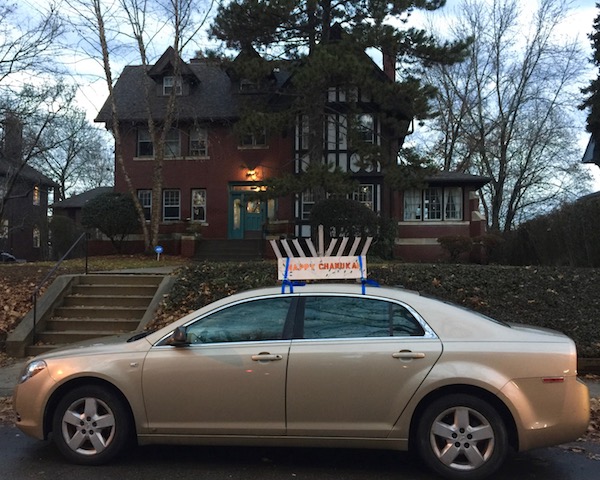
Many vehicles feature menorahs with the same overall design as the CarMenorah piece, but built of wood on a 2×4 base rather than pre-assembled stainless steel. The more up-to-date of these include switchable LED lights; others had old-school tiny incandescent bulbs. Each set seems to have included a good-sized blank white board with room enough for the family to create their own custom messages across each side. Many simply pulled out the stencils and colored-in Happy Chanukah, but we also saw the additions of floral artwork, 8 Great Nights, and one pan of frying latkes.

Two cars with rooftop menorahs and home made "Happy Chanukah" signs, Pittsburgh, PA

Wooden menorahs make for 8 great nights!

lit rooftop menorah with homemade "Happy Chanukah" sign featuring frying latkes, Pittsburgh, PA

Thanks a latke, menorahmobile!

Finally, there is a particularly unique-to-Pittsburgh design that stands (literally) above all other car menorahs. Constructed of stout PVC pipe, spaced and jointed at 45-degree angles, and connected to a base spanning the width of the roof of a car, these menorahs extend probably 30 inches off the vehicle’s roof. A switch array connects the nine candle lights to the vehicle’s cigarette lighter. These menorahs become glorious headdresses to the otherwise plain Maximas and Odysseys they adorn.

Aside from the clever ingenuity of these materials, the PVC menorah wins on both simple elegance and sheer grandeur of its design. The menorah alone, spray-painted silver with no other adornment, is a striking and beautiful sight–the automobile underneath becomes but a humble pedestal for such interesting rolling modern sculpture.

mini van with rooftop menorah and "Happy Chanukah" banner, Pittsburgh, PA

PVC car menorah, electrical pole not included

If the spectator wants to see the full panoply of menorahmobiles, ground zero is Chabad of Pittsburgh’s Grand Menorah Parade. This year, it was held on Dec. 28, the fifth day of Chanukah. Detail-focused Orbit readers will note many photos included here have five bulbs lit and three dark.

The parade group assembles in the big back parking lot of Rodef Shalom Temple in Oakland and let this blogger tell you: it’s menorahmobiles as far and wide as the eye can see. Any lapse in reporting on this story can be blamed on the simple overwhelming number of subjects to try to catch, photograph, and say hello to in the midst of rapidly-diminishing daylight and the parade group’s imminent takeoff.

sedan with menorah and "Happy Chanukah" sign on roof, Pittsburgh, PA

Street menorahmobile, Squirrel Hill

white car with home made menorah on roof, Pittsburgh, PA

One on the street and one in the driveway. Squirrel Hill.

While fans can bag a virtually unlimited number of menorahmobiles in the setup for the parade, it’s also great to spot them “in the wild”. For the eight days of Chanukah, jaunts down the residential streets of Squirrel Hill will yield cockscombed Corollas and mohawked minivans casually parked on curbsides and driveways throughout.

* * *

One final thought: While this exercise was enlightening and fun, ultimately we found ourselves wishing the vehicle owners put more emphasis on creativity and individuality than simply selecting one of four off-the-shelf models. Menorahs come in infinite fantastic and original designs and have been a common subject for Jewish artists forever. Of course the roof of an automobile imposes some practical limitations to what the car’s owner can do, but I bet the community would come up with some really incredible creations if just given a little bit more of a prompt.

lineup for Grand Menorah Parade, Pittsburgh, PA

Lineup for the Grand Menorah Parade at sundown, Rodef Shalom, Oakland

Birdwatching, Clarence the Bird Watching

Clarence the Bird artwork stapled to wood covering empty storefront, Pittsburgh, PA

Penn Avenue, Garfield

Traditional birdwatching likely takes place at a more inviting season. Not only is it nicer for the spectator to be outside in a warmer, drier climate–one filled with the bright colors and in-bloom flora of the other three-quarters of the year–but (we assume) there simply must be a lot more birds to look at.

This blogger imagines typical northern birders–just like baseball fans–consider winter the long dark off-season. Weather and the absence of fowl require avian fanciers to temporarily retire binoculars and sun visors, instead spending their time curled up by the fireplace leafing through back copies of Birder’s World magazine and plotting strategies to snare an up-close photo of the green-winged teal, surf scoter, or greater white-fronted goose when the season turns.

Clarence the Bird artwork stapled to empty storefront, Pittsburgh, PA

Penn Avenue, Garfield

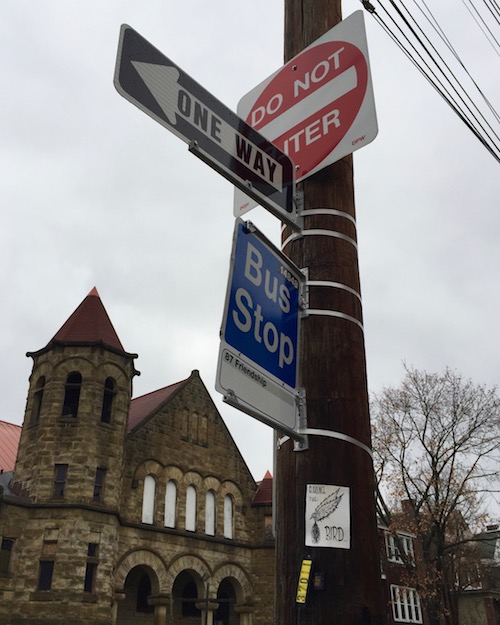
Clarence the Bird artwork stapled to telephone pole, Pittsburgh, PA

Friendship Avenue, Friendship

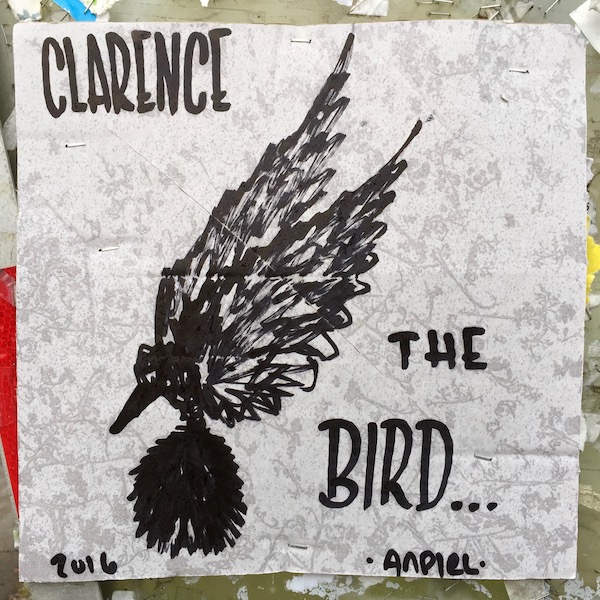
So it’s a right fine unexpected treat to spot the friendly face and outstretched, oversized wings of Clarence the Bird peering back at you as a fellow makes his or her rounds throughout the day. There he is, tacked to a telephone pole on a residential throughway and mingling with the high-minded street art on Penn Avenue.

For the most part, we didn’t get too close. Not wanting to scare poor Clarence out from his various perches, we caught him here in the wild, hiding amongst the traffic signs, crumbling plaster, and effluvia of street handbills and stray graffiti.

Clarence the Bird artwork stapled to former storefront, Pittsburgh, PA

Penn Avenue, Garfield

cardboard sign with pen drawing of a bird and the text "Clarence the Bird...", Pittsburgh, PA

Main Street, Lawrenceville

This blogger knows what you’re thinking: Someone sure missed the memo on that whole flying south for the winter thing, right?

Certainly, even in these darkest, gloomiest, and most dreary of days, Clarence the Bird eschewed a sun-filled January of jello shots in Daytona Beach or working up a savage tan in Belize to instead rest his wings right here at home in the East End. Whether Clarence is a loyal Steeler fan hoping for the best in the playoffs or just too lazy to make the trip south, we don’t know. Either way, we’re betting he’s regretting that decision right about now. That said, The Orbit is selfishly very happy he stuck around.

Clarence the Bird artwork stapled to telephone pole, Pittsburgh, PA

Penn Avenue, Garfield

cardboard "Clarence the Bird ... Make the World Beautiful" artwork stapled to telephone pole, Pittsburgh, PA

Friendship Avenue, Friendship

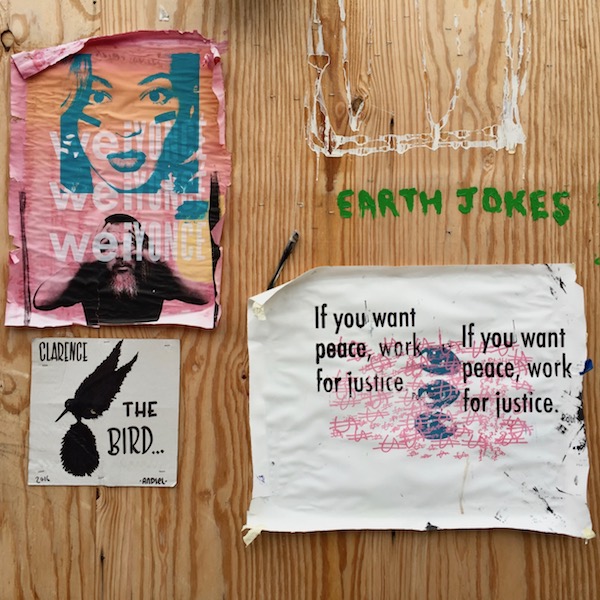
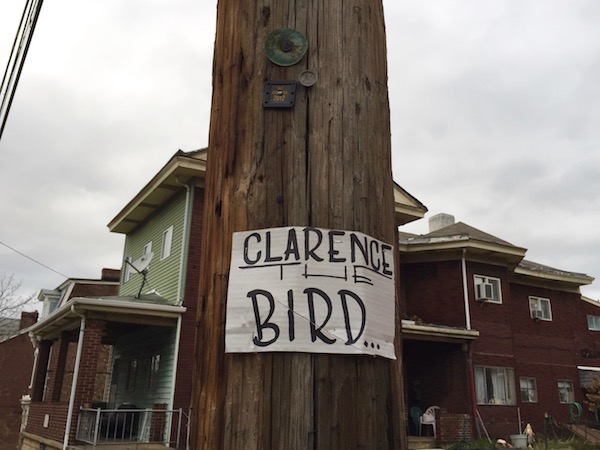
Like the Pittsburgh protractors–or men wearing Zubaz–once you start looking out for Clarence, he’s everywhere. On cardboard with crude Sharpie and in fine lines on card stock and curlicues, Clarence gets around. This most urban of avian creatures loves to nest in the protective plywood covering abandoned store fronts on Penn Avenue, mingling with wheat pasted street art and course slurred graffiti. On one Main Street pole, Clarence isn’t even present but has left us a bold-faced title card with his name followed by a tantalizing ellipsis begging the question where is Clarence the Bird and what is he up to?

Clarence the Bird artwork among collage on empty storefront, Pittsburgh, PA

Penn Avenue, Garfield

cardboard sign with the words "Clarence the Bird..." stapled to telephone pole, Pittsburgh, PA

Main Street, Lawrenceville

The last time we crossed paths with Mr. The Bird he was urging us to Make the World Beautiful in three of four consecutive Butler Street telephone pole hang-outs. After migrating up the hill to greater Garfield/Friendship*, Clarence seems to have both cloned himself many times over and abandoned the explicit message almost entirely. [The one photo included above is the only exception we spotted.]

While this blogger still agrees with the sentiment–and misses Clarence’s fine calligraphy in the inscription–it’s safe to say that actions speak louder than words and Clarence is out there doing his best to decorate the landscape without ever having to brag about it. You go, bird!

Clarence the Bird artwork stapled to info kiosk, Pittsburgh, PA

Fourth Presbyterian Church, Friendship

Clarence the Bird artwork stapled to info kiosk, Pittsburgh, PA

Fourth Presbyterian Church, Friendship (detail)


* The way Lawrenceville rents are going, we can’t blame the guy.

New Year’s Resolution: The 90 Neighborhoods Project

stylized map of the city of Pittsburgh by neighborhood

Pittsburgh is famously a “city of neighborhoods”–ninety of them, to be precise. Going through the full list, it was both enlightening and exciting to think of how much of The ‘Burgh hasn’t yet been Orbit covered–let alone the parts of town we’ve never even been to or couldn’t place on the map. How could we have never even been to Esplen or New Homestead or Summer Hill?

For this speculative journal’s New Year’s resolution 2017, we’re beginning a brand new project to visit and cover each and every one of the city’s defined neighborhoods*, Orbit style.

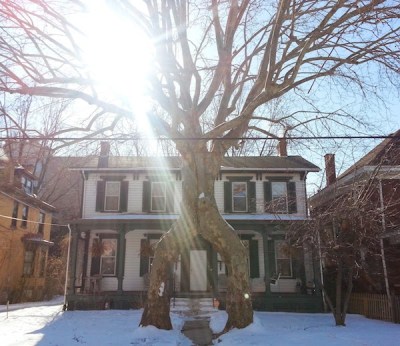
Two sycamore trees trained and grafted together to form an archway over an entrance sidewalk

The twin sycamores of Sheraden

To qualify for the series, the story must be fully of and about that place. If we include a single photo from somewhere in one of our collections on a theme, that doesn’t count. Similarly, an interview with someone who happens to live in a neighborhood would only register if that person’s particular work specifically related to the place.

Many parts of town have already been visited–Oakland, Bloomfield, Lawrenceville, The Hill District, Woods Run, and Downtown each have a bunch of stories to their names. For these, we’re grandfathering them into the series retroactively.

We even started a little early. Our trips to the amazing former Broadhead Manor project in Fairywood and Loretto Cemetery in Arlington Heights late in 2016 were prompted simply because we’d just never been to those parts of town and they seemed interesting. [SPOILER ALERT: they are.] We’ll be doing a lot more of that in 2017.

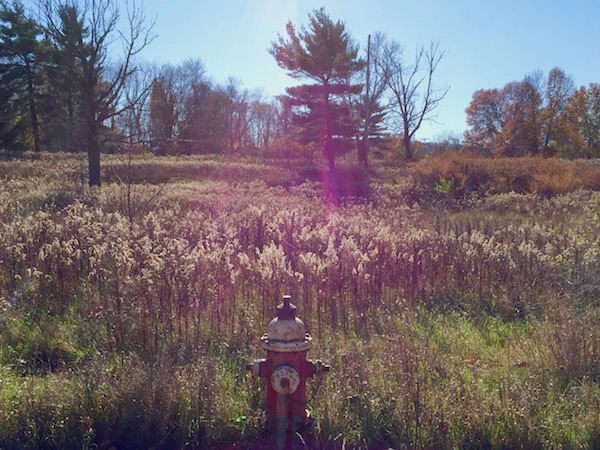
fire hydrant in field of tall weeds, Pittsburgh, PA

Former Broadhead Manor public housing project, Fairywood

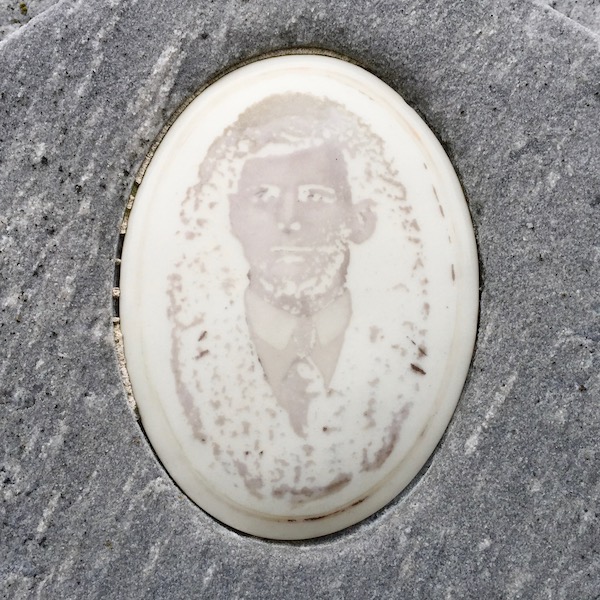
detail of marble headstone with embedded ceramic photograph of young man protected by purple plastic cover, Loretto Cemetery, Pittsburgh, PA

One of the late Victorian photo headstones of Loretto Cemetery, Arlington Heights

Here’s where we could use your help: If you know of anything particularly Orbit-worthy happening anywhere–but especially in these un-covered territories–please let us know (via the Contact page) and we’d love to check it out.


* We’re counting the neighborhoods in a slightly more practical way for reporting purposes, so the total target number isn’t quite a full 90. This is all explained on the 90 Neighborhoods project page.

The Orbit 2016 Year in Review

close-up of golden baby in red onesie, Pittsburgh, PA

Tis the season for year-end lists and the ghosts of blogging past. As The Orbit bids adieu to 2016, our last post of this annum is a little look back at both the year’s greatest hits as well as some overlooked gems.

The former is easy to work out–we’re just relying on straight analytics for page-views. Frankly, we were a little surprised by what the green visored bean-counters turned up in their and ticker-tape results, but the numbers don’t lie–at least, they should be pretty close.

For the latter, our editorial staff selected an equal number of personal favorites that somehow managed to end up in the bottom percentile of the very same stats. Hopefully, you’ll give them another chance.

The Hits

1. Jerry’s Records and the $30 Instant Record Collection (Feb. 21)

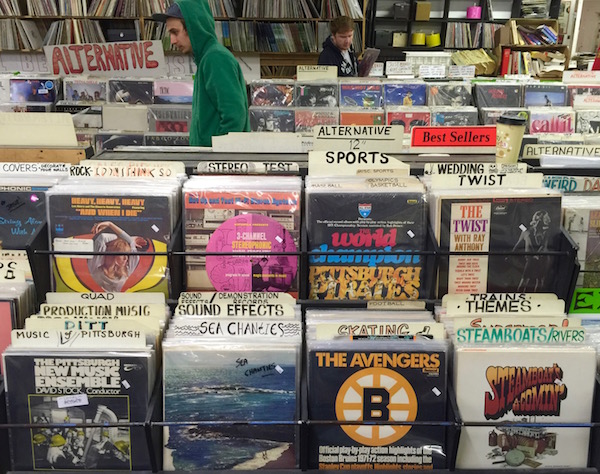
used record bins at Jerry's Records, Pittsburgh, PA

Jerry’s Records in Squirrel Hill, home of the $30 instant record collection

“Jerry’s Records is a local institution and a national treasure,” The Orbit‘s #1 story of 2016 begins, and apparently America agreed. In this piece, the crew make the argument for record collecting as cheap fun and cultural preservation while urging you to pick up loose copies of ’80s soundtracks, ’30s jazz, and The Romantics’ In Heat. Nearly a year later, we stand by each and every one of these recommendations and urge you to get your keister down to sit on Santa’s…er, Jerry’s lap and tell him what you want the very next chance you get.

2. Pittsburgh’s Next Hottest Neighborhoods (March 23)

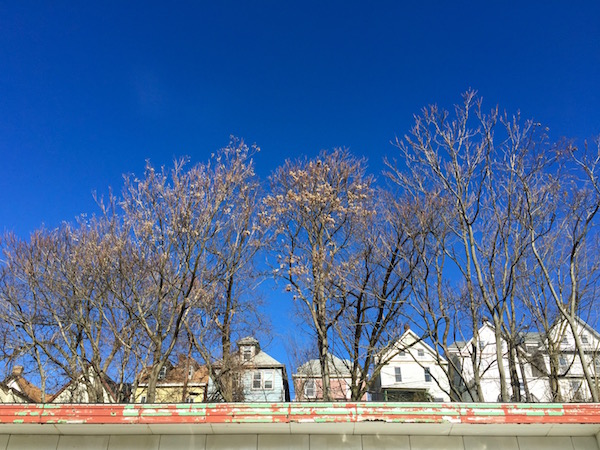
older frame houses with clear blue sky and bare trees, Pittsburgh, PA

NoCarSoSoSlo: one of Pittsburgh’s next hottest neighborhoods

Looking to invest in an up-and-coming neighborhood? Hoping to distinguish a bland urban void? NoSOak, PaHolE/WheBiJIs, and VoBeShaBlo are just three of the suggested rebrandings/”acronames” for less-defined and ripe-for-the-gentrification sections of the city. Get there now and plant some roots before all the parking is gone. Those craft beers aren’t going to brew themselves!

3. More Golden Babies! [or] A Golden Baby Boom! (Jan. 31)

Golden baby hanging from power lines, Pittsburgh, PA

One of the many “golden babies” that took The Orbit by storm in 2016

Our continued coverage of Pittsburgh’s mysterious dangling golden babies “deserves the Pulitzer,” according to one Orbit reader. Four separate stories spread over eight months of 2016 chronicle the strange tale of an elaborate act of street art and/or pranksterdom that goes all the way to the top! … or, at least, all the way to the Department of Public Works. Only the second installment made our Top 5, but check out the whole set if you really want to sort-of know what’s going on.

P.S. The saga of the golden babies is far from over, so hopefully 2017 will bring us another entry in this series.

4. The Pizza Chase: P&M Pizza, Arnold (Oct. 7)

child's head seen over a large pepperoni and olive pizza, P&M Pizza, Arnold, PA

Sunrise over molten lake of cheese. P&M Pizza, Arnold

“There’s more to hair than real hair,” George Willard reminds us in his classic song “Wig Store”. Similarly, greater New Kensington’s pizzerias are happy to let you know there’s more to cheese than real cheese. What they’re cooking up out at the great P&M Pizza in Arnold and across the river at Phillippi’s in Natrona Heights is a defiantly Alle-Kiski Valley concoction of “micro-crust ambiguously-cheesed bar pizza” that ain’t for everyone, but The Orbit calls “absolutely gooey-great”–at least, after a hard morning of pawpaw picking.

5. Street Beat: Who is the Dirty Poet? (March 20)

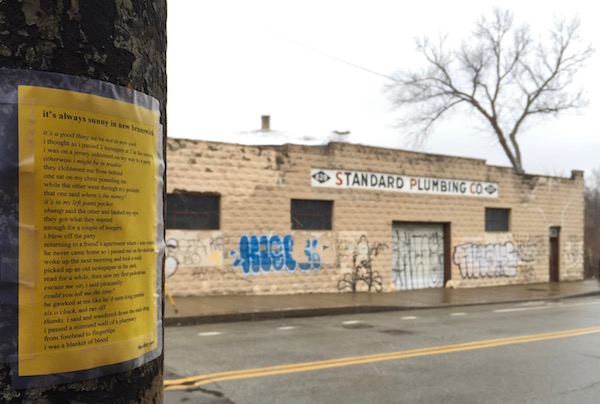
Photocopy of "It's Always Sunny in New Brunswick" by The Dirty Poet, taped to a light pole, Pittsburgh, PA

“It’s Always Sunny in New Brunswick”, one of The Dirty Poet’s many on-street works, Bloomfield.

One dude (and yes: it is a dude) with a healthy set of legs, one big roll of Scotch tape, and a whole lot on his mind has been distributing his poetry throughout Pittsburgh for the last fifteen years. By turns, the verse is loose, personal, true, vulgar, cynical, sly, smart-alecky, profane, and, yes, possibly (but not usually) dirty. You’ve either seen his colored Xeroxes on telephone poles and street light bases or you haven’t been looking.

We tracked The Dirty Poet down, signed the non-disclosure agreements, and filed a pretty tasty piece on the whole deal. Enough of Pittsburgh must have been wondering about this guy too as this poet’s post earned him a spot in The Orbit‘s year-in-review Top 5.

The Sleepers

Up In Smoke: Ex-Snack Shops (April 20)

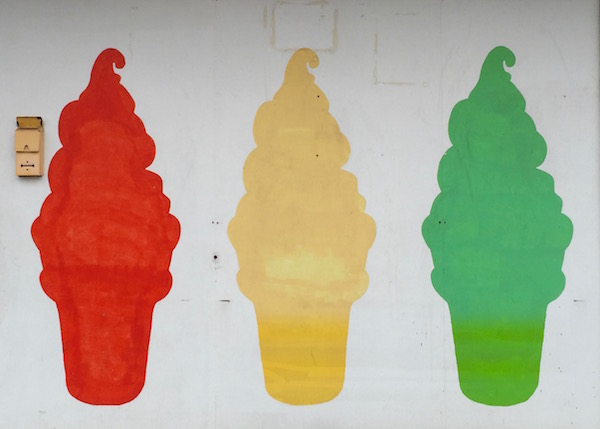
mural of soft-serve ice cream cones in colorful silhouette, former Tastee Queen, Ambridge, PA

Mural from the former Tastee Queen, Ambridge

This one sure had The Orbit‘s editorial board chortling smugly: we’ll run a story about former munchies supply shops on 4/20! Maybe our audience was just too doobied-up to bother reading the day’s news, but this fun look at a bunch of ex-ice cream parlors, Coney houses, and corner stores featured some great photographs of long-gone snackeries and sure struck our collective smoke-free funny bone.

Muffler Man: The Cadet Cowboy (May 22)

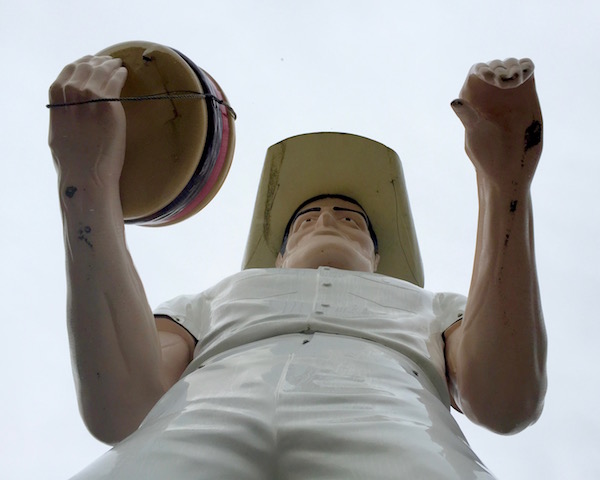
looking up at the giant fiberglass cowboy known as "Sam", Cadet Restaurant, Kittanning, PA

“Sam”, the giant resident cowboy/muffler man of the Cadet Restaurant, Kittanning

It can’t be easy standing thirty feet tall, but Big Sam is lucky enough to know a place with hamburgers just his size. This giant has been vigilantly watching over the fantastic Cadet Restaurant, just outside Kittanning, for more than 60 years. One taste of their mind-melting rhubarb pie and you’ll consider a long-term stay yourself.

Pittsburgh proper doesn’t have a single, legitimate “muffler man”, but there are a handful in the larger region. Not having made it down to see Mr. Tire in Uniontown yet, Big Sam is definitely the most impressive of the species we’ve come across.

An Orbit Obit: The Lost Art of Found Photographs (June 22)

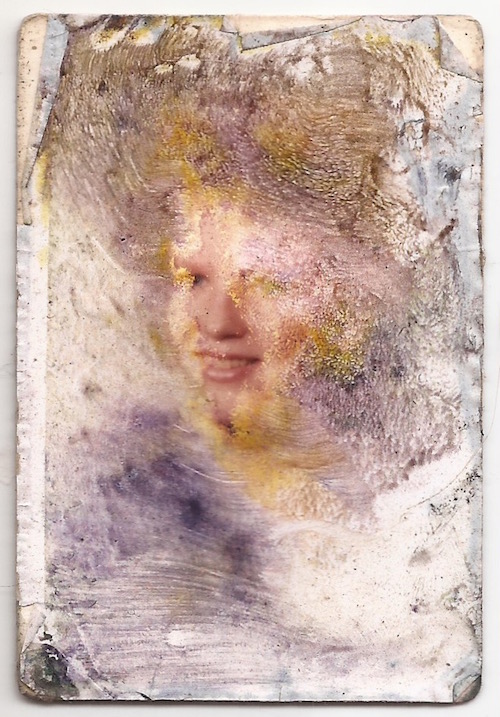
water-damaged wallet size photograph of an unknown girl

A blast-from-the-past found photo

The Orbit goes all blast-from-the-past in this trip down (someone else’s) (psychedelically-distorted) memory lane. There was a time you could find printed photographs jettisoned from car doors, torn up in tear-stained despair, and blown by the wind in almost all manner of public space. That time is gone (sigh), so we were thrilled to have Kirsten Ervin’s amazing park cleanup treasure to clear the cobwebs and blow the mind.

Alien Landscapes: Color Run Cleanup (July 20)

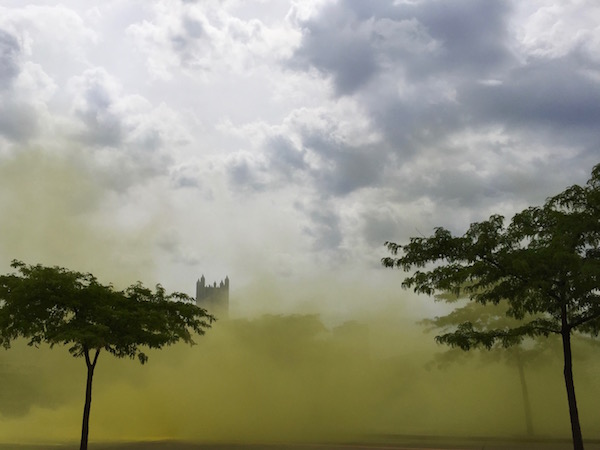
Peak of PPG Place seen through a cloud of yellow dust, Pittsburgh, PA

North Side Pittsburgh: alien landscape

Six months later and we still have no idea what “The Color Run” is all about. That said, if you happen to arrive on the scene of one of these events just after the whole thing winds up, you’ll wander into a weird alien landscape of iridescently-colored swirling winds and technicolor-bathed Star Trek set pieces. The dazed, color-battered participants slog through North Shore parking lots like refugees from some alternate world where Trey Anastasio is sultan and YPPAH is dictum.

Fairywood: The World Without Us (Nov. 20)

fire hydrant in field of tall weeds, Pittsburgh, PA

Former Broadhead Manor public housing project, Fairywood

Fairywood exists as a superlative city neighborhood in many categories: its position is the most geographically distant to both the south and west, it is (perhaps) the smallest by residential population, and, of course, it has maybe the quaintest of names this side of Narnia. All those features drew us to it, but it was the huge plot of land that was once the Broadhead Manor public housing project that really caught our attention.

Today, all the residential buildings of Broadhead Manor are gone, as are its former four thousand residents. But the ex-project’s infrastructure–roads, street lights, sidewalks, fire hydrants–remain in what resembles every post-apocalyptic sci-fi vehicle you’ve ever sat through. Nature is coming back fast and hard to Fairywood and it’s a fascinating thing to see in this limited window before the whole place gets paved-over once again.

Look Out Loretto, Part 2: He’s Dead, Wrapped in Plastic

detail of marble headstone with embedded ceramic photograph of young man protected by purple plastic cover, Loretto Cemetery, Pittsburgh, PA

unknown (detail)

He stands bolt upright, looking straight into the camera. The man is young–probably in his early twenties–dressed formally in jacket and tie with a corsage pinned to the lapel. Black hair is combed flat and parted hard to one side with a pair of troublesome locks springing loose across the forehead just above his eyebrow. The facial expression is curious: fixed formal, let’s-get-this-right sternness appears just on the edge of breaking to a suppressed, forbidden smile. This may have been his wedding day.

The small rectangular photograph is preserved in thick, transparent violet-hued Lucite and has one transverse crack across the man’s chest. A handful of small dings decorate the surface as if an assailant has taken to it with a crude weapon but gave up before doing any real damage. Otherwise, it is in fine shape.

The combined piece is about the size of a deck of playing cards and mounted to a beautiful marble headstone featuring Jesus on the cross, a pointed arch shape like a cathedral window, and a fading old-world cross-and-sun image we’re not familiar with. [Pious Orbit readers: help us out here–what is that thing?]

marble headstone with embedded ceramic photograph of young man protected by purple plastic cover, Loretto Cemetery, Pittsburgh, PA

unknown

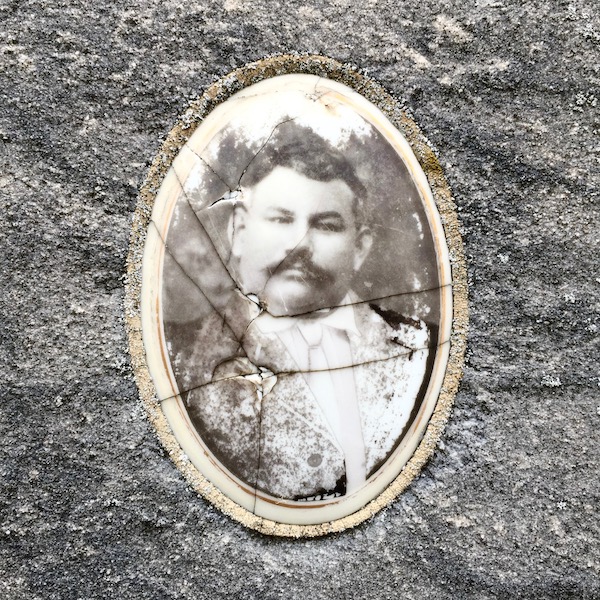
detail of marble headstone with embedded ceramic photograph of middle-aged man encased in plastic, Loretto Cemetery, Pittsburgh, PA

unknown

The irony of the photos mounted to headstones at Loretto Cemetery–most preserved on ceramic discs as we discussed in the previous post, but this and one other encased in thick acrylic–is that for so many, we don’t even know the names of the deceased.

What’s unique among the vast majority of photo markers here is the complete absence of identification remaining. At one time, the de rigueur details–name, birth and death dates, perhaps an epitaph or Lahke mu Zamlja inscription–almost surely filled the flat faces of the stones. But now on all but a few, they’ve been completely wiped-clean.

ceramic photograph with image almost completely disappeared on headstone of grave, Loretto Cemetery, Pittsburgh, PA

unknown

detail from marble headstone with embedded ceramic photograph of young man, Loretto Cemetery, Pittsburgh, PA

unknown

How this came to be, we can only speculate on–but that’s what this blogger does best! It seems likely the cause has to do with the underlying material (marble? fieldstone?) and what was literally falling from the sky around Pittsburgh through most of the twentieth century. With the Jones & Laughlin steel mill occupying both sides of the river just downhill from Loretto Cemetery until the 1980s–not to mention plenty more like it up and down each of the rivers–regular doses of acid rain had to do a number on all the headstones made from susceptible materials.

This is a noteworthy turn of the tables for an environment where typically all we know are names and dates, forever left to wonder who these people were.

marble headstone with embedded ceramic photograph now broken, Loretto Cemetery, Pittsburgh, PA

unknown grave with faded and broken photo

detail from marble headstone with embedded ceramic photograph of woman, broken, Loretto Cemetery, Pittsburgh, PA

faded and broken ceramic photo (detail), unknown

In Part 1 of this story we looked at a bunch of these headstone photos where the name of the deceased may or may not be known, but at least we got a pretty good (literal) picture of him or her. In almost all cases the ceramic has weathered with irregular cracking throughout the piece, but the image survives with enough clarity to get a sense of the person below the earth.

Not all these photos fared as well, though. First of all, at this point there are roughly an equal number of empty oval cutouts in headstones where the photos simply don’t exist any more. It’s impossible to know if these were stolen or vandalized or simply dropped out of their markers through a century of freeze-and-thaw cycles.

But even the ones that are still here aren’t necessarily all here. The sun had faded a number of the South-facing photos to mere ghosts represented in strange gray negatives. One of the pieces (above) has been broken with only the bottom half remaining. The detail is all gone, leaving just a vague outline of the woman’s face and basic description of the house dress she wore in the photo.

ceramic photograph with image almost completely disappeared on headstone of grave, Loretto Cemetery, Pittsburgh, PA

faded ceramic photo, unknown

detail from granite headstone with embedded ceramic photograph of man in military dress, Loretto Cemetery, Pittsburgh, PA

Joseph Andreucci

Consider the plight of Joseph Andreucci (above) whose loved-ones ponied-up for a beautiful deep red and black granite that never suffered the erosion present on so many of the other stones. All this only to have his photo in military dress attire worn- or scraped-through to the iridescent green of oxidizing copper underneath.

The poor fellow below is not only unknown in name, but unknowable as image. It appears that some miscreant took a hammer directly to the photograph, rendering it completely unrecognizable. All that remains is a hint of combed, dark hair above the damage and a suit with jaunty floral accent below.

ceramic photograph with image vandalized on headstone of grave, Loretto Cemetery, Pittsburgh, PA

unknown

If it’s possible to end both on a high note and six feet under, we’ll wrap this whole thing up with the big smile and voluminous curly locks of Anna Vensak. Her passing in 1996 is decidedly outside of the early century/between-the-wars window where we find all the other headstones in the series. But it seems notable for inclusion by virtue of its proximity here at Loretto Cemetery and the monument-maker’s continued use of the technique–certainly antiquated by the 1990s–deploying the oval-shaped photo, mortared directly to an inset cutout in the stone.

detail of granite headstone with embedded ceramic photograph of woman, Loretto Cemetery, Pittsburgh, PA

Anna Vensak

In an age where photographs are so immediate, disposable, and omni-present as they currently are, it’s fascinating to think of a time not that long ago when a single image may be all that remains of the legacy of a human being’s time here on earth. For that one last opportunity to reach beyond this mortal coil to end up cracked, faded out entirely, or lost in the weeds of Arlington Heights is humbling at best and reaches to full-on existential crisis at worst. Either way, The Orbit will still be here, looking out for you.

Look Out Loretto, Part 1: Lahka Mu Zamlja

detail of marble headstone with embedded ceramic photograph of a young girl and baby, Loretto Cemetery, Pittsburgh, PA

unknown

The first thing you’ll notice are the names: Kolesar, Zgurich, Csajka, Lippl, Knezevic. Any cemetery in Pittsburgh–certainly any older cemetery associated with a Catholic parish–will have its share of Eastern Europeans as long-term residents, but this one’s different.

Sure, there’s a couple token Irish and Italian names loitering among the stones–we spotted a Finnegan, a DiBlasio, and an Andreucci–but you’ll not any find any Smith, Jones, Williams, or Davis buried here. Kusmircak, Blosl, Czegan, Fabijanec, and Kuchta are the rule, not the exception.

marble headstone with large cross and embedded ceramic photograph of young man, Loretto Cemetery, Pittsburgh, PA

unknown

detail of marble headstone with embedded ceramic photograph of young man, Loretto Cemetery, Pittsburgh, PA

unknown

Loretto Cemetery rests at the very easternmost end of the big mount that rises above the South Side. Far below, but difficult to see from the steep angle, is an S-shaped crook in the Monongahela as it snakes between Hazelwood and the South Side. It’s an enviable location: quiet, vacant, and with terrific long views across the river to Oakland and Greenfield on the other side.

We hadn’t come here looking for the dead, but any new cemetery is worth a poke-see when you trip across it. When we did, those names–Cvetkovic, Vnencsak, Mlinac, Turkovich, Opacic–just popped right out like candy on the shelf. Something interesting would surely await.

detail of marble headstone with embedded ceramic photograph of young man, Loretto Cemetery, Pittsburgh, PA

Toni Poljak

detail from marble headstone with embedded ceramic photograph of baby in high chair, Loretto Cemetery, Pittsburgh, PA

unknown

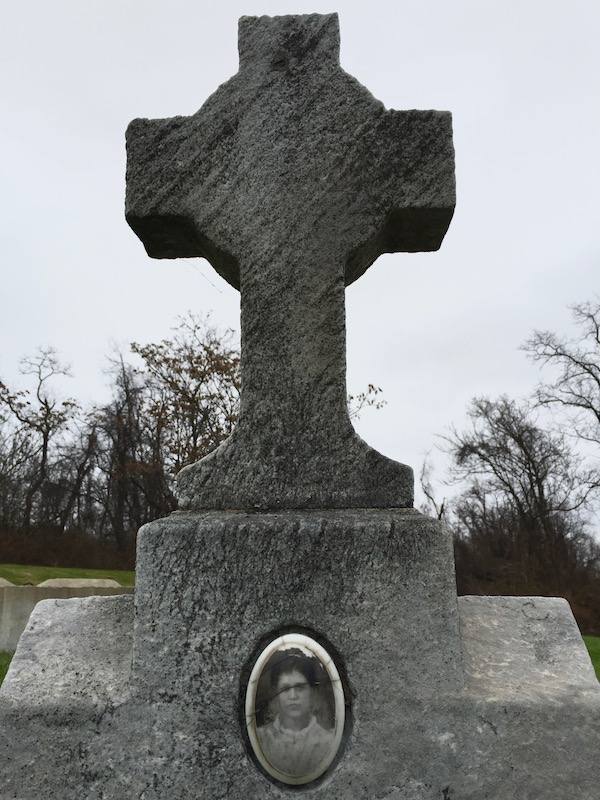
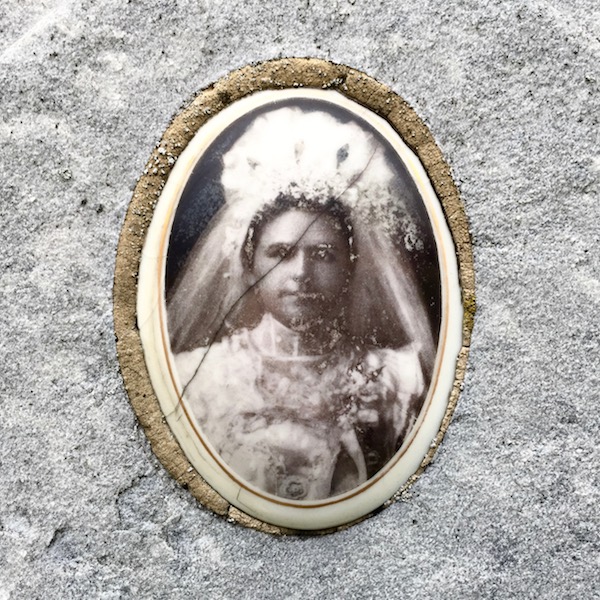
That something came in the form of a small black-and-white photograph, cast onto an oval-shaped ceramic disc and inset directly into one of the tower-like headstones. The posed portrait was of a middle-aged woman, “Mother” Antonija Komlenić, Victorian in both high-necked formal dress and dour, no-fun-allowed expression.

The colored mortar used to anchor the piece in stone is half chipped-away, eroded by a century of industrial mill exhaust and harsh Western Pennsylvania weather[1]. The image is all there, but it’s faded and scored by sharp cracks awkwardly bisecting Komlenić’s face and torso.

headstone for Antonija Komlenić, Loretto Cemetery, Pittsburgh, PA

Antonija Komlenić

detail of ceramic photograph on headstone for Antonija Komlenić, Loretto Cemetery, Pittsburgh, PA

Antonija Komlenić (detail)

Looking around a little closer now, another headstone is embedded with the same kind of oval-shaped photo just steps away. This one features a large man in suit and tie, his head is cocked and he wears a kind of bushy mustache that hasn’t been in vogue for a very long time. Both the deep black of his dress jacket and the shade of the photo’s backdrop have worn away significantly. There’s an angled crack through the ceramic just under the deceased’s chin suggesting a sinister garrote, but the man’s face is calm–bored, even–and remarkably untouched by the hands of time.

Suddenly aware and on the lookout for more, the grave photos are all over–on stones tall and thin, mounted below marble crosses and flat on granite. There may be a couple dozen in total, scattered across the sections closest to Loretto’s entry gate on Devlin Street. At least as many feature an empty cutaway in the stone where the inset image is no longer present; its former tenant stolen or broken, weathered or vandalized long ago.

detail of marble headstone with embedded ceramic photograph of older man, Loretto Cemetery, Pittsburgh, PA

unknown

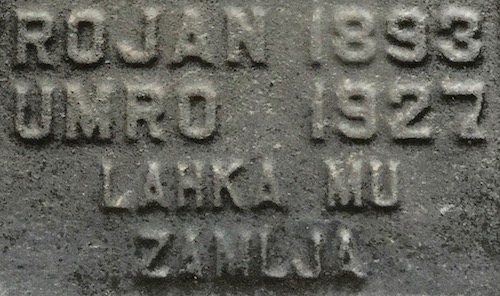
detail from headstone reading "Rojan 1893 - Umro 1927 - Lahka mu zamlja", Loretto Cemetery, Pittsburgh, PA

Lahka mu Zamlja

Lahka Mu Zamlja (alternately Laka Mu Zemlja), the Internet informs us, is either a Serbian or Croatian (perhaps both?) expression of condolence that translates to “may the black earth be easy on him.” Confirming this with Google translate was not very successful–it came up with preposterous gropes in the dark such as “easy land of mu” or “light mu country”[2]. But as this is likely an arcane idiom, it seems a pretty safe Balkanization of Rest in Peace.

We found this phrase on quite a number of Loretto’s graves, including some of the very ones with the inset portraits. While it’s impossible to know how “easy” the black earth was on each of these folks, the atmosphere above ground has taken varying degrees of torture out on their memorials. The photos here labeled unknown aren’t for lack of note-taking–there simply isn’t any text still readable on the headstones.

weathered marble headstone in the shape of a cross with embedded ceramic photograph of young woman, Loretto Cemetery, Pittsburgh, PA

unknown

detail of marble headstone with embedded ceramic photograph of young woman, Loretto Cemetery, Pittsburgh, PA

unknown

The Orbit has spent considerable time in a whole lot of bone yards over the years and we’ve written quite a bit on the subject already. It’s nothing special to see more recent headstones with all manner of high-tech integral photos, bas reliefs, and digital engravings of the deceased, his or her family, loved ones, hobbies, and The Pittsburgh Steelers. But these hundred-year-old…ish[3] photographs-turned-grave ornaments are new to this blogger. Even if I have encountered other late Victorian/pre-war ceramic photos on headstones before, it certainly wasn’t with the quantity or density found in Loretto.

They’re something special, for sure. For one, simply because of the number that are still here [and that’s even more remarkable by the obvious number that are not]. More than that, though, it may be the context or the unpredictable deterioration they’ve been through, but the people in these photos seem to look right through you with a dark, foreboding wisdom of time and fate.

Old photos are almost always interesting. In these, though, there’s somehow a deeper presence. “Wife” Maria Miklin died in 1941, but her sepia-toned portrait as a young woman–scored, chipped, and cracked across the face and torso–seems to defiantly say is that all you got? Just wait ’til you get here, Jack. Lahka Mu Zamlja, indeed.

detail of marble headstone with embedded ceramic photograph of woman, Loretto Cemetery, Pittsburgh, PA

Maria Miklin

detail from marble headstone with embedded ceramic photograph of a woman in bridal gown, Loretto Cemetery, Pittsburgh, PA

unknown

If existential blogging is what you’re looking for, The Orbit is qualified to satisfy. This whole bag conjured up all kinds of deep thoughts on memory and preservation and forever–luckily, we’ve also got a bunch more interesting photos to back that up. We’ll get to all that in Part 2.

GETTING THERE: Loretto Cemetery is in Arlington Heights and can be reached by going all the way to the east end of Arlington Ave. until it curls around to become Devlin Street. If you want a great hike, though, The Orbit recommends starting on the South Side at the base of the Oakley Way steps and making the journey all the way up and over on foot.


[1] In this case, literally a century; Antonija Komlenić died exactly one hundred years ago, in 1916.
[2] Note to Google: when you get tired of mucking about with driverless cars, see if you can translate “mu” from Croatian!
[3] An incredible number of these headstones have no remaining legible text, but the ones that do date from the 1910s to 1940s.

Step Beat: Oakley Dokeley, The Oakley Way Rehab

Detail of public steps with mosaic decoration of a woman's head, Pittsburgh, PA

It’s a cruel reality: when you’re working the city step beat, there ain’t a lot of news to report. No, most of the stories we run end up being about going to visit steps that inevitably won’t be around for long, occasional Indiana Jones-style heroics to hike them, or the historical curiosities of infrastructure ruins that were once so vital and now–all too often–go nowhere and serve no one.

So it is with no small amount of glee that The Orbit goes to press with a story on not only the complete rehabilitation of a set of core city steps, but the genuine newsy news that they’ve been wonderfully dressed-up in brand-new full-color mosaic tile.

public steps with mosaic decoration including houses, sky, a fox, a bird, sun, and stars, Pittsburgh, PA

Oakley Way Steps, top mosaic section

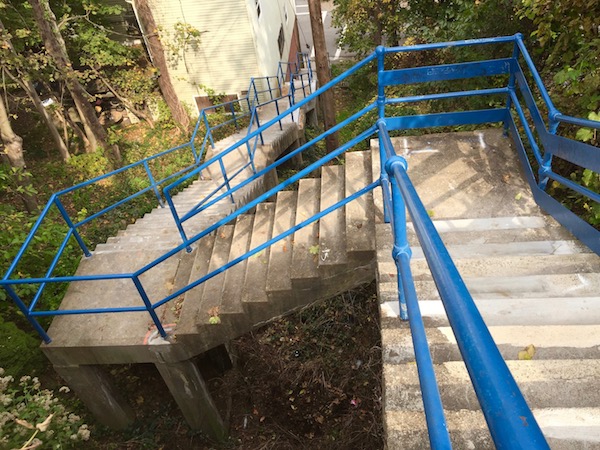
Oakley Way is one of the many climbs that create access points from the South Side Slopes above to the flats below (and vice-versa). The street is actually seven short (but mostly vertical) blocks long–part city steps/part steep road-with-steps sidewalk. The bottommost stretch (from Josephine to McCord) is the only section that’s received the mosaic treatment, but some of the upper sections have also been nicely rehabbed with patched concrete and fully repaired and repainted blue handrails.

Artist Laura Jean McLaughlin led a group of volunteers in the design, construction, and installation of the mosaic risers. That process was covered in a recent Post-Gazette piece that only scooped us because we got side-tracked by Fairywood and tryptophan and shelved the post for a month. Fooey!

looking up Oakley Street city steps, Pittsburgh, PA

Looking up: the Oakley Way steps

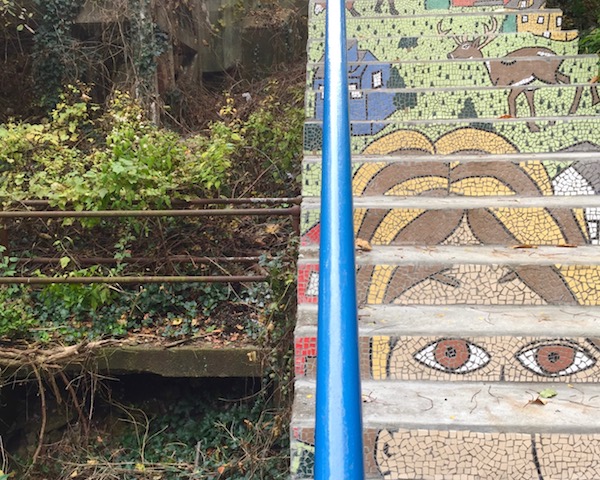
Spread across seventy-seven consecutive risers, the mosaic’s central figure is a tall red-booted woman in a checkered skirt who–based on the proportional size of the river, bridge, and factory building also in the piece–must stand about the height of the US Steel tower. Also decorating the lush scene are Slopes homes, grass, flowers, a fox, a bird, the sun and stars.

If you’ve seen any of McLaughlin’s other local projects you’ll recognize her loose, cartoonish, and earthy signatures. A lesser blog might invoke the term “whimsical,” or even (shudder) “funky”. The Orbit won’t stoop to that level, so we’ll just say they’re fun, very Slopes-centric, and a great compliment to the D.P.W.’s fix-up work.

Oakley Street city steps, Pittsburgh, PA

View down the bottommost section of Oakley Way (from McCord Street)

We’ve argued in these very virtual pages that Pittsburgh’s network of public steps is a city asset unlike any other–part transit route, part jungle gym, part historical oddity, and what should be a big draw for tourism*. It’s encouraging to see any set of steps getting much-needed maintenance, but it’s especially great to see them dressed to thrill with such a wonderful addition as McLaughlin’s mosaic.

There’s at least one other similar project out there and completed. Linda Wallen’s mosaic work at the base of the steps off Itin Street in Spring Garden isn’t nearly as ambitious as Oakley Way, but it’s still a great twinkling beacon in the great constellation of city step dark stars. May these two heroic projects guide step freaks to a new, golden dawn of altitude adjustment, wide perspectives, and throbbing calf muscles.

public steps with mosaic tile decoration of woman's head with houses and deer in the background, Pittsburgh, PA

Old and new: remnants of an earlier, defunct passage under the rehabbed Oakley Way steps


* Visitors who don’t want to lose their breath climbing dozens of flights of steps to dilapidated neighborhoods with spectacular views should consider lodging other than Chez Orbit’s fold-out sofa.