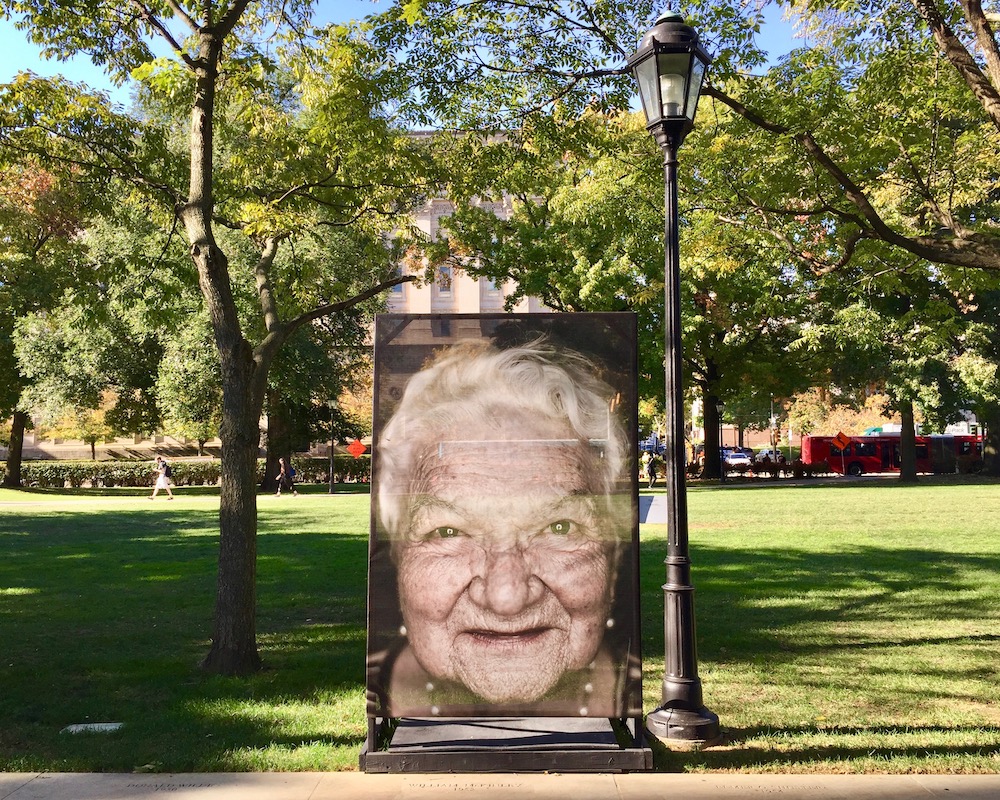
Portrait of Bronia Weiner (b. Romania, 1919). One of 60 large-scale photographs of Holocaust survivors in Luigi Toscano’s “Lest We Forget” project, Oakland
It is almost what you might call a Mona Lisa smile. The face on the canvas is warm, but contains a hundred years of ups and downs, tragedy, triumph, and vigor—at least, that’s what we’re seeing. The woman’s emerald green eyes stare straight back at you. Her white hair is cut short and styled—or maybe it just goes this way naturally—in a loose wave that would look fashionable on a woman a quarter her age.
But it is the upturned curl at the corner of the woman’s mouth that gives her away. This cheshire grin suggests no matter how much heartache she may have experienced, there is an indomitable human spirit alive, well, and ready to release an outrageous tall tale with joyous laughter.
Bronia Weiner is a Holocaust survivor and it is no accident that her portrait is on public display here in Pittsburgh, now.
Robert (Bob) Behr (b. Berlin, Germany, 1922)
A partnership between The Holocaust Center of Pittsburgh and the University of Pittsburgh has brought German-Italian photographer Luigi Toscano’s project Lest We Forget(or Gegen das Vergessen in the original German) to Oakland.
The installation features 60 large-scale color photo portraits mounted on semi-translucent screen. Designed for outside exhibition, the photos, stretched on big wooden frames, line the broad walkways between The Cathedral of Learning and Heinz Chapel. Additional portraits are indoors at The Carnegie Museum and Chatham University library.
Shulamit Bastacky (b. Vilnius, Lithuania, 1941)
Up close and in person, the photographs read as the kind of opaque, hiqh-quality prints that one might find on art gallery walls. From any distance, however—especially on a bright sunny day—the fine mesh of the media allows background elements to bleed through the images.
The lush green of the Cathedral lawn colors a sun-dappled face. Eyeballs pop out from university infrastructure. Cloud-like white hair disappears into arching tree limbs, autumn leaves, and blue sky.
We have no idea if this was the intended artistic effect or just a simple accident of the medium. Either way, the result is a beautiful and haunting way to portray these elder survivors and simultaneously address the mortality all of us inevitably wrestle with.
Toscano’s subjects range in age from their late 70s to 100 years old. Their time here—like all of ours—is limited. As these rich, detailed photographs dissolve into the wider landscape, it’s impossible not to think of the dust-to-dust return to the earth that will claim us one way or another.
“Lest We Forget” portraits near Heinz Chapel
As of today, it’s been exactly one year since a gunman entered the Tree of Life synagogue and committed an act of hate-filled violence that will forever affect every Pittsburgher.
With the Lest We Forget portraits, it is impossible not to see the sad irony that the 60 individuals pictured here survived Nazi concentration camps—not to mention everything else life throws at a person over eight or nine decades—and yet eleven of our neighbors were murdered at a Shabbat prayer service in Squirrel Hill.
“Lest We Forget” portraits on Cathedral of Learning lawn
Whatever you end doing today—be it attending the Tree of Life vigil or just parked on the couch with a bowl of popcorn—please keep all of these folks in your mind. Better yet, take a walk over to the lovely Cathedral lawn to see the installation for yourself. This remarkable collection of faces, each containing more life experiences than we could possibly know, will help you remember just what you have—and what we all lost exactly one year ago.
These pipes are smokin’! A deluxe calliope at DeBence Antique Music World in Frankin, PA.
Close your eyes and imagine what a robot looks like. Chances are, you might conjure up a blocky sci-fi stereotype–all shiny metal, wires, and blinking lights, rolling around assisting space forces in a stilted computer voice. Others may envision the kinds of already-in-the-real-world robots currently zipping through assembly plants and fulfillment centers with lightning precision, or the pure artificial intelligence powering high-tech interactive devices everywhere.
Whatever you’re thinking of, it doesn’t look like this.
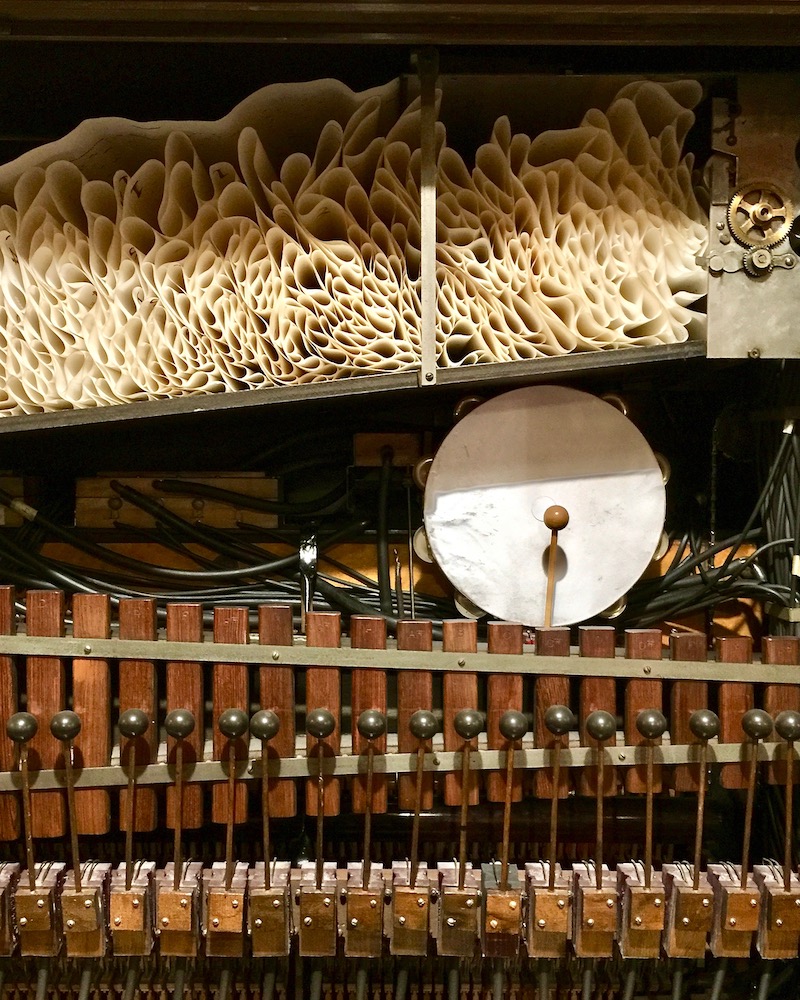
A large, handmade wooden cabinet–maybe six feet long, four feet high, and at least 18 inches deep–is placed directly in front of a full-size upright piano, rendering the instrument completely inaccessible to any human hands that might wish to tickle the ebony and/or ivory. The add-on unit takes input in the form of elaborate scrolls and translates the paper’s precisely-cut notches to the mechanical operation of eighty-some wooden fingers, one placed on each (almost) of the piano’s keys*.
interior of nickelodeon music machine including player scroll, xylophone, and percussion
DeBence Antique Music World has one of these piano-playing appliance-attachment-robots on display and ready to crank up for a mini concert on your next visit. DeBence’s collection also includes elaborate coin-operated mechanical music machines, calliopes, band organs, and more evolutions of disk-playing music boxes and phonographs than you ever knew existed.
The museum, located 80-some miles north of Pittsburgh in the über-quaint “Oil Country” town of Franklin, is a little out of our typical reach. But DeBence–and the region’s other many out-of-the-way attractions–are well worth the easy day trip from home.
Regina music disk and player
band organ horns
It’s probably safe to say musicians, record collectors, and those excited by domestic history and the development of America during its boom years will have an extra special interest in DeBence. The sheer volume of intricate, hand-cut music disks and elaborate, room-filling multi-instrument machinery is awe-inspiring and humbling to anyone who’s already dabbled in the media, fiddled with sound, or rocked the wheels of steel.
But you don’t have to be a music freak to appreciate DeBence. Just experiencing all the little gears clicking in metric time, wooden mallets tick-tocking stacked xylophone blocks, and the hair-blown-back blasts of dozens of brass pipes squonking in unison is a fascinating spectacle. The objects–polished metal disks, dark hardwood cabinetry, hand-painted decorative details–could stand alone in a design museum without ever hearing them play.
ornate disk player with dancing ballerinas display
painted detail on band organ frame
But, oh–you know where this is going–at DeBence, you do get to hear them perform. The collection is no mere array of historical objects entombed behind glass. No, they really don’t make them like they used to–and part of that means you can still hand crank the coil spring of a c. 1890s disk-playing music box and hear its metallic tines ting-ting-tingling out the popular music of the day. Try seeing if your 10-year-old Zune is still up to the task.
Our crew was fortunate enough to have an excellent volunteer guide who not only knew his stuff, but took us on the full tour even when we slipped in the door just before closing time. We don’t know how many of DeBence’s machines are still in working order, but an enormous number of them got cranked-up, switched-on, or otherwise sprung to life for the tour–each full of beans and with a song to sing.
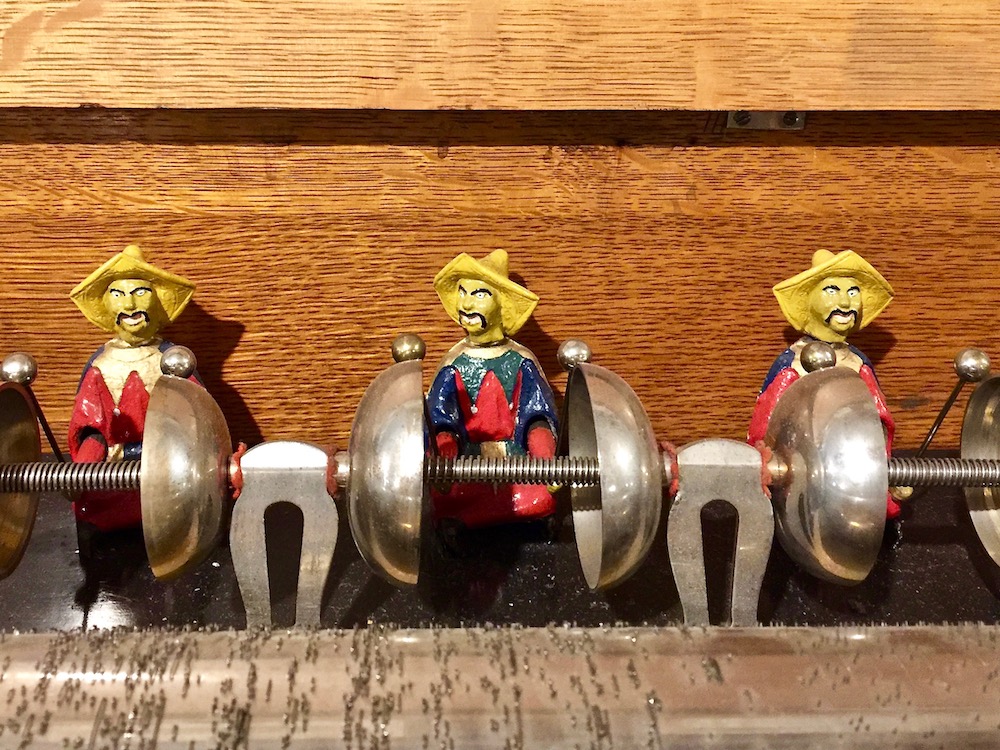
Dumb bells. Jesters ready to strike in a 19th century music box.
organ pipes
It takes a whole lot of mind-bending technology to enable the history of recorded music to be beamed instantly through one’s digital device and straight into their psyche. That’s great and all, but there is an intangible loss in this convenience.
Maybe it’s an extreme rationalization from a part-time blogger and full time record collecting junkie, but something otherworldly happens when the black lacquer spins up, a tone arm adjusts over and drops down into place. There’s an electric moment of heightened sensation when we get just the barest static sizzle of a stylus in dead wax before the Side A, track 1 music kicks in. Sure: by any objective measure, it’s low-tech, obsolete, and patently nostalgic. But there’s a magic here you just don’t get with a Spotify stream.
handmade wooden Victrola dancer attachment
ceramic Victrola dancer attachment
If it seems like that today, imagine what the technology must have felt like to the Victorians–pre-radio, pre-motion picture, probably before most had ever talked on a telephone. Those early adopters, who first plunked-down an entire paycheck for a Victrola and then had to send off to Sears for a couple two-and-a-half-minute songs to play on them, must have lost their minds at the variety of voices and sounds coming to them from far, far away.
To see these old machines whir to life, sound spilling out–yes: creaking, wheezing, groaning, and, as Randy Jackson would say, “a little pitchy, dog,” at times–is a beautiful, transformative, and, yes, magical experience. I don’t know whether there’s a chance that gets your keister to dust off the phonograph and back in the record store [we’re rooting for you!] but it should at least get you up to Franklin.
Regardless, we can cross our fingers, hope the bellows push air, the paper score feeds the tickling digits, and the beautiful sound of magical music fills the air around you.
Frog fantasy. Among DeBence’s novelties are many “real frogs stuffed with sawdust.”
DeBence Antique Music World, downtown Franklin, PA
All the stops: Vox Humana, Gemshorn, Dulcissimo, etc.
Getting there: DeBence Antique Music World is located at 1261 Liberty Street in Franklin. It’s about an hour-and-a-half drive from downtown Pittsburgh. DeBence has regular hours through the warmer months, but slows down over winter, so check the museum’s web site to make sure you’ll be able to get in.
* Almost. The unit doesn’t quite reach the full 88-key range of a standard piano keyboard. If you want to hit those super low notes, you’ll have to do that yourself.
All the colors, all the time: Randyland, Arch Street, North Side
Even on one’s second, third, or fourth visit, there is still a lot left to take in. Dangling fruit and topiary flora; psychedelic pattern-over-pattern detail and wooden animals spinning their wings in the breeze; funhouse mirrors elongate space and disembodied mannequin heads make sure someone’s looking out for you at all times.
With all these competing attention-grabbers, what will stay with you most are the colors. The phrase “every crayon in the box” comes to mind–but it’s not quite accurate here. You’ll find no dour grays or bland beiges, nor any ugly browns or heavy black. The colors are more like an exploded rainbow dipped in a dream: big, bright, and bold, fully saturated with no restrictions on theme or palette.
Arbor fruit and psychedelic stairs
By now, Randyland needs (almost) no introduction. The North Side house of many murals, its open-to-the-public garden art environment, decorated fences, adjoining buildings, and extending-to-the-street pole art have been featured in travel sites, airline magazines, city visitor guides, and a zillion Instragram selfies.
That level of publicity usually takes a location out of our purview … usually. But Randyland is also such a special place–so individual, fun, giving, personal, positive, and, yes, colorful that we also can’t not include it in The Orbit‘s broader map of Pittsburgh’s you need to see this cultural high points. Plus, we’ve been negligent on including a Mexican War Streets story and it’s high time we right that wrong.
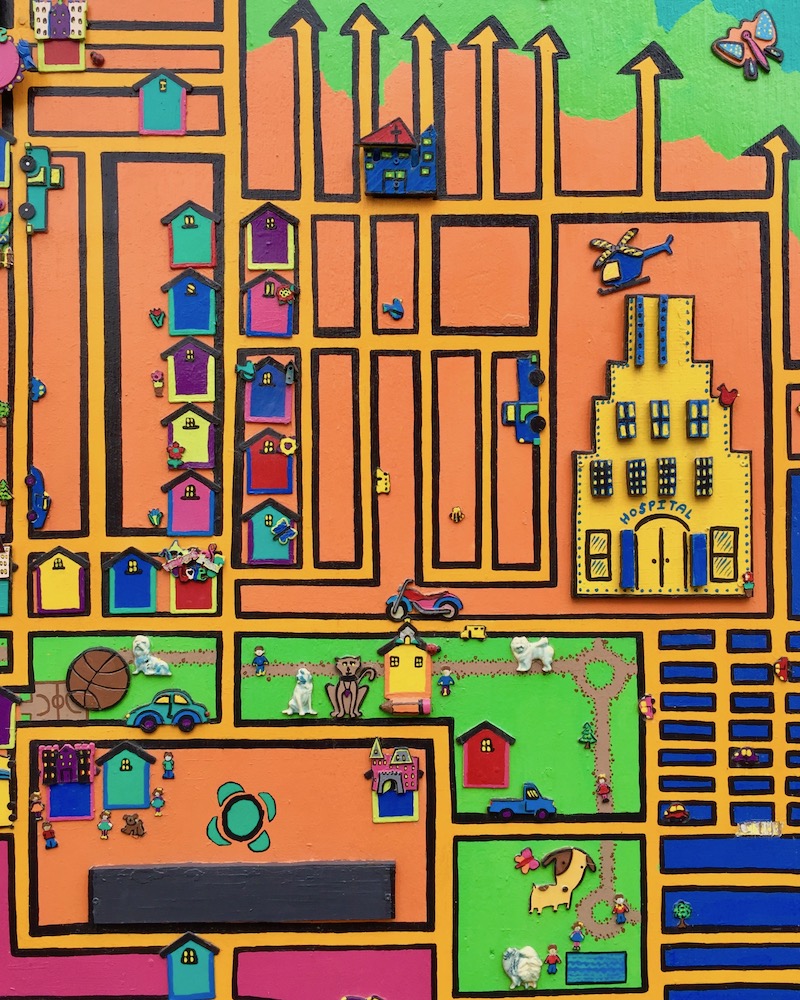
3-D Central North Side map (excerpt)
However it happened, Pittsburgh’s North Side ended up with an outsize share of the city’s big name cultural and tourist attractions. The Andy Warhol Museum, National Aviary, Children’s Museum, and Carnegie Science Center are all within (long) blocks of each other, as are the ball parks for both The Steelers and Pirates. The North Side also hosts slightly less name-brand amenities like The Mattress Factory, St. Anthony’s Reliquary, The Hazlett Theatre, Bicycle Heaven, and the newish (but terrificish) Alphabet City. It would be negligent to not mention that that the city’s only casino also ended up on the far “North Shore.” (Sigh.)
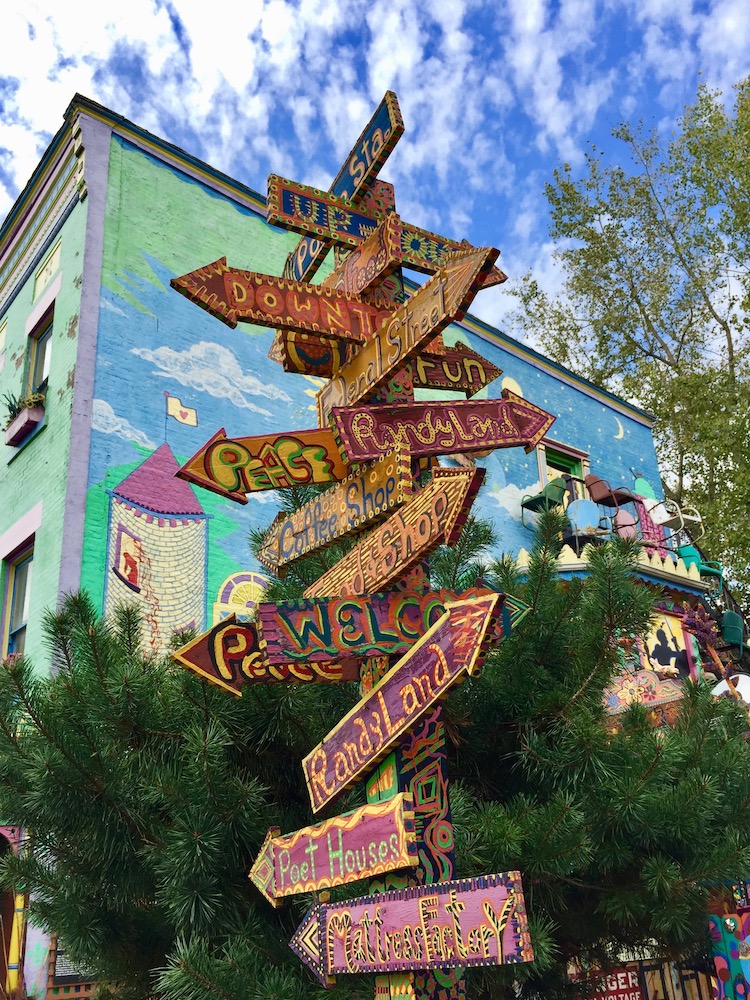
All roads lead to Randyland
So it is entirely fitting that Randyland is right here, on Arch Street, at the absolute geographical center of The North Side. This place–both visionary and as grass roots and down-to-earth as they come–seeks to be a welcome beacon to all of Pittsburgh’s disparate citizens, as well as all of her visitors. Those who come to our fair city and ignore the Land of Randy in favor of a roll on the slots or pre-game beers in a parking lot do so at their own peril. You’ve been warned.
Section of “The largest international welcome wall in America”
Whether The largest international welcome wall in America can really claim that honor is probably up for debate. Regardless, Randyland has the interior of the Arch Street fence fully decked out with hand-painted arrows that bienvenidos, murakaza neza, üdvözöljük, and haere-mai visitors from around the world into Randy’s little corner of it.
The property’s side shed is well-stocked with shelves full of blanks ready for visitors to decorate with new welcome messages. A sign by the project mentions the creator’s welcome message “must be your ancestry,” suggesting a United Nations-like visitor count has already made Randyland a stop on their American adventure.
Play, baby, play … and then dream big
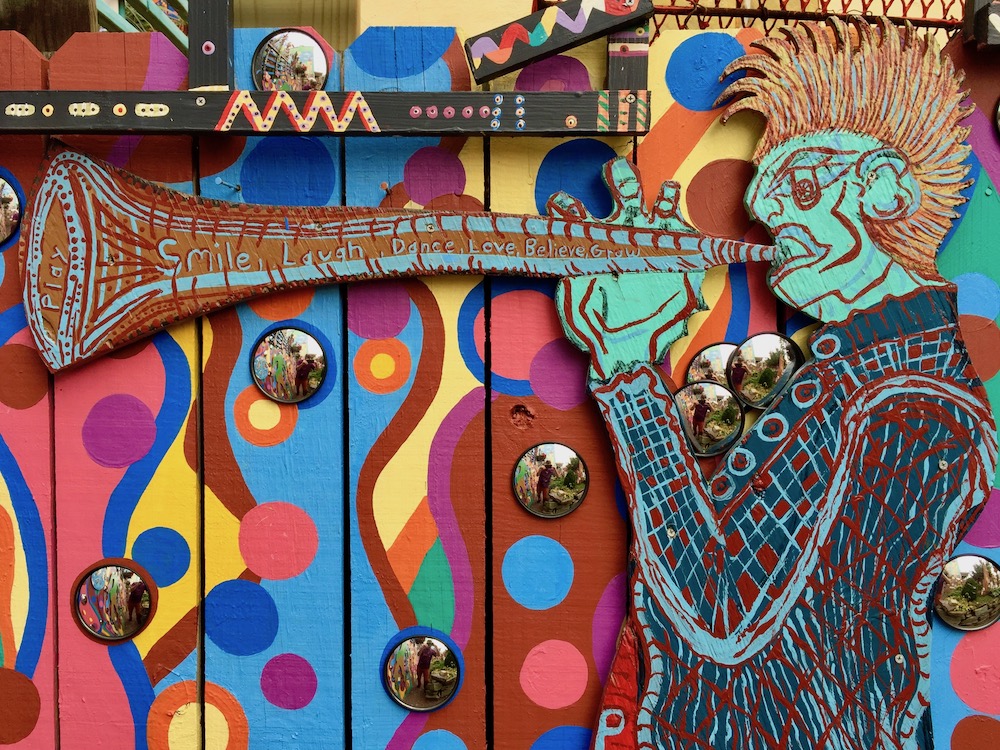
Around the east and south sides of Randyland, facing Arch and Jacksonia Streets, are big sections of wooden picket fence. It’s likely the first thing you’ll see after the Randyland pseudo-storefront right on the corner. Like everything else on the property, these are decorated in multiple layers of swirling psychedelic bubbles, little round fish eye mirrors, and spinning whirligigs on off-kilter poles.
Atop all this are a series of life-size, 2-D wooden cutouts of musicians and dancers. Wearing fabulously groovy patterns, caught mid-stride and in full blown-out jam mode, they seem to all be at a swinging good-time party no one would want to miss. Among all the eccentric oddball entries scattered about Randyland, these painted cutout figures are a really incredible collection of work that would stand on its own in any environment.
Play, smile, laugh, dance, love, believe, grow
Messages painted directly on the figures’ body parts, clothes, and instruments are a not-too-subtle thesis for Randyland writ large. Dream Big, reads the bell of a saxophone; Believe U Can, the inscription on a dancer’s necktie. A cubist trumpeter with a punk rock hairdo implores us to Play, Smile, Laugh, Dance, Love, Believe, Grow. The message on a frenetic dancer’s long flowing dress is simply Be Happy.
We IOVF Randyland! Love letters in the sand.
That kind of relentlessly earnest optimism and you-can-do-it positive encouragement is both a rare thing in this age of cynicism and easy to dismiss as hopelessly naive. It may also be a tough nut to swallow for those suffering from a blues that can make tossed-off statements like “be happy” feel like either an insufferably shallow temperature reading or an insurmountable obstacle to achieve in a real world outside the boundaries of Randyland.
HUG-BOT 2.0
But…that’s why Randy created the HUG-BOT 2.0–and a garden’s worth of oversize art flowers, goofy takes on where to hang one’s lawn furniture, and how to look at the sky in its mirror opposite. If you can manage to visit Randyland, take your time speculating on the preposterous occasion of a suit of armor with a necktie, giant flies on telephone poles, mannequin heads in sunglasses and lip gloss and still not feel any better about the state of the world, well, you may just need to turn around, look at that wall of arrows one more time, and know that this is a place where you’re always welcome to try again.
Here’s lookin’ at you! The future’s so bright, even the mannequins gotta wear shades.
Getting there: Randyland is located at 1501 Arch Street in the Mexican War Streets neighborhood of the North Side. It’s free and open to the public from 10 a.m. to dusk pretty much every day.
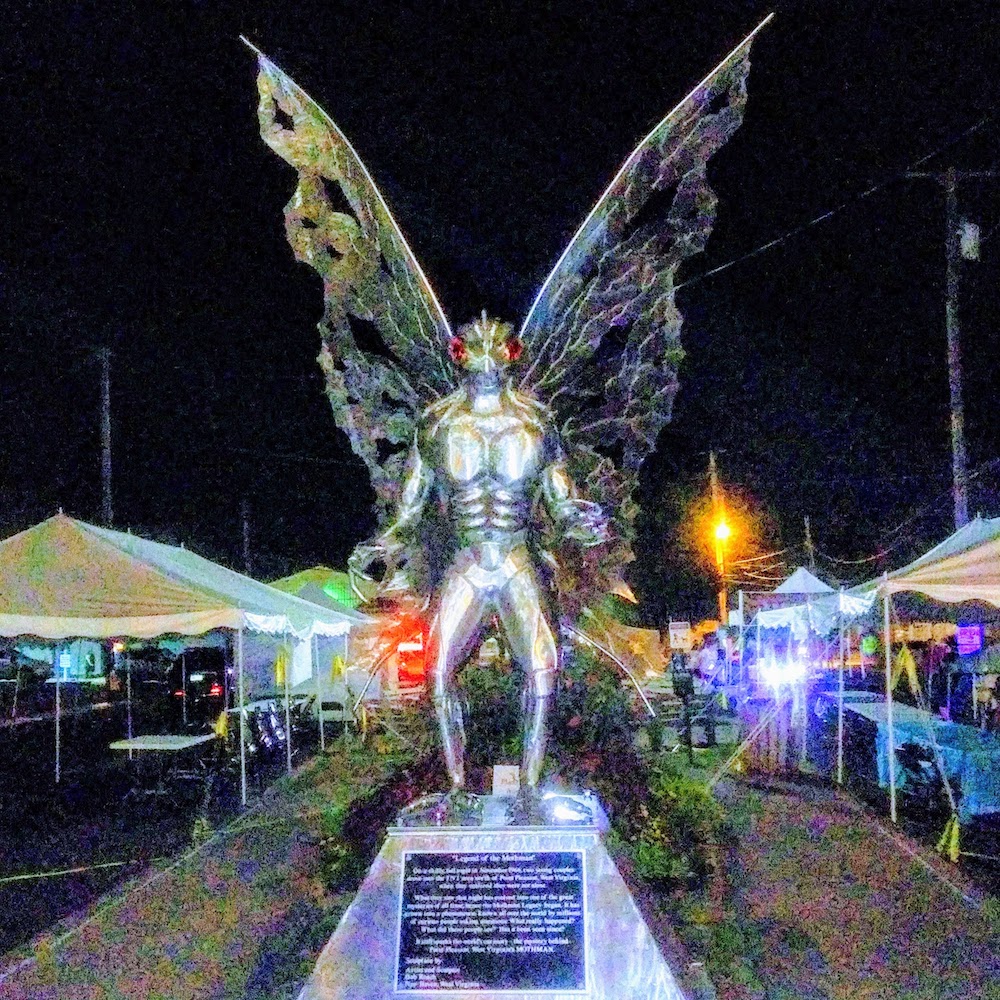
Man-Sized Bird…Creature…Something. Mothman statue in Point Pleasant, WV. [photo: Candice Northcut Tomon]
When Candice NorthcutTomon told us she was headed to Point Pleasant, West Virginia for the 18th annual Mothman Festival we were initially both jealous and irate she was scooping us on this important regional event–so we put her on the payroll. Here’s Candice’s first story for Pittsburgh Orbit.
Couples see Man-Sized Bird…Creature…Something
This was the front-page headline readers of the Point Pleasant Register woke up to on November 16, 1966. Over the course of the following year, many residents of the greater Ohio River Valley reported seeing this same ominous creature, said to have glowing red eyes, a sculpted, helmet-like cranium, and the tattered wings of a giant moth. Other news outlets picked up on the story and the legend grew.
A red-crested sandhill crane–possible dupe for the Mothman? [photo: Omaha World-Herald]
What was messing with the television reception and causing dogs to disappear in and around Point Pleasant? Was it a large sandhill crane–a bird described as the size of a grown man with red eyes–out of its migration pattern? Or possibly an otherworldly moth-like creature? During that year, over a hundred reports were logged and paranoia ran rampant in the small town.
old postcard showing a pre-collapse Silver Bridge
On December 15, 1967 the Silver Bridge that connected Point Pleasant, WV to Gallipolis, OH, collapsed during rush hour traffic. A single eye-bar in a suspension chain failed and the Silver Bridge fell into the Ohio River, killing 46 people that evening. Two of the bodies have never been found. After the tragedy, for the most part, the Mothman seemed to disappear from the area. But there have been reported sightings in other parts of the world. In 1975, John A. Keel wrote the book The Mothman Prophecies which later spawned the 2002 movie of the same name starring Laura Linney and Richard Gere.
book cover for John A. Keel’s “The Mothman Prophecies” (Saturday Review Press, 1975)
The book has led many to believe the Mothman was a prophet of doom, a figure arriving in Point Pleasant to warn residents that harm was to come their way. Fifty-two years later, the Mothman is a cottage industry, but now he is a harbinger of cotton candy and curly fries. Every September for the last 18 years, the town has hosted a festival to honor this spooky doom-predicting winged creature. Even though the event is light-hearted, after speaking to a few residents, I get the feeling they do not find humor in the myth.
One local antique shop owner described to us the feeling of isolation that was felt in the town after the bridge collapsed. You were stuck here until they finally borrowed a ferry boat from a neighboring town, he said. For better or worse, they seem to believe their fellow townspeople saw something that petrified them. However, if they did not take this marketing opportunity someone else surely would. Thus, the Mothman Museum and festival were born.
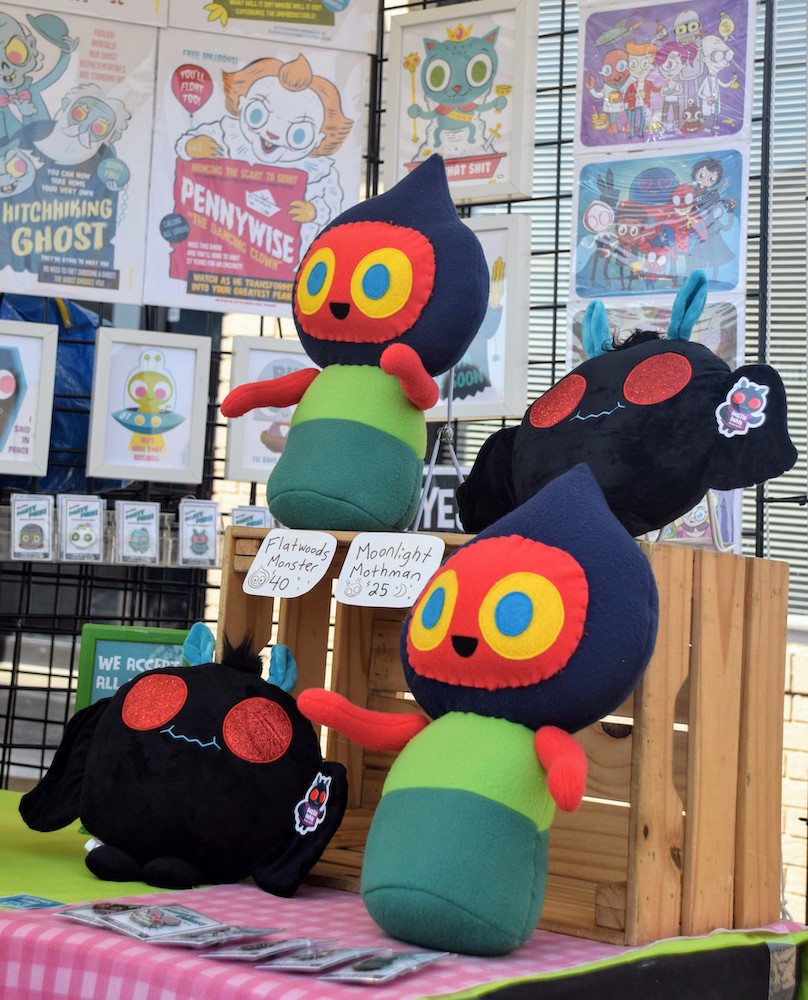
Keep on Squatchin’. Mothman souvenirs in Point Pleasant. [photo: Tim Tomon]
At the festival, you’ll find no shortage of t-shirts, mugs, stickers, badges, taxidermized gewgaws, and sweet treats. There are also local enthusiasts costumed as superheroes, Ghostbusters, and Star Wars characters. One can mingle with an elected court of royals, musicians, and expert speakers in all things paranormal. You want to know more about Sasquatch and eat your weight in ice cream? Come to Point Pleasant and enjoy the sites.
The Flatwoods Monster meets Moonlight Mothman [photo: Tim Tomon]
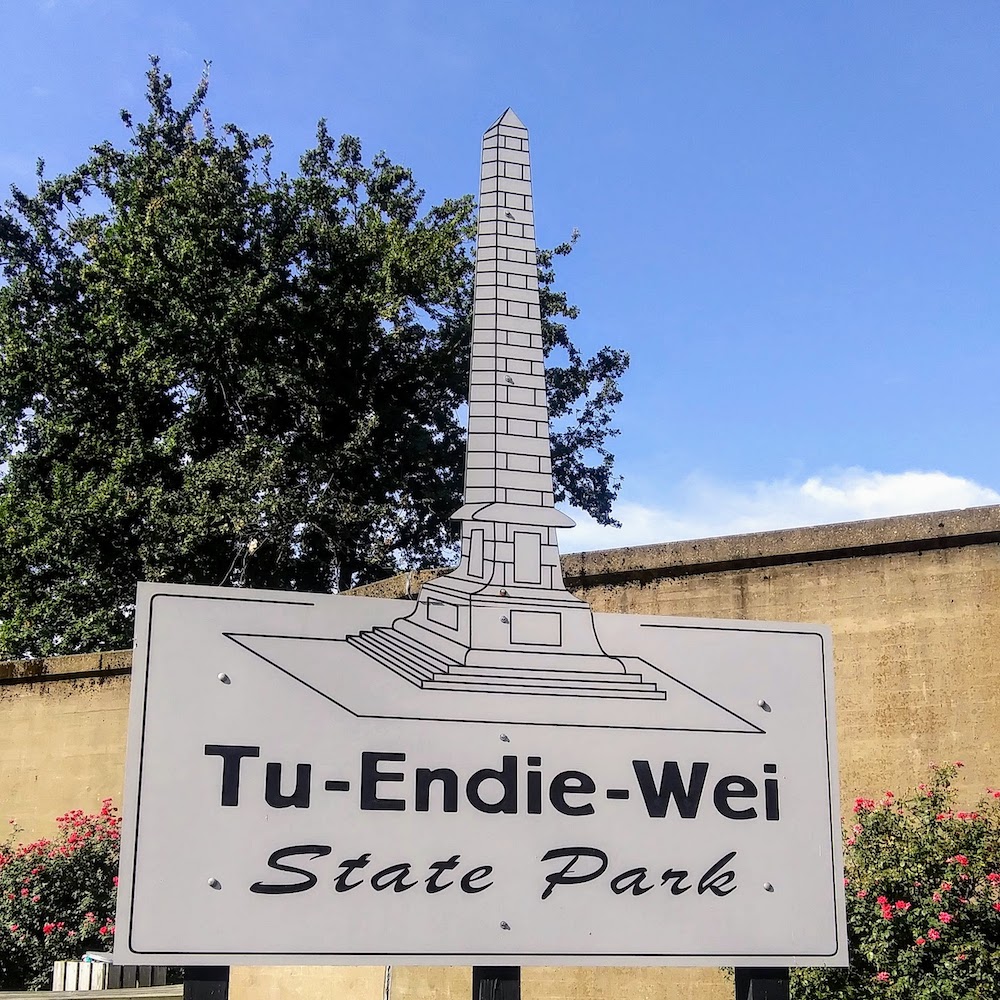
Point Pleasant is a throwback to a different time with its functioning Main Street, a Piggly Wiggly grocery store and an old timey hotel, the Lowe, which is said to be haunted (of course). If you’re staying, ask for room 314, “the Pi Room,” a local shop owner advised. The town also offers the opportunity to take in the history of the region at nearby Tu-Endie-Wei State Park. The location is integral to the tragic story of Shawnee Leader Chief Cornstalk, as the place where he was both defeated in battle in 1774, murdered in 1777, and interred for at least the third time in 1954.
You can say that again: Tu-Endie-Wei State Park, Point Pleasant [photo: Candice Northcut Tomon]
I have to say that while I wish I were a Mulder, I am a Scully. I did not see anything that would make me believe that the Mothman was real, however, I do believe that the people who reported seeing the creature believed. If possible, the residents of Point Pleasant have managed to find a silver lining in such a sad event. Overall, I thought it was a perfect weekend road trip and I recommend the festival to anyone who wants a touch of the weird in their street fair.
Getting there: Point Pleasant is around three-and-a-half hours drive from metro Pittsburgh, so yes–it’s debatable whether this counts as “in orbit.” The Mothman Festival is held annually on the third weekend of September.
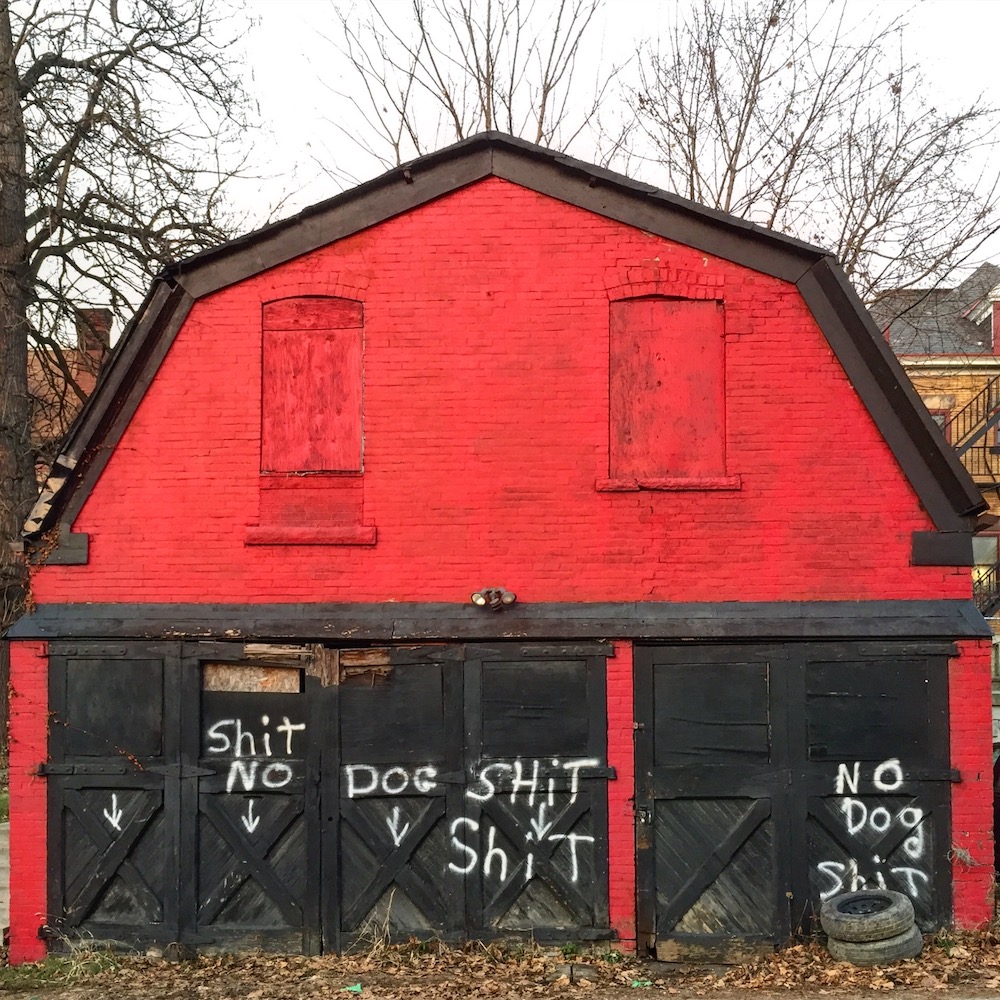
Dog Police beat poetry: “Shit No / Dog Shit Shit / No Dog Shit”, Friendship
The brick structure is two stories tall, three car-widths wide, with a barn-like gambrel roof. It’s been painted in a striking color scheme of deep black and vivid red. The legit c. 1900 carriage house faces the back alley of one of Friendship’s many stately manses. Across the building’s three sets of big wooden folding doors are a collection of crude, self-administered graffiti publicizing a wild set of existentialist free verse:
Shit no
Dog shit shit
No dog shit
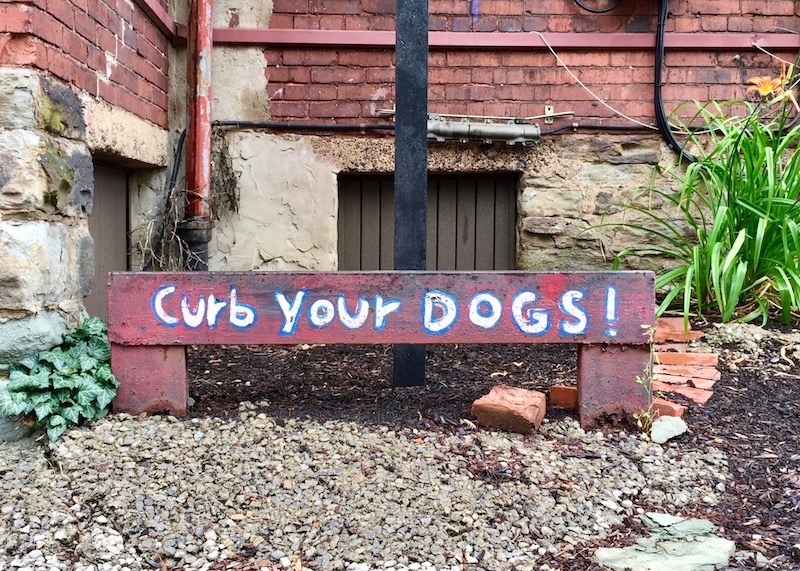
“Curb your dogs!” Shadyside
Title Six, Article III of the City of Pittsburgh’s Code of Ordinances deals with citizens’ conduct around the ownership of dogs, cats, and other animals. It’s a lengthy tract full of minutia on the expected behavior for pet owners on predictable topics like spaying and neutering; the conditions of kennels and catteries; food, water, and bedding; off-leash exercise areas.
Section § 634.09 deals with sanitation. The first paragraph is as close as we get to detailing the conduct around expectations for dog (and cat) poop:
(a) Excreta shall be removed from primary enclosures and exercise areas on a daily basis. Feces and soiled litter material shall be removed from all litter pans on a daily basis. Absorbent litter and/or any other litter material used to absorb urine shall be changed when it becomes thirty (30) percent saturated with urine.
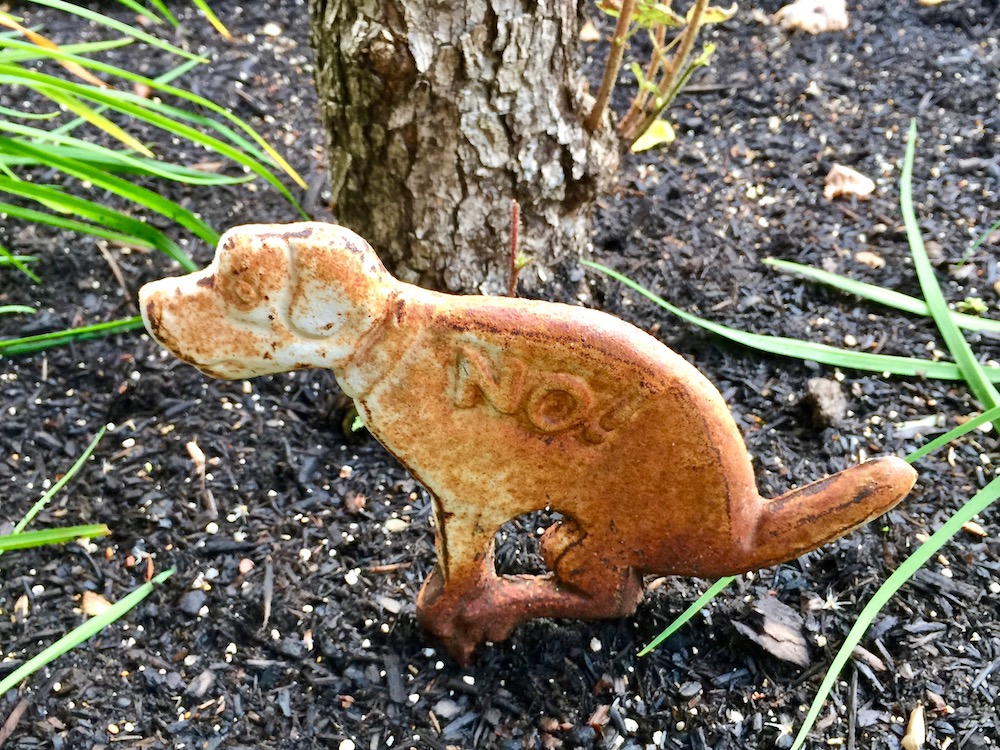
No! Lawrenceville
Setting aside any comments on whether cat owners (ahem) ever let Mr. Peeper’s litter box get “thirty (30) percent saturated with urine,” this finely-worded requirement has more gray area than one may think.
Is a dog owner, taking the pooch out on a stroll, required to clean up Fido’s dookie or not? Is every block a dog walks his or her “exercise area”? And if so, “daily basis” suggests a person has a fair window, perhaps as much as 24 hours–or at least until Midnight–to clean up anything left behind on the jaunt.
With no law in sight, the city’s homeowners have become vigilantes of a sort–the sidewalk and front yard their beat; dog crap the contraband flooding the beaches and temping youths into a an amoral lifestyle of loose peeing and rampant defecation. These are The Dog Police.
“Clean that shit up,” Bloomfield
The city’s web site offers a little more information on the For Pet Owners page. Without any specification of repercussions, the site defines the following (among other actions) as “nuisance violations”:
Allowing a dog to “go to the bathroom” on school grounds, a City park or other public or private property (It is not considered to be a nuisance violation if you immediately clean up after your dog – called “Poop-Scoop” laws in most communities).
Allowing your pet to scratch, dig or defecate on any lawn, tree, shrub, plant, building or any other public or private property other than that of the owner or person in charge or control of the animal.
“Please clean up after your dog,” Lawrenceville
One might assume that Rover’s, uh, solid waste would be the primary source on contention here–and that probably is the case–but one would be underestimating the full jurisdiction of The Dog Police.
Dog urine kills flowers reads one dinner plate-cum-public service announcement and it is true that canine pee–in enough quantity–can kill flowers, grass, and other foliage. This seems to be a result of the combination of alkaline pH of dog urine, its nitrogen load, and enough repeated applications–i.e. one or more dogs hitting the same spots over and over.
That said, it’s unlikely that a neighborhood dog passing umpteen tempting bushes, lamp posts, grassy lawns, and, yes, flower patches are really going to lay waste to mother nature. But … maybe.
If killing the petunias and turning the grass brown wasn’t enough, The Dog Police work another urban scourge–disposing of Scout’s crap in someone else’s private receptacles.
Take dog poop home with dog reads a hand-painted brick holding down the lid of a garbage can in Friendship; another sign, just a few blocks away, demands Do not throw dog wastes in garbage can or driveway.
“Take dog poop home with dog,” Friendship
One would think that having the “dog waste” disposed of in the rubbish bin would be vastly preferable to … just about any realistic alternative. But this gets into the “broken window” theory of dog policing–you let them put Ranger’s shit in your 50-gallon Rubbermaid today, they’ll be soiling that tall fescue, asking who’s a good boy? and laughing in your face about it tomorrow. Let’s nip this (quite literal) shit in the bud right now.
“Do not throw dogs wastes in garbage cans or driveway,” Friendship
It’s a cruel world out there. In the face of global environmental catastrophe, absolute political corruption–not to mention each of our own worries about health, economics, and mortality–a patch of stray dog poop or some browned grass can seem mighty petty.
BUT–with dogs, there’s always a big butt–if I was the homeowner repeatedly waking up to a minefield of crap on the sidewalk or my black-eyed Susans murdered in the night by a spray of Fido whiz, well, I’d be pissed-off too. One has to assume you don’t go to the lengths of painting your garage over just one or two stray incidents.
That’s when ordinary citizens feel the need to take the law into their hands. That’s when we call The Dog Police.
“Please be a good neighbor!!! Clean up after your dog.” Shadyside
“Clean up after your dog please! Yuck!” Bloomfield
There is only one way to drive from El Rito to Abiquiu, in north-central New Mexico. You’ll take state road 554, a curlicued up-and-down route through wild and beautiful country that may as well be another planet for us “back East” folks. Gorgeous mountain views and scrubby desert vegetation join rugged canyons, dry river beds, and dramatic wind-scarred buttes.
What you won’t see much are signs of human existence. Sure, we’re on a two-lane blacktop that someone had to build, but there aren’t any other vehicles on it, nor will you find gas stations, billboards, graffiti, guard rails, or reflectors. You may come across the occasional stand-alone house, a stretch of elevated power line, or barbed wire fencing marking a property boundary, but often, that’s about it.
Pilar
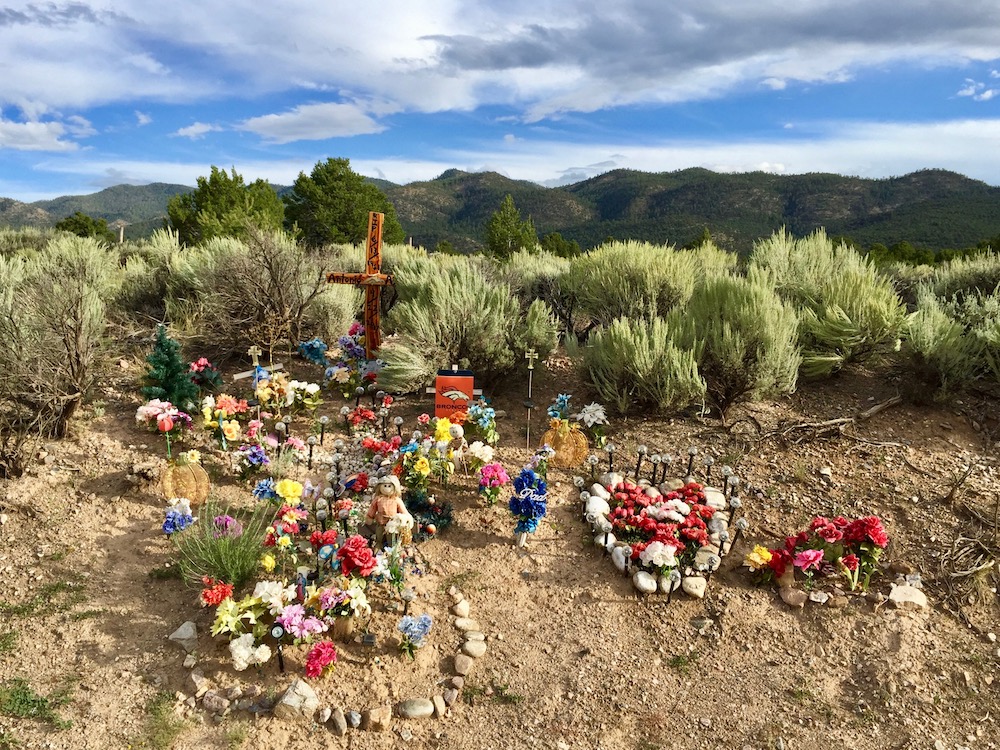
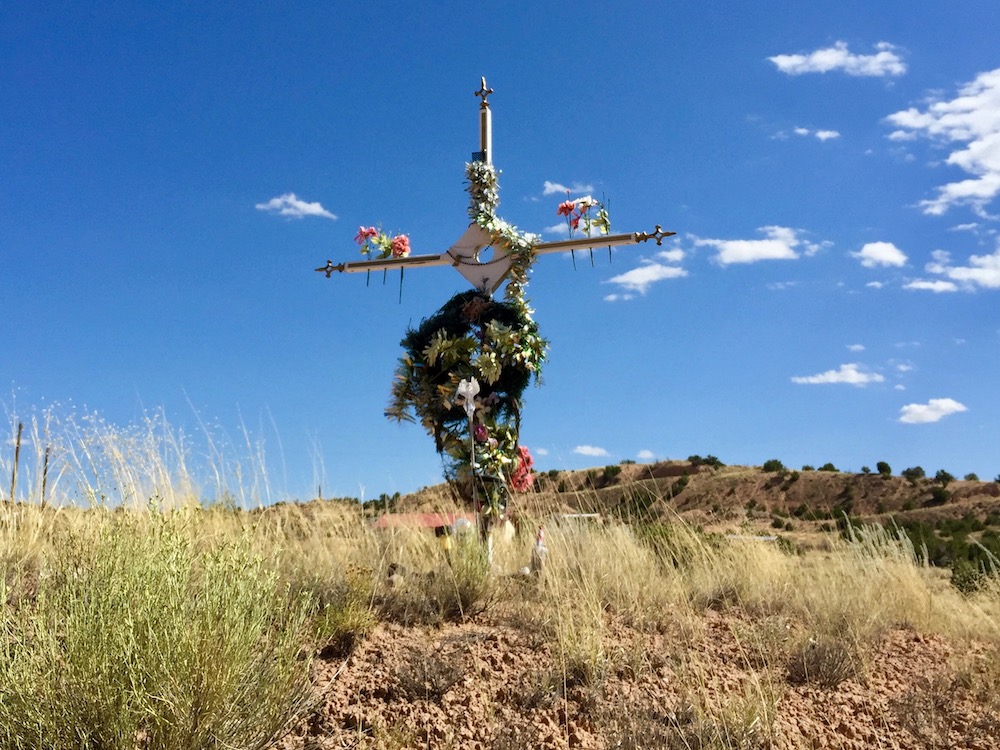
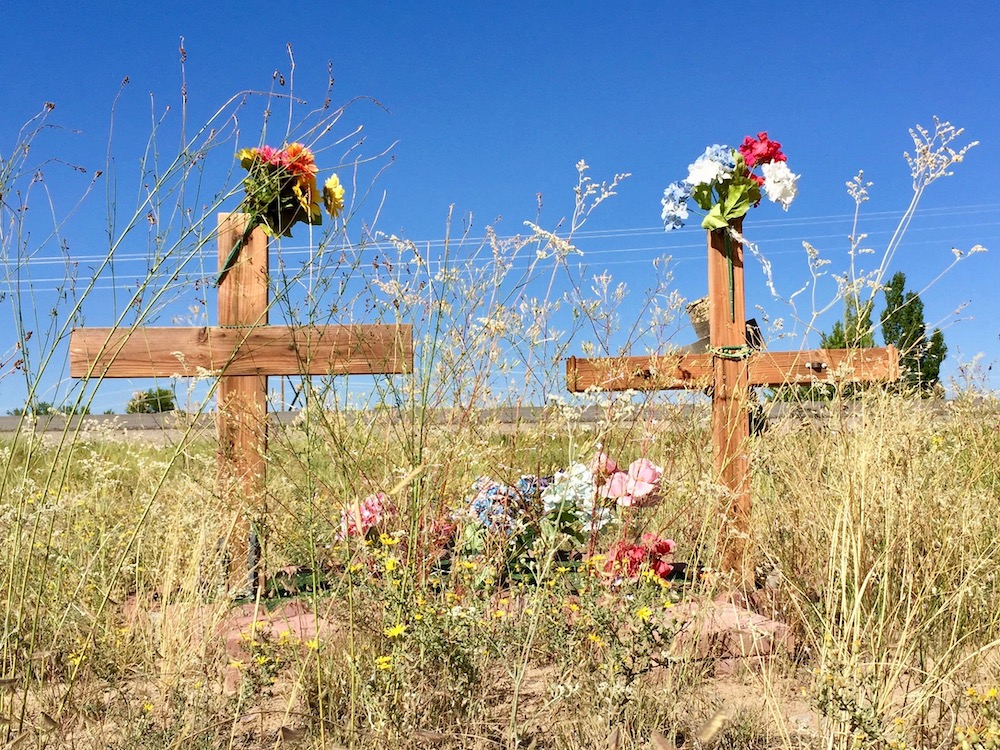
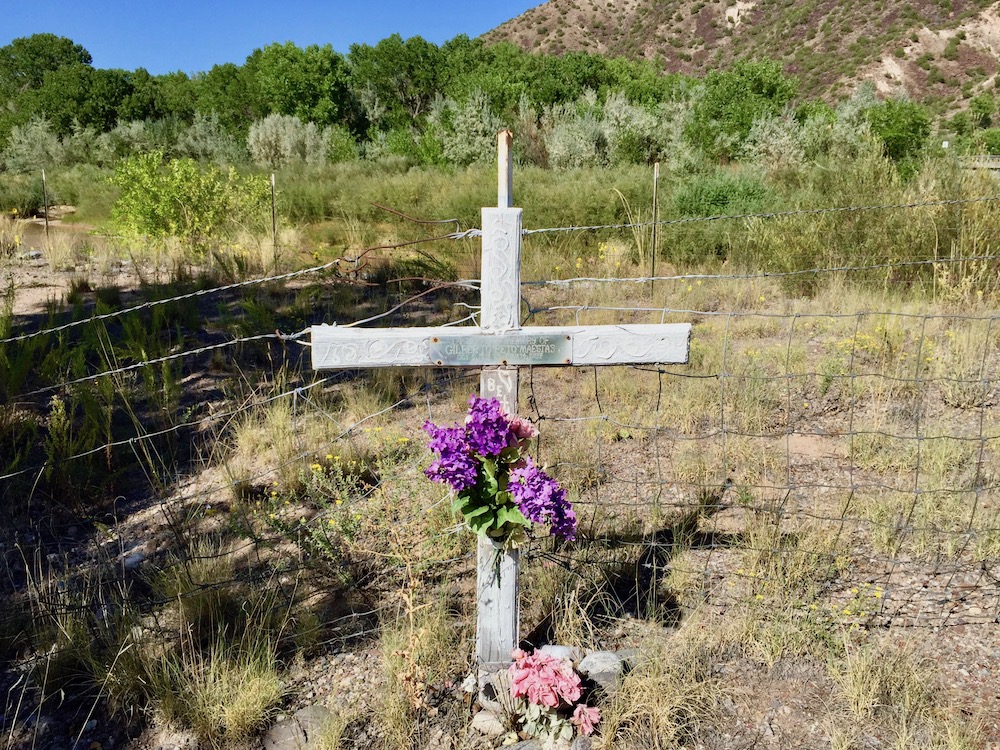
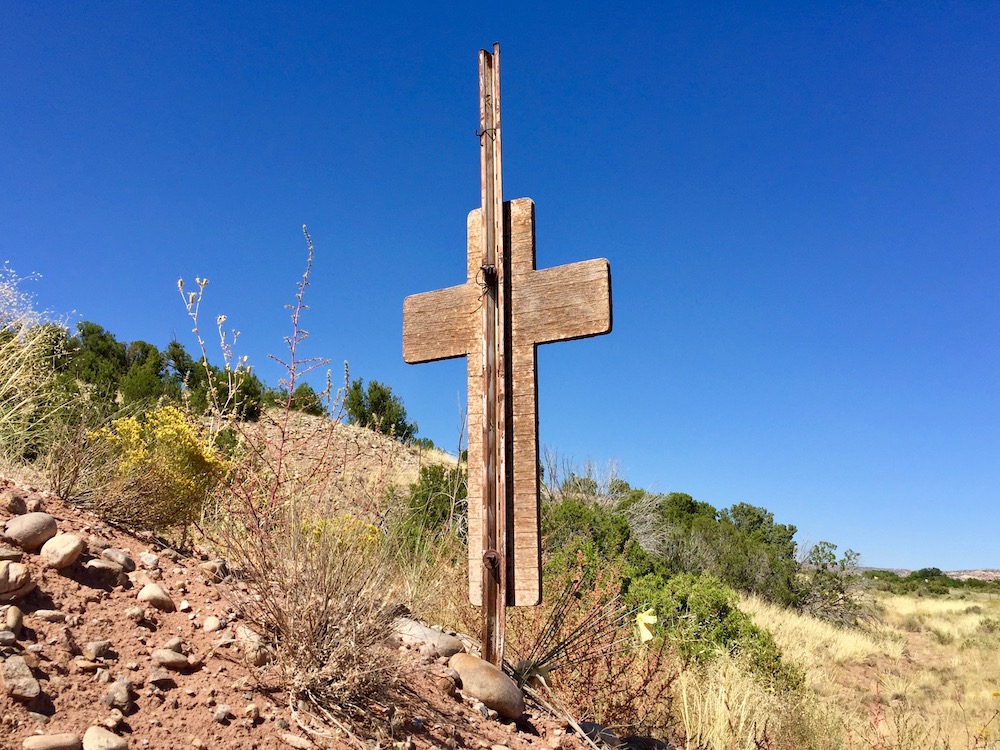
So the memorials that appear with alarming regularity–some dozen or more on the short, sixteen-mile stretch between El Rito and Abiquiu alone–pop from the roadside as the most tender of touches in a landscape otherwise devoid of human intervention. The shapes–vertical and angled in a world of broad horizontals, colored in eye-popping reds, pinks, yellows, and purples found nowhere else around these parts–make the tributes jump from the scraggly earth.
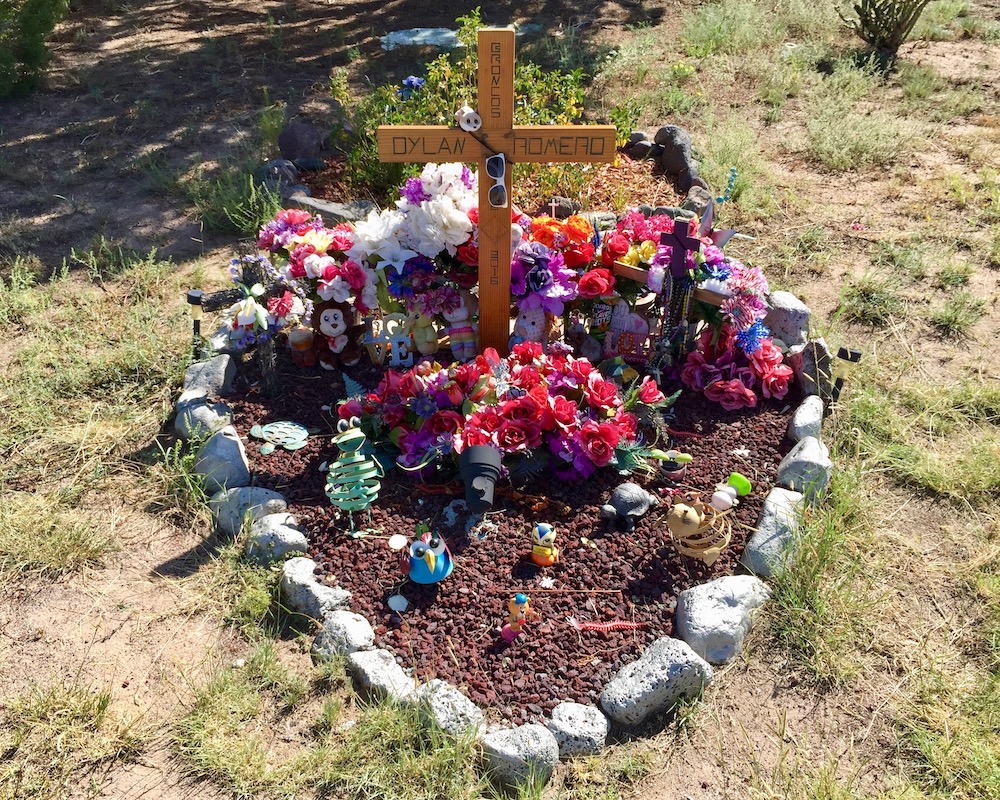
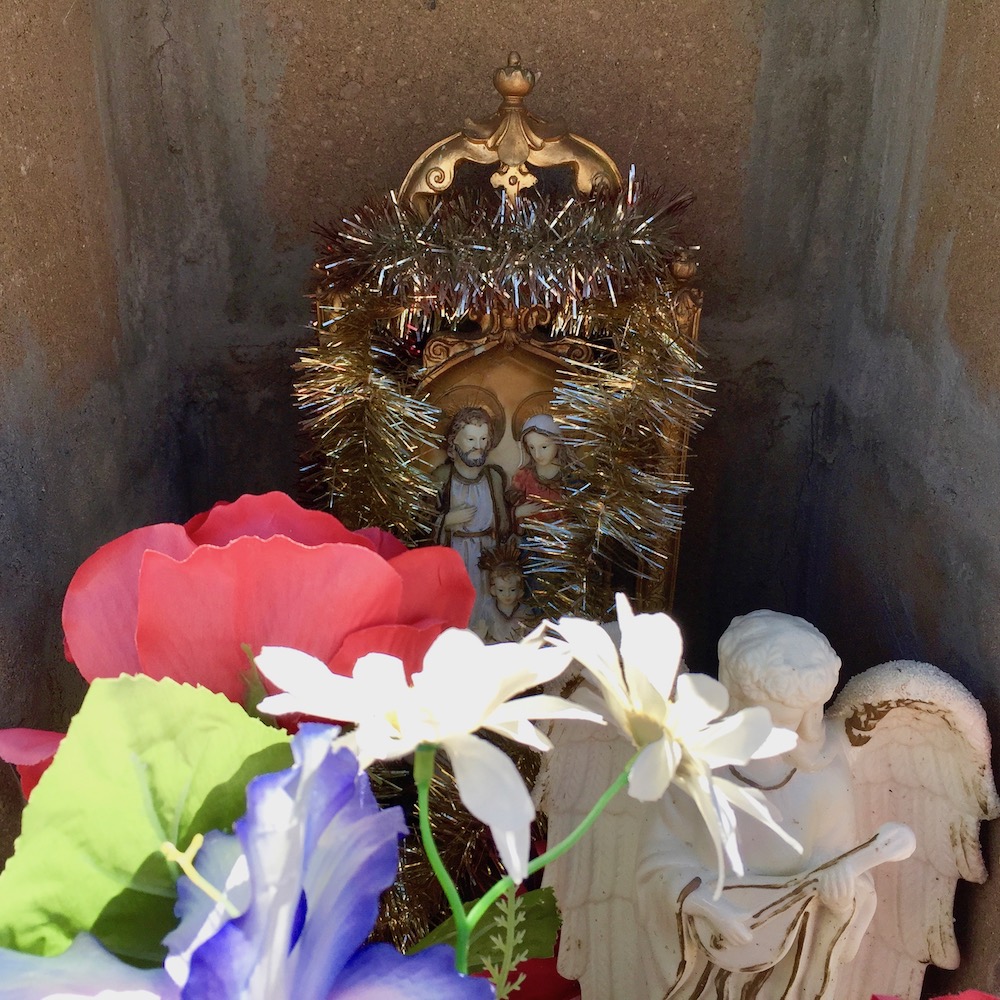
There are some simple wooden crosses, sure, but most of the memorials are unique elaborate displays that include custom ironwork, closely arranged stone formations, photographs, religious dioramas, plastic funeral flowers, garlands, flags, and treasured personal mementos of the departed.
Fabian Lawrence Mata, Ojo Caliente
A little Googling proves that, surprise surprise, Pittsburgh Orbit wasn’t the first to take notice of New Mexico’s descansos, the Spanish term for this tradition. New Mexico Explorer, a kind of NM Orbit, has a nice intro with some good photos and the Albuquerque Journal ran a 2015 piece about Pam and Doug Rietz’ documentation of descansos (but no links to see the pictures!) There are plenty of photo collections out there.
So why cover it here? Well, for one thing, we’ve written about roadside memorials back home a couple of times [see our Memorial Day 2018 and 2019 stories], so the subject is near and dear. Also, we’re jealous–with all due respect to the loving displays on Pennsylvania’s rural routes, New Mexico’s descansos are just so much more–excuse the apparent contradiction–full of life*. Each one is unique, glorious, heartbreaking, and beautiful in its own way.
And yes, it’s a good way to squeeze vacation for an Orbit story.
El Rito
Abiquiu
Jeffrey Zamora, Ohkay Owingeh
Abiquiu
El Rito
Phil Snow, La Madera
Dylan Romero, Abiquiu
Abiquiu
D.D.H., Rio Grande gorge
Jamie, Hernandez
Juan Mariscal, Abiquiu
Gilberto “Beto” Maestas, La Chauchia
Baldino Elizardo Gomez, Ojo Caliente
El Rito
El Rito
Hernandez
El Rito
Abiquiu
Kenneth and Elmer Martinez, El Rito
* In fairness, though, the relentlessly dry sunny weather in New Mexico naturally elongates the lifetime of a descanso. Pennsylvania’s omnipresent rain and thick humidity, plus winter snow and ice, make all SW PA memorials de facto temporary installations. For what it’s worth, it is also true that New Mexicans die in motor vehicle accidents at greater than twice the rate of Pennsylvanians. [Source: https://www.iihs.org/topics/fatality-statistics/detail/state-by-state]
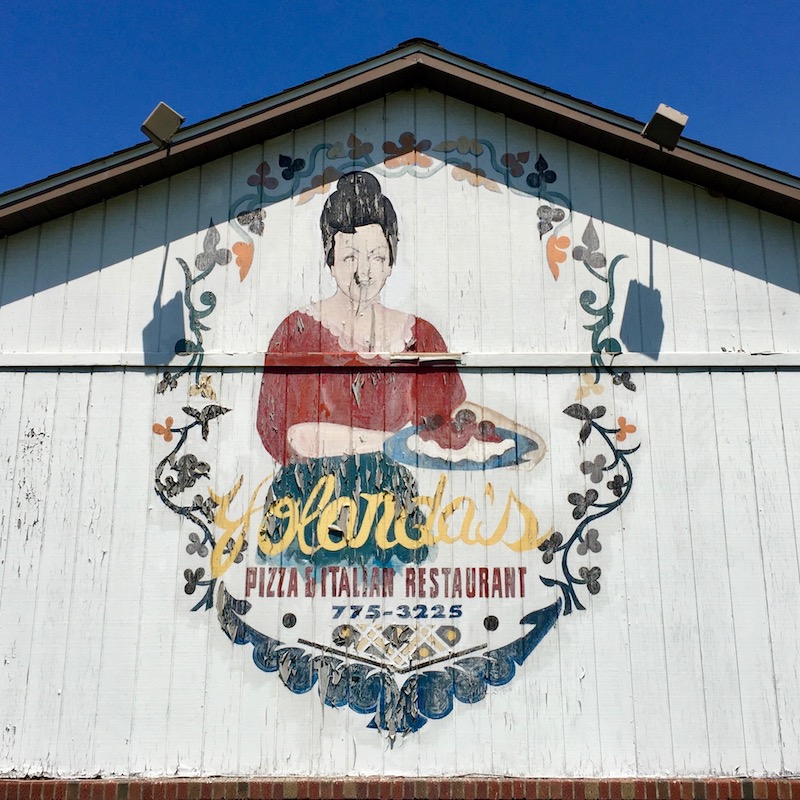
The lovely woman approaches, jet black hair up in a tight bun, dressed in a plain green skirt and poofy red peasant blouse. She’s headed straight toward you, carrying an enormous plate of indeterminate pasta, red sauce, and meatballs–let’s just assume the carafe of house chianti is already breathing on the table. Her facial expression is difficult to discern as the detail has been lost to weather and time, but we’re willing to bet that once it concealed a secret, Mona Lisa smile.
unknown, Johnstown
Yolanda’s Pizza & Italian Restaurant, the source of this faded gastronomical fantasia, appears to still be very much around. It’s even multiplied, with dining rooms both in Beaver Falls and here, the original location, in a converted gas station/car wash on Pennsylvania Ave. in Monaca.
But it sure didn’t look like (the possibly-fictional?[1]) Yolanda was still slinging sauce the summer day a year ago when this interloper was wandering around town, dying for an eggplant parmigiana or meatball volcano big enough to sate a blogger’s schnoz-poking appetite. Instead, there was just an empty lot, a Closed sign in the window, and that faded, peeling mural. Sigh.
Ed’s Pizza House, Jeannette
While Yolanda’s is still serving their traditional Italian chicken pot pie calzones and Polish pizzas–just not when we’re in town–the restaurant’s success doesn’t extend to other regional pizzerias and hoagie houses.
For all the true fans who loved The Orbit‘s 2017 Pi/Pie Day salute to “ghost pizza” and have been waiting a cruel a couple years for more photos of boarded-up Italian restaurants, blinds-drawn dining rooms, and pizza shops vacated long enough ago for their buildings to be condemned, well, here you go.
Happy Labor Day, y’all. Go out and eat a damn pizza before they’re all gone!
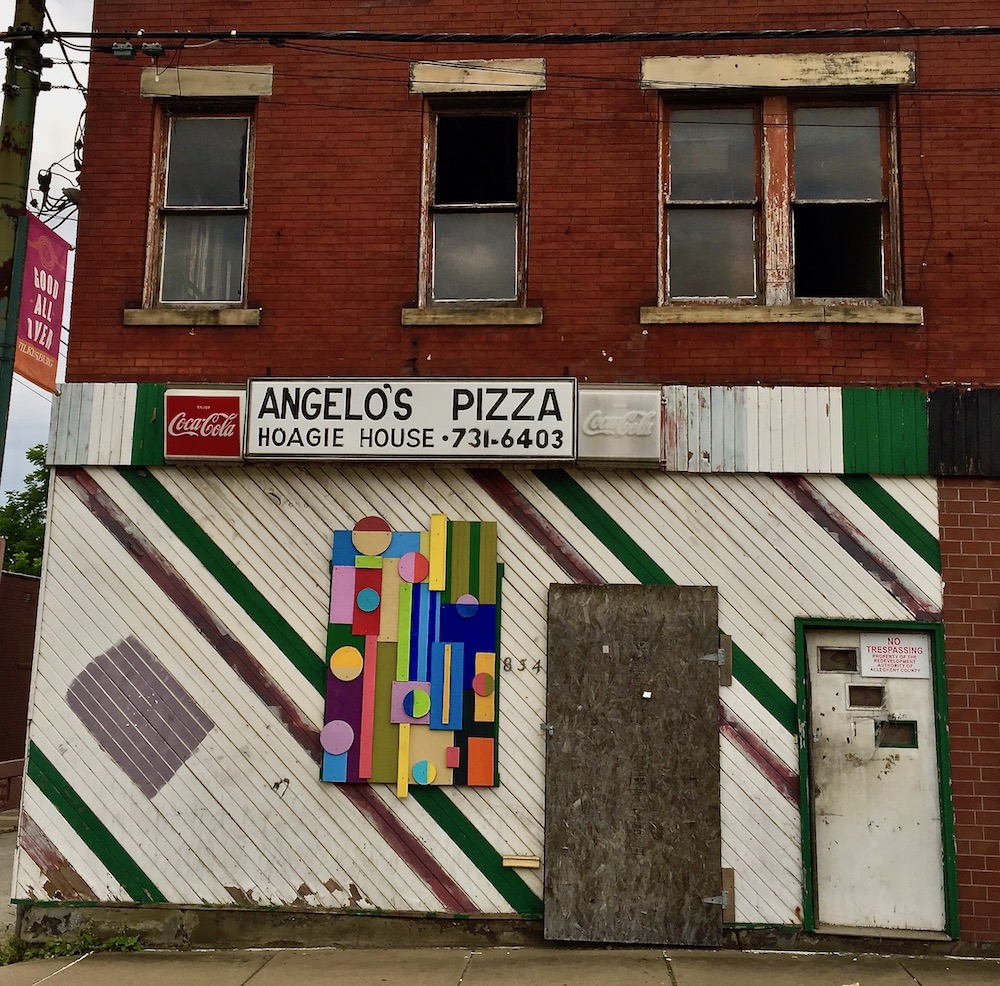
Angelo’s Pizza and Hoagie House, Wilkinsburg
DiBacco’s, Weirton, WV
Pizza Prima, Oakland
“Thanks for 42 great years,” Luigi’s, Bellevue
Rosario’s, New Kensington [Note: “X” = building condemned]
Italian Restaurant, Monaca
Ciocca’s “Italian Maid” (sic.) Pizza, Etna
[1] On yolandaspizza.com, the About section mentions the restaurant was founded by a carpenter named Pete Samovoski. There is no explanation as to who the namesake Yolanda is.
Penn Lincoln Memorial Park mausoleum and chapel, c. 1960, North Huntingdon
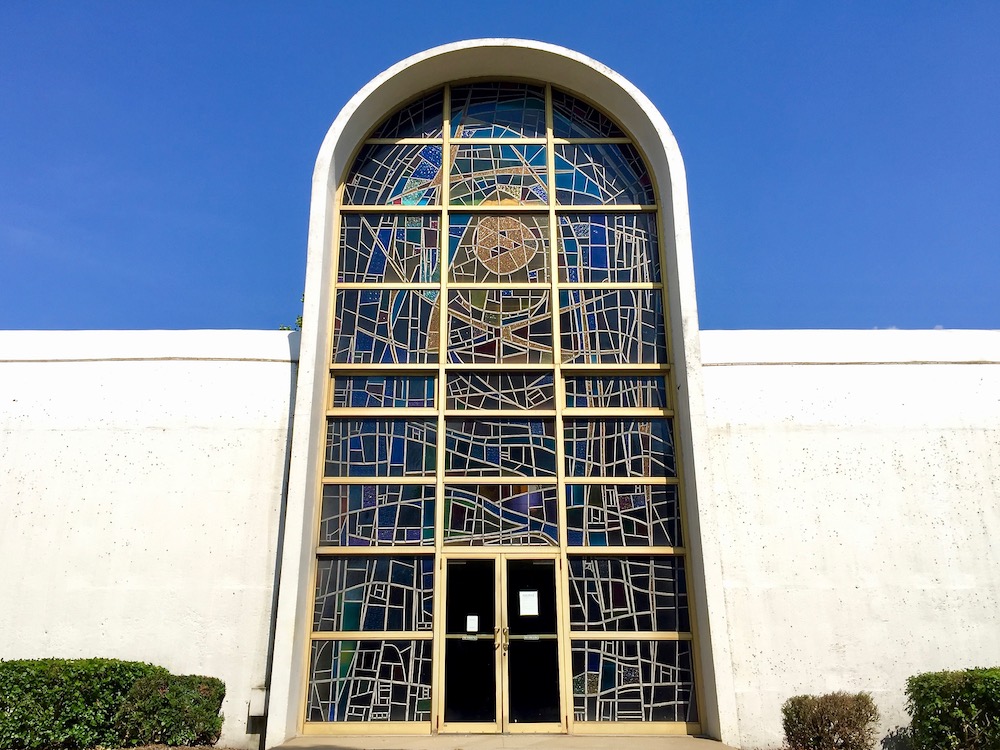
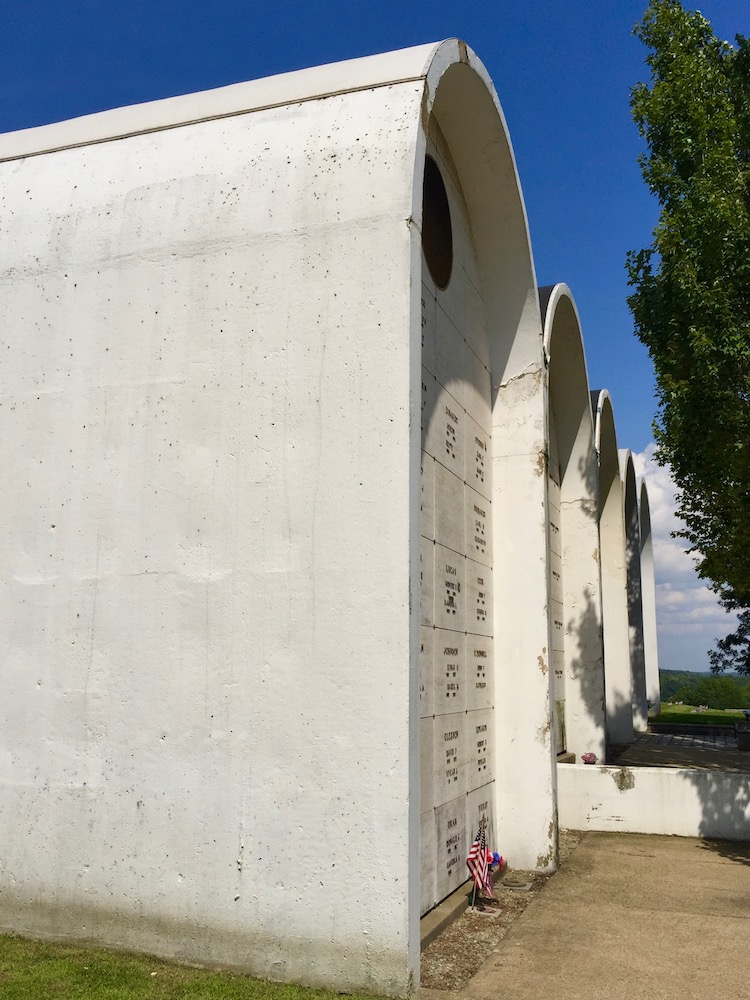
The unusual roofline, viewed from either end, has the perfect semi-circular curves of a series of long sheets of paper, each arched gracefully to bend back in on itself. Across the front of the big building are evenly-spaced openings echoing the same design motif. The big spaces are filled with aluminum grids and stained glass windows that echo the fantastically frenetic line drawings of Ben Shahn or Paul Klee.
In fact, one can imagine the entire structure modeled in miniature, constructed from simple cardboard tubes, thick paper stock, and colored gels. You can almost see the architects–’50s beatnik-meets-big city corporate; all cigarette ash, turtlenecks, and horn rims–as they talk the wary customer through an unexpected design laid out before them in the firm’s big conference room.
Penn Lincoln Memorial Park mausoleum and chapel, North Huntingdon, PA
Appearing like a retro-futuristic science-fiction film set, the mausoleum at Penn Lincoln Memorial Park rests atop a gentle hill along Route 30, east of Pittsburgh. Driving by–one would have no good reason to walk or bicycle this stretch of highway–it may not even be obvious what you’re seeing as the big building flashes past the driver’s side window at 45 MPH.
An industrial R&D laboratory? Experimental school? A sneaker preacher’s mega-church? Heck, maybe even some crackpot millionaire’s attempt at an ex-urban Utopia. Any of these seem as plausible as something this designy winding up as an “above-ground burial” for Westmoreland County’s deceased moderne.
CMS East, Inc., the parent company that owns Penn Lincoln Memorial Park, along with 22 other cemeteries across five states, declined to provide The Orbit with any information on the architect who designed the mausoleum or any history of the design. CMS didn’t even respond to our request so it’s safe to say we do not recommend having any organization this rude turn your lifeless body to cinder!
The Google Machine offers no more information, so we’re left to wonder and speculate.
chapel interior
And that’s a shame. Not the wonder part, mind you, but the complete lack of recognition this remarkable construction seems to have received.
I’m no architect, but the artful curved concrete pours, the clean lines with no square corners, and the New Age yoga camp-meets-abandoned spaceport atmosphere all feel like ample source material for some academic’s Ph.D. thesis or a full-color spread in a glossy design magazine. At the very minimum, it’s worth pulling over to take a walk around the next time you’re headed east, toward Jeannette or Greensburg.
Most of metro Pittsburgh was constructed in a relatively short period of the city’s great industrial build-up–say, from the 1880s to the start of the Great Depression. So the prevailing design heritage here is curlicued Victorian filigree and blunt worker efficiency. The modernism of mid-century American design–so prevalent in breezy West Coast cities and Sun Belt oases–largely passed us by.
There are some notable exceptions, of course–Gateway Center’s gleaming aluminum cladding, Pitt’s brutalist expansions throughout Oakland, and (sigh) the old Civic Arena’s extraterrestrial colony come to mind.
But the lovely mausoleum at Penn Lincoln Memorial Park reminds us that the brilliant ambition of post-war America extended everywhere–to gasoline stations and dry cleaners, ice cream stands and car dealerships. It even came out here, to the distant suburbs of Pittsburgh, as a place one might entomb their loved-ones forever … in the future.
“above-ground burial” plots
Getting there: Penn Lincoln Memorial Park is on Rt. 30, half way between East McKeesport and North Huntingdon. It’s about a half hour’s drive from downtown Pittsburgh.
St. Demetrius Ukrainian Catholic church and clergy house, Jeannette
Come around the back, narrow your focus a little bit, and forget about how you got here. It doesn’t take too much imagination to feel instantly transported several thousand miles away–to Khmelnytskyi or Zhytomyr, Bila Tserkva or Ivano-Frankivsk.
The scene is something right out of a movie depicting a romanticized rendering of old world Eastern European rural quaintness. In all directions, hills rise with gentle grace, their trees a deep green in this wet summer’s lush glow. A simple old stone church, built for maybe a hundred congregants, rests aside its semi-attached, wood frame clergy house.
Saint Demetrius Ukrainian Catholic Church has a peaked roof, tiled in red shingles, with a single small steeple at the front. Atop it sits a glorious–if weather-worn–steel onion dome, accented by the Byzantine cross of the orthodox church.
St. Demetrius
It’s not alone. Jeannette had around 8,000 people at the time of the 1910 census. Likely most of them were working in the small city’s many glass factories–there were at least seven and there is a claim that at one time 70-85% of the world’s glass was made in Jeannette.
Yeah–that seems like a stretch. Regardless, the little boom town clearly attracted a fair number of these folks from old Russia as two different orthodox Catholic churches were constructed that same year, mere blocks apart.
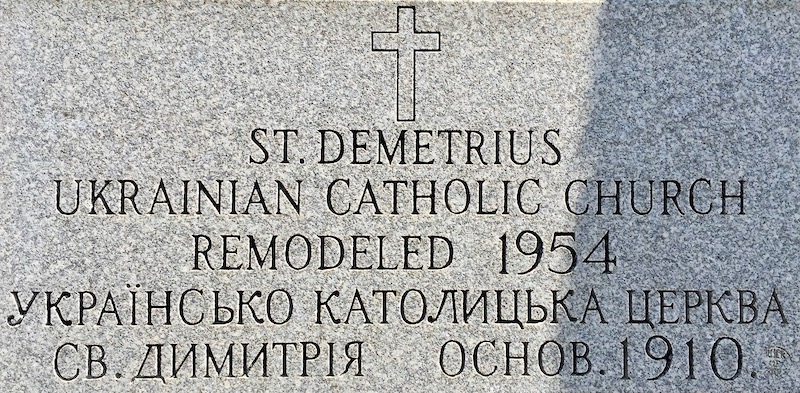
cornerstone, St. Demetrius, 1910 (remodeled 1954)
St. Demetrius Ukrainian Catholic Church, Jeannette, PA
St. Demetrius, the Ukrainian church on Gaskill Avenue, is the smaller and more humble of the pair. It sits in an otherwise unremarkable row of simple wood frame houses just a block off the railroad tracks that bisect Jeannette. It’s also a little ways downhill, so you won’t spot the gleaming silver-colored ornament until you’re relatively close.
Ss. Cyril and Methodius Russian Orthodox Catholic Church, Jeannette
The same can’t be said for Saints Cyril and Methodius. The eponymous brick Russian Orthodox church constructed in their honor decorates the absolute peak of Scott Avenue on the north side of town. The building’s distinct roofline, featuring multiple sky blue-with-gold crosses, is visible from just about anywhere in the city.
Ss. Cyril and Methodius
Cyril and Methodius is a magnificent brick-and-stone structure of multiple depths and angles, details and decorations, murals and stained glass. It also appears to be in spectacular shape, freshly repainted and bricks tightly pointed, on well-groomed grassy grounds. Catch it as we were lucky enough to on a cloudless day, gleaming in the hot sun, and looking resplendent against a perfect blue sky and even this atheist feels like he’s died and gone to heaven.
Cornerstone, Ss. Cyril and Methodius, 1910. We don’t know if the smiley face skull and cross-bones is original.
It’s doubtful anywhere in the area–heck, anywhere in America–has the per-capita domes of little Lyndora, up in Butler County. (Not to mention being able to righteously claim Poison’s Bret Michaels as a former congregant.)
That said, Jeannette’s lovely pair of orthodox churches, mere blocks from one another on the same side of town, are a feast for the onion ogler and an invitation to sidle out to Westmoreland County that should not be turned down. You can load up at DeLallo Foods, pace anxiously as two new microbreweries threaten opening any day now, and walk off that nervous energy with an old world constitutional. Recommended.
The truth is out there … but it’s probably not here at the Kecksburg UFO Festival
There is a lot of green in Kecksburg this time of year. The deep, multi-hued leaves on trees, rich with heavy spring and summer rainfall, are present in all directions as are rich earthy greens found in grasses and flower stems, corn fields and vegetable gardens bursting with life in summer’s thick humidity. The local volunteer fire department has painted their cinderblock-and-wood plank buildings in muted emerald shades and you’ll find dark, military-issue greens in the small set of U.S. Army Jeeps and troop-transports brought in for the weekend.
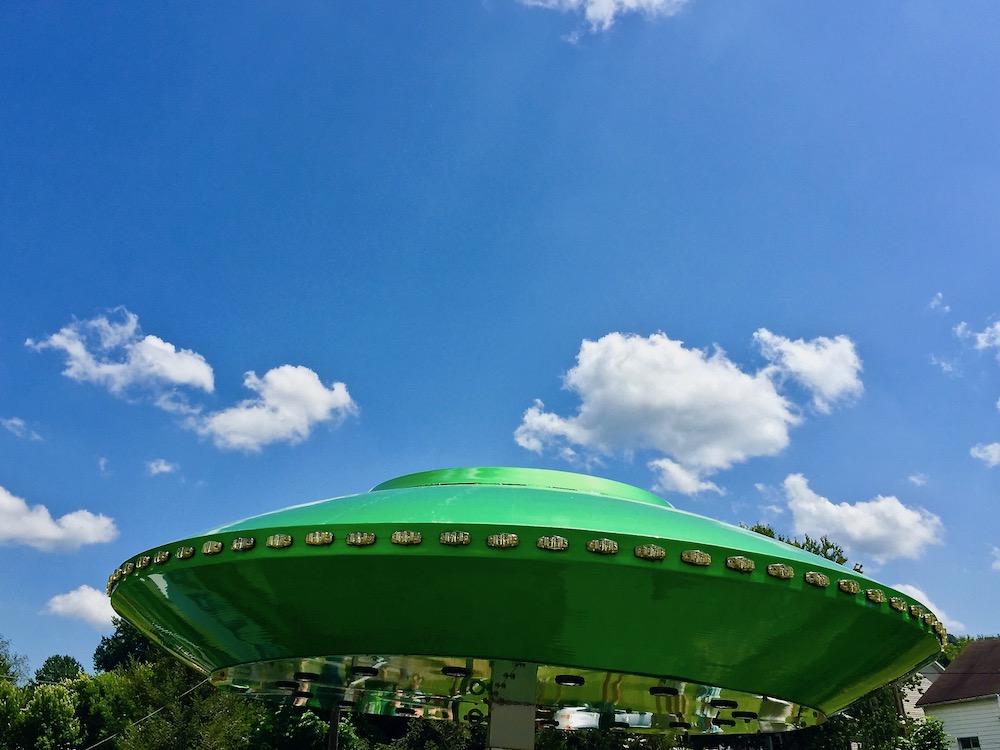
With all this, the green that stays with you is an electric, iridescent lime color. Like a fluorescent safety sign come to life or the inside of one of those light sticks, the eye-popping Day-Glo green wiggles in spring-mounted antennae on the heads of youths, graces noggins in the form of synthetic costume wigs, and gently flutters as inflatable figures dance in the wind. It glows in the bright sunlight on a 10-foot pneumatic carnival saucer and struts through the midway in novelty full-body costumes.
The Kecksburg “space acorn” monument, created for “Unsolved Mysteries” in 1990
Little Kecksburg, a rural community 40 miles east of Pittsburgh, was the perfect spot for a UFO to crash land. Far enough in the country to have few eyewitnesses but close enough to city resources for federal authorities to swoop in and make off with the evidence before anyone could figure out what had happened.
Exactly what occurred on the evening of December 9, 1965 is still in question. Theories range from a stray meteor and fallen Russian satellite to a time-traveling Nazi war machine and, yes, alien spacecraft.
It is this last possibility–amazingly, not the weirdest option in the list–that has kept dogged UFO hunters and seekers of truth in the unexplained coming back to “Pennsylvania’s Roswell” for the last 54 years. The continued interest brought the TV series Unexplained Mysteries to town in 1990, bringing a custom-built, scaled-to-life facsimile of the flying object with them. The hieroglyphics-engraved, acorn-shaped replica lives in permanent display elevated atop a tall pole on a hillside near the VFD hall. (See photo, above.) It’s also one of the things that brought us here. That, and the 14th annual Kecksburg UFO Festival.
The Orbit wasn’t the only news outlet on the scene. TV crews interview Kecksburg incident expert Stan Gordon.
Stan Gordon is the self-declared “primary investigator” of the 1965 Kecksburg incident and a lifelong researcher of the unexplained. Mr. Gordon operates a “radio command center” from his home in nearby Greensburg and regularly attends the UFO Festival. He was busy signing books and DVD documentaries at a corner table that included numerous fuzzy photo enlargements of mysterious lights in the night sky and enormous ape-like footprints in both mud and snow.
Gordon has spent a lifetime looking for the truth about Kecksburg and the description of the event and summary of his findings on his web site are without parallel. We encourage our readers to visit stangordon.info for his full rundown of the event and subsequent investigations.
Yes: the tinfoil hats were there
Stan Gordon wasn’t alone. Appearing at the annual UFO festival is both de rigueur and a no braineur for the region’s experts on the unexplained–and there are a lot more of these than you may think.
Why, there was Raymond Keller, author of Cosmic Ray and Tony Lavorgne of the Legends & Lore podcast. Bilco Productions, the team behind the film Paranormal Bigfoot, was there, as was Ed Kelemen, author of a half dozen books of haunted Pennsylvania lore.Saucers Over Appalachia! author William B. Van Huss had books to sell as did “Mr. UFO” Timothy Green Beckley.
Carried away. This parade-goer may or may not have made it to the main event.
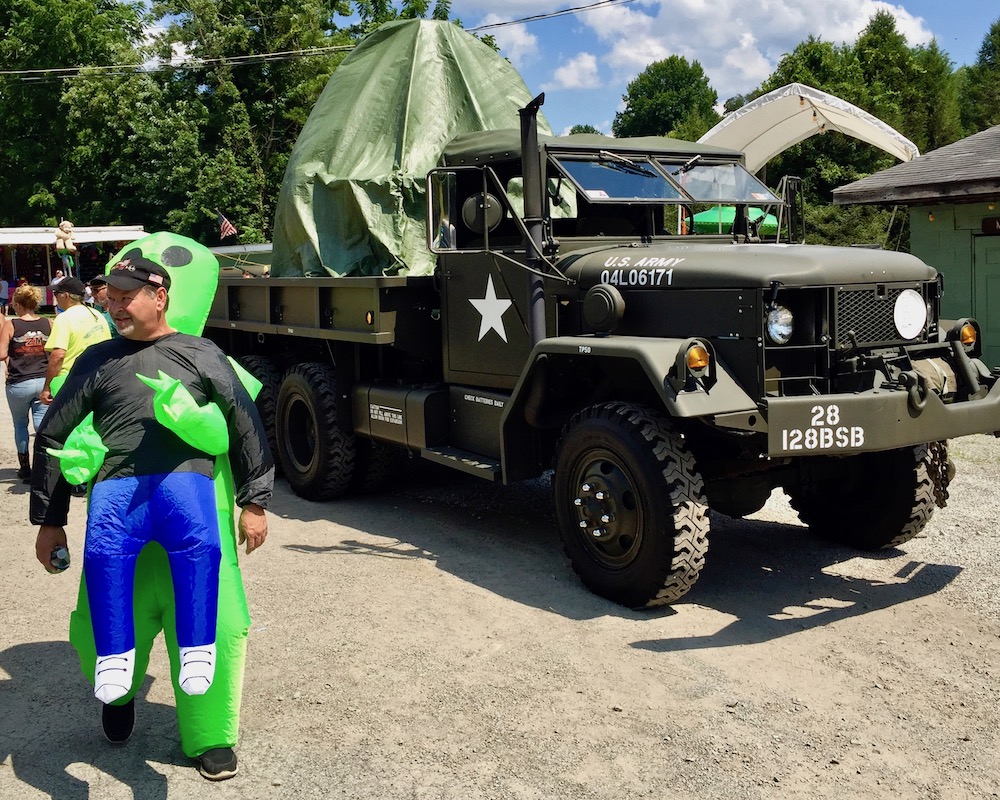
Of course, not every attendee of the Kecksburg UFO Festival takes the event quite so seriously. The costume du jour was clearly this one that effectively makes the illusion an alien is hoisting a child-sized version of the person within (see photos above and below). After seeing a bunch of these–both at the event and then reviewing the pictures afterward–I can tell you neither is the deception obvious nor does the joke get old.
The Leeper Meats crew in the festival parade
The three-day festival is paced with a number of marquee events. Some of these–lectures from UFO and paranormal experts–stay firmly on-message. Others–a corn hole tournament, country band, and the “UFO hot dog-eating contest”–not so much.
Saturday afternoon features a parade down a half-mile of Kecksburg Road, alongside the VFD grounds where the main event takes place. The fancy term bifurcated comes to mind as there were really only two unconnected parties involved here: a handful of old-school military vehicles, with riders playing along dressed-up as the 1960s-era G-men and -women that whisked E.T. away, and then what felt like every fire truck in Westmoreland County.
That’s it. No high school marching bands dressed in coordinated alien costumes and no pre-teen dance troupes shimmying to “Outta Space”; no local politicians waving from tinfoil-covered convertibles and no flatbed hay bale dioramas. Just army play-actors, fire trucks, and Leeper Meats.
U.S. Army truck with replica of cloaked UFO remains
Yes, the parade was a disappointment. Luckily The Kecksburg UFO Festival redeems itself in its many other offerings.
The best of the lot were a number of artisans who brought chainsaw-hewn sculptures of big-eyed aliens and models of Big Foot. (Big Feet?) Among the latter were some extremely impressive life-size (around 7-feet tall) carved-from-a-tree-trunk Sasquatches–any one of which would look great in the backyard of Chez Orbit.
Sasquatch chainsaw sculptures
alien chainsaw art
It’s unclear who comes to the Kecksburg UFO Festival and why they’re there. If I had to put money on it, I’d guess the dressing up/having-a-laugh group outnumbers the relatively small contingent of true believers. Both sets are likely dwarfed by the soft pretzel-and-corn hole crowd, for whom this is the nearby summer fair benefiting their local fire department.
These numbers don’t work in the favor of a researcher who’s given his or her life (it’s pretty much always his) to studying alien contact and Big Foot sightings. Visibly annoyed at having to answer the same old questions from funnel cake-wielding skeptics and won’t-stop-talking over-enthusiasts, a number of the authors and filmmakers came with an arms-crossed, scowl and furrowed brow body language that pretty much told the world, just buy the damn book and get out of my face. No one said ghost hunting was easy.
little green man, big soft pretzel
The story of the Kecksburg incident and its supposed cover-up is even getting the big-screen treatment courtesy of a new, feature-length independent film by SW PA local Cody Knotts. Representatives from the team were there to sell t-shirts and offer advance tickets to the world premier and “red carpet screening” this September in Uniontown.
A couple trailers for the movie are already out. While it’s clear the filmmakers are working on a budget and you won’t recognize any of the local actors (at least, you know, not from acting), they managed to get the period look of mid-’60s America right and shot in a creepy, stylized Twilight Zone way that should satisfy the Creature Feature audience. Judging from the preview clips alone, I doubt we’ll see Kecksburg during Oscar season, but hats off to anyone who can produce a full-length dramatic period piece–even if the actor portraying L.B.J. had to be shot from behind.
Alas, a real journalist would have bunked-down for the full UFO conference on Sunday–or at least stayed later on Saturday to catch the bed race and Renegade Ridge Band! But it was just too damn hot and your fair-skinned, not-watching-his-figure-enough author didn’t need any more time around the deep-fried pierogies and Helltown beers.
So … we headed home early, content that whether or not the truth is out there, it could wait for another day.
Kecksburg V.F.D., home of the 14th annual UFO Festival