The D.I.Y. Graves of Highwood Cemetery, Part 1

handmade grave made of 2x4s with photograph and Hennessy bottles, Highwood Cemetery, Pittsburgh, PA

Unknown

The cemetery, perhaps more than any other civic institution, implies permanence–or maybe eternity. Headstones are carved from granite or cast in bronze. The deceased are entombed in a manicured landscape that we optimistically imagine will appear with the same tranquility forever. Rest in Peace is both believable fantasy and contractual expectation for those laid out under its well-groomed acres.
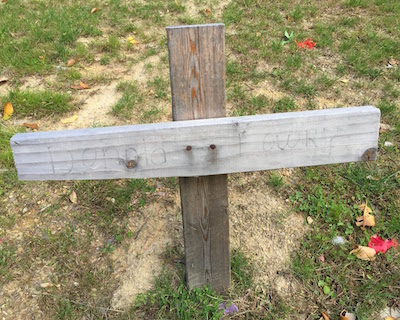
handmade grave made from 2x4s, Highwood Cemetery, Pittsburgh, PA

Donald Lowry

So The Orbit‘s purely accidental arrival on a section of homemade or “do-it-yourself” grave markers at the far back of Highwood Cemetery was both a complete surprise and a total revelation. From a single PVC pipe with a child’s art class cement step stone to a pair of two-by-fours crudely nailed together, the departed’s name applied with a Sharpie to the bare wood, these memorials are already sun-bleached, rain-soaked, and definitely won’t make it through that many Pittsburgh winters.

diy-grave-brub-efb

Brub E.F.B.

This blogger will be the first to admit his general good fortune, both in life, and yes, in death. He’s still breathing, for one, and has never had to bury anyone, never had make funeral arrangements or pick out a casket, never had to select a grave plot or deal with a funeral home, never even had to make awkward conversation with distant relatives at the wake of a close loved one.

And so, of course, I’ve also never been in the position to select a headstone. Nor had I ever even considered that one might be able (err…allowed within the cemetery’s rules) to do this for oneself.

handmade grave with wooden cross and paving stones, Highwood Cemetery, Pittsburgh, PA

Bruce A. Jones

This whole month, Pittsburgh Orbit has been visiting local cemeteries. You start to see some interesting patterns when you spend enough time in a place. One of those is that in terms of visitation, our cemeteries may be roughly divided into three general sections. There’s the older parts, full of dramatic high-gothic mausoleums, giant focus cenotaphs, stained glass, and ornate statuary, often accompanied by a (locally) famous name. Jennie Benford gives a great tour of such monuments in Homewood Cemetery. Then there are the newer sections of (generally) more humble graves for the recently-departed. These collect nearly 100% of the flowers and teddy bears. And then there’s everybody else.

handmade grave with wooden cross, bandana, and Steelers hat, Highwood Cemetery, Pittsburgh, PA

R.W.G. Bang

If your name isn’t H.J. Heinz or Lillian Russell or Stephen Foster and if you didn’t choose a gravestone tribute to Jaws, well, your monument may be available–and it’s probably still in good shape and totally legible–but realistically, probably no one cares that much. I’m not trying to harsh the mellow of someone who’s, you know, already dead, but it’s the truth. Even etched in stone, we’ve got a limited shelf life.

handmade grave with wooden cross, blue bow, and flowers, Highwood Cemetery, Pittsburgh, PA

Keith

I think this is ultimately what gives Highwood’s D.I.Y. graves such emotional power. These aren’t cold stones that will dramatically outlive the families that planted them. They’re very much living tributes for the people who are still in their lives and they will exist for exactly the time they’re most in need–while their loved-ones are still grieving.

I don’t know if it will ever happen, but you could imagine this as a really beautiful, sustainable model for the future. Allow the family to have the closure of a funeral, burial, and a completely home-made memorial that they can visit for five or ten or twenty years–whatever makes sense. But ultimately return the earth to a general pool for another generation to use.

That may or may not be something that would sell to the general cemetery customer but I’d be willing to–let’s abuse our metaphors here–put it in the ground and see who eulogizes it.

Homemade grave with PVC pipe and cast concrete medallion, Highwood Cemetery, Pittsburgh, PA

Dad


Orbit note: There are so many of these D.I.Y. graves in Highwood and they raised so many interesting questions that we decided to break this into two posts. Here’s part 2.
Ghost House: Wearing a Hearth on the Eaves

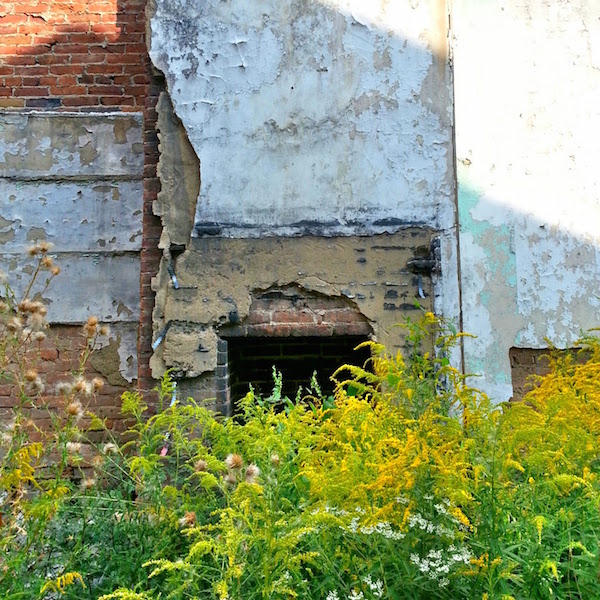
Brick house with exposed fireplace, Pittsburgh, Pa.

Central North Side

Home is where the heart is–at least if Granny’s framed needlepoint aphorism is to be believed. For buildings of a certain age, we may cheekily adjust this to say that home is where the hearth is (or hearths are)–every pre-steam heat building having requisite fireplaces in each and every living space throughout the house. This blogger’s little row house had eight of them.

Sometimes, though, the old saw gets flipped on its head. Quite often the old fireplaces end up outliving their host homes. Keith Richard-like hard-smoking, hard-living grizzled bears that manage to defy odds and stay alive while marathon-running vegetarians a generation younger fall in their trail.

Brick house with exposed fireplace, Pittsburgh, Pa.

Central North Side

When we started our series on ghost houses, the very first post was on a pair of houses in East Liberty. The second of these profiled had the curious arrangement that two fireplaces from the former home were left intact and hanging from the now-exposed common wall. We remarked at how extraordinary this was. [That post is still worth a look as the combined brick-faced (upper) and fake stone (lower) hearths still paint a strange portrait.]

Well, it sure seemed like that at the time. But as with so many of life’s mysteries, once the eyes were properly trained, it became a thing we started seeing everywhere–like faces in plumbing arrangements, or constellations in sidewalk chewing gum, or evil elves.

Brick house with two exposed fireplaces, Pittsburgh, Pa.

East Deutschtown

This is surely not a Pittsburgh phenomena, but the city is uniquely suited for it. Almost all of the oldest parts of town were built in dense neighborhoods of brick row houses, their adjoining walls sharing common, integral chimney stacks. As time and tide (and the death of the local steel industry) did their thing, lots of these houses were demolished–or just plain collapsed from neglect. So when the situation resulted in a kept-up house abutting a felled one, you get fireplaces dangling from external walls. It’s weird. And it’s kind of cool.

Brick house with two exposed fireplaces, Millvale, Pa.

Millvale

It turns out that there are so many of these out there, in fact, that we may end up needing to run a sequel (or two). There are even some interesting related-but-different sub-categories: exterior bath and kitchen tile, stair framing, exposed plaster walls that somehow survive winter after winter. So much to get to!

Brick house with two exposed fireplaces, Pittsburgh, Pa.

Hill District

Smoky City: Six Looks at the Heinz Plant Smokestacks

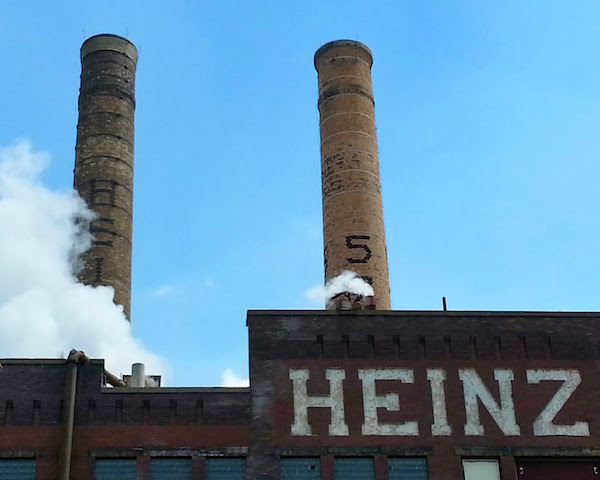
Heinz factory smokestacks with red brick factory buildings

Why do we love smokestacks? [Ladies: don’t answer that! We also love water towers, and rivers, and, uh…doughnuts.] They just look so great! Especially when we no longer have to suffer the consequences of blackened skies and filthy garments and routine emphysema*. It’s like the hollow promise of light beer: all the taste without those pesky calories.

When we started thinking about a series on Pittsburgh smokestacks, there were really just three obvious first world properties to kick off with: the old U.S. Steel stacks in Homestead, Michael Chabon’s “Cloud Factory” in Oakland, and the Heinz plant. Only one of these is on the bicycle ride that separates this blogger from the cheap blueberries and hard Italian cheese in the Strip District, so the choice was made for us.

Heinz factory smokestacks, Pittsburgh, PA

It’s unclear how much of Heinz’ near North Side plant is still an ongoing ketchup-making operation vs. condiment-associated loft housing. At least a part of the facility is security fenced from blogging yabbos like myself and the plant continues to spout a white particulate that suggests vinegar may still be combined with tomato paste on the premises. It’s the kind of place where workers (at least, a few workers) in hard hats still exit at quittin’ time with a cold beer on the noggin. There ain’t no Hunt’s on the table where they’re headed.

Heinz factory smokestacks with new glass and aluminum buildings, Pittsburgh, PA

Like the Washington Monument or St. Paul’s Cathedral, the smokestacks are visible from all over–the Heinz and 57 brick inlays readable from some distance. Almost everywhere on the Allegheny River side of town gets some sort of vantage point.

The Heinz stacks are so omnipresent that most people likely don’t even pay attention to them anymore. On bicycle rides down the river trail I kept noticing how you’d see the stacks from far off up the trail, glimpsed between the newer buildings along the river, from up above on Troy Hill, and down below near town. This was an Orbit story begging to happen.

Heinz factory smokestacks close-up, Pittsburgh, PA

Oh, and happen it will…er, did. In fact, happening it is, right now. I’m typing–I should know! It’s one of those freaky kind of ketchup happenings you read about in the condiment blogs. Dudes in fry outfits; ladies going “hash brownie”; little tykes experiencing colors we never dreamed of. It’s so beautiful! There’s no casting aspersions; just reporting the facts. Lay down thy preconceptions and pick up your spatula: it’s an old-school fry-up and we’re tending the griddle, jack.

Heinz plant smokestacks seen over a mound of gravel in the Strip District, Pittsburgh, PA

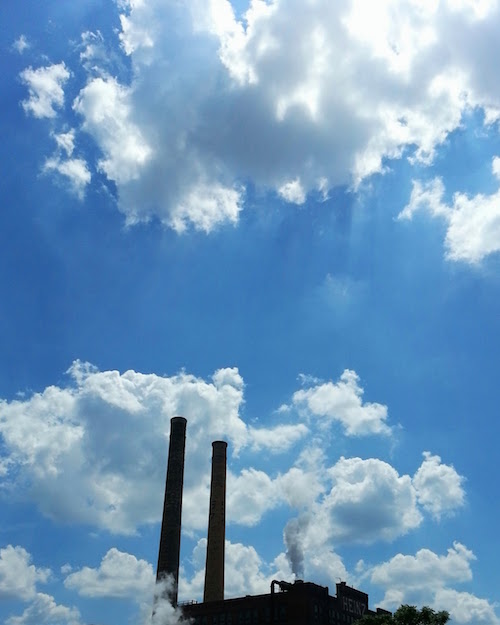
Heinz factory smokestacks silhouette with blue sky and white clouds, Pittsburgh, PA

* Pittsburgh’s air quality is still a mess, but, you know, it ain’t like it used to be.


Step Beat: Rising Main, The Longest Steps

Rising Main city steps, Pittsburgh, Pa.

Rising Main Way steps (from hobo camp)

The one and only time he met (then) Pittsburgh mayor Luke Ravenstahl, this future citizen-journalist knew it was a prime opportunity. “What are you doing to save the Rising Main Way steps?” was the sum total of my interrogation. (There was a rumor at the time that Rising Main was slated for demolition.) I got a non-committal response: “I thought those were getting fixed-up?”

Sure: public education and jobs and keeping crime down and paving the streets are all important things, but The Orbit will argue all day that the city steps (in general) and Rising Main Way (in particular) are a historical and cultural treasure that should be maintained and protected the way we preserve the Fort Pitt Blockhouse or Pitt’s little log cabin.

Intersection of Rising Main Way and Toboggan Street, Pittsburgh, Pa.

View from base camp: the intersection of Rising Main Way and Toboggan Street

In the world of city steps, Rising Main Way is the big Kahuna, the alpha and the omega, the most colorful single crayon in the box. At 371 steps, Rising Main is not just the longest stretch of city steps in Pittsburgh, it is among the longest sets of community steps in the country. To put it in perspective, it’s something on the order of a fifteen to eighteen-story building, built straight up a steep hillside, and now totally surrounded by nature. And it’s less than two miles from the center of downtown Pittsburgh.

Two sets of steps of city steps in Pittsburgh, Pa.

Two sets of steps: Toboggan Street (foreground) and Rising Main Way (back)

Getting there: There are a couple different ways to approach the Rising Main steps. Probably best for the first-timer is to drive/ride to the very end of Howard Street (off North Avenue, North Side), park/lock up anywhere and plan to just do an up-and-back. It will be plenty.

That said, there are a ton of terrific steps throughout Fineview and a lot of great things to see when you’re up there, so the more adventurous could plan one of many possible longer routes around. The Orbit will most certainly be back to describe some of these possible journeys.

Former home foundation in Pittsburgh, Pa.

Forgotten foundation

One of the fascinating things about any step hike is the amateur archeological survey one inevitably ends up on. At one time there were dozens of properties that lined the hillsides of both Rising Main and the shorter Toboggan Street. Today maybe eight houses still stand, and only a few of these appear to be occupied.

Along the way up, you’ll see plenty of evidence of these former homes: if their sandstone foundations and crumbling walkways don’t give them away there are obvious breaks in the step railing that show where there was an entrance point from the steps to a property. Some of these inevitably become hobo camps or teen drinking hangouts. If you’re lucky, there’s evidence of witchcraft.

That houses were only accessible by the steps is certainly not unusual–you still see many of these around. But the thought of being half-way up or down this particular incline, needing to haul your groceries the equivalent of, say, eight or ten stories to your front door, is pretty amazing. It’s romantic to think of the houses built in this environment, but the reality would certainly be challenging. It’s no surprise that few of these homes remain.

View from Rising Main city steps, Pittsburgh, Pa.

View from half-way up Rising Main city steps

The original purpose of the steps was of course a means of commuter travel from the many high hills (where people lived) to the valleys and flats along the river (where they worked, shopped, prayed, and played). Some of the steps still serve this purpose, but Rising Main certainly does not. Plenty of people live in the Fineview neighborhood (at the top of the hill), but there’s really nothing to walk down to anymore.

The project that built I-279 in the mid-1970s ran right through the industrial and commercial heart of the valley that separates Spring Hill and Reserve Township (on the east) from Fineview and Observatory Hill (on the west). The constant drone of rushing traffic never lets you forget it. The full run of houses that used to line Howard Street (at the base of the hill) have been long demolished (though again, many foundations remain), so there aren’t even any people to visit. [But The Orbit will put in a pitch to visit Pittsburgh’s finest piece of public art while you’re there.]

Stenciled marker reading "371 Steps" for Rising Main Way, Pittsburgh, Pa.

371 Steps

I’ve dragged a lot of out-of-town guests up the steps–and some of them don’t let me forget it! But if I were visiting Pittsburgh for the first time, I’d take a step hike over a trip to the museum, or a ball game, or whatever it is that most people do when they travel. Take The Orbit‘s advice: corral your guests and get their whining-ass kiesters up the steps–they’ll thank you for it later.

View from the top of Rising Main city steps, Pittsburgh, Pa.

View from the top, Spring Hill in the distance

Public Art: The Howard Street Line Painting Tests

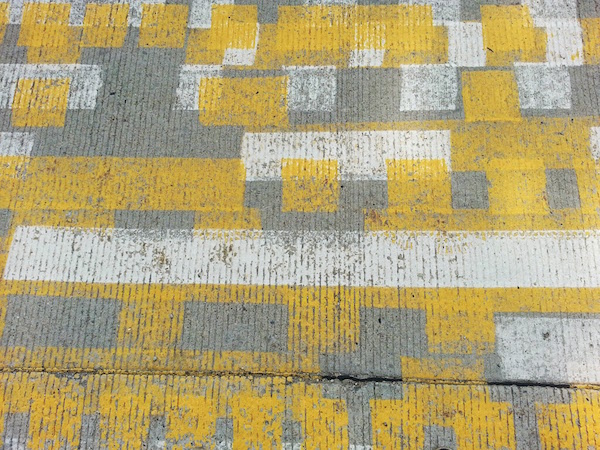
Street line test (detail)

Street line painting test (detail), North Side

The Orbit doesn’t know what it likes, but it knows art. And we’re going to go out on a limb here and say that this fair city’s very best piece of public art is one that almost no one ever sees, tucked away on a dead-end street on the North Side*. Yes: it’s more exciting than the french fry sculpture, or the Tomb of the Unknown Bowler, or that red paperclip-looking thing, or even Dippy the dinosaur (yes: better than a dinosaur).

Street line test (detail)

Street line painting test (detail)

Back in February, The Orbit did a story on the Toynbee Tiles of Smithfield Street wherein we had the gaul to claim that “it doesn’t get much more ‘street art’ than [the tiles].” Well, this blogger is not too proud to admit when he has erred. The giant Howard Street painting was created right there on the street, by road workers, with special street line painting machines. This time we really mean it: you really can’t get much more “street art” than that.

We can only assume the city Department of Public Works (which has a facility right at the end of Howard Street) created the painting as some kind of test area for applying street directional/lane marking lines in white and gold. Whatever prompted it, the final creation is totally beautiful.

Street line test (detail)

Street line painting test (detail)

What’s miraculous about the piece is that the crew that laid it down stuck to a very particular fifty-or-so foot stretch of road surface, testing back-and-forth, on top of and just next to the previous runs. Howard Street is probably three quarters of a mile long, completely void of any houses or traffic, so the workers could have stretched their tests out lengthwise if they wanted to, but for whatever reason they chose to concentrate their dense repetitions on one contained area, approximately the width of one lane of traffic.

Street line test (detail)

Street line painting test (detail)

The result is a hypnotic series of dot-dash blocks of a common width, but with the off-register overlap of a cheap silkscreen job. Colors fade and flare irregularly where layers intersect, the grooved pavement cracks, and time and tide have done their various things. The big blocks suggest the abstraction of intense pixelization or a more figurative image refracted through raindrops. Staring at them long enough, letting your eye focus go soft, could easily work as a kind of Rorschach test.

Street line painting tests

My only regret is that I didn’t have one of those big Genie lifts on hand to take me up thirty or forty feet in the air to get a proper photograph of the whole enchilada. If I were running the Carnegie International, I’d be tempted to just exhume the whole road surface and bring it in to the big architecture hall. Or maybe they should just hold the International right there on Howard Street. That’d show ’em.

street with line painting tests, Pittsburgh, Pa.

In context: Howard Street line painting tests, North Side

* The Orbit sadly acknowledges that the bar is extremely low for this particular category.

Onion Dome Fever: St. John Church of the Eastern Rite

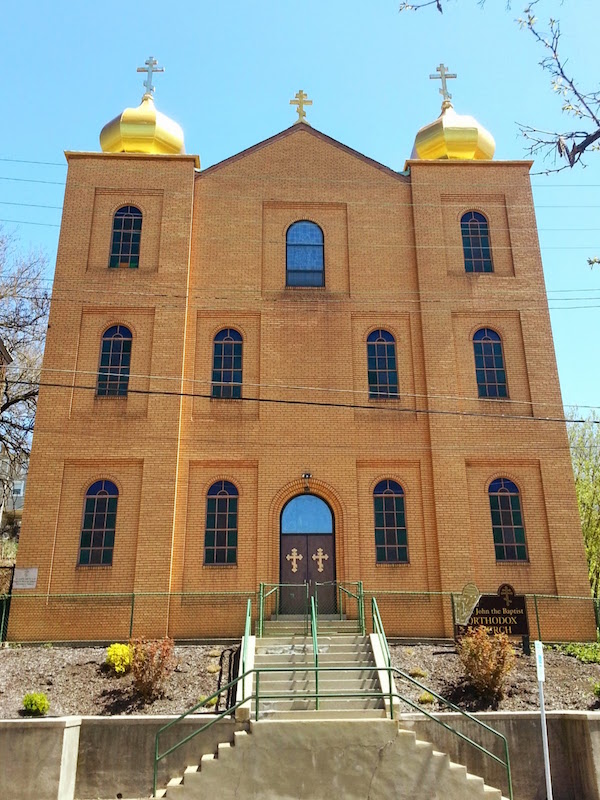
St. John the Baptist church, Pittsburgh, Pa.

St. John the Baptist Carpatho-Russian Church of the Eastern Rite, Marshall-Shadeland

Sometimes life has a funny way of handing out consolation prizes. This blogger was out hunting an elusive patch of historically important heavy metal graffiti and wound up finding religion. I was out looking for Black Sabbath and came back with, uh, actual sabbath. Out for Queensryche, got Eastern Rite. Seeking Slade, got saved. Searching for Slayer, got a savior. Looking for Judas Priest…O.K., this is too easy; you get the joke.

There I was, huffing and puffing my way up and down, back and forth combing through the steep streets and alleys of Marshall-Shadeland looking for a very particular deconstructed garage containing a spray painted history of teenage male hair farmer fandom that I’m starting to think only exists in my dreams (and others’ nightmares). I curse myself for failing to take pictures the first time I came across them (“always record!”) and turn the bicycle toward home in disgrace.

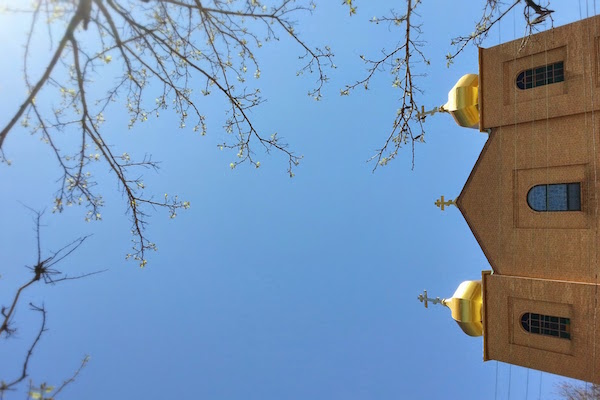
But then, clearing a bluff I’d never been to at the end of Woodland Ave., they popped right out of the sky at me: gleaming onion domes, gorgeous against the perfectly blue early Spring sky, glowing like golden apples in the bright sun.

Detail of onion dome on St. John the Baptist church, Pittsburgh, Pa.

St. John the Baptist Carpatho-Russian Church of the Eastern Rite sits on a lonely stretch of California Ave. It dominates the otherwise two-story frame houses that surround it. The building and grounds seem to be in fine, well-maintained order, but its sign has either been vandalized or severely weather-worn. There is no indication the church is still open Sundays, nor is there evidence of closure. (I was there mid-day on a Saturday and the doors were locked tight.)

Cornerstone for St. John the Baptist church, Pittsburgh, Pa.

Bilingual cornerstone

The church stands an impressive three (very tall) stories, but, other than the showy domes and big Byzantine crosses on the front doors, has a very subdued plainness. That may be a Carpatho-Russian thing, or possibly just a belt-tightening side-effect of its Depression-era construction. I’d love to see inside.

Byzantine crosses on the front doors of St. John the Baptist church, Pittsburgh, Pa.

Byzantine crosses on St. John’s front doors

Probably you’ve whizzed by St. John on your way out Route 65, taking your tube amp to Don for yet another repair at Phil’s TV, or just to peruse the menu of fried items at Miller’s Seafood. Maybe, like me, you never really processed it from the highway, but hopefully you did. Either way, if you find yourself off the main drag, down on California Ave., maybe stick around one time and say hello to St. John. And let me know if you ever find that garage full of graffiti over the hill.

St. John the Baptist church, Pittsburgh, Pa.

St. John the Baptist Carpatho-Russian Church of the Eastern Rite, Marshall-Shadeland

The Over-the-Wall Club: A Secret Picnic Spot

cement wall with graffiti, trees, and smokestacks in the distance

Over-the-Wall lies a secret picnic spot

When last we left The Over-the-Wall Club, members were straining their necks, up on their tip-toes, peeking and peeping. Sometimes we catch a break and actually make it over to have a look on the other side. And every once in a while we find out that the grass really is greener over there.

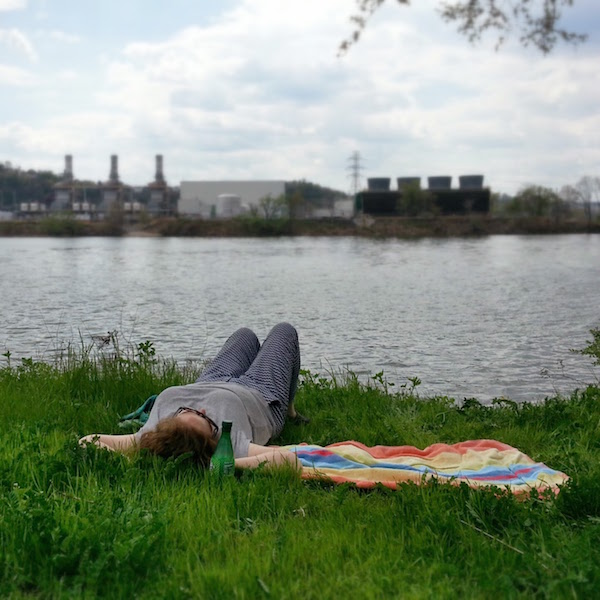
The most perfect secret picnic spot lies high in the aerie of Peregrine falcons, reachable only by trained tall tree-climbers with provisions shuttled in by drone. Sigh, someday. Until then, Orbit staff stumbled across a right nice substitute, on a grassy bank of the Ohio River, in the shade of flowering Spring trees, attainable only by bicycle. [Technically one could drive, park, and walk a trail, but that’s not as much fun.] The spot is accessed through a breach in a concrete wall.

woman laying on grass by the Ohio River

A very Pittsburgh picnic spot: Brunot Island power plants on the far shore

It is early May, the first definitive shorts-weather occasion of the year, and a glorious post-Pittonkatonk, post-marathon Sunday afternoon comin’ down. Not to nit pick on the picnic, but the menu was nothing to brag about (my fault, entirely). That said, we can credit Shur-Save with providing an acceptable board of fare (after we applied some after-market vegetables and condiments to the “Anytime Deli” sub) at a price that didn’t dent this blogger’s wallet.  Next time–and there will be a next time–we’ll do it up right.

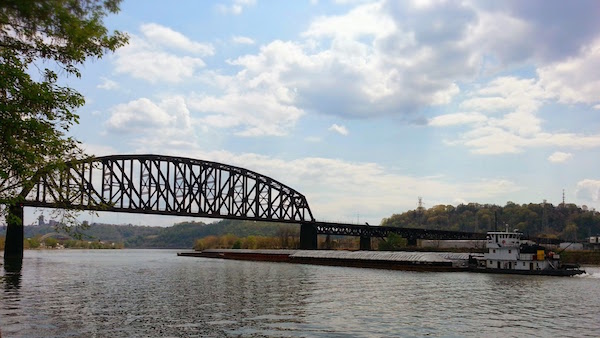
But what’s really special here is the amazing peace on this particular stretch of riverbank. We were well within Pittsburgh city limits, but never heard the sound of an automobile, a booming stereo, shouting, clattering, or any other noise (man or machine) for that matter. In fact, the only “traffic” we witnessed was one long coal barge and a couple pleasure crafts on the river.  One train rumbled by on the Brunot Island bridge.

barge on the Ohio River near Pittsburgh

This barge is all the traffic we encountered at the Secret Picnic Spot

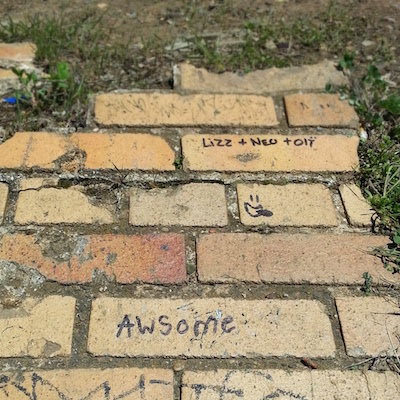
The Secret Picnic Spot is known to at least a few other river dwellers.  There was an empty Black Velvet bottle in the weeds and the burnt offering of an old school hobo fire.  A stray patch of brick wall embedded in the ground had been graffiti’d in black Sharpie.  We crossed paths with a pair of amorous middle-agers and a grandfather/granddaughter combo, but the spot’s fifty-or-so yards of riverbank can handle at least that much of a crowd with relative privacy.

bricks embedded in grass and dirt with handwritten "awsome" graffiti

Don’t take our word for it: Lizz + Neo + Oly confirm that the Secret Picnic Spot is awsome

If you’ve got a tip on a great Pittsburgh picnic spot (secret or otherwise), please let us know. We’ll show you ours if you show us yours.

H.W. 46 ft. 3-18-1936

St. Patrick's Day Flood marker, Manchester

This intriguing painted marker lives on the corner of a big brick warehouse building at Island and Preble Aves. in Manchester.  I came across it bicycle-riding through the neighborhood last summer.  It read like some weird code: H.W. 46 ft.  It wasn’t until thinking about it days later that I put the pieces together: a date (March 18, 1936) and a measurement in feet.  This had to be a high water marker for the Great St. Patrick’s Day Flood of 1936.

Floods happen in Pittsburgh somewhat regularly–especially right at the end of winter when all the collected ice upriver starts melting en masse–but the flood of 1936 was The Big One, the most devastating in the city’s history and the one that provoked massive flood control efforts in and around the city.

view of downtown Pittsburgh from Mt. Washington during flood of 1936

View of downtown Pittsburgh during the flood of 1936 from Mt. Washington

I had a heard about the flood a few times, first and most memorably from a much older co-worker at a place I was temping in the late 1990s who had personally experienced it as a child.  He had this vivid memory of looking down on the city from Mt. Washington and seeing giant rolls of newsprint from the Pittsburgh Post printing facility downtown inflated by the water and floating down the river like giant marshmallows.

I’ve come across very few other physical artifacts of the flood (although one would think there are many others), so this was a really neat discovery.  It wasn’t long, though, until I came across this second marker for the flood on a different ride, but also in the same general area of Manchester (exact address unknown).

St. Patrick's Day Flood marker, Manchester

St. Patrick’s Day Flood marker, Manchester