Allegheny Cemetery: The Shark Grave

Shark grave marker, Allegheny Cemetery, Pittsburgh

Lester C. Madden: Korean War veteran, Jaws fanatic

Allegheny Cemetery is as vast as the largest of Pittsburgh’s city neighborhoods, occupying some three hundred acres.  There are well over a hundred thousand permanent residents on site, some going back to the French and Indian War.  These include titans of industry, mayors and congressmen, silent film actress Lillian Russell, baseball great Josh Gibson, and the father of popular music, Stephen Foster.  With any luck, The Orbit will get to all these folks at some point in future.

Possums, squirrels, field mice, and scores of deer scurry about when the rare visitor is encountered.  Thousands of blackbirds haunt its treetops, moving in coordinated squadrons.  Its steep hillsides, dramatic views, and gentle sweeping passes rival any of the city’s great parks, but it’s rare to encounter even a single other living human, making it unique for its solitude.

As one may imagine, it also has many curiosities.  One of the most interesting (and out-of-place) is “the Shark Grave” of one Lester C. Madden (1931-1983).  I won’t pretend that I did any more digging than a Google search, which merely turned up the two facts that Mr. Madden was a veteran of the Korean War, and that indeed, he was a great fan of the 1975 blockbuster shark thriller Jaws. So much so, apparently, that he chose to spend his post-mortal coil eternity under a headstone in that film’s most indelible, terrifying image.  For you, Lester C. Madden, in the words of Jaws‘ old sea dog character Quint, “And so never more shall we see you again,” but we’ll enjoy your marker for a very, very long time.

Movie poster for the 1975 shark thriller "Jaws"

Movie poster for the 1975 shark thriller “Jaws”

UPDATE (3/2/2015): Mere days after this post was originally published, a suspiciously similar image appeared spray-painted on the wall of a Bloomfield garage.  Coincidence?

Graffiti on garage wall similar to the "Jaws" movie poster

Jaws graffiti, Bloomfield

UPDATE (5/3/2015): Even more new(ish) Jaws graffiti, this time wheat-pasted in Garfield.  What’s going on around here?

wheat paste graffiti of Jaws

Jaws III: Garfield

Ghost Houses: East Liberty

Ghost houst: East Liberty

Ghost house: East Liberty

Ghost house: the imprinted silhouette of a structure that is no longer there on one that is.  They’re the last remnants of a structure that has been banished from this earth and they speak to the current property owner’s neglect for updating to hide what many would consider a cosmetic blemish.  The alternate explanation being that they may be a very reverent way to honor the former structure.  It is impossible to know the intent.

Pittsburgh has a lot of these, owing to the city’s history of many close-quartered row houses and houses directly abutting industry.  That, coupled with the massive loss of population in the 1970s and ’80s that left lots of vacant, derelict properties that were ultimately razed.

The ghost house photographed above is particularly amazing.  It’s right across the street from The Home Depot in East Liberty and makes a perfect outline of the former house, including front and rear porches, against the off-white painted brick wall of a much larger building.  The addition of the lush green weedy grass (this photo taken in summer) makes it all the more unreal

Ghost house: East Liberty

Ghost house: East Liberty

This is another one, also in East Liberty, with a weird variant on the theme.  In this case, the former house’s fireplaces–including the fake stone work on the first floor fireplace–and plaster walls have been preserved in the exterior wall of the still-standing house next door.  It boggles the mind that someone would tear down an entire house, and yet leave pieces of the razed structure embedded in the house next door.  Or maybe it’s structurally damaging to pry out something as integral as fireplace and chimney from abutting houses?  Either way, the outcome is strange, magical, and beautiful.

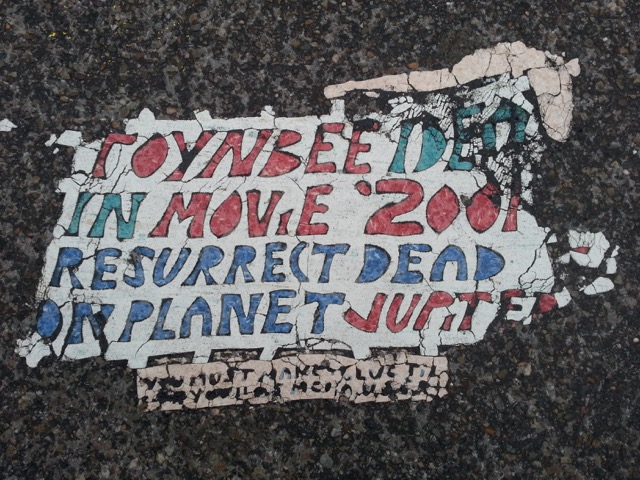
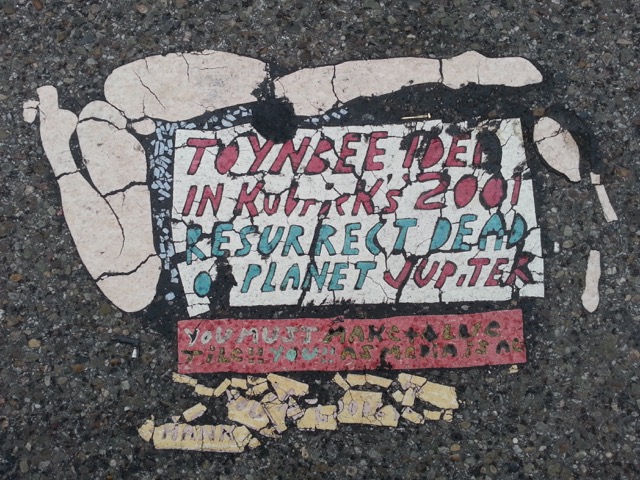
The Toynbee Tiles of Smithfield Street

Toynbee tile, Smithfield Street, Pittsburgh

It doesn’t get much more “street art” than the mystery “Toynbee Tiles” that have appeared embedded in the macadam of city streets throughout the country (and the world!) for the last several decades.  They’ve been tracked pretty thoroughly and their story and the search for their creator was spellbindingly told in the terrific documentary film Resurrect Dead (2011).

We don’t have the kind of quantity that exist in Philadelphia or Baltimore, but Pittsburgh still has a bunch.  Smithfield Street (downtown) is the best spot to collectively see a run of the local ones, all of which are photographed here.  There’s approximately one on each block from Boulevard of the Allies to Sixth Street.

Toynbee tile, Smithfield Street, Pittsburgh

Toynbee tile, Smithfield Street, Pittsburgh

Toynbee tile, Smithfield Street, Pittsburgh

Toynbee tile, Smithfield Street, Pittsburgh

H.W. 46 ft. 3-18-1936

St. Patrick's Day Flood marker, Manchester

This intriguing painted marker lives on the corner of a big brick warehouse building at Island and Preble Aves. in Manchester.  I came across it bicycle-riding through the neighborhood last summer.  It read like some weird code: H.W. 46 ft.  It wasn’t until thinking about it days later that I put the pieces together: a date (March 18, 1936) and a measurement in feet.  This had to be a high water marker for the Great St. Patrick’s Day Flood of 1936.

Floods happen in Pittsburgh somewhat regularly–especially right at the end of winter when all the collected ice upriver starts melting en masse–but the flood of 1936 was The Big One, the most devastating in the city’s history and the one that provoked massive flood control efforts in and around the city.

view of downtown Pittsburgh from Mt. Washington during flood of 1936

View of downtown Pittsburgh during the flood of 1936 from Mt. Washington

I had a heard about the flood a few times, first and most memorably from a much older co-worker at a place I was temping in the late 1990s who had personally experienced it as a child.  He had this vivid memory of looking down on the city from Mt. Washington and seeing giant rolls of newsprint from the Pittsburgh Post printing facility downtown inflated by the water and floating down the river like giant marshmallows.

I’ve come across very few other physical artifacts of the flood (although one would think there are many others), so this was a really neat discovery.  It wasn’t long, though, until I came across this second marker for the flood on a different ride, but also in the same general area of Manchester (exact address unknown).

St. Patrick's Day Flood marker, Manchester

St. Patrick’s Day Flood marker, Manchester