Lawrenceville Stencil Graffiti

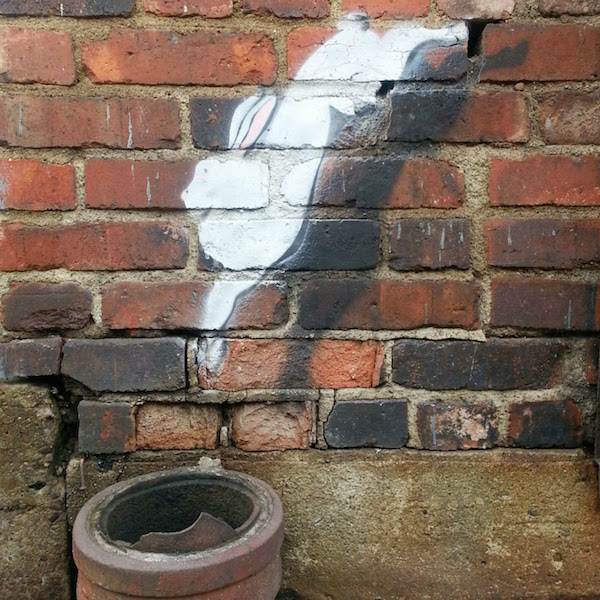
stencil graffiti of rabbit jumping, Pittsburgh, Pa.

This law-abiding blogger has never committed an act of graffiti in his life–but that doesn’t mean he doesn’t think about it! All the time, as a matter of fact. If I were going to get into the wall-scrawling business (don’t get your hopes up: the chances are extremely low), I’d follow a very strict code of ethics: I wouldn’t touch anyone’s personal property, I wouldn’t write some dumb, regrettable message or invent a cheesy “tag” like, say, 0rbi7, I’d make damn sure the graffiti was only an improvement to the visual landscape, and I’d perpetrate with a stencil.

Why a stencil? I’m glad I asked for you. Mostly because if they’re created with any dignity, stencils just look uniformly good, without looking uniformly, uh, uniform. They have the beauty of any hand-run print process that provides great repetition of image, but with each rendition some warm distortion and subtle variation.

All of these stenciled pieces come from a relatively small area of Central Lawrenceville–mainly 42nd and Harrison Streets (I think). I’m sure there are plenty more where these came from, so hopefully The Orbit can get a few more pulls out of this particular template.

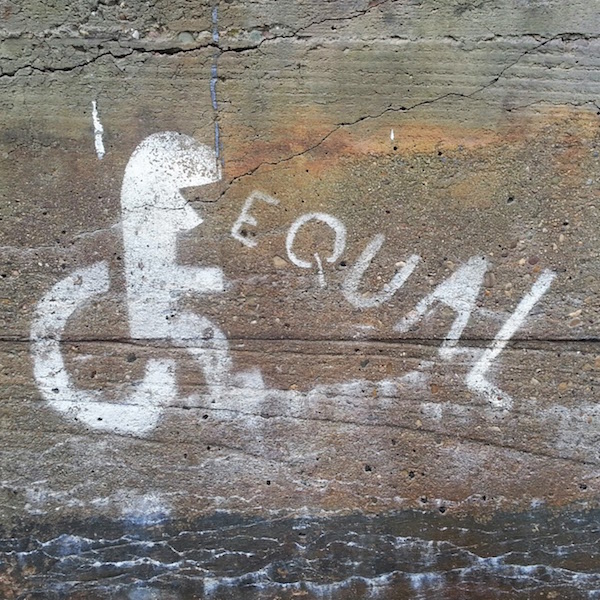
stencil graffiti of figure in wheelchair with the word "equal", Pittsburgh, Pa.

Equal

With all due respect to The Orbit‘s female, LGBT, and people-of-color brothers and sisters, the disability community is the minority group that has by far the least public exposure and the largest and longest denial of basic human rights. No Hollywood stars are lining up around accessible transit issues, Iggy Azalea is not getting uninvited from any giant downtown deaf pride events, and no one is burning retail stores over the unemployment rates of blind people. I’ve seen these Equal graffiti splashes in Lawrenceville, Polish Hill, and Bloomfield, which is a great sign of some small amount of awareness at a very literal street level (and my wife reminds me that there are a lot of very positive changes happening in this space). Now, why the person in the wheelchair looks like Pac-Man with a torso…

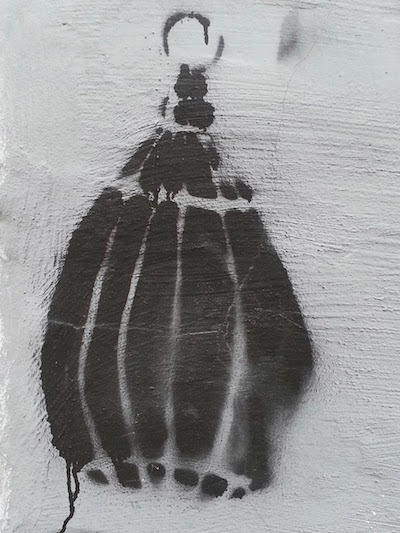
stencil graffiti of hand grenade, Pittsburgh, Pa.

Hand grenade (?)

This one violates my above-stated personal rule against “bombing” personal property. But if I was the owner of the row house whose cement foundation wall had this illicitly added, frankly, I’d be fine with it. [That is not an invitation!] So far, no one has busted out the Zinsser to cover it up, so perhaps these neighbors are on the same wavelength. Bonus points for the paint run (the stenciler’s equivalent of a beauty mark) in the bottom left corner.

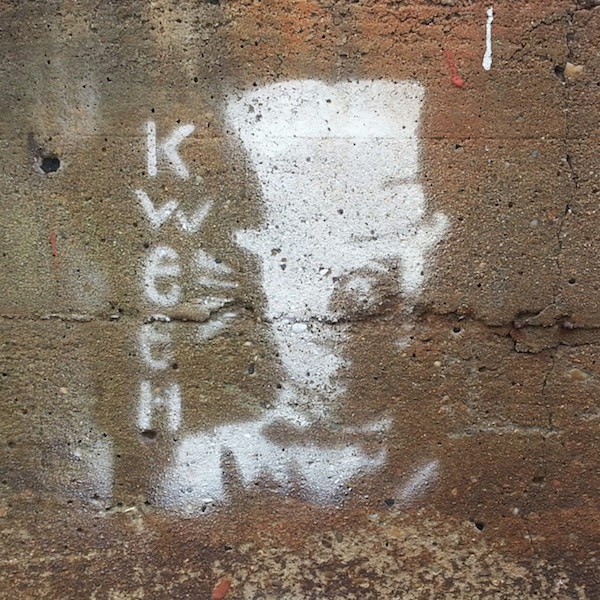
stencil graffiti of man with top hat and the word "kween", Pittsburgh, Pa.

Kween

According to the computer internet, “Kween” can mean umpteen different things, none of which we’ve ever heard of. So it’s hard to know what the profligate who sprayed this one was going on about. [Enlightened Orbiters: straighten us out.] But sure: top hat, weird spelling, stencil on concrete–that’s good enough for us.

stencil graffiti of a dove on a street pole, Pittsburgh, Pa.

Dove

Lay a flat stencil on a round surface and you’ll lose line definition somewhere. Whoever committed this one got that and more with a blurred leading edge so fuzzy it looks like this particular winged creature has just engaged hyperdrive. That, coupled with some oxidization and the pre-existing copper-colored lines it’s competing with and the results are a really beautiful addition to this particular streetlight pole.


Vacation notice: If you’ve gotten this far (and I’ll bet you have!) then, Mom: call me! No, seriously, Pittsburgh Orbit will be on a week-and-a-half vacation break wherein we’ll try to figure out what to do when we get back on Pittsburgh time. In the words of the late, great George Willard, “All of the sudden, her eyebrows were too intense.” Be good.

Flag Post: A Very Orbit Independence Day

detail of door painted like the American flag, Pittsburgh, Pa.

Shur-Fine America, Bloomfield

From the mountains to the prairies and from an alley in Bloomfield all the way to a men’s room in Bloomfield, it’s Independence Day in America (aka “The Fourth of July”) and we’re going to celebrate that with a flag post.

We see a lot of American flags this time of year, and that’s no easy experience for the eyes. Red, white, and blue are not colors that naturally look great together–at least, not when served up in the kind of equal doses Old Glory delivers. So for this amateur vexillologist, it can be a challenging holiday. It’s a blitzkrieg to the corneas, a D-Day for the optic nerve, and no laughing matter for the vitreous humor.

Graphically, we’d be a lot better off with just the red and white stripes or just the white stars on the blue field. We know The Orbit wields no small amount of international influence. Fortunes have been made and men (yes: and women) destroyed with the simple addition of key tag or a righteous repost. But a rebranding of The United States of America may be out of even this blog’s enviable powers.

So what are we to do? It’s our flag and whatever one thinks of it symbolically, it’s one of the great constants in any American’s existence. We at The Orbit find that the flags rendered by actual American hands have a whole lot more charm and humanity than their perfect (if cheap) cousins that show up on doorsteps and grave markers, waving at parades and discarded or packed-away by Summer’s end.

Through absolutely no forethought or planning, almost all of these flags were picked up when we thought we were photographing something else.  Super fans may cry “rerun!” but, c’mon–there’s good new stuff here! We’ll brand this a six-month “roll-up” to highlight some stories may be not everyone got to the first time. Happy birthday, America!

American flag made out of wooden fence

Fence flag, Highland Park

We came across this fine flag when we reported on Chet’s Tiny Backyard Dream World last month. Aside from the fact that Chet created this piece from old fence posts, I love that it both ended up slanted at this odd trapezoidal angle, and that it only has nine stripes and thirty stars. There is something so slyly seditious (if, likely, unconscious) about having patriotic art that is factually incorrect.

American flag made from popsicle sticks

Popsicle stick flag, Munhall [photo: Lee Floyd]

Lee sent in this photo of a flag constructed of painted (?) popsicle sticks hours before going to press, so we frankly don’t have time to get all the details on it. What we do know is that just like Chet’s, the popsicle stick flag eschews the standard 13 stripes/50 stars arrangement in favor of a more loose interpretation. Whatever the artist’s intention, we like what we’re seeing from this American!

American flag sticker, scratched and graffiti'd

Sonny’s Tavern, Bloomfield

This flag begs the question: Which is more (or less) patriotic? To paste an American flag sticker above the urinal of a men’s room in a dive bar or to (fail to) properly remove/destroy it? Are all representations of the flag sacred?

American flag behind cypress bushes

Cypress flag, Highland Park

We came across this interesting flag/hedge combination when we were in Highland Park photographing the Heidi Houses back in May. The owner/tenant of this house used a huge flag to cover the entire front porch of the house, draping it between the gutter and scraggly cypress bushes. Like the men’s room above, this is a very questionable way to honor America. I love how the unmistakable red and white stripes blast out out from behind the green shrubs.

In retrospect, this photo‘s red, white, and green would have made an excellent inclusion in our Italian Colors story (and inevitable sequel!) from a while back. Magari la prossima volta.

exterior wall of a former V.F.W. painted like the American flag, Pittsburgh, Pa.

(Former) V.F.W., Bloomfield

All right–we did a whole story on the murals of the Bloomfield V.F.W. a couple months back, so this one you’ve pretty much seen before. But not this side and not from this angle! I had to climb out on a wall, leaning back against the top of an eighteen-wheeler at the Shur-Save loading dock to get any shot of this, the only side of the V.F.W. that just has flag painting (and no representational war fantasy). Also notable here is the odd choice to paint the flag on its end–with the stars at the bottom and the stripes at the top. Whatever that was about, the veterans obviously wanted big flag and they got it–covering three sides of the building. And then the club closed. Sigh.

Two Wheels Good: The Orbit Takes Healthy Ride For a Spin

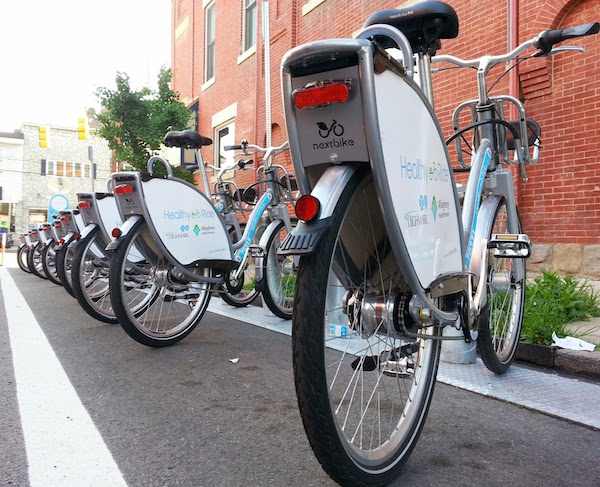
Healthy Ride bicycle share station in the Bloomfield neighborhood, Pittsburgh, Pa.

Healthy Ride station in Bloomfield

Observant readers will no doubt have already absorbed Pittsburgh Orbit‘s favoritism toward all things bicycle. This blogger loves to ride a bike! He loves it so much that when it’s time for the inevitable maintenance on his own road-ravaged chopper, a dread creeps over. The depression of going even one non-pouring down day without some form of ride so dour that wheels wobble, brakes are worn to nubs, and gears slip on an over-stretched chain for months too long–all so we can defer the separation anxiety that comes from a few days in the shop.

So last year’s news that the city would be gaining a bicycle share program this Spring was triply terrific. First: we’re going to get excited about anything that puts more two-wheelers on the street and more keisters on bike seats. Second: I can take my bike to the shop any time I like and use the new temporary rentals in its stead. Third, of course, is that we can opportunistically turn the whole thing into a right proper blog post. Here, then, is The Orbit‘s early take on Pittsburgh’s brand new bike share program.

Map of Healthy Ride bicycle rental stations (Phase I)

Map of Healthy Ride bicycle rental stations (Phase I) [map: Bike Pittsburgh]

The System

The first phase of the Healthy Ride[1] deployment involves fifty self-serve rental stations and five hundred identical bicycles. All users must have an account and register with a credit card, but this can be done right there at any station. There are a variety of ways to check out a bike: using the station computer, using on-board systems on each bicycle, or with the mobile phone apps. The technology comes to us from a German company called NextBike, which has implemented bicycle sharing programs around the world. Pittsburgh is only NextBike’s second U.S. city, but they run a ton of programs throughout Europe.

Bicycles are rented in half-hour increments and the system is designed for A-to-B transit rides (and not all-day/long-term rentals). You can pay for individual rides ($2 per half-hour) or unlimited rides for month-long periods. With a “basic” rate of $12 / month (unlimited 30-minute rides) and a “deluxe” rate of $20 / month[2] (unlimited one-hour rides), the Pittsburgh system is among the cheapest in the country[3].

Phase I of the rollout is for a concentrated area focusing on downtown, The Hill District, The Strip District, Lawrenceville, Bloomfield, Shadyside, and small sections of the North and South Side. I’m sure if you’ve been waiting for this and live in, say, Squirrel Hill or The West End, you’re going to feel gypped, but the tight grouping of the first batch of stations makes a lot of sense as an alternate public transit system.

Healthy Ride bicycle with vinyl records spilling out of its small cargo basket.

Design flaw: Healthy Ride bicycles are totally unfit for traveling with records.

The Bicycles

All Healthy Ride bicycles are the exact same one-size-fits-all design. They feature heavy “step-through” frames, big tires, front and rear fenders, lights, adjustable seats, a bell, and a small (maybe too small) front basket. The bikes are all seven-speeds, meaning they’ve theoretically got enough gears to climb hills and run at a good clip when you build up speed. Riders must supply their own helmets.

I found a couple challenges with the design. Namely that for this six-foot-five biker, even with the seat raised to its maximum height, I couldn’t get full leg extension. This, along with the heavy weight of the bike, made going up hills a little rough. Also, the anatomically aware will know that men and women have different shaped pelvises (pelvi?), which is why bicycle seats come in two very different basic shapes. The Healthy Ride system opted for women’s seats across-the-board–which makes sense–but presents a certain discomfort to the dudes of the species.

All that said, the bikes were all in fine condition (with one exception), will likely work great for the average rider, and they’re fun. Take one out any time soon and you’ll also get a lot of attention: I was stopped by pedestrians, drivers, cyclists, one 8 a.m. drunk, and one in-transit PAT bus driver–everybody was curious and wanted to either ask about the program or tell me what was wrong with it.

NextBike employee restarting a Healthy Ride station, Pittsburgh, Pa.

NextBike employee Tom rebooting the Children’s Hospital station

The Technology

As a “technologist” by day[4], I am in awe of all the moving parts (literally!) involved in the system–50 stations, 500 bicycles, multiple payment options, onboard computers, the web site, iOS and Android apps, rental maintenance, etc. I experienced a couple of glitches along the way, but given this was only the system’s third week out of the gate, it performed admirably.

A couple times in my maiden voyage I found that bicycles parked at stations and flashing their “available” lights were, in fact, not rentable. No explanation on what was going on, but I can recommend the app feature where you look at an individual station and see which bikes it actually knows are parked there. After that first day, I didn’t see this problem again.

Another time, I arrived at the Children’s Hospital station to find NextBike employee Tom having to repeatedly reboot the system and test whether it was going to process check-outs.  This allowed me to ask a bunch of questions while we waited for the system to restart, eves-drop on his call back to Leipzig, and surreptitiously bag a photo for the blog. [Tom got me back: he filmed our band marching during the Open Streets event last Sunday.]

Another obvious issue they’ll have to work out is the distribution of bikes. I found that the station I was checking-out from (Penn & 42nd Street, by Children’s Hospital) had fewer and fewer bikes each day until on my final Friday there was only one rental and it turned out to be unridable (the rear fender was severely bent into the back wheel and I was unable to fix it; I ended up walking to Bloomfield and checked-out from the station by Crazy Mocha).

By contrast, the station I was usually returning to (Butler & 42nd Street, across from Hambone’s) was nearly always full. This is likely no accident–I have a feeling the system will regularly experience the higher-elevation bikes draining and welling up at the bottom of hills. Those seven gears are just not enough to get a lot of part-time riders up steep grades (especially after they’ve spent the evening at Hambone’s!). Stations in flatter areas (Bloomfield, Oakland) seemed to be more consistently medium-stocked.
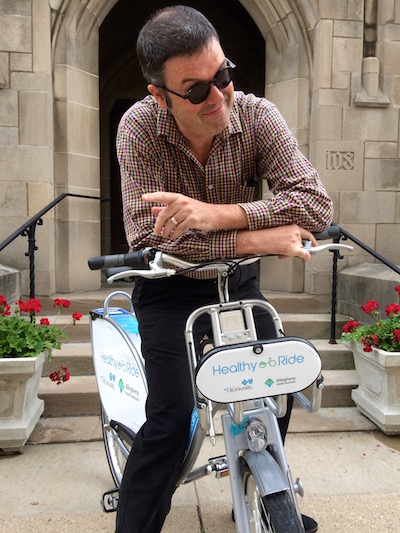
rider posed on a Healthy Ride rental bicycle, Pittsburgh, Pa.

Not dorky at all. Some dude with a rented bike. [photo: Lee Floyd]

Final Thoughts

It’s very hard to tell, but anecdotal observation suggests that people are using the system and that its rollout has been smooth enough to claim some level of success. Pittsburgh presents a lot of challenges for experienced cyclists–steep hills, tight streets, rutty roads pockmarked with potholes, few designated bicycle lanes, much unfavorable weather–so loosing a bunch of non-riders on city streets with unfamiliar bicycles seems like it’s not going to end well for everybody. But then, neither does automotive travel.

If allowed to succeed, it seems like the program will inevitably grow interest in cycling and more awareness of bicycle needs in infrastructure planning and design, which are all good things in The Orbit‘s book.

I plan to maintain my “deluxe” subscription partially because I want to support the program (even though I own a bicycle) but also because I can imagine a ton of scenarios where I can legitimately put a short rental to use. Plus, it’s cheap. If you haven’t given it shot, we suggest you do. Happy (and healthy!) riding to you!

Footnotes

  1. “Healthy Ride” is a pretty square name, but I imagine the underwriting from Highmark and Allegheny Health Network played into the branding.
  2. Though monthly, the rates require a minimum three-month signup commitment.
  3. I started looking into comparison pricing against other bike share programs, but with each city having their own rental time windows, subscription terms, etc. this quickly became a fool’s errand. The claim that it’s “among the cheapest in the country” seems legit, though.
  4. Not a good one.

Recording Existence: Life Logging with Weird Paul

Weird Paul with his personal archive

Weird Paul at home with his personal archive

Today, Pittsburgh Orbit celebrates a small milestone: this is the blog’s fiftieth post. That half century occurred in almost exactly six months, making The Orbit on an optimistic hundred post-a-year trajectory. I don’t know if that’s a believable or sustainable or even desirable pace, [likely not, we’ve got vacation coming up] but it’s still fun, and it’s still motivating, and there is no lack of things to (un)cover. Dial up another fifty!

Why make this big spiel about digits? Well, today’s story is all about numbers, as well as lists, and collections, and memories, and personal archives. We’re going to get into all of that with a guy who was prescient (or obsessive) enough to start recording and collecting the minutia of his life at a very early age and has kept it up for thirty-some years with no signs of slowing down.

Journal entry reading "stayed home 'cause of cruddy diarheaa not much happened"

Journal entry from 1985

Weird Paul Petroskey is a prolific Pittsburgh musician, raconteur, video-maker, and now television variety show entertainer. But before he got into any of these things, he was documenting himself and the very immediate world around him.

Paul’s habit began with cassette tapes and his father’s tape recorder, graduated to recycled day planners-turned-diaries, and eventually found him filming hours upon hours of videotape and filling entire notebooks with aspirational accomplishments and neurotic achievements. This old schooler has gone full Web 2.0 with his own YouTube channel, Vine, etc.

The Orbit sat down, stood up, took pictures of, and ate Fiore’s Pizza with Weird Paul wherein we got to dig through all the primary sources and see exactly where the magic continues to happen.

video still of teenage Weird Paul from the 1980s

The “Original Vlogger”, a teenage Weird Paul on video, sometime in the 1980s [photo: Weird Paul]

It all started with movies. As a young teenager in the 1980s Paul’s first love was film–especially the weird stuff. With the acquisition of The Psychotronic Encyclopedia of Film–a guide to all things horror/exploitation/sci-fi/B (before the Internet democratized such knowledge)–he began creating separate lists of all the movies he wanted to see, along with encapsulations and ratings of the ones he managed to get to. This list is maintained to this day.

As Sir Weird-a-Lot tells us, he’s “seen 8,460 movies; 2,318 of them are listed in the Psychotronic Encyclopedia. 813 of the movies were either produced in Italy or directed by an Italian. The actor who appears the most is Christopher Lee (98). The most watched actress is Marianne Stone (68).” Paul keeps the films watched list in a special large spiral-bound notebook with his own star-based rating system.

His Weirdness estimates that he owns over 4,000 movies, most of them on around 1,000 VHS tapes. (Sorry, no exact figures here–he stopped keeping this particular stat twelve years ago.)

Hand-written entry page from Weird Paul's movies watched/rated journal

Entry page from Weird Paul’s movies watched/rated journal

The Weird One got into music in short order and there are a ton of videos where Paul assembled his younger siblings into what would become known as “fan videos” lip-syncing and/or acting out current top 40 hits of the day. The likes of Falco, Rod Stewart, RUN DMC, and Lindsey Buckingham all get their due. Then Paul discovered metal.

A great recent video titled “Heavy Metal Memories” recalls The Weirdmaster General’s obsession with Pittsburgh’s first all heavy metal radio, K-Rock 107, its quick rise and fall, back in the day. The fan videos continue, but now include black leather, eye makeup, head-banging, and the occasional thrown goat. Between these two eras, you’ll not find a better encapsulation of white suburban America in the 1980s.

Weird Paul outside with an acoustic guitar

Wading in the weeds with Weird Paul

The avalanche of Weird Paul songwriting, recording, and self-released cassettes begins somewhere in here too. They’re all there: non-stop party rock classic cassettes like In Case of Fire, Throw This InI Need a Pencil Sharpener, and Now I Blow My A-B-Cs. Thanks to Paul, no one can ever again get a piece of meat in their Tang without firing up the earworm machine.

Dr. Weirdenkranz tells us: “I’ve written or co-written over 750 songs – including parodies. I don’t have an exact number, because I was up to 750 but I haven’t added in a few from the new album Ben [Blanchard] and I released [PP2BB].” These amount to literally dozens of album-length cassettes, LPs, seven-inch singles, and compact discs. He’s performed live exactly 527 times.

Stacks of journals/lists

Stacks of handwritten journals/lists

Weird Paul’s musical oeuvre is an enormous subject unto itself, so we’re not going to attempt to cover that here (at least, not right now). Suffice to say he’s the consummate showman and promoter with many avenues of access.

The Weird Paul Variety Show is a whole lot of fun and thoroughly Orbit-approved. It airs Thursdays at 7:30pm on Cozi TV Pittsburgh (59.1 through the rabbit ears) and on Verizon Fios channel 463. [No: you can’t just watch it on the Internet machine.] Check out the Variety Show for a steaming hot serving of Weird Paul and the gang.

Weird Paul in front of the videotape archive

Weird Paul with the videotape archive

Frankie Files: Where’d You Go, Joe?

St. Michael Church, Munhall sans statue of Saint Joseph the Worker

St. Michael Church, Munhall sans statue of Saint Joseph the Worker

Superfan-turned-Munhall Bureau Chief Lee Floyd files his first story for The Orbit with a classic Pittsburgh who-done-it? and where-did-it-go? on a great piece of religion-meets-industry history from the former steel capital of the world.


As a tot, I was cruisin’ around Munhall in Cathy (my mother’s third-owner Cordoba) and watching the power lines move like waves with each pole we passed. Suddenly, I exclaimed, “There’s the Statue of Liberty!” Wrong state, wrong artist, wrong blog! I said it, and my family never let me forget it.

While he didn’t create anything quite as well-known as Lady Liberty, Frank Vittor (1888-1968), Italian-born sculptor and artist, has at least 50 works in and around the Pittsburgh area, including the prominent icons of Schenley Park and Bucco Field. The piece that many Steel Valley residents remember most-fondly is the statue of St. Joseph the Worker. High atop St. Michael’s bell tower, he was certainly hard to miss by anyone passing through the area.

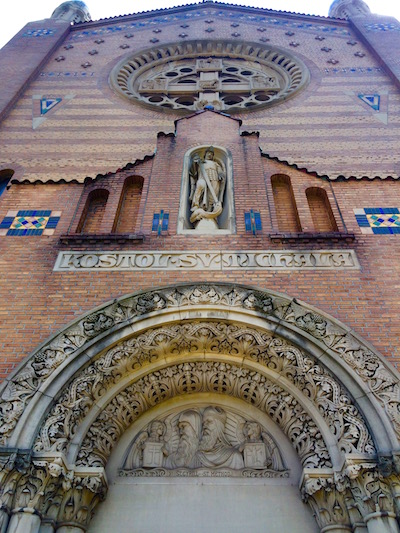
Front of St. Michael Church featuring tympanum, figure in a niche, and rose window

Front of St. Michael Church featuring tympanum, figure in a niche, and rose window

The Slovak St. Michael Parish built the eponymous church in 1927. Though adorned with beautiful sculptures and architectural details, it was not until 1967 that the church acquired the statue of St. Joseph the worker for its impressive bell tower.

Six parishes, including St. Michael, merged to become St. Maximilian Kolbe in ’92. Eventually, the building closed beneath him and the statue ended its 44-year lofty exhibition in January 2010. Though he ended up about a mile away at the new home for the St. Max parish, some people may have thought he skipped town. Now I’ve heard that a saint’s feet don’t touch the ground, and while that my technically be true in this case, one could argue that his pedestal shouldn’t either.
Saint Joseph the Worker statue by Frank Vittor

Saint Joseph the Worker by Frank Vittor in its new location at St. Maximilian Kolbe

“After designing a six-foot-tall plaster model, Vittor sent it to the Bruni Foundry in Rome for casting in aluminum and then to the Vatican for a papal blessing by Pope Paul VI. The sculptor viewed this final statue as another permanent tribute to the working man that he so admired. When Vittor passed away two years later, his Saint Joseph the Worker capped a prolific career…” (Iorizzo, Rossi 153)

I can’t think of a better tribute to the working man of Pittsburgh than what appears to be ladles of molten steel dumpin’ dahn on the world with flames shootin’ aht da back. Typically Joe carries a small wooden L-square and a woodworking tool or staff of flowers. In this case, Vittor fitted him with a badass riveted bar of steel and modern working boots. Now you should also roll up your sleeves and get back to work.

Photos and text by Lee Floyd.

St. Joseph the Worker statue detail of steel cauldron

Why the equator is hot


An Orbit side trip: Reading Lee’s piece and seeing the molten steel pour down on the globe, we couldn’t help but think of one of our favorite, beautifully unfortunate corporate identities: Sherwin-Williams Paint’s old “Cover the Earth” image that perversely renders nearly the entire globe dripping with blood red Sherwin-Williams paint, as if this were an ideal world to strive for.

According to the Sherwin-Williams history/timeline, the concept goes back to the 1890’s, so we can’t claim they were biting Frank Vittor (although Frank may well have been aware of Sherwin-Williams). A special side note to this side trip is that “The paint…is not pouring over the North Pole, as we tend to assume, but over Cleveland, Ohio, the center of the paint universe.” No comment.

Sherwin-Williams "Cover the Earth" identity showing a can pouring dripping red paint on the earth

Sherwin-Williams “Cover the Earth” identity

Sources:

The Pizza Chase: Sir Pizza

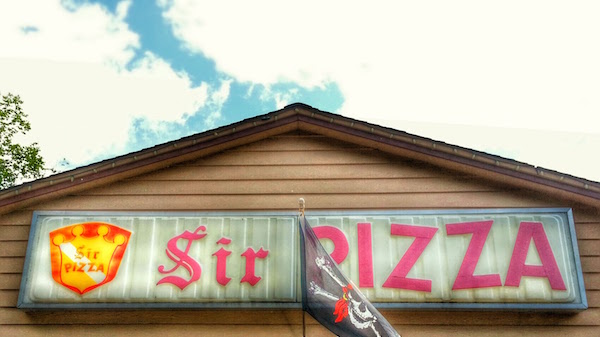
Sir Pizza storefront sign

Ross Township Camelot: Sir Pizza

“Good day, m’lord! What doth though requireth for thy after-noon repast?”

“Knave: bring forth your lordship a pair of this establishment’s esteemed ten-inch pizzas–and may they resemble the handicraft of the time-honored artisans at Totino’s in all possible ways!”

“Very good, sir! How wouldst thou prefereth to decorate thine pies and enliven thy spirit?”

“Adorn the lady’s with olives black and your finest banana peppers.”

“Of course. And for thou, sir? What extraordinary combination suits sire today?”

“Allow me to bloweth thy mind with coating true, twixt sausage and multi-colored peppers.”

“Such an extraordinary request your humble servant has never encountered! Raise the flag and open the hearth! An order from the king!”

O.K. Ordering at Sir Pizza wasn’t quite like that, but I think it’s fair to say we were treated like some demi-royalty.

Last month, when we introduced The Pizza Chase with Beto’s Pizza we made it clear we were looking for pizzerias that did things in some fundamentally different (though, not necessarily better) way. The people spoke, The Orbit followed-through, and below are our questions (if not yours) on Sir Pizza answered (and not) to the best of our ability.

Sir Pizza 10" pizza with black olives and banana peppers

Is Sir Pizza a chain?

Yes…wait: no…maybe? The Orbit‘s crack research team spent no small amount of time attempting to answer this seemingly-simple question and came to no definitive conclusion. As far as we can tell, Sir Pizza started in 1957 in Indiana as Pizza King and operated as a chain up through at least the early 1990s. From there it gets hazy.

Sir Pizza-Pittsburgh has three locations–all in the North Hills. We visited the “original,” started in 1975 in Ross Township. But a search for Sir Pizza reveals other similar shires scattered around the eastern half of the United States–two in Michigan, five in South Florida, some South Carolina chapters, an outpost each in Kentucky and Tennessee, etc.

There seems to be no central dominion to which the individual restaurants pay tribute. The marionettes appear to have cut their own strings, leaving independent fiefdoms that may or may not resemble each other, but certainly don’t acknowledge any connection publicly.

Sir Pizza crest logo

The royal crest of the Kingdom of Sir Pizza

What’s with the whole ‘Sir’ thing? Is this medieval pizza?

Another interesting ponderable with no clear answer. Sir Pizza’s commitment to the whole lords in sauce/knights of the round pie pan thing is shaky at best. There’s the calligraphic “Sir” in the signage, the crest/shield logo, and a smiling cartoony knight tipping his armored visor on the menu, but other than that you’d swear you were back in any old suburban pizza parlor in a squat New World strip mall. Black and white photos of “la familia” take up one wall and nods to various local sports teams are positioned around the dining areas. On decor alone, it could as easily be Italian Wedding Pizza, or High School Football Pizza.

close-up of Sir Pizza sausage and pepper pizza crust

“Good to the very edge”

The pizza

The only previous time this hungry blogger experienced Sir Pizza was years ago as payment for helping to move a giant 1970s-era recording console from Turtle Creek to the North Hills. “I almost died and you’re paying me with Totino’s?”, I asked. I don’t even remember if I got a beer out of the deal. [Bill: you (might) owe me a beer!] In retrospect, that assessment is a little harsh–but just a little.

The pizza is on a thin, cracker-like crust with a reasonable layer of cheese and toppings. Sir Pizza claims they use special smoked provolone instead of mozzarella, but these layman’s tastebuds couldn’t discern the difference. The meat toppings, as well as the peppers and onions, were minced into tiny morsels, which again gave it that joie de congélateur allée. The pizzas are cooked and served on cardboard discs.

Sir Pizza uses the tag line “Good to the very edge” which is a nod to the practice of running the sauce, cheese, and toppings all the way out to (and over) the pizza’s perimeter. It’s a nice gimmick, but I couldn’t help but think it’s really a mask for a completely uninteresting flat crust that wouldn’t survive on its own.

Our Pittsburgh-born Wisconsin-based correspondent Murphy informed us that all of these qualities–the cracker crust, the minced toppings, the hidden edge–are all hallmarks of a more general “midwestern pizza”.

The other great midwesterness of Sir Pizza’s product is the curious way the pie is cut. Instead of the familiar wedge-shaped diametric slices one expects, the pizza is cut on a loose grid: two cuts in one direction, three the other. But because the pizza is round, this makes every cut an awkward non-standard size. Murphy lays down the pitfalls pretty clearly:

Also and very important is the way they slice it, in little squares called “party style” though it doesn’t sound like a party to me when you have nothing solid to grab onto (like, you know, a CRUST). I would like to further note that using non-triangular cuts means that some people might get stuck with a dinky little side piece and others get a weird gloopy middle piece rather than beautifully uniform, foldable triangles.

Ouch! Ain’t no law like Murphy’s. Just like we said back in our report on Beto’s, when you bake a fresh pizza, even when it’s bad, it’s still good. That basic fact holds true at Sir Pizza. The legion of devoted “Sir-heads” who line up for the trademark pie and defend it with the zeal of South Hills’ “Betonauts” will disagree, but we’re glad they love their local(-ish) pie. The Orbit remains perplexed, but still curious. Mangia!

half-eaten Sir Pizza 10" pizza with sausage and peppers

Sir Pizza’s “party style” cuts


Chet’s Tiny Backyard Dream World

garden with waterfalls and model pirate ship and dock

The Orbit hit pay dirt right away at the great annual Highland Park neighborhood yard sale. The very first stop yielded copies of The Floaters cheese-soul astrology by way of the classified ads slow jam Float On” (the full 12-minute album version). Sadly, thirty-eight years later, Larry is still looking for a woman that loves everything and everybody.

We also found one from that other Larry–Larry Norman and his bluesy Jesus-rock concept album Something New Under the Son (recorded the same year as “Float On”!). So this off-duty blogger slash on-duty record fiend was sated almost before he’d begun.

Of course we soldiered on, following some enticing signs off Highland towards a side street. There, we came to one particular sale that didn’t have any merchandise worth perusal, but the most amazing back yard world opened up behind the sale tables set up along the street.

The house’s owner Chet (we only got a first name) told us that he’s been gradually building this tiny fantasy world for the last thirty years. On the one hand, it’s an outdoor two-or-three-season model train set, but it’s also so much more.

Chet individually hand built huts, log cabins (one includes an outhouse–in use), a church, farmhouse, stable, greenhouse, bungalow with garage, pirate ship, floating river dock, a bridge, surf shack, windmill, and fire tower. He told us he rearranges the train set and building layout every year when the world re-emerges each Spring. And that’s all on top of the permanently-landscaped pair of waterfalls and flowing river that run through and around this part of the yard.

The full eco-system lives outside for the duration of the season with only the thick cover of the giant elm tree over head as protection. It’s miraculous that these tiny wooden houses survive so well. But then again, they’re protected by magic.

model cabin with man in outhouse

backyard train set with model buildings

model house, garage, and old pickup truck

model hut and church

model church and surf shack

model log cabins with waterfall in background

model river scene with bridge and dock

Step Beat: Rising Main, The Longest Steps

Rising Main city steps, Pittsburgh, Pa.

Rising Main Way steps (from hobo camp)

The one and only time he met (then) Pittsburgh mayor Luke Ravenstahl, this future citizen-journalist knew it was a prime opportunity. “What are you doing to save the Rising Main Way steps?” was the sum total of my interrogation. (There was a rumor at the time that Rising Main was slated for demolition.) I got a non-committal response: “I thought those were getting fixed-up?”

Sure: public education and jobs and keeping crime down and paving the streets are all important things, but The Orbit will argue all day that the city steps (in general) and Rising Main Way (in particular) are a historical and cultural treasure that should be maintained and protected the way we preserve the Fort Pitt Blockhouse or Pitt’s little log cabin.

Intersection of Rising Main Way and Toboggan Street, Pittsburgh, Pa.

View from base camp: the intersection of Rising Main Way and Toboggan Street

In the world of city steps, Rising Main Way is the big Kahuna, the alpha and the omega, the most colorful single crayon in the box. At 371 steps, Rising Main is not just the longest stretch of city steps in Pittsburgh, it is among the longest sets of community steps in the country. To put it in perspective, it’s something on the order of a fifteen to eighteen-story building, built straight up a steep hillside, and now totally surrounded by nature. And it’s less than two miles from the center of downtown Pittsburgh.

Two sets of steps of city steps in Pittsburgh, Pa.

Two sets of steps: Toboggan Street (foreground) and Rising Main Way (back)

Getting there: There are a couple different ways to approach the Rising Main steps. Probably best for the first-timer is to drive/ride to the very end of Howard Street (off North Avenue, North Side), park/lock up anywhere and plan to just do an up-and-back. It will be plenty.

That said, there are a ton of terrific steps throughout Fineview and a lot of great things to see when you’re up there, so the more adventurous could plan one of many possible longer routes around. The Orbit will most certainly be back to describe some of these possible journeys.

Former home foundation in Pittsburgh, Pa.

Forgotten foundation

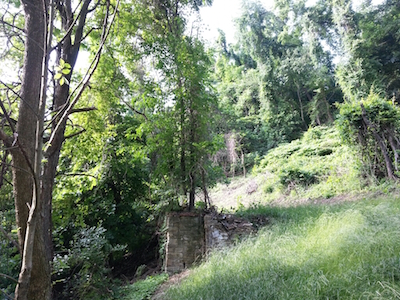
One of the fascinating things about any step hike is the amateur archeological survey one inevitably ends up on. At one time there were dozens of properties that lined the hillsides of both Rising Main and the shorter Toboggan Street. Today maybe eight houses still stand, and only a few of these appear to be occupied.

Along the way up, you’ll see plenty of evidence of these former homes: if their sandstone foundations and crumbling walkways don’t give them away there are obvious breaks in the step railing that show where there was an entrance point from the steps to a property. Some of these inevitably become hobo camps or teen drinking hangouts. If you’re lucky, there’s evidence of witchcraft.

That houses were only accessible by the steps is certainly not unusual–you still see many of these around. But the thought of being half-way up or down this particular incline, needing to haul your groceries the equivalent of, say, eight or ten stories to your front door, is pretty amazing. It’s romantic to think of the houses built in this environment, but the reality would certainly be challenging. It’s no surprise that few of these homes remain.

View from Rising Main city steps, Pittsburgh, Pa.

View from half-way up Rising Main city steps

The original purpose of the steps was of course a means of commuter travel from the many high hills (where people lived) to the valleys and flats along the river (where they worked, shopped, prayed, and played). Some of the steps still serve this purpose, but Rising Main certainly does not. Plenty of people live in the Fineview neighborhood (at the top of the hill), but there’s really nothing to walk down to anymore.

The project that built I-279 in the mid-1970s ran right through the industrial and commercial heart of the valley that separates Spring Hill and Reserve Township (on the east) from Fineview and Observatory Hill (on the west). The constant drone of rushing traffic never lets you forget it. The full run of houses that used to line Howard Street (at the base of the hill) have been long demolished (though again, many foundations remain), so there aren’t even any people to visit. [But The Orbit will put in a pitch to visit Pittsburgh’s finest piece of public art while you’re there.]

Stenciled marker reading "371 Steps" for Rising Main Way, Pittsburgh, Pa.

371 Steps

I’ve dragged a lot of out-of-town guests up the steps–and some of them don’t let me forget it! But if I were visiting Pittsburgh for the first time, I’d take a step hike over a trip to the museum, or a ball game, or whatever it is that most people do when they travel. Take The Orbit‘s advice: corral your guests and get their whining-ass kiesters up the steps–they’ll thank you for it later.

View from the top of Rising Main city steps, Pittsburgh, Pa.

View from the top, Spring Hill in the distance

Public Art: The Howard Street Line Painting Tests

Street line test (detail)

Street line painting test (detail), North Side

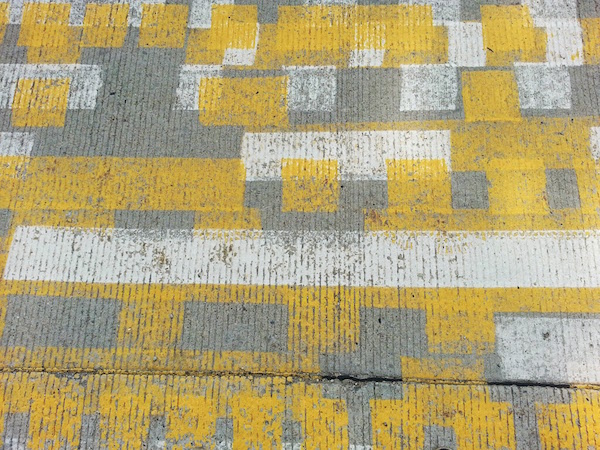
The Orbit doesn’t know what it likes, but it knows art. And we’re going to go out on a limb here and say that this fair city’s very best piece of public art is one that almost no one ever sees, tucked away on a dead-end street on the North Side*. Yes: it’s more exciting than the french fry sculpture, or the Tomb of the Unknown Bowler, or that red paperclip-looking thing, or even Dippy the dinosaur (yes: better than a dinosaur).

Street line test (detail)

Street line painting test (detail)

Back in February, The Orbit did a story on the Toynbee Tiles of Smithfield Street wherein we had the gaul to claim that “it doesn’t get much more ‘street art’ than [the tiles].” Well, this blogger is not too proud to admit when he has erred. The giant Howard Street painting was created right there on the street, by road workers, with special street line painting machines. This time we really mean it: you really can’t get much more “street art” than that.

We can only assume the city Department of Public Works (which has a facility right at the end of Howard Street) created the painting as some kind of test area for applying street directional/lane marking lines in white and gold. Whatever prompted it, the final creation is totally beautiful.

Street line test (detail)

Street line painting test (detail)

What’s miraculous about the piece is that the crew that laid it down stuck to a very particular fifty-or-so foot stretch of road surface, testing back-and-forth, on top of and just next to the previous runs. Howard Street is probably three quarters of a mile long, completely void of any houses or traffic, so the workers could have stretched their tests out lengthwise if they wanted to, but for whatever reason they chose to concentrate their dense repetitions on one contained area, approximately the width of one lane of traffic.

Street line test (detail)

Street line painting test (detail)

The result is a hypnotic series of dot-dash blocks of a common width, but with the off-register overlap of a cheap silkscreen job. Colors fade and flare irregularly where layers intersect, the grooved pavement cracks, and time and tide have done their various things. The big blocks suggest the abstraction of intense pixelization or a more figurative image refracted through raindrops. Staring at them long enough, letting your eye focus go soft, could easily work as a kind of Rorschach test.

Street line painting tests

My only regret is that I didn’t have one of those big Genie lifts on hand to take me up thirty or forty feet in the air to get a proper photograph of the whole enchilada. If I were running the Carnegie International, I’d be tempted to just exhume the whole road surface and bring it in to the big architecture hall. Or maybe they should just hold the International right there on Howard Street. That’d show ’em.

street with line painting tests, Pittsburgh, Pa.

In context: Howard Street line painting tests, North Side

* The Orbit sadly acknowledges that the bar is extremely low for this particular category.

Onion Dome Fever: St. John Church of the Eastern Rite

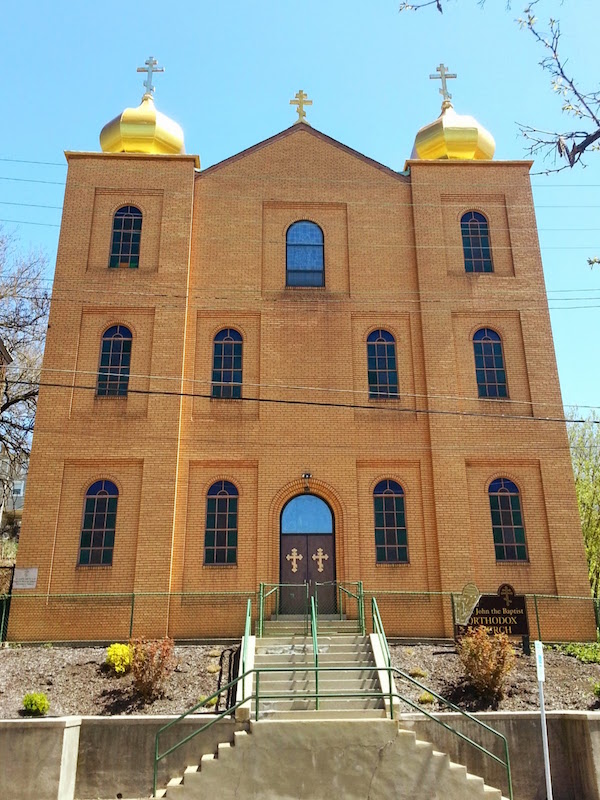
St. John the Baptist church, Pittsburgh, Pa.

St. John the Baptist Carpatho-Russian Church of the Eastern Rite, Marshall-Shadeland

Sometimes life has a funny way of handing out consolation prizes. This blogger was out hunting an elusive patch of historically important heavy metal graffiti and wound up finding religion. I was out looking for Black Sabbath and came back with, uh, actual sabbath. Out for Queensryche, got Eastern Rite. Seeking Slade, got saved. Searching for Slayer, got a savior. Looking for Judas Priest…O.K., this is too easy; you get the joke.

There I was, huffing and puffing my way up and down, back and forth combing through the steep streets and alleys of Marshall-Shadeland looking for a very particular deconstructed garage containing a spray painted history of teenage male hair farmer fandom that I’m starting to think only exists in my dreams (and others’ nightmares). I curse myself for failing to take pictures the first time I came across them (“always record!”) and turn the bicycle toward home in disgrace.

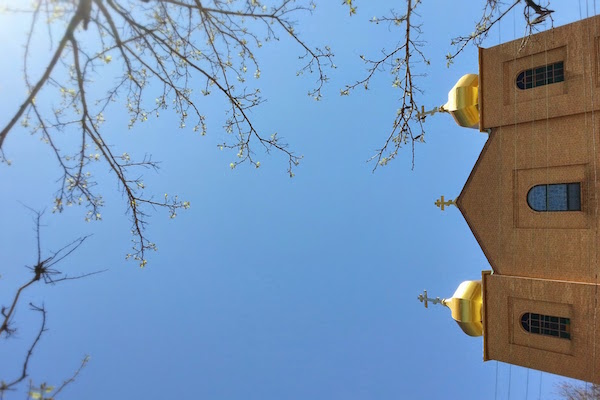
But then, clearing a bluff I’d never been to at the end of Woodland Ave., they popped right out of the sky at me: gleaming onion domes, gorgeous against the perfectly blue early Spring sky, glowing like golden apples in the bright sun.

Detail of onion dome on St. John the Baptist church, Pittsburgh, Pa.

St. John the Baptist Carpatho-Russian Church of the Eastern Rite sits on a lonely stretch of California Ave. It dominates the otherwise two-story frame houses that surround it. The building and grounds seem to be in fine, well-maintained order, but its sign has either been vandalized or severely weather-worn. There is no indication the church is still open Sundays, nor is there evidence of closure. (I was there mid-day on a Saturday and the doors were locked tight.)

Cornerstone for St. John the Baptist church, Pittsburgh, Pa.

Bilingual cornerstone

The church stands an impressive three (very tall) stories, but, other than the showy domes and big Byzantine crosses on the front doors, has a very subdued plainness. That may be a Carpatho-Russian thing, or possibly just a belt-tightening side-effect of its Depression-era construction. I’d love to see inside.

Byzantine crosses on the front doors of St. John the Baptist church, Pittsburgh, Pa.

Byzantine crosses on St. John’s front doors

Probably you’ve whizzed by St. John on your way out Route 65, taking your tube amp to Don for yet another repair at Phil’s TV, or just to peruse the menu of fried items at Miller’s Seafood. Maybe, like me, you never really processed it from the highway, but hopefully you did. Either way, if you find yourself off the main drag, down on California Ave., maybe stick around one time and say hello to St. John. And let me know if you ever find that garage full of graffiti over the hill.

St. John the Baptist church, Pittsburgh, Pa.

St. John the Baptist Carpatho-Russian Church of the Eastern Rite, Marshall-Shadeland