The Meadville PennDOT Road Sign Sculptures, Part 2: The Flower Garden

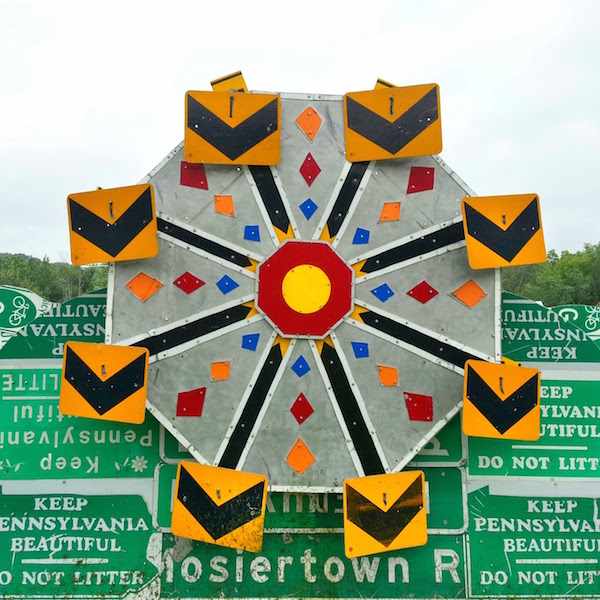
flower sculpture made from one way and stop roadsigns, Meadville, PA

Back in July, we ran a piece on the PennDOT road sign sculptures in Meadville, just up the highway from Pittsburgh. That post detailed the quarter-mile-long fence/mural that stretches down Route 322 and forms the majority of the immense sculptural project on the property of the local highway maintenance yard.

But not all of it. There is so much art in the PennDOT project that we decided to break the story in two parts, with this second post dedicated to the gorgeous flower garden that sits at the corner of Rt. 322 and Mercer Pike/Rt. 102.

flower sculpture made from highway roadsigns, Meadville, PA

It’s interesting that with all its financial backing and oversight, the brand new Whitney Museum was not sited at a location with Sheetz and Dairy Queen franchises on opposing corners. Worry not: no such oversight was committed in Meadville. Why, if the Crawford County art connoisseur and gastronomist wanted both an order of Sheetz’ Pretzel Meltz or Shnack Wrapz paired with a DQ Peanut Butter Cookie Dough Smash Blizzard Treat, well, she’d be all set, wouldn’t she? And what if her old man had a hankering for one of Sheetz Cold Subz or Saladz, washed down with an original Orange Julius? You know he could find that too–hopefully with room for a Peanut Buster Parfait.

flower sculpture made from highway roadsigns, Meadville, PA

In their present form the flowers look like the work of some combination between Dr. Seuss and Dr. Jekyll. All fantasy shapes and riveted steel; eye-popping iridescent reflectors and crudely cut welded metal. These photos may or may not accurately represent the scale of these pieces, so let’s just say this tall blogger was dwarfed by even the shortest of the flowers which easily topped-out at ceiling height.

silhouette of the underside of flower sculpture made from highway roadsigns, Meadville, PA

Trying to figure out which particular specimins the sculptures may represent–or even if they’re modeled on reality–led this blogger down the rabbit hole of Pennsylvania flower identification. Where’s cub reporter Tim when you need him? I won’t claim we came away with any clear IDs, but we’ve got our suspicions.

flower sculpture made from highway detour roadsigns, Meadville, PA

We’re pretty sure we located sweet wakerobin (Trillium vaseyi) in the garden, [note to self: consider “Sweet Wakerobin” for next band name] maybe a sunflower, but, we realized pretty quick that trying to match bent steel that reads Boy Scout Troup 254 to a nature guide is a fool’s errand. Maybe we could put some real scouts to work, you know, scouting actual local flora against these art flowers. Or maybe we should just sit back back with our M.T.O. Chicken Stripz and enjoy the scenery.

flower sculpture made from highway speed limit and direction roadsigns, Meadville, PA

Like the best art, the Meadville PennDOT sculptures are equal parts wonder and inspiration. How did they do that? at the same time as I want to do that! And I truly would love to do that. Maybe all it would take is a pair of tin snips, a couple trips to Construction Junction, and box of Band-Aids. Oh, and that pesky basement cleanout.

flower sculpture made from highway roadsigns, Meadville, PA


Ghost House: Brighton Heights II, The Redemption

ghost house in Pittsburgh, PA

Ghost house: Antrim Street, Brighton Heights

According to one old saw, it takes a lot to laugh, and it takes a train to cry. And let me tell you something: it takes missing a broad-daylight ghost house to bring this blogger to his knees; begging forgiveness from you, dear reader. Mom: you deserve better.

Back in April, we ran our first ghost house story on a particular gem we found climbing the steep McClure Avenue hill from the Woods Run neighborhood to Brighton Heights. Maybe if we’d stopped whining about having to bicycle uphill long enough to look around, we’d have seen the yin to that house’s yang literally right around the corner.

Returning to that same beat this summer we were greeted by this visage on Antrim Street. The outline a classic Pittsburgh two-story, four-room frame with an almost-exact match rear porch/addition glommed onto the back. This one features the added mystery of a second-floor section above the back porch that appears in white paint. What is that? It looks like an addition on top of the sloped porch roof, but that seems nutty. You got me.

Fitzgerald famously said that there are no second acts in American lives, but he had less to say about make-goods from unreliable bloggers. Let’s make this thing right. We got back there; we realized the error in our ways; now let the record be set. I know we can never hope to fully repair the trust we’ve lost in this failure of reporting, but we can try. To you, Antrim Street ghost house, hopefully we’re square.

ghost house in Pittsburgh, PA

Smoky City: Six Looks at the Heinz Plant Smokestacks

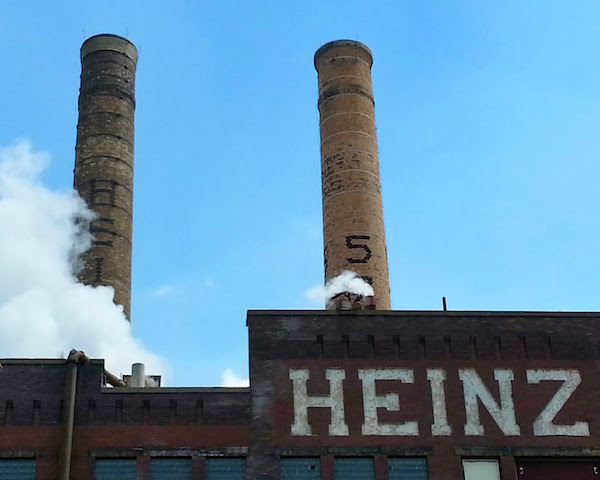
Heinz factory smokestacks with red brick factory buildings

Why do we love smokestacks? [Ladies: don’t answer that! We also love water towers, and rivers, and, uh…doughnuts.] They just look so great! Especially when we no longer have to suffer the consequences of blackened skies and filthy garments and routine emphysema*. It’s like the hollow promise of light beer: all the taste without those pesky calories.

When we started thinking about a series on Pittsburgh smokestacks, there were really just three obvious first world properties to kick off with: the old U.S. Steel stacks in Homestead, Michael Chabon’s “Cloud Factory” in Oakland, and the Heinz plant. Only one of these is on the bicycle ride that separates this blogger from the cheap blueberries and hard Italian cheese in the Strip District, so the choice was made for us.

Heinz factory smokestacks, Pittsburgh, PA

It’s unclear how much of Heinz’ near North Side plant is still an ongoing ketchup-making operation vs. condiment-associated loft housing. At least a part of the facility is security fenced from blogging yabbos like myself and the plant continues to spout a white particulate that suggests vinegar may still be combined with tomato paste on the premises. It’s the kind of place where workers (at least, a few workers) in hard hats still exit at quittin’ time with a cold beer on the noggin. There ain’t no Hunt’s on the table where they’re headed.

Heinz factory smokestacks with new glass and aluminum buildings, Pittsburgh, PA

Like the Washington Monument or St. Paul’s Cathedral, the smokestacks are visible from all over–the Heinz and 57 brick inlays readable from some distance. Almost everywhere on the Allegheny River side of town gets some sort of vantage point.

The Heinz stacks are so omnipresent that most people likely don’t even pay attention to them anymore. On bicycle rides down the river trail I kept noticing how you’d see the stacks from far off up the trail, glimpsed between the newer buildings along the river, from up above on Troy Hill, and down below near town. This was an Orbit story begging to happen.

Heinz factory smokestacks close-up, Pittsburgh, PA

Oh, and happen it will…er, did. In fact, happening it is, right now. I’m typing–I should know! It’s one of those freaky kind of ketchup happenings you read about in the condiment blogs. Dudes in fry outfits; ladies going “hash brownie”; little tykes experiencing colors we never dreamed of. It’s so beautiful! There’s no casting aspersions; just reporting the facts. Lay down thy preconceptions and pick up your spatula: it’s an old-school fry-up and we’re tending the griddle, jack.

Heinz plant smokestacks seen over a mound of gravel in the Strip District, Pittsburgh, PA

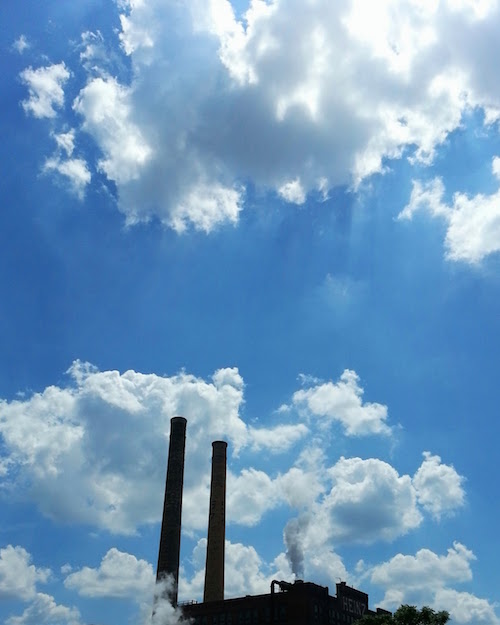
Heinz factory smokestacks silhouette with blue sky and white clouds, Pittsburgh, PA

* Pittsburgh’s air quality is still a mess, but, you know, it ain’t like it used to be.


Step Beat: The Shortest Street in Pittsburgh

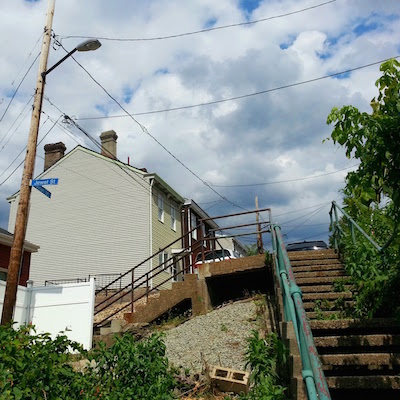
Jewel Street city steps in Pittsburgh, PA

“Little” Jewel Street in Polish Hill: Pittsburgh’s shortest street (we think)

Years ago, this blogger attended a dinner party at a house on the steep hill high above upper Lawrenceville. I remember very clearly that there were fifty-six exterior stairs to get from the street to the (second floor) kitchen door where people entered the house. Man, I thought to myself at the time, that’s a long way up to haul your groceries.

It’s funny to think that one home’s front entrance walk (up) would be four times the length of an official city street, but that seems to be the case. Though I don’t know it for sure, at just thirteen steps, plus one short walkway at the top, tiny Jewel Street* in Polish Hill is very likely the shortest street in Pittsburgh**.

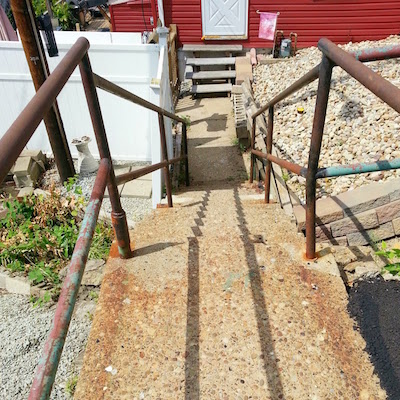
Jewel Street city steps in Pittsburgh, PA

Looking down the full length of Jewel Street, all thirteen steps of it

Back in May, when The Orbit reported on the remarkable intersection of Romeo & Frazier, we got all urbanophysical about what a “street” really is. Little Jewel Street seems to push that notion over the top, and then some. Let’s not worry that no vehicles are traveling on this particular thoroughfare and just consider that it has only ever served one house. There are likely other public streets in the city that have just one address on them now, but I’d wager that most of them were built back in the day when there were rickety worker houses up and down every pointy hill and slanted dale in the ‘burgh.

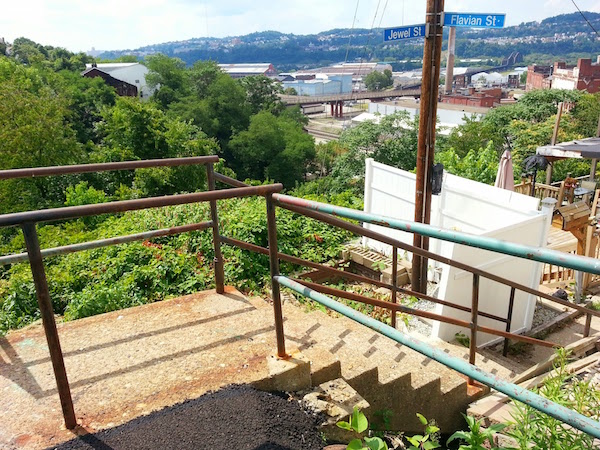
Jewel and Flavian Street city steps in Pittsburgh, PA

Jewel Street from the Flavian Street steps

How the first residents of the only house on Little Jewel Street managed to swing the deal where they didn’t have to build or maintain their own steps is beyond both my knowledge and researching capacity. But if they hadn’t, Pittsburgh would be stuck with some anonymous half-block-long shortest street that no one would even blink an eye at. To you, Little Jewel Street, keep on keepin’ on. We’re on your side.


* There is a two-block-long alley across Melwood Avenue which becomes a substantial set of city steps, both marked as Jewel Street. But here’s the thing: from the spot we’re talking about, you have to travel down an entirely separate street (the Flavian Street city steps) and make a hard left to get to this other Jewel. Each is an entirely separate entity. Even seemingly all-knowing Google Maps isn’t aware of this set. So we think it’s fair to count the very short residential section of Jewel off Flavian as its own street, despite the repetition in name.

** The Internet has very little to say about Pittsburgh’s shortest street, the main nominations being a pair of streets in the South Side–one of which no longer exists–both well over the length of Little Jewel.

New Kensington Bauhaus: Aluminum City Terrace

Aluminum City Terrace block of two-story units, each with different front yard changes

Lived-in: Aluminum City Terrace today

Our story begins with a breakfast dish that goes by the auspicious name Never Again. Two eggs scrambled, bacon, home fries, and “S.O.S.” (Shit On Shingle). This is then topped with cheese and gravy, all in a fabulous pile-up that makes lunch at Primanti’s look like high tea. Needless to say, David’s Diner in Springdale is Orbit-approved.

We’d booked our resident architecture consultants Charles & Susan for a gorgeous bright Sunday morning poke-see at a site just across the river in New Kensington and David’s friendly staff made sure all aboard were well provisioned for the hard journalism work ahead.

The crew was on its way to Aluminum City Terrace, a historically-significant housing complex that touched the interconnected spheres of World War II, big industry, and mid-century rock star architects. We wanted to see what the place looks like today, who lives there, and how it’s fared in the seventy-some years since it was hastily built back in the day.

Original drawings for Aluminum City Terrace, 1942

[image: Library of Congress]

Nineteen forty-two. America had just joined World War II and the nation needed aluminum (along with lots of other raw materials) for the effort. That meant lots of work for New Kensington-based Alcoa and a whole slew of new factory jobs for the town.

In what was reportedly a lightning development process, ex-Bauhaus  founder/instructors/architects and design world big-wigs Walter Gropius and Marcel Breuer drew up a 250-unit campus of cheap, simple, efficient worker apartments specifically geared to Alcoa (and New Kensington’s) immediate need to house the ramped-up workforce. The location was a beautifully hilly section just outside of town. It was a mere two miles as the crow flies from Alcoa’s plants along the Allegheny River, but must have felt like another world compared to the belching industry and urban grid of the New Ken/Arnold flats.

Aluminum City Terrace two-story units

Have you seen the back? The very utilitarian rear of the two-story units

Seeing the apartment buildings in person, the immediate effect is, frankly, underwhelming. Aluminum City Terrace may have a great history and rich architectural pedigree, but the two-story units basically look somewhere between the kind of no-frills “garden” apartments that sit at the perimeter of many American towns and the independent no-tell motels just a little further out. This is especially true of the buildings’ featureless back sides.

The road that snakes through the complex and swells into various parking areas dominates its midsection with a regrettable amount of pavement. There are many opportunities to include a shade tree, flower bed, or line of shrubs, but the groundskeepers of the Terrace have chosen to keep its midway decidedly foliage-free.

It’s not a great first impression–especially because you’re likely only going to arrive here by car, and that will land you on pavement. Look a little deeper, though, and the Terrace tells a really interesting story, both past and present.

I’ll add that Aluminum City Terrace is no Dwell set piece, either. People live here, and the sense of life is apparent everywhere. In the drying beach towels hanging off the back porches, the kids trampoline and sports equipment strewn about the yard, the incongruous white plastic picket fence added to a single unit. Architects must flip a gripper when they see what real people do to “their” spaces, but this neutral observer found the collision to be most enjoyable.

Aluminum City Terrace plan and elevation drawings, 1942

Good on paper: Aluminum City Terrace plan and elevation, 1942 [image: Library of Congress]

The irony of the complex that Alcoa built (not literally–the federal government actually sponsored the project–but you know what I mean) is that there wasn’t a square inch of aluminum in Gropius and Breuer’s design. That is, of course, because America needed all of it to fight the bad guys. What are now the long louvered aluminum sun shades were originally made from wood. The elevations tell us the odd jutting-out second-floor bedrooms/back porch roofs were first clad in vertical cedar siding (since replaced) and back entrances shielded by sleek flat asbestos board canopies (ditto).

Aluminum City Terrace single-story one-bedroom block

One-bedroom units, each with an integrated back porch and shed

Aluminum City Terrace Activities Center

Aluminum City Terrace Activities Center

Walking through the complex, I was repeatedly struck by the cattywumpus arrangement of buildings. Each individual set of apartments is one of two designs (single floor one-bedrooms and two-story combined two-/three-bedrooms). The only real exception being the unique yard spaces and controlled additions the current co-op owners have created. But with none of the units lining up in any form of metered placement, it gives the place the overall feeling of a child’s building blocks dropped indiscriminately on a (very well-groomed) lawn, or train cars gently derailed, but untoppled.

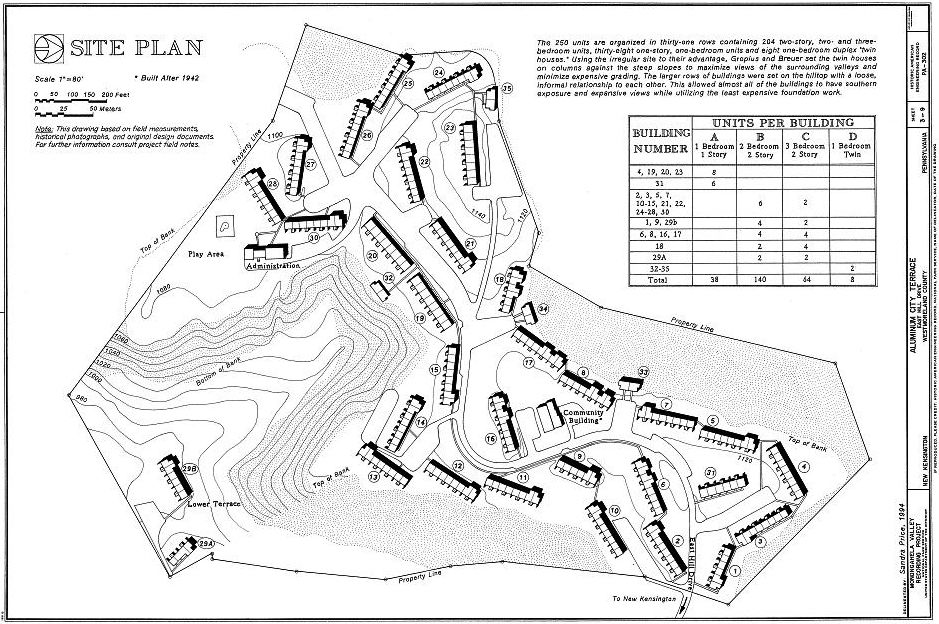
I’m sure the primary reason for this was to follow the natural contours of the land. This part of New Kensington is quite hilly, surrounded by trees, and the plan takes advantage of the location in many ways. But even with that in mind, the site plan suggests there was a conscious effort to break evenly lining up any two buildings–either in parallel or perpendicular–on the grounds.

Aluminum City Terrace site plan, 1942

Cattywumpus layout: site plan, 1942 [image: Library of Congress]

We were fortunate to run across a very friendly family, one of whom happened to be on the board of Aluminum City Terrace. They invited the group into their apartment and showed us before and after photos from a large scale remodeling job they’d done. We also got some background on how the co-op system works there.

Residents must apply, pass a background check, and pay a one-time expense to get into the co-op. They then pay monthly upkeep fees for the maintenance of the exteriors of the buildings and grounds. Compared to more strict co-ops (ex: Pittsburgh’s Chatham Village), the residents seem to have a good amount of leniency in the treatment of their yard spaces, adding trees, fences, all manner of shrubs, flowers, vegetable gardens, etc. According to our hosts, all 250 units are occupied and there’s a waiting list to get in.

And it’s easy to see why. The buildings, sidewalks, its one road, and the grounds are in immaculate condition. This is in stark contrast to seen-better-days New Kensington proper. Our hosts told us their daughter is living in a one-bedroom nearby with other relatives also in the complex and there seems to be a strong community throughout. The Terrace is surrounded by trees and was built in maybe the last age before developers routinely flattened the landscape prior to development, leaving it with terrific rolling ups and downs.

Aluminum City Terrace unit with heavily-manicured front yard/garden

There’s a lot going on here: one of the busier/more heavily-maintained front yards

So…what’s the takeaway? Well, this is the first Bauhaus-related project this architecture-curious (but just a casual fan) blogger has experienced up close and personal. As such, it’s cool to find out it’s here, and it’s so loved, lived-in, and accessible in a very real world way. I don’t know much about Gropius and Breuer, but I hope they’d like most of what they’d see seventy years on. I do.

Oh, and that breakfast? On that, David is wrong: you can bet I’ll be having it again.

Onion Dome Fever: St. George’s Syrian Orthodox Church

former St. George’s Syrian Orthodox Church, Pittsburgh, PA

(Former) St. George’s Syrian Orthodox Church, Hill District

Like the ripe tomato hanging on the vine, seductively whispering “take me, I’m yours.” This fantastic little old-world church, complete with big stained glass windows and its Byzantine onion dome. Sitting empty, literally right in the center of Pittsburgh, up on The Hill. An inevitable fantastic view across the Allegheny River from the rear and an easy walk downtown, mere blocks (O.K., maybe a half mile) away.

As this blogger kickstanded his hog and pulled out the camera-phone, a fellow at the bus stop across the street asked if I was going to buy the place. I told him I wasn’t, but wished I could. What would you do with it? he said. Me: I’d live there.

And wow: wouldn’t that be a peach? I haven’t been inside and can only imagine what it would take to resuscitate a heap like this, but you know it would be incredible. What a terrific little place! We’d be living the dream in Orbit World Headquarters! Ha! Instead, it’s sitting idle and, if not shuffling off this mortal coil, it’s at least finished dessert and asked for the check. Sigh. Maybe we need to make a few calls…

former St. George’s Syrian Orthodox Church, Pittsburgh, PA

It comes in color, too!

A side note: One Christmas, we attended midnight mass at the new(er) St. George’s in Oakland with the Syrian family I was tutoring in E.S.L. at the time. [St. George’s moved from The Hill District to Oakland in 1954.] I can tell you that experience was intense. This ceremony actually started at midnight (not one of those middle-of-the-mall midnight masses), went on for two-and-a-half hours, and was all in Latin. Much chanting, swinging the burning herbs, robes, beads; the whole bit. I’m pretty sure those spirits are all still at it in the old place and I’d love to fall asleep to their ghostly modal Acapulco hymns.

An Orbit Obit: The Myrtle Booth Tanning Salon (Storefront)

Window for former Myrtle Booth Tanning Salon, Pittsburgh, PA

Myrtle Booth Tanning Salon (storefront), R.I.P.

Very recently, the long-vacant storefront at 4116 Main Street in Lawrenceville/Bloomfield finally turned over. By chance, I was lucky enough to have ganked this photo of the most recent business a few months before it disappeared.

Why do I care about an ex-tanning salon? I don’t even like real sun that much! Well, there were just so many little things to love about the Myrtle Booth windows.

I’ve been to Myrtle Beach

Myrtle Booth is clearly a riff on Myrtle Beach, the popular South Carolina beach/party town where many pasty northerners prefer to vacation this time of year. This blogger-to-be used to live just up the coast in Wilmington, NC. In the couple years I lived there, I made the hour-long drive down to Myrtle Beach a number of times, seemingly all for some goofy reason.

I remember driving down with my friends Detlef and David on the former’s quest for plastic pants, a necessary adjunct to the aspirationally-epic rock and roll he was performing at the time. No memory of whether he located them or not. I also remember making the trip with musical pen pal Marion, visiting the southern United States from Great Britain, along with Portland Orbit‘s own David. The parade of signs advertising “shag dancing,” “shag contest,” “shag music,” and just plain “shagging” turned her porcelain English sun-starved cheeks blood red. In the lowlands of the South, nothing could be tamer than shagging, but we understand it means something entirely different across the lake.
Handmade sign advertising shag dancing classes

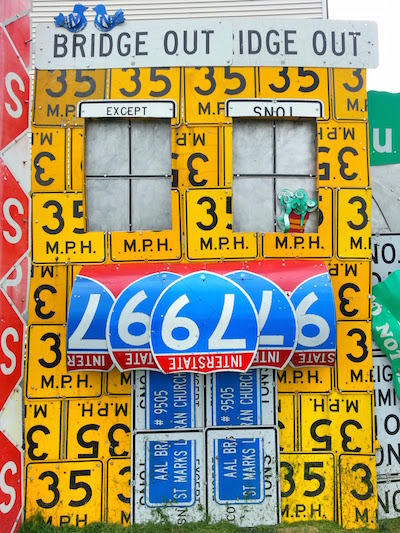
Shag classes in Myrtle Beach: come join in or watch! [photo: the Internet]

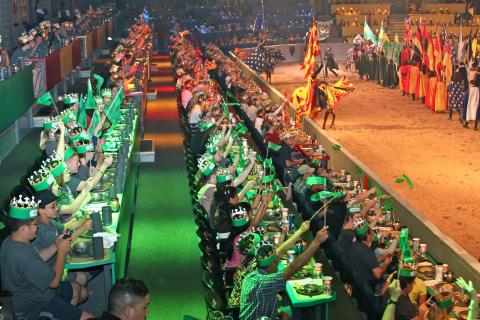
You know what? I was there at least one more time. David (again, Orbit David) (what a prince!) helped me pack up a U-Haul and move from Wilmington to Pittsburgh. My repayment was to take him to Medieval Times wherein we ate giant turkey drumsticks, drank Pepsi products, and watched the pageantry of real humans and horses parading and jousting on the dirt floor of suburban Myrtle Beach sprawl. [Note to those relocating cross-country: an evening for two at Medieval Times is a lot cheaper than professional movers and pretty solid entertainment. Go Green Knight!]

Medieval Times theater/restaurant

Medieval Times: Where you’re the king and the Pepsi products are all-you-can-drink [photo: the Internet]

All this is to say Myrtle Beach is fine, but it’s not the destination I’d name my business after. But then, I probably won’t ever open a tanning salon. As my mother is wont to say, “maybe in my next life…”

Every square inch of their big front windows was painted over

I don’t know that I can name any other business that so successfully blocked out the light as Myrtle Booth. The irony that a tanning salon–in legendarily bleak Pittsburgh, no less–would attempt to thwart real sunlight from breaching its interior is just too great. Maybe people walk around naked in tanning salons? [Note to self: investigate!] I feel like that’s the only plausible explanation for this particular design decision.

The way the window was fallING apart

I can’t remember a time Myrtle Booth was actually open for business and we’ve been in the neighborhood for fifteen years now. You can see that aged wear it the way the white background paint has flaked off and has an amazing art-imitates-life look of loose sand on a wooden surface. I also love the single aborted attempt at graffiti in the pair of small black spray paint runs in the bottom right corner. What happened? Did the assailant just run out of paint at the wrong time? S/he never felt the need to come back and finish the job? Kids these days! No commitment!

Windows for Overcast Skate Shop retail store, Pittsburgh, PA

Overcast Skate Shop, the new occupants of 4116 Main Street

Back in May, we eulogized the relocation of Goeller Generator, a decades-old non-sexy business that cashed-in on rapidly-gentrifying Lawrenceville to make way for new upscale eats and digs in the Sixth Ward. The change from Myrtle Booth to its new life as Overcast Skate Shop is happening in the same general part of town, but with a very different set of circumstances. It’s hard to feel anything negative about a new business moving into to a storefront that’s been empty for so long and we wish them well, but I’ll still miss those big front windows.

The Meadville PennDOT Road Sign Sculptures, Part I: The Fence/Mural

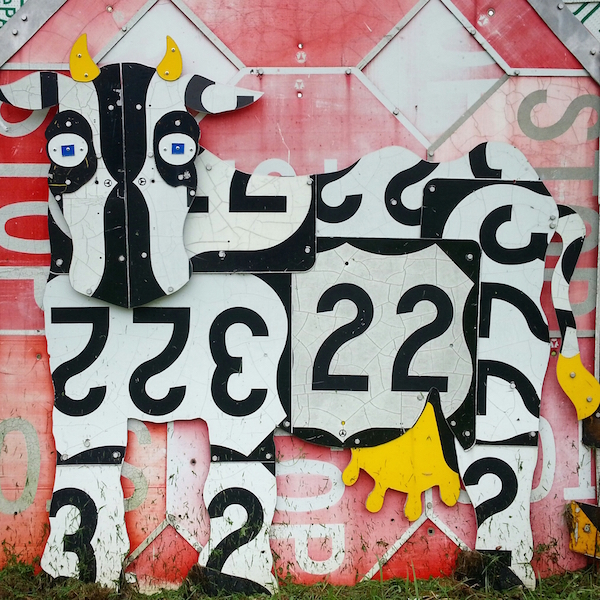
Meadville PennDOT sign sculpture fence detail of cow

It was a dreary, cool, rainy day when The Orbit crew pulled off the highway for some high art and a bag of Combos. We’d describe the weather as very un-summer-like, except it was very much in keeping with this particular summer. This cool-weather-lover is certainly not complaining–give him forty-five degrees and drizzling and you’ll find one happy blogger chortling to himself as he types. That said, we were hoping for a break in the rain long enough to photograph one particular roadside curiosity, and were granted that particular wish.

Meadville PennDOT sign sculpture fence of hot air balloons

Thurston Balloon Classic over Weight Limit Mountain

An hour-and-a-half due north of Pittsburgh lies Meadville, the seat of Crawford County. This smallish town is the unlikely host of an immense collection of sculptures, all in connection with and displayed by the local Pennsylvania Department of Transportation (“PennDOT”) maintenance yard.

Meadville PennDOT sign sculpture fence of barn and silo

Stop barn with Jct silo

According to PennDOT, the fence/mural project and its adjunct flower garden (more about that, later) were conceived by Allegheny College art professor Amara Geffen and Jack Molke, former Crawford County maintenance manager. The actual work was executed both by Allegheny College art students and the local PennDOT workers. It began back in 2001, but continued over many years until the entire maintenance yard fence was covered.

Meadville PennDOT sign sculpture fence detail of great blue heron

Great blue heron

From PennDOT:

The mural depicts life in Crawford County highlighting annual events such as the Thurston Balloon Classic and the Crawford County Fair. Local community landmarks such as the Crawford County Courthouse, Conneaut Lake Park, and Allegheny College’s Bentley Hall highlight the scene. The project depicts life in Crawford County with farm scenes, seasonal scenes and downtown Meadville buildings.

Meadville PennDOT sign sculpture fence of trees

Lane change ahead tree

What no set of photographs will accurately depict is the sheer immensity of this piece. The fence is well over human height and probably reaches up to ten or twelve feet. It stretches some 1,200 feet (approx. a quarter mile) down Route 322 and around the corner. The fence is at once a single continuous piece and also dozens of distinct interlocking sections that each bleed into one another.

Meadville PennDOT sign sculpture fence of singing cowboy on stage

Singin’ cowboy down at the (railroad) crossroads

There are broad strokes like rolling Crawford County hillsides and a series of sections devoted to (downtown Meadville?) storefronts. But the detail on the pieces is terrific with little touches that play with the recycled signage and “Easter egg” details that you’d never catch if you just did a drive-by.

Meadville PennDOT sign sculpture fence house

Bridge outhouse … or Bridge Out house

For all these reasons, it’s really worth parking and taking a walk down the full length of the fence and back. Then, like all great art experiences, you can cross the highway to Sheetz for some M.T.O. and group reflection.

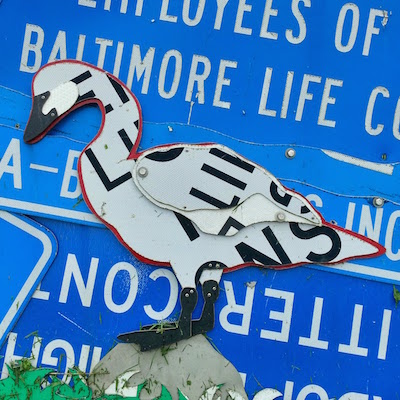
Meadville PennDOT sign sculpture fence of Canada goose

Baltimore Life/Canada goose

Are the sculptures worth a trip from Pittsburgh? They’re pretty great, and no set of photographs is really going to do them justice, so we’d have to say yes. That said, combine them with the next time you’re heading to Erie, or Conneaut Lake, or are just making a run to Meadville’s own Voodoo Brewery and you’ll have yourself a fine combo for your Combos.

Meadville PennDOT sign sculpture fence of merry-go-round

Ferris wheel

Getting there: The PennDOT building and maintenance yard is on Rt. 322, literally just a minute (maybe a half mile?) from the Meadville exit off I-79. The sculptures leap out at you and go on for a quarter mile so you really “can’t miss it.”

Meadville PennDOT sign sculpture fence of clouds, rain, mountains, and tree

Art imitates life: rainy day scene


A Salute to The City of Sad Toys

Stuffed polar bear toy in alley

Bloomfield clip job

I only became aware of Al Hoff’s City of Sad Toys right at the end. So late in the game, in fact, that by the time I started submitting photos, the blog had already ceased to publish any new content. [Note to self: consider Rejected by Sad Toys as potential memoir title.] That was four years ago.

“Sad toys” are pretty much what they sound like: lost, discarded, maimed, or otherwise on-the-loose playthings, often photographed in the comically incongruous settings of other urban flotsam. City of Sad Toys still exists in whatever perpetuity Blogspot grants its lapsed authors, so we encourage our readers to check it out while you still can. Al generously offered to hand the keys over to this Johnny-blog-lately fan, but as we’re more Rupert Pupkin than Rupert Murdoch, we’ll stick to just one global media enterprise.

In Al’s hands, the definition of “toys” was extremely liberal–the blog accepted sports equipment, cake toppers, board games, and party decorations among its sad clientele. This is of course all fine, but The Orbit considers these outliers as merely middle-of-the-mall sad toys; the only real anchor tenants being stuffed animals and downtrodden dolls.

Despite the official blog’s inevitable denouement, our digital shutters never stopped virtually clicking and blogs exist largely for us citizen-journalists to, in Al’s words, “do whatever [we] want!”–including important work like publishing photos of filthy fake fur. Here then, we’ve collected a nice little set of Pittsburgh-area additions to share in this Orbit tribute to a great photo genre: the sad toy.

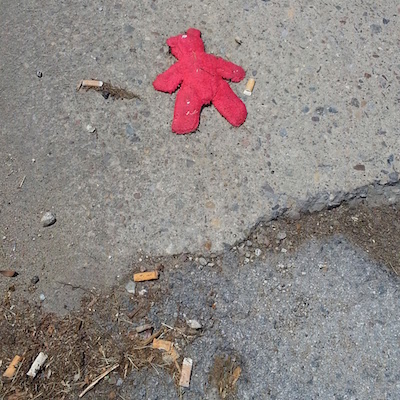
stuffed red toy in street

Red…thing, Oakland

stuffed monster toy on street

Green monster, Oakland

stuffed bunny toy on roadside

Roadside bunny, Rogers, Ohio

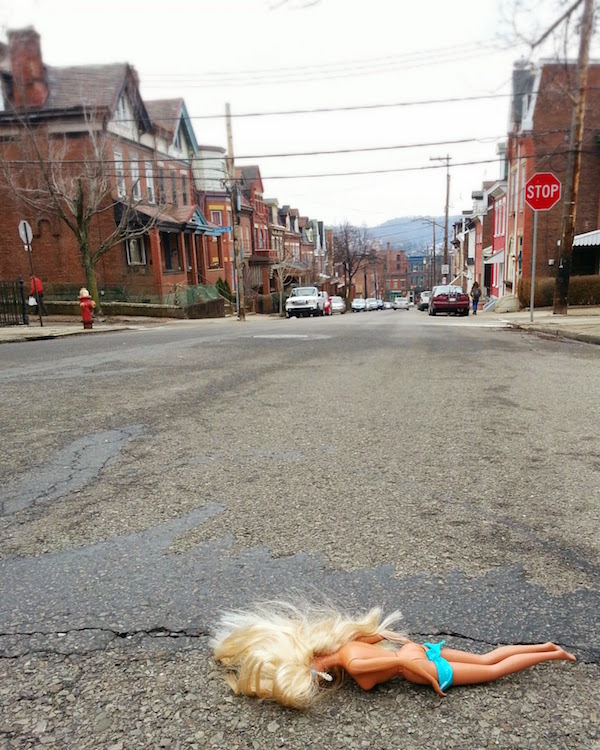
Barbie doll laying face down in street

Barbie hit-and-run, Lawrenceville

Medium Cool: An Orbit Day Trip to Lily Dale Pet Cemetery

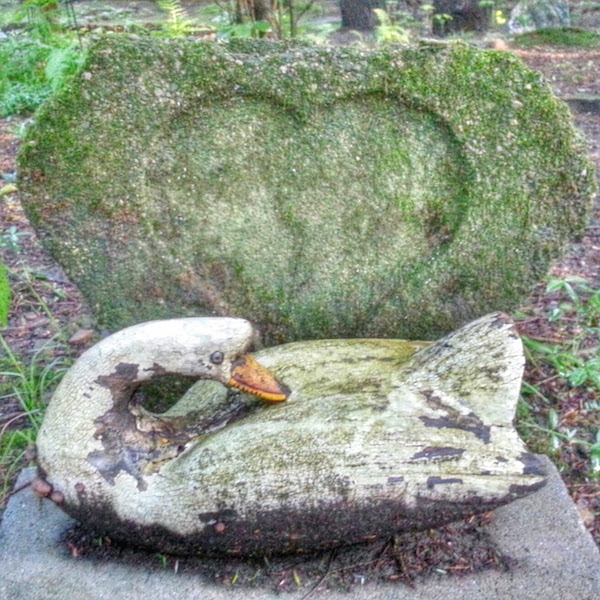
grave marker with a wooden duck and stone heart, Lily Dale, NY

Duck/heart

Far Western New York is certainly outside of what can be reasonably considered “the Pittsburgh region,” but at two hours and change driving time (each way), it’s a doable up-and-back, so we’re going to include this one as An Orbit Day Trip.

Lily Dale (aka Lily Dale Assembly), New York is a picturesque Victorian village that sits on tiny Lake Cassadaga, between Fredonia, Jamestown, and Chautauqua. It bills itself as “the world’s largest center for the science, philosophy, and religion of spiritualization.” While this chakra-curious blogger would be hard pressed to name a larger center for such things, at just a handful of streets, maybe a couple hundred year-round residents, it’s still a little difficult to believe Lily Dale is the largest anything. But we’ll take their word for it.

Trees with prayer ribbons, Lily Dale, NY

Prayer ribbons in Lily Dale

That said, the ratio of psychics-to-ne’er-do-wells is extremely high. Seemingly every other one of Lily Dale’s cottage-houses has a shingle out advertising the services of one or more registered in-house mediums (media?). Lily Dale is also home to the National Spiritualist Association of Churches (NSAC).

The catalog for the June-September workshop programs is ample and either the lecturing-on or attending-of these courses, along with individual “readings” with the aforementioned mediums, seems to be what people do in Lily Dale. Instructors Michele Whitedove, Lee Two Hawks, Shadow Fox, and others with less spectacular names offer courses on subjects like Banshees, Curses, and Little People; Interdimensional Out-of-Body Travel; Orb Phenom–Orbs Are Among Us; Etheric Projection & The Human Energy Field; The Art of Using Pendulums, Dowsing Rods, Sticks & Stones; and Spoon Bending.

Forest Temple, Lily Dale, NY

Forest Temple

While The Orbit generally subscribes to a “when in Rome…” philosophy, we’re also too skeptical (and too cheap) to pay $45 (the going rate for a two-hour workshop) to get our Laugh-a-Yoga Leader Certification. Whether all this New Age stuff strikes your divining rod or seems like a bunch of hooey, Lily Dale is absolutely a lovely and magical little place to visit. The whole landscape is completely enmeshed in tall woods and seems bathed in the gauzy soft light of an Elfin dreamland. We skipped the lectures and stuck to nice walks of the town, lakefront, Forest Temple, Inspiration Stump, Fairy Trail, and pet cemetery–all recommended.

wooden cross grave marker for a pet named Mutlee, Lily Dale, NY

Mutlee, 1988

This was The Orbit‘s first trip to a legit pet cemetery, but hopefully not our last–we’re hooked! Lily Dale’s goes way back. The earliest dated stone we saw was from 1920, but I got the sense it was considerably older than that. There are hundreds of graves in the small forest clearing where the cemetery stands. The markers range from professional chiseled stones with names, dates, and epitaphs, to crumbling homemade crosses, sculptures, cast concrete, and painted rocks.

Here are some of our favorites:

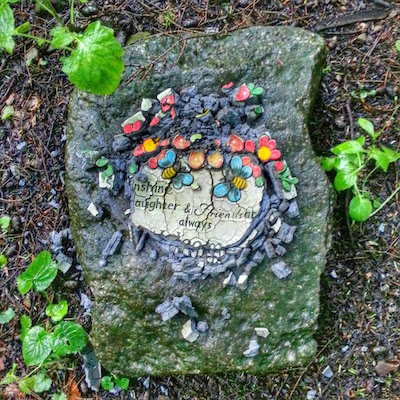
stone grave marker for pet with disintegrating tile, Lily Dale, NY

(Su)nshine, (l)aughter & friends ar(e) always (welcome)

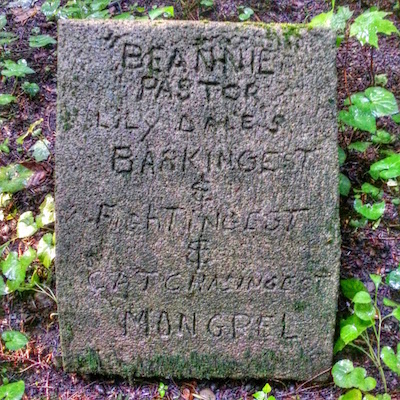
cement grave marker for pet, Lily Dale, NY

Beanie Pastor: Lily Dale’s barkingest & fightingest & cat chasingest mongrel

stone grave marker for a chipmunk, Lily Dale, NY

The cemetery’s newest marker: Friend and Teacher, 6-29-15

stone grave marker with pet's name "Fluffy", Lily Dale, NY

Fluffy

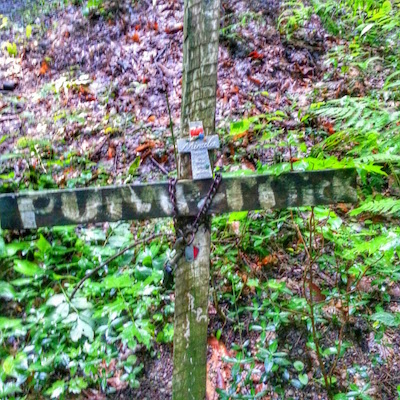
wooden cross grave marker for a pet named Pumpernickel, Lily Dale, NY

Pumpernick(el)

Getting there: As mentioned, it’s somewhere around two-and-a-half hours drive from Pittsburgh to Lily Dale. Likely a lot faster if you can travel interdimensionally out-of-body, but we’re old-fashioned. There are numerous inns, beds and breakfast, and one old hotel on the grounds. But really, if you’re not attending the seminars, you can probably see everything you need in a few hours–it’s just not that big. There are two non-fancy/grab-and-go restaurants, one coffee shop, and one general store in the town.

Also be warned that there is a steep ($12 per person per day) gate fee to get on the grounds. My advice to the casual visitor would be to park somewhere outside the gate and see if they’ll let you walk in for free.

Sundown at Lily Dale Assembly pet cemetery

Sundown at Lily Dale Assembly pet cemetery