Lord Stanley’s Cupboard

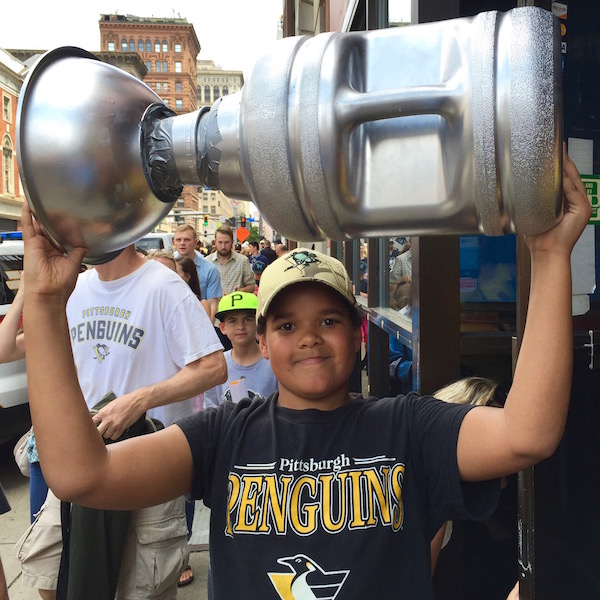
Boy with homemade Stanley Cup, Pittsburgh Penguins 2016 victory parade

To win the Stanley Cup–the legendary trophy of professional hockey’s ultimate championship–is quite a feat. The Pittsburgh Penguins played 106 grueling matches between October 8 and last Sunday, finally besting the San Jose Sharks to become National Hockey League champs of the 2015-16 season. It is the team’s fourth Stanley Cup victory since its inception in 1967.

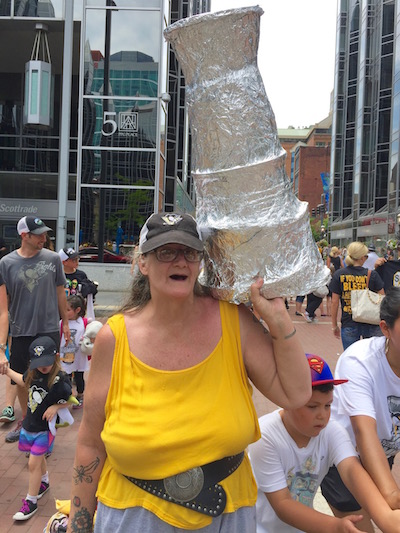
Woman with homemade Stanley Cup, Pittsburgh Penguins 2016 victory parade

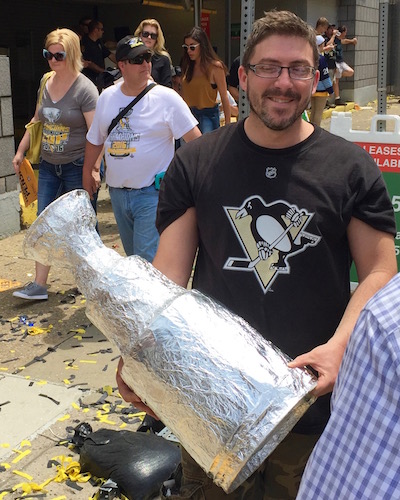
It turns out, though, that to own a Stanley Cup isn’t nearly as difficult. All it takes is a five gallon paint bucket, one medium salad bowl, some duct tape, and a roll of tin foil. Phil Kessel and Patric Hörnqvist no doubt put in countless hours–hell, years–training, conditioning, and carbo-loading for this honor–and they don’t even get to keep the cup! For Jane or Joe Fan, a well-focused half hour in the basement can bring home a fine facsimile of hockey’s ultimate prize. This efficiency even leaves time for some optional carbo-loading of their own. Many of these D.I.Y. Stanley Cups made the trip downtown for the Penguins victory parade on Wednesday.

Man with homemade Stanley Cup, Pittsburgh Penguins 2016 victory parade

It’s a curious motivation, bringing your own faux Stanley Cup to a parade featuring the real deal. What if, say, Michael Rapaport or Curtis Armstrong showed up at the Academy Awards with an “Oscar” homemade from the top of a bowling trophy? Or if, I don’t know, Limp Bizkit or Hoobastank loitered outside the Grammy awards ceremony with the woofer from a boombox nailed into their mother’s jewelry case? Maybe they do–heck, this blogger hopes they do! It would definitely be cool, but also a little weird.

Woman with homemade Stanley Cup, Pittsburgh Penguins 2016 victory parade

Regardless, the fans that create these tribute trophies are obviously dedicated beyond the run-in-the-mill “Gold Rush” shirt-sporters or “White Out” towel-wavers. They sacrificed an eight-quart mixing bowl and a day of vacation to go to town with 400,000 like minds and at least a couple dozen other not-fooling-anyone Stanley Cups. The Orbit wholeheartedly salutes them, their enthusiasm, and their creativity. May we fill Pittsburgh’s cupboards with Lord Stanley’s dishware.

Man with homemade Stanley Cup, Pittsburgh Penguins 2016 victory parade

Hand made banner hung from window reading "Welcome Home Lord Stanley", Pittsburgh Penguins 2016 victory parade

Welcome home, Lord Stanley, we have much of your dishware.

Wheatpaste Roundup

drawing of a pig with the text "Every day is a fresh start" wheatpasted to mail box, Pittsburgh, PA

Shadyside

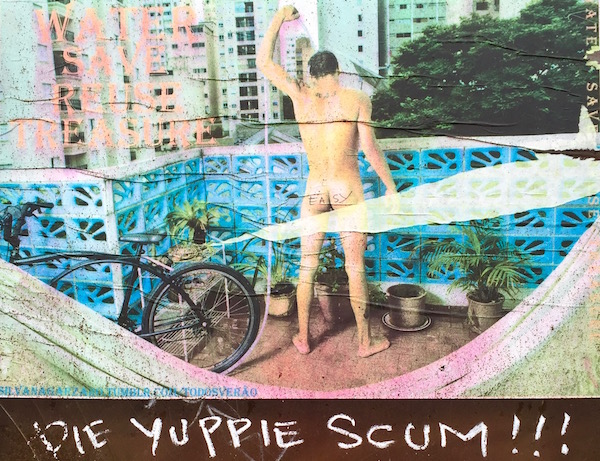
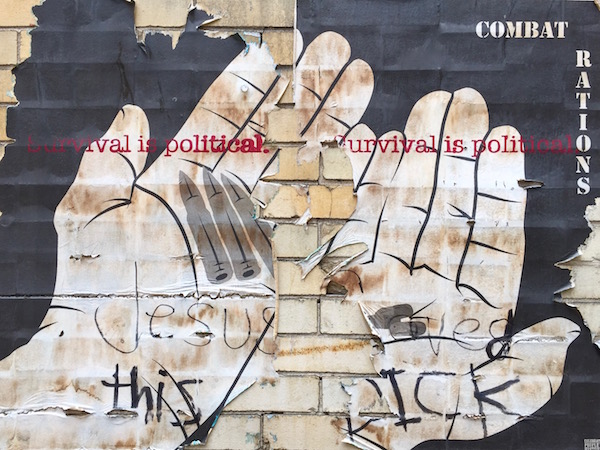
A drawing, some cut paper–maybe somebody else’s poster. A batch of homemade goo cooked up on the stove. It’s the lowest of tech, but when it works, wheatpaste jumps right off the wall–sometimes quite literally as the rough edges curl up, tears form where property managers have fought to scrape them off, or they inevitably fade and disintegrate in the weather. It’s always a surprise–graffiti, sort-of, but also like weird wallpaper. It looks equally good when it’s fresh and new and also when it’s falling apart. Sometimes they even manage to attract their own after market graffiti.

Enough talking about this one–this blogger will just get on with it. Here’s a batch of recent-ish grabs from around town.

image of hand-drawn telephones wheatpasted to glass bus shelter, Pittsburgh, PA

Bloomfield

image of three children wheatpasted to brick wall, Braddock, PA

Braddock

poster of naked man urinating into plant pots with text "Water save reuse treasure" and graffiti "Die yuppie scum!!!", Pittsburgh, PA

Lawrenceville

wheatpaste poster of psychedelic eagle with graffiti "Praise God" and "Survival is Political", Pittsburgh, PA

Downtown

image of circular saw cutting off fingers with the handwritten text "Everybody makes mistakes", Pittsburgh, PA

Bloomfield

image of man with camera wheatpasted to brick wall, Pittsburgh, PA

Strip District

wheatpaste poster of bare hands holding bullets and pills with the text "Survival is political" and "Combat rations", Pittsburgh, PA

Downtown

A Paean to the Disappearing Pittsburgh Protractors

purple protractor with number "500" written on it attached to garbage can, Pittsburgh, PA

The final protractor? #500, river trail, North Side

They’re all over the damn place. Protractors–those same cheap plastic devices we had to pony up for to complete ninth grade geometry–are glued to guard rails, bridge supports, waste bins, mailboxes, lamp posts, and the backs of street signs all over the city.

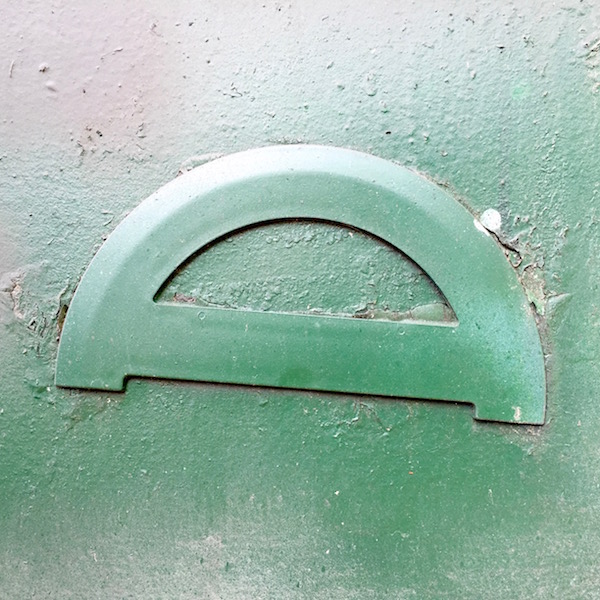
If you haven’t seen them, you either don’t live around here or you haven’t been looking. There are–or werehundreds of them[1]. In the hands of our pranksters/artists/mysterions (take your pick) each of the protractors has been painted a solid color, sequentially numbered by hand in big block numerals, and grafted to every manner of publicly-accessible metal surface.

green protractor glued to graffiti-covered mailbox, Pittsburgh, PA

#100, North Oakland

Until now, The Orbit has resisted writing about the so-called “Pittsburgh protractors”. They’ve been around for a number of years and have achieved a certain level of obscure fame. The phenomenon is well documented in one dogged blogger’s map and database[2]. Even the local TV news got involved. The protractors don’t need us…or do they?

We started to realize that a lot of the old familiar golden, purple, green, and pink arches we’re used to seeing around town are disappearing. Gone are standout creatures of the Fort Duquesne, Smithfield Street, and Hot Metal bridges. Lamppost bases are scraped clean; big relay mailboxes and waste bin containers have simply been painted-over in not-quite-matching colors, sparing the maintenance workers the trouble of decoupling the protractors underneath. When oddity turns into nostalgic despair, that’s when The Orbit steps in.

protractor glued to mailbox, both painted hunter green, Pittsburgh, PA

#273[3], mailbox, Oakland/Shadyside (painted-over)

protractor glued to public waste bin container, Pittsburgh, PA

(unknown), river trail, North Side (painted-over)

What do the protractors mean?

The Orbit has always been content with a state of bemused wonder, so trying to suss meaning out of someone’s goofy art prank doesn’t concern us that much. As the protractor perpetrator(s) have remained mum this long, it’s unlikely we’ll get any definitive answer any time soon–if ever.

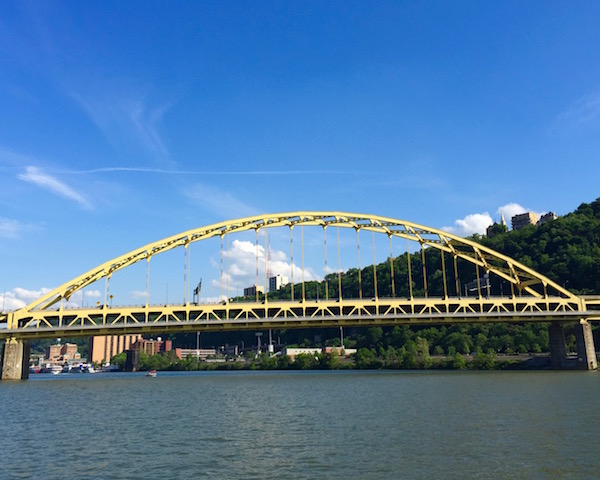
That said, it’s been commonly theorized that the shape of a protractor echoes the gentle arc and twin supports of a standard truss bridge–think the Fort Pitt, Fort Duquesne, or 16th Street bridges. It’s an appealing and believable theory. Pittsburgh is, after all, the “city of bridges,” and the protractors have been applied liberally to many of them.

Fort Pitt Bridge over the Monongahela River, Pittsburgh, PA

Fort Pitt Bridge, possible protractor prompt?

Who put these up?

It sure seems like no one knows–or, at least, no one’s talking/blogging. According on one old axe, “Three people can keep a secret, if two of them are dead.” By this logic, we’re dealing with one lone wolf–but who knows? What does seem obvious is that the person or persons behind this are intimately familiar with the walkable/ridable core of central Pittsburgh.

The aforementioned map contains points almost solely within the East End, Central North Side, and a very small representation of South Side (really just the river trail). We see nothing up in or over the hills, in the suburbs, or, frankly, in the black neighborhoods. There are also no reports from downtown, Squirrel Hill, or Greenfield–but some of this may be the bias of who’s reporting the finds, rather than actual placement.

All this certainly points to a bicycle-rider. There are a ton of protractors along the river trails and probably more along the bridge pedestrian walkways (although many of these have been removed). But beyond that….we got nuthin’.

purple protractor glued to metal blocker on bicycle trail, Pittsburgh, PA

#408, river trail, Millvale/North Side

Frankly, we’ve always had some issues with the protractors. It’s such an interesting and dedicated act of…mystery, but the slapped-on, haphazard approach and application often feels like it falls just short. Why not even them up, add an element, make them sing?

But as we muddled over this story, we realized what a minor gripe this really is. This blogger has great respect for any covert operation that exists for this long without anyone spilling the beans. We also love that the targets are all the city’s forgotten infrastructure–no private property has been harmed in the addition of the protractors[4].

And then, of course, there’s the egg hunt. If this whole thing has gotten even just a small number of dedicated weirdos to take to the streets, bridges, and bicycle trails with an eye out for the curve, well, The Orbit says hats off for the protractor perpetrators getting people off their keisters, into the outdoors, and observing their surroundings.

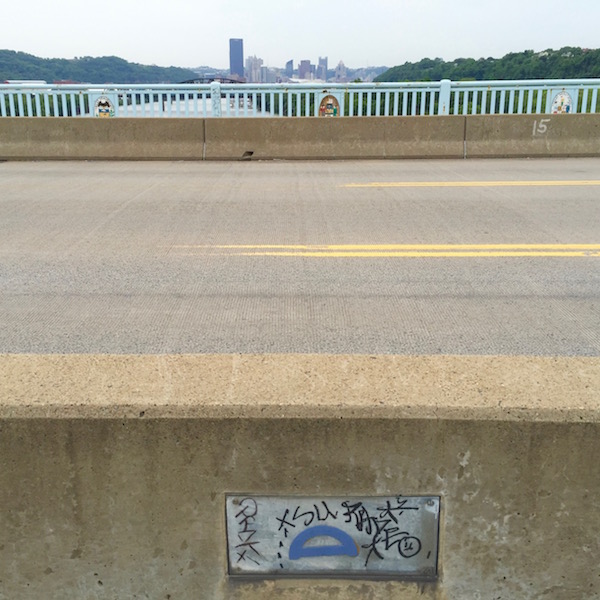
blue protractor glued to metal plate on 40th Street Bridge, Pittsburgh, PA

#303, 40th Street Bridge


[1]  At least 500. But, you know, it ain’t official.
[2]  Just in comparing notes for this story, it was obvious how difficult keeping the map accurate and current would be. Many of the inclusions on the map are no longer there, and likewise many of the (newer?) protractors we located aren’t listed.
[3]  Identification from Eric Lidji’s Pittsburgh Protractor Map, which also includes a photo before the paint-over.
[4]  We wish the War on Google and Facebook is Boring taggers would be this respectful.
Rankin Amateurs

faded mural with a mixed group of people in front of elementary school, Rankin, PA

Rankin Elementary: home of tomorrow’s professionals and today’s friendly aliens

Two of the friendliest alien lifeforms one is likely to encounter wave hello from the distance. Welcome to Rankin! they seem to suggest. The creatures’ giant insectoid bodies are as large as the glass entry doors of an elementary school, comical color-coordinated antennae bob from their big-eyed heads.

In front are a panoply of the borough’s truly fine citizens: a physician, the mayor, 4-H club members, their advisor, and one sullen teenager*. In the background, Old Glory waves spectacularly as a perpetual rainbow gilds the perfectly blue sky.

fading mural with businessman and exterior of Dipcraft Mfg. Co., Rankin, PA

Businessman, Dipcraft Mfg. Co.

It’s one of the Images of Rankin, a series of four large murals** created by artist Connie Merriman along with a dozen Woodland Hills high school students. The paintings pay tribute to positive community members in Rankin through posed group portraits with backdrops of notable borough locations. The set turns twenty this year.

The images decorate an otherwise drab, high cement retaining wall half-way between, and parallel-to 2nd Ave. (aka Rankin Blvd., below) and 3rd Ave. (above). They form the backdrop to a small parklet with a wooden gazebo/bandstand at the north end.

fading mural with well-dressed ladies and gentlemen, Rankin, PA

The ladies and gentlemen of Rankin

Rankin Borough has had a rough few decades. The giant U.S. Steel mill along the river stopped producing in the late 1970s and it never had the business district that neighboring Swissvale (to the north) and Braddock (south) have. Today, its unruly collection of squat row houses, frame worker homes, and newer (but not new) apartment terraces have clearly had their share of wear and tear.

But there’s a lot of pride in these paintings that celebrate the people in the neighborhood that are (or, at least, were, in 1996) still fighting for it–a councilwoman, president of the CDC, members of the Rankin Christian Center, a businessman, a community organizer. Like Alfred Hitchcock before them, the 4-H Club members took the opportunity to paint themselves into Rankin’s history.

fading mural of kids hanging out, Rankin, PA

Youth of Rankin: watch out for that weed!

Back in March, we covered the tragic and beautiful deterioration of the murals of the Sewickley Speakeasy. Many of the thoughts from that post could be restated here, but there are some notable differences. Where the Speakeasy paintings suffered from paint flaking and water seepage, the Rankin murals are more intact, but have been substantially sun-bleached and overtaken by nature.

In both cases, the artists’ work is skilled and recognizable–I bet everyone in town could name the figures portrayed. That said, these ain’t Rembrandt. There’s a delightful amateur quality that’s somewhere between folk/outsider art and thrift store chic. The trees look like cartoon backdrops and perspectives are distorted; hands are formed like stiff mannequin parts and people tilt awkwardly as if magnetically drawn. And then there are those overly-excited bug-like aliens…

Retaining wall with murals, Rankin, PA

In context: retaining wall with the Rankin murals


* All mural subject identification comes from the very informative entry at pghmurals.com
** The paintings are actually on OSB mounted to the wall, so they probably aren’t technically “murals”.

Muffler Man: The Cadet Cowboy

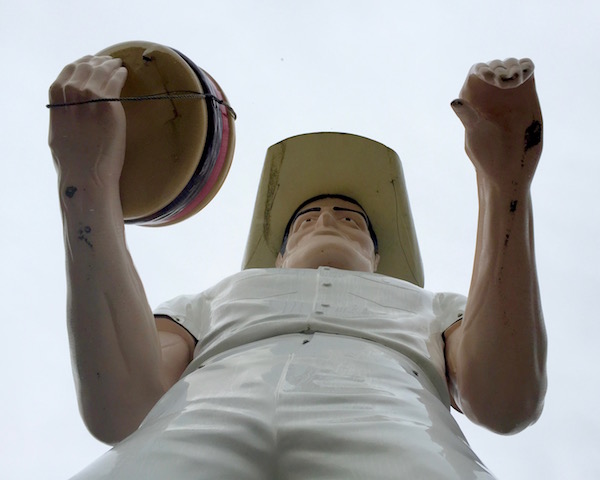
looking up at the giant fiberglass cowboy known as "Sam", Cadet Restaurant, Kittanning, PA

“Sam”, Cadet Restaurant’s giant hamburger-slinging cowboy/muffler man, Kittanning

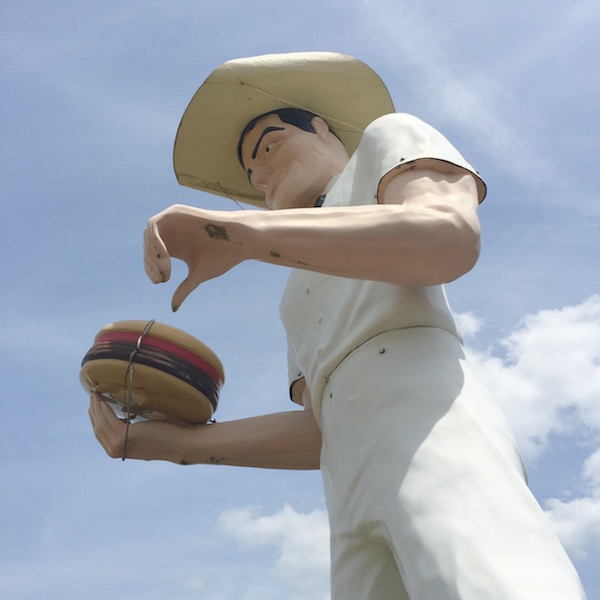
He’s broad-shouldered, with a square jaw and steely gaze, and he’s bare-handing a burger the size of a doberman en route just for you. Yes, in crisp white shirt and trousers, black boots, and one enormous cowboy hat cocked just so, Big Sam, the resident burger-slinging cowboy/muffler man of The Cadet Restaurant is the waiter of your dreams…or maybe your nightmares.

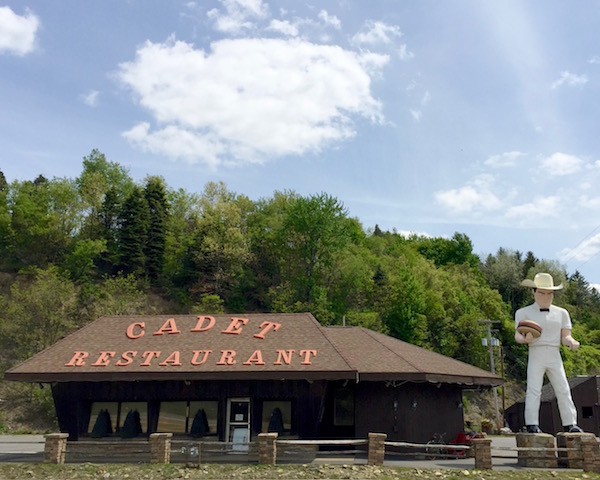
At 30 feet tall (we’re taking the Cadet’s word on this–but it seems reasonable), Big Sam is, quite literally, head-and-shoulders above the peak of the Cadet Restaurant’s roof. In an era when the neighboring Sheetz signage (and every other modern highway adjunct) is visible from space, it doesn’t seem like Sam could possibly stand out from the other roadside noise. But he’s got a couple things all those other places can only dream of: class and style.

Exterior of the Cadet Restaurant with giant fiberglass cowboy holding a hamburger, Kittanning, PA

Cadet Restaurant, Kittanning

Though there’s absolutely nothing automobile-related about Big Sam (aside from the Cadet’s previous life as a drive-in) he falls into the broad category of giant “muffler men”. Roadside America has a great detailed repository of muffler man info, but the short version is that the original fiberglass mold was built in the early ’60s for a huge Paul Bunyan advertising a restaurant in Flagstaff, Arizona. The arms are positioned as so to hold the famous lumberjack’s big axe.

The same mold was repurposed over the next dozen years for generic working men, Indians, the “happy halfwit”, and, yes, cowboys. Many muffler shops took advantage of both the striking figure and the fixed hand shapes to cradle exhaust systems, hence the nickname.

Side view of giant fiberglass cowboy, Cadet Restaurant, Kittanning, PA

It may get a thumbs-down from Big Sam, but Cadet’s food is qualified to satisfy

Cadet’s history page tells us that Sam was purchased at the Chicago Restaurant Show for $3,900 in 1962 and details a great story of tragedy and redemption for the big guy:

One foggy morning on September 29, 1990, an unsuspecting Ford Bronco pulled into the path of a fully loaded coal truck traveling from Indiana. The Bronco was catapulted into Sam leaving him in shambles for years to come.

Despite many attempts, no one would take on the task of repair. We would find his hat or burger on top of a local school’s flagpole and other various locations. Luckily, we had our own team of students that were always kind enough to locate and extract the missing pieces.

It was over 12 years before our customers were able to help us finally piece him back together. Dave Bish, stepped up and asked if he could try, and try he did. What a beautiful job! He was back on his feet in 2002. It took a full day, a crane and many volunteers.

Cadet restaurant placemat advertisement proclaiming "Home of the 'Poor Boy'"

And what of the food at the Cadet? As diners go, it’s top-notch. The menu features the expected array of greasy breakfasts and burgers/sandwiches/deep-fried platters for lunch and dinner. A handmade sign on wall proclaims the “Poorboy burger” (a double patty with all the fixins) and roast beef as house specialties. This blogger’s only real quibble was a lack of Polish food on the menu [every Pittsburgh-area diner should have pierogies, haluski, and potato pancakes!]–but even Big Sam can’t provide everything.

The Orbit went all Craig Claiborne with repeat visits to the Cadet. On the way up, we had a fantastically Sam-sized blueberry pancake. It’s sort of the yin to Pamela’s crepe-style yang–thick as a book* and large as the plate, but hot, fluffy, and tasty. On the return trip, it was a thoroughly-satisfying chicken biscuit dinner for lunch with a mind-melting piece of rhubarb pie for dessert.

Needless to say, the Cadet is Orbit-approved and recommended. Stop by the next time you’re headed north and give ol’ Sam the hi-de-ho.

rear view of giant fiberglass cowboy, Cadet Restaurant, Kittanning, PA

Big Sam keeping watch over Rt. 422 outside Kittanning

Getting there: Cadet Restaurant is on Route 422-East, just off Route 28 outside Kittanning. Note: you have to awkwardly go through the next-door Sheetz to get there, but you can’t miss it.


* Thick like a paperback novel–not, you know, the dictionary.

Onion Dome Fever: St. Michael’s Orthodox

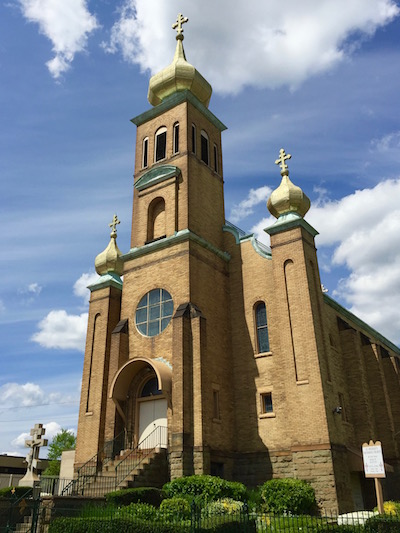
St. Michael's Orthodox Church, Rankin, PA

St. Michael’s Orthodox Church, Rankin

If you want to give The Orbit‘s brakes a thorough wringing-out, just throw a new set of onion domes up in sky and listen for the screech of rubber on pavement.

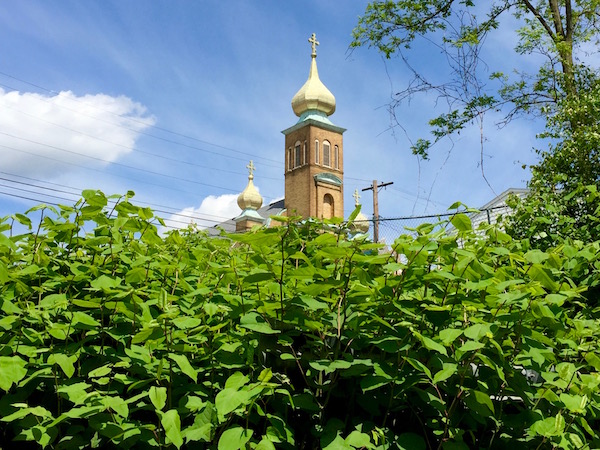
That’s just what happened as we found ourselves off track and reconnoitering back down 3rd Avenue in Rankin. There, gleaming in the bright sunlight against a backdrop of pillow-perfect wispy cumulous formations, rose the three perfect golden domes of St. Michael’s Orthodox Church.

St. Michael's Orthodox church, Rankin, PA from over a bank of weeds

In the weeds: St. Michael’s onion domes viewed from the pass-through to Rankin Blvd.

It should come as no surprise that Rankin hosts a traditional Eastern Orthodox church. Pretty much every old steel town has at least one–it speaks to who was immigrating over here to work the jobs in the mills. We’ve already run scene reports on churches in McKeesport, Marshall-Shadeland, Steubenville, and McKees Rocks.

Just like those places, the church stands as the tallest structure in town. While that’s not a huge feat in a borough as small as Rankin, it’s always a great payoff as the giant golden ornaments reach out and above from any vantage point: as a beacon from the local through-street (Braddock Ave.), above the rows of peaked-roof frame homes and squat brick row houses, and apparently right out of the weeds from the hillside below.

St. Michael's Orthodox Church, Rankin, PA

St. Michael’s Orthodox Church, Rankin

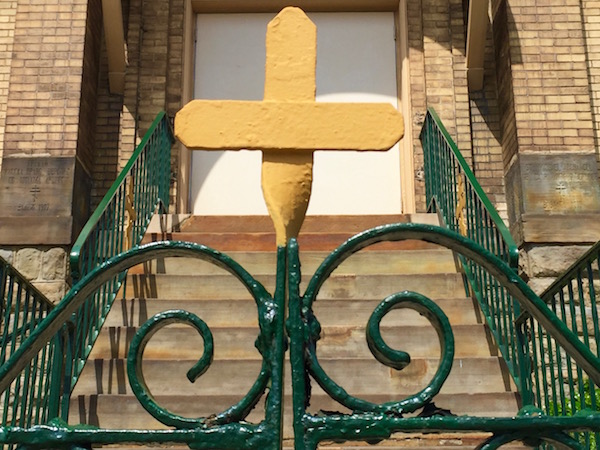
Matching cornerstones in both English and Cyrillic date St. Michael’s to 1907, which seems just about right for the peak of Russian/Ukrainian immigration to work in the mills. Rankin reached its greatest population a couple decades later in the 1930 census with around 8,000 people. Today, with only a quarter of that–the vast majority African-American–it’s hard to imagine a lot of local Russian Orthodox parishioners for St. Michael’s*.

Despite all this, though, the church–at least on the outside (it was locked tight when we visited)–is in terrific shape. The masonry work is solid, the stained-glass windows aglow, and the little front garden well-tended and in lovely full spring bloom. Oh, and you won’t miss those big golden onion domes–they’re still up there and they look spectacular.

Detail of cross on St. Michael's Orthodox Church entrance gate, Rankin, PA

Cross here. St. Michael’s front gate (detail)


* Source: Wikipedia entry for Rankin demographics.

Step Beat: May the 54th Be With You

Top entrance to the 54th Street city steps, Pittsburgh, PA

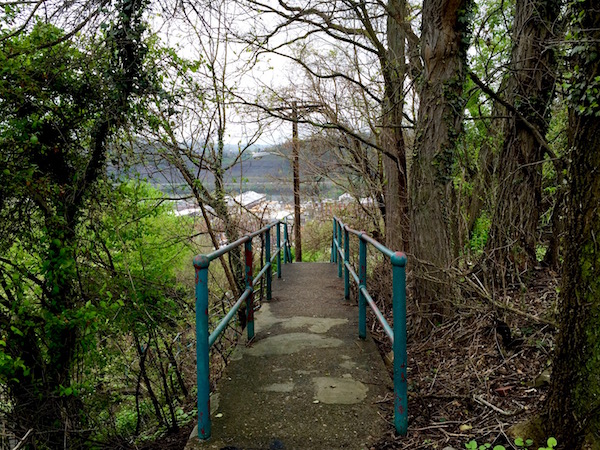
There is a darkness. Upper entrance to the 54th Street steps at Camelia Street, Stanton Heights.

An unusually iridescent quality to the daylight–the result of diffuse, cloud-filtered sunbeams’ gentle descent to Earth. That, paired with recent showers and high spring reawakening, resulted in a glorious array of patchwork greens popping from every direction. Bright yellow-greens from first leaves and tangled weeds climbing through last year’s dead growth. Deep low greens darken ivy shadows and taller members’ undergrowth. Add one storybook passageway–literally full of twists and turns, hoots and birdsongs–and you’ve got a recipe for magic.

Right-angle turns at the top of the 54th Street city steps, Pittsburgh, PA

Zig zag wanderer: right-angle turns at the top of the 54th Street steps.

The 54th Street steps are a stretch that one can only assume is on the endangered species list. Several pedestrian walkways link the residential neighborhood of Stanton Heights (above) to 10th Ward/Upper Lawrenceville (below). At one time, there must have been significant demand for this kind of infrastructure, but with (most of) Lawrenceville’s big industry jobs long gone and automobile ownership more rule than exception, it’s hard to imagine many people needing to use these particular steps anymore. This blogger didn’t encounter a single other human on his recent visit.

Long middle section of the 54th Street city steps, Pittsburgh, PA

The long middle section of the 54th Street steps including wooden replacement handrail.

And that’s a shame…sort of. Pittsburgh has its share of great parks, trails, green spaces, etc. But it never ceases to amaze how simply walking around city neighborhoods offers so many everyday opportunities for nature, tranquility, solitude–you name it.

The 54th Street steps, as well as others up this way, are a prime example. The parks may have a greater bounty of trees, flowers, birds, and chipmunks, but they don’t supply the crazy catwalk gangways and cut-into-hillside stair climbs. You won’t see the same ghostly foundations of long-gone step-accessible (only) houses or burnt offerings to witchcraft. The entire length of 54th provides commanding bird’s eye views of Upper Lawrenceville and across the river to Millvale. The river trails are often crowded with Sunday cause-marchers and lollygagging strollers that can test the through-rider’s patience. The presence of humanity is no such problem up here.

Overgrown hillside view from the 54th Street city steps, Pittsburgh, PA

This is city living. View from the 54th Street steps.

The 54th Street steps are in quite good shape overall. There is some cracking to the concrete and there’s been obvious repair work including a fixed-up section of felled handrail with a jerry-rigged wooden replacement. But the treads are all sound and there’s no point where they feel like they’re falling apart. Any regular step-hiker will tell you this is no small achievement.

This is all pretty remarkable given the length and complexity of the operation. Fifty-fourth Street is definitely not the longest set of steps in the city (that’s the unbelievable Rising Main Way on the North Side), but with maybe 200 stairs* it’s probably up there. When you factor in the six right-angle turns and long flat stretches, it’s really a hidden jewel a in the city’s step crown. Get out there and try it on for size.

Bottom entrance to the 54th Street city steps, Pittsburgh, PA

Lower end of the 54th Street steps at Wickliff Street, Lawrenceville.

* Just guessing here–we didn’t count.

More Time for the Skyline

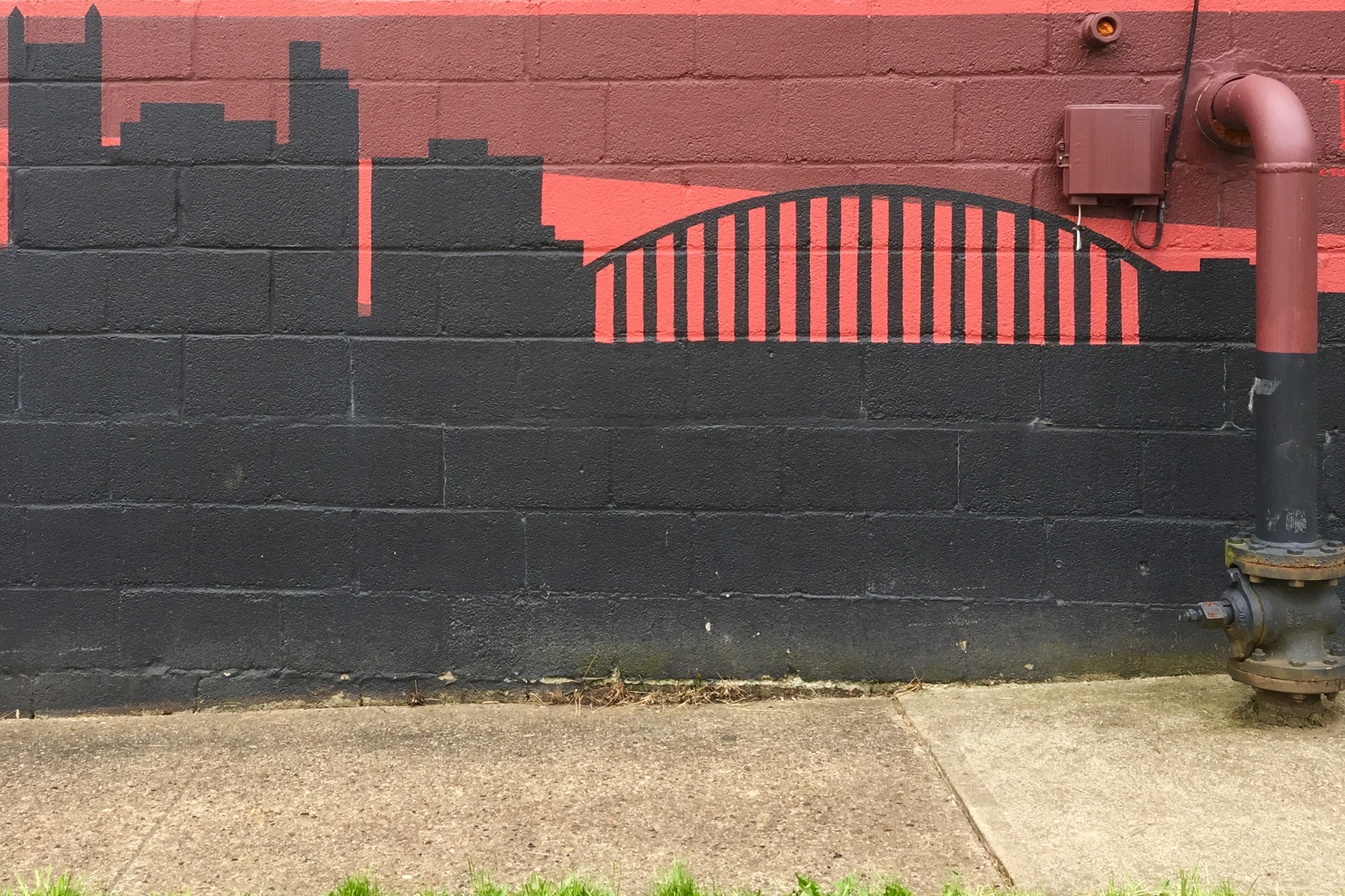
Art installation of Pittsburgh skyline as large cut-outs with black and white patterns projected on them

Spirit Lounge Pittsburgh 200th Birthday Celebration

Back in January, we posed the question is the Pittsburgh skyline that distinct? No definitive conclusion was achieved but it became clear that we’re dealing with an extremely popular subject. In only the few months since, we’ve seen new examples of the same profile appear over and over–in art, in industry, in history. Here are The Orbit’s favorites:

Spirit Lounge‘s 200th birthday party for the city was an orgy of Pittsburgh in-joke goofballery. The flashing, multi-color downtown skyline diorama looked great in all of its phases, but especially this high-contrast, two-tone number (above)–amazingly with just one building’s profiles caught on the bias. Hats off to whoever put this great display together.

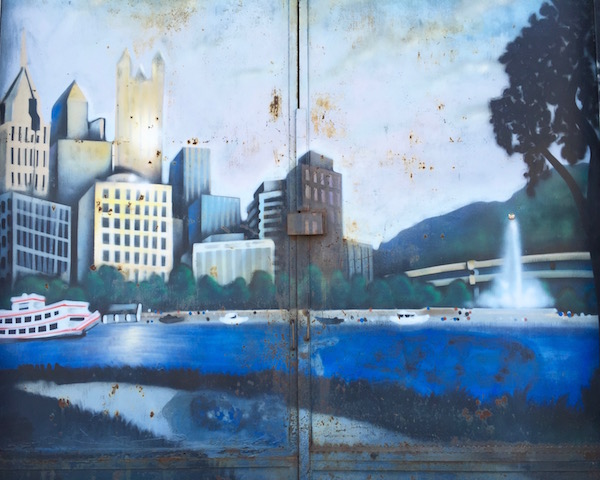
Airbrush painting of the Pittsburgh skyline seen from the North Side

Warhola Recycling, North Side

Warhola Recycling would have to include a North Sider’s view of the city. The big touch points are all there: PPG, Fifth Avenue Place, Point State Park and its fountain–even one of the party boats on the river. This mural, airbrushed on the big steel doors on the side the building, is a great example of the skyline potentially popping up just about anywhere.

fantasy skyline with various Pittsburgh elements included

Energy Innovation Center (former Connelly Technical Institute), Hill District, c. 1930

The depiction of Pittsburgh in this arched doorway mural from the old Connelly Technical Institute is terrific in a number of ways. First, it’s just very much of its time–a pseudo-realistic depiction of the city in full industrial might: a place of buildings reaching to the skies, bridges that can ford any span, industry cranking out…stuff, and glorious rolling green hills as far as the eye can see.

But it’s also a perspective that doesn’t actually exist–and never did. The painting is a fantasy view of Pittsburgh combining real-life entities (downtown’s Gulf Tower, the Panther Hollow Bridge in Oakland, steel mills, farmland) plucked out of their actual habitats and re-combined in a close-shouldered collision. It’s like a regional greatest hits album that lacks any cohesive flow, but still sells because it’s got all the good stuff people want to hear.

city skyline painted on concrete tennis practice wall, Pittsburgh, PA

Garland Parklet, East Liberty

This skyline, painted graffiti-style in a park in East Liberty, is almost so abstract that we can’t count it–it could be Anytown (O.K. any city), U.S.A. There’s no recognizable Gulf Tower or U.S. Steel Building, but the central point is arguably Fifth Avenue Place’s giant hypodermic needle. They’ve also got a generic bridge in there, though it doesn’t really look like any of the “three sisters” suspension bridges. In any case, this blogger thinks it counts. Plus, it ended up on the backstop of a tennis practice wall in East Liberty, which is a pretty neat place to turn up a city mural.

Pittsburgh skyline mural painted on cinderblock building

Red Star Ironworks, Millvale

Excuse the weird cropping here, but there was a glass block window and a competing mural to work around. The entire front of Red Star Ironworks’ Millvale workshop has been painted as a giant tribute to big dudes working with hot steel. The split pair of Pittsburgh skylines that bookend the mural are really just a decorative afterthought. But they’re still there, and you won’t have any trouble picking out the now-familiar key players.

mural on brick wall including the downtown Pittsburgh skyline

Mural, Art All Night 2016, Lawrenceville

We could have filled an entire post–maybe several–with depictions of downtown Pittsburgh entered into this year’s (or any year’s) Art All Night. But we went with the one that will go down with the ship: a mural painted directly on the brick wall of the 39th Street Arsenal Terminal building that ain’t long for this world. New condos await, right there at the foot of the 40th Street Bridge, but they’re not going to make it into this skyline.

Down Under: The Bloomfield Bridge Troll

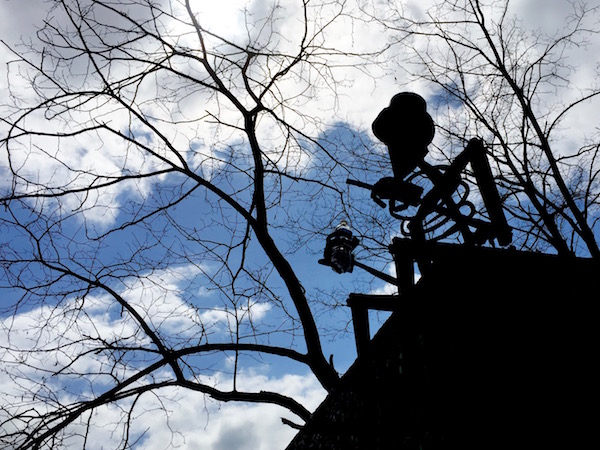
Silhouette of the Polish Hill troll, Pittsburgh, PA

Under the bridge, up in the sky. The Bloomfield Bridge Troll.

Every bridge should have a troll. Some may even deserve a couple.

It hadn’t ever occurred to this blogger that there was room for more than one of the creatures under any given bridge. That is, until he surveyed the fiefdom of The Bloomfield Bridge Troll. Down under that high span, on the steep incline of the Polish Hill side, it is obvious that there is room enough for neighboring Bloomfield to host their own troll to guard his or her side of the deep Skunk Hollow ravine in-between. The two “bridge buddies” may never even get to meet!

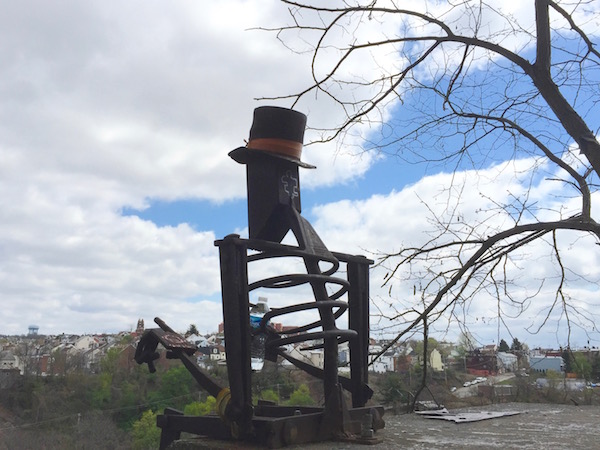
Boxy head with top hat of the Polish Hill troll, Pittsburgh, PA

Hard-headed, but well-dressed. The Bloomfield Bridge Troll in top hat.

Perhaps every bridge having its own troll is a little fanciful. Who’d want to get stuck under one of those featureless highway overpasses with a busy interstate rushing by and the only decoration being the reliable Trust Jesus graffiti? Not this bridge-under-hanger-outer, I can tell you that.
On the opposite end, consider some little footbridge over a culvert or babbling brook–no troll with any self-respect is going to hole-up in a hovel s/he can’t even stand upright in.

The Polish Hill troll and concrete support for the Bloomfield Bridge, Pittsburgh, PA

The Bloomfield Bridge Troll and concrete bridge support, decoration by paint pellets

The Bloomfield Bridge is no great architectural marvel, but its span is so long and its gulf so deep that those with a fear of heights (ahem) can get a little nauseous just looking down on the long walk over it. From the bridge deck you can see sights in all directions: tall buildings downtown, The Strip District, Lawrenceville, Bloomfield, Schenley Heights, Oakland’s Cathedral of Learning.

Under the bridge is just as interesting: there are train tracks in heavy use, the East busway, and an assortment of the old industry buildings that dot the single road, which amazingly has three names*. It’s hard to get lost in a place that’s one-way-in/one-way-out, but Skunk Hollow will do its best to accommodate.

The Polish Hill troll with Bloomfield visible in the distance, Pittsburgh, PA

A troll’s eye view of Bloomfield across Skunk Hollow

Pittsburgh famously calls itself the “City of Bridges,” with varying counts putting us at one of the top four in total quantity for the world**. Given that we have between 446 and 2000 bridges, depending on who’s counting–and how–it stands to reason that we’d have an enormous troll population.

But that doesn’t seem to be the case. Aside from the uninspired Troll’s Restaurant*** (not quite under the 31st Street Bridge on Washington’s Landing), the Bloomfield Bridge Troll is the only one this blogger has encountered thusfar.

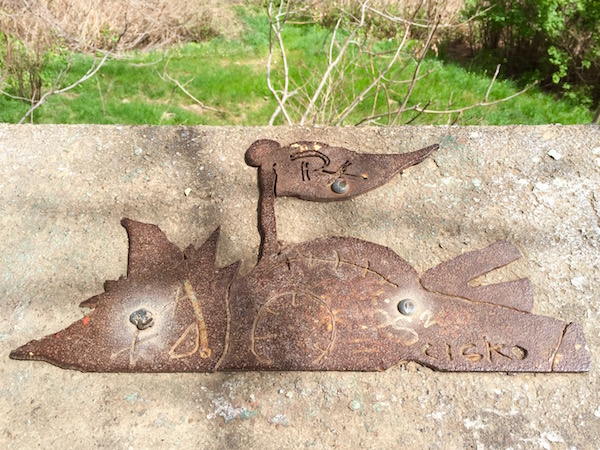
Cut out steel placard on the Polish Hill troll's concrete pedestal, Pittsburgh, PA

Prescription: Cisko. Steel placard on the troll’s pedestal.

In any case, hats off to whomever fabricated and installed the iron and/or steel Bloomfield Bridge Troll–an adjacent cut steel placard with the name “Cisko” may be a clue to that. With its jaunty chapeau, skeletal rib cage, defiant stogie, and drink-holder left hand (it was grasping a full water bottle when we visited–who says trolls only want to party?), the troll is a welcome surprise addition to always-mysterious Polish Hill.


* Lorigan Street > Neville Street > Sassafras Street.
** This is a major issue of debate among the bridge-counting set. Other cities vying for the title of most bridges include Amsterdam, Hamburg, and Venice.
*** Troll’s also has the bizarre status of being one of only a handful of dining establishments to actually take advantage of a position on one of the rivers.

Up in Smoke: Ex-Snack Shops

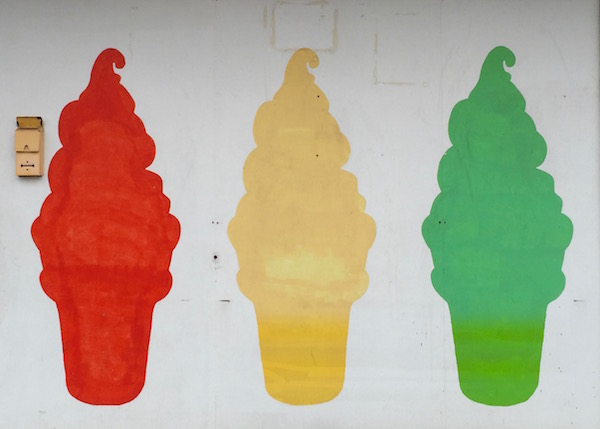
mural of soft-serve ice cream cones in colorful silhouette, former Tastee Queen, Ambridge, PA

Tastee Queen, Ambridge

Scene: The freezer aisle at the Lawrenceville Shop’n’Save, 9:30 on a recent Sunday evening. An enormous man is paused, his buggy half-full with potato chips, Cheez Doodles, canned chili, two-liter pop bottles, the makings for deli sandwiches–there’s not a fruit or vegetable in sight. He’s dressed in the kind of long short pants that big men often wear and a t-shirt in the Rastafarian red/green/black/gold color scheme featuring a prominent marijuana leaf and the single word STONED. The man is engaged in a cell phone conversation communicating ice cream flavors to an associate: “They got rocky road, they got butter pecan, they got moose tracks, they got strawberry, they got double chocolate…”

former Coney Island Convenience store, McKeesport, PA

Coney Island Convenience, McKeesport

As fascinating as this was (would this guy keep naming flavors all the way down to the Ben & Jerry’s section? would the team consider sherbet, ice milk, and/or frozen yogurt? how about the add-ons: chocolate sauce, nuts, whipped-cream? what would the final decision be?) this eves-dropper can only pretend to peruse the Stouffer’s frozen dinners for so long–we needed to move along.

former Howze Corner Store, Wilkinsburg, PA

Howze Corner Store, Wilkinsburg

What’s a doobie smoker to do? Gone (for the most part) are the mom & pop corner convenience stores, replaced almost entirely by the one-two punch of supermarkets and gas & sips. Good luck finding a retailer with only one brand of potato chips or a single freezer for the ice cream. It’s a wonder we’re not all standing confused and on the help line right now trying to make an informed, intelligent decision on Funyuns vs. Fritos, Cheetos vs. Cheese Puffs, ridges vs. kettle-cooked. Somehow, we must all dig deep and make these most difficult of life’s decisions.

snack trailer with cartoon images and sign "Temporarily closed for remodeling"

unknown (snack trailer), Hill District

In central Lawrenceville, we lost our independent snack shop three or four years ago. Mrs. The Orbit always cites Star Discount* as the place where ladies of the evening could purchase undergarments and bingo freaks could stock up on daubers. Lottery tickets and cigarettes were likely paying the bills, but “Star’s” also carried Herr’s and Snyder’s chips and pretzels as well as Cotton Club pop. Everyone behind the counter was always smoking.

Star Discount was replaced by the trifecta of Row House Cinema, Smoke BBQ, and Bierport (née Atlas Beer)–all of which we’ve patronized and enjoyed–but even if they let you in the door, try getting a $1.99 bag of cheese puffs from Smoke!

former Haley's Market, Pittsburgh, PA

Haley’s Market, Lincoln

Growing up in southwest Virginia, the peaceful, gentle climb to Cascade Falls in the nearby national forest, followed by a celebratory post-hike soft-serve at Dairy Princess made for a fine afternoon. In collecting images for this story, it was nice to see the tradition of knock-off ice cream shops perpetuated in both Tastee Queen (Ambridge) and Tasty Queen (Bruceton Mills, West Virginia). Unfortunately, all three businesses seem to have met a similar fate**. At least we still have Tastee Queen’s glorious technicolor soft-serve silhouettes.

former Tasty Queen ice cream shop, Bruceton Mills, WV

Tasty Queen, Bruceton Mills, WV


* Star Discount would make a great Orbit obit, but we sadly never took the photographic record to do it justice.
** This blogger almost met an even more violent version of the same fate taking this photo of Tasty Queen.