Ghost House: East Liberty Farmers Market

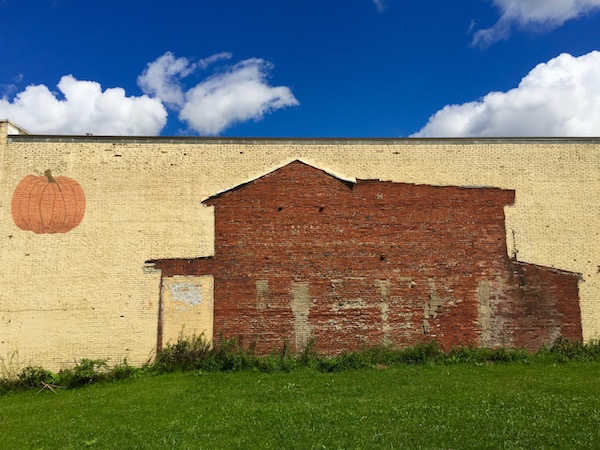
Ghost house with giant pumpkin mural, Pittsburgh, PA

Under the pumpkin moon. The Sheridan Ave. ghost house.

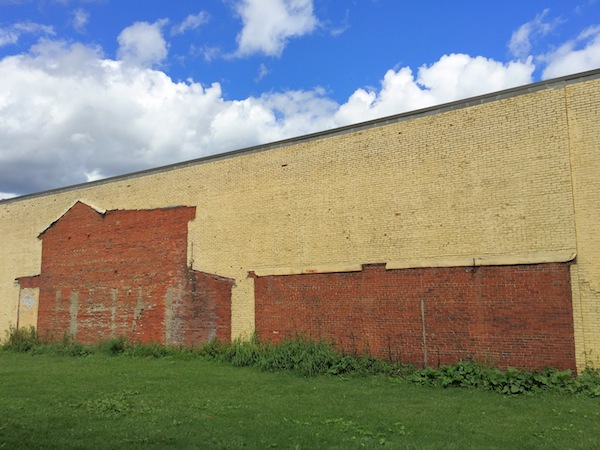
If, nay, when Pittsburgh creates the Ghost House Hall-of-Fame, the imprint on the side of the East Liberty Farmers Market building will certainly be in the very first class of inductees.

It’s just got everything: the perfect lines, the front porch and rear addition details, the unpainted red brick as negative space against the larger building’s long pale yellow wall, luscious green wall-to-wall shag…grass–even an antenna (?) pointing up from the back porch.

There’s not a lot left to the imagination here. Look around town and you can still see standing houses just like this one all over the place. The two-up/two-down design is a pretty standard Pittsburgh row house shape. This one clearly had the very common early flat roof additions off the back, usually to bring the kitchen indoors and provide a bath and extra bedroom upstairs.

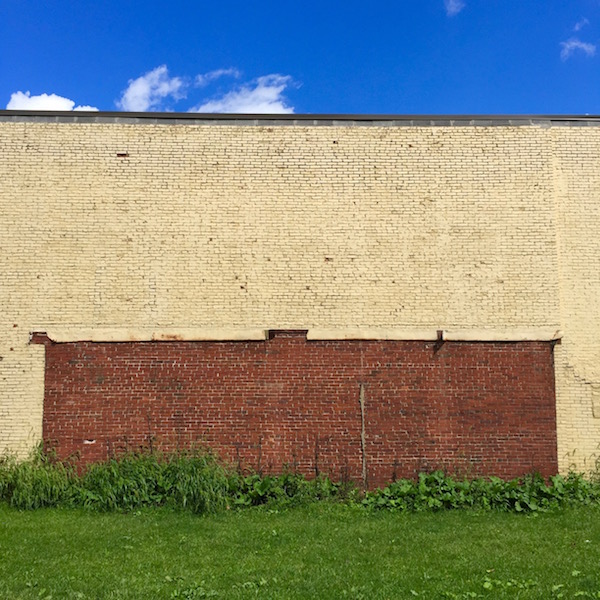
ghost garage, Pittsburgh, PA

Ghost garage

Was it Bob Vila or The Torch Marauder who said: have you seen the back? If the main house wasn’t enough to talk you into this beauty, let me remind you it comes with a fully-dysfunctional two-car ghost garage. It’s nothing fancy–one story tall with a flat roof–but the depth (basically equal to the entire house!) suggests you could park a couple LeSabres, LeBarons, LeMans, or LeCars in there and still have room for le beer fridge, le wood shop, le ping pong table, and some extra le storage for your Hallowe’en decorations.

I can see what you’re thinking–this a little too much of a “fixer-upper” for me–am I right? Granted, the house needs some work–like, pretty much everything–but just imagine the possibilities! That, and it couldn’t be more conveniently located for a rehab job. This ghost property is literally right across the street from Home Depot. You can be in and out in the blink of an eye…just like a ghost.

ghost house and garage, Pittsburgh, PA

Ghost house and garage


On the Trail of the Wild Pawpaw, Part 2: Pickin’ Up Pawpaws

eight smaller pawpaw fruits in a white hat on wooden table

Hatful of holler. The first score.

First: a warning. One should not purchase tickets on the pawpaw express without knowing what she or he is getting into. When you opt to “ride the lightning”, you’re hopping on the front seat of an emotional and physical roller-coaster that won’t be slowing down until it’s thrown–nay, broken–all who boarded with anything less than total commitment.

Be prepared to give it all up. Relationship? Over. Career? Gone. That itchy skin? It’s not going away. Don’t bother paying the rent–you’ll be sleeping in your car most nights, anyway. Friends, family, loved-ones? Kiss them all goodbye–they’ll not be seeing you any time soon. When, or if, you reconnect, the vacant look in your eyes will tell them you’re never really coming back.

pawpaw fruit hanging in tree, Pittsburgh, PA

All that glitters. Nearly-ripe fruit sing their siren song, Squirrel Hill.

Andrew Moore is one hard dude to get an interview with…at least, this time of year. You can’t fault him, though–the author’s late summer schedule is solidly packed. Readings and signings at bookstores in Charleston and Brooklyn; judging the Best Pawpaw Contest and presenting at the Ohio Pawpaw Festival; fruit sampling with customers at the Erie Whole Foods; a talk at the nature club in Sewickley…and that’s just a couple weeks worth.

All that, and Moore still made time for Pittsburgh Orbit, right at the mid-September peak of pawpaw season. We knew we may never have this chance again, so we hit him with the big guns right away: Have you ever been bonked in the head by a falling pawpaw? (It could happen!)

As luck would have it, in the last six years of researching, writing, and extensively traveling the pawpaw belt–Ohio to Louisiana, Virginia to Kansas–a fruit-to-cranium collision has never occurred. Moore took this in stride, as did questions about his wife’s tolerance for that demon pawpaw and the amount of refrigerator space devoted to gestating seeds. [Answers: very much, he loves her a lot; and about the size and volume of a shoe box, respectively.]

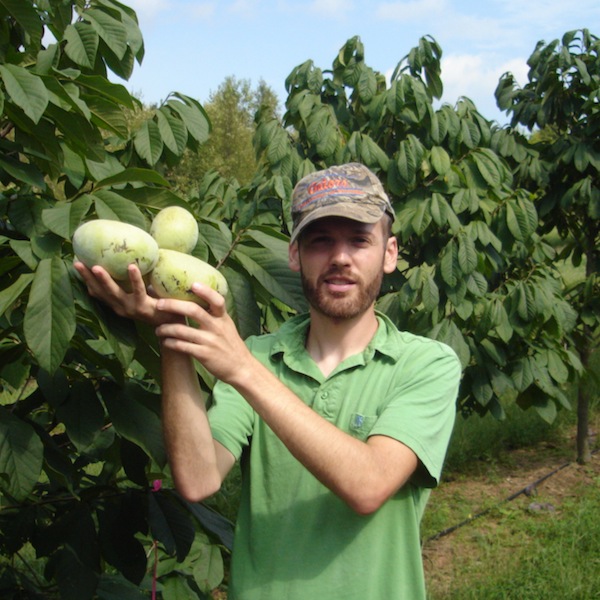
Author Andrew Moore holding three huge pawpaw fruits in a pawpaw orchard

Andrew Moore with the enormous pawpaws of Deep Run Orchard, Maryland [photo courtesy of Moore]

The Orbit consumed Moore’s 2015 book Pawpaw: In Search of America’s Forgotten Fruit (Chelsea Green Publishing) with a gastro-bibliological gusto that invoked what we can only call Pawpaw Fever. It is the definitive work on the subject and as such, Moore has created an elegantly-constructed and fascinating journey through a (literal) landscape both seemingly prosaic (pawpaws grow wild over most of the eastern half of the U.S.–they’re not rare) and at the same time otherworldly (an ancient fruit, re-arriving out of nowhere, with a narrative gift-wrapped for locavores and foodies alike).

Pawpaw contains a couple broad theses that ring long and loud after the last page is turned: the pawpaw as neglected super food that rightfully deserves to be back in markets, lunch bags, and restaurant menus, and the mystery of how this once-ubiquitous early autumn staple that colors so much American history managed to disappear almost entirely from the nation’s collective consciousness. It’s a great read and, needless to say, the book is Orbit-recommended.

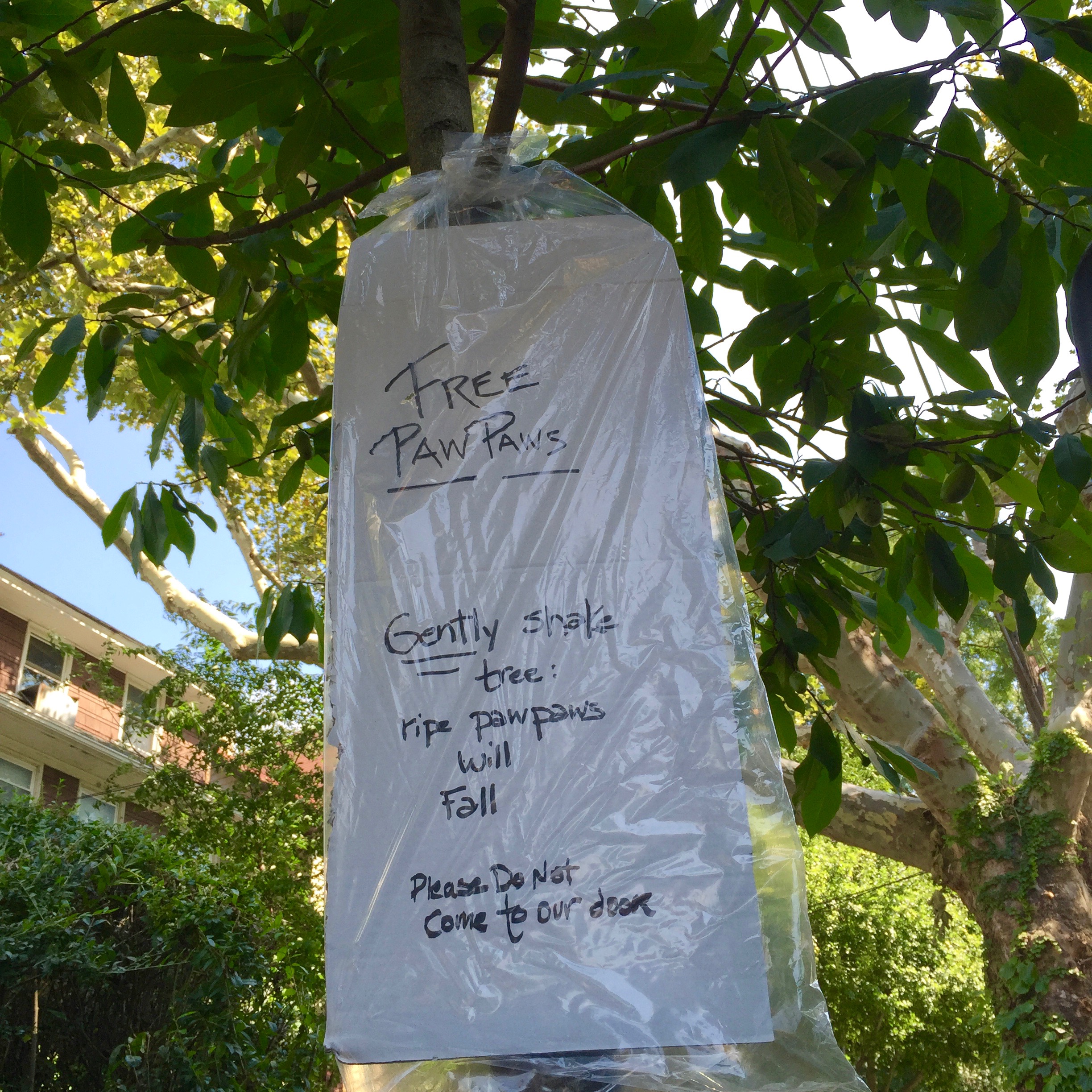
pawpaw tree with sign for free use

The giving pawpaw tree of Squirrel Hill

When last we left our blogger, he was deep in the heart of the Schenley Park pawpaw patch, considering an uncertain fruiture (that’s a future in fruit). The pawpaws dangled tantalizingly in all directions, but like Coleridge’s ancient mariner, there was nary an “Indiana banana”–not to mention pawpaw, paw paw, paw-paw, or papaw*–to eat.

Why? Well, one of the pawpaw’s challenges is that it may only be gathered (either shaken from the tree or collected from the forest floor) when ripe. Unlike, say, a tomato or a banana, the hard pawpaw prematurely selected from the tree will never ripen. That’s no big deal out in the wild, but in the very limited supply and unmet demand within metro Pittsburgh, it’s a real crime to prematurely pick the fruit or overzealously shake the tree.

The hunt was on. We got to the, uh, low-hanging fruit (sorry) first–Schenley Park’s pawpaw patch and the magical pawpaw trees of Squirrel Hill. Moore praises the latter: “God bless [the homeowner/planter] for introducing so many of us to our first pawpaw.” This blogger is no expert, but he’s been around the pawpaw patch enough to realize that while a great entry point, these are chump change, amateur hour, gateway drugs. Both sets of trees are well-known and well-traveled destinations at this point, and as such they’ve been over-shaken, abused, ravaged, and the fruit is rarely given the chance to ripen sufficiently.

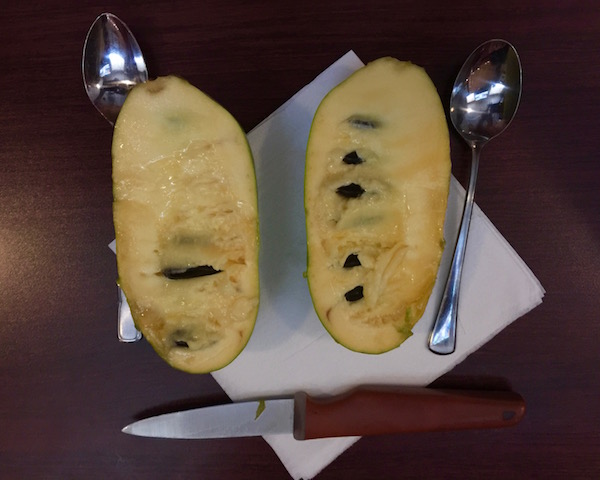
A large pawpaw cut in half with spoons and a knife

Giant pawpaw, halved.

So…blah blah blah, but what do they actually taste like? Well, I’ll tell you: they’re freakin’ delicious! The blanket description of “tropical” is safe, and banana is clearly the closest common fruit flavor profile. Some of the fruit we found was darker in color (more orange than yellow inside) and absolutely tasted and felt like caramel custard.

One other detail we never saw mentioned is that the pawpaw is really fun to eat. You slice it in half, eat it with a spoon, sorting tasty pulp from the large seeds in your mouth. They’re really unique–like a small dessert right there in every fruit.

So, our early goal of uncovering free public pawpaws right in the city gets mixed marks. We did indeed taste the fruit of several different trees, but weren’t able to uncover any real surprises. The chase is still on, though. As Moore tells it, the trees give themselves up in October, flashing a bright yellow where others go all dropping leaves and fall colors. The dedicated hunter marks her prey and bides his time for the oncoming season. Until then, The Orbit will be out there, cruising the trails…watching.

potted pawpaw tree, Frick Park, Pittsburgh, PA

Future fruit. Potted pawpaw at Frick Environmental Center, likely destined for their “From Slavery to Freedom” garden project.

Conclusions:

The bad news: According to Moore, there just aren’t that many publicly-available patches in city limits to get your paws on pawpaws…right now. It’s not a case of us not looking close enough–they just aren’t there. Between the amount of city build-up we’ve had, 150 years of heavy industry, and that damned knotweed, whatever wild pawpaw may have hugged the rivers pre-industrialization likely didn’t survive the steel industry, et al. What is here now was almost surely planted very consciously.

The good news: There is no lack of American pawpaw, even very close to Pittsburgh. As Moore says, “This is not an endangered species…you see it everywhere, especially starting right around the Mason-Dixon line** (and south)”. The Orbit finally got its first big score from a set of trees in the North Hills and realized very quickly how fast you can fill a big bag and why one probably shouldn’t eat eight pawpaws in twelve hours.

Further, Moore paints a portrait of an exciting future for Pittsburgh pawpaw. The fruit is either “having its moment” or “coming back”, depending on how you look at it. [Moore’s book is clearly a not-insignificant factor in this.] Pawpaw is on the cultural radar now like it hasn’t been for several generations and the number of city projects in parks, schools, and community gardens–not to mention all the private growers adding a couple trees to their yards–is huge. According to Moore, in five or ten years there will be more city pawpaw trees than you can shake a stick at…or, you know, just shake the fruit out of.

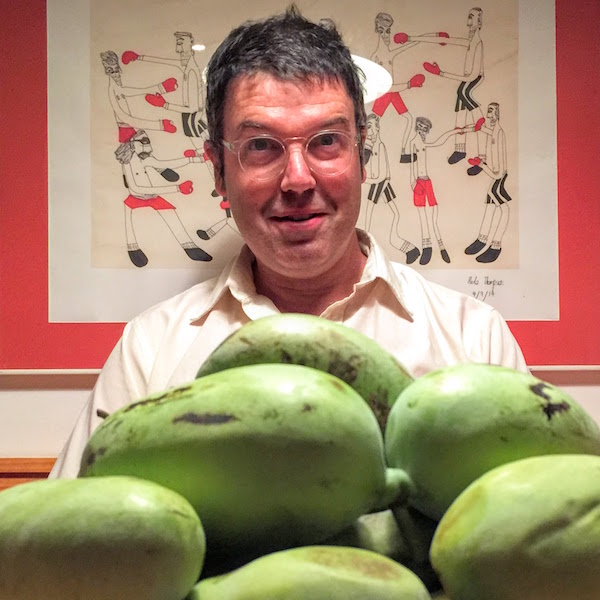
Man seated at table with a large pile of pawpaws.

Driven to madness. The author, with pawpaws.


Pittsburgh Orbit has accepted Moore’s spelling pawpaw (one word), but paw paw (two) seems to appear even more often “in the wild”.
** Basically, the Pennsylvania-Maryland/West Virginia border.
On the Trail of the Wild Pawpaw, Part 1: Way Down Yonder

hillside and trees overgrown with knotweed, Pittsburgh, PA

Panther Hollow hillside. Do pawpaws live here?

This blogger has it bad. Pawpaw fever, that is. The old scout song makes gathering pawpaws sound so easy. Pickin’ up pawpaws, put ’em in your basket…way down yonder in the pawpaw patch. Nothing to it, right? Just head down to the ol’ pawpaw patch–the damn things must be everywhere. Yeah? Well, it’s not quite that simple. 

It started so innocently, almost a year ago. A chance encounter with Andrew Moore, the pawpaw expert who literally wrote the book on “America’s forgotten fruit”[1]. In that conversation, I learned that I had just missed the 2015 season, which was frustrating, but certainly something to look forward to. That pawpaw trees (and their fruit) grow wild and plentiful in our region only made the pursuit more enticing. Could The Orbit locate publicly-accessible fruiting pawpaw trees right in the city? We set our sights on finding out.

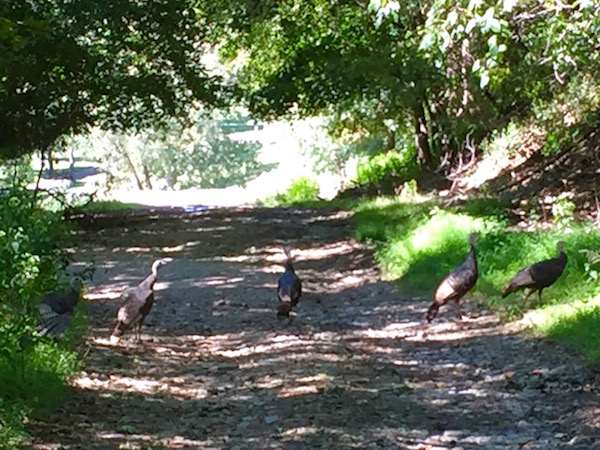
five wild turkeys crossing a gravel road, Pittsburgh, PA

Q: Why did the wild turkeys cross the road? A: We don’t know, but they didn’t find any pawpaws. Allegheny Cemetery

So I waited. Eleven long months counting down to pawpaw season[2]. I read Moore’s book, which only intensified desire. Pawpaws are among our oldest heritage foods–eaten by natives, colonists, and western explorers. The trees grow wild through a wide swath of the eastern half of the United States, but they’re amazingly foreign to most Americans.

The fruit is loaded with vitamins and minerals and is credited with treating diseases from gonorrhea to cancer. And, of course, it’s supposed to be delicious. The flavor is most often compared to something between banana and papaya, often with “caramel notes”, and a pleasing custard-like texture. Hungry yet? Yeah, me too–and you haven’t been waiting a year to get a taste!

Friends, neighbors, The Internet were all polled: Do you know any pawpaw patches in Pittsburgh? People tried to help, but like marrying a prince, or profiling serial killers, one has to sift through a lot of bunko anonymous tips to kiss the right frog.

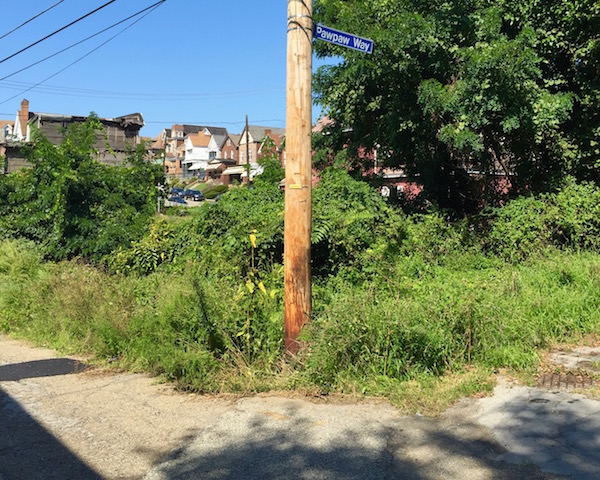
Alley intersection with street sign marking "Pawpaw Way", Pittsburgh, PA

No pawpaws here. Pawpaw Way, Hazelwood.

“There’s a stand in Highland Park by the reservoir,” read the first to arrive. The search was called off before I’d left the house. “Sorry for the false alarm,” the coming-clean tipster filled-in later, “they’re actually horse chestnuts–no pawpaws here.”

Another spoke to rumored pawpaws by the Stanton Heights community garden. I climbed most of that big hill in a low gear, traipsed through the woods, and talked to an Allegheny Cemetery groundskeeper and some Saturday morning gardeners. Sadly, no one knew anything about pawpaws…or at least, no one’s talking. We did happen to cross paths with a rafter of wild turkeys[3], which seems like a decent trade-off.

A third offered pawpaws along the North Side bicycle trail, just as you get off the ramp to the Washington’s Landing bicycle/pedestrian bridge, but it wasn’t happening. There were even more vague directions for entire neighborhoods: “South Side Slopes” and “Panther Hollow” and “on the hill behind Phipps (Conservatory)” and “Frick Park, along the trails”. It’s no surprise that none of these panned-out, but people have got to be a little more specific–we’re racing against time here! Little Pawpaw Way in Hazelwood is six kinds of overgrown, but not with its namesake tree, which is nowhere to be found.

close-up of pawpaw fruits and leaves from a tree, Pittsburgh, PA

First sighting: two fruits of the pawpaw tree

So, empathetic readers will undoubtably understand what a thrill it was to finally lay eyes on the big, tropical leaves of the first pawpaw trees we actually found. There, just feet from a trail in Schenley Park, were tall, mature, big-leafed trees–much larger than I’d expected, but unmistakable after so much preparation.

A scurried hustle off the path and down into the fabled pawpaw patch. Trees–from tiny infants to mature thick-trunked giants–in every direction and continuing far back into the wood. It is glorious, cool in the near full tree cover, soothing, airy, and private.

Seeing no fruit, we began to shake the trees small enough to wrap a hand around. Ripe pawpaw fruit should fall from a shaken tree, but none did. We continued on, deeper into the understory. And then, there they were: a pair of oblong, fist-sized, and potato-shaped green fruits joined under a leaf section. Looking around, another cluster, and then another. Some of the pawpaws low enough to touch, others many feet out of reach. We were finally, unequivocally, in the right place…or were we?
Two clusters of pawpaw fruits hanging from pawpaw tree, Pittsburgh, PA

Double clusters: pawpaw pawpaw.

Will our blogger ever achieve sweet relief beneath the leaves? Does the peculiar pawpaw please the palate or merely maim the maw? And With fruit in hand, what’s the plan, man?

I’m afraid, dear reader, this blog post must end on the kind of nail-biting cliffhanger one would expect, nay, demand from a story about foraged fruit. We get to all that, however, in Part 2 of On the Trail of the Wild Pawpaw.


[1] Andrew Moore, Pawpaw: In Search of America’s Forgotten Fruit (Chelsea Green Publishing). More of Moore in Part 2.
[2] Pawpaw fruit is ripe enough to pick roughly for the month of September in western Pennsylvania’s climate zone.
[3] Yes, rafter is the term of venery for turkeys.

Black-and-Gold: On the Fence

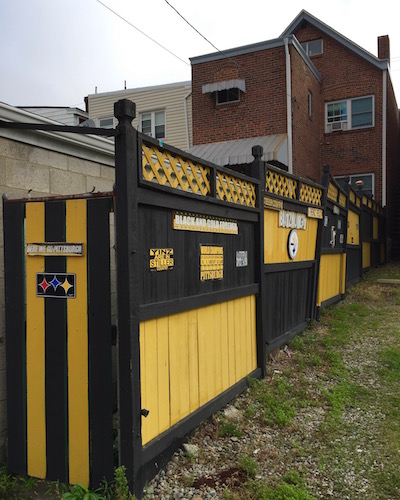
black and gold section of picket fence with hand-painted messages to the Steelers

Lawrenceville

To football spectators–from the die-hard to even the most casual/occasional game-watchers–the practice is so common it’s become cliché. Cameras trained on a small group of fanatics in the stands. One dude (and yes, it is almost always a dude) with a giant poster board cut-out of the letter D, his buddy right next to him with a matching section of picket fence. The pair are very excited to be on television. D-fence. Very clever.

So with this familiar rebus haunting NFL crowd shots every Sunday, Monday, and Thursday* throughout autumn, it’s no wonder Steeler faithful would consider their own side yards and front porches as prime opportunity for a black-and-gold home improvement makeover.

Here then, on this opening day of the Steelers 2016 campaign, The Orbit salutes those fans who’ve taken up post-hole diggers and sacks of concrete mix, lattice board and exterior enamel all in preparation to defend our fair city from the attack of marauding Bengals, Browns, Ravens, and (eesh) “Patriots”. Here, indeed, we go.

row house back yard fence painted black and gold and decorated with Steelers signs, Pittsburgh, PA

Bloomfield

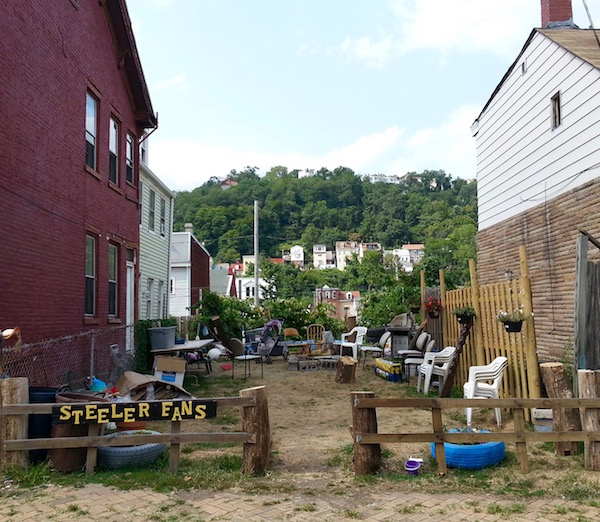
side yard and fence with sign reading "Steeler fans", Pittsburgh, PA

East Deutschtown

side yard with chain link fence decorated with lifesavers, Steeler colored rope, and flowers, Pittsburgh, PA

Marshall-Shadeland**

black and gold fence and jungle gym, Pittsburgh, PA

East Deutschtown


* I don’t know if this particular act of fandom shows up as often at high school and college games, but if so, yes: every single day of the week, August through January.
** It was suggested that this may not, in fact, be a Steeler party yard, but with the Steel City lifesaver and black-and-gold rope, we think it qualifies.

Step Beat: Anthony and Ivondale

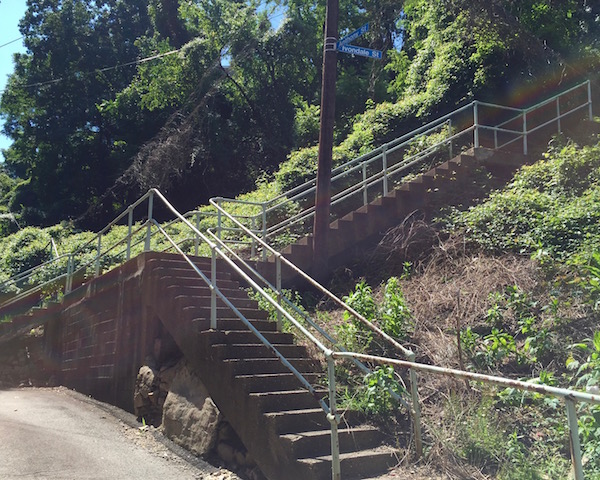
intersection of Anthony Street and Ivondale Street city steps, Pittsburgh, PA

Anthony and Ivondale streets, The Run

They’re not the longest or the prettiest. They’re not one of the great nature-in-the-city hikes, and there’s not much of a view. Heck, these steps don’t even fulfill the most basic purpose of infrastructure: you can’t go anywhere on them!

So why are we even reporting on the Anthony and Ivondale city steps? Well, this blogger will tell you. There’s a time for greatest hits and, as Buck Dharma so wisely reminds us, there’s a time to play B-sides. On the back of the platter, Anthony and Ivondale still earn the occasional spin, and it still sounds…er, walks pretty good.

The onion domes of St. John Chrysostom Byzantine from the Anthony/Ivondale intersection, Pittsburgh, PA

The onion domes of St. John Chrysostom Byzantine from the Anthony/Ivondale intersection

Last year we reported on the wonderful existence of the great Romeo & Frazier intersection in an overgrown hillside of South Oakland. That particular confluence of city steps is remarkable for a number of reasons, not the least of which is Pittsburgh’s commitment (at least, historically) to pedestrian thoroughfares as fully-accredited “streets.”

We see the same great treatment at the corner of Anthony and Ivondale, where the steps are given their own street light and signage. Only here, the whole enterprise is more absurd since there’s not really any chance of either walking these steps in the dark or needing directions to where they’re (not) going.

intersection of Anthony Street and Ivondale Street city steps, Pittsburgh, PA

Looking up Ivondale Street from behind St. John’s

The other obvious factor on any step-trekker’s noodle is that this particular pair of step-streets is almost surely on the endangered list. At one time, Anthony Street must have continued all the way up the hill to Greenfield*. That would have connected residents of The Run up to Greenfield’s commercial district and uphill parishioners down to the mighty St. John Chrysostom Byzantine Catholic Church.

But those aren’t really well-travelled routes any more–at least, not on foot. In fact, they’re so neglected that you can only walk a tiny minority of Anthony Street before you’re met by an ocean of out-of-control overgrowth that completely blocks passage on the through-way**.

city steps overgrown with weeds, Pittsburgh, PA

Pittsburgh Babylon: Anthony Street’s long, inaccessible climb up to Greenfield

Anthony & Ivondale will never be destination steps like Rising Main or Little Jewel Street or the “Try Try Try” steps. But if you find yourself in The Run for a large sandwich at Big Jim’s or just passing through en route between the Schenley Park and “Jail Trail” bicycle runs, it’s well worth the stop and poke-see. You won’t get lost; there’s nowhere to go.


* Looking at the map, it seems like Anthony probably terminated at tiny Raff Street, itself just an extension of Alger Street, a block off Greenfield Ave.
** Already on the list is going back in the winter when we can see what’s left when the knotweed has died off.

An Orbit Obit: Holy Trinity Catholic Church, Duquesne

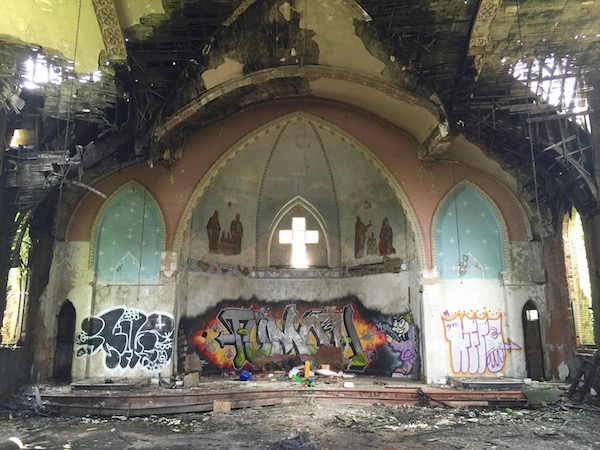
interior of former Holy Trinity Catholic church with spray paint graffiti and sky visible through the roof, Duquesne, PA

Before the fall. Holy Trinity’s chancel and still (barely) intact roof

The term ruin porn makes it sound so dirty. The Orbit likes to consider its mission[1] a noble one: peek into special, disappearing, fantastic places; record, document, and tell their tales–especially the ones that won’t be around that long.

But there’s a nebby, morbid, and yes, prurient curiosity too. How did things get this way? What’s going to happen next? Why isn’t anyone paying attention here? If I were a citizen of Duquesne, or any of its struggling sister boros, would I be resentful of some ne’er-do-well blogger poking his bicycle-riding picture-taking schnoz into my town’s business? I don’t know, but yeah…maybe.

interior of former Holy Trinity Catholic church with spray paint graffiti and sky visible through the roof, Duquesne, PA

Holy Trinity’s nave, viewed from the second floor alley window

The news came just this week that Monday’s huge thunderstorm had finally collapsed the roof and several wall sections of the century-old former Holy Trinity Roman Catholic Church in Duquesne. The church is so close to catastrophe that nearby residents have been relocated and the city is expediting plans to demolish what remains out of safety concerns.

The Orbit had the good fortune–or, at least, good timing–to stumble upon and check out Holy Trinity mere weeks before the walls literally came tumbling down. We captured a few final images of the church, its threadbare, about-to-drop ceiling, and the sad beauty of a kind of old world liturgical construction that we’ll surely never see created anew.

exterior of former Holy Trinity Catholic church, Duquesne, PA missing windows and trees growing over front steps

Exterior, from South 1st Street

Pittsburgh is littered with beautiful, old churches. Many of the ones that no longer function as houses of worship have been repurposed into any manner of creative second lives. Performance halls, community centers, art studios, living spaces, a hookah lounge, and even a brewery have been reborn from sacred bones. Last year we got all dewey-eyed drooling over the potential of the former St. George’s Syrian Orthodox Church in the lower Hill. This blogger’s co-worker is still trying to figure out what to do with the combined church and school he bought in Tarentum for the price of a suped-up SUV earlier this year.

Holy Trinity - mural Moses

Chancel mural

So it’s worth remembering that despite metro Pittsburgh’s relative urban health–verging on full-on priced-out gentrification in some necks of the wood–places like Duquesne exist just a couple miles down the river…any of the rivers. They’re dying (quite literally) for any investment.

In Duquesne, according to the WTAE report, city managers can’t even find the owner of the old church. Twenty years ago–maybe not even that long–the former Holy Trinity, abandoned by its congregation in 1970, was probably still in a state where it could have been saved, loved, and re-used. Now, we’ve not just lost the potential of preserving something unique and beautiful, but that very thing has become a safety hazard to even leave around as standing ruins. Sigh.

Holy Trinity - mural lamb

Chancel mural

Mrs. The Orbit and I sometimes squabble about what the changes to Pittsburgh’s fortunes will really amount to. Will the Lawrencevillianization of the East End spill across the rivers and turn the city into another place where, you know, “real people” can’t afford to live any more? Or do we just have way too much available space[2] and cheap housing with nowhere near the curb appeal of a New York or a San Francisco?[3]

This optimist tends to believe the latter. But if, by some crazy twist of socio-economic happenstance, every looking-for-a-change young person really does decide to turn Pittsburgh into the “next Portland”, hopefully it will mean a breath of life to the immediate industry towns just outside city limits which will inevitably absorb some of the overflow. If we could see good things come to Ambridge, New Kensington, McKeesport, and, yes, Duquesne, well, that might make it all worthwhile. Let’s just hope it happens before all the roofs collapse.

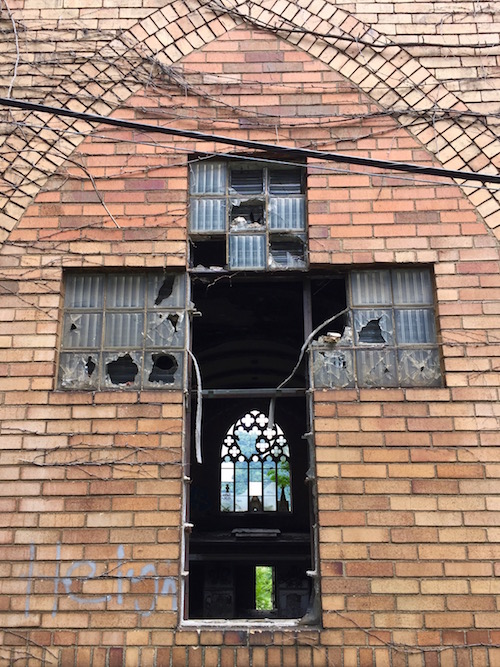
view through broken glass block window in shape of a cross to dark interior of former Holy Trinity Catholic church, Duquesne, PA

View through (replacement) second floor rear window (from Oak Alley)

All photos taken July 25, 2016 just a month prior to the roof and wall collapse on August 29.

Also: Lost Monongahela has a nice write-up with some great photos on the history of Holy Trinity and the congregation’s decision to build a brand new church in nearby West Mifflin and abandon their original home in Duquesne.


[1] At least, one of its missions.
[2] Pittsburgh’s current city population is around 325,000–just about half of what it was in the 1960 census–there is a lot of vacant land here.
[3] Not to mention the sunshine and no-snow climate of a Charlotte, Miami, or Los Angeles.

Behold the Hands of Holtz

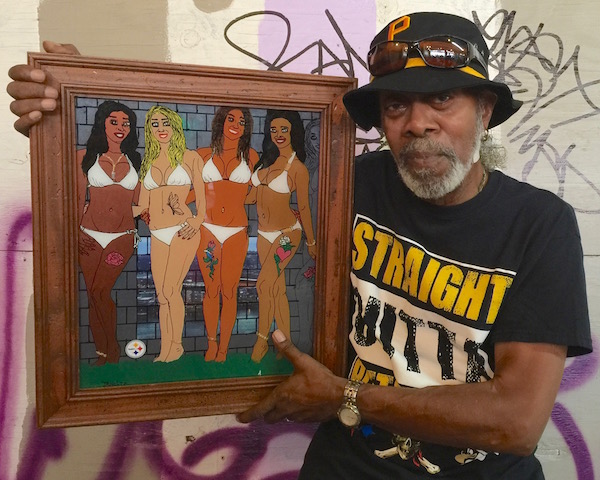
Artist JR Holtz holding a painting of four women in bikinis

Artist J.R. Holtz with some of his sexy ladies

You may have run into J.R. Holtz just like we did (or do, quite often), out on the street. He sets up on Penn Avenue for the monthly Unblurred art crawls and every Saturday at the Artisan Market in the Strip District. At either location, you’ll find him camped out with an eight-foot folding table covered with dozens of his small- and medium-sized paintings. Each one comes in a repurposed picture frame–or even an entire wooden window–and they’re all for sale at extremely reasonable prices.

several small, framed paintings by artist JR Holtz

Holtz’ recent artwork for sale in the Strip District

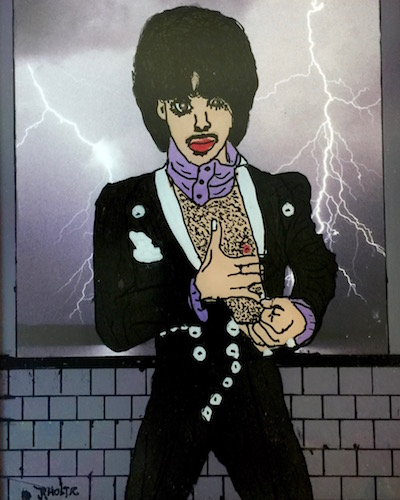
J.R., who creates under the moniker Hands of Holtz, tells us he paints every day and he’s been at it since the mid-1980s. His subjects are all across the board: cartoon characters, superheroes, pop culture figures, nature images, family scenes, science fiction, and Pittsburgh sports. On our most recent visit, there were portraits of Prince, Jimi Hendrix, and Muhammed Ali; likenesses of Mighty Mouse, Captain America, and Wonder Woman. Several scenes from Star Wars made their way to Holtz’ glass panes, as had fad-du-jour Pokemon creatures.

painting of Prince in front of an open window with a purple sky and lightning by JR Holtz

Prince/purple lightning

2-color painting of Star Wars characters by JR Holtz

Star Wars

But let’s cut the crap: you’re going to notice the sexy ladies first. It’s hard to focus on Spider Man when there’s this much bare skin going around. Not since the glory days of Cinemax or those weird shaving cream ads they used to run during hockey games has there been semi-public soft-core erotica on display like this.

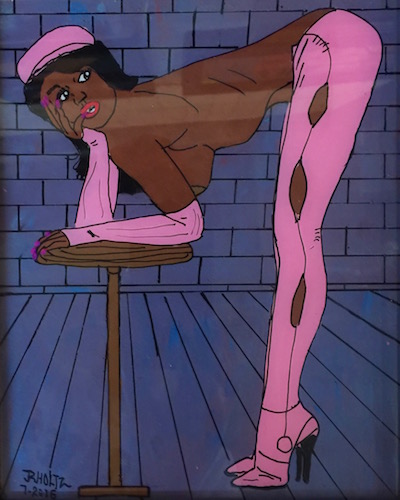
J.R. is the first to admit “I like the ladies!” and it’s safe to say he isn’t lying. There are strong warrior-princesses, tattooed big-boobed sports fans, tawdry hoochie-mamas, yoga posers with naughty underwear, and lots and lots of smiling, bikini babes–often with added glitter details and bonus Steeler emblems, just for good measure.

painting of woman wearing pink hat, gloves, boots, and skin-tight pants (but no shirt) bending over by JR Holtz

Pink Lady

Many of the images are taken from existing photographs, but Holtz says some of the ladies are friends who pose for pictures knowing they’ll be turned into future paintings. Individual requests and interests of the models are incorporated into the artwork, as are other extra bedazzled features including color-changing paints, glitterized jewelry, and inset photos.

I asked Holtz what the reaction is when unexpecting Saturday shoppers accidentally browse across the decidedly PG-13 content. “Some of them start walking real fast,” he chuckles.

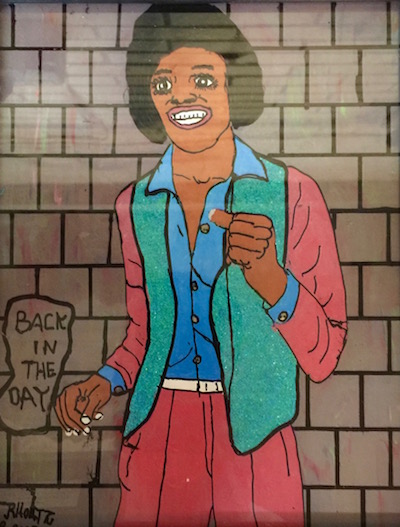
Painting of man in 1970s clothes with caption "Back in the Day"

Back in the Day

J.R. describes his own artwork as novelty, and it’s tempting to overlook it as such. He paints directly on glass which gives the final images a glossy, finished look–almost like when you see framed “cels” from animation. The subject matter is as populist as it comes–you could imagine some of these pieces on sale in a turnpike gift shop. Matthew Barney or Damien Hirst, this ain’t.

But with the flat perspective, heavy black outlines, and single-color schemes, the end result reminds us of a different art superstar on the very other end of the spectrum, Howard Finster. Like Finster, Holtz’s style appears untrained or “naive”, but there’s a beautiful honesty to it–even when the subject is Jedi Master Yarael Poof*.

JR Holtz standing in front of his paintings for sale, Pittsburgh, PA

JR Holtz with more of his recent paintings, Strip District

Holtz is also one of the kindest and nicest artists you’ll meet. He wouldn’t ape for the camera, but don’t believe it–every time we’ve talked with him, J.R. is all smiles, high energy, positive vibes, and can’t wait to tell you about his work.

This blogger doesn’t know what he likes, but he knows art. We probably wouldn’t chose to decorate Chez Orbit with any of the beach babes–at least, we haven’t picked any of those up yet–but we especially love many of his portraits and simpler two-color work. When J.R. hits, it’s as serious as a heart attack and as true as an arrow.


* Not pictured, but among The Orbit‘s small collection of Holtzs.

Golden Babies: Strange Things Afoot!

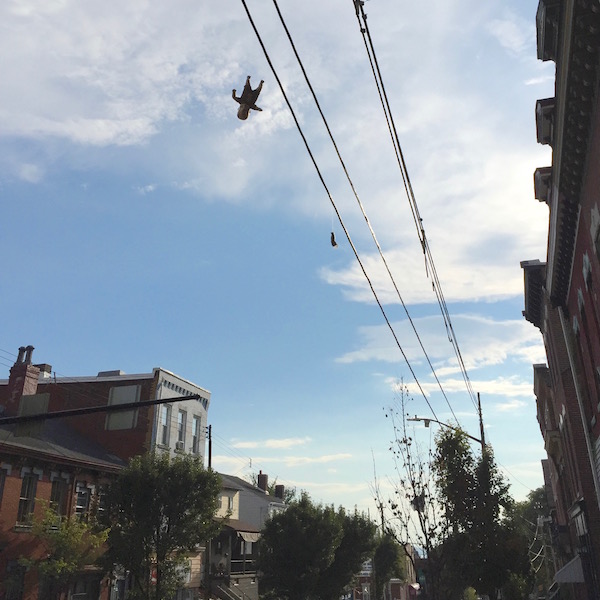
golden baby and baby foot hanging from wires in front of row houses, Pittsburgh, PA

Dismembered foot of Penn Baby with Penn Baby 2, Lawrenceville

Regrettably, The Orbit had accepted the mystery around the Golden Babies–like the Kennedy assassination, or where real babies come from–would likely never be solved.

But then a tip of the reddest and hottest variety came in: “MAJOR new development in the golden babies,” it began. What followed was a pair of plot twists to this ongoing street art narrative that both flipped our collective wig and, like Michael Phelps waking from his doobie-smoking Subway bender, re-lit a fire underneath this blogger that fans had thought long extinguished in the purple haze of five dollar foot-longs.

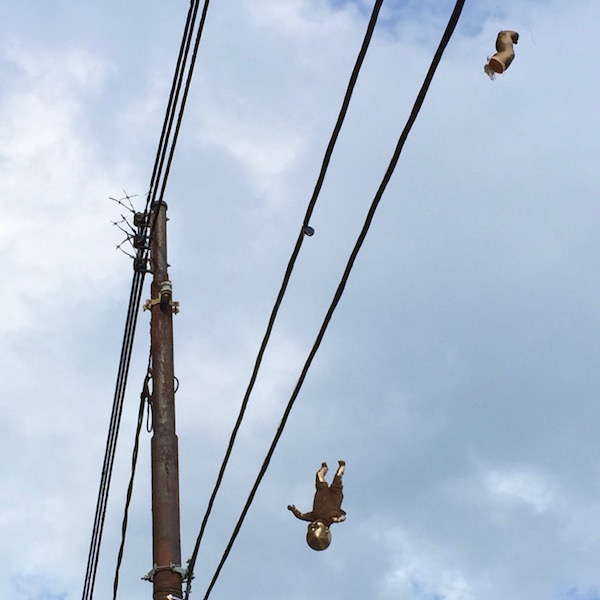
golden baby and baby foot hanging from wires, Pittsburgh, PA

Golden baby has a leg up on other street art

Faster than you can say quasi-respectable news source we hoofed it up to Constellation Coffee. The café sits right where our first-sighted golden baby (“Penn Baby”) appeared. Here, we could confirm the tip–and also enjoy a delicious cup of coffee*.

The story, right from the baristas at Constellation, goes like this: one Sunday morning, a concerned citizen phoned in a complaint to the city. Apparently the golden baby, dangling by his ankle from the wires on the 4000 block of Penn Ave., was just too much. The substance of the concern is not known, but we’ll take a wild guess that the baby was deemed “offensive,” “creepy,” and/or “weird.” Fair enough, I suppose**.

Penn Avenue, Pittsburgh, PA with golden baby hanging from wires

View down Penn Ave. with golden baby and loose foot.

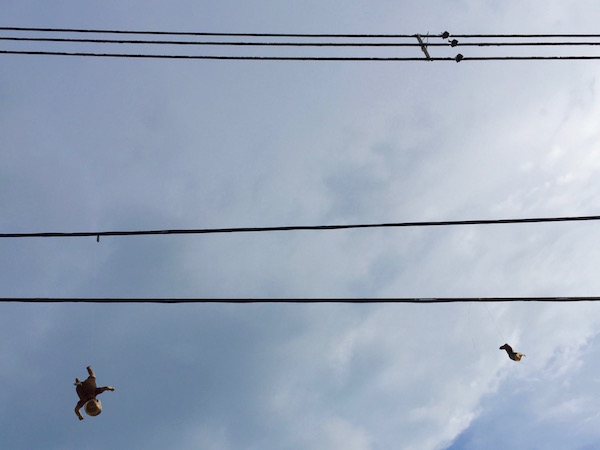
With nothing more substantive ablaze, the fire department was dispatched to remove the offending infant from the airspace over Penn Avenue. For whatever reason, they were unable to either undo the baby’s hanging wire or just cut it off, so the crew made the bizarre decision to instead saw through its tiny plastic leg. This allowed the removal of most of the kid, but left one stray golden foot, ankle, and calf dangling from the telephone wires.

Side note: This action begs a number of questions. Among them: Is leaving a disembodied leg really less offensive than the whole baby? and How is it that a street artist/prankster has a longer ladder than the fire department? and If I’m in the third floor of a burning building should I just accept fate and kiss my feet goodbye?

golden baby and baby leg dangling from wires, Pittsburgh, PA

Golden baby: foot loose and fancy free

Strange? Sure is! But what happened next will blow your mind! [That is, unless you’ve already looked at the pictures.]

In less than 48 hours, a brand new golden baby went up on the same stretch of wires–within mere feet of the foot. “Penn Baby 2” generally looks the same as the other golden babies, but with the key differences that s/he’s clothed in a red onesie (the others are white) and that garment appears to be stamped or silk-screened with some mystery insignia (the others are plain/unadorned).

close-up of golden baby in red onesie, Pittsburgh, PA

Penn Baby 2. Note the red onesie with cryptic insignia.

If blogging teaches us anything, it’s to not rest on one’s assumptions. The strange circumstances of Penn Babies 1 and 2 only prove that black is white, up is down, child is father to the man, and therefore, baby is, uh…older sibling to the child? Ah, hell.

This story is not over yet–no, not by a long shot. There’s one very important piece of evidence still in dispute–the whereabouts of the footless and foot-loose Penn Baby. Sources say it’s in the possession of Constellation Coffee–secured in a drawer right on the premises. But when the subject came up during The Orbit’s interrogation of the staff, the aforementioned “friendly” baristas clammed up tighter than a set of quad toms at a Sun Devils half-time show. Believe you me: their guilty eyes have got no rhythm.

What are they hiding? O.K., we think we know what they’re hiding, but why are they hiding it? You can bet we’ll get to the bottom of this…or at least to another cup of that delicious coffee.


* Constellation makes a damn good cup of coffee.
** If only a phone call could have the much more offensive Crocs stripped from the feet of our citizenry so easily.

Off the Rails: An Orbit Awakening in Boxcar Tagging

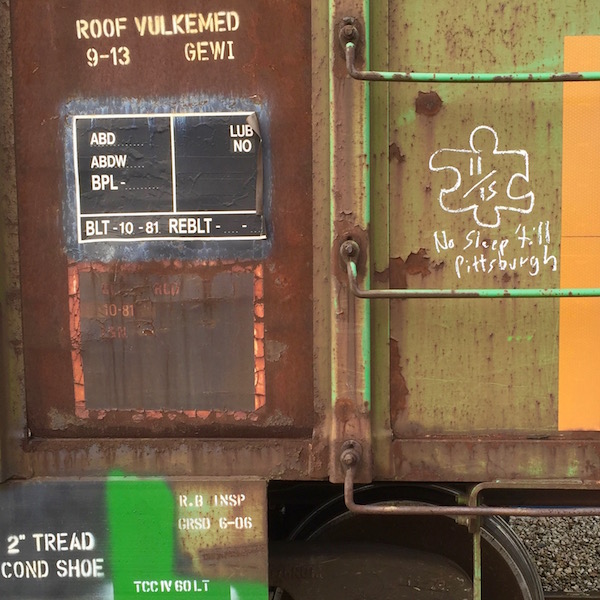
detail of boxcar with graffiti of puzzle piece reading "No sleep till Pittsburgh"

No sleep ’till Pittsburgh

What a pleasant surprise! To wake up to a subculture that’s been around forever[1] and yet somehow completely eluded any level of popular consciousness. At least, this blogger was totally ignorant of its existence until some time not too long ago.

Whether you pay attention or not, you’ve seen the big, spray-painted graffiti that either decorates or defiles freight trains, depending on one’s point-of-view. The same sort of multi-color highly-stylized calligraphs of tagger names and inside jokes that show up under bridges and the back sides of commercial buildings end up on the large steel canvases provided by Norfolk & Western and the Chessie System.

yellow boxcar with graffiti of a cartoon man smoking cigarette

Cash & Carry / Got head? / Sluto

But look a little closer–you usually have to get right up on the boxcars to see them[2]–and there’s a whole world of much more subtle human interaction with the trains. Here, there are small, simple line drawings, monikers, arch messages, and coded insignias, dates, and locations created (we assume) by an entirely different type of graffiti writer and likely intended for a very different audience.

Is this just street tagging on a different surface or is there something more going on here? Are these committed by train-hoppers, hobos, or just bored teenagers who live near train yards? Maybe the tags equate to an American form of trainspotting–more punk respectable and less trenchcoat nebbish?

detail of boxcar with graffiti of grave stone with message "The Ghouls"

The Ghouls

Almost always, the tags include three- or four-character numerical codes: 11/15 or 8/10 or 6/08, for example. We assume these are abbreviated month/year dates, but who knows? If so, apparently Y2K’s lesson in the need for full four-digit years doesn’t apply to these folks–they’re “future proof”.

It turns out that entire academic theses have been written on the subject. We haven’t read them (at least, not yet), so we certainly can’t answer these questions. But The Orbit likes to imagine the train cars become both the largest and most random of bottles to which these writers toss their messages to exchange whereabouts, news, and rail-riding one-upmanship in a very analog, low-tech manner.

yellow boxcar with graffiti of a mountain range

Retribalize, back to sea level / Lovely Spring / (unnamed)

Even in our extremely limited survey, one tag kept reappearing. In it, the sun is rising over a barren mountain, squiggly cloud gestures float in the sky, and the text Retribalize / adios – mutha is written in loose cursive over an arced train track/arrow. In each case, there’s an additional bonus message: Back to sea level or E.B. Creep – Co. or Wish you were here… A version of this particular scrawl showed up on so many cars that we didn’t even include all the photos of ones we found. A cruise around the Google machine proves this is no anomaly–the Retribalizer may or may not get around, but his or her tags sure do.

boxcar graffiti of mountain, sunrise, and train tracks with text "Retribalize, adios-mutha 10/5"

Retribalize, E.B. Creep

boxcar graffiti of mountain, sunrise, and train tracks with text "Retribalize, adios-mutha, wish you were here 6/08"

Retribalize, wish you were here…

boxcar graffiti of a jug with a hat and the message "Retribe's spot!"

The response: Retribe’s spot!

A final note: we have it on some decent authority that the Packaging Corporation of America, whose plant in the Strip District provided such convenient access to a weekly new supply of boxcars, is moving out of the city (to Cheswick). If that’s the case, and there are no longer any train cars on Railroad Street (sigh), that will definitely be a bummer. But we won’t stop collecting tags–we may just have to work a little harder to find them.

Until then, in the eloquent, bilingual words of Retribalize, adios – mutha”!

boxcar graffiti of old man with hat and text "here today, gone tomorrow"

Here today, gone tomorrow


[1] At least, around as long as hobos have been jumping trains.
[2] It goes without saying, be safe: make sure the trains are not in motion if and when you take a look.

Photo Grab Bag: Ghost Sign Roundup

ghost sign with layered text, McKeesport, PA

(unknown), McKeesport

Longtime readers know The Orbit is in the business of making dreams come true–and business is good. It was pointed out by super fan/sometime contributor Lee that probably a lot of folks don’t see the loose photos that end up on The Orbit‘s artsy dark and/or snarky narc pages and maybe we should roll them up into an actual blog post once in a while.

So here you go. Like Cheech and/or Chong, we’ve pulled out the gatefold copy of Fragile and are rounding up and rolling out a first collection of non-specific pictures from the last year or so. Here, they’re grouped on the pseudo-theme of ghost signs. Don’t inhale too deeply.

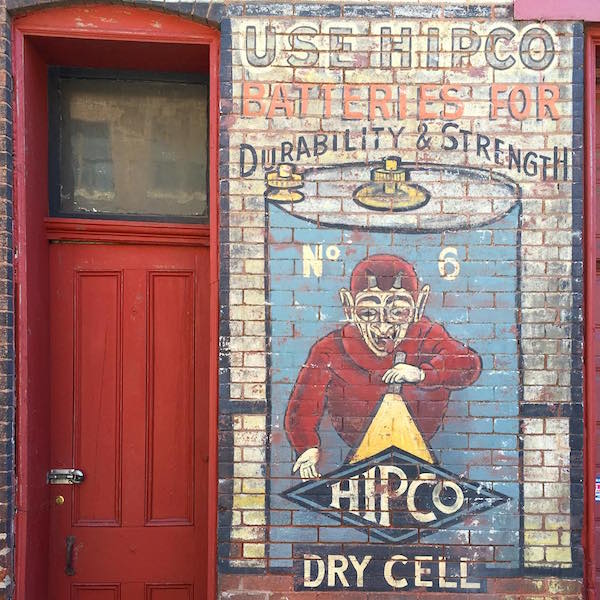
ghost sign/advertisement for Hipco Batteries, Pittsburgh, PA

Hipco Batteries, Manchester

It’s a bold claim, but the Hipco Batteries ad has to be the city’s greatest ghost sign. The incredible painted image has some classic “vernacular typography”, one giant old school No. 6 dry cell battery, and a sadistic, grinning red devil, his tongue wagging like a pervert from his open, fanged mouth. He’s very excited, with one hand reaching out, palm up, and the other employing a Hipwell flashlight to no doubt look for trouble in the dark.

This begs the question: do devils really need flashlights? Well, we know this one does. Unlike the subjects of every other photo in this post, the Hipwell Manufacturing Company, founded in 1887, amazingly still exists and continues to manufacture a line of flashlights (but no longer batteries) right in this big old brick building on West North Avenue[1].

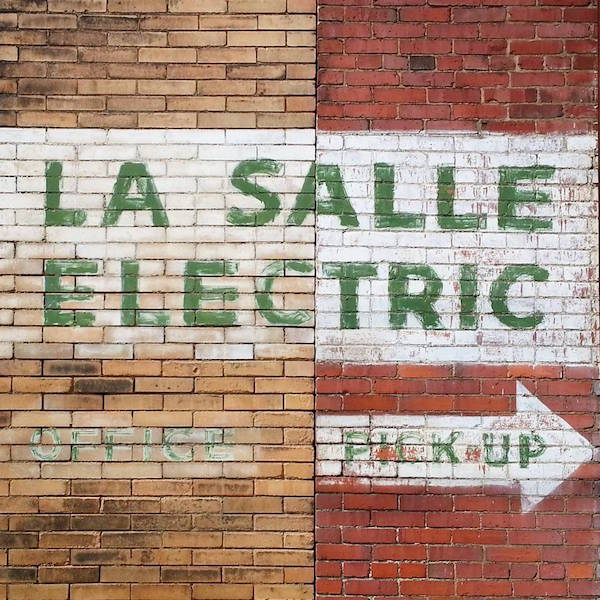
ghost sign for former La Salle Electric, Pittsburgh, PA

La Salle Electric, Manchester

The pair of conjoined industrial buildings that once housed La Salle Electric, just off Brighton Road in Manchester, were torn down earlier this year. Now there’s just a re-grassed vacant lot where they used to be. Whatever prompted that action, it’s sad for a lot of reasons–mainly that we’ve got a limited supply of this kind of late 19th century industrial buildings out there and it’s a bummer to lose two of them in one fell swoop.

Here, we can only focus on the relatively minor loss of this great ghost sign, painted across the point where the two buildings met. You can see the red brick side appears to have shifted ever so slightly, distorting the alignment of the white background and breaking the A in “Salle”. And what a great pair of arrows! The office is that way, you can pick up your stuff on the other side. Ugh. I mean, the office used to be that way…

ghost sign for former Regent Sportswear Shop, Pittsburgh, PA

Regent Sportswear (and Wig Shop?), East Liberty

The rear entrance to the former Regent Sportswear Shop doesn’t have what we usually consider “ghost signs”, but still seems like it ought to count. Regent’s 3-D sign, the typeface in Wigs, and the multi-color blue/gray/white brick treatment all suggest a 1960s/70s makeover to a building that probably goes back to the very early 1900s. Somewhere out there is a person who bought a terrycloth track suit or tried on someone else’s hair at Regent’s and we sure hope this last reminder in the Kirkwood Street alley makes him or her feel something. Hopefully that feeling is not, you know, “itchy”.

ghost sign reading "Sal's Meats Since 1921", Ambridge, PA

Sal’s Meats, Ambridge

Sadly, Sal’s Meats, like most of the businesses in Ambridge, ain’t there any more. But at least we’ve still got this great ghost sign. Painted signs don’t get any graphically stronger than bold red text on a white background, painted fifteen feet across on a deep red brick wall. Sal’s Meats, since 1921. ‘Nuf sed.

ghost sign for former Penn Bowling Lanes, Pittsburgh, PA

Penn Bowling Lanes, Downtown

What a time when the downtown worker could bowl ten frames over a lunch break! This literal back alley entrance on Exchange Way (between Liberty and Penn, downtown) suggests the bowling may have taken place in the basement, but who knows? Heck, maybe those wooden lanes, pin-setters, ball returns, and beer taps are all still down there, covered in forty years of dust. Either way, we’re glad no one felt the need to paint over this incredible patchwork wall with its reminder of old Pittsburgh.

ghost sign for Dr. D.E. Earley, Optometrist, New Martinsville, W. Va.

Dr. D.E. Earley, Optometrist, New Martinsville, W. Va.

Last winter, we made a special stop for the mind-boggling buffet at Quinets Court in the fine little West Virginia town of New Martinsville (about 90 minutes from Pittsburgh–and well worth the trip)[2]. The inevitable post-gorge belt-loosening constitutional yielded some fine views of the Ohio River and a bunch of great little oddities in the four-block downtown stretch. This ghost sign for Dr. D.E. Earley, Optometrist looks like it could go back a hundred years. That’s a long time to wait to get your eyes examined and glasses fitted, but then again, you’ve got a steam tray full of Quinets cobbler two blocks away. I can think of worse ways to spend a century.

Former storefront for G's Restaurant and Pizzeria, Pittsburgh, PA

G’s Restaurant and Pizzeria, Downtown

Bathed in low winter sunlight, made awkwardly diffuse by scaffolding and construction fence, this photo of the former G’s Restaurant and Pizzeria on Forbes Ave. got shoehorned into an update story on the last remaining Toynbee Tile on Smithfield Street and the face of a rapidly changing downtown Pittsburgh. But we felt like there was a little more to say here.

G’s Restaurant, along with the former Honus Wagner Sports building next door, were razed earlier this year. Point Park University is building a big new performance arts building/theater on the property. This will no doubt be a great cultural asset, but The Orbit‘s going to miss this pair of early 1900s terra cotta storefronts, each with their own goofy mid-century add-ons.


[1] See article: In The Spotlight: Hipwell Manufacturing (Pittsburgh Post-Gazette, Nov. 10, 2002) for the full story.
[2] The Orbit actually needs to make the trip to Quinets again for a full review–or even if just for that eggplant parm, and the kielbasa and kraut, and the fried chicken, and the haluski, and the brown sugar sweet potatoes, and the butterscotch pie, and the…