Hail, Mary! Front Yard Mary Roundup

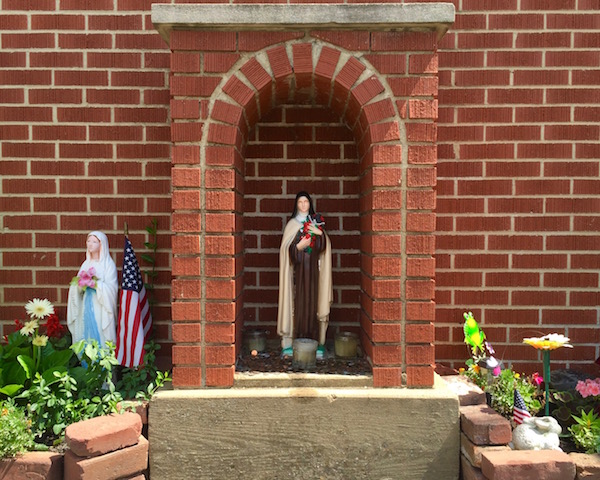
grotto with statue of Mary in front yard, Pittsburgh, PA

Deluxe grotto Mary, Spring Hill

With apologies to James Rado and Jerome Ragni:

Don’t ask me why, I’m just a Mary guy
I’m Mary noon and night, Mary, she’s a sight
I’m Mary high and low, don’t ask me why, don’t know

Not really expecting Mary to fly in the breeze, get caught in the trees, or provide a hive for the buzzing bees, we’ll end this frivolity right now–there’s big Mary business on the docket!

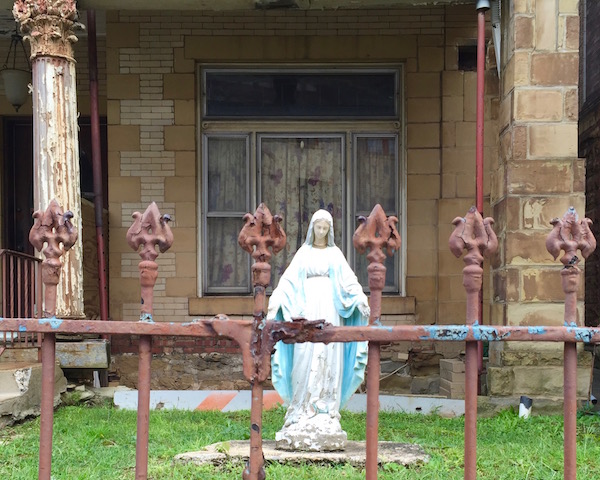
Mary statuette in front yard grass, Pittsburgh, PA

The Run

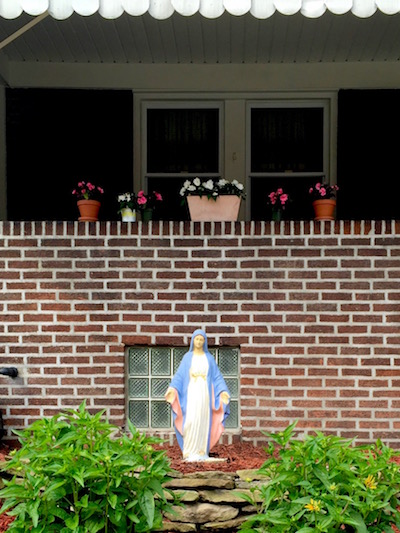
More Marys! In super-deluxe retaining wall grottos, bedecked in spinners and lights, obscured by Halloween decorations, enveloped in the deep-fry aromas of Big Jim’s, and standing alone in shame like a misbehaving student at recess.

The Orbit was not at all sated the by The Front Yard Marys of Bloomfield. No, that June, 2016 scene report just whet an appetite that inspired us to climb mountains, ford streams, and canvas for Hillary Clinton to slake this curio-religious thirst. Drink up.

Statuette of Mary in front yard, Homestead, PA

Homestead

Mary statuette in front of brick house, Pittsburgh, PA

Stanton Heights

Mary statuette in front yard, Pittsburgh, PA

Morningside

statue of Mary in front of older pink frame house, Pittsburgh, PA

Oakland

front yard Mary in grotto with a separate front yard Mary, Pittsburgh, PA

Big Jim’s Marys, The Run

Front yard Mary, Pittsburgh, PA

Lawrenceville

Mary statuette in wooded yard, Pittsburgh, PA

Mary of the Wood, South Side Slopes

Mary statue in grotto in front of frame house, Pittsburgh, PA

Halloween Mary, Spring Hill

statuette of Mary in front yard of house, Pittsburgh, PA

Allentown

Three statuettes of Mary in front yard of home, Pittsburgh, PA

Trio of Marys, Stanton Heights

statue of Mary in homemade grotto, Pittsburgh, PA

Back yard Mary, Lawrenceville

Fairywood: The World Without Us

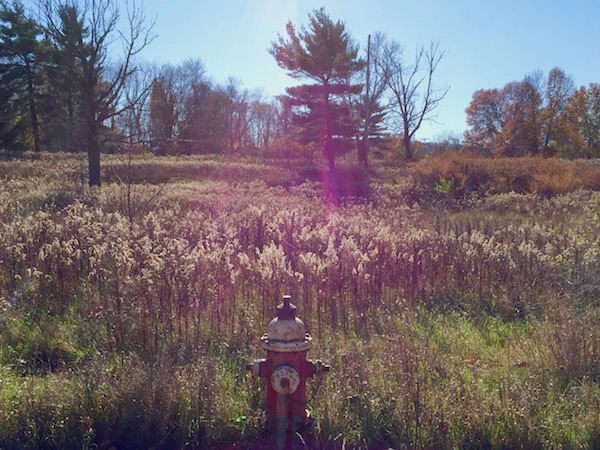
fire hydrant in field of tall weeds, Pittsburgh, PA

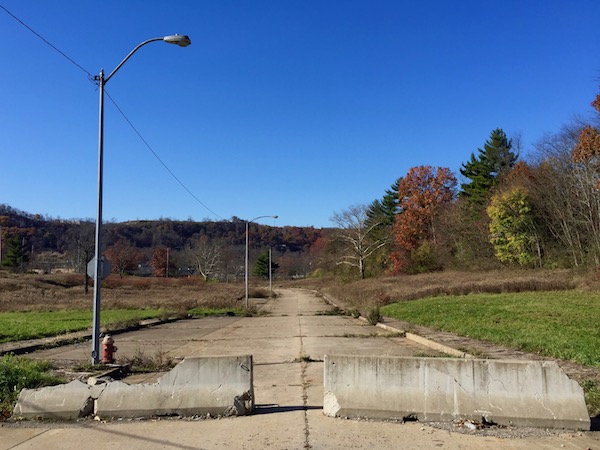
Former Broadhead Manor public housing project, Fairywood

Fairywood. Has any place as bucolic a name? One would assume it could only exist in fantasy–within Narnia or Neverland or, at least, New Zealand. Fairywood must be a land of eternal mist, riddle-spinning toadstools, magick staffs hewn from gnarled bentwood, spellcasting. It is where banshees live, and yes, they do live well. But one need not cross the Misty Mountains nor the darkest depths of Mordor[1]–it’s right here in the City of Pittsburgh.

If one were to set out for Fairywood, she or he might also optimistically hope to encounter pixies, gnomes, gremlins, griffins, or unicorns along the journey. Such other-worldly creatures simply must exist in the forest faerie realm. Alas, that was not this blogger’s experience.

empty street with jersey barriers at entrance of former Broadhead Manor, Fairywood, Pittsburgh, PA

Entrance from Broadhead Fording Road

Look up Fairywood and you’ll likely come across some bad press. At this point, the peninsular neighborhood on Pittsburgh’s far southwestern border [it is surrounded on three sides by non-city boroughs] is mainly associated with two things: colossal ex-urban warehouses and off-the-charts crime.

The former is easy to see–along the south and west perimeters are huge distribution centers for UPS, ModCloth, Amazon, and Giant Eagle/OK Grocery. The hum of their idling 18-wheelers and beeps of reversing forklifts are omnipresent even from a great distance.

The latter is not so obvious. On a picture-perfect Saturday afternoon, we barely encountered a single living soul–and the ones we did meet were real nice! The sum of residential Fairywood is contained in four or five streets of pre-war frame houses and Baby Boom-era pill boxes and split-levels, plus one former project-turned-gated community. Only around a thousand people live here. Who’s committing all this crime?

cul-de-sac in former Broadhead Manor, Fairywood, Pittsburgh, PA

Cul-de-sac

Alan Weisman’s 2007 best-seller The World Without Us detailed the ways in which the built environment would inevitably deteriorate in the absence of human beings. I’ll confess I haven’t actually read the book, but Mrs. The Orbit did and relayed its projections of houses collapsing and cities overtaken by nature as I was suddenly getting much more aware of cracks in the plaster ceiling and loosening of our mortar joints.

By far, the most prominent feature of Fairywood today is the enormous negative space created by what was at one time the Broadhead Manor public housing project. In its absence is a massive plot of land–its footprint similar in size to a junior college campus or suburban shopping mall (including all the parking). The actual housing blocks have been razed and removed, but the infrastructure–several curling roads that terminate in dead-ends, street lights, sidewalks, fire hydrants, an absurd children at play road sign–all remain.

handrail and concrete sidewalk to urban prairie, former Broadhead Manor, Fairywood, Pittsburgh, PA

Handrail, sidewalks

Between these few remaining stretches of concrete, nature has come back hard and fast. It’s a very un-Pittsburgh landscape–almost completely flat (although you can see hills in the distance in any direction) and dominated not by trees, but instead with scrubby waist-high bushes, weeds, and wildflowers–much more midwestern than Appalachian. Nationally, these kinds of spaces have been coined urban prairies for a reason–they’re not quite nature without man, but they’re decidedly not city (as most tend to think of it) either.

That Broadhead Manor should or should not have been razed is a conversation for those who actually lived in and around it[2]. With no personal connection, it does strike me as a classic built-to-fail situation: warehousing people in closed-circle public projects at the most distant edge of the city in a neighborhood with neither business district nor many transportation options[3]. What could go wrong?

Man in winter clothes against chain link fence, Pittsburgh, PA

Mr. Ro Ro (note his wizard’s staff)

We met Mr. Ro Ro camped out on a folding chair, waiting for a bus on Prospect Avenue. A wizard’s staff was casually propped against the chain link fence. Mr. Ro Ro told us he’s lived in Fairywood for fifty years and said of Broadhead Manor, “Roosevelt built them after the war.” President Roosevelt’s connection is unknown, but Broadhead Manor was indeed former military housing, purchased by the city in 1946[4].

As the only human wandering through the strange dystopian landscape of an ex-neighborhood with all its buildings removed–now almost completely reclaimed by nature–the irony of the phrase “after the war” was ringing in the air. More than anything else, this huge section of Fairywood feels like what’s left after the nuclear winter has finally subsided and an entirely new form of nature begins again on the bones of the civilization that destroyed the old one. Let’s hope we get it right this time.

dead end street in former Broadhead Manor, Fairywood, Pittsburgh, PA

The end of the road


[1] It is telling that The Orbit‘s knowledge of Middle Earth comes more from Houses of the Holy than The Player’s Handbook.
[2] A post in the Abandoned, Old & Interesting Places – Western PA FaceBook group shows some of the housing after the residents had been moved but pre-demolition. It includes many comments–both positive and negative–including quite a few former residents who speak glowingly of their time at Broadhead Manor in the 1960s.
[3] Port Authority’s 27 bus route serves Fairywood and nearby neighborhoods with a link to downtown Pittsburgh.
[4] Fairywood Fact Sheet (date unknown) http://digitalcollections.library.cmu.edu/awweb/awarchive?type=file&item=550317

Castle Damas

retaining wall on hillside constructed to look like medieval castle, Pittsburgh, PA

Castle Damas, Spring Hill

Rick Sebak’s inevitable future Pittsburgh history documentary Great Retaining Walls of Allegheny County should begin right here, in Spring Hill.

Castle Damas[1], a medieval fortress whose turrets and battlements were formed from mortar and stone rises with a spectacular view of the lands it holds dominion over–through the valley, down to Spring Garden, and across the river to the Strip District.

That these impenetrable walls should stand just up the block from the Spring Hill spring is no accident. The first settlers of Damas Street wisely selected an optimal site for defense, visibility, quality of life, and its free-flowing supply of life-sustaining cleanish natural spring water[2].

house with retaining wall on hillside constructed to look like medieval castle, Pittsburgh, PA

The keep and battlements of Castle Damas

Given the news of the week, we can assume we’ll all be getting a little more familiar with wall-building. On our recent visit, we were fortunate enough to meet the lord or this particular manor, who’s probably got as much wall experience as anyone. This day, our regent was engaged in maintenance of the structure, giving his naves a precious Saturday off and pulling weeds from the parapets himself. Lord Damas [Swiss cheese-for-brains failed to record the homeowner’s given name] told us his hilltop house was built in 1926 and its first owner, a baker, began construction of the elaborate wall around 1933.

Perhaps because it hasn’t been around quite as long as its European cousins, the castle wall and its bungalow-style keep are in impressive condition. Our liege told us he’d had to rebuild the top left half of the battlements and after pointing it out, the different colored mortar makes that somewhat obvious–but there’s enough variance in the stonework that this masonry-challenged blogger probably wouldn’t have noticed otherwise.

figure of an owl created with concrete and reflectors, Pittsburgh, PA

The owl of Castle Damas

Brendan Gill, (then) architecture critic for The New Yorker, famously wrote “If Pittsburgh were situated somewhere in the heart of Europe, tourists would eagerly journey hundreds of miles out of their way to visit it.”[3] This blogger’s about as crazy cuckoo coconuts on Pittsburgh as anyone, but even he can recognize hyperbole when he trips on it.

That said, when just any old anonymous hillside street gives us these cross-city views, this public spring, and a terrific faux castle/retaining wall overgrown in beautiful wildflowers and fall colors, birds–even a guard owl–well, who are we to argue?

retaining wall on hillside constructed to look like medieval castle, Pittsburgh, PA

Castle Damas


[1] “Castle Damas” is Pittsburgh Orbit‘s name for the construction–don’t bother looking it up (at least, not by that name).
[2] We’ll note that the construction of the uphill houses on Damas Street was considered a contributing factor to the discoloration and impurity of the sping’s water.
[3] In the same quote, Gill also claims “The three most beautiful cities in the world are Paris; St. Petersburg, Russia; and Pittsburgh,” but if the guy has never even been to Akron, take it with a grain of salt.

Get Out The Voegt: Finding the Spring Hill Spring

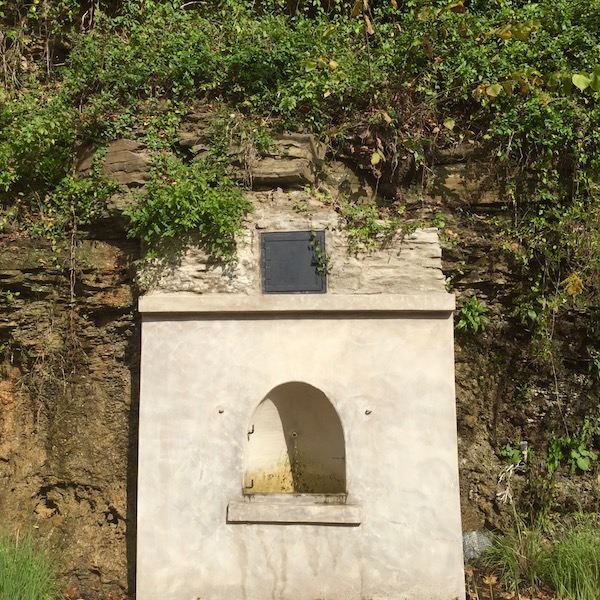
natural spring in concrete pedestal embedded in hillside, Pittsburgh, PA

Spring is sprung: Voegtly Spring, The Spring Hill spring

Ask a Spring Hill local how to get to the neighborhood’s newly-unearthed and re-opened natural spring and he or she will make it real easy for you: “It’s right by the boxing ring.” Me: “Oh, thank you very much, that helps a lot. Just one more question: where’s the boxing ring?”

From there, it just gets more confusing. The “boxing ring” is actually the Steel City Boxing Association and Google Maps puts it way down the hill from its true location. Assuming you do find the right place, the stonework is engraved Hook & Engine Co. 53 for its (former?) life as a fire hall and contains no after-market mention of the sweet science.

How about the Internet–a recently excavated and restored piece of local history should be front page news, right? Well, you try a web search for “Spring Hill spring”–it’s un-Googleable! Spring Hill’s Internet presence doesn’t assist at all–there’s nary a peep about the spring from the neighborhood associations or its wiki page. C’mon, guys–help a blogger out!

Rest assured, dear reader: if we achieve nothing else, The Orbit will get you to the Spring Hill spring.

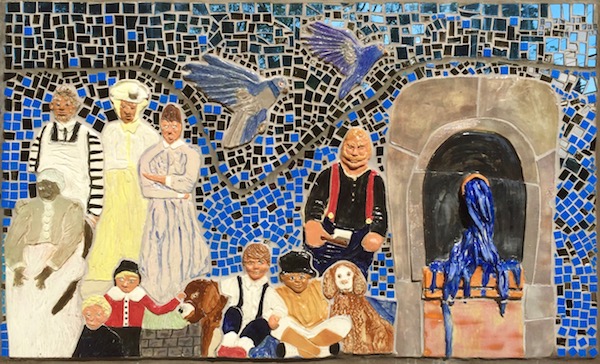
Detail from public mosaic "The German Settlers of Spring Hill" depicting the Spring Hill spring, Pittsburgh, PA

“The German Settlers of Spring Hill” (detail) mosaic depicting Voegtly Spring, Spring Hill

A large mosaic installation titled The German Settlers of Spring Hill welcomes visitors near the corner of Homer and Damas Streets*, one of just a few access points to the hilltop neighborhood. The final section of the four-panel piece features various community members in old world garb gathered around the image of the hearth-like Voegtly Spring, the natural water source that gave Spring Hill its name.

In that depiction, the spring is a flooding outpour overflowing its basin, its output equal to a dozen garden hoses. That’s not exactly what we found. The constant stream of water–there is no Off valve to a natural spring–is more of a dribble or a trickle than the gusher one might expect from the artwork mere feet away. That may have something to do with us visiting after a run of dry weather, so we’ll have to go back to verify after a decent stretch of rain.

masonry enclosure around pipe dribbling natural spring water, Pittsburgh, PA

The spring

Some background, from the Voegtly Spring historic nomination form**:

A stream ran down from the top of Spring Hill, ran through the intersection of Humboldt St. (now Homer St.) and an unnamed street (now Damas St.) and down into modern day Spring Garden (Fig. 4). In 1912 a rectangular stone and concrete structure was built into the shale hillside alongside Damas St. (formerly Robinson Road) to harness the flow of water beneath the ground to provide easy access to drinking water for the residents of the neighborhood and surrounding area.

The nomination form goes on to mention that “the spring water was tested and shut off sometime in the 1950s” and that house construction above the spring “may have contributed to [its] contamination”. Furthermore, “It is reported that during this time the spring water developed a distasteful odor and became a yellowish orange color.”

There’s no official word on whether the discoloration is still in effect, but it looked fine to my admittedly low standards. Despite the warning that “public works does not encourage its use because [the water] is not treated”, it’s certainly right there for the drinking and let’s face it: it’s cool to suck spring water right out of the hillside. Lesser journalists–speculative or otherwise–would turn toward home after snapping some pictures, but this blogger rushed in for a righteous century-in-the-making quaff.

glass of water from Voegtly Spring, Pittsburgh, PA

No discoloration here. Voegtly Spring water.

So…what does Voegtly Spring’s water taste like? Well, it ain’t Perrier, that’s for sure. If it’s not too vague, we’ll describe it as earthy, or maybe minerally. Flavorful–but I wouldn’t describe that flavor as desirable. It’s maybe a little gritty–like a woodsy stream–surprisingly warm, and decidedly different from city tap water (for good or bad). That said, it doesn’t have the natural toe-tingling effervescence of more celebrated waters. I’ll go out on a limb to suggest it’s unlikely we’ll encounter Winnebagos parked on Damas Street with tourists filling five-gallon jugs like you regularly see down in Berkeley Springs.

I’ll be honest: there’s not a lot else to do at the spring. You can drink from it straight like a water fountain and you can fill up a jug. That’s pretty much it. As entertainment, a visit is pretty low rent compared to, say, Pac-Man or The Jumble. Regardless, it’s a neat little old world nugget to trip across if you find yourself hanging out by the boxing ring or, more practically, desperately need some hydration and can’t quite make it down to Penn Brewery.

Here, on this eve of an incredibly important national election, we can only recommend that Orbiteers first get out and vote. And then, if you’re still not satisfied, get out and Voegt.

masonry enclosure for natural spring in hillside, Pittsburgh, PA

Voegtly Spring, The Spring Hill spring

Getting there: Voegtly Spring is on Damas Street, just off Homer. When you see the old Hook & Ladder Company or the big public mosaic/garden, you’re real close. The easiest way to get there (especially on bicycle) is from Spring Garden Avenue, up the hill on Homer. We’ve also added a pin for the spring to our Map page.


CORRECTION: An earlier version of this story quoted an August, 2016 Post-Gazette piece on the re-opening of the spring that incorrectly lists Fred and Wilbert Bergman as the builders. The Bergmans took the earliest known photograph of the spring, but construction was done by the city Department of Public Works.


* The mosaic was constructed by a large group at the leadership of Linda Wallen, whose Yetta Street mosaics (also in Spring Hill) we profiled last year.
** A big thank-you to Spring Hill resident James Rizzo for helping to clarify the facts on ownership and construction of Voegtly Spring.

Day of the Dead: Susan Hicks, Uber Alles

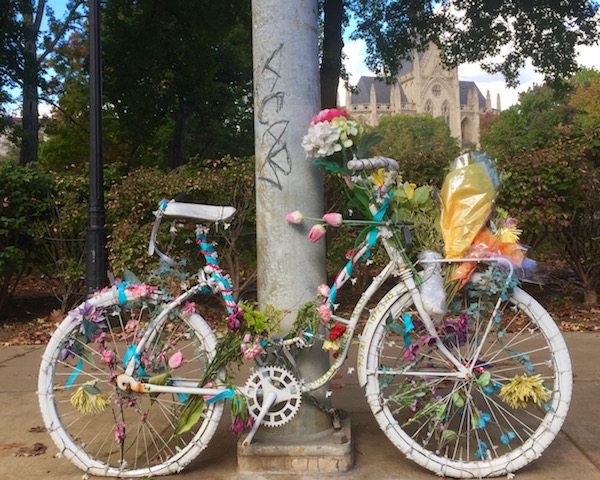
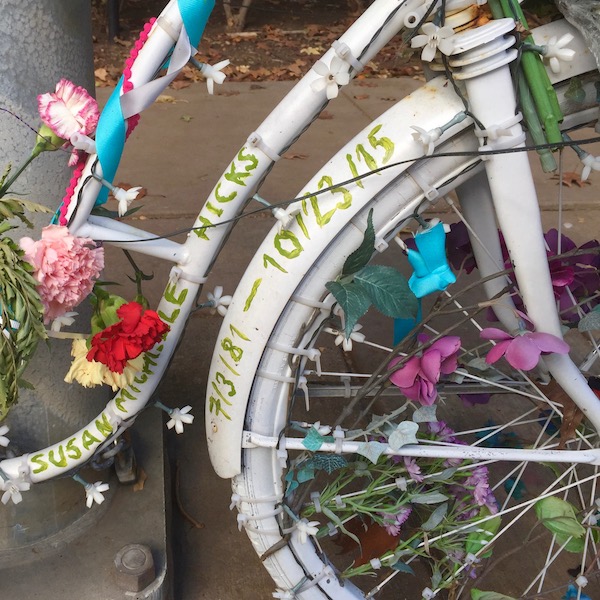
bicycle painted completely white and decorated with flowers and lights, Pittsburgh, PA

Ghost bike memorial for Susan Hicks, Oakland

Last week marked the one year anniversary of Susan Michelle Hicks death. This blogger didn’t know her personally, but Ms. Hicks was “friends of friends” who commuted–and was killed–riding her bicycle on a stretch of Forbes Avenue in Oakland where I ride all the time. Quite literally, it could have been me.

Very near the tragic spot where Ms. Hicks died, just across the street from Dippy the Dinosaur and the Carnegie Music Hall, is a so-called “ghost bike” memorial. Chained to the pole of a stout street lamp, it’s a decommissioned older bicycle, painted completely white, draped in flowers, ribbons, personal messages, and a strand of solar-powered lights. A felt-tipped pen left on the seat invites visitors to ink inscriptions to the fallen–many have done so.

The effect of seeing the Hicks ghost bike–or any other–is incredibly moving. It’s both beautiful and haunting, arresting, sombre, and reverent. It’s also encouraging that this obviously-un-sanctioned memorial has been allowed to remain intact; city works crews choosing to leave it alone–now, for over a year–in this very public, well-travelled spot instead of treating it as an act of litter or vandalism.

detail of ghost bike for Susan Hicks, Pittsburgh, PA

Statistically, Pittsburgh is among the very safest U.S. cities to be a bicycle rider/pedestrian. This is, perhaps, surprising given our severe infrastructure challenges, but according to some numbers collected by Bike PGH, the city’s rate of 1.8 fatalities per 10,000 commuters is way down the list of American cities. As comparison, the bottom of the collection contains Ft. Worth, Detroit, and Jacksonville, all with an average of 40 to 50 fatalities on the same scale.

That said, it’s sadly no surprise this particular tragedy happened in the heart of Oakland. Any Pittsburgh cyclist will tell you what a nightmare it is to navigate the neighborhood on two wheels. It’s nearly impossible to feel safe riding from, say, Neville to Atwood, or CMU to Pitt without either breaking some kind of law or going way out of your way–and this is a part of town with 40-some thousand college students! I get mad at the kids riding on sidewalks, but what alternative do they have?

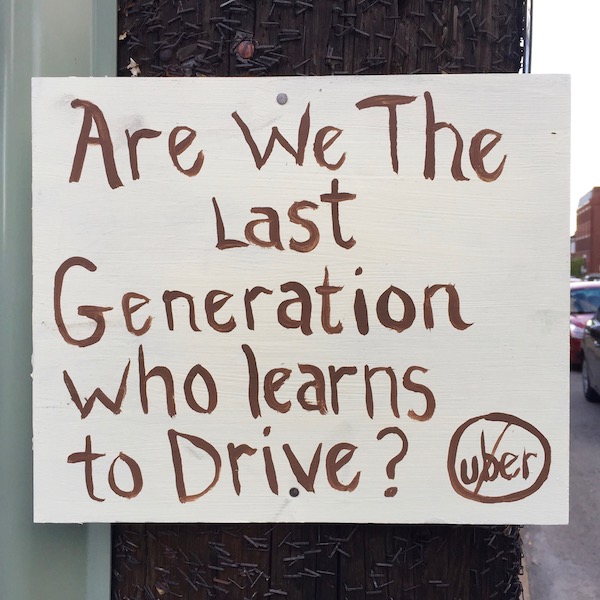
Handmade sign reading "Are we the last generation who learns to drive?", Pittsburgh, PA

Anti-Uber sign, Oakland

On a recent ride home from work, I came across a batch of wooden signs nailed to telephone poles. On each was a hand-scripted message: Are we the last generation who learns to drive? read one on Craig Street, and Humans crave community, not isolation another. The messages continued in Bloomfield:  Automation smothers natural beauty and awe and Deep in your humanness, your heart longs not to be mechanized.*

If you’ve spent any time in the East End over the last half year, you know where these are coming from. Uber self-driving cars are being tested all over the city–we see them every day**. It’s a technology that’s not without controversy, but surprisingly little considering the potential societal implications. Overall, opinion has felt more like a collective ho-hum.

collage of photos of Uber self-driving cars being tested on Pittsburgh city streets

Uber self-driving cars testing in Pittsburgh [photos, clockwise from top left: P. Worthington, M. Hertzman, A. Hoff, K. Barca]

The full point of these guerrilla signs is not entirely clear, but each contains Uber’s name in a crossed-out circle. We can assume the opposition to the ride-sharing company is the anonymous sign-poster’s major thesis, but there are also messages around community, beauty, and “humanness”.

Is Uber being accused of colossal corporate takeover? Or is the issue that they’re developing self-driving technology? Assuming the latter, how does changing the way a car navigates “smother natural beauty and awe”? [We did a pretty good job of this way before Uber came along.] Plenty of people drive alone every day–why do these vehicles create any more isolation than any other solo car trip?

If we’re worried about the number of Uber (and other) human drivers who may be put out of work by this technology, that’s legit. But let’s not assume that’s the only sociological possibility for self-driving vehicles. There is the very real likelihood that autonomous cars will be much safer on the road than humans. They certainly won’t drive drunk or fall asleep at the wheel. They won’t show off to impress the girls in the back seat and won’t take their eyes off the road when their phones light up. There are a whole lot of people with disabilities who can’t wait for an alternative to Access.
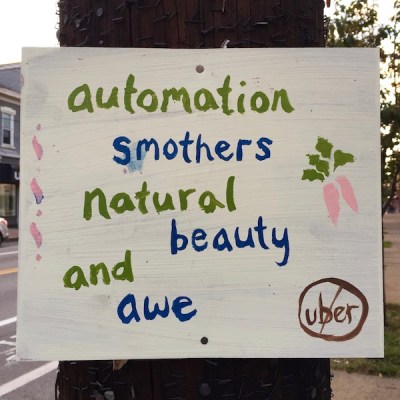
Handmade sign reading "Automation smothers natural beauty and awe", Pittsburgh, PA

Anti-Uber sign, Bloomfield

Bicycle riders are not saints. There are a lot of dangerous people out there, and we come across them every day–treating sidewalks as bicycle lanes, recklessly jack-rabbiting through traffic, ignoring traffic lights, signaling, and stop signs. Cyclists who take off without a helmet or foregoing lights in the dark are just plain foolish.

These are condemnable actions that frankly burn this biker’s breeches–you guys give us all a bad name! That said, it’s nothing compared to the regular behavior we see from drivers toward cyclists. I’ve never been hit by a vehicle driven by a computer; the same can’t be said for humans. In my years (ahem, decades) on two wheels, I’ve been spit on, had trash thrown at me, yelled-at, cat-called, and aggressively hip-greased more times than I can recall. Drivers routinely drift absent-mindedly, park in bicycle lanes, and wildly swing open their parked doors without first consulting their mirrors. While driving, they eat and drink, talk on the phone, apply lipstick in the rearview mirror, and, of course, are constantly texting.

Given all this, I’ll take my chances with the robots. If they’d been deployed to Oakland last year at this time, maybe Susan Hicks would still be with us and on the road today.

bicycle painted completely white and decorated with flowers and lights, Pittsburgh, PA

Ghost bike for Susan Hicks, Oakland


* If anyone has seen more of these, we’d love to know about them.
** So far, always with a human in the driver’s seat.

Sudden Death, Over Time: Steeler Graves

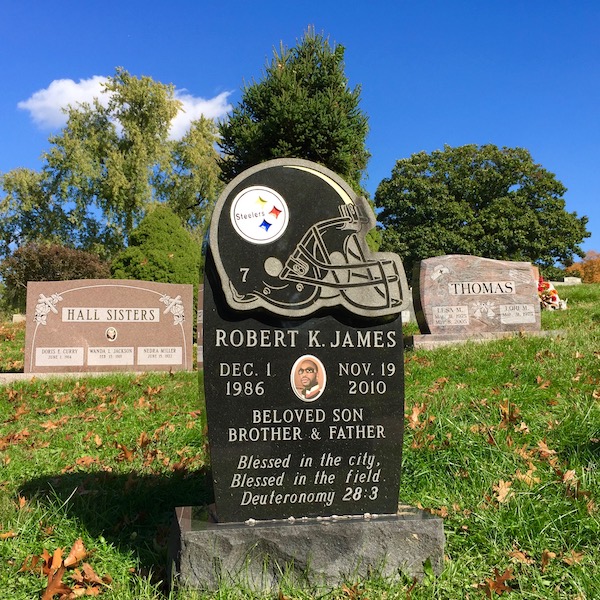
gravestone with Pittsburgh Steelers football helmet, Allegheny Cemetery, Pittsburgh, PA

Robert K. James, Allegheny Cemetery

In the great Autumn campaign that is each of our lives, we’ll inevitably begin to feel those last seconds of the final game tick off the clock. We can all hope to make it deep into the playoffs–heck, some may even get lucky enough to reach this preposterous metaphor’s Super Bowl. But even with the very best “clock management,” we’re all heading toward a long long off-season in the sky at some point.

matching graves with Steelers logo, Allegheny Cemetery, Pittsburgh, PA

Stacy and Stephen Slanina, Allegheny Cemetery

Forever, the Purple One reminds us, is a mighty long time. It’s likely, though, that The Prince was not thinking about funeral arrangements when he urged us all to “go crazy.” So I’m sure it’s with no small amount of consideration that most folks choose the design and ornament of a gravestone–either for oneself (if he or she likes to plan ahead) or for the loved one the family is burying (more likely?).

Why, there’s the stone itself, available in any number of shapes, sizes, finishes, and flourishes. There’s the text–a full name, sometimes with a favorite nickname, birth and death dates*, and then any manner of other possibilities: pithy epitaphs, Bible verses, embedded portraits, etched images both representational (occupations, avocations) and ornamental (flowers, angels, religious insignia).

grave marker with Steelers logo, St. Michael's Cemetery, Pittsburgh, PA

Jack W. Springer, St. Michael’s Cemetery

If the deceased happened to champion a particularly well-loved, black-and-gold-hued eleven, chances are maybe better than you’d think that the emblem of said N.F.L. franchise will end up etched into his or her headstone. This act of committing and commemorating the deceased to eternity as a devoted Steeler fanatic lets the living know that while still tripping on this mortal coil he or she bled (hopefully not, you know, all the way out) black and gold.

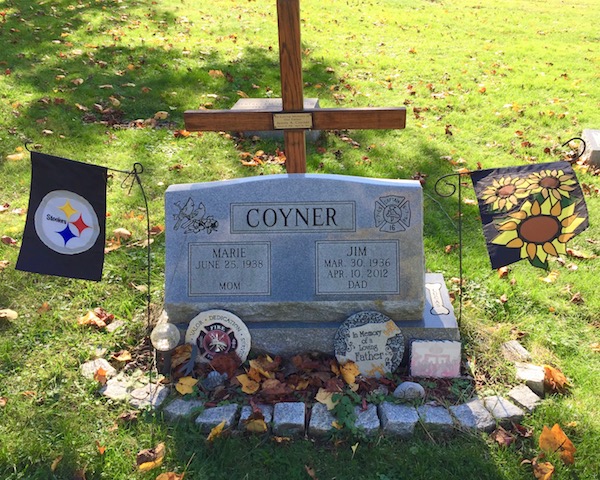
gravestone with Pittsburgh Steelers flag, Allegheny Cemetery, Pittsburgh, PA

Marie and Jim Coyner, Allegheny Cemetery

It’s a curious choice. Steelers fans would never admit it, but sports franchises are transient things. Pittsburgh has been fortunate to never have one of its teams skip town, but we’re only 80-some years into professional football history–there’s still a lot of time for a lot of things to happen.

Are there graves in Baltimore or Brooklyn or Hartford with Colts, Dodgers, and Whalers logos carved into them? I doubt it, but only because those moves all happened before the relatively recent phenomena of having one’s passions preserved in stone**. But what about St. Louis–are there fresh graves just set with Rams insignia marking them? Possibly…maybe even probably. What an indignity to give one’s afterlife to a team that just high-tailed it back to Los Angeles.

gravestone with Pittsburgh Steelers logo, Allegheny Cemetery, Pittsburgh, PA

Roman L. Bryant, Allegheny Cemetery

It makes you wonder if this happens everywhere. This blogger can certainly imagine the same level of devotion from fans of the Boston Red Sox or Montreal Canadiens or Green Bay Packers. But what about Cleveland or Cincinnati? They’ve got their own rabid fans, but are there Browns and Bengals graves? We sure hope not–life on earth following these teams was already Hell, why take that misery with you?

upright gravestone with Steelers logo, Highwood Cemetery, Pittsburgh, PA

Frederick J. Brown, Highwood Cemetery

What about even more marginal sports territories? Is there anyone in Seattle or San Jose that cares enough about the Seahawks or the Sharks to tattoo it on a gravestone? Does most of North Carolina, Florida, or Texas even know they have hockey teams? What monument maker could carve the offensive Cleveland Indian or Washington “redskin” into stone in good faith? I don’t even want to look at the terrible Anaheim “mighty duck”, let alone get buried under it.

gravestone with Pittsburgh Steelers logo, Allegheny Cemetery, Pittsburgh, PA

Jeffrey L. Turner, Allegheny Cemetery

All that said, the good people of Pittsburgh are quite comfortable with this option. It wouldn’t be my choice, but I’m glad it is for some. Studying the cemetery is like anything else where we see changes in culture reflected over time. In many ways, future generations will know more about us now from these Steeler graves (as well as the other custom designs and embedded images) than we can derive from their much more opulent 19th century ancestors. At least, they’ll know we (Pittsburgh) sure liked football. On that, they’ll be correct.

gravestone with large Pittsburgh Steelers football helmet, Highwood Cemetery, Pittsburgh, PA

Kevin Washington, Sr., Highwood Cemetery


* Coming across the occasional stone with no death date is always intriguing. We assume these are just folks who plan farther ahead than Orbit staff, but you never know.
** You’ll note that all photos are from graves dating from 2002 onward. We don’t know when monument makers began offering these kind of options, but almost all of the custom personal interest imagery seems to come from the 1990s-present.

Union Dale Cemetery: The Lamb Lies Down on Baahway

iron grave marker of a lamb, Union Dale Cemetery, Pittsburgh, PA

(unknown)

Union Dale Cemetery‘s Division Three, Section b (yes: that’s a lower-case b) lies waaay in the back, at a high point in the park, bordered by treelined fencing that separates the property from nearby Presley Ridge School. Section b is so far removed that it doesn’t even appear on the cemetery’s online maps*.

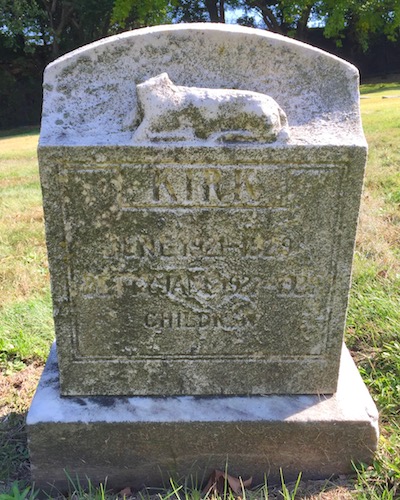
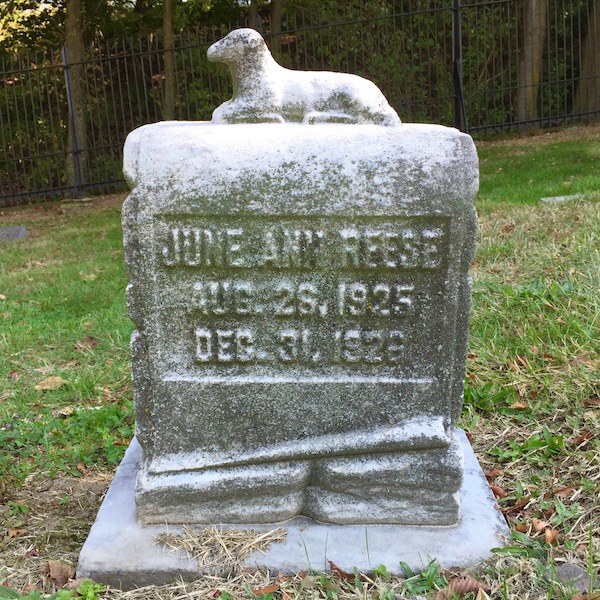
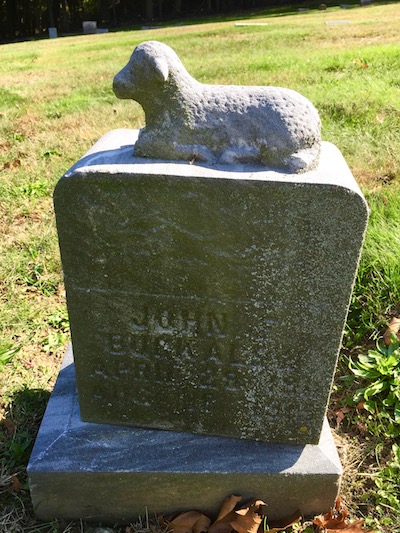
But if you can make it out to Union Dale’s far northeast outpost, the tell-tale shapes of lambs popping up on gravestones and laying down in the grass will tell you you’ve reached the right spot. The creatures will be calmly resting, their little lamb ears pointing out at the sides. Each one of them will face the same direction.

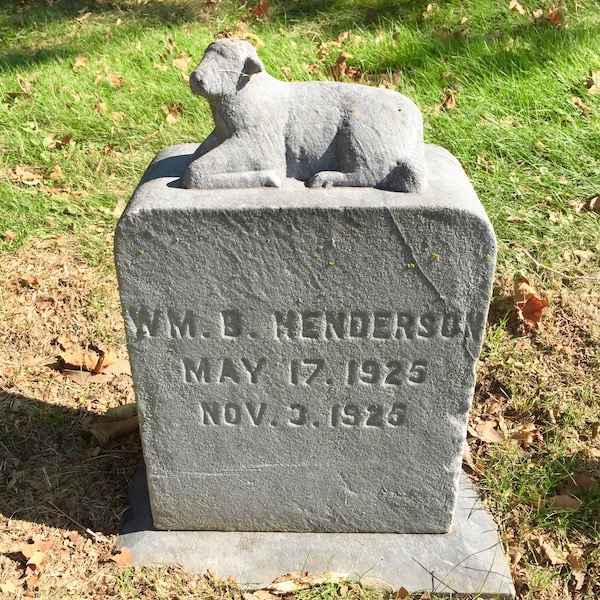
weathered gravestone with lamb, Union Dale Cemetery, Pittsburgh, PA

Wm. B. Henderson

weathered gravestone with lamb, Union Dale Cemetery, Pittsburgh, PA

Jane Lee Blumfeldt

Listen here: when we shoot the sheep, we’re not talking about any jive-ass 2-D cutaways or bas relief lambs, either–though there’s plenty of those loitering on newer stones in the same neighborhood. No, this is full-on, worn-to-nubs marble and granite lambitude.

Two of the specimens (Kirk and Klein, photos below) seem to be the same general make and model, but otherwise each gravestone is unique. That’s not to say the lambs don’t look alike–they do–but there’s enough variance here to suggest these weren’t simply off-the-shelf lamb-on-a-box markers.

weathered gravestone with lamb, Union Dale Cemetery, Pittsburgh, PA

Kirk

weathered gravestone with lamb, Union Dale Cemetery, Pittsburgh, PA

Ralph A. Klein

Jennie Benford, our Concierge to the Dead, says “The lambs were very popular but almost exclusively for children’s markers.” The Internet backs her up on this claim, as does the anecdotal evidence of the dates we can see on the (still-legible) stones here. The deceased were all between months and just a few years old when they arrived at Union Dale and given the concentration in this one small area, we have to wonder if Section b was earmarked as plot for children.

The association of lambs with the death of children has a number of explanations, but the most common seems to this passage from the Bible:

The next day John seeth Jesus coming unto him, and saith, Behold the Lamb of God, which taketh away the sin of the world.  — John 1:29

weathered gravestone with lamb, Union Dale Cemetery, Pittsburgh, PA

(unknown)

weathered gravestone with lamb, Union Dale Cemetery, Pittsburgh, PA

June Ann Reese

There are other similarities. Every one of the markers (that we’re able to read) is dated from the same decade. Jennie assures us “The lamb stones are not strictly 1920s–I’ve seen them used much earlier than that and for some time after,” but it’s an interesting data point.

The lamb is always sculpted alone and awake, but in a resting position with its legs folded underneath. I imagine there is a practical aspect to this–sculpting those spindly legs from delicate marble is likely very expensive and accident-prone. That said, one has to accept that the feeling of innocence is even more pronounced with the gentle creature in repose. What could be more harmless and vulnerable than a kneeling fluffy white lamb?

Perhaps most curious, every single lamb faces to the left (as the visitor faces the stone)**. Now, that may just be a coincidence in our small sample, but if so, it’s equal to flipping “heads” ten times in a row. Still, reading any dramatic symbolism into facing left vs. right seems like a major stretch. Left, in this case, is also north, since all the stones face the same direction–west, or downhill and towards the only small access road. Again: likely not a planned coordination.

weathered gravestone with lamb, Union Dale Cemetery, Pittsburgh, PA

(unknown)

weathered gravestone with lamb, Union Dale Cemetery, Pittsburgh, PA

Catherine Achey

Union Dale Cemetery is an intimidating place to explore. It covers a huge area–likely equal to the size of Allegheny Cemetery or many (larger) city neighborhoods. The full plot is divided by Brighton Road and Marshall Avenue/Rt. 19, which effectively turns the park into three separate cemeteries. [Union Dale labels each of these a division.]

It’s hard to imagine there’s any best or worst way to take in Union Dale for the newcomer. That said, like so many things in life–or, it seems, in death–there’s nothing wrong with ending up at Plan b.

weathered gravestone with lamb, Union Dale Cemetery, Pittsburgh, PA

John Buckalynn


* Section b should not be confused with Section B, right by the entrance. Also, it looks like Union Dale’s PDF maps may have a page 2 that just didn’t make it to the web site.
** Two of the markers photographed are simply freestanding sculptures without an engraved headstone, so there is no left or right.

Allegheny Cemetery: Mausoleum Stained Glass

mausoleum stained glass with pentagram, Allegheny Cemetery, Pittsburgh, PA

Sproal-Splane

Seeing the world through the Orbit eye. Those words came to us a while back from superfan Lee, and we accept it as the ultimate compliment. Lee still requires corrective eyewear–so be warned that Pittsburgh Orbit is no substitute for Lasik–but we think we know what he was getting at.

If Orbit “reporting” has taught us anything at all, it’s to always take another look. Lose the expectations and open up the senses. Point those peepers everywhere you can: down the alley, around the corner, on the pavement, up in the telephone wires, and through the crack in the window. Like Irene Cara said: take your pants off and make it happen. What a feeling, indeed.

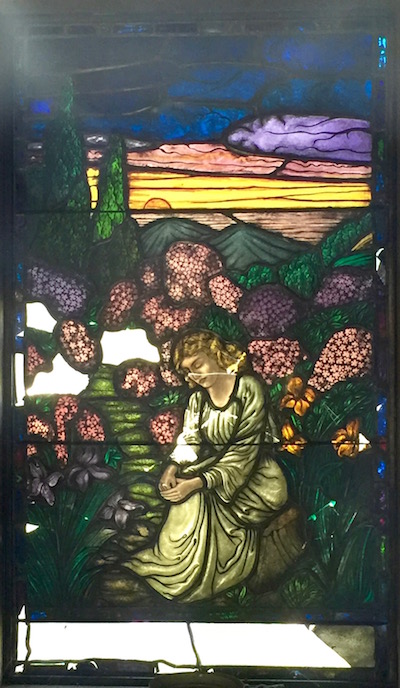
broken mausoleum stained glass with sitting woman and field of flowers, Allegheny Cemetery, Pittsburgh, PA

James M. Miller

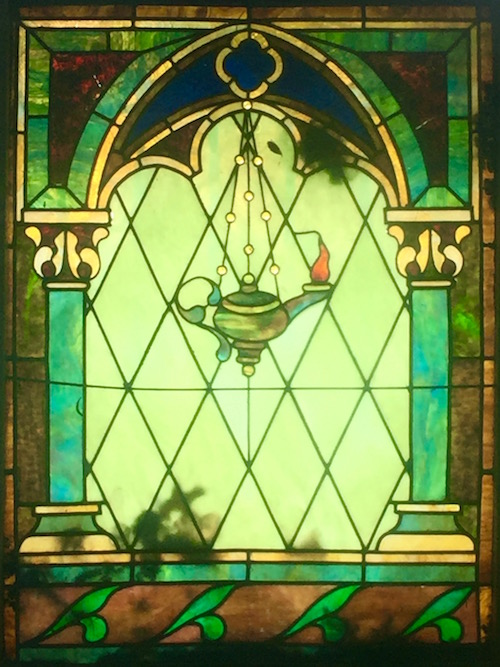
mausoleum stained glass of oil lamp hanging in arched window with columns, Allegheny Cemetery, Pittsburgh, PA

Unknown (possibly Krey, based on nearby cenotaph)

One of those spots, attentive Orbit readers will have anticipated by now, is through the thick barred grates, cobwebbed glass, and musky air of the ornate mausoleums at our historic cemeteries. Pittsburgh is sitting on a bunch of these.

This blogger has walked through, bicycled around, picnicked in, and shutterbugged Allegheny Cemetery literally hundreds of times over the last couple decades. Allegheny’s collection of mausoleums isn’t quite as spectacular as the rock star ones we toured with Jennie Benford last year at Homewood, but it’s nothing to scoff at.

The mausoleums act as both beacons and exclamation points on the rolling landscape and much of the art deco and faux-Egyptian architecture is really astounding. But for whatever reason, we rarely ever took the opportunity to shade the eyes and poke the schnoz in to check out the interior spaces.

mausoleum stained glass with angel, Allegheny Cemetery, Pittsburgh, PA

Unknown (detail)

mausoleum shelves with trophies in front of colored glass, Allegheny Cemetery, Pittsburgh, PA

Sheets

I’ll tell you: it’s not an easy thing to do. The average mausoleum–in Allegheny Cemetery, at least–seems to have a pair of thin, highly-decorated entry doors, each behind some version of vertical iron bars or decorative scrolled metalwork. Half the time, the original door locks are still in use, if not, there’s an awkward after-market steel chain and padlock lashed around whatever it can grab ahold of.

If you can see much inside, it’s typically a narrow passage, just wide enough for a person to turn around in, flanked by the celebrated residents’ crypts. Sometimes there’s just one of these on either side; others are stacked floor to ceiling. At the rear of almost every mausoleum is a stained glass window providing the only natural light outside of the shaded entry doors.

So to look inside a mausoleum is to peer through several layers of obfuscation, from the outside daylight into a darkened interior that may have had a hundred years since its last human visitor.

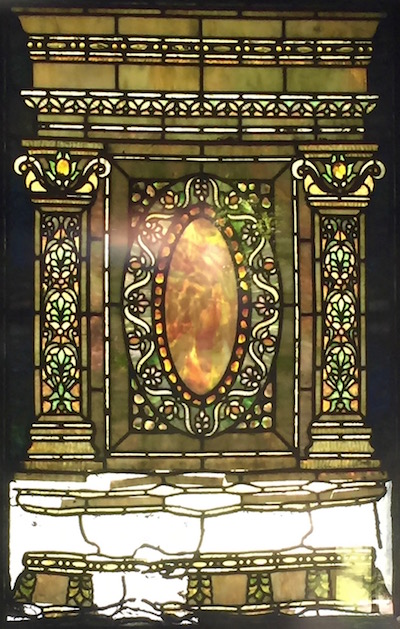
broken mausoleum stained glass with architectural design, Allegheny Cemetery, Pittsburgh, PA

King

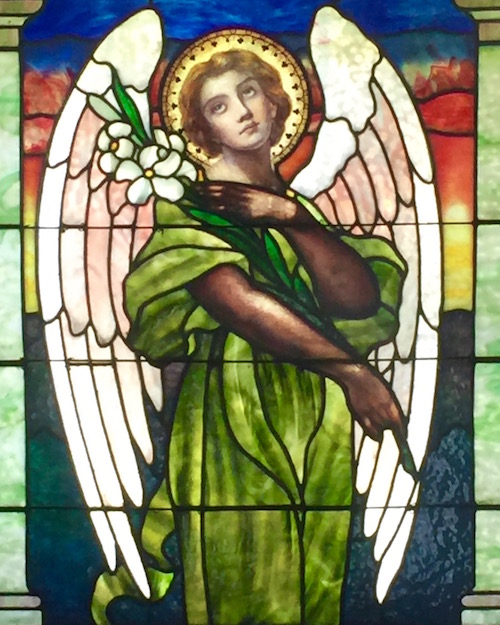
mausoleum stained glass with angel in green tunic, Allegheny Cemetery, Pittsburgh, PA

Wettengel (detail)

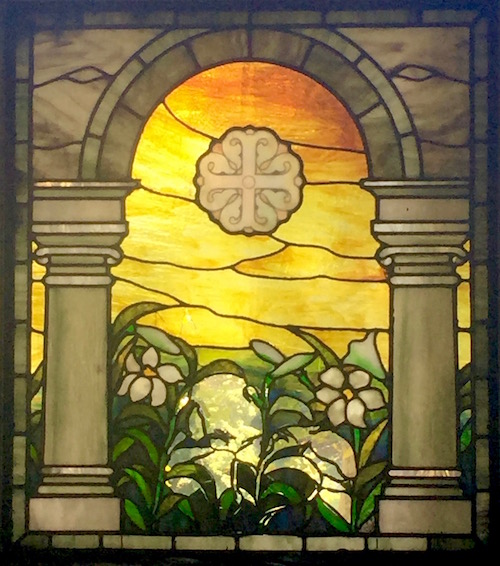
And what do we get to see in the stained glass? In a word: flowers–lots and lots of flowers. Flowers in vases, flowers in gardens, ornamental flowers, and flowers held by angels; lillies of the valley and daffodils of the foothills. We only included photos for a few of these; the flowers are quaint, but they’re just not that exciting.

Beyond the flora, however, there’s some pretty neat stuff. An old-school oil lamp dangles under an arched cathedral window with ghostly leaf shadows backlit from the outside; angels appear with painted-on faces, doe-eyed and calming; and, of course, in that chestnut of mortal symbolism, the sun sets over and over again in Mausoleumville.

There are also the broken panes. Windows whose heavy weight, coupled with a hundred years of un-climate-controlled Pennsylvania weather, eventually overburdened the lower sections. Individual colored pieces have popped out and cracked, leaving the windows looking like incomplete paint-by-numbers; the unimpeded sun’s glare the brightest element in the tiny space.

broken mausoleum stained glass with arch and white flowers, Allegheny Cemetery, Pittsburgh, PA

Lillian Russell Moore

Is it worth a trip? Well, Allegheny Cemetery is absolutely worth all the time you can give it–even if you don’t want to squint into (silent film star) Lillian Russell‘s final repository. But while you’re there, yeah, you should neb into whoever’s crypt you can. The Sheets and the Kreys and the Sproal-Splanes don’t seem like they’re coming around anymore, but don’t worry; we’ve got that Orbit eye looking out for them.

The Pizza Chase: P&M Pizza, Arnold

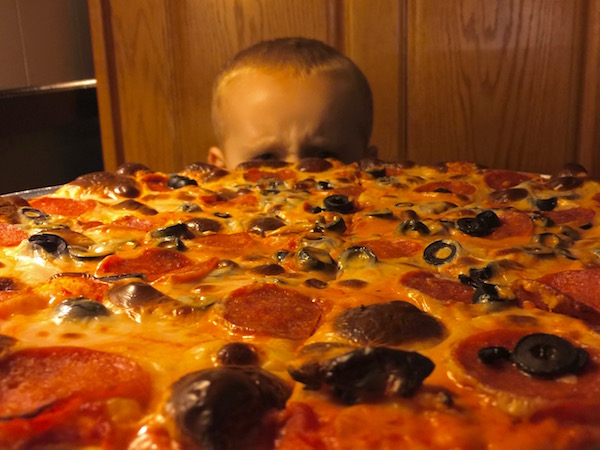
child's head seen over a large pepperoni and olive pizza, P&M Pizza, Arnold, PA

Sunrise over Lake Cheese d’Orange. P&M Pizza, Arnold

American cheese. Have wars been fought for less? Probably. At least…maybe.

As far as we can determine, the story goes like this: The original P&M Pizza goes back to 1947 in Arnold. Owners Lefty and Mooney Martz ran the place for over fifty years before finally selling and retiring in the late 1990s[1]. During that half-century, P&M became a landmark to locals with its unique pizza, distinctive in both crust and cheese blend (we’ll get to these).

At some point during the end of their run, the Martz’ trademark recipe was sold and is now reproduced across the river at Phillippi’s Family Dining and Pizzeria in Natrona Heights. Phillippi’s has rebranded both the pizza style and the restaurant, now calling itself the “Home of the Birdville Pie.”[2] 

In the meantime, P&M was re-opened in the late aughts in the very same 5th Avenue building the Martz’ called home for half a century. The new owners–a pair of Arnold natives–now claim to serve “The Original P&M Pizza” and they clearly want to take back the glory of what they believe is rightfully theirs. P&M’s web site features the crossed-out image of Phillippi’s cartoon pizza-eating chicken aside the text Leave it for the birds! P&M will also accept your (Phillippi’s) “Birdville Pie” coupons.

whole pepperoni and black olive pizza from above, P&M Pizza, Arnold, PA

P&M pizza

Whose pizza is really the most original? We have no idea. Sadly, we never got the chance to have a P&M pie cooked up by the Martzes. The Internet seems, as Internets do, both divided and unreliably-sourced on the topic. Technology-savvy Orbit readers can seek out opinions of each on their own, but suffice to say there are many reviews for both restaurants that include the cliché “you either love it or hate it” as well as the predictable accusations of “NOT the original…”

Regardless of how exact either P&M or Phillippi’s recreates the Martz’ formula, it’s clear they’re both working from a similar set of blueprints. As Zomato user Akvalleyfoodman–a self-proclaimed “expert” who’s “eaten (original P&M’s) thousands and thousands of times” since the mid-60s–says (of P&M), they’re “in the same zip code.”[3]

Coming late to the party, we’re just glad that there are two different establishments carrying the torch for micro-crust ambiguously-cheesed bar pizza located within minutes drive of each other. The Martz’ legacy–however approximate it may be–is alive and well.

child holding nose as a piece of P&M pizza is offered to him

P&M pizza: it’s not for everyone

So how do the two pies stack up? It’s been almost a year since The Orbit checked in at Phillippi’s, so we’re running on pizza fumes here. That said, we can attest that the two pies are very similar–at least, to tastebuds from outside the Alle-Kiski Valley.

Both are built on exceptionally thin crusts. In the previous report, we stated that Phillippi’s is “as wafer-thin as this eater has ever experienced.” Well, that may have been true last year, but P&M’s crust makes Phillippi’s look like deep dish. The crust is so thin that the cornmeal used to keep the dough from sticking to the oven becomes a major factor in the flavor. A pita looks thick by comparison. Heck, a Triscuit would need to get planed down to be this thin. [Carb-conscious dieters take note: P&M is a place you can get the thrill of hot, delicious pizza and barely consume any bread at all.]

The other thing that makes both places seem incomprehensible to all who didn’t grow up in greater New Kensington is the “proprietary cheese blend”. It’s electric orange and obviously contains some high percentage of American “cheese.” Now, we can get all snobby about our fromage, but gosh darnit if it didn’t taste absolutely gooey-great in the combination that P&M cooked up. Just editing the included photos is making this blogger hungry all over again.

one slice of pizza on a paper plate, P&M Pizza, Arnold, PA

Wafer thin and golden orange: a single cut of P&M pizza.

So which pizza gets the Orbit nod–P&M’s “original” vs. Phillippi’s “Birdville Pie”? We don’t want to disparage either establishment and it’s safe to say the two pizzas have a lot more in common than not. It’s also fair that both are definitely “acquired tastes” that you may have had to ingest in the womb to truly love. Curious outsiders: you’ve been warned.

All that said, in our very unscientific experience, The Orbit‘s guests at Phillippi’s declared that while it was an interesting experience, they didn’t really ever need to have another Birdville Pie. I couldn’t talk any of the bunch into trying their cross-river rival for comparison. The same was not true at P&M, where the entire table (O.K. just two adults and one narrowly-converted youth) was ready to go back for more the next day. Advantage: P&M.

front window of P&M Pizza, Inc., Arnold, PA

Check out The Orbit‘s first half on this two-part Pizza Chase story: Phillippi’s, Home of the “Birdville Pie”.


[1] “P&M Pizza in Arnold delivers the classic goods”, 10 April, 2014, TribLive.com,
http://triblive.com/aande/diningout/3761321-74/pizza-mckinley-phil
[2] Phillippi’s Family Restaurant and Pizzeria http://phillippis.com/
[3] Zomato: P&M Pizza House, user reviews https://www.zomato.com/pittsburgh/p-m-pizza-house-arnold/reviews

Re:NEW Festival: DRAP-ART

Chinese temples made by artist Gao Yansong from recycled boxes

Gao Yansong “The Chinese Dream Marlboro” and “The Chinese Dream NIKE”

It can’t be easy to light up a brand new festival. Why, you’ve got to do a bunch of planning, organize volunteers, negotiate with venues, talk people into doing umpteen different things, write a grant, create a logo, secure a domain name, and then when the day–or month–finally rolls around, you can only cross your fingers and hope that somebody–anybody–is willing to give your goofy idea a shot. It’s exhausting just thinking about it.

The folks that cooked-up this year’s Re:NEW Festival* weren’t mucking about. The festival spans a full month across a dozen different downtown venues, features a slew of staggered events, long-run gallery shows, lamppost banners, glossy printed materials, and of course, printed t-shirts. Oh, yeah–they also decided to stage the North American premier of a world-renowned international recycled art festival/organization, just so you’ll know they aren’t slacking.

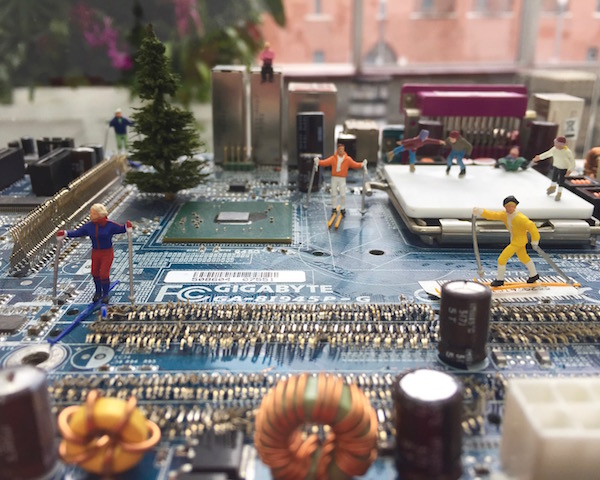
sculpture of tiny skiers on lanscape of recycled circuit board by artist David Martin

David Martín “Ski” (detail)

pendant lamp created by artist Imanol Ossa from piano keys

Imanol Ossa “Piano XL Lamp”

From its web site, DRAP-ART is a Barcelona-based “association of artists who have chosen trash to be their material and/or conceptual resource.” Whether you want to call it recycled or repurposed or straight-up trash, (a term DRAP seems to have embraced) the non-standard (typically) mixed media is front-and-center in almost every piece in the show.

Bic pens and piano keys dangle from pendant lamps, a woman’s mod-inspired go-go dress is created with the pop-tops from aluminum cans and sewn with plastic bag “thread”. There are robots made from deconstructed office equipment and a school of tin can-fashioned fish. Phonograph records are laser cut into birds on telephone wires and brown paper bags become the canvas for ashen drawings of industrial Detroit. Bill Miller [the only local in the bunch and one of just two Americans] turns in an incredible wall-sized mosaic/collage of cut linoleum flooring.

landscape by Irene Wölfl created from recycled plastic

Irene Wölfl “Irgendwo” (detail)

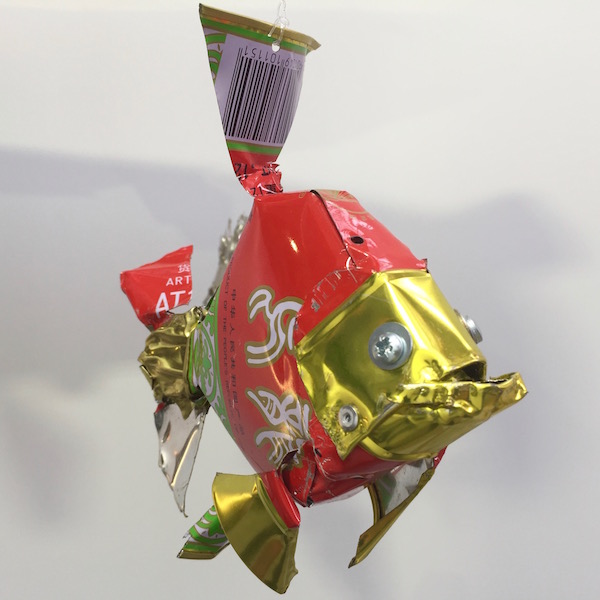
sculpture of red fish created from recycled metal can by artist Orson Buch

Orson Buch “Red Fish”

Artists do this kind of stuff all the time, but what makes the DRAP-ART show so out-of-this-world is the level of craft and the deep exploration of the various recycled media. In these artists’ hands, the use of the discarded materials is no gimmick, but rather act as really great prompts to build truly extraordinary new and fantastic things.

We could go on, but suffice to say, it’s a fantastic and truly inspirational show that is thoroughly Orbit-approved. To use the hoity-toity argot of art academia, it’s a real sock-knocker-offer. In fact, right after seeing the show we ran out to buy some new socks. It’s that good.

detail from large mosaic by Bill Miller created with recycled linoleum flooring

Bill Miller “Steal Mill” (detail)

pendant lamp created from recycled Bic pens by artist Héctor Escudero

Héctor Escudero “PENcil”

Back to those festival organizers. This blogger knows it must have been a huge undertaking to put on and we have no insight into whether attendance and sponsorship made all that worthwhile. That said, not all successes can be measured with a calculator. So we’d just like say we sure hope this first Re:NEW festival can itself be renewed next–or, at least, some future–year. It’s a great idea for an art festival and Pittsburgh is a great place to host it. We hope the public is enjoying it as much as we are.

The Orbit will even go as far as to suggest a title for the come-back: Re:NEW : Re:DUX. Don’t even say anything. By the time you’re ready, it’ll sound great.

three-piece sculpture of square boxes with recycled fencing and bamboo by artist Felip Gaig

Felip Gaig “Els Horts de Sant Vicens”

portrait of Mary Cassatt made from egg cartons by artist Verónica Arellano

Verónica Arellano “Mary Stevenson Cassatt”

A note: We included way more photos in this piece than we normally do in a post, just because there is so much great stuff we’re excited about**. Even so, this is just a small portion of what’s actually set up, beautifully-presented, and even for sale over at the Wintergarden. The show ain’t over yet, but you need to shake a leg–it ends this Saturday. Get your kiester down there and see it for yourself while you still can.

Re:NEW Festival’s DRAP-ART show is at the PPG Wintergarden (PPG1, downtown), through next Saturday, Oct. 8. Admission is free.
sculpture made from recycled ironing board, silverware, and advertising image by artist Karol Bergeret

Karol Bergeret “Camarera” (detail)


* A large-scale collaboration between city arts, tourism, downtown, and reuse organizations including the Greater Pittsburgh Arts Council, Carnegie Museum of Art, Andy Warhol Museum, Visit Pittsburgh, Downtown Pittsburgh Partnership, Pittsburgh Center for Creative Reuse, Construction Junction, Goodwill, etc.
** And had a hard time not including yet another half dozen photos, but that would just be ridiculous.