Tin Can Pole Art, Part 2: A Date with Some Little Devils

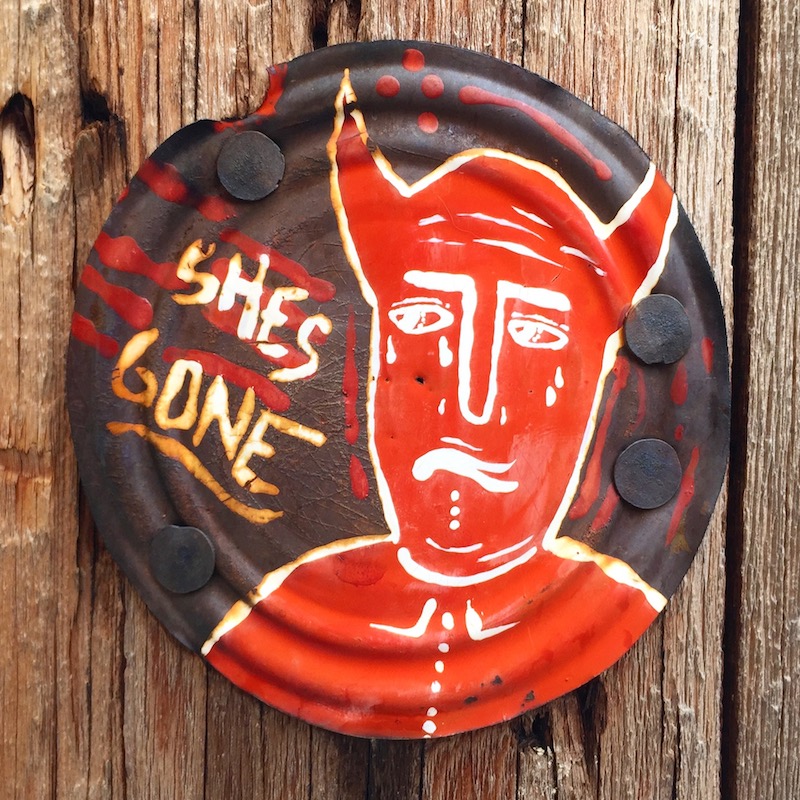
tin can lid painted with sad devil and the words "She's gone", Pittsburgh, PA

Hell & Oates[1]: “She’s Gone”, Bloomfield

Farewell to all these smiling angels….I’ve got a date with some little devils.

That auspicious message, artfully paint-penned to the cut lid of a large-size steel can, is nailed to a wooden utility pole on South Aiken Ave. in Friendship. Immediately above it appears one half of another can lid, cocked upright, suggesting a single bunny ear–its mate either removed after-the-fact or just never made it to the pole the first time.

However nutty this inscription might seem, little devils are absolutely on the loose in the greater East End. And while pious Christians worry about getting right with God or facing Lucifer’s pitchfork in the keister for all eternity, the city’s devils clearly have their own concerns to stress over. Indeed, the red one appears on a couple different poles both broken-hearted and teary-eyed.

steel can metal painted and nailed to utility pole, Pittsburgh, PA

“Farewell to all these smiling angels….I’ve got a date with some little devils,” Friendship

She’s gone were the only two words Messrs. Oates and Hall really needed as shorthand to heartbreak–that, and close falsetto harmony over a slinky Fender Rhodes groove. Here, the simple message is a clue to the devil’s distress (above).

A cat-like devil has an inverted pink heart for a nose and a topsy-turvy screwed-up mouth (below, top). Those sad eyes may say just as much with no words at all. There’s one more teary-eyed devil, this time with cupid’s arrows literally piercing his visible heart (below, middle).

steel can painted with sad devil and nailed to utility pole, Pittsburgh, PA

sad devil, Friendship

painting of devil with arrows piercing his chest, nailed to utility pole, Pittsburgh, PA

Friendship [photo: Susan Peake]

steel can metal painted and nailed to utility pole, Pittsburgh, PA

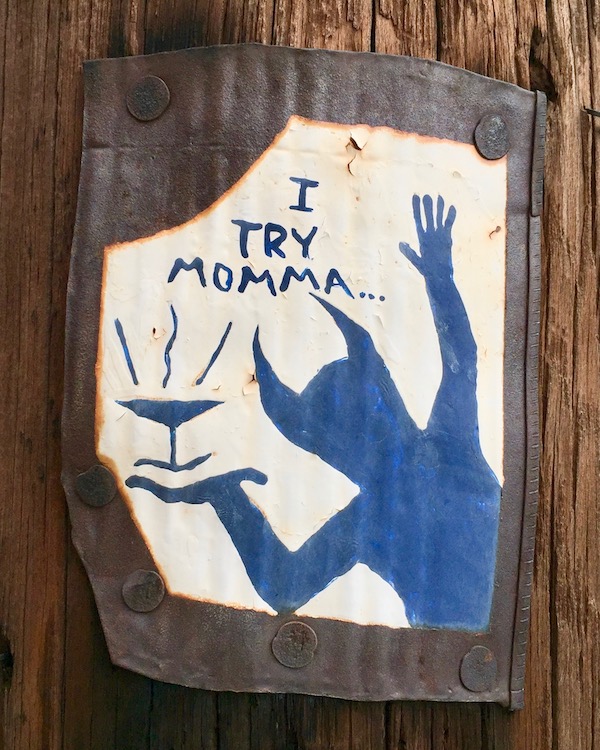
“I try momma…”, Friendship

I try momma… implores a blue devil, rendered in stark silhouette and levitating an electric martini with one hand, the other raised in salutation (above). A different pole devil clutches the circle-A anarchy flag while waving to friends (below)–no doubt shopping for bargain Clancy’s chips at the nearby Aldi.

This same common imagery of devils, hearts, anarchy, and martini glasses showed up a couple times in our first story on tin can pole art earlier this year. These were clearly no coincidence as the themes get even more of a workout this time around.

metal can lid painted with devil holding anarchy flag nailed to utility pole, Pittsburgh, PA

anarchy devil, Friendship

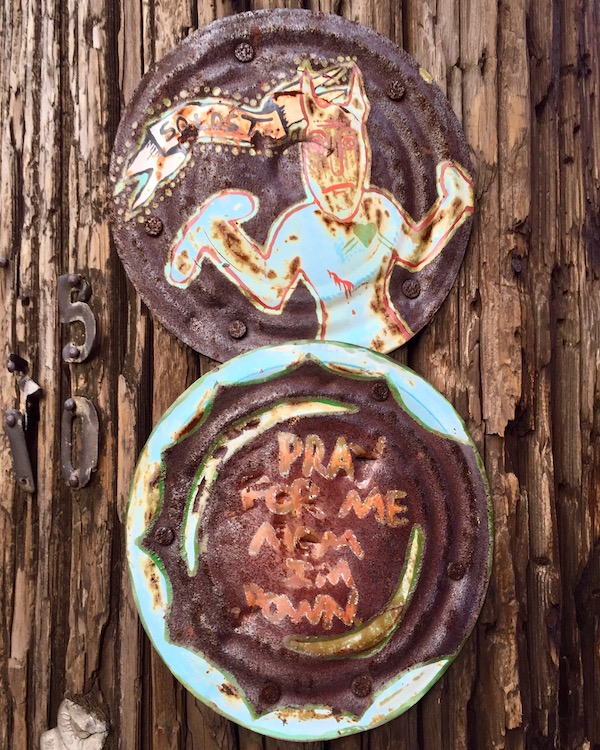
tin can lids painted and nailed to a utility pole, Pittsburgh, PA

“So lost … pray for me, I’m down,” Garfield

Somebody needs to get this guy into therapy! Or maybe we all just need to be better friends to the devils we know. Whatever it is, she’s gone and the plea to appease momma aren’t the only cries for help on the city’s telephone poles.

So lost…pray for me, Mom, I’m down reads a Garfield alley two-fer (above); the simple message Struggle, along with a fire-dancing, heart-balancing devil, turns up on a nice, rust patina’d single-color piece in Shadyside (below).

small painting of devil with heart on tin can nailed to utility pole, Pittsburgh, PA

Struggle, Shadyside [photo: Lee Floyd]

While that’s a lot of devils clinging to East End telephone poles, they’re far from the only specimens in this tin can pole art roundup. We also spotted a number of other pieces with the same stylistic DNA as the devil-doer dealt–we’re talking about the tell-tale cryptic calligraphy, hearts, flowers, martinis, and anarchy.

BUT…[yes, there’s always a big but] there are some outliers in the collection, too. We’ve seen the swirling, psychedelic television/VCR combo scrawled on all sorts of walls and dumpsters, as well as turned into back-of-sign decals. But this nice, two-color paint can lid outside The Glitterbox Theater (below) feels like a giant leap forward–even if the perpetrator still can’t get his or her mind off the TV.

tin can lid painted with TV and nailed to utility pole, Pittsburgh, PA

North Oakland

steel can with painting nailed to utility pole, Pittsburgh, PA

“I try to stop…and smell the flowers (in life too),” East Liberty

steel can metal painted and nailed to utility pole, Pittsburgh, PA

“My worst enemy has always been time, 2001,” Friendship
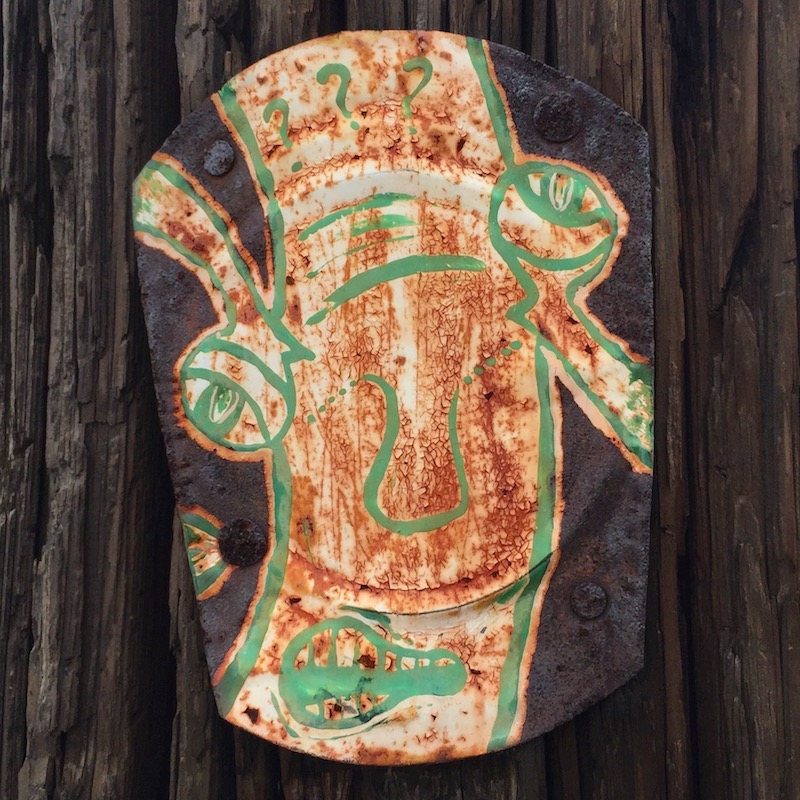
tin can lid painted with abstract face and nailed to telephone pole, Pittsburgh, PA

Garfield

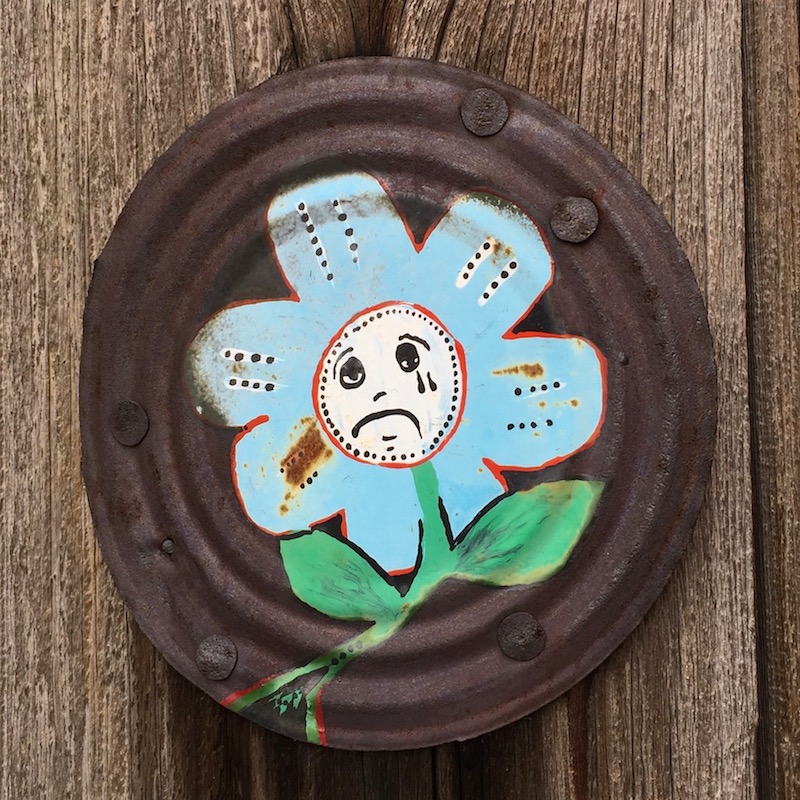
can lid painting of flower with crying face, Pittsburgh, PA

sad flower face, Bloomfield

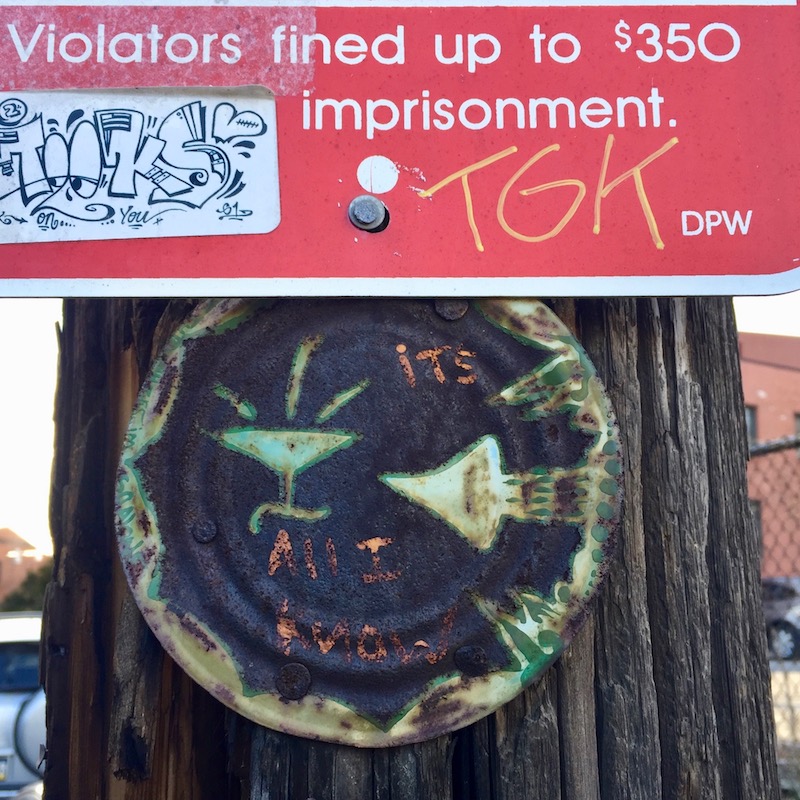
tin can lid painted with the message "It's all I know", Pittsburgh, PA

“It’s all I know,” Bloomfield

tin can lid painted with indecipherable image and nailed to utility pole, Pittsburgh, PA

Shadyside [photo: Lee Floyd]

tin can painted and nailed to utility pole, Pittsburgh, PA

Shadyside (partial) [photo: Lee Floyd]

While asking one’s mother for her prayers may or may not be common practice, doing so via painted kitchen tool on side-street telephone pole seems an especially unlikely way to share one’s feelings.

As if parenting weren’t difficult enough, kids are always coming up with new ways to communicate. First SnapChat, now GreatChee. “How’s our youth doing, honey?” We imagine a clueless Dad asking, “Why, not so good,” the response from Mom, “Haven’t you checked East Liberty for cheese graters?”

painted cheese grater nailed to utility pole, Pittsburgh, PA

cheese grater pole art! “Mom – pray for me”, East Liberty

There are also a couple more of these giant, five-gallon driveway sealant drum lids, tagged-up and screwed-into poles/trees along Spring Hill city steps. The pair clearly begs for a deeper investigation of the neighborhood’s walkways as we’re guessing these aren’t the only two out there[2].
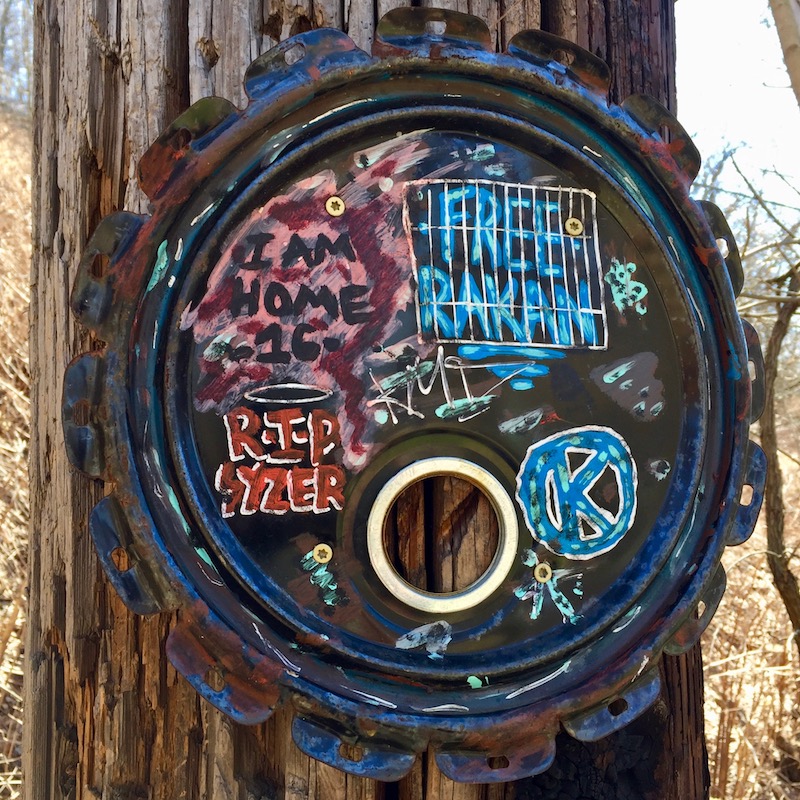
steel can lid painted and attached to utility pole, Pittsburgh, PA

“I am home 16” / “free Rakan” / “R.I.P. Syzer”, Spring Hill

large metal can lid painted and nailed to a tree, Pittsburgh, PA

“I’m so glad you’re here,” Basin Street steps, Spring Garden/Troy Hill

Finally, a couple pieces that are absolutely metal and pole art, but don’t have their material origin in discarded soup cans. They’re a little off-topic, but we’re not going to sit on these waiting for a collection of stray non-tin can-but-still-metal pole art.

The triptych of embossed blank verse into sheet metal that hangs on a Harriet Street utility pole (below, top) gets high marks for its innovation in the genre, but the execution feels a little, you know, “smoke a little dope, skip a little rope”… but maybe this blogger just doesn’t get it, man.

Similarly, A boy from Frankford… (below, bottom) really feels like somebody who doesn’t know what he’s trying to do. Then again, I guess he says it right there: like anyone in the tin can pole art game, this “boy” is just trying to find his way.

metal sheets stamped with words and painted, nailed to utility pole in Pittsburgh, PA

Friendship

metal sheet painted, lettered, and screwed to utility pole, Pittsburgh, PA

“a boy from Frankford … trying to find his way,” Spring Hill

Thanks to Susan Peake for tipping us off to a number of the Friendship pieces and co-assistant cub reporter Lee Floyd for his work in Shadyside.


[1] Thank you, Chris Caldwell.
[2] Greater Spring Hill: if you spot more of these, let us know!

Memorial Day: Roadside Crosses

roadside memorial cross with Christmas wreathes, West Elizabeth, PA

Mark, 66-02, West Elizabeth

A simple cross. Each spar a length of white PVC pipe a couple feet long with the ends capped and sealed. There is one heavily-sun-bleached Christmas wreath attached to the piece and another lays in the grass just in front. Also at the scene is a small, hand-painted, ceramic angel. Peel-and-stick letters on three ends of the pipe describe only the most basic details: Mark, 66-02.

wooden memorial plaque with flowers for Vincent Lapko, Pittsburgh, PA

Vincent Lapko, Nov-30-1983 – Oct-7-2017, Homestead Grays (neé High Level) Bridge [photo: Lee Floyd]

Years ago, the makeshift memorial was hammered into the grass of a wide berm along Route 837 in West Elizabeth. We pass the cross on every trip down to Donora and Monessen, so it’s become a kind of mile marker in this industrial stretch that includes a number of small factory buildings along with large operations for Eastman Chemical Resins and Marathon Petroleum. The enormous, stories-tall gas reservoirs of the latter form an imposing backdrop to the very human-scaled and personally-tended roadside cross put up for the departed.

roadside memorial cross with fireman's helmet and the text "When I am called to duty", Homestead, PA

firefighter’s memorial, Homestead/Munhall

Memorial Day means a lot of things to a lot of different people. It was created to honor those men and women who’ve died in military service for the country and has morphed into the great long weekend of igniting propane under chicken thighs after deeply-discounted blowout sales at department stores and car dealerships.

While those interpretations of the holiday are all valid, The Orbit finds a profound depth in the very personal and extremely individual work of making and tending these unique tributes that seem to pop up just about anywhere.

roadside cross and wreath with lettering "Ryan 1998-2017"

Ryan, 1998-2017, Rt. 65

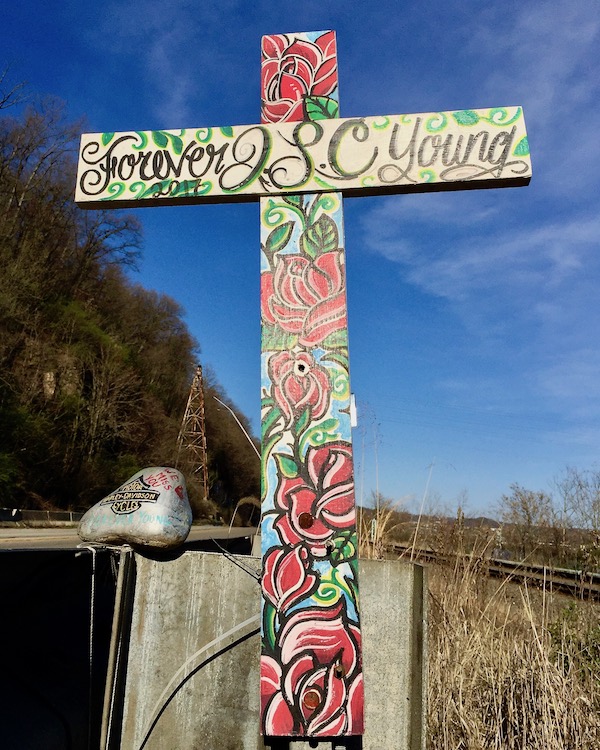
There’s a lot we don’t know…and will never know just by randomly passing a roadside cross with someone’s first name. Somewhere out there–for any accident that’s resulted in fatality–there must exist the blunt facts of a police record or newspaper obituary. But even with the clues provided–a firefighter’s helmet, a stone painted with the Harley-Davidson logo, an unexpected location along the bicycle trail–the memorials generate more questions than they answer.

hand-painted roadside memorial cross, state route 837, PA

Jordan Celovsky, 1988-2017, Rt. 837

Whatever happened to Mark, Ryan, Jordan, or any of the others remembered in these roadside crosses, it probably wasn’t a happy ending. Their ages–from late teens to mid-thirties–and placement of the crosses (mainly) along busy roadways suggest unexpected, unnatural deaths. These seem likely to be car crash-related, but of course those details are part of what remain a mystery.

The most important unknown, for the vast majority of us, is the character of these people whose lives were cut short on the two-lane blacktop. They were clearly loved and are missed with a reverence we should all be so lucky to have. The Orbit spends a lot of time in the graveyard; very few marble headstones get the loving upkeep of some of these lashed-to-a-guardrail wooden crosses.

wooden memorial cross by bicycle trail

Ronald Vahosky, Great Allegheny Passage bicycle trail

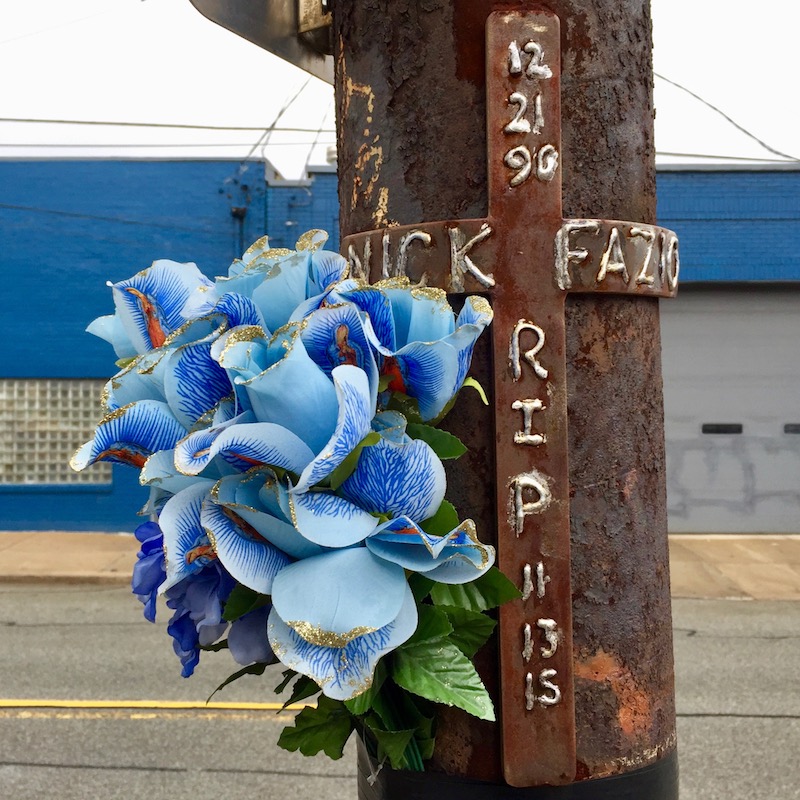
iron memorial cross with plastic flowers on utility pole, Pittsburgh, PA

Nick Fazio, 12/21/90-11/13/15, Bloomfield/Lawrenceville

Back to that anonymous roadside in West Elizabeth–graveled and dusty, noisy with truck traffic, and surrounded by the petrochemical industry. It has none of the solemn peace, flowering dogwoods, frolicking deer, or generations-old sculpted beauty of Allegheny or Union Dale Cemeteries. It offers neither the great cross-river views of St. John’s and Loretto nor the rock star lineup at Homewood.

But…this is where it happened. And for the people who loved Mark and Vincent, Ryan and Jordan, these lonely stretches of ex-urban highway seem to have become hallowed ground in a way that may never seem completely appropriate for more pristine, formal burial grounds.

* * *

metal cross attached to iron train trestle, Pittsburgh, PA

unknown, West Liberty Ave.

Roadside crosses, though not obviously memorials, showed up in a couple other places on our travels. These anonymous acts of faith–a metal cross on steel girder (above) and old world painted wood cross on utility pole (below) come with even less to go on.

Do they remember a specific traffic fatality like the more personalized examples above? Or do these crosses have nothing to do with an individual or specific intersection and just represent a quiet-but-public expression of religious belief?

wooden cross attached to utility pole, Pittsburgh

unknown, Lawrenceville

There’s a couple more here, too. This loving, heart-shaped and patio-sized tribute to “mom / grandma / friend” on Route 51 is hard to suss out. Did grandma pass away at this stretch of highway [it’s as likely as anywhere] or did the family just decide to landscape their elaborate memorial in a naked roadside where the greater Coraopolis/Moon Township commuter community could pay their respects? Who knows!

roadside memorial heart with sign

mom / grandma / friend, Rt. 51

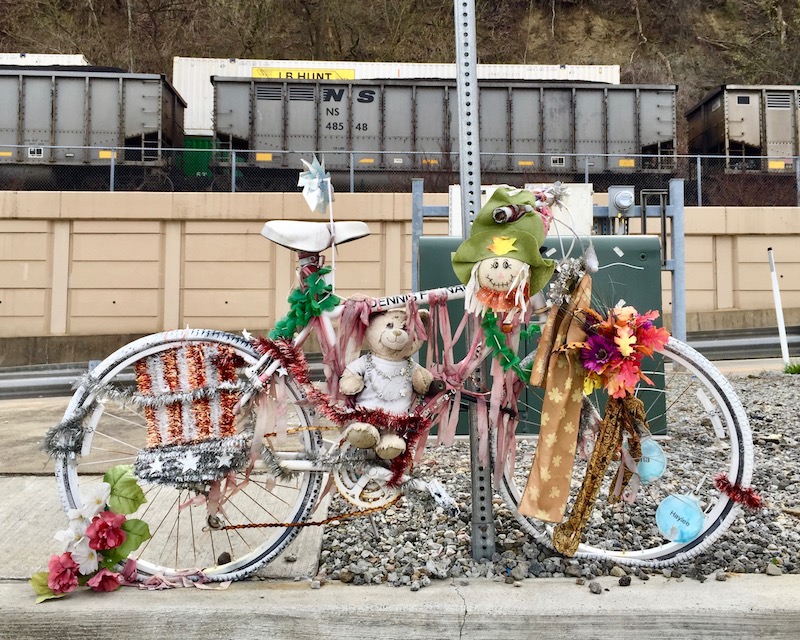
Finally, the one that really hits home. We wrote a while back about the ghost bicycle for Susan Hicks in central Oakland and went into a whole spiel about putting our faith in robots. We’ve been fortunate enough that there haven’t been too many other cycling fatalities in the city since then.

One painful exception is Dennis Flanagan, a cyclist who was killed riding on a fast-moving stretch of West Carson Street in 2016. For the ghost bicycle left to mark the spot of Flanagan’s fatal accident, the teddy bears have faded, plastic flowers droop, gears and chain are rusty. But the painted-white bicycle remains, locked to a street sign faithfully reminding passers-by that Dennis Flanagan was here and we all need to look out for each other. That’s what Memorial Day means to me.

ghost bicycle memorial decorated with plastic flowers and stuffed animals, Pittsburgh, PA

ghost bicycle, West End

Something Fishy: Angling for the East End Dangler

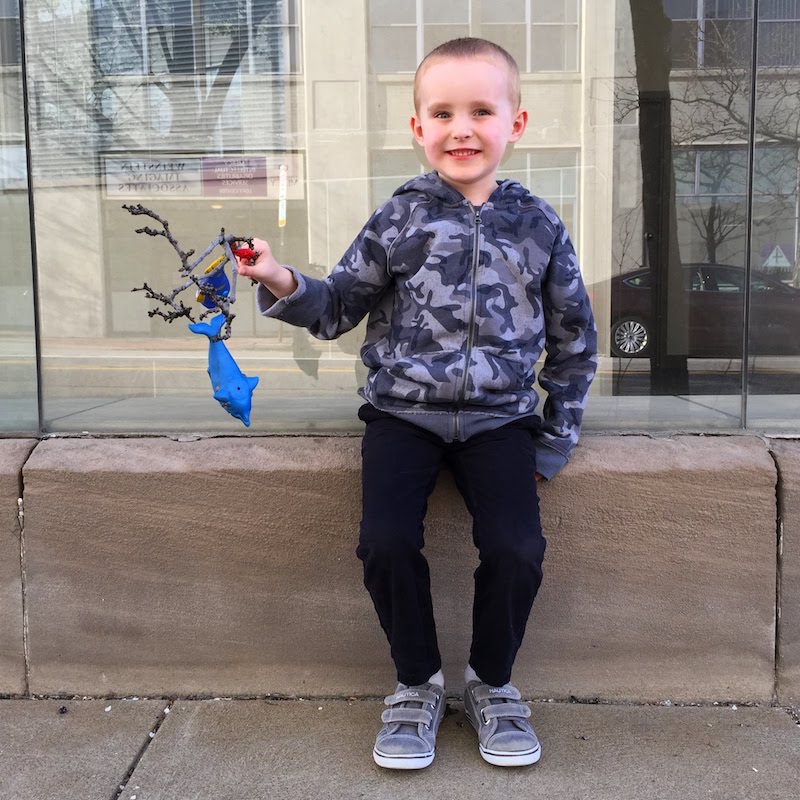
boy with tree twig and strand of toy fish

The littlest Dangler angler with another clue from the trail, East Liberty

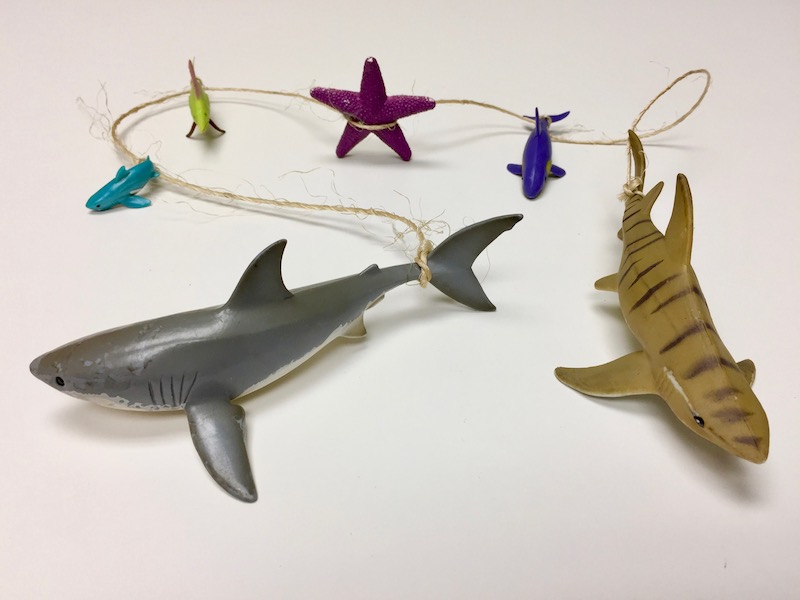
It started, as these things do, with just a single incident. Back in the early fall, out on an afternoon constitutional, the crew came across a curious sight. Tangled in the mid-level branches of a street tree on Centre Avenue was a six-inch plastic tiger shark, hanging by a length of rough twine tied around her tail fin. Following the string led to a purple dolphin, then a starfish, and so forth. Six miniature sea creatures in all, very much out of water, and awkwardly tossed into the leafy undergrowth just above head level.

strand of plastic toy fish tied together with twine and hanging from tree branches, Pittsburgh, PA

exhibit #1 aka “two sharks,” as found in East Liberty, Sept. 2017

As we’ve mentioned before, Orbit staff maintain a strict do-not-disturb policy when it comes to street art, pranks, and other happenstance findings in the public sphere. Our interns do not always abide by the same code of conduct.

Such was the case on this day, as cub reporter Lee extracted the string of toys from the overhead branches and brought it back home for further examination. While that felt very much like disturbing the scene of a crime way back in September, it would prove eerily prescient. It was only just recently that we became aware this was no isolated incident.

That’s right: Pittsburgh has a repeat offender on a loose and he, she, or they have struck enough times to warrant serial status. The East End Dangler walks among us, covertly decorating the city’s flora with strange garlands of (mostly) plastic fish.

6 plastic sea creature toys connected by twine

exhibit #1 aka “two sharks,” found on Centre Ave., East Liberty

Nearly seven months after that initial encounter, we were certainly in for a surprise. Walking back to the office on a chilly early spring afternoon–the belly still reeling from a lunch of huevos con chorizo con tortillas con frijoles con arroz y unlimited chips–to see a tiny die-cast aeroplane poking its propeller schnoz out of the newly-cut grass. On retrieval, we found the same tell-tale twine knotted around the plane’s tiny tail and rudder. It wasn’t until just this moment that the connection between aircraft design and sea life anatomy became so perfectly clear–but let’s stay on topic.

Our very same cub reporter not only identified the toy as “Dusty Crophopper” from Disney’s Planes but also spotted a tiny rubber fish nearby. The squishy little fellow was dislodged from the strand when its tail broke off, but in an unlikely and gruesome turn of events, the dismembered body part was still caught in the twine to confirm the relationship.

toy airplane on string of twine

exhibit #3 aka “Dusty Crophopper,” (partial) found on Centre Ave., East Liberty

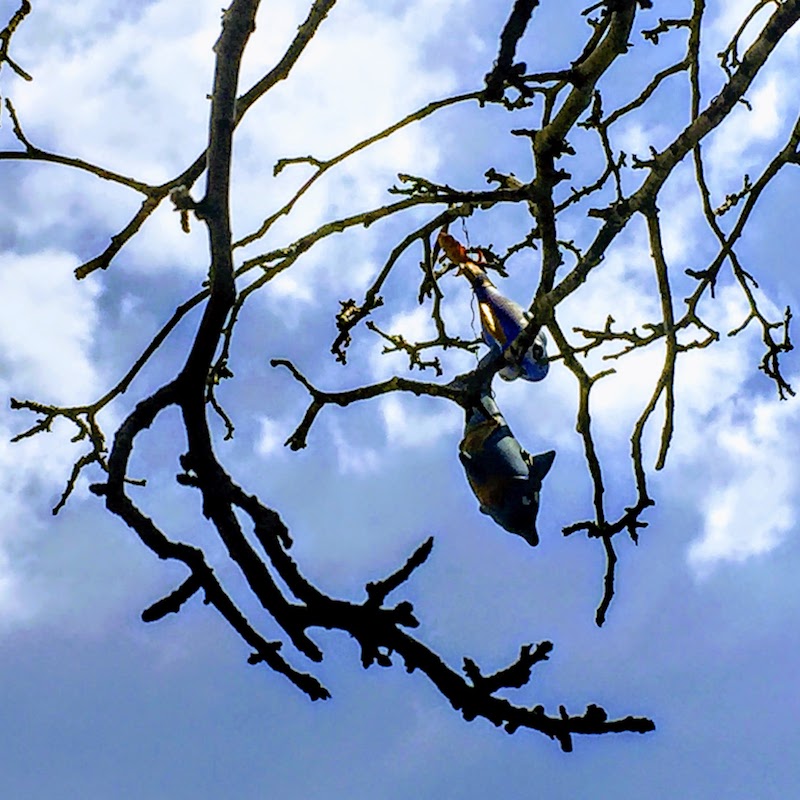
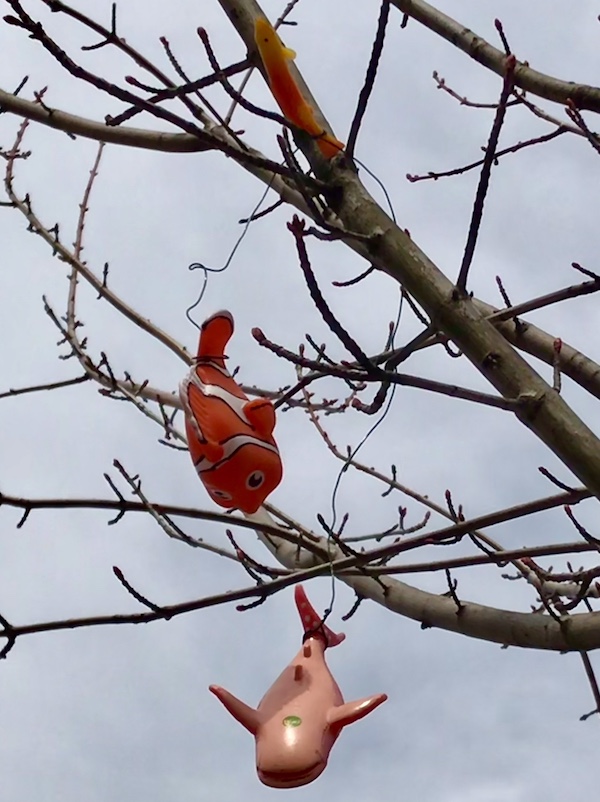
The revelation that the string of sharks was not a one-time deal would have–should have–been enough, but we were in for a couple more shocks. Mere feet away–O.K., maybe one or two hundred of them–was another bare tree with another set of dangling fish. In this case, two bug-eyed, cartoonish blue fish and one tiny red-orange fellow. Unlike the previous two marks of The Dangler, this trio was connected by wire (not twine) and thrown way up high, out of arm’s reach, but well within eyesight.

plastic fish toys strung together with wire and hanging from tree limb, Pittsburgh, PA

exhibit #4 aka “blue fish,” as found in East Liberty, April, 2018

Attentive readers are already yelling at their mobile devices, hopefully not in public restrooms. How did you jump from exhibit #1 to exhibits #3 and #4? What kind of amateur-hour investigation are your running around here?

Ah–that’s where the plot thickens! Lee had already bagged exhibit #2 (aka “orange fish”) and just never filed his paperwork. Way out of the relatively-small perimeter we were working, this yang to “blue fish’s” yin [three fish, the little one in the middle, single color scheme, wire connector–orange and blue are even opposites on the color wheel!] hung from a tree along Browns Hill Road, miles from Centre Avenue.

three plastic fish hanging from wire in a bare tree

exhibit #2 aka “orange fish,” as found on Browns Hill Road, April, 2018 [photo: Lee Floyd]

Like Ed Gein and Ted Kaczynski, Rudy Giuliani and Pauly Shore, we may never know what motivates The East End Dangler to do what they do. In lieu of any hard evidence on the person behind the dangling, we’re left with just the physical items: toys–specifically fish toys–and location.

On that first point, one popular theory holds that the perp is a parent, the child or children having aged out of their fish phase and into teenage alienation. What to do with those leftover sharks, goldfish, and neon tetras but string them up and throw them in city trees? A little goofy, but more unlikely events happen around us every day.

3 toy fish connected by wire

exhibit #4 aka “blue fish”, found on Centre Ave., East Liberty

These may also be the work of a prankster or frustrated conceptual artist. The nearby Goodwill on Centre likely offers an ample supply of second-hand toys at by-the-pound prices. If decorating trees with Happy Meal castoffs is your thing, it can be done easily and at bargain rates. As art? Well, it beats spray paint tagging.

A third opinion holds that we’ve got deeper symbolism here–something very specifically fish-related. All three of the Centre Ave. finds are within rock-tossing distance of the East Liberty Whole Foods; “orange fish” was spotted adjacent to the Hokkaido Seafood Buffet restaurant. It doesn’t take Hercule Poirot to connect these particular dots. Whether the Dangler might be addressing mercury in the food chain or the Pacific Ocean’s plastic vortex is unclear, but lines can certainly be drawn.

3 toy fish connected by wire

exhibit #2 aka “orange fish,” found on Browns Hill Road

We may never know…or this may just be the beginning of the conversation. If you’ve noticed the work of The East End Dangler (literally) hanging around a tree you frequent, please let us know. Until then, to paraphrase Casey Kasem, keep your feet on the ground, and keep reaching for the fish in the trees.


BREAKING NEWS: On the eve of going to press, The Dangler dropped another bombshell on us. There, in those same Centre Avenue street trees hangs yet another dangled concoction. This one appears to be just two toy airplanes, one a bulbous, cartoonish propeller; the other, a second Dusty Crophopper. As of this writing, the dangled bits remain tree-side.

toy airplane hanging from wire in tree limbs

exhibit #5 as found in East Liberty, May, 2018

Heavy Living: Cement City, Donora

2-story cement house with large side yard, Donora, PA

Cement City, Donora, PA

Spoiler alert: Cement City is neither. No, the lovely little residential neighborhood consists of a combined 80 single-family homes and larger duplexes lining just a few streets on a hilltop at the south end of Donora. With its 360-degree views across several different valleys, glorious green lawns, and kid’s bicycles left carelessly on front sidewalks, this is hardly the picture of urban life.

That name, though–Cement City. It’s industrial, brutal–fantastic even–like the fictional world created for a shoot-’em-up video game or dystopian science fiction. One might imagine each resident of Cement City as some version of Snake Plissken or Sarah Connor–an eyepatch, leather wristbands, and heavy weaponry required for the epic quest just to make it out alive.

Rest assured, though, nothing could be further from the truth. That said, Cement City does have a certain retro-futurism in its very interesting past.

row of cement houses in Donora, PA

houses on Walnut Street

In the first couple decades of the twentieth century, the Borough of Donora, 30 miles south-southeast/upriver from Pittsburgh, grew like crazy. It went from incorporation in 1901 to reaching its peak population just 20 years later. That was all on the boom of the American Steel & Wire Company. With its integrated blast furnace, open hearth, and ancillary industries in zinc smelting and product finishing, the U.S. Steel subsidiary was the local employer in this prototypic company town. We learned all about these in our tour of the terrific Donora Smog Museum over the winter.

Twice a year, the same folks from the historical society throw a terrific combined educational lecture/walking tour of Cement City, a hundred-year-old housing development borne of the perfect storm of new innovation, high-demand for middle-management lodging, and a massive corporate entity that could take the whole project on and manage it after its completion.

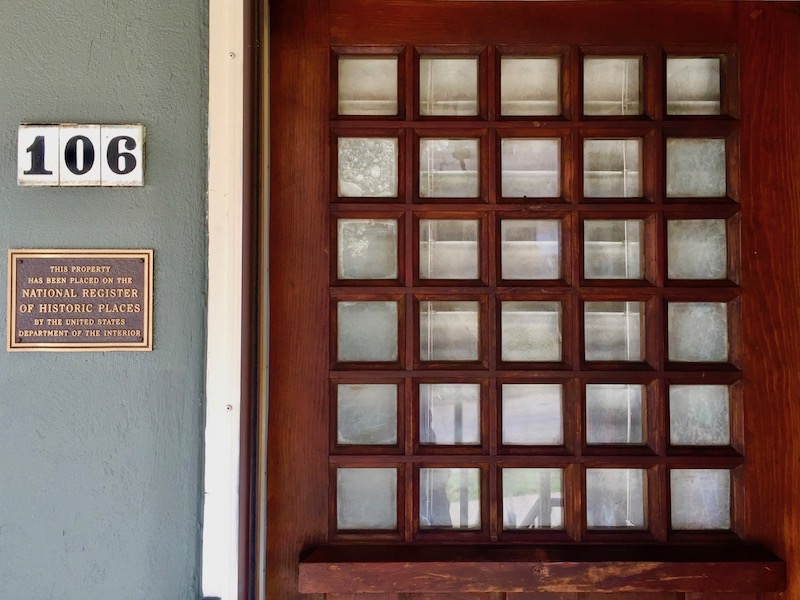
wooden door detail showing 30 small window panes

original arts and crafts-style wood door

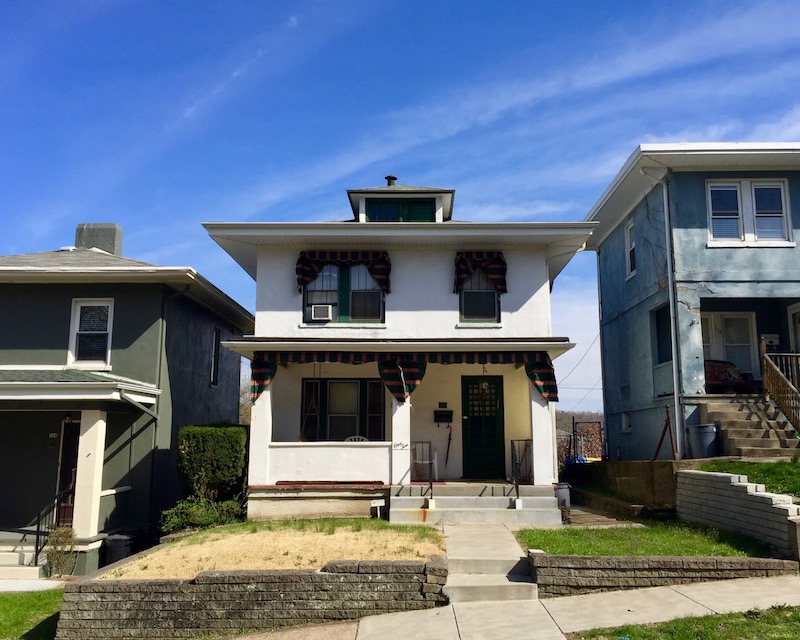
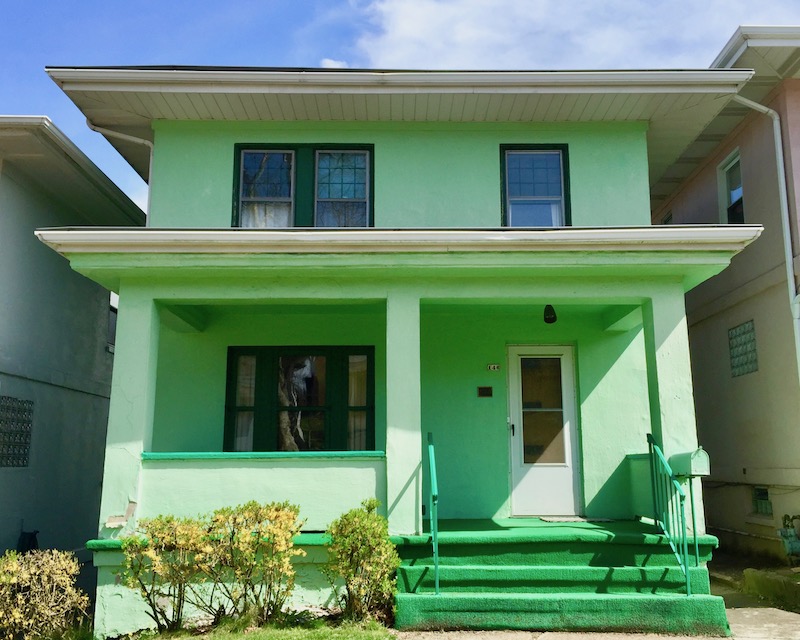
Today, Cement City doesn’t look that different than many other neighborhoods of pre-war, detached, American four-square houses–each with its own concessions to time. Here, a mismatched garage addition or fresh paint job, there, some buckling stucco or an obvious collapse in the fascia. Many houses have decorated with lawn statuary (including a generous number of front yard Marys) and ornamental landscaping; in others, the grill is lit, children’s toys are scattered in the yard, and bass-heavy party music blasts from open windows on this perfect Spring day.

There’s one big difference, though. Under the wide eaves and behind the technicolor paint jobs live skeletons of pure concrete. [Yes: concrete, not cement.] When industrial America needed to grow the most, Thomas Edison was trying to figure out what to do with all the concrete he’d been tinkering with. As a building material, concrete seemed perfect: it was cheap, wasn’t going anywhere, the termites wouldn’t touch it, and–most importantly in a pre-fire code America–it was impossible to burn down.

detail of cement ceiling in home in Donora, PA

basement ceilings reveal the original cement forms

We’ll not go into the whole history here–it’s just too much for one little blog post and we’d get the facts wrong anyway. But if you can go on the tour, D.H.S. president Brian Charlton will spin an engrossing yarn in a history that blends the often at-odds interests of Big Steel, quality-of-life, architectural design, and Age of Innovation new technology[1].

Suffice to say, it’s not easy to build a community of houses out of concrete–even more so on the slanted hillsides of Donora in 1916. Making the project cost-effective proved to be the biggest challenge of all. It takes an entirely different building model to pour in place the walls and floors of any construction. You need elaborate forms, a mobile mixing and delivery system, accounting for multi-day cure times, and then back-filling all the various trades that complete a home.

several cement houses on a hill in Donora, PA

Cement City houses on Bertha Ave.

Regardless, it all got done and the homes remain charming to this day. Eventually, the one-time company village grew from identically-maintained, corporate ownership to being sold off to individuals with the surrounding tennis courts and playground lots redeveloped into newer housing. Early photos show the neighborhood denuded of all vegetation as the land was clear-cut for build-out. Today, hundred-year-old sycamores line the sidewalks and reach way above the rooflines on Bertha and Ida Avenues as flowering dogwoods and manicured cypress decorate front yards.

All of Cement City’s original houses are still standing, largely occupied and in good shape. A remarkable number of other features–including original sluiced backyard storm drains and locally-made Ellword woven wire fencing–persist as well. There are similar Edison-era collections of concrete houses all over the Northeast and upper Midwest, but Donora’s set of 80 homes makes it the second-largest development of its kind.

detail of Ellwood woven wire yard fence made by American Steel & Wire Co.

hundred year old Ellwood woven wire yard fence, made locally by American Steel & Wire Co., in a Cement City backyard

Like we saw with Aluminum City Terrace in New Kensington, the transition from high-concept, mass-produced worker housing to present day free-market community is an interesting one. Were they alive to see them today, the after-market shutters, dish TV hook-ups, dangling gutter systems, and quaint lawn ornamentation would probably have given Edison and American Steel & Wire fits.

But the fact remains that good design endures, even if the humans that come along later monkey with the architects’ master vision of clean lines and a uniform presentation. It speaks volumes that 100% of Donora’s original concrete houses remain today–a hundred years after they were constructed–in a town that has lost more than two-thirds of its population in the same time frame[2].

cement house in Donora, PA with lawn statuary and porch modifications

Lived-in. Cement City house on Walnut Street with lawn statuary and porch modifications.

The next time you’re in Donora–and yes, make sure there is a next time–you’ll have to take in the classic McKean Ave. twofer of the Smog Museum and Anthony’s Italiano. Grab a hike up to St. Nick’s if you get a chance, too. But then consider making the short drive south and up the hill for a post-pizza constitutional around Cement City’s handful of streets. You’ll not be sorry you did.

concrete house in Donora, PA's Cement City

Cement City house on Ida Avenue

The Donora Historical Society will offer the next Cement City lecture/walking tours the weekend of Saturday, Sept. 22 and Sunday, Sept. 23. at 1:00 p.m. both days.

RSVP by calling 724-823-0364 or email donorahistoricalsociety@gmail.com


[1] Brian Charlton literally wrote the book (or, at least, detailed article) on Cement City. His article “Cement City: Thomas Edison’s experiment with worker’s housing in Donora,” appeared in the Fall, 2013 issue of Western Pennsylvania History.
[2] Donora’s current population is around 4,600 people, down from 14,000 in 1920. Source: https://en.wikipedia.org/wiki/Donora,_Pennsylvania

No Room for Squares: When the Pittsburgh Triangles Were Golden

members of 1976 Pittsburgh Triangles World Team Tennis, 1976

All smiles. [l-r] (trainer) Paul Denny, Danny McGibbeny, Bernie Mitton, Mark Cox, 1976

All sports fans, no matter how much they may deny it, suffer a common delusion. These devoted optimists assume their acts of ritual loyalty in the stands, parking lot tail-gates, and even back home on the sofa, will somehow compel their team to victory on the field of play.

These fantasies range from the relatively credible–filling a stadium with a fired-up crowd makes home field advantage a very real thing–to completely ludicrous acts of superstition. We’ve all known someone with a ridiculous game-day habit: the requirement of a particular team jersey; the arrangement of beverages on a coffee table; a tiny bird-sized Steelers helmet the pet parakeet must wear during the playoffs. It’s goofy, but it works…some of the time.

crowded locker room following Pittsburgh Triangles tennis championship, 1975

Clint Burton (right) with Triangles player Peggy Michel and team owner Frank Fuhrer, 1975

Tennis star Betty Stöve needed to use the crapper–bad. It was right before her match at the old Civic Arena and teenage Clint Burton was the kid on the bench with the key to the locker room. The only thing was…he couldn’t actually find where he’d put it. It was a simple mistake–Clint had switched sideline assignments with another boy who’d failed to hand over the most important thing Clint needed to do the job.

Stöve lost her set–likely in some level of discomfort–and her San Francisco Golden Gaters fell to the Pittsburgh Triangles on this particular summer night in 1976. It’s not how the average fan would choose to tip the scales for his or her team, but sometimes things just work out the way they do.

Pittsburgh Triangles tennis team in the 1970s

The Pittsburgh Triangles at home on a WTT multi-color court

In 1974, American professional tennis was on a tear. A year earlier, Billie Jean King had defeated Bobby Riggs in the much-celebrated, prime-time “Battle of the Sexes” match. King’s then-husband Larry, along with three other financiers, rode the wave to a completely new concept in the sport: convert the traditionally staid, solo/duet tennis match into a raucous team sport with streamlined rules, heavy crowd involvement, and a rock-and-roll atmosphere.

On the strength of Billie Jean King’s involvement, along with that of Wilt Chamberlain and Arthur Ashe, the new World Team Tennis league was able to attract a who’s-who of mid-’70s professionals in the sport. King was a player herself, as were Chris Evert, Martina Navratilova, John McEnroe, Jimmy Connors, Björn Borg, and “Nasty” Ilie Nastase.

tennis player Ille Nastase hitting a ball behind his back

“Nasty” Ilie Nastase of the New York Sets/Hawaii Leis, some time in the 1970s [photo: the Internet]

World Team Tennis games were played on a multi-color court, the advantage rule was dismissed to speed up play, and scoring simplified to 1-2-3-game[1]. Matches consisted of five sets where teammates switched off for one set each of women’s singles, men’s singles, women’s doubles, men’s doubles, and mixed doubles. Scores of individual games were accumulated across the entire match. If you were lucky, a close match might be decided with something called a “super-tiebreaker.”

Breaking all rules of team sports, nearly half the clubs took references from the mechanics of the game into naming their franchises. There were no mere Lions or Spartans in World Team Tennis. Instead, the Chicago Aces, Cleveland Nets, and New York Sets did battle with the Phoenix Racquets, Indiana Loves, and L.A. Strings. [Aside: there is no doubt in this blogger’s mind that “The Baltimore Balls” was suggested at some point.] These were complimented by a collection of very of-their-era team names: the Houston E-Z Riders, Minnesota Buckskins, and Hawaii Leis. Most impressive were the double-entendres delivered in naming both the San Diego Swingers[2] and Boston Lobsters.

Danny McGibbeny on telephone at World Team Tennis match in the 1970s

Danny McGibbeny [on phone] and Daniel James McGibbeny

“I was the little stats guy,” Clint Burton says today, “I was always a math geek.” At just 13 years old, it was an unlikely move to put a middle schooler on the Triangles payroll as assistant statistician, but it helps to have your uncle Danny running promotion.

The year prior, a fresh-out-of-college Danny McGibbeny would charm his way into the fledgling Triangles organization–one of the league’s original 16 teams–as its first public relations director. McGibbeny was responsible for numerous promotions and activities, including writing copy for the local version of the league’s magazine/game program Super-Tiebreaker.

By 1975, McGibbeny had assumed the role of general manager, while still acting as P.R. director. There, he had the freedom to bring on his friends and family in a variety of support roles for home games. “Danny got everyone a job,” Burton says, “his friends from college, kids in the neighborhood. My father ran the scoreboard and my sister was a ball girl.”

tennis player Syd Ball talking with a young ball girl

Clint’s sister and Triangles’ ball girl Karen with the aptly-named Syd Ball, 1976

Burton’s early interest in sports, statistics, and “math geek” mind made the 13-year-old an easy fit as assistant to official stats man Drew Ondik. Clint went beyond the standard league-assigned stats sheet to develop a unique set of custom numbers based on additional play factors he would track during matches. At the end of the night, all of Clint’s work was typed-up and sent via an early Xerox fax machine to the league office in New York.

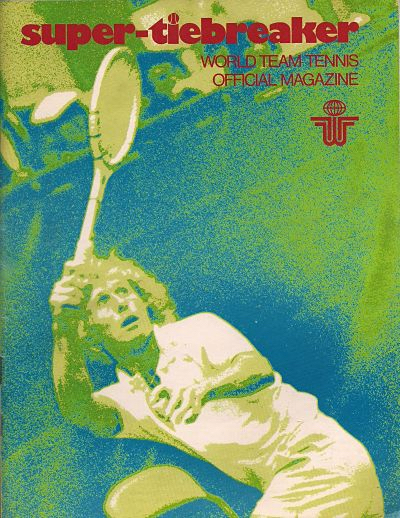
cover of 1976 Super-Tiebreaker magazine with tennis star Vitas Gerulaitis on the cover

Triangles star Vitas Gerulaitis on the cover of a 1976 Super-Tiebreaker magazine/program [photo: funwhileitlasted.net]

The Triangles didn’t have any players with the lasting name recognition of Chris Evert or Jimmy Connors. That said, Pittsburgh’s two biggest stars, Vitas Gerulaitis and Evonne Goolagong, led a group that would go on to win the 1975 WTT championship over Betty Stöve’s Golden Gaters in a home court match at the Civic Arena.

Gerulaitis, with his purple Lamborghini, monster stereo system, and on-court antics, was the undeniable crowd favorite. Vitas was so popular that he had his own rollicking “G-Men” cheering section at the top of the arena and occasionally paid for these super fans to travel to nearby away games.

Clint was there see Evonne Goolagong hoist the 1975 WTT championship trophy and–anticipating the winning coach Gatorade dumps of a generation later–there in the locker room for team owner Frank Fuhrer as he was hauled into the showers, fully clothed.

tennis star Evonne Goolagong-Cawley holding a trophy for the World Team Tennis Cup, 1975

[l-r] Danny McGibbeny, Evonne Goolagong-Cawley, and coach Vic Edwards after winning the WTT Cup at the Civic Arena, 1975

Typically, when a sports team wins a championship, they try to change as little as possible–if it ain’t broke, don’t fix it. But World Team Tennis was not a typical sports league. “It was ahead of its time,” Burton says, “it gathered momentum, but couldn’t sustain itself.”

The 1976 season was one of highs and lows for The Triangles. There were player moves–fan favorites Rayni Fox and Kim Warwick were replaced by Sue Stap and Bernie Mitton–coaching changes, and a roller-coaster ride in the win-loss column.

large seated crowd watching tennis match

Triangles fans watch a sold-out match with the Civic Arena roof open, 1976

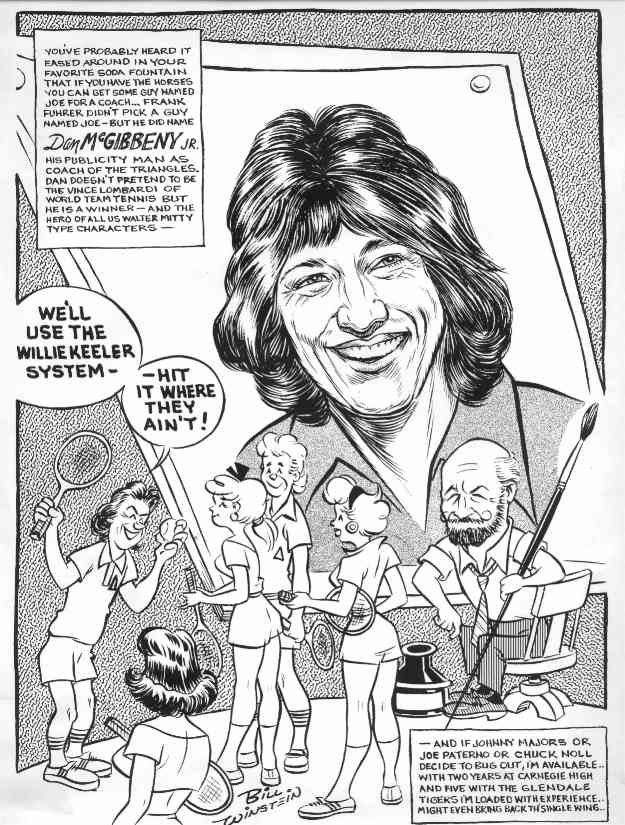
Most radical was the elevation of McGibbeny to his third job with the organization in as many years–this time as skipper. Danny replaced player/coach Marc Cox midway through the season while still maintaining general manager and public relations duties. Though untrained in the sport, the McGibbney-led team ultimately succeeded, going on a winning streak that took the Triangles back to the playoffs. “He didn’t know anything about tennis,” Burton says, “but he knew just how to talk to the players. Once he took over, they all started having fun again.”

Bill Winstein comic for the Pittsburgh Post-Gazette on Danny McGibbeny taking over as coach of the Triangles, 1976

Bill Winstein comic for the Pittsburgh Post-Gazette on Danny McGibbeny taking over as coach of the Triangles, 1976

After the 1976 season, both the Pittsburgh Triangles and World Team Tennis were in rapid decline. The league would limp along for another few years, but the Triangles day had come and gone. First subsumed in a one-season, combined Cleveland-Pittsburgh “Tri-Nets” team that never gelled, by 1978 professional team tennis had left Pittsburgh forever.

More painful than the fate of this oddball sports experiment was the parallel loss of its absolute heart in Danny McGibbeny. Suffering from quickly-declining physical health, Danny wouldn’t have had the strength for the 1977 season, even if the team had soldiered on. McGibbeny developed cancer that came on ruthlessly fast. He died on Sept. 6, 1977 at just 26 years old[3].

two young men look at the camera

“He was my hero,” Danny McGibbeny and Clint Burton, Christmas, 1975

Clint Burton’s career in professional sports statistics ended there, before he ever got out of high school. But the same analytical mind propelled him into the world of old-school “big iron” computer programming–FORTRAN, COBOL, and the like.

Today, Clint maintains the terrific Brookline Connection web site and FaceBook page. There, he works to document, digitize, and connect various aspects of the site’s namesake South Hills neighborhood. We thank Clint for all his help opening up to tell us his story and providing us with so many great photographs.

All photos courtesy Clint Burton, except where noted.

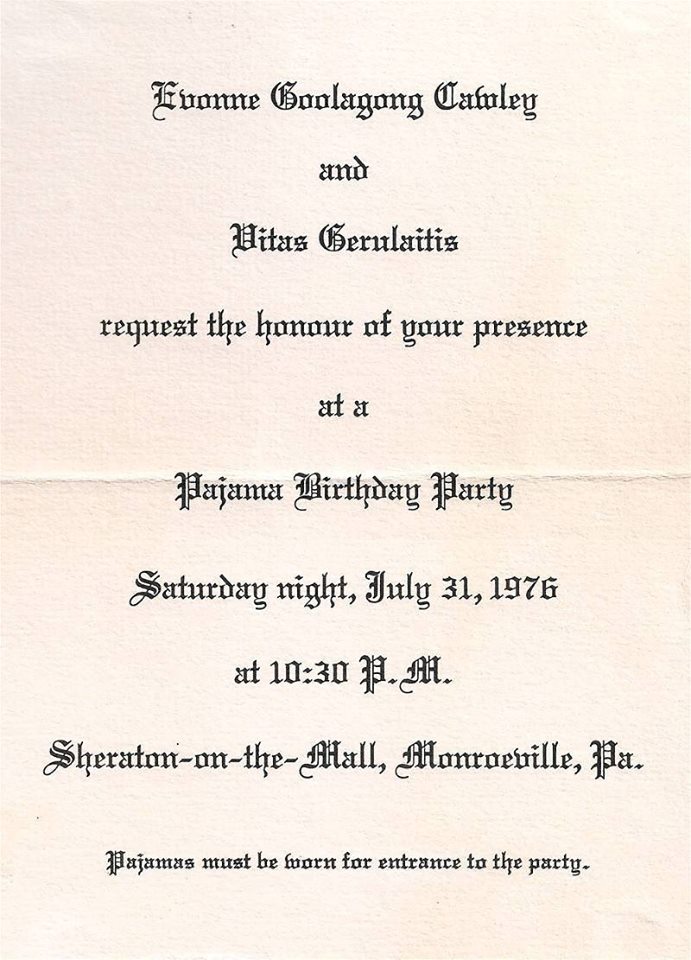
printed invitation for pajama party hosted by Evonne Goolagong Cawley and Vitas Gerulaitis, 1976

Always a party. Invitation to Goolagong/Gerulaitis pajama party, 1976.


[1] Traditionally, tennis games are played with an arcane scoring system of 15/30/40 and then a series of “deuce”/”advantage” points with the requirement to win a game by 2.
[2] The Swingers apparently never actually played a game, but their proposed team name is good enough to warrant a mention. Source: https://en.wikipedia.org/wiki/World_TeamTennis.
[3] Clint Burton has a great tribute page with many more stories about Danny McGibbeny on his site brooklineconnection.com.

Alms Race: The Front Yard Marys of Beaver County

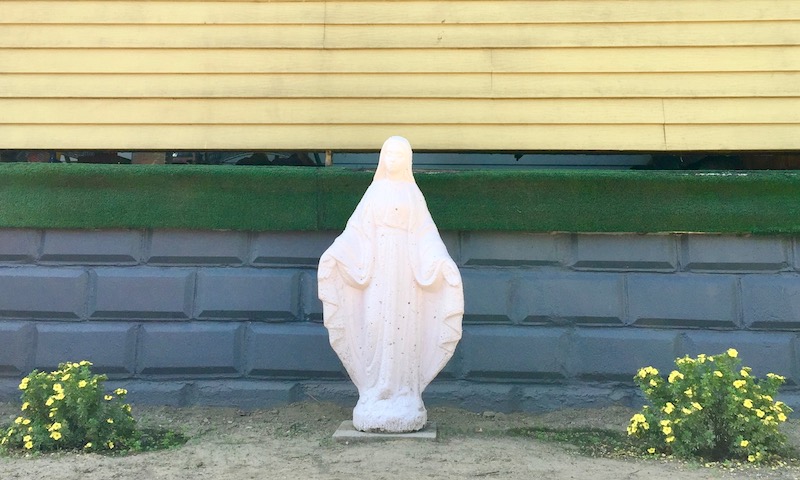
Mary statuette in front of house, New Brighton, PA

ghost Mary, New Brighton

Mary. We’ve already talked about the blessed virgin/most famous mama’s ability to get around. This week, Mary makes it clear her home-anointing juju doesn’t stop at the Allegheny County line. No, not content to let metro Pittsburgh have all the fun, Beaver County enters the escalating alms race with a shock and awe campaign of heavy-duty religion and hardcore beatitude.

You’ll find her Maryness all over Allegheny County’s western neighbor–from Harmony to New Galilee, Shippingport to Vanport, Raccoon to Big Beaver. There are so many likenesses of Mary in the front yards, porches, and gardens of homes across Beaver County that each of its larger towns could easily supply a post’s worth all on its own. That’s an intriguing opportunity for the Mary-obsessed, but let’s face it–sometimes there’s just too much Mary…even for dedicated Orbit readers.

Like The Bible and Catholic mass, this post is going to be long on pictures and short on words, so let’s get down to it. Here’s a random sampling of but a few of Beaver County’s unlimited supply of front yard Marys.

Mary statuette in front of house with large aerial antenna, New Brighton, PA

Our Lady of Perpetual Reception, New Brighton

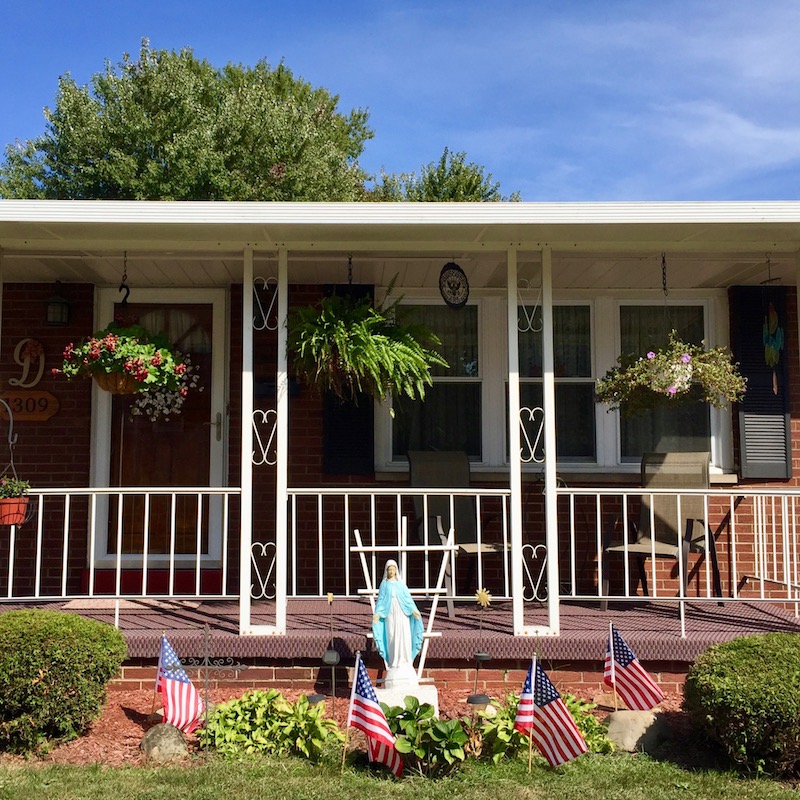
Mary statuette on front porch of house, Beaver Falls, PA

front porch autumnal Mary, Beaver Falls

statue of Mary on pedestal in front yard, Ambridge, PA

chain link Mary, Ambridge

Mary statuette in front of house, New Brighton, PA

patriotic Mary, New Brighton

Mary statuette in front of house, New Brighton, PA

New Brighton

Mary statuette in front of house, Monaca, PA

Monaca

Mary statuette in back yard of house, Monaca, PA

voyeuristic Mary, Monaca

Mary statuette in front of house, Eastvale, PA

Eastvale

brick house with Mary statue in front yard, Baden, PA

Baden

Mary statuette in front of house, New Brighton, PA

New Brighton

Mary statuette and dog statuette in front yard, Ambridge, PA

Mary with pet pooch, Ambridge

house with Mary statuette in front yard, Baden, PA

Baden

Mary statuette on front steps of brick house, Ambridge, PA

Ambridge


Further reading:

Show’s Over: Ex-Theaters, Part 1 – Mourning the Recently Departed

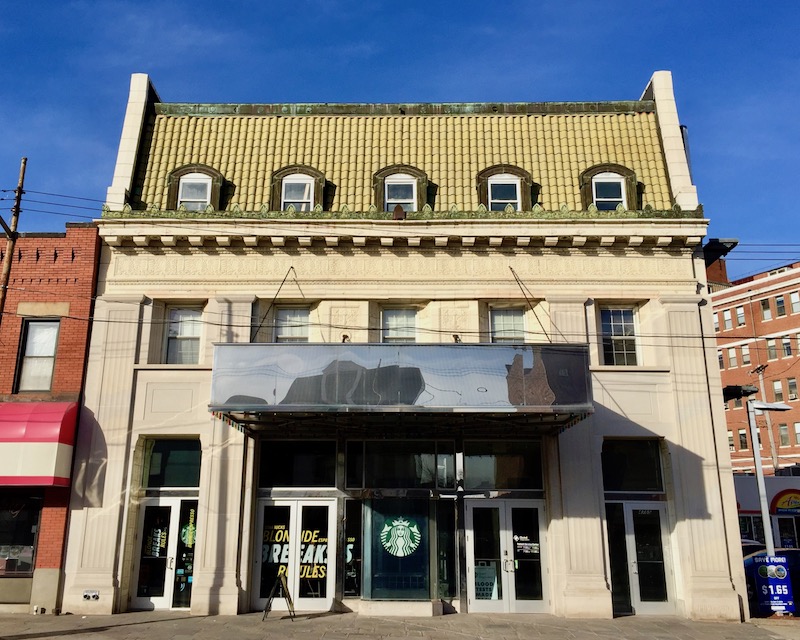
former Plaza Theatre in Pittsburgh, PA

Plaza Theatre [now Starbucks Coffee] (1917-1998), Bloomfield

For years–ten of them, to be precise–the scene on West Liberty Avenue was unchanged. There, as the street rises just past Dormont’s little downtown business district, was a true last-of-its-kind (for Pittsburgh, at least) cast in the amber of its final waking moment. The old Cinema 4 (neé Harris/South Hills Theatre) was a classic American neighborhood movie house. Built in 1927 to seat 1200 and later sectioned into four smaller screening rooms, the theater–when it was still open–had enough old glamour, oddball kitsch, and weird juju to make any goofy second-run feature a fun experience.

Those opportunities ran out abruptly when the theater closed forever in 2001. For the following decade, Cinema 4’s giant, façade-spanning marquee pathetically clung to the plastic letters advertising its final program: Morgan Freeman in  Along Came a Spider, the drug-dealing/using drama Blow, and, permanently etched in this blogger’s brain, Paul Hogan gettin’ it done one last time in Crocodile Dundee in Los Angeles[1]. [Side note: will America ever understand what a real knife looks like?!?] Alas, no departing staff ever bothered to update the marquee with a final “Closed. Thanks for 74 great years.” message.

former Cinema 4 movie theater, Dormont, PA

Cinema 4, sometime in the oughts, Dormont (1927-2001; demolished 2010) [photo: cinematreasures.org]

Though the theater stayed dark for all that time, somehow it always felt like it would be return to life. The building was too impressive, too unique, too important to let go. Those giant multi-story glass windows! The gleaming chrome–likely added in the ’50s or ’60s–reflecting along the sidewalk entrance! The big, reach-out-over-the-street neon marquee! Seven decades of South Hillsian memories, popcorn debris, garish paint jobs, and sticky floors.

But…you already know where this is going. In 2010, Dormont felt it needed a fancy new drug store more than a derelict movie house that had sat empty for the last decade. Cinema 4 was razed and West Liberty Avenue got a brand new CVS franchise with plenty of surface-level parking. Not only won’t you be able to see the latest Crocodile Dundee for a dollar, but the borough lost another local business at the same time–CVS ultimately made it impossible for Your Hometown Pharmacy (just down the hill) to compete and now they’re gone too. Sigh.

wooden ornament of apothecary mortar and pestle, Dormont, PA

Ghost apothecary. All that’s left of Your Hometown Pharmacy, Dormont

In the mid-1990s, greater Pittsburgh was awash with bargain movies. I know this very very well. As a new transplant to the city with neither television nor friends [don’t worry–I would pay dearly for both, later] this movie nut would go out three or four nights a week to feast on the unbelievable buffet of discount/second-run movies operating in the glorious cinematic salad days that ended way too early. I’d go see everything–some Wesley Snipes shoot-’em-up, dumb rom-coms, The Spice Girls movie. To this day, I’ll stand by the philosophy that any picture is a worth a buck on a the big screen–but try finding a movie that cheap any more!

Aside from the Cinema 4, Dormont also had the Hollywood (which is still sort-of operating?). There was the two-screen Bellevue Theatre (now a Family Dollar), four or five screens out in Cheswick (since demolished), and a similar number in a Penn Hills strip mall (amazingly still open and still half-price!). There was one obscure little theater in Whitehall or Brentwood that I only made it to a couple times (current status: unknown) and there were the big bargains of suburban sprawl: Northway Mall’s Super Saver Cinemas 8 with its sci-fi/spaceship looking gangways (closed 2007) and the completely generic $1.50 monster multiplex at Century III Mall (closed for a while, then reopened and rebranded as Century Square Luxury Cinemas).

Family Dollar store with the marquee of the former Bellevue Theatre, Bellevue, PA

Bellevue Theatre [now Family Dollar] (1920s-2002), Bellevue

The most painful loss was The Plaza–mainly because it was just so close to where I was living. Bloomfield’s little $2.00 second-run house was evidently a totally charming single-screen, 500-seat neighborhood theater when it opened in 1917. It went through a series of ups and downs including a substantial closure during the 1970s and eventual re-opening and reconfiguration as a two-screen bargain theater.

The layout was nuts. Typically when an old theater gets subdivided, they either figure out a way to cut the space down the middle or the balcony becomes one theater and the ground floor the other. For The Plaza, some genius came up with the idea to make one theater larger than the other using a bizarre L-shape that necessitated projecting the film from such a severe angle the screen was a perpetual trapezoid with only about half the frame in focus. A substantial portion of the seats couldn’t actually see the left hand side of the screen.

ornate stone building in Pittsburgh, PA

King’s Court/Beehive [now Noodles & Company/T-Mobile] (1965-1990s), Oakland [2]

When you start digging, it’s a history that will break your heart. It’s astounding how many nickelodeons, dance halls, opera houses, and movie palaces Pittsburgh–and pretty much every other place–once had. Three or four or five different theaters on every commercial drag in every part of town. A whole lot of those buildings–like the Cinema 4–are just gone forever. But an amazing number of them survive today and they’re mostly not what you’re expecting.

former movie theater in Pittsburgh, PA

Princess Theatre/Beacon Theatre/Guild Theatre [now Friendship Circle] (1937-1979), Squirrel Hill

If the building’s owners let the marquee stand, you’ve got a pretty obvious clue to what was once there. Most visitors to Squirrel Hill have probably noticed the big sign for Friendship Circle (and for decades before that, Gullifty’s restaurant) on Murray Ave. [See photo, above.] That, and the clean, art-deco design are a dead giveaway for the building’s past life as a movie theater. The Warner Centre, downtown, has its exterior so well preserved that you’d assume it still is the grand movie palace it was built as a hundred years ago. You’d be wrong.

façade of former Warner Theatre, downtown Pittsburgh, PA

Grand Theatre/Warner Theater [now Warner Centre shops] (1918-1983), downtown

This is a big topic with a fascinating history. We went from one story about the rash of (somewhat) recently-closed movie houses to digging into all of the various places that used to be theaters and performance halls. There is plenty of documentation out there about the lovely, ornate old theaters of yore [the web site cinematreasures.org is an invaluable resource] but what really interested The Orbit were the places that have held on–not as the handful of still-operating theaters, but a building’s transformation from nickelodeon to retail space, 200-seater to neighborhood bar, community theater to taxi stand.

A space like Cinema 4 could really only serve one purpose–and that’s probably what would ultimately doom it. Others, though, were far more humble in design–baked into retail blocks with apartments or office spaces above and storefronts bookending their entranceways. These seem to have survived much better than their great single-use siblings and have the intriguing quality of hiding in plain sight, masquerading as health clubs and laundromats, juice bars and dentists offices.

marquee of former Squirrel Hill Theatre, Pittsburgh, PA

Squirrel Hill Theatre (1940-2010), Squirrel Hill [3]

There are some bright spots, too. We’d intended on including a photo of the old Denis Theatre in Mt. Lebanon, but it’s currently getting rehabbed to be a new community-run theater/art space. North Side’s Garden Theatre is undergoing similar treatment and Row House Cinema in Lawrenceville likes to claim it’s the first new, single-screen theater built in America in the last 50 years (or something like that).

We’ll get to all this as the series unspools. Until then, just like Siskel & Ebert, we’ll see you at the movies.


[1] There is no indication why only three films were listed on the marquee of the four-screen theater. Perhaps technical difficulties precipitated Cinema 4’s ultimate closing or maybe souvenir-hunters just scavenged the lowest-hanging set of removable marquee letters. We’ll probably never know.
[2] Obvious in the photograph, the old King’s Court was not originally a theater. It was built as a police station and only converted into a movie theater some time in the 1960s. As we’ll see–especially when we get into the nickelodeons–this is not an uncommon practice.
[3] Squirrel Hill Theatre, along with the Denis, were both first-run theaters, so not included in the bargain buffet discussion. At the time it closed, the rumor was that the whole block was going to be razed and redeveloped along with the Poli plot, but that hasn’t happened and there’s a For Sale sign on the theater now, so keep your fingers crossed on this one.

Art Opening: Garage Door Murals

garage door murals of giant cat head and abstract lines and stars, Pittsburgh, PA

Lawrenceville

Garages, man. The mythological backyard birthplaces of great art and invention–from Thomas Edison making light bulbs to The Kingsmen banging out those three chords to Steve Jobs and “The Woz” inventing Pac-Man (or whatever they did).

While little structures to park your car in exist everywhere, there is something quintessentially and uniquely American about the garage. Our obsession with the automobile, along with the affluence to afford the extra real estate–let alone, the sport SUV–and America’s young history, unencumbered by precious Medieval ruins, ancient bazaars, or sacred bones–makes all land fallow ground for building home for our cars.

While the three-bedroom split-level house with its integrated two-car garage has become synonymous with twentieth-century suburbia, there are plenty of interesting alleyway garages serving retail storefronts, row houses, and gingerbread Victorians all over the city. It is this collision of circumstances that, uh, opens the door (sorry) to great garage murals.

garage door covered with plywood painted with colorful bridge and hills, Pittsburgh, PA

Garfield

Mural painted on garage door of man on motorcycle with the Pittsburgh skyline behind him and a banner reading "Gone but not Forgotten"

Gone but not forgotten, Homewood

Some of these many retractable, roll-up doors have been gloriously decorated with large-form artwork. That makes perfect sense–the garage door is such a nice, big canvas–sixty square feet at the minimum; much much more when you get into two-car widths and double-door arrangements. Plus, the street- (or, more often, alley-) facing arrangement guarantees an audience of neighbors, scavengers, and garbage collectors as they trundle down the hill, possibly to or from their own garages.

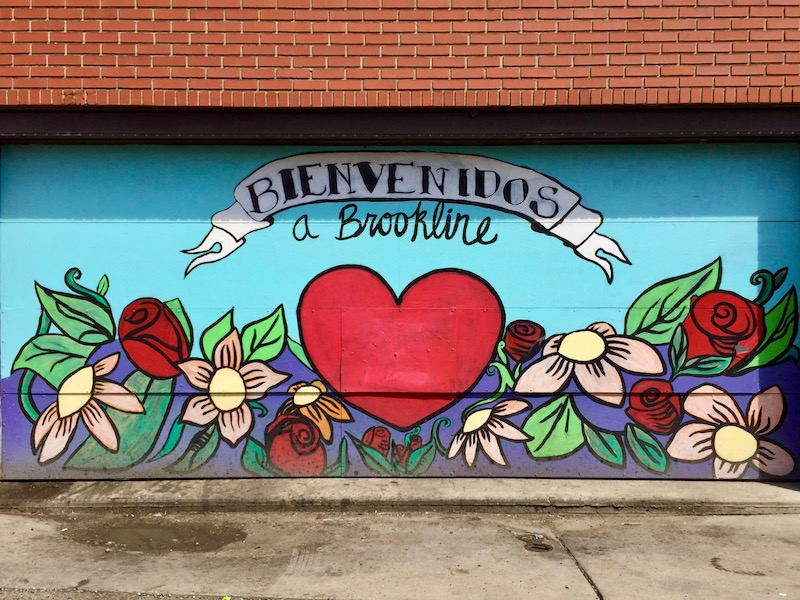
garage door mural of heart and flowers with text "Bienvenidos a Brookline", Pittsburgh, PA

Bienvenidos a Brookline, Brookline

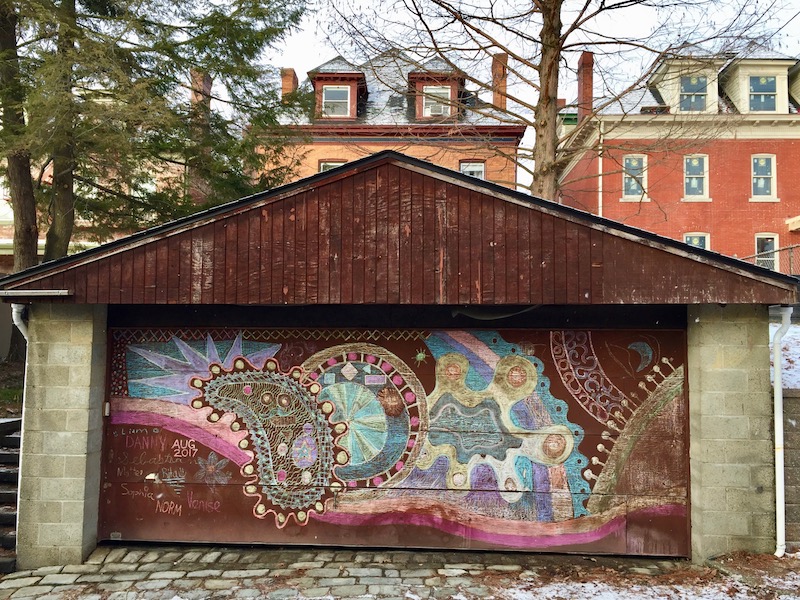
colorful abstract mural on garage, Pittsburgh, PA

Friendship

It’s an interesting opportunity. Most property owners don’t paint such wild, loose scenes on the exterior brick and stucco walls of the main house. But the garage seems to have a different set of rules–no one considers it sacred space, crucial to the visual integrity of the home. The neighborhood may look like Peyton Place from the street, but it’s Dazed and Confused in the back alley.

mural of colorful furry cartoon character painted on garage door, Pittsburgh, PA

Lawrenceville

garage door painted with crowd of people, Pittsburgh, PA

Garfield

garage door opening covered in plywood and stenciled with birds and birdcages, Pittsburgh, PA

Friendship [1]

brick wall over former garage painted with elaborate tag, Pittsburgh, PA

Garfield

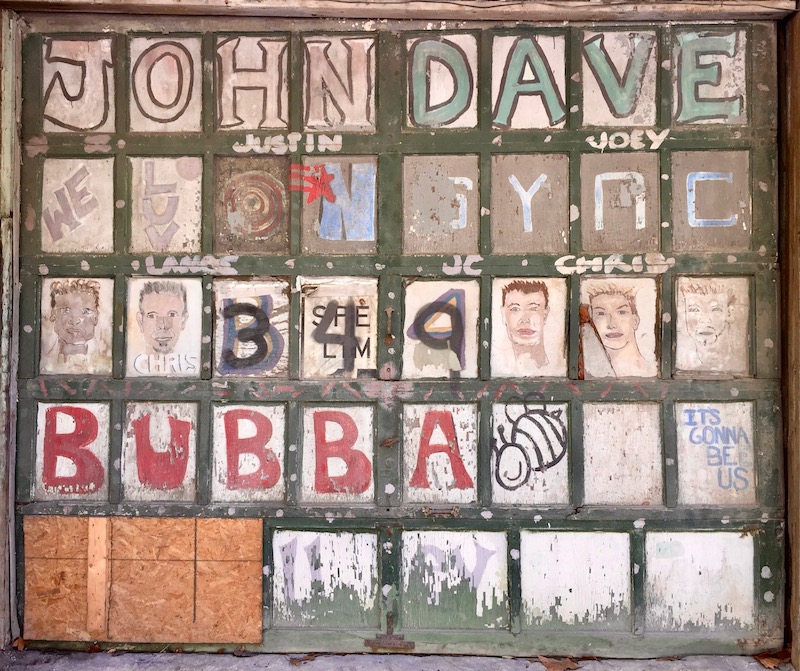
An interesting sub-genre of the garage door mural shows up in these artifacts from a long-over radio station contest around pop group ‘N Sync. I was unable to locate any mentions of this on the computer Internet, but from our small sample size, it looks like participants were required to paint a garage door in tribute to both the singers and [defunct radio station] B-94, with the names of on-air personalities John, Dave, Bubba, Shelley and band members spelled-out. The one from Aliquippa (below) is particularly great for its crude renderings of Justin, Lance, J.C., and the gang.

garage door painted by fans of N*Sync for radio contest, Aliquippa, PA

B-94 ‘N Sync mural, Aliquippa [2]

The B-94/’N Sync murals would make a great subject for its own post, but we have no confidence we’ll ever see any more of these. [If you know of any, hook us up!] The contest probably ran right around 2001 at the height of ‘N Sync’s popularity and while it may have had many teenagers decorating the family car park back then, turn-of-the-millennia middle/high school students are now in their 30s and should have moved out of the house by now. We imagine even the most supportive and/or nostalgic parents took the opportunity to whitewash over these alley-facing memories.

garage door painted for radio station content as tribute to N*Sync, Munhall, PA

B-94 ‘N Sync mural, Munhall [photo: Lee Floyd]


[1] Given the quantity of both the stenciled bird and birdcage images around town, this particular artwork was likely not created by the property owner–nor is it a full mural. Regardless, it’s still garage door art, so we included it here.
[2] Shelley’s name is partially-covered in plywood and otherwise faded/worn away in the bottom row of panels.

Stamp Collecting: Even More City Sidewalk Stamps

sidewalk stamp for Sam Nicoletti, Pittsburgh, PA

Sam Nicoletti, Perry Hilltop

Who doesn’t like an egg hunt? The literal ones are hard to come by, but luckily we’ve got an inexhaustible supply of figurative eggs to bag.

If you’re The Orbit, one of these hunts puts you on your hands and knees, on someone else’s sidewalk, whisking the effluvia of the streets from the shallow impressions made by the city’s long-gone concrete masons and parsing out their disappearing names.

For Easter this year, we’re going to keep it real simple. The next (perhaps final?) installment in our continuing series on sidewalk stamps is almost all pictures with none of the boring blah blah blah to wade through. Honestly, there’s just not that more to say on this subject and we know our busy readers have bunnies to rustle and glazed hams to consume.

Happy Easter, y’all!

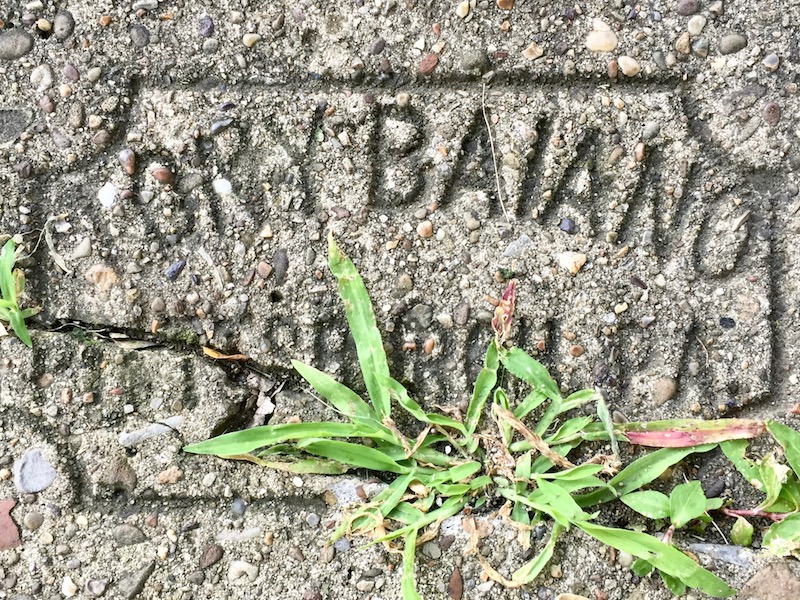
sidewalk stamp for Tory Baiano, Pittsburgh, PA

Tory Baiano, Greenfield

sidewalk stamp for E. Putch, Pittsburgh, PA

E. Putch, Oakland

sidewalk stamp for Edward W. Putch, Pittsburgh, PA

Edward W. Putch, Concrete Construction, Oakland

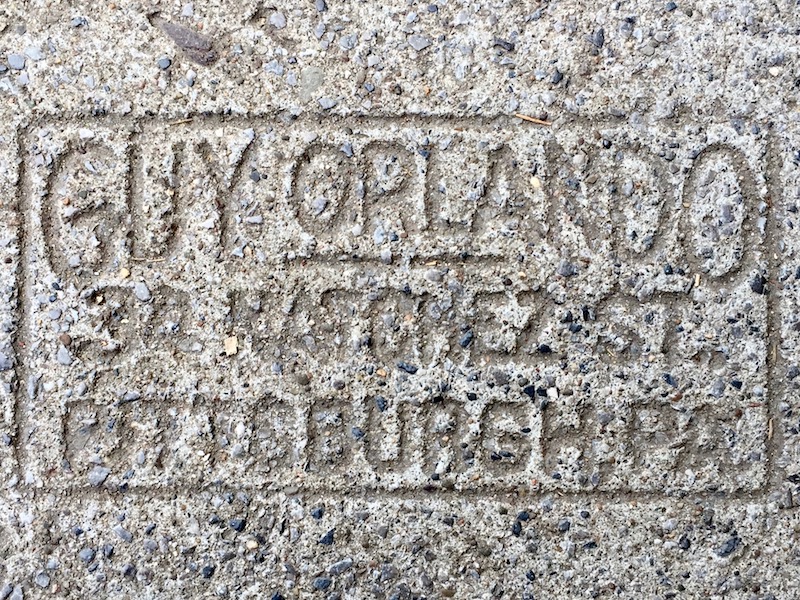
sidewalk stamp for Guy Orlando, Pittsburgh, PA

Guy Orlando, Oakland

sidewalk stamp for Jos. Crimeni Paving, Pittsburgh, PA

Jos. Crimeni Paving, Oakland

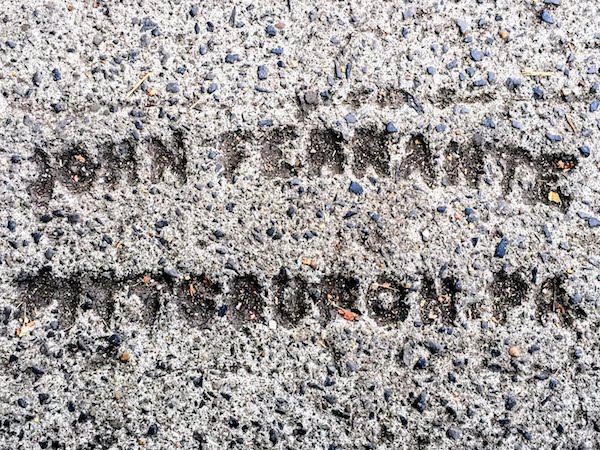
sidewalk stamp for mason John Ferrante, Pittsburgh, PA

John Ferrante, Shadyside

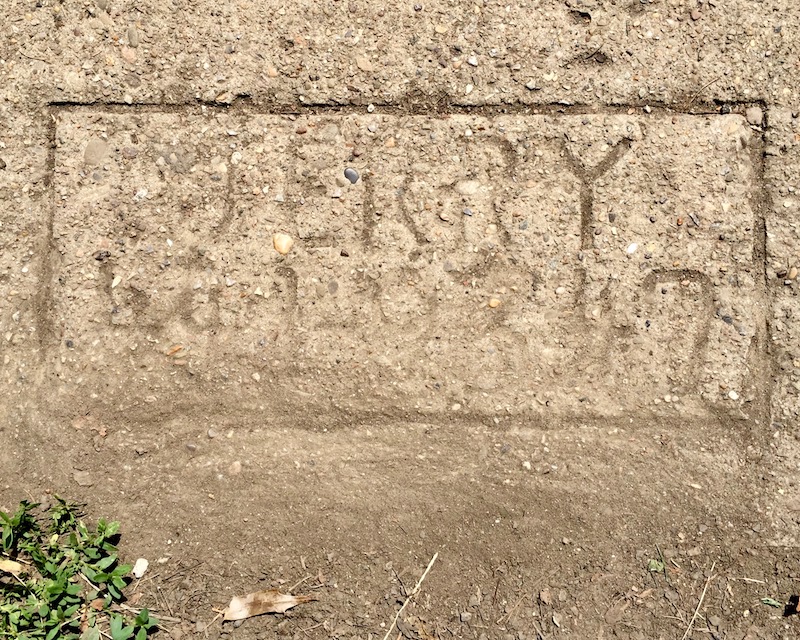
sidewalk stamp for "Jerry", Pittsburgh, PA

Jerry, Friendship

sidewalk stamp for August Didiano, Pittsburgh, PA

August Didiano Construction Inc., Friendship [photo: Paul Schifino]

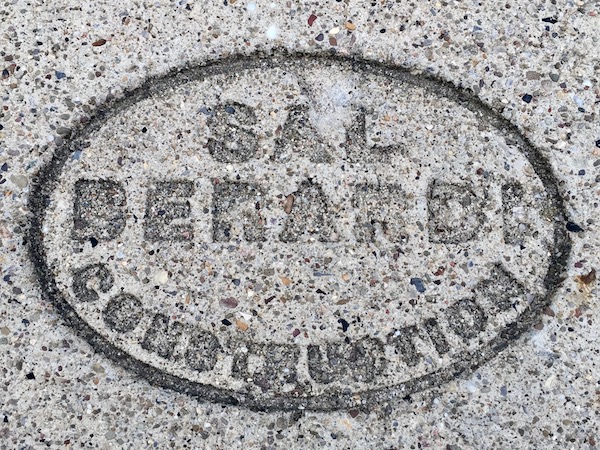
sidewalk stamp for Sal Berardi Construction, Pittsburgh, PA

Sal Berardi Construction, Friendship

sidewalk stamp for Benito Moscatiello, Pittsburgh, PA

Benito Moscatiello, Greenfield

How did Lent become fish fry season?

fish sandwich on styrofoam plate

Week 3: Fish sandwich bathed in the Italian flag-colored light of the Regina Elena Club, Sharpsburg

The plate is a standard-issue, eight-inch disposable picnic platter. On it is a large sandwich bun flipped open, both sides up. Across this bed of bread and extending way off its edges lies a gigantic piece of codfish, reclining leisurely like the most relaxed den dweller on a chaise lounge.

The filet is coated in a thick layer of Panko breadcrumbs, deep-fried until golden brown, and still-sizzlin’ as it approaches the table with its partner plate of macaroni & cheese. As is customary, there are no vegetable toppings for the sandwich but the supplies of tartar and hot sauce are ample.

Eleven months a year, this blogger stays away from religion, but he gives up atheism for fish fry season or, as the Catholics call it, Lent.

fish sandwich with sides of haluski and potato haluski from church fish fry

Fish sandwich with sides of haluski and potato haluski, St. Max’s, Homestead (2017)

Catholic? No. But Catholic-curious…sure. Fried cod, mac & cheese, individually-wrapped slices of pineapple upside-down cake or pretzel salad for dessert–a cold beer to go with it if we’re lucky? It’s freakin’ delicious and enough to bring even the most ardent pagan back into the welcoming arms of the church…basement…at supper time.

But isn’t the whole point of the season supposed to be penance and sacrifice? “Having” to eat a giant deep-fried fish filet with a side of haluski or pasta olio once a week hardly constitutes a war effort. If this is The Vatican’s idea of fasting, sign me up for the hunger strike.

front windows decorated for Lenten Fish Fry, Angelo's Pizza, Pittsburgh, PA

Angelo’s Pizza, Bloomfield

So how did we get here? Apparently this all goes back to Pope St. Leo who, in the fifth century, preached that the faithful must “fulfill with their fasts the Apostolic institution of the 40 days.” (Again with the 40 days!) Traditionally the fasting ritual was much more severe, allowing only a single evening meal every day of Lent (just like Ramadan), and the rules were much more restrictive disallowing all meats (including fish), eggs, sweets, and “other indulgences.”

In the intervening centuries, the church and congregation have come to a strange compromise with the laity seeming to hold all the cards. The concept of a fast has gone from eating only one penitential meal a day to merely cutting out meat on Friday. [That fish doesn’t count as “meat” is a whole other discussion.] This “sacrifice” just doesn’t seem that painful.

large fried fish dinner on plate

Week 4, part 2: Fish, haluski, and cole slaw: Church of the Assumption, Bellevue

A couple weeks back, this blogger pulled the “Lenten double”–a sort-of Stove Top Stuffing ruse for the fish-obsessed. First, there was an enormous sandwich from Giant Eagle’s seasonal “Fish Frydays” for lunch followed by a full dinner spread at Church of the Assumption. It’s no easy feat–the ridiculously early hours the church suppers keep really requires you shake a leg to pack it all in.

Let me tell you something: I’m going to need a serious weight-loss plan after all the fasting I’ve been doing the last few weeks. Catholics need to come up with a real season of penance and self-denial after the unhinged gluttony of Lent.

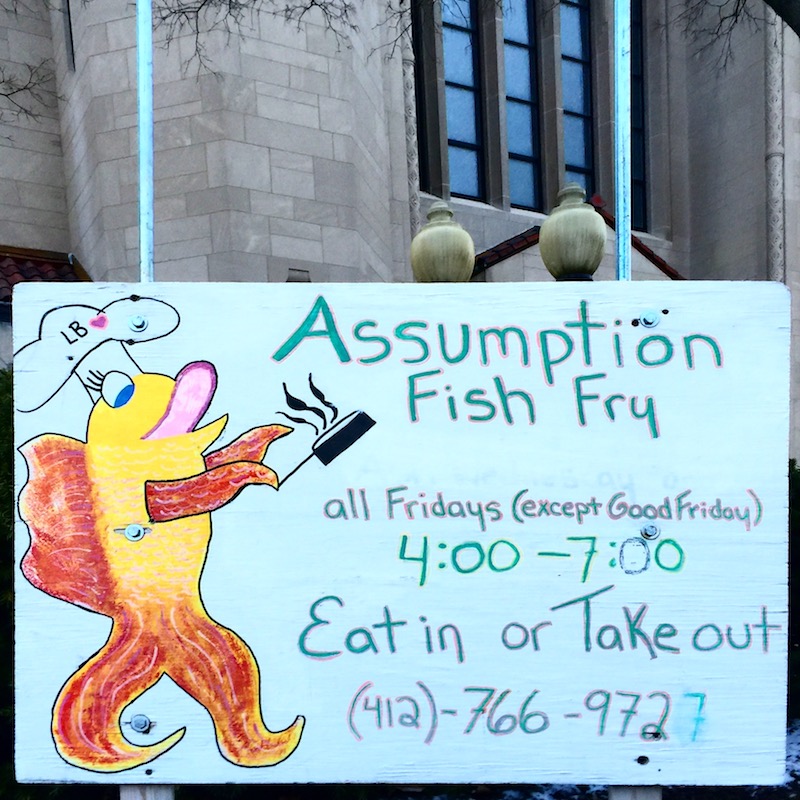
hand-made sign for fish fry, Church of the Assumption, Bellevue, PA

Of course, fish fry-hosting churches do a lot of their fundraising during the six Fridays of Lent and we see evidence of Churches consolidating and closing all the time. So in an era when the larger populace would no longer be described as “god-fearing” it’s an understandable economic necessity that churches need to relax some of the old-world doctrine and bring in some pew-filling carbohydrates.

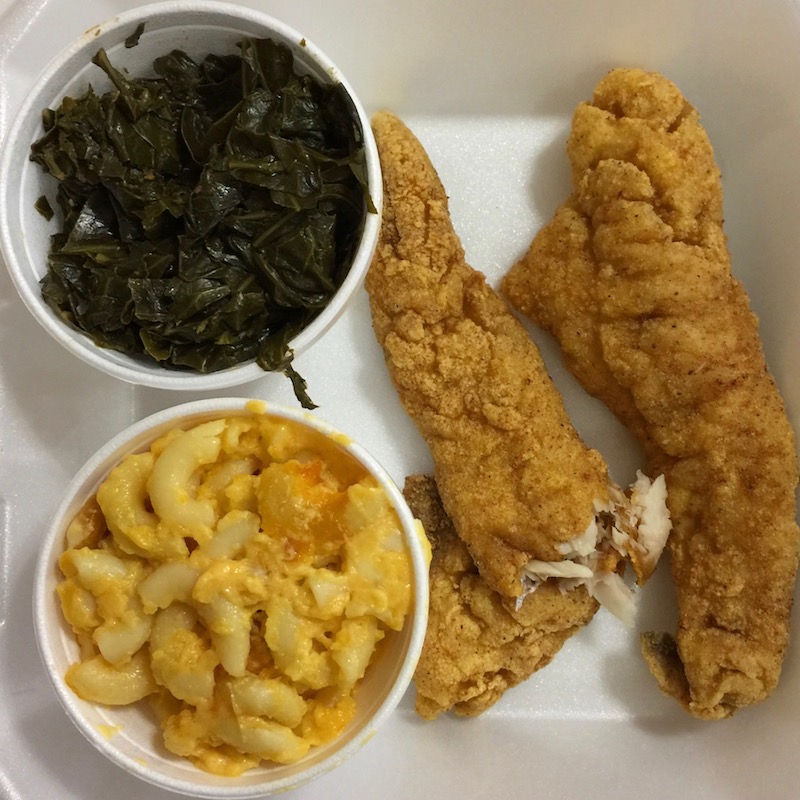
catfish dinner from New Jerusalem Holiness Church, Pittsburgh, PA

Week 2: Even non-Catholics get into it! New Jerusalem Holiness Church, Larimer

Still, to stray so wildly from the original “reason for the season” (to borrow from another highly mutated Christian tradition) seems like a real lost opportunity–both for the church and its congregants. While it’s both bizarre and wonderful for us non-believers to look forward to Lent for its distinct church basement suppers, the tradition of voluntarily giving up something loved (or, at least, appreciated) to learn the value of sacrifice and everyday privilege seems like an extremely valuable exercise.

Maybe next year this blogger will have to give up all those fish fry calories, you know, for Lent.

fish sandwich with mac & cheese

Week 6: Harris Grill, Shadyside*


* The obvious addition of lettuce, tomato, onion, and pickle slices would only come from a restaurant offering.