An Orbit Obit: Where the Buffalo Roamed

sidewalk painting of purple and white buffalo with painted fence

Last photographic evidence of the now-extinct sidewalk buffalo of lower Lawrenceville, Summer 2015

The lore will be passed-down for generations to come. It was a time when proud giants strode the streets (err…sidewalks) of lower Lawrenceville; their brilliant purple, red, white, and gold colors shimmering and electrifying the drab, weed-cracked concrete blocks. Mere mortals freely walked foot-to-hoof with these legendary lords of the great plains. Every one of the animals was rendered in its own style–the group less herd and more party of like-shaped individuals; each creature with its own agenda. Though trampled underfoot, they still managed to stand tall–at least if you stood back far enough to get the angle right.

sidewalk painting of purple, red, and white buffalo

Purple pain: one big hombre

If you find yourself at the corner of 35th and Charlotte Streets in Lawrenceville’s sixth ward, you won’t miss Jeremy Raymer‘s house. The otherwise standard-issue two-story Pittsburgh rowhouse is covered–foundation to soffit–in big, eye-popping mural portraiture. Around the side, a gray, picket fence is more loosely painted in an ever-evolving array of icons. The closest telephone pole is covered in an odd assortment of push-pinned offerings. [More about all of this, hopefully, in some future Orbit story.] The one thing you won’t see anymore is the fantastic parade of buffalo that roamed freely on Raymer’s sidewalks just weeks ago.

sidewalk painting of purple and white buffalo

Lascaux-a-go’alo: caveman street buffalo

It was a surprise to see them disappear so quickly. Street art is by its very nature temporary/ephemeral, but we hope the good stuff will get a little time in the sunshine before the man sends in the clouds. Having just taken these photos in August, we arrived back at the same intersection a mere couple months later with nothing but the faintest outlines of the great beasts remaining. It was a sad reminder of both how fleeting grace can be and also how potentially on-the-verge-of-dissolution pretty much everything is. The great American street bison is clearly no exception.

sidewalk painting of purple, red, and white buffalo

All wound up: mechanique’alo

We got in touch with Mr. Raymer to ask about the sudden extinction of his herd. He verified that indeed he was the perpetrator (the buffalos were loosely based on series of photographs by Eadweard Muybridge taken in late 19th century), planning to make them last, Raymer painted the buffalos in Montana Gold spray paint, and that a neighbor filed an official complaint about the sidewalk paintings. The city’s Graffiti Task Force was called-in and was therefore obligated to power wash them away. (Apparently the city would not have acted but for the formal complaint.) Raymer would like to re-paint his sidewalks with a new to-be-decided theme at some point in the future, but this time he’ll go through official channels to do so.
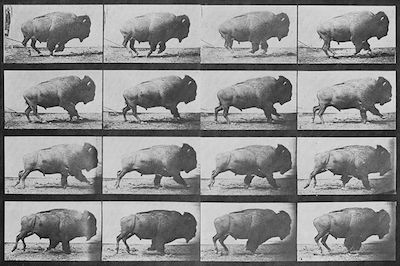
Sequence of a buffalo (American bison) galloping. Photos taken by Eadweard Muybridge (died 1904), first published in 1887 at Philadelphia (Animal Locomotion).

Eadweard Muybridge’s photographic sequence of a buffalo (American bison) galloping, 1887

The whole thing raises an interesting series of questions. Sidewalks are this curious blend of public and private space and the letter of the law doesn’t necessarily add up logically. Technically, one’s sidewalks are part of the property lot and the homeowner (not the city) is legally responsible for the care and maintenance, including weed, snow, and ice removal, patching and replacing cracked concrete, etc. Sidewalks are undeniably public thoroughfares that everyone uses and are absolutely essential to a healthy urban environment. They also offer great opportunities for expression.

Shouldn’t Raymer (or anyone else) be allowed to decorate his own property–that he’s legally responsible for maintaining–in a way he chooses? Why is he allowed to paint the public-facing fence, but not the adjacent sidewalk, which is inches away and just as visible? If the same neighbors objected to his wall murals, would the city be in power to act on those complaints? And if one is painting his or her own property, does it really count as graffiti?

sidewalk painting of purple and white buffalos

Then: corner buffalo (and friend)

faded outline of a buffalo painted on sidewalk, Pittsburgh, PA

Now: the same corner with the last traces of the once-proud herd of Lawrenceville’s sidewalk buffalo

The Orbit does not pretend to have answers to these questions, nor do we want to vilify the residents who objected to the paintings. That said, this hardcore all-seasons blogging pedestrian would like to see the neighbors of Lawrenceville put that same keep-the-sidewalks-clean enthusiasm put into clearing the inevitable mini glaciers of snow and ice that will arrive any day now.

Maybe down on 35th Street they don’t have this problem, but just a few blocks away I sure do! Every year I slip on un-shoveled winter sidewalks. Most years there is at least one ugly fall that ends with a bent knee, a twisted ankle, or a very literal pain in the ass. These buffalos may look threatening, and they may not be Raymer’s neighbors’ idea of art, but it’s hard to imagine they were really offending anyone. It’s the coming ice age that may do us all in.


To see more of Jeremy Raymer’s work, check him out on Instagram @jeremyMraymer.

An Orbit Obit: The Toynbee Tiles of Smithfield Street

Toynbee Tile reading "Toynbee Idea in movie '2001' resurrect dead on planet Jupiter"

Resurrect dead while you can. The last remaining Smithfield Street Toynbee Tile, Downtown.

It was not that long ago (February, to be exact) when Pittsburgh Orbit filed one of its earliest stories on the great run of five “Toynbee Tiles” that were imprinted on Smithfield Street, approximately one per block from Boulevard of the Allies to Sixth, downtown.

This blogger likes to think The Orbit come a long way since those nascent days of yore, [Only two paragraphs of text? Who was doing the photo editing?] but looking back on this very recent history, it’s also a reminder of how rapidly (and drastically) things can change in the city as a whole. [Young people: for good or bad, back in the ’90s/early aughts, the words “Pittsburgh,” “rapid,” and “change” were never bundled in the same text.]

I’ve gotten in the habit of eyeballing and taking inventory of the Toynbee Tiles every time I ride through downtown, inevitably on Smithfield’s relatively-convenient route from the South Side to the great new Penn Ave. bike lane. It’s news to no one that there’s a tremendous amount of development happening in town right now–you see giant cranes, construction fencing, and torn up pavement everywhere you look. But I was startled to find that as of this past weekend–less than a year after that early blog post–only one out of the five Toynbee Tiles was still intact. The sole survivor (pictured above) is at the corner of Smithfield and Oliver Way.

It doesn’t seem like there was any malice involved here or that the tiles were actively removed in a clean-up effort. [Let’s hope not: the city has far bigger infrastructure-shaped fish to fry.] There just seems to be that much digging up of streets and running new, uh, things under them. The block of Smithfield from Sixth to Seventh has been totally resurfaced.

terra cotta storefront for former G's Restaurant and Pizzeria, Pittsburgh, PA

(The former) G’s Restaurant and Pizzeria on a torn-up Forbes Ave., Downtown

Fifteen years ago, me and a whole bunch of other concerned citizens drank a lot of beers and ate a lot of fried zucchini at The Chart Room in the name of not having downtown Pittsburgh eaten alive (or something like that) (hey: it worked, didn’t it? sort of?). The Chart Room is long gone (heavy sigh), but at least the building didn’t get torn down. [Sadly we can’t say the same for the old nickel bingo parlor across the street.]

No, The Chart Room got mangled by choice, in private hands, without needing any help from eminent domain. It’s strange to have lived through that extreme “Hail Mary”/desperation-style urban planning only to wake up in an entirely new world where big money comes in and builds big things all on its own. It’s different in a whole lot of important, structural ways, but still strangely the same as it seemed like it might have turned out to be. Resurrect dead, indeed.

Ah, hell. If you want The Orbit’s advice, go check out the last Toynbee Tile on Smithfield Street while you still can. It won’t be there forever.

Polish Hill’s Abstract Art Walks

graffiti cover-up, Pittsburgh, PA

Bethoven Street

If Don and Phil Everly are to be believed, a man in Kentucky sure is lucky to lie down in Bowling Green. Well, you can bet your dupa that man, woman, and child sure are lucky to wake up in Polish Hill–its spectacular vistas, its legendary city steps, its cattywumpus streets clinging to the hillside. To this list, you can add one more bonus. The residents of Melwood, Herron, and Brereton get the year-round, open-air, free-admission modern art walks of Bethoven and Finland Streets.

graffiti cover-up, Pittsburgh, PA

Finland Street

The works are created and maintained as a joint effort between some number of indefatigable spray paint-weilding taggers and what we imagine is a combination of city D.P.W. “graffiti busters” and concerned citizens taking matters into their own hands. This cat-and-mouse adversarial partnership ensures that every season the palette will shift, the structure will renew, and the layers will be reborn yet again.

graffiti cover-up, Pittsburgh, PA

Bethoven Street

The quirkiest thing about these artists is exactly what makes the whole thing work. A graffiti cover-up team could easily just invest in bulk orders of battleship gray exterior primer. End of story. That’s what it’s like along the jail trail, down in “The Run,” and a bunch of other places*. One clean sweep every spring. If so, there’d be one less blogger loitering at the top of the hill.

graffiti cover-up, Pittsburgh, PA

Bethoven Street

But it ain’t like that in Polish Hill. Instead, the clean-up crews (whoever they are) seem to use whatever extra paint they just happen to have laying around. I don’t see any green or black in these photos, but just about every other color in the spectrum is represented. The way these layers peel, flake, and erode suggests they may just be using leftover house paint, rather than some heavy-duty, element thwarting, highway-grade pigment.

graffiti cover-up, Pittsburgh, PA

Finland Street

Further, the painters use an irregular approach to the graffiti cover. Sometimes roughly squaring off big fields, others targeting individual spots just as needed. The effect is to give the abstraction a loose (if undefined) composition that wouldn’t have been there without the smaller details.

Mark Rothko "Yellow, Cherry, Orange" (1947)

Mark Rothko “Yellow, Cherry, Orange” (1947)

Maybe you have to mentally crop the big retaining wall-sized sections down into more digestible chunks, let the eye focus go a little soft, relax a little bit for it to make sense. But you really don’t have to stretch too far to imagine these pieces sitting side-by-side the great abstract expressionists. I imagine a Hans Hofmann or a Franz Kline or a Mark Rothko being quite pleased to share wall space along Bethoven Street.

graffiti cover-up, Pittsburgh, PA

Bethoven Street


* In fairness, the city uses a few different shades of white and gray and some of the results are still interesting…but they’re not like these.

A Salute to The City of Sad Toys

Stuffed polar bear toy in alley

Bloomfield clip job

I only became aware of Al Hoff’s City of Sad Toys right at the end. So late in the game, in fact, that by the time I started submitting photos, the blog had already ceased to publish any new content. [Note to self: consider Rejected by Sad Toys as potential memoir title.] That was four years ago.

“Sad toys” are pretty much what they sound like: lost, discarded, maimed, or otherwise on-the-loose playthings, often photographed in the comically incongruous settings of other urban flotsam. City of Sad Toys still exists in whatever perpetuity Blogspot grants its lapsed authors, so we encourage our readers to check it out while you still can. Al generously offered to hand the keys over to this Johnny-blog-lately fan, but as we’re more Rupert Pupkin than Rupert Murdoch, we’ll stick to just one global media enterprise.

In Al’s hands, the definition of “toys” was extremely liberal–the blog accepted sports equipment, cake toppers, board games, and party decorations among its sad clientele. This is of course all fine, but The Orbit considers these outliers as merely middle-of-the-mall sad toys; the only real anchor tenants being stuffed animals and downtrodden dolls.

Despite the official blog’s inevitable denouement, our digital shutters never stopped virtually clicking and blogs exist largely for us citizen-journalists to, in Al’s words, “do whatever [we] want!”–including important work like publishing photos of filthy fake fur. Here then, we’ve collected a nice little set of Pittsburgh-area additions to share in this Orbit tribute to a great photo genre: the sad toy.

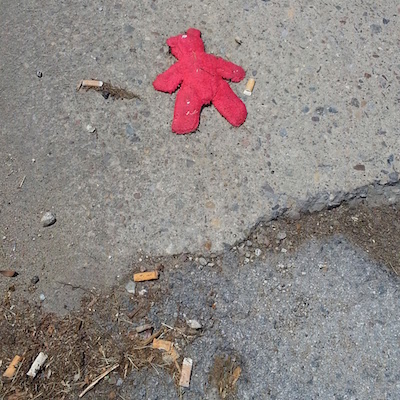
stuffed red toy in street

Red…thing, Oakland

stuffed monster toy on street

Green monster, Oakland

stuffed bunny toy on roadside

Roadside bunny, Rogers, Ohio

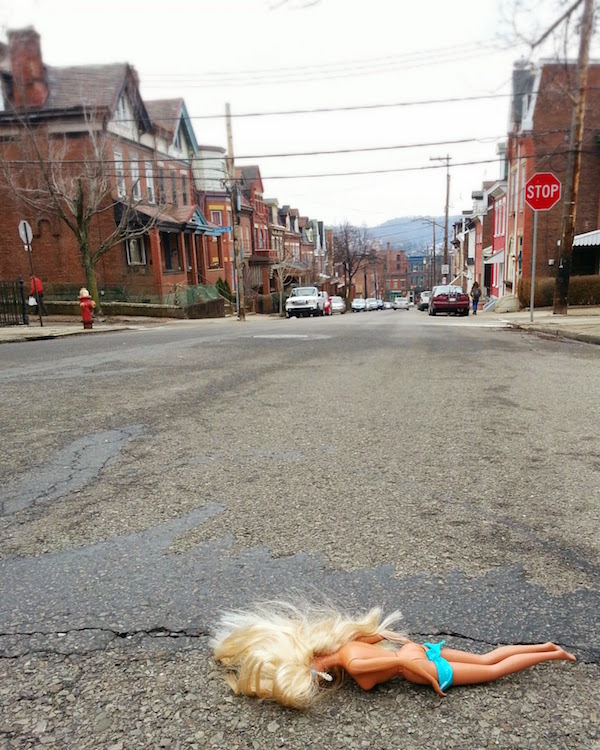
Barbie doll laying face down in street

Barbie hit-and-run, Lawrenceville