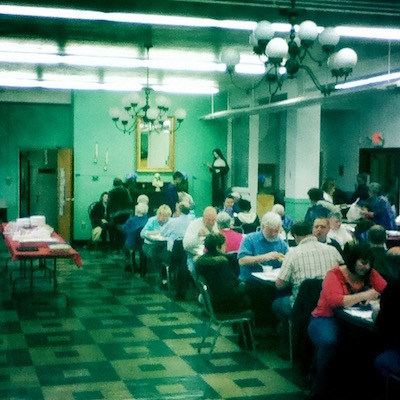
How did Lent become fish fry season?

fish sandwich on styrofoam plate

Week 3: Fish sandwich bathed in the Italian flag-colored light of the Regina Elena Club, Sharpsburg

The plate is a standard-issue, eight-inch disposable picnic platter. On it is a large sandwich bun flipped open, both sides up. Across this bed of bread and extending way off its edges lies a gigantic piece of codfish, reclining leisurely like the most relaxed den dweller on a chaise lounge.

The filet is coated in a thick layer of Panko breadcrumbs, deep-fried until golden brown, and still-sizzlin’ as it approaches the table with its partner plate of macaroni & cheese. As is customary, there are no vegetable toppings for the sandwich but the supplies of tartar and hot sauce are ample.

Eleven months a year, this blogger stays away from religion, but he gives up atheism for fish fry season or, as the Catholics call it, Lent.

fish sandwich with sides of haluski and potato haluski from church fish fry

Fish sandwich with sides of haluski and potato haluski, St. Max’s, Homestead (2017)

Catholic? No. But Catholic-curious…sure. Fried cod, mac & cheese, individually-wrapped slices of pineapple upside-down cake or pretzel salad for dessert–a cold beer to go with it if we’re lucky? It’s freakin’ delicious and enough to bring even the most ardent pagan back into the welcoming arms of the church…basement…at supper time.

But isn’t the whole point of the season supposed to be penance and sacrifice? “Having” to eat a giant deep-fried fish filet with a side of haluski or pasta olio once a week hardly constitutes a war effort. If this is The Vatican’s idea of fasting, sign me up for the hunger strike.

front windows decorated for Lenten Fish Fry, Angelo's Pizza, Pittsburgh, PA

Angelo’s Pizza, Bloomfield

So how did we get here? Apparently this all goes back to Pope St. Leo who, in the fifth century, preached that the faithful must “fulfill with their fasts the Apostolic institution of the 40 days.” (Again with the 40 days!) Traditionally the fasting ritual was much more severe, allowing only a single evening meal every day of Lent (just like Ramadan), and the rules were much more restrictive disallowing all meats (including fish), eggs, sweets, and “other indulgences.”

In the intervening centuries, the church and congregation have come to a strange compromise with the laity seeming to hold all the cards. The concept of a fast has gone from eating only one penitential meal a day to merely cutting out meat on Friday. [That fish doesn’t count as “meat” is a whole other discussion.] This “sacrifice” just doesn’t seem that painful.

large fried fish dinner on plate

Week 4, part 2: Fish, haluski, and cole slaw: Church of the Assumption, Bellevue

A couple weeks back, this blogger pulled the “Lenten double”–a sort-of Stove Top Stuffing ruse for the fish-obsessed. First, there was an enormous sandwich from Giant Eagle’s seasonal “Fish Frydays” for lunch followed by a full dinner spread at Church of the Assumption. It’s no easy feat–the ridiculously early hours the church suppers keep really requires you shake a leg to pack it all in.

Let me tell you something: I’m going to need a serious weight-loss plan after all the fasting I’ve been doing the last few weeks. Catholics need to come up with a real season of penance and self-denial after the unhinged gluttony of Lent.
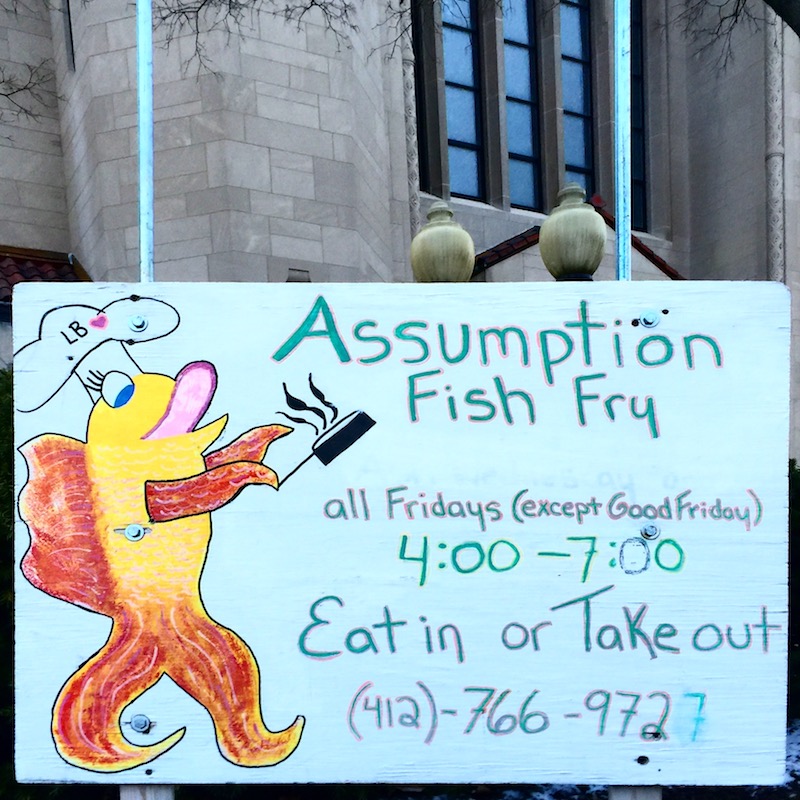
hand-made sign for fish fry, Church of the Assumption, Bellevue, PA

Of course, fish fry-hosting churches do a lot of their fundraising during the six Fridays of Lent and we see evidence of Churches consolidating and closing all the time. So in an era when the larger populace would no longer be described as “god-fearing” it’s an understandable economic necessity that churches need to relax some of the old-world doctrine and bring in some pew-filling carbohydrates.
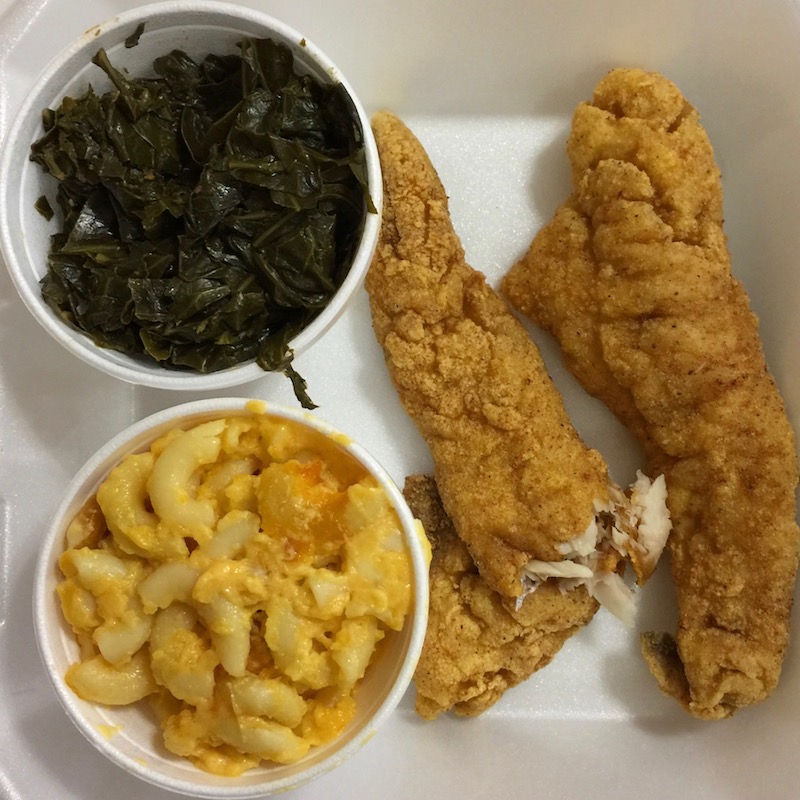
catfish dinner from New Jerusalem Holiness Church, Pittsburgh, PA

Week 2: Even non-Catholics get into it! New Jerusalem Holiness Church, Larimer

Still, to stray so wildly from the original “reason for the season” (to borrow from another highly mutated Christian tradition) seems like a real lost opportunity–both for the church and its congregants. While it’s both bizarre and wonderful for us non-believers to look forward to Lent for its distinct church basement suppers, the tradition of voluntarily giving up something loved (or, at least, appreciated) to learn the value of sacrifice and everyday privilege seems like an extremely valuable exercise.

Maybe next year this blogger will have to give up all those fish fry calories, you know, for Lent.

fish sandwich with mac & cheese

Week 6: Harris Grill, Shadyside*


* The obvious addition of lettuce, tomato, onion, and pickle slices would only come from a restaurant offering.

An Orbit Obit: The Bloomfield Bridge Tavern

mural for Frankowski family with people holding giant pierogie, Bloomfield Bridge Tavern, Pittsburgh, PA

It takes a village to raise a pierogi. Frankowski family coat-of-arms.

This one’s personal.

Over at Orbit headquarters, we wailed into the night over the loss of Chiodo’s–it with its dusty, historic underwear hanging from the ceiling and the Mystery Sandwich haunting our dreams. We took it easy with the Casio beats and flared collars of The Casual Approach (R.I.P.) who defied gravity every weekend at Dormont’s Suburban Lounge (also R.I.P.). Letter-writing campaigns begged our congressmen to turn The Chart Room into a national monument and there should have been so many more piano sing-a-longs at Moré. The days of dollar pints and four-bit “lady drafts” at bygone Lawrenceville watering holes like Michalski’s, A.J.’s, and Salak’s feel like ancient history–but it wasn’t actually that long ago.

The loss of these iconic, convivial, rowdy barrelhouses are all just eyewash to the earthquake that music-making/beer-drinking/pierogi-eating/squirt-gun-shooting Pittsburgh felt last week. The “Polish party house in the heart of Little Italy,” has bled the grease from its deep friers, removed the ceramic stein collection, carved wooden stage bear, and pictures of the pope. They’ve powered down the spotty PA system and shooed out the last late-night booze hounds. The Bloomfield Bridge Tavern has closed forever.

gated front door for the Bloomfield Bridge Tavern, Pittsburgh, PA

Closed forever, sigh.

[Cue: shimmering soft focus and a one-two polka beat.]

The year was 1996–some time in November. Arriving from The South with its still-turning mid-fall leaves and pleasant, temperate climate, Pittsburgh was soaking in several inches of days-old dirty street slush as a steady freezing rain dripped from the unrelenting overcast gray-black sky. Needless to say, this blogger-to-be had found a new home.

By pure chance–we’re talking pre-Internet tourism here–The Bloomfield Bridge Tavern was the very first place he spent a nickel. It was on a Polish Platter, and I’m pretty sure it still cost just $5.95 at the time. Carbs are pretty cheap in The South–but they don’t come with names like golabki and kluski. Although my middle-aged metabolism can’t demolish a plate like it used to, the food was as delicious just a few weeks ago as it was all the way back in the ’90s.

plate of Polish food including pierogi, kielbasa, golabki, haluski, and kluski, Bloomfield Bridge Tavern, Pittsburgh, PA

Oh, how I will miss you. The Polish Platter (“Red”): pierogi, kielbasa, golabki, haluski, and kluski

For the next, gulp, twenty-one years the Bloomfield Bridge Tavern has been the most long-running, consistent presence in this transplant’s Pittsburgh experience. The doctor only prescribes Polish Platters a couple times a year [yes, I know: find a new doctor!] but it’s been rare to go more than a couple months without receiving an audio-visual screening from BBT’s musical stage.

Typically, these are administered by local bands. [Full disclosure: the author is sometimes playing in one of them.] But despite BBT’s tiny size, cramped quarters, and DIY show-running [bands were responsible for collecting at the door, setting up the PA system, and running their own sound], the bar has played host to amazing run of touring players too numerous to list here.

Weird Paul Rock Band performing at the Bloomfield Bridge Tavern, Pittsburgh, PA

Weird Paul Rock Band at BBT, August, 2017

You think that’d be it, right? It’s a tavern: there’s beer, bar food, and weekend rock-and-roll–what else do you need? Well, you may not need much more, but the BBT plays into a legacy of Pittsburgh culture so deep we may take years–decades, even–to dig out from the loss.

Back in the day, then-city councilman Jim Ferlo held an annual Pittsburgh Marathon party in BBT’s side parking lot, complete with polka bands, a hot dog buffet, and cold beer. A highlight of the event was seeing exhausted runners, just hitting “the wall” at the marathon’s 23-mile point, veer straight off Liberty Avenue and plunge into the soft welcoming foam of a free Iron City Beer. Every local politician made it a point to stop by the BBT’s temporary parking lot stage to dole out cash “prizes” for things like “best dancer” and “cutest puppy”. Across the street, Foodland’s electronic weekly specials sign would be programmed to read the jingoist message Go runners. Beat Kenyans.

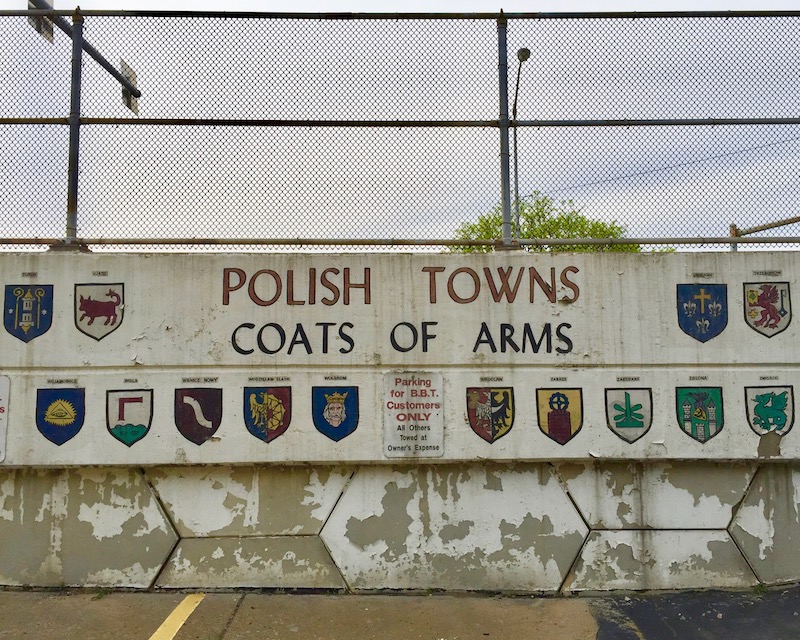
mural of Polish towns coats of arms painted on parking lot wall, Bloomfield Bridge Tavern, Pittsburgh, PA

Polish towns coats of arms, BBT parking lot

And then there are those murals. Dozens–maybe a hundred–different coats-of-arms of Polish towns you’ve probably never heard of. Crests with identifying names like Głowno, Szczecin, Gryfów Ślaski, and Żywiec ring the inside of BBT’s short concrete parking lot wall and come decorated in all manner of old world imagery–castles, bulls, red stags, and green griffins; kings, knights, mermaids, the sun & plow.

It’s gone now, but an earlier generation will forever associate the exterior of the bar with both the wonderful potted-flower Bloomfield mural/sign and [BBT founder/patriarch] Stan Frankowski’s wall-sized polemics attacking local politicians, anti-union foes, and corporate corruption. After Stan’s passing in 2005, his sons Steve and Karl took over the business. They kept up all the other traditions–including the annual day-after-Easter Dyngus Day party–but toned-down the see-it-from-the-suburbs politics. The updated red-and-white paint job, side screened porch/smoker’s lounge, and Polish falcons still look great.

coats of arms for Rodom and Radlin painted as murals on parking lot wall, Bloomfield Bridge Tavern, Pittsburgh, PA

Coats-of-arms from Rodom and Radlin

I didn’t make it out to the final night at the BBT–the body just wouldn’t let me. Luckily, Mike Shanley gave us all a pretty good scene report plus a slew of his own reminiscences in this week’s City Paper.

That said, news began to circulate about the (then-future) closing of the bar back in the late winter, so 2017 became a kind-of year-long living goodbye to venue. I played a last show there, saw a (different) last show there, and yes, ate a last Polish Platter. For the piece on his recent book of poetry, we interviewed Scott Silsbe over Strawb ambers in BBT’s breezy side porch on a lovely day in May.

mirrored wall behind the bar and patrons at Bloomfield Bridge Tavern, Pittsburgh, PA

BBT near the end: bevelled mirror bar, blood red ceiling, and big cats on TV.

As much as I’ll personally miss the place, I don’t fault the Frankowski brothers one bit for the decision to move on. Running a bar has got to be really tough work full of long, late hours dealing with no small amount of jerks, deadbeats, drunkards, and bodily fluids. Hats off to anyone who can put up with all that and still keep smiles on their faces the way Stan, Steve, Karl, and Sheila always did.

The Orbit certainly hopes the Frankowskis find a good new owner for the building and business so they can finally relax on the weekends without the sound of electric guitars ringing in their ears. Hopefully, the next tenants at 4412 Liberty Ave. will understand the legacy and history they’re dealing with–maybe they’ll even keep up the outside murals.

exterior of Bloomfield Bridge Tavern with Polish red and white flag and logo, Pittsburgh, PA

Hallowed ground. Bloomfield Bridge Tavern.

A final note. “New” Pittsburgh: if you’re out there listening and planning the next local, organic, hop-infused culinary venture, please–sweet Jesus–consider adding a Polish Platter to the menu. I’m sure I won’t be the only one pining for the taste and willing to pony up every chance I get–at least as much as the doctor allows.

metal window cover painted with message "The worst form of failure is the failure to try.", Bloomfield Bridge Tavern, Pittsburgh, PA

Hold the Cheese: A Pi Day Salute to Ghost Pizza

neon sign reading "IZZA" (the letter "P" is burnt out), Natrona Heights, PA

unknown, Natrona Heights

What’s not to like? Fresh-baked bread–right out of the oven–some kind of sauce, a lake of molten cheese. There are umpteen different things you can throw on top for more flavor–and each one has its defenders and cynics–but these are almost superfluous. Pizza–Hot, Fresh, & Delicious, as if the standard-issue paperboard box needed to remind us of it–is (unofficially) America’s national dish[1].

Pizzerias are a classic formula that’s never needed to be updated–order a single cut for a quick lunch or a whole pie for a group dinner. They get dressed-up in fancy toppings and elaborate food narratives one day, but it still tastes great as greasy street food the next. Pizza places are future-proof: utilitarian as gas stations and lusty as saloons. No one wants Internet pizza.

All that said, not every pizza joint is going to have the long-term endurance of Beto’s or P&M. So on this Pi Day, we celebrate some of the fallen soldiers on pizza’s long campaign to win the hearts, minds, waistlines, and cholesterol counts of America. Buon appetito!

hand-painted sign for Venice Pizza on cinderblock wall, covered in vines, Pittsburgh, PA

Venice Pizza I, Lawrenceville

cinderblock wall with mural for former Venice Pizza & Pasta, Pittsburgh, PA

Venice Pizza II, Lawrenceville[2]

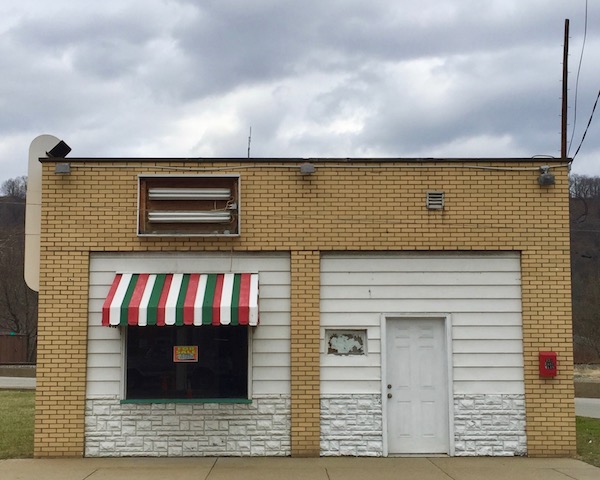
Brick commercial building with green, white, and red storefront, Clairton, PA

unknown[3], Clairton

glass storefront windows painted with the name of DeSalla's Pizza and running pizza delivery man, Pittsburgh, PA

DeSalla’s, Allentown[4]

rear of commercial building with hand-painted sign reading "Astro Pizza", Pittsburgh, PA

Astro Pizza, East Liberty

freestanding brick restaurant with Italian red, green, and white awning and "For Sale" sign, Monongahela, PA

unknown[3], Monongahela

empty glass storefront with the word "Pizza" on glass, Pittsburgh, PA

Potenza Pizza & Pasta, North Oakland

glass storefront window with hand painted image of a bear eating pizza, Pittsburgh, PA

Pizza Bear, DeSalla’s, Allentown


[1] The United States has no official “national dish”. The obvious rivals for this title–hamburgers, hot dogs, apple pie, and the like–could make strong counter-arguments, but this blogger thinks you’re fooling yourself if you buy them.
[2] That’s Amore pizza now occupies this building, but the obvious paint-over of the Venice name still qualifies the original tenant as ghost pizza.
[3] We can’t be sure the storefronts in Clairton and Monongahela were pizzerias, but the tell-tale green/white/red color scheme suggests they were either that or more full-on Italian restaurants.
[4] An Orbit reader from Allentown informs us that “DeSalla’s is not closed!” That may be true, but it sure looked like it the day we were there and they’ve got a prominent For Sale sign in the window, which suggests it won’t be long either way.

The Pizza Chase: P&M Pizza, Arnold

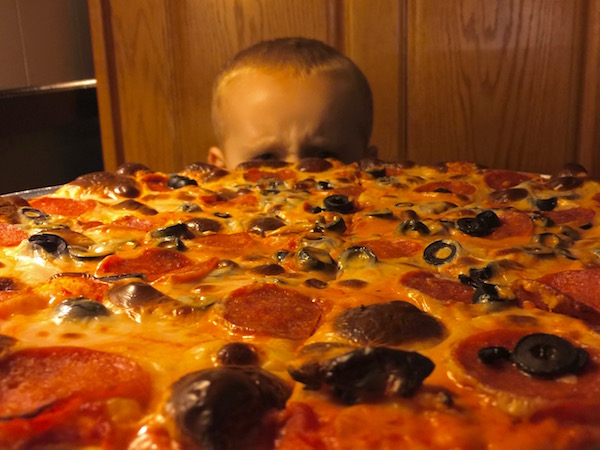
child's head seen over a large pepperoni and olive pizza, P&M Pizza, Arnold, PA

Sunrise over Lake Cheese d’Orange. P&M Pizza, Arnold

American cheese. Have wars been fought for less? Probably. At least…maybe.

As far as we can determine, the story goes like this: The original P&M Pizza goes back to 1947 in Arnold. Owners Lefty and Mooney Martz ran the place for over fifty years before finally selling and retiring in the late 1990s[1]. During that half-century, P&M became a landmark to locals with its unique pizza, distinctive in both crust and cheese blend (we’ll get to these).

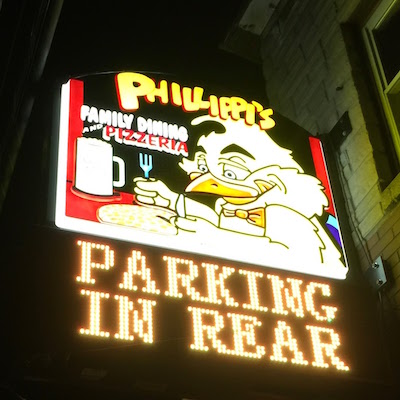
At some point during the end of their run, the Martz’ trademark recipe was sold and is now reproduced across the river at Phillippi’s Family Dining and Pizzeria in Natrona Heights. Phillippi’s has rebranded both the pizza style and the restaurant, now calling itself the “Home of the Birdville Pie.”[2] 

In the meantime, P&M was re-opened in the late aughts in the very same 5th Avenue building the Martz’ called home for half a century. The new owners–a pair of Arnold natives–now claim to serve “The Original P&M Pizza” and they clearly want to take back the glory of what they believe is rightfully theirs. P&M’s web site features the crossed-out image of Phillippi’s cartoon pizza-eating chicken aside the text Leave it for the birds! P&M will also accept your (Phillippi’s) “Birdville Pie” coupons.

whole pepperoni and black olive pizza from above, P&M Pizza, Arnold, PA

P&M pizza

Whose pizza is really the most original? We have no idea. Sadly, we never got the chance to have a P&M pie cooked up by the Martzes. The Internet seems, as Internets do, both divided and unreliably-sourced on the topic. Technology-savvy Orbit readers can seek out opinions of each on their own, but suffice to say there are many reviews for both restaurants that include the cliché “you either love it or hate it” as well as the predictable accusations of “NOT the original…”

Regardless of how exact either P&M or Phillippi’s recreates the Martz’ formula, it’s clear they’re both working from a similar set of blueprints. As Zomato user Akvalleyfoodman–a self-proclaimed “expert” who’s “eaten (original P&M’s) thousands and thousands of times” since the mid-60s–says (of P&M), they’re “in the same zip code.”[3]

Coming late to the party, we’re just glad that there are two different establishments carrying the torch for micro-crust ambiguously-cheesed bar pizza located within minutes drive of each other. The Martz’ legacy–however approximate it may be–is alive and well.

child holding nose as a piece of P&M pizza is offered to him

P&M pizza: it’s not for everyone

So how do the two pies stack up? It’s been almost a year since The Orbit checked in at Phillippi’s, so we’re running on pizza fumes here. That said, we can attest that the two pies are very similar–at least, to tastebuds from outside the Alle-Kiski Valley.

Both are built on exceptionally thin crusts. In the previous report, we stated that Phillippi’s is “as wafer-thin as this eater has ever experienced.” Well, that may have been true last year, but P&M’s crust makes Phillippi’s look like deep dish. The crust is so thin that the cornmeal used to keep the dough from sticking to the oven becomes a major factor in the flavor. A pita looks thick by comparison. Heck, a Triscuit would need to get planed down to be this thin. [Carb-conscious dieters take note: P&M is a place you can get the thrill of hot, delicious pizza and barely consume any bread at all.]

The other thing that makes both places seem incomprehensible to all who didn’t grow up in greater New Kensington is the “proprietary cheese blend”. It’s electric orange and obviously contains some high percentage of American “cheese.” Now, we can get all snobby about our fromage, but gosh darnit if it didn’t taste absolutely gooey-great in the combination that P&M cooked up. Just editing the included photos is making this blogger hungry all over again.

one slice of pizza on a paper plate, P&M Pizza, Arnold, PA

Wafer thin and golden orange: a single cut of P&M pizza.

So which pizza gets the Orbit nod–P&M’s “original” vs. Phillippi’s “Birdville Pie”? We don’t want to disparage either establishment and it’s safe to say the two pizzas have a lot more in common than not. It’s also fair that both are definitely “acquired tastes” that you may have had to ingest in the womb to truly love. Curious outsiders: you’ve been warned.

All that said, in our very unscientific experience, The Orbit‘s guests at Phillippi’s declared that while it was an interesting experience, they didn’t really ever need to have another Birdville Pie. I couldn’t talk any of the bunch into trying their cross-river rival for comparison. The same was not true at P&M, where the entire table (O.K. just two adults and one narrowly-converted youth) was ready to go back for more the next day. Advantage: P&M.

front window of P&M Pizza, Inc., Arnold, PA

Check out The Orbit‘s first half on this two-part Pizza Chase story: Phillippi’s, Home of the “Birdville Pie”.


[1] “P&M Pizza in Arnold delivers the classic goods”, 10 April, 2014, TribLive.com,
http://triblive.com/aande/diningout/3761321-74/pizza-mckinley-phil
[2] Phillippi’s Family Restaurant and Pizzeria http://phillippis.com/
[3] Zomato: P&M Pizza House, user reviews https://www.zomato.com/pittsburgh/p-m-pizza-house-arnold/reviews

On the Trail of the Wild Pawpaw, Part 2: Pickin’ Up Pawpaws

eight smaller pawpaw fruits in a white hat on wooden table

Hatful of holler. The first score.

First: a warning. One should not purchase tickets on the pawpaw express without knowing what she or he is getting into. When you opt to “ride the lightning”, you’re hopping on the front seat of an emotional and physical roller-coaster that won’t be slowing down until it’s thrown–nay, broken–all who boarded with anything less than total commitment.
Be prepared to give it all up. Relationship? Over. Career? Gone. That itchy skin? It’s not going away. Don’t bother paying the rent–you’ll be sleeping in your car most nights, anyway. Friends, family, loved-ones? Kiss them all goodbye–they’ll not be seeing you any time soon. When, or if, you reconnect, the vacant look in your eyes will tell them you’re never really coming back.

pawpaw fruit hanging in tree, Pittsburgh, PA

All that glitters. Nearly-ripe fruit sing their siren song, Squirrel Hill.

Andrew Moore is one hard dude to get an interview with…at least, this time of year. You can’t fault him, though–the author’s late summer schedule is solidly packed. Readings and signings at bookstores in Charleston and Brooklyn; judging the Best Pawpaw Contest and presenting at the Ohio Pawpaw Festival; fruit sampling with customers at the Erie Whole Foods; a talk at the nature club in Sewickley…and that’s just a couple weeks worth.

All that, and Moore still made time for Pittsburgh Orbit, right at the mid-September peak of pawpaw season. We knew we may never have this chance again, so we hit him with the big guns right away: Have you ever been bonked in the head by a falling pawpaw? (It could happen!)

As luck would have it, in the last six years of researching, writing, and extensively traveling the pawpaw belt–Ohio to Louisiana, Virginia to Kansas–a fruit-to-cranium collision has never occurred. Moore took this in stride, as did questions about his wife’s tolerance for that demon pawpaw and the amount of refrigerator space devoted to gestating seeds. [Answers: very much, he loves her a lot; and about the size and volume of a shoe box, respectively.]

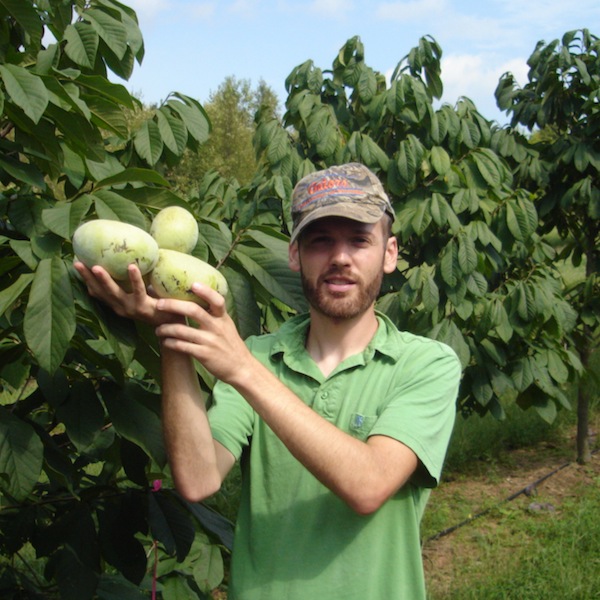
Author Andrew Moore holding three huge pawpaw fruits in a pawpaw orchard

Andrew Moore with the enormous pawpaws of Deep Run Orchard, Maryland [photo courtesy of Moore]

The Orbit consumed Moore’s 2015 book Pawpaw: In Search of America’s Forgotten Fruit (Chelsea Green Publishing) with a gastro-bibliological gusto that invoked what we can only call Pawpaw Fever. It is the definitive work on the subject and as such, Moore has created an elegantly-constructed and fascinating journey through a (literal) landscape both seemingly prosaic (pawpaws grow wild over most of the eastern half of the U.S.–they’re not rare) and at the same time otherworldly (an ancient fruit, re-arriving out of nowhere, with a narrative gift-wrapped for locavores and foodies alike).

Pawpaw contains a couple broad theses that ring long and loud after the last page is turned: the pawpaw as neglected super food that rightfully deserves to be back in markets, lunch bags, and restaurant menus, and the mystery of how this once-ubiquitous early autumn staple that colors so much American history managed to disappear almost entirely from the nation’s collective consciousness. It’s a great read and, needless to say, the book is Orbit-recommended.

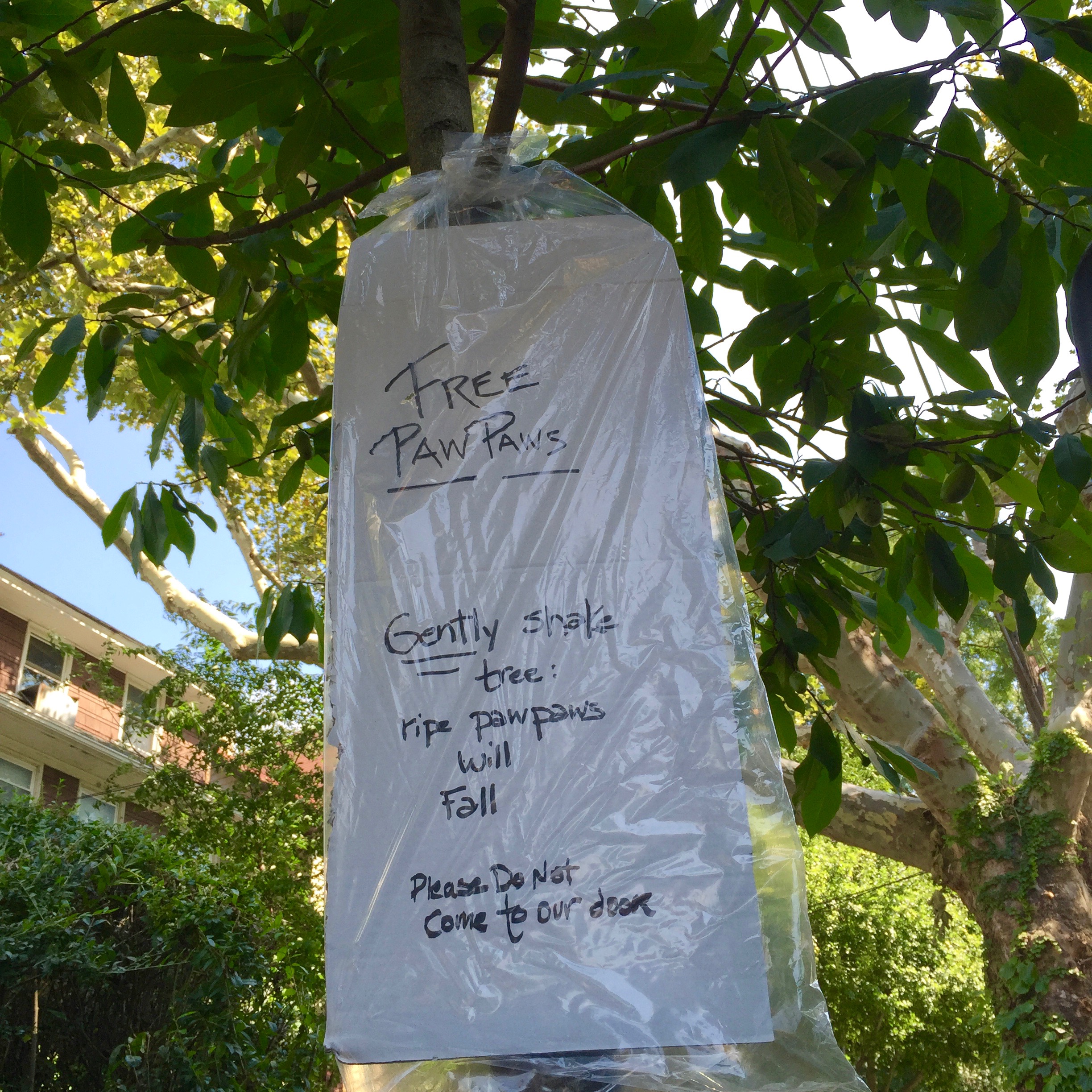
pawpaw tree with sign for free use

The giving pawpaw tree of Squirrel Hill

When last we left our blogger, he was deep in the heart of the Schenley Park pawpaw patch, considering an uncertain fruiture (that’s a future in fruit). The pawpaws dangled tantalizingly in all directions, but like Coleridge’s ancient mariner, there was nary an “Indiana banana”–not to mention pawpaw, paw paw, paw-paw, or papaw*–to eat.

Why? Well, one of the pawpaw’s challenges is that it may only be gathered (either shaken from the tree or collected from the forest floor) when ripe. Unlike, say, a tomato or a banana, the hard pawpaw prematurely selected from the tree will never ripen. That’s no big deal out in the wild, but in the very limited supply and unmet demand within metro Pittsburgh, it’s a real crime to prematurely pick the fruit or overzealously shake the tree.

The hunt was on. We got to the, uh, low-hanging fruit (sorry) first–Schenley Park’s pawpaw patch and the magical pawpaw trees of Squirrel Hill. Moore praises the latter: “God bless [the homeowner/planter] for introducing so many of us to our first pawpaw.” This blogger is no expert, but he’s been around the pawpaw patch enough to realize that while a great entry point, these are chump change, amateur hour, gateway drugs. Both sets of trees are well-known and well-traveled destinations at this point, and as such they’ve been over-shaken, abused, ravaged, and the fruit is rarely given the chance to ripen sufficiently.

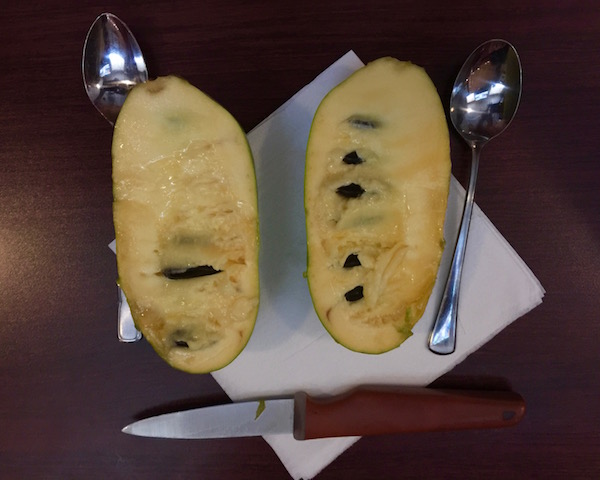
A large pawpaw cut in half with spoons and a knife

Giant pawpaw, halved.

So…blah blah blah, but what do they actually taste like? Well, I’ll tell you: they’re freakin’ delicious! The blanket description of “tropical” is safe, and banana is clearly the closest common fruit flavor profile. Some of the fruit we found was darker in color (more orange than yellow inside) and absolutely tasted and felt like caramel custard.

One other detail we never saw mentioned is that the pawpaw is really fun to eat. You slice it in half, eat it with a spoon, sorting tasty pulp from the large seeds in your mouth. They’re really unique–like a small dessert right there in every fruit.

So, our early goal of uncovering free public pawpaws right in the city gets mixed marks. We did indeed taste the fruit of several different trees, but weren’t able to uncover any real surprises. The chase is still on, though. As Moore tells it, the trees give themselves up in October, flashing a bright yellow where others go all dropping leaves and fall colors. The dedicated hunter marks her prey and bides his time for the oncoming season. Until then, The Orbit will be out there, cruising the trails…watching.
potted pawpaw tree, Frick Park, Pittsburgh, PA

Future fruit. Potted pawpaw at Frick Environmental Center, likely destined for their “From Slavery to Freedom” garden project.

Conclusions:

The bad news: According to Moore, there just aren’t that many publicly-available patches in city limits to get your paws on pawpaws…right now. It’s not a case of us not looking close enough–they just aren’t there. Between the amount of city build-up we’ve had, 150 years of heavy industry, and that damned knotweed, whatever wild pawpaw may have hugged the rivers pre-industrialization likely didn’t survive the steel industry, et al. What is here now was almost surely planted very consciously.

The good news: There is no lack of American pawpaw, even very close to Pittsburgh. As Moore says, “This is not an endangered species…you see it everywhere, especially starting right around the Mason-Dixon line** (and south)”. The Orbit finally got its first big score from a set of trees in the North Hills and realized very quickly how fast you can fill a big bag and why one probably shouldn’t eat eight pawpaws in twelve hours.

Further, Moore paints a portrait of an exciting future for Pittsburgh pawpaw. The fruit is either “having its moment” or “coming back”, depending on how you look at it. [Moore’s book is clearly a not-insignificant factor in this.] Pawpaw is on the cultural radar now like it hasn’t been for several generations and the number of city projects in parks, schools, and community gardens–not to mention all the private growers adding a couple trees to their yards–is huge. According to Moore, in five or ten years there will be more city pawpaw trees than you can shake a stick at…or, you know, just shake the fruit out of.

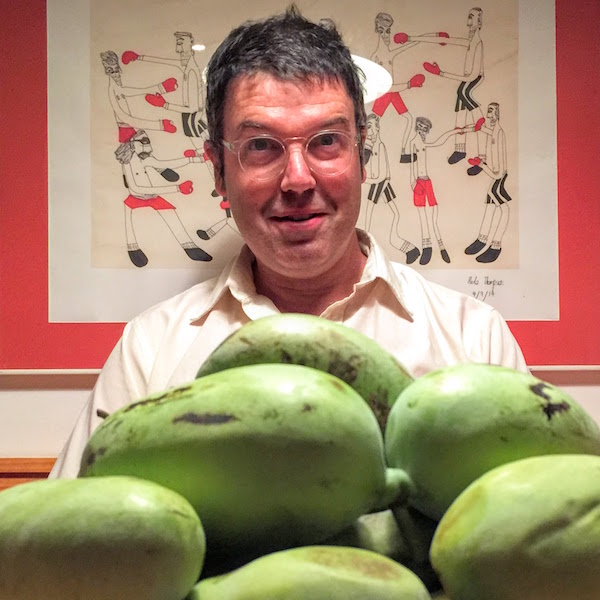
Man seated at table with a large pile of pawpaws.

Driven to madness. The author, with pawpaws.


Pittsburgh Orbit has accepted Moore’s spelling pawpaw (one word), but paw paw (two) seems to appear even more often “in the wild”.
** Basically, the Pennsylvania-Maryland/West Virginia border.

On the Trail of the Wild Pawpaw, Part 1: Way Down Yonder

hillside and trees overgrown with knotweed, Pittsburgh, PA

Panther Hollow hillside. Do pawpaws live here?

This blogger has it bad. Pawpaw fever, that is. The old scout song makes gathering pawpaws sound so easy. Pickin’ up pawpaws, put ’em in your basket…way down yonder in the pawpaw patch. Nothing to it, right? Just head down to the ol’ pawpaw patch–the damn things must be everywhere. Yeah? Well, it’s not quite that simple. 

It started so innocently, almost a year ago. A chance encounter with Andrew Moore, the pawpaw expert who literally wrote the book on “America’s forgotten fruit”[1]. In that conversation, I learned that I had just missed the 2015 season, which was frustrating, but certainly something to look forward to. That pawpaw trees (and their fruit) grow wild and plentiful in our region only made the pursuit more enticing. Could The Orbit locate publicly-accessible fruiting pawpaw trees right in the city? We set our sights on finding out.
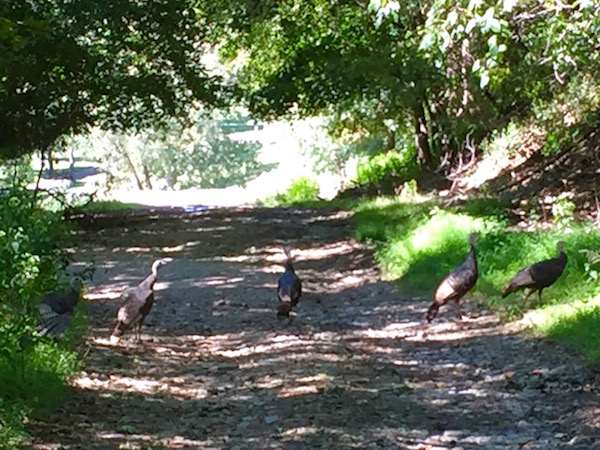
five wild turkeys crossing a gravel road, Pittsburgh, PA

Q: Why did the wild turkeys cross the road? A: We don’t know, but they didn’t find any pawpaws. Allegheny Cemetery

So I waited. Eleven long months counting down to pawpaw season[2]. I read Moore’s book, which only intensified desire. Pawpaws are among our oldest heritage foods–eaten by natives, colonists, and western explorers. The trees grow wild through a wide swath of the eastern half of the United States, but they’re amazingly foreign to most Americans.

The fruit is loaded with vitamins and minerals and is credited with treating diseases from gonorrhea to cancer. And, of course, it’s supposed to be delicious. The flavor is most often compared to something between banana and papaya, often with “caramel notes”, and a pleasing custard-like texture. Hungry yet? Yeah, me too–and you haven’t been waiting a year to get a taste!

Friends, neighbors, The Internet were all polled: Do you know any pawpaw patches in Pittsburgh? People tried to help, but like marrying a prince, or profiling serial killers, one has to sift through a lot of bunko anonymous tips to kiss the right frog.

Alley intersection with street sign marking "Pawpaw Way", Pittsburgh, PA

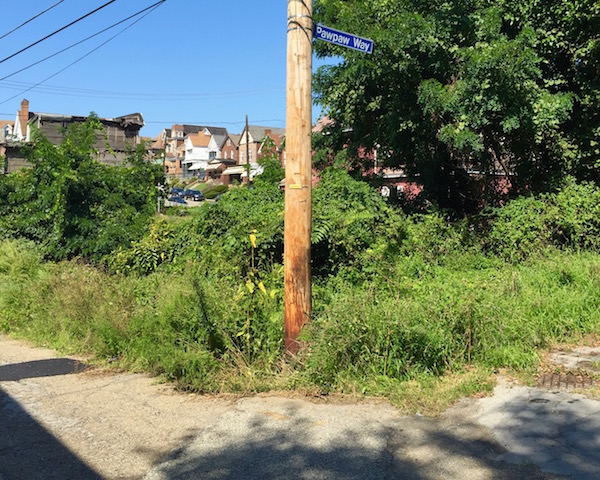
No pawpaws here. Pawpaw Way, Hazelwood.

“There’s a stand in Highland Park by the reservoir,” read the first to arrive. The search was called off before I’d left the house. “Sorry for the false alarm,” the coming-clean tipster filled-in later, “they’re actually horse chestnuts–no pawpaws here.”

Another spoke to rumored pawpaws by the Stanton Heights community garden. I climbed most of that big hill in a low gear, traipsed through the woods, and talked to an Allegheny Cemetery groundskeeper and some Saturday morning gardeners. Sadly, no one knew anything about pawpaws…or at least, no one’s talking. We did happen to cross paths with a rafter of wild turkeys[3], which seems like a decent trade-off.

A third offered pawpaws along the North Side bicycle trail, just as you get off the ramp to the Washington’s Landing bicycle/pedestrian bridge, but it wasn’t happening. There were even more vague directions for entire neighborhoods: “South Side Slopes” and “Panther Hollow” and “on the hill behind Phipps (Conservatory)” and “Frick Park, along the trails”. It’s no surprise that none of these panned-out, but people have got to be a little more specific–we’re racing against time here! Little Pawpaw Way in Hazelwood is six kinds of overgrown, but not with its namesake tree, which is nowhere to be found.

close-up of pawpaw fruits and leaves from a tree, Pittsburgh, PA

First sighting: two fruits of the pawpaw tree

So, empathetic readers will undoubtably understand what a thrill it was to finally lay eyes on the big, tropical leaves of the first pawpaw trees we actually found. There, just feet from a trail in Schenley Park, were tall, mature, big-leafed trees–much larger than I’d expected, but unmistakable after so much preparation.

A scurried hustle off the path and down into the fabled pawpaw patch. Trees–from tiny infants to mature thick-trunked giants–in every direction and continuing far back into the wood. It is glorious, cool in the near full tree cover, soothing, airy, and private.

Seeing no fruit, we began to shake the trees small enough to wrap a hand around. Ripe pawpaw fruit should fall from a shaken tree, but none did. We continued on, deeper into the understory. And then, there they were: a pair of oblong, fist-sized, and potato-shaped green fruits joined under a leaf section. Looking around, another cluster, and then another. Some of the pawpaws low enough to touch, others many feet out of reach. We were finally, unequivocally, in the right place…or were we?

Two clusters of pawpaw fruits hanging from pawpaw tree, Pittsburgh, PA

Double clusters: pawpaw pawpaw.

Will our blogger ever achieve sweet relief beneath the leaves? Does the peculiar pawpaw please the palate or merely maim the maw? And With fruit in hand, what’s the plan, man?

I’m afraid, dear reader, this blog post must end on the kind of nail-biting cliffhanger one would expect, nay, demand from a story about foraged fruit. We get to all that, however, in Part 2 of On the Trail of the Wild Pawpaw.


[1] Andrew Moore, Pawpaw: In Search of America’s Forgotten Fruit (Chelsea Green Publishing). More of Moore in Part 2.
[2] Pawpaw fruit is ripe enough to pick roughly for the month of September in western Pennsylvania’s climate zone.
[3] Yes, rafter is the term of venery for turkeys.

Muffler Man: The Cadet Cowboy

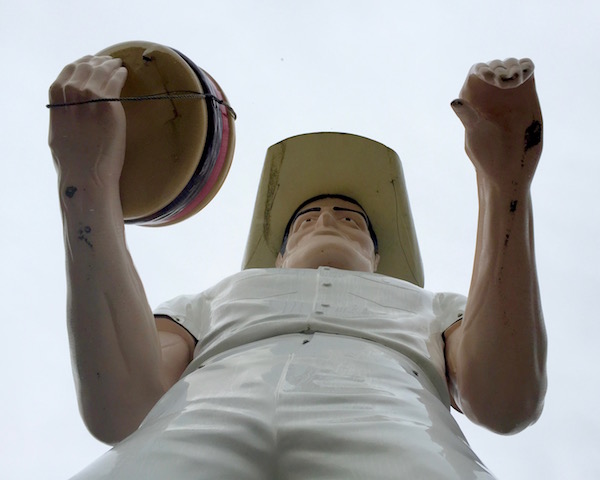
looking up at the giant fiberglass cowboy known as "Sam", Cadet Restaurant, Kittanning, PA

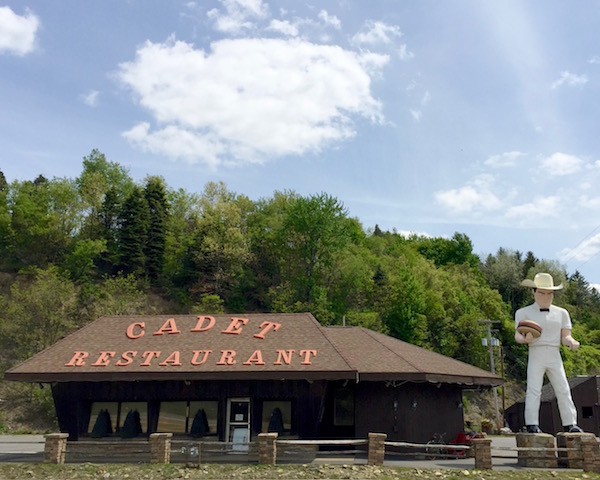
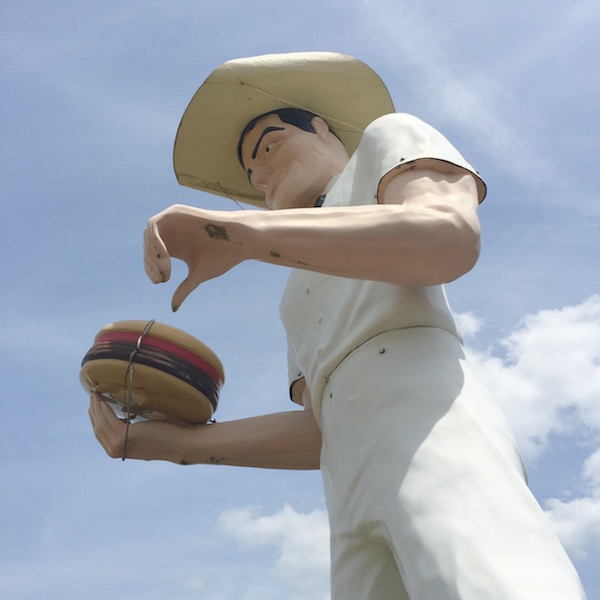
“Sam”, Cadet Restaurant’s giant hamburger-slinging cowboy/muffler man, Kittanning

He’s broad-shouldered, with a square jaw and steely gaze, and he’s bare-handing a burger the size of a doberman en route just for you. Yes, in crisp white shirt and trousers, black boots, and one enormous cowboy hat cocked just so, Big Sam, the resident burger-slinging cowboy/muffler man of The Cadet Restaurant is the waiter of your dreams…or maybe your nightmares.

At 30 feet tall (we’re taking the Cadet’s word on this–but it seems reasonable), Big Sam is, quite literally, head-and-shoulders above the peak of the Cadet Restaurant’s roof. In an era when the neighboring Sheetz signage (and every other modern highway adjunct) is visible from space, it doesn’t seem like Sam could possibly stand out from the other roadside noise. But he’s got a couple things all those other places can only dream of: class and style.

Exterior of the Cadet Restaurant with giant fiberglass cowboy holding a hamburger, Kittanning, PA

Cadet Restaurant, Kittanning

Though there’s absolutely nothing automobile-related about Big Sam (aside from the Cadet’s previous life as a drive-in) he falls into the broad category of giant “muffler men”. Roadside America has a great detailed repository of muffler man info, but the short version is that the original fiberglass mold was built in the early ’60s for a huge Paul Bunyan advertising a restaurant in Flagstaff, Arizona. The arms are positioned as so to hold the famous lumberjack’s big axe.

The same mold was repurposed over the next dozen years for generic working men, Indians, the “happy halfwit”, and, yes, cowboys. Many muffler shops took advantage of both the striking figure and the fixed hand shapes to cradle exhaust systems, hence the nickname.

Side view of giant fiberglass cowboy, Cadet Restaurant, Kittanning, PA

It may get a thumbs-down from Big Sam, but Cadet’s food is qualified to satisfy

Cadet’s history page tells us that Sam was purchased at the Chicago Restaurant Show for $3,900 in 1962 and details a great story of tragedy and redemption for the big guy:

One foggy morning on September 29, 1990, an unsuspecting Ford Bronco pulled into the path of a fully loaded coal truck traveling from Indiana. The Bronco was catapulted into Sam leaving him in shambles for years to come.

Despite many attempts, no one would take on the task of repair. We would find his hat or burger on top of a local school’s flagpole and other various locations. Luckily, we had our own team of students that were always kind enough to locate and extract the missing pieces.

It was over 12 years before our customers were able to help us finally piece him back together. Dave Bish, stepped up and asked if he could try, and try he did. What a beautiful job! He was back on his feet in 2002. It took a full day, a crane and many volunteers.

Cadet restaurant placemat advertisement proclaiming "Home of the 'Poor Boy'"

And what of the food at the Cadet? As diners go, it’s top-notch. The menu features the expected array of greasy breakfasts and burgers/sandwiches/deep-fried platters for lunch and dinner. A handmade sign on wall proclaims the “Poorboy burger” (a double patty with all the fixins) and roast beef as house specialties. This blogger’s only real quibble was a lack of Polish food on the menu [every Pittsburgh-area diner should have pierogies, haluski, and potato pancakes!]–but even Big Sam can’t provide everything.

The Orbit went all Craig Claiborne with repeat visits to the Cadet. On the way up, we had a fantastically Sam-sized blueberry pancake. It’s sort of the yin to Pamela’s crepe-style yang–thick as a book* and large as the plate, but hot, fluffy, and tasty. On the return trip, it was a thoroughly-satisfying chicken biscuit dinner for lunch with a mind-melting piece of rhubarb pie for dessert.

Needless to say, the Cadet is Orbit-approved and recommended. Stop by the next time you’re headed north and give ol’ Sam the hi-de-ho.

rear view of giant fiberglass cowboy, Cadet Restaurant, Kittanning, PA

Big Sam keeping watch over Rt. 422 outside Kittanning

Getting there: Cadet Restaurant is on Route 422-East, just off Route 28 outside Kittanning. Note: you have to awkwardly go through the next-door Sheetz to get there, but you can’t miss it.


* Thick like a paperback novel–not, you know, the dictionary.

Fish On My List: An Orbit Guide to Fish Fry Guides

Handmade wooden sign reading "Fried Fish Specials"
If the oil’s a-roilin’, we’ll be a-loiterin’

Editor’s note: This story on the various available guides to Lenten fish fries first ran in 2016, but is obviously a valuable resource every year. We’ve done our best to update links for 2025, but definitely let us know if there’s something new we’re missing, a better site, etc.


For some, it is leafing through seed catalogs. It may be freezing outside, but the simple act of dog-earing full-color pages of enticing heirloom vegetables and glorious full-bloom flowers invokes a not-too-distant future digging in the dirt, pulling weeds, and planting tight rows of zebra-striped tomatoes and black Hungarian peppers. They’ll even take the opportunity to cast lettuce seed directly in the snow–a holdover until the St. Patrick’s Day peas are sewn in the inevitable bone-chilling soil. Anything for a breath of life.

For others, it is the sound of horsehide slapping cowhide as pudgy catchers receive wayward fastballs and woe-be-gone change-ups from out-of-practice Skoal-spitting pitchers. [At least we sure hope they’re still allowed to chew tobacco before the real season begins.] Images of sun-soaked Kissimmee, Bradenton, and Jupiter transport those in bleached, bare-treed northern climes. You can almost smell the luxurious perfect green blanket.

But if you insist on knowing my bliss, I’ll tell you this. Here at The Orbit, our first gentle gust of spring blows in with the arrival of Lent and its barrage of church fund-raising Lenten dinners. These fried fish feasts are so numerous they require a comprehensive guide. As it turns out, you even need a guide just to make sense of all of the fish guides out there. That is why we’re here.

fish dinner in former St. John Vianney church, Pittsburgh, PA
Fish dinner, St. John Vianney (R.I.P.), Allentown (c. 2011)

The big fish and the O.G. in this particular roiling grease-filled pond is Pittsburgh Catholic‘s yearly fish fry list. The guide has the no-nonsense pre-Internet feel of kind parishioners dutifully volunteering their time to type out, update, and double-check their facts each February, all in the name of the Lord. It was likely the region’s first fish fry guide (?) and for this blogger, it’s still the best. [Update: gone is the old no-styling design and downloadable version.]

It was the Pittsburgh Catholic list that led us to the late, great St. John Vianney in Allentown (the church was just closed by the diocese early in 2016). St. John was not only open for Friday lunches (a rarity) but offered a spectacular dessert table where the kinds of confections you thought had been banished from this earth (Jello surprise! Pretzel salad! Pineapple upside-down cake! Dirt!) were generously spooned out by the congregants for sums in the twenty-five to fifty cent range. Maybe if they’d asked a more reasonable price, St. John would still be running Sunday services and The Orbit could be dining there this Friday. Sigh.

Window sign advertising Lenten fish fry at St. Maria Goretti Parish, Pittsburgh, PA
St. Maria Goretti Parish fish fry, Lent 2015

Each of the local “Big 3” TV news affiliates has their own guide. KDKA‘s is your basic nuts-and-bolts alphabetized (by church name) list, including the bare essential name, address, hours, and menu items. It’s the best of the lot. WPXI has improved considerably in the last couple years, now offering the same basic script that we see on other sources. It’s nothing fancy, but it’ll get you dinner on Friday night.

WTAE basically phones it in with a “guide” that simply lists names and addresses of locations that claim to have fish fries. There are no other details–no menus, no days or times of service, no bonus data. For that reason–and the bounty of other options–you can safely skip this one too.

Sadly, neither local public television station WQED nor Fox affiliate WPGH appear to make any attempts at fish fry coverage.

screen capture of Pittsburgh Post-Gazette's interactive fish fry map
The Post-Gazette’s interactive “Find a Fish Fry!” site, new in 2018

This year, the Post-Gazette has upped its ante considerably. In past, there were no detailed listings, instead focusing on a few random highlights. It was interesting if you already had a plan, but no resource for the hardcore fisherman or fisherwoman.

The new guide is a really nicely designed app that includes a lot of nice bonus info. However, with just the most casual perusal, it’s obvious the P-G still has a lot more data entry to do. [How can you possibly miss Sacred Heart on your first pass?] We’d also like to see some filtering options. It’s fine to include The Harris Grill (I guess), but please let the user skip the noise and get down to the church fries.

As far as other print-first resources, the Tribune-Review has some scattered stories with suburb-specific listings, but they’re not nearly comprehensive enough for us to bother wasting your time. Every year, it seems, the City Paper opts to sit this one out.

screen capture of Code for Pittsburgh's interactive fish fry map
Code for Pittsburgh’s interactive fish fry map

By contrast, Code for Pittsburgh’s Lenten Fish Fry Map is what the Post-Gazette‘s new tool is trying to be. The interactive web site is extremely useful if your first concern is where the fish is. Zeroing in on a particular location and selecting its pinned point gives the same basic information you get from Pittsburgh Catholic and KDKA (name, address, brief menu description). A good resource for the time- and distance-restricted and definitely preferable to the TV station listings.

Fish fry guides have gone totally Lent 2.0 with their own social media presence on the Pittsburgh Lenten Fish Fry Map FaceBook page. As one may expect, these are less comprehensive guides and more in-realtime breaking fish-related news. The latter seems to be a little more active than the former, but we’re only one week in so far, so we’ll keep tuned to see how this thing plays out.

bracket listing comparing fish fries
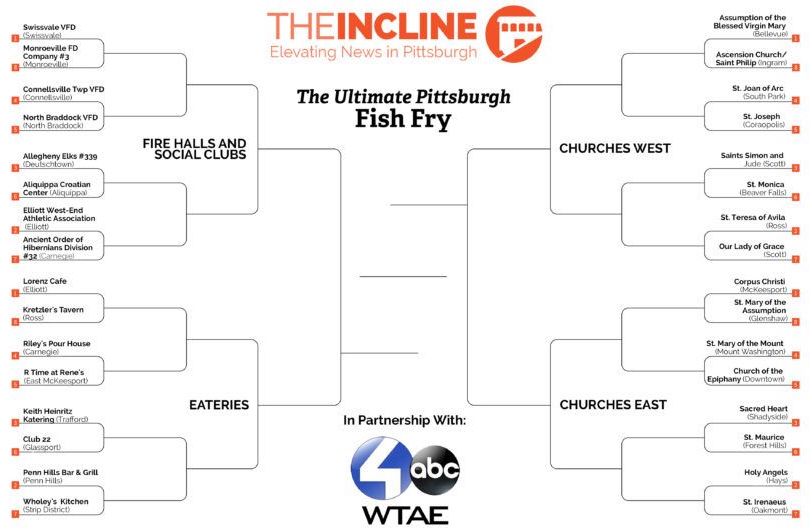
The Incline’s Ultimate Pittsburgh Fish Fry bracket

Launched last year with some amount of fanfare, The Incline’s “Ultimate Pittsburgh Fish Fry” bracket looks a lot like the office’s NCAA tournament pool, but tastes a lot better. This was obviously enough of a success in 2017 for it to come back again a year later, this time with ABC affiliate WTAE as a media partner. The Orbit is just not that competitive–nor can we realistically get to 32 fish fries this Lentbut we love the spirit behind this one. [Update: The Incline appears have gone belly-up, so links removed. Graphics persist for historical purposes.]

Lastly, we wouldn’t be reporting if we didn’t mention that there’s even a mobile phone app called PGH FF & FF. But it gets such pathetic reviews, we’ll not dignify it with a hyperlink.

hand-painted sign reading "Fish Fry Today"

The Pizza Chase: Phillippi’s, Home of the “Birdville Pie”

one slice pizza on paper plate with table setting

You could even say it glows: one cut of “Birdville Pie” (only slight color exaggeration)

American cheese, it is said, is neither American, nor cheese. Some would also have us believe that this most maligned of processed foods has no place on that other great American culinary institution, the pizza pie. Those folks, however, don’t live in Birdville, and they don’t get their pizza at Phillippi’s.

excited diners look with anticipation of their "Birdville Pie"

Excited diners can’t wait to dig in to their “Birdville Pie”

We don’t actually know for sure what that gooey stuff is on top of the Birdville Pie–Phillippi’s is famously tight-lipped about the “special blend of Birdville cheeses” they use. But between the radioactive aura it gives off and the weird molar-coating mouth feel, it’s pretty obvious that American cheese is the dominant sibling of this particular nuclear family.

The pizza at Phillippi’s has one other major distinguishing factor. The crust is as wafer-thin as this eater has ever experienced. It puts the pie clearly in the camp of a meal that eats like a snack, or an appetizer, or, as one of our party derisively put it, “like a Lunchable.” Not that anyone left hungry, it just had the overall feeling of one big (processed) cheese and cracker.

exterior of Phillippi's Family Dining and Pizzeria, Natrona Heights, PA

Phillippi’s Family Dining and Pizzeria, Home of the “Birdville Pie”, Natrona Heights

To call eating a Birdville Pie pleasurable is a stretch. The pizza is an acquired taste of the highest (or lowest) degree, but it’s clear the locals love it. The restaurant’s tag line “Home of the Birdville Pie” is printed proudly across the front awning, on every menu, and the masthead to the web site. The Birdville Pie and its sister White Birdville Pie (no sauce, but the same great cheese blend) (come to think of it, wouldn’t that make this an “orange pizza”?) (ah, heck, go with it–we’re in Birdville!) appear at the top of the restaurant’s short pizza list. We can attest that every group around us in the filled dining room was enjoying at least one the famous pizzas at their table. [Explanations for why the uninitiated baby at the next table kept screaming are pure conjecture.]

Phillippi's "Birdville Pie" with banana peppers and bacon

Phillippi’s “Birdville Pie” (here with banana peppers and bacon)

Someone at Phillippi’s really cares about local history. The walls of the Dining room are covered with great black and white photographs of Natrona Heights through the years. The restaurant’s web site has an extensive history–not of Phillippi’s (which is only mentioned in passing) or its namesake pizza pie (ditto)–but of Birdville, Pennsylvania.

This time-is-money blogger will admit he didn’t read the whole thing, (to give you a sense of scale, there are forty-two footnotes) but we can tell you it goes from Frenchman Rene Robert Cavalier de la Salle fording the Allegheny River in 1670 to Rachel Carson and Silent Spring in 1962, and just about everything along the way.

The key fact seems to be that one Richard Bird, “a carpenter born in 1851 in Shropshire, England” purchased a big chunk of what is now Natrona Heights/Harrison Township in the late 1800s. Thereafter, though never an official designation, the locals have referred to the area as “Birdville.”

sign for Phillippi's Family Dining and Pizzeria, Natrona Heights, PA

As generally happens with American cheese-related stories, this one is not without controversy. Any discussion of Phillippi’s and their unique pizza recipe would be incomplete without a mention of their cross-river rival and the authenticity of the Birdville Pie. This is something, we can assure you, that is as contested as the house of Romanov. That, however, must wait for another day, when the Orbit staff have had an opportunity to get the other side of this particular tale. As Dee Snider and the gang said so aptly, stay hungry.

[Editor’s note: we did indeed follow up with a visit to Phillippi’s “cross-river rival” in October, 2016. Check it out in The Pizza Chase: P&M Pizza, Arnold]

The Pizza Chase: Sir Pizza

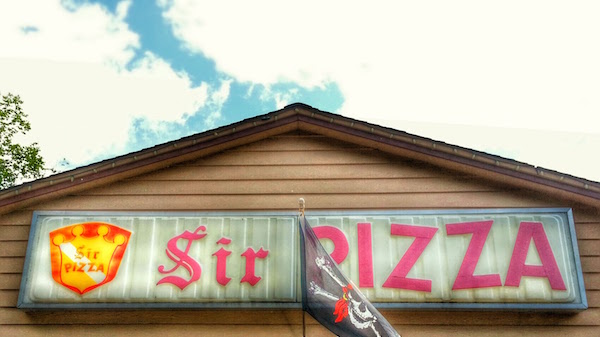
Sir Pizza storefront sign

Ross Township Camelot: Sir Pizza

“Good day, m’lord! What doth though requireth for thy after-noon repast?”

“Knave: bring forth your lordship a pair of this establishment’s esteemed ten-inch pizzas–and may they resemble the handicraft of the time-honored artisans at Totino’s in all possible ways!”

“Very good, sir! How wouldst thou prefereth to decorate thine pies and enliven thy spirit?”

“Adorn the lady’s with olives black and your finest banana peppers.”

“Of course. And for thou, sir? What extraordinary combination suits sire today?”

“Allow me to bloweth thy mind with coating true, twixt sausage and multi-colored peppers.”

“Such an extraordinary request your humble servant has never encountered! Raise the flag and open the hearth! An order from the king!”

O.K. Ordering at Sir Pizza wasn’t quite like that, but I think it’s fair to say we were treated like some demi-royalty.

Last month, when we introduced The Pizza Chase with Beto’s Pizza we made it clear we were looking for pizzerias that did things in some fundamentally different (though, not necessarily better) way. The people spoke, The Orbit followed-through, and below are our questions (if not yours) on Sir Pizza answered (and not) to the best of our ability.

Sir Pizza 10" pizza with black olives and banana peppers

Is Sir Pizza a chain?

Yes…wait: no…maybe? The Orbit‘s crack research team spent no small amount of time attempting to answer this seemingly-simple question and came to no definitive conclusion. As far as we can tell, Sir Pizza started in 1957 in Indiana as Pizza King and operated as a chain up through at least the early 1990s. From there it gets hazy.

Sir Pizza-Pittsburgh has three locations–all in the North Hills. We visited the “original,” started in 1975 in Ross Township. But a search for Sir Pizza reveals other similar shires scattered around the eastern half of the United States–two in Michigan, five in South Florida, some South Carolina chapters, an outpost each in Kentucky and Tennessee, etc.

There seems to be no central dominion to which the individual restaurants pay tribute. The marionettes appear to have cut their own strings, leaving independent fiefdoms that may or may not resemble each other, but certainly don’t acknowledge any connection publicly.

Sir Pizza crest logo

The royal crest of the Kingdom of Sir Pizza

What’s with the whole ‘Sir’ thing? Is this medieval pizza?

Another interesting ponderable with no clear answer. Sir Pizza’s commitment to the whole lords in sauce/knights of the round pie pan thing is shaky at best. There’s the calligraphic “Sir” in the signage, the crest/shield logo, and a smiling cartoony knight tipping his armored visor on the menu, but other than that you’d swear you were back in any old suburban pizza parlor in a squat New World strip mall. Black and white photos of “la familia” take up one wall and nods to various local sports teams are positioned around the dining areas. On decor alone, it could as easily be Italian Wedding Pizza, or High School Football Pizza.

close-up of Sir Pizza sausage and pepper pizza crust

“Good to the very edge”

The pizza

The only previous time this hungry blogger experienced Sir Pizza was years ago as payment for helping to move a giant 1970s-era recording console from Turtle Creek to the North Hills. “I almost died and you’re paying me with Totino’s?”, I asked. I don’t even remember if I got a beer out of the deal. [Bill: you (might) owe me a beer!] In retrospect, that assessment is a little harsh–but just a little.

The pizza is on a thin, cracker-like crust with a reasonable layer of cheese and toppings. Sir Pizza claims they use special smoked provolone instead of mozzarella, but these layman’s tastebuds couldn’t discern the difference. The meat toppings, as well as the peppers and onions, were minced into tiny morsels, which again gave it that joie de congélateur allée. The pizzas are cooked and served on cardboard discs.

Sir Pizza uses the tag line “Good to the very edge” which is a nod to the practice of running the sauce, cheese, and toppings all the way out to (and over) the pizza’s perimeter. It’s a nice gimmick, but I couldn’t help but think it’s really a mask for a completely uninteresting flat crust that wouldn’t survive on its own.

Our Pittsburgh-born Wisconsin-based correspondent Murphy informed us that all of these qualities–the cracker crust, the minced toppings, the hidden edge–are all hallmarks of a more general “midwestern pizza”.

The other great midwesterness of Sir Pizza’s product is the curious way the pie is cut. Instead of the familiar wedge-shaped diametric slices one expects, the pizza is cut on a loose grid: two cuts in one direction, three the other. But because the pizza is round, this makes every cut an awkward non-standard size. Murphy lays down the pitfalls pretty clearly:

Also and very important is the way they slice it, in little squares called “party style” though it doesn’t sound like a party to me when you have nothing solid to grab onto (like, you know, a CRUST). I would like to further note that using non-triangular cuts means that some people might get stuck with a dinky little side piece and others get a weird gloopy middle piece rather than beautifully uniform, foldable triangles.

Ouch! Ain’t no law like Murphy’s. Just like we said back in our report on Beto’s, when you bake a fresh pizza, even when it’s bad, it’s still good. That basic fact holds true at Sir Pizza. The legion of devoted “Sir-heads” who line up for the trademark pie and defend it with the zeal of South Hills’ “Betonauts” will disagree, but we’re glad they love their local(-ish) pie. The Orbit remains perplexed, but still curious. Mangia!

half-eaten Sir Pizza 10" pizza with sausage and peppers

Sir Pizza’s “party style” cuts