Muffler Man: The Cadet Cowboy

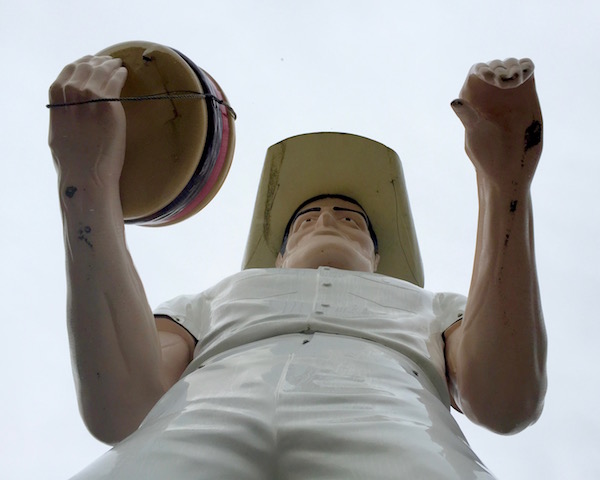
looking up at the giant fiberglass cowboy known as "Sam", Cadet Restaurant, Kittanning, PA

“Sam”, Cadet Restaurant’s giant hamburger-slinging cowboy/muffler man, Kittanning

He’s broad-shouldered, with a square jaw and steely gaze, and he’s bare-handing a burger the size of a doberman en route just for you. Yes, in crisp white shirt and trousers, black boots, and one enormous cowboy hat cocked just so, Big Sam, the resident burger-slinging cowboy/muffler man of The Cadet Restaurant is the waiter of your dreams…or maybe your nightmares.

At 30 feet tall (we’re taking the Cadet’s word on this–but it seems reasonable), Big Sam is, quite literally, head-and-shoulders above the peak of the Cadet Restaurant’s roof. In an era when the neighboring Sheetz signage (and every other modern highway adjunct) is visible from space, it doesn’t seem like Sam could possibly stand out from the other roadside noise. But he’s got a couple things all those other places can only dream of: class and style.
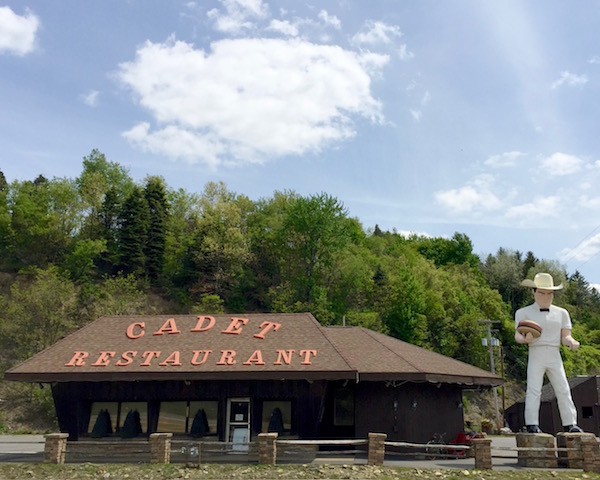
Exterior of the Cadet Restaurant with giant fiberglass cowboy holding a hamburger, Kittanning, PA

Cadet Restaurant, Kittanning

Though there’s absolutely nothing automobile-related about Big Sam (aside from the Cadet’s previous life as a drive-in) he falls into the broad category of giant “muffler men”. Roadside America has a great detailed repository of muffler man info, but the short version is that the original fiberglass mold was built in the early ’60s for a huge Paul Bunyan advertising a restaurant in Flagstaff, Arizona. The arms are positioned as so to hold the famous lumberjack’s big axe.

The same mold was repurposed over the next dozen years for generic working men, Indians, the “happy halfwit”, and, yes, cowboys. Many muffler shops took advantage of both the striking figure and the fixed hand shapes to cradle exhaust systems, hence the nickname.
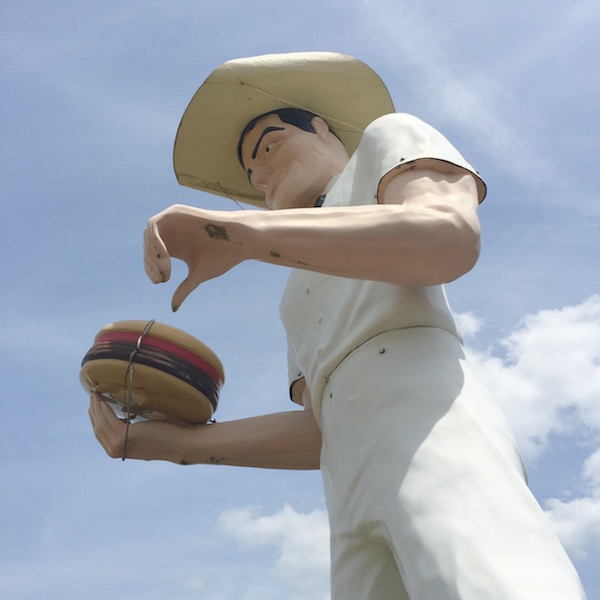
Side view of giant fiberglass cowboy, Cadet Restaurant, Kittanning, PA

It may get a thumbs-down from Big Sam, but Cadet’s food is qualified to satisfy

Cadet’s history page tells us that Sam was purchased at the Chicago Restaurant Show for $3,900 in 1962 and details a great story of tragedy and redemption for the big guy:

One foggy morning on September 29, 1990, an unsuspecting Ford Bronco pulled into the path of a fully loaded coal truck traveling from Indiana. The Bronco was catapulted into Sam leaving him in shambles for years to come.

Despite many attempts, no one would take on the task of repair. We would find his hat or burger on top of a local school’s flagpole and other various locations. Luckily, we had our own team of students that were always kind enough to locate and extract the missing pieces.

It was over 12 years before our customers were able to help us finally piece him back together. Dave Bish, stepped up and asked if he could try, and try he did. What a beautiful job! He was back on his feet in 2002. It took a full day, a crane and many volunteers.

Cadet restaurant placemat advertisement proclaiming "Home of the 'Poor Boy'"

And what of the food at the Cadet? As diners go, it’s top-notch. The menu features the expected array of greasy breakfasts and burgers/sandwiches/deep-fried platters for lunch and dinner. A handmade sign on wall proclaims the “Poorboy burger” (a double patty with all the fixins) and roast beef as house specialties. This blogger’s only real quibble was a lack of Polish food on the menu [every Pittsburgh-area diner should have pierogies, haluski, and potato pancakes!]–but even Big Sam can’t provide everything.

The Orbit went all Craig Claiborne with repeat visits to the Cadet. On the way up, we had a fantastically Sam-sized blueberry pancake. It’s sort of the yin to Pamela’s crepe-style yang–thick as a book* and large as the plate, but hot, fluffy, and tasty. On the return trip, it was a thoroughly-satisfying chicken biscuit dinner for lunch with a mind-melting piece of rhubarb pie for dessert.

Needless to say, the Cadet is Orbit-approved and recommended. Stop by the next time you’re headed north and give ol’ Sam the hi-de-ho.

rear view of giant fiberglass cowboy, Cadet Restaurant, Kittanning, PA

Big Sam keeping watch over Rt. 422 outside Kittanning

Getting there: Cadet Restaurant is on Route 422-East, just off Route 28 outside Kittanning. Note: you have to awkwardly go through the next-door Sheetz to get there, but you can’t miss it.


* Thick like a paperback novel–not, you know, the dictionary.

More Time for the Skyline

Art installation of Pittsburgh skyline as large cut-outs with black and white patterns projected on them

Spirit Lounge Pittsburgh 200th Birthday Celebration

Back in January, we posed the question is the Pittsburgh skyline that distinct? No definitive conclusion was achieved but it became clear that we’re dealing with an extremely popular subject. In only the few months since, we’ve seen new examples of the same profile appear over and over–in art, in industry, in history. Here are The Orbit’s favorites:

Spirit Lounge‘s 200th birthday party for the city was an orgy of Pittsburgh in-joke goofballery. The flashing, multi-color downtown skyline diorama looked great in all of its phases, but especially this high-contrast, two-tone number (above)–amazingly with just one building’s profiles caught on the bias. Hats off to whoever put this great display together.

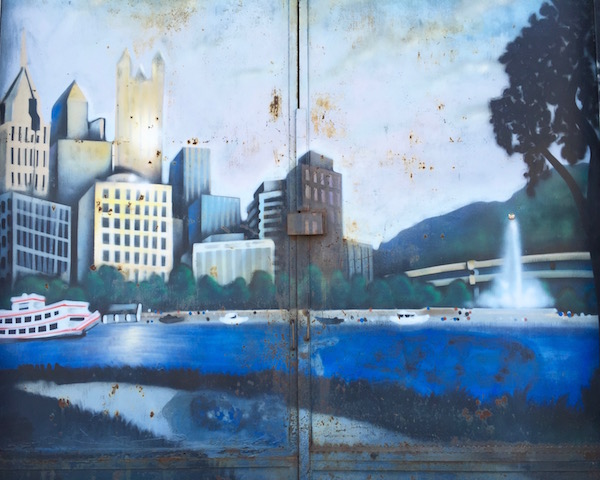
Airbrush painting of the Pittsburgh skyline seen from the North Side

Warhola Recycling, North Side

Warhola Recycling would have to include a North Sider’s view of the city. The big touch points are all there: PPG, Fifth Avenue Place, Point State Park and its fountain–even one of the party boats on the river. This mural, airbrushed on the big steel doors on the side the building, is a great example of the skyline potentially popping up just about anywhere.

fantasy skyline with various Pittsburgh elements included

Energy Innovation Center (former Connelly Technical Institute), Hill District, c. 1930

The depiction of Pittsburgh in this arched doorway mural from the old Connelly Technical Institute is terrific in a number of ways. First, it’s just very much of its time–a pseudo-realistic depiction of the city in full industrial might: a place of buildings reaching to the skies, bridges that can ford any span, industry cranking out…stuff, and glorious rolling green hills as far as the eye can see.

But it’s also a perspective that doesn’t actually exist–and never did. The painting is a fantasy view of Pittsburgh combining real-life entities (downtown’s Gulf Tower, the Panther Hollow Bridge in Oakland, steel mills, farmland) plucked out of their actual habitats and re-combined in a close-shouldered collision. It’s like a regional greatest hits album that lacks any cohesive flow, but still sells because it’s got all the good stuff people want to hear.

city skyline painted on concrete tennis practice wall, Pittsburgh, PA

Garland Parklet, East Liberty

This skyline, painted graffiti-style in a park in East Liberty, is almost so abstract that we can’t count it–it could be Anytown (O.K. any city), U.S.A. There’s no recognizable Gulf Tower or U.S. Steel Building, but the central point is arguably Fifth Avenue Place’s giant hypodermic needle. They’ve also got a generic bridge in there, though it doesn’t really look like any of the “three sisters” suspension bridges. In any case, this blogger thinks it counts. Plus, it ended up on the backstop of a tennis practice wall in East Liberty, which is a pretty neat place to turn up a city mural.

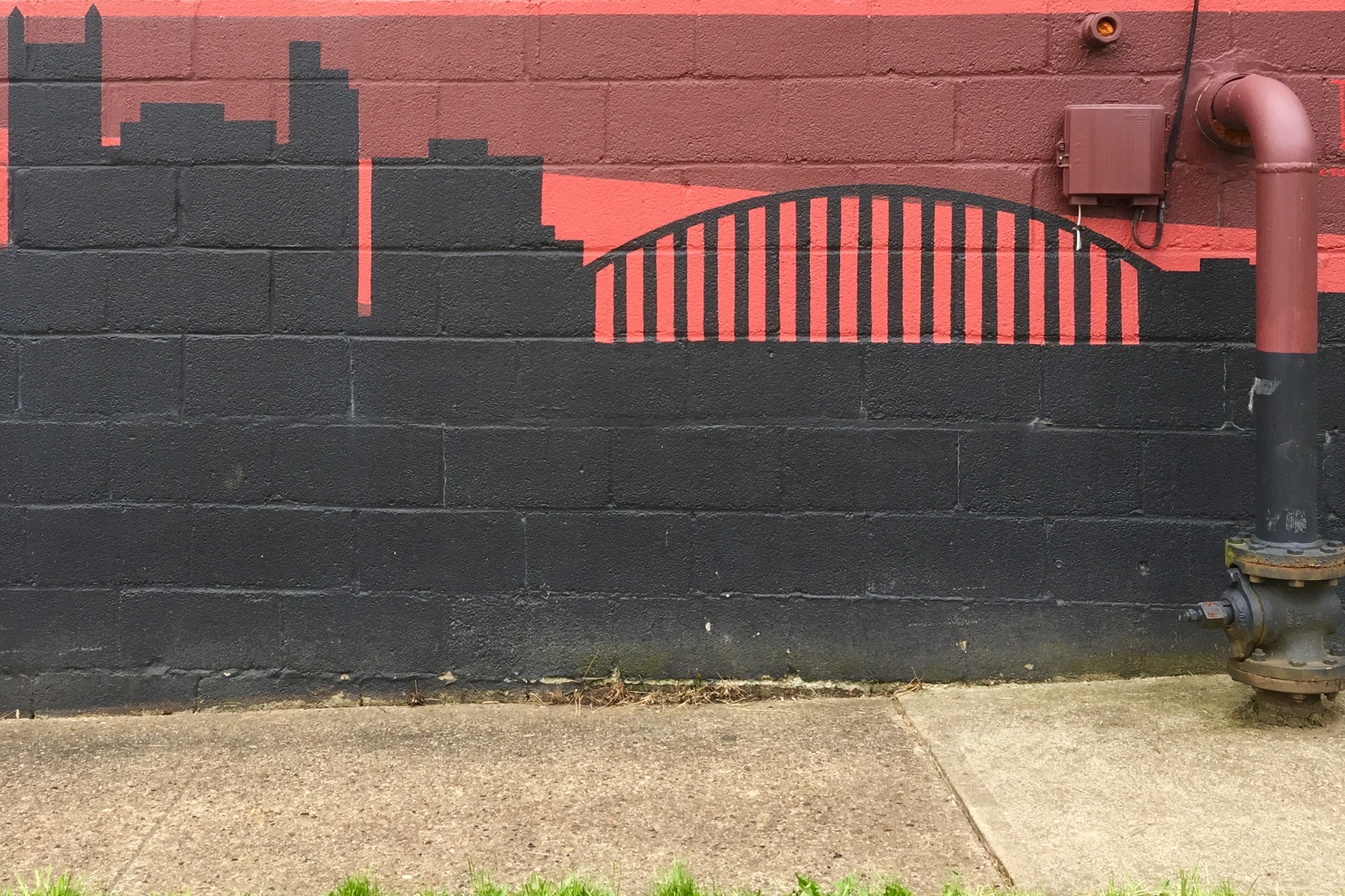
Pittsburgh skyline mural painted on cinderblock building

Red Star Ironworks, Millvale

Excuse the weird cropping here, but there was a glass block window and a competing mural to work around. The entire front of Red Star Ironworks’ Millvale workshop has been painted as a giant tribute to big dudes working with hot steel. The split pair of Pittsburgh skylines that bookend the mural are really just a decorative afterthought. But they’re still there, and you won’t have any trouble picking out the now-familiar key players.

mural on brick wall including the downtown Pittsburgh skyline

Mural, Art All Night 2016, Lawrenceville

We could have filled an entire post–maybe several–with depictions of downtown Pittsburgh entered into this year’s (or any year’s) Art All Night. But we went with the one that will go down with the ship: a mural painted directly on the brick wall of the 39th Street Arsenal Terminal building that ain’t long for this world. New condos await, right there at the foot of the 40th Street Bridge, but they’re not going to make it into this skyline.

Down Under: The Bloomfield Bridge Troll

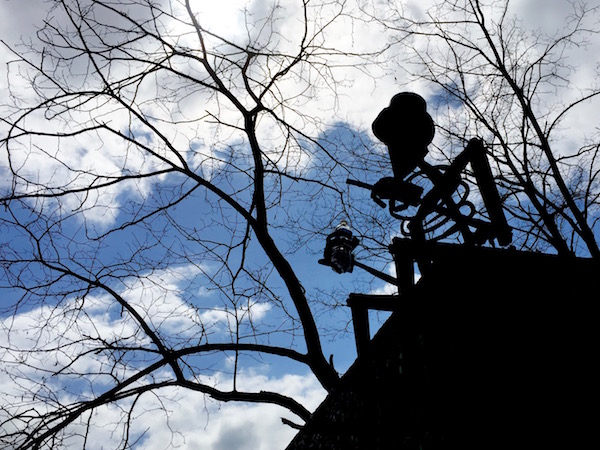
Silhouette of the Polish Hill troll, Pittsburgh, PA

Under the bridge, up in the sky. The Bloomfield Bridge Troll.

Every bridge should have a troll. Some may even deserve a couple.

It hadn’t ever occurred to this blogger that there was room for more than one of the creatures under any given bridge. That is, until he surveyed the fiefdom of The Bloomfield Bridge Troll. Down under that high span, on the steep incline of the Polish Hill side, it is obvious that there is room enough for neighboring Bloomfield to host their own troll to guard his or her side of the deep Skunk Hollow ravine in-between. The two “bridge buddies” may never even get to meet!

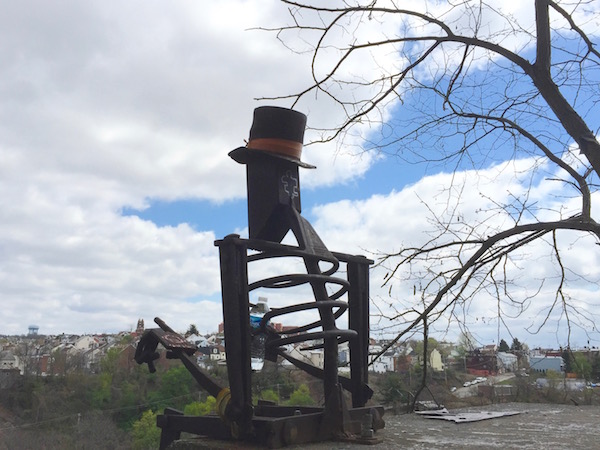
Boxy head with top hat of the Polish Hill troll, Pittsburgh, PA

Hard-headed, but well-dressed. The Bloomfield Bridge Troll in top hat.

Perhaps every bridge having its own troll is a little fanciful. Who’d want to get stuck under one of those featureless highway overpasses with a busy interstate rushing by and the only decoration being the reliable Trust Jesus graffiti? Not this bridge-under-hanger-outer, I can tell you that.

On the opposite end, consider some little footbridge over a culvert or babbling brook–no troll with any self-respect is going to hole-up in a hovel s/he can’t even stand upright in.

The Polish Hill troll and concrete support for the Bloomfield Bridge, Pittsburgh, PA

The Bloomfield Bridge Troll and concrete bridge support, decoration by paint pellets

The Bloomfield Bridge is no great architectural marvel, but its span is so long and its gulf so deep that those with a fear of heights (ahem) can get a little nauseous just looking down on the long walk over it. From the bridge deck you can see sights in all directions: tall buildings downtown, The Strip District, Lawrenceville, Bloomfield, Schenley Heights, Oakland’s Cathedral of Learning.

Under the bridge is just as interesting: there are train tracks in heavy use, the East busway, and an assortment of the old industry buildings that dot the single road, which amazingly has three names*. It’s hard to get lost in a place that’s one-way-in/one-way-out, but Skunk Hollow will do its best to accommodate.

The Polish Hill troll with Bloomfield visible in the distance, Pittsburgh, PA

A troll’s eye view of Bloomfield across Skunk Hollow

Pittsburgh famously calls itself the “City of Bridges,” with varying counts putting us at one of the top four in total quantity for the world**. Given that we have between 446 and 2000 bridges, depending on who’s counting–and how–it stands to reason that we’d have an enormous troll population.

But that doesn’t seem to be the case. Aside from the uninspired Troll’s Restaurant*** (not quite under the 31st Street Bridge on Washington’s Landing), the Bloomfield Bridge Troll is the only one this blogger has encountered thusfar.

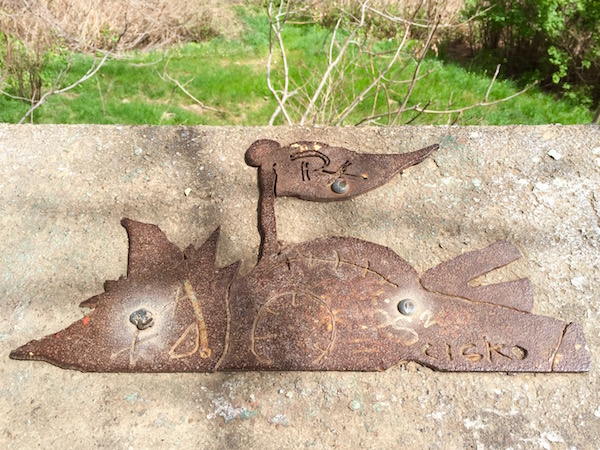
Cut out steel placard on the Polish Hill troll's concrete pedestal, Pittsburgh, PA

Prescription: Cisko. Steel placard on the troll’s pedestal.

In any case, hats off to whomever fabricated and installed the iron and/or steel Bloomfield Bridge Troll–an adjacent cut steel placard with the name “Cisko” may be a clue to that. With its jaunty chapeau, skeletal rib cage, defiant stogie, and drink-holder left hand (it was grasping a full water bottle when we visited–who says trolls only want to party?), the troll is a welcome surprise addition to always-mysterious Polish Hill.


* Lorigan Street > Neville Street > Sassafras Street.
** This is a major issue of debate among the bridge-counting set. Other cities vying for the title of most bridges include Amsterdam, Hamburg, and Venice.
*** Troll’s also has the bizarre status of being one of only a handful of dining establishments to actually take advantage of a position on one of the rivers.

Golden Babies: The Final Chapter?

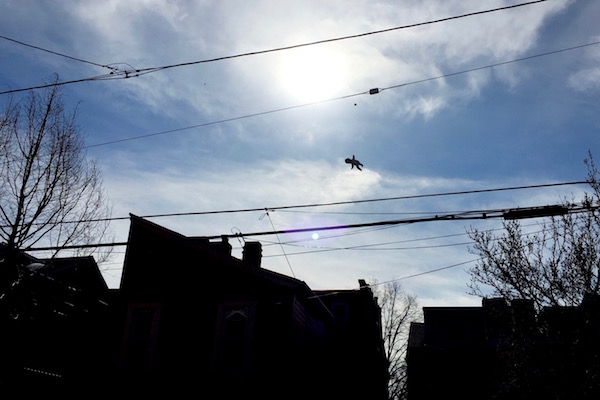
golden baby hanging from electric line, Pittsburgh, PA

Golden baby #4 (aka “Clement Baby”)

Almost as soon as this blogger’s index finger migrated January’s More Golden Babies! post from “draft” to public record even more tips on the mysterious street art/prank started rolling in. Three of them, in fact, one right after the other. Another golden baby had been spotted just off Main Street in Bloomfield/Lawrenceville, a second over on The North Side, and yet a third down in the 10th Ward on Butler Street. That last one turned out to be duplicate report of Butler Baby (golden baby #3), but, as a famous realist–and entrée–once said, two out of three ain’t bad.

silhouette of baby doll dangling from electric line over row houses, Pittsburgh, PA

Golden Baby #5 (aka “Sampsonia Baby”)

Oh, you can believe that chops were licked and hootenannies kicked into high gear to confirm these reports. Orbit readers who’ve already perused the included photographs will note that we were not let down in our pursuit.

Golden Baby #4 is (still) dangling from the electrical infrastructure on tiny Clement Way, just off Main Street, right next to The Shop and Liberty Beer. Golden Baby #5 was caught hanging loose in the Mexican War Streets on the very block where both The Mattress Factory and City of Asylum houses are. In both cases, the baby dolls seem to perfectly match their siblings: same gold paint, same white onesie, same dangle by the ankle.

The jump across the river for #5 was especially interesting as it meant our perpetrator(s) may be, you know, “city-wide,” rather than concentrated purely in the Penn and Butler stretches of the East End. How many more would there be? We’d just have to hang back, wait, and see what else turned up.

golden baby hanging from electric line over brick building, Pittsburgh, PA

Golden baby, blue sky. Clement Baby

Well…the calendar turned from February to March, we ate a bunch of fried fish and mac & cheese, and now we’re half way into April and there’s been nary a peep from any more golden babies (or their spotters). The 1-800-ORBIT-ME hotline sits silent, phone bank operators idly twiddling their well-intentioned thumbs. We can’t get a grainy cell-phone baby photo tweeted at us to save our lives. Sigh.

Is this it? Is this the way it all goes down? If so, that’s O.K.–we had a good run. I’m tempted to say, like a famous minstrel–and heartbreaker–once did, don’t do me like that. But, you know, that ain’t how it is. No, Mr. or Ms. Golden Baby dangler, you did me pretty good. Yeah, you did The Orbit pretty darn good.

golden baby, electric lines, and sky, Pittsburgh, PA

Upside-down you’re turning me. Sampsonia Baby

The Sweet’N Lowdown: Three Theories on a Street Art Secret Stash

Tiny wooden picture frame containing a Sweet'n'Low packet

Street sweets

What makes a person frame a single Sweet’N Low packet and then hide the tiny objet d’art inside the metallic drain of an Oakland office building? Strange but true, The Orbit came across exactly one such exhibit earlier this week, on the side street face of one of Pitt’s off-campus buildings. Yes: conspiracy theorists are rampant, their evidence minimal, but the desire for truth is as strong as black coffee.

Theory: The framed packet as tribute to an artificial sweetening classic

This one comes from co-worker Rizzo, present at the discovery. I always say: if you want to know about something that pretends to be sweet, look no further than Rizzo. Sweet’N Low, though not the first artificial sweetener, owned that market for half a century. That’s not so true any more. Splenda, Equal, NutraSweet, Truvia, Sweet Leaf, and probably others, are all out there crowding the field. In Rizzo’s theory, the perpetrator has created a tiny tribute to that most famous saccharin-dextrose concoction whose time has come, wolves hopped-up on Splenda gathered at the door. One would hope for the honor of being memorialized in bronze and on public display, rather than hidden in a dingy side street hidey-hole, but if you’re Sweet’N Low, I guess you take what you can get.

Brick wall with bricks missing and metal opening containing tiny picture frame

A couple missing bricks and one secret hiding place

Theory: Sweet’N Low sachet as cruel “gotcha”

What if the tiny picture frame didn’t always contain a Sweet’N Low packet? How many works of fiction have placed stolen artwork in obscure secret stashes–often hidden in plain sight. Nothing quite gets the heart racing like a great heist film–cat burglars in berets and turtlenecks spiriting stolen canvases on thrilling guy wire runs between rooftops. In the best of these, the original owner of the artwork is always shown aghast the following morning with the discovery of the disappeared oil painting replaced by a cheap, comical substitute–the thief’s ultimate “you’ve been had.” Perhaps the tiny frame once contained a pocket Picasso or a miniature Miro, its present owner having slipped in the pink packet with a wink to let you know there’s no sugar here, but you can have one of these.

Craig Hall, Carnegie-Mellon University, Pittsburgh, PA

In context: Craig Hall, home of the secret stash of tiny street art

Theory: Art scavenger hunt prize gone missing

It’s only a couple weeks past Easter, and we’ve still got egg hunts on the membrane. What if a cabal of clever art-gamers decided to stage a city-wide scavenger hunt for tiny hidden art pieces, each one identified by its common wooden frame? Maybe the Sweet’N Low portrait is just one that got away, left behind unclaimed. Somewhere out there, there’s a participant laying awake at night, replaying the one missed clue: At Craig on Craig, at the base of the leg, lies something pink, and something sweet. That’s the treasure hunt this blogger wishes he’d been invited to. Sigh. Add another one to The Orbit‘s big list.

We may never know lowdown on the Sweet’N Low, but then again, who really wants to know what’s in that pink packet anyway? The taste is good enough…isn’t it?

An Orbit Obit: Clemente Street Art

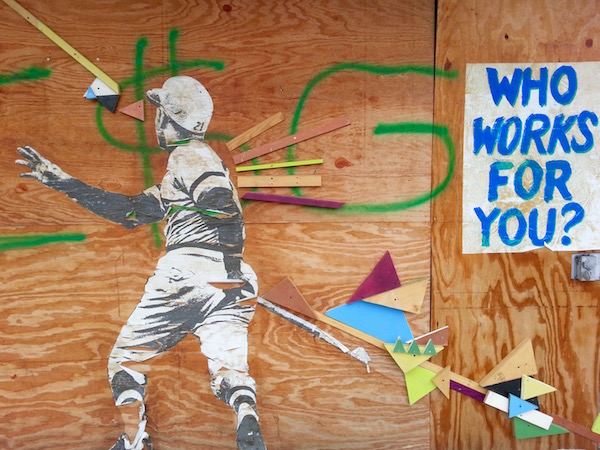
wheat paste and colored wood block street art of Roberto Clemente, Pittsburgh, PA

Wheel Emporium (detail), 2013

Today it begins. The period from now until the early dark eves of October is, for many sports fans, a restoration of when things feel right. It is a time of chin music and LOOGies, where men scratch their groins and spit sunflower seeds in concrete dugouts awash in discarded Gatorade cups. It is the season where contests are interrupted at the discretion of “managers” who summon pitchers and catchers at the mound for tense mid-game summits, runners in scoring position the imminent threat. Phrases like “O-and-two, the count,” “low and outside,” “check swing,” and “foul ball” will be repeated ad infinitum. Rivers of yellow mustard, sweet relish, and, yes, ketchup (heathens!) will adorn a non-stop parade of frankfurters. It is a time when spring’s inevitable showers send both players and spectators alike to huddle under whatever protection the park offers while radio announcers ramble on in aimless filibusters to occupy the dead air. It is baseball season.

wheat paste street art of Roberto Clemente, Pittsburgh, PA

Wheel Emporium, 2014

Wheel Emporium, a retail outlet and installation garage for what they used to call mag wheels, existed at the corner of Penn Avenue and 34th Street in Lawrenceville for years. The small shop was shuttered some time around 2012 (?) and plywood installed to protect the giant panes of glass in its showroom windows.

Though this blogger would sooner, uh, put ketchup on his hot dog than pay money for fancy auto parts, we always enjoyed passing the little shop with its big windows and array of shiny chrome. But what we liked even more was what came after Wheel Emporium closed: the terrific pair of elaborate street art tributes to Pittsburgh Pirate great Roberto Clemente.

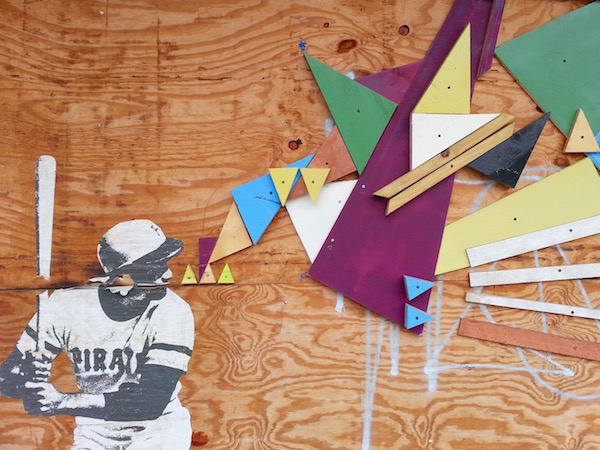
wheat paste and colored wood block street art of Roberto Clemente, Pittsburgh, PA

Wheel Emporium, 2013

A note to bloggers: always get an establishing shot! We sadly just took close-up photos of the artwork–and of course they’re now long gone*–so there’s not really a sense of how the pieces relate. For sure, though, we can say there were two nearly life-sized black-and-white enlargements of old photos wheat-pasted to Wheel Emporium’s protective plywood. In the first, Clemente is in his batting stance, left leg starting its lift in anticipation of the incoming pitch. The other–perhaps just seconds later–shows the batter watching the rocket he’s just launched sail from the park, his body twisted in the follow-through of the heavy swing. In both, the artist(s) applied shards of cut painted wood to the plywood which suggest waves of energy coming directly from Clemente.

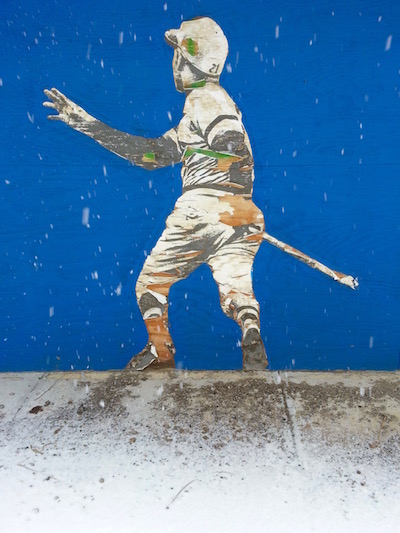
wheat paste street art of Roberto Clemente, Pittsburgh, PA

Wheel Emporium, 2014

The tale of the Clemente art took a strange turn a year later. At some point in 2014, the colored wood pieces were all removed and the rest of the exterior plywood painted over in a deep blue color. Amazingly, though, whoever did this chose to preserve the wheat pasted photos, leaving an equally-effective alternate version of the previous year’s art. In these, we see Clemente’s two-tone image really “pop” against the monochrome blue background. It would have been fantastic to re-install the wooden additions on top of the blue, which would have looked far superior to the noisy graffiti’d wood grain, but we can’t always get what we want.

wheat paste and colored wood block street art of Roberto Clemente, Pittsburgh, PA

Wheel Emporium (full), 2013

Roberto Clemente is debatably the most beloved Pittsburgh Pirate for his prowess both in the batter’s box and out in right field (which helped the team win two World Series over his eighteen year tenure) and also for his charitable efforts off the field. His life ended tragically in a plane crash Clemente was on for a humanitarian relief mission to Nicaragua in 1972. For all of these reasons, he’s certainly a fitting subject for not just his bronze statue at PNC Park, but also the street art tributes that appeared in Lawrenceville. We’d love to see more of them.

That said, The Orbit would be equally enthusiastic about seeing similar street-level honors bestowed on other Pirate greats. Imagine a stenciled and spray-painted Honus Wagner or a 3-D “Pops” Stargell constructed from recycled materials. If you don’t see the opportunities in “Big Poison” and “Little Poison” (brothers/teammates Paul and Lloyd Waner), then you’re not trying very hard. Hell, why not create a new set of Greenberg Gardens in the city’s many vacant lots? I guess we need to quit yapping about it and start…planting about it.

wheat paste street art of Roberto Clemente, Pittsburgh, PA

Strip District (current)

Addendum: We were so glad to see the tradition of Clemente wheat-pasting continue on a recent ride through the Strip District. This photo was taken just last week and shows what appears to be a relatively new photo of Clemente pasted to a vacant storefront on the 2700 block of Penn Avenue. In it, Clemente’s bat is pointed directly at the camera and he displays a look that’s both steely and also posed, perhaps stifling his characteristic smile to crack serious for the photographer.

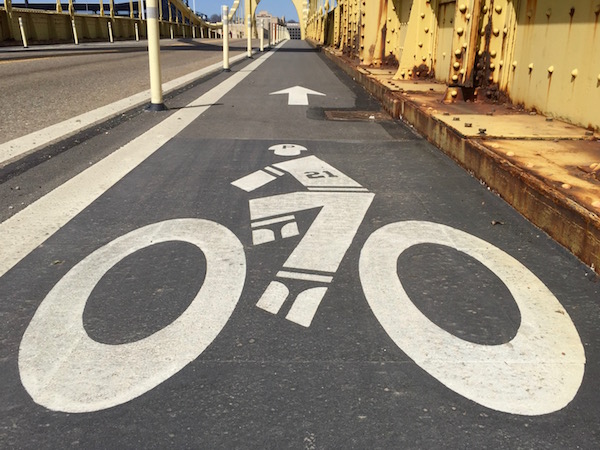
bicycle lane marker of Roberto Clemente, Pittsburgh, PA

Bicycle lane marker, Clemente Bridge

One final addition: over at The Portland Orbit, they recently ran a story called “The Beautiful People of the Bike Lane” about the terrific work of that city’s Board of Transportation to make customized, humorous bicycle lane markers. This cyclist was totally jealous and wished Pittsburgh would do something as fun and interesting. Well, it turns out that we do have at least a few these customized “bike guys.” You guessed it: they’re honoring the very same Roberto Clemente on the downtown bridge that now bears his name. It’s definitely Clemente art on the street, even if it’s not, you know, street art.


* The former Wheel Emporium was razed in 2015 and at present there’s a much larger building under construction that appears to be another combined retail/residential mixed-use space.

Street Beat: Who is the Dirty Poet?

Three of The Dirty Poet's poems taped to a light post, Pittsburgh, PA

In the wild: The Dirty Poet’s work where most people experience it

You’ve seen his work. At least, you have if you’ve loitered around any less-than-respectable tavern, coffee shop, or music venue in Pittsburgh’s East End over the last decade.

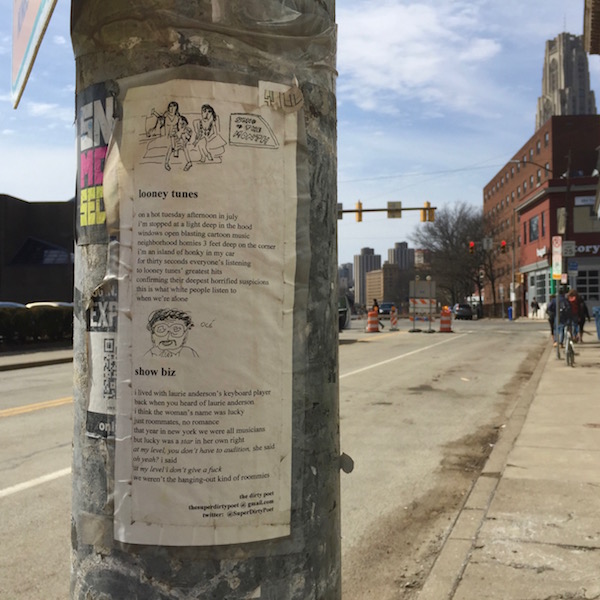
Xeroxed in small batches–usually two or three bite-sized poems at at time–cut down to vertical half pages, and taped to light poles, left on bulletin boards, and passed hand-to-hand (if you know who to talk to), The Dirty Poet is an old-school bard of the boroughs, a tale-teller of the tarmac. Like the clergyman preaching to drunkards on Skid Row, The Dirty Poet takes the mountain to Mohammed with that very deliberate pre-Internet mass communication, the flyer and handbill.

The Dirty Poet sits on a set of Pittsburgh city steps with his face hidden behind an open copy of his book

The Dirty Poet: his head is always in a book

The Dirty Poet, who spoke with Pittsburgh Orbit on condition of anonymity, claims he is the best read poet in Pittsburgh. Admittedly, this is probably not a high bar, but it would be difficult to name any competition for this title*. “People read these poems that would never read any other poetry,” says The Dirty Poet, and he’s right.

The work is taken out of the English department, out of the bookstores and coffee shop readings, hell, you don’t even have to enter a building–it’s right there on the sidewalk. One needn’t have a college degree or even a library card. [Spoiler alert: you do need to be able to read.] By taking the poems directly to the streets, taped up on light poles, it’s as populist and mass accessible as it could be. Whether he’s reaching people hungry for an unslaked thirst for verse or just bored and waiting for the bus, they’re all [OK, some of them] joining the revival in this tent.

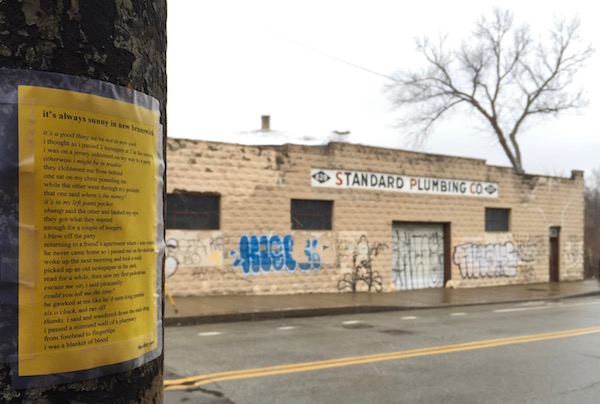
Photocopy of "It's Always Sunny in New Brunswick" by The Dirty Poet, taped to a light pole, Pittsburgh, PA

The Dirty Poet has also been at this a long time. Writing his whole life, he began the practice of pairing his Xeroxed literature with the other gig flyers, ads for weight loss studies, and rock band stickers that litter the street some fifteen years ago. That’s more time than most poets have cumulatively spent in grad school, getting rejected by literary journals, and giving up writing entirely.

In our conversation, El Dirtero spoke with obvious pride about the many chance meetings he’s had with readers as he’s plied his trade on the pavement. “Guys in their twenties come up to me and tell me they’ve been reading me since they were teenagers,” the Dirty One says, “I think I speak to a universal feeling of alienation.”

The Dirty Poet sits on a jersey barrier with the graffiti "Your vulgarity is a virtue"

The Dirty Poet: vulgar, virtuous

But what of the poetry itself? It’s loose, personal, true, vulgar, cynical, sly, smart-alecky, profane, and, yes, possibly (but not usually) dirty. It also doesn’t rhyme and it’s definitely not for everyone. “I write poetry to process my experience,” the Soapless Shakespeare tells us. Subject matter ranges from the topical (politics, gun violence, race relations) to observational (hypocrites of all faiths and isms, technology dependence, media and mass culture) to many personal anecdotes of characters and experiences throughout his life. The Great Unwashed assures us these are all true.

Three poems by The Dirty Poet taped to a light pole on Forbes Ave, Pittsburgh, PA

One final note: Pittsburgh Orbit was planning to reprint a couple of The Dirty Poet’s pieces here, but in the spirit of his work, we thought it only made sense to urge our readers to take the time, step outside, and check out the poetry where it lives, right on the streets of Pittsburgh. If you don’t see it, you’re not trying very hard. And if you don’t live around here, well, this is just one more reason to come pay us a visit**. The Dirty Poet will still be at it when you do.


* Billy Nardozzi, the “Chaucer of the Classifieds,” seems like the only legitimate competition for this title, but when you get into pay-to-play territory, the water gets muddied pretty quick.

** Those looking for a more substantial collection of The Dirty Poet’s work can find the collection Emergency Room Wrestling on Words Like Kudzu Press.

Murals of the Sewickley Speakeasy

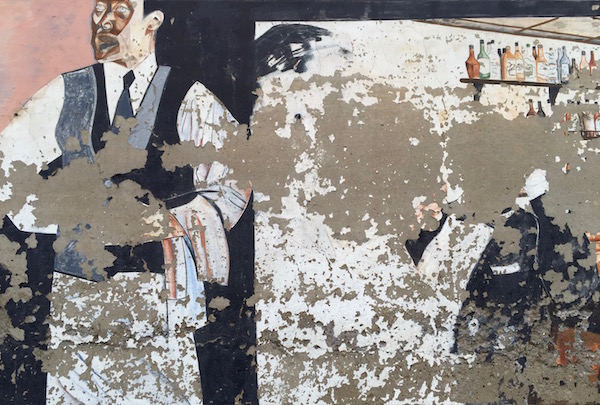
disintegrating mural from Sewickley Speakeasy, Sewickley, PA

Waiter

Nothing lasts forever, we know this. This is especially true of art, which is produced in much greater quantity than there is demand, often in fragile formats and up to extremely subjective taste and value judgement. But to have one’s canvas get dusty in the basement or torn in a move has got to be a wholly different experience than watching the slow-motion disintegration of something as large and inescapable as a giant public mural right along a major thoroughfare where passers-by literally can’t miss it.

disintegrating mural from Sewickley Speakeasy, Sewickley, PA

George Gershwin

The Murals of the Sewickley Speakeasy have a lot going against them, at least in terms of longevity. First, they’ve got to deal with an inhospitable Western Pennsylvania climate–drastic temperature fluctuations, dense humidity, snow, ice, sleet, rain, and, yes, occasional bright sunshine. Then, they’ve been painted on a retaining wall holding back a steep incline. The hillside runoff alone, leaching through the concrete, would likely separate paint from surface material in short order. Add to this the wall’s position, mere feet from busy Route 65, which must receive plenty of kicked-up salt, exhaust, and road debris.

disintegrating mural from Sewickley Speakeasy, Sewickley, PA

W.C. Fields

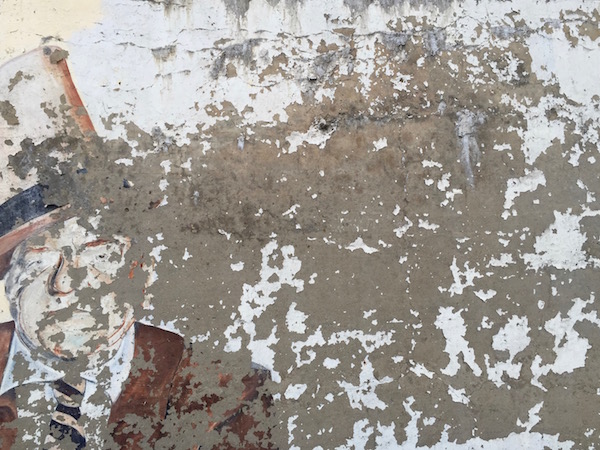
Given all that, maybe it’s no surprise the murals have weathered so severely in not even twenty years. We don’t know what they looked like when the paint was fresh, but even with an obvious nostalgia theme in mind, dollars to doughnuts they didn’t have the washed-out, sepia-toned color you’ll find today–and that’s where you can still make out an image at all. On large stretches of the seven mural sections, great amounts of the underlying paint and nearly all of the recognizable figures are gone.

disintegrating mural from Sewickley Speakeasy, Sewickley, PA

Greta Garbo

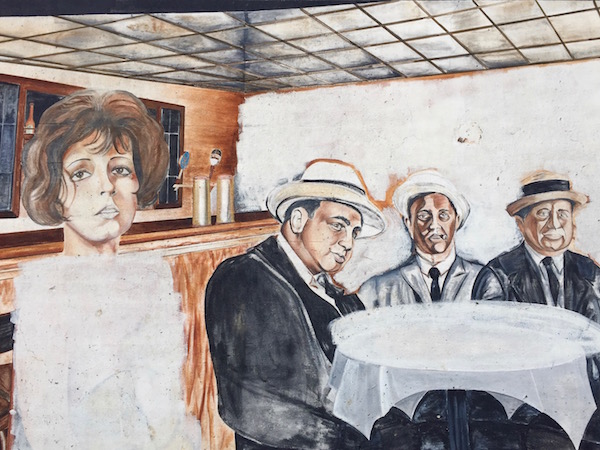
What’s left, though, is beautiful and tragic. I’m sure when the owners of the Sewickley Speakeasy commissioned these pieces they set out for an inviting, mood-setting series of vignettes to invoke not just the conviviality of any great nightspot, but certainly also the high-style/wink-and-nod underground romanticism of Jazz Age urban life–a place where some of America’s greatest musicians and movie stars mixed with politicians, bootleggers, flappers, and toe-tappers (not to mention the penciled-in family members of the bar’s owner).

Some of that still shines through the cracks, but mostly we get ghosts–fractured, fallen apart, and disappearing into clouds of base primer and bare concrete. In some cases, the remaining images are astonishing. George Gershwin, still nearly intact but soot-covered enough to look as in black face, sits at an invisible piano. W.C. Fields, with cocked top hat and great drunkard’s schnoz, is clearly identifiable against a blitzed-out snowstorm of fragmented paint chips. All smiles, Bill “Bojangles” Robinson and Pittsburgh’s-own Lena Horne still look like they’re having fun, oblivious to the dust storm blowing in fast*.

disintegrating mural from Sewickley Speakeasy, Sewickley, PA

Bill “Bojangles” Robinson, Lena Horne, piano player

The Orbit reached out to August Vernon, the artist who painted the murals back in 1999, but either he doesn’t want to talk to us or he really doesn’t check his email. From what we can tell, Vernon continues to paint large-scale murals, but now from a home base in a warmer, sunnier climate (either Florida or South Carolina–his web site lists both). The artist’s changes in latitude have likely put grimy Route 65 and the Sewickley Speakeasy murals far in his pastel-colored rearview mirror. That’s too bad, as we really wanted to know what the experience is like to see such an epic project fall into this nether state and what the outlook is like for a working artist who must confront this potential deterioration on a daily basis. We’d also love to get his memories on creating the Speakeasy murals.

At this point it seems unlikely we’ll hear from Vernon, and if so, that’s something he shares with his most famous characters. We’ll never know the real Clara Bow, or Rudolf Valentino, or Bette Davis. The world was left with their films, and we’ve got Vernon’s painted tributes–at least, until they’re gone with the wind.

disintegrating mural from Sewickley Speakeasy, Sewickley, PA

Clara Bow, Al Capone and friends


* Help identifying some of these characters from an entry on pghmurals.com based on a 1999 Post Gazette article by Barbara Cloud.


The Frankenstein Hillside of Woods Run

Hillside with embedded bricks and cinderblocks, Pittsburgh, PA

The Frankenstein hillside of Woods Run (detail)

This is about as Pittsburgh as it gets. A steep, nearly vertical, hillside forms a natural boundary between two distinct neighborhoods–Brighton Heights up above and Woods Run down below. Hillside erosion (or the threat thereof) has forced the hand of…someone (the city? industry? private property owners?) to infill cracks and fissures in the bare rock, but they’ve done it in the cheapest, most ramshackle way possible. It’s kind of like creating the goofy colored belt system instead of actually building any new highways–but to solve erosion issues instead of…directional? [The belts certainly do nothing for traffic.] In both cases, The Orbit applauds this philosophy of low-tech, minimally-destructive, infrastructure recycling.

Hillside with embedded bricks and cinderblocks, Pittsburgh, PA

Even with the bright morning sun shining on them, it’s a little hard to see what’s going on in these photos. The hill probably reaches fifty or sixty feet above street level at its highest and there are at least a handful of houses that back right up near the top edge. At the base is vacant land (today), but likely held row houses, retail, or small industry buildings back in the day.

Irregularly set into the rock face are a mortared collection of various masonry materials–bricks of all shapes, sizes, and colors, as well as cinderblocks, paving stones, and poured concrete. The overall effect is as if some bygone cheapskate public works director gave the order to “just fill the cracks with whatever you have laying around.”

Hillside with embedded bricks and cinderblocks, Pittsburgh, PA

The combination is beautiful, weird, and, yes, looks like the work of a mad scientist, or maybe a mad civil engineer. There’s the very awkward collision of nature and technology–like a brick and stone cyborg, only this one wants to keep loose rock from falling on you instead of hunting you down for crimes you’ll inevitably commit in the future. The spare parts and junk shop chic is something any crazy inventor with a bricklaying hobby would be proud of. The hill’s vertical face is rendered in wonderful 3-D, at points both smooth and jagged, metric and chock-a-block–it gives the whole enterprise this incredible depth and texture. Seeing these on a clear day, in the A.M. (when the eastern sun lights them up), will match any gallery experience. We guarantee it, just like Dr. Frankenstein did.

Hillside with embedded bricks and cinderblocks, Pittsburgh, PA

Getting there: The Frankenstein hillside runs along the dog-legged stretch of Woods Run Ave. between Eckert St. and McClure, right across the street from Mr. Jack’s Neighborhood Bar (“No guns. No knives.”)–just look up. Cyclists will be well aware of this particular patch of road as it’s the primary route from the very end of the river bike trail by the old jail to points west and north.

Put Clarence the Bird On It

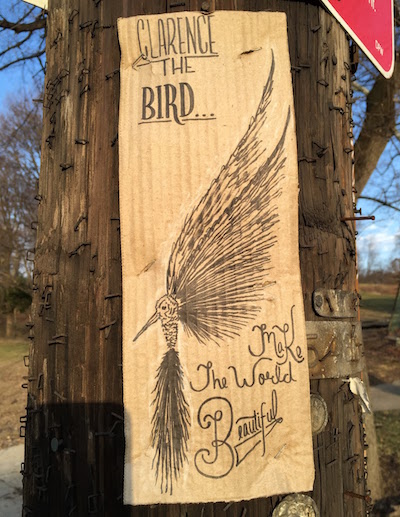
ink on cardboard street art of a bird with the text "Clarence the Bird...Make the world beautiful", Pittsbugh, PA

Out and about, on our way to something-or-other. Yet another spectacular non-winter day in the middle of February. Then, from nowhere, a hand-inked and slightly-weathered swath of grainy card stock, crudely stapled to a telephone pole. On it, the image of a fluttering fantasy bird–a long beak, gloriously-oversized wings pitched high in mid-flutter, and a preposterous dangling tail feather. Bloggers with less couth would suggest this bird is a pimp. The calligraph Clarence the Bird…Make the World Beautiful frames the fine creature.
ink on cardboard street art of a bird with the text "Clarence the Bird...Make the world beautiful", Pittsbugh, PA

We pull out the trusty electronic image-preserver, do our duty, and continue on down Butler Street. Where were we going? All I remember is the light was getting low. More worried about the damn photograph than where we were headed. Anyway, the next telephone pole, another Clarence the Bird drawing, this one on corrugated cardboard. Aside from the base material, the drawings are strikingly similar–clearly by the same hand, but again an original drawing. The pole after that? Yeah: same thing. This is turning into a legitimate bird happening. What’s going on around here?

ink on cardboard street art of a bird with the text "Clarence the Bird...Make the world beautiful", Pittsbugh, PA

Four drawings in total [hopefully we didn’t miss any] on successive Butler Street light poles, roughly around Home and 47th Streets on the cemetery side. Who is Clarence the Bird? And why is he so darned determined to “make the world beautiful”? Make no mistake: we applaud this end game. The Orbit may never be able to properly answer more than the what in this curious equation, but that’s all right–being left in wonder is no great hardship. Some might even suggest that it’s the greatest reward we could ask for. Clarence–or whoever you are–you’ve done good.

ink on cardboard street art of a bird with the text "Clarence the Bird...Make the world beautiful", Pittsbugh, PA