Step Beat: Anthony and Ivondale

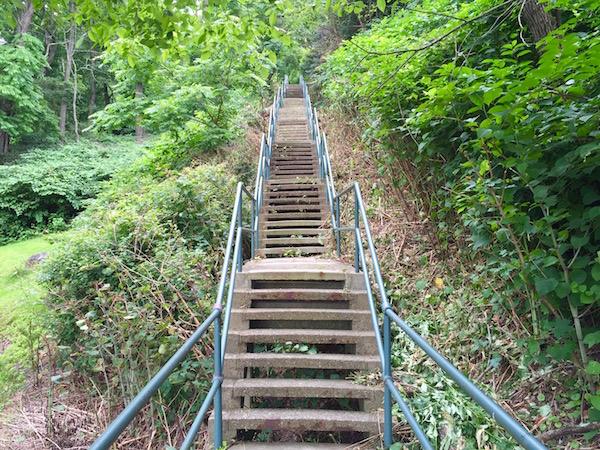
intersection of Anthony Street and Ivondale Street city steps, Pittsburgh, PA

Anthony and Ivondale streets, The Run

They’re not the longest or the prettiest. They’re not one of the great nature-in-the-city hikes, and there’s not much of a view. Heck, these steps don’t even fulfill the most basic purpose of infrastructure: you can’t go anywhere on them!

So why are we even reporting on the Anthony and Ivondale city steps? Well, this blogger will tell you. There’s a time for greatest hits and, as Buck Dharma so wisely reminds us, there’s a time to play B-sides. On the back of the platter, Anthony and Ivondale still earn the occasional spin, and it still sounds…er, walks pretty good.

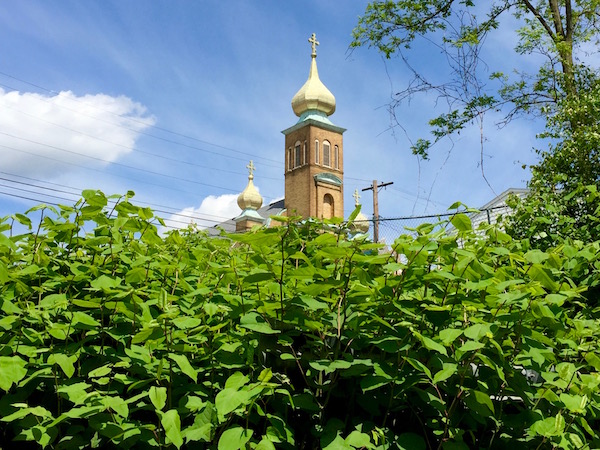
The onion domes of St. John Chrysostom Byzantine from the Anthony/Ivondale intersection, Pittsburgh, PA

The onion domes of St. John Chrysostom Byzantine from the Anthony/Ivondale intersection

Last year we reported on the wonderful existence of the great Romeo & Frazier intersection in an overgrown hillside of South Oakland. That particular confluence of city steps is remarkable for a number of reasons, not the least of which is Pittsburgh’s commitment (at least, historically) to pedestrian thoroughfares as fully-accredited “streets.”

We see the same great treatment at the corner of Anthony and Ivondale, where the steps are given their own street light and signage. Only here, the whole enterprise is more absurd since there’s not really any chance of either walking these steps in the dark or needing directions to where they’re (not) going.

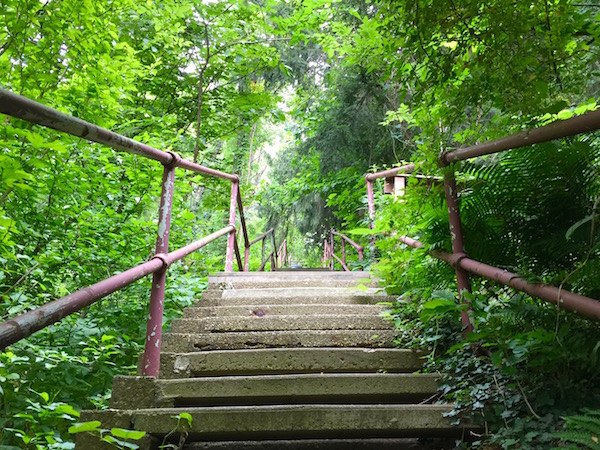
intersection of Anthony Street and Ivondale Street city steps, Pittsburgh, PA

Looking up Ivondale Street from behind St. John’s

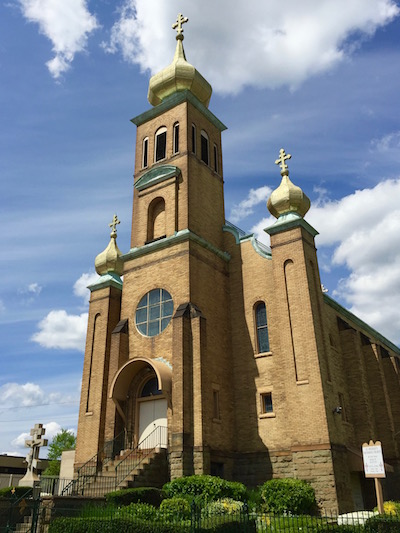
The other obvious factor on any step-trekker’s noodle is that this particular pair of step-streets is almost surely on the endangered list. At one time, Anthony Street must have continued all the way up the hill to Greenfield*. That would have connected residents of The Run up to Greenfield’s commercial district and uphill parishioners down to the mighty St. John Chrysostom Byzantine Catholic Church.

But those aren’t really well-travelled routes any more–at least, not on foot. In fact, they’re so neglected that you can only walk a tiny minority of Anthony Street before you’re met by an ocean of out-of-control overgrowth that completely blocks passage on the through-way**.

city steps overgrown with weeds, Pittsburgh, PA

Pittsburgh Babylon: Anthony Street’s long, inaccessible climb up to Greenfield

Anthony & Ivondale will never be destination steps like Rising Main or Little Jewel Street or the “Try Try Try” steps. But if you find yourself in The Run for a large sandwich at Big Jim’s or just passing through en route between the Schenley Park and “Jail Trail” bicycle runs, it’s well worth the stop and poke-see. You won’t get lost; there’s nowhere to go.


* Looking at the map, it seems like Anthony probably terminated at tiny Raff Street, itself just an extension of Alger Street, a block off Greenfield Ave.
** Already on the list is going back in the winter when we can see what’s left when the knotweed has died off.

An Orbit Obit: Holy Trinity Catholic Church, Duquesne

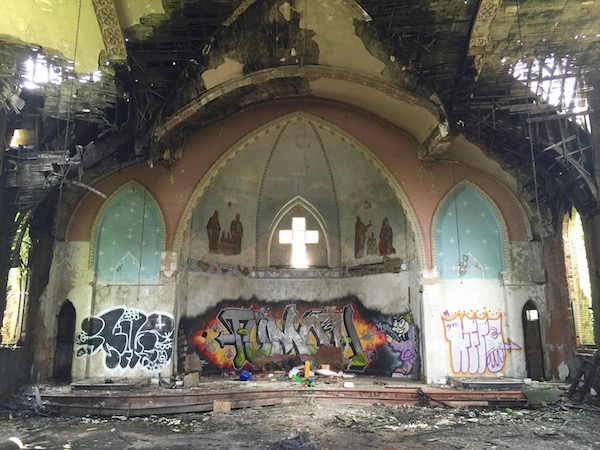
interior of former Holy Trinity Catholic church with spray paint graffiti and sky visible through the roof, Duquesne, PA

Before the fall. Holy Trinity’s chancel and still (barely) intact roof

The term ruin porn makes it sound so dirty. The Orbit likes to consider its mission[1] a noble one: peek into special, disappearing, fantastic places; record, document, and tell their tales–especially the ones that won’t be around that long.

But there’s a nebby, morbid, and yes, prurient curiosity too. How did things get this way? What’s going to happen next? Why isn’t anyone paying attention here? If I were a citizen of Duquesne, or any of its struggling sister boros, would I be resentful of some ne’er-do-well blogger poking his bicycle-riding picture-taking schnoz into my town’s business? I don’t know, but yeah…maybe.

interior of former Holy Trinity Catholic church with spray paint graffiti and sky visible through the roof, Duquesne, PA

Holy Trinity’s nave, viewed from the second floor alley window

The news came just this week that Monday’s huge thunderstorm had finally collapsed the roof and several wall sections of the century-old former Holy Trinity Roman Catholic Church in Duquesne. The church is so close to catastrophe that nearby residents have been relocated and the city is expediting plans to demolish what remains out of safety concerns.

The Orbit had the good fortune–or, at least, good timing–to stumble upon and check out Holy Trinity mere weeks before the walls literally came tumbling down. We captured a few final images of the church, its threadbare, about-to-drop ceiling, and the sad beauty of a kind of old world liturgical construction that we’ll surely never see created anew.

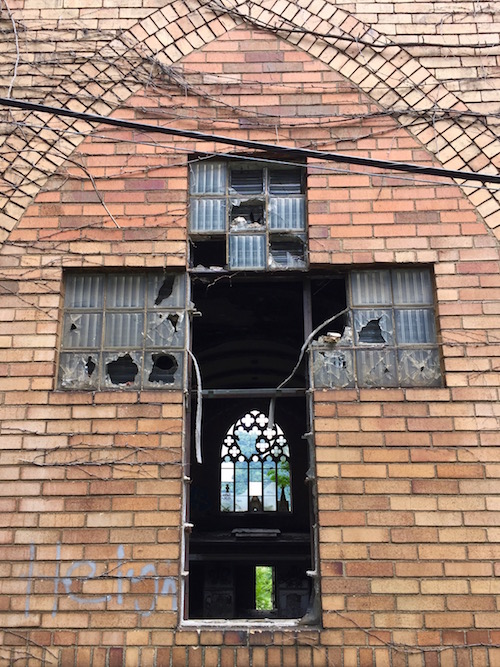
exterior of former Holy Trinity Catholic church, Duquesne, PA missing windows and trees growing over front steps

Exterior, from South 1st Street

Pittsburgh is littered with beautiful, old churches. Many of the ones that no longer function as houses of worship have been repurposed into any manner of creative second lives. Performance halls, community centers, art studios, living spaces, a hookah lounge, and even a brewery have been reborn from sacred bones. Last year we got all dewey-eyed drooling over the potential of the former St. George’s Syrian Orthodox Church in the lower Hill. This blogger’s co-worker is still trying to figure out what to do with the combined church and school he bought in Tarentum for the price of a suped-up SUV earlier this year.

Holy Trinity - mural Moses

Chancel mural

So it’s worth remembering that despite metro Pittsburgh’s relative urban health–verging on full-on priced-out gentrification in some necks of the wood–places like Duquesne exist just a couple miles down the river…any of the rivers. They’re dying (quite literally) for any investment.

In Duquesne, according to the WTAE report, city managers can’t even find the owner of the old church. Twenty years ago–maybe not even that long–the former Holy Trinity, abandoned by its congregation in 1970, was probably still in a state where it could have been saved, loved, and re-used. Now, we’ve not just lost the potential of preserving something unique and beautiful, but that very thing has become a safety hazard to even leave around as standing ruins. Sigh.

Holy Trinity - mural lamb

Chancel mural

Mrs. The Orbit and I sometimes squabble about what the changes to Pittsburgh’s fortunes will really amount to. Will the Lawrencevillianization of the East End spill across the rivers and turn the city into another place where, you know, “real people” can’t afford to live any more? Or do we just have way too much available space[2] and cheap housing with nowhere near the curb appeal of a New York or a San Francisco?[3]

This optimist tends to believe the latter. But if, by some crazy twist of socio-economic happenstance, every looking-for-a-change young person really does decide to turn Pittsburgh into the “next Portland”, hopefully it will mean a breath of life to the immediate industry towns just outside city limits which will inevitably absorb some of the overflow. If we could see good things come to Ambridge, New Kensington, McKeesport, and, yes, Duquesne, well, that might make it all worthwhile. Let’s just hope it happens before all the roofs collapse.

view through broken glass block window in shape of a cross to dark interior of former Holy Trinity Catholic church, Duquesne, PA

View through (replacement) second floor rear window (from Oak Alley)

All photos taken July 25, 2016 just a month prior to the roof and wall collapse on August 29.

Also: Lost Monongahela has a nice write-up with some great photos on the history of Holy Trinity and the congregation’s decision to build a brand new church in nearby West Mifflin and abandon their original home in Duquesne.


[1] At least, one of its missions.
[2] Pittsburgh’s current city population is around 325,000–just about half of what it was in the 1960 census–there is a lot of vacant land here.
[3] Not to mention the sunshine and no-snow climate of a Charlotte, Miami, or Los Angeles.

Photo Grab Bag: Ghost Sign Roundup

ghost sign with layered text, McKeesport, PA

(unknown), McKeesport

Longtime readers know The Orbit is in the business of making dreams come true–and business is good. It was pointed out by super fan/sometime contributor Lee that probably a lot of folks don’t see the loose photos that end up on The Orbit‘s artsy dark and/or snarky narc pages and maybe we should roll them up into an actual blog post once in a while.

So here you go. Like Cheech and/or Chong, we’ve pulled out the gatefold copy of Fragile and are rounding up and rolling out a first collection of non-specific pictures from the last year or so. Here, they’re grouped on the pseudo-theme of ghost signs. Don’t inhale too deeply.

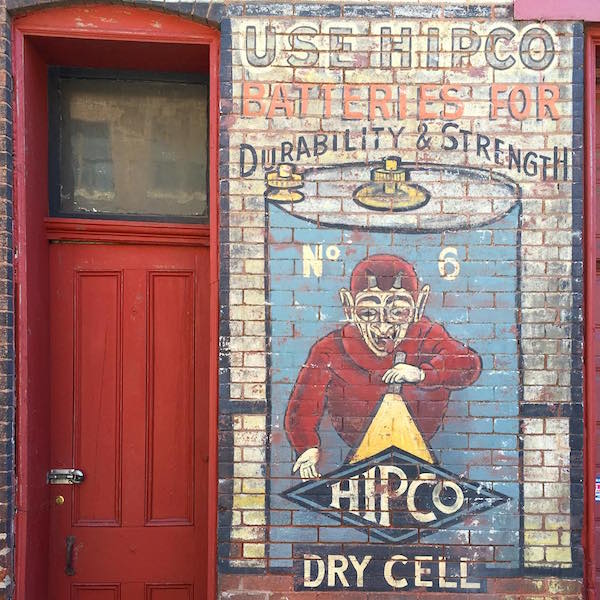
ghost sign/advertisement for Hipco Batteries, Pittsburgh, PA

Hipco Batteries, Manchester

It’s a bold claim, but the Hipco Batteries ad has to be the city’s greatest ghost sign. The incredible painted image has some classic “vernacular typography”, one giant old school No. 6 dry cell battery, and a sadistic, grinning red devil, his tongue wagging like a pervert from his open, fanged mouth. He’s very excited, with one hand reaching out, palm up, and the other employing a Hipwell flashlight to no doubt look for trouble in the dark.

This begs the question: do devils really need flashlights? Well, we know this one does. Unlike the subjects of every other photo in this post, the Hipwell Manufacturing Company, founded in 1887, amazingly still exists and continues to manufacture a line of flashlights (but no longer batteries) right in this big old brick building on West North Avenue[1].
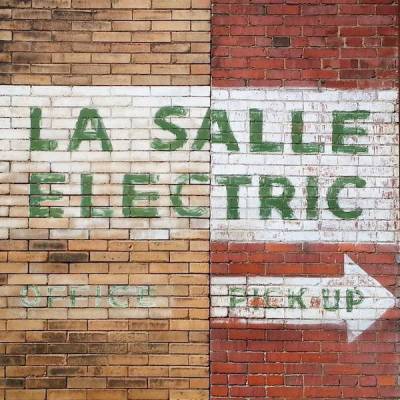
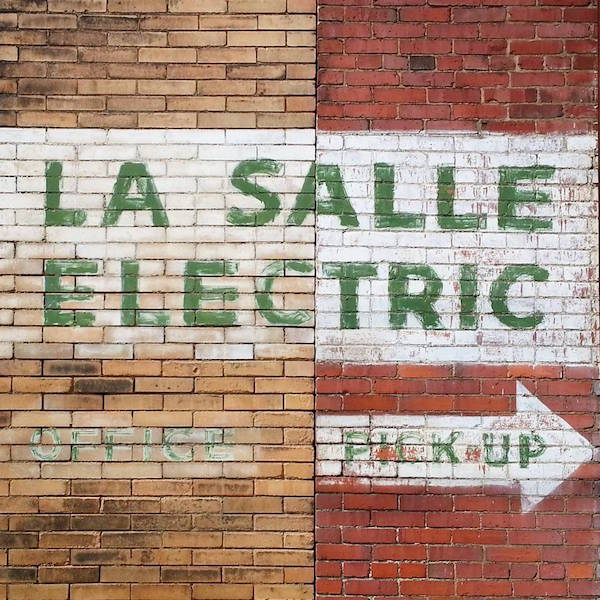
ghost sign for former La Salle Electric, Pittsburgh, PA

La Salle Electric, Manchester

The pair of conjoined industrial buildings that once housed La Salle Electric, just off Brighton Road in Manchester, were torn down earlier this year. Now there’s just a re-grassed vacant lot where they used to be. Whatever prompted that action, it’s sad for a lot of reasons–mainly that we’ve got a limited supply of this kind of late 19th century industrial buildings out there and it’s a bummer to lose two of them in one fell swoop.

Here, we can only focus on the relatively minor loss of this great ghost sign, painted across the point where the two buildings met. You can see the red brick side appears to have shifted ever so slightly, distorting the alignment of the white background and breaking the A in “Salle”. And what a great pair of arrows! The office is that way, you can pick up your stuff on the other side. Ugh. I mean, the office used to be that way…
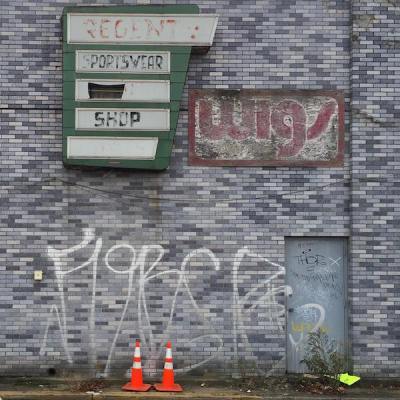
ghost sign for former Regent Sportswear Shop, Pittsburgh, PA

Regent Sportswear (and Wig Shop?), East Liberty

The rear entrance to the former Regent Sportswear Shop doesn’t have what we usually consider “ghost signs”, but still seems like it ought to count. Regent’s 3-D sign, the typeface in Wigs, and the multi-color blue/gray/white brick treatment all suggest a 1960s/70s makeover to a building that probably goes back to the very early 1900s. Somewhere out there is a person who bought a terrycloth track suit or tried on someone else’s hair at Regent’s and we sure hope this last reminder in the Kirkwood Street alley makes him or her feel something. Hopefully that feeling is not, you know, “itchy”.
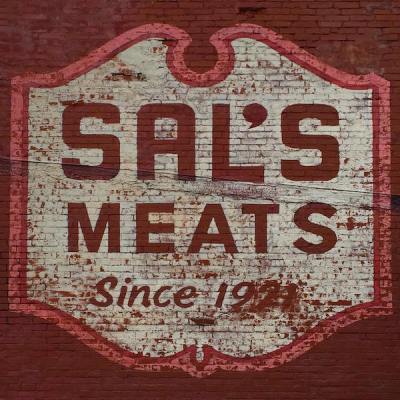
ghost sign reading "Sal's Meats Since 1921", Ambridge, PA

Sal’s Meats, Ambridge

Sadly, Sal’s Meats, like most of the businesses in Ambridge, ain’t there any more. But at least we’ve still got this great ghost sign. Painted signs don’t get any graphically stronger than bold red text on a white background, painted fifteen feet across on a deep red brick wall. Sal’s Meats, since 1921. ‘Nuf sed.

ghost sign for former Penn Bowling Lanes, Pittsburgh, PA

Penn Bowling Lanes, Downtown

What a time when the downtown worker could bowl ten frames over a lunch break! This literal back alley entrance on Exchange Way (between Liberty and Penn, downtown) suggests the bowling may have taken place in the basement, but who knows? Heck, maybe those wooden lanes, pin-setters, ball returns, and beer taps are all still down there, covered in forty years of dust. Either way, we’re glad no one felt the need to paint over this incredible patchwork wall with its reminder of old Pittsburgh.

ghost sign for Dr. D.E. Earley, Optometrist, New Martinsville, W. Va.

Dr. D.E. Earley, Optometrist, New Martinsville, W. Va.

Last winter, we made a special stop for the mind-boggling buffet at Quinets Court in the fine little West Virginia town of New Martinsville (about 90 minutes from Pittsburgh–and well worth the trip)[2]. The inevitable post-gorge belt-loosening constitutional yielded some fine views of the Ohio River and a bunch of great little oddities in the four-block downtown stretch. This ghost sign for Dr. D.E. Earley, Optometrist looks like it could go back a hundred years. That’s a long time to wait to get your eyes examined and glasses fitted, but then again, you’ve got a steam tray full of Quinets cobbler two blocks away. I can think of worse ways to spend a century.

Former storefront for G's Restaurant and Pizzeria, Pittsburgh, PA

G’s Restaurant and Pizzeria, Downtown

Bathed in low winter sunlight, made awkwardly diffuse by scaffolding and construction fence, this photo of the former G’s Restaurant and Pizzeria on Forbes Ave. got shoehorned into an update story on the last remaining Toynbee Tile on Smithfield Street and the face of a rapidly changing downtown Pittsburgh. But we felt like there was a little more to say here.

G’s Restaurant, along with the former Honus Wagner Sports building next door, were razed earlier this year. Point Park University is building a big new performance arts building/theater on the property. This will no doubt be a great cultural asset, but The Orbit‘s going to miss this pair of early 1900s terra cotta storefronts, each with their own goofy mid-century add-ons.


[1] See article: In The Spotlight: Hipwell Manufacturing (Pittsburgh Post-Gazette, Nov. 10, 2002) for the full story.
[2] The Orbit actually needs to make the trip to Quinets again for a full review–or even if just for that eggplant parm, and the kielbasa and kraut, and the fried chicken, and the haluski, and the brown sugar sweet potatoes, and the butterscotch pie, and the…
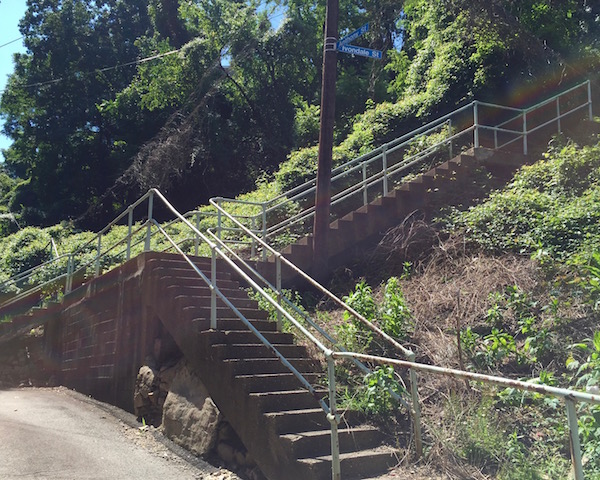
Step Beat: Climbs 57

looking up long set of city steps, Pittsburgh, PA

Looking up the lower section of the 57th Street steps

Has Pittsburgh fifty-seven varieties of city steps? Maybe.

It’s an intriguing question. There are long and short sets of steps; steps on the side of the street and steps alone in the woods. There are steps of wood, metal, and concrete; steps in good repair and ones that are falling apart; open steps and ones permanently closed. Some have special bicycle ramps added; others just tell you to Try. There are steps with crazy turns and angles and steps that just go up one straight line. There are steps the whole neighborhood uses, step street intersections, and steps that no longer go anywhere.

It would probably take a significant imagination to keep this riff going all the way out to the magic number. However, we know Henry J. Heinz considered 57 to be a lucky number*, and if it’s good enough for the king of condiments, it’s good enough for Pittsburgh Orbit. We certainly felt lucky after a climb up the very fine 57th Street Steps in Lawrenceville.

city steps with older home, Pittsburgh, PA

Step-accessible (only) house at the bottom of the 57th Street steps

city steps at 57th and Duncan Streets, Pittsburgh, PA

The intersection at Duncan Street, mid-point in the 57th Street steps

The steps that make up the pedestrian section of 57th Street qualify as at least two of these varieties. The lower half, from where Christopher Street forks off 57th up to Duncan Street, is in immaculate shape. The treads and rails are all perfectly maintained, with easy clear passage. The surrounding foliage has been neatly trimmed and there was no litter the day we visited. There’s even one remaining house that is only accessible via the steps.

An the upper half? Well, that’s another story. In the middle of a lush Pittsburgh summer, dense knotweed has enveloped the majority of this stretch with just enough room for the city trekker to go full-on Indiana Jones. [Note to readers: bring a fedora, whip, and satchel.] It’s clear this batch is neither as well-loved nor as well-used as its downhill sibling. Still, it offers a great off-the-grid version of the step experience, which is just as much of what we’re after.

city steps nearly overgrown with knotweed, Pittsburgh, PA

Entrance to the upper section of 57th Street steps (at Duncan Street)

looking up city steps covered by trees, Pittsburgh, PA

Looking up the upper section of 57th Street steps

If there’s a bummer to the 57th Street steps, it’s that you’re stuck with a straight up-and-back trip–there’s no looping around for a more interesting walk/hike. Somewhere around half-way up the top stretch (above Duncan), you hit a pretty decisive end-of-the-line. The treads are gone, trees and weeds have overtaken what’s left, and a clear Steps Closed barrier has been placed across the route.

At this point, the red handrails continue, tantalizing us by disappearing into the hillside. The map shows that at one point the steps terminated up on Price Way in Stanton Heights, but that connection seems unlikely to be re-opened–at least until The Orbit gets put in charge of public works. Until then, pass the ketchup.

city steps missing treads with "Steps Closed" sign blocking the way, Pittsburgh, PA

End of the line: top of the 57th Street steps


* Heinz famously had way more than 57 different food products when the “57 Varieties” tag line was dreamed up and added to packaging.

Onion Dome Fever: St. Michael’s Orthodox

St. Michael's Orthodox Church, Rankin, PA

St. Michael’s Orthodox Church, Rankin

If you want to give The Orbit‘s brakes a thorough wringing-out, just throw a new set of onion domes up in sky and listen for the screech of rubber on pavement.

That’s just what happened as we found ourselves off track and reconnoitering back down 3rd Avenue in Rankin. There, gleaming in the bright sunlight against a backdrop of pillow-perfect wispy cumulous formations, rose the three perfect golden domes of St. Michael’s Orthodox Church.

St. Michael's Orthodox church, Rankin, PA from over a bank of weeds

In the weeds: St. Michael’s onion domes viewed from the pass-through to Rankin Blvd.

It should come as no surprise that Rankin hosts a traditional Eastern Orthodox church. Pretty much every old steel town has at least one–it speaks to who was immigrating over here to work the jobs in the mills. We’ve already run scene reports on churches in McKeesport, Marshall-Shadeland, Steubenville, and McKees Rocks.

Just like those places, the church stands as the tallest structure in town. While that’s not a huge feat in a borough as small as Rankin, it’s always a great payoff as the giant golden ornaments reach out and above from any vantage point: as a beacon from the local through-street (Braddock Ave.), above the rows of peaked-roof frame homes and squat brick row houses, and apparently right out of the weeds from the hillside below.

St. Michael's Orthodox Church, Rankin, PA

St. Michael’s Orthodox Church, Rankin

Matching cornerstones in both English and Cyrillic date St. Michael’s to 1907, which seems just about right for the peak of Russian/Ukrainian immigration to work in the mills. Rankin reached its greatest population a couple decades later in the 1930 census with around 8,000 people. Today, with only a quarter of that–the vast majority African-American–it’s hard to imagine a lot of local Russian Orthodox parishioners for St. Michael’s*.

Despite all this, though, the church–at least on the outside (it was locked tight when we visited)–is in terrific shape. The masonry work is solid, the stained-glass windows aglow, and the little front garden well-tended and in lovely full spring bloom. Oh, and you won’t miss those big golden onion domes–they’re still up there and they look spectacular.

Detail of cross on St. Michael's Orthodox Church entrance gate, Rankin, PA

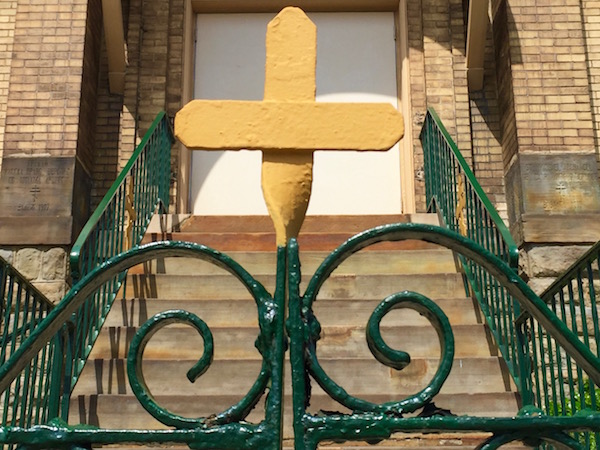
Cross here. St. Michael’s front gate (detail)


* Source: Wikipedia entry for Rankin demographics.

More Time for the Skyline

Art installation of Pittsburgh skyline as large cut-outs with black and white patterns projected on them

Spirit Lounge Pittsburgh 200th Birthday Celebration

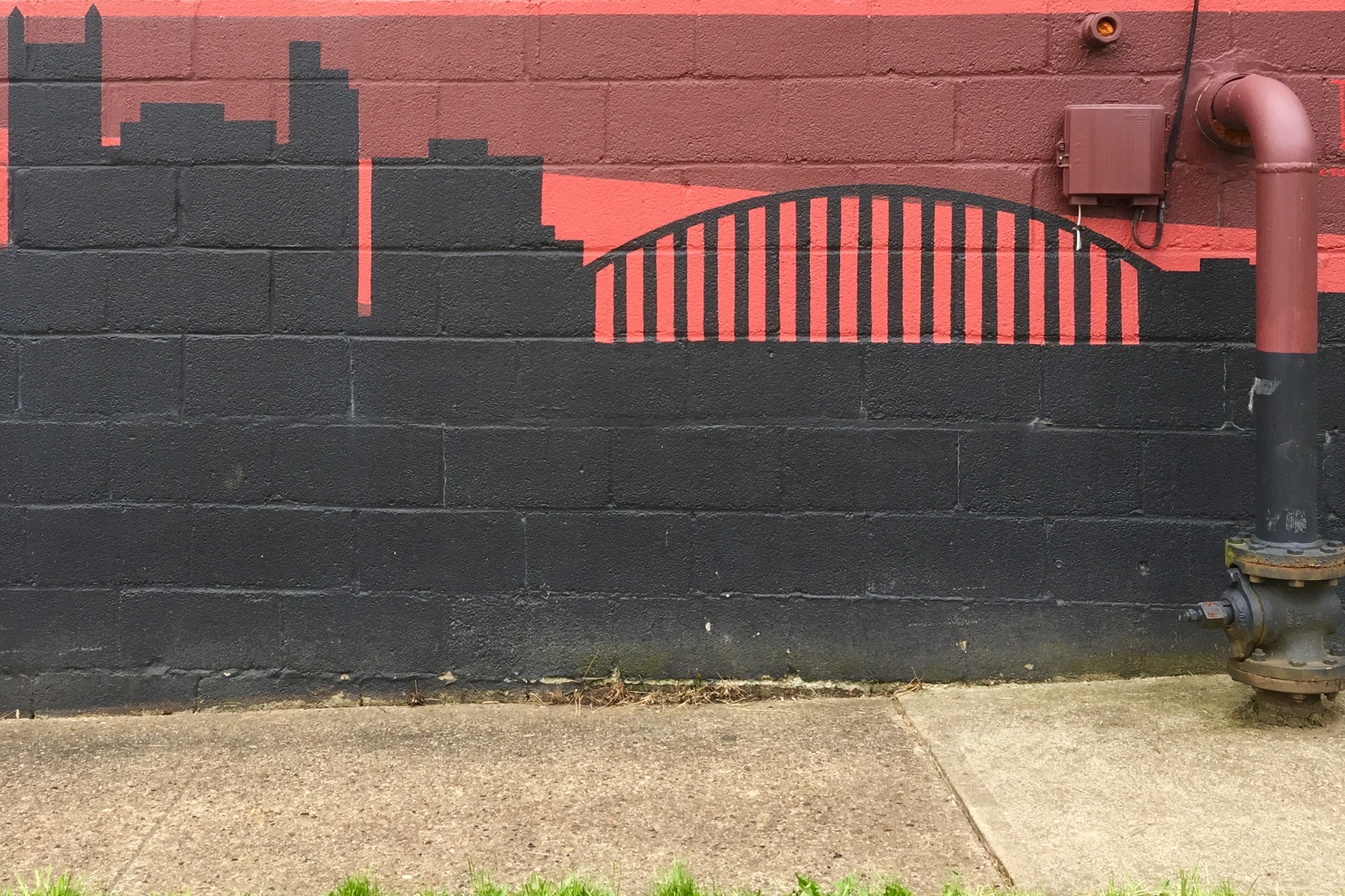
Back in January, we posed the question is the Pittsburgh skyline that distinct? No definitive conclusion was achieved but it became clear that we’re dealing with an extremely popular subject. In only the few months since, we’ve seen new examples of the same profile appear over and over–in art, in industry, in history. Here are The Orbit’s favorites:

Spirit Lounge‘s 200th birthday party for the city was an orgy of Pittsburgh in-joke goofballery. The flashing, multi-color downtown skyline diorama looked great in all of its phases, but especially this high-contrast, two-tone number (above)–amazingly with just one building’s profiles caught on the bias. Hats off to whoever put this great display together.

Airbrush painting of the Pittsburgh skyline seen from the North Side

Warhola Recycling, North Side

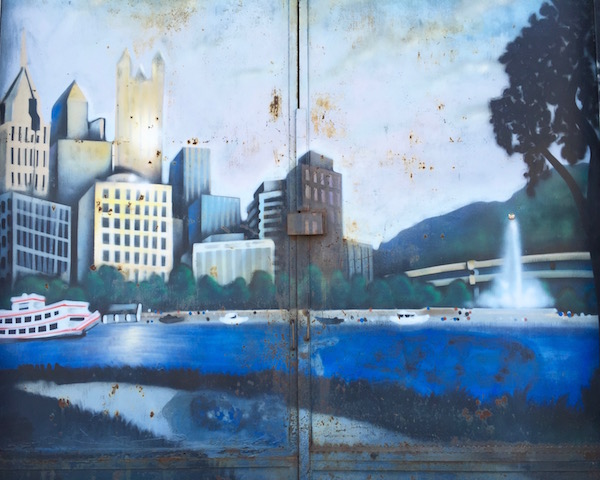
Warhola Recycling would have to include a North Sider’s view of the city. The big touch points are all there: PPG, Fifth Avenue Place, Point State Park and its fountain–even one of the party boats on the river. This mural, airbrushed on the big steel doors on the side the building, is a great example of the skyline potentially popping up just about anywhere.

fantasy skyline with various Pittsburgh elements included

Energy Innovation Center (former Connelly Technical Institute), Hill District, c. 1930

The depiction of Pittsburgh in this arched doorway mural from the old Connelly Technical Institute is terrific in a number of ways. First, it’s just very much of its time–a pseudo-realistic depiction of the city in full industrial might: a place of buildings reaching to the skies, bridges that can ford any span, industry cranking out…stuff, and glorious rolling green hills as far as the eye can see.

But it’s also a perspective that doesn’t actually exist–and never did. The painting is a fantasy view of Pittsburgh combining real-life entities (downtown’s Gulf Tower, the Panther Hollow Bridge in Oakland, steel mills, farmland) plucked out of their actual habitats and re-combined in a close-shouldered collision. It’s like a regional greatest hits album that lacks any cohesive flow, but still sells because it’s got all the good stuff people want to hear.

city skyline painted on concrete tennis practice wall, Pittsburgh, PA

Garland Parklet, East Liberty

This skyline, painted graffiti-style in a park in East Liberty, is almost so abstract that we can’t count it–it could be Anytown (O.K. any city), U.S.A. There’s no recognizable Gulf Tower or U.S. Steel Building, but the central point is arguably Fifth Avenue Place’s giant hypodermic needle. They’ve also got a generic bridge in there, though it doesn’t really look like any of the “three sisters” suspension bridges. In any case, this blogger thinks it counts. Plus, it ended up on the backstop of a tennis practice wall in East Liberty, which is a pretty neat place to turn up a city mural.

Pittsburgh skyline mural painted on cinderblock building

Red Star Ironworks, Millvale

Excuse the weird cropping here, but there was a glass block window and a competing mural to work around. The entire front of Red Star Ironworks’ Millvale workshop has been painted as a giant tribute to big dudes working with hot steel. The split pair of Pittsburgh skylines that bookend the mural are really just a decorative afterthought. But they’re still there, and you won’t have any trouble picking out the now-familiar key players.

mural on brick wall including the downtown Pittsburgh skyline

Mural, Art All Night 2016, Lawrenceville

We could have filled an entire post–maybe several–with depictions of downtown Pittsburgh entered into this year’s (or any year’s) Art All Night. But we went with the one that will go down with the ship: a mural painted directly on the brick wall of the 39th Street Arsenal Terminal building that ain’t long for this world. New condos await, right there at the foot of the 40th Street Bridge, but they’re not going to make it into this skyline.

Up in Smoke: Ex-Snack Shops

mural of soft-serve ice cream cones in colorful silhouette, former Tastee Queen, Ambridge, PA

Tastee Queen, Ambridge

Scene: The freezer aisle at the Lawrenceville Shop’n’Save, 9:30 on a recent Sunday evening. An enormous man is paused, his buggy half-full with potato chips, Cheez Doodles, canned chili, two-liter pop bottles, the makings for deli sandwiches–there’s not a fruit or vegetable in sight. He’s dressed in the kind of long short pants that big men often wear and a t-shirt in the Rastafarian red/green/black/gold color scheme featuring a prominent marijuana leaf and the single word STONED. The man is engaged in a cell phone conversation communicating ice cream flavors to an associate: “They got rocky road, they got butter pecan, they got moose tracks, they got strawberry, they got double chocolate…”

former Coney Island Convenience store, McKeesport, PA

Coney Island Convenience, McKeesport

As fascinating as this was (would this guy keep naming flavors all the way down to the Ben & Jerry’s section? would the team consider sherbet, ice milk, and/or frozen yogurt? how about the add-ons: chocolate sauce, nuts, whipped-cream? what would the final decision be?) this eves-dropper can only pretend to peruse the Stouffer’s frozen dinners for so long–we needed to move along.

former Howze Corner Store, Wilkinsburg, PA

Howze Corner Store, Wilkinsburg

What’s a doobie smoker to do? Gone (for the most part) are the mom & pop corner convenience stores, replaced almost entirely by the one-two punch of supermarkets and gas & sips. Good luck finding a retailer with only one brand of potato chips or a single freezer for the ice cream. It’s a wonder we’re not all standing confused and on the help line right now trying to make an informed, intelligent decision on Funyuns vs. Fritos, Cheetos vs. Cheese Puffs, ridges vs. kettle-cooked. Somehow, we must all dig deep and make these most difficult of life’s decisions.

snack trailer with cartoon images and sign "Temporarily closed for remodeling"

unknown (snack trailer), Hill District

In central Lawrenceville, we lost our independent snack shop three or four years ago. Mrs. The Orbit always cites Star Discount* as the place where ladies of the evening could purchase undergarments and bingo freaks could stock up on daubers. Lottery tickets and cigarettes were likely paying the bills, but “Star’s” also carried Herr’s and Snyder’s chips and pretzels as well as Cotton Club pop. Everyone behind the counter was always smoking.

Star Discount was replaced by the trifecta of Row House Cinema, Smoke BBQ, and Bierport (née Atlas Beer)–all of which we’ve patronized and enjoyed–but even if they let you in the door, try getting a $1.99 bag of cheese puffs from Smoke!

former Haley's Market, Pittsburgh, PA

Haley’s Market, Lincoln

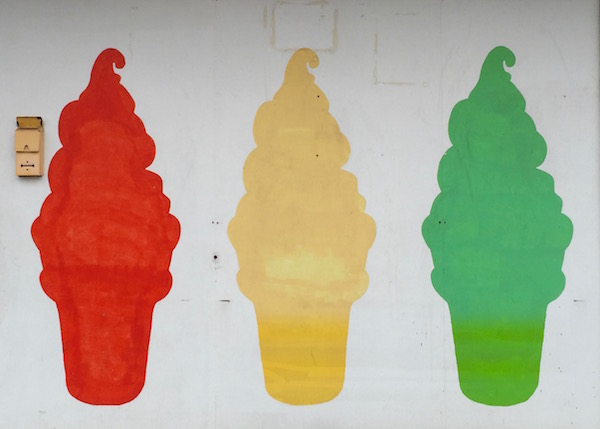
Growing up in southwest Virginia, the peaceful, gentle climb to Cascade Falls in the nearby national forest, followed by a celebratory post-hike soft-serve at Dairy Princess made for a fine afternoon. In collecting images for this story, it was nice to see the tradition of knock-off ice cream shops perpetuated in both Tastee Queen (Ambridge) and Tasty Queen (Bruceton Mills, West Virginia). Unfortunately, all three businesses seem to have met a similar fate**. At least we still have Tastee Queen’s glorious technicolor soft-serve silhouettes.

former Tasty Queen ice cream shop, Bruceton Mills, WV

Tasty Queen, Bruceton Mills, WV


* Star Discount would make a great Orbit obit, but we sadly never took the photographic record to do it justice.
** This blogger almost met an even more violent version of the same fate taking this photo of Tasty Queen.

Dead Mall: Allegheny Center

Former office building in Allegheny Center, Pittsburgh, PA

Former office building, former Dollar Bank

It was a Saturday afternoon and this American was at the mall. Nothing strange about that, right? Where it gets weird is that he was the only one at the mall. And I mean literally the only living creature on this giant plot of city-center property*.

I wasn’t even there to buy anything! But that’s lucky, because believe me, there was nothing for sale–no novelty t-shirts, no shoes, no Spencer Gifts, no Licorice Pizza, and (sigh) no Orange Julius.

Empty common area of Allegheny Center Mall, Pittsburgh, PA

Main common area

Allegheny Center, one of Pittsburgh’s three ginormous, well-intentioned, but ultimately disastrous urban redevelopment projects of the 1960s, is today the most intact of that triumvirate. The Civic Arena was torn down several years ago and its massive site is currently in development for yet another makeover. East Liberty’s business district is more gradually having its wrongs…undone (I’m not sure “righted” is fair–certainly the displaced residents wouldn’t think so).

This isn’t your average dead mall. For one, it’s not way out in the suburbs–just one river crossing and a few blocks separate Allegheny Center from downtown Pittsburgh. For another, even though as a shopping mall it’s definitely long gone, some amount of the property is very much in use. Many of the former retail spaces are now occupied by an unlikely collection of anonymous back offices for banks, utilities, tech companies, etc. There’s even a working soup-and-sandwich restaurant to serve the captive clientele (but it’s not open over the weekend).

Things are going to change fast for Allegheny Center real soon. Announced last year, the complex is about to have a whole bunch of money dumped into it to convert the mall space to a incubator and campus for high tech companies with the new name Nova Place. Radiant Hall has moved into the ground floor of the office building and Quantum Theatre will stage its next production (Ibsen’s The Master Builder) upstairs in April. We thought The Orbit ought to get in there and take a look before everything changes once again.

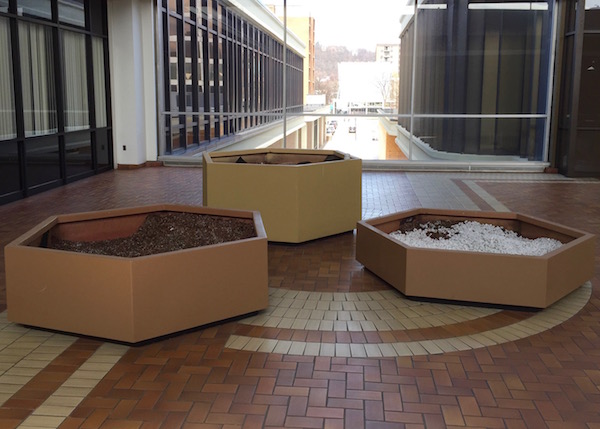
Large hexagon-shaped planters filled with both dirt and styrofoam packing peanuts, Allegheny Center Mall, Pittsburgh, PA

Empty hex planters

Allegheny Center isn’t just a (former) shopping mall. It’s a small complex of buildings that includes an eight-story office building and a similarly-sized set of apartments (which may still be in use). There’s also a terrific freestanding bank branch that has the center’s very of-its-time midcentury modern curved boxes.

Much has been made about what The North Side lost when the Allegheny Center project came in–most notably its beautiful, central market house and sensible street grid. That was all before this blogger’s time, but the pictures are heartbreaking.

Entrance to parking garage and curved, projecting windows, Allegheny Center Mall, Pittsburgh, PA

Parking garage entrance and characteristic curved exterior features

That said, the fifty years that have passed since Allegheny Center was built in 1966 have largely been kind to what could have been a horrific featureless and windowless box like many of its enclosed mall peers. The overall design is an inventive mixture of interior and exterior space. Shoppers could get to destinations both within the enclosed mall area and also from a number of outside-facing storefronts. Allegheny Center’s original plan devoted much of its space to an open garden/park are on what is now just a bizarre gray plane. The center had mixed use as a central focus, accommodating retail, dining, office, and residential space. Parking is entirely hidden within underground garages. Maybe most surprising, given what we’ve seen of mall design since, nearly 100% of the exterior space contains big windows with views of downtown Pittsburgh (to the south) and up to the hills of Fineview (north).

Aerial photo showing Allegheny Center's original open space parklet and red polymer surface

Aerial photo of Allegheny Center’s original open space parklet with red polymer surface [photo: concretedecor.net]

It’s also in amazingly great condition. I was struck by how absolutely clean and immaculately cared-for the entire property seems to be. Inside the mall, the arched atrium windows still let in a great slanted light, the original tile may show its age in color selection, but not in cracks or wear. Windows–there are many–are clean and bright.

Outside we didn’t see any of the tell-tale signs of other dead malls–no rust or leaks, no cracked window panes or graffiti, no trash, cigarette butts, or weeds. The exterior retail spaces have all been boarded-over with plywood to protect them. We obviously don’t know what things look like underneath, but if they resemble the rest of property, restaurants and retail stores could move back in tomorrow. [Note to Lou Pappan’s heirs: please consider this!]

While it’s certainly dated, the architectural design has the remarkable quality of being both curved and boxy, regular and asymmetric, retro and modern. By today’s standards, it’s cool…or, at least, it could be. By any yardstick, it’s got a lot more potential than Century III. Let’s all cross our fingers for Nova Place.

Empty exterior common/garden area, Allegheny Center Mall, Pittsburgh, PA

Exterior common area with boarded-up former storefronts, former parklet


* This is only a slight exaggeration–during our half-hour visit we did see one dog-walker (outside) and one security officer (inside).

Sources:

A Thomasson!

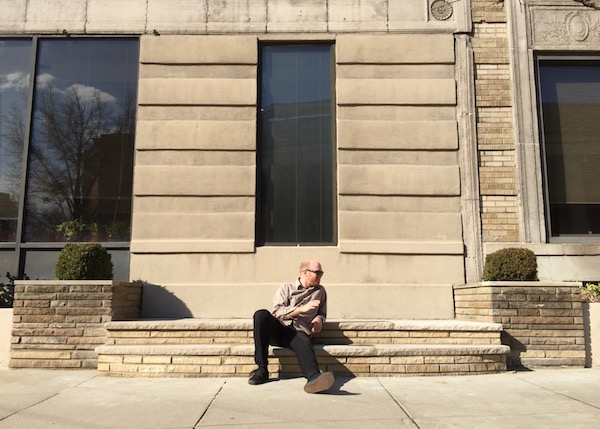
Man relaxing on unused, but well-maintained entry steps to apartment building in Pittsburgh, PA

At least one guy uses this thing. The Thomasson, after a full rehab, March, 2016

We got really interested in Thomassons from a story of the same name on the great 99% Invisible podcast. A Thomasson, as defined by the Japanese artist Akasegawa Genpei who first identified and named them, is an architectural leftover or vestige that no longer has any use and is actively maintained. The name is a reference to one Gary Thomasson, a baseball player who, through twist of fate and contractual obligations was paid to ride the bench–ineffective, but maintained. [The podcast has that whole backstory.] Pittsburgh Orbit became obsessed with finding a local Thomasson.

Pittsburgh is littered with evidence of architectural decay. The giant extant former stone supports of the old Point and Manchester bridges downtown or the countless foundations of long-gone hillside houses come to mind–but there are plenty of examples. The tricky part in identifying a Thomasson is in finding one that people are still actively taking care of.

Bellefield Tower and Bellefield Clinic, Pittsburgh, PA

Bellefield Tower, Oakland. The mother of all Thomassons or still in use?

Bellefield Tower, at the corner of Fifth and Bellefield streets in Oakland, is a potentially glorious Thomasson–we could go as far as saying the mother of all Thomassons. But does it count? Bellefield is a freestanding bell tower that appears to have outlived the church (we assume?) it was once attached to. It’s now mere feet from the curved puce and mauve shopping mall chic exterior of Bellefield Clinic, making for possibly the most painfully awkward architectural juxtaposition in the city.

But does the tower really have no current use? It’s hard to say–this blogger has never heard its bell ringing, and it seems too small and awkwardly-shaped for much else. But possibly the clinic stores scrubs and hypodermic needles there. Maybe a couple of lucky administrative employees get solo offices, each with a tiny staircase. The point is, it could be in use. An investigation is in order*, but we’re not ready to call this a Thomasson…yet.

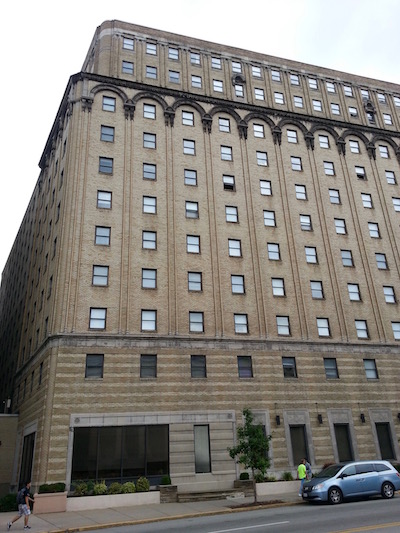
Apartment building on Fifth Avenue, Pittsburgh, PA

In context: Webster Hall’s Thomasson (pre-rebuild), Summer, 2015

Luckily, though, almost right next door, on the corner of Dithridge and Fifth Avenue, sits Webster Hall and what is an undeniable Thomasson. The eleven-story apartment building clearly used to hold something like lunch counters, or maybe retail spaces, on each ground floor corner–you can tell by the decorative masonry work and big window openings. There’s also a strange pair of steps that lead up to a now-bricked-in and glassed-over former entry point. It’s dressed-up with a pair of inviting potted boxwood shrubs, but they’re not fooling this blogger: in nine years of working a block away, I’ve never seen anyone (except The Orbit‘s hired stooge/model) use this as a resting spot. And why would you? As steps, they’re an uncomfortable, awkward seat–there’s no back and not enough leg room–and who wants to relax on busy/noisy Fifth Avenue when you could walk two blocks and be in Schenley Plaza?

Work truck and crew repairing unused steps on apartment building, Pittsburgh, PA

The Thomasson during reconstruction, Feb. 2016

The steps are also undeniably under active maintenance. By last fall, they had lost some of their mortar, causing stones to shift and structure to break apart. The coming of winter only made it worse. When Team Orbit spotted a work crew out front in January it led to some great group rubber-necking and speculation, trying to get a glimpse at what was happening under the mysterious plastic tent. Would they tear up the downtrodden, useless steps-to-nowhere, dashing our hopes that this was our first legit Thomasson? Or was the crew there to make things right–to enpower Oakland’s pedestrians to once again bypass this funny stoop on their way to more pleasant places of repose?

Well, by this point in the story it’s no surprise that the workers came armed with mortar and trowels (not a jackhammer) and we can happily report that the Thomasson is alive and looking as good as new. To Pittsburgh’s other Thomassons, hang in there: we’re coming for you!


* Yes: finding out what’s up with Bellefield Tower is on The Orbit‘s big list!


L’chaim on a Hilltop: Jewish Holy Houses in the Hill District (Part 2)

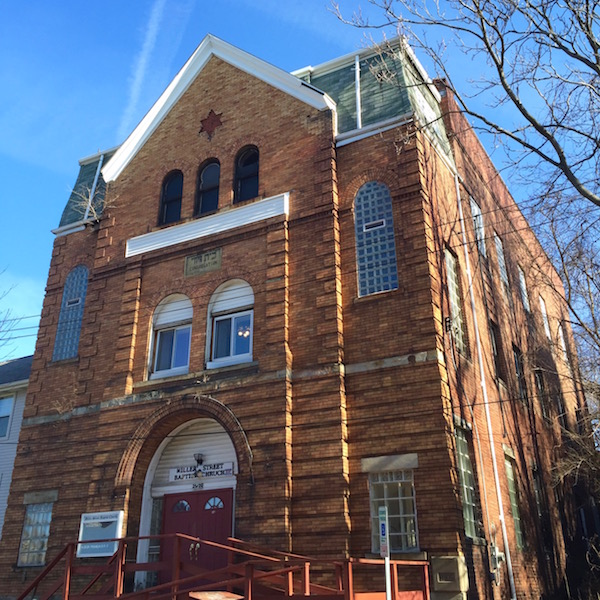
Miller Street Baptist Church formerly Shaaray Teffilah Synagogue/Beth David Congregation, Pittsburgh, PA

Miller Street Baptist Church (former Shaaray Teffilah Synagogue/Beth David Congregation), Miller Street

Back in May, The Orbit ran a story on a couple of really spectacular former Jewish holy houses in the lower Hill District and their new lives today. As we were cruising the old maps looking for info on these places, we kept realizing there were more former synagogues–plus one celebrated settlement house–that survived in the same general area (just outside of the old Civic Arena footprint). This begged for a sequel to the original post, and here we are.

Enon Baptist Church formerly Lebovitch Synagogue, Pittsburgh, PA

Enon Baptist Church (former Lebovitch Synagogue), Erin Street

It’s nothing like it was. Look at platte maps of the lower Hill from the ’20s or ’30s and the density of Jewish life in the area is made incredibly obvious–“Pittsburgh’s Lower East Side,” it’s sometimes referred as. The Jewish population seems to have largely migrated out (to Highland Park, and then Squirrel Hill) by the 1940s, but it was the colossal Civic Arena project that took out the vast majority of its remaining physical structures.

On streets that no longer exist, where City View apartments and the giant, empty former arena parking lot now stand, the maps show block after block containing tiny, often only house-sized synagogues–Bani Israel (sic.), Beth Jacob, Sharey Zadek, Gates of Wisdom, etc.

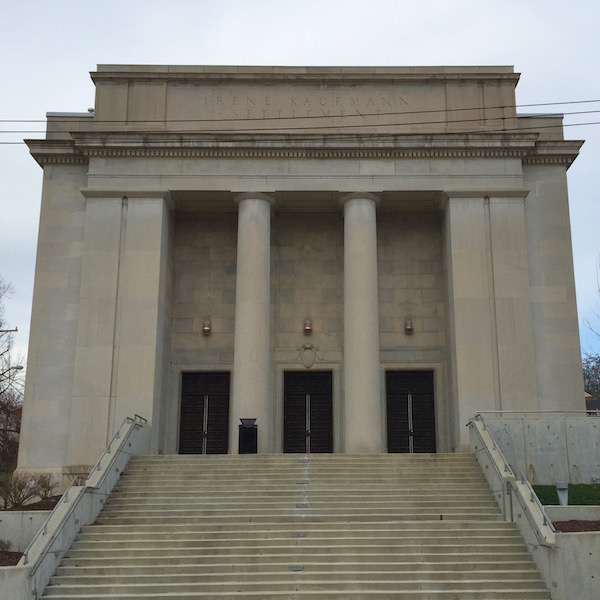
Hill House Association Kaufmann Center formerly the Irene Kaufmann Settlement, Pittsburgh, PA

Hill House Association – Kaufmann Center (former Irene Kaufmann Settlement), Centre Ave.

Those are all gone–along with (almost) everything else below Crawford and above Fifth Ave. But for a handful of former houses of worship outside of the arena project’s gluttonous reach, life has carried on in new and different incarnations.

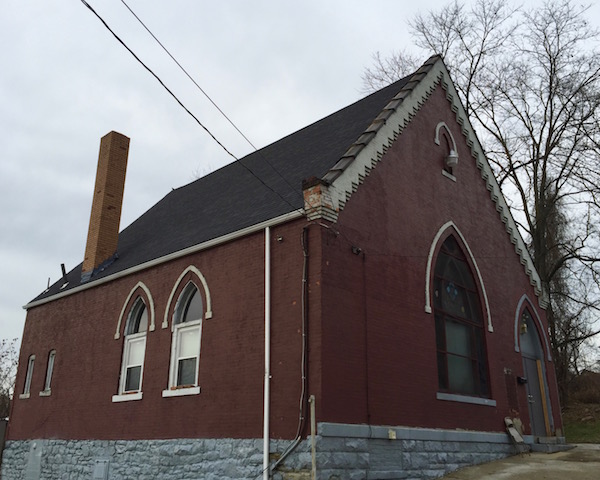
The three former synagogues we located–Shaaray Teffilah/Beth David and Kanascis Israel on Miller Street and Lebovitch on Erin Street–have all become Baptist churches. The former Irene Kaufmann Settlement on Centre Ave. now serves as one of the non-profit Hill House Association‘s main locations.

New Pilgrim Baptist Church formerly Kanascis Israel Synagogue, Pittsburgh, PA

New Pilgrim Baptist Church (former Kanascis Israel Synagogue), Miller Street

This loitering blogger met a very welcoming member of the Miller Street Baptist congregation when curbing his bicycle to take a photo of the church. She told me she’d been a member for 23 years and encouraged me to attend a service some time. Despite her very warm invitation, I wasn’t sure I could accept in good (err…bad) faith. That said, I would love to see inside the place. Had I been wearing something closer to Sundaygotomeetin’ duds and not running late to scour the woods for evidence of insurance fraud, I might have asked for a poke-see around. But it wasn’t going to happen this day.

Miller Street Baptist Church formerly Shaaray Teffilah Synagogue/Beth David Congregation, Pittsburgh, PA

Miller Street Baptist Church