Step Beat: Oakley Dokeley, The Oakley Way Rehab

Detail of public steps with mosaic decoration of a woman's head, Pittsburgh, PA

It’s a cruel reality: when you’re working the city step beat, there ain’t a lot of news to report. No, most of the stories we run end up being about going to visit steps that inevitably won’t be around for long, occasional Indiana Jones-style heroics to hike them, or the historical curiosities of infrastructure ruins that were once so vital and now–all too often–go nowhere and serve no one.

So it is with no small amount of glee that The Orbit goes to press with a story on not only the complete rehabilitation of a set of core city steps, but the genuine newsy news that they’ve been wonderfully dressed-up in brand-new full-color mosaic tile.

public steps with mosaic decoration including houses, sky, a fox, a bird, sun, and stars, Pittsburgh, PA

Oakley Way Steps, top mosaic section

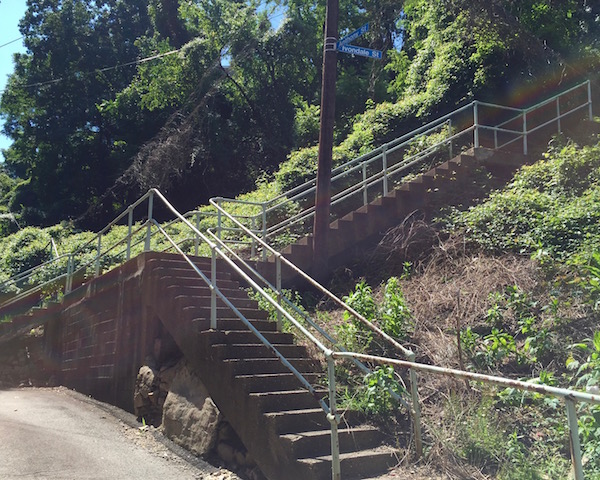
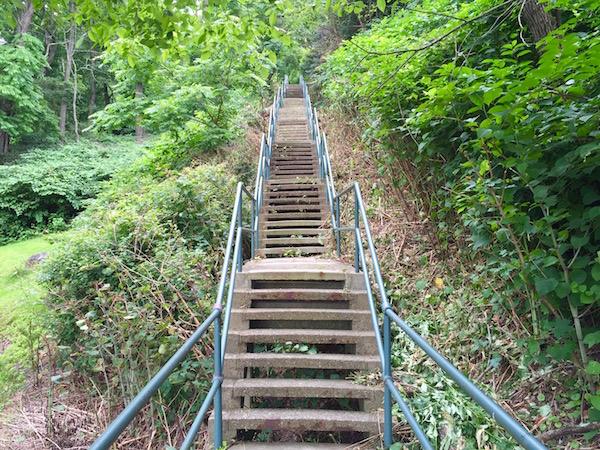
Oakley Way is one of the many climbs that create access points from the South Side Slopes above to the flats below (and vice-versa). The street is actually seven short (but mostly vertical) blocks long–part city steps/part steep road-with-steps sidewalk. The bottommost stretch (from Josephine to McCord) is the only section that’s received the mosaic treatment, but some of the upper sections have also been nicely rehabbed with patched concrete and fully repaired and repainted blue handrails.

Artist Laura Jean McLaughlin led a group of volunteers in the design, construction, and installation of the mosaic risers. That process was covered in a recent Post-Gazette piece that only scooped us because we got side-tracked by Fairywood and tryptophan and shelved the post for a month. Fooey!

looking up Oakley Street city steps, Pittsburgh, PA

Looking up: the Oakley Way steps

Spread across seventy-seven consecutive risers, the mosaic’s central figure is a tall red-booted woman in a checkered skirt who–based on the proportional size of the river, bridge, and factory building also in the piece–must stand about the height of the US Steel tower. Also decorating the lush scene are Slopes homes, grass, flowers, a fox, a bird, the sun and stars.

If you’ve seen any of McLaughlin’s other local projects you’ll recognize her loose, cartoonish, and earthy signatures. A lesser blog might invoke the term “whimsical,” or even (shudder) “funky”. The Orbit won’t stoop to that level, so we’ll just say they’re fun, very Slopes-centric, and a great compliment to the D.P.W.’s fix-up work.
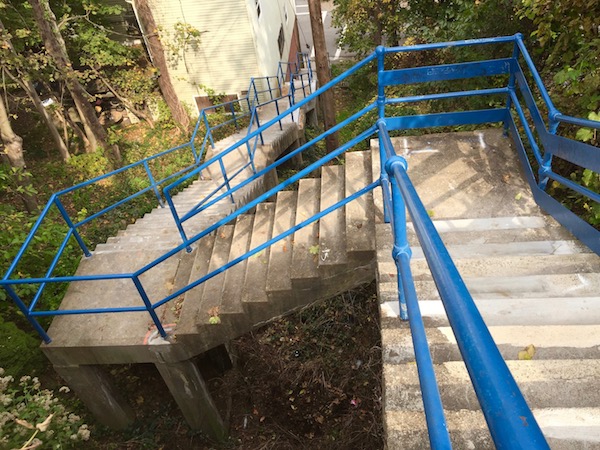
Oakley Street city steps, Pittsburgh, PA

View down the bottommost section of Oakley Way (from McCord Street)

We’ve argued in these very virtual pages that Pittsburgh’s network of public steps is a city asset unlike any other–part transit route, part jungle gym, part historical oddity, and what should be a big draw for tourism*. It’s encouraging to see any set of steps getting much-needed maintenance, but it’s especially great to see them dressed to thrill with such a wonderful addition as McLaughlin’s mosaic.

There’s at least one other similar project out there and completed. Linda Wallen’s mosaic work at the base of the steps off Itin Street in Spring Garden isn’t nearly as ambitious as Oakley Way, but it’s still a great twinkling beacon in the great constellation of city step dark stars. May these two heroic projects guide step freaks to a new, golden dawn of altitude adjustment, wide perspectives, and throbbing calf muscles.
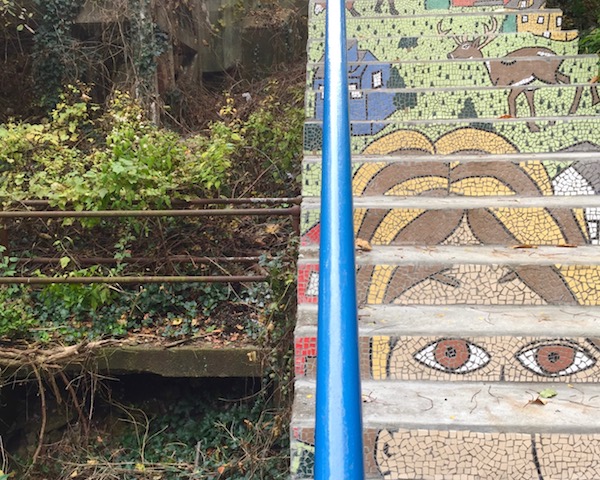
public steps with mosaic tile decoration of woman's head with houses and deer in the background, Pittsburgh, PA

Old and new: remnants of an earlier, defunct passage under the rehabbed Oakley Way steps


* Visitors who don’t want to lose their breath climbing dozens of flights of steps to dilapidated neighborhoods with spectacular views should consider lodging other than Chez Orbit’s fold-out sofa.
Fairywood: The World Without Us

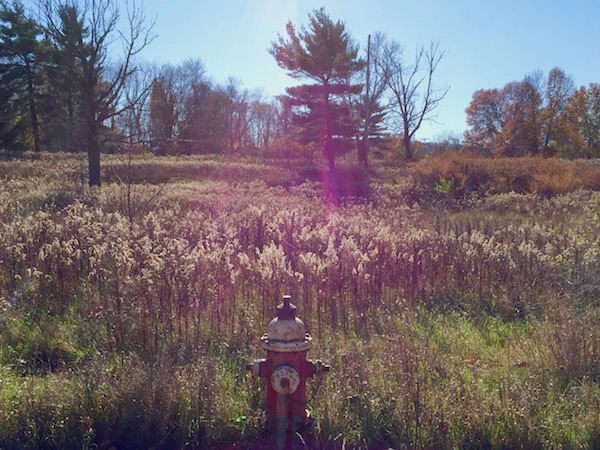
fire hydrant in field of tall weeds, Pittsburgh, PA

Former Broadhead Manor public housing project, Fairywood

Fairywood. Has any place as bucolic a name? One would assume it could only exist in fantasy–within Narnia or Neverland or, at least, New Zealand. Fairywood must be a land of eternal mist, riddle-spinning toadstools, magick staffs hewn from gnarled bentwood, spellcasting. It is where banshees live, and yes, they do live well. But one need not cross the Misty Mountains nor the darkest depths of Mordor[1]–it’s right here in the City of Pittsburgh.

If one were to set out for Fairywood, she or he might also optimistically hope to encounter pixies, gnomes, gremlins, griffins, or unicorns along the journey. Such other-worldly creatures simply must exist in the forest faerie realm. Alas, that was not this blogger’s experience.

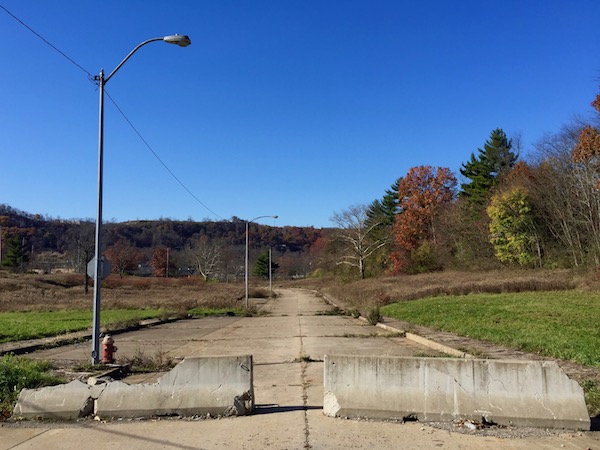
empty street with jersey barriers at entrance of former Broadhead Manor, Fairywood, Pittsburgh, PA

Entrance from Broadhead Fording Road

Look up Fairywood and you’ll likely come across some bad press. At this point, the peninsular neighborhood on Pittsburgh’s far southwestern border [it is surrounded on three sides by non-city boroughs] is mainly associated with two things: colossal ex-urban warehouses and off-the-charts crime.

The former is easy to see–along the south and west perimeters are huge distribution centers for UPS, ModCloth, Amazon, and Giant Eagle/OK Grocery. The hum of their idling 18-wheelers and beeps of reversing forklifts are omnipresent even from a great distance.

The latter is not so obvious. On a picture-perfect Saturday afternoon, we barely encountered a single living soul–and the ones we did meet were real nice! The sum of residential Fairywood is contained in four or five streets of pre-war frame houses and Baby Boom-era pill boxes and split-levels, plus one former project-turned-gated community. Only around a thousand people live here. Who’s committing all this crime?

cul-de-sac in former Broadhead Manor, Fairywood, Pittsburgh, PA

Cul-de-sac

Alan Weisman’s 2007 best-seller The World Without Us detailed the ways in which the built environment would inevitably deteriorate in the absence of human beings. I’ll confess I haven’t actually read the book, but Mrs. The Orbit did and relayed its projections of houses collapsing and cities overtaken by nature as I was suddenly getting much more aware of cracks in the plaster ceiling and loosening of our mortar joints.

By far, the most prominent feature of Fairywood today is the enormous negative space created by what was at one time the Broadhead Manor public housing project. In its absence is a massive plot of land–its footprint similar in size to a junior college campus or suburban shopping mall (including all the parking). The actual housing blocks have been razed and removed, but the infrastructure–several curling roads that terminate in dead-ends, street lights, sidewalks, fire hydrants, an absurd children at play road sign–all remain.

handrail and concrete sidewalk to urban prairie, former Broadhead Manor, Fairywood, Pittsburgh, PA

Handrail, sidewalks

Between these few remaining stretches of concrete, nature has come back hard and fast. It’s a very un-Pittsburgh landscape–almost completely flat (although you can see hills in the distance in any direction) and dominated not by trees, but instead with scrubby waist-high bushes, weeds, and wildflowers–much more midwestern than Appalachian. Nationally, these kinds of spaces have been coined urban prairies for a reason–they’re not quite nature without man, but they’re decidedly not city (as most tend to think of it) either.

That Broadhead Manor should or should not have been razed is a conversation for those who actually lived in and around it[2]. With no personal connection, it does strike me as a classic built-to-fail situation: warehousing people in closed-circle public projects at the most distant edge of the city in a neighborhood with neither business district nor many transportation options[3]. What could go wrong?

Man in winter clothes against chain link fence, Pittsburgh, PA

Mr. Ro Ro (note his wizard’s staff)

We met Mr. Ro Ro camped out on a folding chair, waiting for a bus on Prospect Avenue. A wizard’s staff was casually propped against the chain link fence. Mr. Ro Ro told us he’s lived in Fairywood for fifty years and said of Broadhead Manor, “Roosevelt built them after the war.” President Roosevelt’s connection is unknown, but Broadhead Manor was indeed former military housing, purchased by the city in 1946[4].

As the only human wandering through the strange dystopian landscape of an ex-neighborhood with all its buildings removed–now almost completely reclaimed by nature–the irony of the phrase “after the war” was ringing in the air. More than anything else, this huge section of Fairywood feels like what’s left after the nuclear winter has finally subsided and an entirely new form of nature begins again on the bones of the civilization that destroyed the old one. Let’s hope we get it right this time.

dead end street in former Broadhead Manor, Fairywood, Pittsburgh, PA

The end of the road


[1] It is telling that The Orbit‘s knowledge of Middle Earth comes more from Houses of the Holy than The Player’s Handbook.
[2] A post in the Abandoned, Old & Interesting Places – Western PA FaceBook group shows some of the housing after the residents had been moved but pre-demolition. It includes many comments–both positive and negative–including quite a few former residents who speak glowingly of their time at Broadhead Manor in the 1960s.
[3] Port Authority’s 27 bus route serves Fairywood and nearby neighborhoods with a link to downtown Pittsburgh.
[4] Fairywood Fact Sheet (date unknown) http://digitalcollections.library.cmu.edu/awweb/awarchive?type=file&item=550317

Castle Damas

retaining wall on hillside constructed to look like medieval castle, Pittsburgh, PA

Castle Damas, Spring Hill

Rick Sebak’s inevitable future Pittsburgh history documentary Great Retaining Walls of Allegheny County should begin right here, in Spring Hill.

Castle Damas[1], a medieval fortress whose turrets and battlements were formed from mortar and stone rises with a spectacular view of the lands it holds dominion over–through the valley, down to Spring Garden, and across the river to the Strip District.

That these impenetrable walls should stand just up the block from the Spring Hill spring is no accident. The first settlers of Damas Street wisely selected an optimal site for defense, visibility, quality of life, and its free-flowing supply of life-sustaining cleanish natural spring water[2].

house with retaining wall on hillside constructed to look like medieval castle, Pittsburgh, PA

The keep and battlements of Castle Damas

Given the news of the week, we can assume we’ll all be getting a little more familiar with wall-building. On our recent visit, we were fortunate enough to meet the lord or this particular manor, who’s probably got as much wall experience as anyone. This day, our regent was engaged in maintenance of the structure, giving his naves a precious Saturday off and pulling weeds from the parapets himself. Lord Damas [Swiss cheese-for-brains failed to record the homeowner’s given name] told us his hilltop house was built in 1926 and its first owner, a baker, began construction of the elaborate wall around 1933.

Perhaps because it hasn’t been around quite as long as its European cousins, the castle wall and its bungalow-style keep are in impressive condition. Our liege told us he’d had to rebuild the top left half of the battlements and after pointing it out, the different colored mortar makes that somewhat obvious–but there’s enough variance in the stonework that this masonry-challenged blogger probably wouldn’t have noticed otherwise.

figure of an owl created with concrete and reflectors, Pittsburgh, PA

The owl of Castle Damas

Brendan Gill, (then) architecture critic for The New Yorker, famously wrote “If Pittsburgh were situated somewhere in the heart of Europe, tourists would eagerly journey hundreds of miles out of their way to visit it.”[3] This blogger’s about as crazy cuckoo coconuts on Pittsburgh as anyone, but even he can recognize hyperbole when he trips on it.

That said, when just any old anonymous hillside street gives us these cross-city views, this public spring, and a terrific faux castle/retaining wall overgrown in beautiful wildflowers and fall colors, birds–even a guard owl–well, who are we to argue?

retaining wall on hillside constructed to look like medieval castle, Pittsburgh, PA

Castle Damas


[1] “Castle Damas” is Pittsburgh Orbit‘s name for the construction–don’t bother looking it up (at least, not by that name).
[2] We’ll note that the construction of the uphill houses on Damas Street was considered a contributing factor to the discoloration and impurity of the sping’s water.
[3] In the same quote, Gill also claims “The three most beautiful cities in the world are Paris; St. Petersburg, Russia; and Pittsburgh,” but if the guy has never even been to Akron, take it with a grain of salt.

Get Out The Voegt: Finding the Spring Hill Spring

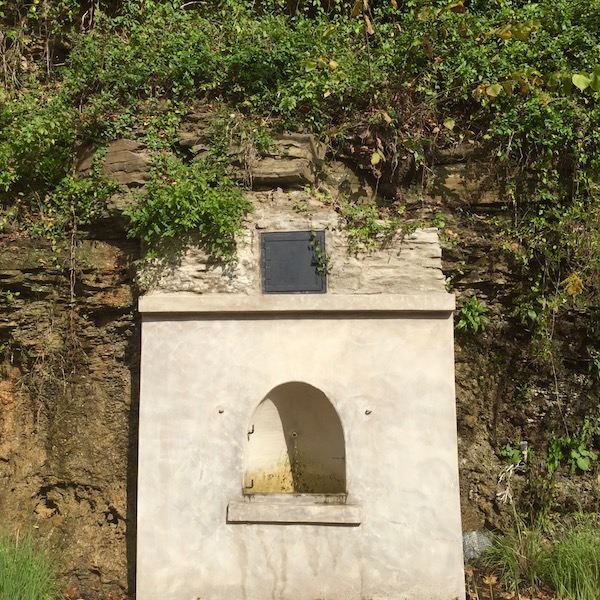
natural spring in concrete pedestal embedded in hillside, Pittsburgh, PA

Spring is sprung: Voegtly Spring, The Spring Hill spring

Ask a Spring Hill local how to get to the neighborhood’s newly-unearthed and re-opened natural spring and he or she will make it real easy for you: “It’s right by the boxing ring.” Me: “Oh, thank you very much, that helps a lot. Just one more question: where’s the boxing ring?”

From there, it just gets more confusing. The “boxing ring” is actually the Steel City Boxing Association and Google Maps puts it way down the hill from its true location. Assuming you do find the right place, the stonework is engraved Hook & Engine Co. 53 for its (former?) life as a fire hall and contains no after-market mention of the sweet science.

How about the Internet–a recently excavated and restored piece of local history should be front page news, right? Well, you try a web search for “Spring Hill spring”–it’s un-Googleable! Spring Hill’s Internet presence doesn’t assist at all–there’s nary a peep about the spring from the neighborhood associations or its wiki page. C’mon, guys–help a blogger out!

Rest assured, dear reader: if we achieve nothing else, The Orbit will get you to the Spring Hill spring.

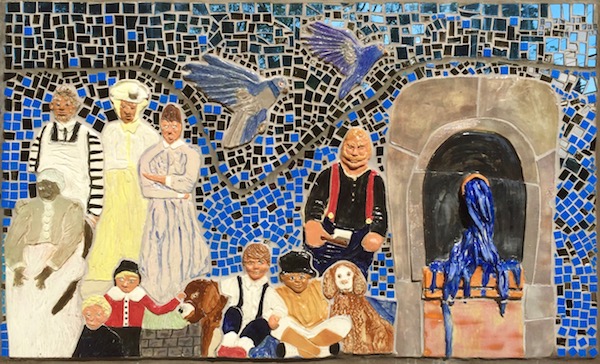
Detail from public mosaic "The German Settlers of Spring Hill" depicting the Spring Hill spring, Pittsburgh, PA

“The German Settlers of Spring Hill” (detail) mosaic depicting Voegtly Spring, Spring Hill

A large mosaic installation titled The German Settlers of Spring Hill welcomes visitors near the corner of Homer and Damas Streets*, one of just a few access points to the hilltop neighborhood. The final section of the four-panel piece features various community members in old world garb gathered around the image of the hearth-like Voegtly Spring, the natural water source that gave Spring Hill its name.

In that depiction, the spring is a flooding outpour overflowing its basin, its output equal to a dozen garden hoses. That’s not exactly what we found. The constant stream of water–there is no Off valve to a natural spring–is more of a dribble or a trickle than the gusher one might expect from the artwork mere feet away. That may have something to do with us visiting after a run of dry weather, so we’ll have to go back to verify after a decent stretch of rain.

masonry enclosure around pipe dribbling natural spring water, Pittsburgh, PA

The spring

Some background, from the Voegtly Spring historic nomination form**:

A stream ran down from the top of Spring Hill, ran through the intersection of Humboldt St. (now Homer St.) and an unnamed street (now Damas St.) and down into modern day Spring Garden (Fig. 4). In 1912 a rectangular stone and concrete structure was built into the shale hillside alongside Damas St. (formerly Robinson Road) to harness the flow of water beneath the ground to provide easy access to drinking water for the residents of the neighborhood and surrounding area.

The nomination form goes on to mention that “the spring water was tested and shut off sometime in the 1950s” and that house construction above the spring “may have contributed to [its] contamination”. Furthermore, “It is reported that during this time the spring water developed a distasteful odor and became a yellowish orange color.”

There’s no official word on whether the discoloration is still in effect, but it looked fine to my admittedly low standards. Despite the warning that “public works does not encourage its use because [the water] is not treated”, it’s certainly right there for the drinking and let’s face it: it’s cool to suck spring water right out of the hillside. Lesser journalists–speculative or otherwise–would turn toward home after snapping some pictures, but this blogger rushed in for a righteous century-in-the-making quaff.

glass of water from Voegtly Spring, Pittsburgh, PA

No discoloration here. Voegtly Spring water.

So…what does Voegtly Spring’s water taste like? Well, it ain’t Perrier, that’s for sure. If it’s not too vague, we’ll describe it as earthy, or maybe minerally. Flavorful–but I wouldn’t describe that flavor as desirable. It’s maybe a little gritty–like a woodsy stream–surprisingly warm, and decidedly different from city tap water (for good or bad). That said, it doesn’t have the natural toe-tingling effervescence of more celebrated waters. I’ll go out on a limb to suggest it’s unlikely we’ll encounter Winnebagos parked on Damas Street with tourists filling five-gallon jugs like you regularly see down in Berkeley Springs.

I’ll be honest: there’s not a lot else to do at the spring. You can drink from it straight like a water fountain and you can fill up a jug. That’s pretty much it. As entertainment, a visit is pretty low rent compared to, say, Pac-Man or The Jumble. Regardless, it’s a neat little old world nugget to trip across if you find yourself hanging out by the boxing ring or, more practically, desperately need some hydration and can’t quite make it down to Penn Brewery.

Here, on this eve of an incredibly important national election, we can only recommend that Orbiteers first get out and vote. And then, if you’re still not satisfied, get out and Voegt.

masonry enclosure for natural spring in hillside, Pittsburgh, PA

Voegtly Spring, The Spring Hill spring

Getting there: Voegtly Spring is on Damas Street, just off Homer. When you see the old Hook & Ladder Company or the big public mosaic/garden, you’re real close. The easiest way to get there (especially on bicycle) is from Spring Garden Avenue, up the hill on Homer. We’ve also added a pin for the spring to our Map page.


CORRECTION: An earlier version of this story quoted an August, 2016 Post-Gazette piece on the re-opening of the spring that incorrectly lists Fred and Wilbert Bergman as the builders. The Bergmans took the earliest known photograph of the spring, but construction was done by the city Department of Public Works.


* The mosaic was constructed by a large group at the leadership of Linda Wallen, whose Yetta Street mosaics (also in Spring Hill) we profiled last year.
** A big thank-you to Spring Hill resident James Rizzo for helping to clarify the facts on ownership and construction of Voegtly Spring.

Union Dale Cemetery: The Lamb Lies Down on Baahway

iron grave marker of a lamb, Union Dale Cemetery, Pittsburgh, PA

(unknown)

Union Dale Cemetery‘s Division Three, Section b (yes: that’s a lower-case b) lies waaay in the back, at a high point in the park, bordered by treelined fencing that separates the property from nearby Presley Ridge School. Section b is so far removed that it doesn’t even appear on the cemetery’s online maps*.

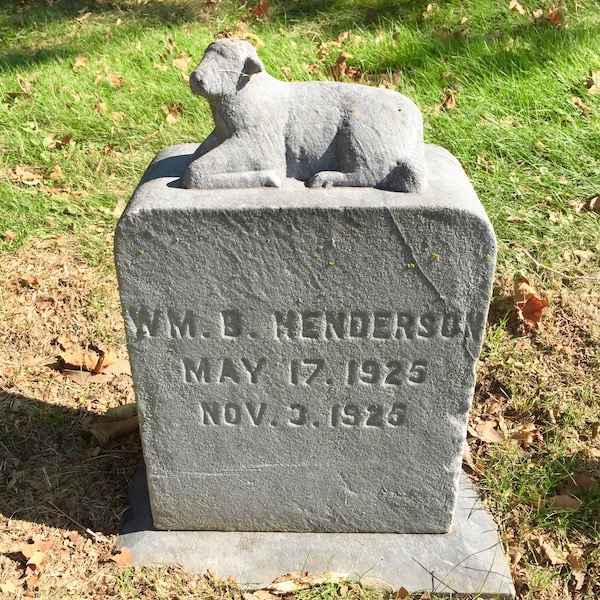
But if you can make it out to Union Dale’s far northeast outpost, the tell-tale shapes of lambs popping up on gravestones and laying down in the grass will tell you you’ve reached the right spot. The creatures will be calmly resting, their little lamb ears pointing out at the sides. Each one of them will face the same direction.

weathered gravestone with lamb, Union Dale Cemetery, Pittsburgh, PA

Wm. B. Henderson

weathered gravestone with lamb, Union Dale Cemetery, Pittsburgh, PA

Jane Lee Blumfeldt

Listen here: when we shoot the sheep, we’re not talking about any jive-ass 2-D cutaways or bas relief lambs, either–though there’s plenty of those loitering on newer stones in the same neighborhood. No, this is full-on, worn-to-nubs marble and granite lambitude.

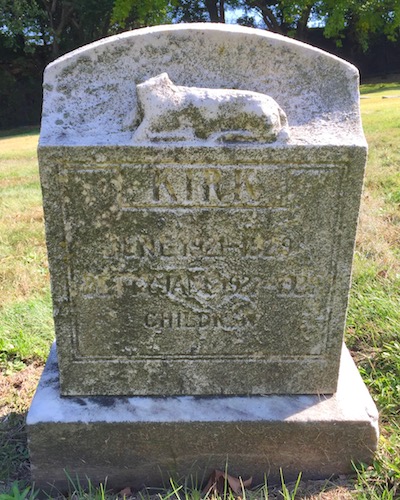
Two of the specimens (Kirk and Klein, photos below) seem to be the same general make and model, but otherwise each gravestone is unique. That’s not to say the lambs don’t look alike–they do–but there’s enough variance here to suggest these weren’t simply off-the-shelf lamb-on-a-box markers.

weathered gravestone with lamb, Union Dale Cemetery, Pittsburgh, PA

Kirk

weathered gravestone with lamb, Union Dale Cemetery, Pittsburgh, PA

Ralph A. Klein

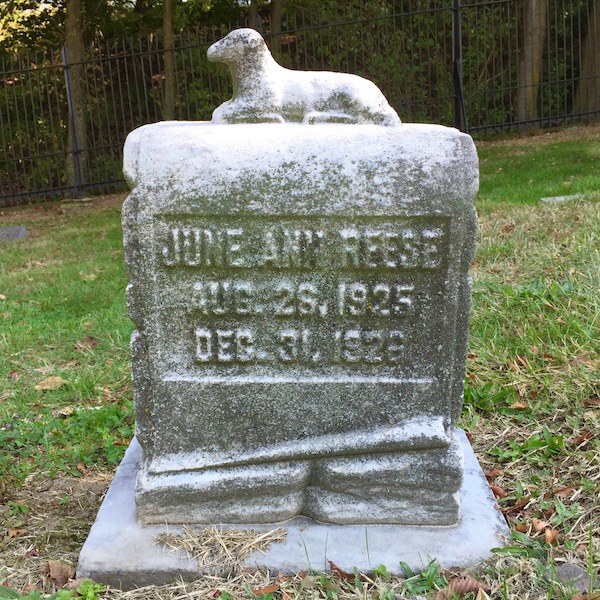
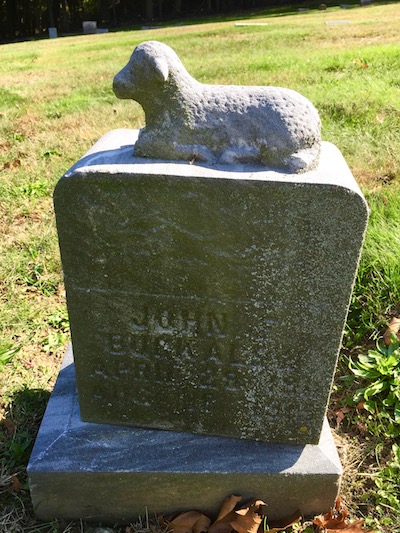
Jennie Benford, our Concierge to the Dead, says “The lambs were very popular but almost exclusively for children’s markers.” The Internet backs her up on this claim, as does the anecdotal evidence of the dates we can see on the (still-legible) stones here. The deceased were all between months and just a few years old when they arrived at Union Dale and given the concentration in this one small area, we have to wonder if Section b was earmarked as plot for children.

The association of lambs with the death of children has a number of explanations, but the most common seems to this passage from the Bible:

The next day John seeth Jesus coming unto him, and saith, Behold the Lamb of God, which taketh away the sin of the world.  — John 1:29

weathered gravestone with lamb, Union Dale Cemetery, Pittsburgh, PA

(unknown)

weathered gravestone with lamb, Union Dale Cemetery, Pittsburgh, PA

June Ann Reese

There are other similarities. Every one of the markers (that we’re able to read) is dated from the same decade. Jennie assures us “The lamb stones are not strictly 1920s–I’ve seen them used much earlier than that and for some time after,” but it’s an interesting data point.

The lamb is always sculpted alone and awake, but in a resting position with its legs folded underneath. I imagine there is a practical aspect to this–sculpting those spindly legs from delicate marble is likely very expensive and accident-prone. That said, one has to accept that the feeling of innocence is even more pronounced with the gentle creature in repose. What could be more harmless and vulnerable than a kneeling fluffy white lamb?

Perhaps most curious, every single lamb faces to the left (as the visitor faces the stone)**. Now, that may just be a coincidence in our small sample, but if so, it’s equal to flipping “heads” ten times in a row. Still, reading any dramatic symbolism into facing left vs. right seems like a major stretch. Left, in this case, is also north, since all the stones face the same direction–west, or downhill and towards the only small access road. Again: likely not a planned coordination.

weathered gravestone with lamb, Union Dale Cemetery, Pittsburgh, PA

(unknown)

weathered gravestone with lamb, Union Dale Cemetery, Pittsburgh, PA

Catherine Achey

Union Dale Cemetery is an intimidating place to explore. It covers a huge area–likely equal to the size of Allegheny Cemetery or many (larger) city neighborhoods. The full plot is divided by Brighton Road and Marshall Avenue/Rt. 19, which effectively turns the park into three separate cemeteries. [Union Dale labels each of these a division.]

It’s hard to imagine there’s any best or worst way to take in Union Dale for the newcomer. That said, like so many things in life–or, it seems, in death–there’s nothing wrong with ending up at Plan b.

weathered gravestone with lamb, Union Dale Cemetery, Pittsburgh, PA

John Buckalynn


* Section b should not be confused with Section B, right by the entrance. Also, it looks like Union Dale’s PDF maps may have a page 2 that just didn’t make it to the web site.
** Two of the markers photographed are simply freestanding sculptures without an engraved headstone, so there is no left or right.

Allegheny Cemetery: Mausoleum Stained Glass

mausoleum stained glass with pentagram, Allegheny Cemetery, Pittsburgh, PA

Sproal-Splane

Seeing the world through the Orbit eye. Those words came to us a while back from superfan Lee, and we accept it as the ultimate compliment. Lee still requires corrective eyewear–so be warned that Pittsburgh Orbit is no substitute for Lasik–but we think we know what he was getting at.

If Orbit “reporting” has taught us anything at all, it’s to always take another look. Lose the expectations and open up the senses. Point those peepers everywhere you can: down the alley, around the corner, on the pavement, up in the telephone wires, and through the crack in the window. Like Irene Cara said: take your pants off and make it happen. What a feeling, indeed.

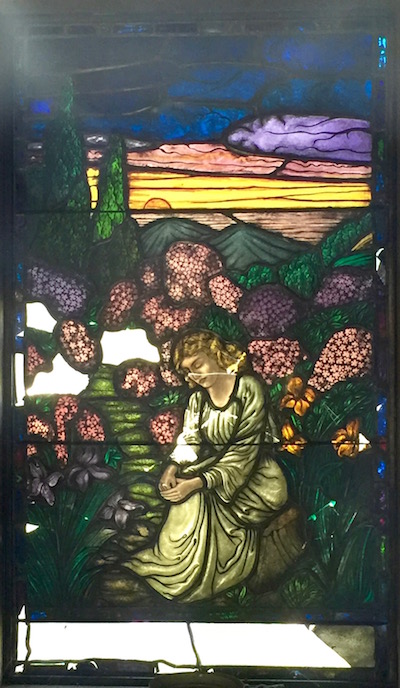
broken mausoleum stained glass with sitting woman and field of flowers, Allegheny Cemetery, Pittsburgh, PA

James M. Miller

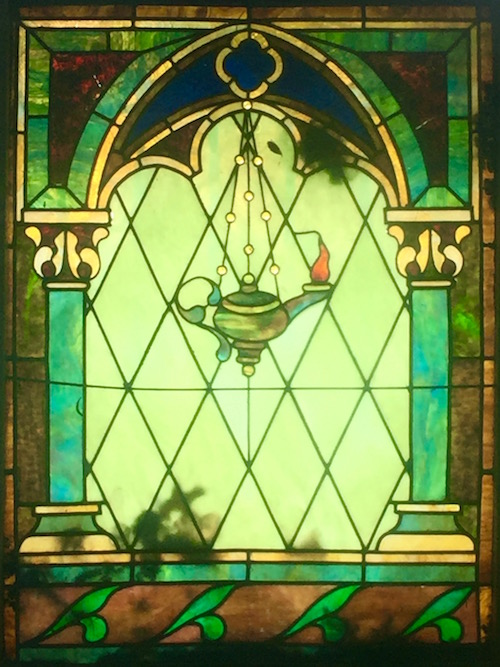
mausoleum stained glass of oil lamp hanging in arched window with columns, Allegheny Cemetery, Pittsburgh, PA

Unknown (possibly Krey, based on nearby cenotaph)

One of those spots, attentive Orbit readers will have anticipated by now, is through the thick barred grates, cobwebbed glass, and musky air of the ornate mausoleums at our historic cemeteries. Pittsburgh is sitting on a bunch of these.

This blogger has walked through, bicycled around, picnicked in, and shutterbugged Allegheny Cemetery literally hundreds of times over the last couple decades. Allegheny’s collection of mausoleums isn’t quite as spectacular as the rock star ones we toured with Jennie Benford last year at Homewood, but it’s nothing to scoff at.

The mausoleums act as both beacons and exclamation points on the rolling landscape and much of the art deco and faux-Egyptian architecture is really astounding. But for whatever reason, we rarely ever took the opportunity to shade the eyes and poke the schnoz in to check out the interior spaces.

mausoleum stained glass with angel, Allegheny Cemetery, Pittsburgh, PA

Unknown (detail)

mausoleum shelves with trophies in front of colored glass, Allegheny Cemetery, Pittsburgh, PA

Sheets

I’ll tell you: it’s not an easy thing to do. The average mausoleum–in Allegheny Cemetery, at least–seems to have a pair of thin, highly-decorated entry doors, each behind some version of vertical iron bars or decorative scrolled metalwork. Half the time, the original door locks are still in use, if not, there’s an awkward after-market steel chain and padlock lashed around whatever it can grab ahold of.

If you can see much inside, it’s typically a narrow passage, just wide enough for a person to turn around in, flanked by the celebrated residents’ crypts. Sometimes there’s just one of these on either side; others are stacked floor to ceiling. At the rear of almost every mausoleum is a stained glass window providing the only natural light outside of the shaded entry doors.

So to look inside a mausoleum is to peer through several layers of obfuscation, from the outside daylight into a darkened interior that may have had a hundred years since its last human visitor.

broken mausoleum stained glass with architectural design, Allegheny Cemetery, Pittsburgh, PA

King

mausoleum stained glass with angel in green tunic, Allegheny Cemetery, Pittsburgh, PA

Wettengel (detail)

And what do we get to see in the stained glass? In a word: flowers–lots and lots of flowers. Flowers in vases, flowers in gardens, ornamental flowers, and flowers held by angels; lillies of the valley and daffodils of the foothills. We only included photos for a few of these; the flowers are quaint, but they’re just not that exciting.

Beyond the flora, however, there’s some pretty neat stuff. An old-school oil lamp dangles under an arched cathedral window with ghostly leaf shadows backlit from the outside; angels appear with painted-on faces, doe-eyed and calming; and, of course, in that chestnut of mortal symbolism, the sun sets over and over again in Mausoleumville.

There are also the broken panes. Windows whose heavy weight, coupled with a hundred years of un-climate-controlled Pennsylvania weather, eventually overburdened the lower sections. Individual colored pieces have popped out and cracked, leaving the windows looking like incomplete paint-by-numbers; the unimpeded sun’s glare the brightest element in the tiny space.

broken mausoleum stained glass with arch and white flowers, Allegheny Cemetery, Pittsburgh, PA

Lillian Russell Moore

Is it worth a trip? Well, Allegheny Cemetery is absolutely worth all the time you can give it–even if you don’t want to squint into (silent film star) Lillian Russell‘s final repository. But while you’re there, yeah, you should neb into whoever’s crypt you can. The Sheets and the Kreys and the Sproal-Splanes don’t seem like they’re coming around anymore, but don’t worry; we’ve got that Orbit eye looking out for them.

Ghost House: East Liberty Farmers Market

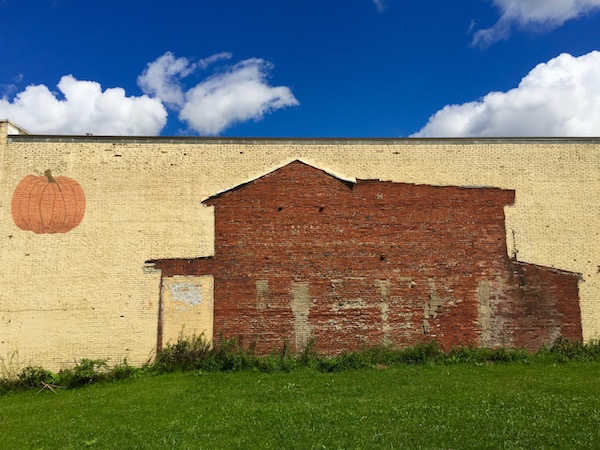
Ghost house with giant pumpkin mural, Pittsburgh, PA

Under the pumpkin moon. The Sheridan Ave. ghost house.

If, nay, when Pittsburgh creates the Ghost House Hall-of-Fame, the imprint on the side of the East Liberty Farmers Market building will certainly be in the very first class of inductees.

It’s just got everything: the perfect lines, the front porch and rear addition details, the unpainted red brick as negative space against the larger building’s long pale yellow wall, luscious green wall-to-wall shag…grass–even an antenna (?) pointing up from the back porch.

There’s not a lot left to the imagination here. Look around town and you can still see standing houses just like this one all over the place. The two-up/two-down design is a pretty standard Pittsburgh row house shape. This one clearly had the very common early flat roof additions off the back, usually to bring the kitchen indoors and provide a bath and extra bedroom upstairs.

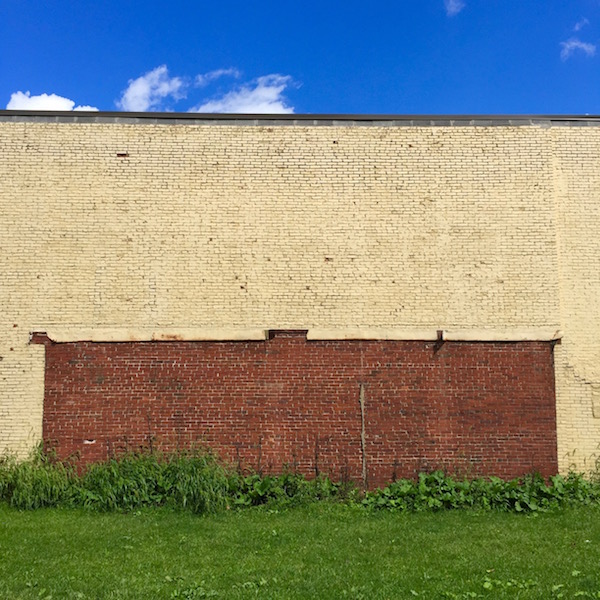
ghost garage, Pittsburgh, PA

Ghost garage

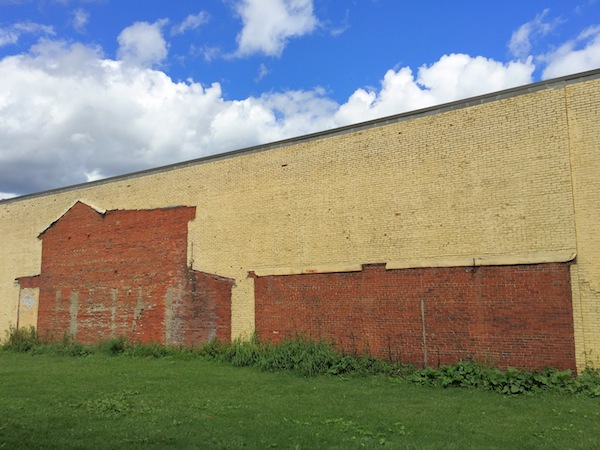
Was it Bob Vila or The Torch Marauder who said: have you seen the back? If the main house wasn’t enough to talk you into this beauty, let me remind you it comes with a fully-dysfunctional two-car ghost garage. It’s nothing fancy–one story tall with a flat roof–but the depth (basically equal to the entire house!) suggests you could park a couple LeSabres, LeBarons, LeMans, or LeCars in there and still have room for le beer fridge, le wood shop, le ping pong table, and some extra le storage for your Hallowe’en decorations.

I can see what you’re thinking–this a little too much of a “fixer-upper” for me–am I right? Granted, the house needs some work–like, pretty much everything–but just imagine the possibilities! That, and it couldn’t be more conveniently located for a rehab job. This ghost property is literally right across the street from Home Depot. You can be in and out in the blink of an eye…just like a ghost.

ghost house and garage, Pittsburgh, PA

Ghost house and garage


Step Beat: Anthony and Ivondale

intersection of Anthony Street and Ivondale Street city steps, Pittsburgh, PA

Anthony and Ivondale streets, The Run

They’re not the longest or the prettiest. They’re not one of the great nature-in-the-city hikes, and there’s not much of a view. Heck, these steps don’t even fulfill the most basic purpose of infrastructure: you can’t go anywhere on them!

So why are we even reporting on the Anthony and Ivondale city steps? Well, this blogger will tell you. There’s a time for greatest hits and, as Buck Dharma so wisely reminds us, there’s a time to play B-sides. On the back of the platter, Anthony and Ivondale still earn the occasional spin, and it still sounds…er, walks pretty good.

The onion domes of St. John Chrysostom Byzantine from the Anthony/Ivondale intersection, Pittsburgh, PA

The onion domes of St. John Chrysostom Byzantine from the Anthony/Ivondale intersection

Last year we reported on the wonderful existence of the great Romeo & Frazier intersection in an overgrown hillside of South Oakland. That particular confluence of city steps is remarkable for a number of reasons, not the least of which is Pittsburgh’s commitment (at least, historically) to pedestrian thoroughfares as fully-accredited “streets.”

We see the same great treatment at the corner of Anthony and Ivondale, where the steps are given their own street light and signage. Only here, the whole enterprise is more absurd since there’s not really any chance of either walking these steps in the dark or needing directions to where they’re (not) going.

intersection of Anthony Street and Ivondale Street city steps, Pittsburgh, PA

Looking up Ivondale Street from behind St. John’s

The other obvious factor on any step-trekker’s noodle is that this particular pair of step-streets is almost surely on the endangered list. At one time, Anthony Street must have continued all the way up the hill to Greenfield*. That would have connected residents of The Run up to Greenfield’s commercial district and uphill parishioners down to the mighty St. John Chrysostom Byzantine Catholic Church.

But those aren’t really well-travelled routes any more–at least, not on foot. In fact, they’re so neglected that you can only walk a tiny minority of Anthony Street before you’re met by an ocean of out-of-control overgrowth that completely blocks passage on the through-way**.

city steps overgrown with weeds, Pittsburgh, PA

Pittsburgh Babylon: Anthony Street’s long, inaccessible climb up to Greenfield

Anthony & Ivondale will never be destination steps like Rising Main or Little Jewel Street or the “Try Try Try” steps. But if you find yourself in The Run for a large sandwich at Big Jim’s or just passing through en route between the Schenley Park and “Jail Trail” bicycle runs, it’s well worth the stop and poke-see. You won’t get lost; there’s nowhere to go.


* Looking at the map, it seems like Anthony probably terminated at tiny Raff Street, itself just an extension of Alger Street, a block off Greenfield Ave.
** Already on the list is going back in the winter when we can see what’s left when the knotweed has died off.

Step Beat: Climbs 57

looking up long set of city steps, Pittsburgh, PA

Looking up the lower section of the 57th Street steps

Has Pittsburgh fifty-seven varieties of city steps? Maybe.

It’s an intriguing question. There are long and short sets of steps; steps on the side of the street and steps alone in the woods. There are steps of wood, metal, and concrete; steps in good repair and ones that are falling apart; open steps and ones permanently closed. Some have special bicycle ramps added; others just tell you to Try. There are steps with crazy turns and angles and steps that just go up one straight line. There are steps the whole neighborhood uses, step street intersections, and steps that no longer go anywhere.

It would probably take a significant imagination to keep this riff going all the way out to the magic number. However, we know Henry J. Heinz considered 57 to be a lucky number*, and if it’s good enough for the king of condiments, it’s good enough for Pittsburgh Orbit. We certainly felt lucky after a climb up the very fine 57th Street Steps in Lawrenceville.

city steps with older home, Pittsburgh, PA

Step-accessible (only) house at the bottom of the 57th Street steps

city steps at 57th and Duncan Streets, Pittsburgh, PA

The intersection at Duncan Street, mid-point in the 57th Street steps

The steps that make up the pedestrian section of 57th Street qualify as at least two of these varieties. The lower half, from where Christopher Street forks off 57th up to Duncan Street, is in immaculate shape. The treads and rails are all perfectly maintained, with easy clear passage. The surrounding foliage has been neatly trimmed and there was no litter the day we visited. There’s even one remaining house that is only accessible via the steps.

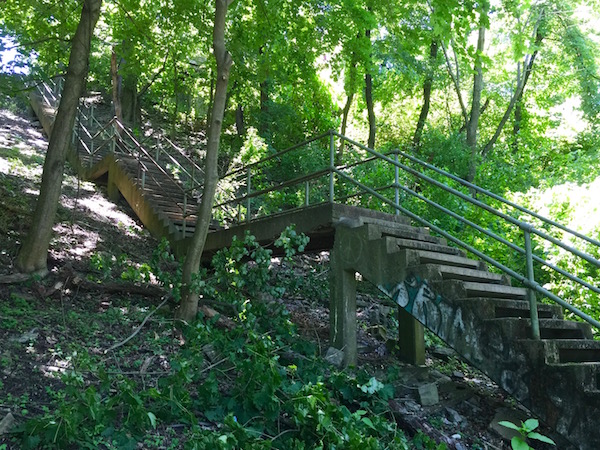
An the upper half? Well, that’s another story. In the middle of a lush Pittsburgh summer, dense knotweed has enveloped the majority of this stretch with just enough room for the city trekker to go full-on Indiana Jones. [Note to readers: bring a fedora, whip, and satchel.] It’s clear this batch is neither as well-loved nor as well-used as its downhill sibling. Still, it offers a great off-the-grid version of the step experience, which is just as much of what we’re after.

city steps nearly overgrown with knotweed, Pittsburgh, PA

Entrance to the upper section of 57th Street steps (at Duncan Street)

looking up city steps covered by trees, Pittsburgh, PA

Looking up the upper section of 57th Street steps

If there’s a bummer to the 57th Street steps, it’s that you’re stuck with a straight up-and-back trip–there’s no looping around for a more interesting walk/hike. Somewhere around half-way up the top stretch (above Duncan), you hit a pretty decisive end-of-the-line. The treads are gone, trees and weeds have overtaken what’s left, and a clear Steps Closed barrier has been placed across the route.

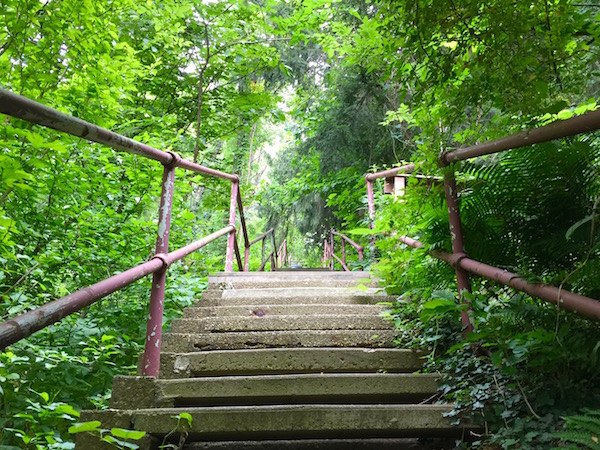
At this point, the red handrails continue, tantalizing us by disappearing into the hillside. The map shows that at one point the steps terminated up on Price Way in Stanton Heights, but that connection seems unlikely to be re-opened–at least until The Orbit gets put in charge of public works. Until then, pass the ketchup.

city steps missing treads with "Steps Closed" sign blocking the way, Pittsburgh, PA

End of the line: top of the 57th Street steps


* Heinz famously had way more than 57 different food products when the “57 Varieties” tag line was dreamed up and added to packaging.

Step Beat: Basin Street Blues

Looking down the Basin Street city steps, Pittsburgh, PA

Looking down from near the top of the Basin Street steps, Troy Hill

If there are more stereotypically Pittsburgh names for a couple streets than Brabec and Voskamp, point this blogger to them. That these two short residential ways (in Troy Hill and Spring Garden, respectively), should be connected by a picture-perfect set of city steps is all the more apropos. Action, scene, cut, and print.

Top of the Basin Street city steps at Brabec Street, Pittsburgh, PA

Top of Basin Street at Brabec Street, Troy Hill

Tripping across a new set of city steps is no great feat–there are hundreds of them after all*. But randomly arriving at a stretch as spectacular as the Basin Street steps doesn’t happen every day. The couple hundred individual risers that connect these two near North Side neighborhoods have everything the step trekker and urban daydreamer could possibly hope for–theater, tranquility, history, and mystery.

View of Spring Garden and Spring Hill neighborhoods from the Basin Street steps, Pittsburgh, PA

View from the steps: Spring Garden (below) and Spring Hill (above)

Steps, by their altitude-adjusting nature, almost always offer something in the way of rewarding city vistas and Basin Street is no exception. The view from the very top (at Brabec Street) is shrouded in trees, but multiple points along the way offer terrific angles through the branches down to the Spring Garden bottoms below and up into the lush hillside of City View/Spring Hill above.

Thick tree cover and hand rail from city steps, Pittsburgh, PA

Hill view from the steps

Aside from the surround-sound bird chirping and song-singing–plus one indefatigable opossum loitering in a Voskamp Street back patio–not a creature was stirring in or around Basin Street on the day we visited. It is this gentle peace right in the center of the city that makes a great set of steps so special.

Basin Street has its requisite signs of humanity–foundations for long-gone homes off to the sides and no small amount of litter left by teen drinkers and hill campers–but it generally has more of the feeling of being way out in the woods. It’s fair to say that this particular wood still features the sounds of weed whackers, dudes working on cars, and distant classic rock wafting through branches–but a wood nonetheless.

Looking up the Basin Street city steps, Pittsburgh, PA

Looking up the Basin Street steps

Like Tolstoy’s happy families, each story of the city steps is in a sense the same: a wonderous artifact of urban infrastructure still exists, relaxing in repose on and under-visited city hillside. Nature, time, and tide reclaim as much as the Pittsburgh D.P.W. allows. The occasional pedestrian saunters through, but they exist mostly in a time of their own.

On the other hand, though, each passage of steps–at least the really glorious, long, secluded ones like Basin Street–offer their own unique experiences: different views, twists and turns, different high, lows, and end points. Rising Main, it ain’t, nor does it have the clusters of great steps like Fineview or the South Side Slopes, but this little backside of Troy Hill is well worth the trip. Big ups to the Basin.

View of the Spring Garden neighborhood from the Basin Street city steps, Pittsburgh, PA

Voskamp Street, Spring Garden, from near the bottom of Basin Street


* There is no official number, but the estimate is somewhere around 750 sets of public steps in Pittsburgh.