The Mystery of the Tip Top Chop Shop

Wooded hillside in early fall

There’s cars in them thar hills. Looking up at the former hillside chop shop location.

It’s a truth among bloggers that if you haven’t had your “Geraldo moment” then, you know, welcome to amateur hour: you’re not really blogging, dude. This citizen-journalist/new media shaman (err…shamed man) is here to say he’s been through the eye of the needle and is back to tell the tale.

We certainly didn’t expect our Waterloo to arrive on a glorious sunny fall morning, the echoes of a classic Casey Kasem American Top 40 from ’72 still ringing in the ears. [What a great era when “Popcorn” by Hot Butter could chart! You try catching Moog-based instrumental proto-disco on “terrestrial radio” nowadays.] But there we were, on a pristine wooded hillside, high above Turtle Creek (the actual creek, not its namesake town). This post, its lack of sound and/or fury, may forever mark The Orbit’s Little Big Horn, our little corner of the blogosphere’s Mystery of Al Capone’s Vaults.
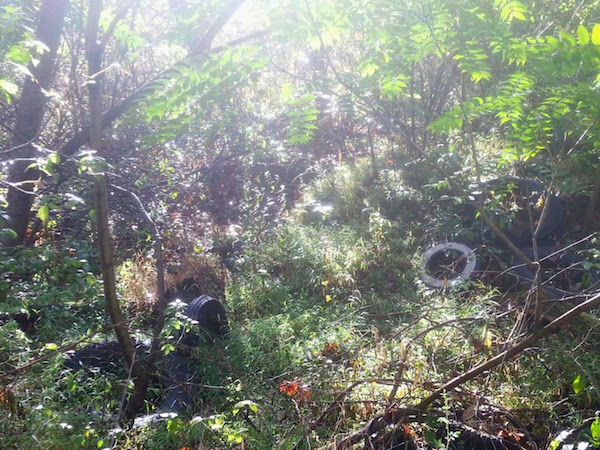
white wall tire in wooded area

The first evidence: that looks like a whitewall to me!

The promise was spectacular and had Orbit written all over it: an untouched fifty-year-old automobile graveyard in about as improbably inaccessible a location as one could imagine–a thick wood up a steep hillside outside Monroeville. The junkyard had been abandoned for half a century leaving a rusting collection of stray Hudsons and Studebakers, Packards and DeSotos as far as the eye could see. Trees had grown up, over, and through the spent carcasses. Pickers and plunderers had pulled everything of value. Nature had reclaimed what she could.
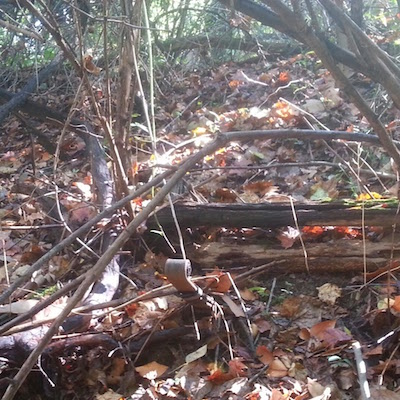
rusted leaf spring from an old car among fallen leaves

Model T-era leaf spring among fallen leaves

WOW! Sounds incredible, right? I know! So naturally The Orbit‘s dawn patrol caught the first suitable morning light to high tail it out The Parkway East  to meet our native guides, Moskal & Son. I’d been told that “We’ll have to take you there–you won’t be able to find this place yourself.” Truer words were never spoken. The journey involved one twisty-turny car ride, some combination of bridges, train tunnels, and one climb up a still-soaking-from-rain-the-night-before hillside.

The story goes that in the 1950s and ’60s an underworld operation existed that stole automobiles off the streets of Pittsburgh, drove them way out here to (pre-Squirrel Hill Tunnel/pre-suburbia) Monroeville/Wilkins Township, and somehow hoisted them all the way up the hill to this secluded location. There, this crew ran a woodland chop shop for the cars’ re-salable parts. At some point in the 1960s the location was discovered and the whole ring busted, crooks were sent to the big house, and their spoils were just left in the woods to rot. Pa Moskal had been to the site several times since the ’60s, but as a pair, father and son hadn’t been up the hill in twenty years–the younger but a wee Moskal at the time–so we’d have to do some tromping around to find the right spot.

window handle crank and rusted metal in fallen leaves

Window crank and door panel

Let me tell you something: if you want to see two grown Moskals and one still-figuring-things-out blogger brought to tears, just put them this deep in unspoiled nature. The three of us climbed, hiked, and trudged–hell, we located walking sticks and were on verge of singing mountain songs! How is one supposed to remember his or her troubles in this degree of mid-autumn pleasantness? The dappled sun streaming through the still-changing leaves; the only sounds, the chirping of birds and babbling of brooks. Very disheartening.

rusted automobile metal in wooded area

One big rusted carcass

Well, we know it is darkest before the dawn and even at this moment of greatest despair, like Geraldo unearthing that alleged bathtub gin bottle, we tripped across our first evidence. It’s certainly not unusual to find discarded tires in the woods, but the whitewall that popped out was something that looked older than your garden-variety illegal dump site. It was followed by a distinct leaf spring–the kind found on the suspension of very early automobiles–protruding from a pile of downed foliage. Next: an unmistakable door panel with its window crank still attached. Just one giant rusted steel carcass appeared: itself so twisted, decomposed, and enwrapped in thick vine that its original shape was completely lost.

We never found the hundreds of car bodies we were hoping to see–they’re long gone–but at least we knew we had the right place.

Bob and Mike Moskal in Monroeville woods

Our intrepid guides Moskal & Son

So what happened to the acres of autos? Pa Moskal’s theory is that the railroad owns the land and cleaned it out when they put in the (newish) gravel access road we came across. I looked for a news story on a Monroeville-area illegal junkyard clean out some time in the last couple decades, but came up with nothing.

In the end, maybe it doesn’t matter. Geraldo never found any buried bodies in Chicago and he ended up O.K. At least we got a little rust.


If you have any information on either the history of the Monroeville Tip Top Chop Shop or its cleanout, please get in touch. We’d love to hear about it.
 

Ghost House: Nabbing a Strip District Two-fer!

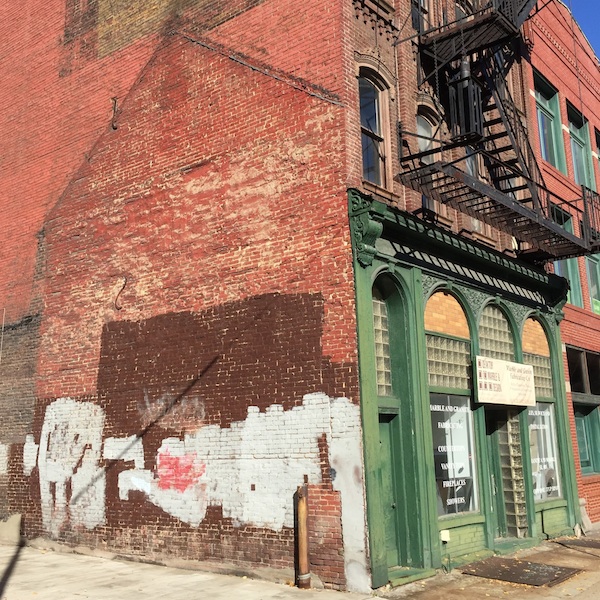
outline of 2-story "ghost house", Pittsburgh, PA

Ghost house (East), Strip District

We’d been after this pair for a while and yeah, we bagged them. It was a ghost house hunter’s ultimate score–side-by-side impressions of the same disappeared structure left right (and left/right) next to each other. With a little imagination even a dime store gum shoe could put the pieces together. The whole picture is right there in front of you, guilty as the day is long.

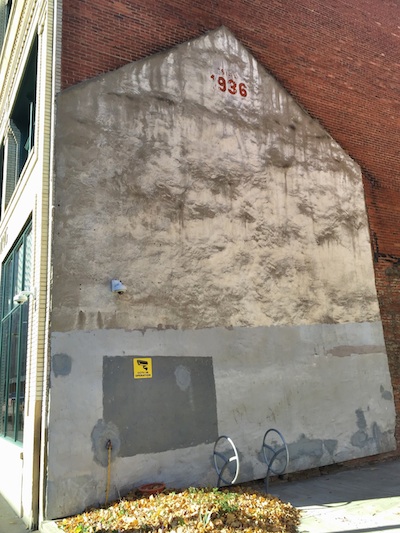
Cruise down Penn Ave. from the Strip to town and you can’t miss the western-facing member of this pair. She’s a platinum figure built like a brick (row)house, answering to this mathematician’s favorite dimensions: 24′ x 24′ x 36′. The dirty gray, ruffled skirt told us everything we needed to know about how the last century had treated her. Centered in what must have been one lovely attic space is an intriguing 1936, tattooed in red and beginning to flake away.

Her old man didn’t have the same distinction but the outlines were all there. The bruises across his midsection told us the block had been around him more than a few times and he could give as good as he got. On top of his pointy head sat a bonus ghost sign so far gone it’s now just a blur.

outline of 2-story "ghost house", Pittsburgh, PA

Ghost house (West), Strip District

Even though we’ve been down this particular stretch of road a zillion times, it was never quite the right time to make the grab. Some bozo would leave a car right in my shot [“Get out of the way, you bozo!”] or some dude would be parallel-parked on Penn Ave. and throw off the foto shui (look it up) of the bigger scene [“Beat it, pal!”].

But who’s this blogger kidding? These pictures ain’t for the museum, and they’re not getting pinned up in some teenage hair-farmer’s gym locker. No: we’re here to put this couple up on the blog wall faster than you can say “son now here’s some little something”.

Catching ghosts turns about to be a lot like nabbing bad guys. You order up some take-out coffees [“Black for me; two creams for my partner.”], get giant sandwiches from a place called Sal’s [“That bastard owes me!”], and then you wait [“I’ll take first watch. You get some shuteye.”].

And wait we did. Days, weeks–hell, it was months sitting on these perps. Just biding our time until they made a move. Oh, and what move they made. Another perfect, glorious, unseasonably warm November day; the sky so deep and blue it looked like the water from the prow of a skipjack off Dewey Beach. Me: all the time in the world to set ’em up and knock ’em down. Yeah, The Orbit got the collar. Put it in the books, Jack.

4-story brick building with outline of 2-story "ghost house", Pittsburgh, PA

Bonus (unreadable) ghost sign above the ghost house!

An Orbit Obit: The Toynbee Tiles of Smithfield Street

Toynbee Tile reading "Toynbee Idea in movie '2001' resurrect dead on planet Jupiter"

Resurrect dead while you can. The last remaining Smithfield Street Toynbee Tile, Downtown.

It was not that long ago (February, to be exact) when Pittsburgh Orbit filed one of its earliest stories on the great run of five “Toynbee Tiles” that were imprinted on Smithfield Street, approximately one per block from Boulevard of the Allies to Sixth, downtown.

This blogger likes to think The Orbit come a long way since those nascent days of yore, [Only two paragraphs of text? Who was doing the photo editing?] but looking back on this very recent history, it’s also a reminder of how rapidly (and drastically) things can change in the city as a whole. [Young people: for good or bad, back in the ’90s/early aughts, the words “Pittsburgh,” “rapid,” and “change” were never bundled in the same text.]

I’ve gotten in the habit of eyeballing and taking inventory of the Toynbee Tiles every time I ride through downtown, inevitably on Smithfield’s relatively-convenient route from the South Side to the great new Penn Ave. bike lane. It’s news to no one that there’s a tremendous amount of development happening in town right now–you see giant cranes, construction fencing, and torn up pavement everywhere you look. But I was startled to find that as of this past weekend–less than a year after that early blog post–only one out of the five Toynbee Tiles was still intact. The sole survivor (pictured above) is at the corner of Smithfield and Oliver Way.

It doesn’t seem like there was any malice involved here or that the tiles were actively removed in a clean-up effort. [Let’s hope not: the city has far bigger infrastructure-shaped fish to fry.] There just seems to be that much digging up of streets and running new, uh, things under them. The block of Smithfield from Sixth to Seventh has been totally resurfaced.

terra cotta storefront for former G's Restaurant and Pizzeria, Pittsburgh, PA

(The former) G’s Restaurant and Pizzeria on a torn-up Forbes Ave., Downtown

Fifteen years ago, me and a whole bunch of other concerned citizens drank a lot of beers and ate a lot of fried zucchini at The Chart Room in the name of not having downtown Pittsburgh eaten alive (or something like that) (hey: it worked, didn’t it? sort of?). The Chart Room is long gone (heavy sigh), but at least the building didn’t get torn down. [Sadly we can’t say the same for the old nickel bingo parlor across the street.]

No, The Chart Room got mangled by choice, in private hands, without needing any help from eminent domain. It’s strange to have lived through that extreme “Hail Mary”/desperation-style urban planning only to wake up in an entirely new world where big money comes in and builds big things all on its own. It’s different in a whole lot of important, structural ways, but still strangely the same as it seemed like it might have turned out to be. Resurrect dead, indeed.

Ah, hell. If you want The Orbit’s advice, go check out the last Toynbee Tile on Smithfield Street while you still can. It won’t be there forever.

Hey, Porter: Daria Sandburg and Pittsburgh’s Baggage Claim

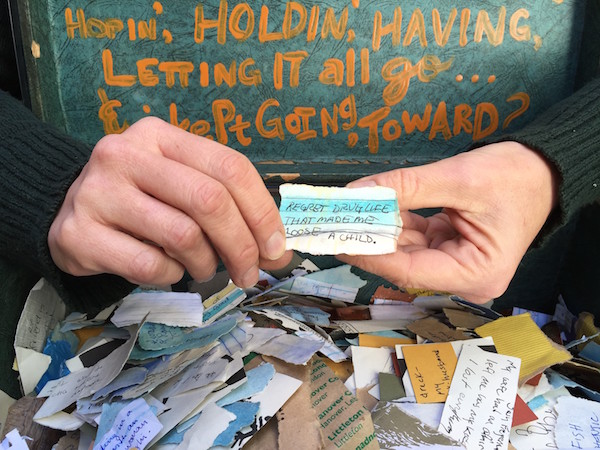
Hands holding scrap of paper with the writing "Regret drug life that made me loose a child" (sic.)

“Regret drug life that made me loose a child” (sic.) Just one small piece of Pittsburgh’s baggage.

It’s a strange weight to carry–both metaphorically and very literally. The worn, shiny metal case (it was built to carry roller skates) is painted with a series of intriguing messages. A quote from Kate Tempest: “That thing you weep for, leave it,” and one from Carl Sandburg: “What is this load I carry out of yesterday?” The ends of the case have the instructions Got baggage? Leave it here.

The Orbit encountered this unique piece of luggage attached to the arm of one Daria Sandburg who has been toting it through our fair city streets, to events and happenings for a couple years now. Sandburg honors every one of the case’s painted instructions with an invitation for whoever accepts to leave their messages (“Pittsburgh’s baggage”) in the form of short hand-written notes on scraps of multicolored paper. A separate, smaller inset box contains “possibilities,” which people are equally encouraged to submit. Ask nice and Sandburg will convert your hand-written note into cut, stamped metal. Over the last year, hundreds have taken Sandburg up on the offer.

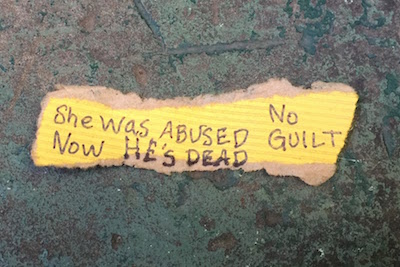
torn paper scrap with the writing "She was abused, now he's dead. No guilt."

Heavy baggage: one of the hundreds of hand-written claims

The baggage claim tickets cover the full gamut of guilt, regret, fear, and much much more. Markers of love and love lost, admissions of poor choices, addiction, and anxieties of every shade are stowed in the case. And while there’s a level of repetition and predictability to many of the entries, the format of one real human having submitted her or his expression in their own hand, in person, directly to Sandburg’s protective case makes each one unique, special, and often tragic.

Even the most prosaic of messages–Being forgotten or My ex or Uncertainty–somehow carry a greater weight when you know the author was right there, among us. Logically, we know everyone has these feelings, but somehow it’s hard to accept, or to believe. The volume of tickets expressing some level self doubt is staggering.

When the claims get deeper, more personal, they can be outright devastating. Take my lies, one reads, or My father’s suicide, or Letting where I missed be the measure of my life, or She was abused, now he’s dead. No guilt. It’s good the slips are so small or these could turn into major therapy sessions on both ends of the paper.

Daria Sandburg and her open case of Pittsburgh's baggage.

Daria Sandburg and her open case of Pittsburgh’s baggage.

All told, it’s a heavy load to carry around. I asked Sandburg if she feels the project, open-ended and unresolved by design, could, ironically, become her own personal baggage. Could she be trapped under the weight of needing to collect and store ever more of the limitless pool of strangers’ personal issues?

The response was remarkably upbeat, positive, and forward-looking. She doesn’t feel married to either the suitcase or the project, especially after the completion of a recent show combining the baggage claims with Sandburg’s original art (inspired by the submitted claims) at Boxheart. [The project required a greater-than-normal commitment to baggage collection.] But at the same time, there are no immediate plans to suspend her regular forays out with the box.

hand stamped metal with the text "I wish I wasn't afraid of doing literally everything"

One of Sandburg’s by-request hammered metal claim tickets.

Sandburg is leaving soon to take the case out for a week-long working/collecting trip to the greater Art Basel Miami (and its associated shows/events) for that annual art/schmooze megalopolis as part of Boxheart Gallery‘s travel team. [Boxheart is participating in the alternative Fridge Art Fair.] There, she’ll be collecting South Florida’s baggage, and yes, mixing it with our own. This blogger predicts more regrets around taking on extra calories or the perils of imperfect abs and less decades-old nightmares around the Mark Malone and Bubby Brister regimes. But maybe we’ll find out that everyone really has the same baggage, even if Miami’s comes well-tanned and wrapped in vintage alligator.

Daria Sandburg holding metal case with painted words "Got baggage? Check it here."

Follow Daria Sandburg and the Baggage Claim project on Twitter and/or Instagram for regular updates on incoming claim tickets–or just look out for the lady with the cool hand-painted metal case. She encourages meeting interested strangers: “Happenstance is what really makes the project wonderful.” If you do spot her, say hello, and maybe consider leaving that thing you weep for.

The Pizza Chase: Phillippi’s, Home of the “Birdville Pie”

one slice pizza on paper plate with table setting

You could even say it glows: one cut of “Birdville Pie” (only slight color exaggeration)

American cheese, it is said, is neither American, nor cheese. Some would also have us believe that this most maligned of processed foods has no place on that other great American culinary institution, the pizza pie. Those folks, however, don’t live in Birdville, and they don’t get their pizza at Phillippi’s.

excited diners look with anticipation of their "Birdville Pie"

Excited diners can’t wait to dig in to their “Birdville Pie”

We don’t actually know for sure what that gooey stuff is on top of the Birdville Pie–Phillippi’s is famously tight-lipped about the “special blend of Birdville cheeses” they use. But between the radioactive aura it gives off and the weird molar-coating mouth feel, it’s pretty obvious that American cheese is the dominant sibling of this particular nuclear family.

The pizza at Phillippi’s has one other major distinguishing factor. The crust is as wafer-thin as this eater has ever experienced. It puts the pie clearly in the camp of a meal that eats like a snack, or an appetizer, or, as one of our party derisively put it, “like a Lunchable.” Not that anyone left hungry, it just had the overall feeling of one big (processed) cheese and cracker.

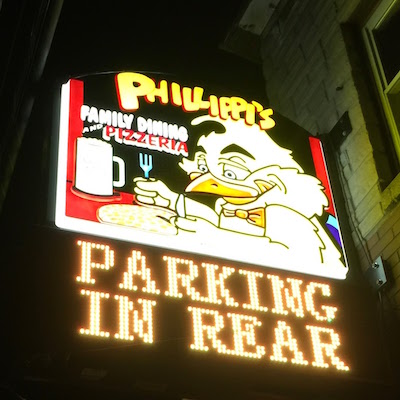
exterior of Phillippi's Family Dining and Pizzeria, Natrona Heights, PA

Phillippi’s Family Dining and Pizzeria, Home of the “Birdville Pie”, Natrona Heights

To call eating a Birdville Pie pleasurable is a stretch. The pizza is an acquired taste of the highest (or lowest) degree, but it’s clear the locals love it. The restaurant’s tag line “Home of the Birdville Pie” is printed proudly across the front awning, on every menu, and the masthead to the web site. The Birdville Pie and its sister White Birdville Pie (no sauce, but the same great cheese blend) (come to think of it, wouldn’t that make this an “orange pizza”?) (ah, heck, go with it–we’re in Birdville!) appear at the top of the restaurant’s short pizza list. We can attest that every group around us in the filled dining room was enjoying at least one the famous pizzas at their table. [Explanations for why the uninitiated baby at the next table kept screaming are pure conjecture.]

Phillippi's "Birdville Pie" with banana peppers and bacon

Phillippi’s “Birdville Pie” (here with banana peppers and bacon)

Someone at Phillippi’s really cares about local history. The walls of the Dining room are covered with great black and white photographs of Natrona Heights through the years. The restaurant’s web site has an extensive history–not of Phillippi’s (which is only mentioned in passing) or its namesake pizza pie (ditto)–but of Birdville, Pennsylvania.

This time-is-money blogger will admit he didn’t read the whole thing, (to give you a sense of scale, there are forty-two footnotes) but we can tell you it goes from Frenchman Rene Robert Cavalier de la Salle fording the Allegheny River in 1670 to Rachel Carson and Silent Spring in 1962, and just about everything along the way.

The key fact seems to be that one Richard Bird, “a carpenter born in 1851 in Shropshire, England” purchased a big chunk of what is now Natrona Heights/Harrison Township in the late 1800s. Thereafter, though never an official designation, the locals have referred to the area as “Birdville.”

sign for Phillippi's Family Dining and Pizzeria, Natrona Heights, PA

As generally happens with American cheese-related stories, this one is not without controversy. Any discussion of Phillippi’s and their unique pizza recipe would be incomplete without a mention of their cross-river rival and the authenticity of the Birdville Pie. This is something, we can assure you, that is as contested as the house of Romanov. That, however, must wait for another day, when the Orbit staff have had an opportunity to get the other side of this particular tale. As Dee Snider and the gang said so aptly, stay hungry.

[Editor’s note: we did indeed follow up with a visit to Phillippi’s “cross-river rival” in October, 2016. Check it out in The Pizza Chase: P&M Pizza, Arnold]

Ex-Atom Smasher

Westinghouse atom smasher laying on its side at the site of former Westinghouse research facility, Forest Hills, PA

Westinghouse atom smasher, Forest Hills

This blogger knows what you’re thinking: That would look great in my apartment! Am I right? Well, bad news: The Orbit’s got dibs. [Note to self: get apartment with sixty foot ceilings.]

That is the Westinghouse atom smasher. According to the historical marker on the site (see below) it’s the “world’s first industrial Van de Graaff generator, created by Westinghouse Research Labs in 1937.”

The Orbit pretends to be many things–substantive, humorous, newsworthy–but it won’t pretend to know science (at least, not in a post that “real scientists” might actually read). The atom smasher has been well-documented with its own Wikipedia page and Roadside America entry, not to mention countless news stories and physics lessons, so we’ll leave the facts to the pros.

Remains of Westinghouse building in Forest Hills, PA

Former Westinghouse Research Labs building

But to not cover the ex-atom smasher, currently laying on its side as the only remaining piece of the former Westinghouse Research Labs in Forest Hills, would be an oversight we’re not prepared to live with. We never ate dinner at Poli’s, never caught rays at Myrtle Booth, and never got a generator re-jiggered at Goeller. We’ll not make that same mistake with the only Van de Graaff generator we’re likely to encounter in this lifetime.

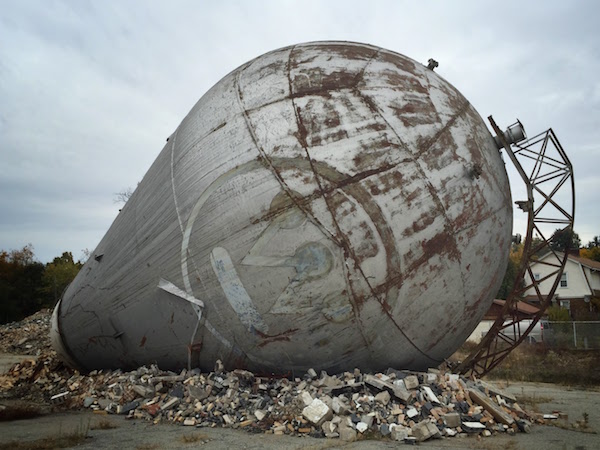
Westinghouse atom smasher on pile of rubble, Forest Hills, PA

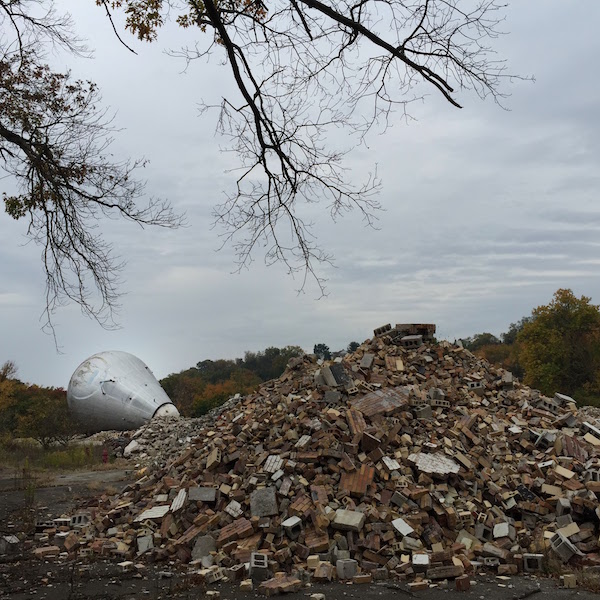
It’s a strange sight today. The same historical marker describes the ex-atom smasher as a “pear-shaped structure,” but in its present form, it looks more like a great rusting lightbulb, laying in a pile of debris on a giant’s basement floor. Or maybe a Bladerunner-era war balloon, made of some future lighter-than-air material, downed tragically in an electrical storm.

Atom smasher on its side at the former Westinghouse research facility, Forest Hills, PA

Ex-atom smasher with Paul Rand’s great Westinghouse logo still clearly visible

It’s also beautiful. Especially the day we visited, under thick cloud cover with perfect mid-autumn leaf-changing adding an incongruous warmth to an otherwise cold, gray scene. The ex-atom smasher even looks comfortably nestled on the chock-a-block pile of bricks, broken concrete, and cinderblocks that have been swept together to (presumably) keep it from rolling away. Even faded, scored, and turned on its side, Paul Rand‘s great 1960 Westinghouse logo still looks fantastic.

Historical marker for Westinghouse atom smasher: the world's first Van de Graaff generator, 1937

Historical marker at the corner of F Ave. and Service Road No. 1 in Forest Hills

But this is maybe the most perfect way to see the ex-atom smasher today. The former site of the Westinghouse lab sits among a neighborhood of detached middle-class houses in the appropriately-named Pittsburgh suburb of Forest Hills. Its medium-large poured concrete footprint is surrounded on three sides not by industry, but thick foliage. The whole scene has a feeling of nature reclaiming this land, the ex-atom smasher the lone survivor as the earth’s wolves salivate at the chain-linked perimeter. Each of them thinking that would look great in my apartment.

Westinghouse atom smasher and giant pile of bricks from former research facility, Forest Hills, PA

Forest Hills: lunar landscape


Orbit bonus! The original atom smasher influenced some musical collisions as well, including a second-tier British prog band that took their name (with a slight spelling difference) from the technology. Here’s them, a couple dozen candelabras, and a whole lot of organ live in 1972:

As Robert Mueller mentions in the comments:

…WATCH the right hand of the keyboard player (from 3:36 to 3:42) and PAUSE at 3:39 !!! ASTONISHING !! His fingers are like LIQUID plastic !! HIS FINGERS ARE SHAPESHIFTING !!!! A REPTILIAN SHAPESHIFTER !!!!! These beings come from SIRIUS !!!!

Graceland North: The Antignani Estate Sale

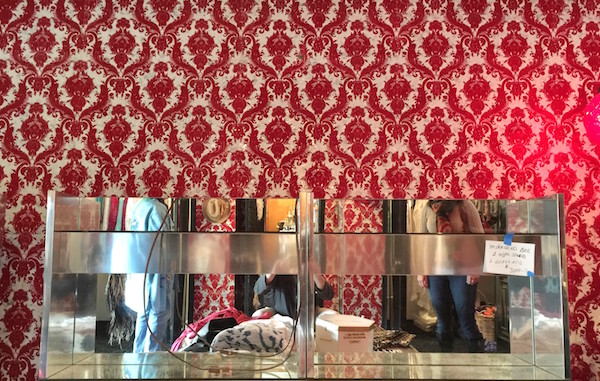
mirrored headboard against a very complex wallpaper pattern

It might get loud: mirror in the bedroom

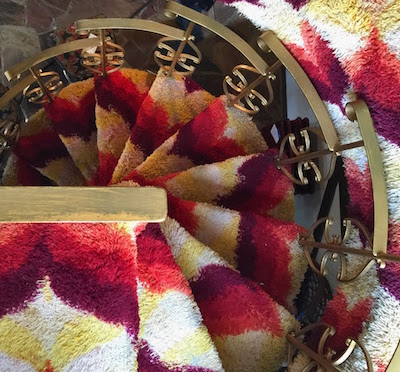
If it could be covered in psychedelic shag carpeting, they did it: doors, bathroom walls, spiral staircase treads. If the mood called for fake leopard skin, or zebra, or gold lamé, you can bet that call was answered too. The master bedroom holds a half dozen legitimate feathered pimp hats. The living room features a six-foot-tall clear plastic aquarium in the shape of a bent palm tree. The kitchens (there are two) have tile work with images of sport fish and day-glo flowered wallpaper. You can believe if there was a wall surface, shelving, headboard, or light fixture that could possibly be mirrored, spangled, or bedazzled, that need was not taken lightly.

No, the Antignanis had a decidedly more-is-more, leave no stone un-decorated design sense that has unprepared eyeballs begging for mercy, mouths gasping for Dramamine, and visitors vowing to finally get serious about their own basements. Even just what’s left of the estate, which occupies an entire serene hilltop in Pittsburgh’s distant northern suburbs, makes Graceland look minimalist.

large plastic gorilla in the Antignani estate yard

(larger-than?) life-size gorilla: make offer

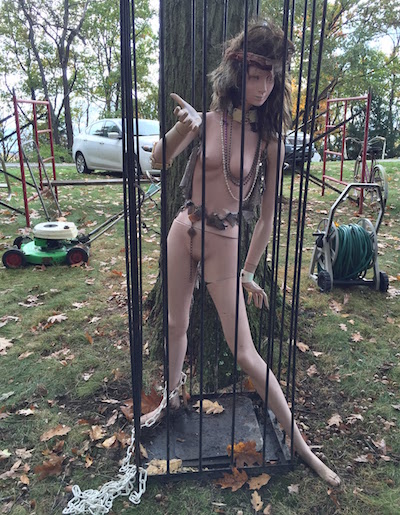
You know it’s going to be a good estate sale when the first thing you see is a life-size plastic lawn gorilla: make offer. The front-of-house alone contains a bevy of oddball riches we’re not used to seeing at suburban sales: a six-foot plaster saxophone ornament for a matching fountain suspended on giant golden musical notes; replicas of Italian statuary; a slide and ladders from a since-removed pool; a ’70s-era Dodge Ram pickup. Oh, and there’s a caged female mannequin, chained at the ankle, barely clothed in a headband, Mardi Gras beads, and torn hippie vest.

Lawn mower, chained, caged, naked, go-go mannequin, hose reel.

A sale for all your yard care needs: lawn mower, naked go-go mannequin-in-cage, garden hose with reel.

Any assumptions or prejudices about the lifestyles of older generations are quickly overturned with one step inside the Antignani estate. Their tastes were eccentric, loud, gaudy, and corny, but very clearly theirs. We know that Arthur lived into his 80s and it doesn’t appear that any accommodations were made for the couple’s advancing age. It’s wonderfully amusing to think of anyone traipsing around this crazy environment for forty years (?) let alone a couple my grandparents’ (R.I.P.) age.

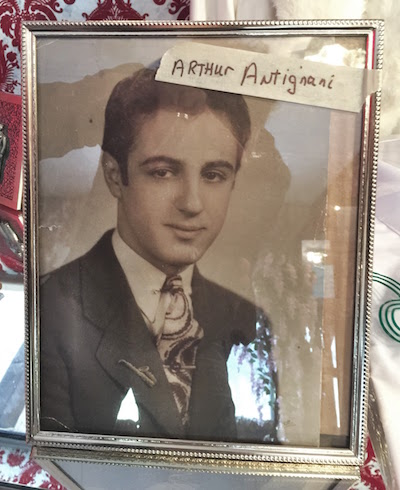
framed black and white photograph of Arthur Antignani as a young man

Arthur Antignani

Of the many mysteries surrounding this sale, the most intriguing is the Antignanis themselves. Described as a “millionaire musician,” Arthur Antignani has left almost zero Internet trail. There’s no obituary from either of the Pittsburgh papers, one nearly-empty entry on the site Tributes.com, and some vague hits on various genealogical sites. That’s it.
Of Arthur’s wife Alfreda we know even less. The friendly estate sale agents told us she had been a cosmetologist and that the couple saved their voluminous love letters from Arthur’s time on the road. And that’s all we’ve got.

wall-mounted sound system including reel-to-reel tape deck, 8-track player, intercom, CD player, speaker toggle switches

Hi-fi command central

Arthur’s musical career is just as in need of clarification. The same agent had heard he was a frequent performer in Las Vegas who regularly entertained the “Rat Pack” in the early days of The Strip. We can assume he played the saxophone by the number of sax icons scattered throughout house, including the lapel pin on the above photograph. But again, it’s difficult to substantiate any of this.

poured concrete patio in the shape of a guitar, with additional paint to represent sound hole, saddle, and strings

The guitar-shaped patio

One thing we do know is that the Antignanis were crazy about music–or, at least, they liked the look of it. The imagery of musical instruments (especially saxophones) and musical staff notes aggressively played into the design and decoration of the house. Notes decorate the front entrance gate, the shag carpeting on the bedroom door, and metalwork throughout. A back patio was poured in the shape of a giant guitar, complete with the awkwardly long sidewalk-to-nowhere of the instrument’s to-scale long neck. Paint was added to supply details for the sound hole and hardware. There’s a bust of Elvis lamp.

Hundreds of tchotchkes render every variety of creature–mammal, amphibian, you name it–multi-instrumentalists in some nutty symphony. These figures, along with gilt candlesticks, shimmering pendant lamps, a mixed-species chest-of-drawers, and a pair of over-the-top rotary telephones, are now stacked so densely in the former great room that it’s difficult to imagine how they could have been displayed when the house was still in use.

[The photo gallery for this sale has many more detail shots than we’ve chosen to include here. Check it out while it’s still available.]

spiral staircase with psychedelic shag carpeting and gold-painted railings

Looking down the psychedelic psprial pstaircase

Although we have no concrete evidence, I think the other safe assumption here is that the Antignanis could party. The whole house is laid out such that no guest’s Greek-themed highball glass will ever go dry and its extensive sound system had speaker options that reached every room, patio, and even the “Zen garden.” There are only three bedrooms, but guests could pass out on their choice of several giant sectional sofas. The kitchen equipment is pretty standard stuff, but the barware is stocked with enough tumblers, martini, wine, and shot glasses to outfit several all-nighters without ever needing to do the dishes.

mural with naked male and female figures, tree with snake wrapped around its trunk, and a stag

“While you’re down there, my giant snake could use some attention.” Mural in the Antignani dining room.

The word from the sales agents was that one of their team had purchased the entire lot, house, and contents, and was emptying it for an inevitable demolition and redevelopment. On the one hand, that makes a lot of sense–it’s pretty incredible to have a property that covers an entire hilltop with 360-degree views (at least, when the tree cover isn’t too thick) and also has perfect privacy. The house itself is no great architectural marvel, so it’s likely any buyer in this market would want something different.

But at the same time, those of us who never knew the couple can feel the Antignanis’ spirits within the home’s eye-popping walls. The couple’s mausoleum (yes, a photograph proves it’s adorned with more musical notes and giant saxophones) may last much longer, but it’s in the soft-porn dining room mural and plastic fruit-shaped piña colada cups, the silver Queen of Hearts wallpaper and shiny clothes that they actually lived. And oh–if it’s not too trite to say–how they lived.

antignani-gold-statue

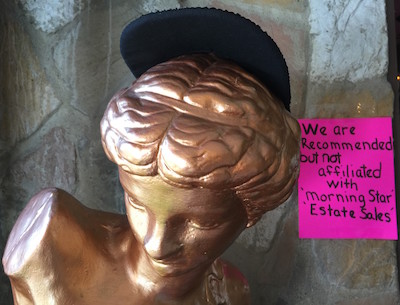
If it ain’t Baroque, don’t fix it. Statuary in the Antignani home entranceway.

lawn ornament of Mary with $40 hand-written price tag

Mary, cheap


Special note: We’d love to know more about the Antignanis. If you knew them, know more of the story, or if we got any of our facts wrong, we’d love to hear it. Please get in touch.


Correction: An earlier version of this post incorrectly identified Alfreda as Arthur’s given name and Mrs. Antignani as first name unknown. Several readers have corroborated that Mrs. Antignani was Alfreda (see comments). We apologize for the error and thank you commenters!


The D.I.Y. Graves of Highwood Cemetery, Part 2

handmade grave made from cement block, Highwood Cemetery, Pittsburgh, PA

“Bucky” Bailey

In our previous post, we got all philosophical on the nature of a cemetery’s role in eternity. But coming across the D.I.Y. graves in Highwood Cemetery made us think about a lot more than the future of the mortuary industry or how long the living realistically need graves to visit. So in this follow-up we think about the possible reasons that moved these families to create their own grave markers. And, of course, there’s a bunch more pictures.

diy-grave-adelle-wright

Adelle Wright

This blogger won’t pretend to know why or how these folks ended up with a homemade cross or a cement building block for their grave marker–there may well be as many different reasons as there are plots. The most obvious though, is that it can be really expensive to purchase and install a custom-made granite stone. From the high hundreds to thousands of dollars it takes to have a stone cut, inscribed, and installed is likely way out of the budget for many people, especially immediately following a death, funeral, and burial.

At Highwood Cemetery, the D.I.Y. graves are all clustered in the same general vicinity, all the way at the back in a section bordering fence and the grounds crew sheds on spot of scrub grass that lacks all of the natural beauty and tall trees of the older sections. I don’t know what the pricing or politics of D.I.Y. graves is, but I’d guess these are the cheap seats.

handmade grave with rough poured concrete, flowers, and spinner, Highwood Cemetery, Pittsburgh, PA

Unknown

It begs a follow-up question, though, which is that if money were the main object, why have a burial at all? Cremation is absolutely the most cost-efficient way to deal with a death and I’m sure there are a lot of people who would suggest that if you don’t have a “real” gravestone, then what’s the point?

I think the answer to that is pretty obvious. For a whole lot of people, it’s still very important to have a physical place to commune with their loved-one and for a totem of that person’s life to exist. Despite all the practicality of cremation, this is really the primary reason why cemeteries exist.

handmade grave with wooden cross and flowers, Highwood Cemetery, Pittsburgh, PA

Leroy Jacks

One thing that struck me about the D.I.Y. graves is that, for the most part, they seem to be visited much more recently than their more permanent neighbors. I’m purely basing that on the volume of flowers, wreaths, personal belongings, etc. that have been applied to them. These items don’t last at cemeteries–they’re routinely cleaned-up in seasonal purges by the grounds crew. With nearly every single one of the D.I.Y. graves having some form of recent offering, it’s a remarkable correlation to the type of grave.

handmade grave with photograph, flowers, and stones in shape of a heart, Highwood Cemetery, Pittsburgh, PA

Unknown

We couldn’t help but think of the study showing an inverse correlation between the amount of money spent on the wedding and the length of the marriage. Maybe in today’s world, purchasing a raised lawn-level plaque is the post-mortal coil equivalent of just buying a Hallmark card and writing a check. How fast can I get out of here?

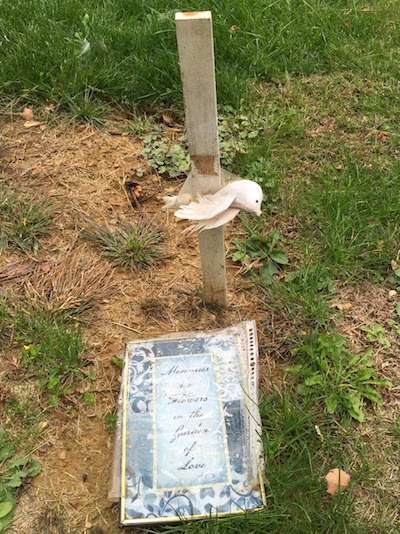
handmade grave with wooden post, white dove, and memory book, Highwood Cemetery, Pittsburgh, PA

Unknown


Final note: We’re hooked! If you’ve got a tip on some D.I.Y. graves in the general Pittsburgh area, please let us know.

See also: The D.I.Y Graves of Highwood Cemetery, Part 1