The Pizza Chase: Phillippi’s, Home of the “Birdville Pie”

one slice pizza on paper plate with table setting

You could even say it glows: one cut of “Birdville Pie” (only slight color exaggeration)

American cheese, it is said, is neither American, nor cheese. Some would also have us believe that this most maligned of processed foods has no place on that other great American culinary institution, the pizza pie. Those folks, however, don’t live in Birdville, and they don’t get their pizza at Phillippi’s.

excited diners look with anticipation of their "Birdville Pie"

Excited diners can’t wait to dig in to their “Birdville Pie”

We don’t actually know for sure what that gooey stuff is on top of the Birdville Pie–Phillippi’s is famously tight-lipped about the “special blend of Birdville cheeses” they use. But between the radioactive aura it gives off and the weird molar-coating mouth feel, it’s pretty obvious that American cheese is the dominant sibling of this particular nuclear family.

The pizza at Phillippi’s has one other major distinguishing factor. The crust is as wafer-thin as this eater has ever experienced. It puts the pie clearly in the camp of a meal that eats like a snack, or an appetizer, or, as one of our party derisively put it, “like a Lunchable.” Not that anyone left hungry, it just had the overall feeling of one big (processed) cheese and cracker.

exterior of Phillippi's Family Dining and Pizzeria, Natrona Heights, PA

Phillippi’s Family Dining and Pizzeria, Home of the “Birdville Pie”, Natrona Heights

To call eating a Birdville Pie pleasurable is a stretch. The pizza is an acquired taste of the highest (or lowest) degree, but it’s clear the locals love it. The restaurant’s tag line “Home of the Birdville Pie” is printed proudly across the front awning, on every menu, and the masthead to the web site. The Birdville Pie and its sister White Birdville Pie (no sauce, but the same great cheese blend) (come to think of it, wouldn’t that make this an “orange pizza”?) (ah, heck, go with it–we’re in Birdville!) appear at the top of the restaurant’s short pizza list. We can attest that every group around us in the filled dining room was enjoying at least one the famous pizzas at their table. [Explanations for why the uninitiated baby at the next table kept screaming are pure conjecture.]

Phillippi's "Birdville Pie" with banana peppers and bacon

Phillippi’s “Birdville Pie” (here with banana peppers and bacon)

Someone at Phillippi’s really cares about local history. The walls of the Dining room are covered with great black and white photographs of Natrona Heights through the years. The restaurant’s web site has an extensive history–not of Phillippi’s (which is only mentioned in passing) or its namesake pizza pie (ditto)–but of Birdville, Pennsylvania.

This time-is-money blogger will admit he didn’t read the whole thing, (to give you a sense of scale, there are forty-two footnotes) but we can tell you it goes from Frenchman Rene Robert Cavalier de la Salle fording the Allegheny River in 1670 to Rachel Carson and Silent Spring in 1962, and just about everything along the way.

The key fact seems to be that one Richard Bird, “a carpenter born in 1851 in Shropshire, England” purchased a big chunk of what is now Natrona Heights/Harrison Township in the late 1800s. Thereafter, though never an official designation, the locals have referred to the area as “Birdville.”
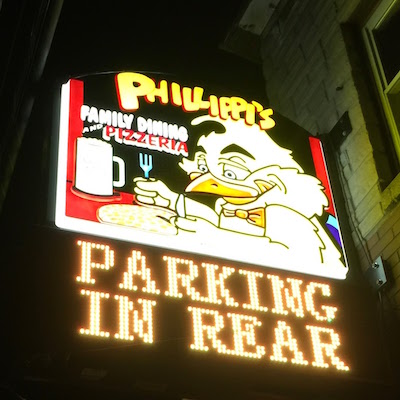
sign for Phillippi's Family Dining and Pizzeria, Natrona Heights, PA

As generally happens with American cheese-related stories, this one is not without controversy. Any discussion of Phillippi’s and their unique pizza recipe would be incomplete without a mention of their cross-river rival and the authenticity of the Birdville Pie. This is something, we can assure you, that is as contested as the house of Romanov. That, however, must wait for another day, when the Orbit staff have had an opportunity to get the other side of this particular tale. As Dee Snider and the gang said so aptly, stay hungry.

[Editor’s note: we did indeed follow up with a visit to Phillippi’s “cross-river rival” in October, 2016. Check it out in The Pizza Chase: P&M Pizza, Arnold]

Ex-Atom Smasher

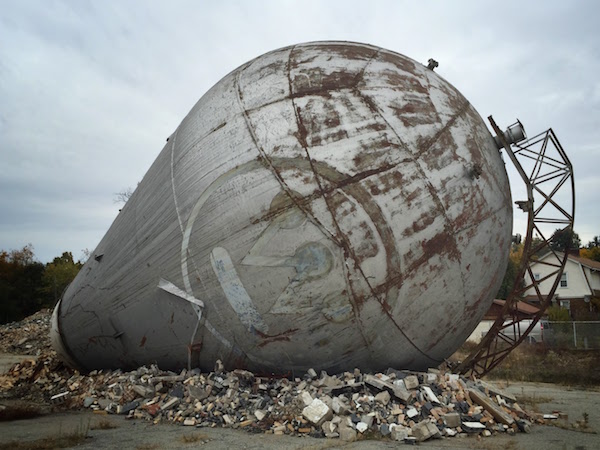
Westinghouse atom smasher laying on its side at the site of former Westinghouse research facility, Forest Hills, PA

Westinghouse atom smasher, Forest Hills

This blogger knows what you’re thinking: That would look great in my apartment! Am I right? Well, bad news: The Orbit’s got dibs. [Note to self: get apartment with sixty foot ceilings.]

That is the Westinghouse atom smasher. According to the historical marker on the site (see below) it’s the “world’s first industrial Van de Graaff generator, created by Westinghouse Research Labs in 1937.”

The Orbit pretends to be many things–substantive, humorous, newsworthy–but it won’t pretend to know science (at least, not in a post that “real scientists” might actually read). The atom smasher has been well-documented with its own Wikipedia page and Roadside America entry, not to mention countless news stories and physics lessons, so we’ll leave the facts to the pros.

Remains of Westinghouse building in Forest Hills, PA

Former Westinghouse Research Labs building

But to not cover the ex-atom smasher, currently laying on its side as the only remaining piece of the former Westinghouse Research Labs in Forest Hills, would be an oversight we’re not prepared to live with. We never ate dinner at Poli’s, never caught rays at Myrtle Booth, and never got a generator re-jiggered at Goeller. We’ll not make that same mistake with the only Van de Graaff generator we’re likely to encounter in this lifetime.

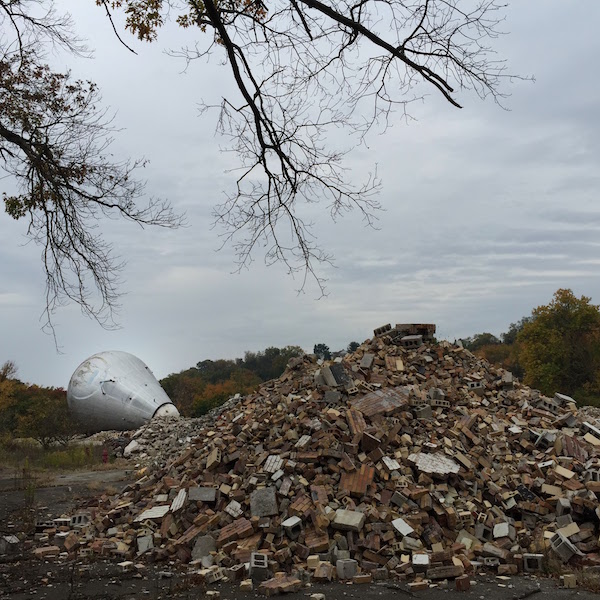
Westinghouse atom smasher on pile of rubble, Forest Hills, PA

It’s a strange sight today. The same historical marker describes the ex-atom smasher as a “pear-shaped structure,” but in its present form, it looks more like a great rusting lightbulb, laying in a pile of debris on a giant’s basement floor. Or maybe a Bladerunner-era war balloon, made of some future lighter-than-air material, downed tragically in an electrical storm.

Atom smasher on its side at the former Westinghouse research facility, Forest Hills, PA

Ex-atom smasher with Paul Rand’s great Westinghouse logo still clearly visible

It’s also beautiful. Especially the day we visited, under thick cloud cover with perfect mid-autumn leaf-changing adding an incongruous warmth to an otherwise cold, gray scene. The ex-atom smasher even looks comfortably nestled on the chock-a-block pile of bricks, broken concrete, and cinderblocks that have been swept together to (presumably) keep it from rolling away. Even faded, scored, and turned on its side, Paul Rand‘s great 1960 Westinghouse logo still looks fantastic.

Historical marker for Westinghouse atom smasher: the world's first Van de Graaff generator, 1937

Historical marker at the corner of F Ave. and Service Road No. 1 in Forest Hills

But this is maybe the most perfect way to see the ex-atom smasher today. The former site of the Westinghouse lab sits among a neighborhood of detached middle-class houses in the appropriately-named Pittsburgh suburb of Forest Hills. Its medium-large poured concrete footprint is surrounded on three sides not by industry, but thick foliage. The whole scene has a feeling of nature reclaiming this land, the ex-atom smasher the lone survivor as the earth’s wolves salivate at the chain-linked perimeter. Each of them thinking that would look great in my apartment.

Westinghouse atom smasher and giant pile of bricks from former research facility, Forest Hills, PA

Forest Hills: lunar landscape


Orbit bonus! The original atom smasher influenced some musical collisions as well, including a second-tier British prog band that took their name (with a slight spelling difference) from the technology. Here’s them, a couple dozen candelabras, and a whole lot of organ live in 1972:

As Robert Mueller mentions in the comments:

…WATCH the right hand of the keyboard player (from 3:36 to 3:42) and PAUSE at 3:39 !!! ASTONISHING !! His fingers are like LIQUID plastic !! HIS FINGERS ARE SHAPESHIFTING !!!! A REPTILIAN SHAPESHIFTER !!!!! These beings come from SIRIUS !!!!

Graceland North: The Antignani Estate Sale

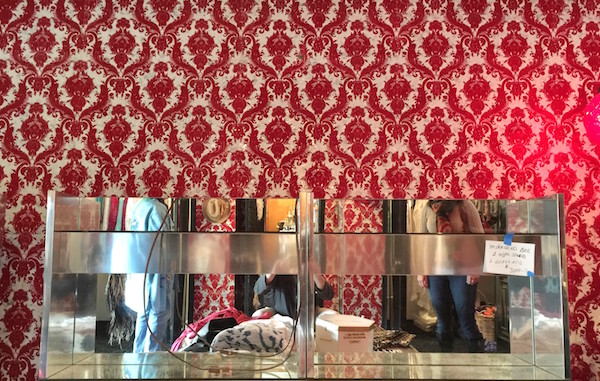
mirrored headboard against a very complex wallpaper pattern

It might get loud: mirror in the bedroom

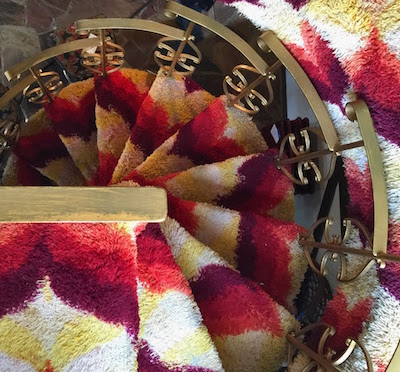
If it could be covered in psychedelic shag carpeting, they did it: doors, bathroom walls, spiral staircase treads. If the mood called for fake leopard skin, or zebra, or gold lamé, you can bet that call was answered too. The master bedroom holds a half dozen legitimate feathered pimp hats. The living room features a six-foot-tall clear plastic aquarium in the shape of a bent palm tree. The kitchens (there are two) have tile work with images of sport fish and day-glo flowered wallpaper. You can believe if there was a wall surface, shelving, headboard, or light fixture that could possibly be mirrored, spangled, or bedazzled, that need was not taken lightly.

No, the Antignanis had a decidedly more-is-more, leave no stone un-decorated design sense that has unprepared eyeballs begging for mercy, mouths gasping for Dramamine, and visitors vowing to finally get serious about their own basements. Even just what’s left of the estate, which occupies an entire serene hilltop in Pittsburgh’s distant northern suburbs, makes Graceland look minimalist.

large plastic gorilla in the Antignani estate yard

(larger-than?) life-size gorilla: make offer

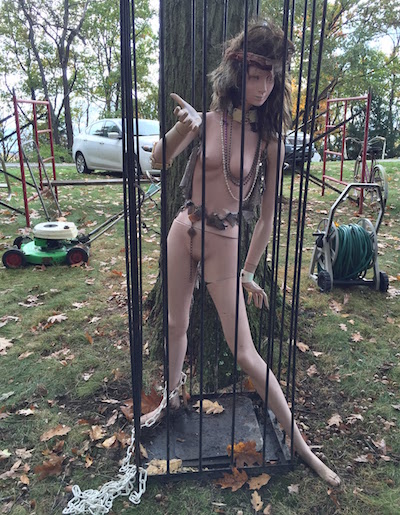
You know it’s going to be a good estate sale when the first thing you see is a life-size plastic lawn gorilla: make offer. The front-of-house alone contains a bevy of oddball riches we’re not used to seeing at suburban sales: a six-foot plaster saxophone ornament for a matching fountain suspended on giant golden musical notes; replicas of Italian statuary; a slide and ladders from a since-removed pool; a ’70s-era Dodge Ram pickup. Oh, and there’s a caged female mannequin, chained at the ankle, barely clothed in a headband, Mardi Gras beads, and torn hippie vest.

Lawn mower, chained, caged, naked, go-go mannequin, hose reel.

A sale for all your yard care needs: lawn mower, naked go-go mannequin-in-cage, garden hose with reel.

Any assumptions or prejudices about the lifestyles of older generations are quickly overturned with one step inside the Antignani estate. Their tastes were eccentric, loud, gaudy, and corny, but very clearly theirs. We know that Arthur lived into his 80s and it doesn’t appear that any accommodations were made for the couple’s advancing age. It’s wonderfully amusing to think of anyone traipsing around this crazy environment for forty years (?) let alone a couple my grandparents’ (R.I.P.) age.

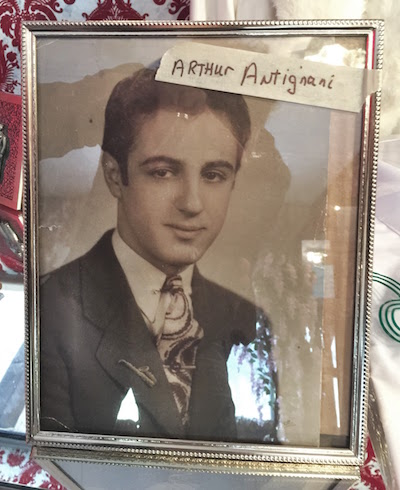
framed black and white photograph of Arthur Antignani as a young man

Arthur Antignani

Of the many mysteries surrounding this sale, the most intriguing is the Antignanis themselves. Described as a “millionaire musician,” Arthur Antignani has left almost zero Internet trail. There’s no obituary from either of the Pittsburgh papers, one nearly-empty entry on the site Tributes.com, and some vague hits on various genealogical sites. That’s it.

Of Arthur’s wife Alfreda we know even less. The friendly estate sale agents told us she had been a cosmetologist and that the couple saved their voluminous love letters from Arthur’s time on the road. And that’s all we’ve got.

wall-mounted sound system including reel-to-reel tape deck, 8-track player, intercom, CD player, speaker toggle switches

Hi-fi command central

Arthur’s musical career is just as in need of clarification. The same agent had heard he was a frequent performer in Las Vegas who regularly entertained the “Rat Pack” in the early days of The Strip. We can assume he played the saxophone by the number of sax icons scattered throughout house, including the lapel pin on the above photograph. But again, it’s difficult to substantiate any of this.

poured concrete patio in the shape of a guitar, with additional paint to represent sound hole, saddle, and strings

The guitar-shaped patio

One thing we do know is that the Antignanis were crazy about music–or, at least, they liked the look of it. The imagery of musical instruments (especially saxophones) and musical staff notes aggressively played into the design and decoration of the house. Notes decorate the front entrance gate, the shag carpeting on the bedroom door, and metalwork throughout. A back patio was poured in the shape of a giant guitar, complete with the awkwardly long sidewalk-to-nowhere of the instrument’s to-scale long neck. Paint was added to supply details for the sound hole and hardware. There’s a bust of Elvis lamp.

Hundreds of tchotchkes render every variety of creature–mammal, amphibian, you name it–multi-instrumentalists in some nutty symphony. These figures, along with gilt candlesticks, shimmering pendant lamps, a mixed-species chest-of-drawers, and a pair of over-the-top rotary telephones, are now stacked so densely in the former great room that it’s difficult to imagine how they could have been displayed when the house was still in use.

[The photo gallery for this sale has many more detail shots than we’ve chosen to include here. Check it out while it’s still available.]

spiral staircase with psychedelic shag carpeting and gold-painted railings

Looking down the psychedelic psprial pstaircase

Although we have no concrete evidence, I think the other safe assumption here is that the Antignanis could party. The whole house is laid out such that no guest’s Greek-themed highball glass will ever go dry and its extensive sound system had speaker options that reached every room, patio, and even the “Zen garden.” There are only three bedrooms, but guests could pass out on their choice of several giant sectional sofas. The kitchen equipment is pretty standard stuff, but the barware is stocked with enough tumblers, martini, wine, and shot glasses to outfit several all-nighters without ever needing to do the dishes.

mural with naked male and female figures, tree with snake wrapped around its trunk, and a stag

“While you’re down there, my giant snake could use some attention.” Mural in the Antignani dining room.

The word from the sales agents was that one of their team had purchased the entire lot, house, and contents, and was emptying it for an inevitable demolition and redevelopment. On the one hand, that makes a lot of sense–it’s pretty incredible to have a property that covers an entire hilltop with 360-degree views (at least, when the tree cover isn’t too thick) and also has perfect privacy. The house itself is no great architectural marvel, so it’s likely any buyer in this market would want something different.

But at the same time, those of us who never knew the couple can feel the Antignanis’ spirits within the home’s eye-popping walls. The couple’s mausoleum (yes, a photograph proves it’s adorned with more musical notes and giant saxophones) may last much longer, but it’s in the soft-porn dining room mural and plastic fruit-shaped piña colada cups, the silver Queen of Hearts wallpaper and shiny clothes that they actually lived. And oh–if it’s not too trite to say–how they lived.

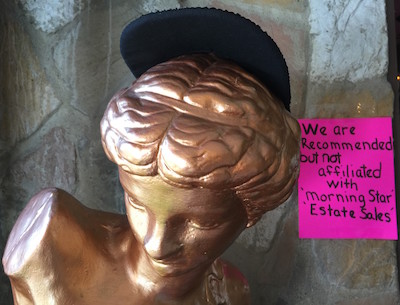
antignani-gold-statue

If it ain’t Baroque, don’t fix it. Statuary in the Antignani home entranceway.

lawn ornament of Mary with $40 hand-written price tag

Mary, cheap


Special note: We’d love to know more about the Antignanis. If you knew them, know more of the story, or if we got any of our facts wrong, we’d love to hear it. Please get in touch.


Correction: An earlier version of this post incorrectly identified Alfreda as Arthur’s given name and Mrs. Antignani as first name unknown. Several readers have corroborated that Mrs. Antignani was Alfreda (see comments). We apologize for the error and thank you commenters!


The D.I.Y. Graves of Highwood Cemetery, Part 2

handmade grave made from cement block, Highwood Cemetery, Pittsburgh, PA

“Bucky” Bailey

In our previous post, we got all philosophical on the nature of a cemetery’s role in eternity. But coming across the D.I.Y. graves in Highwood Cemetery made us think about a lot more than the future of the mortuary industry or how long the living realistically need graves to visit. So in this follow-up we think about the possible reasons that moved these families to create their own grave markers. And, of course, there’s a bunch more pictures.

diy-grave-adelle-wright

Adelle Wright

This blogger won’t pretend to know why or how these folks ended up with a homemade cross or a cement building block for their grave marker–there may well be as many different reasons as there are plots. The most obvious though, is that it can be really expensive to purchase and install a custom-made granite stone. From the high hundreds to thousands of dollars it takes to have a stone cut, inscribed, and installed is likely way out of the budget for many people, especially immediately following a death, funeral, and burial.

At Highwood Cemetery, the D.I.Y. graves are all clustered in the same general vicinity, all the way at the back in a section bordering fence and the grounds crew sheds on spot of scrub grass that lacks all of the natural beauty and tall trees of the older sections. I don’t know what the pricing or politics of D.I.Y. graves is, but I’d guess these are the cheap seats.

handmade grave with rough poured concrete, flowers, and spinner, Highwood Cemetery, Pittsburgh, PA

Unknown

It begs a follow-up question, though, which is that if money were the main object, why have a burial at all? Cremation is absolutely the most cost-efficient way to deal with a death and I’m sure there are a lot of people who would suggest that if you don’t have a “real” gravestone, then what’s the point?

I think the answer to that is pretty obvious. For a whole lot of people, it’s still very important to have a physical place to commune with their loved-one and for a totem of that person’s life to exist. Despite all the practicality of cremation, this is really the primary reason why cemeteries exist.

handmade grave with wooden cross and flowers, Highwood Cemetery, Pittsburgh, PA

Leroy Jacks

One thing that struck me about the D.I.Y. graves is that, for the most part, they seem to be visited much more recently than their more permanent neighbors. I’m purely basing that on the volume of flowers, wreaths, personal belongings, etc. that have been applied to them. These items don’t last at cemeteries–they’re routinely cleaned-up in seasonal purges by the grounds crew. With nearly every single one of the D.I.Y. graves having some form of recent offering, it’s a remarkable correlation to the type of grave.

handmade grave with photograph, flowers, and stones in shape of a heart, Highwood Cemetery, Pittsburgh, PA

Unknown

We couldn’t help but think of the study showing an inverse correlation between the amount of money spent on the wedding and the length of the marriage. Maybe in today’s world, purchasing a raised lawn-level plaque is the post-mortal coil equivalent of just buying a Hallmark card and writing a check. How fast can I get out of here?

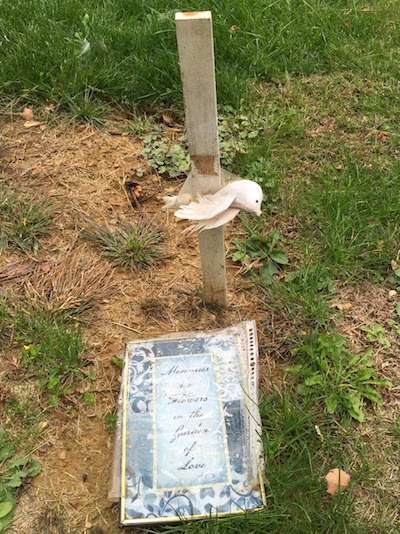
handmade grave with wooden post, white dove, and memory book, Highwood Cemetery, Pittsburgh, PA

Unknown


Final note: We’re hooked! If you’ve got a tip on some D.I.Y. graves in the general Pittsburgh area, please let us know.

See also: The D.I.Y Graves of Highwood Cemetery, Part 1

The D.I.Y. Graves of Highwood Cemetery, Part 1

handmade grave made of 2x4s with photograph and Hennessy bottles, Highwood Cemetery, Pittsburgh, PA

Unknown

The cemetery, perhaps more than any other civic institution, implies permanence–or maybe eternity. Headstones are carved from granite or cast in bronze. The deceased are entombed in a manicured landscape that we optimistically imagine will appear with the same tranquility forever. Rest in Peace is both believable fantasy and contractual expectation for those laid out under its well-groomed acres.

handmade grave made from 2x4s, Highwood Cemetery, Pittsburgh, PA

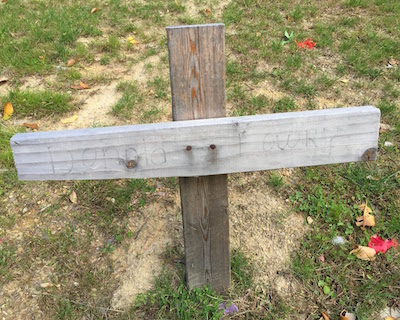
Donald Lowry

So The Orbit‘s purely accidental arrival on a section of homemade or “do-it-yourself” grave markers at the far back of Highwood Cemetery was both a complete surprise and a total revelation. From a single PVC pipe with a child’s art class cement step stone to a pair of two-by-fours crudely nailed together, the departed’s name applied with a Sharpie to the bare wood, these memorials are already sun-bleached, rain-soaked, and definitely won’t make it through that many Pittsburgh winters.

diy-grave-brub-efb

Brub E.F.B.

This blogger will be the first to admit his general good fortune, both in life, and yes, in death. He’s still breathing, for one, and has never had to bury anyone, never had make funeral arrangements or pick out a casket, never had to select a grave plot or deal with a funeral home, never even had to make awkward conversation with distant relatives at the wake of a close loved one.

And so, of course, I’ve also never been in the position to select a headstone. Nor had I ever even considered that one might be able (err…allowed within the cemetery’s rules) to do this for oneself.

handmade grave with wooden cross and paving stones, Highwood Cemetery, Pittsburgh, PA

Bruce A. Jones

This whole month, Pittsburgh Orbit has been visiting local cemeteries. You start to see some interesting patterns when you spend enough time in a place. One of those is that in terms of visitation, our cemeteries may be roughly divided into three general sections. There’s the older parts, full of dramatic high-gothic mausoleums, giant focus cenotaphs, stained glass, and ornate statuary, often accompanied by a (locally) famous name. Jennie Benford gives a great tour of such monuments in Homewood Cemetery. Then there are the newer sections of (generally) more humble graves for the recently-departed. These collect nearly 100% of the flowers and teddy bears. And then there’s everybody else.

handmade grave with wooden cross, bandana, and Steelers hat, Highwood Cemetery, Pittsburgh, PA

R.W.G. Bang

If your name isn’t H.J. Heinz or Lillian Russell or Stephen Foster and if you didn’t choose a gravestone tribute to Jaws, well, your monument may be available–and it’s probably still in good shape and totally legible–but realistically, probably no one cares that much. I’m not trying to harsh the mellow of someone who’s, you know, already dead, but it’s the truth. Even etched in stone, we’ve got a limited shelf life.

handmade grave with wooden cross, blue bow, and flowers, Highwood Cemetery, Pittsburgh, PA

Keith

I think this is ultimately what gives Highwood’s D.I.Y. graves such emotional power. These aren’t cold stones that will dramatically outlive the families that planted them. They’re very much living tributes for the people who are still in their lives and they will exist for exactly the time they’re most in need–while their loved-ones are still grieving.

I don’t know if it will ever happen, but you could imagine this as a really beautiful, sustainable model for the future. Allow the family to have the closure of a funeral, burial, and a completely home-made memorial that they can visit for five or ten or twenty years–whatever makes sense. But ultimately return the earth to a general pool for another generation to use.

That may or may not be something that would sell to the general cemetery customer but I’d be willing to–let’s abuse our metaphors here–put it in the ground and see who eulogizes it.

Homemade grave with PVC pipe and cast concrete medallion, Highwood Cemetery, Pittsburgh, PA

Dad


Orbit note: There are so many of these D.I.Y. graves in Highwood and they raised so many interesting questions that we decided to break this into two posts. Here’s part 2.

Rose of Sharon

angel statuary with broken wing under tree

Only when the sun had just crested the rooftops was it visible. There, in the backyard, under the Rose of Sharon, seen through the kitchen door. Just put the coffee on, pulled the bathrobe tight, squinted into the early light to make something out. It was staring back at him.

Colder now than it ought to be. Maybe that happened every year at this time. Remembered years past leaving Virginia in shirtsleeves and arriving back to Western Pennsylvania freezing rain. The rest of the seasons always seemed closer in sync, but the quick transition to fall made it feel like a different world.

Still looking out the window. The neighbor hates that tree. Every lovely spring flower produced aggressive new sprouts where it dropped anchor, many of them on her side of the fence. The neighbor has to beat them back when she weed-whacks around her tiny above-ground pool. One more thing to be mad at him about. Felt guilty–but not guilty enough to take out the tree.

The coffee maker gurgled and let out its last great gasp. Felt sorry for those people who couldn’t get up early, or forced to stay up late. Morning light, crisp air, near perfect silence. People rise earlier the older they get, he’d been told. Hoped to one day wake easily at dawn, to have the full sunrise experience every day, without effort.

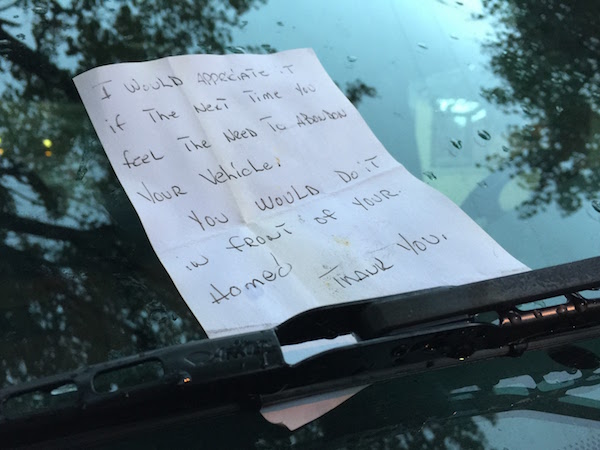
The windshield of a green Honda held an angry note with neat Catholic school penmanship: I’d like to park in front of my own house. Park where you live! This familiar drama played itself out regularly. Strangers left their vehicles out front when they hit the bars down the hill or stayed over at the apartment building next door.

Retrieving the newspaper on a weekend morning, it was not uncommon to find random jetsam from the previous night’s revelry: a stray beer can, hamburger foil, an unfamiliar automobile. One time he’d found a ceramic coffee mug with the emblem of a rehab clinic in Carlisle. It was never a big deal. The neighbor thought she owned the twenty-four feet of city street in front of her house. She should have put in a parking place instead of that pool.

Note left on car's windshield reading "I would appreciate it if the next time you feel the need to abandon your vehicle you would do it in front of your home. Thank you."

The first day to see his breath. Streets uninhabited, save for a pair of early-risers sitting on benches in the sun, hands crossed on the top of a walking cane. A near-empty city bus rumbled through, headed out of town. Fast food bags, cigarette butts, and early felled leaves eddying with wind gusts in the inset storefront entranceways.

Trees at the lower gate to the cemetery make a natural tunnel that glows golden orange as the morning sun pours through changing leaves. Here, before the sounds of the city come to life, before families visit loved-ones, and before the joggers and cyclists challenge themselves up and down its steep terrain, was his most sacred place.

Clusters of deer bound up and over the hills, through the weathered graves, pausing in unison to look curiously at the human disturbing their quiet time. Each member of the small group posed in concert like a dramatic point in a modern dance, cautiously allowing him to approach as close as twenty feet before some inaudible signal triggers the group to spring off into the wood.

A dumpster filled with most unusual contents. Piles of fake flowers, wreaths, filthy teddy bears, plastic placards, laminated photographs. Lifting the container’s lid, there was a two-foot concrete angel with one of its wings broken off. Hoisted the statuette from the bin, cradled the heavy piece like a load of firewood, walked the half mile back to the house.

Home again, the sun higher now with the morning fog burned off, under the Rose of Sharon. Pulled weeds, rerouted a set of raspberry tendrils always reaching for more distant soil to colonize. Placed the statue along the fence where the creature had spotted him earlier. Maybe the angel could still keep evil away, even short a wing.

Sad Toys: Graveyard Edition

pink teddy bear leaning against gravestone

Pink bear, Highwood Cemetery. [Yes: for a sad toy, this guy looks pretty happy–but don’t let that grin fool you!]

The grass-is-greener daydreamers that loaf around Pittsburgh Orbit’s office imagine there’s a point in any blog’s creative arc when the pieces begin to fall together without even trying; when the self-referential tropes loop in on themselves. Like a well-primed compost heap, or a nuclear meltdown, heat is generated all on its own and the stories pop out as fully-formed posts, and then barrel their way through the earth’s core.

“Imagine”? Hell: we’re counting on it! By one reasonable calculation, mere months separate the Orbit from magically appearing on your computer screen without any legwork or finger-clicking on our part. There’s Yoo-hoo in the fridge, call me if you need anything–just don’t interrupt my Rockford Files.

four plastic action figures in weeds in front of gravestone with date and epitaph

“Our Beloved Son”. Superheroes in the weeds, Highwood Cemetery

Whatever the reality of “publishing” “new media,” we don’t think we’re abusing too many metaphors to say there was some kind of magic that happened when this little piece of manna dropped from the sky and rolled across the Orbit editorial desk. There it was: a story with all the ingredients for the most satisfying of autumn blogging stews: a heaping helping of cemetery tales, a motherlode of sad toys, a dash of pathos, some human expression, and nature-without-man chaos. Bitter, sweet, and yes, umami. Oh, and it was all timed for Halloween season–when the graveyard toys rise up to take back what is rightfully theirs.

2 teddy bears in thick grass

Twin teddy bears, Allegheny Cemetery

To label stuffed animals left at grave sites as “sad toys” is certainly a judgement call. These creatures are not flotsam dropped from strollers or ejected from the open windows of minivans. No, the figures were left very intentionally as tribute or companion to the departed. In that way, they’re exactly where their owners expect them to be, doing just what they intend them to do. Is that so bad? We should all be so fortunate.

grave with teddy bears, solar lights, and deflated champagne bottle balloon

Sad teddy bear, sad cool bear, sad inflatable Cristal bottle, Allegheny Cemetery

stuffed animal dog on bed of plastic flowers, Allegheny Cemetery, Pittsburgh, PA

Game over, Rover, Allegheny Cemetery

But to not call them sad would be an even greater oversight. These playthings are, after all, left out in the rain, ice, and snow; their once-soft fur a gnarled, sun-bleached mat. Often alone, these fierce friends watch over the graves of the deceased with no company but the occasional stray deer, opossum, or wild turkey. A drive-by from this flash bulb-popping blogger paparazzi makes the highlight reel of their short lives.

If this wasn’t pathetic enough, these toys’ inevitable fate is to be corralled in every cemetery’s seasonal cleanup where Build-a-Bears and Steeler monkeys join the plastic flowers, laminated photographs, sports balls, Hennessy bottles, and deflated Mylar balloons in grotesque heaps that, as one Orbit pundit put it, “look like a florist threw up.”

stuffed bear and stuffed dog with flowers

Bear and dog, Highwood Cemetery

two plastic action figures with living flowers

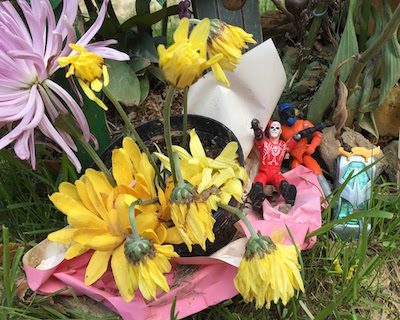
Wrestler (?), stunt man (?), last-legs flowers, Highwood Cemetery

To you, faithful servants, doomed sentries of the cemetery, mud-soaked minions of Mordor: know that at least one of us is here looking out for you. You may be in a trash compactor in McKees Rocks by the time we go to press, but you’ll live on for eternity–or at least a couple months–in cyberspace blogosphere Purgatory. Godspeed.

monkey in Pittsburgh Steelers colors with sad bear

Steeler Monkey and friend, Highwood Cemetery

Allegheny Cemetery: Halloween Graves

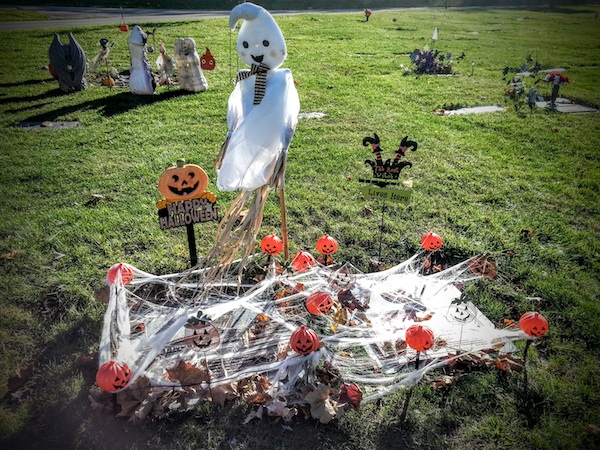
Graves decorated for Halloween, Allegheny Cemetery, Pittsburgh, PA

Spiderland: Halloween grave at Allegheny Cemetery

Every October people put great energy into making their homes look like graveyards. The ubiquitous R.I.P. curved-top cardboard or foam-core headstones dot America’s front yards like popped toasters at a diner. In city neighborhoods, sometimes you see these incongruously strapped to stoops and front railings as if somehow there were people buried under the porch.

So in real graveyards, what’s the motivation to add additional set dressing to the already universally-understood scariest of locales? Decorating a grave marker for Halloween strikes this spookworthy blogger as somewhere between questionable in the taste department and just plain redundant.

I’ve checked the dates, and none of the deceased were ever either born or died on the thirty-first of October, so that’s not it. One can only assume then that either the holiday had a special significance for the departed, or that the grave-tenders are so faithful they give the full redecoration treatment every season. I’ve certainly seen the other holidays represented throughout the year (but not at these specific graves).

Grave decorated for Halloween, Allegheny Cemetery, Pittsburgh, PA

Sauerwein grave, 2013

Graves decorated for Halloween, Allegheny Cemetery, Pittsburgh, PA

Sauerwein grave, 2014

grave decorated for Halloween, Allegheny Cemetery, Pittsburgh, PA

Sauerwein grave, 2015

Whatever the reason, the phenomenon of Halloween-decorated graves occurs every year in Allegheny Cemetery. There aren’t a ton of them, but enough that’s it’s definitely a thing.

Above are photos from the the same plot over the last three Octobers. You’ll see a number of repeated pieces–the big gray plastic gargoyle, the 2-D Jack-o-lanterns, the solar lights, the homemade ghost, the Trick-or-Treat grave and ghoul combo–but a lot of the decor either didn’t make it back or had to get re-generated. The park has a strict fall cleanup policy (more about that later) but they seem to leave the Halloween decorations alone, at least through November.

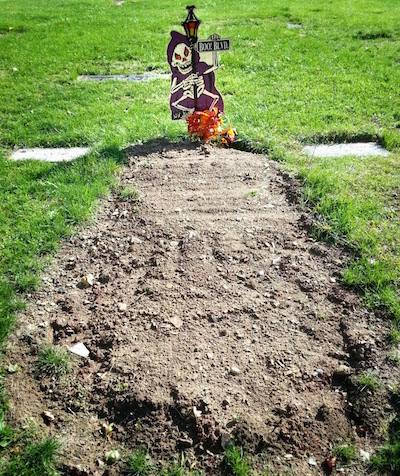
fresh grave with Halloween skeleton decoration, Allegheny Cemetery, Pittsburgh, PA

Boo Blvd.

Google Maps tells us there’s a Boo Avenue in Kansas City, a Boo Street in Louisiana, and a couple Boo Roads in Mississippi and Indiana. There are apparently more Boo Lanes than any other type of Boo thoroughfare.

But Pittsburgh Orbit readers will be excited to learn that the nation’s one and only Boo Boulevard exists right at the end of this freshly-dug grave in Allegheny Cemetery’s section 61. A cloaked skeleton hangs on a old school gaslight to mark the entrance.

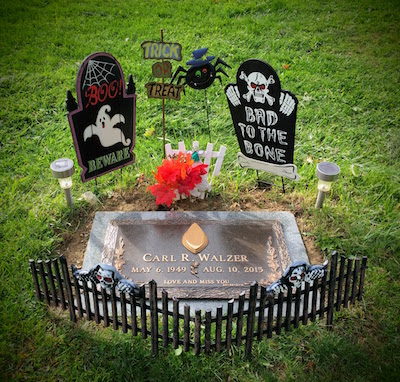
Grave decorated for Halloween, Allegheny Cemetery, Pittsburgh, PA

Carl Walzer: bad to the bone

Grave decorated for Halloween, Allegheny Cemetery, Pittsburgh, PA


Jennie Benford: Concierge to the Dead

Jennie Benford, Homewood Cemetery archivist, in front of Brown mausoleum

Jennie Benford at the Brown mausoleum, Homewood Cemetery

If you got rich in Pittsburgh’s first great golden age, chances are you wound up here. Walking through Homewood Cemetery‘s beautiful large-plot section 14, the names pop right out at you: Frick, Mellon, Heinz, Straub, Baum, Benedum, et cetera, et cetera. These may not be household names to the rest of the world, but in Pittsburgh they’ve all got streets and buildings and foundations and corporations named after them. And they all ended up in the same big section of the same cemetery*.

Mausoleum for Benedum family, Homewood Cemetery, Pittsburgh, PA

From black gold to pink granite: the art deco Benedum mausoleum

Jennie Benford has been leading visitors through Homewood Cemetery for nearly twenty years, and let this amateur crypt fancier tell you: she gives good tour. As an archivist, historian, and major league taphophile (she was also married at Homewood Cemetery), Benford landed her dream job as Director of Programming for The Homewood Cemetery Historical Fund not too long ago.

Benford currently offers three different tours of Homewood: Taking It With You, the one we took concentrating on Section 14’s robber baron excesses; Angels and Obelisks, highlighting particular grave styles and details; and the newest tour, In The Beginning, which focuses on the first three sections of the cemetery that were open for business in 1878.

Bronze angel statuary at Homewood Cemetery, Pittsburgh, PA

Aura the explorer: bronze statuary

Benford’s deep knowledge and communication of not just Homewood’s long-term residents, but American (cemetery) history is incredible. To this blogging layman, our older bone yards tend to look a lot alike. But we started with a great overview of American cemetery history and a terrific comparison between the tenor of the “rural cemetery” movement (ala Allegheny Cemetery, opened 1844) and how it compared to Homewood’s “lawn-park” model (1878).

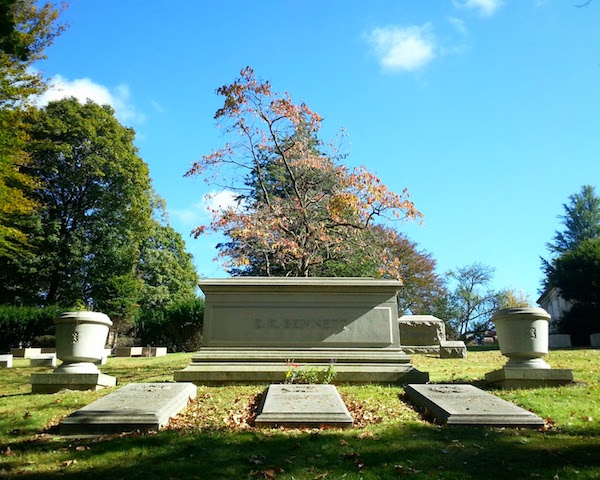
Cenotaph for E.K. Bennett, Homewood Cemetery, Pittsburgh, PA

Dressed and recessed for success: the E.K. Bennett plot

Benford’s greatest gifts, though, are an encyclopedic knowledge of her subject and the deft craft of relating historical detail with the skill of a great storyteller. Architectural nuance, names and dates, period styles, and a rich volume of tales (some of them with appropriate verbal grain-of-salt asterisks) put the context with the casket, the undertone with the eulogy, and the diary on top of the dirt.

Theo F. Straub mausoleum, Homewood Cemetery, Pittsburgh, PA

There stands the ‘taph: Theodore Straub, King of Beers

Benford’s tours of Homewood Cemetery are available by appointment and may be scheduled for “just about any day or time.” Those interested can call 412-260-6305 or message Benford through the Homewood Cemetery Historical Fund FaceBook page to set up a tour.


* They didn’t all end up in Homewood. Allegheny Cemetery in Lawrenceville (for instance) also contains many prominent Pittsburgh figures, but Homewood definitely has the most marquee names, and they’re all clustered in one defined section.

Warhol By The Book: The Orbit Review

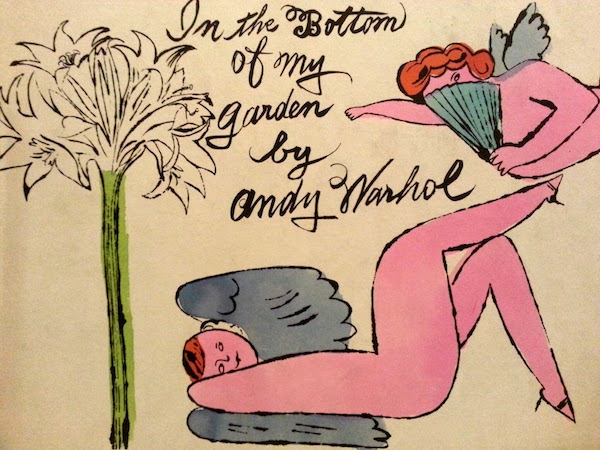
Book cover for Andy Warhol "In the Bottom of My Garden"

“In the Bottom of My Garden”, 1955-56

Two decades ago, this blogger bought a cookbook. Back in those dark ages, we didn’t have the same opportunities to immediately share this groundbreaking news with the world, but thank goodness that wrong can be righted today.

It was in an antique shop in rural Virginia where I found a beat up copy of Amy Vanderbilt’s Complete Cookbook for a couple bucks. Amy is an 800-page Doubleday hardback, published in 1961, that contains all the (quite literal) meat & potatoes recipes of mid-century middle America: Turkey a la king, Swedish cornets, potatoes au gratin, “Pablo’s Spanish rice.” In the pre-Epicurious days, people still needed nuts-and-bolts cookbooks like Amy Vanderbilt.

"According to the Evidence", 1953

“According to the Evidence”, 1953

It wasn’t until some time later that I noticed a small credit on some of the book’s breeze-through front matter: Drawings by Andrew Warhol. The simple line figures that illustrated cut lemon garnishes or rolled Roquefort tea sandwiches never stood out to me as particularly noteworthy and my knowledge of Andy Warhol’s pre-fame commercial work was pretty limited, so I wasn’t even sure if this was the same guy.

Well, it was. Or it is. Whichever. Andy Warhol had a wealth of pre-soup can commercial work (roughly the full decade of the 1950s, and then less frequently in the ’60s) and much of this was in the context of book illustration. Those early drawings, along with photography and silkscreen work from the second half of Warhol’s career, make up the terrific new show Warhol By The Book, up now at The Warhol Museum through January 10, 2016.

Andy Warhol "So Meow" print

So Meow [note: the print in the show has a green cat]

The exhibition is a fantastic deep-dive into anything book-related that Warhol worked on. Included are gorgeous dyed lithographs, original pencil drawings, (rejected) book proposals, correspondence with publishers, fountain pen-through-paper towel ink drawings, celebrity photographs, late-career silkscreens, and many final-product trade reproductions. And yes, there’s a copy of Amy Vanderbilt.

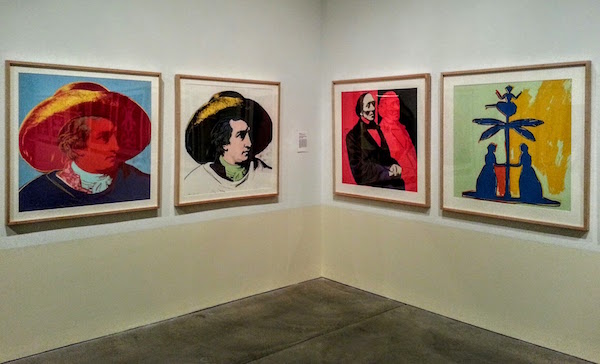
silkscreens of book art from "Warhol By The Book" exhibit at The Andy Warhol Museum, Pittsburgh, PA

1980s era silkscreens

While the photos and silkscreens are interesting, this home-cooking art fancier’s socks were quite figuratively knocked off by the drawn-by-hand half of the show. The rooms of Warhol’s early illustrations have always been my favorite part of the museum and this new show opened up that world in entire new ways. Aside from maybe some of the 25 Cats pieces, I’m not sure I had encountered any of the hundreds of original prints and drawings that make up that section of the exhibit.

Warhol’s Factory-era silkscreens are of course iconic and interesting in their own right, but seemingly lost in that fame was the incredibly beautiful drawing hand of the artist. The coupling of his great, loose style, tastefully deployed bursts of color, Warhol’s distinct schoolyard cursive captions, and the Carnegie Tech-educated, less-is-more design sense make each of these wonderful little new discoveries.

"Borderline Ballads", 1955

“Borderline Ballads”, 1955

Back in February, The Orbit gushed over The Warhol’s Sister Corita Kent show, which had just opened, calling it “the best Warhol Museum show this blogger has ever seen.” We’ll stand by that that assessment. But the By The Book exhibit is right up there. Book it.

lithograph and watercolor illustration from "25 Cats Name Sam and One Blue Pussy"

Illustration from “25 Cats Name Sam and One Blue Pussy”, 1954