Who hasn’t prayed for a Steelers win? Statuary with black and gold rosary, St. John Vianney Cemetery
If there was any question about the black-and-gold beaded rosary, one only needs to look down. At the foot of the concrete statuary figure in blue (a monk? saint? pious Orbit readers, help this heathen out!) is a grave marker in red granite. Along with the deceased’s name, dates, and engraved rope-like border, is the unmistakeable triple-hypocycloid emblem of the Pittsburgh Steelers.
… if there was any question about the colors in the rosary, St. John Vianney Cemetery
To say that Steelers fans live and die by the team may be an exaggeration, but when a person (or their family, for them) chooses to take that fandom into the infinite, the statement becomes much closer to literal.
Our first story on Steelers Graves was eight years ago—an eternity in the blogosphere!—and while we’ve likely passed way more markers than we’ve collected here, it was time for a re-up. Here we go.
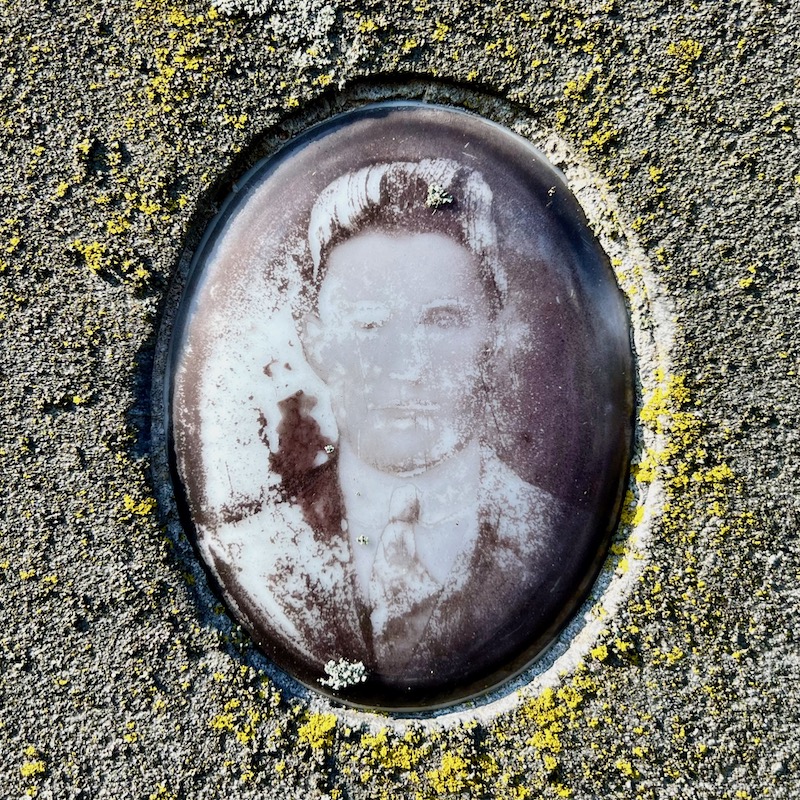
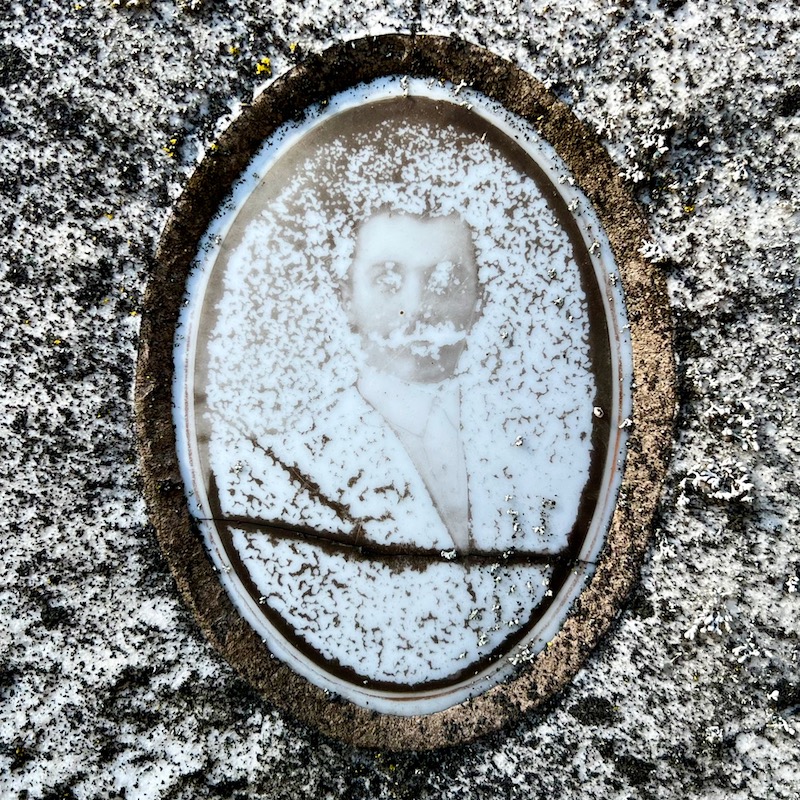
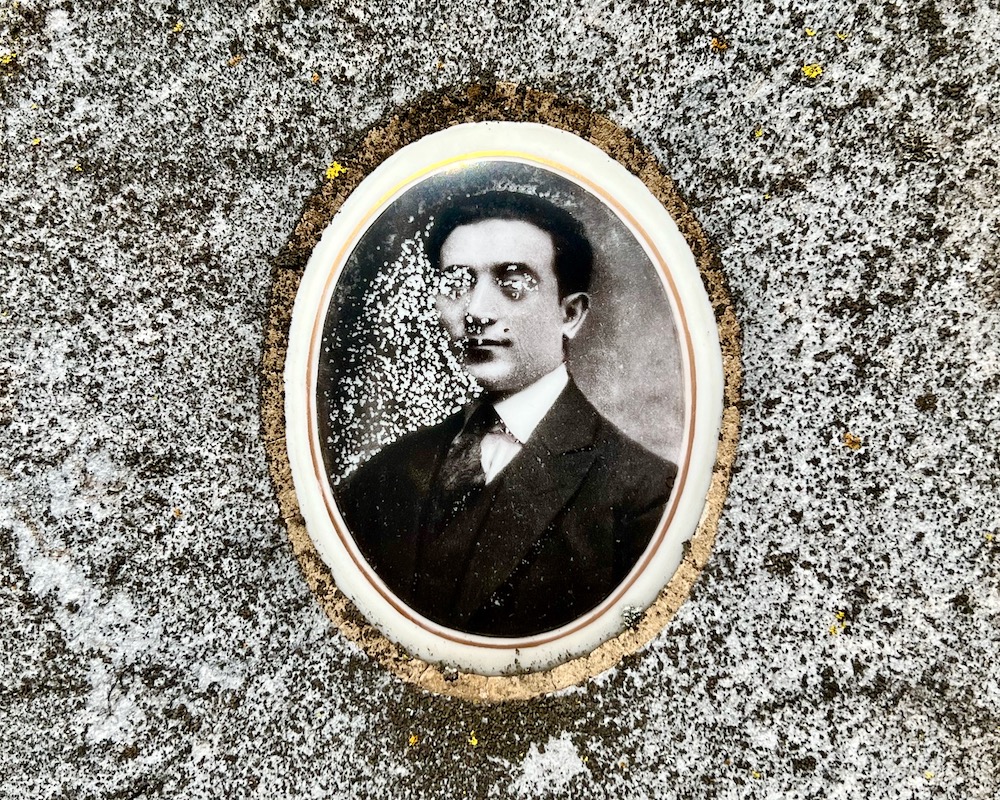
Electrified and psychedlicized. One of many time-weathered ceramic photographs set into grave markers at Economy Cemetery
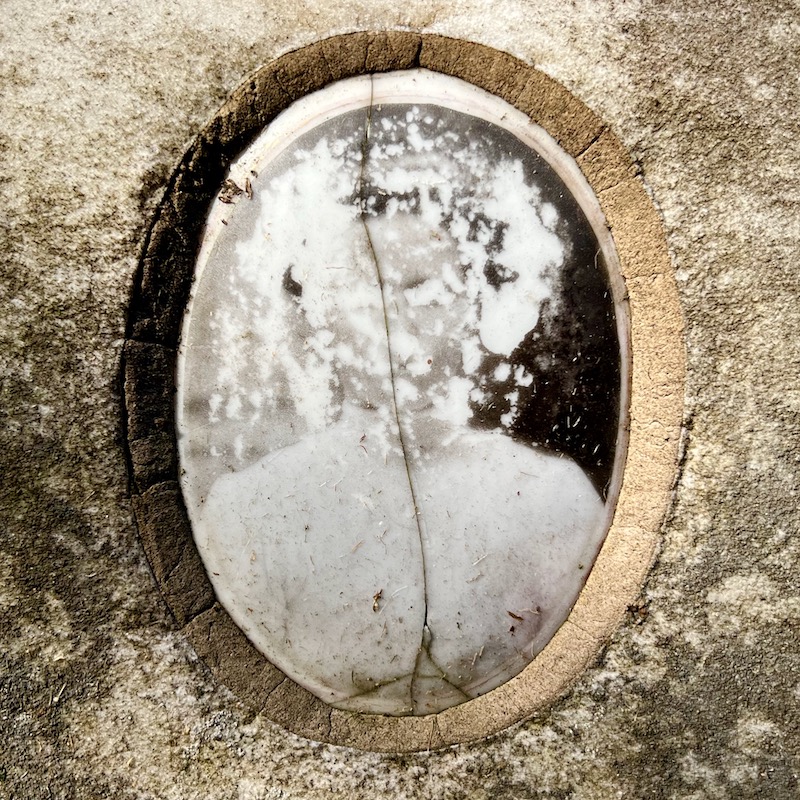
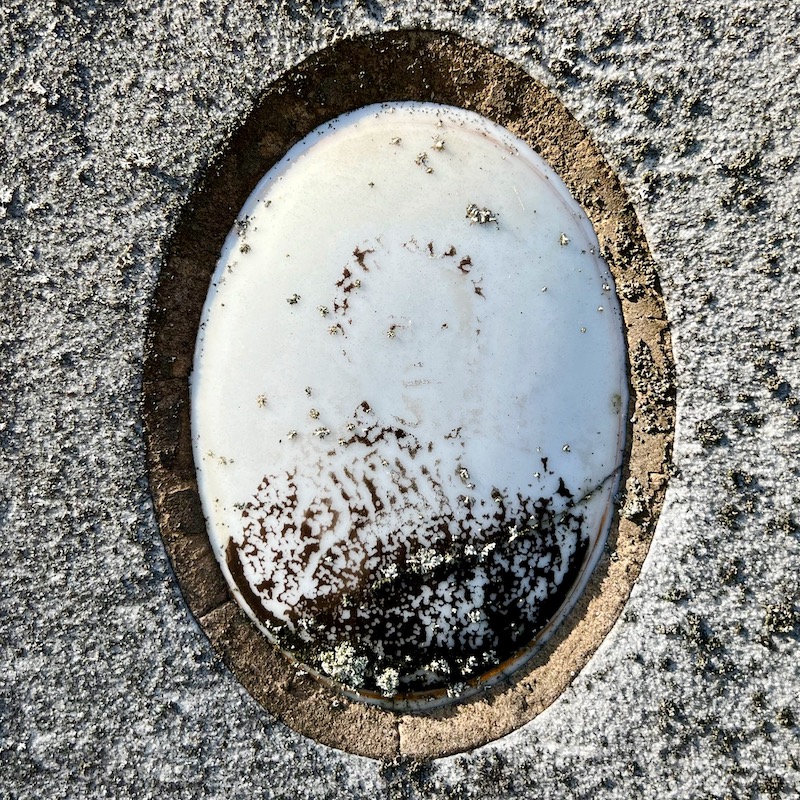
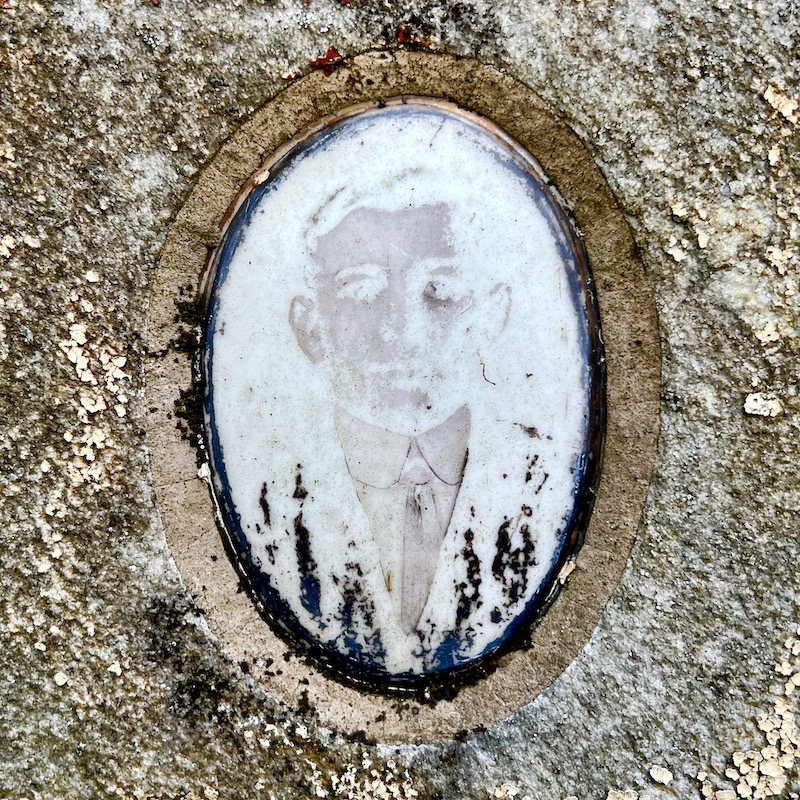
The cemetery outliers are all here. Silver gelatin flaking with weathered age. Sun-soaked and disappearing to time. Cracked by a century’s worth of freeze-thaw cycles. Behatted with a gaping wound across the brow as if struck by a vandal’s hammer. In one case, marvelous indigo Lucite glowing brightly in the afternoon sun but no longer protecting any recognizable image within.
Such is the fate of an early technology meant to immortalize not only the name of the departed, but also their visage.
In our last venture to Economy Cemetery, we focused on a particular subset of ceramic photographic discs inset to the cemetery’s grave markers. Those pictured appear to have left the earth’s bounds and gone straight into the aether. This week, we’re looking at another grouping of damaged portraits from the same hallowed ground. These are the crook’d and crack’d, the maimed and disappeared. They’re equally beautiful, magical, and tragic, but by a whole different measure.
For every portrait, there is a profound revelation in recognizing the exact moment in time when we experience these strangers’ final posthumous interaction with our own. Nothing lasts forever and any attempt to contradict that basic truth is doomed to its own cruel fate.
Enjoy me now, each of these disappearing portraits seems to say, we won’t be here forever.
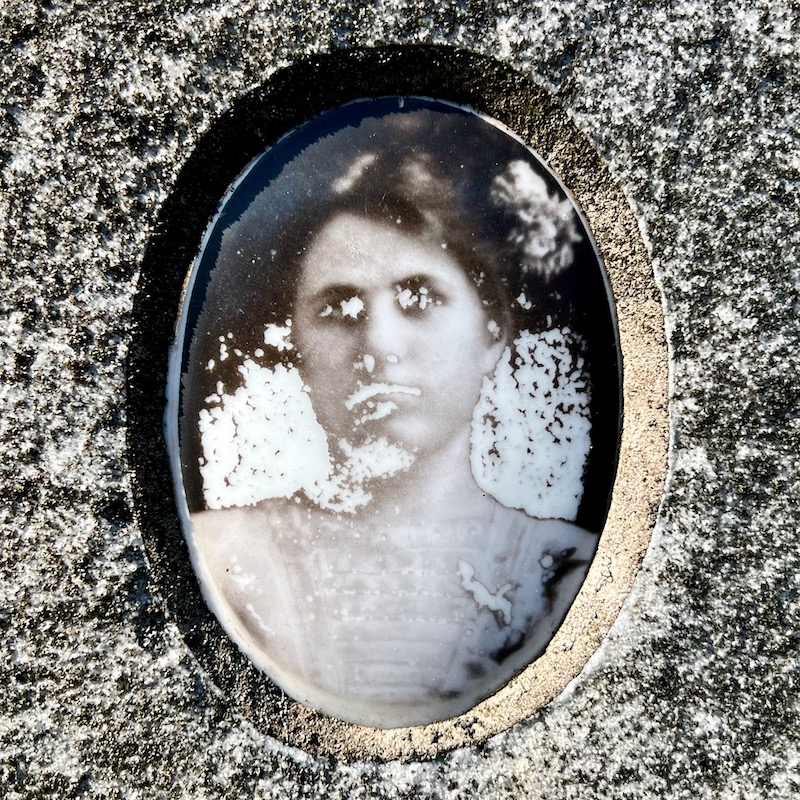
Here’s where the strings come in. One of many ghostly images inset to grave markers at Economy Cemetery, Harmony Township
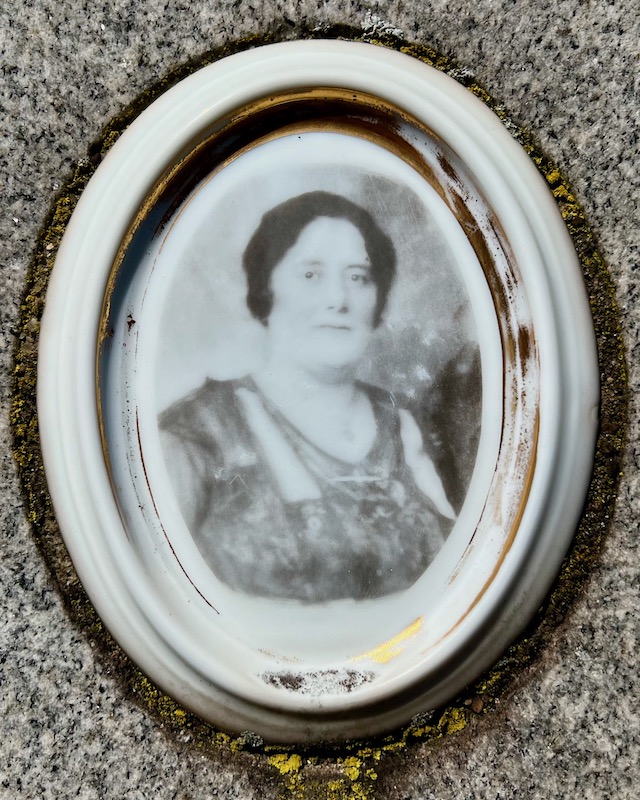
The woman is still recognizable, but just barely. The pale white complexion of her face and forehead is clear and intact as is her uncharacteristically short, slightly disheveled brown hair. She’s dressed in a Victorian-style formal high-necked gown, but in the photograph the dress looks full-on psychedelicized. One side of the woman’s head is disintegrating right before our eyes.
The whole scene looks like a pixelated digital effect created for low-rent science fiction, but this one’s falling apart the old-fashioned way. A hundred years of living outside in harsh Pennsylvania winters with toxic heavy industry air have started to corrode and dismantle this relic. That fact is both tragic—if you wish to see the woman’s image preserved—and beautiful in the haphazard way the photograph is dissolving. She’s not alone.
It was just about seven years ago to the day when The Orbit first tripped across the early-last-century ceramic photo insets at Loretto Cemetery. It was our first exposure to the phenomena and entrée to the fever. Along with the majorly disproportionate number of these at the little cemetery in Arlington Heights—and the near complete absence of them at much larger cemeteries—the experience totally flipped our collective wig.
Since that time, every trip to the boneyard comes with some amount of spying for these “posthumous portraits” both as historical record and the fascinating aesthetic of the completely random ways they weather and age. We dug deep. Not just at Loretto, but also Workmen’s Circle Branch 45 and Beaver Cemetery, where pre-war photo graves are similarly in great supply.
Nothing, though, had us prepared for the overwhelming volume of portraits available at Economy Cemetery in Harmony Township, just outside of Ambridge. The number was so great, the occurrence so common, that we abandoned any hope of a true cataloging of the form and stuck to the wild ones—the ghosts, disappearing acts, invisible figures, full blown possession.
There were plenty in just this minority of the total number that we’re splitting the subject into a two-parter. This week, the apparitions; next time, the crook’d and crack’d.
A note on the photos: You’ll notice there are no attributions to the people photographed as we’ve tried to do in the past. That’s in part because there are just so many to deal with and the task quickly became untenable. More than that, though, at least a third of the photos are from grave markers where the text is no longer legible and probably another third are in a variety of non-Roman alphabets—Greek, Cyrillic—that your author wouldn’t know how to represent accurately.
The Lucite-enclosed photograph of Harry Begler (d. 1921). One of many grave markers that include both photographs and the symbolic imagery of chain links at Workmen’s Circle Branch 45 Cemetery, Shaler
From inside a half-globe of clear Lucite, Harry Begler stares straight back at us. The young man’s image is amazingly intact and undistorted by the odd curvature of the material that protects his photograph. The clear casing has suffered somewhat over time, but is still in terrific condition considering it’s spent the last hundred years living through as many freeze-and-thaw cycles, the corrosive air produced by heavy industry, and the inevitable presence of no-goodniks. Centered below Beglar’s photo and cut into his long granite grave marker is the depiction of three chain links making an ever-so-graceful arc downward.
Harry Abromovitz, 1888-1932
Chains are a not-uncommon symbol to find etched into gravestones and they appear in great frequency here at Workmen’s Circle Branch 45 Cemetery. Begler’s three links match the totem of the Independent Order of Odd Fellows whose symbol—standing for Amicitia Amor et Veritas (English: Friendship, Love, and Truth)—is its own standalone thing.
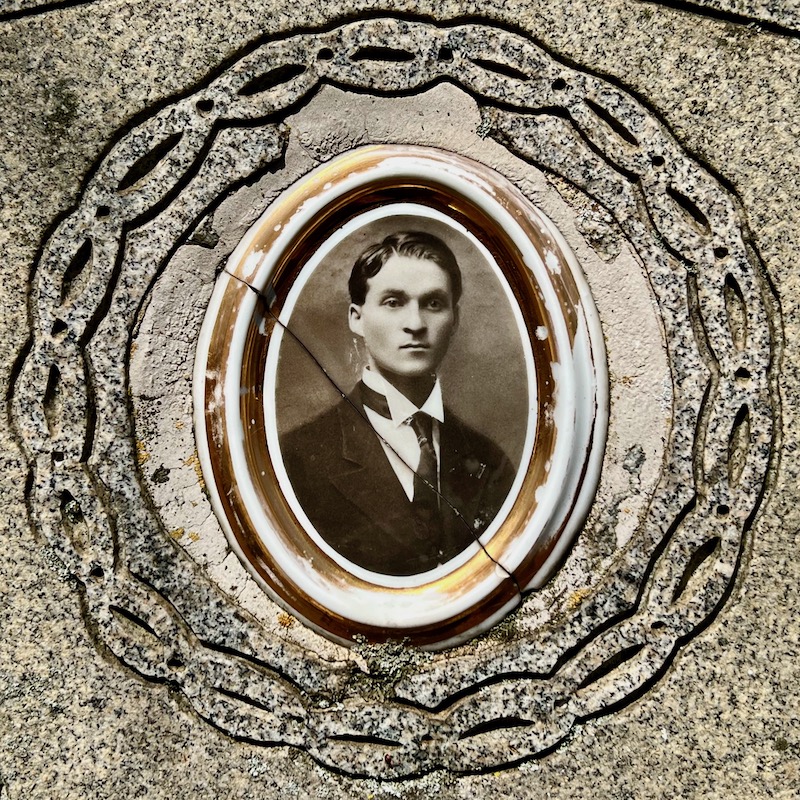
The rest of Workmen’s Circle’s linked chain imagery takes an entirely different form. For these, an unbroken chain encircles the deceased’s portrait.
Harry Shore, 1885-1928
Google the subject and you’ll find a whole lot more information around grave marker carvings that feature a broken chain—with its last link either missing or severed. There even appears to be a common twofer plan where the first half of a couple to die would have the broken link with her or his partner following it up with a connected chain to symbolize the pair united in the afterlife. We don’t see any of this at Workmen’s Circle, though—all chains are perfect circles and completely intact.
That the residents of Workmen’s Circle are all Jews may or may not be significant with regard to the symbolism of chains on grave markers. This goy couldn’t find anything connecting the two, but perhaps our O.T. brothers and sisters can help us out here.
Speculation aside, it’s always interesting to see how these patterns emerge at certain cemeteries—it’s almost fad-like. So gander away at these terrific combos of grave marker photographic portraits and the wreath-like protective chains that wrap them up both as design elements and symbols.
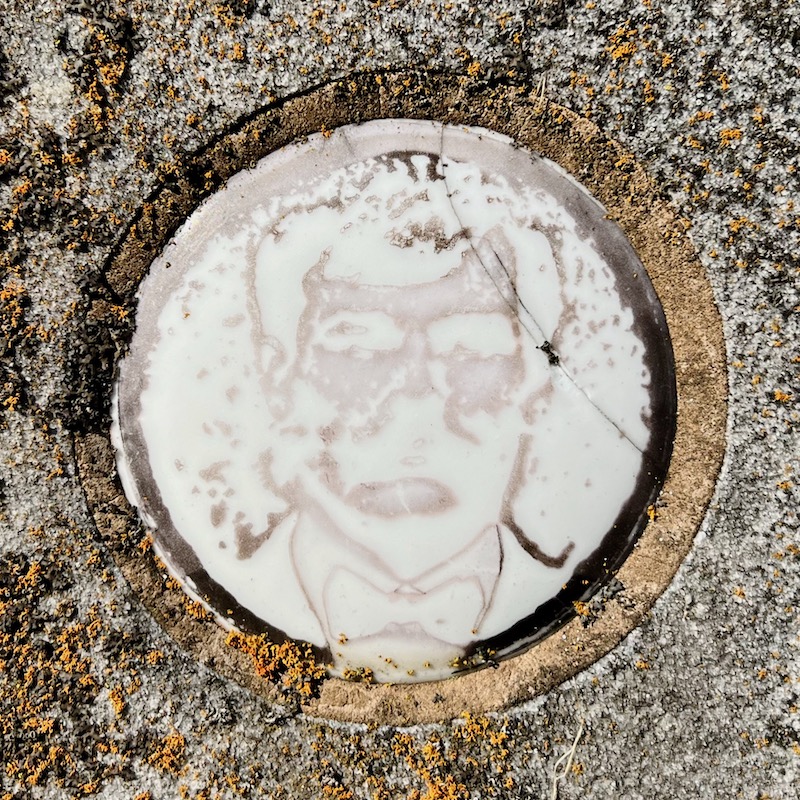
The ghostly image of Bennie Mazer (d. 1925) set into his grave marker. One of many similar deteriorating ceramic photos at Workmen’s Circle Branch 45 Cemetery, Shaler
The young man—he’s perhaps all of twenty-five—sits for his formal portrait in a jacket, tie, and pressed white dress shirt. Bennie Mazer possesses a full head of thick black hair and holds what is fair to call a Mona Lisa smile. The man’s eyes, though, are inscrutable. Through no fault of his own, the photograph—printed on a ceramic disc nearly one hundred years ago—has started to deteriorate in a most unexpected way.
In this image, Mr. Mazer’s deep set eyes appear as if engulfed by sparkles of light. The swirling electrical field that creeps over his right shoulder seems to have entered the body and lit Mazer like a jack-o-lantern from within.
The photograph, set into a large stone grave marker, is lovely, fascinating, and bizarre—equal parts local history and science fiction. It’s also hard to fathom how this object that survived 98 harsh Pittsburgh winters would deteriorate in such a lopsided way. The reality probably has to do with the printing technique and the particular value of that two-tone shade, but it feels like the work of spirits.
Dora Cherry, 1909-1918
The Orbit first went goo-goo ga-ga over these early-century ceramic grave photos when we encountered them at Loretto Cemetery years ago. Those were a revelation … and then Beaver Cemetery upped the ante considerably. Those earlier posts brought to mind all sorts of ponderances on memory and permanence and how we (the living) use these places—we’ll not repeat all that here but to say those questions are never far from the noggin.
Harry Beck
We also discussed the strange clustering of ceramic photos in certain cemeteries and the near complete absence in others. Let me know if you find more than three or four of these in all of giant Allegheny Cemetery.
Stone for stone, the per capita count of photo graves, or posthumous portraits, at the tiny Workman’s Circle Branch 45 Cemetery (and next-door New Light Cemetery—we’ll get to that) is off-the-charts. There are so many examples that we decided to break these out into a series around a few loose themes.
unknown
Here then is part one, where we look at the most haunting of the gravestone portraits—the ones that are in their own slow dissolve right before our eyes. The images contained range from mostly there with some weird distortions—like we see with Bennie Mazer—to versions so weatherbeaten and sun-bleached as to make their subjects barely distinguishable. We also threw in a handful of gentle fades and a couple that have apparently been defaced—a sadly common occurrence at all these cemeteries.
We’ll quit the gabbin’ so you can get to gawkin’. We’ll see you on the other side.
unknown
Eva Millstone, 1895-1917
Simon Begler, 1890-1932
Eleanor Saul, 1900-1925
unknown
Mary Katz, d. 1922
Temma Sigal, d. 1939
Harry Singer, d. 1927
Harry Singer
Rebecca Leah, d. 1940
Evelyn Goldman, 1927-1934
One that got away / Spock hands. S. Rozinsky d. 1918
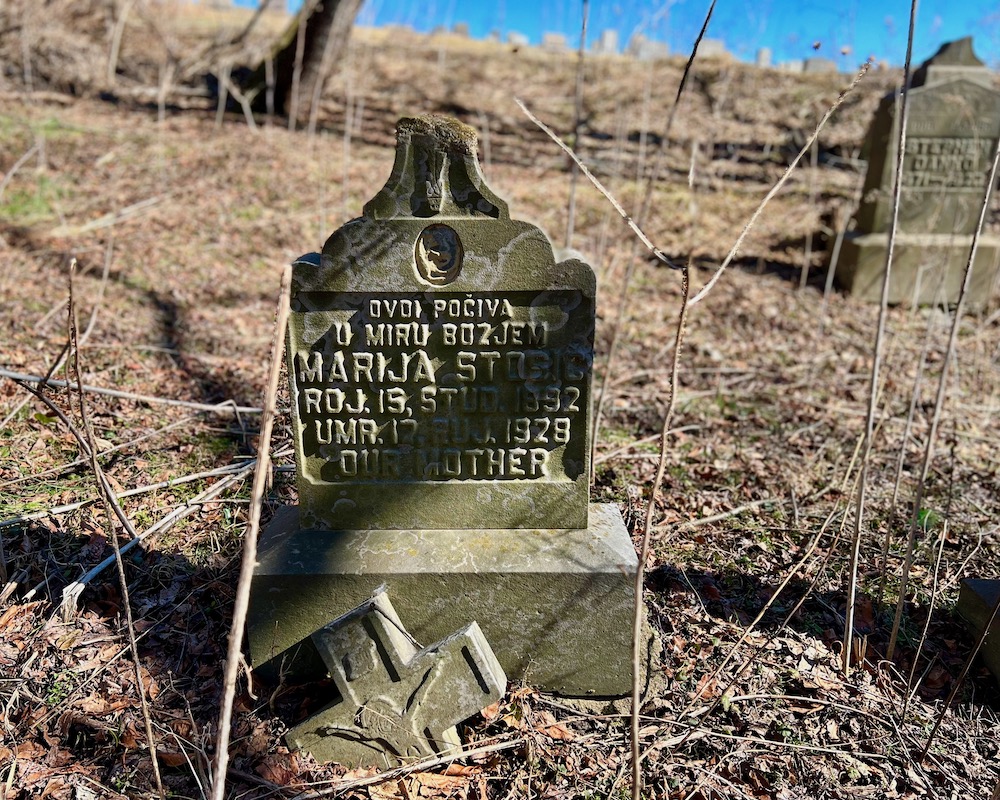
Crucified and cut in two. Marija Stosic’s grave marker is one of dozens in a no-longer-maintained section of Loretto Cemetery, Arlington
It’s a striking image. Marija Stosic’s grave marker has deep-chiseled text that casts stark shadows in the day’s bright sunlight. The minimal epitaph, Ovoi počiva u miru bozjem, is—if Google Translate is to be believed—Croatian for Rest in the peace of God. Above, we see the familiar empty oval cutout where a ceramic portrait of Ms. Stosic would have been inset when the stone marker was first installed.
The design of the monument features a carved cross at the top with an image of Jesus in relief. Sometime over the last 94 years, the top has broken off leaving the Beloved Son not only crucified but bisected at the waist. Marija Stosic’s tombstone rests with another couple dozen (at least) fellow graves in a plot that’s now overgrown with the kind of scrubby barbs that will make this place difficult to negotiate by the time spring returns.
Elizabeth Floros
To be honest, we didn’t think Loretto Cemetery would produce another Orbit story. Our two-parter, from way back in 2016, on Loretto’s fine collection of pre-war photo graves and the ones that just about slipped away seemed like all we’d be able to squeeze out of such a small memorial park.
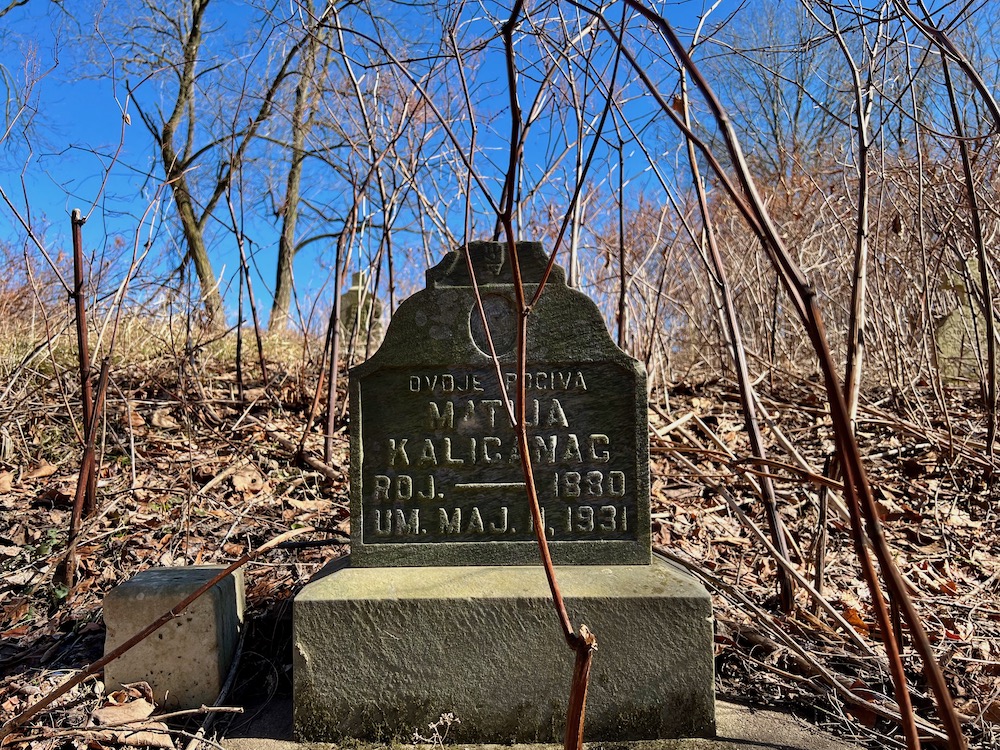
This time though, with a return trip on a lovely full sun midwinter day, we went all the way to the back and the bottom. The cemetery has an L-shaped extension that reaches down the hillside and runs out where the closely-clipped grass meets untamed snags and prickly bushes … but the cemetery doesn’t actually end there.
Loretto’s lost cemetery below; still-tended cemetery above
Come springtime, it’s unlikely anyone would even have the sight lines into this extra, lost, forgotten—take your pick—section of the cemetery. We imagine the winter’s long grasses and denuded vinery will produce the same sort of thick greenery that envelopes every square inch of untended, asphalt-free Pittsburgh making this parcel all but invisible to Loretto’s visitors.
Mary Pavicič
The obvious question: why did this section of the cemetery—a plot maybe a few acres large, containing grave markers almost entirely with Croatian names, deceased in the 1920s and ’30s—stop receiving the care the rest of the park has? In lieu of any real journalism, we’re left to speculate.
Mathilda Goralczyk
Theory 1: Cost savings for the cemetery. The geography of the hillside is just too severe and Loretto’s management decided they couldn’t justify the expense of sending their grounds crew into an untamable wild to tend a set of grave markers so old they rarely—if ever—receive family members.
Theory 2: This was never a part of Loretto and instead it was a separate, independent cemetery. We find these tiny cemeteries—often associated with a particular church, faith, or national origin—all over the place. They’re also often immediately adjacent to larger cemeteries. Perhaps the Hilltop’s Croatian community purchased or sub-leased this plot of land back in the 1920s with their own maintenance agreements that Loretto is not responsible for.
Matija Kalicanac
A wander through the cemetery—any cemetery—always brings up questions of permanence. Grave markers—cut from granite, weighing hundreds of pounds, placed on land with this specific purpose—carry the unrealistic expectation that they will exist in this state forever. But we know it ain’t going to play out like that.
In our previous story on Loretto’s photo graves we discuss the irony that some of the ceramic photos on grave markers have outlived the carved text, such that we don’t even know the names of people whose images we still have—and it’s been less than a hundred years.
Loretto’s forgotten cemetery takes that and says hold my beer. You’re not even guaranteed a reasonable way for visitors to access your plot—and it may have been that way for decades.
Anna ? (Genz?)
You’re still reading this? The rambling rarely stops, but here we are.
If you do want to check out Loretto’s forgotten cemetery, we recommend doing it before the poison ivy, viney overgrowth, and legit jaggerbushes come back to life.
Otec Janko Sculac
* That should be something like Here rests the forgotten cemetery.
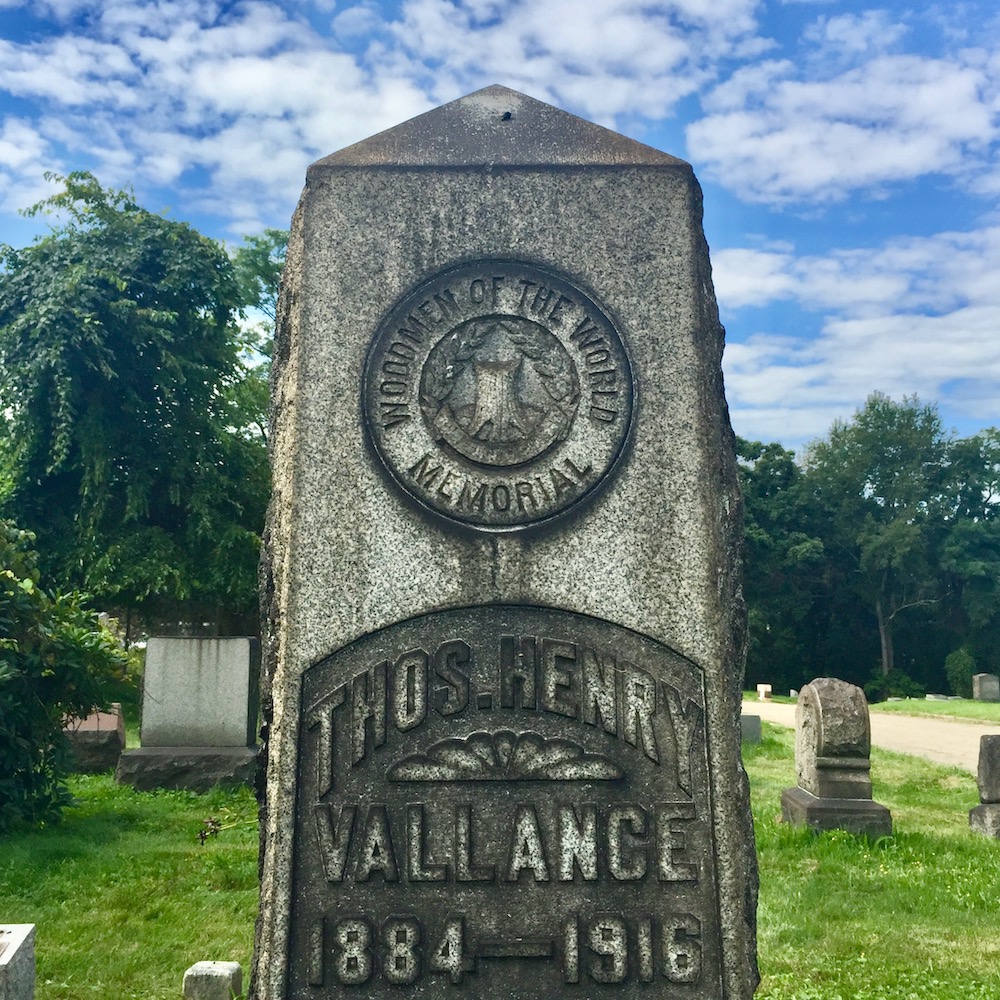
Thos. Henry Vallance (1884-1916), one of many Woodmen of the World grave markers at Richland Cemetery, Dravosburg
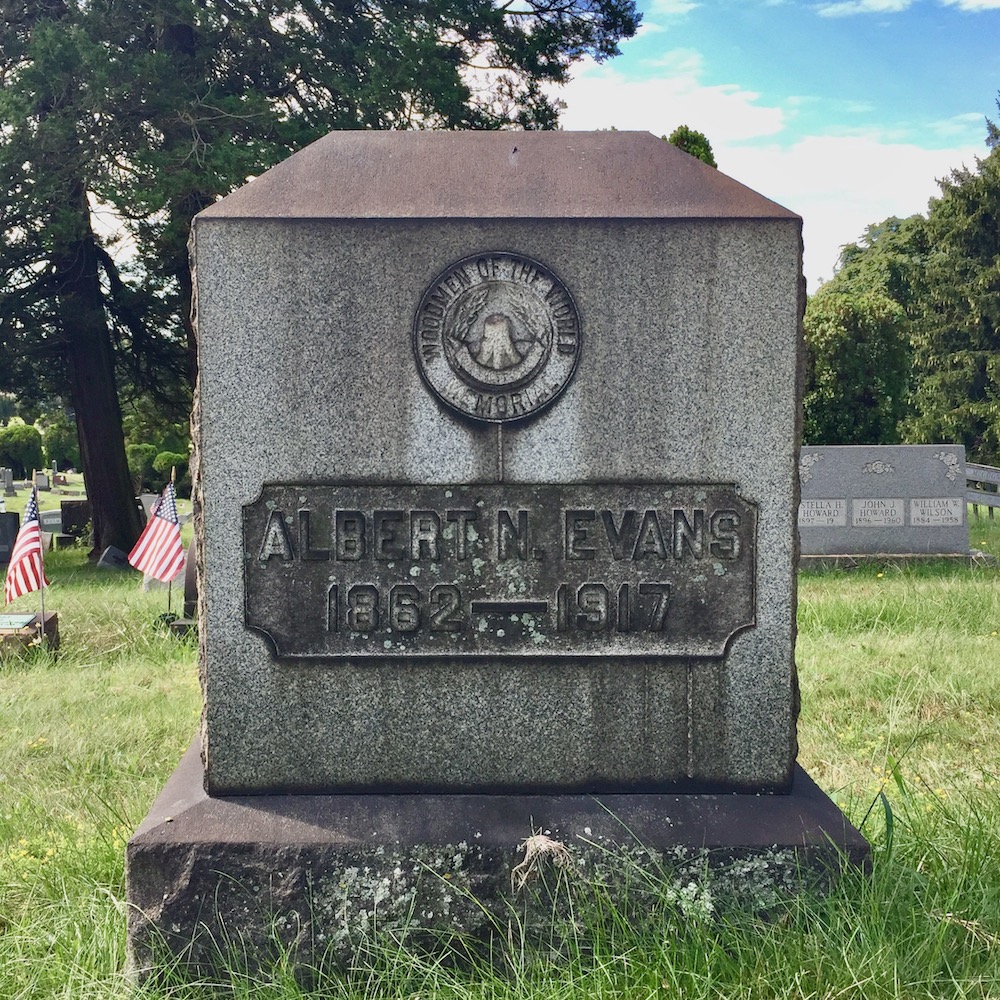
The image is both bold and secretive, seal and sigil, blunt of message and artful in its old-world, hand-crafted execution. At its center is the stump of a tree, big roots extended like a three-legged beast; on either side are crossed boughs, each leaf in perfect alignment. Ringed around the image in a practical, modern typeface are the words WOODMEN OF THE WORLD MEMORIAL.
Beneath the tree’s roots is a small scroll. More often than not–at least in our harsh climate–the words have been worn away. But if you’re lucky, you’ll find one that still has its Latin inscription clear enough to read: dum tacet clamat, “though silent, he speaks.”
Matthew J. and Florence C. Webster
Woodmen of the World grave markers were a new thing to this taphophile until just recently. Sure, any tombstone tourist has tripped over plenty of big granite monuments carved to look like tree trunks, piles of cut wood, or stumps carved with a common surname, sometimes with each limb separately marked for a departed family member. As gravestone fads go, these were a big thing in the 19th Century and the fever lasted well into the 20th. Pretty much any larger cemetery dating from this era will have its share.
But The Woodmen! Not every stump-like grave marker is for a Woodman. In fact, here in the city of Pittsburgh, they seem to be extremely rare. To find one, you’ve got to kiss a lot of lumber-looking frogs. Woodmen markers will have that impressive insignia bearing the organization’s name or the dum tacet clamat phrase. Each will almost certainly date within the 30-ish year period from the 1890s to the 1920s.
Woodmen of the World brass plaque
Annette Stott, professor of art history at The University of Denver, seems to be the authority on Woodmen gravestones. Her article “The Woodmen of the World Monument Program,”(Markers XX: Annual Journal of the Association for Gravestone Studies, 2003) is a great introduction to the relatively short history of Woodmen of the World’s (WOW) membership/insurance policy-gets-you-a-free-gravestone program.
Stott was writing from Colorado, which is perhaps not coincidentally where the Woodmen–a secretive, fraternal order in the mold of Freemasons and Odd Fellows–were founded in 1883. (WOW headquarters moved to Omaha, known as the “Sovereign Camp,” in 1890. The insurance side of the business–rebranded as “Woodmen Life“–persists to this day.) She describes a very particular couple of styles for the monuments the Woodmen initially offered to supply their beneficiary members in good standing upon death.
Jacob and Sophia Elicker
When and how the Woodmen spread east is unclear, but they sure found a lot of takers in the Mon Valley. I’ve had a devil of a time locating any WOW stones in all of my hundreds of walks through giant Allegheny Cemetery; exactly one found (so far) in equally huge Homewood Cemetery. (Though I haven’t put in the same amount of time there.)
But Dravosburg–WOWza yowza! Richland Cemetery, just uphill from the bridge to McKeesport, has dozens of Woodmen monuments. There are so many in this medium-sized memorial park that at a certain point, your author just stopped looking. You can’t bag them all and I had a cookout to get to.
Stumped
Wm. G.E. Ward
Stott describes the two original designs offered by the Woodmen program as “a six-and-a-half-foot monument consisting of a shaft surmounted by a draped urn … or a seven-and-a-half-foot tree trunk with the Woodmen of the World emblems carved in high relief.”
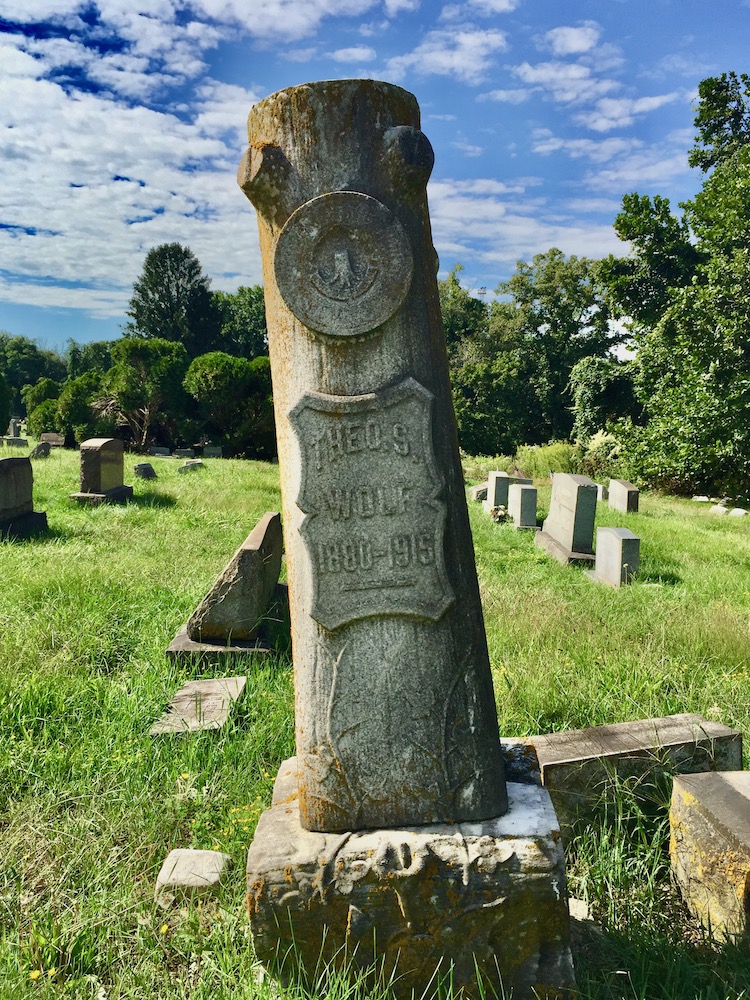
There is nothing resembling “a draped urn” on any of the WOW monuments at Richland, but tall tree trunks with the Woodmen emblem are in no short supply there. There is a strong similarity in all of these, but they’re not cookie-cutter copies, either. The placement of severed limbs, design of the deceased’s name plaque, and the monument’s base all vary from model to model.
One of these (Peter Wersderfer, below) is decidedly more ornate than all the rest, but whoever decided to face the monument north–so it would be perpetually backlit–never considered the trouble that would cause photographers in the blogosphere a century later. Sigh.
Peter Wersderfer
Theo. S. Wolf
James H. Edwards
unknown
Walter H. Smith
Alfred A. Trecanowan
Not Stumped
Alonzo L. Sutton
Even though one being a “member in good standing” was the initial qualification to be in the Woodmen of the World’s monument program, one has to assume the big seven- or eight-foot tree trunks had to cost a lot more than a simple flat slab. Money came into the system somewhere and it wasn’t going to pay out evenly across-the-board.
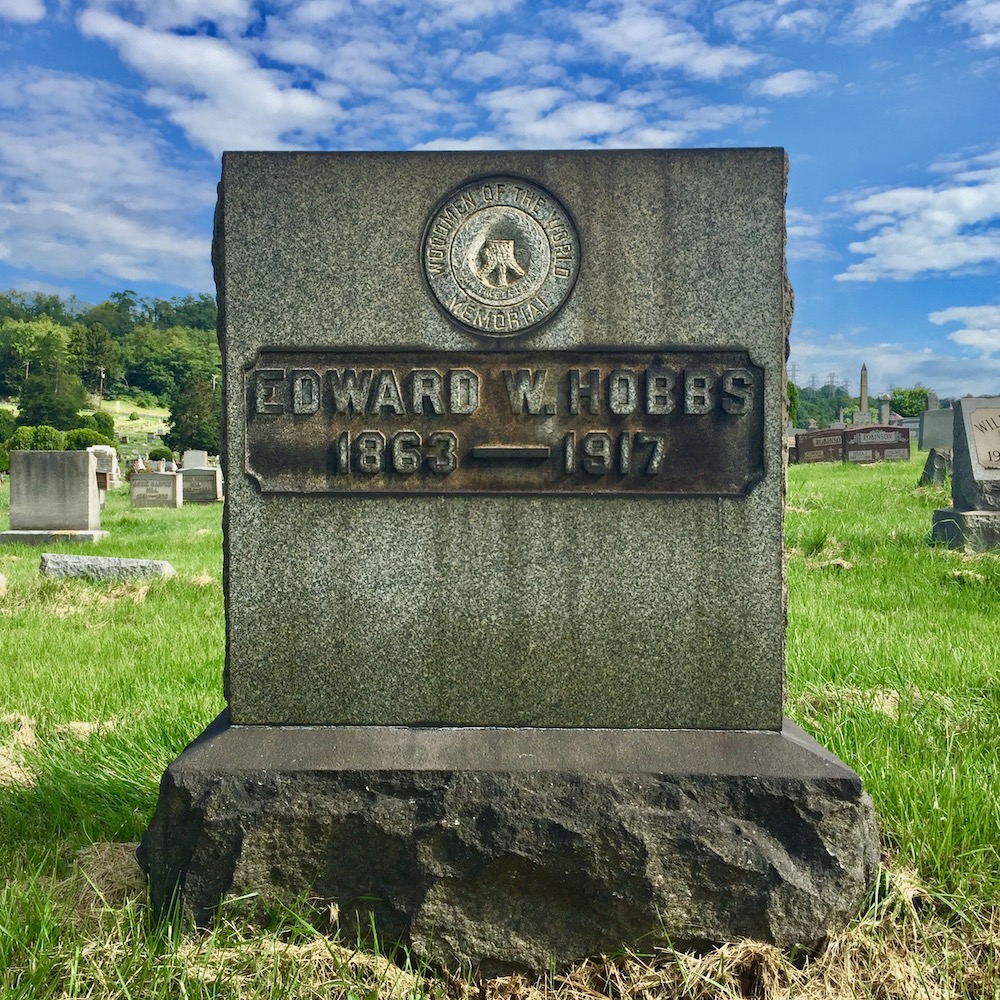
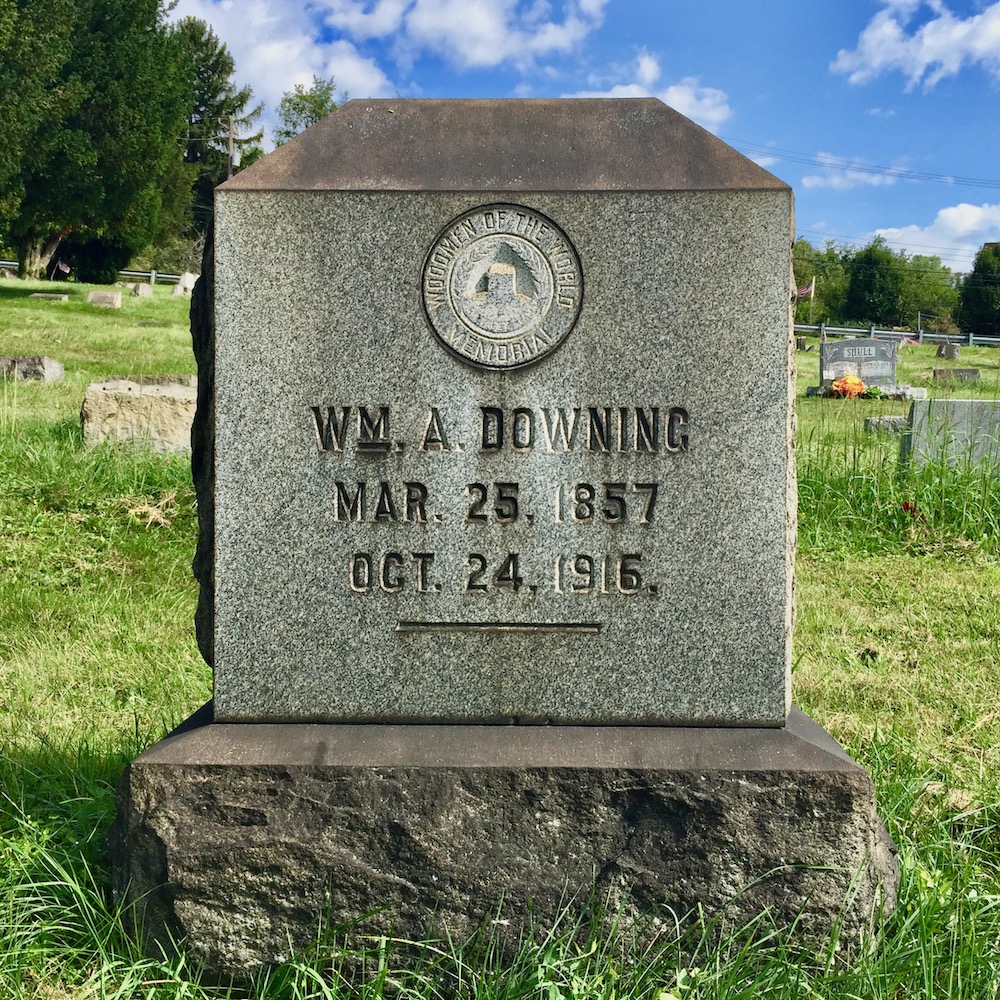
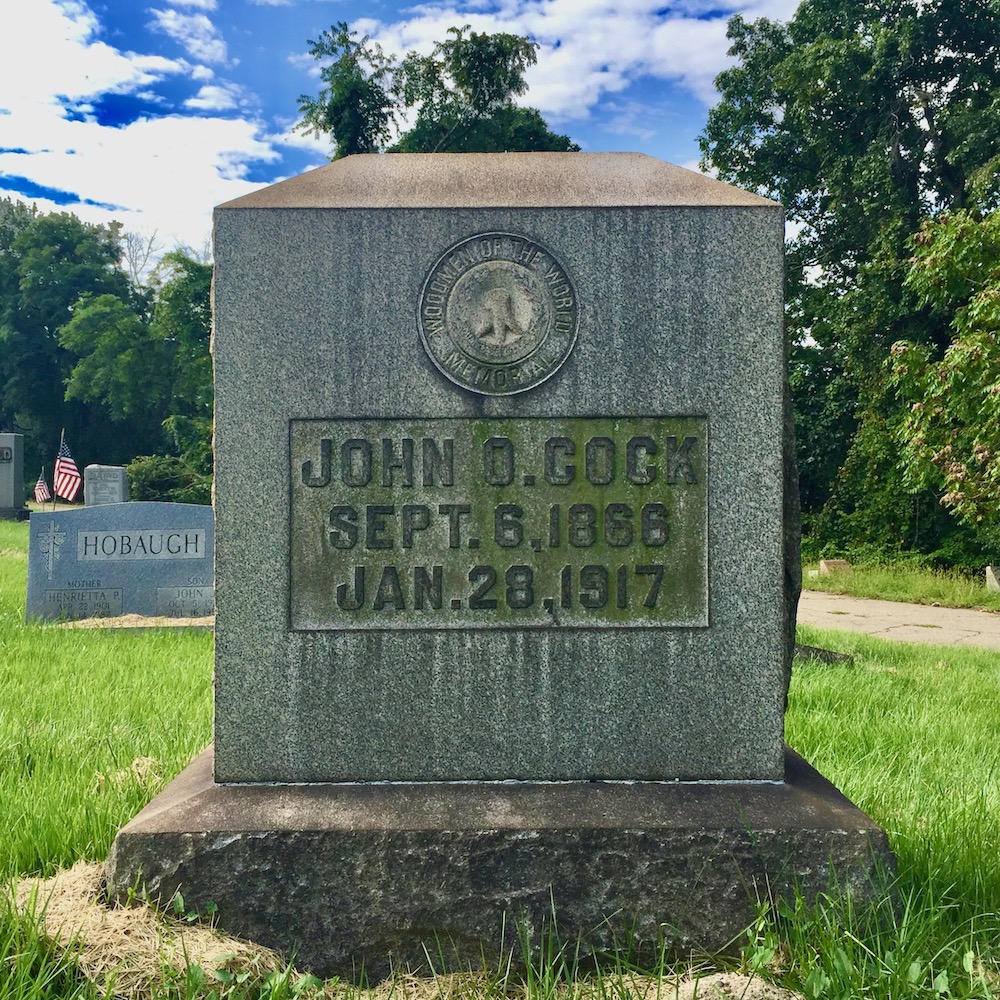
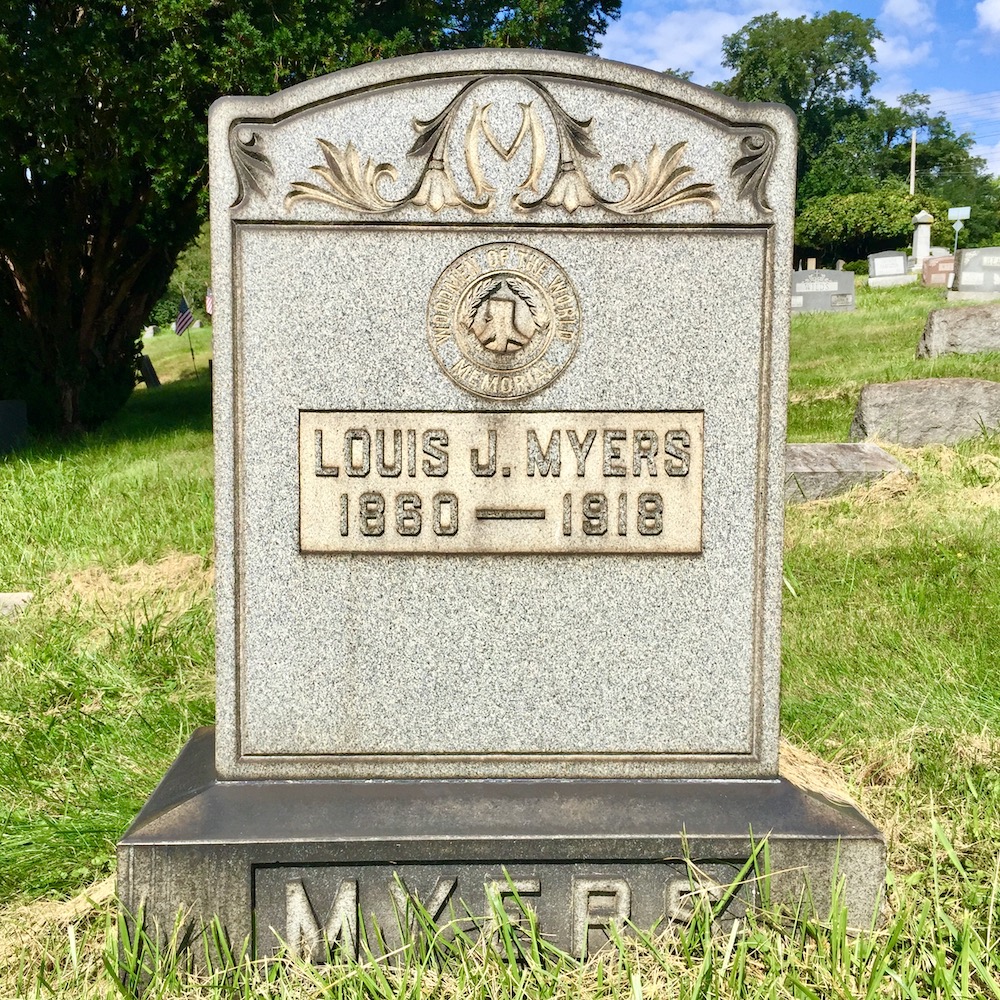
So there are many Woodmen grave markers out there with no resemblance to trees or stumps or woodland anything. One can see by the examples below that there were a couple more common, much simpler designs and then a number of outliers that look like the monument carvers added the WOW emblem to other off-the-shelf models in their catalog.
Samuel G. Gilbert
Edward W. Hobbs
Robert Jackson
Wm. A. Downing
Albert N. Evans
Henry Williams
No snickering! Yes, John O. Cock was a Woodman of the World
Isaac Miller Shick
Louis J. Myers
Charles C. Seitz
Woodwomen of the World?
Grave marker for Martha Ann Tharp (1862-1915), a member of the adjunct “Woodmen Circle.”
While there were undoubtedly many many ladies of the frontier who could accurately be described as “woodwomen,” it will come as a surprise to no one that a hundred years ago, a person required a Y chromosome to be eligible for the Woodmen of the World.
That doesn’t mean women were entirely excluded from memorials. Rather, as is so often the case, they arrived on WOW-branded markers partnered with their husbands or in their own separate, adjunct status.
Stott describes a particular version of this the Western U.S. “Women of Woodcraft, the female auxiliary of the Pacific Jurisdiction Woodmen of the World since 1898, also maintained a monument program.”
In Dravosburg, at least, there don’t appear to be any Women of Woodcraft, but rather a number of stones bearing typically female names and the seal-like imprint of the alternate Woodmen Circle. That title is objectively less cool than Women of Woodcraft, but we imagine the route to get there was pretty similar.
Insignia of the Woodmen Circle
Lizzy (Woodmen Circle) and Thomas N. Fletcher
Matilda Neel (Woodmen Circle)
Woodmen of the Afterworld
A rare post-1920s Woodmen of the World grave marker.
Woodmen of the World grave markers exist for a relatively slim segment of history–approximately, the 1890s through the 1920s. This tracks with what we found in Dravosburg, although the earliest ones spotted are from 1907. The insurance program likely took some extra time to spread this far east.
Stott describes the end of things as a basic case of an unsustainable business model:
After 1928, no insurance certificates were issued with a monument benefit, and in 1932, with no new money going into the monument fund, it was decided to distribute to each member still holding a monument agreement the exact amount that they had paid in, plus interest. That ended the program.
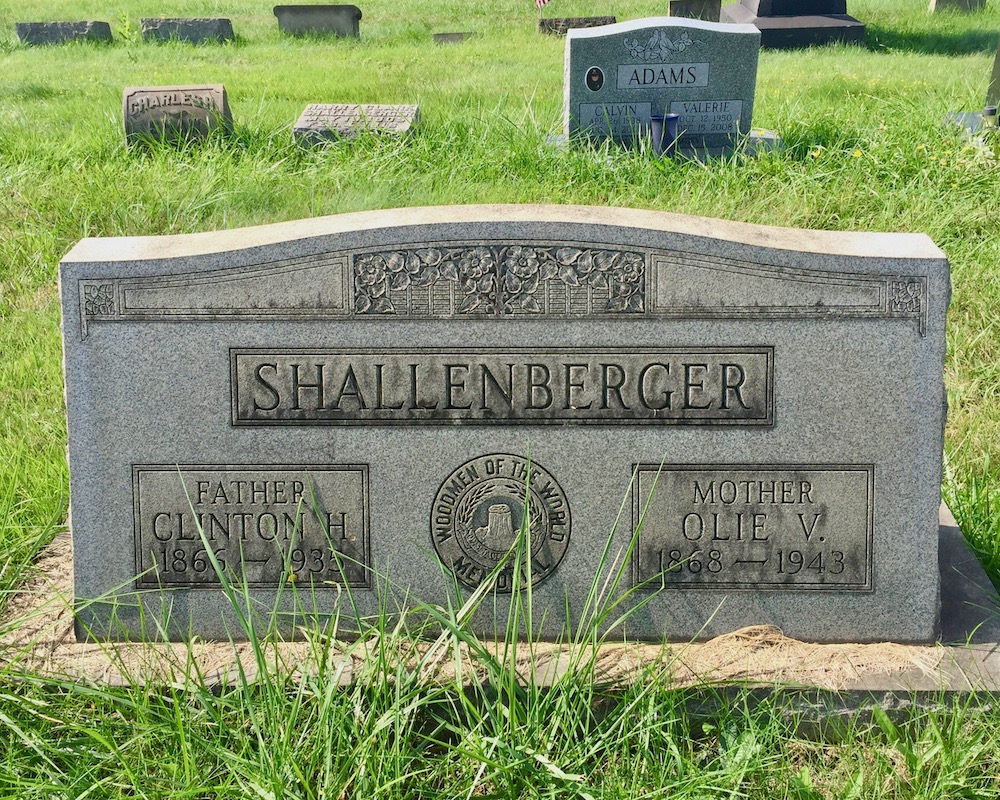
Richland Cemetery has at least two markers that include the WOW insignia and fall outside this timeline. Clinton Shallenberger (d. 1935, photo above) and William Neel (d. 1945, below) both ended up with WOW-branded grave markers, but it seems unlikely they were paid for by the organization.
William M. Neel, another post-1920s WOW marker
Were these “members in good standing” who’d paid enough into the program back in the day to find a grandfathered-in loophole? Or were they loyal Woodmen to the end who specified the organization’s seal on their gravestones–even if the family had to pay for it–as a dying wish?
We’ll likely never know–there may be as many reasons as there are after-market Woodmen of the World grave markers. Like their fellow crypto-brotherhoods The Freemasons and The Odd Fellows, The Knights of Pythias, The Frogs, and The Owls, there’s what’s known, what’s imagined, and what we’d rather leave untold to keep some mystery alive in this age of over-exposure, instant reward, and gluttonous narcissism. We can be grateful that maybe that’s something that might still be taken to the grave.
All photographs taken in Richland Cemetery, Dravosburg, PA., Sept. 2021.
From grieving family to alien beings in just 150 years. One of many intriguing details in Allegheny Cemetery.
The family is gathered together in grief. Their roles are not entirely clear, but it appears we’ve got a husband and wife, several school-aged children, and a nanny tending to the youngest of the lot. There is also another, larger, man dressed formally in the kind of double-breasted coat-and-tails popular among the well-to-do of the mid-19th century. Even if the patriarch hadn’t quite literally lost his head (and portions of both arms) it’s probably safe to say he’s the reason the gang is all here.
The figures, intricately carved into an elaborate marble cemetery monument, don’t appear as they originally did 150 years ago. Like her father (or maybe it’s her father-in-law), mom is also sans-tête, but even more striking is the way the facial features of the entire group have been worn away, leaving a strange alien-like cadre–gaunt, ghostly, and zombified–but awkwardly dressed in Sunday-best human clothes with an out-of-place Greek temple in the background. It’s the perfect setup for a gothic sci-fi story.
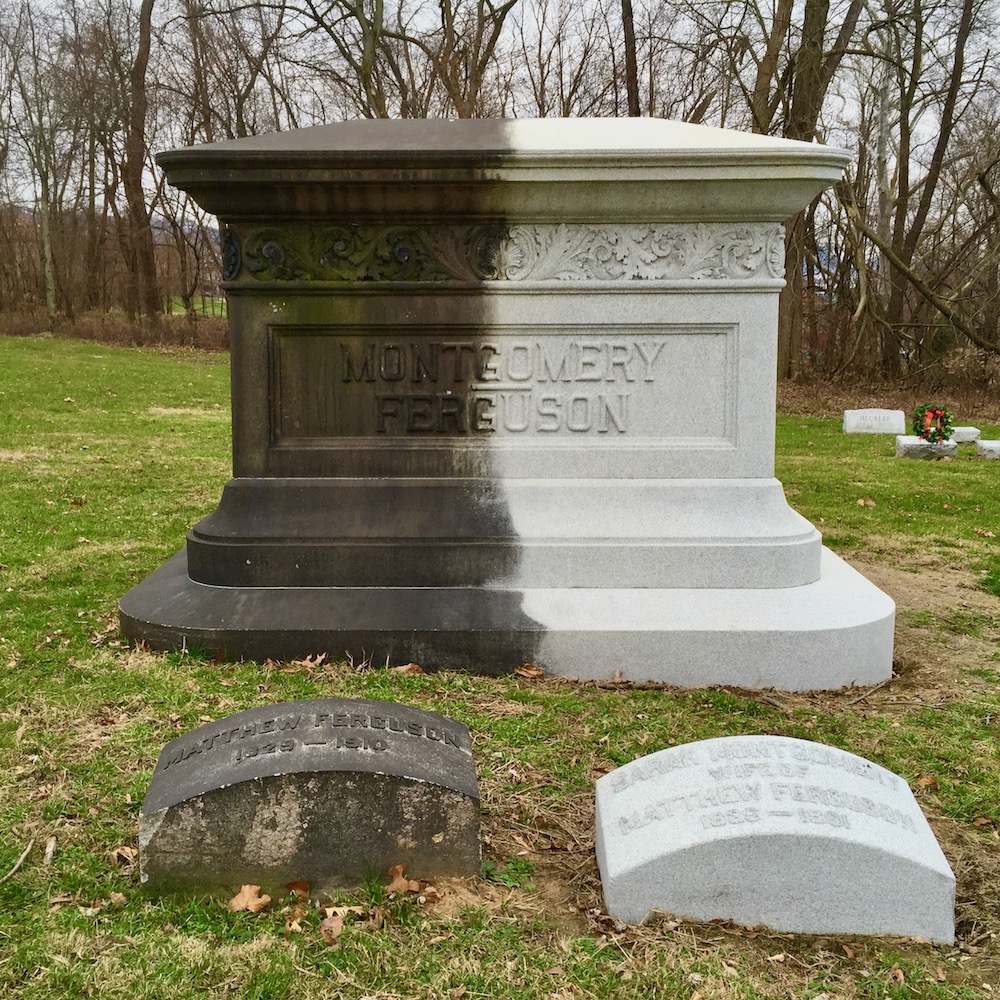
Breaking up is hard to do. The two-tone stone.
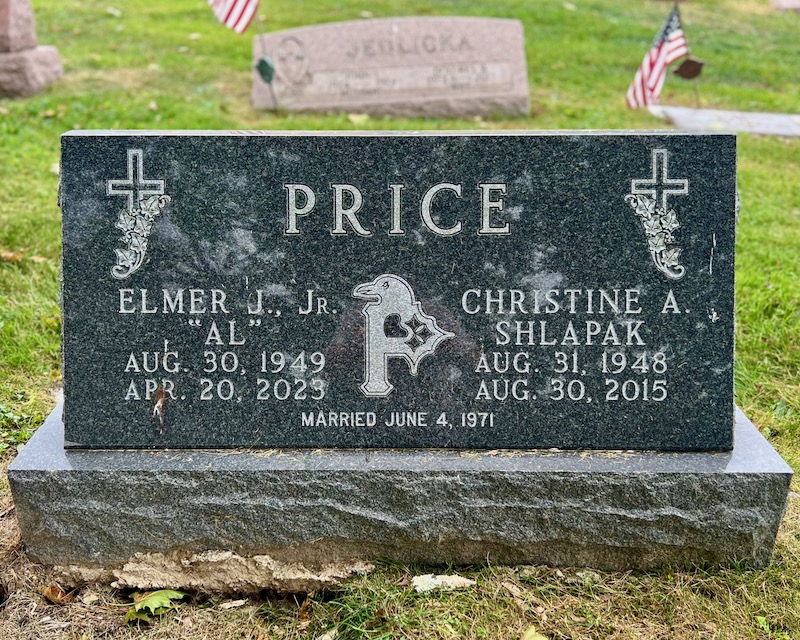
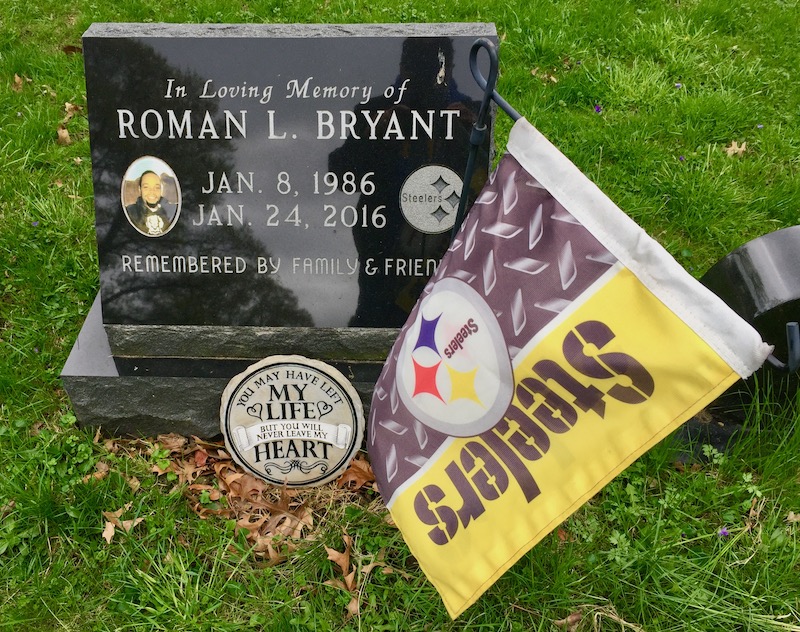
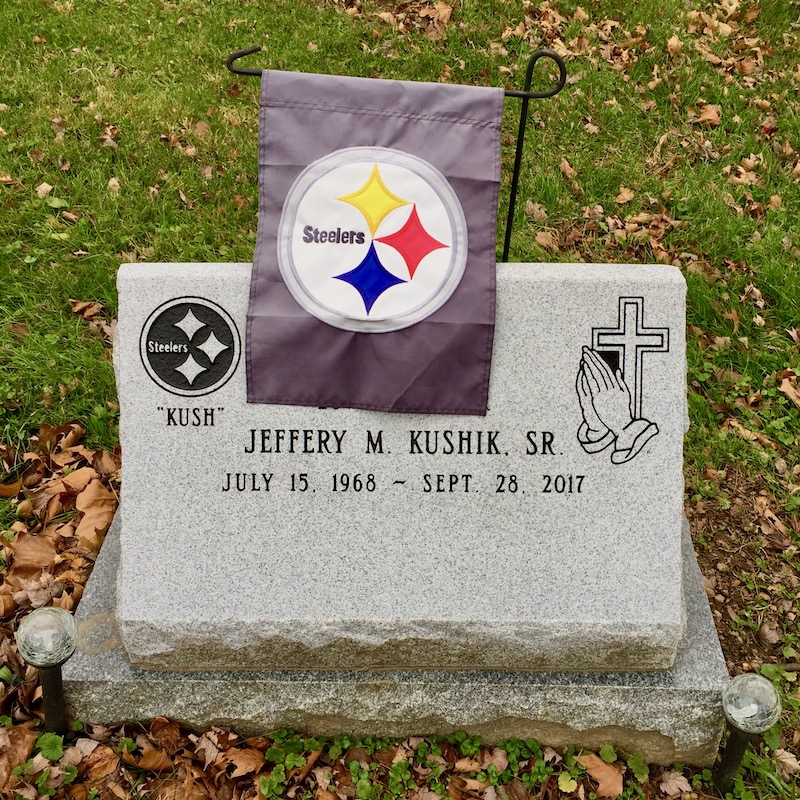
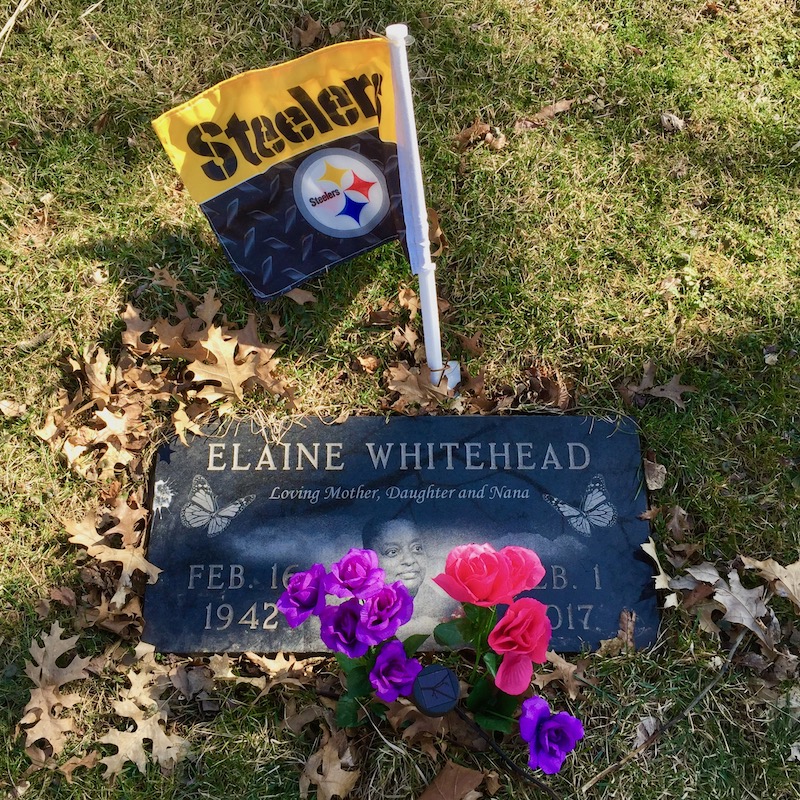
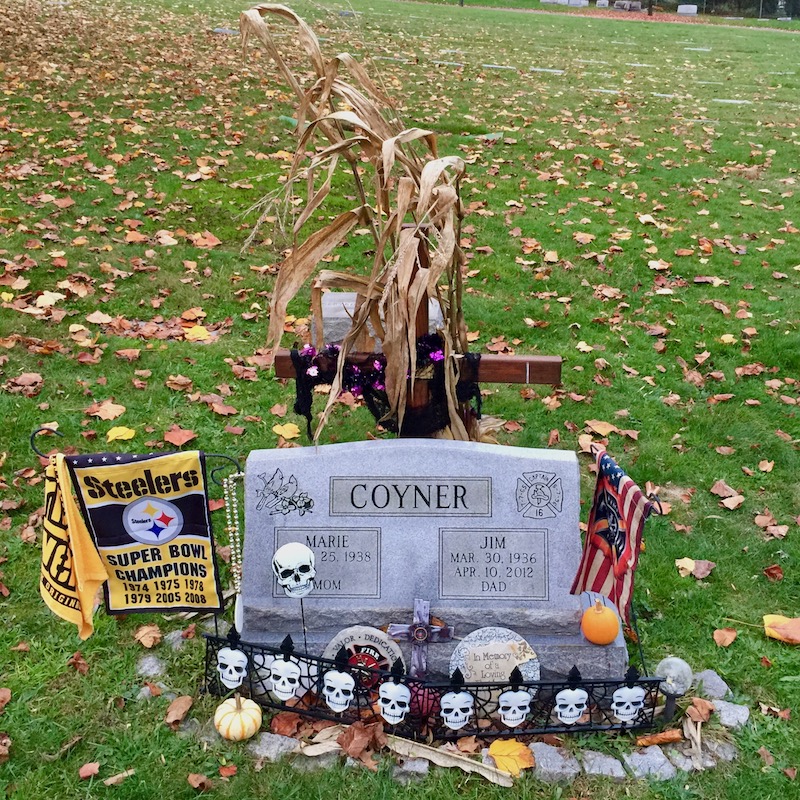
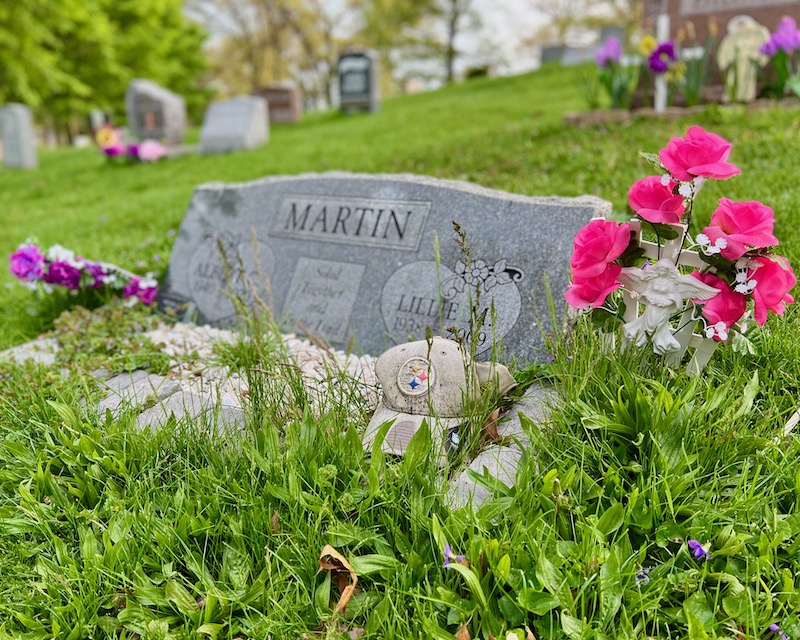
If you’ve spent any time at all within the beautiful boundaries of Allegheny Cemetery, you know its greatest hits: the rolling landscape, gangs of deer, and gaggles of geese; the Winter mausoleum, resplendent in faux-Egyptian glory, complete with a pair of guardian sphinxes; elegant–if, endangered–stained glass; the hokey Jaws-inspired “shark grave”; Orbit favorite Steelers stones; final resting places of famous (at least, Pittsburgh famous) people like Stephen Foster, Josh Gibson, Lillian Russell, and Stanley Turrentine. The list goes on …
But for those of us who spend enough time in the cemetery to, you know, “check the pulse,” there are so many more fascinating details to this 177-year-old burial park that we thought we’d put together a scavenger hunt for those who might be looking for an excuse to get out and poke around.
Below is a collection of favorite oddball, accidental, and unexpected elements from Allegheny Cemetery’s 300+ acres that we offer up as a fun, we-still-need-to-be-Covid-safe outdoor hunt for the curious. Much like an office visit with Dr. Love, there are neither bills nor fees for participating. There is also no time limit and the only reward is the satisfaction of getting out there, stretching the legs, and doing the thing–but that’s a fine way to spend a sunny spring afternoon.
Happy hunting, y’all!
The headless boy
We’re four photos in, and already down as many noggins. The ornate colliding with the real world never fails to generate interesting anomalies. Statues carved from stone that have lost fingers, whole limbs, and yes, their entire cranium are always something to see–and Allegheny Cemetery has plenty of these–but we thought we’d call out two evergreen favorites.
The headless boy (above) sits among a circle of similar–but still intact–statuary in a glorious part of the cemetery, reliably basking in fine views and peaceful tranquility. By contrast, the bird’s nest monument (below) is always a hive of activity as a family of sparrows almost always take up residence under the structure’s partial roof, atop the cloth-draped column by the headless woman. Yes, again with the science fiction, but it’s almost as if the lady’s brain has been transformed into a bird’s nest that her decapitated body must now lean in close to communicate with.
The bird’s nest monument
Get hosed: the fireman’s memorial
Hat ornaments! There are many markers that incorporate iconography of the service their occupants pursued, but we particularly like the fireman’s memorial (above) with its old-school pointy hat-helmet and large firehose nozzle.
There are plenty of military veterans buried at Allegheny Cemetery, but few got the Union soldier’s hat + crossed cannons and cannonballs treatment of this fellow (below).
Union soldier’s hat, cannons, and cannonballs
Modern Times: a stone age machine
Most of the big cemetery obelisks are pretty plain. Shaped like mini-Washington Monuments, their whole thing is to be big and simple. But we love the detail on this one (above) where a stonemason has carved an incredibly intricate fantasy machine full of gears, engine belts, flywheels, an anvil, tools–you name it. Its an abstracted imagination of what a fully-mechanical factory might look like. It probably bears little resemblance to real life (even the real life of a hundred years ago) and more to the satire of Chaplin’s Modern Times vision of innovation-run-amok.
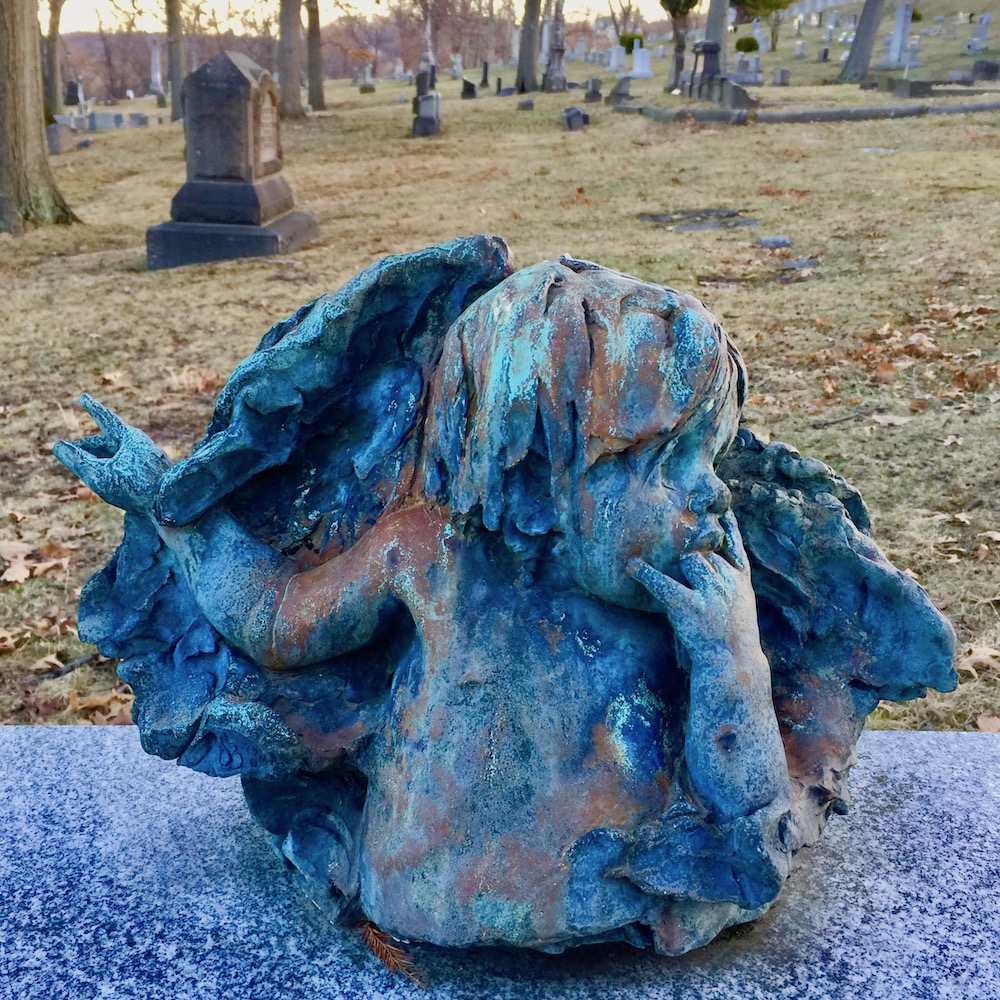
The bronze toddler, avec tête
Orbit whisperer Paul Schifino pointed this one out to us, and we’re glad he did. While including statuary of a young child isn’t all that rare (especially when the deceased died young), this one appears to be a bonus, add-on stone to a much more traditional marker. The bronze (?) head and bust was clearly handmade by an artisan and features the flat back of a piece that had previously been mounted … somewhere else. Who’s the kid? Where did he come from? We don’t know!
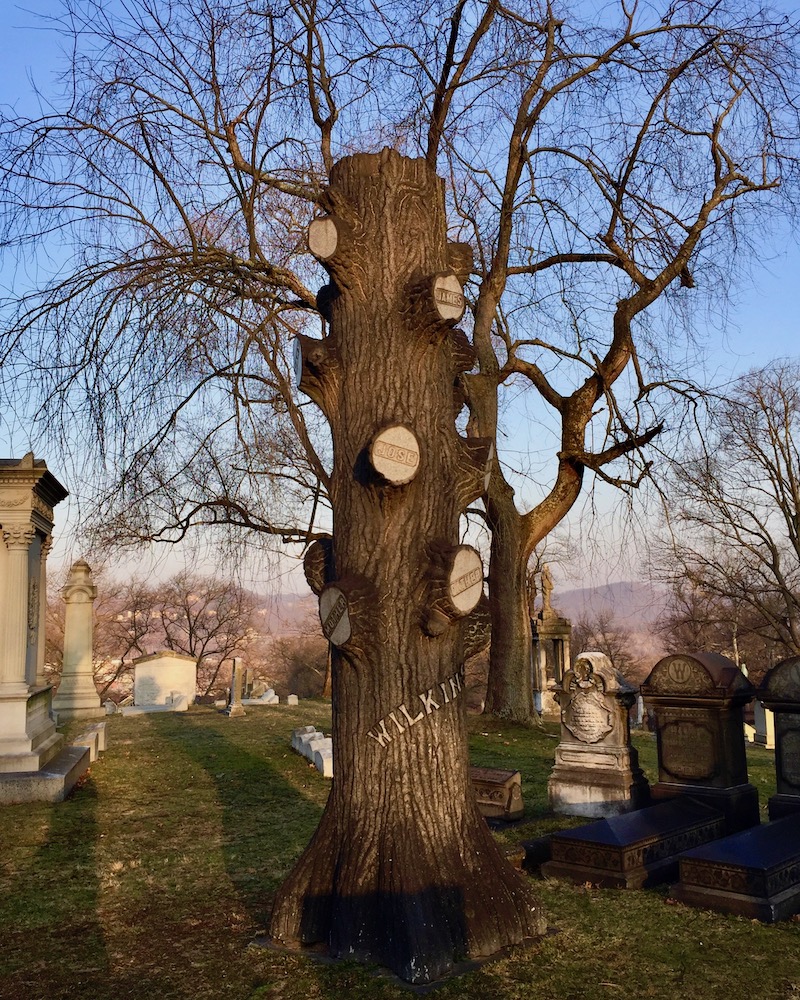
The Wilkins family tree
One of the holy grails for American taphophiles are the monuments created by the Woodmen of the World. That mysterious fraternal order/life insurance society provided stones carved to look like tree trunks with severed limbs for just a few decades at the turn of the 20th century.
The Wilkins family tree (above) is not one of these (at least, it doesn’t bear the WOTW insignia)–nor are there any in Allegheny Cemetery as far as we can tell. We have reached full-on obsession with finding some–heck, finding one. [Side note: if you know of any Woodmen of the World markers in greater Pittsburgh, please let us know and we’ll be on the road faster than you can say Dum Tacet Clamet.] Regardless, the Wilkins didn’t skimp when it came to ordering up this extra-large trunk with a dozen or so names carved into the severed limb stumps.
Pick up a couple good books
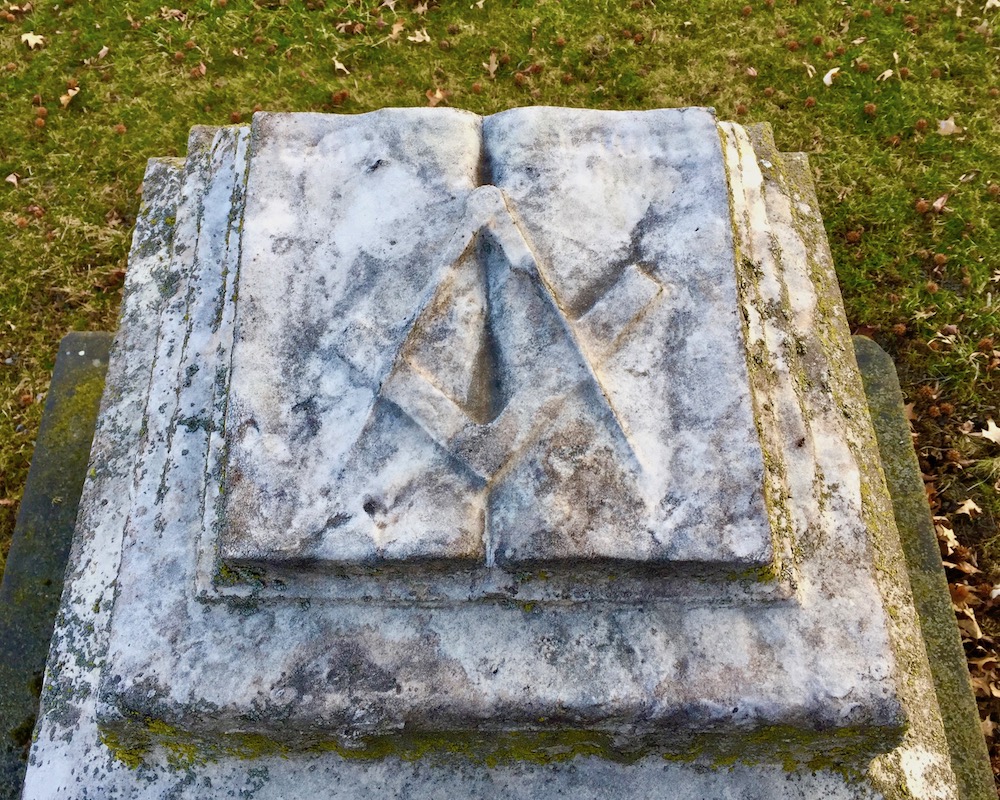
We love this pair of open book memorials. It would be interesting to know the title of a couple good books (above). History would suggest they’re probably two matching Bibles, but with all detail worn away, they could as easily be Lincoln in the Bardo and The Lovely Bones. Let’s hope it’s something good, because they’ll be here a while.
No mystery with this one, though. The square and compass insignia tells us a Freemason planted this stout stone dais with an open book and the two aforementioned tools acting as bookmark. Around the base (not pictured) is additional iconography–a Star of David, cross, etc.
The square and compass: the book of Freemasonry.
Going green: George Hogg’s multi-hued monument
Cemeteries–all cemeteries–are dominated by the color gray. Grave markers, large monuments, cenotaphs–they all live somewhere in the very limited spectrum of dirty white to not-quite black. It’s why the larger environment looks so great among the turning leaves of fall and against the green grass of spring; it’s why they look so stark within the equally monotone grays of winter.
Green also appears every once in a while in the stone itself. The Orbit doesn’t have a resident geologist/chemist, but our understanding is that this is the result of some mineral (copper, probably?) oxidizing over its decades exposed to the open air.
Many individual markers and statuary have streaks of iridescent green in their surfaces, but none moreso than the big memorial for George Hogg (above), which has completely mutated into a psychedelic light show of rich, emerald greens, electric neon blues, and washed-out pale cornflower.
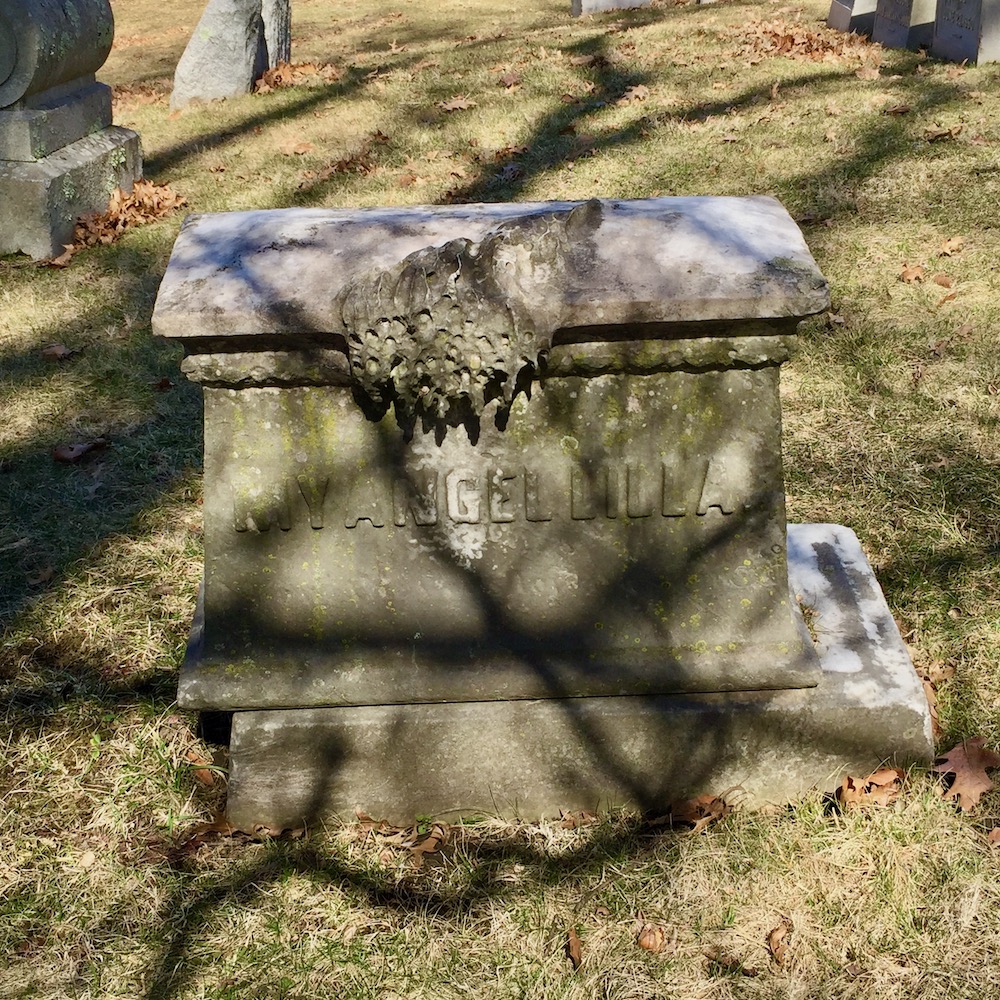
Hello, Dali. My Angel Lilla, the melting monument.
A couple oddballs here. My Angel Lilla (above) is nothing special but for the way time and tide have created this weird distortion in the lid. Did some imperfection in the stone cause it to … melt? Does that really happen to rock?
What the artist of the salt and pepper shakers (below) was going for might have been more obvious when it was installed and the details were sharp, but by now it’s a total mystery. Are those columns? cannons? some kind of industrial product? And what is binding them–vines? rope? chains? Heck, we’ve got today’s writing prompt for you right here.
The salt and pepper shakers: twin columns of mystery.
Lawrenceville in line
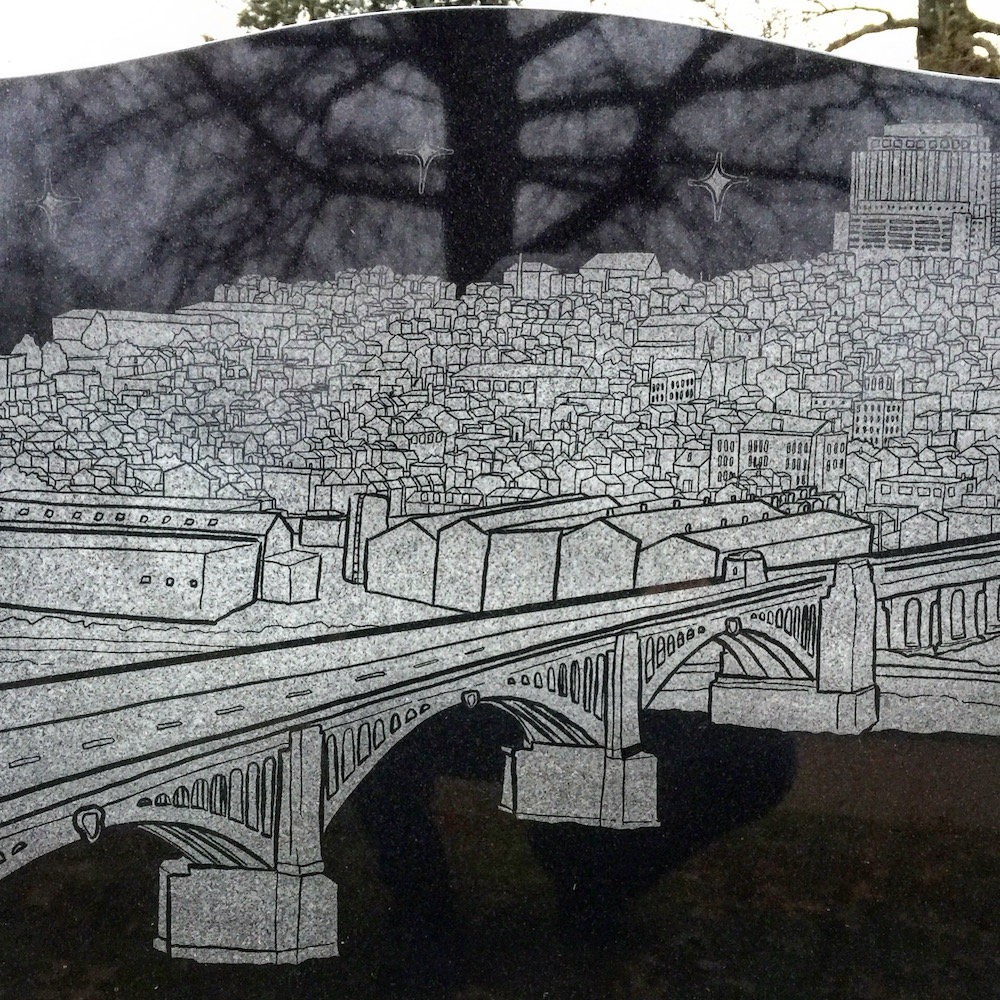
Generally the newer-style, glossy black headstones with etched-in details just look too shiny and too computer-generated for these old blogger’s eyes. But we love this view of ninth-ward Lawrenceville–the 40th Street Bridge and Heppenstall mill in the foreground, the chock-a-block row houses rising above–as seen from the top of the hill, across the river in Millvale. Maybe it’s just because we like the art better or because this was obviously a Lawrenceville (after-)lifer, but this speaks more about the person than all those clip art shovels and Steelers emblems and musical notes we see on its sister stones.
Have a ball with Bailey Balken’s big brown ball
Bailey Balken went rouge when s/he went out (above). Not afraid to mix media or typefaces, Balken’s marker includes a pair of flat marble stones inside a brass plaque laid atop a just-a-size-larger granite slab. That alone won’t get you in the Orbit scavenger hunt, but the volleyball-sized round rock inserted into the middle will. Looking like a rising loaf of rustic Italian bread, it’s unclear what Bailey was after … unless it was some kind of play on ball/Balken. Who knows?
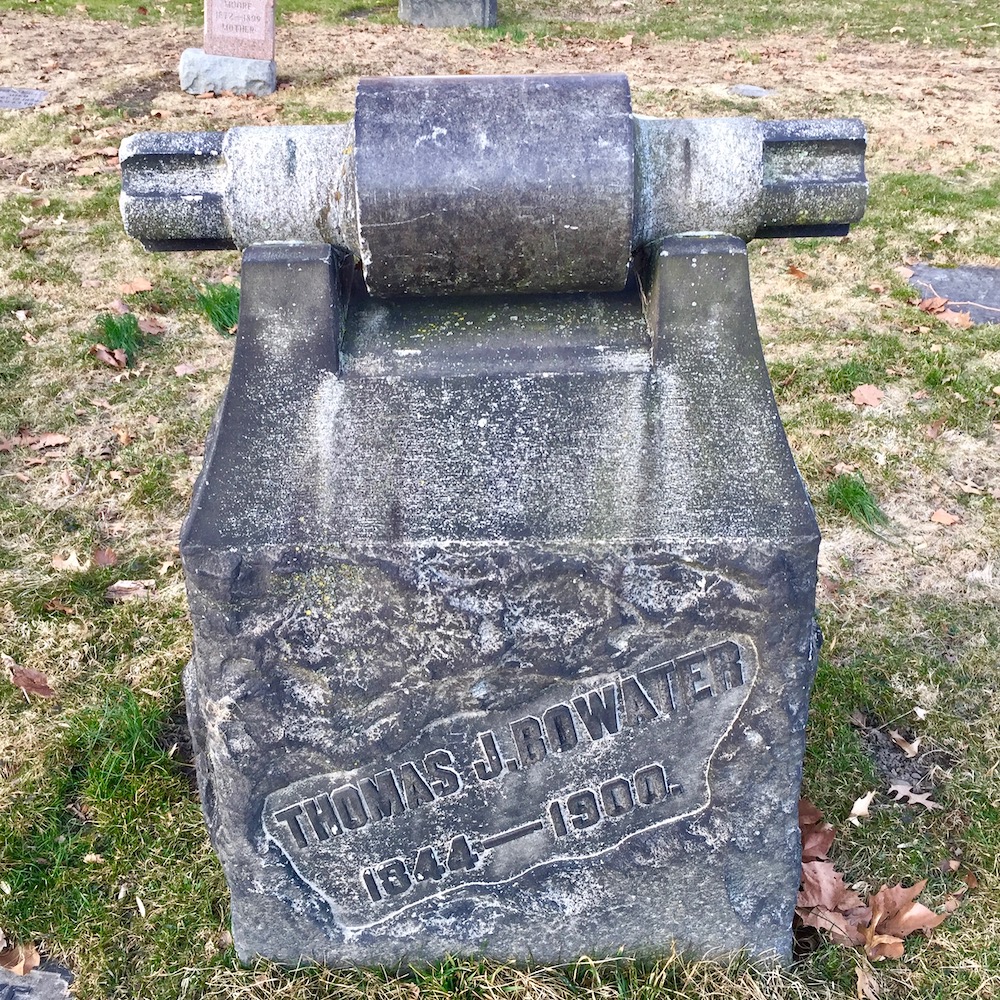
We imagine Thomas Bowater (below) must have been an engineer, or a machinist, or something in that world. That seems the most likely explanation for including a rolling axle/cog/gear as the prominent feature in a gravestone that looks like it came right off the shop floor. This rock rolls.
Rock and roll. The Bowater rolling axle/cog/gear grave.
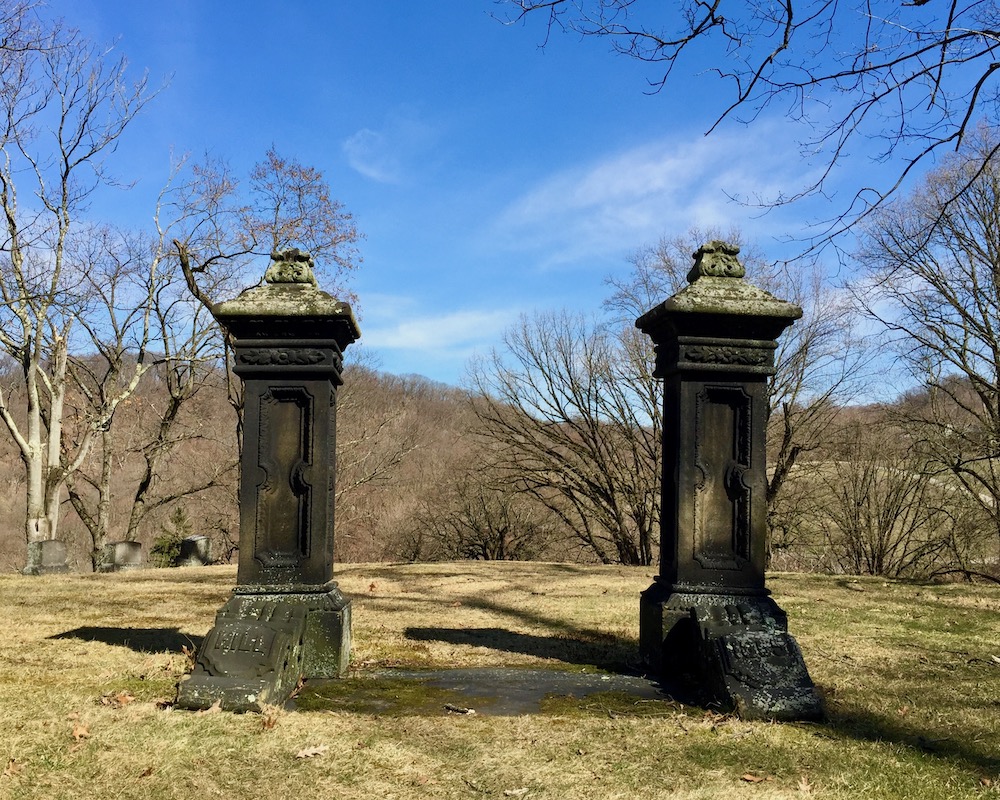
The Gates to Nowhere
These gates don’t really lead to nowhere–there’s actually a nice, circular plot back there–but the family clearly didn’t get the buy-in they were expecting from the rest of the crew, which left the space largely uninhabited. The result is a pristine little plateau with a great view across the river, down and over the rest of the cemetery, and up to Garfield–all with the ornate decorative blackened stone portico that says to the world you’re here–but we don’t know why.
Grave marker with ceramic photo inset of Rade Vujnovich, Beaver Cemetery
Like all those famous musicians, Rade Vujnovich was just 27 years old when he died in 1935. Unlike Jimi or Janis, we know very little about the man, but we do get to have one good last look at him. Dressed in an official uniform, hat cocked at a jaunty angle, Mr. Vujnovich stares right back at us with a goofy expression that suggests he’s holding back a laugh–or maybe just had one too many šljivovica some time between dressing up and saying cheese.
The information on Rade Vujnovich’s grave marker ain’t easy to work through. The cross-shaped granite stone was chiseled away in his native Croatian [thank you, Google Translate] and has had 85 years of harsh Western Pennsylvania winters eroding the details. But the mangled translation at least gets us the tidbit that young Rade was laid to rest here, in Beaver Cemetery, by his aunt Pipa and uncle Andja.
Beaver Cemetery in October: fall colors, raised Cyrillic lettering, and grave markers with ceramic photo insets
Every fall we make the trip out to the town of Beaver and visit its eponymous cemetery. Trees are reliably reaching their glorious technicolor peak, headstones come engraved in beautifully modern raised Cyrillic, and the uber-oddball James P. Leaf mausoleum will always ask more questions than it answers.
All that said, it is the collection of early 20th century photo graves (that’s our term) that really sets Beaver Cemetery apart. Dozens–more like hundreds–of stone markers that include inset ceramic photographs of the departed fill whole sections of the 46-acre grounds. You’ll see these photo graves other places [we first flipped our nut over them at Loretto Cemetery], but not in this quantity.
Men in bushy, un-ironic mustaches; women in big-bowed, broad-necked pre-war fashions of the day. Ceramic photo gravestone insets.
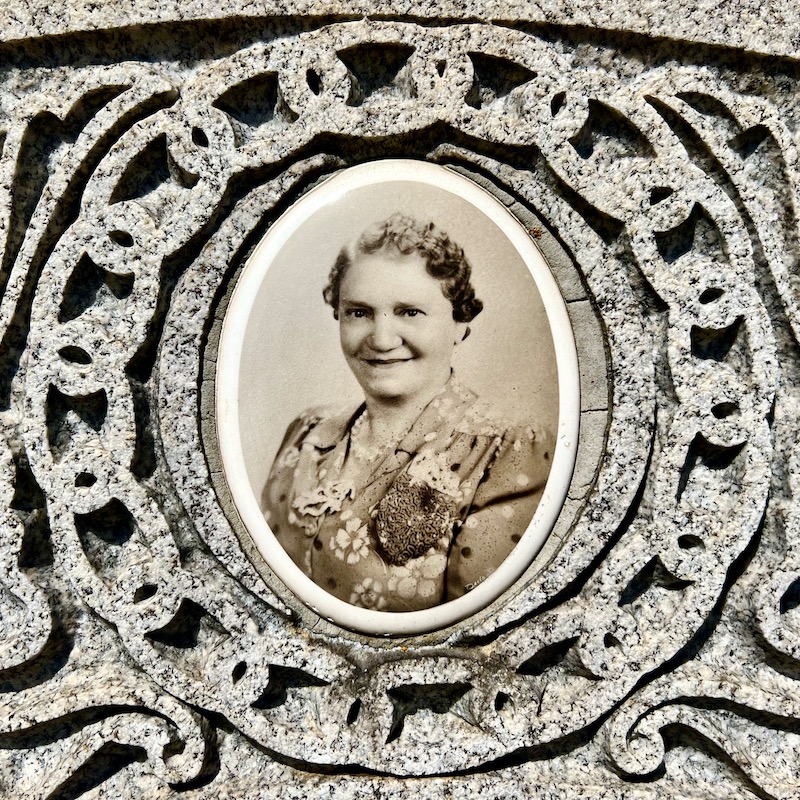
The preserved photographs are fascinating and haunting; a disappearing history in both subject and context. They have all the curiosities of any old portraiture: men in bushy, un-ironic mustaches that actually look good on them; women in the big-bowed, broad-necked pre-war fashions of the day; the dour, flat affect of a population raised in humorless Victorian times. They also come with reliably great old-world names–you try finding anyone in America still named Žita or Cveta, Beniamino or Liberata.
More than that, the photographs are visually arresting in a way our image-oversaturated brains aren’t used to seeing. Without fail, the figures appear to look right through us with a ghostly, world-weary knowing from beyond. Beware, they seem to say, or maybe just enjoy it while you can.
“Here lies…”
Cveta Srzmac
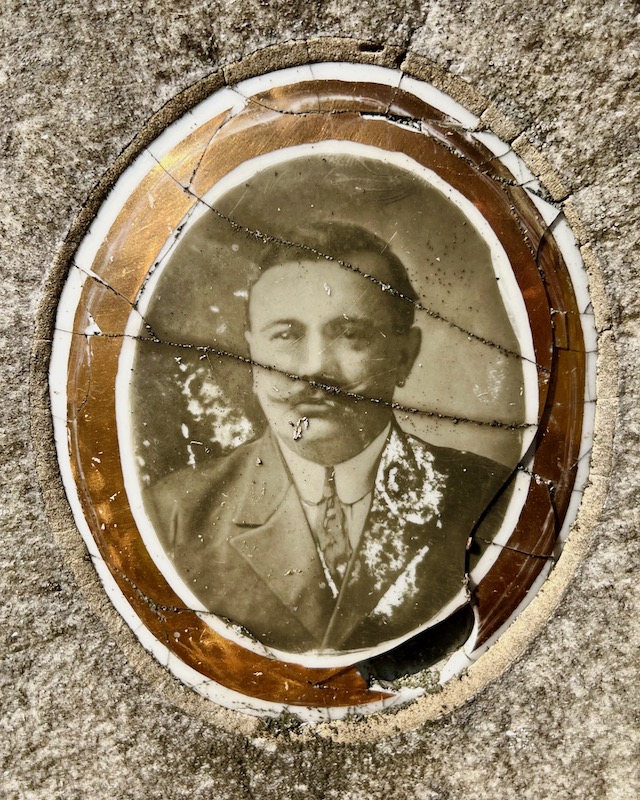
That the black-and-white portraits are inset into the grave markers of the humans who sat for them gives the pictures a deep, added pathos. The typically-oblong ceramic discs have lived outside in the elements for decades and almost always show a predictable level of wear-and-tear. Some of the photos are completely gone, leaving awkward oval cutouts in the headstones. For the majority that are still intact, there are hairline cracks across their surfaces, washed-out bits of silver gelatin, insect and grass-cutting debris, and–thankfully, not too often–the gouged and scarred evidence of vandalism.
Ghost couple: Simone Riccitello + 1
Gone girl/gone guy: unknown couple
As if spending one’s free time in a cemetery wasn’t existentially-draining enough, try picking out the one photograph that sums up your entire life. And then consider it’s a picture that will eventually crack, fade, and/or fall out of the rock it was embedded in…or worse. Chipped out with a screwdriver by bored middle school kids on a sleepover jailbreak–what a way to go.
We’re nato, we morto, and in between we hang out in cemeteries. Berardino and Liberata Dipliacita
unknown
The first wave of photo graves had a relatively short run. We tend to only see the old first-gen, black-and-white discs in the gravestones of those who passed in the 1920s through 1940s. At that point they seem to have gone out of vogue.
We have to wonder if this has something to do with the increased prevalence of photography. At the point where every household had a Kodak Brownie and every drug store could process film, it probably just didn’t feel that special to have a framed portrait on the mantle–or one’s headstone. But maybe, in the post-war modernist ’50s, tastes just changed away from early-century sentimentalism and toward sleek, down-to-business grave markers with little ornament and even less personal detail.
Cracked, faded, and washed-out, but still hanging on. Ceramic photo gravestone insets.
Stephen N. Burich
A trip to the cemetery is admittedly not everyone’s cup of tea. It’s morbid, they say, or depressing. I’ve got plenty of time for the graveyard when I’m dead.
That’s hard to argue with. But cemeteries are also fascinating repositories of history that one can enjoy with all the fresh air, chirping birds, and fall colors of a nature hike. The arrangement of artifacts is haphazard and their current state has so many random influences–from the whims of the family that organized burial to nature and weather–that the experience is more that of browsing a junk store than visiting a curated collection.
It appears to be another gorgeous day in run of them we’ve had in this, our greatest season. If you want get out and see some people without any risk of the plague, there’s no better place than Beaver Cemetery.
Teresa Ulizio
Getting there: Beaver Cemetery is right on 3rd Street, the town of Beaver’s main drag and just past the downtown area. It takes 40-50 minutes to drive there from downtown Pittsburgh. You’ll find the photo graves throughout the cemetery, but a good place to start is at the very back (nearest the McDonald’s).
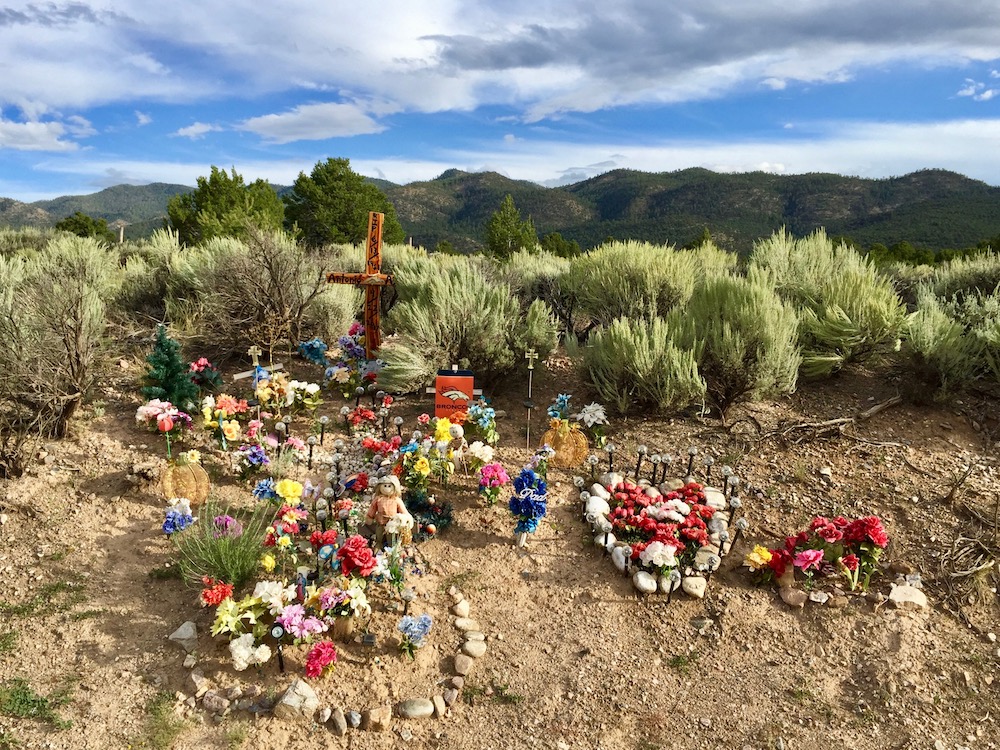
There is only one way to drive from El Rito to Abiquiu, in north-central New Mexico. You’ll take state road 554, a curlicued up-and-down route through wild and beautiful country that may as well be another planet for us “back East” folks. Gorgeous mountain views and scrubby desert vegetation join rugged canyons, dry river beds, and dramatic wind-scarred buttes.
What you won’t see much are signs of human existence. Sure, we’re on a two-lane blacktop that someone had to build, but there aren’t any other vehicles on it, nor will you find gas stations, billboards, graffiti, guard rails, or reflectors. You may come across the occasional stand-alone house, a stretch of elevated power line, or barbed wire fencing marking a property boundary, but often, that’s about it.
Pilar
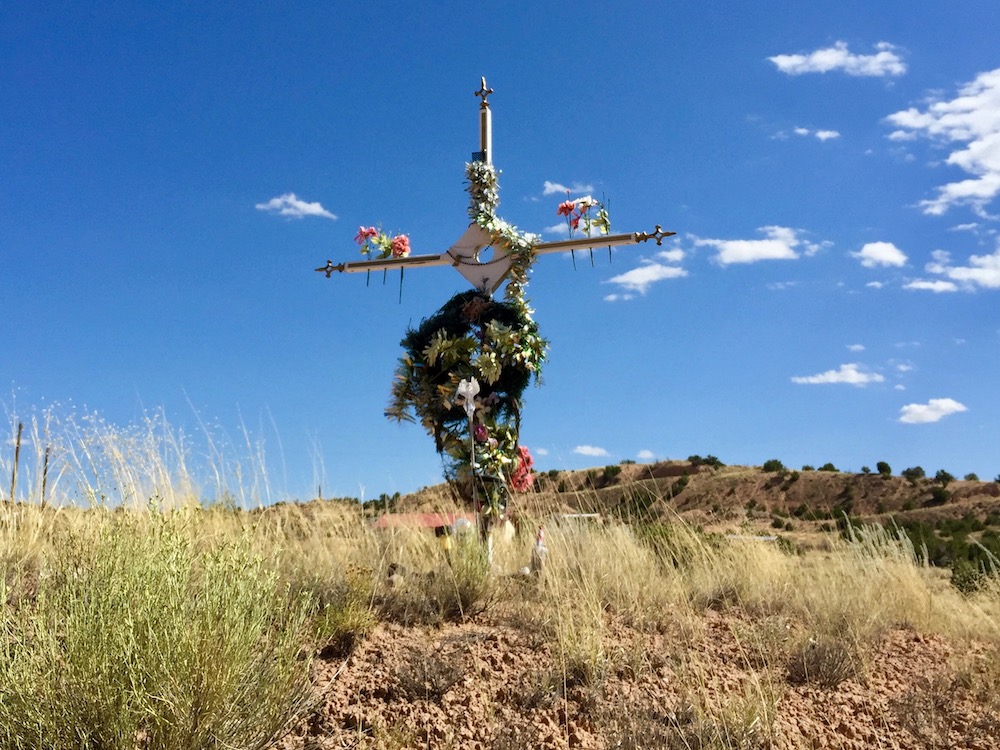
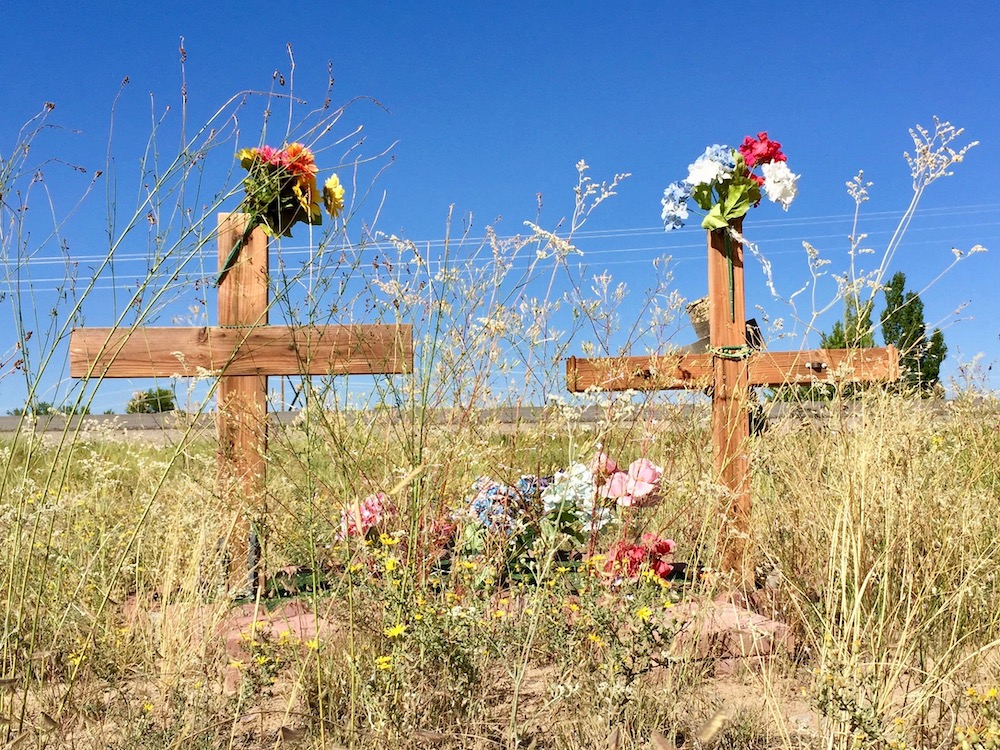
So the memorials that appear with alarming regularity–some dozen or more on the short, sixteen-mile stretch between El Rito and Abiquiu alone–pop from the roadside as the most tender of touches in a landscape otherwise devoid of human intervention. The shapes–vertical and angled in a world of broad horizontals, colored in eye-popping reds, pinks, yellows, and purples found nowhere else around these parts–make the tributes jump from the scraggly earth.
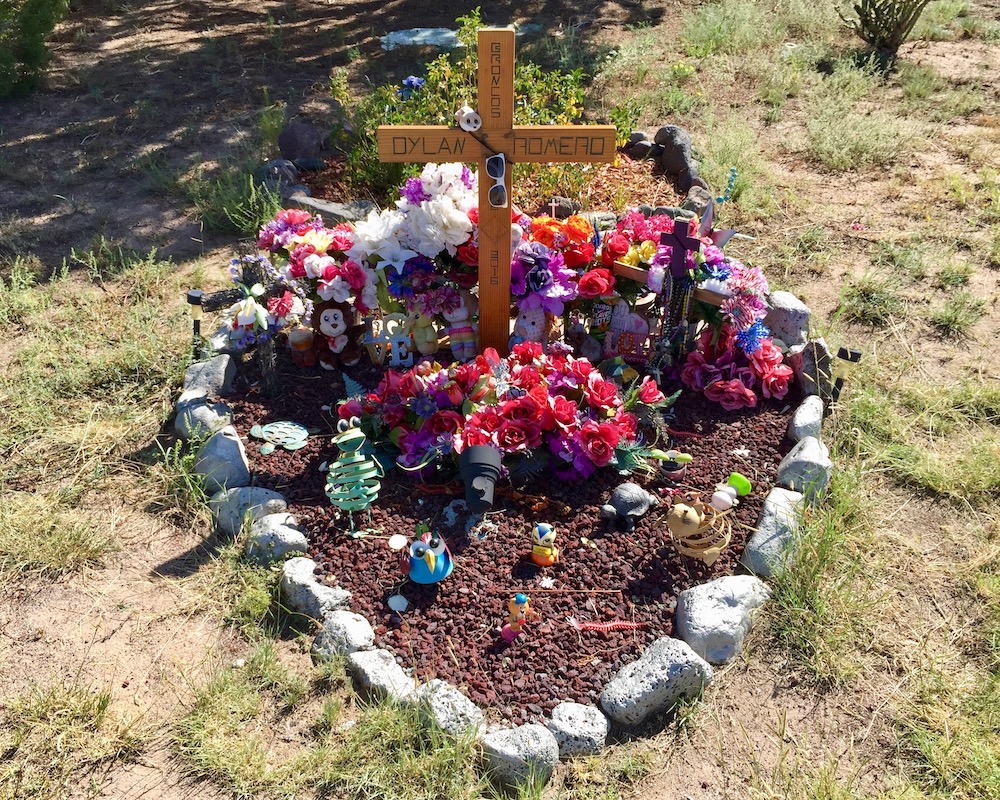
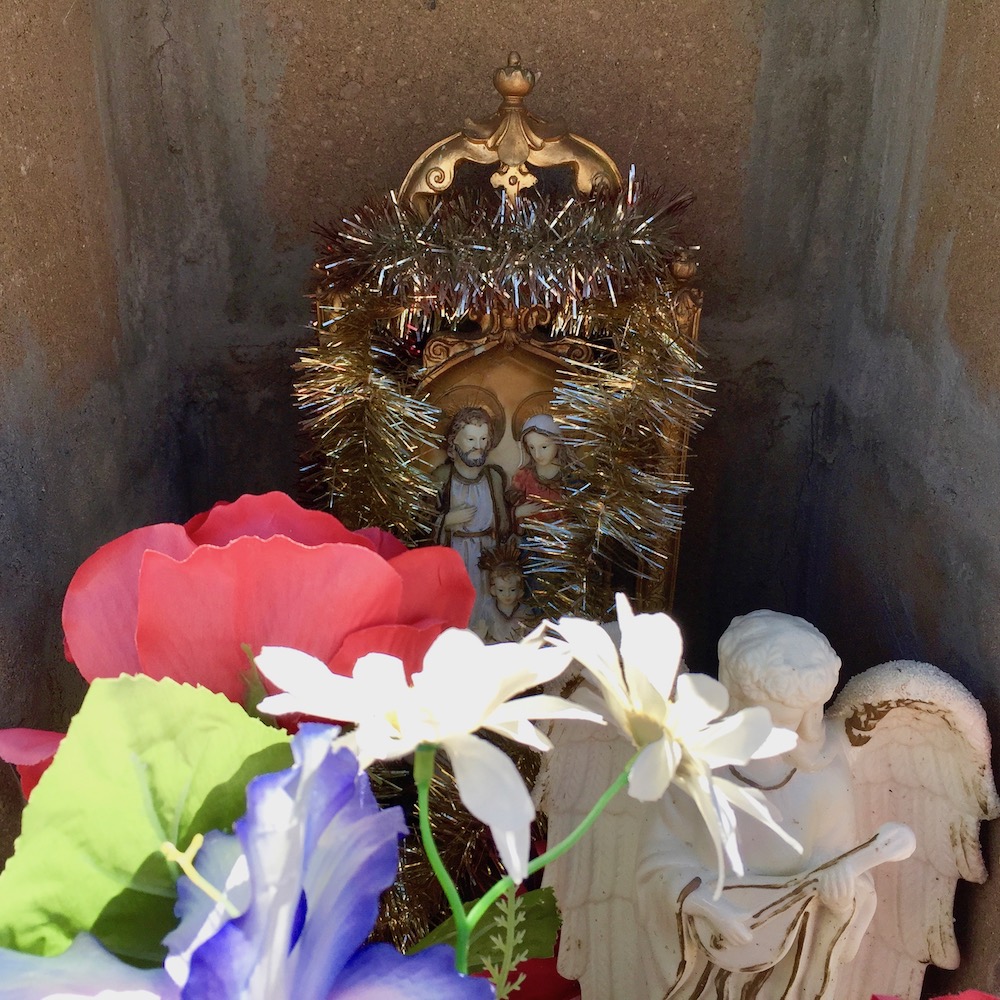
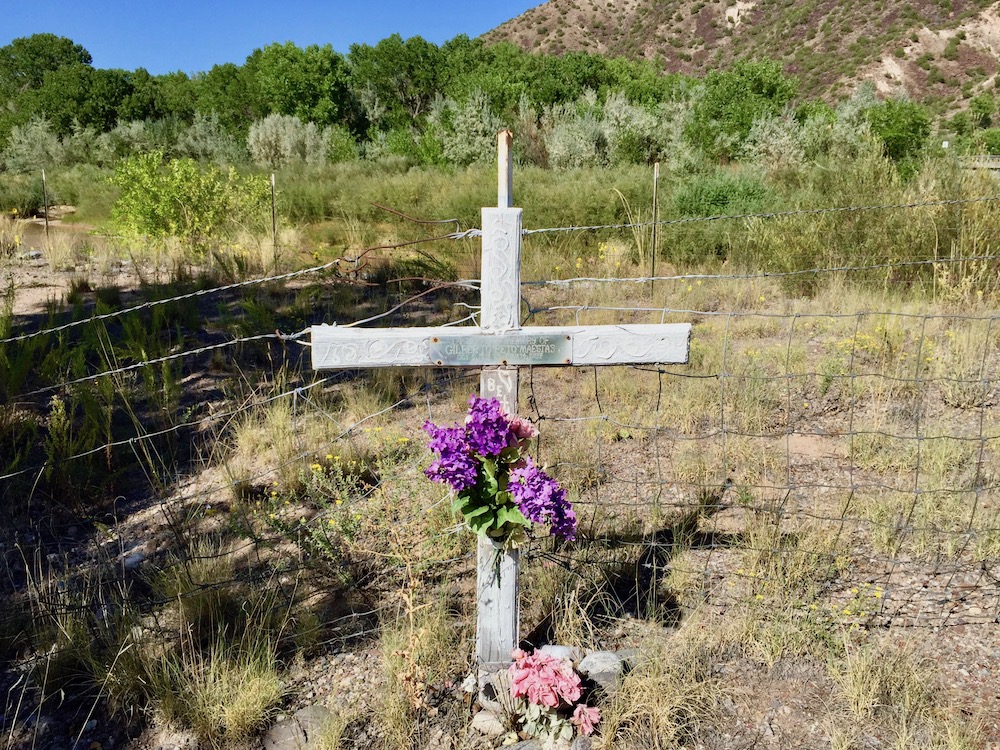
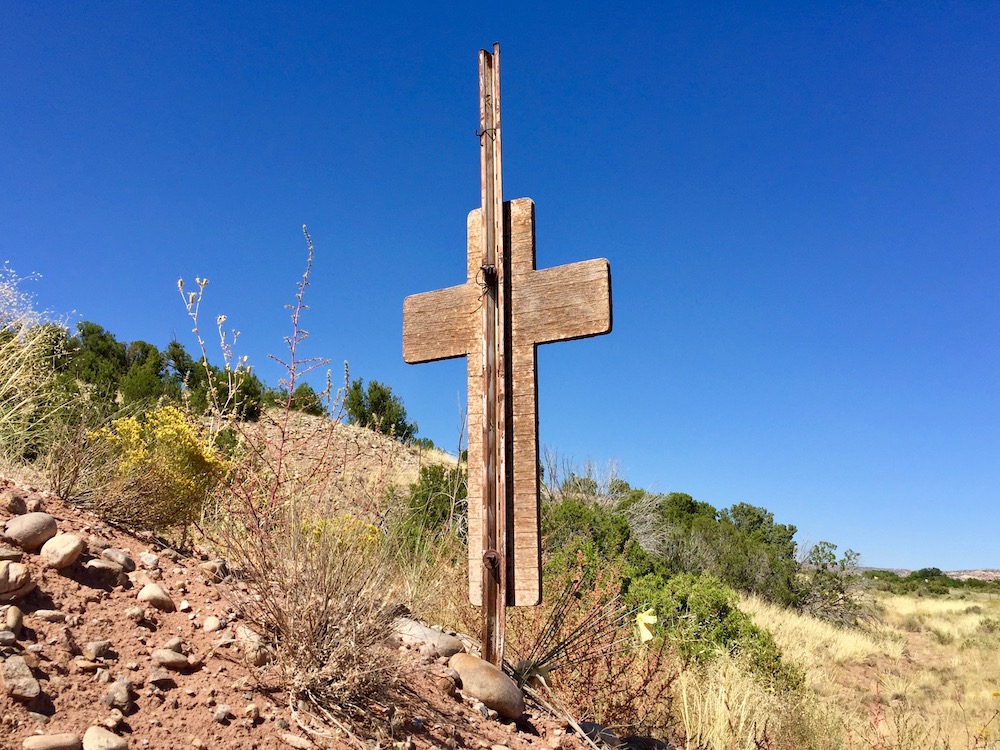
There are some simple wooden crosses, sure, but most of the memorials are unique elaborate displays that include custom ironwork, closely arranged stone formations, photographs, religious dioramas, plastic funeral flowers, garlands, flags, and treasured personal mementos of the departed.
Fabian Lawrence Mata, Ojo Caliente
A little Googling proves that, surprise surprise, Pittsburgh Orbit wasn’t the first to take notice of New Mexico’s descansos, the Spanish term for this tradition. New Mexico Explorer, a kind of NM Orbit, has a nice intro with some good photos and the Albuquerque Journal ran a 2015 piece about Pam and Doug Rietz’ documentation of descansos (but no links to see the pictures!) There are plenty of photo collections out there.
So why cover it here? Well, for one thing, we’ve written about roadside memorials back home a couple of times [see our Memorial Day 2018 and 2019 stories], so the subject is near and dear. Also, we’re jealous–with all due respect to the loving displays on Pennsylvania’s rural routes, New Mexico’s descansos are just so much more–excuse the apparent contradiction–full of life*. Each one is unique, glorious, heartbreaking, and beautiful in its own way.
And yes, it’s a good way to squeeze vacation for an Orbit story.
El Rito
Abiquiu
Jeffrey Zamora, Ohkay Owingeh
Abiquiu
El Rito
Phil Snow, La Madera
Dylan Romero, Abiquiu
Abiquiu
D.D.H., Rio Grande gorge
Jamie, Hernandez
Juan Mariscal, Abiquiu
Gilberto “Beto” Maestas, La Chauchia
Baldino Elizardo Gomez, Ojo Caliente
El Rito
El Rito
Hernandez
El Rito
Abiquiu
Kenneth and Elmer Martinez, El Rito
* In fairness, though, the relentlessly dry sunny weather in New Mexico naturally elongates the lifetime of a descanso. Pennsylvania’s omnipresent rain and thick humidity, plus winter snow and ice, make all SW PA memorials de facto temporary installations. For what it’s worth, it is also true that New Mexicans die in motor vehicle accidents at greater than twice the rate of Pennsylvanians. [Source: https://www.iihs.org/topics/fatality-statistics/detail/state-by-state]




























































 Pittsburgh Orbit