Two Great Tastes: Get Write with God

wall painted with "Jesus is the answer", Pittsburgh, PA

Watch that first step: it’s a doozy. “Jesus is the answer,” Homewood

He measured it on the four sides; it had a wall all around, the length five hundred and the width five hundred, to divide between the holy and the profane. (Ezekiel 42:20)

Back in the early Spring, we inaugurated the Two Great Tastes series with a piece on how snow and trains just naturally look (and photograph) great together. We also included a bunch of other pithy two-fers involving things like French cop movies, Zubaz, and fried fish sandwiches. This blogger certainly can’t predict when another one of these terrific combos will come along, but believe you me: The Orbit knows it when we see it.

And see it we did! Or do. Or keep on seeing as we come across the seemingly incongruous one-two of (Christian) religion and street graffiti. It might seem weird to take up both scripture and Rust-Oleum, but, you know, it’s the greatest story ever told and these colors, like true faith and decent exterior enamel, definitely won’t run.
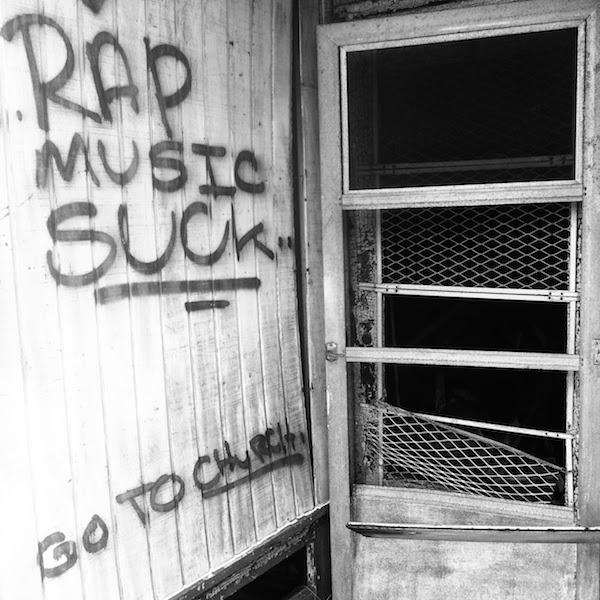
Abandoned storefront with graffiti reading "Rap music suck. Go to church."

The door’s open but the ride ain’t free. “Rap music suck. Go to church.” Clairton

Generalizations about entire musical genres aside, it’s hard to understand the connection between the relative quality of rap music and the commandment to attend church. We know correlation is not causation as one might just as inaccurately assume spray paint-wielding taggers would be unlikely in a house of the lord on Sunday.

Church stair rail with graffiti reading "God is dead, Devil is everywhere"

Crossed the deserts bare, man. “God is dead, Devil is everywhere.” Millvale

Is God dead? Is The Devil really everywhere? At least one troubled soul sure felt strongly enough about it to render this haunting message in black Sharpie on the stair rail of the great Holy Spirit Parish Catholic church in Millvale. We have to assume that, like the song says, “people are cracking up all over.” And when reaching out to the mental health system involves vandalizing church property, well…we’ve still got a ways to go.

Tell him what you want. “Jesus rides freight trains.” Strip District

Another questionable assertion, this one on a boxcar in the Strip District. I don’t know if Jesus rides freight trains, but they’re probably more reliable than AmTrak. That said, if Jesus really wants to commune with the in-transit laity there are going to be a lot more of them on the Greyhound or MegaBus (not to mention the DMV). And let me tell you something: some of those bus riders could learn something from a good ol’ monastic vow of silence!

Graffiti on tile wall reading "The Devil made me do it the first time ...", Pittsburgh, PA

Out on the tiles. “The Devil made me do it the first time …” Lawrenceville

So many questions: What is it? Who made you do it the next time? How many times did you do it? Did you ever get tired of it? Why do I need to hear about it? We’ll likely never know what TSU was going on about here, but hopefully admitting it was a least a first step to reaching a better place.

Brick wall with graffiti reading "What if the only things God blesses you with tommrow is what u r thankful for today"

He would / Die 4 / U. “What if the only things God blesses you with tommrow is what u r thankful for today,” (sic.) Manchester

The Orbit‘s copy-editing team is having a fit with this one, but relax, guys: everything’s cool. The suggestion (we can’t actually locate a Biblical reference for this one) that the salvation we’re waiting for in the future is here right now strikes this frequent grass-is-greener blogger as actually quite profound. The statement speaks to both live for today and be grateful for what you have sentiments, and also that the (presumably) afterlife-believing perpetrator wants us to be happy, right here in this world. Amen.

An Orbit Obit: Where the Buffalo Roamed

sidewalk painting of purple and white buffalo with painted fence

Last photographic evidence of the now-extinct sidewalk buffalo of lower Lawrenceville, Summer 2015

The lore will be passed-down for generations to come. It was a time when proud giants strode the streets (err…sidewalks) of lower Lawrenceville; their brilliant purple, red, white, and gold colors shimmering and electrifying the drab, weed-cracked concrete blocks. Mere mortals freely walked foot-to-hoof with these legendary lords of the great plains. Every one of the animals was rendered in its own style–the group less herd and more party of like-shaped individuals; each creature with its own agenda. Though trampled underfoot, they still managed to stand tall–at least if you stood back far enough to get the angle right.

sidewalk painting of purple, red, and white buffalo

Purple pain: one big hombre

If you find yourself at the corner of 35th and Charlotte Streets in Lawrenceville’s sixth ward, you won’t miss Jeremy Raymer‘s house. The otherwise standard-issue two-story Pittsburgh rowhouse is covered–foundation to soffit–in big, eye-popping mural portraiture. Around the side, a gray, picket fence is more loosely painted in an ever-evolving array of icons. The closest telephone pole is covered in an odd assortment of push-pinned offerings. [More about all of this, hopefully, in some future Orbit story.] The one thing you won’t see anymore is the fantastic parade of buffalo that roamed freely on Raymer’s sidewalks just weeks ago.

sidewalk painting of purple and white buffalo

Lascaux-a-go’alo: caveman street buffalo

It was a surprise to see them disappear so quickly. Street art is by its very nature temporary/ephemeral, but we hope the good stuff will get a little time in the sunshine before the man sends in the clouds. Having just taken these photos in August, we arrived back at the same intersection a mere couple months later with nothing but the faintest outlines of the great beasts remaining. It was a sad reminder of both how fleeting grace can be and also how potentially on-the-verge-of-dissolution pretty much everything is. The great American street bison is clearly no exception.

sidewalk painting of purple, red, and white buffalo

All wound up: mechanique’alo

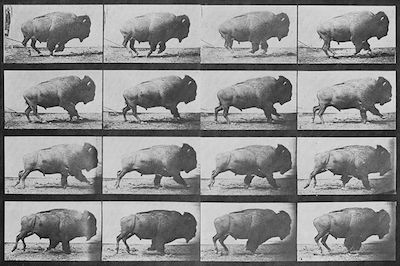
We got in touch with Mr. Raymer to ask about the sudden extinction of his herd. He verified that indeed he was the perpetrator (the buffalos were loosely based on series of photographs by Eadweard Muybridge taken in late 19th century), planning to make them last, Raymer painted the buffalos in Montana Gold spray paint, and that a neighbor filed an official complaint about the sidewalk paintings. The city’s Graffiti Task Force was called-in and was therefore obligated to power wash them away. (Apparently the city would not have acted but for the formal complaint.) Raymer would like to re-paint his sidewalks with a new to-be-decided theme at some point in the future, but this time he’ll go through official channels to do so.

Sequence of a buffalo (American bison) galloping. Photos taken by Eadweard Muybridge (died 1904), first published in 1887 at Philadelphia (Animal Locomotion).

Eadweard Muybridge’s photographic sequence of a buffalo (American bison) galloping, 1887

The whole thing raises an interesting series of questions. Sidewalks are this curious blend of public and private space and the letter of the law doesn’t necessarily add up logically. Technically, one’s sidewalks are part of the property lot and the homeowner (not the city) is legally responsible for the care and maintenance, including weed, snow, and ice removal, patching and replacing cracked concrete, etc. Sidewalks are undeniably public thoroughfares that everyone uses and are absolutely essential to a healthy urban environment. They also offer great opportunities for expression.

Shouldn’t Raymer (or anyone else) be allowed to decorate his own property–that he’s legally responsible for maintaining–in a way he chooses? Why is he allowed to paint the public-facing fence, but not the adjacent sidewalk, which is inches away and just as visible? If the same neighbors objected to his wall murals, would the city be in power to act on those complaints? And if one is painting his or her own property, does it really count as graffiti?

sidewalk painting of purple and white buffalos

Then: corner buffalo (and friend)

faded outline of a buffalo painted on sidewalk, Pittsburgh, PA

Now: the same corner with the last traces of the once-proud herd of Lawrenceville’s sidewalk buffalo

The Orbit does not pretend to have answers to these questions, nor do we want to vilify the residents who objected to the paintings. That said, this hardcore all-seasons blogging pedestrian would like to see the neighbors of Lawrenceville put that same keep-the-sidewalks-clean enthusiasm put into clearing the inevitable mini glaciers of snow and ice that will arrive any day now.

Maybe down on 35th Street they don’t have this problem, but just a few blocks away I sure do! Every year I slip on un-shoveled winter sidewalks. Most years there is at least one ugly fall that ends with a bent knee, a twisted ankle, or a very literal pain in the ass. These buffalos may look threatening, and they may not be Raymer’s neighbors’ idea of art, but it’s hard to imagine they were really offending anyone. It’s the coming ice age that may do us all in.


To see more of Jeremy Raymer’s work, check him out on Instagram @jeremyMraymer.

An Orbit Obit: The Toynbee Tiles of Smithfield Street

Toynbee Tile reading "Toynbee Idea in movie '2001' resurrect dead on planet Jupiter"

Resurrect dead while you can. The last remaining Smithfield Street Toynbee Tile, Downtown.

It was not that long ago (February, to be exact) when Pittsburgh Orbit filed one of its earliest stories on the great run of five “Toynbee Tiles” that were imprinted on Smithfield Street, approximately one per block from Boulevard of the Allies to Sixth, downtown.

This blogger likes to think The Orbit come a long way since those nascent days of yore, [Only two paragraphs of text? Who was doing the photo editing?] but looking back on this very recent history, it’s also a reminder of how rapidly (and drastically) things can change in the city as a whole. [Young people: for good or bad, back in the ’90s/early aughts, the words “Pittsburgh,” “rapid,” and “change” were never bundled in the same text.]

I’ve gotten in the habit of eyeballing and taking inventory of the Toynbee Tiles every time I ride through downtown, inevitably on Smithfield’s relatively-convenient route from the South Side to the great new Penn Ave. bike lane. It’s news to no one that there’s a tremendous amount of development happening in town right now–you see giant cranes, construction fencing, and torn up pavement everywhere you look. But I was startled to find that as of this past weekend–less than a year after that early blog post–only one out of the five Toynbee Tiles was still intact. The sole survivor (pictured above) is at the corner of Smithfield and Oliver Way.

It doesn’t seem like there was any malice involved here or that the tiles were actively removed in a clean-up effort. [Let’s hope not: the city has far bigger infrastructure-shaped fish to fry.] There just seems to be that much digging up of streets and running new, uh, things under them. The block of Smithfield from Sixth to Seventh has been totally resurfaced.

terra cotta storefront for former G's Restaurant and Pizzeria, Pittsburgh, PA

(The former) G’s Restaurant and Pizzeria on a torn-up Forbes Ave., Downtown

Fifteen years ago, me and a whole bunch of other concerned citizens drank a lot of beers and ate a lot of fried zucchini at The Chart Room in the name of not having downtown Pittsburgh eaten alive (or something like that) (hey: it worked, didn’t it? sort of?). The Chart Room is long gone (heavy sigh), but at least the building didn’t get torn down. [Sadly we can’t say the same for the old nickel bingo parlor across the street.]

No, The Chart Room got mangled by choice, in private hands, without needing any help from eminent domain. It’s strange to have lived through that extreme “Hail Mary”/desperation-style urban planning only to wake up in an entirely new world where big money comes in and builds big things all on its own. It’s different in a whole lot of important, structural ways, but still strangely the same as it seemed like it might have turned out to be. Resurrect dead, indeed.

Ah, hell. If you want The Orbit’s advice, go check out the last Toynbee Tile on Smithfield Street while you still can. It won’t be there forever.

Hey, Porter: Daria Sandburg and Pittsburgh’s Baggage Claim

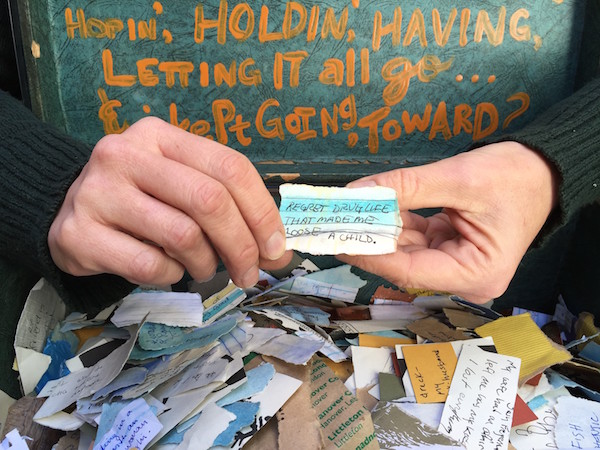
Hands holding scrap of paper with the writing "Regret drug life that made me loose a child" (sic.)

“Regret drug life that made me loose a child” (sic.) Just one small piece of Pittsburgh’s baggage.

It’s a strange weight to carry–both metaphorically and very literally. The worn, shiny metal case (it was built to carry roller skates) is painted with a series of intriguing messages. A quote from Kate Tempest: “That thing you weep for, leave it,” and one from Carl Sandburg: “What is this load I carry out of yesterday?” The ends of the case have the instructions Got baggage? Leave it here.

The Orbit encountered this unique piece of luggage attached to the arm of one Daria Sandburg who has been toting it through our fair city streets, to events and happenings for a couple years now. Sandburg honors every one of the case’s painted instructions with an invitation for whoever accepts to leave their messages (“Pittsburgh’s baggage”) in the form of short hand-written notes on scraps of multicolored paper. A separate, smaller inset box contains “possibilities,” which people are equally encouraged to submit. Ask nice and Sandburg will convert your hand-written note into cut, stamped metal. Over the last year, hundreds have taken Sandburg up on the offer.

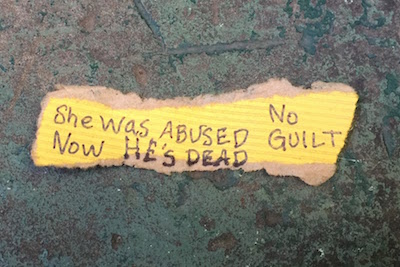
torn paper scrap with the writing "She was abused, now he's dead. No guilt."

Heavy baggage: one of the hundreds of hand-written claims

The baggage claim tickets cover the full gamut of guilt, regret, fear, and much much more. Markers of love and love lost, admissions of poor choices, addiction, and anxieties of every shade are stowed in the case. And while there’s a level of repetition and predictability to many of the entries, the format of one real human having submitted her or his expression in their own hand, in person, directly to Sandburg’s protective case makes each one unique, special, and often tragic.

Even the most prosaic of messages–Being forgotten or My ex or Uncertainty–somehow carry a greater weight when you know the author was right there, among us. Logically, we know everyone has these feelings, but somehow it’s hard to accept, or to believe. The volume of tickets expressing some level self doubt is staggering.

When the claims get deeper, more personal, they can be outright devastating. Take my lies, one reads, or My father’s suicide, or Letting where I missed be the measure of my life, or She was abused, now he’s dead. No guilt. It’s good the slips are so small or these could turn into major therapy sessions on both ends of the paper.

Daria Sandburg and her open case of Pittsburgh's baggage.

Daria Sandburg and her open case of Pittsburgh’s baggage.

All told, it’s a heavy load to carry around. I asked Sandburg if she feels the project, open-ended and unresolved by design, could, ironically, become her own personal baggage. Could she be trapped under the weight of needing to collect and store ever more of the limitless pool of strangers’ personal issues?

The response was remarkably upbeat, positive, and forward-looking. She doesn’t feel married to either the suitcase or the project, especially after the completion of a recent show combining the baggage claims with Sandburg’s original art (inspired by the submitted claims) at Boxheart. [The project required a greater-than-normal commitment to baggage collection.] But at the same time, there are no immediate plans to suspend her regular forays out with the box.

hand stamped metal with the text "I wish I wasn't afraid of doing literally everything"

One of Sandburg’s by-request hammered metal claim tickets.

Sandburg is leaving soon to take the case out for a week-long working/collecting trip to the greater Art Basel Miami (and its associated shows/events) for that annual art/schmooze megalopolis as part of Boxheart Gallery‘s travel team. [Boxheart is participating in the alternative Fridge Art Fair.] There, she’ll be collecting South Florida’s baggage, and yes, mixing it with our own. This blogger predicts more regrets around taking on extra calories or the perils of imperfect abs and less decades-old nightmares around the Mark Malone and Bubby Brister regimes. But maybe we’ll find out that everyone really has the same baggage, even if Miami’s comes well-tanned and wrapped in vintage alligator.

Daria Sandburg holding metal case with painted words "Got baggage? Check it here."

Follow Daria Sandburg and the Baggage Claim project on Twitter and/or Instagram for regular updates on incoming claim tickets–or just look out for the lady with the cool hand-painted metal case. She encourages meeting interested strangers: “Happenstance is what really makes the project wonderful.” If you do spot her, say hello, and maybe consider leaving that thing you weep for.

Warhol By The Book: The Orbit Review

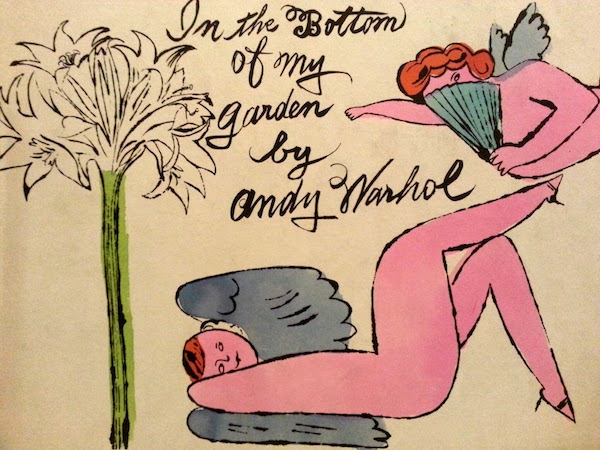
Book cover for Andy Warhol "In the Bottom of My Garden"

“In the Bottom of My Garden”, 1955-56

Two decades ago, this blogger bought a cookbook. Back in those dark ages, we didn’t have the same opportunities to immediately share this groundbreaking news with the world, but thank goodness that wrong can be righted today.

It was in an antique shop in rural Virginia where I found a beat up copy of Amy Vanderbilt’s Complete Cookbook for a couple bucks. Amy is an 800-page Doubleday hardback, published in 1961, that contains all the (quite literal) meat & potatoes recipes of mid-century middle America: Turkey a la king, Swedish cornets, potatoes au gratin, “Pablo’s Spanish rice.” In the pre-Epicurious days, people still needed nuts-and-bolts cookbooks like Amy Vanderbilt.

"According to the Evidence", 1953

“According to the Evidence”, 1953

It wasn’t until some time later that I noticed a small credit on some of the book’s breeze-through front matter: Drawings by Andrew Warhol. The simple line figures that illustrated cut lemon garnishes or rolled Roquefort tea sandwiches never stood out to me as particularly noteworthy and my knowledge of Andy Warhol’s pre-fame commercial work was pretty limited, so I wasn’t even sure if this was the same guy.

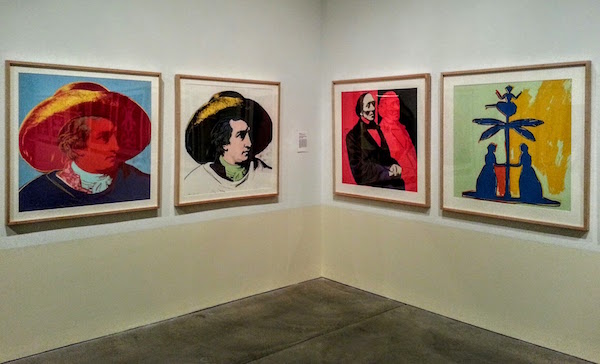
Well, it was. Or it is. Whichever. Andy Warhol had a wealth of pre-soup can commercial work (roughly the full decade of the 1950s, and then less frequently in the ’60s) and much of this was in the context of book illustration. Those early drawings, along with photography and silkscreen work from the second half of Warhol’s career, make up the terrific new show Warhol By The Book, up now at The Warhol Museum through January 10, 2016.

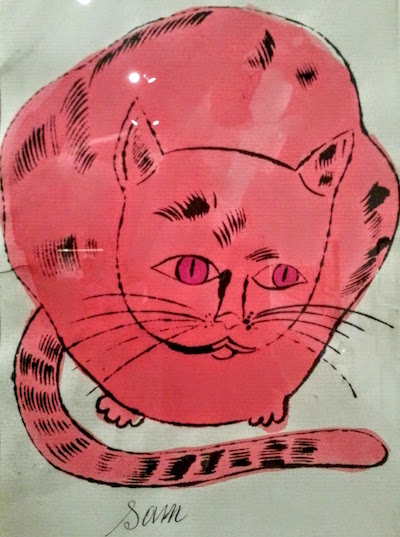
Andy Warhol "So Meow" print

So Meow [note: the print in the show has a green cat]

The exhibition is a fantastic deep-dive into anything book-related that Warhol worked on. Included are gorgeous dyed lithographs, original pencil drawings, (rejected) book proposals, correspondence with publishers, fountain pen-through-paper towel ink drawings, celebrity photographs, late-career silkscreens, and many final-product trade reproductions. And yes, there’s a copy of Amy Vanderbilt.

silkscreens of book art from "Warhol By The Book" exhibit at The Andy Warhol Museum, Pittsburgh, PA

1980s era silkscreens

While the photos and silkscreens are interesting, this home-cooking art fancier’s socks were quite figuratively knocked off by the drawn-by-hand half of the show. The rooms of Warhol’s early illustrations have always been my favorite part of the museum and this new show opened up that world in entire new ways. Aside from maybe some of the 25 Cats pieces, I’m not sure I had encountered any of the hundreds of original prints and drawings that make up that section of the exhibit.

Warhol’s Factory-era silkscreens are of course iconic and interesting in their own right, but seemingly lost in that fame was the incredibly beautiful drawing hand of the artist. The coupling of his great, loose style, tastefully deployed bursts of color, Warhol’s distinct schoolyard cursive captions, and the Carnegie Tech-educated, less-is-more design sense make each of these wonderful little new discoveries.

"Borderline Ballads", 1955

“Borderline Ballads”, 1955

Back in February, The Orbit gushed over The Warhol’s Sister Corita Kent show, which had just opened, calling it “the best Warhol Museum show this blogger has ever seen.” We’ll stand by that that assessment. But the By The Book exhibit is right up there. Book it.

lithograph and watercolor illustration from "25 Cats Name Sam and One Blue Pussy"

Illustration from “25 Cats Name Sam and One Blue Pussy”, 1954

Polish Hill’s Abstract Art Walks

graffiti cover-up, Pittsburgh, PA

Bethoven Street

If Don and Phil Everly are to be believed, a man in Kentucky sure is lucky to lie down in Bowling Green. Well, you can bet your dupa that man, woman, and child sure are lucky to wake up in Polish Hill–its spectacular vistas, its legendary city steps, its cattywumpus streets clinging to the hillside. To this list, you can add one more bonus. The residents of Melwood, Herron, and Brereton get the year-round, open-air, free-admission modern art walks of Bethoven and Finland Streets.

graffiti cover-up, Pittsburgh, PA

Finland Street

The works are created and maintained as a joint effort between some number of indefatigable spray paint-weilding taggers and what we imagine is a combination of city D.P.W. “graffiti busters” and concerned citizens taking matters into their own hands. This cat-and-mouse adversarial partnership ensures that every season the palette will shift, the structure will renew, and the layers will be reborn yet again.

graffiti cover-up, Pittsburgh, PA

Bethoven Street

The quirkiest thing about these artists is exactly what makes the whole thing work. A graffiti cover-up team could easily just invest in bulk orders of battleship gray exterior primer. End of story. That’s what it’s like along the jail trail, down in “The Run,” and a bunch of other places*. One clean sweep every spring. If so, there’d be one less blogger loitering at the top of the hill.

graffiti cover-up, Pittsburgh, PA

Bethoven Street

But it ain’t like that in Polish Hill. Instead, the clean-up crews (whoever they are) seem to use whatever extra paint they just happen to have laying around. I don’t see any green or black in these photos, but just about every other color in the spectrum is represented. The way these layers peel, flake, and erode suggests they may just be using leftover house paint, rather than some heavy-duty, element thwarting, highway-grade pigment.

graffiti cover-up, Pittsburgh, PA

Finland Street

Further, the painters use an irregular approach to the graffiti cover. Sometimes roughly squaring off big fields, others targeting individual spots just as needed. The effect is to give the abstraction a loose (if undefined) composition that wouldn’t have been there without the smaller details.

Mark Rothko "Yellow, Cherry, Orange" (1947)

Mark Rothko “Yellow, Cherry, Orange” (1947)

Maybe you have to mentally crop the big retaining wall-sized sections down into more digestible chunks, let the eye focus go a little soft, relax a little bit for it to make sense. But you really don’t have to stretch too far to imagine these pieces sitting side-by-side the great abstract expressionists. I imagine a Hans Hofmann or a Franz Kline or a Mark Rothko being quite pleased to share wall space along Bethoven Street.

graffiti cover-up, Pittsburgh, PA

Bethoven Street


* In fairness, the city uses a few different shades of white and gray and some of the results are still interesting…but they’re not like these.

Post No Bills

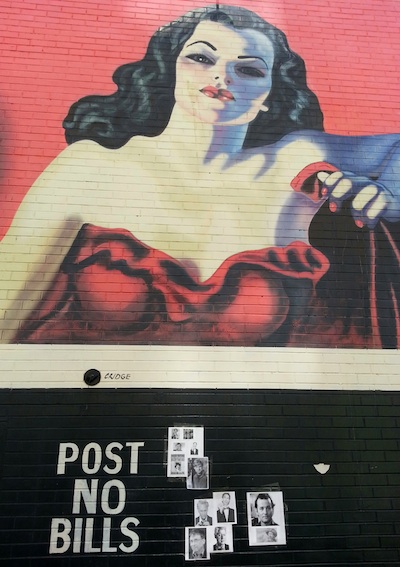
brick wall painted with "Post No Bills" message plus print-outs of famous Bills taped to the wall, Pittsburgh, PA

It’s a cheap visual joke. The self-consciously retro POST NO BILLS painted in big white block letters on the black brick wall of the former Joe Mama’s Italian restaurant in Oakland. Right next to it, jokesters have taped–nay, “posted”–a slew of pictures of famous people named Bill. There’s Bill Murray and Bill Clinton, Bill Gates and Bill Maher, Bill Nye “The Science Guy” and the wall’s most arcane inclusion, Buffalo Bill Cody. Bill Cosby makes a de rigueur appearance begging the question: is it bad taste or mockery to include a disgraced Bill in one’s (relatively benign) act of prankdom?

It’s a sad state of affairs when one gets a nice chuckle out of some college kids’ first nights back jape and then we jump immediately to skepticism. This is probably a thing–maybe it counts as a “meme,” I think to myself, something somebody thought of and now folks do as a cliche, like adding love locks to the nearest bridge, or “this gum tastes like rubber,” or flossing.

So off to the Internet I went, and sure enough, Google Images was stocked with variants on this joke. Color copies clipped to a chain link fence; Xeroxes stapled to plywood; Clinton, Gates, and Murray as Run-DMC; and nice, spray-painted stencils on plywood of the same group (plus Cosby) at various urban construction sites. A template clearly exists and the canon established.

So, what would it take to make this bit more interesting? If this prank-loving blogger was going to have at it (and he’s not) he would at minimum throw out all the obvious candidates. Pittsburgh young people: make it your own! Here then, for anyone considering a future rendition, are a handful of Orbit suggestions for great Pittsburgh “Bill”s that you could use, without getting into the Post No Bills rut. Make us proud.

William Pitt, 1st Earl of Chatham

William “Bill” Pitt, 1st Earl of Chatham

William Pitt: A guy who liked Pittsburgh so much he named himself after the city. Hold it. No, it was the other way around. And maybe the city didn’t get any choice in the matter. Whatever. “Ol’ Bill” is the namesake of both Pittsburgh and Chatham College/Chatham Village and a host of other places all over the country. Tell me the image of William Pitt’s ridiculous powdered white wig wouldn’t look great wheat-pasted to the side of Joe Mama’s.

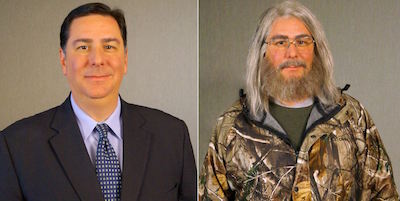
Two photos of Pittsburgh Mayor Bill Peduto: one in a suit, one in disguise for the television show "Undercover Boss"

Pittsburgh Mayor Bill Peduto in both mayoral and “Undercover Boss” guises

Mayor Bill Peduto: This one is pretty obvious. Even if you’re a student here in your first semester, you should be aware of your mayor. You’ll likely even have the opportunity to vote in the next mayoral election, so you should pay attention. Though Mayor Peduto probably would not condone vandalism (even if it’s only committed with photocopies and packing tape), I’ll bet even he would get a little kick out of being in the Order of the Bills.

Bill Mazeroski's 1960 World Series-winning home run over the New York Yankees

Bill Mazeroski, 1960 World Series

Bill Mazeroski: “Maz” gets credit for one of the most dramatic moments in Pittsburgh sports history: a walk-off home run to win the 1960 World Series over the New York Yankees. You might not be able to pick his face out of a Post No Bills line-up, but this iconic photo of the ecstatic game-winning stride around the bases will resonate with even the casual Pirates fan–there’s even a bronze statue of it at PNC Park. Oh yeah: and this all happened at Forbes Field, which is now Schenley Plaza/Pitt campus.

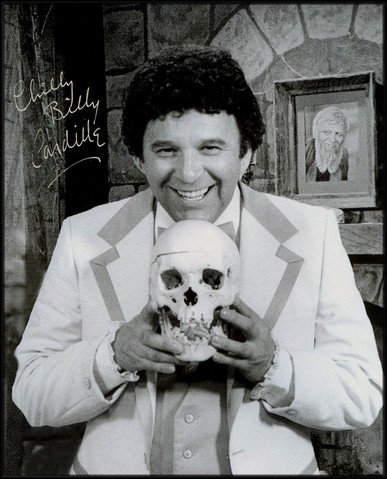
Pittsburgh television/radio personality "Chilly" Bill Cardille, from his time hosting "Chiller Theatre"

Chilly Billy Cardille in the “Chiller Theatre” days

Bill Cardille: This blogger didn’t move to Pittsburgh until the 1990s, so I missed out on Chiller Theatre, Pittsburgh’s entry in the bygone era of local hosts introducing late-night B-movie features on broadcast television. But I still know of it, so you should too. Cardille is equally famous both for his role as a TV news reporter in Night of the Living Dead and as a longtime radio host on (former) “music of your life” station WJAS (R.I.P.). I don’t know how many dozens of times I heard him spin “Theme From a Summer Place” or “Close to You” while I patched plaster and sanded floors. Those tunes, just like Cardille’s bedroom baritone, never got old. The patching and sanding, on the other hand…

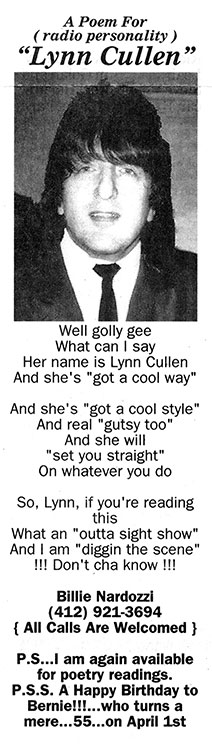
A poem titled "Lynn Cullen" from the newspaper classified ads by Billie Nardozzi

One of Billie Nardozzi’s weekly classified ad poems

Billie Nardozzi: As Pittsburgh’s (unofficial) poet-laureate, Nardozzi published his verse weekly in the Post-Gazette classified ads for at least a decade. Every Tuesday, you’d get the same photo of himself with some rhyming, quoted “words” of “wisdom” on subjects like kindness, true love, loneliness, home cooking, etc. You make yourself a spray paint stencil of that mug with that mullet and the people of Pittsburgh will “lose” their “minds.” Guaranteed.


Honorable Mentions. Other great Pittsburgh Bills:

  • Billy Conn: Professional boxer, mostly known for the oxymoronic title of World’s Light-Heavyweight Champion (1939-1941) and for taking on (and, yes, losing to) Joe Louis, who was a weight class above him. There’s a Billy Conn Boulevard in Oakland (actually just a ceremonial section of Craig Street) and a line of photos up at Hambone’s, some of them with googly eyes stuck on the glass. Make it happen.
  • Billy Strayhorn: Jazz composer, arranger, lyricist and Duke Ellington’s right-hand man. Just try taking an ‘A’ train or living a lush life in some small dive without him.
  • Bill Bored: Drummer for the late great new wave weirdos The Cardboards and star of Stephanie Beros’ Debt Begins at 20. That movie contains a ton of great shots in Oakland and Bloomfield of places that don’t exist anymore. I’m dying for an Orbit interview with Mr. Bored!
  • Bill Cowher: He of the most-noteworthy mustache, beard, and flying saliva–oh, and he coached a football team, too. Another person with features so strong they scream out to be abstracted into two-tone.
  • Billy Buck Hill: Obscure sub-neighborhood of the South Side Slopes. Yes, this counts as a “Bill.”

brick wall painted with "Post No Bills" message and retro Coca-Cola advertisement, plus print-outs of famous Bills taped to the wall, Pittsburgh, PA

The Meadville PennDOT Road Sign Sculptures, Part 2: The Flower Garden

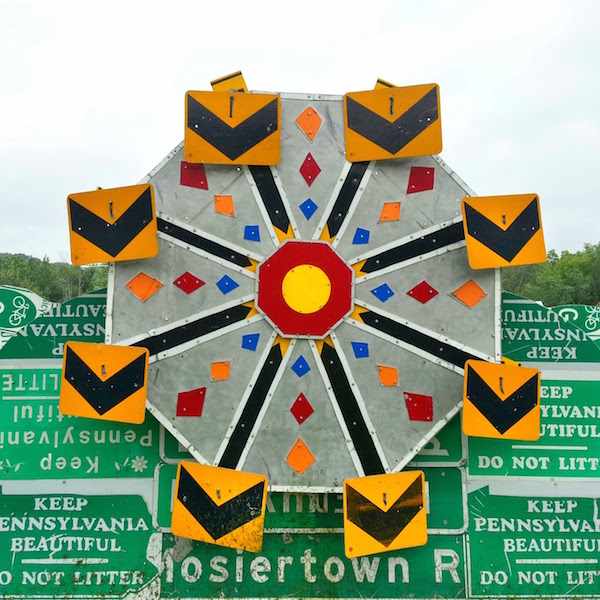
flower sculpture made from one way and stop roadsigns, Meadville, PA

Back in July, we ran a piece on the PennDOT road sign sculptures in Meadville, just up the highway from Pittsburgh. That post detailed the quarter-mile-long fence/mural that stretches down Route 322 and forms the majority of the immense sculptural project on the property of the local highway maintenance yard.

But not all of it. There is so much art in the PennDOT project that we decided to break the story in two parts, with this second post dedicated to the gorgeous flower garden that sits at the corner of Rt. 322 and Mercer Pike/Rt. 102.

flower sculpture made from highway roadsigns, Meadville, PA

It’s interesting that with all its financial backing and oversight, the brand new Whitney Museum was not sited at a location with Sheetz and Dairy Queen franchises on opposing corners. Worry not: no such oversight was committed in Meadville. Why, if the Crawford County art connoisseur and gastronomist wanted both an order of Sheetz’ Pretzel Meltz or Shnack Wrapz paired with a DQ Peanut Butter Cookie Dough Smash Blizzard Treat, well, she’d be all set, wouldn’t she? And what if her old man had a hankering for one of Sheetz Cold Subz or Saladz, washed down with an original Orange Julius? You know he could find that too–hopefully with room for a Peanut Buster Parfait.

flower sculpture made from highway roadsigns, Meadville, PA

In their present form the flowers look like the work of some combination between Dr. Seuss and Dr. Jekyll. All fantasy shapes and riveted steel; eye-popping iridescent reflectors and crudely cut welded metal. These photos may or may not accurately represent the scale of these pieces, so let’s just say this tall blogger was dwarfed by even the shortest of the flowers which easily topped-out at ceiling height.

silhouette of the underside of flower sculpture made from highway roadsigns, Meadville, PA

Trying to figure out which particular specimins the sculptures may represent–or even if they’re modeled on reality–led this blogger down the rabbit hole of Pennsylvania flower identification. Where’s cub reporter Tim when you need him? I won’t claim we came away with any clear IDs, but we’ve got our suspicions.

flower sculpture made from highway detour roadsigns, Meadville, PA

We’re pretty sure we located sweet wakerobin (Trillium vaseyi) in the garden, [note to self: consider “Sweet Wakerobin” for next band name] maybe a sunflower, but, we realized pretty quick that trying to match bent steel that reads Boy Scout Troup 254 to a nature guide is a fool’s errand. Maybe we could put some real scouts to work, you know, scouting actual local flora against these art flowers. Or maybe we should just sit back back with our M.T.O. Chicken Stripz and enjoy the scenery.

flower sculpture made from highway speed limit and direction roadsigns, Meadville, PA

Like the best art, the Meadville PennDOT sculptures are equal parts wonder and inspiration. How did they do that? at the same time as I want to do that! And I truly would love to do that. Maybe all it would take is a pair of tin snips, a couple trips to Construction Junction, and box of Band-Aids. Oh, and that pesky basement cleanout.

flower sculpture made from highway roadsigns, Meadville, PA


The Meadville PennDOT Road Sign Sculptures, Part I: The Fence/Mural

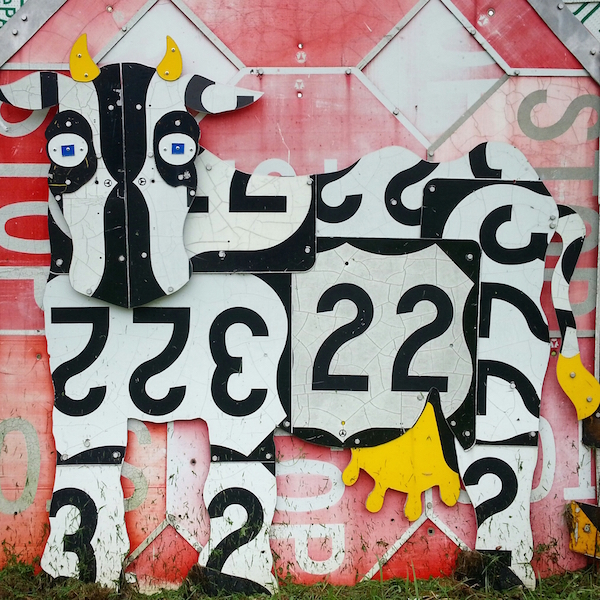
Meadville PennDOT sign sculpture fence detail of cow

It was a dreary, cool, rainy day when The Orbit crew pulled off the highway for some high art and a bag of Combos. We’d describe the weather as very un-summer-like, except it was very much in keeping with this particular summer. This cool-weather-lover is certainly not complaining–give him forty-five degrees and drizzling and you’ll find one happy blogger chortling to himself as he types. That said, we were hoping for a break in the rain long enough to photograph one particular roadside curiosity, and were granted that particular wish.

Meadville PennDOT sign sculpture fence of hot air balloons

Thurston Balloon Classic over Weight Limit Mountain

An hour-and-a-half due north of Pittsburgh lies Meadville, the seat of Crawford County. This smallish town is the unlikely host of an immense collection of sculptures, all in connection with and displayed by the local Pennsylvania Department of Transportation (“PennDOT”) maintenance yard.

Meadville PennDOT sign sculpture fence of barn and silo

Stop barn with Jct silo

According to PennDOT, the fence/mural project and its adjunct flower garden (more about that, later) were conceived by Allegheny College art professor Amara Geffen and Jack Molke, former Crawford County maintenance manager. The actual work was executed both by Allegheny College art students and the local PennDOT workers. It began back in 2001, but continued over many years until the entire maintenance yard fence was covered.

Meadville PennDOT sign sculpture fence detail of great blue heron

Great blue heron

From PennDOT:

The mural depicts life in Crawford County highlighting annual events such as the Thurston Balloon Classic and the Crawford County Fair. Local community landmarks such as the Crawford County Courthouse, Conneaut Lake Park, and Allegheny College’s Bentley Hall highlight the scene. The project depicts life in Crawford County with farm scenes, seasonal scenes and downtown Meadville buildings.

Meadville PennDOT sign sculpture fence of trees

Lane change ahead tree

What no set of photographs will accurately depict is the sheer immensity of this piece. The fence is well over human height and probably reaches up to ten or twelve feet. It stretches some 1,200 feet (approx. a quarter mile) down Route 322 and around the corner. The fence is at once a single continuous piece and also dozens of distinct interlocking sections that each bleed into one another.

Meadville PennDOT sign sculpture fence of singing cowboy on stage

Singin’ cowboy down at the (railroad) crossroads

There are broad strokes like rolling Crawford County hillsides and a series of sections devoted to (downtown Meadville?) storefronts. But the detail on the pieces is terrific with little touches that play with the recycled signage and “Easter egg” details that you’d never catch if you just did a drive-by.

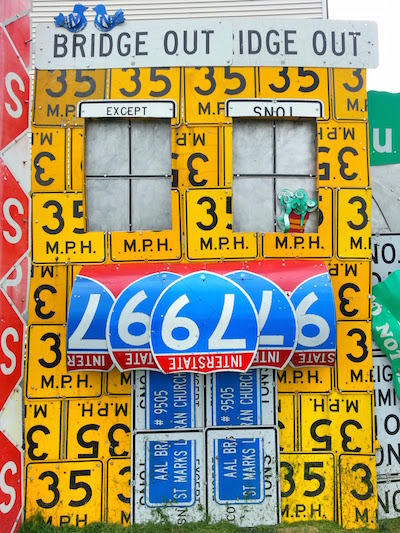
Meadville PennDOT sign sculpture fence house

Bridge outhouse … or Bridge Out house

For all these reasons, it’s really worth parking and taking a walk down the full length of the fence and back. Then, like all great art experiences, you can cross the highway to Sheetz for some M.T.O. and group reflection.

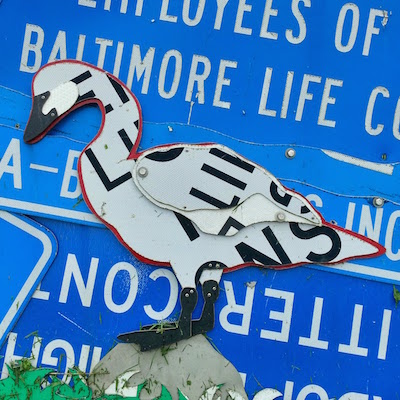
Meadville PennDOT sign sculpture fence of Canada goose

Baltimore Life/Canada goose

Are the sculptures worth a trip from Pittsburgh? They’re pretty great, and no set of photographs is really going to do them justice, so we’d have to say yes. That said, combine them with the next time you’re heading to Erie, or Conneaut Lake, or are just making a run to Meadville’s own Voodoo Brewery and you’ll have yourself a fine combo for your Combos.

Meadville PennDOT sign sculpture fence of merry-go-round

Ferris wheel

Getting there: The PennDOT building and maintenance yard is on Rt. 322, literally just a minute (maybe a half mile?) from the Meadville exit off I-79. The sculptures leap out at you and go on for a quarter mile so you really “can’t miss it.”

Meadville PennDOT sign sculpture fence of clouds, rain, mountains, and tree

Art imitates life: rainy day scene


Medium Cool: An Orbit Day Trip to Lily Dale Pet Cemetery

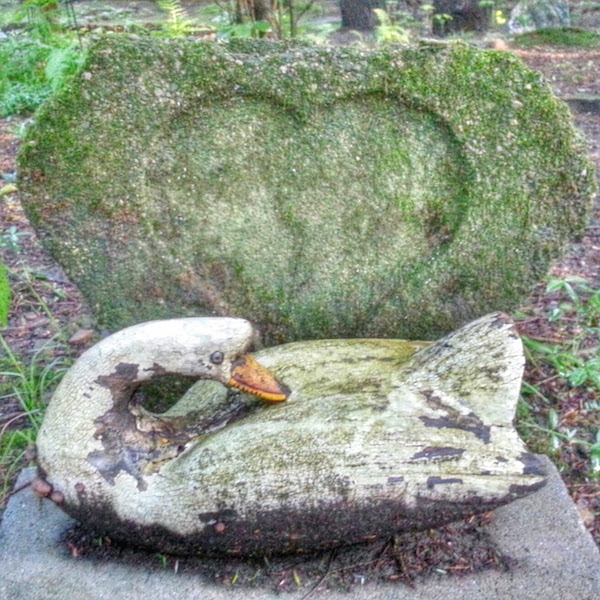
grave marker with a wooden duck and stone heart, Lily Dale, NY

Duck/heart

Far Western New York is certainly outside of what can be reasonably considered “the Pittsburgh region,” but at two hours and change driving time (each way), it’s a doable up-and-back, so we’re going to include this one as An Orbit Day Trip.

Lily Dale (aka Lily Dale Assembly), New York is a picturesque Victorian village that sits on tiny Lake Cassadaga, between Fredonia, Jamestown, and Chautauqua. It bills itself as “the world’s largest center for the science, philosophy, and religion of spiritualization.” While this chakra-curious blogger would be hard pressed to name a larger center for such things, at just a handful of streets, maybe a couple hundred year-round residents, it’s still a little difficult to believe Lily Dale is the largest anything. But we’ll take their word for it.

Trees with prayer ribbons, Lily Dale, NY

Prayer ribbons in Lily Dale

That said, the ratio of psychics-to-ne’er-do-wells is extremely high. Seemingly every other one of Lily Dale’s cottage-houses has a shingle out advertising the services of one or more registered in-house mediums (media?). Lily Dale is also home to the National Spiritualist Association of Churches (NSAC).

The catalog for the June-September workshop programs is ample and either the lecturing-on or attending-of these courses, along with individual “readings” with the aforementioned mediums, seems to be what people do in Lily Dale. Instructors Michele Whitedove, Lee Two Hawks, Shadow Fox, and others with less spectacular names offer courses on subjects like Banshees, Curses, and Little People; Interdimensional Out-of-Body Travel; Orb Phenom–Orbs Are Among Us; Etheric Projection & The Human Energy Field; The Art of Using Pendulums, Dowsing Rods, Sticks & Stones; and Spoon Bending.

Forest Temple, Lily Dale, NY

Forest Temple

While The Orbit generally subscribes to a “when in Rome…” philosophy, we’re also too skeptical (and too cheap) to pay $45 (the going rate for a two-hour workshop) to get our Laugh-a-Yoga Leader Certification. Whether all this New Age stuff strikes your divining rod or seems like a bunch of hooey, Lily Dale is absolutely a lovely and magical little place to visit. The whole landscape is completely enmeshed in tall woods and seems bathed in the gauzy soft light of an Elfin dreamland. We skipped the lectures and stuck to nice walks of the town, lakefront, Forest Temple, Inspiration Stump, Fairy Trail, and pet cemetery–all recommended.

wooden cross grave marker for a pet named Mutlee, Lily Dale, NY

Mutlee, 1988

This was The Orbit‘s first trip to a legit pet cemetery, but hopefully not our last–we’re hooked! Lily Dale’s goes way back. The earliest dated stone we saw was from 1920, but I got the sense it was considerably older than that. There are hundreds of graves in the small forest clearing where the cemetery stands. The markers range from professional chiseled stones with names, dates, and epitaphs, to crumbling homemade crosses, sculptures, cast concrete, and painted rocks.

Here are some of our favorites:

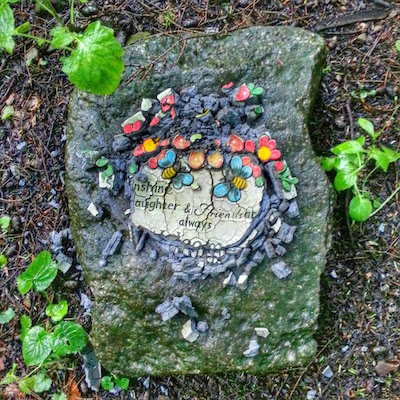
stone grave marker for pet with disintegrating tile, Lily Dale, NY

(Su)nshine, (l)aughter & friends ar(e) always (welcome)

cement grave marker for pet, Lily Dale, NY

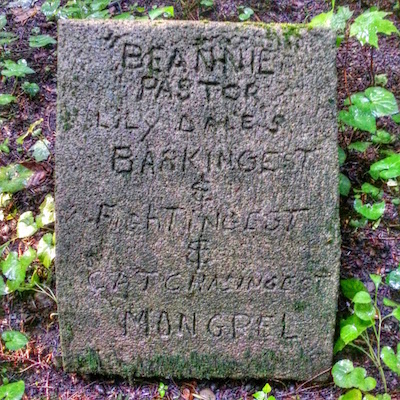
Beanie Pastor: Lily Dale’s barkingest & fightingest & cat chasingest mongrel

stone grave marker for a chipmunk, Lily Dale, NY

The cemetery’s newest marker: Friend and Teacher, 6-29-15

stone grave marker with pet's name "Fluffy", Lily Dale, NY

Fluffy

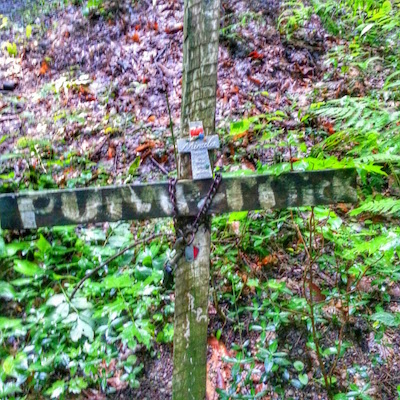
wooden cross grave marker for a pet named Pumpernickel, Lily Dale, NY

Pumpernick(el)

Getting there: As mentioned, it’s somewhere around two-and-a-half hours drive from Pittsburgh to Lily Dale. Likely a lot faster if you can travel interdimensionally out-of-body, but we’re old-fashioned. There are numerous inns, beds and breakfast, and one old hotel on the grounds. But really, if you’re not attending the seminars, you can probably see everything you need in a few hours–it’s just not that big. There are two non-fancy/grab-and-go restaurants, one coffee shop, and one general store in the town.

Also be warned that there is a steep ($12 per person per day) gate fee to get on the grounds. My advice to the casual visitor would be to park somewhere outside the gate and see if they’ll let you walk in for free.

Sundown at Lily Dale Assembly pet cemetery

Sundown at Lily Dale Assembly pet cemetery