Onion Dome Fever: St. Mary’s Russian Orthodox Church

St. Mary's Russian Orthodox Church, McKeesport, Pa.

St. Mary’s Russian Orthodox Church, McKeesport

It was a bleak late February day when Orbit cub reporter Tim and I set out in the slush for McKeesport. We were tracking big game: one muffler man and a couple onion domes.  And bag them we did. Oh yes, bag them we did. But so much more, too: fish and trains and saints and steps and one Magic Palace. More about all that (hopefully) in the weeks to come.

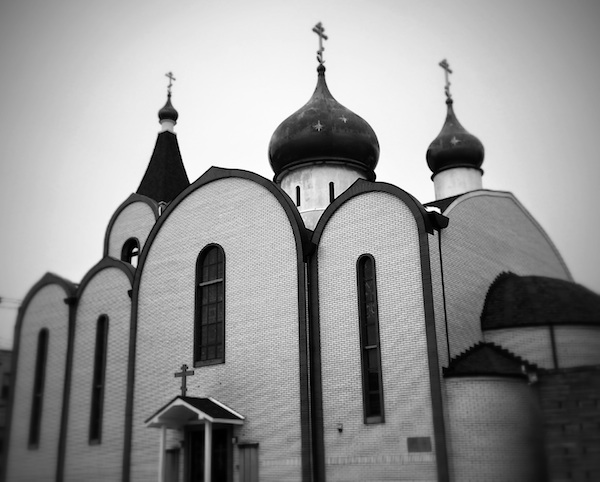
But for now, let’s get to the task at hand: the beautiful St. Mary’s Russian Orthodox Church. Located on a side street, a couple blocks off the main drag from McKeesport’s downtown, St. Mary’s looks nothing like the landscape that surrounds it.  It also looks not particularly like the other Eastern Orthodox churches we’ve seen on this beat: more modern, white-bricked, with glowing blue domes (you’ll have to take my word on that one, or see video at bottom).

If this blogger wants to hit the big time he’s going to have to remember to bring his reporter’s notebook and write down some facts, so I don’t have a date on when St. Mary’s was built.  That said, it feels very between-the-wars: sleek and stylish, its curves more suggestive, its lines part old world, part deco.

I don’t know if it’s worth a trip to McKeesport just to see St. Mary’s–that’s what the Orbit is here for!–but definitely do stop by if you’re out that way.  And if you do, let me know what it says on the cornerstone.

St. Mary's Russian Orthodox Church, McKeesport, Pa.

McKeesport skyline with St. Mary’s

St. Mary's Russian Orthodox Church, McKeesport, Pa.

“Tim: get out of my shot!”

Bonus footage!  Video of St. Mary’s new dome getting installed in 1998:

Onion Dome Fever: Rocks Bottoms Orthodox

St. Nicholas Orthodox Church

St. Nicholas Orthodox Church, McKees Rocks

Growing up in the South, we had plenty of churches, but they tended to be Baptist, Methodist, and A.M.E.  They worshipped in unremarkable generic brick buildings, scaled-down budget classics, old wooden country churches, and occasionally unfortunate modern takes that would make even the most pious consider a life of sin.

There were a handful of Catholics in every decent-sized town, but they weren’t the wine-swilling, cigar-chomping, fish-frying variety that exist in the North.  One of my earliest new-to-Pittsburgh memories was going to a church carnival in my neighborhood where the fund-raising priest hosted a cash-on-the-table spinning wheel gambling game where the prizes were all bottom shelf liquor.  That just doesn’t go on in Appalachian Virginia.

Around Pittsburgh, there are dozens of amazing Eastern Orthodox churches with an architecture that still strikes me as otherworldly.  Byzantine crosses and elaborate stained glass.  Gold-leafed tableaus and, above all (literally), glorious (usually) gold-painted onion domes that routinely mark the skylines of otherwise humble brick factory towns and glow on gray and rainy days.

Here’s a first post wherein we honor the amazing church architecture in Pittsburgh.  The small neighborhood of “The Bottoms” in McKees Rocks boasts at least three different Eastern Orthodox churches, each with their own interesting features.  Let’s start with St. Nicholas.

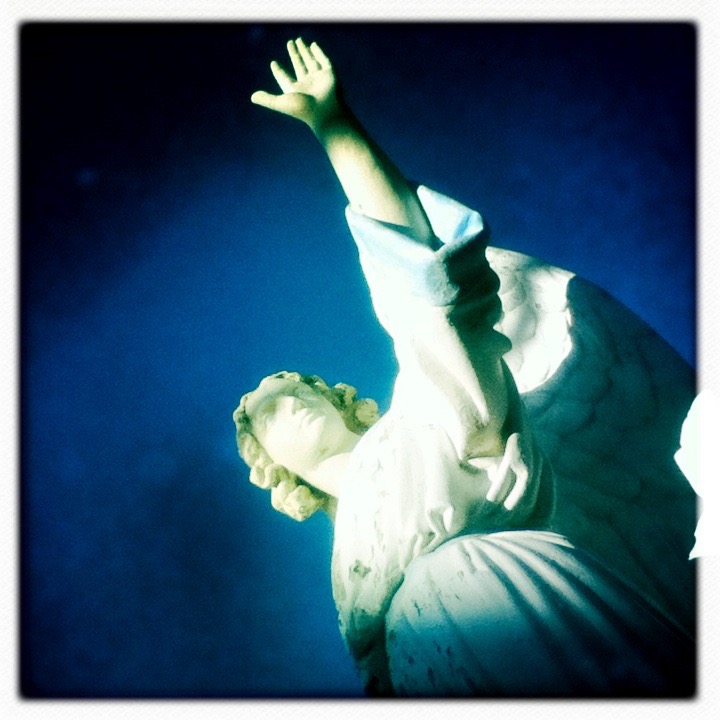
Statue at St. Nicholas Orthodox Church

Angel

Statue at St. Nicholas Orthodox Church

Angel (detail)

Statue at St. Nicholas Orthodox Church

Angel with power lines

St. Nicholas Orthodox Church in silhouette

St. Nicholas silhouette


Italian Colors

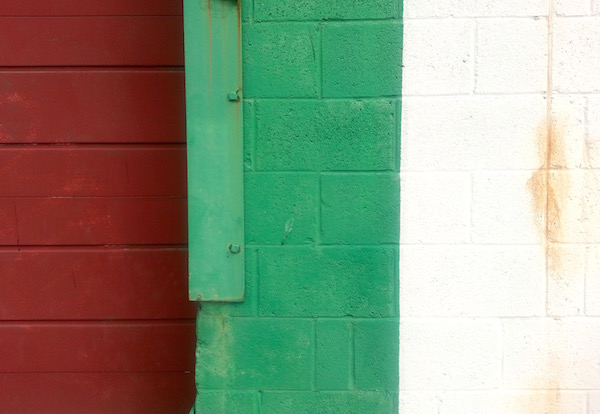
Two rowhouses in the Bloomfield neighborhood of Pittsburgh: one green, one red

Green house, red house, white snow, Bloomfield

Even the most casual student of the classics will recognize the names of great Italian painters. Botticelli, Caravaggio, Verrocchio–the list goes on and on.  Their descendants made their way in droves to Pittsburgh, settling largely in Larimer, Bloomfield, South Oakland, and other parts of the city.  And they continued to paint.

The medium of choice is still oils (albeit exterior enamel) and they’ve simplified their color palette to the trinity of green, white, and red.  Boldly eschewing the staid canvas and gallery presentation, these artists work large and for the world to see: on cement walls and park benches, street lights and entire houses.

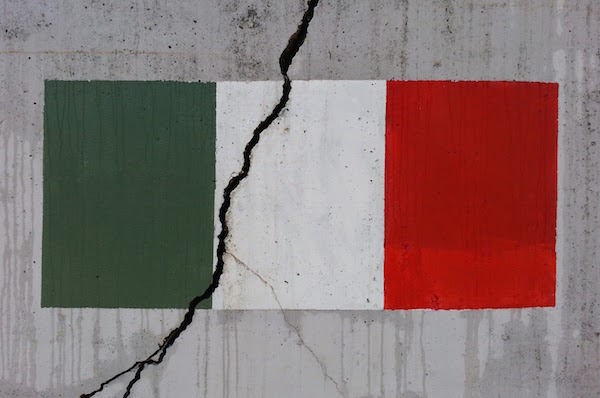
Garage wall in Italian red, green, and white

Garage (detail), Uptown

It’s curious to me that while Pittsburgh’s great expansion in the late nineteenth and early twentieth centuries was famously from eastern and southern European immigrants, it seems that only the Italians felt the need to reproduce the flag over and over again.  Why don’t we see crude renderings of the white eagle on garages in Polish Hill and Lawrenceville?  Why no black, red, and gold telephone poles in Deutschtown?  We’ve got (people who identify as) Croats and Slovaks out the yin yang.  Who’s representing?

Street light pole in Italian colors

Street light pole, Bloomfield

Flower pot with red and white flowers and statue of Jesus

Jesus Planter, Bloomfield

While only a fraction of the population of those other neighborhoods, the tiny neighborhood-within-a-neighborhood of Panther Hollow has possibly more Italian colored things per capita than anywhere else.  There’s a bi-lingual war memorial with the flags of The United States, Italy, and Pittsburgh, an Italian-colored park bench and picnic table, the flag rendered graffiti-style on a retaining wall, and one abbreviated stretch of picket fence.

Park bench and picnic table in Italian colors

Park bench, picnic table, Panther Hollow

It was there, at the very end of Panther Hollow, that we had the great fortune to run into lifetime resident, local historian, and maintainer of the terrific pantherhollow.us website, Carlino Giampolo. “Everyone should have a fence to hide their garbage,” Carlino told us as explanation for the curious freestanding set of tri-colored fence at the edge of his property, the last plot in the Hollow as the dead-end Boundary Street trickles into Schenley Park bicycle trail.

Retaining wall with Italian flag

Retaining wall, Panther Hollow

Carlino went on to tell us about growing up in Panther Hollow, when what is now Pitt’s lower parking lot was a ball field, community park, and cow pasture.  When there were as many as six different operating businesses in the Hollow (today there are none, nor any obvious former retail spaces).  He showed us where the hotel once stood in what is now his side yard, the community oven that would cook the neighborhood’s bread, and how self-sufficient the whole place once was (and not that long ago)–butchering their own animals, making cheese and butter from the small herd of cows they kept, etc.

Picket fence in Italian colors

“Everyone should have a fence to hide their garbage”, Carlino’s fence, Panther Hollow

Dead Mall: Century III

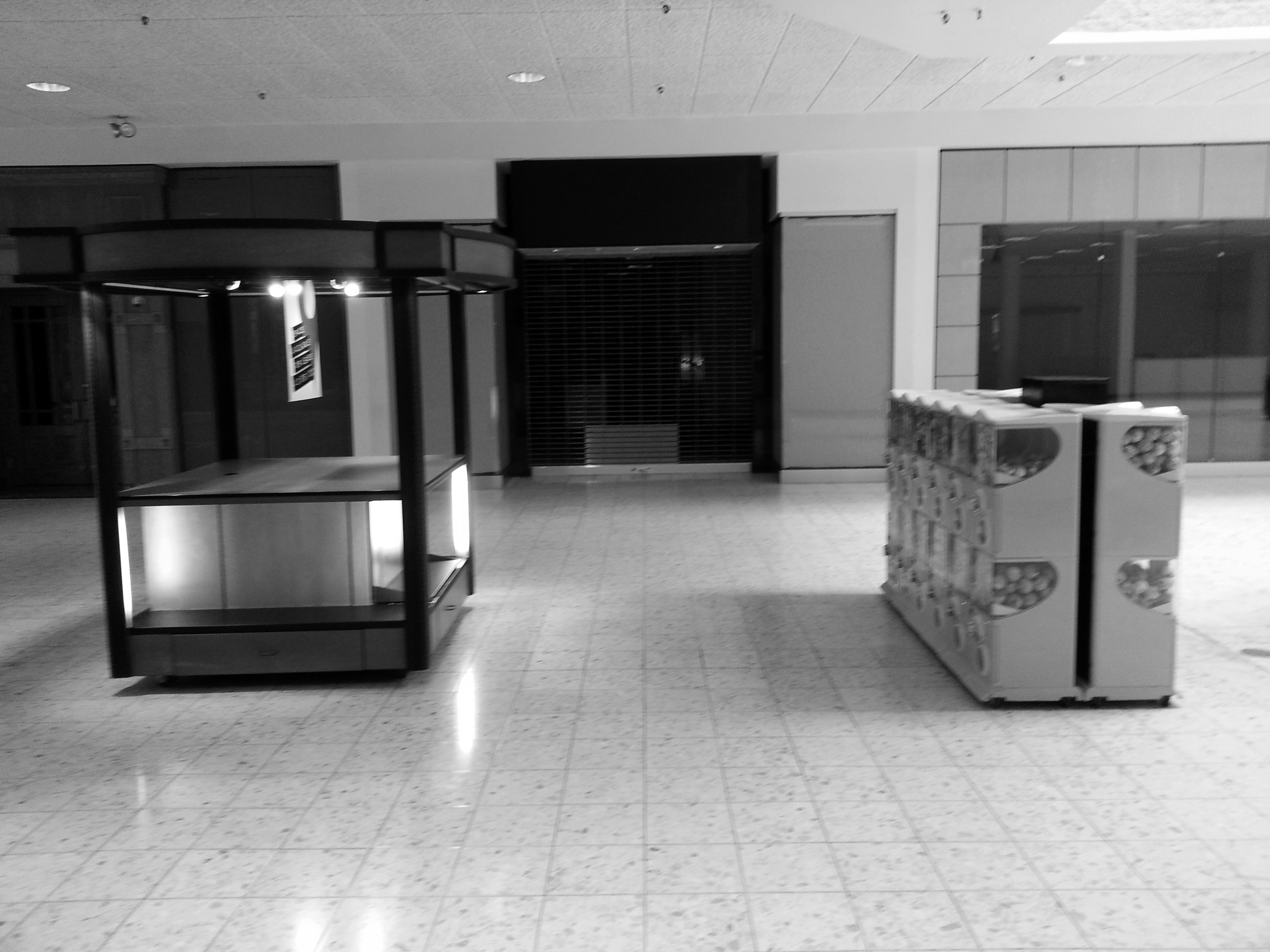
Century III shopping mall common area with empty kiosk and candy machines

Century III Mall: from dust to dust

The “dead mall” phenomenon is certainly not anything unique to Pittsburgh.  It’s been documented in sites like deadmalls.com and articles like a recent New York Times piece on “the economics and nostalgia of dead malls.”  For those of us old enough to remember when the local shopping mall was the predator, not the prey, it’s almost inconceivable that these retail-draining, downtown-killing behemoths could ever be ousted, but whether it be the Internet or competition cannibalizing their own, it’s for real, and it’s happening everywhere.

The Century III Mall, located in the borough of West Mifflin, in the southeast suburbs of Pittsburgh, is not technically dead.  It is, in fact, still open for business, with anchor tenants and a relatively clean and cared-for interior.  It maintains three anchor tenants (with Sears having recently pulled-out), a two-restaurant food court, and just enough open businesses to think they may draw a crowd on weekends and the run-up to Christmas.

That said, it’s probably only a matter of time.  The mall is supposedly only 40% occupied, down from 80% ten years ago, and walking through on a recent Friday afternoon there were next to no customers in any of the remaining stores.  The clerk at the jewelry kiosk was clearly asleep.

Century III Mall empty storefront detail

Century III: empty storefront detail

Century III Mall empty storefront detail

Century III: empty storefront detail

Century III does have a uniquely Pittsburgh backstory, though, connected to the steel industry right at the end of its reign on the region’s economy.  The Wikipedia article on the mall summarizes well:

The name Century III was conceived at the time of the nation’s Bicentennial, making light of the time at hand – the advent of America’s third century. When the mall opened in 1979, it was the third largest enclosed shopping center in the world. The site is a recycled former U.S. Steel industrial area, a huge slag pile once known as Brown’s Dump. Slag, a waste product of steel making, had for years been transported by rail cars from the mills of Pittsburgh to this once remote valley.

Aerial photo of former slag heap "Brown's Dump"

“Brown’s Dump” (no snickering), pre-mall

This transformation of the ultimate brownfield–a steel industry slag heap–into a bright and shiny shopping mecca must have made business section headlines all over the place.  But its (seemingly inevitable) demise at this point is now a sad ashes-to-ashes, dust-to-dust, slag-to-slag parable of retail in the twenty-first century.  It’s unlikely this particular heap will last the sixty-some years it would take for it to reach Century IV.

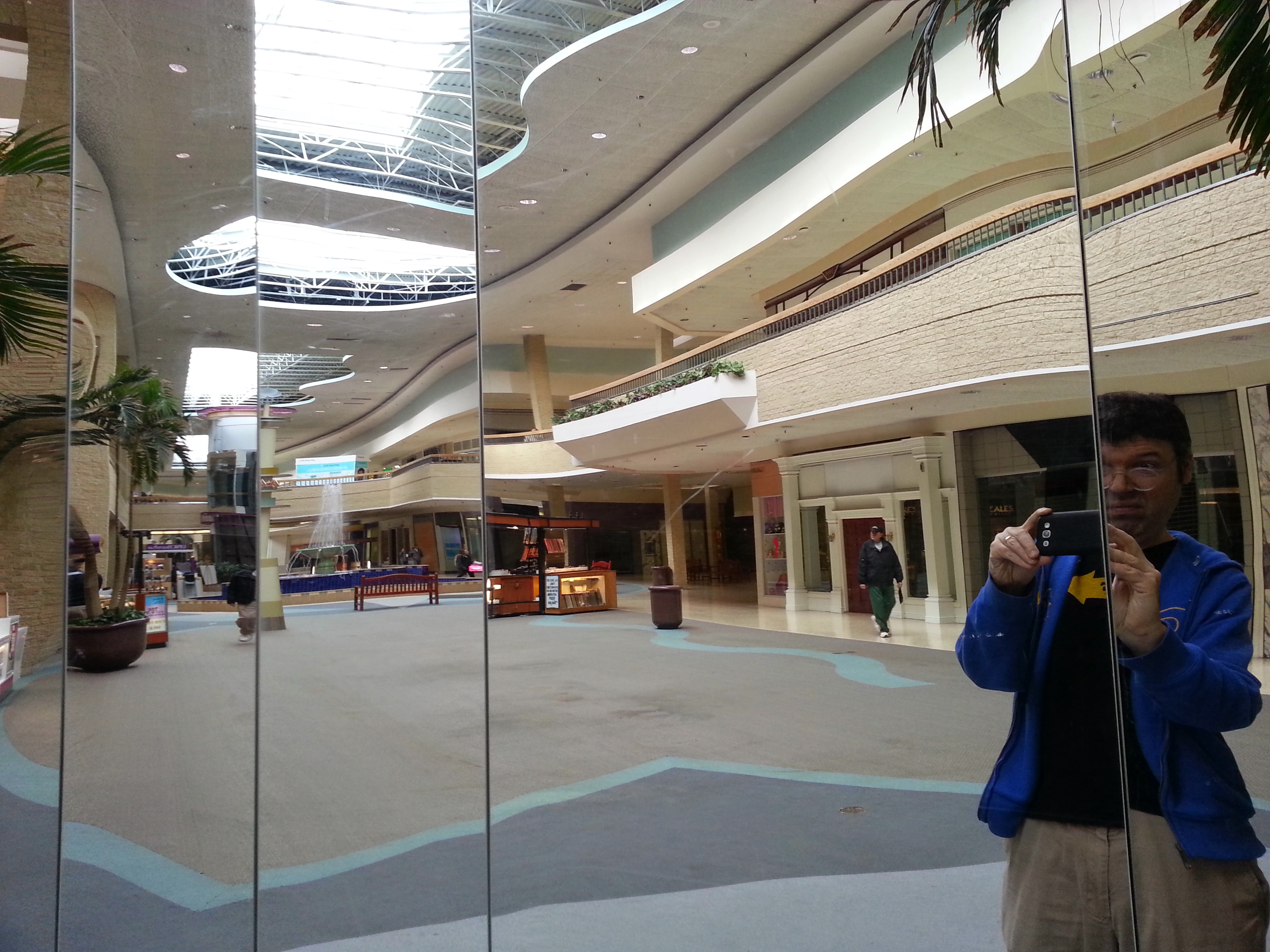
Blog author reflected in empty mall mirrors

Century Selfiii: the author, fractured and alone at the mall

Ghost Houses: East Liberty

Ghost houst: East Liberty

Ghost house: East Liberty

Ghost house: the imprinted silhouette of a structure that is no longer there on one that is.  They’re the last remnants of a structure that has been banished from this earth and they speak to the current property owner’s neglect for updating to hide what many would consider a cosmetic blemish.  The alternate explanation being that they may be a very reverent way to honor the former structure.  It is impossible to know the intent.

Pittsburgh has a lot of these, owing to the city’s history of many close-quartered row houses and houses directly abutting industry.  That, coupled with the massive loss of population in the 1970s and ’80s that left lots of vacant, derelict properties that were ultimately razed.

The ghost house photographed above is particularly amazing.  It’s right across the street from The Home Depot in East Liberty and makes a perfect outline of the former house, including front and rear porches, against the off-white painted brick wall of a much larger building.  The addition of the lush green weedy grass (this photo taken in summer) makes it all the more unreal

Ghost house: East Liberty

Ghost house: East Liberty

This is another one, also in East Liberty, with a weird variant on the theme.  In this case, the former house’s fireplaces–including the fake stone work on the first floor fireplace–and plaster walls have been preserved in the exterior wall of the still-standing house next door.  It boggles the mind that someone would tear down an entire house, and yet leave pieces of the razed structure embedded in the house next door.  Or maybe it’s structurally damaging to pry out something as integral as fireplace and chimney from abutting houses?  Either way, the outcome is strange, magical, and beautiful.