New Kensington Bauhaus: Aluminum City Terrace

Aluminum City Terrace block of two-story units, each with different front yard changes

Lived-in: Aluminum City Terrace today

Our story begins with a breakfast dish that goes by the auspicious name Never Again. Two eggs scrambled, bacon, home fries, and “S.O.S.” (Shit On Shingle). This is then topped with cheese and gravy, all in a fabulous pile-up that makes lunch at Primanti’s look like high tea. Needless to say, David’s Diner in Springdale is Orbit-approved.

We’d booked our resident architecture consultants Charles & Susan for a gorgeous bright Sunday morning poke-see at a site just across the river in New Kensington and David’s friendly staff made sure all aboard were well provisioned for the hard journalism work ahead.

The crew was on its way to Aluminum City Terrace, a historically-significant housing complex that touched the interconnected spheres of World War II, big industry, and mid-century rock star architects. We wanted to see what the place looks like today, who lives there, and how it’s fared in the seventy-some years since it was hastily built back in the day.

Original drawings for Aluminum City Terrace, 1942

[image: Library of Congress]

Nineteen forty-two. America had just joined World War II and the nation needed aluminum (along with lots of other raw materials) for the effort. That meant lots of work for New Kensington-based Alcoa and a whole slew of new factory jobs for the town.

In what was reportedly a lightning development process, ex-Bauhaus  founder/instructors/architects and design world big-wigs Walter Gropius and Marcel Breuer drew up a 250-unit campus of cheap, simple, efficient worker apartments specifically geared to Alcoa (and New Kensington’s) immediate need to house the ramped-up workforce. The location was a beautifully hilly section just outside of town. It was a mere two miles as the crow flies from Alcoa’s plants along the Allegheny River, but must have felt like another world compared to the belching industry and urban grid of the New Ken/Arnold flats.

Aluminum City Terrace two-story units

Have you seen the back? The very utilitarian rear of the two-story units

Seeing the apartment buildings in person, the immediate effect is, frankly, underwhelming. Aluminum City Terrace may have a great history and rich architectural pedigree, but the two-story units basically look somewhere between the kind of no-frills “garden” apartments that sit at the perimeter of many American towns and the independent no-tell motels just a little further out. This is especially true of the buildings’ featureless back sides.

The road that snakes through the complex and swells into various parking areas dominates its midsection with a regrettable amount of pavement. There are many opportunities to include a shade tree, flower bed, or line of shrubs, but the groundskeepers of the Terrace have chosen to keep its midway decidedly foliage-free.

It’s not a great first impression–especially because you’re likely only going to arrive here by car, and that will land you on pavement. Look a little deeper, though, and the Terrace tells a really interesting story, both past and present.

I’ll add that Aluminum City Terrace is no Dwell set piece, either. People live here, and the sense of life is apparent everywhere. In the drying beach towels hanging off the back porches, the kids trampoline and sports equipment strewn about the yard, the incongruous white plastic picket fence added to a single unit. Architects must flip a gripper when they see what real people do to “their” spaces, but this neutral observer found the collision to be most enjoyable.

Aluminum City Terrace plan and elevation drawings, 1942

Good on paper: Aluminum City Terrace plan and elevation, 1942 [image: Library of Congress]

The irony of the complex that Alcoa built (not literally–the federal government actually sponsored the project–but you know what I mean) is that there wasn’t a square inch of aluminum in Gropius and Breuer’s design. That is, of course, because America needed all of it to fight the bad guys. What are now the long louvered aluminum sun shades were originally made from wood. The elevations tell us the odd jutting-out second-floor bedrooms/back porch roofs were first clad in vertical cedar siding (since replaced) and back entrances shielded by sleek flat asbestos board canopies (ditto).

Aluminum City Terrace single-story one-bedroom block

One-bedroom units, each with an integrated back porch and shed

Aluminum City Terrace Activities Center

Aluminum City Terrace Activities Center

Walking through the complex, I was repeatedly struck by the cattywumpus arrangement of buildings. Each individual set of apartments is one of two designs (single floor one-bedrooms and two-story combined two-/three-bedrooms). The only real exception being the unique yard spaces and controlled additions the current co-op owners have created. But with none of the units lining up in any form of metered placement, it gives the place the overall feeling of a child’s building blocks dropped indiscriminately on a (very well-groomed) lawn, or train cars gently derailed, but untoppled.

I’m sure the primary reason for this was to follow the natural contours of the land. This part of New Kensington is quite hilly, surrounded by trees, and the plan takes advantage of the location in many ways. But even with that in mind, the site plan suggests there was a conscious effort to break evenly lining up any two buildings–either in parallel or perpendicular–on the grounds.
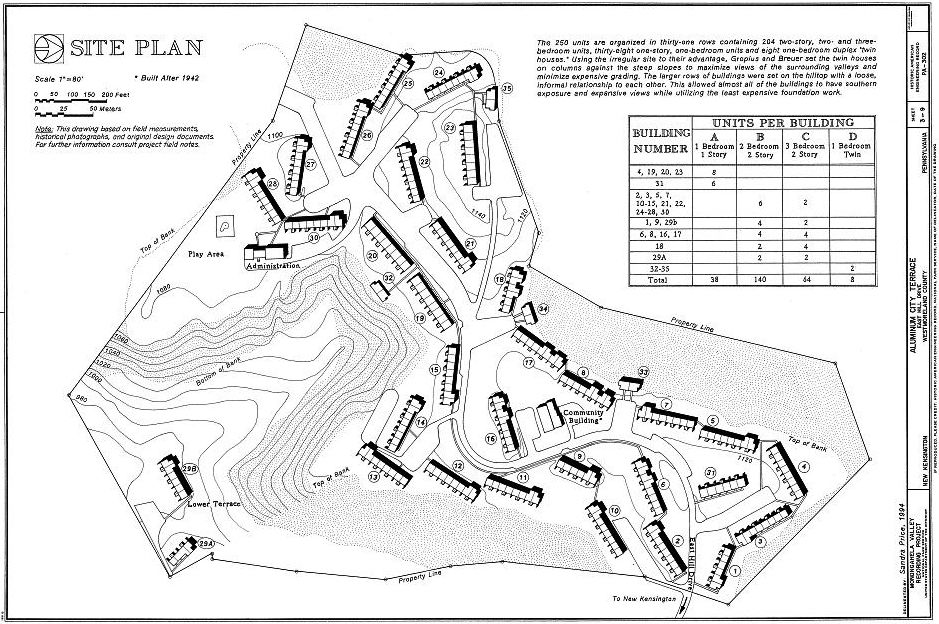
Aluminum City Terrace site plan, 1942

Cattywumpus layout: site plan, 1942 [image: Library of Congress]

We were fortunate to run across a very friendly family, one of whom happened to be on the board of Aluminum City Terrace. They invited the group into their apartment and showed us before and after photos from a large scale remodeling job they’d done. We also got some background on how the co-op system works there.

Residents must apply, pass a background check, and pay a one-time expense to get into the co-op. They then pay monthly upkeep fees for the maintenance of the exteriors of the buildings and grounds. Compared to more strict co-ops (ex: Pittsburgh’s Chatham Village), the residents seem to have a good amount of leniency in the treatment of their yard spaces, adding trees, fences, all manner of shrubs, flowers, vegetable gardens, etc. According to our hosts, all 250 units are occupied and there’s a waiting list to get in.

And it’s easy to see why. The buildings, sidewalks, its one road, and the grounds are in immaculate condition. This is in stark contrast to seen-better-days New Kensington proper. Our hosts told us their daughter is living in a one-bedroom nearby with other relatives also in the complex and there seems to be a strong community throughout. The Terrace is surrounded by trees and was built in maybe the last age before developers routinely flattened the landscape prior to development, leaving it with terrific rolling ups and downs.

Aluminum City Terrace unit with heavily-manicured front yard/garden

There’s a lot going on here: one of the busier/more heavily-maintained front yards

So…what’s the takeaway? Well, this is the first Bauhaus-related project this architecture-curious (but just a casual fan) blogger has experienced up close and personal. As such, it’s cool to find out it’s here, and it’s so loved, lived-in, and accessible in a very real world way. I don’t know much about Gropius and Breuer, but I hope they’d like most of what they’d see seventy years on. I do.

Oh, and that breakfast? On that, David is wrong: you can bet I’ll be having it again.

Onion Dome Fever: St. George’s Syrian Orthodox Church

former St. George’s Syrian Orthodox Church, Pittsburgh, PA

(Former) St. George’s Syrian Orthodox Church, Hill District

Like the ripe tomato hanging on the vine, seductively whispering “take me, I’m yours.” This fantastic little old-world church, complete with big stained glass windows and its Byzantine onion dome. Sitting empty, literally right in the center of Pittsburgh, up on The Hill. An inevitable fantastic view across the Allegheny River from the rear and an easy walk downtown, mere blocks (O.K., maybe a half mile) away.

As this blogger kickstanded his hog and pulled out the camera-phone, a fellow at the bus stop across the street asked if I was going to buy the place. I told him I wasn’t, but wished I could. What would you do with it? he said. Me: I’d live there.

And wow: wouldn’t that be a peach? I haven’t been inside and can only imagine what it would take to resuscitate a heap like this, but you know it would be incredible. What a terrific little place! We’d be living the dream in Orbit World Headquarters! Ha! Instead, it’s sitting idle and, if not shuffling off this mortal coil, it’s at least finished dessert and asked for the check. Sigh. Maybe we need to make a few calls…

former St. George’s Syrian Orthodox Church, Pittsburgh, PA

It comes in color, too!

A side note: One Christmas, we attended midnight mass at the new(er) St. George’s in Oakland with the Syrian family I was tutoring in E.S.L. at the time. [St. George’s moved from The Hill District to Oakland in 1954.] I can tell you that experience was intense. This ceremony actually started at midnight (not one of those middle-of-the-mall midnight masses), went on for two-and-a-half hours, and was all in Latin. Much chanting, swinging the burning herbs, robes, beads; the whole bit. I’m pretty sure those spirits are all still at it in the old place and I’d love to fall asleep to their ghostly modal Acapulco hymns.

Onion Dome Fever: St. John Church of the Eastern Rite

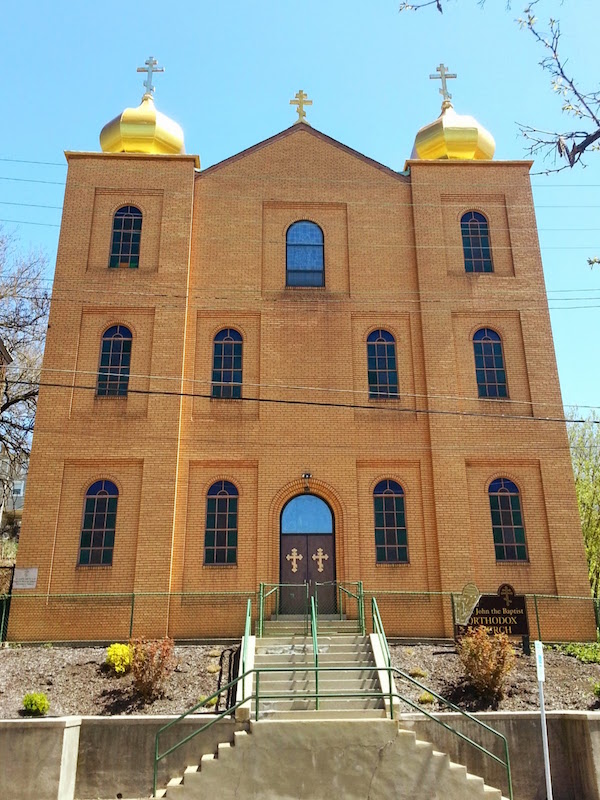
St. John the Baptist church, Pittsburgh, Pa.

St. John the Baptist Carpatho-Russian Church of the Eastern Rite, Marshall-Shadeland

Sometimes life has a funny way of handing out consolation prizes. This blogger was out hunting an elusive patch of historically important heavy metal graffiti and wound up finding religion. I was out looking for Black Sabbath and came back with, uh, actual sabbath. Out for Queensryche, got Eastern Rite. Seeking Slade, got saved. Searching for Slayer, got a savior. Looking for Judas Priest…O.K., this is too easy; you get the joke.

There I was, huffing and puffing my way up and down, back and forth combing through the steep streets and alleys of Marshall-Shadeland looking for a very particular deconstructed garage containing a spray painted history of teenage male hair farmer fandom that I’m starting to think only exists in my dreams (and others’ nightmares). I curse myself for failing to take pictures the first time I came across them (“always record!”) and turn the bicycle toward home in disgrace.

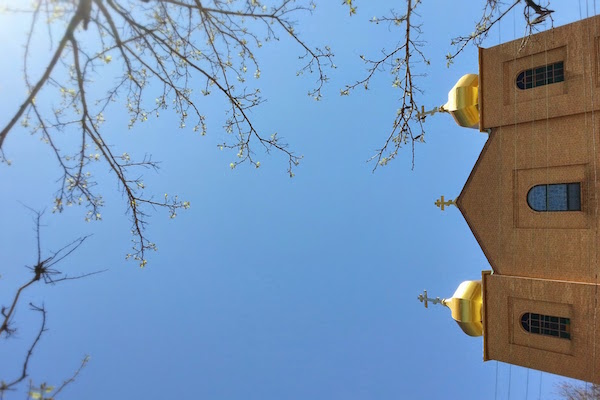
But then, clearing a bluff I’d never been to at the end of Woodland Ave., they popped right out of the sky at me: gleaming onion domes, gorgeous against the perfectly blue early Spring sky, glowing like golden apples in the bright sun.

Detail of onion dome on St. John the Baptist church, Pittsburgh, Pa.

St. John the Baptist Carpatho-Russian Church of the Eastern Rite sits on a lonely stretch of California Ave. It dominates the otherwise two-story frame houses that surround it. The building and grounds seem to be in fine, well-maintained order, but its sign has either been vandalized or severely weather-worn. There is no indication the church is still open Sundays, nor is there evidence of closure. (I was there mid-day on a Saturday and the doors were locked tight.)

Cornerstone for St. John the Baptist church, Pittsburgh, Pa.

Bilingual cornerstone

The church stands an impressive three (very tall) stories, but, other than the showy domes and big Byzantine crosses on the front doors, has a very subdued plainness. That may be a Carpatho-Russian thing, or possibly just a belt-tightening side-effect of its Depression-era construction. I’d love to see inside.

Byzantine crosses on the front doors of St. John the Baptist church, Pittsburgh, Pa.

Byzantine crosses on St. John’s front doors

Probably you’ve whizzed by St. John on your way out Route 65, taking your tube amp to Don for yet another repair at Phil’s TV, or just to peruse the menu of fried items at Miller’s Seafood. Maybe, like me, you never really processed it from the highway, but hopefully you did. Either way, if you find yourself off the main drag, down on California Ave., maybe stick around one time and say hello to St. John. And let me know if you ever find that garage full of graffiti over the hill.

St. John the Baptist church, Pittsburgh, Pa.

St. John the Baptist Carpatho-Russian Church of the Eastern Rite, Marshall-Shadeland

Say Hello to the Heidi Houses of Highland Park

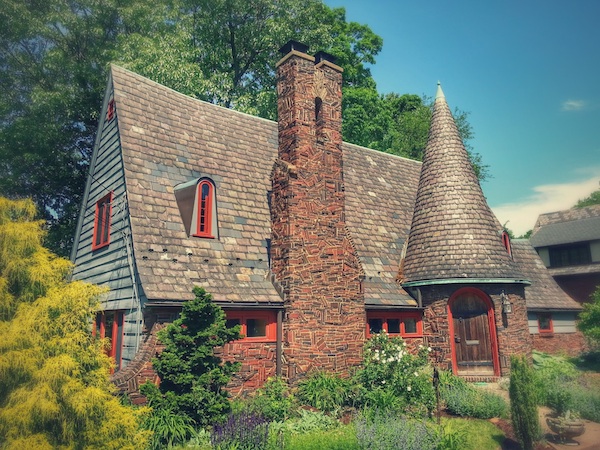
house in Pittsburgh, Pa.

Heidi house #1, Highland Park

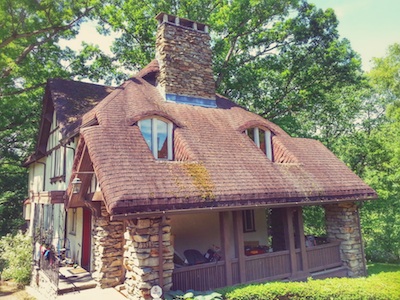
The Orbit is generally not big on cute, or quaint, or anything too goo-goo ga-ga–that is, unless you get all doe-eyed for fading paint or crazy person graffiti. But if these elfin charmers don’t warm your heart, well, then you have no heart to warm. Tucked away in the back corner of the one-way-in/one-way-out Cordova Road circle in Highland Park sit two lovely little fantasy cottage-houses straight out of Hans Christian Andersen, or maybe The Sound of Music.

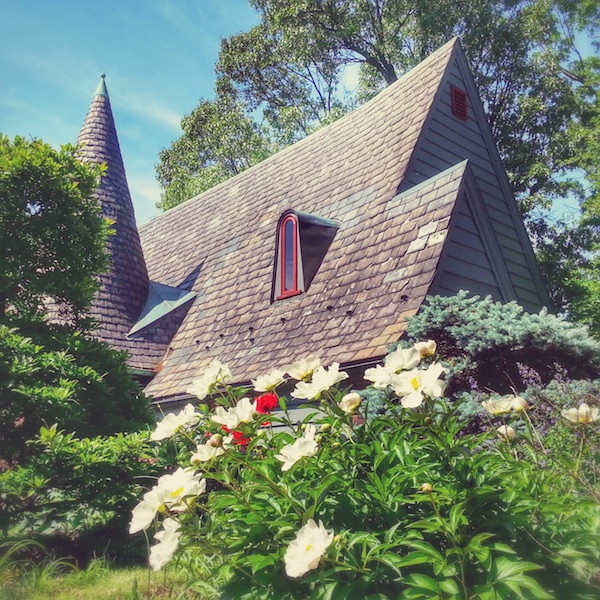
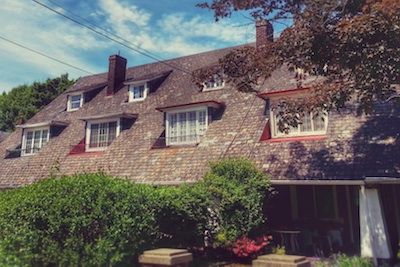
With its peaked Alpine roof, pointed turret entrance, Tolkien door, and cattywumpus brickwork, the first of these is really the picture perfect Heidi house. As we visited, its front garden was in full bloom, a hodge-podge of unmatched flora that echoed the irregular, asymmetric design of the house.

The impossibly narrow dormers must provide absurdly little daylight to the second floor, but they sure look great on the outside! In fact, I expect this house is probably a lot better fantasy than practicality–but we’d rather spend our time in the astral plane.

house in Pittsburgh, Pa.

Heidi house #1 in full Spring bloom

Right next door, there’s a slightly more conventional, but equally magical home. Its front dormers cut into the porch roof with gentle curves that suggest excited brows to the windows’ ogling eyes; the porch below a grinning gap-toothed smile. And what’s not to smile about? The thick piled stone supports and wood railing look equal parts Bavarian der kutenhaussenmaken (look it up) and woodsy Adirondack lodge.

Both properties have an idyllic setting up against the thick wood of Heths Run Greenspace that extends as far as one can see and must make the perfect silent shady backdrop to their inevitable side decks.

house in Pittsburgh, Pa.

Heidi house #2, Highland Park

Bonus! Just around the corner on King Avenue sits what can only be described as a set of Heidi row houses, for, you know, when Heidi comes into the city. One solid block of five adjoined residences in a similar (if less dramatic) Teutonic style to the two houses on Cordova. The roofline cuts at an unusual angle allowing dormers on both the second and third floors, casement windows, and deep, pre-A/C porches, guaranteed to keep herself cool even in the worst summer humidity.

connected three-story rowhouses in Pittsburgh, Pa.

Heidi row houses

L’chaim on a Hilltop: Jewish Holy Houses in the Hill District (Part I)

Former House of the Hebrew Book, now Blakey Program Center, Pittsburgh, Pa.

Former Hebrew Institute, now Blakey Program Center, Hill District

Before Squirrel Hill was the center of Jewish life in Pittsburgh, that designation went to the Hill District, specifically the lower Hill a.k.a. “the big empty lot where the Civic Arena used to be.” Not a ton remains, but then again, maybe more than we expected. There are a couple really spectacular examples that we visited in our Memorial Day weekend travels.

First up is the former Hebrew Institute, now the Blakey Program Center, on Wylie Avenue. A beautiful (exactly) one hundred-year-old red brick building with an ornate front portico that’s been kept in terrific condition. It spent nearly sixty years as the Kay Boys Club/Kay Program Center and is now a community center that is part of the Hill House Association.

Cornerstone from way back in 5675, Blakey Program Center, Hill District

Cornerstone from way back in 5675

I love that the cornerstone was set with both Hebrew and Gregorian calendar years. The original institutional name has been updated to its current purpose, but executed nicely–I imagine this is no small feat in a set block of stone.

Former synagogue, now Zion Hill Full Gospel Baptist Chuch, Pittsburgh, Pa.

Former Congregation Kaisor Torah Synagogue, now Zion Hill Full Gospel Baptist Chuch, Hill District

On the corner of Webster and Erin Streets sits the large cube of a building that used to be the Congregation Kaisor Torah Synagogue (although you wouldn’t know it from the defaced cornerstone) and is now Zion Hill Full Gospel Baptist Church. A hand-painted alternate cornerstone also shows evidence that the building served as an A.M.E. church somewhere in the between time.

The big building has clearly seen better days as many of the windows are knocked-out, others replaced by plywood including the huge Star of David-shaped circular windows on the third floor of both the east and west sides. On its Erin Street face, the building shows evidence of removed staircases and stair rooflines (a mirrored set still stands on the other side). But the trees and sidewalks are looking good, and this heathen can testify that he heard a Zion Hill preacher doing the same to a rapt congregation inside last Sunday morning.

Cornerstone for former synagogue, Pittsburgh, Pa.

Kaisor Torah Synagogue: a less artful updating of the original cornerstone

Large Star of David synagogue window, Pittsburgh, Pa.

Kaisor Torah Synagogue (window detail)

These first two buildings were all The Orbit was aware of going into this piece, but combing through some old maps of the Hill District turned up a bunch of other things that we’ll be back to check out. So, you know, don’t touch that browser–stay tuned for the exciting sequel.

The Twin Ghost Houses of Chateau

profile of ghost house in Pittsburgh, Pa.

Ghost house #1, Chateau/Manchester

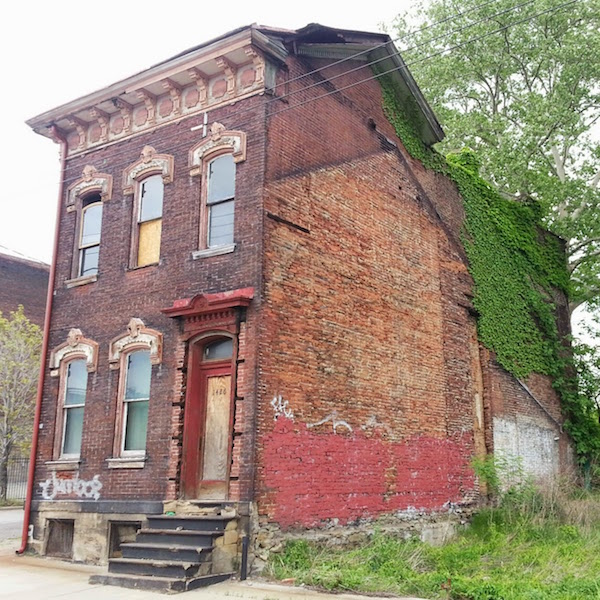
This blogger catches poison ivy if he just looks at it funny.  So it was with some trepidation that I waded into the calf-high weeds in short pants to snap this pair of ghost houses in the 1400 block of Chateau Street.

O but the risk was worth it! What prime examples of the form! The first (larger) house was clearly a short, two-story dwelling that lacked the big Italianate profile of the extant. It looks like a squat single-story addition (or possibly large porch) was added off the back. The extra roof line may be an added dormer, or it could have just been a line left from a since-removed gutter.

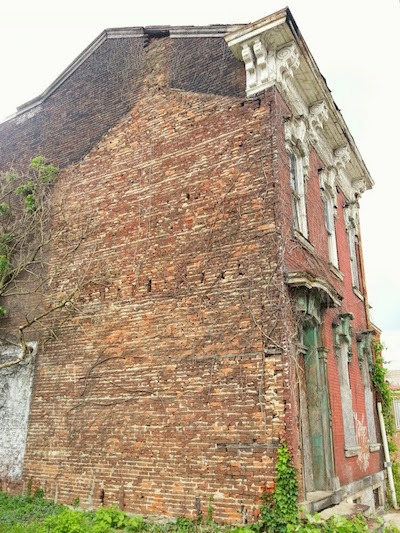
The second (smaller) ghost house is really remarkable. Two stories, and a centered chimney with no expansion. This entire house may have only been the two rooms (one up/one down), maybe five or six-hundred square feet; probably very old.

profile of ghost house in Pittsburgh, Pa.

Ghost house #2, Chateau/Manchester

The finder’s fee on this one goes to Orbit superfan Lee Floyd who spotted the first house driving by on Chateau Street and was able to locate an approximate address on the computer internet. He astutely spun Google Maps around to catch the first house’s ghost sister just down the block. Together they make a great one-two ghost house party!

Google will eventually put all citizen-journalists out of business, but for now, it still took a nice rain-threatening bicycle ride to the neighborhood to get the quality photographs Orbit readers have come to expect. This particular section of Chateau/Manchester (still not sure what’s what down there) has other some really nice things that also got stashed in the digital photo bag. Hopefully they’ll surface in some future post(s).

profile of ghost house in Pittsburgh, Pa.

Don’t Bogart the Calamine lotion! Full profile of house #1 from the poison ivy.

Lackzoom Acidophilus

Terra cotta facade storefront in Pittsburgh with the engraved names Lackzoom and Acidophilus

5438 Penn Ave: Lackzoom Acidophilus

I must have passed it a thousand times or more.  Certainly I’d noticed the white terra cotta facade and its odd trapezoidal shape, canted in such a way that it doesn’t quite align with the street, like a mis-set bone.

But it wasn’t until very recently that I happened to actually look up and take in the detail above the doorway/windows.  Two names (?) permanently formed into the ceramic tile that read like ancient runes, some hep jazzcat jive, or a preposterous stage name: Lackzoom Acidophilus.

The small, two-story building at 5438 Penn Avenue turns out to have been the one-time laboratory and corporate headquarters for the lineal parent of the General Nutrition Corporation (or GNC), the Pittsburgh-based retail giant that made a fortune over the last half century urging America to “Live Well” vis-a-vis shopping and popping (malls and pills, respectively).

Terra cotta tile reading "Lackzoom"

It’s no surprise that I’m not the only one to ever spot this curious storefront, but there’s remarkably little information out there on it.  The definitive piece seems to be a short Western Pennsylvania History Magazine article written in 2003 by Chris Potter.

Potter’s story details David Shakarian, founder of GNC, whose:

… Armenian parents ran a business called “Lackzoom” which sold yogurt, buttermilk, and Bulgarian acidophilus–milk fortified with the bacteria lactobacillus acidophilus to intestinal bacteria that make digesting milk difficult for some.

Apparently the original Lackzoom never survived The Great Depression, but Shakarian would go on to found his own health food store, and eventually the GNC chain. In 1983, the year before his death, Shakarian was named by Forbes magazine as the wealthiest Pittsburgher on their annual list. Live well, indeed.

Pittsburgh ghost sign reading "Lackzoom and Acidophilus"

Ghost sign, obscured by flora: “Lackzoom and Acidophilus”

Onion Dome Fever: Holy Transfiguration!

Holy Transformation Russian Orthodox Church, Steubenville, Ohio

Holy Transfiguration Russian Orthodox Church, Steubenville, Ohio

The Orbit road crew was a on a mission to find the grave of Jimmy The Greek in Steubenville, Ohio, and find it we did.  Oh yes, find it we did.  But as we were heading up Washington Street from downtown, there, sparkling like a new penny, was the phosphorescent green mini onion dome of Holy Transfiguration Russian Orthodox Church.  Never ones to avoid getting distracted by shiny things, we detoured up to the tiny dead end of North 10th Street to get a shot of the church all lit up in the afternoon sun.

Pastor Greg, dressed appropriately in a friar’s dark, knotted robe and sandals, spotted me taking pictures outside and asked if we’d like to come in for the service that was beginning in fifteen minutes.  We politely declined, to which he followed up by urging us to just come inside for a look. That was an offer we couldn’t refuse.

The humble country church look of the outside didn’t give any clue to the gorgeous collection of gold leaf icons, burning candles, Byzantine crosses, live flowers, incense burners, brassware, lace cloth, and the like that awaited within.

interior of Holy Transformation Russian Orthodox Church, Steubenville, Ohio

Interior, Holy Transfiguration Church

The pastor had departed in his minivan to pick up a parishioner who needed a ride to the service.  I wish we’d had the chance to ask him about the history of the church and the current state of the laity.  That very congregation was beginning to file in as we were poking around, so it started to feel pretty awkward and we made our exit.

Steubenville has been draining population since the 1940s (The Greek led that wave out of town), and my guess is that the number of Russian Orthodox parishioners is dwindling in the low double-digits.  So one hopes that Holy Transfiguration will be around for Steubenville’s inevitable glorious comeback, but it will probably take a little divine intervention.

Holy Transformation Russian Orthodox Church, Steubenville, Ohio

Interior (detail), Holy Transfiguration Church

Ghost House: Brighton Heights

"Ghost house"--impression of one razed house against another still standing

Ghost house: Brighton Heights

You don’t see one of these every day–that is, unless you regularly find yourself traveling the back way from Woods Run up to Brighton Heights.  I was all the way down in my low gear huffing and puffing up that hill and believe you me I thought twice about giving up the small amount of inertia I had to stop for a photo, but there was really no decision.  This is the kind of hardship we dedicated bloggers/ghost house haunters live for.

‘Scuse me while I catch my breath, even the memory is exhausting…OK, I’m good.  Where was I?  Oh, yeah: there I was, face-to-tar shingle and clapboard with the big one!  This amateur archeologist had everything he needed but the platte maps.  Such a perfect specimen!  One tiny house perfectly imprinted on the neighbor’s only slightly larger simple frame home, complete with front and rear porches, slanted roof, and exposed foundation.

I don’t know what happened to that little guy, but I’m sure glad it (literally) left a mark to tell us where it was and give us a hint at what it was all about.


The Over-the-Wall Club

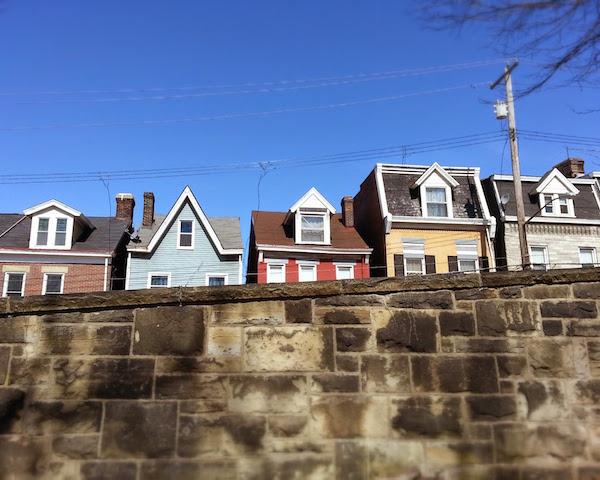
Bloomfield rowhouses seen over a wall

Bloomfield

What’s on the other side?

The question that drove thousands (millions!) of seekers–from Lief Ericson and Amelia Earhart to Harry Houdini and Charlie Sheen to that darned chicken.  What’s on the other side?

Walls make us wonder all the time, especially those that give just glimpses above of what might be masked below: treetops, a roofline, hillside, telephone wires.  What’s going on over there? Who’s in there? Is the grass really greener?

Photographically, they’re strange creatures. There’s very little visual action in a wall (depending on the wall), and you probably wouldn’t want to only look at a just a plain old wall. But what if it bisects a scene into neat geometric chunks: bands of near and far, light and dark, patterned and dissonant.

The Over-the-Wall Club meets irregularly to share photos of their findings, gulp coffee, inhale paint fumes, stare over the wall, and ask the question one more time: what’s on the other side?

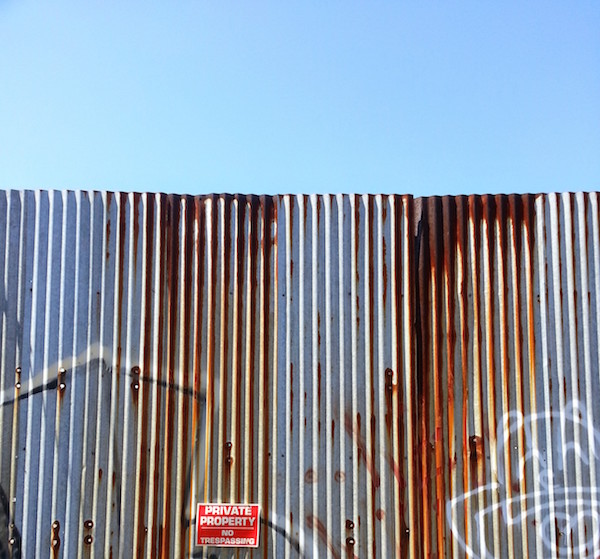
Corrugated metal wall, Lawrenceville

Lawrenceville

Leslie Park Pool, seen over the pool wall

Leslie Park Pool, Lawrenceville

Troy Hill, seen over a wall

Troy Hill (from the Strip District)

Lawrenceville row houses from Allegheny Cemetery

Lawrenceville (from Allegheny Cemetery)

ALICE IN WONDERLAND, W.C. Fields, as Humpty-Dumpty, 1933

The Over-the-Wall Club’s most famous member