L’chaim on a Hilltop: Jewish Holy Houses in the Hill District (Part I)

Former House of the Hebrew Book, now Blakey Program Center, Pittsburgh, Pa.

Former Hebrew Institute, now Blakey Program Center, Hill District

Before Squirrel Hill was the center of Jewish life in Pittsburgh, that designation went to the Hill District, specifically the lower Hill a.k.a. “the big empty lot where the Civic Arena used to be.” Not a ton remains, but then again, maybe more than we expected. There are a couple really spectacular examples that we visited in our Memorial Day weekend travels.

First up is the former Hebrew Institute, now the Blakey Program Center, on Wylie Avenue. A beautiful (exactly) one hundred-year-old red brick building with an ornate front portico that’s been kept in terrific condition. It spent nearly sixty years as the Kay Boys Club/Kay Program Center and is now a community center that is part of the Hill House Association.

Cornerstone from way back in 5675, Blakey Program Center, Hill District

Cornerstone from way back in 5675

I love that the cornerstone was set with both Hebrew and Gregorian calendar years. The original institutional name has been updated to its current purpose, but executed nicely–I imagine this is no small feat in a set block of stone.

Former synagogue, now Zion Hill Full Gospel Baptist Chuch, Pittsburgh, Pa.

Former Congregation Kaisor Torah Synagogue, now Zion Hill Full Gospel Baptist Chuch, Hill District

On the corner of Webster and Erin Streets sits the large cube of a building that used to be the Congregation Kaisor Torah Synagogue (although you wouldn’t know it from the defaced cornerstone) and is now Zion Hill Full Gospel Baptist Church. A hand-painted alternate cornerstone also shows evidence that the building served as an A.M.E. church somewhere in the between time.

The big building has clearly seen better days as many of the windows are knocked-out, others replaced by plywood including the huge Star of David-shaped circular windows on the third floor of both the east and west sides. On its Erin Street face, the building shows evidence of removed staircases and stair rooflines (a mirrored set still stands on the other side). But the trees and sidewalks are looking good, and this heathen can testify that he heard a Zion Hill preacher doing the same to a rapt congregation inside last Sunday morning.

Cornerstone for former synagogue, Pittsburgh, Pa.

Kaisor Torah Synagogue: a less artful updating of the original cornerstone

Large Star of David synagogue window, Pittsburgh, Pa.

Kaisor Torah Synagogue (window detail)

These first two buildings were all The Orbit was aware of going into this piece, but combing through some old maps of the Hill District turned up a bunch of other things that we’ll be back to check out. So, you know, don’t touch that browser–stay tuned for the exciting sequel.

The Pizza Chase: Beto’s of Beechview

Sign for Beto's Pizza in Pittsburgh, Pa.

Beto’s Pizza, Beechview

Pizza has gotten almost totally standardized. Sure, there’s a couple varieties: New York-style thin-crust and Chicago-style deep dish, square Sicilian, and some fancy places dress theirs up in various ways, but you’ve pretty much seen it before.

We’ve been collecting stories about Pittsburgh-area pizza houses that do something fundamentally different from any of the above standard configurations. We’re not trying to name the best pizza (although each of these has its super fans); we’re just looking for something that’s truly unique. These will be explored in a new series called The Pizza Chase. And we’re going to start with Beto’s Pizza of Beechview.

There are a bunch of goofy things about Beto’s:

First: there are only two denominations of pie: either individual cuts (approximately 4″ square) or an entire 28-cut rectangular “tray”. Nothing round; none of this small/medium/large business. You’re either all-in, or you take it on the run.

Second: ordering individual cuts (as almost all customers seem to do) takes exactly the same time as ordering a whole tray. (We were told this by the staff and wound up ordering a tray on our first visit; they speak the truth.) How can that be? Anywhere else, the cuts are ready to go and they just pop them in the oven for a minute to warm them up. Not at Beto’s. What are they doing back there? I don’t know, but they’re not working off the standard playbook.

Third: even if you order a full tray, it doesn’t arrive on anything resembling one. The pizza is delivered as seven separate plates, each containing four cuts with an giant halo of post-op mozzarella cascading to the floor.

Beto's pizza tray

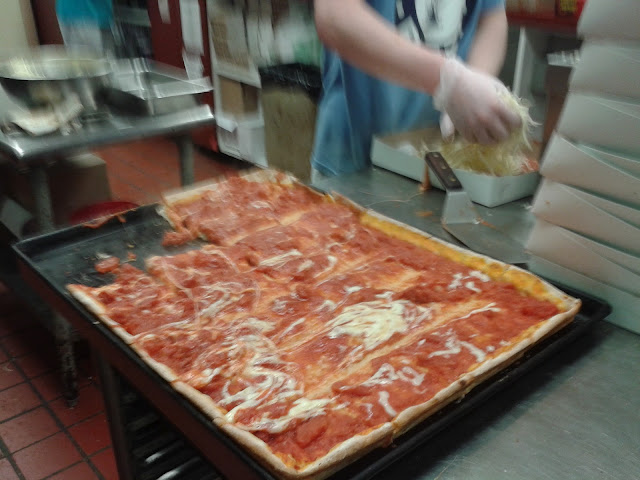
Beto’s full “tray” with four cuts removed. Note the near total lack of melted cheese and the employee applying mozzarella to the box (photo: The Internet)

Most jarringly, Beto’s separates itself from other pizzerias by only adding the cheese and toppings after the pizza has left the oven. This bizarre practice produces a hot-on-the-bottom, cold-on-top sensation that is as pleasurable as being in a hot tub while it’s snowing (to its fans) or as disorienting as, uh, being in a hot tub with a big block of ice on your head (to its detractors). After two visits, The Orbit still isn’t sure where it stands on all this.

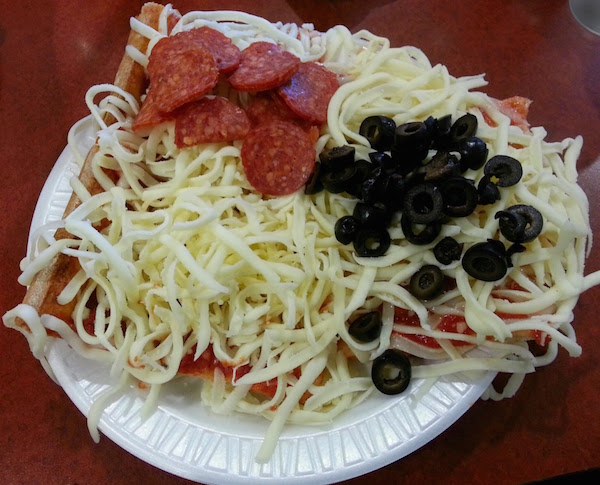
I should add that if you are the kind of conformist who wants his or her cheese melted to the rest of the pizza, this is an option you can specify. You just need to order it “baked.”

Three cuts of pizza from Beto's, Pittsburgh, Pa.

Three cuts the normal way (not “baked”), Beto’s Pizza

How does it taste? Well, a guy trying to watch his carbs will start by saying that he generally feels like even when pizza is bad, it’s still good. It’s a forbidden fruit, a taboo pleasure to be savored when the occasion presents itself and he’s prepared to put in some extra hill climbs to pay the rent. And so in that sense, Beto’s bi-temperate, sometimes-you-gotta-break-the-rules approach still satisfies.

That said, it is this blogger’s belief that eating melted cheese on fresh-baked pizza dough is one of the world’s great carnal pleasures and to eschew this when you’ve got all the tools and ingredients right there seems insane. But I’m here for the ride.

Beto's customer "Red" Bob Jungkunz

Our Beto’s ambassador: Bob Jungkunz

To get a handle on all this, we called in an expert. Carrick native Bob Jungkunz has been a Beto’s customer since at least 1975 when his older sister and her boyfriend first introduced the cross-hills Beto’s to her little brother. Bob has been coming to Beto’s ever since and continues to stop in for dinner nearly once a week.

Bob swears that the pizza preparation hasn’t changed a bit in the last forty years and went on to detail the old environment. Apparently before the expansion of both the dining room and parking lot, it was common for Beto’s customers to simply eat in their cars in the cramped lot, seating in one of the the handful of tiny booths nearly impossible to secure.

Bob describes Beto’s no-cook-topping approach and mild sauce as “subtle” and the overall experience as “very pleasing,” preferring plain cheese, but mixing it up from time-to-time. He also gave us the pro tip that one can order cuts to go and by the time you reach your destination the cold cheese had done its own partial melt from the in-box heat, offering yet another taste and texture option.

Bob is not alone. Beto’s dining room is stuffed with cold-topping cut-consuming customers, photos of smiling faces, decades-old news clippings, and mementos of the pizzeria’s fifty-plus-year history. To-go boxes sit pre-folded from counter height to ceiling everywhere you look around the kitchen, prepped and ready for a phalanx of orders.

I don’t know if I love it–heck, I don’t know that I like it–but I’m glad it exists.

Beto’s Pizza is at 1473 Banksville Road in Beechview.


A Tiny Castle in The Strip District

homemade model of a castle mounted to a brick wall

A tiny castle on a wall in an alley in the Strip District

Man, can The Orbit ever haunt some alleys. Some days it seems like all the good stuff turns up in them. It was that way recently when this blogger found himself headed home from downtown, rolling through Spring Way (the long alley between Liberty and Penn in the Strip District). There I was, minding my own business*, not a care in the world**, when something quite literally popped-out from the brick wall high over head causing one citizen-journalist to nearly eject himself from his bicycle seat with the hasty application of a desperately in-need-of-repair set of brakes.

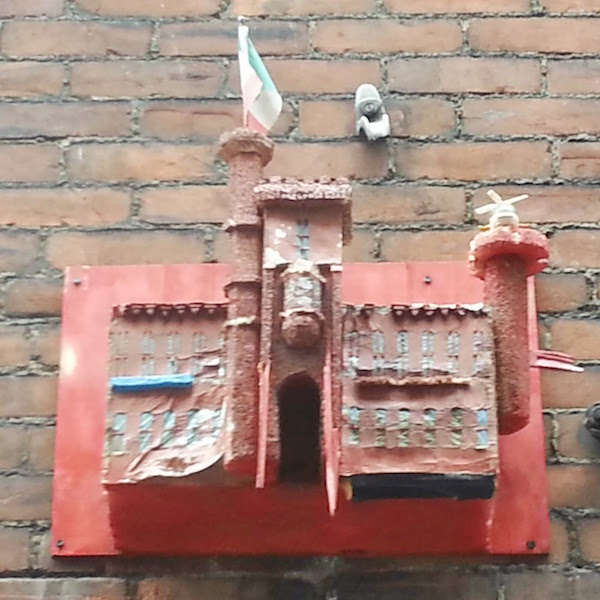
What could possibly demand this kind of reckless photo-pseudo-journalism? Well, the astute reader has probably already divined that there was a mysterious red castle fixed to a painted piece of wood and screwed to the wall. The piece is high over head (I’d say maybe twelve or fifteen feet off the ground?)–so unnaturally out-of-sight and out-of-mind that less reputable bloggers and side-street walkers wouldn’t even have noticed its presence.

Ha! It’s this kind of attention-to-detail that hopes to land Pittsburgh Orbit as your go-to news source. Look no further! But where was I? Oh, yeah–the castle.

We have very few clues to tell us what this is all about. I’m calling it a castle, but it could just as easily be a prison, maybe a school, or some other institutional building with turrets and large porticos. The model has what appears to be a flag of Mexico affixed to the high central parapet, but it’s up too high to make a positive ID. There’s also a dramatic helipad with a tiny yellow chopper seated in place.

homemade model of a castle mounted to a brick wall

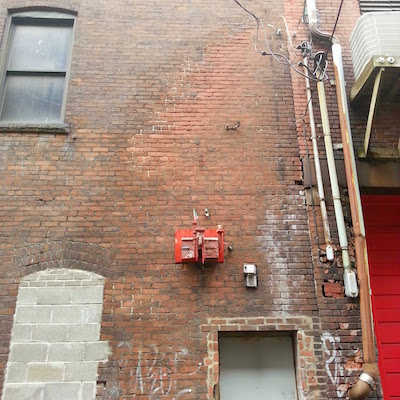
In context: the tiny castle affixed above window/door height

“Real” castles may last for hundreds (thousands!) of years, but this objet d’art d’alley will not. It’s made of some combination of particle board, foam, paper, and paint and is already showing some serious deterioration. I doubt it will make it through more than one harsh Pittsburgh winter—and that’s assuming the man doesn’t take it down before then.

Getting there: For all these reasons, if you want to see the tiny castle, you shouldn’t wait too long. Those headed to Penn-Mac for their Fiore Sardo or to Stan’s Market for cheap peppers this long holiday weekend should take the extra couple minutes to walk around the corner. The castle is located in Spring Way on the block between 21st and 22nd Streets, approximately behind Luke Wholey’s Wild Alaskan Grill. Look up.

homemade model of a castle mounted to a brick wall

Note: An Orbit apology for the photo quality here, which does not meet our usual standards, but it’s the best we could do under the circumstances. The piece was so high I had to get way back to snap it and the ol’ camera phone just doesn’t do too well with the zoom.

* Nebbing into every possible window, conversation, open loading dock, etc.
** Skating on the thin ice of crippling self-doubt, guilt, and regret

The Twin Ghost Houses of Chateau

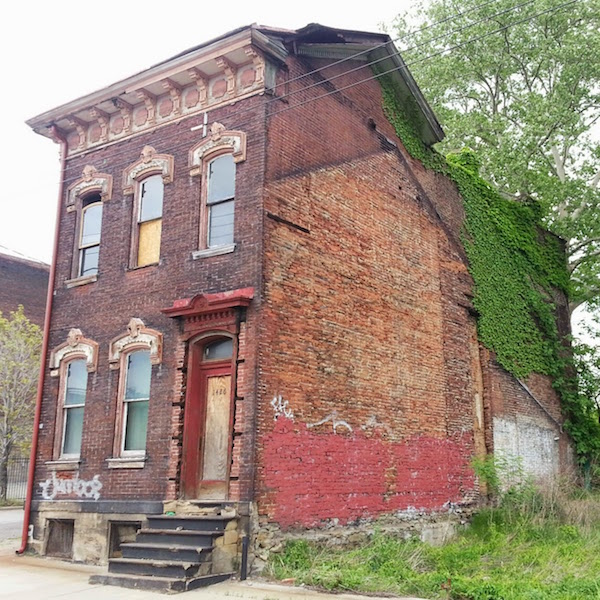
profile of ghost house in Pittsburgh, Pa.

Ghost house #1, Chateau/Manchester

This blogger catches poison ivy if he just looks at it funny.  So it was with some trepidation that I waded into the calf-high weeds in short pants to snap this pair of ghost houses in the 1400 block of Chateau Street.

O but the risk was worth it! What prime examples of the form! The first (larger) house was clearly a short, two-story dwelling that lacked the big Italianate profile of the extant. It looks like a squat single-story addition (or possibly large porch) was added off the back. The extra roof line may be an added dormer, or it could have just been a line left from a since-removed gutter.

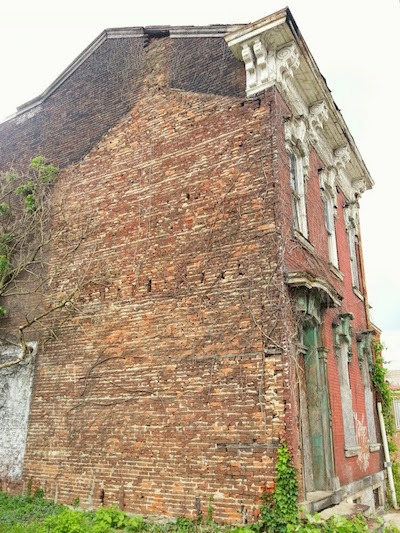
The second (smaller) ghost house is really remarkable. Two stories, and a centered chimney with no expansion. This entire house may have only been the two rooms (one up/one down), maybe five or six-hundred square feet; probably very old.

profile of ghost house in Pittsburgh, Pa.

Ghost house #2, Chateau/Manchester

The finder’s fee on this one goes to Orbit superfan Lee Floyd who spotted the first house driving by on Chateau Street and was able to locate an approximate address on the computer internet. He astutely spun Google Maps around to catch the first house’s ghost sister just down the block. Together they make a great one-two ghost house party!

Google will eventually put all citizen-journalists out of business, but for now, it still took a nice rain-threatening bicycle ride to the neighborhood to get the quality photographs Orbit readers have come to expect. This particular section of Chateau/Manchester (still not sure what’s what down there) has other some really nice things that also got stashed in the digital photo bag. Hopefully they’ll surface in some future post(s).

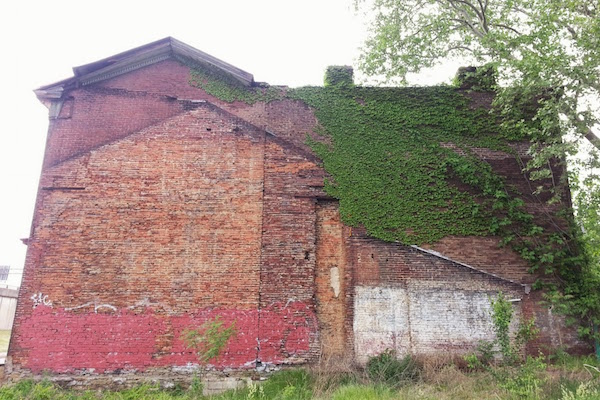
profile of ghost house in Pittsburgh, Pa.

Don’t Bogart the Calamine lotion! Full profile of house #1 from the poison ivy.

Step Beat: Romeo & Frazier

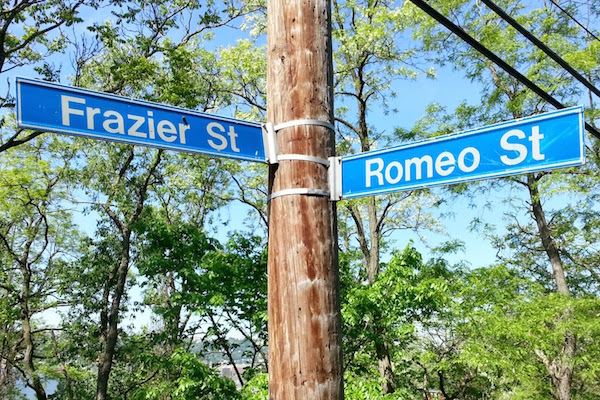
Street signs for Romeo and Frazier Street intersection, Pittsburgh, Pa.

In our automobile-oriented culture, we tend to think of streets as a means for car travel. In cities and towns, hopefully you’ll also get a sidewalk; in the suburbs or out in the country, not so much. If you’re lucky, the road might be striped for bicycles.

Pittsburgh has its own definition. A street is simply a public thoroughfare that may be any and all of these things, but it could also just be a pedestrian walkway, usually on a hillside. These are city steps, and we have a ton of them.

The intersection of Romeo and Frazier Streets, South Oakland, Pittsburgh, Pa.

The intersection of Romeo and Frazier Streets, South Oakland

Nowhere is that notion of walkways as public streets more perfect than the intersection of Romeo and Frazier Streets in South Oakland.  There, on a steep hillside, in a fen of trees, climbing vines, wildflowers, and thick weeds meet two terrific sets of well-maintained concrete city steps. Like any other crossroads worth its rock salt, this one comes complete with street signs and a streetlight.

The steps go way back. Back to a time before the automobile, the bus, or the trolley. They’re sometimes considered Pittsburgh’s first public transportation system as they were used extensively by workers to commute from residential neighborhoods up the hills to the factories and business districts below.

Frazier Street city steps, Pittsburgh, Pa.

Looking up Frazier Street from Bates

The steps don’t get anywhere near the traffic they once did. For one thing, most of those industrial areas and many of the business districts just don’t exist anymore (witness the steps leading from Troy Hill down to Route 28 or from Fineview down to 279–there’s nothing to walk down to). And then, of course, there are just a whole lot more ways to get around, and most people prefer them over the shoe leather express.

All that said, the city steps are an amazing resource. This blogger routinely drags his out-of-town visitors up to Fineview or the South Side Slopes or maybe the West End to get a full dose of up-and-down, nature-in-the-city, and a reliably terrific views from whichever ones we opt for. Some first-timers are agasp; others are just gasping for breath. Either way, you do enough of them and they’ll get you in shape right quick. Hopefully The Orbit will get back to all these spots at some point.

Romeo Street house accessible only by city steps

Romeo Street house accessible only by city steps

One great egg hunt of city step hikes is finding houses (or just the foundations) that are/were only accessible by the steps. On Romeo, there’s just one of these, right at the top of the steps. The house is a good 50 yards or so from the nearest paved road (also Romeo Street).

It must be a pain to move into a place like this or haul your groceries in the snow, but it sure is pretty and peaceful out there. From the Tibetan prayer flags and half-inflated balloon decoration to the snare drum and Oriental carpet on the porch, I’ll admit I was making some unsubstantiated judgements about these renters skipping a little rope. But hey, man, it’s all good. They’s just on the step beat.

Frazier Street city steps, Pittsburgh, Pa.

Looking down Frazier Street

An Orbit Obit: Goeller Generator, R.I.P.

faded sign for Goeller Generator, Pittsburgh, Pa.

Goeller Generator in Lawrenceville, 1946-2015

It was mere weeks ago that I finally took note (and, thankfully, took photo) of the beautifully faded Goeller Generator sign against the equally-transfixing rough weathered multi-color wall of the retail space next door (current home of gift shop Divertido).

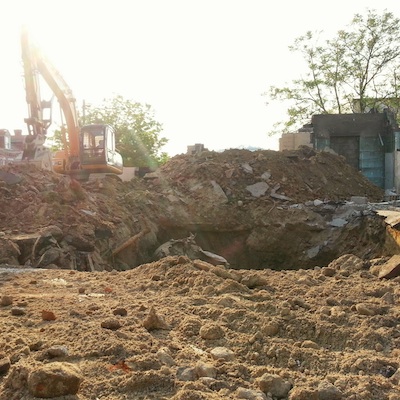
Imagine my surprise, then, to pass this week by a pile of rubble and big hole in the ground where Goeller used to be.  The squat, one-story pair of cinder-block structures were no architectural marvel, and I can’t say that I’ve ever required the offerings of a generator sales and service shop (so maybe I’m part of the problem!) but I liked the fact that it was there–a constant among all the change that’s happened around it on Butler Street in Lawrenceville.

construction site with a large hole dug in the ground

A big hole in the ground

The move is so recent that there’s no mention of it on Goeller’s website, which still states proudly “We have been in the same location since 1946,” and had only in the last year or two gotten a new lit-up painted sign/mural on the wall facing 36th Street.

I e-asked around, my neighbors delivered, and the story is predictable. Zoned-retail real estate on Butler Avenue is worth a pretty penny right now and Goeller cashed-in to make way for a new development featuring a hamburger restaurant called Burgh’ers on the first floor and apartments upstairs. One report mentioned that Goeller will continue operating in a new location.

cinder-block wall of partially demolished Goeller Generator, Pittsburgh, Pa.

Over-the-Wall Club bonus: Goeller’s last wall standing with Our Lady of the Angels

Now, this blogger can eat the hell out of a fancy hamburger, even if he’s disgusted with himself for doing so. I’m also glad the neighborhood’s empty storefronts have mostly filled up and I like having more than Hambone’s and Barb’s Country Kitchen as walkable dining options. [No disrespect: I still patronize both!] But the whiplash rate of development/gentrification in Lawrenceville is pretty scary. Forever we’ve heard about this stuff happening in other cities, but I naively imagined it would never be so in Pittsburgh, let alone right in my neighborhood. Sigh.

If Frankie’s closes, it’s time to move to Rankin.

The Ultimate Pittsburgh Greenhouse Experience

worn painted wooden sign reading "Greenhouse"

Here’s how you get there: Go out Penn Avenue all way through Wilkinsburg and Forest Hills. Pass Vincent’s Pizza Park. [Pro tip: keep Vincent’s in mind–time things right and you can stop there for lunch on the way back.] Take the turn onto Electric Avenue to get you down into Turtle Creek. When you’re stopped, staring straight up at the giant old Westinghouse plant, make that left. You’ll slide onto the Tri-Boro Expressway, but you won’t be there long.

As soon as you see a handmade sign reading Greenhouse stuck into the grass, take that left, and then a quick right where the road forks and leads you straight up the hillside. Follow it around until you get to Henkel’s Greenhouse.

temporary roadsign for Henkel's Greenhouse

Directions to Henkel’s: it’s somewhere up the hill

Why go all the way out to Turtle Creek when there are so many places that will sell you plantlings between here and there? I’ll tell you why: Henkel’s is the ultimate Pittsburgh greenhouse experience. Thanks to my buddy Bill for the tip on this one, it’s become an annual tradition ever since.

This weekend is a couple of things: today is Mother’s Day. Nothing says “thank you for bringing me into the world” like a drug store greeting card and brunch at King’s, but this blogger really does love his momma, and momma is a terrific gardener. It also happens to be exactly the right time to get your vegetables in the ground, and this turned out to be a perfect sunshiny hot weekend to get on it (but don’t worry if you didn’t, there’s still time).

So we’re going to honor mothers, gardeners, thumbs (green and otherwise), and terrific old-school family businesses with this little Orbit tribute to Henkel’s Greenhouse via three great reasons to get your keister out to Turtle Creek.

Henkel's Greenhouse, Turtle Creek

Henkel’s Greenhouse, Turtle Creek

Reason #1: Four generations of Henkels growing your plants

I’m not going to pretend that I know the Henkel’s whole family tree and The Orbit isn’t the kind of shady “journalism” that “asks hard questions” and “gets answers.” No, we go with our gut and just hope we’re right. But here’s what our gut has witnessed over the years: a relationship of what appears to be great-grandpa, grandpa, father, and son (yes: all Henkel growers seem to be male), ages roughly eight to eighty, sowin’ and growin’ together. It’s beautiful. (But guys: maybe let the ladies get in the dirt too.)

Henkel's Greenhouse with tomato varieties

Tomato/pepper greenhouse, Henkel’s

Reason #2: The trip to the greenhouse

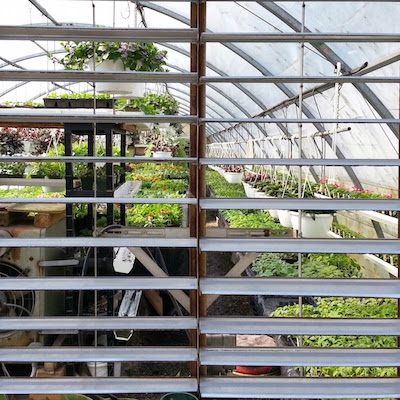
It’s a little bit of an adventure just getting up there.  The signage is minimal, you’re very far off any commercial drag, and the single-lane road that takes you there could well be on a mountain in West Virginia. Home Depot, this ain’t. Once you’re there, Henkel’s occupies the large yard of a humble two-story frame house, built up a steep hillside, cobbled together over likely decades with jerry-rigged kits and recycled shipping pallets.

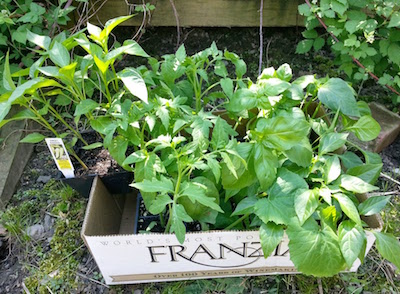
cardboard box containing vegetable plants for replanting

What twelve bucks gets you

Reason #3: It’s cheap*

Here’s what twelve bucks buys you at Henkel’s**:

  • 9 tomato (3 each: Golden Boy, Potato Leaf, Viva Italia)
  • 15 pepper (6 Sweet Banana, 3 Early Sensation, 6 Inferno)
  • 4 zucchini
  • 3 sweet Italian basil

* Realistically, travel time and expense to Turtle Creek likely erases any monetary savings, but it’s still cheap.

** This blogger is obviously interested in vegetables, but Henkel’s has a full compliment of flowers, shrubs, ground cover, etc.–which we’ve purchased in the past. I just didn’t pick any of those up this year. They also have lots of other vegetables, but I just stuck with the basics this year.

stacked planting containers

view of greenhouse through ventilation slats


The Over-the-Wall Club: A Secret Picnic Spot

cement wall with graffiti, trees, and smokestacks in the distance

Over-the-Wall lies a secret picnic spot

When last we left The Over-the-Wall Club, members were straining their necks, up on their tip-toes, peeking and peeping. Sometimes we catch a break and actually make it over to have a look on the other side. And every once in a while we find out that the grass really is greener over there.

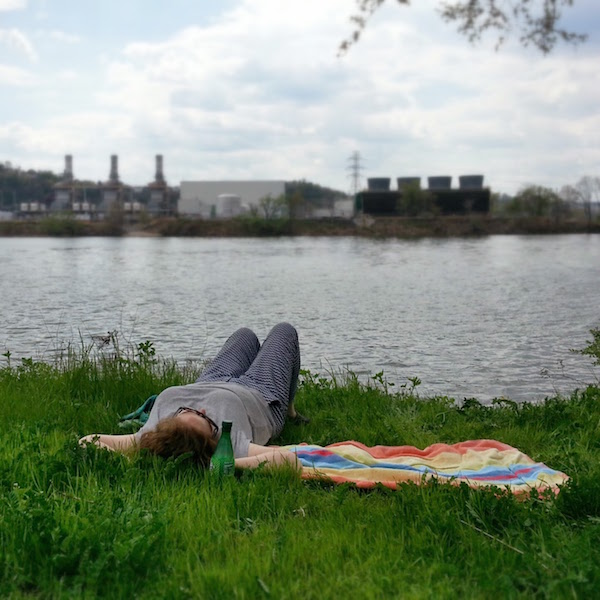
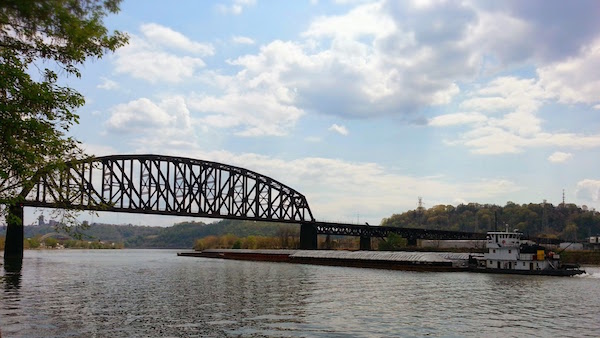
The most perfect secret picnic spot lies high in the aerie of Peregrine falcons, reachable only by trained tall tree-climbers with provisions shuttled in by drone. Sigh, someday. Until then, Orbit staff stumbled across a right nice substitute, on a grassy bank of the Ohio River, in the shade of flowering Spring trees, attainable only by bicycle. [Technically one could drive, park, and walk a trail, but that’s not as much fun.] The spot is accessed through a breach in a concrete wall.

woman laying on grass by the Ohio River

A very Pittsburgh picnic spot: Brunot Island power plants on the far shore

It is early May, the first definitive shorts-weather occasion of the year, and a glorious post-Pittonkatonk, post-marathon Sunday afternoon comin’ down. Not to nit pick on the picnic, but the menu was nothing to brag about (my fault, entirely). That said, we can credit Shur-Save with providing an acceptable board of fare (after we applied some after-market vegetables and condiments to the “Anytime Deli” sub) at a price that didn’t dent this blogger’s wallet.  Next time–and there will be a next time–we’ll do it up right.

But what’s really special here is the amazing peace on this particular stretch of riverbank. We were well within Pittsburgh city limits, but never heard the sound of an automobile, a booming stereo, shouting, clattering, or any other noise (man or machine) for that matter. In fact, the only “traffic” we witnessed was one long coal barge and a couple pleasure crafts on the river.  One train rumbled by on the Brunot Island bridge.

barge on the Ohio River near Pittsburgh

This barge is all the traffic we encountered at the Secret Picnic Spot

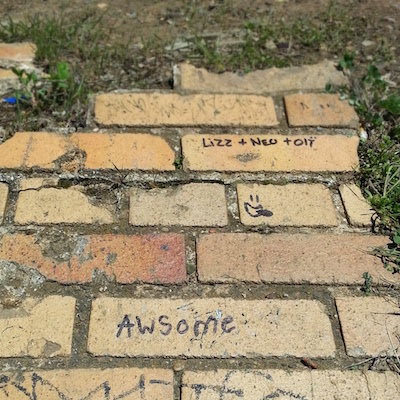
The Secret Picnic Spot is known to at least a few other river dwellers.  There was an empty Black Velvet bottle in the weeds and the burnt offering of an old school hobo fire.  A stray patch of brick wall embedded in the ground had been graffiti’d in black Sharpie.  We crossed paths with a pair of amorous middle-agers and a grandfather/granddaughter combo, but the spot’s fifty-or-so yards of riverbank can handle at least that much of a crowd with relative privacy.

bricks embedded in grass and dirt with handwritten "awsome" graffiti

Don’t take our word for it: Lizz + Neo + Oly confirm that the Secret Picnic Spot is awsome

If you’ve got a tip on a great Pittsburgh picnic spot (secret or otherwise), please let us know. We’ll show you ours if you show us yours.

Lackzoom Acidophilus

Terra cotta facade storefront in Pittsburgh with the engraved names Lackzoom and Acidophilus

5438 Penn Ave: Lackzoom Acidophilus

I must have passed it a thousand times or more.  Certainly I’d noticed the white terra cotta facade and its odd trapezoidal shape, canted in such a way that it doesn’t quite align with the street, like a mis-set bone.

But it wasn’t until very recently that I happened to actually look up and take in the detail above the doorway/windows.  Two names (?) permanently formed into the ceramic tile that read like ancient runes, some hep jazzcat jive, or a preposterous stage name: Lackzoom Acidophilus.

The small, two-story building at 5438 Penn Avenue turns out to have been the one-time laboratory and corporate headquarters for the lineal parent of the General Nutrition Corporation (or GNC), the Pittsburgh-based retail giant that made a fortune over the last half century urging America to “Live Well” vis-a-vis shopping and popping (malls and pills, respectively).

Terra cotta tile reading "Lackzoom"

It’s no surprise that I’m not the only one to ever spot this curious storefront, but there’s remarkably little information out there on it.  The definitive piece seems to be a short Western Pennsylvania History Magazine article written in 2003 by Chris Potter.

Potter’s story details David Shakarian, founder of GNC, whose:

… Armenian parents ran a business called “Lackzoom” which sold yogurt, buttermilk, and Bulgarian acidophilus–milk fortified with the bacteria lactobacillus acidophilus to intestinal bacteria that make digesting milk difficult for some.

Apparently the original Lackzoom never survived The Great Depression, but Shakarian would go on to found his own health food store, and eventually the GNC chain. In 1983, the year before his death, Shakarian was named by Forbes magazine as the wealthiest Pittsburgher on their annual list. Live well, indeed.

Pittsburgh ghost sign reading "Lackzoom and Acidophilus"

Ghost sign, obscured by flora: “Lackzoom and Acidophilus”

Art All Night 2015 Round-up

warehouse in Pittsburgh where Art All Night 2015 was held

Outside Art All Night’s home for the last couple years

Art All Night.  That most democratic of all one-day, all-night, anything-goes art “happenings.” It’s one of the reasons The Orbit took up shop in Lawrenceville some fifteen years ago and, at least for the moment, it’s still going strong.

This past weekend was Art All Night’s eighteenth year.  We were there seventeen years ago for event #2 in the former G.C. Murphy’s on Butler Street (now Rent-a-Center).  Back then, that medium-sized retail space was over-large for the hundred-some pieces of artwork that walked in the door and the couple hundred event-goers there to check them out. The art was hung, as I recall, on old Murphy’s pegboard, before the advent of the now-standard OSB and 2×4 panels.

Even in its embryonic state, this blogger-to-be was hooked.  We bought our house right up the hill a year later and I was volunteering for the event the year after that. My contribution has dwindled to just the big build-out day, but my conscience won’t let me not show up at all.

Art All Night is in the weird position of being a victim of its own success.  The elephant in the warehouse-sized room is that the event won’t be around forever; Lawrenceville is just running out of the kind of giant, vacant real estate that can still accommodate thousands of visitors. This year’s building is slated for (at least partial) demolition and redevelopment, which is sad, but also makes perfect sense.

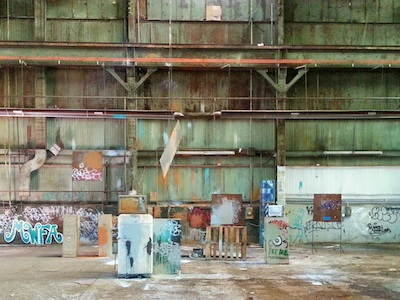
industrial warehouse interior with paint slingshot targets

Paint slingshot targets

I didn’t take any big group shots of the thousands of people who packed the massive five-bay industrial building where the event took place this (and last) year, nor did I try to capture any of the many performers (some 40+ musical acts, dance, improv comedy, live painting, a guy trying to set a world record for human beat-boxing, etc.) or wacky crowd figures (Abe Lincoln, “The Cowboy,” the rubber men, guy with Christmas lights under his furry coat, etc.).

There are many great things about Art All Night, but ostensibly, the event is about the thousand-or-so objets d’art that manage to make their way into the space that afternoon and up on the panels, or along the walls, or spilled along the floor for the world to see mere hours later.

There is great art, for sure, but in the shotgun blast of raw expression, joke art, quirk, deviance, desire, and beauty that is rushed onto the particle-board panels, it’s the ones that scream the loudest that seem to make the event the most memorable.

It is in that spirit that I thought I’d just feature some great examples of what we consider “classic Art All Night”–whether that speaks to cliche or repetition or simply some base human mode of expression is up for debate. Presented are individual examples of this year’s entries and the various itches they scratch.  Enjoy.  I know I did.

artwork of Pittsburgh skyline in cut paper

Pittsburgh skyline

painting of steel worker with steel mill in background

Steel mills/steel industry

painting of two football players on the field

Sports art/Steelers

painting of Jerry Garcia with a glowing third eye

Skip a little rope, smoke a little dope

line drawing of intertwining pipes

Time to wash the hands (again)

This is nothing to those halcyon days of the early oughts when a guy could cover an entire 8′ x 4′ display panel with an imaginary city, complete with all transit routes and street names, mapped out on graph paper and executed in mechanical pencil.

artwork showing challenges and options for women today

Thought-provoking/statement

Under-represented this year were the big poster boards loaded up with (literal) ripped-from-the-headlines newspaper clippings (another casualty of the death of print!).  These would often be accessorized by a top layer big message: WAR? or Progress? or Justice? There were some nice sentiments on the evils of bearing children (one complete with a dangling flaccid condom), but it just wasn’t the same.

sculpture of human torso with world map glued to it

Maps/torsos OR “That’s not my belly-button!”

assemblage artwork including a baby doll's head

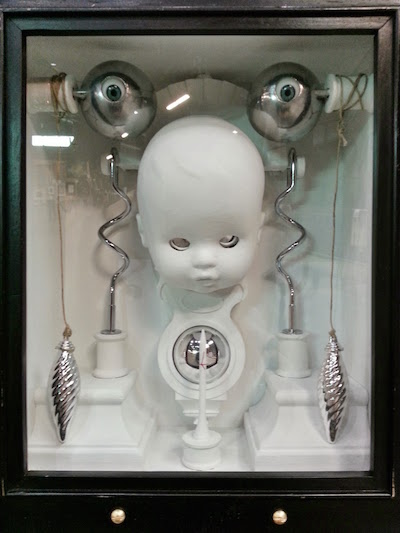
Doll head/parts assemblage

The doll parts genre this year was impressively (if disappointingly) tasteful. Typically there are numerous crude entries, oft splattered with red paint, grafted in vulgar ways to stray objects, etc.  Sigh.

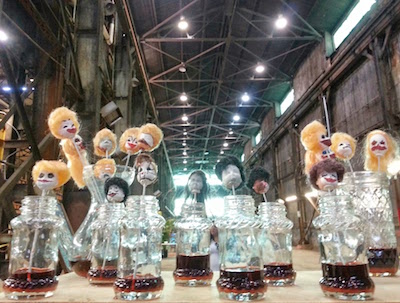
artwork with tiny clown heads on sticks in jars with mysterious liquid

Science art/tiny clown heads on sticks in jars with mysterious liquid

I love the pseudo-science entries–and this was a fine one–but the genre lacked quantity this year.

two large-size sculptures of robots

Big robots

Artwork with a mannequin dressed like a queen in a clothes washing machine

Mannequin/English royalty/appliance-related

painting of Spock from Star Trek

science fiction

Spoke from Star Trek rendered on an Etch-a-Sketch

Etch-a-Sketch

sculpture of zombie hand and grave stone in dirt

The evergreen: Pittsburgh loves zombies

painting of female monster eating a human head

Monster/horror

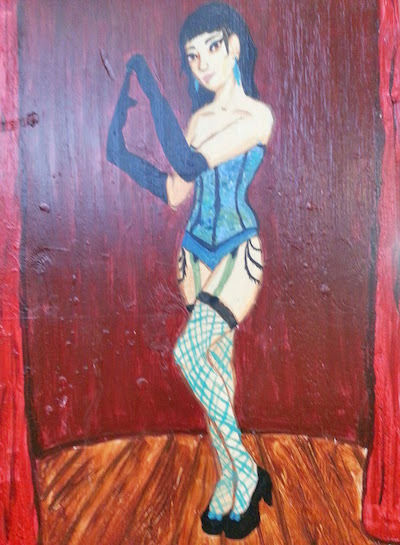
painting of woman in her underwear removing a long black glove

Naughty ladies (and the men who like them)

This year’s naughty/nudie art count was way down from any previous event.  In fact, the normally stocked “porn art” entrants must have just sat on their flesh- and boudoir-colored paint cans this year, as there was nary a stray wang or cooter to bat an eye at.

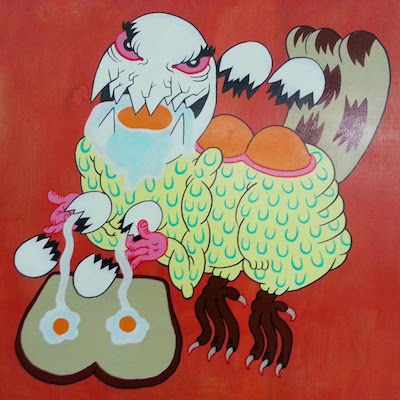
painting of a strange part chicken/part egg creature

Which came first: the chicken or the … ah, jeez

sculpture of woman's head and hand surrounded by silver foil

???

I heard a number of people remark that it felt like the total amount of art was down from previous years. Maybe that’s true, or maybe it’s just the way the space and panels were used. Either way, my remarks above definitely include a lot of sentiments around missing some old friends.  Ah, well, maybe next year.