The Blight Stuff: Nathan Van Patter’s “Bound by Blight”

Artist Nathan Van Patter with a sculpture of moving truck holding an entire deconstructed house
Artist Nathan Van Patter with his sculpture Moving Day 15104

We know it when we see it. And if you live in Pittsburgh, you see it all the time.

Sure, a drive through the East End can feel like there’s a new Legoland condo going up on every block and us old-timers will prattle on about the travesty of cranky old dive bars and red sauce Italian joints turning over into foo foo artisanal dining experiences with curated wine programs—but it’s really not that way everywhere. Huge swaths of Pittsburgh aren’t seeing any new investment; real estate values have barely budged; vacant lots and condemned properties way outnumber lived-in homes.

sculpture/painting by artist Nathan Van Patter of dilapidated house
North Braddock House 6

That reality gets a whole lot more obvious as soon as you head up or down any of the rivers. To most outsiders, (ex-)industry towns like Monessen and Clairton, New Kensington and Ambridge are the very picture of Rust Belt devastation. These are places where the mill shut down 40 years ago and took most of the people who lived there with it. Nature reclaims whatever is left untended and ultimately the wrecking ball will finish the job.
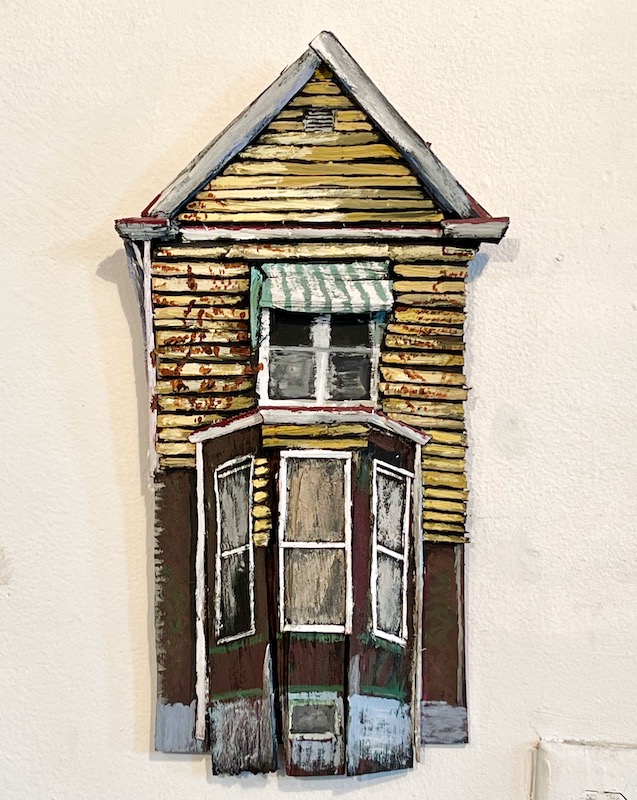
sculpture/painting by artist Nathan Van Patter of dilapidated house
North Braddock House 2

“I don’t know if there’s a perfect word to describe it,” says artist Nathan Van Patter, whose current show Bound by Blight is an honest, loving, powerful meditation on life in another post-industrial borough, North Braddock.

“I chose the word bound because it has two meanings,” Van Patter says, “It means to be stuck—which is how a lot people in places like North Braddock find themselves. But it also has this other meaning of being bound together—people working to solve these kinds of problems as a community.”

sculpture/painting by artist Nathan Van Patter featuring clock, sunshine over house, housing tower, police car, and ambulance
The Nights Are Too Big

Those dual themes—the weight of life in a crumbling physical landscape and the joy of that same life in a community where neighbors, bound together, truly look out for each other—inhabit every artwork in Van Patter’s terrific collection, even the ones in outer space.

Seeing the show, we experience enough of the hard stuff to get it. But Van Patter, who moved to North Braddock with his wife and kids four years ago, isn’t interested in “ruin porn.” The show is also full of the many many good things he’s experienced as a resident—a wall of portraits for various neighbors and community members, the metal shop and barber, sunflowers and urban farms, the big North Braddock sky.

painting/sculpture by artist Nathan Van Patter of blue sky with clouds painted on cracked wooden boards
North Braddock Sky #2 (Cracked Sky)
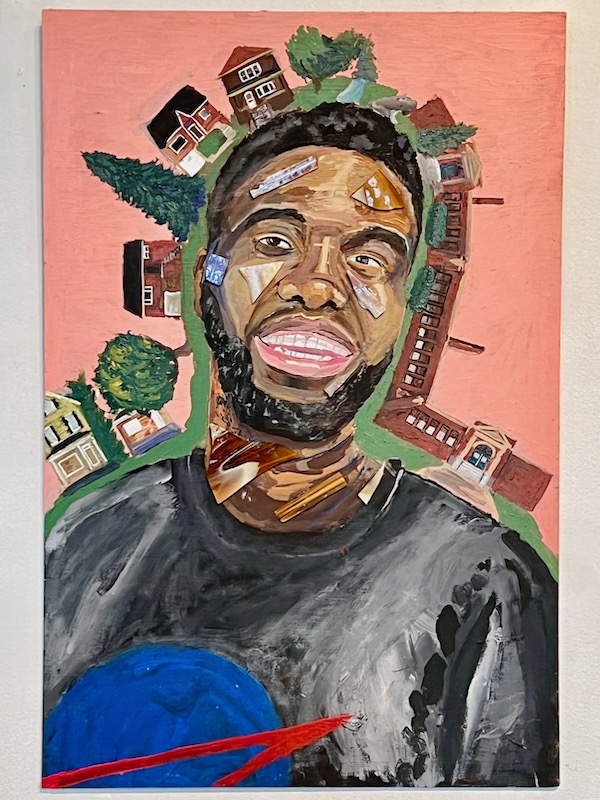
portrait painting by artist Nathan Van Patter of woman with houses running around his head
Lisa
portrait painting by artist Nathan Van Patter of man with houses running around his head
Sean

Van Patter works in a medium we might call pictorial painted sculpture. You could also turn that around and say they’re paintings on wood constructions with sculptural elements. Van Patter just calls them paintings.

The pieces are literally rough—built on irregularly sized wooden boards with chips of rough cedar glued into place to approximate wood siding and stone, crumpled metal and bushy trees. The Orbit‘s photographs included here—or any photographs of Van Patter’s work—won’t do the 3-D elements justice, so we encourage the reader to see them IRL. (More about that below.)

The awkward chunkiness of the medium gives every artwork depth and texture, sure, but more importantly the fantastic quality that while we’re looking at real life subject matter—abandoned houses, police cars, utility poles—the scenes are distorted, dream-like, impressionistic.

sculpture by artist Nathan Van Patter of police car with fences and street signs growing out of it
Community/Police

That fantasy/reality divide runs through the full breadth of the show. Trees, fencing, and street signs jut out from a distorted North Braddock police car in Community/Police (above). Black-winged angels fly in the night sky above a fast food restaurant in the appropriately-named Angels Over Taco Bell (below).

Van Patter imagines an entire deconstructed home, including utility poles and power lines, packed-up and driven away in Moving Day 15104 (top). With The Nights are Too Big (above) an elaborate clock is made atop a grand day/night scene that contrasts the bucolic sunshine and flowers of the former with the symphony of sirens that score the dark night.

sculpture/painting by artist Nathan Van Patter of angels flying over Taco Bell restaurant
Angels Over Taco Bell (with self-portrait at bottom)

Blight is a heavy word. It’s a shorthand for the kind of urban decay that exists pretty much everywhere, but especially in depopulated, neglected areas where all those socioeconomic factors have very real world, visible effects. It’s also an outsider’s term—no one wants to describe where they live as blight.

“Blight, to me, is the combination of physical decay and intentional disinvestment in communities,” Van Patter says, “People know there’s a problem, whether they’d use that term or not … and it’s a word that gets used in community development a lot.”
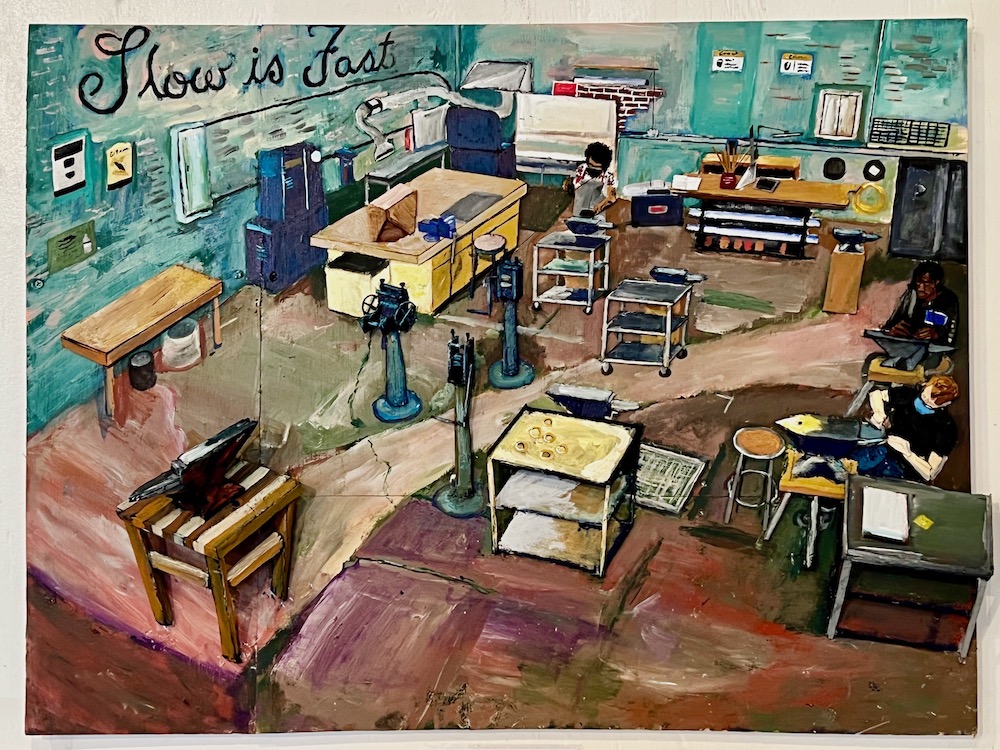
painting/sculpture by artist Nathan Van Patter of small metal shop
Studebaker Metals
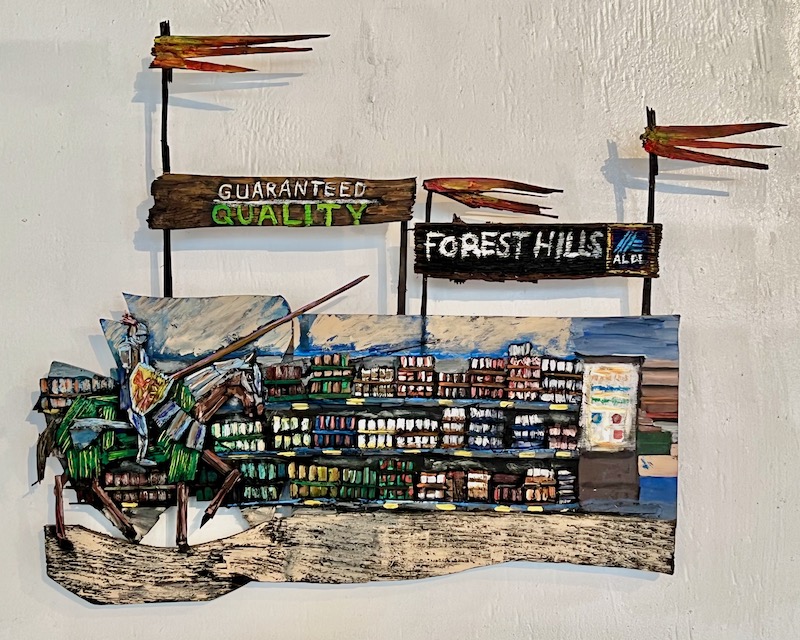
sculpture/painting by artist Nathan Van Patter of medieval knight on horseback in grocery store
Grocery Knight

Nathan Van Patter is a humble guy who thankfully doesn’t talk about his work with any level of art school mumbo-jumbo. He didn’t have to go looking for overgrown houses; they’re all real buildings right there in his neighborhood. The portraits are people he sees at borough meetings and his children’s day care. “Every time something bad has happened [in the neighborhood], something really good happens too,” Van Patter says, “I wanted to paint the portraits of people who’ve helped me and my family and are doing positive things for the community.”

Why insert medieval knights in armor on horseback into into several of the pieces? “I just thought it was cool.”

sculpture/painting by artist Nathan Van Patter of medieval knight on horseback
Deer Dragon (detail)

I think it’s cool, too—the whole thing. Nathan Van Patter, working a full-time job and raising a family, has invented his own very personal approach to creating a unique artistic vision. The artwork is both about the world immediately around him and stretches way beyond the Mon Valley—to knights in armor and sailing ships, angels in the night sky and the “Rust Belt futurism” of science-fiction space stations made from buildings right there in Braddock.

Whether those leaky old windows can hold oxygen is debatable, but that I’d like to visit this vision of the future is not. Beam me up, have one of those jousting knights bring the Aldi’s crudité, and let me at that long view coming out of the Ohringer building floating a couple thousand miles off the edge of the Mon River.

painting/sculpture by artist Nathan Van Patter of science fiction-like space station made from old buildings
Rust Belt futurism: Space Station 15104
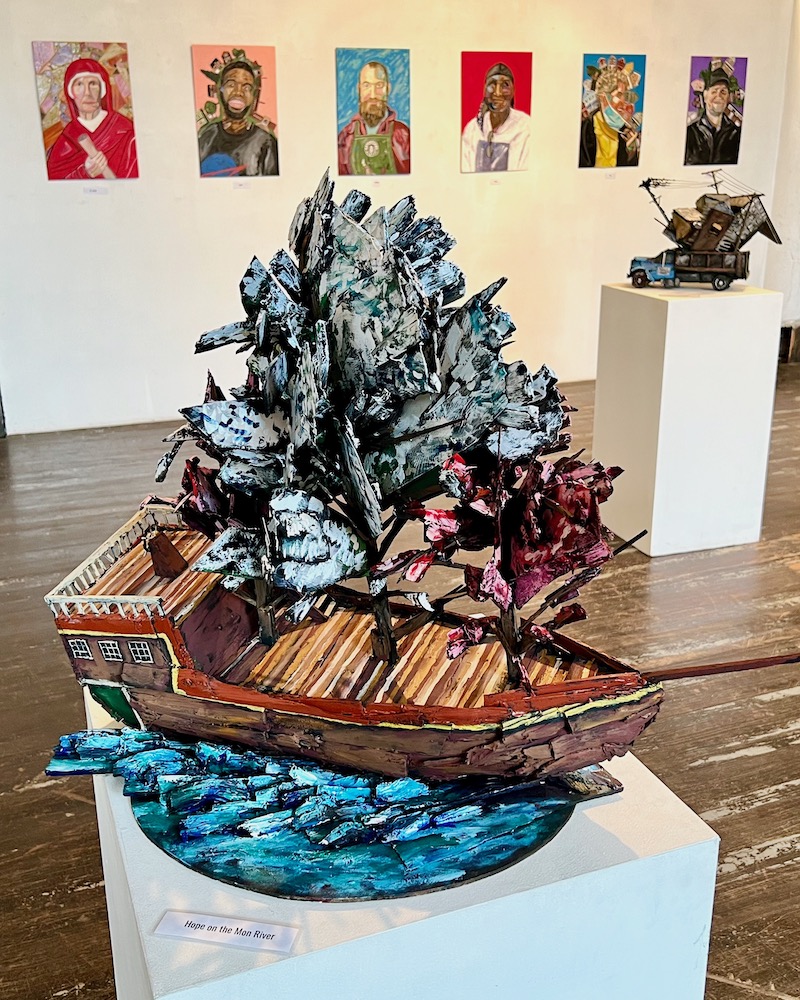
sculptures and paintings in large gallery space
Hope on the Mon River and other pieces from Nathan Van Patter’s Bound by Blight show

Bound by Blight is up now at UnSmoke Systems in Braddock. There will be a final opportunity to see the full collection at a closing reception this Saturday, August 20, 6:00-8:00 PM.

UnSmoke is located at 1137 Braddock Ave. in Braddock.

More on Nathan Van Patter at his web site nathanvanpatter.com and/or Instagram @nathanvp_art.

The Pizza Chase: Picking Up a Spare at Ricky Dee’s

black-and-white photo of bowling banquet in the 1970s
Every meal is a bowling banquet—with or without the 40s of Colt—when you dine on Ohio Valley pizza. Photo from the men’s room at Ricky Dee’s, Aliquippa.

It is, to be sure, an unusual recommendation for a restaurant: you have to see the men’s room.

The bathroom is immaculately clean and well-stocked with soap and paper products—these are not givens for the men’s room in a bowling alley—but the real draw here is how the space is decorated. There is a wall-to-wall, chair rail-to-ceiling collage of photographs that document the last 65 years of bowling in Aliquippa.

Bowling teams—collections of five or six reliably pudgy white dudes—clutching black bowling balls in matching uniforms; color snapshots of parties, gatherings, and banquets; rough cut-outs of single rollers approaching the lanes with the tucked-in shirts and pressed slacks of another era. Across them all, the names of the alley’s regulars, friends, and family members are recorded in hand-written ballpoint and fading-away felt tip: Larry Turkovich, Art Delisio, Angel Rama, Yogi Brachetti, the Ambroses.

photo collection of bowlers taped to bathroom wall
For dollars … maybe, maybe not—but there other reasons to bowl

Ohio Valley Pizza is its own glorious thing. Par-baked ahead of time in large, rectangular sheet pans and cut in squares to be sold by the slice, the dough is oxymoronically thick but light, crispy—not chewy—and comes adorned with cheese and toppings that may or may not have been through the baking cycle. With the exception of Beto’s—perhaps Ohio Valley pizza’s easternmost outpost—The Orbit has been negligent of reporting this important regional style. That ends today.

man with excited expression looking at large pizza
Paul experiences his first Ricky Dee’s pizza

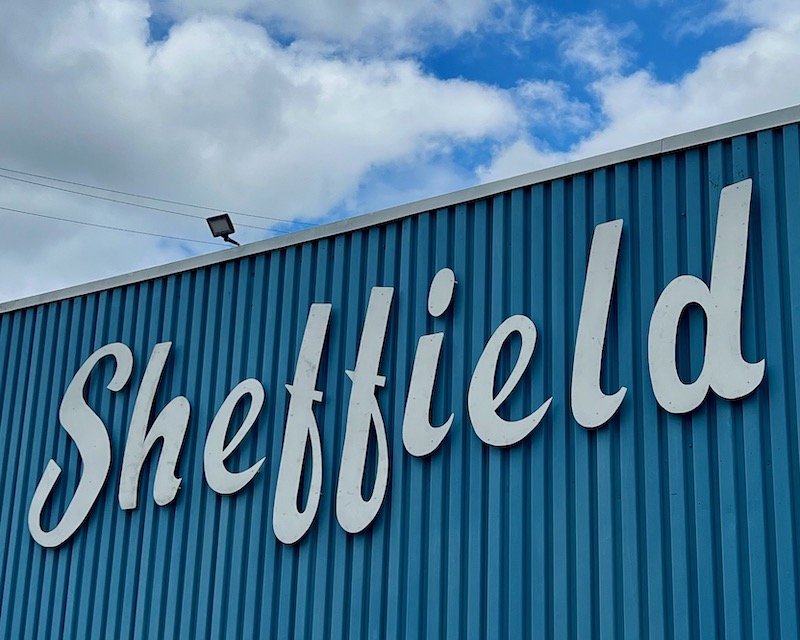
Ricky Dee’s, the pizzeria/restaurant/bar inside Aliquippa’s Sheffield Lanes bowling alley, has been serving up Ohio Valley pizza for the last four decades. First, from a longstanding shop in Glenwillard and then moving into its present location within the bowling alley sometime later.

exterior of Sheffield Lanes bowling alley
Sheffield Lanes, Aliquippa, home of Ricky Dee’s Pizza

A bowling alley’s restaurant need only make serviceable hamburgers and french fries to accompany the bowling—and beer—that pay the rent. Ricky Dee’s ain’t that.

The pizza is the real thing: dough made fresh daily by people who care, risen high and cooked hot to crispen the edges and keep the inside lifted, dreamy, and airy. Sold by the six-cut block—one quarter tray—you’ll end up with one corner, three edge pieces, and two middle slices per order. The six pack ($8.40 plain, $12-$13 bucks with a couple toppings) was plenty for the two of us.

It is a perfect pizza experience all on its own … but that’s only half of the reason for a trip to Ricky Dee’s.

six square cuts of pizza on pizza pan
A Ricky Dee’s standard quarter-sheet/6-cut order

The restaurant is so much more than merely an exquisite pizza shop. Inside its windowless walls, there exists a kind of historical archive—and love letter—to Aliquippa, its people, and bowling. The reverence paid to the many, many patrons of Sheffield Lanes over the last five or six decades is felt immediately. The big photo collage in the men’s room is incredible, but the tribute neither begins nor ends there.

Cafe tables—made from recycled bowling lanes—are decorated with bowling pins painted as tiny statuettes and include wax-dripped bowling balls as chunky candleholders. Every chair in Ricky Dee’s is upholstered with a bowler’s retired league shirt, covered in thick clear plastic—so sitting on them doesn’t feel as weird as it sounds. The walls include dozens of additional photographs of local bowlers, tournaments, and curios of a unique world just gone by.

diner chair upholstered with former bowling shirt
Bowling shirt upholstery
man in cafe chair next to chair upholstered with his shirt
Long-time Sheffield bowler George with the chair upholstered with his retired league shirt

The alley’s patriarch, Joe D’Agostino—Ricky’s father and the original “Dee”—is memorialized in a fascinating collection of club membership cards that is worth the drive alone. Between the late-1940s and mid-1960s, the man was a member of The Ukrainian National Association, Chiefs of Police, Wolves Club of Aliquippa, American Rubberband Duckpin Bowling Congress, and dozens of other social, fraternal, and sport organizations. The light and glare inside Ricky Dee’s is not always conducive to photography, so you’re going to have to see this amazing collection for yourself, in person.

1962 PSWBA tournament bowlers

And you should—see it in person, that is—as well as eat it in person—the pizza, that is.

Sure, when you’re looking for a dinner pie, you could order from some (literal!) cheesy chain or pay thirty bucks to a foo-foo pizza artisan with a colorful spiel. That’s all fine—I guess—but places like Ricky Dee’s that continue to craft extraordinary pizza with a no-nonsense simple approach are not ones to ignore or take for granted. When a pizzeria comes with this much extra history, eye-popping detail, and love for their city and its people, that’s really something special.

photographs of bowling teams in the 1970s
Taped-up, sure, by bound by a brotherhood of the lanes

Lastly, I’ll add that the pizza was great hot out of the oven on the day we visited Sheffield Lanes, but Ricky Dee’s also offers a take-and-bake option that was equally delicious back home, prepared as directed the following day. So if you take the trip out to Aliquippa, make sure to do like any good cleanup bowler and pick up a spare. Whether you need it or not is debatable; that it is fantastic is not.

exterior of Ricky Dee's restaurant with no windows
Ricky Dee’s: come for the pizza, not the view

Getting there: Ricky Dee’s is located inside the Sheffield Lanes bowling alley, 818 Raccoon Street, Aliquippa. Ricky Dee’s is not open all the time, so check their web site for current hours.