Leftover Lashes

single false eyelash still in its packaging

There hadn’t been a need to dress up for some time and the available options were limited. The couple of fancy dresses pulled from the back of the closet now felt tired, faded, and dated. Skirts too tight about the waist; a formal blouse needing a stiff ironing to flatten its deeply-embedded crinkles.

Still, anticipation of dinner with Marcus was great enough that the exercise of assembling a passable ensemble from the spare parts laid out across Solœil’s bedspread was enjoyable with let’s-put-on-a-show optimistic enthusiasm.

One of her nicer business jackets was selected and a jaunty scarf in a translucent floral print tied just-so could cover the sagging neckline of the only top that matched. A silver brooch with a stylized image of the sun, a gift from her father way back on her 21st birthday, accented nicely. The whole thing came together well enough to instill confidence.

Marcus had selected Le Pommier both because for its impressive reputation and on the false assumption that Solœil came from French ancestry. Solœil’s name was something of an in-joke within her family. A portmanteau of “sole” and the French word for “eye,” the invented name (shortened to “Loy” by friends and family) wrapped the newborn in faux-Gallic exoticism. Her parents felt the name would be both personally meaningful and celebrate her guaranteed-unique status.

That Marcus had asked Solœil for a second date–their first was a casual after-work coffee–was something of a surprise. The whole eye thing made dating a nonstarter for most men. The few who approached Solœil were either jerks wanting a laughable story for their beer buddies or complete weirdos looking for a freak show. Solœil had learned to make any first meeting quick, cheap, and easy to escape from.

Marcus was different in the plainest of ways. He was neither good nor bad looking and came off as boringly normal, sensibly logical, and never once questioned Solœil about the single eye centered right above the bridge of her nose. It hadn’t come up even once in their hour-long chat at the coffee shop. That itself was refreshingly freeing and completely unexpected.

It turned out Marcus had a matter-of-fact way about most things in his life. As their bread, wine, and iced tea arrived–Marcus hadn’t had alcohol since his uncle died of liver failure at 58–conversation turned to where each lived in the city. Solœil learned that only a couple years prior, Marcus had extensive remodeling done to his house on the North Side. A drunk driver had jumped the curb and crashed into the front wall of his two-bedroom bungalow. The ’88 LeBaron only came to rest after colliding with the living room couch. Had he not been retrieving dinner from the microwave, Marcus would have died right there, watching Jeopardy. That night, Marcus explained, he’d finished his Salisbury steak and tiny apple pie before calling the insurance agent.

Over steaming bowls of soupe de poisson, Marcus went on to reveal a shocking litany of other near-death experiences. At six years old, a plastic chess piece was jammed into his throat by sadistic older brother Steven, prompting his first Life Flight. To this day, the brothers still play a protracted match each year at Christmas and Steven will menacingly twiddle his rook when he feels like he’s losing. Marcus had almost drowned after stepping on an out-of-its-reach stingray on a family vacation to Ocean City. An absentminded fall through an open elevator shaft happened just weeks into his first IT job downtown. The medics said he would have died if the server room hadn’t been on the second floor. At 42, the wrong IV injected by a sleep-deprived first-year at Presby forced Marcus into a five-day coma.

Marcus turned out to be an excellent listener–engaged without being too personal, curious, and asking thoughtful follow-up questions. He showed real interest in Solœil’s work in graphic design, the deep connection to her parents, her love of gardening and cinema. Like a skilled therapist, Marcus had connected dots between Solœil’s family history, being an only-child, and the importance of helping disadvantaged people in her volunteer work. Some of his theories were a little out-there, but Solœil couldn’t shake the depth of thought that went into them.

By the time Solœil put her dessert spoon to rest–Marcus was still scraping the plate for every last microcurd of creme brulee–she’d decided she legitimately liked this quirky, frugal man. She also found herself realizing Marcus’ veneer or normality hid a much more complex person than the one she met for coffee a week earlier.

As they left the restaurant, Marcus extended his hand and said how much he’d enjoyed the evening. He announced it was past his bedtime and needed to dash off to catch the bus home. Solœil was surprised by the abruptness, but with everything else it was something of a piece. She got out her keys and headed home.

The next morning Solœil received an email from Marcus. It was an invitation for another date–this one to attend a fancy garden party at a private home in tony Sewickley. The pricey admission went to support a charity supplying textbooks and medical supplies to schoolchildren in Ghana. Marcus offered to pay for two tickets if Solœil would drive them.

When she arrived at Marcus’ home the following Saturday, Solœil was immediately struck by the obvious reconstruction of the house. Carpenters had grafted an incongruous modern paneled exterior on one half of the street-facing side of the building to its original wide wood siding everywhere else. The work was well done, but for a designer it was a chalk-and-cheese Frankenstein job. At the restaurant, Marcus had admitted he had no eye for architecture and bought the house purely for its proximity to town and affordable price.

On either side of the front steps were a single row of newly-planted marigolds–each perfectly in bloom and spaced an exact six inches from one another.

“Do you like those?” a voice asked, seemingly from nowhere, “I just planted them on Thursday.” Marcus emerged from behind the screen door. “You said you like gardening, so I figured I should take the cue to finally put in some flowers.”

Marcus was dressed nicely in a casual jacket and tie. The colors didn’t really compliment each other, but Solœil didn’t yet feel comfortable enough in the nascent relationship to offer wardrobe advice.

Solœil had taken the opportunity to purchase a new sun dress for herself. She’d also decided to force the eye discussion by adding a single false eyelash–jet black with lashes perfectly fanned-out like rays of a new rising sun. A thick stroke of eyeliner made the single window to her soul impossible to miss.

“Why don’t you drive?” Solœil asked as they cruised out-of-town, “Is it because of the accident at your house?”

“Oh no,” Marcus replied, “I’ve never been able to drive. I have an impairment that would make it dangerous to do so.”

Marcus went on to describe, in great technical detail, the way dysocunesia had affected his life. The rare condition caused the brain to process visual stimuli in hyper-spectral, multi-dimensional, extra-reality. “Essentially, I can’t trust anything I see with my own two eyes,” Marcus said, “I have an accommodation for screens–television and computer–which is how I’m able to work and do most of the things I need to get by.”

Solœil learned that most of Marcus’ interaction with the real world involved some version of trial-and-error. He would probe his plate with a fork to sense where each item actually rested. Doing his laundry, dishes, or cutting the grass was more by sense of touch, or rote memory. Stairwells, with their hypnotic pattern, were especially troublesome; Marcus would close his eyes entirely and use the handrail rather than trust the swirling angles his brain was delivering. The new flowers at the house had been spaced by using a special ruler with notches set every inch so he could feel distance measurements.

At the party, Solœil now noticed the careful way Marcus navigated the world–especially these new surroundings. He could clearly see well enough to know when to reach for the stone handrail leading down six steps into the sunken garden or how the hors d’oeuvres were arranged across their wide table. But he approached each new challenge with a delicate restraint that belied a lifetime of experience processing confusing incoming stimuli. Solœil sensed an ability to parse reality from kaleidoscope vision and then carefully select the safest route forward.

Solœil found herself assisting Marcus in the gentlest of ways. She took his hand as they walked across the grass and made sure to clearly introduce them in conversation, audibly identifying each new person they met. Marcus seemed completely unaware of the weird stares, jerking double-takes, and whispered innuendo from other attendees on seeing this strange woman with a single eye above her nose.

When they got back to his house, Marcus thanked Solœil for the wonderful day and clumsily expressed a desire to kiss her. Several inches taller than Marcus and the only one who could see straight, Solœil needed to lean in and guide the maneuver before the whole thing got even more awkward than it already was.

“Marcus,” Solœil started, still not sure how she was feeling about any of this, “You never once asked me about my eye. Aren’t you curious?”

“Which one?” Marcus replied. “Sorry–that’s a dysocunesia joke we don’t get to use too often. I thought I’d let you bring it up, in your time.”

“I’ve spent my life trying to adjust to a world I can’t always participate in,” Marcus said, “Trying to join a society that doesn’t always have time for a person who can’t move at their speed is really difficult. From what I can tell, your one eye works a whole lot better than both of mine put together.”

The couple moved to an old steel glider on the front porch. Marcus leaned his head back to rest his exhausted eyes and relaxed into quiet humming–a beautiful and haunting Gaelic melody he’d learned as a kid, he explained. Solœil peeled the single false eyelash from its lid, kicked off her uncomfortable heels, and gently pushed the glider into a slow rocking sway.
The Sound of No Hands Clapping: A Flyer that Won’t Go Away for the Show that Never Happened

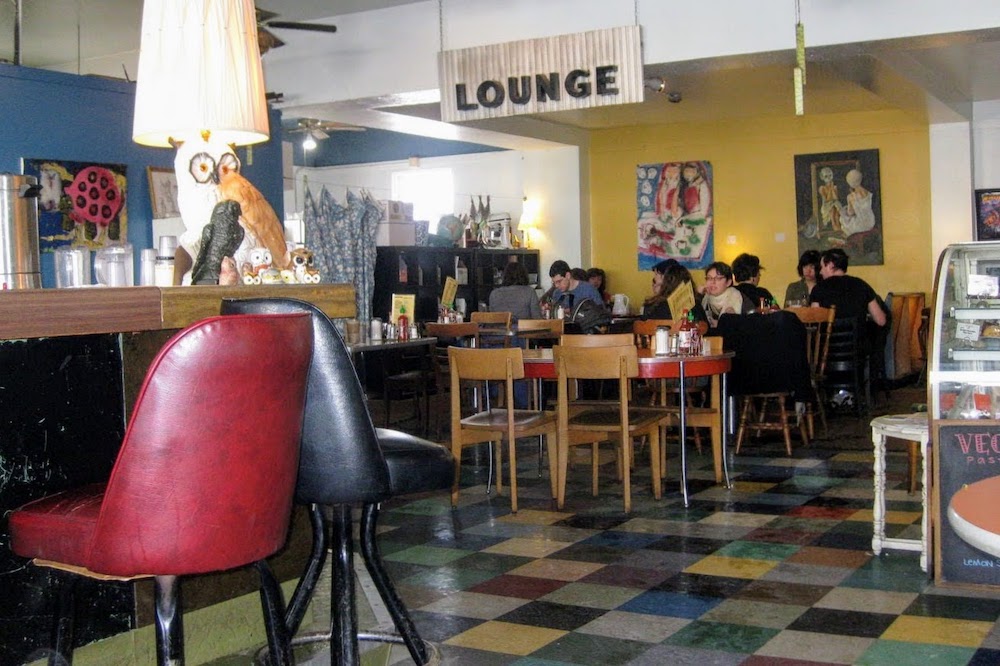
photo inside former Quiet Storm coffee shop, Pittsburgh
Interior of the old Quiet Storm, after the stage had been removed, c. 2011 [photo: The Chubby Vegan]

We’ve all pondered the sound of one hand clapping, but what is the sound of no hands clapping?

In the late 1990s, a former “nuisance bar” on Penn Avenue called The Quiet Storm was shut down after the nuisance of having a man knifed to death on premises. In its place, a coffee shop/vegetarian restaurant/leftie command center opened. The new owners painted the walls a patchwork of bright colors, refloored the space with a random splattering of leftover acrylic tiles, added fresh flowers to the tables, displayed them in thrift shop vases–but they kept the old name.

By the early-aughts, The Quiet Storm had added a small stage, a minimal PA system, and quickly became an ideal performance venue for Pittsburgh’s local musicians. The back half of the big room could comfortably host a hundred audience members and with no liquor license, the venue’s BYOB policy made for easy, fun, cheap nights out.

So it was with some pleasant surprise that my band at the time, The Hope-Harveys, were offered a prime Friday night spot, just a couple weeks away. We (and The Cuff, the other band on the bill) did our due diligence at getting the word out, flyering throughout the city, inviting friends. This was going to be a good night.
Rock video for “Antarctica, I’m Yours” by The Hope-Harveys, c. 2004. Video produced by David Craig, starring The Failed Mime and band.

The anecdotal responses started to follow a pattern: “Oh, man, I’d be there, but I’m going to that Johnsons show.” The Johnsons Big Band were something of a local phenomenon at the time and their record release show–with its scene-de facto mandatory attendance policy and near guarantee for onstage anarchic drama–was booked for the same evening in a small theater across town. [Your author was a big fan and likely would have been there himself, but for.]

We arrived, we set up, we kibbutzed with The Cuff. But that was it. No one. No friends, no local music gadabouts, no spouses and no girl/boyfriends of band members. Not a single audience member–paying or otherwise. The Cuff had a pregnant bass player at the time who wasn’t feeling great and had decided to see if anyone rolled in late before committing to performance. Our band had no such prerequisite.

Moments before taking the stage, the sound woman had just one request. “You guys know how to run this stuff, right?” she said, gesturing to the sound board behind the coffee bar, “I’m going to try to catch that Johnsons show.”

Postscript: Johnsons Big Band, The Cuff, Hope-Harveys, and the much-beloved, but not sustainable venue are all gone. But fifteen years later, if you’re on Morewood Ave., on the block between Centre and Baum, you can still see a flyer–sun-bleached and half torn off though it is–advertising The Hope-Ha… and Cu…

torn and sun-bleached flyer for rock-and-roll show on steel pole
The flyer that won’t die for the gig that didn’t happen, Morewood Ave. Advertisement for The Hope-Harveys and The Cuff at The Quiet Storm, c. 2004, still partially visible in 2021.

Editor’s note: This piece was originally submitted to a literary magazine seeking first-person stories from musicians about memorable experiences occurring while on stage. Never having even heard back from the journal, I’m using it here, dammit. Rock on.

Hair Today, Gone Tomorrow: Wigged-Out On Tumbleweave, Part 2

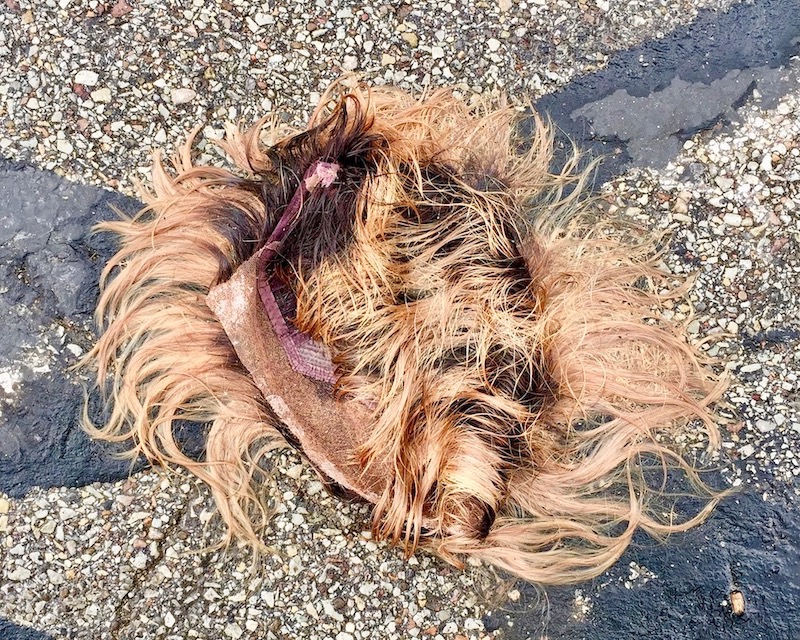
large mass of false hair on road surface
The Jellyfish, Hill District. One of the many species of tumbleweave we routinely see throughout metro Pittsburgh.

It is the fine excesses of life that make it worth living.

Richard Le Gallienne

Anyone who has lost something they thought was theirs forever finally comes to realize that nothing really belongs to them.

Paulo Coelho

There’s more to hair than real hair.

George Willard
sandy blond colored wig on road surface
The Mop Head. Lawrenceville
full head of hair including ponytail covered with road grit
The Baccala: head to tail and covered in salt. McKees Rocks

When last we considered Tumbleweave–the unique phenomenon of loose hair running buck wild throughout the city–it was to ponder the begged question What causes a person lose a full head of hair, all at once, right out in the street? Sadly, we’re no closer to achieving enlightenment on this (or any other) subject.

Still, the weave, wigs, braids, plugs, and other faux follicles keep a-tumblin’ and we’ll be the ones putting kickstands to pavement and taking the photographic evidence. Rest assured: as long as people are dropping hairdos on sidewalks, you’ve got a reliable proxy in the fourth estate to keep everyone honest.

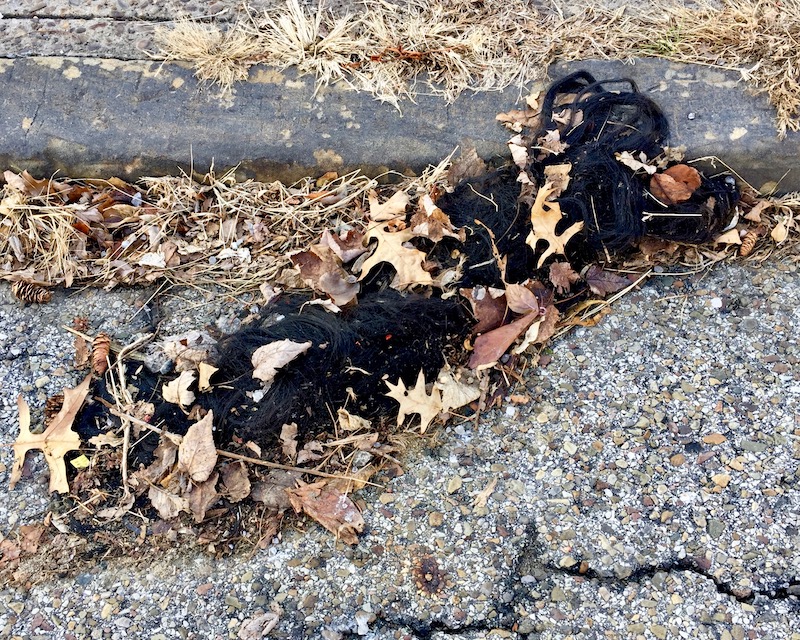
braided ponytail on cracked cement
The Slithering Snake. Etna
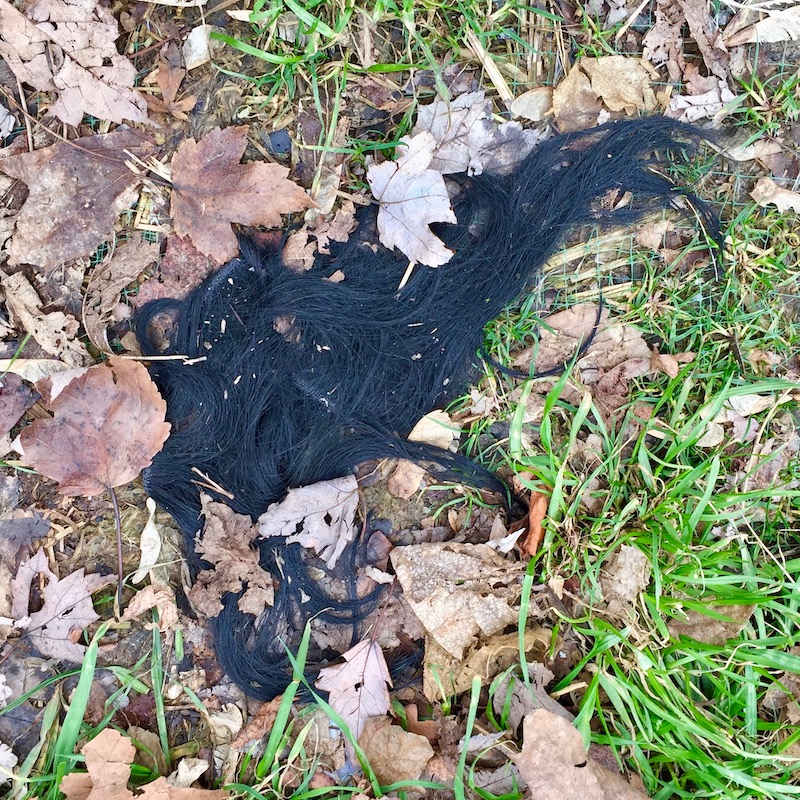
section of black hair on black asphault
Black top on blacktop. The Knot. East Liberty

So this time around The Orbit is taking a more academic approach. The discarded, lost, stolen, or torn-from-their-roots heads of hair we find may have lived a dozen lives by the time they end up here–or maybe they’re freshly arrived from last night’s revelry–we just don’t know. Like stargazers of yore, we have the rare opportunity to look deep into their mesmerizingly-random shapes and placement, isolation and juxtaposition and speculate on how they got here and what their inkblot forms spark in the subconscious.

Science is built on the backs of its predecessors. Legions of well-intended scientists before us have attempted to categorize and classify nature; when that involves human behavior and the cut-loose coiffures within it, we’re dancing with the devil. Remember: it is only through spectacular failure that we may ultimately achieve sublime success. Let’s assume we’re in the early days of this particular journey.
Finally, if you’re out-and-about and spot a particularly nice ‘do drop or mop top at the street stop, tag us–we’d love to see what our readers are finding and what they see in them. Until then, we hope everyone is wigging-out in the best of ways.
single false eyelash still in its packaging
Leftover Lash of the One-Eyed Lady, Hill District
dyed red hair braid on road surface
Don’t fear the red reaper: The Crimson Scythe. Strip District
section of fake hair on road surface
Aloha! The Hula Skirt. Lawrenceville
section of false hair on leaf-strewn ground
Surf’s up! The Crashing Wave. Lawrenceville
mass of hair on muddy sidewalk
Mudbound: The Fossil. Beltzhoover
small tuft of false hair on road surface
Fall fuzz: The Puffball. Oakland
section of false hair on leaf-strewn ground
Calling home: The Head with Antennae. Oakland
large mass of false hair among large roadside weeds
Tumbleweave in the weeds *or* knotweave: The Dead Poodle. Hill District
large mass of false hair in bicycle lane on city street
Bike Lane Roadkill. East Liberty [note the Orbitmobile sneaking in for a mise en scène cameo!]
small tuft of false hair on road surface
Like Bruce Willis, even tumbleweave takes Bigelow. The Gutter Other. North Oakland
false hair mixed with cigarette butts and other trash on weed-covered sidewalk
All butts, no ifs: The Garbage Collector. West Homestead
blue belt and clump of false hair on sidewalk
Still life in black and blue: The Tied-up-in-a-Bow. Strip District
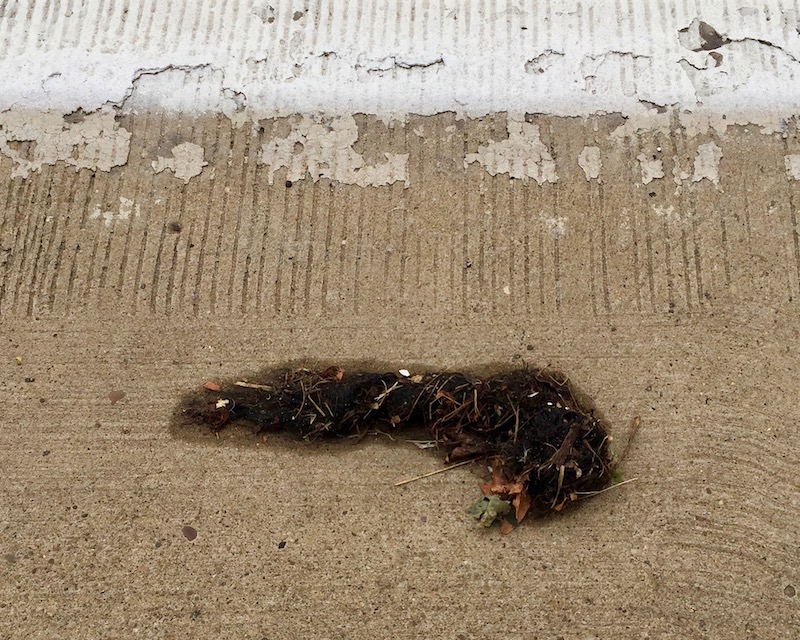
long braid of false hair on street surface
Product placement: The Swoosh. Hill District
full head of hair covered with dry leaves on street
Who’s Sylvester? The Unmade Bed. Marshall-Shadeland
small tuft of false hair on road surface
It’s cicada season somewhere! The Cocoon. Bloomfield Bridge
small tuft of fuzzy false hair on sidewalk surface
Late night fuzz: The UFO. Strip District
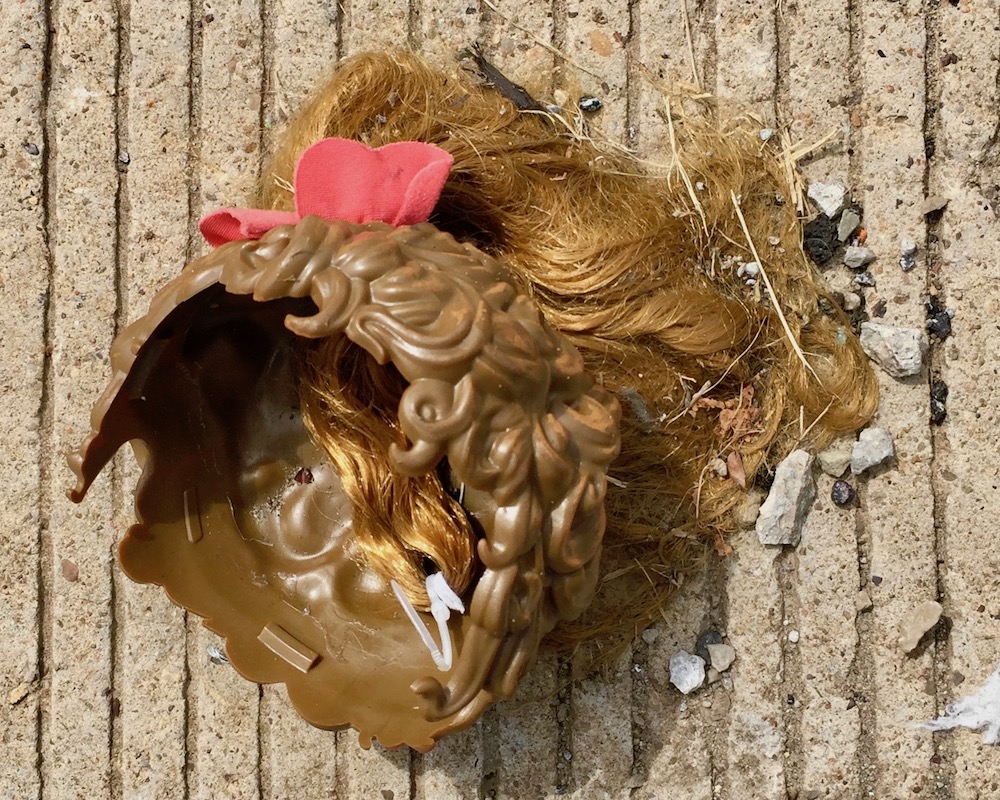
plastic doll's hairdo with attached hair found on roadside
It’s come to this! Even dolls wig out. North Side
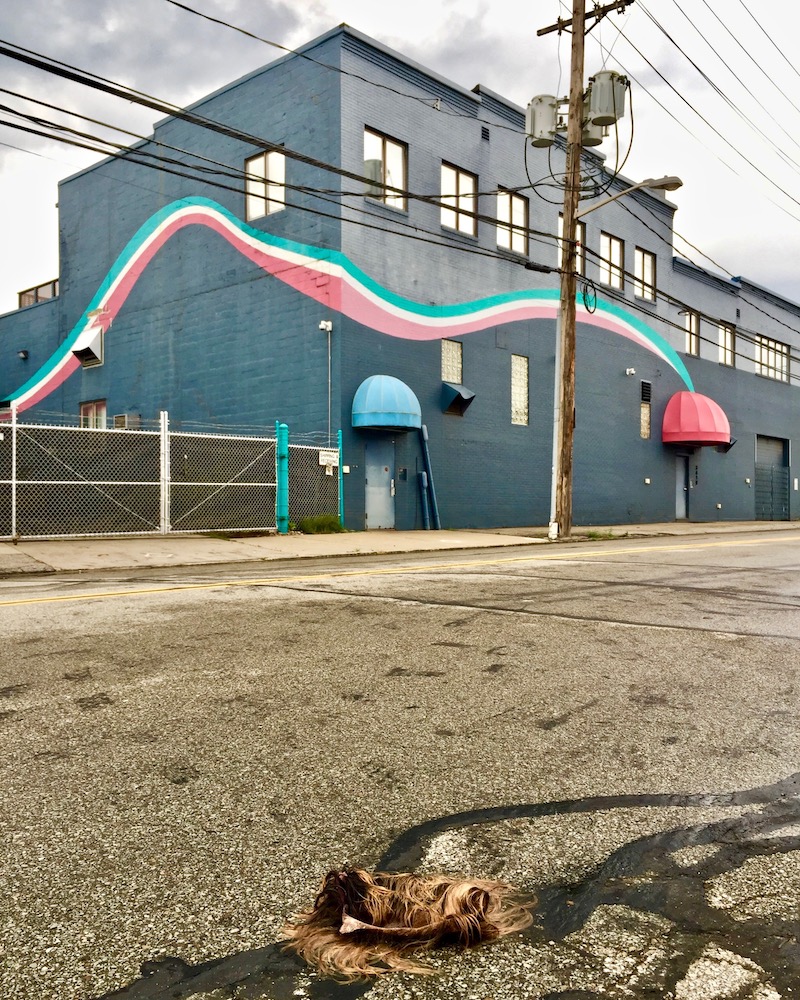
sandy blond colored wig on road surface
Under Pressure (Chemical): The Mop Head (again, in context). Lawrenceville

Hello Kitty, Goodbye Innocence: Sad Toys, Vehicular Edition

pink Hello Kitty toy car left out for trash pickup
Hello Kitty, goodbye innocence. Ain’t no sad toy like the one parked under an illegally-dumped mattress. Hill District

It is hard to overstate the raw pathos wrought by the scene confronting your author. A tiny automobile–its proportions only fit for a youth of perhaps five or six–electric pink and decked-out in the familiar white-cat-with-bow-in-her-hair emblem of the Hello Kitty brand. The vehicle is parked in a vacant lot in the upper Hill District aside and underneath an illegally-dumped sofa and guts-spilling-out mattress. The waterworks are already flowing and it’s only just seven a.m.!

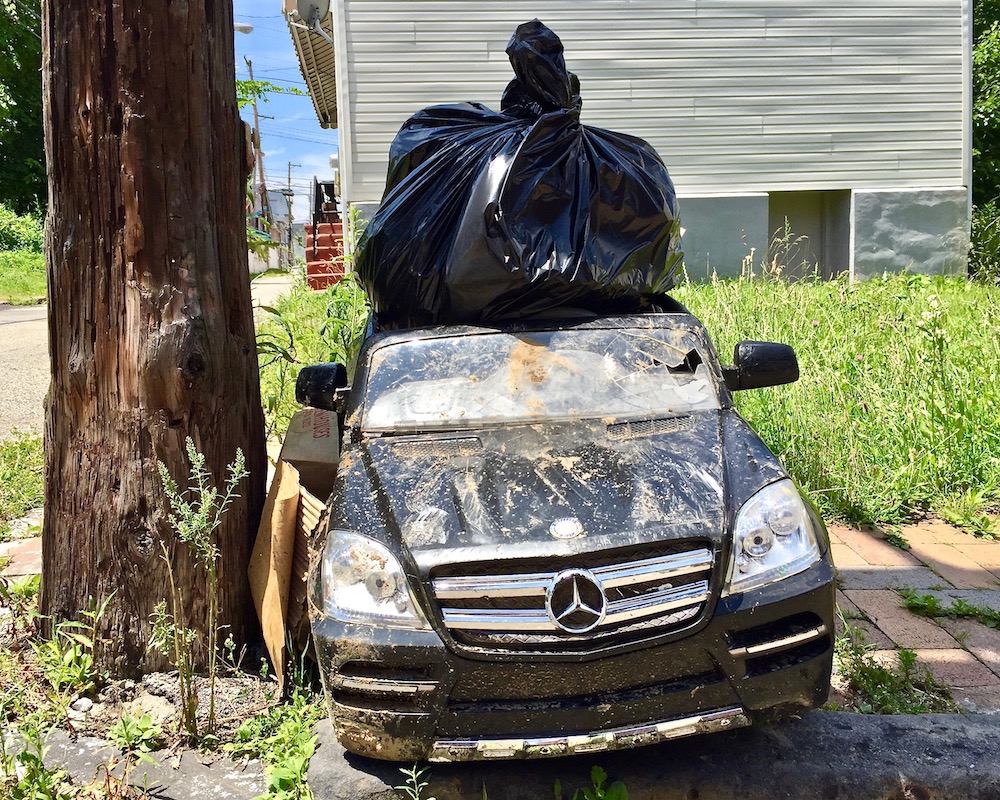
Mercedes ends. Spring Garden

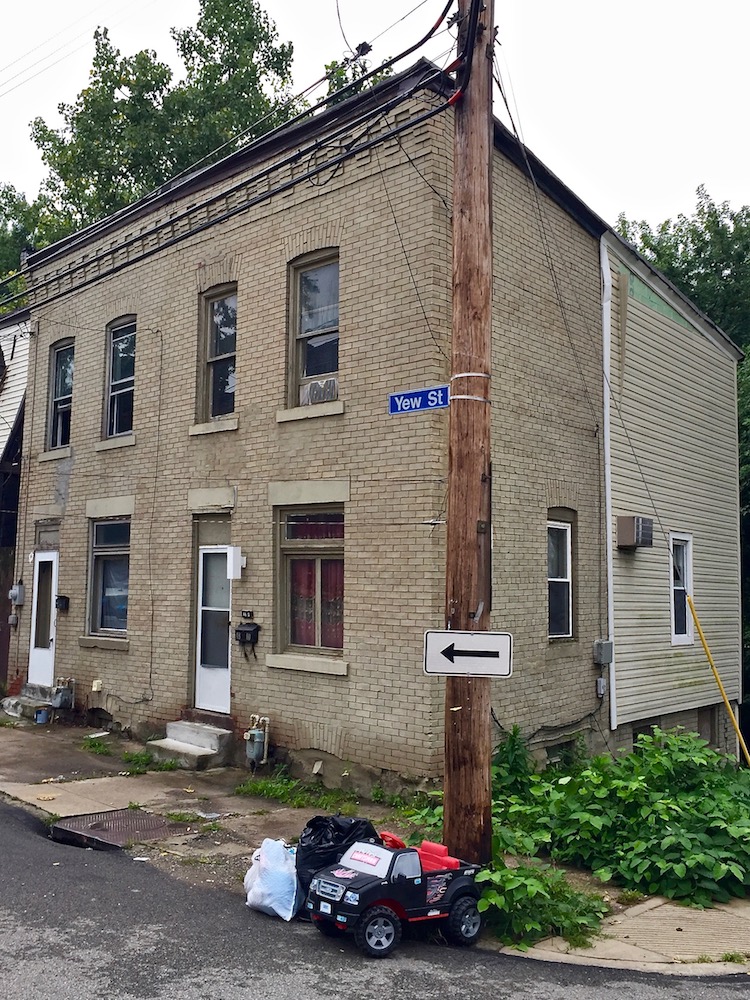
While it might surprise some that such a fine motor vehicle–and hopefully a once-beloved child’s plaything–would end up in this sorry state, the pink Hello Kitty two-seater is no anomaly. It turns out big little cars are outgrown, lost interest in, and not making the cut on moving day for much of America’s youth. That, or these not-meant-to-last distractions just plain break down. No one knows how to repair the engine in a plastic toy car.

Regardless, if we see a tiny Mercedes, mud-soaked and windshield smashed, now resting curbside with full garbage bags as roof cargo, we’re going to squeeze the brakes and take a picture every time. Welcome back to the City of Sad Toys: Vehicular Edition!

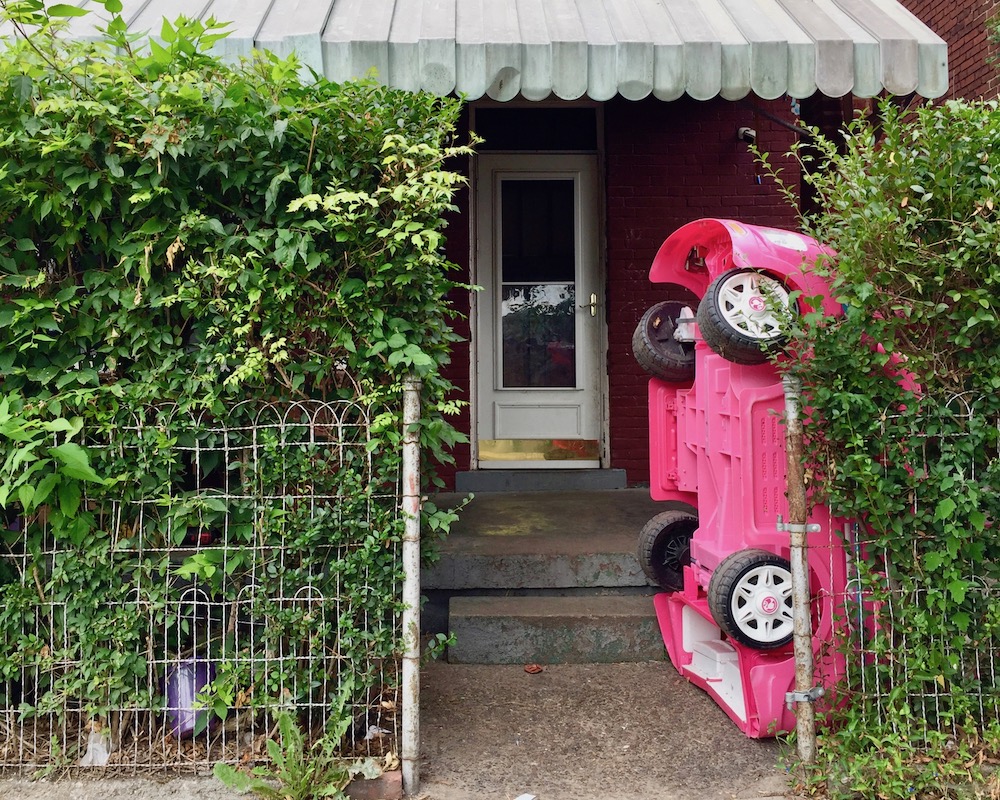
large pink toy car parked vertically in front of brick house
Unclear whether this is a sad toy or a creatively-parked roadster, but we’re counting it. Hazelwood
Garbage/truck. Bloomfield
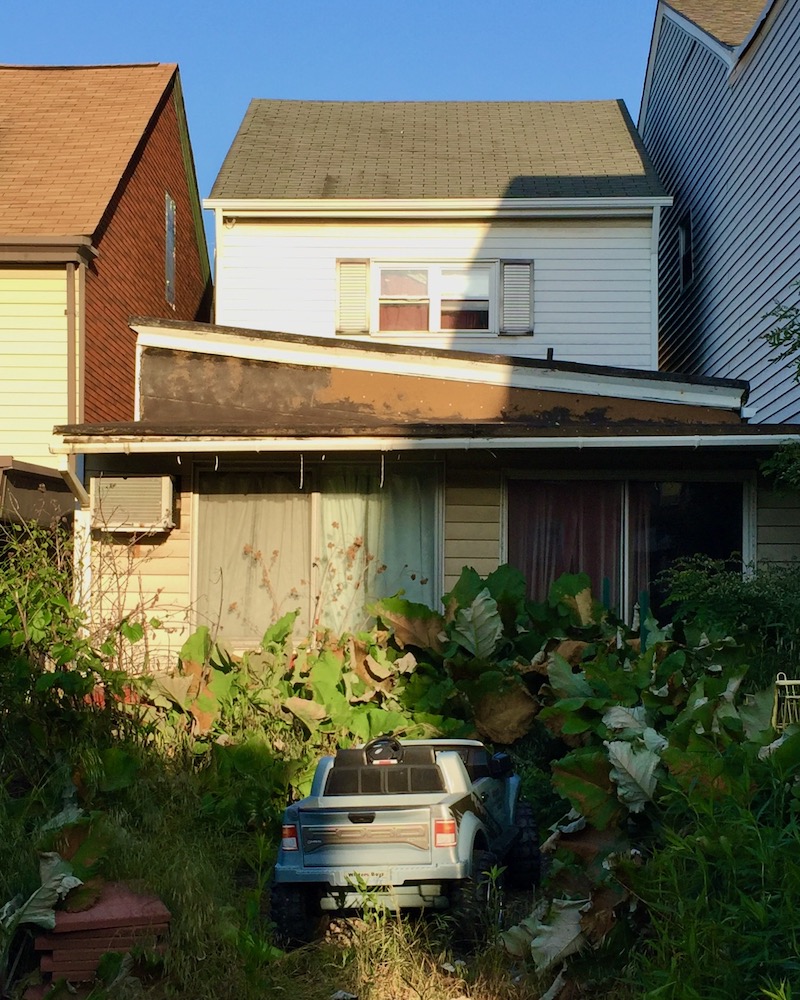
child's toy truck left in overgrown backyard
Out back, break house. Sharpsburg
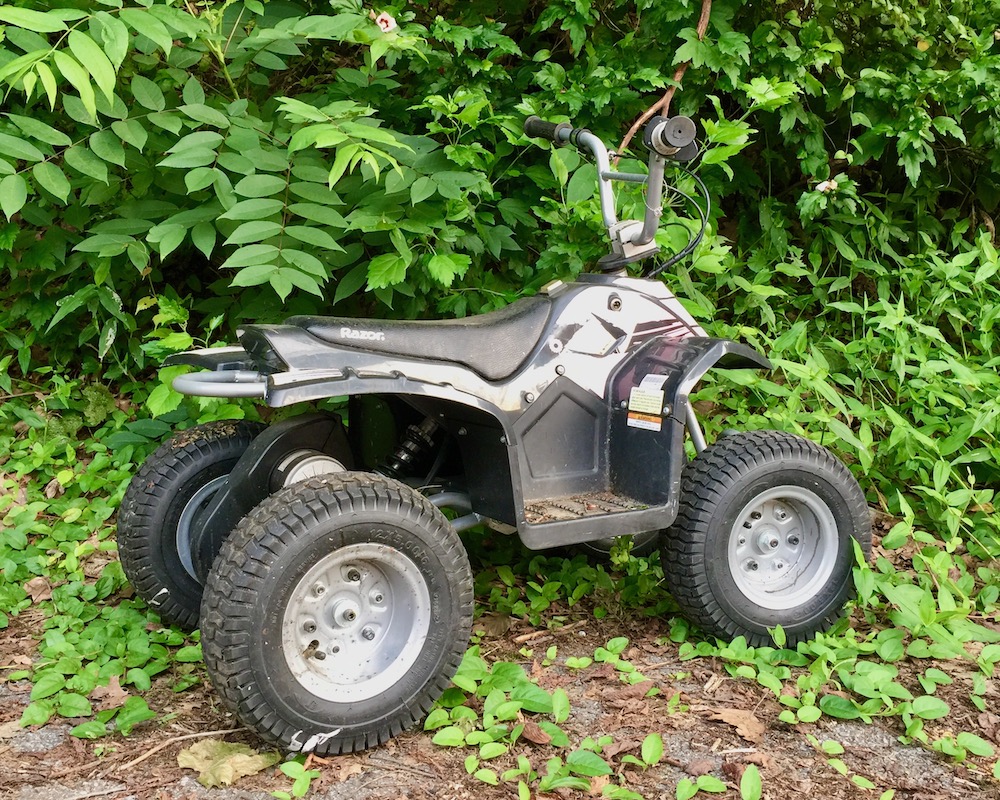
child's all-terrain vehicle left on roadside
Rusty Razor [no, it’s not that rusty…yet]. Woods Run
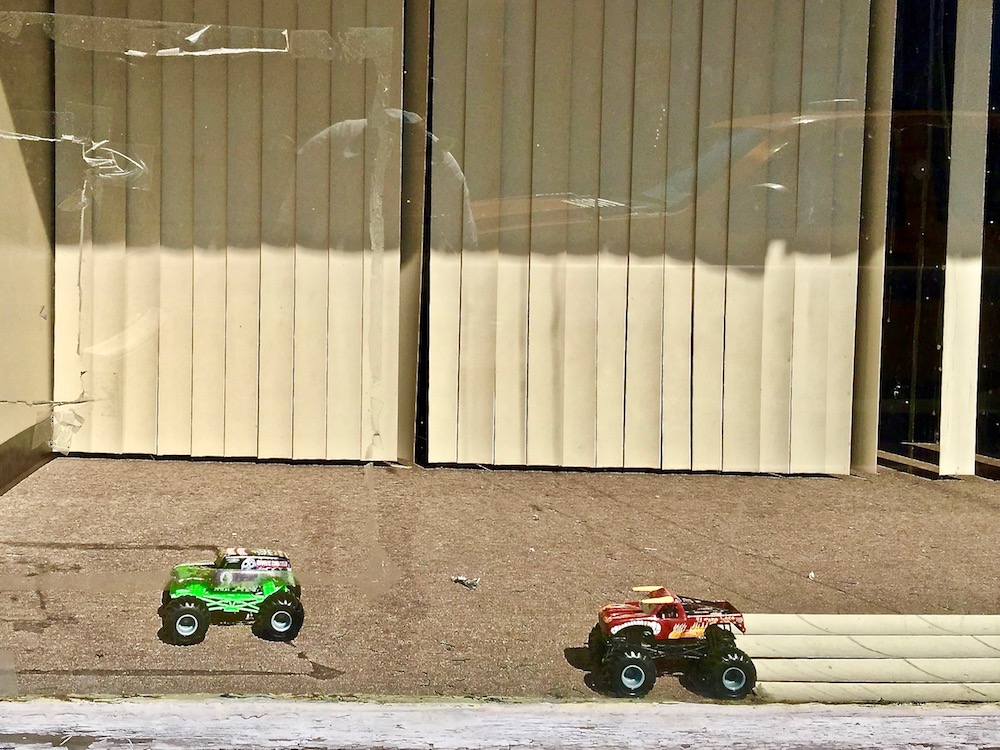
Mini-monster trucks, empty storefront. Jeannette

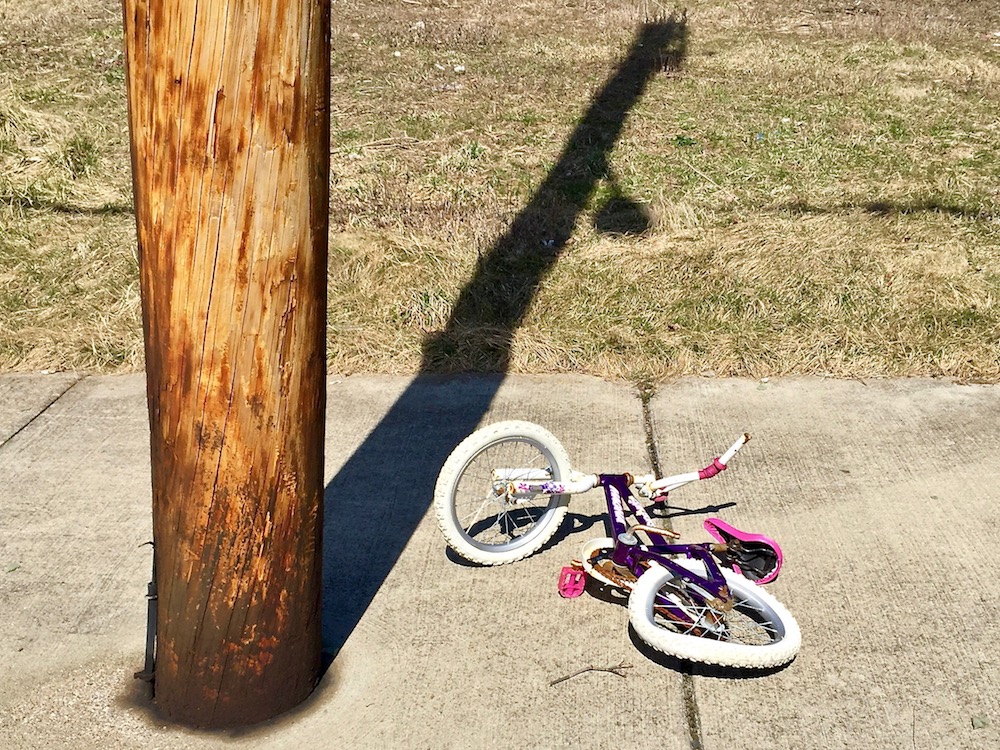
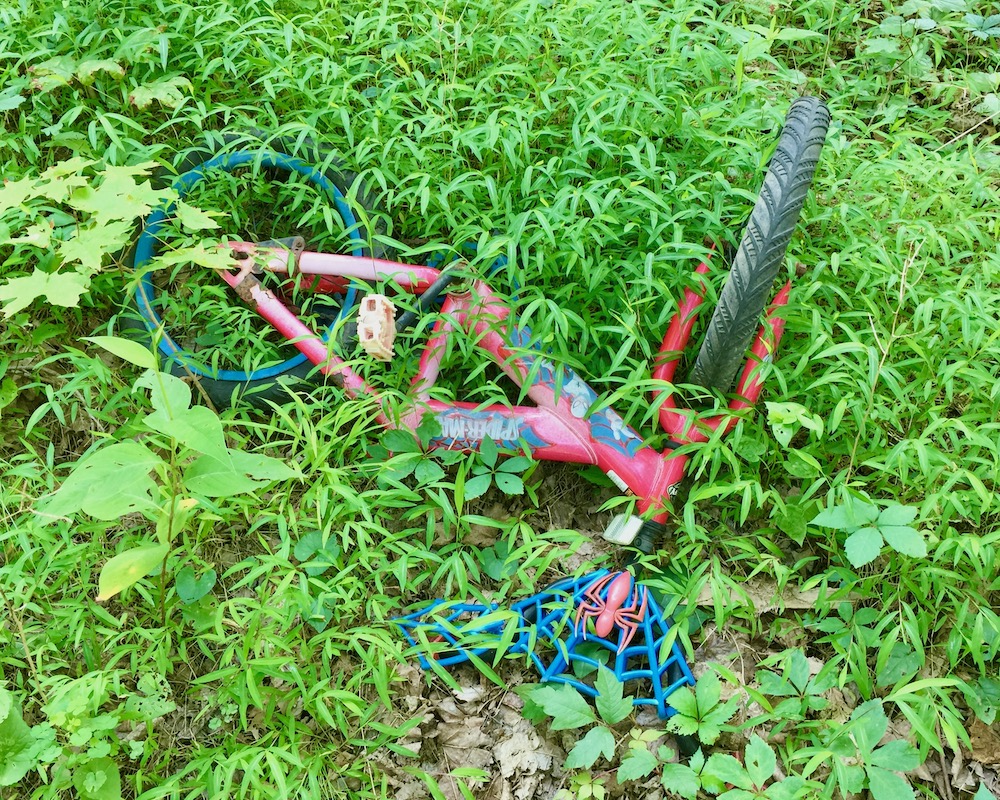
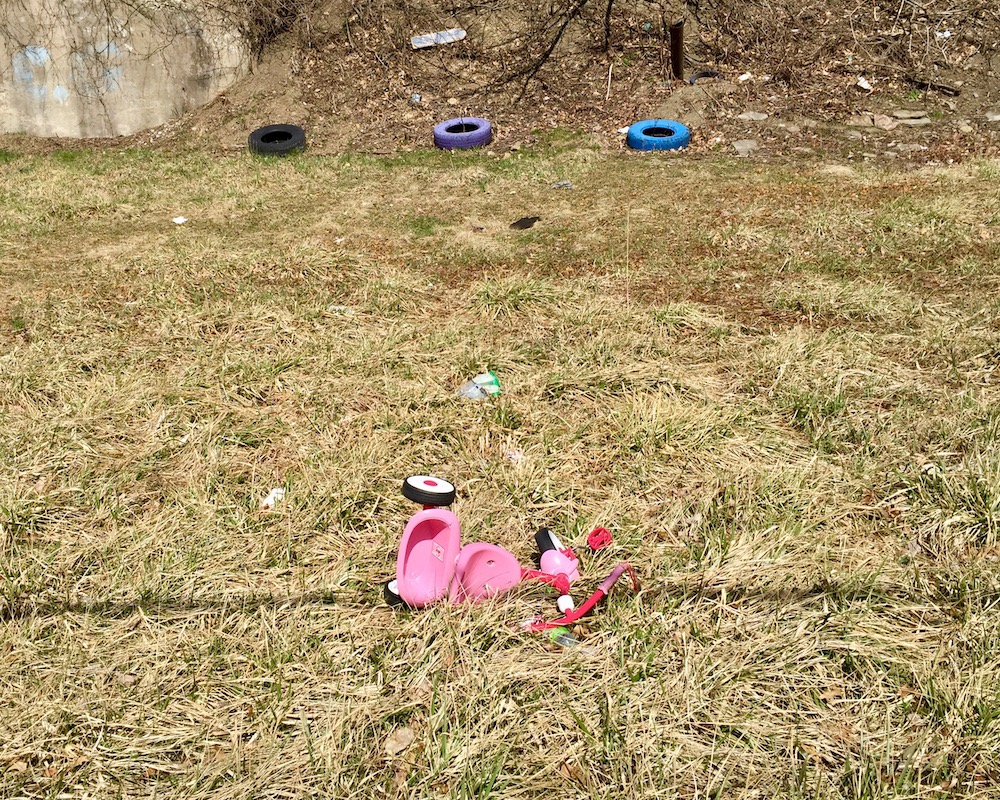
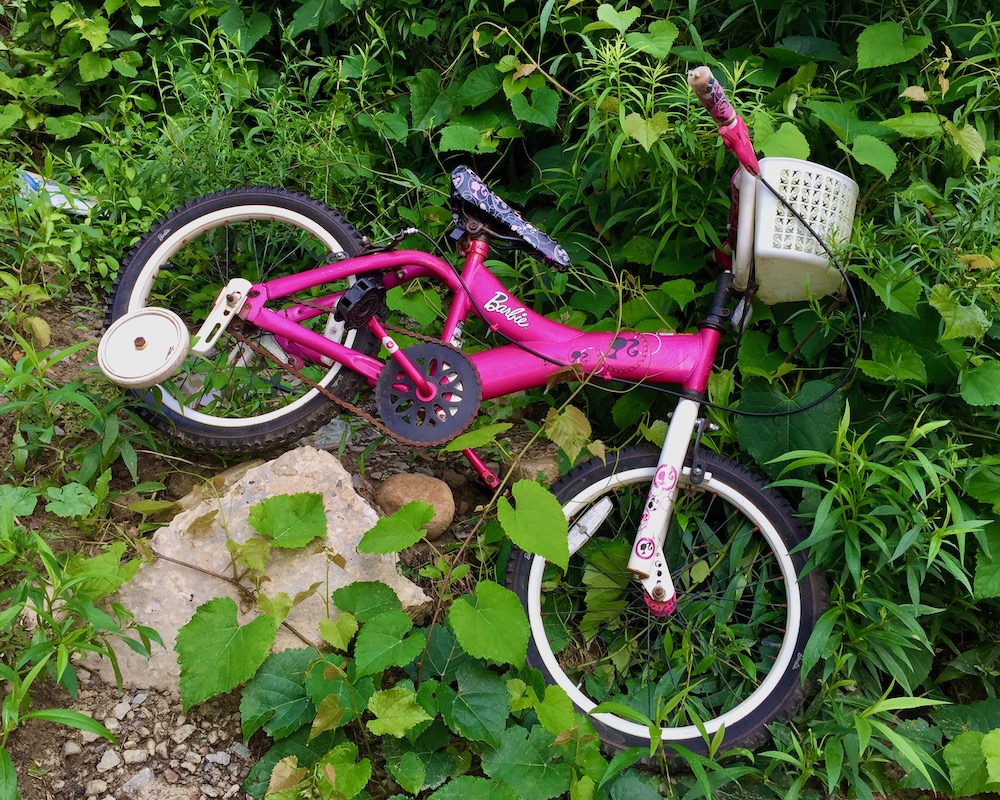
Sad bicycles are where it really gets personal. As a daily rider and cycling advocate who thinks everyone (physically-capable) would be happier on two wheels, seeing kids’ bikes crushed, tossed in the weeds, and abandoned on lonely roadsides hurts. Unlike the battery-operated cars above, bicycles are infinitely repairable–up to a point–so they really needn’t be dismissed so easily.

Imagine the childhood trauma at having one’s first taste of freedom ripped from her or his hands, left behind, or destroyed by negligence. It’s like we’re already training the next generation of road-rage-infused drivers for whom bicycles represent deep psychological wounds. To the youth of America [yes, I’m sure they’re reading Pittsburgh Orbit]: don’t let a lost or stolen Spider Man bike color your tomorrows! The future’s on two wheels!

Oh! The humanity! California-Kirkbride
child's Spiderman bicycle dumped in weed-filled lot
Spidey nonsense. Beltzhoover
pink tricycle abandoned in grassy lot
Crawling from the wreckage. California-Kirkbride
child's bicycle dumped in overgrown alley
Barbie’s dream cycle, this ain’t. Marshall-Shadeland

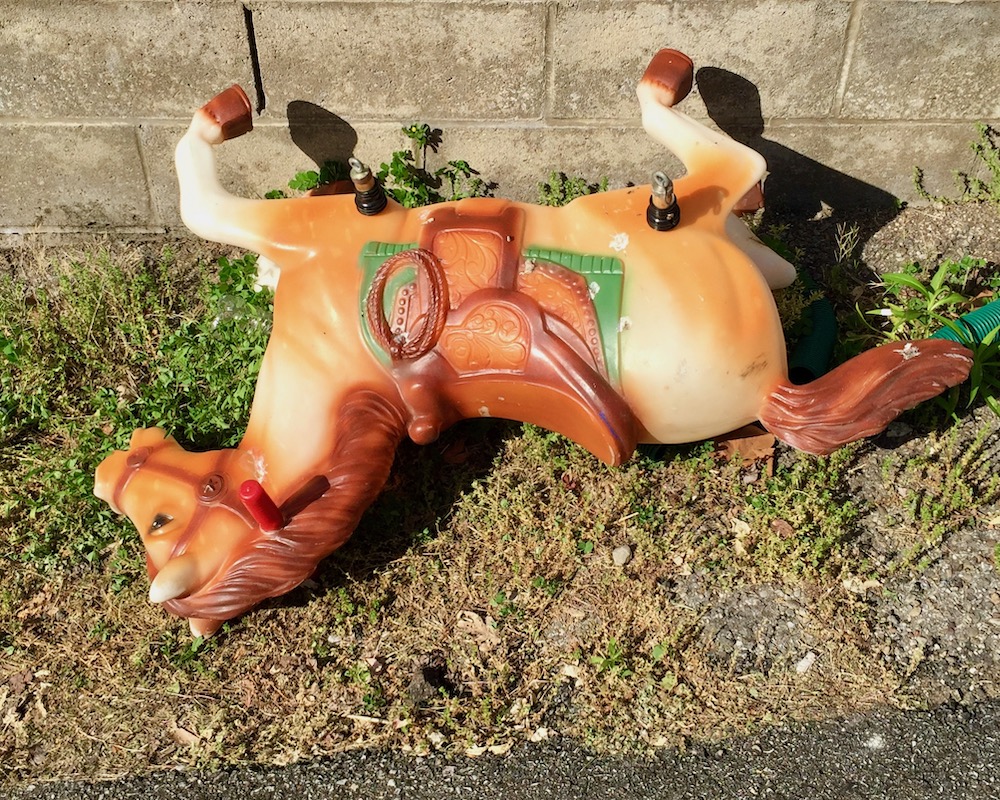
Finally, some other things-with-wheels/things-people-ride-on. Not much to say here except I’m still kicking myself for not bringing the rocking horse home and painting it silver. That would have looked great attached the fence at Chez Orbit. We’ll not get that chance again. Sigh.

rocking horse toy left out for trash
Rocking horse loser. Lawrenceville
riding/rolling toy abandoned at former quick mart
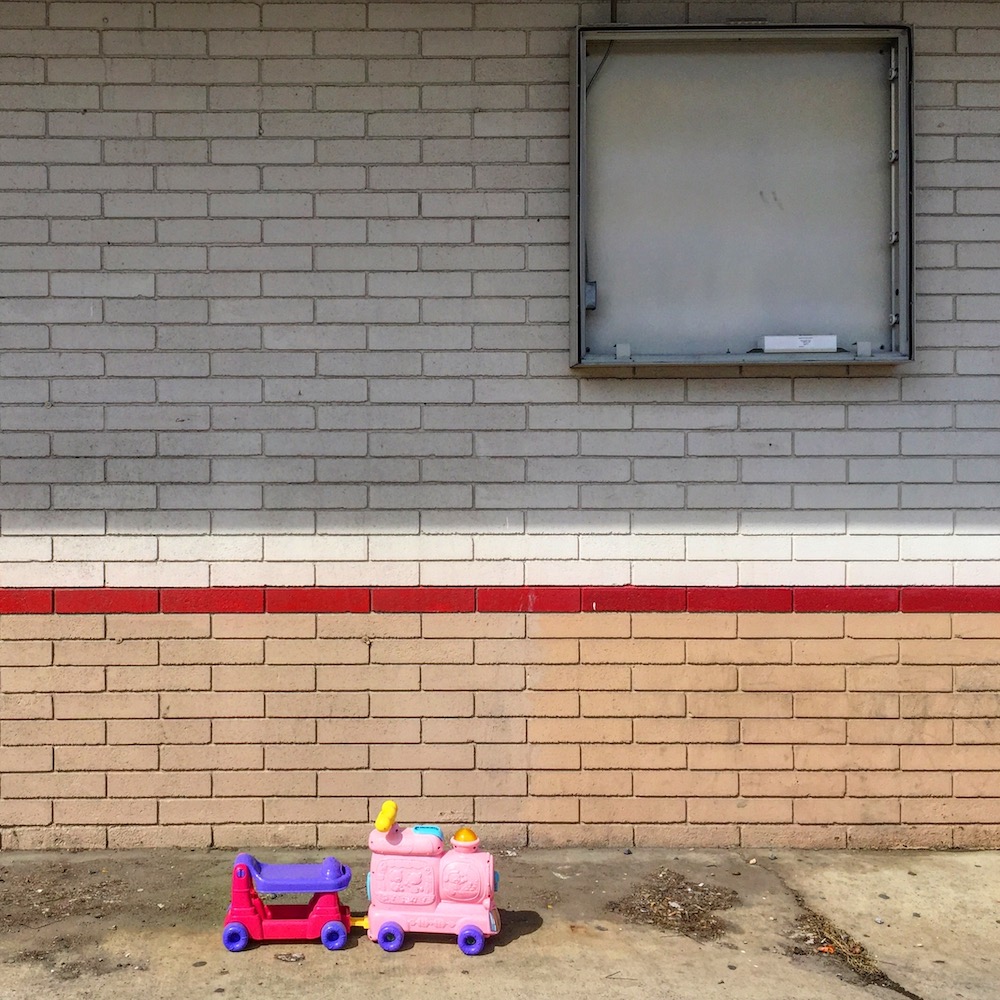
Train in vain. Lawrenceville
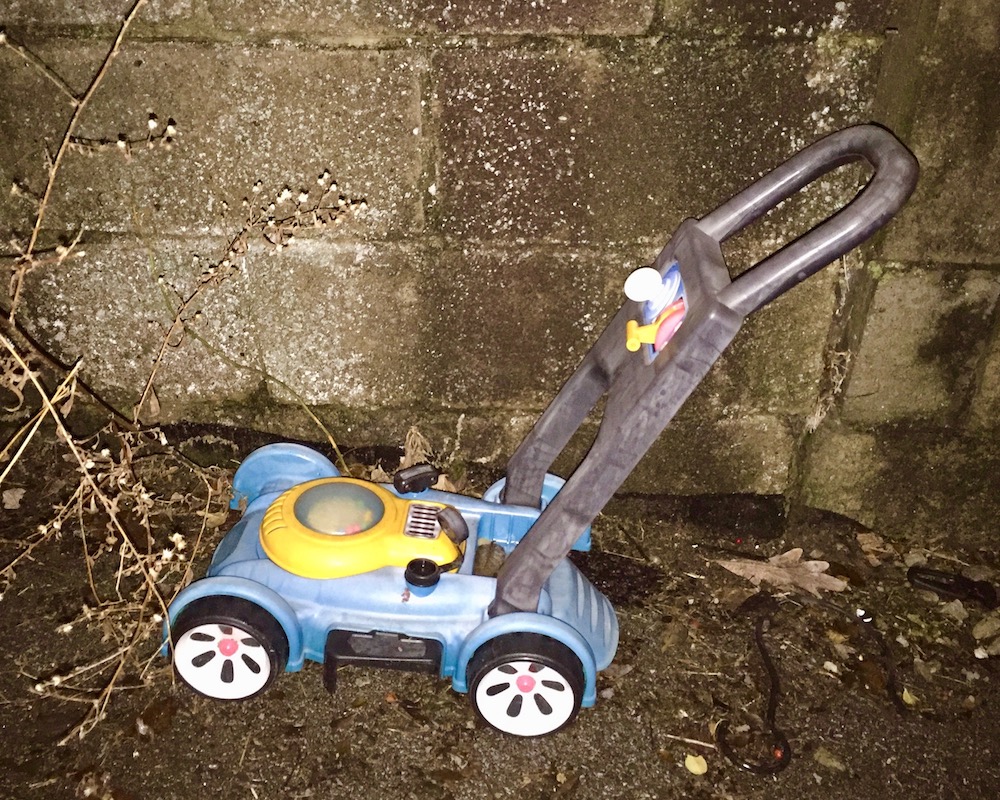
toy lawnmower left in alley
Enough practicing. Someone’s ready for the real thing. Lawrenceville
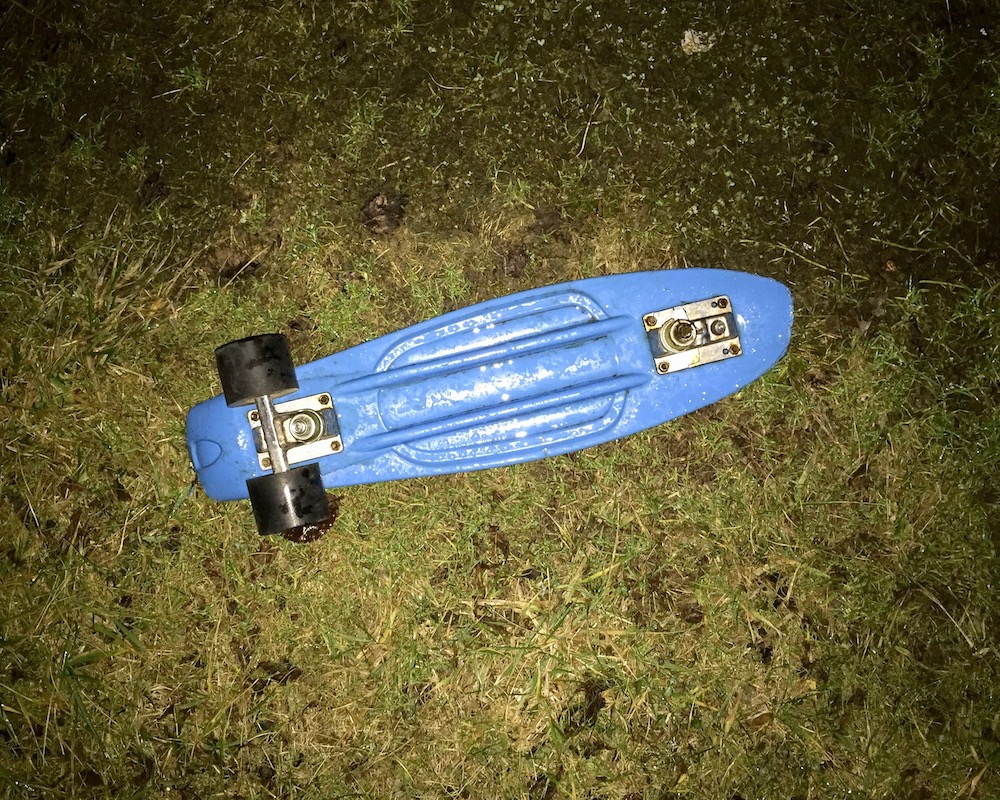
skateboard missing two wheels left in rainy grass
Two wheels bad. Millvale
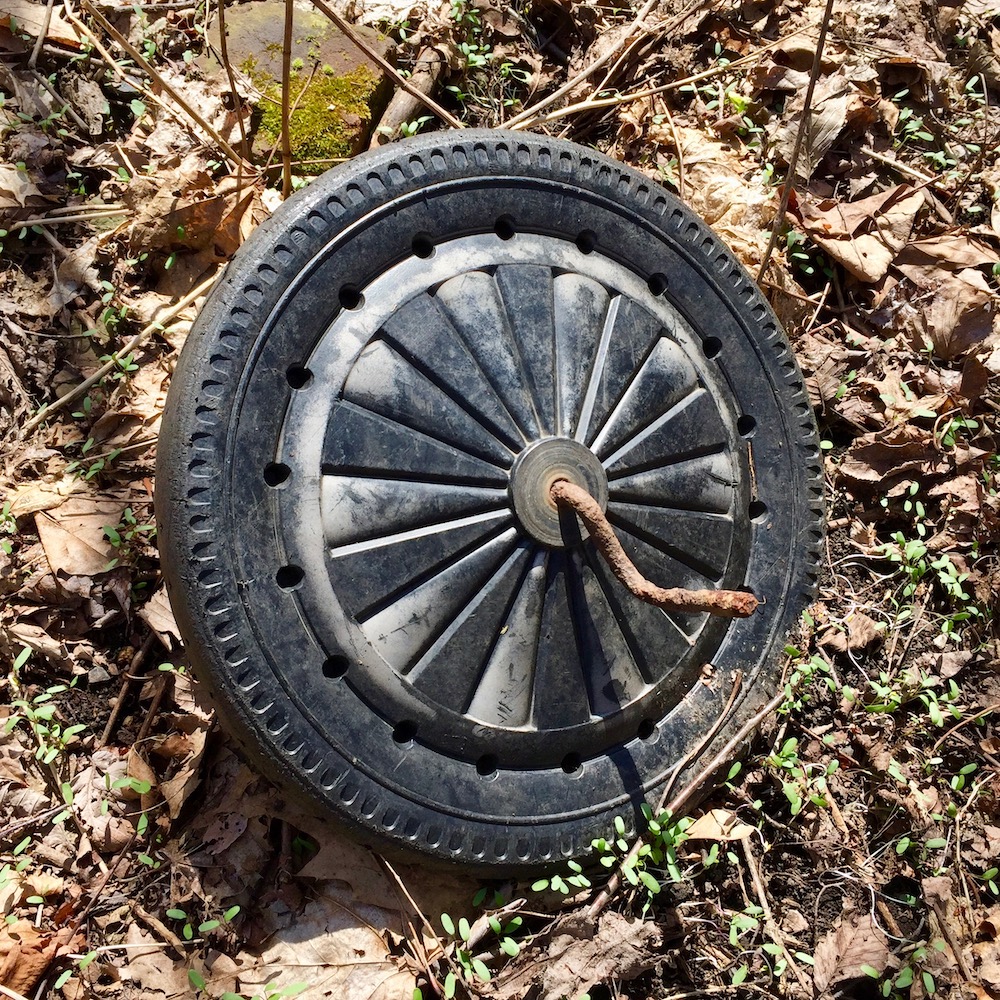
plastic front wheel from a Big Wheel toy left on leafy ground
Big Wheel, little else. Mt. Washington
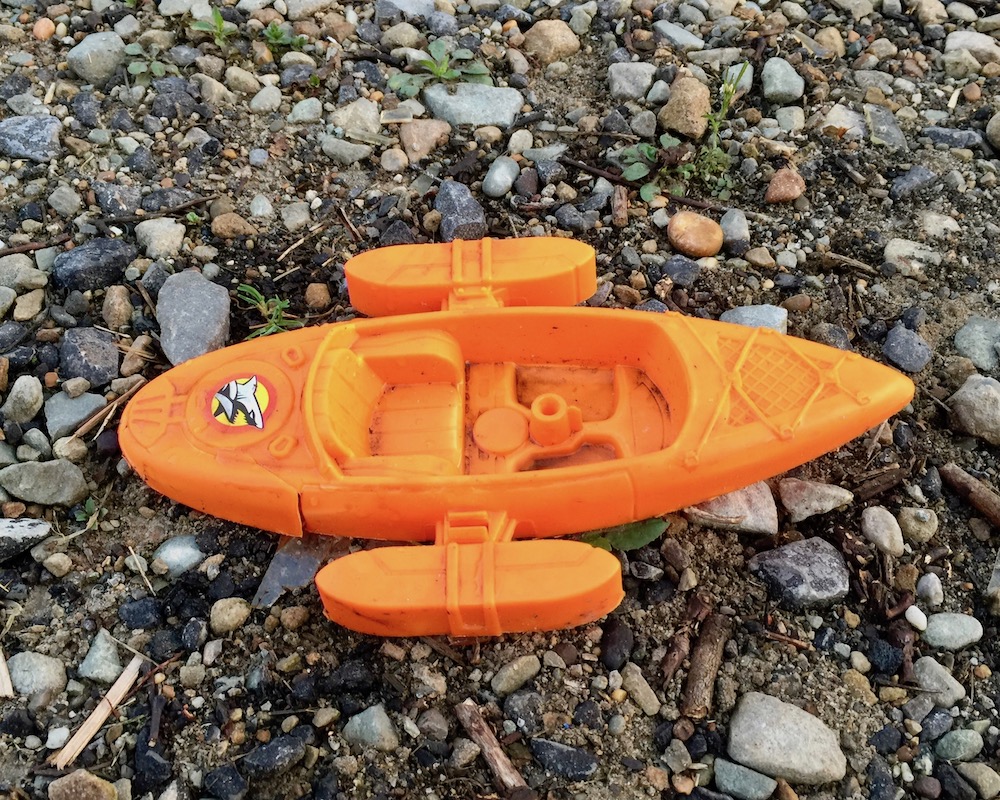
plastic toy boat crushed in gravel
It’s Shark Week somewhere! Polish Hill