
The family is gathered together in grief. Their roles are not entirely clear, but it appears we’ve got a husband and wife, several school-aged children, and a nanny tending to the youngest of the lot. There is also another, larger, man dressed formally in the kind of double-breasted coat-and-tails popular among the well-to-do of the mid-19th century. Even if the patriarch hadn’t quite literally lost his head (and portions of both arms) it’s probably safe to say he’s the reason the gang is all here.
The figures, intricately carved into an elaborate marble cemetery monument, don’t appear as they originally did 150 years ago. Like her father (or maybe it’s her father-in-law), mom is also sans-tête, but even more striking is the way the facial features of the entire group have been worn away, leaving a strange alien-like cadre–gaunt, ghostly, and zombified–but awkwardly dressed in Sunday-best human clothes with an out-of-place Greek temple in the background. It’s the perfect setup for a gothic sci-fi story.
If you’ve spent any time at all within the beautiful boundaries of Allegheny Cemetery, you know its greatest hits: the rolling landscape, gangs of deer, and gaggles of geese; the Winter mausoleum, resplendent in faux-Egyptian glory, complete with a pair of guardian sphinxes; elegant–if, endangered–stained glass; the hokey Jaws-inspired “shark grave”; Orbit favorite Steelers stones; final resting places of famous (at least, Pittsburgh famous) people like Stephen Foster, Josh Gibson, Lillian Russell, and Stanley Turrentine. The list goes on …
But for those of us who spend enough time in the cemetery to, you know, “check the pulse,” there are so many more fascinating details to this 177-year-old burial park that we thought we’d put together a scavenger hunt for those who might be looking for an excuse to get out and poke around.
Below is a collection of favorite oddball, accidental, and unexpected elements from Allegheny Cemetery’s 300+ acres that we offer up as a fun, we-still-need-to-be-Covid-safe outdoor hunt for the curious. Much like an office visit with Dr. Love, there are neither bills nor fees for participating. There is also no time limit and the only reward is the satisfaction of getting out there, stretching the legs, and doing the thing–but that’s a fine way to spend a sunny spring afternoon.
Happy hunting, y’all!

We’re four photos in, and already down as many noggins. The ornate colliding with the real world never fails to generate interesting anomalies. Statues carved from stone that have lost fingers, whole limbs, and yes, their entire cranium are always something to see–and Allegheny Cemetery has plenty of these–but we thought we’d call out two evergreen favorites.
The headless boy (above) sits among a circle of similar–but still intact–statuary in a glorious part of the cemetery, reliably basking in fine views and peaceful tranquility. By contrast, the bird’s nest monument (below) is always a hive of activity as a family of sparrows almost always take up residence under the structure’s partial roof, atop the cloth-draped column by the headless woman. Yes, again with the science fiction, but it’s almost as if the lady’s brain has been transformed into a bird’s nest that her decapitated body must now lean in close to communicate with.


Hat ornaments! There are many markers that incorporate iconography of the service their occupants pursued, but we particularly like the fireman’s memorial (above) with its old-school pointy hat-helmet and large firehose nozzle.
There are plenty of military veterans buried at Allegheny Cemetery, but few got the Union soldier’s hat + crossed cannons and cannonballs treatment of this fellow (below).


Most of the big cemetery obelisks are pretty plain. Shaped like mini-Washington Monuments, their whole thing is to be big and simple. But we love the detail on this one (above) where a stonemason has carved an incredibly intricate fantasy machine full of gears, engine belts, flywheels, an anvil, tools–you name it. Its an abstracted imagination of what a fully-mechanical factory might look like. It probably bears little resemblance to real life (even the real life of a hundred years ago) and more to the satire of Chaplin’s Modern Times vision of innovation-run-amok.
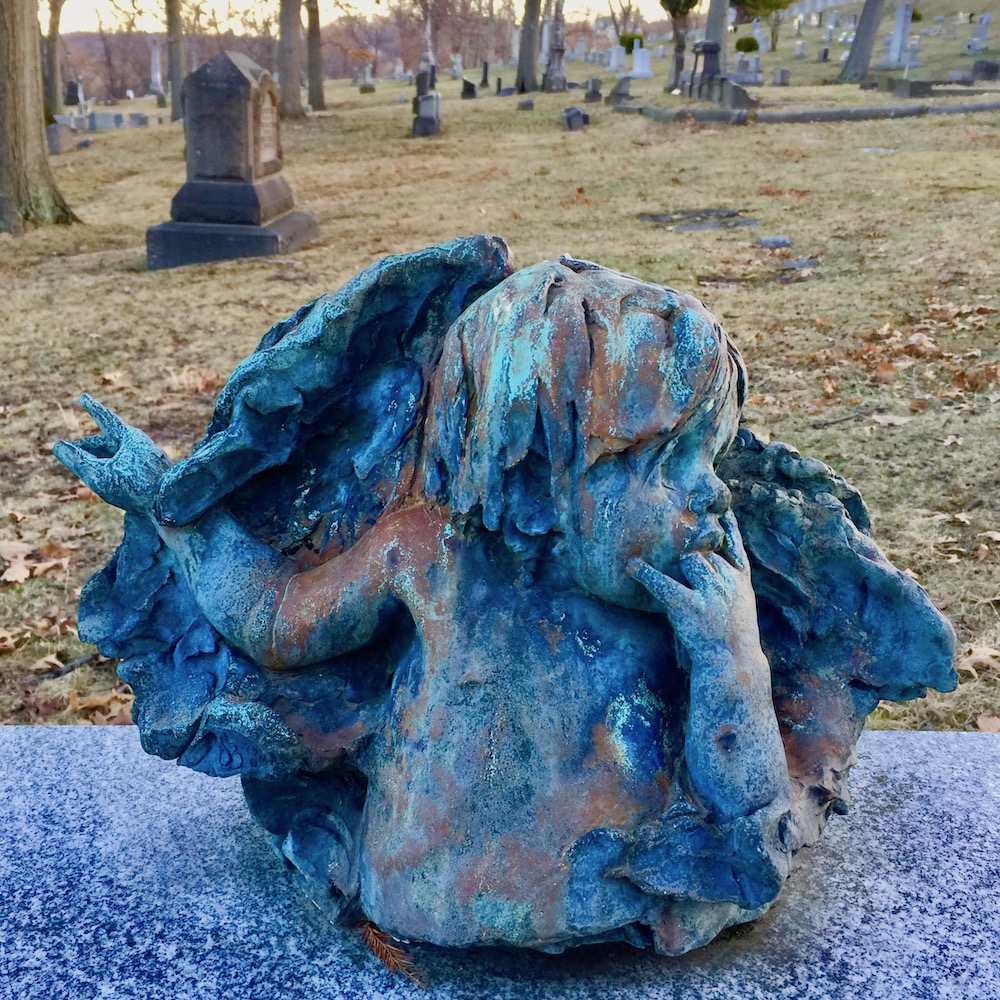
Orbit whisperer Paul Schifino pointed this one out to us, and we’re glad he did. While including statuary of a young child isn’t all that rare (especially when the deceased died young), this one appears to be a bonus, add-on stone to a much more traditional marker. The bronze (?) head and bust was clearly handmade by an artisan and features the flat back of a piece that had previously been mounted … somewhere else. Who’s the kid? Where did he come from? We don’t know!
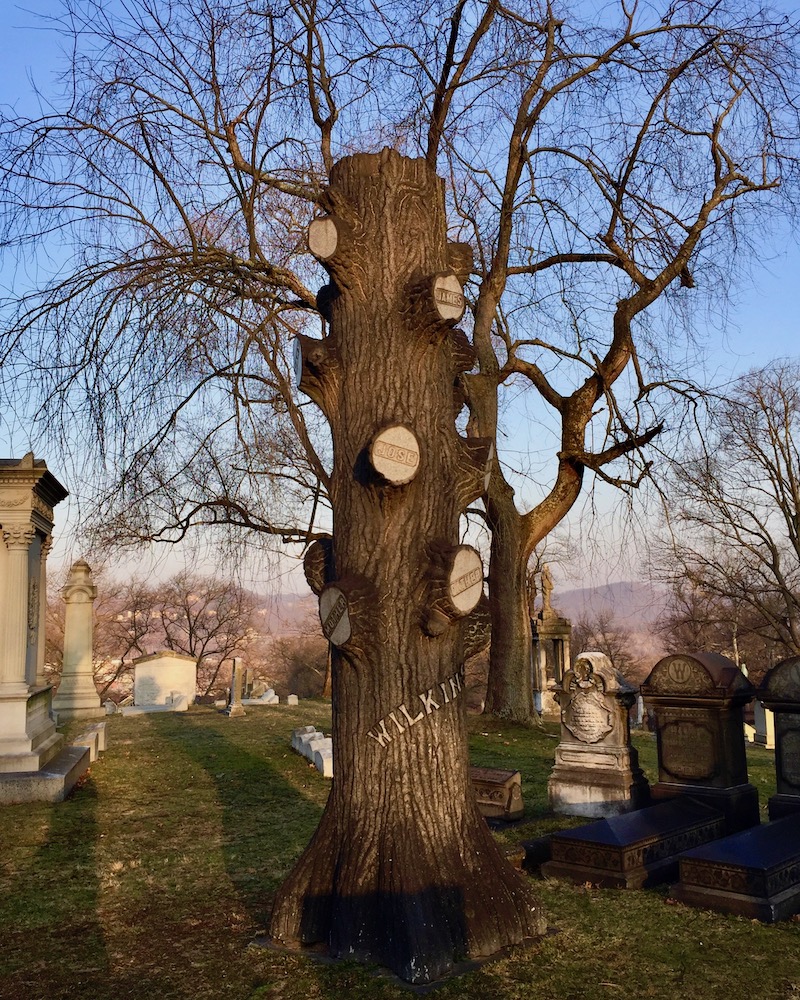
One of the holy grails for American taphophiles are the monuments created by the Woodmen of the World. That mysterious fraternal order/life insurance society provided stones carved to look like tree trunks with severed limbs for just a few decades at the turn of the 20th century.
The Wilkins family tree (above) is not one of these (at least, it doesn’t bear the WOTW insignia)–nor are there any in Allegheny Cemetery as far as we can tell. We have reached full-on obsession with finding some–heck, finding one. [Side note: if you know of any Woodmen of the World markers in greater Pittsburgh, please let us know and we’ll be on the road faster than you can say Dum Tacet Clamet.] Regardless, the Wilkins didn’t skimp when it came to ordering up this extra-large trunk with a dozen or so names carved into the severed limb stumps.

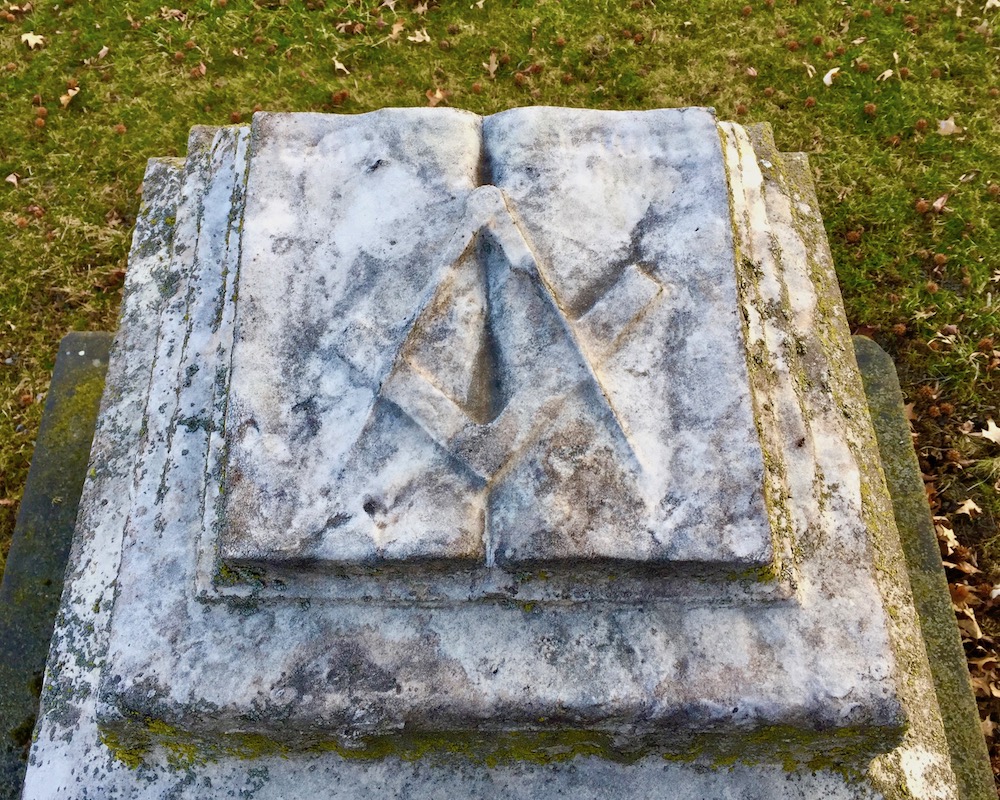
We love this pair of open book memorials. It would be interesting to know the title of a couple good books (above). History would suggest they’re probably two matching Bibles, but with all detail worn away, they could as easily be Lincoln in the Bardo and The Lovely Bones. Let’s hope it’s something good, because they’ll be here a while.
No mystery with this one, though. The square and compass insignia tells us a Freemason planted this stout stone dais with an open book and the two aforementioned tools acting as bookmark. Around the base (not pictured) is additional iconography–a Star of David, cross, etc.

Cemeteries–all cemeteries–are dominated by the color gray. Grave markers, large monuments, cenotaphs–they all live somewhere in the very limited spectrum of dirty white to not-quite black. It’s why the larger environment looks so great among the turning leaves of fall and against the green grass of spring; it’s why they look so stark within the equally monotone grays of winter.
Green also appears every once in a while in the stone itself. The Orbit doesn’t have a resident geologist/chemist, but our understanding is that this is the result of some mineral (copper, probably?) oxidizing over its decades exposed to the open air.
Many individual markers and statuary have streaks of iridescent green in their surfaces, but none moreso than the big memorial for George Hogg (above), which has completely mutated into a psychedelic light show of rich, emerald greens, electric neon blues, and washed-out pale cornflower.
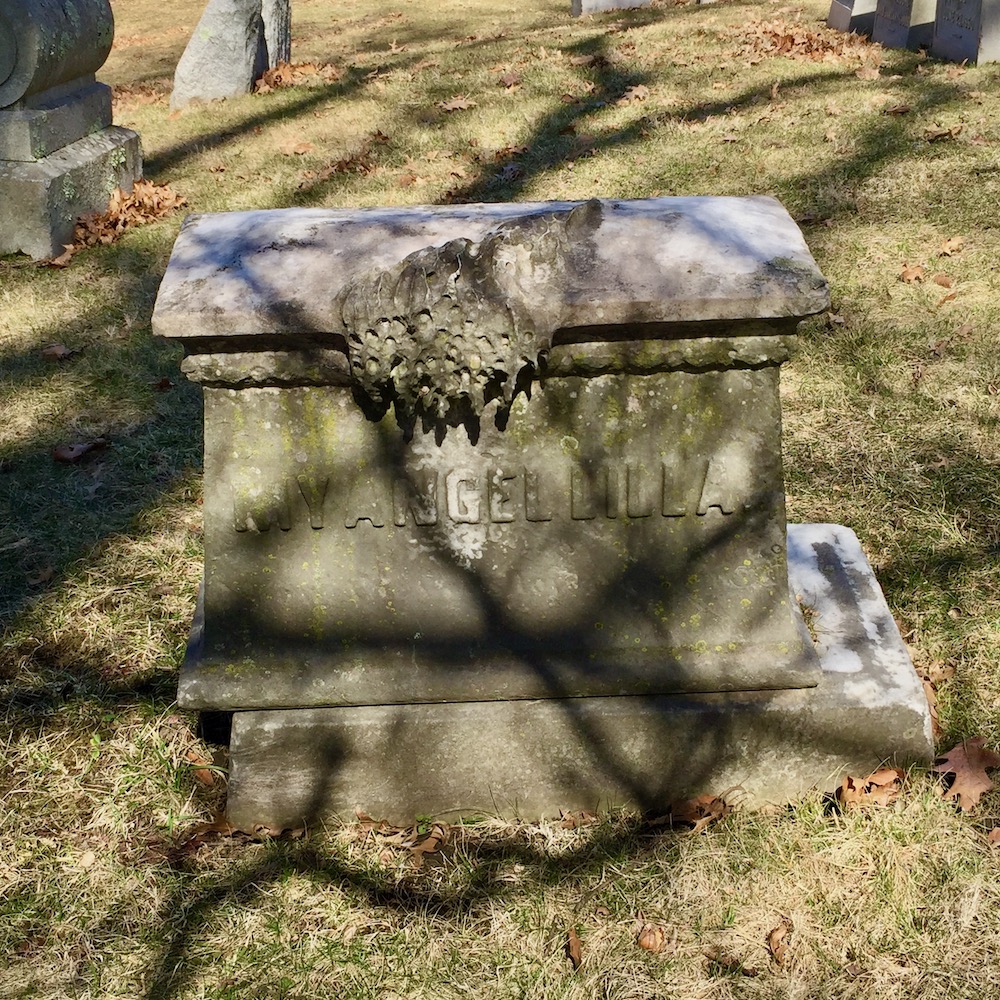
A couple oddballs here. My Angel Lilla (above) is nothing special but for the way time and tide have created this weird distortion in the lid. Did some imperfection in the stone cause it to … melt? Does that really happen to rock?
What the artist of the salt and pepper shakers (below) was going for might have been more obvious when it was installed and the details were sharp, but by now it’s a total mystery. Are those columns? cannons? some kind of industrial product? And what is binding them–vines? rope? chains? Heck, we’ve got today’s writing prompt for you right here.

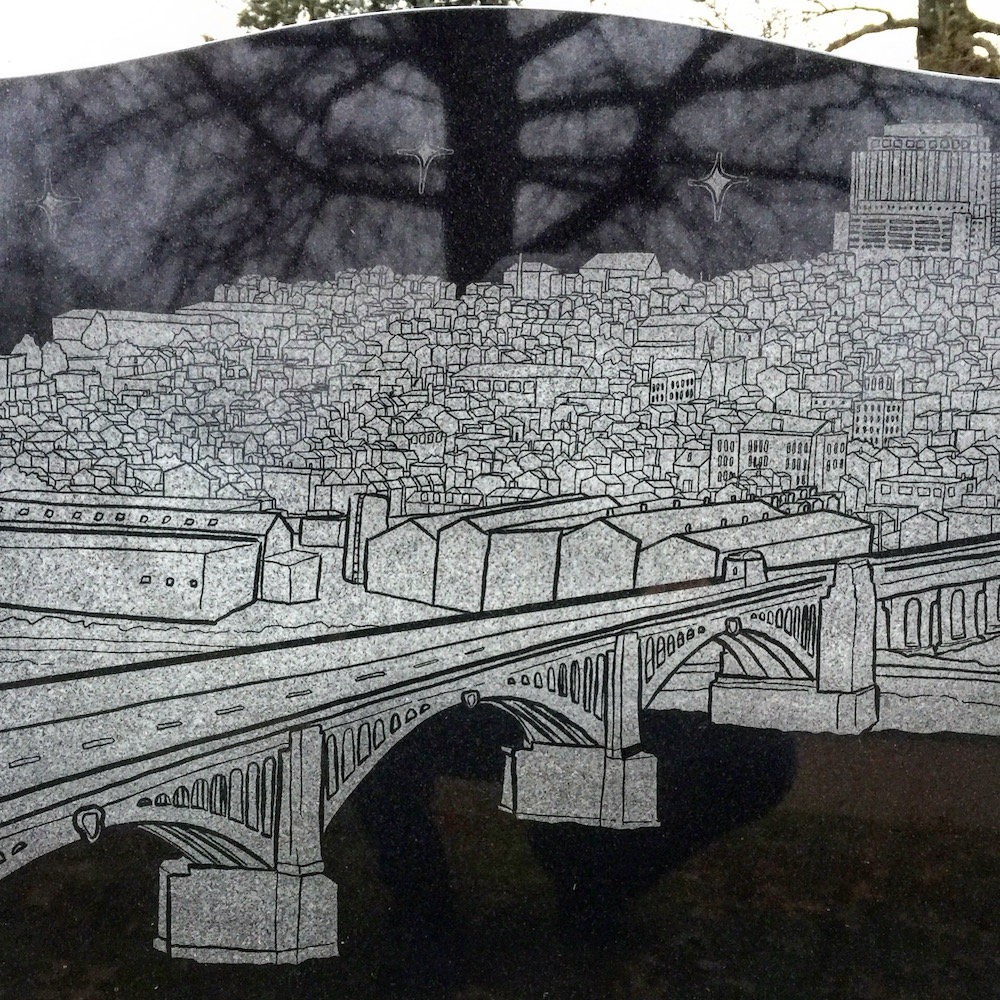
Generally the newer-style, glossy black headstones with etched-in details just look too shiny and too computer-generated for these old blogger’s eyes. But we love this view of ninth-ward Lawrenceville–the 40th Street Bridge and Heppenstall mill in the foreground, the chock-a-block row houses rising above–as seen from the top of the hill, across the river in Millvale. Maybe it’s just because we like the art better or because this was obviously a Lawrenceville (after-)lifer, but this speaks more about the person than all those clip art shovels and Steelers emblems and musical notes we see on its sister stones.

Bailey Balken went rouge when s/he went out (above). Not afraid to mix media or typefaces, Balken’s marker includes a pair of flat marble stones inside a brass plaque laid atop a just-a-size-larger granite slab. That alone won’t get you in the Orbit scavenger hunt, but the volleyball-sized round rock inserted into the middle will. Looking like a rising loaf of rustic Italian bread, it’s unclear what Bailey was after … unless it was some kind of play on ball/Balken. Who knows?
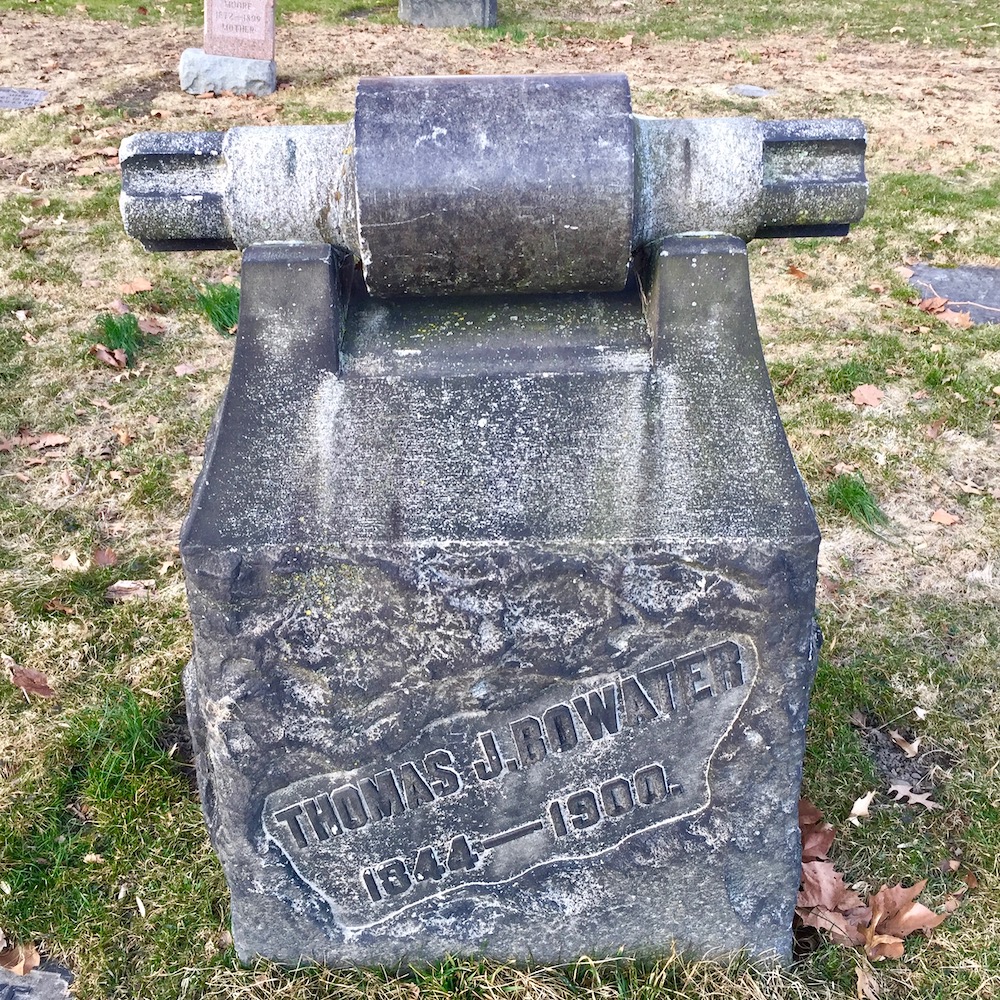
We imagine Thomas Bowater (below) must have been an engineer, or a machinist, or something in that world. That seems the most likely explanation for including a rolling axle/cog/gear as the prominent feature in a gravestone that looks like it came right off the shop floor. This rock rolls.
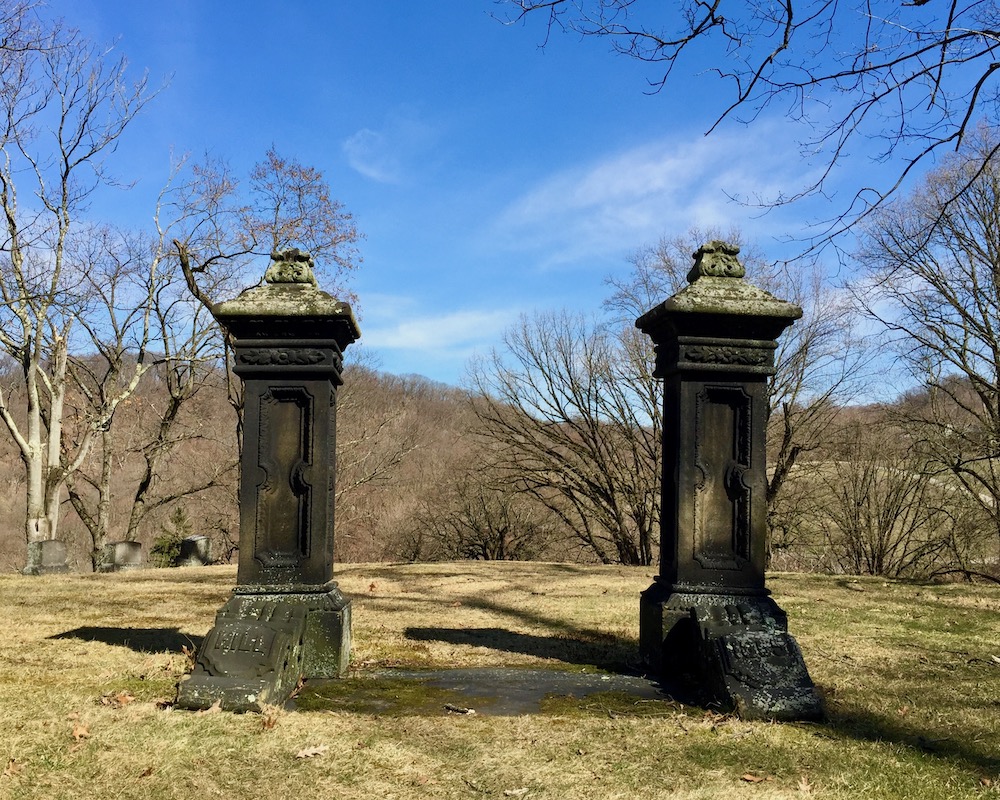
These gates don’t really lead to nowhere–there’s actually a nice, circular plot back there–but the family clearly didn’t get the buy-in they were expecting from the rest of the crew, which left the space largely uninhabited. The result is a pristine little plateau with a great view across the river, down and over the rest of the cemetery, and up to Garfield–all with the ornate decorative blackened stone portico that says to the world you’re here–but we don’t know why.





 Pittsburgh Orbit