Memorial Day: Roadside Crosses

roadside memorial cross with Christmas wreathes, West Elizabeth, PA

Mark, 66-02, West Elizabeth

A simple cross. Each spar a length of white PVC pipe a couple feet long with the ends capped and sealed. There is one heavily-sun-bleached Christmas wreath attached to the piece and another lays in the grass just in front. Also at the scene is a small, hand-painted, ceramic angel. Peel-and-stick letters on three ends of the pipe describe only the most basic details: Mark, 66-02.

wooden memorial plaque with flowers for Vincent Lapko, Pittsburgh, PA

Vincent Lapko, Nov-30-1983 – Oct-7-2017, Homestead Grays (neé High Level) Bridge [photo: Lee Floyd]

Years ago, the makeshift memorial was hammered into the grass of a wide berm along Route 837 in West Elizabeth. We pass the cross on every trip down to Donora and Monessen, so it’s become a kind of mile marker in this industrial stretch that includes a number of small factory buildings along with large operations for Eastman Chemical Resins and Marathon Petroleum. The enormous, stories-tall gas reservoirs of the latter form an imposing backdrop to the very human-scaled and personally-tended roadside cross put up for the departed.

roadside memorial cross with fireman's helmet and the text "When I am called to duty", Homestead, PA

firefighter’s memorial, Homestead/Munhall

Memorial Day means a lot of things to a lot of different people. It was created to honor those men and women who’ve died in military service for the country and has morphed into the great long weekend of igniting propane under chicken thighs after deeply-discounted blowout sales at department stores and car dealerships.

While those interpretations of the holiday are all valid, The Orbit finds a profound depth in the very personal and extremely individual work of making and tending these unique tributes that seem to pop up just about anywhere.

roadside cross and wreath with lettering "Ryan 1998-2017"

Ryan, 1998-2017, Rt. 65

There’s a lot we don’t know…and will never know just by randomly passing a roadside cross with someone’s first name. Somewhere out there–for any accident that’s resulted in fatality–there must exist the blunt facts of a police record or newspaper obituary. But even with the clues provided–a firefighter’s helmet, a stone painted with the Harley-Davidson logo, an unexpected location along the bicycle trail–the memorials generate more questions than they answer.
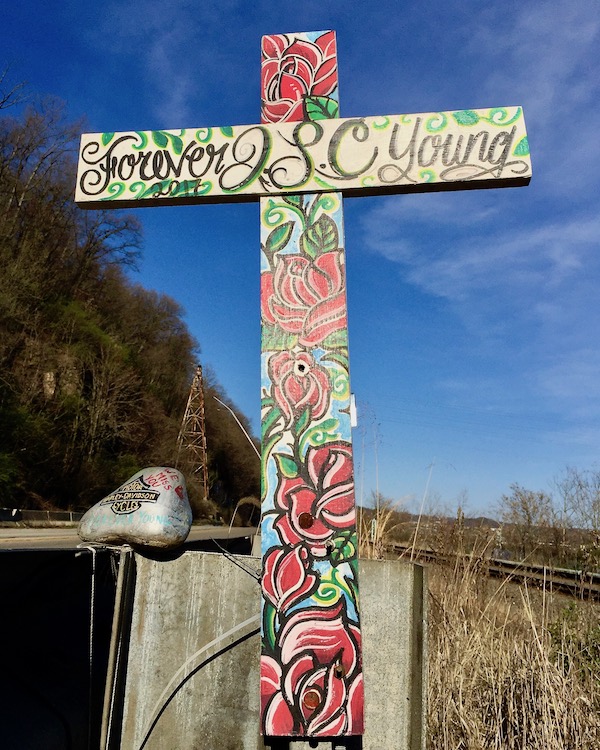
hand-painted roadside memorial cross, state route 837, PA

Jordan Celovsky, 1988-2017, Rt. 837

Whatever happened to Mark, Ryan, Jordan, or any of the others remembered in these roadside crosses, it probably wasn’t a happy ending. Their ages–from late teens to mid-thirties–and placement of the crosses (mainly) along busy roadways suggest unexpected, unnatural deaths. These seem likely to be car crash-related, but of course those details are part of what remain a mystery.

The most important unknown, for the vast majority of us, is the character of these people whose lives were cut short on the two-lane blacktop. They were clearly loved and are missed with a reverence we should all be so lucky to have. The Orbit spends a lot of time in the graveyard; very few marble headstones get the loving upkeep of some of these lashed-to-a-guardrail wooden crosses.

wooden memorial cross by bicycle trail

Ronald Vahosky, Great Allegheny Passage bicycle trail
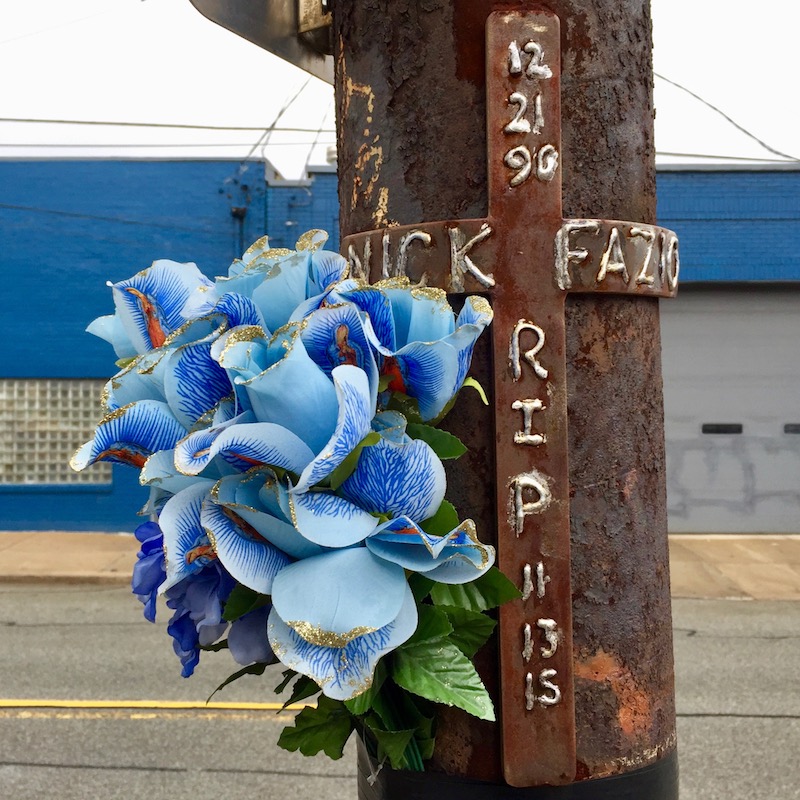
iron memorial cross with plastic flowers on utility pole, Pittsburgh, PA

Nick Fazio, 12/21/90-11/13/15, Bloomfield/Lawrenceville

Back to that anonymous roadside in West Elizabeth–graveled and dusty, noisy with truck traffic, and surrounded by the petrochemical industry. It has none of the solemn peace, flowering dogwoods, frolicking deer, or generations-old sculpted beauty of Allegheny or Union Dale Cemeteries. It offers neither the great cross-river views of St. John’s and Loretto nor the rock star lineup at Homewood.

But…this is where it happened. And for the people who loved Mark and Vincent, Ryan and Jordan, these lonely stretches of ex-urban highway seem to have become hallowed ground in a way that may never seem completely appropriate for more pristine, formal burial grounds.

* * *

metal cross attached to iron train trestle, Pittsburgh, PA

unknown, West Liberty Ave.

Roadside crosses, though not obviously memorials, showed up in a couple other places on our travels. These anonymous acts of faith–a metal cross on steel girder (above) and old world painted wood cross on utility pole (below) come with even less to go on.

Do they remember a specific traffic fatality like the more personalized examples above? Or do these crosses have nothing to do with an individual or specific intersection and just represent a quiet-but-public expression of religious belief?

wooden cross attached to utility pole, Pittsburgh

unknown, Lawrenceville

There’s a couple more here, too. This loving, heart-shaped and patio-sized tribute to “mom / grandma / friend” on Route 51 is hard to suss out. Did grandma pass away at this stretch of highway [it’s as likely as anywhere] or did the family just decide to landscape their elaborate memorial in a naked roadside where the greater Coraopolis/Moon Township commuter community could pay their respects? Who knows!

roadside memorial heart with sign

mom / grandma / friend, Rt. 51

Finally, the one that really hits home. We wrote a while back about the ghost bicycle for Susan Hicks in central Oakland and went into a whole spiel about putting our faith in robots. We’ve been fortunate enough that there haven’t been too many other cycling fatalities in the city since then.

One painful exception is Dennis Flanagan, a cyclist who was killed riding on a fast-moving stretch of West Carson Street in 2016. For the ghost bicycle left to mark the spot of Flanagan’s fatal accident, the teddy bears have faded, plastic flowers droop, gears and chain are rusty. But the painted-white bicycle remains, locked to a street sign faithfully reminding passers-by that Dennis Flanagan was here and we all need to look out for each other. That’s what Memorial Day means to me.
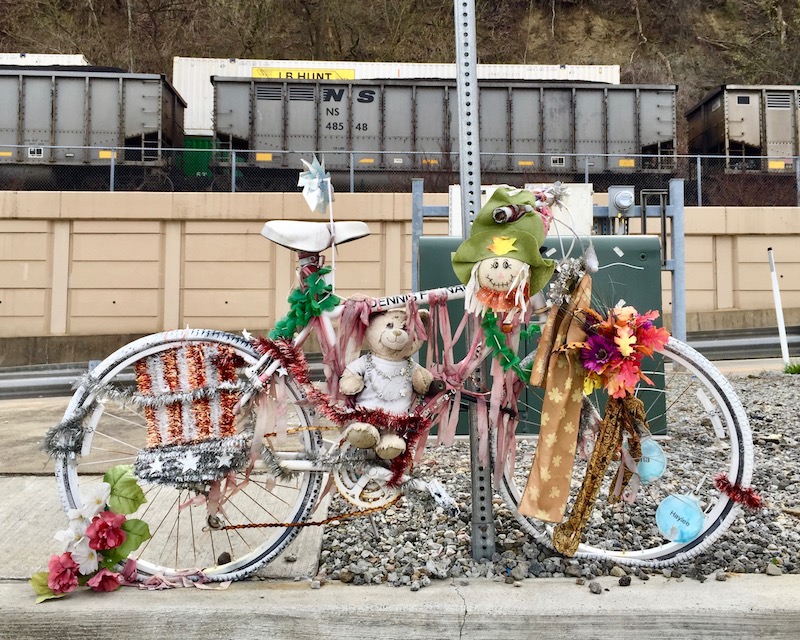
ghost bicycle memorial decorated with plastic flowers and stuffed animals, Pittsburgh, PA

ghost bicycle, West End

Something Fishy: Angling for the East End Dangler

boy with tree twig and strand of toy fish

The littlest Dangler angler with another clue from the trail, East Liberty

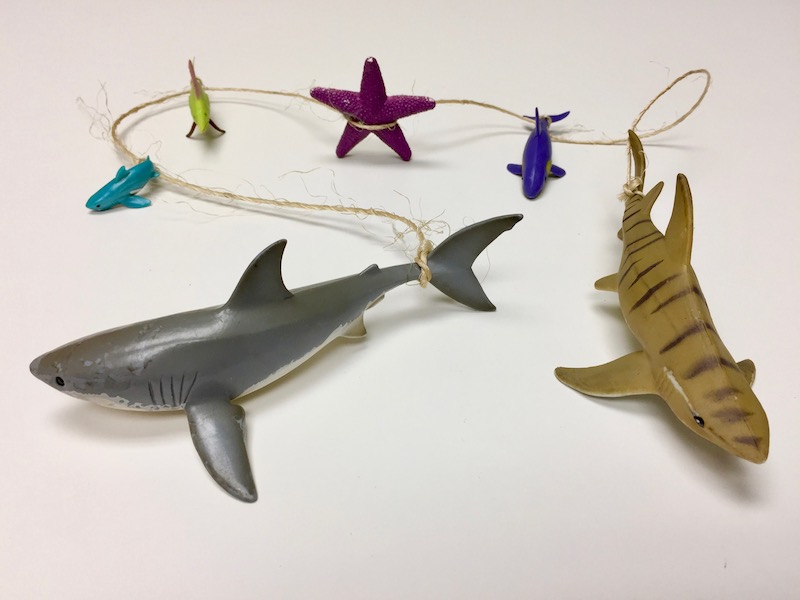
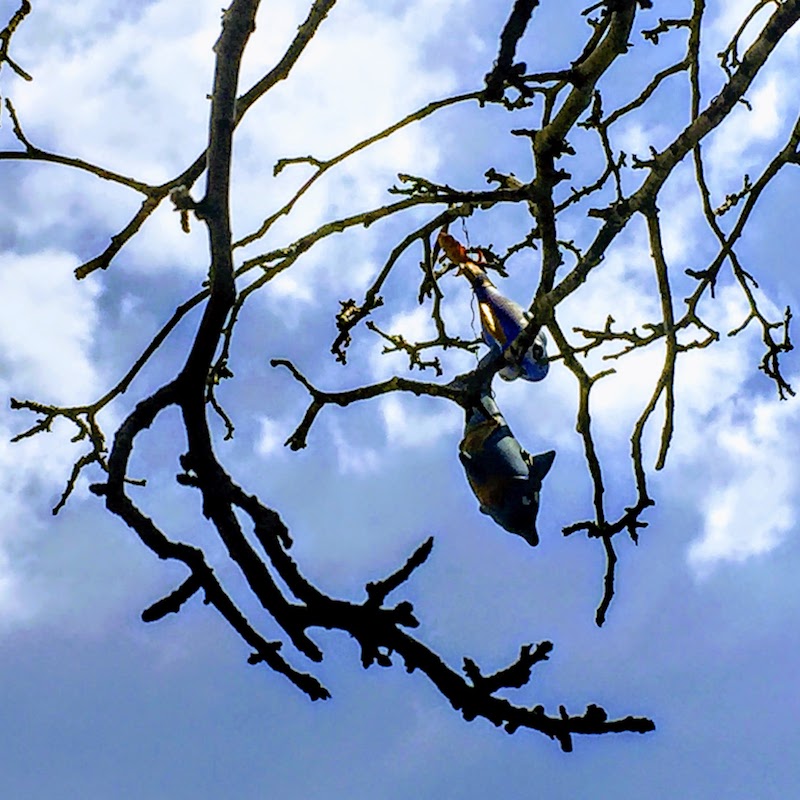
It started, as these things do, with just a single incident. Back in the early fall, out on an afternoon constitutional, the crew came across a curious sight. Tangled in the mid-level branches of a street tree on Centre Avenue was a six-inch plastic tiger shark, hanging by a length of rough twine tied around her tail fin. Following the string led to a purple dolphin, then a starfish, and so forth. Six miniature sea creatures in all, very much out of water, and awkwardly tossed into the leafy undergrowth just above head level.

strand of plastic toy fish tied together with twine and hanging from tree branches, Pittsburgh, PA

exhibit #1 aka “two sharks,” as found in East Liberty, Sept. 2017

As we’ve mentioned before, Orbit staff maintain a strict do-not-disturb policy when it comes to street art, pranks, and other happenstance findings in the public sphere. Our interns do not always abide by the same code of conduct.

Such was the case on this day, as cub reporter Lee extracted the string of toys from the overhead branches and brought it back home for further examination. While that felt very much like disturbing the scene of a crime way back in September, it would prove eerily prescient. It was only just recently that we became aware this was no isolated incident.

That’s right: Pittsburgh has a repeat offender on a loose and he, she, or they have struck enough times to warrant serial status. The East End Dangler walks among us, covertly decorating the city’s flora with strange garlands of (mostly) plastic fish.

6 plastic sea creature toys connected by twine

exhibit #1 aka “two sharks,” found on Centre Ave., East Liberty

Nearly seven months after that initial encounter, we were certainly in for a surprise. Walking back to the office on a chilly early spring afternoon–the belly still reeling from a lunch of huevos con chorizo con tortillas con frijoles con arroz y unlimited chips–to see a tiny die-cast aeroplane poking its propeller schnoz out of the newly-cut grass. On retrieval, we found the same tell-tale twine knotted around the plane’s tiny tail and rudder. It wasn’t until just this moment that the connection between aircraft design and sea life anatomy became so perfectly clear–but let’s stay on topic.

Our very same cub reporter not only identified the toy as “Dusty Crophopper” from Disney’s Planes but also spotted a tiny rubber fish nearby. The squishy little fellow was dislodged from the strand when its tail broke off, but in an unlikely and gruesome turn of events, the dismembered body part was still caught in the twine to confirm the relationship.

toy airplane on string of twine

exhibit #3 aka “Dusty Crophopper,” (partial) found on Centre Ave., East Liberty

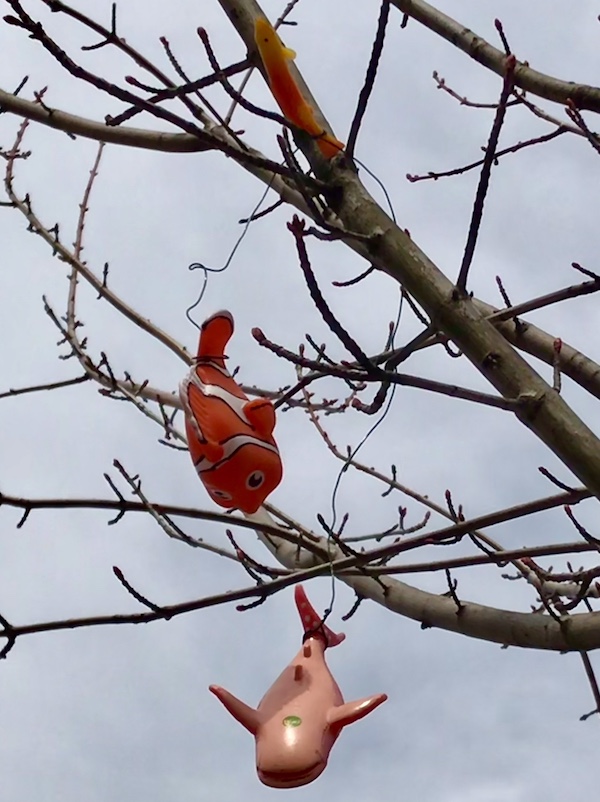
The revelation that the string of sharks was not a one-time deal would have–should have–been enough, but we were in for a couple more shocks. Mere feet away–O.K., maybe one or two hundred of them–was another bare tree with another set of dangling fish. In this case, two bug-eyed, cartoonish blue fish and one tiny red-orange fellow. Unlike the previous two marks of The Dangler, this trio was connected by wire (not twine) and thrown way up high, out of arm’s reach, but well within eyesight.

plastic fish toys strung together with wire and hanging from tree limb, Pittsburgh, PA

exhibit #4 aka “blue fish,” as found in East Liberty, April, 2018

Attentive readers are already yelling at their mobile devices, hopefully not in public restrooms. How did you jump from exhibit #1 to exhibits #3 and #4? What kind of amateur-hour investigation are your running around here?

Ah–that’s where the plot thickens! Lee had already bagged exhibit #2 (aka “orange fish”) and just never filed his paperwork. Way out of the relatively-small perimeter we were working, this yang to “blue fish’s” yin [three fish, the little one in the middle, single color scheme, wire connector–orange and blue are even opposites on the color wheel!] hung from a tree along Browns Hill Road, miles from Centre Avenue.

three plastic fish hanging from wire in a bare tree

exhibit #2 aka “orange fish,” as found on Browns Hill Road, April, 2018 [photo: Lee Floyd]

Like Ed Gein and Ted Kaczynski, Rudy Giuliani and Pauly Shore, we may never know what motivates The East End Dangler to do what they do. In lieu of any hard evidence on the person behind the dangling, we’re left with just the physical items: toys–specifically fish toys–and location.

On that first point, one popular theory holds that the perp is a parent, the child or children having aged out of their fish phase and into teenage alienation. What to do with those leftover sharks, goldfish, and neon tetras but string them up and throw them in city trees? A little goofy, but more unlikely events happen around us every day.

3 toy fish connected by wire

exhibit #4 aka “blue fish”, found on Centre Ave., East Liberty

These may also be the work of a prankster or frustrated conceptual artist. The nearby Goodwill on Centre likely offers an ample supply of second-hand toys at by-the-pound prices. If decorating trees with Happy Meal castoffs is your thing, it can be done easily and at bargain rates. As art? Well, it beats spray paint tagging.

A third opinion holds that we’ve got deeper symbolism here–something very specifically fish-related. All three of the Centre Ave. finds are within rock-tossing distance of the East Liberty Whole Foods; “orange fish” was spotted adjacent to the Hokkaido Seafood Buffet restaurant. It doesn’t take Hercule Poirot to connect these particular dots. Whether the Dangler might be addressing mercury in the food chain or the Pacific Ocean’s plastic vortex is unclear, but lines can certainly be drawn.

3 toy fish connected by wire

exhibit #2 aka “orange fish,” found on Browns Hill Road

We may never know…or this may just be the beginning of the conversation. If you’ve noticed the work of The East End Dangler (literally) hanging around a tree you frequent, please let us know. Until then, to paraphrase Casey Kasem, keep your feet on the ground, and keep reaching for the fish in the trees.


BREAKING NEWS: On the eve of going to press, The Dangler dropped another bombshell on us. There, in those same Centre Avenue street trees hangs yet another dangled concoction. This one appears to be just two toy airplanes, one a bulbous, cartoonish propeller; the other, a second Dusty Crophopper. As of this writing, the dangled bits remain tree-side.

toy airplane hanging from wire in tree limbs

exhibit #5 as found in East Liberty, May, 2018

Heavy Living: Cement City, Donora

2-story cement house with large side yard, Donora, PA

Cement City, Donora, PA

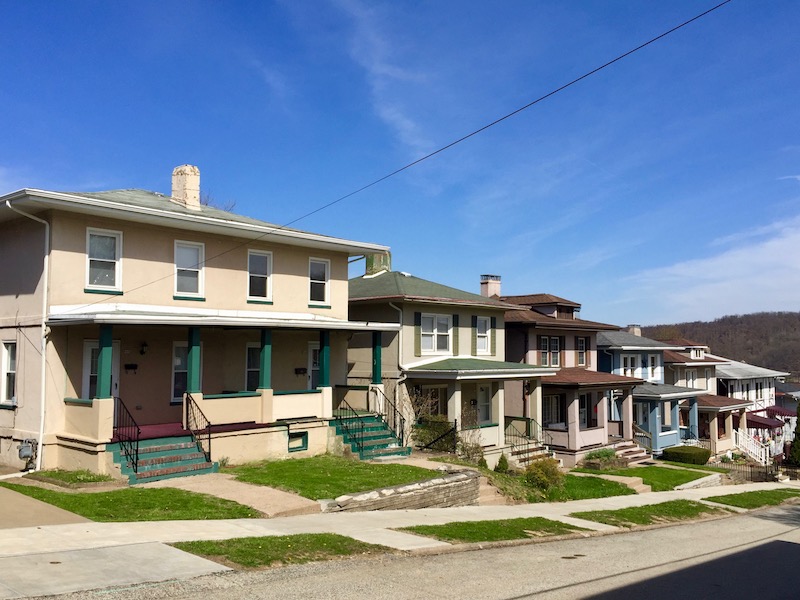
Spoiler alert: Cement City is neither. No, the lovely little residential neighborhood consists of a combined 80 single-family homes and larger duplexes lining just a few streets on a hilltop at the south end of Donora. With its 360-degree views across several different valleys, glorious green lawns, and kid’s bicycles left carelessly on front sidewalks, this is hardly the picture of urban life.

That name, though–Cement City. It’s industrial, brutal–fantastic even–like the fictional world created for a shoot-’em-up video game or dystopian science fiction. One might imagine each resident of Cement City as some version of Snake Plissken or Sarah Connor–an eyepatch, leather wristbands, and heavy weaponry required for the epic quest just to make it out alive.

Rest assured, though, nothing could be further from the truth. That said, Cement City does have a certain retro-futurism in its very interesting past.

row of cement houses in Donora, PA

houses on Walnut Street

In the first couple decades of the twentieth century, the Borough of Donora, 30 miles south-southeast/upriver from Pittsburgh, grew like crazy. It went from incorporation in 1901 to reaching its peak population just 20 years later. That was all on the boom of the American Steel & Wire Company. With its integrated blast furnace, open hearth, and ancillary industries in zinc smelting and product finishing, the U.S. Steel subsidiary was the local employer in this prototypic company town. We learned all about these in our tour of the terrific Donora Smog Museum over the winter.

Twice a year, the same folks from the historical society throw a terrific combined educational lecture/walking tour of Cement City, a hundred-year-old housing development borne of the perfect storm of new innovation, high-demand for middle-management lodging, and a massive corporate entity that could take the whole project on and manage it after its completion.

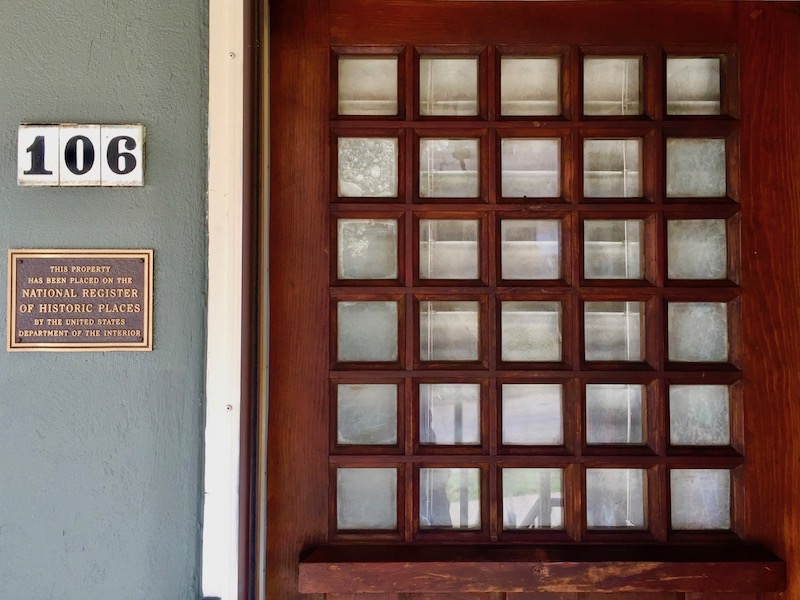
wooden door detail showing 30 small window panes

original arts and crafts-style wood door

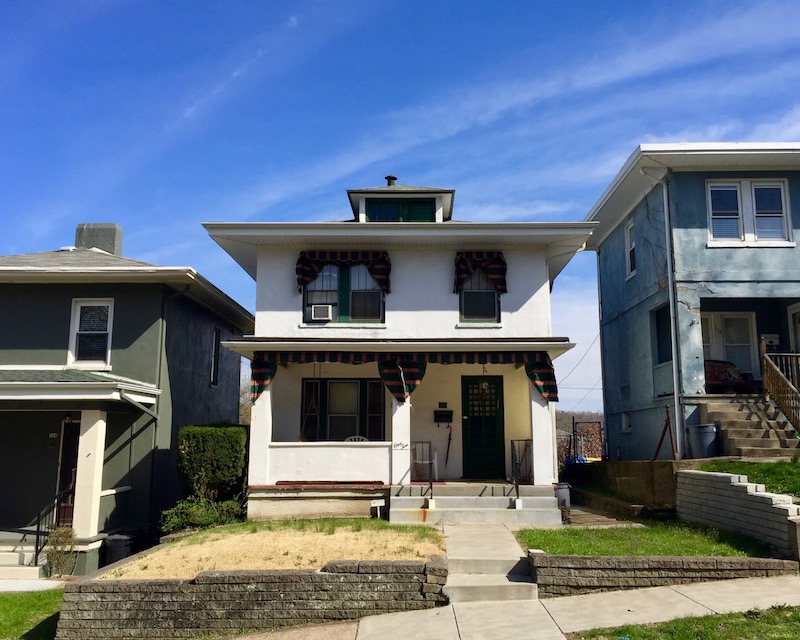
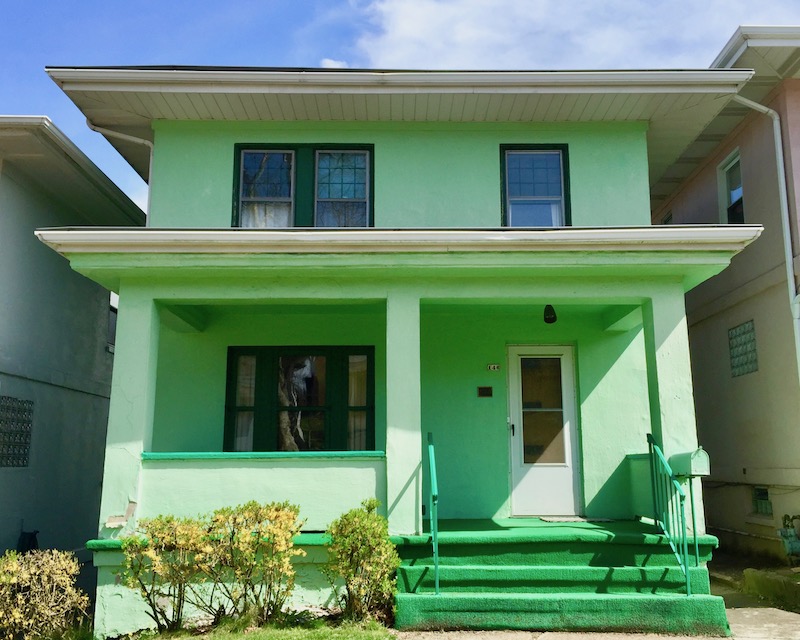
Today, Cement City doesn’t look that different than many other neighborhoods of pre-war, detached, American four-square houses–each with its own concessions to time. Here, a mismatched garage addition or fresh paint job, there, some buckling stucco or an obvious collapse in the fascia. Many houses have decorated with lawn statuary (including a generous number of front yard Marys) and ornamental landscaping; in others, the grill is lit, children’s toys are scattered in the yard, and bass-heavy party music blasts from open windows on this perfect Spring day.

There’s one big difference, though. Under the wide eaves and behind the technicolor paint jobs live skeletons of pure concrete. [Yes: concrete, not cement.] When industrial America needed to grow the most, Thomas Edison was trying to figure out what to do with all the concrete he’d been tinkering with. As a building material, concrete seemed perfect: it was cheap, wasn’t going anywhere, the termites wouldn’t touch it, and–most importantly in a pre-fire code America–it was impossible to burn down.

detail of cement ceiling in home in Donora, PA

basement ceilings reveal the original cement forms

We’ll not go into the whole history here–it’s just too much for one little blog post and we’d get the facts wrong anyway. But if you can go on the tour, D.H.S. president Brian Charlton will spin an engrossing yarn in a history that blends the often at-odds interests of Big Steel, quality-of-life, architectural design, and Age of Innovation new technology[1].

Suffice to say, it’s not easy to build a community of houses out of concrete–even more so on the slanted hillsides of Donora in 1916. Making the project cost-effective proved to be the biggest challenge of all. It takes an entirely different building model to pour in place the walls and floors of any construction. You need elaborate forms, a mobile mixing and delivery system, accounting for multi-day cure times, and then back-filling all the various trades that complete a home.

several cement houses on a hill in Donora, PA

Cement City houses on Bertha Ave.

Regardless, it all got done and the homes remain charming to this day. Eventually, the one-time company village grew from identically-maintained, corporate ownership to being sold off to individuals with the surrounding tennis courts and playground lots redeveloped into newer housing. Early photos show the neighborhood denuded of all vegetation as the land was clear-cut for build-out. Today, hundred-year-old sycamores line the sidewalks and reach way above the rooflines on Bertha and Ida Avenues as flowering dogwoods and manicured cypress decorate front yards.

All of Cement City’s original houses are still standing, largely occupied and in good shape. A remarkable number of other features–including original sluiced backyard storm drains and locally-made Ellword woven wire fencing–persist as well. There are similar Edison-era collections of concrete houses all over the Northeast and upper Midwest, but Donora’s set of 80 homes makes it the second-largest development of its kind.

detail of Ellwood woven wire yard fence made by American Steel & Wire Co.

hundred year old Ellwood woven wire yard fence, made locally by American Steel & Wire Co., in a Cement City backyard

Like we saw with Aluminum City Terrace in New Kensington, the transition from high-concept, mass-produced worker housing to present day free-market community is an interesting one. Were they alive to see them today, the after-market shutters, dish TV hook-ups, dangling gutter systems, and quaint lawn ornamentation would probably have given Edison and American Steel & Wire fits.

But the fact remains that good design endures, even if the humans that come along later monkey with the architects’ master vision of clean lines and a uniform presentation. It speaks volumes that 100% of Donora’s original concrete houses remain today–a hundred years after they were constructed–in a town that has lost more than two-thirds of its population in the same time frame[2].

cement house in Donora, PA with lawn statuary and porch modifications

Lived-in. Cement City house on Walnut Street with lawn statuary and porch modifications.

The next time you’re in Donora–and yes, make sure there is a next time–you’ll have to take in the classic McKean Ave. twofer of the Smog Museum and Anthony’s Italiano. Grab a hike up to St. Nick’s if you get a chance, too. But then consider making the short drive south and up the hill for a post-pizza constitutional around Cement City’s handful of streets. You’ll not be sorry you did.

concrete house in Donora, PA's Cement City

Cement City house on Ida Avenue

The Donora Historical Society will offer the next Cement City lecture/walking tours the weekend of Saturday, Sept. 22 and Sunday, Sept. 23. at 1:00 p.m. both days.

RSVP by calling 724-823-0364 or email donorahistoricalsociety@gmail.com


[1] Brian Charlton literally wrote the book (or, at least, detailed article) on Cement City. His article “Cement City: Thomas Edison’s experiment with worker’s housing in Donora,” appeared in the Fall, 2013 issue of Western Pennsylvania History.
[2] Donora’s current population is around 4,600 people, down from 14,000 in 1920. Source: https://en.wikipedia.org/wiki/Donora,_Pennsylvania