Hail, Mary! Front Yard Mary Roundup

grotto with statue of Mary in front yard, Pittsburgh, PA

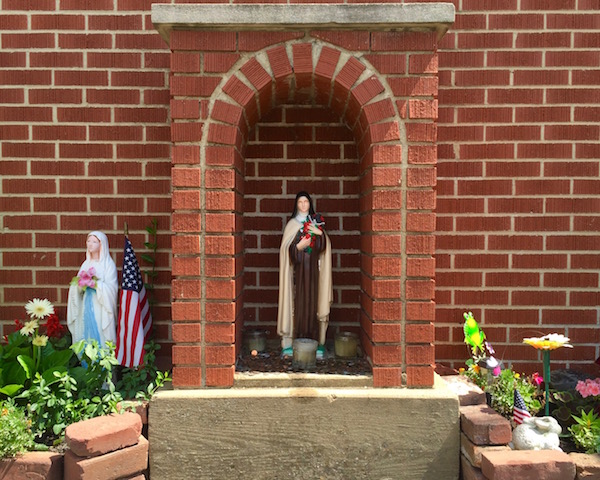
Deluxe grotto Mary, Spring Hill

With apologies to James Rado and Jerome Ragni:

Don’t ask me why, I’m just a Mary guy
I’m Mary noon and night, Mary, she’s a sight
I’m Mary high and low, don’t ask me why, don’t know

Not really expecting Mary to fly in the breeze, get caught in the trees, or provide a hive for the buzzing bees, we’ll end this frivolity right now–there’s big Mary business on the docket!

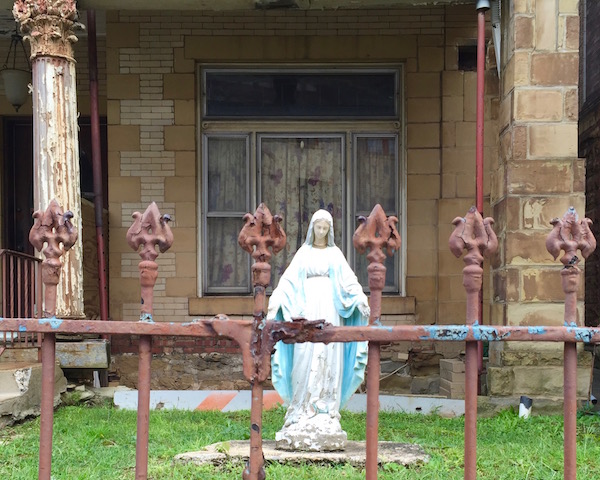
Mary statuette in front yard grass, Pittsburgh, PA

The Run

More Marys! In super-deluxe retaining wall grottos, bedecked in spinners and lights, obscured by Halloween decorations, enveloped in the deep-fry aromas of Big Jim’s, and standing alone in shame like a misbehaving student at recess.

The Orbit was not at all sated the by The Front Yard Marys of Bloomfield. No, that June, 2016 scene report just whet an appetite that inspired us to climb mountains, ford streams, and canvas for Hillary Clinton to slake this curio-religious thirst. Drink up.

Statuette of Mary in front yard, Homestead, PA

Homestead

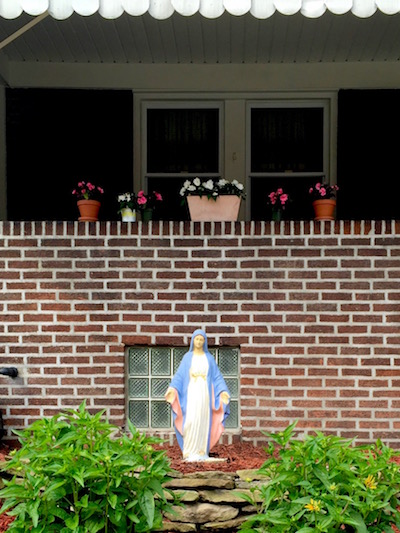
Mary statuette in front of brick house, Pittsburgh, PA

Stanton Heights

Mary statuette in front yard, Pittsburgh, PA

Morningside

statue of Mary in front of older pink frame house, Pittsburgh, PA

Oakland

front yard Mary in grotto with a separate front yard Mary, Pittsburgh, PA

Big Jim’s Marys, The Run

Front yard Mary, Pittsburgh, PA

Lawrenceville

Mary statuette in wooded yard, Pittsburgh, PA

Mary of the Wood, South Side Slopes

Mary statue in grotto in front of frame house, Pittsburgh, PA

Halloween Mary, Spring Hill

statuette of Mary in front yard of house, Pittsburgh, PA

Allentown

Three statuettes of Mary in front yard of home, Pittsburgh, PA

Trio of Marys, Stanton Heights

statue of Mary in homemade grotto, Pittsburgh, PA

Back yard Mary, Lawrenceville

Fairywood: The World Without Us

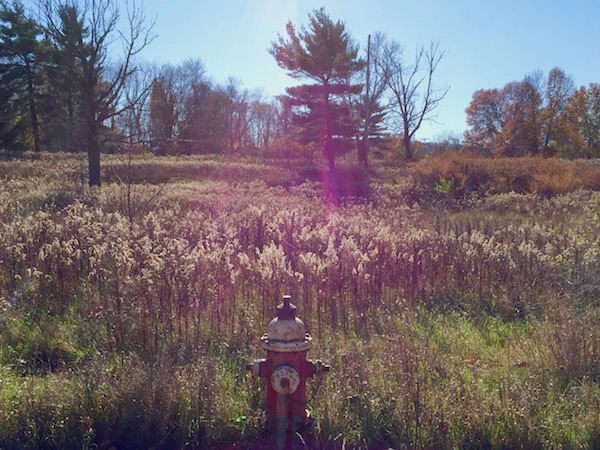
fire hydrant in field of tall weeds, Pittsburgh, PA

Former Broadhead Manor public housing project, Fairywood

Fairywood. Has any place as bucolic a name? One would assume it could only exist in fantasy–within Narnia or Neverland or, at least, New Zealand. Fairywood must be a land of eternal mist, riddle-spinning toadstools, magick staffs hewn from gnarled bentwood, spellcasting. It is where banshees live, and yes, they do live well. But one need not cross the Misty Mountains nor the darkest depths of Mordor[1]–it’s right here in the City of Pittsburgh.

If one were to set out for Fairywood, she or he might also optimistically hope to encounter pixies, gnomes, gremlins, griffins, or unicorns along the journey. Such other-worldly creatures simply must exist in the forest faerie realm. Alas, that was not this blogger’s experience.

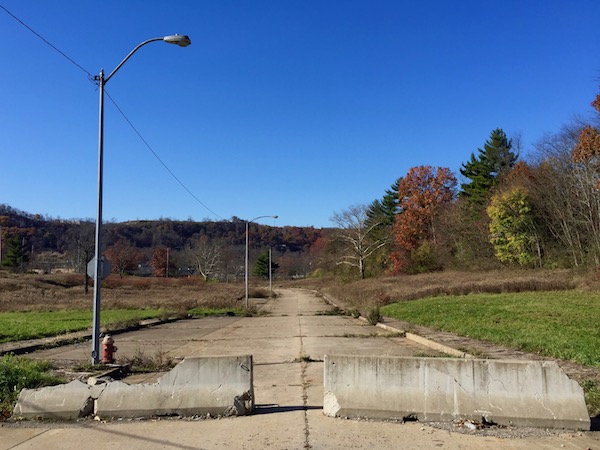
empty street with jersey barriers at entrance of former Broadhead Manor, Fairywood, Pittsburgh, PA

Entrance from Broadhead Fording Road

Look up Fairywood and you’ll likely come across some bad press. At this point, the peninsular neighborhood on Pittsburgh’s far southwestern border [it is surrounded on three sides by non-city boroughs] is mainly associated with two things: colossal ex-urban warehouses and off-the-charts crime.

The former is easy to see–along the south and west perimeters are huge distribution centers for UPS, ModCloth, Amazon, and Giant Eagle/OK Grocery. The hum of their idling 18-wheelers and beeps of reversing forklifts are omnipresent even from a great distance.

The latter is not so obvious. On a picture-perfect Saturday afternoon, we barely encountered a single living soul–and the ones we did meet were real nice! The sum of residential Fairywood is contained in four or five streets of pre-war frame houses and Baby Boom-era pill boxes and split-levels, plus one former project-turned-gated community. Only around a thousand people live here. Who’s committing all this crime?

cul-de-sac in former Broadhead Manor, Fairywood, Pittsburgh, PA

Cul-de-sac

Alan Weisman’s 2007 best-seller The World Without Us detailed the ways in which the built environment would inevitably deteriorate in the absence of human beings. I’ll confess I haven’t actually read the book, but Mrs. The Orbit did and relayed its projections of houses collapsing and cities overtaken by nature as I was suddenly getting much more aware of cracks in the plaster ceiling and loosening of our mortar joints.

By far, the most prominent feature of Fairywood today is the enormous negative space created by what was at one time the Broadhead Manor public housing project. In its absence is a massive plot of land–its footprint similar in size to a junior college campus or suburban shopping mall (including all the parking). The actual housing blocks have been razed and removed, but the infrastructure–several curling roads that terminate in dead-ends, street lights, sidewalks, fire hydrants, an absurd children at play road sign–all remain.

handrail and concrete sidewalk to urban prairie, former Broadhead Manor, Fairywood, Pittsburgh, PA

Handrail, sidewalks

Between these few remaining stretches of concrete, nature has come back hard and fast. It’s a very un-Pittsburgh landscape–almost completely flat (although you can see hills in the distance in any direction) and dominated not by trees, but instead with scrubby waist-high bushes, weeds, and wildflowers–much more midwestern than Appalachian. Nationally, these kinds of spaces have been coined urban prairies for a reason–they’re not quite nature without man, but they’re decidedly not city (as most tend to think of it) either.

That Broadhead Manor should or should not have been razed is a conversation for those who actually lived in and around it[2]. With no personal connection, it does strike me as a classic built-to-fail situation: warehousing people in closed-circle public projects at the most distant edge of the city in a neighborhood with neither business district nor many transportation options[3]. What could go wrong?

Man in winter clothes against chain link fence, Pittsburgh, PA

Mr. Ro Ro (note his wizard’s staff)

We met Mr. Ro Ro camped out on a folding chair, waiting for a bus on Prospect Avenue. A wizard’s staff was casually propped against the chain link fence. Mr. Ro Ro told us he’s lived in Fairywood for fifty years and said of Broadhead Manor, “Roosevelt built them after the war.” President Roosevelt’s connection is unknown, but Broadhead Manor was indeed former military housing, purchased by the city in 1946[4].

As the only human wandering through the strange dystopian landscape of an ex-neighborhood with all its buildings removed–now almost completely reclaimed by nature–the irony of the phrase “after the war” was ringing in the air. More than anything else, this huge section of Fairywood feels like what’s left after the nuclear winter has finally subsided and an entirely new form of nature begins again on the bones of the civilization that destroyed the old one. Let’s hope we get it right this time.

dead end street in former Broadhead Manor, Fairywood, Pittsburgh, PA

The end of the road


[1] It is telling that The Orbit‘s knowledge of Middle Earth comes more from Houses of the Holy than The Player’s Handbook.
[2] A post in the Abandoned, Old & Interesting Places – Western PA FaceBook group shows some of the housing after the residents had been moved but pre-demolition. It includes many comments–both positive and negative–including quite a few former residents who speak glowingly of their time at Broadhead Manor in the 1960s.
[3] Port Authority’s 27 bus route serves Fairywood and nearby neighborhoods with a link to downtown Pittsburgh.
[4] Fairywood Fact Sheet (date unknown) http://digitalcollections.library.cmu.edu/awweb/awarchive?type=file&item=550317

Castle Damas

retaining wall on hillside constructed to look like medieval castle, Pittsburgh, PA

Castle Damas, Spring Hill

Rick Sebak’s inevitable future Pittsburgh history documentary Great Retaining Walls of Allegheny County should begin right here, in Spring Hill.

Castle Damas[1], a medieval fortress whose turrets and battlements were formed from mortar and stone rises with a spectacular view of the lands it holds dominion over–through the valley, down to Spring Garden, and across the river to the Strip District.

That these impenetrable walls should stand just up the block from the Spring Hill spring is no accident. The first settlers of Damas Street wisely selected an optimal site for defense, visibility, quality of life, and its free-flowing supply of life-sustaining cleanish natural spring water[2].

house with retaining wall on hillside constructed to look like medieval castle, Pittsburgh, PA

The keep and battlements of Castle Damas

Given the news of the week, we can assume we’ll all be getting a little more familiar with wall-building. On our recent visit, we were fortunate enough to meet the lord or this particular manor, who’s probably got as much wall experience as anyone. This day, our regent was engaged in maintenance of the structure, giving his naves a precious Saturday off and pulling weeds from the parapets himself. Lord Damas [Swiss cheese-for-brains failed to record the homeowner’s given name] told us his hilltop house was built in 1926 and its first owner, a baker, began construction of the elaborate wall around 1933.

Perhaps because it hasn’t been around quite as long as its European cousins, the castle wall and its bungalow-style keep are in impressive condition. Our liege told us he’d had to rebuild the top left half of the battlements and after pointing it out, the different colored mortar makes that somewhat obvious–but there’s enough variance in the stonework that this masonry-challenged blogger probably wouldn’t have noticed otherwise.

figure of an owl created with concrete and reflectors, Pittsburgh, PA

The owl of Castle Damas

Brendan Gill, (then) architecture critic for The New Yorker, famously wrote “If Pittsburgh were situated somewhere in the heart of Europe, tourists would eagerly journey hundreds of miles out of their way to visit it.”[3] This blogger’s about as crazy cuckoo coconuts on Pittsburgh as anyone, but even he can recognize hyperbole when he trips on it.

That said, when just any old anonymous hillside street gives us these cross-city views, this public spring, and a terrific faux castle/retaining wall overgrown in beautiful wildflowers and fall colors, birds–even a guard owl–well, who are we to argue?

retaining wall on hillside constructed to look like medieval castle, Pittsburgh, PA

Castle Damas


[1] “Castle Damas” is Pittsburgh Orbit‘s name for the construction–don’t bother looking it up (at least, not by that name).
[2] We’ll note that the construction of the uphill houses on Damas Street was considered a contributing factor to the discoloration and impurity of the sping’s water.
[3] In the same quote, Gill also claims “The three most beautiful cities in the world are Paris; St. Petersburg, Russia; and Pittsburgh,” but if the guy has never even been to Akron, take it with a grain of salt.

Get Out The Voegt: Finding the Spring Hill Spring

natural spring in concrete pedestal embedded in hillside, Pittsburgh, PA

Spring is sprung: Voegtly Spring, The Spring Hill spring

Ask a Spring Hill local how to get to the neighborhood’s newly-unearthed and re-opened natural spring and he or she will make it real easy for you: “It’s right by the boxing ring.” Me: “Oh, thank you very much, that helps a lot. Just one more question: where’s the boxing ring?”

From there, it just gets more confusing. The “boxing ring” is actually the Steel City Boxing Association and Google Maps puts it way down the hill from its true location. Assuming you do find the right place, the stonework is engraved Hook & Engine Co. 53 for its (former?) life as a fire hall and contains no after-market mention of the sweet science.

How about the Internet–a recently excavated and restored piece of local history should be front page news, right? Well, you try a web search for “Spring Hill spring”–it’s un-Googleable! Spring Hill’s Internet presence doesn’t assist at all–there’s nary a peep about the spring from the neighborhood associations or its wiki page. C’mon, guys–help a blogger out!

Rest assured, dear reader: if we achieve nothing else, The Orbit will get you to the Spring Hill spring.

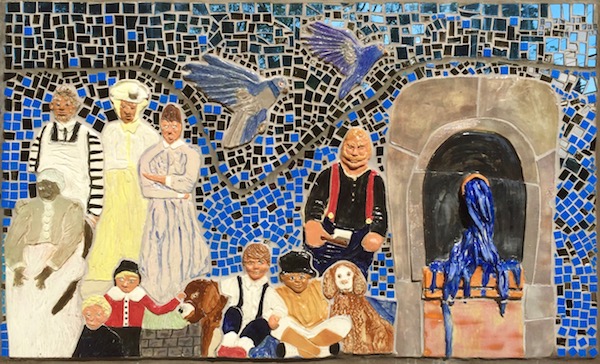
Detail from public mosaic "The German Settlers of Spring Hill" depicting the Spring Hill spring, Pittsburgh, PA

“The German Settlers of Spring Hill” (detail) mosaic depicting Voegtly Spring, Spring Hill

A large mosaic installation titled The German Settlers of Spring Hill welcomes visitors near the corner of Homer and Damas Streets*, one of just a few access points to the hilltop neighborhood. The final section of the four-panel piece features various community members in old world garb gathered around the image of the hearth-like Voegtly Spring, the natural water source that gave Spring Hill its name.

In that depiction, the spring is a flooding outpour overflowing its basin, its output equal to a dozen garden hoses. That’s not exactly what we found. The constant stream of water–there is no Off valve to a natural spring–is more of a dribble or a trickle than the gusher one might expect from the artwork mere feet away. That may have something to do with us visiting after a run of dry weather, so we’ll have to go back to verify after a decent stretch of rain.

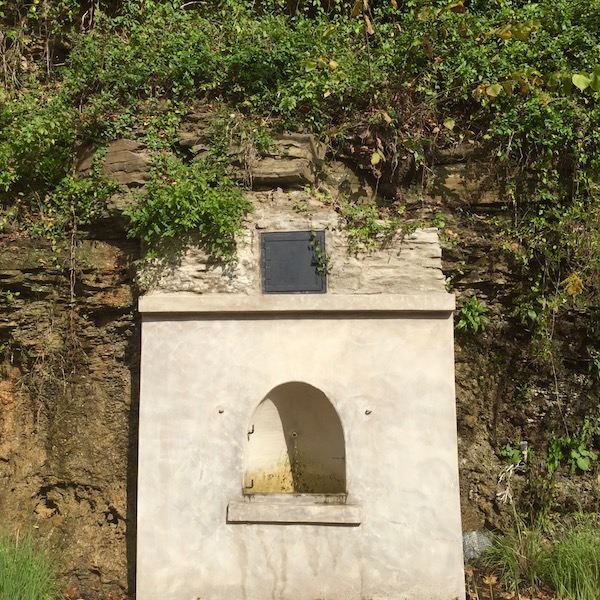
masonry enclosure around pipe dribbling natural spring water, Pittsburgh, PA

The spring

Some background, from the Voegtly Spring historic nomination form**:

A stream ran down from the top of Spring Hill, ran through the intersection of Humboldt St. (now Homer St.) and an unnamed street (now Damas St.) and down into modern day Spring Garden (Fig. 4). In 1912 a rectangular stone and concrete structure was built into the shale hillside alongside Damas St. (formerly Robinson Road) to harness the flow of water beneath the ground to provide easy access to drinking water for the residents of the neighborhood and surrounding area.

The nomination form goes on to mention that “the spring water was tested and shut off sometime in the 1950s” and that house construction above the spring “may have contributed to [its] contamination”. Furthermore, “It is reported that during this time the spring water developed a distasteful odor and became a yellowish orange color.”

There’s no official word on whether the discoloration is still in effect, but it looked fine to my admittedly low standards. Despite the warning that “public works does not encourage its use because [the water] is not treated”, it’s certainly right there for the drinking and let’s face it: it’s cool to suck spring water right out of the hillside. Lesser journalists–speculative or otherwise–would turn toward home after snapping some pictures, but this blogger rushed in for a righteous century-in-the-making quaff.

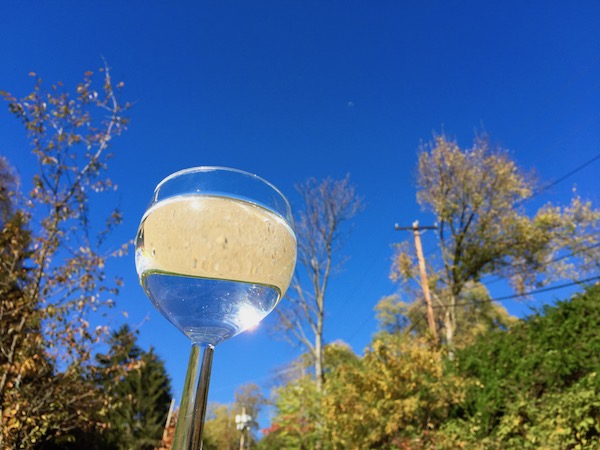
glass of water from Voegtly Spring, Pittsburgh, PA

No discoloration here. Voegtly Spring water.

So…what does Voegtly Spring’s water taste like? Well, it ain’t Perrier, that’s for sure. If it’s not too vague, we’ll describe it as earthy, or maybe minerally. Flavorful–but I wouldn’t describe that flavor as desirable. It’s maybe a little gritty–like a woodsy stream–surprisingly warm, and decidedly different from city tap water (for good or bad). That said, it doesn’t have the natural toe-tingling effervescence of more celebrated waters. I’ll go out on a limb to suggest it’s unlikely we’ll encounter Winnebagos parked on Damas Street with tourists filling five-gallon jugs like you regularly see down in Berkeley Springs.

I’ll be honest: there’s not a lot else to do at the spring. You can drink from it straight like a water fountain and you can fill up a jug. That’s pretty much it. As entertainment, a visit is pretty low rent compared to, say, Pac-Man or The Jumble. Regardless, it’s a neat little old world nugget to trip across if you find yourself hanging out by the boxing ring or, more practically, desperately need some hydration and can’t quite make it down to Penn Brewery.

Here, on this eve of an incredibly important national election, we can only recommend that Orbiteers first get out and vote. And then, if you’re still not satisfied, get out and Voegt.

masonry enclosure for natural spring in hillside, Pittsburgh, PA

Voegtly Spring, The Spring Hill spring

Getting there: Voegtly Spring is on Damas Street, just off Homer. When you see the old Hook & Ladder Company or the big public mosaic/garden, you’re real close. The easiest way to get there (especially on bicycle) is from Spring Garden Avenue, up the hill on Homer. We’ve also added a pin for the spring to our Map page.


CORRECTION: An earlier version of this story quoted an August, 2016 Post-Gazette piece on the re-opening of the spring that incorrectly lists Fred and Wilbert Bergman as the builders. The Bergmans took the earliest known photograph of the spring, but construction was done by the city Department of Public Works.


* The mosaic was constructed by a large group at the leadership of Linda Wallen, whose Yetta Street mosaics (also in Spring Hill) we profiled last year.
** A big thank-you to Spring Hill resident James Rizzo for helping to clarify the facts on ownership and construction of Voegtly Spring.

Day of the Dead: Susan Hicks, Uber Alles

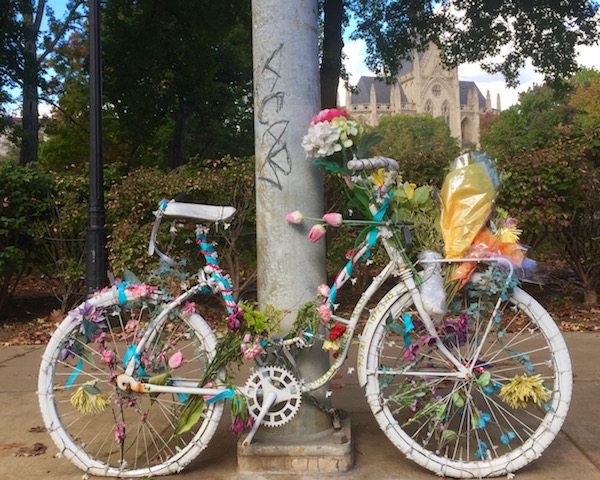
bicycle painted completely white and decorated with flowers and lights, Pittsburgh, PA

Ghost bike memorial for Susan Hicks, Oakland

Last week marked the one year anniversary of Susan Michelle Hicks death. This blogger didn’t know her personally, but Ms. Hicks was “friends of friends” who commuted–and was killed–riding her bicycle on a stretch of Forbes Avenue in Oakland where I ride all the time. Quite literally, it could have been me.

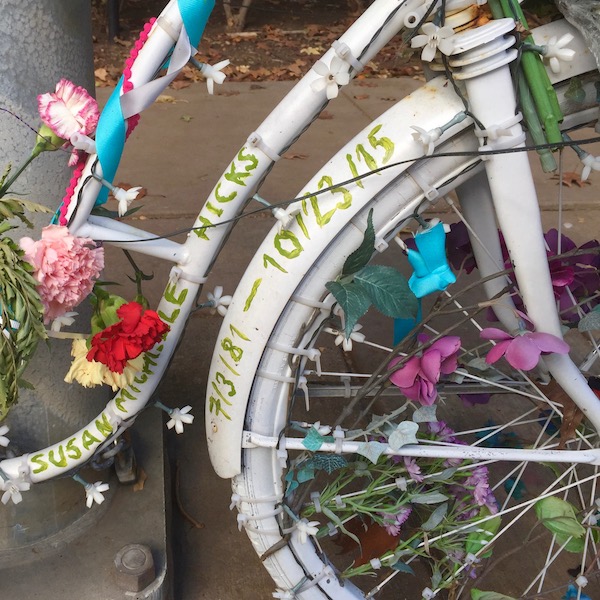
Very near the tragic spot where Ms. Hicks died, just across the street from Dippy the Dinosaur and the Carnegie Music Hall, is a so-called “ghost bike” memorial. Chained to the pole of a stout street lamp, it’s a decommissioned older bicycle, painted completely white, draped in flowers, ribbons, personal messages, and a strand of solar-powered lights. A felt-tipped pen left on the seat invites visitors to ink inscriptions to the fallen–many have done so.

The effect of seeing the Hicks ghost bike–or any other–is incredibly moving. It’s both beautiful and haunting, arresting, sombre, and reverent. It’s also encouraging that this obviously-un-sanctioned memorial has been allowed to remain intact; city works crews choosing to leave it alone–now, for over a year–in this very public, well-travelled spot instead of treating it as an act of litter or vandalism.

detail of ghost bike for Susan Hicks, Pittsburgh, PA

Statistically, Pittsburgh is among the very safest U.S. cities to be a bicycle rider/pedestrian. This is, perhaps, surprising given our severe infrastructure challenges, but according to some numbers collected by Bike PGH, the city’s rate of 1.8 fatalities per 10,000 commuters is way down the list of American cities. As comparison, the bottom of the collection contains Ft. Worth, Detroit, and Jacksonville, all with an average of 40 to 50 fatalities on the same scale.

That said, it’s sadly no surprise this particular tragedy happened in the heart of Oakland. Any Pittsburgh cyclist will tell you what a nightmare it is to navigate the neighborhood on two wheels. It’s nearly impossible to feel safe riding from, say, Neville to Atwood, or CMU to Pitt without either breaking some kind of law or going way out of your way–and this is a part of town with 40-some thousand college students! I get mad at the kids riding on sidewalks, but what alternative do they have?

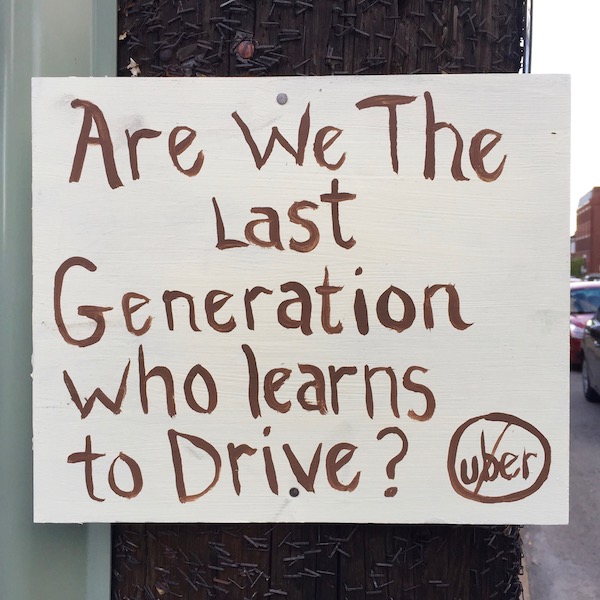
Handmade sign reading "Are we the last generation who learns to drive?", Pittsburgh, PA

Anti-Uber sign, Oakland

On a recent ride home from work, I came across a batch of wooden signs nailed to telephone poles. On each was a hand-scripted message: Are we the last generation who learns to drive? read one on Craig Street, and Humans crave community, not isolation another. The messages continued in Bloomfield:  Automation smothers natural beauty and awe and Deep in your humanness, your heart longs not to be mechanized.*

If you’ve spent any time in the East End over the last half year, you know where these are coming from. Uber self-driving cars are being tested all over the city–we see them every day**. It’s a technology that’s not without controversy, but surprisingly little considering the potential societal implications. Overall, opinion has felt more like a collective ho-hum.

collage of photos of Uber self-driving cars being tested on Pittsburgh city streets

Uber self-driving cars testing in Pittsburgh [photos, clockwise from top left: P. Worthington, M. Hertzman, A. Hoff, K. Barca]

The full point of these guerrilla signs is not entirely clear, but each contains Uber’s name in a crossed-out circle. We can assume the opposition to the ride-sharing company is the anonymous sign-poster’s major thesis, but there are also messages around community, beauty, and “humanness”.

Is Uber being accused of colossal corporate takeover? Or is the issue that they’re developing self-driving technology? Assuming the latter, how does changing the way a car navigates “smother natural beauty and awe”? [We did a pretty good job of this way before Uber came along.] Plenty of people drive alone every day–why do these vehicles create any more isolation than any other solo car trip?

If we’re worried about the number of Uber (and other) human drivers who may be put out of work by this technology, that’s legit. But let’s not assume that’s the only sociological possibility for self-driving vehicles. There is the very real likelihood that autonomous cars will be much safer on the road than humans. They certainly won’t drive drunk or fall asleep at the wheel. They won’t show off to impress the girls in the back seat and won’t take their eyes off the road when their phones light up. There are a whole lot of people with disabilities who can’t wait for an alternative to Access.
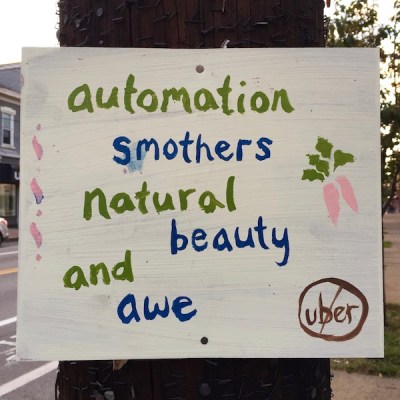
Handmade sign reading "Automation smothers natural beauty and awe", Pittsburgh, PA

Anti-Uber sign, Bloomfield

Bicycle riders are not saints. There are a lot of dangerous people out there, and we come across them every day–treating sidewalks as bicycle lanes, recklessly jack-rabbiting through traffic, ignoring traffic lights, signaling, and stop signs. Cyclists who take off without a helmet or foregoing lights in the dark are just plain foolish.

These are condemnable actions that frankly burn this biker’s breeches–you guys give us all a bad name! That said, it’s nothing compared to the regular behavior we see from drivers toward cyclists. I’ve never been hit by a vehicle driven by a computer; the same can’t be said for humans. In my years (ahem, decades) on two wheels, I’ve been spit on, had trash thrown at me, yelled-at, cat-called, and aggressively hip-greased more times than I can recall. Drivers routinely drift absent-mindedly, park in bicycle lanes, and wildly swing open their parked doors without first consulting their mirrors. While driving, they eat and drink, talk on the phone, apply lipstick in the rearview mirror, and, of course, are constantly texting.

Given all this, I’ll take my chances with the robots. If they’d been deployed to Oakland last year at this time, maybe Susan Hicks would still be with us and on the road today.

bicycle painted completely white and decorated with flowers and lights, Pittsburgh, PA

Ghost bike for Susan Hicks, Oakland


* If anyone has seen more of these, we’d love to know about them.
** So far, always with a human in the driver’s seat.