The D.I.Y. Graves of Highwood Cemetery, Part 1

handmade grave made of 2x4s with photograph and Hennessy bottles, Highwood Cemetery, Pittsburgh, PA

Unknown

The cemetery, perhaps more than any other civic institution, implies permanence–or maybe eternity. Headstones are carved from granite or cast in bronze. The deceased are entombed in a manicured landscape that we optimistically imagine will appear with the same tranquility forever. Rest in Peace is both believable fantasy and contractual expectation for those laid out under its well-groomed acres.
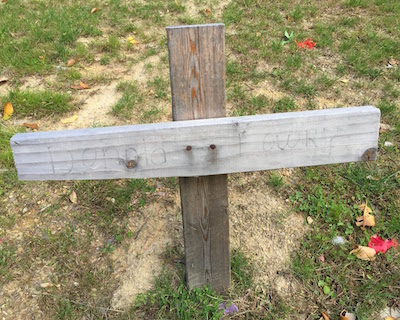
handmade grave made from 2x4s, Highwood Cemetery, Pittsburgh, PA

Donald Lowry

So The Orbit‘s purely accidental arrival on a section of homemade or “do-it-yourself” grave markers at the far back of Highwood Cemetery was both a complete surprise and a total revelation. From a single PVC pipe with a child’s art class cement step stone to a pair of two-by-fours crudely nailed together, the departed’s name applied with a Sharpie to the bare wood, these memorials are already sun-bleached, rain-soaked, and definitely won’t make it through that many Pittsburgh winters.

diy-grave-brub-efb

Brub E.F.B.

This blogger will be the first to admit his general good fortune, both in life, and yes, in death. He’s still breathing, for one, and has never had to bury anyone, never had make funeral arrangements or pick out a casket, never had to select a grave plot or deal with a funeral home, never even had to make awkward conversation with distant relatives at the wake of a close loved one.

And so, of course, I’ve also never been in the position to select a headstone. Nor had I ever even considered that one might be able (err…allowed within the cemetery’s rules) to do this for oneself.

handmade grave with wooden cross and paving stones, Highwood Cemetery, Pittsburgh, PA

Bruce A. Jones

This whole month, Pittsburgh Orbit has been visiting local cemeteries. You start to see some interesting patterns when you spend enough time in a place. One of those is that in terms of visitation, our cemeteries may be roughly divided into three general sections. There’s the older parts, full of dramatic high-gothic mausoleums, giant focus cenotaphs, stained glass, and ornate statuary, often accompanied by a (locally) famous name. Jennie Benford gives a great tour of such monuments in Homewood Cemetery. Then there are the newer sections of (generally) more humble graves for the recently-departed. These collect nearly 100% of the flowers and teddy bears. And then there’s everybody else.

handmade grave with wooden cross, bandana, and Steelers hat, Highwood Cemetery, Pittsburgh, PA

R.W.G. Bang

If your name isn’t H.J. Heinz or Lillian Russell or Stephen Foster and if you didn’t choose a gravestone tribute to Jaws, well, your monument may be available–and it’s probably still in good shape and totally legible–but realistically, probably no one cares that much. I’m not trying to harsh the mellow of someone who’s, you know, already dead, but it’s the truth. Even etched in stone, we’ve got a limited shelf life.

handmade grave with wooden cross, blue bow, and flowers, Highwood Cemetery, Pittsburgh, PA

Keith

I think this is ultimately what gives Highwood’s D.I.Y. graves such emotional power. These aren’t cold stones that will dramatically outlive the families that planted them. They’re very much living tributes for the people who are still in their lives and they will exist for exactly the time they’re most in need–while their loved-ones are still grieving.

I don’t know if it will ever happen, but you could imagine this as a really beautiful, sustainable model for the future. Allow the family to have the closure of a funeral, burial, and a completely home-made memorial that they can visit for five or ten or twenty years–whatever makes sense. But ultimately return the earth to a general pool for another generation to use.

That may or may not be something that would sell to the general cemetery customer but I’d be willing to–let’s abuse our metaphors here–put it in the ground and see who eulogizes it.

Homemade grave with PVC pipe and cast concrete medallion, Highwood Cemetery, Pittsburgh, PA

Dad


Orbit note: There are so many of these D.I.Y. graves in Highwood and they raised so many interesting questions that we decided to break this into two posts. Here’s part 2.
Rose of Sharon

angel statuary with broken wing under tree

Only when the sun had just crested the rooftops was it visible. There, in the backyard, under the Rose of Sharon, seen through the kitchen door. Just put the coffee on, pulled the bathrobe tight, squinted into the early light to make something out. It was staring back at him.

Colder now than it ought to be. Maybe that happened every year at this time. Remembered years past leaving Virginia in shirtsleeves and arriving back to Western Pennsylvania freezing rain. The rest of the seasons always seemed closer in sync, but the quick transition to fall made it feel like a different world.

Still looking out the window. The neighbor hates that tree. Every lovely spring flower produced aggressive new sprouts where it dropped anchor, many of them on her side of the fence. The neighbor has to beat them back when she weed-whacks around her tiny above-ground pool. One more thing to be mad at him about. Felt guilty–but not guilty enough to take out the tree.

The coffee maker gurgled and let out its last great gasp. Felt sorry for those people who couldn’t get up early, or forced to stay up late. Morning light, crisp air, near perfect silence. People rise earlier the older they get, he’d been told. Hoped to one day wake easily at dawn, to have the full sunrise experience every day, without effort.

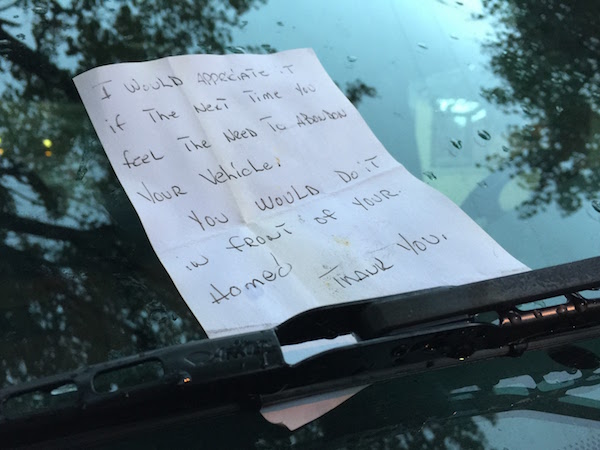
The windshield of a green Honda held an angry note with neat Catholic school penmanship: I’d like to park in front of my own house. Park where you live! This familiar drama played itself out regularly. Strangers left their vehicles out front when they hit the bars down the hill or stayed over at the apartment building next door.

Retrieving the newspaper on a weekend morning, it was not uncommon to find random jetsam from the previous night’s revelry: a stray beer can, hamburger foil, an unfamiliar automobile. One time he’d found a ceramic coffee mug with the emblem of a rehab clinic in Carlisle. It was never a big deal. The neighbor thought she owned the twenty-four feet of city street in front of her house. She should have put in a parking place instead of that pool.

Note left on car's windshield reading "I would appreciate it if the next time you feel the need to abandon your vehicle you would do it in front of your home. Thank you."

The first day to see his breath. Streets uninhabited, save for a pair of early-risers sitting on benches in the sun, hands crossed on the top of a walking cane. A near-empty city bus rumbled through, headed out of town. Fast food bags, cigarette butts, and early felled leaves eddying with wind gusts in the inset storefront entranceways.

Trees at the lower gate to the cemetery make a natural tunnel that glows golden orange as the morning sun pours through changing leaves. Here, before the sounds of the city come to life, before families visit loved-ones, and before the joggers and cyclists challenge themselves up and down its steep terrain, was his most sacred place.

Clusters of deer bound up and over the hills, through the weathered graves, pausing in unison to look curiously at the human disturbing their quiet time. Each member of the small group posed in concert like a dramatic point in a modern dance, cautiously allowing him to approach as close as twenty feet before some inaudible signal triggers the group to spring off into the wood.

A dumpster filled with most unusual contents. Piles of fake flowers, wreaths, filthy teddy bears, plastic placards, laminated photographs. Lifting the container’s lid, there was a two-foot concrete angel with one of its wings broken off. Hoisted the statuette from the bin, cradled the heavy piece like a load of firewood, walked the half mile back to the house.

Home again, the sun higher now with the morning fog burned off, under the Rose of Sharon. Pulled weeds, rerouted a set of raspberry tendrils always reaching for more distant soil to colonize. Placed the statue along the fence where the creature had spotted him earlier. Maybe the angel could still keep evil away, even short a wing.

Sad Toys: Graveyard Edition

pink teddy bear leaning against gravestone

Pink bear, Highwood Cemetery. [Yes: for a sad toy, this guy looks pretty happy–but don’t let that grin fool you!]

The grass-is-greener daydreamers that loaf around Pittsburgh Orbit’s office imagine there’s a point in any blog’s creative arc when the pieces begin to fall together without even trying; when the self-referential tropes loop in on themselves. Like a well-primed compost heap, or a nuclear meltdown, heat is generated all on its own and the stories pop out as fully-formed posts, and then barrel their way through the earth’s core.

“Imagine”? Hell: we’re counting on it! By one reasonable calculation, mere months separate the Orbit from magically appearing on your computer screen without any legwork or finger-clicking on our part. There’s Yoo-hoo in the fridge, call me if you need anything–just don’t interrupt my Rockford Files.

four plastic action figures in weeds in front of gravestone with date and epitaph

“Our Beloved Son”. Superheroes in the weeds, Highwood Cemetery

Whatever the reality of “publishing” “new media,” we don’t think we’re abusing too many metaphors to say there was some kind of magic that happened when this little piece of manna dropped from the sky and rolled across the Orbit editorial desk. There it was: a story with all the ingredients for the most satisfying of autumn blogging stews: a heaping helping of cemetery tales, a motherlode of sad toys, a dash of pathos, some human expression, and nature-without-man chaos. Bitter, sweet, and yes, umami. Oh, and it was all timed for Halloween season–when the graveyard toys rise up to take back what is rightfully theirs.

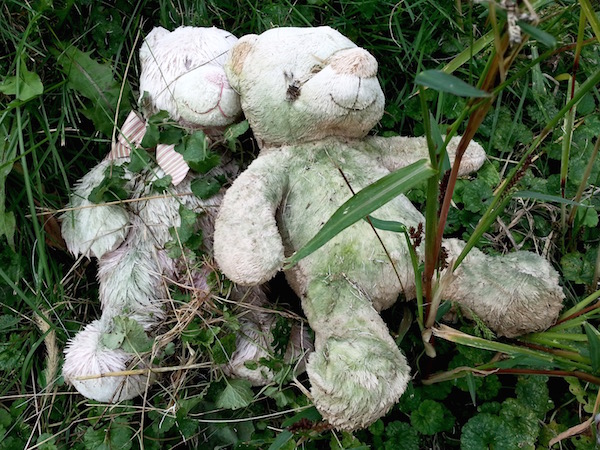
2 teddy bears in thick grass

Twin teddy bears, Allegheny Cemetery

To label stuffed animals left at grave sites as “sad toys” is certainly a judgement call. These creatures are not flotsam dropped from strollers or ejected from the open windows of minivans. No, the figures were left very intentionally as tribute or companion to the departed. In that way, they’re exactly where their owners expect them to be, doing just what they intend them to do. Is that so bad? We should all be so fortunate.

grave with teddy bears, solar lights, and deflated champagne bottle balloon

Sad teddy bear, sad cool bear, sad inflatable Cristal bottle, Allegheny Cemetery

stuffed animal dog on bed of plastic flowers, Allegheny Cemetery, Pittsburgh, PA

Game over, Rover, Allegheny Cemetery

But to not call them sad would be an even greater oversight. These playthings are, after all, left out in the rain, ice, and snow; their once-soft fur a gnarled, sun-bleached mat. Often alone, these fierce friends watch over the graves of the deceased with no company but the occasional stray deer, opossum, or wild turkey. A drive-by from this flash bulb-popping blogger paparazzi makes the highlight reel of their short lives.

If this wasn’t pathetic enough, these toys’ inevitable fate is to be corralled in every cemetery’s seasonal cleanup where Build-a-Bears and Steeler monkeys join the plastic flowers, laminated photographs, sports balls, Hennessy bottles, and deflated Mylar balloons in grotesque heaps that, as one Orbit pundit put it, “look like a florist threw up.”

stuffed bear and stuffed dog with flowers

Bear and dog, Highwood Cemetery

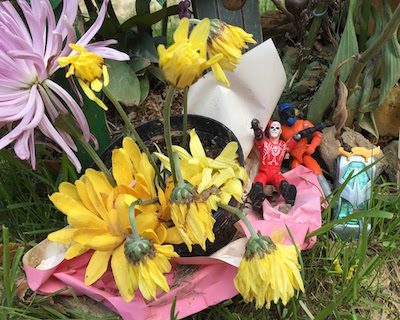
two plastic action figures with living flowers

Wrestler (?), stunt man (?), last-legs flowers, Highwood Cemetery

To you, faithful servants, doomed sentries of the cemetery, mud-soaked minions of Mordor: know that at least one of us is here looking out for you. You may be in a trash compactor in McKees Rocks by the time we go to press, but you’ll live on for eternity–or at least a couple months–in cyberspace blogosphere Purgatory. Godspeed.

monkey in Pittsburgh Steelers colors with sad bear

Steeler Monkey and friend, Highwood Cemetery

Allegheny Cemetery: Halloween Graves

Graves decorated for Halloween, Allegheny Cemetery, Pittsburgh, PA

Spiderland: Halloween grave at Allegheny Cemetery

Every October people put great energy into making their homes look like graveyards. The ubiquitous R.I.P. curved-top cardboard or foam-core headstones dot America’s front yards like popped toasters at a diner. In city neighborhoods, sometimes you see these incongruously strapped to stoops and front railings as if somehow there were people buried under the porch.

So in real graveyards, what’s the motivation to add additional set dressing to the already universally-understood scariest of locales? Decorating a grave marker for Halloween strikes this spookworthy blogger as somewhere between questionable in the taste department and just plain redundant.

I’ve checked the dates, and none of the deceased were ever either born or died on the thirty-first of October, so that’s not it. One can only assume then that either the holiday had a special significance for the departed, or that the grave-tenders are so faithful they give the full redecoration treatment every season. I’ve certainly seen the other holidays represented throughout the year (but not at these specific graves).

Grave decorated for Halloween, Allegheny Cemetery, Pittsburgh, PA

Sauerwein grave, 2013

Graves decorated for Halloween, Allegheny Cemetery, Pittsburgh, PA

Sauerwein grave, 2014

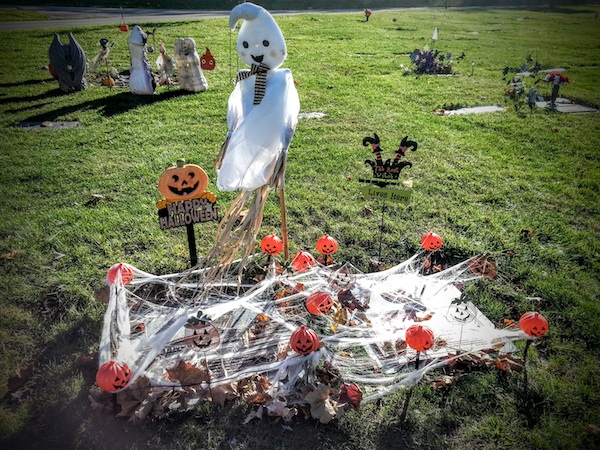
grave decorated for Halloween, Allegheny Cemetery, Pittsburgh, PA

Sauerwein grave, 2015

Whatever the reason, the phenomenon of Halloween-decorated graves occurs every year in Allegheny Cemetery. There aren’t a ton of them, but enough that’s it’s definitely a thing.

Above are photos from the the same plot over the last three Octobers. You’ll see a number of repeated pieces–the big gray plastic gargoyle, the 2-D Jack-o-lanterns, the solar lights, the homemade ghost, the Trick-or-Treat grave and ghoul combo–but a lot of the decor either didn’t make it back or had to get re-generated. The park has a strict fall cleanup policy (more about that later) but they seem to leave the Halloween decorations alone, at least through November.

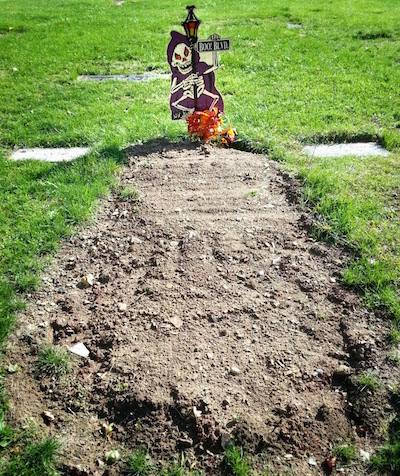
fresh grave with Halloween skeleton decoration, Allegheny Cemetery, Pittsburgh, PA

Boo Blvd.

Google Maps tells us there’s a Boo Avenue in Kansas City, a Boo Street in Louisiana, and a couple Boo Roads in Mississippi and Indiana. There are apparently more Boo Lanes than any other type of Boo thoroughfare.

But Pittsburgh Orbit readers will be excited to learn that the nation’s one and only Boo Boulevard exists right at the end of this freshly-dug grave in Allegheny Cemetery’s section 61. A cloaked skeleton hangs on a old school gaslight to mark the entrance.

Grave decorated for Halloween, Allegheny Cemetery, Pittsburgh, PA

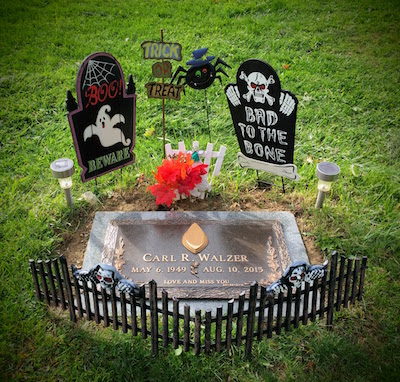
Carl Walzer: bad to the bone

Grave decorated for Halloween, Allegheny Cemetery, Pittsburgh, PA


Jennie Benford: Concierge to the Dead

Jennie Benford, Homewood Cemetery archivist, in front of Brown mausoleum

Jennie Benford at the Brown mausoleum, Homewood Cemetery

If you got rich in Pittsburgh’s first great golden age, chances are you wound up here. Walking through Homewood Cemetery‘s beautiful large-plot section 14, the names pop right out at you: Frick, Mellon, Heinz, Straub, Baum, Benedum, et cetera, et cetera. These may not be household names to the rest of the world, but in Pittsburgh they’ve all got streets and buildings and foundations and corporations named after them. And they all ended up in the same big section of the same cemetery*.

Mausoleum for Benedum family, Homewood Cemetery, Pittsburgh, PA

From black gold to pink granite: the art deco Benedum mausoleum

Jennie Benford has been leading visitors through Homewood Cemetery for nearly twenty years, and let this amateur crypt fancier tell you: she gives good tour. As an archivist, historian, and major league taphophile (she was also married at Homewood Cemetery), Benford landed her dream job as Director of Programming for The Homewood Cemetery Historical Fund not too long ago.

Benford currently offers three different tours of Homewood: Taking It With You, the one we took concentrating on Section 14’s robber baron excesses; Angels and Obelisks, highlighting particular grave styles and details; and the newest tour, In The Beginning, which focuses on the first three sections of the cemetery that were open for business in 1878.

Bronze angel statuary at Homewood Cemetery, Pittsburgh, PA

Aura the explorer: bronze statuary

Benford’s deep knowledge and communication of not just Homewood’s long-term residents, but American (cemetery) history is incredible. To this blogging layman, our older bone yards tend to look a lot alike. But we started with a great overview of American cemetery history and a terrific comparison between the tenor of the “rural cemetery” movement (ala Allegheny Cemetery, opened 1844) and how it compared to Homewood’s “lawn-park” model (1878).

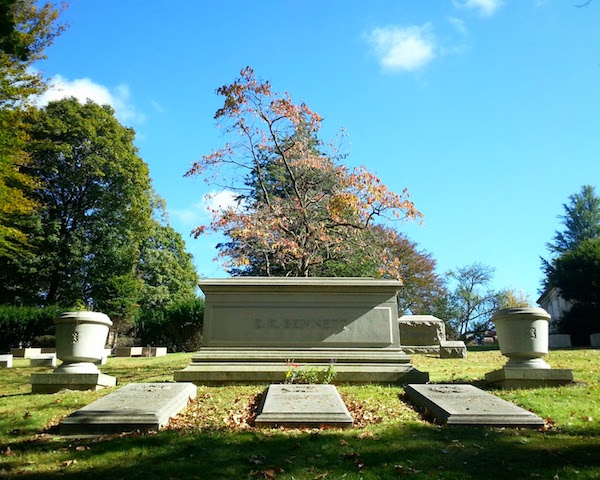
Cenotaph for E.K. Bennett, Homewood Cemetery, Pittsburgh, PA

Dressed and recessed for success: the E.K. Bennett plot

Benford’s greatest gifts, though, are an encyclopedic knowledge of her subject and the deft craft of relating historical detail with the skill of a great storyteller. Architectural nuance, names and dates, period styles, and a rich volume of tales (some of them with appropriate verbal grain-of-salt asterisks) put the context with the casket, the undertone with the eulogy, and the diary on top of the dirt.

Theo F. Straub mausoleum, Homewood Cemetery, Pittsburgh, PA

There stands the ‘taph: Theodore Straub, King of Beers

Benford’s tours of Homewood Cemetery are available by appointment and may be scheduled for “just about any day or time.” Those interested can call 412-260-6305 or message Benford through the Homewood Cemetery Historical Fund FaceBook page to set up a tour.


* They didn’t all end up in Homewood. Allegheny Cemetery in Lawrenceville (for instance) also contains many prominent Pittsburgh figures, but Homewood definitely has the most marquee names, and they’re all clustered in one defined section.

Warhol By The Book: The Orbit Review

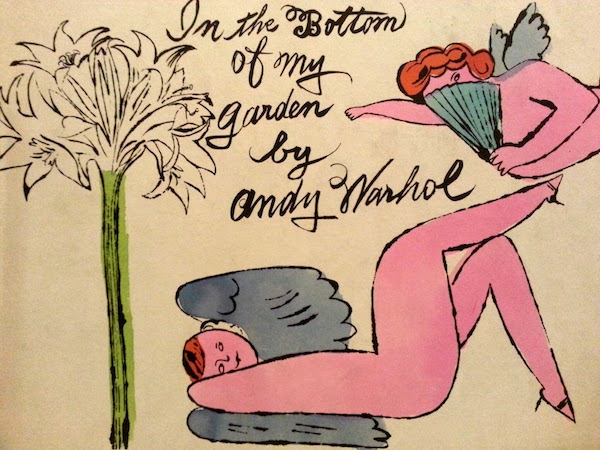
Book cover for Andy Warhol "In the Bottom of My Garden"

“In the Bottom of My Garden”, 1955-56

Two decades ago, this blogger bought a cookbook. Back in those dark ages, we didn’t have the same opportunities to immediately share this groundbreaking news with the world, but thank goodness that wrong can be righted today.

It was in an antique shop in rural Virginia where I found a beat up copy of Amy Vanderbilt’s Complete Cookbook for a couple bucks. Amy is an 800-page Doubleday hardback, published in 1961, that contains all the (quite literal) meat & potatoes recipes of mid-century middle America: Turkey a la king, Swedish cornets, potatoes au gratin, “Pablo’s Spanish rice.” In the pre-Epicurious days, people still needed nuts-and-bolts cookbooks like Amy Vanderbilt.

"According to the Evidence", 1953

“According to the Evidence”, 1953

It wasn’t until some time later that I noticed a small credit on some of the book’s breeze-through front matter: Drawings by Andrew Warhol. The simple line figures that illustrated cut lemon garnishes or rolled Roquefort tea sandwiches never stood out to me as particularly noteworthy and my knowledge of Andy Warhol’s pre-fame commercial work was pretty limited, so I wasn’t even sure if this was the same guy.

Well, it was. Or it is. Whichever. Andy Warhol had a wealth of pre-soup can commercial work (roughly the full decade of the 1950s, and then less frequently in the ’60s) and much of this was in the context of book illustration. Those early drawings, along with photography and silkscreen work from the second half of Warhol’s career, make up the terrific new show Warhol By The Book, up now at The Warhol Museum through January 10, 2016.

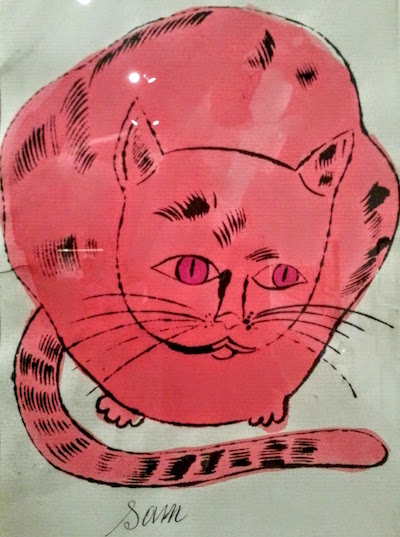
Andy Warhol "So Meow" print

So Meow [note: the print in the show has a green cat]

The exhibition is a fantastic deep-dive into anything book-related that Warhol worked on. Included are gorgeous dyed lithographs, original pencil drawings, (rejected) book proposals, correspondence with publishers, fountain pen-through-paper towel ink drawings, celebrity photographs, late-career silkscreens, and many final-product trade reproductions. And yes, there’s a copy of Amy Vanderbilt.

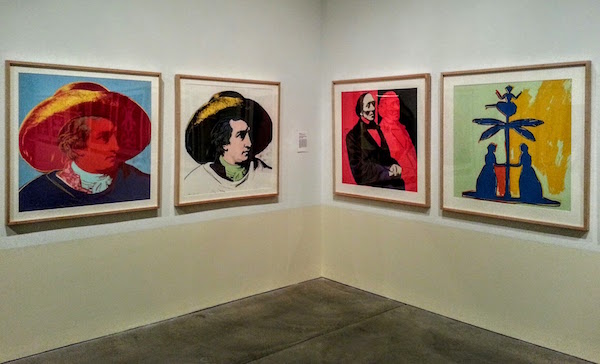
silkscreens of book art from "Warhol By The Book" exhibit at The Andy Warhol Museum, Pittsburgh, PA

1980s era silkscreens

While the photos and silkscreens are interesting, this home-cooking art fancier’s socks were quite figuratively knocked off by the drawn-by-hand half of the show. The rooms of Warhol’s early illustrations have always been my favorite part of the museum and this new show opened up that world in entire new ways. Aside from maybe some of the 25 Cats pieces, I’m not sure I had encountered any of the hundreds of original prints and drawings that make up that section of the exhibit.

Warhol’s Factory-era silkscreens are of course iconic and interesting in their own right, but seemingly lost in that fame was the incredibly beautiful drawing hand of the artist. The coupling of his great, loose style, tastefully deployed bursts of color, Warhol’s distinct schoolyard cursive captions, and the Carnegie Tech-educated, less-is-more design sense make each of these wonderful little new discoveries.

"Borderline Ballads", 1955

“Borderline Ballads”, 1955

Back in February, The Orbit gushed over The Warhol’s Sister Corita Kent show, which had just opened, calling it “the best Warhol Museum show this blogger has ever seen.” We’ll stand by that that assessment. But the By The Book exhibit is right up there. Book it.

lithograph and watercolor illustration from "25 Cats Name Sam and One Blue Pussy"

Illustration from “25 Cats Name Sam and One Blue Pussy”, 1954

Poli-Science: A Double Ghost Exposed in Squirrel Hill!

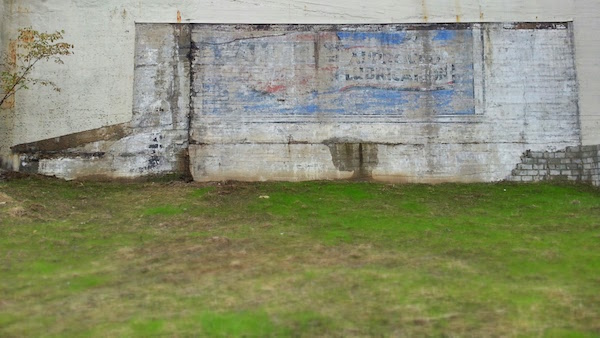
Ghost building with a ghost sign for Approved Lubrication, Pittsburgh, PA

The recently-uncovered rare “double ghost” in Squirrel Hill

Everyone said that great treasures would inevitably appear. When we were in the process of buying an old house, friends told stories of finding wavy glass apothecary bottles lost behind walls, secret messages under wallpaper, amateur paintings behind basement pegboard, pornography stowed and forgotten in loosened ceiling tiles.

A house built in the 1880s should have had ample time to accrue all this and more, but fifteen years later, the sum total this home-renovating blogger unearthed was one skeleton key and a set of Pittsburgh Press pages from the 1950s, laid below the linoleum on the third floor as, it seems, everybody used to do. I kept those papers for half-dozen years and then sent them out with the recycling one day. Sigh.

Poli restaurant in Pittsburgh, PA before the fire that destroyed it

Before the fall: Poli, pre-fire/demolition [photo: SquirellHill.com]

The news that the former Poli restaurant and its neighbor building had burned was big local news–and not without its share of suspicion and intrigue. The whole block at the corner of Murray and Forward (including the former Squirrel Hill Theater) had basically been shuttered and was slated for a massive redevelopment project that seems to have been postponed.

Whatever the reason, this sad event has a curious and surprising double twist for the ghost hunters of Pittsburgh Orbit. Now exposed, behind Poli’s former rear wall, we can see both a very clear building outline against the dense retaining wall behind (this seems to be the ghost of an addition to the original Poli) and a ghost sign that must have predated that section of the structure.

The building outline is nothing special–a straight rectangular box with one angled extension that looks like a slanted entrance to cellar stairs. The sign, on the other hand, begged for some looking into.

detail of faded ghost sign for Approved Lubrication, Pittsburgh, PA

Approved Lubrication ghost sign (detail)

The paint is almost completely worn away at this point. But with a little imagination and a little investigation, it turns out the sign was a large-form rendition of Amoco’s corporate identity and its Permalube Service used in the 1930s and ’40s. The tag line  Approved Lubrication is the most recognizable part of what remains. Knowing the original building dates to 1921, it’s probably safe to assume this painted advertisement was added before Poli’s misguided facelift and expansion onto the right/south side of the old building.

Amoco sign, 1930s-40s

Amoco sign, 1930s-40s [image: the Internet]

Poli would probably have made a great Orbit obit, but we just weren’t the right people to do it. [anyone? anyone?] The restaurant had existed at the same Murray Ave. location since 1921 and this blogger had at least fifteen years of ample opportunity to give it a try. What can I say? I was busy that night! No: it just didn’t happen.

I’m glad I made it to The Suburban Lounge and Moré and Chiodo’s Tavern before each of those storied haunts ended their respective run, but I’m afraid Poli is one that got away. Let it serve as a lesson that these places that seem like they’ll exist forever will not. [Note to self: get to Minutello’s ASAP!]

Ghost building/sign at the location of the former Poli restaurant, Pittsburgh, PA

In context: the double ghost at the former Poli site, Squirrel Hill

All that remains now is a re-seeded empty lot, an incongruous out-of-work smokestack, the nested pair of ghosts, and, across Murray Ave. from the site, the (literal) sign of Poli’s mid-life crisis. This c. 1970s triangular sign sits high up on its tall pedestal and shares a pie-shaped section of the five-points corner with a sidewalk no one will ever use, a parking lot with no apparent sponsor, and a set of out-of-place fruiting apple trees. In generally healthy, pedestrian-friendly Squirrel Hill, this is one dead space.

What will become of the sign? Who owns it now? It would be great if it could gradually morph into a legitimate “Thomasson” or be repurposed into a Welcome to Squirrel Hill beacon–its placement right at one entrance to the neighborhood would be perfect for that. Or, maybe, it will just become another ghost.

Sign reading "Poli Since 1921", Pittsburgh, PA

All that remains: Poli’s triangular sign across Murray Ave.

Jesus Houses

Run down brick house with large white cross above entryway, Steubenville, Ohio

Steubenville, Ohio

This blogger does not know his scripture, but he’s pretty sure that somewhere in Revelations there must be a passage like “If thou believeth in me, maketh sure everyone in the county is awareth of it.” (I’m paraphrasing, of course.)

Whether or not that’s true, there sure are a lot of Christians that want you to know it. You can see it just by looking over their front doors. Big white crosses hanging under the eaves, lashed to the split rail fence, or in one case, the name JESUS in thick garland where a leaded glass pane must have been.

Church built into home, Hill District, Pittsburgh, PA

Hill District

While we at The Orbit subscribe to a “live and let live” approach to life (and letting life), it’s sad that it’s so hard to imagine similar displays of the crescent moon or stars of David being as benignly accepted. Why, Regent Square has its bizarre tribute to Bacchus on that apartment building right across from the movie theater [note to self: get on that!], but I don’t know if they’d get away with a similarly prominent Buddha. [Realistically, Buddha probably gets a pass, but you know what I mean.]

Home with plastic cross tied to split-rail fence, Rochester, PA

Rochester, PA

We love human creation. Sometimes that most obviously comes in a physical statement of faith, or hand painting a Steelers party wagon (although those are increasingly hard to find). A power so great that it compels someone to create who may not otherwise have done so is an amazing thing, whether you believe in it or not. This non-flag-waving heathen has a hard time relating to the specific motivation here, but not to the greater one of exploration, expression, and release. Maybe that’s what these folks would tell me the whole thing is about, anyway.

Large house with "Jesus" written in large letters over the front door, Pittsburgh, PA

Central North Side