Can’t Sit Down: The Inevitable Parking Chair Post

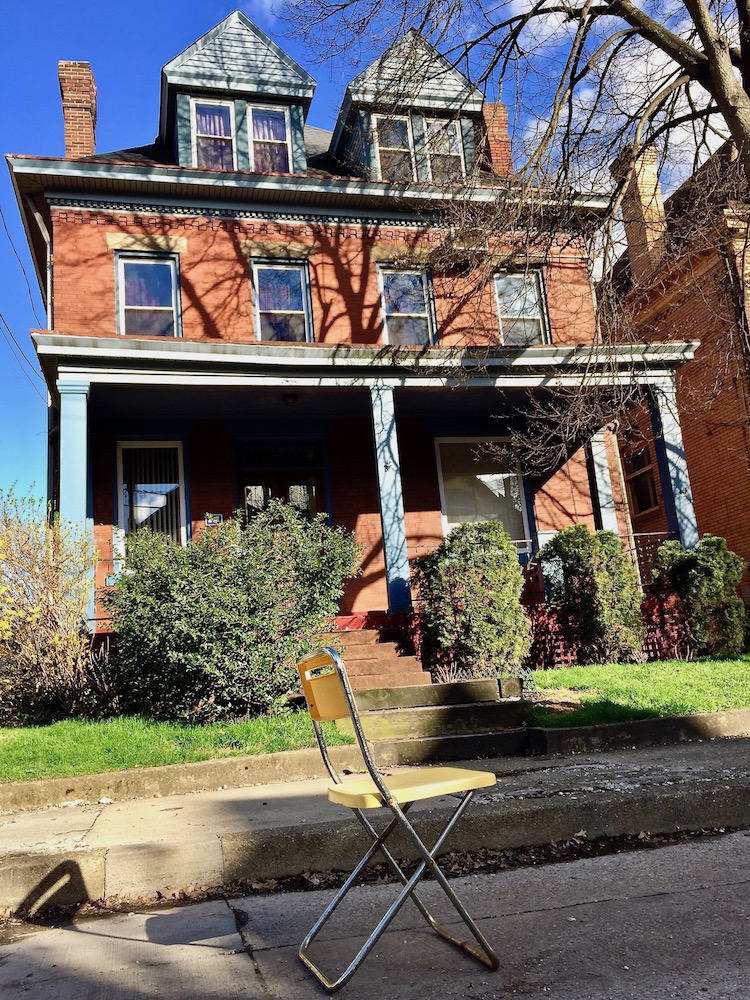
single chair from dinette set on street, acting as a "parking chair", Pittsburgh, PA
The classic! A single chair from a dinette set, orphaned and alone, reserving an on-street parking spot. Garfield

Alone in the rain, playing dangerously in the street, a lone chair stands sentry over his master’s cherished sixteen feet of curbside frontage. The seat was once a member of a family—four, perhaps six, identical siblings joined around a matching dining table where the rest of the household would eat and cajole, argue and play. Now though, with that Camelot lost, just one chair is banished to the loneliest, last role of its life—standing on the street, waiting for a car to come home, holding a parking place.

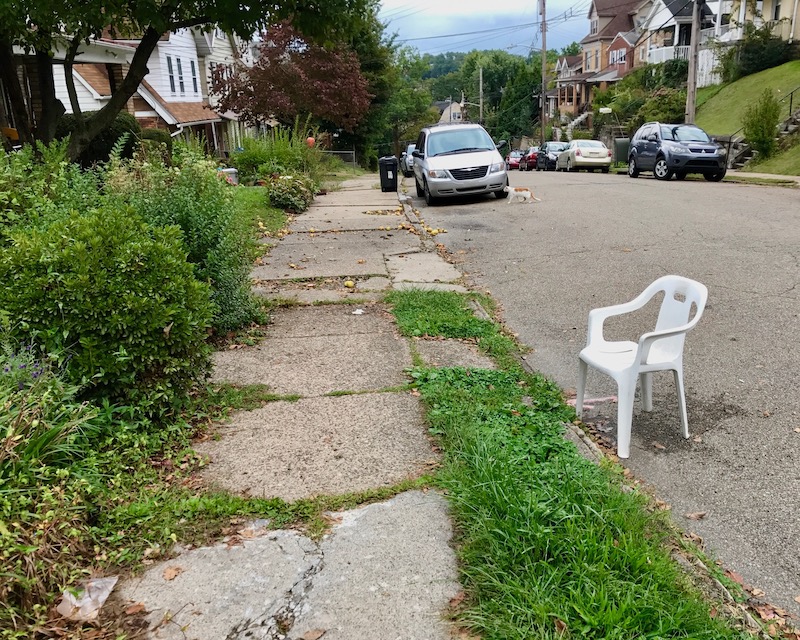
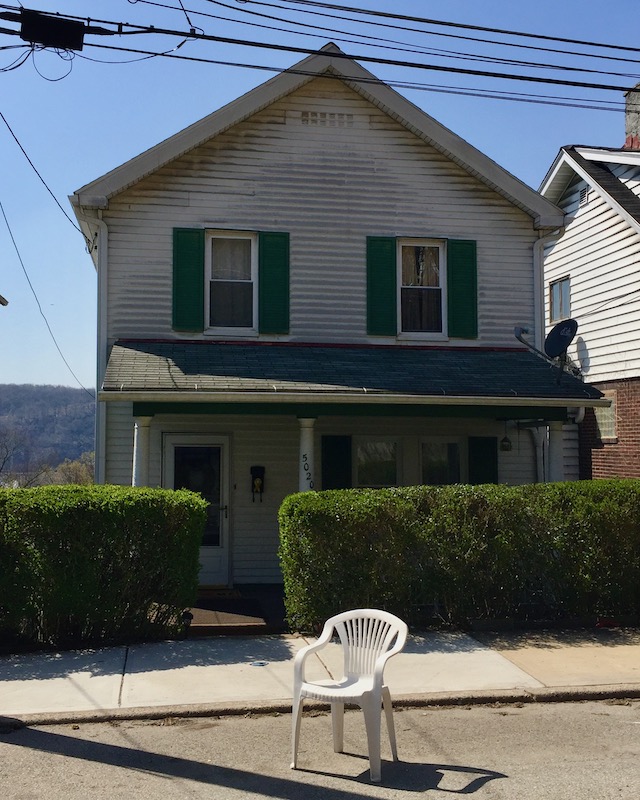
plastic lawn chair holding parking spot in front of small house
Parking chair with backup cone, just in case. Lawrenceville

It’s strange to think of the omnipresent Pittsburgh parking chair as an endangered species or dying phenomenon—it is not, by any means—but the character of the object reserving that spot has changed significantly.

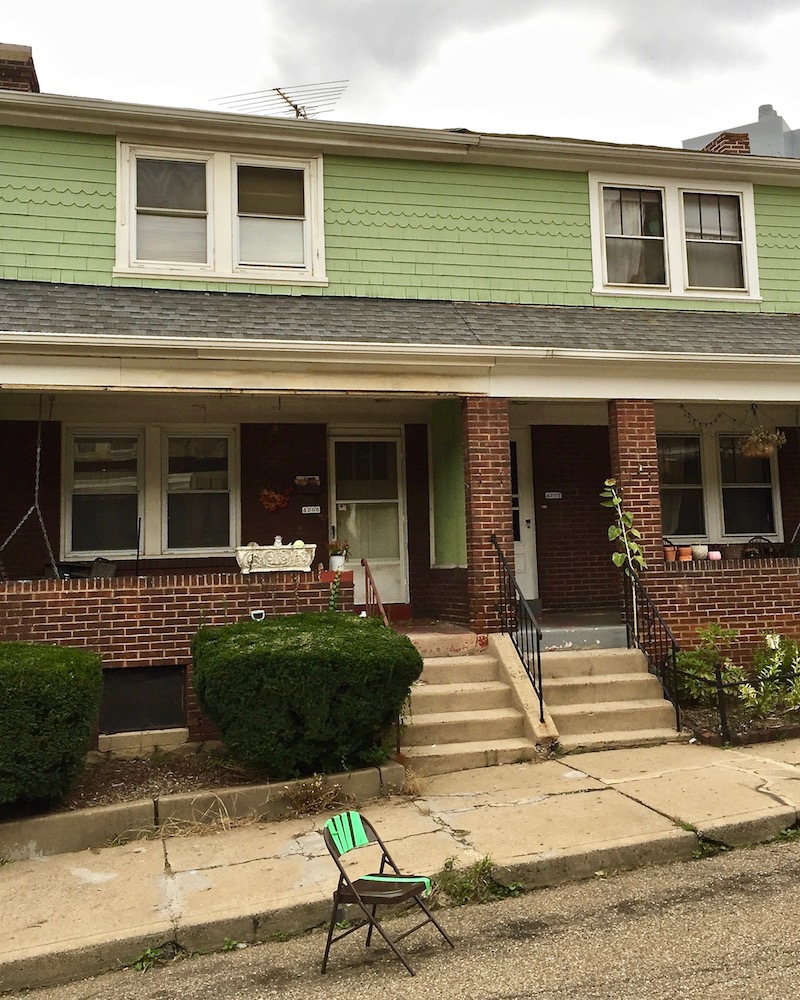
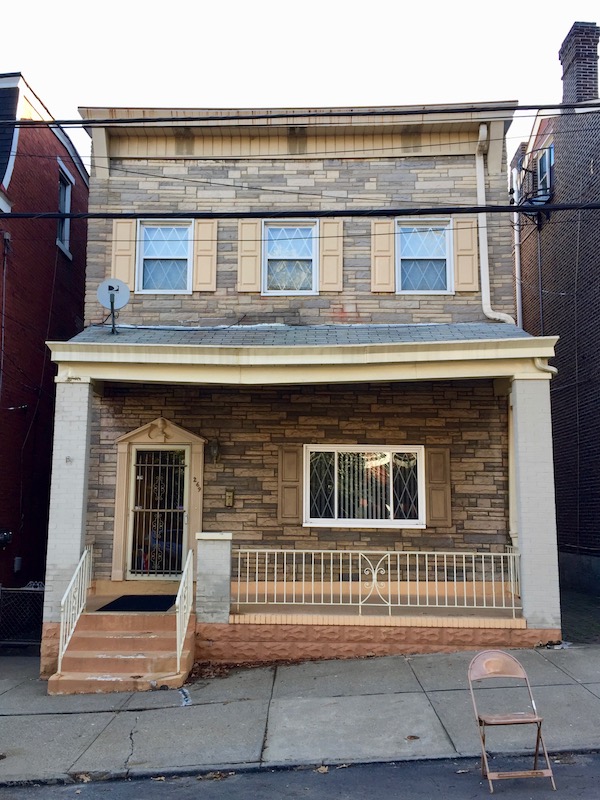
Twenty years ago, the parking scene was still dominated by chairs that once held keisters at the kitchen table. That image of the single chrome dinette chair, rusting and battered, dirty stuffing leaking through cracks in the upholstery, is indelible if you were lucky enough to see them in those salad days.

That time is past, though. Just look at this collection of photographs—the cheap, stackable, white plastic lawn chair has taken over the market and ex-dining chairs are few and far between. There’s still a lot of variety—folding chairs of every make and model and non-chair “chairs” (we’ll get to those)—but we still miss those diner-style seats that used to dot row house residential streets like birds on a wire.

East Liberty

For the last eight years The Orbit has resisted the urge to park our behind in this most predictable of subjects d’Burgh—it seemed too easy and too obvious.

Parking chairs are also really difficult to photograph well. I know, I know—boo hoo to this guy living the dream making fat stacks taking pictures of street chairs in Pittsburgh—do your job, amirite? It ain’t that easy, buddy. You want to see the chair, sure, but it’s (usually) only interesting in the context of a much larger thing—an entire house or a row of them—that it’s related to. So you’ve got to get this little thing in front of really big thing and then houses have all this visual noise distracting you, blah, blah, blah—it ain’t easy.

Anyway, the oddly routine experience of seeing single chairs randomly in the street is also right up our, ahem, alley. So that ultimately won out, even if these aren’t our finest photos.

Finally, if you’ve got a great parking chair, a photo of one, or a story about them, we’d love to hear about it or get tagged on it.

Taped-up. Lawrenceville
folding chair painted in Steelers black-and-gold
Steelers parking chair! Lawrenceville
Bloomfield
metal folding chair on street in front of row house in Pittsburgh, PA
Lawrenceville
plastic chair holding parking spot on street
Parking spot au naturale, Greenfield
brick row house with folding chair in street marking parking place, Pittsburgh, PA
Lawrenceville
folding chair on street in front of row house, Pittsburgh, PA
Lawrenceville
folding chair used to save parking place in front of row houses
Lawrenceville
plastic chair with weight attached to seat by tape
No parking AND no sitting. Polish Hill
plastic lawn chair on street in front of small house
Out front and proud. Hazelwood
stacked lawn furniture in front of row house
Parked parking chairs, ready to deploy. Bloomfield
two high-backed wooden chairs left on street in front of row houses
Parking chair twins! Lawrenceville
wooden chair holding parking spot on street
Chair’s eye view. Lawrenceville

Just in Case You Didn’t Get the Hint …

chair painted with "No Parking" message
“No Parking.” Lawrenceville
metal folding chair with hand-written sign reading "Please do not move chair. Therapist coming."
“Please do not move chair—therapist coming.” Lawrenceville
plastic lawn chair with "No parking" message
“No Parking! You will be towed away.” Bloomfield

Parking Non-Chairs

custom built parking spot holder created from stools and "No Parking" signs
“The Thing” (our term), Bloomfield
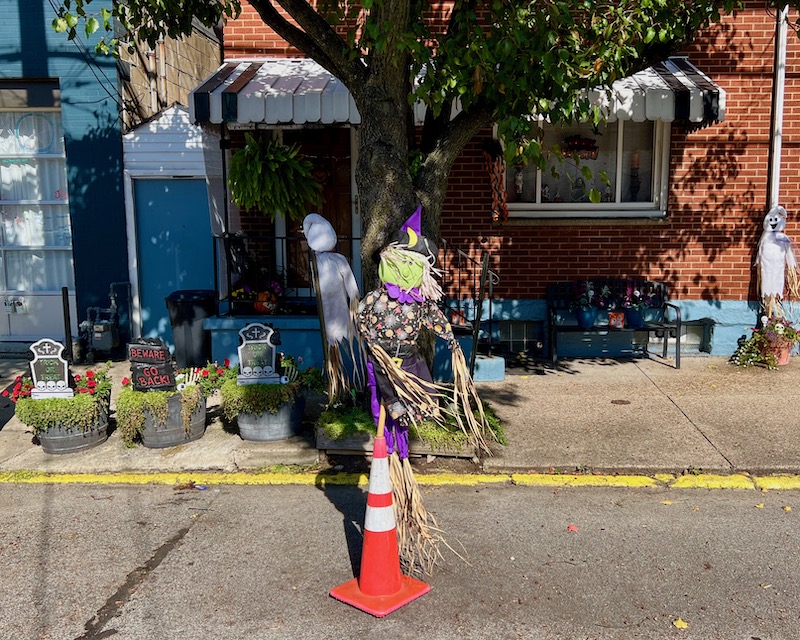
traffic cone with Halloween decoration in front of row house
Park here and you’ll get hexed! Parking witch, Southside
stacked milk crates holding parking spot
Parking milk crates, Bloomfield
Traffic cone covered in stickers
The cone of toxic masculinity, Bloomfield
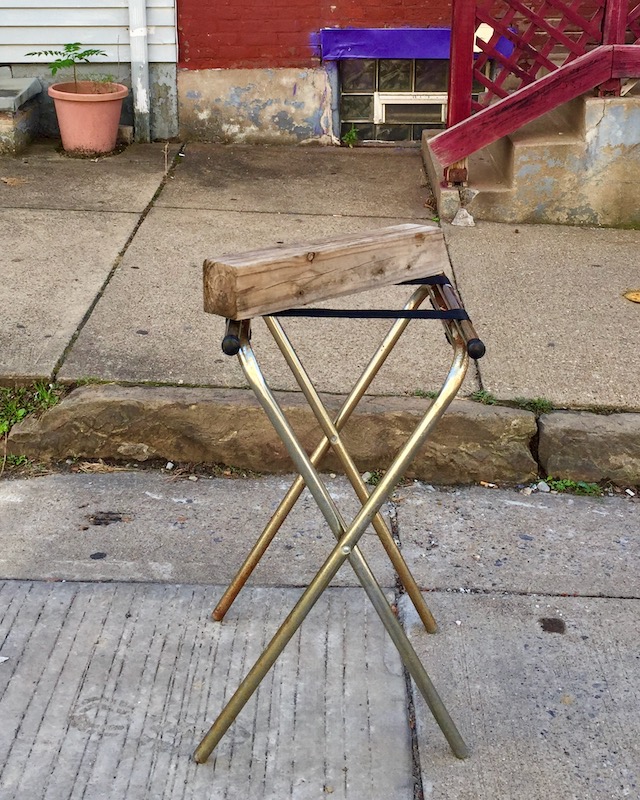
restaurant tray holder used to save parking space
Parking tray holder and 4×4, Lawrenceville
chair and traffic bollard left in front of row houses
The “Anything Goes!” Parking bollard, parking chair with 2x4s, Lawrenceville

Row House Romance: Have You Seen the Back?

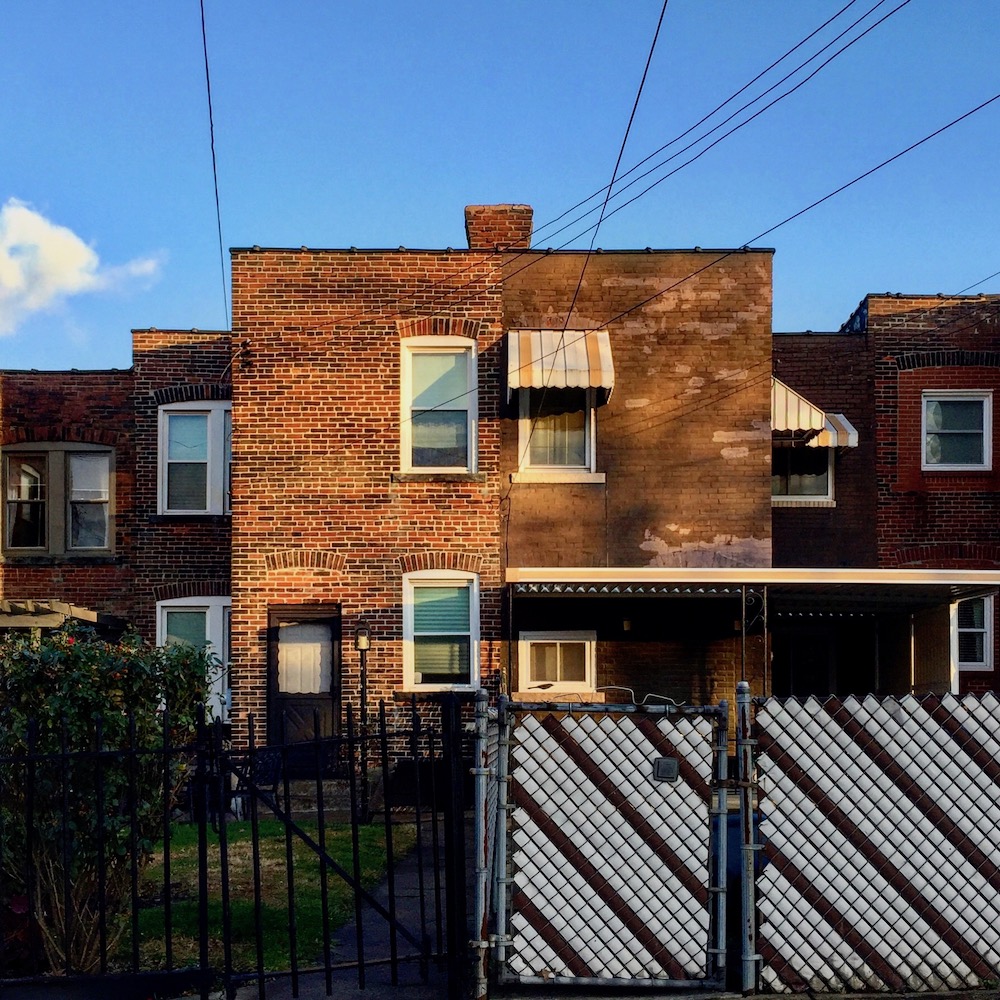
back sides of several joined row houses
Brick/collage: the back side of a row house block with a lot going on. Lawrenceville

Don’t tell Ms. Orbit, but your author has had a long-running affaire d’amour going on decades now. My paramour is lovely—and complicated—but always a surprise. A fellow makes his clandestine visits early in the morning and late at night—sometimes even sneaking in for a Rupert Holmes-style lunch hour. Just like Lionel Richie and the gang, she’s quite literally a brick house … but is still mighty mighty when she dresses down in casual wood frame and siding. Yes, I’m in a legit Row House Romance and here to tell you a fire that burns this hot ain’t going out any time soon.

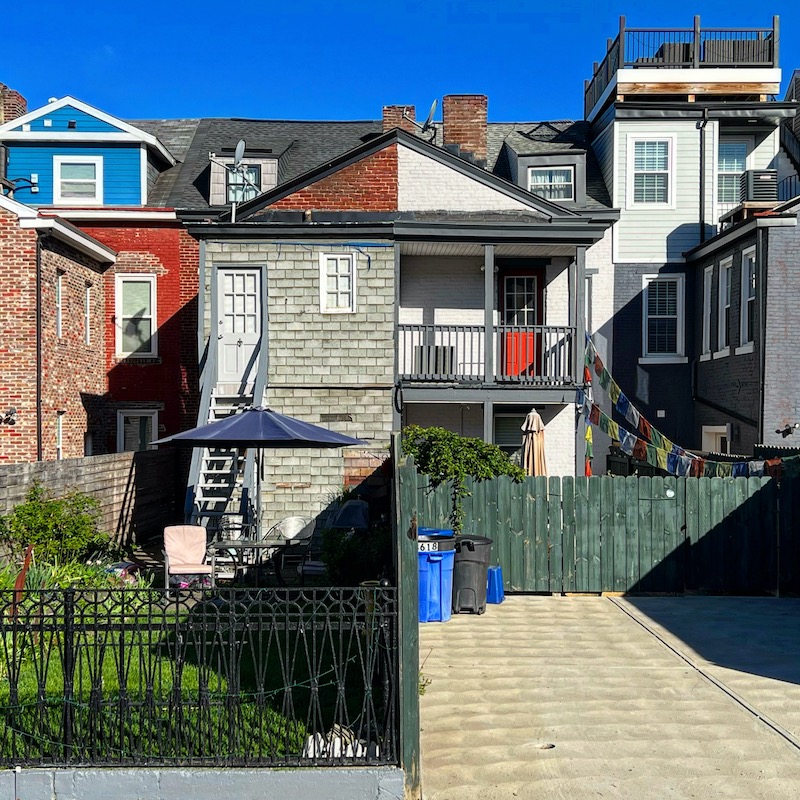
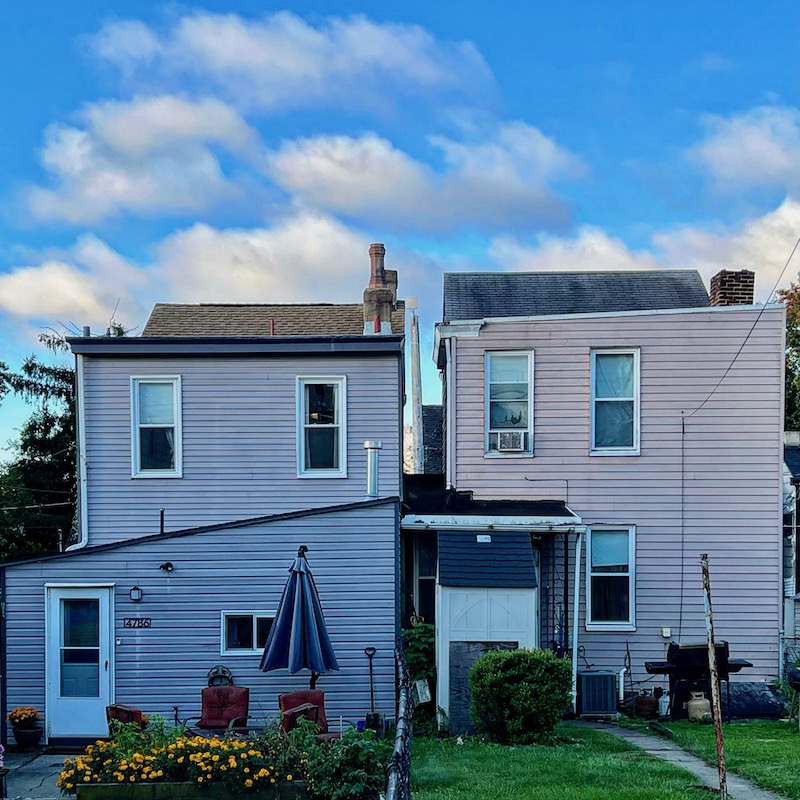
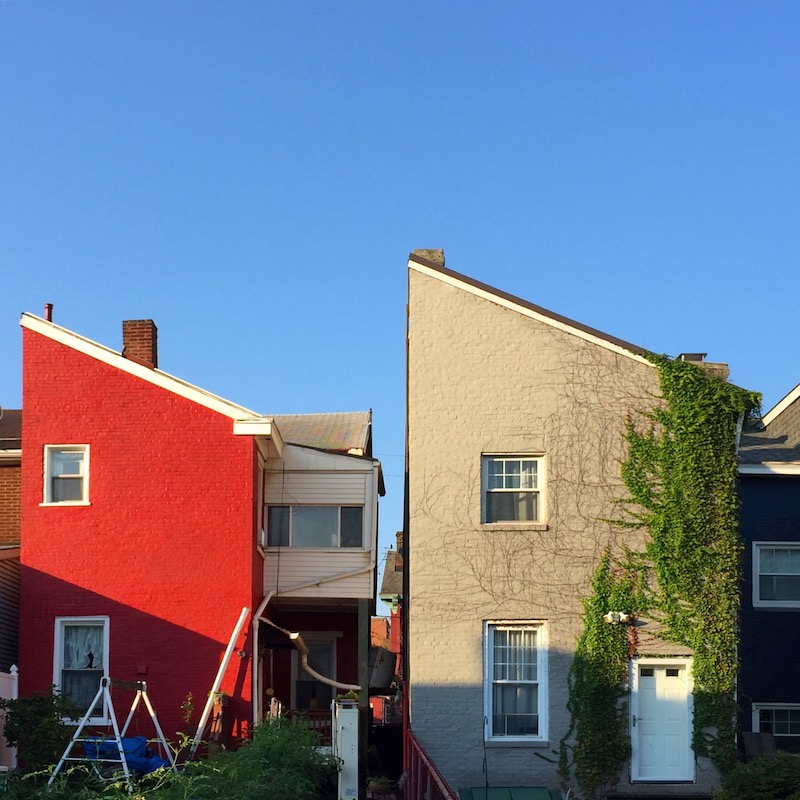
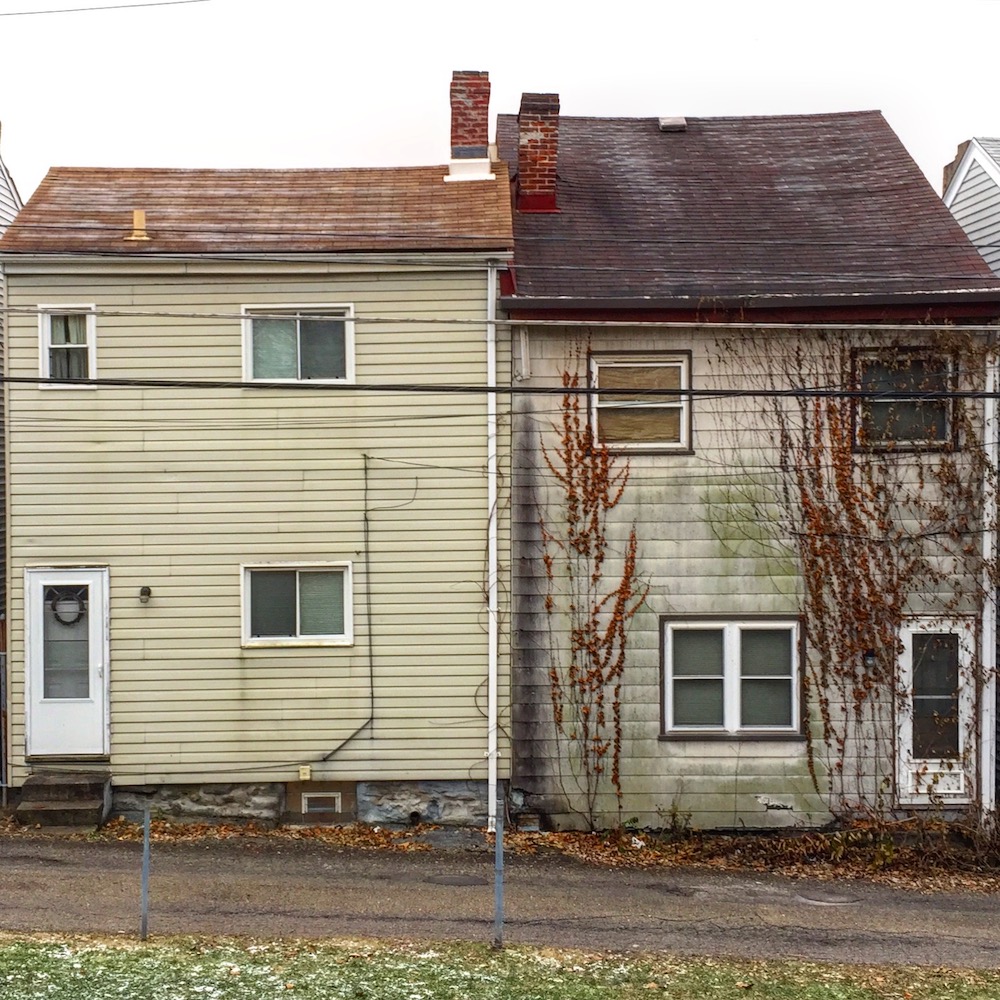
side-by-side row houses, seen from the rear, with very different backyards
A tale of two backyards, Lawrenceville

We’ve talked in this virtual pages about how terrific row houses appear when they’re close-quartered odd couples, as twins gone wild, and dressed alike, side-by-side. Those collections all contemplate the street-side views of this uniquely urban design.

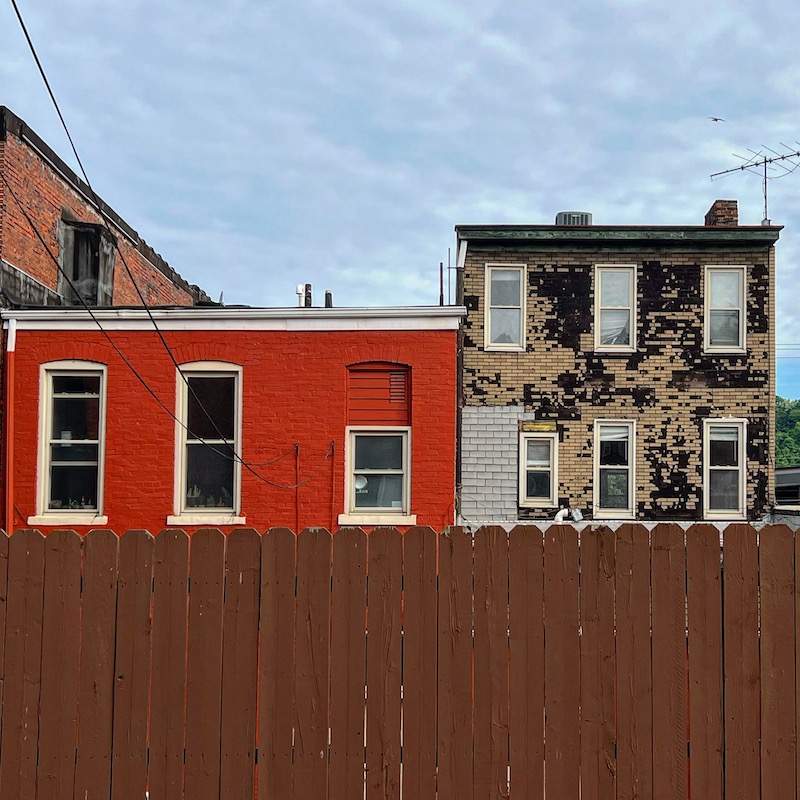
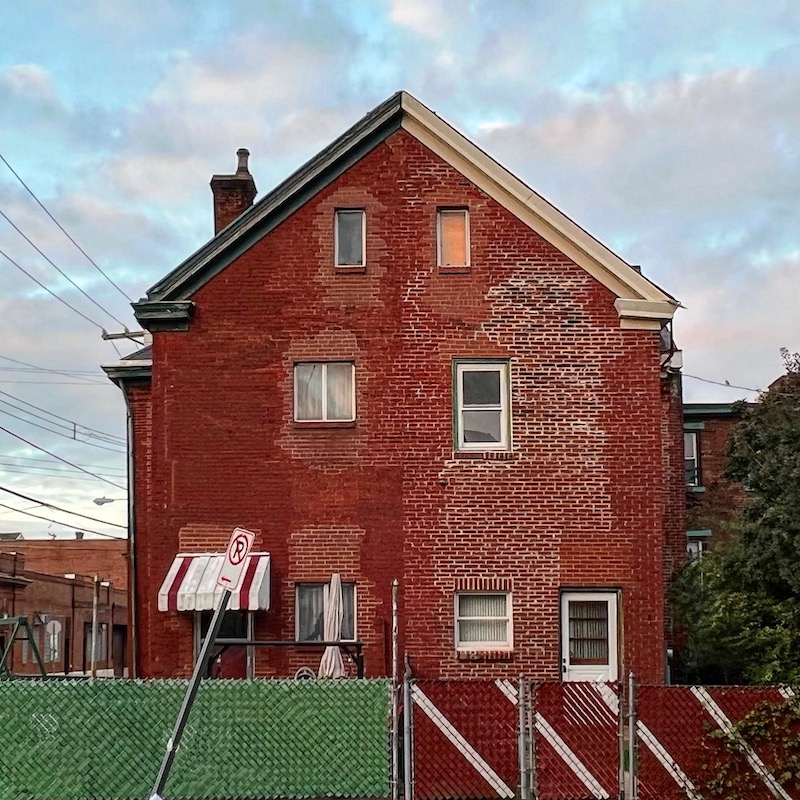
So today, we move around to the alley backsides of row house blocks where so often the true variations on this theme get amplified. Here—with less people looking and a little more room to make choices—homeowners let these birthed-from-the-same-womb siblings go their own ways.

She joined the fencing team, maybe, and likes to wear false eye … err, window lashes. His waistline expanded with a new addition and dresses like a pile of clothes when he can’t keep his siding straight.

rear view of two row houses
Row house cubism, Lawrenceville
rear of row houses seen over wooden fence
On—and over—the fence. Lawrenceville
rear view of three row houses
Squeezed together, Lawrenceville
side-by-side row houses with similar siding, seen from the rear
Little pink houses, Bloomfield
alley view of brick row houses painted red and pink, Pittsburgh, PA
Split personality, Lawrenceville
rear view of three row houses
Three amigos, Lawrenceville
rear view of brick row house showing differences between two halves
Better fences, Lawrenceville
rear-view of house and garage
Green scene, Millvale

Big Sky Rooflines

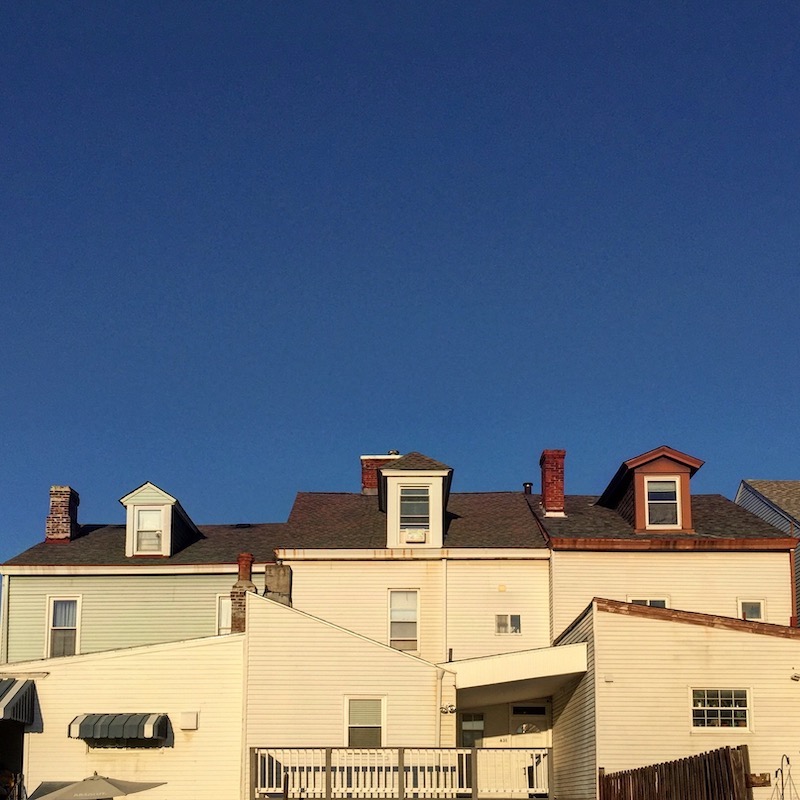
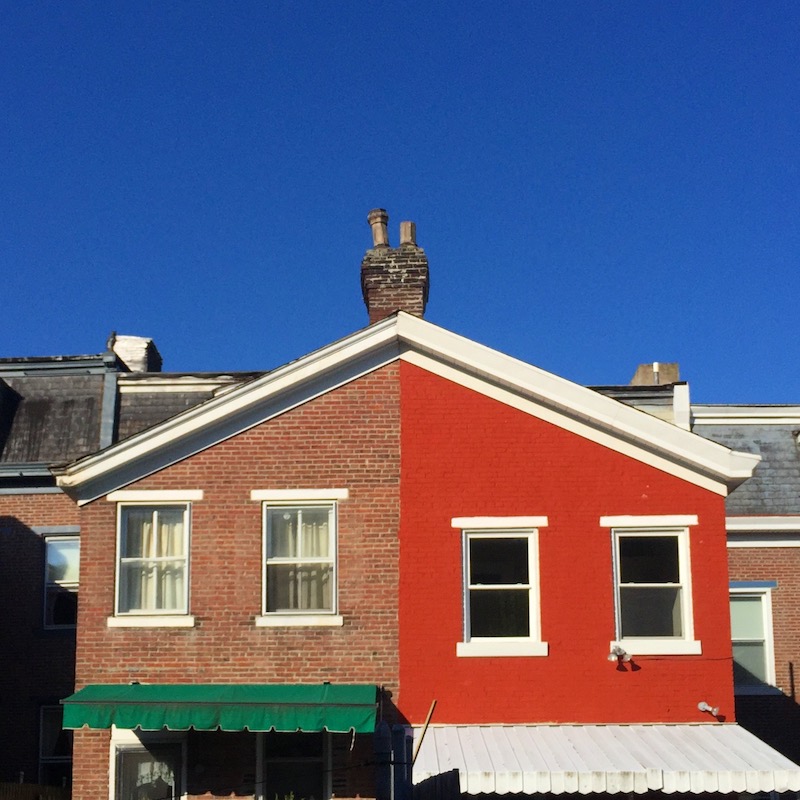
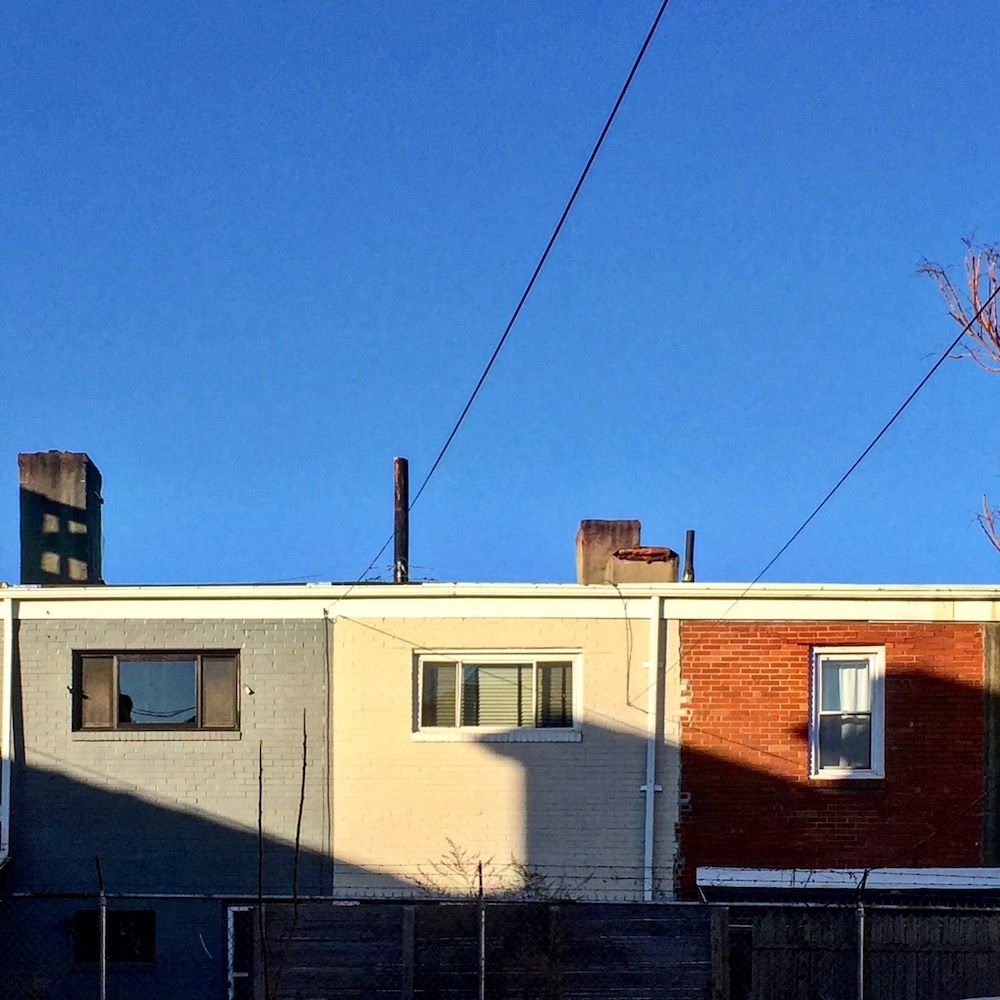
Maybe it’s cheating to include so much big blue sky in a photo that’s supposed to be about buildings, but when you’ve got it—and yes, it’s not all that often in Pittsburgh—a photographer will work it like a rented mule. Lit up like billboards and shining like new pennies, even humble row houses are elevated against a perfectly blue sky. It gives the picture a deep, mystical contrast we can’t resist. They just look so darn good—even from the back side.

three similar-looking row houses with white siding, seen from the back
Bloomfield
alley-facing exterior of row houses in Pittsburgh, PA
Lawrenceville
alley view of row houses, Pittsburgh, PA
Lawrenceville
rear view of three row houses
Lawrenceville
alley-facing exterior of row houses in Pittsburgh, PA
Lawrenceville

Beyond the Valley of the Doldrums: The Skunk Hollow Art Walk

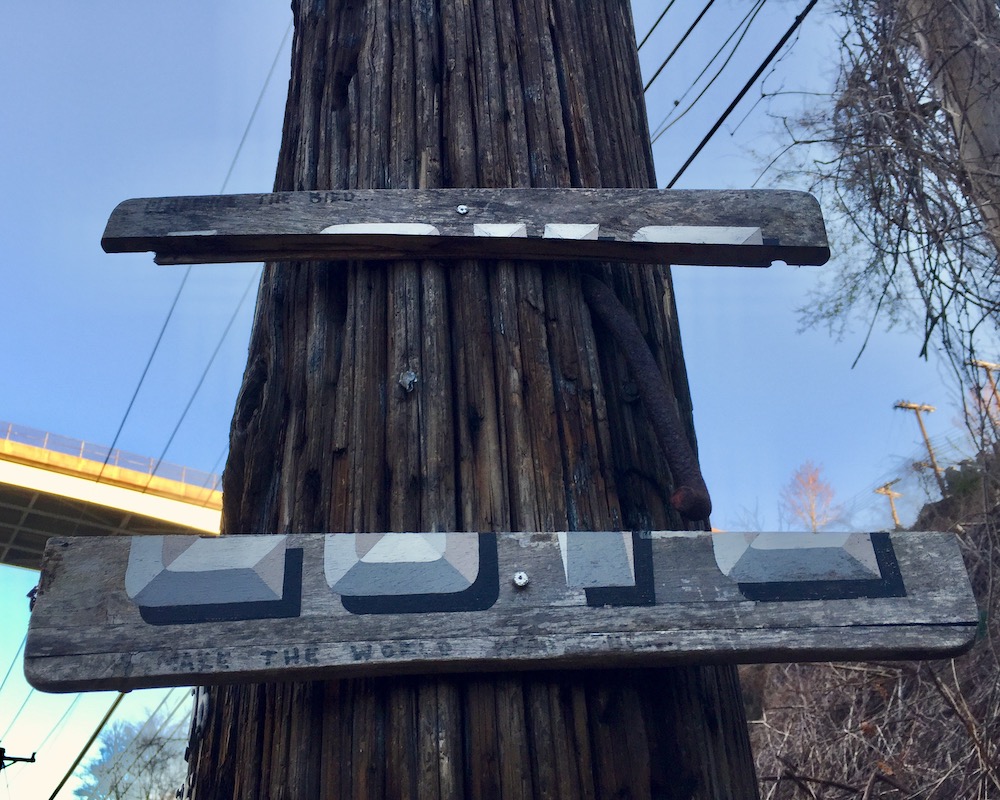
paintings made from flattened tin cans nailed to a utility pole
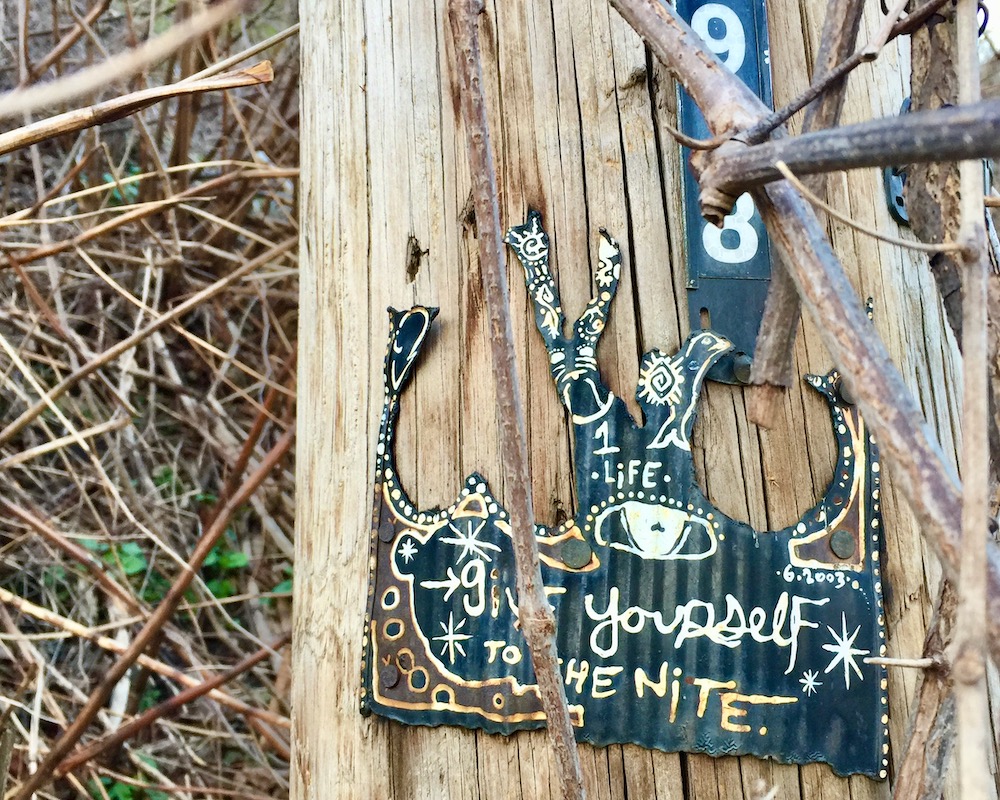
“I’ll tell you what magic is … Love” / “The Hollow.” Unofficial tin can pole art welcome signage for the Skunk Hollow Art Walk.

There is a melancholy to the exhibition: themes of darkness, loneliness, one very literal cry for help. Among the images, you’ll find birds soaring in flight and stretched-out cats, abstractions and twinkling stars–but these are the exception.

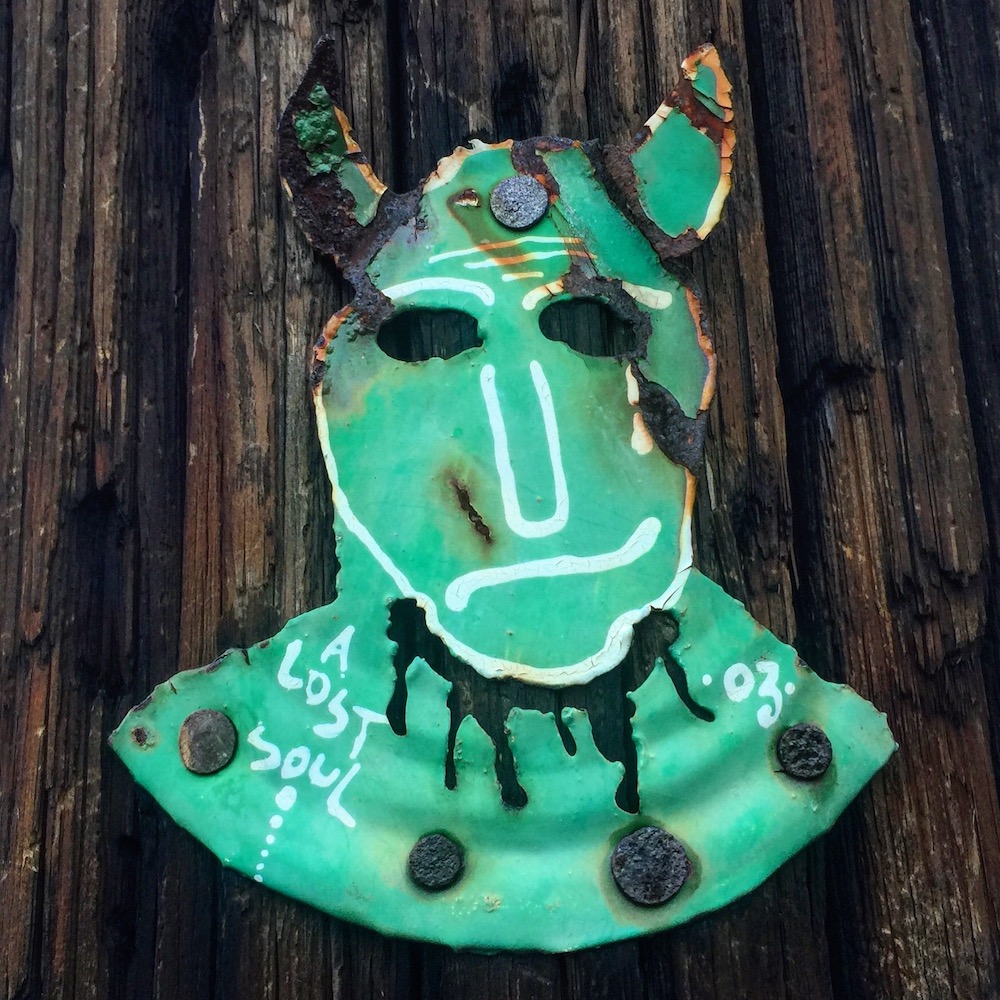
If Orbit staff were laying out a catalog for the collection, our cover would feature the image of a single small piece installed on a utility pole. In it, a figure has been cut from a tin can lid and painted a rich spring green. The devil’s horns are bent and rusted and his eyes are cut out to make us believe we can stare right through the back of his cranium. In hand-lettered paint marker is a simple descriptor alluding to exactly that: A Lost Soul.

painting of devil made from cut steel can nailed to utility pole
A lost soul.

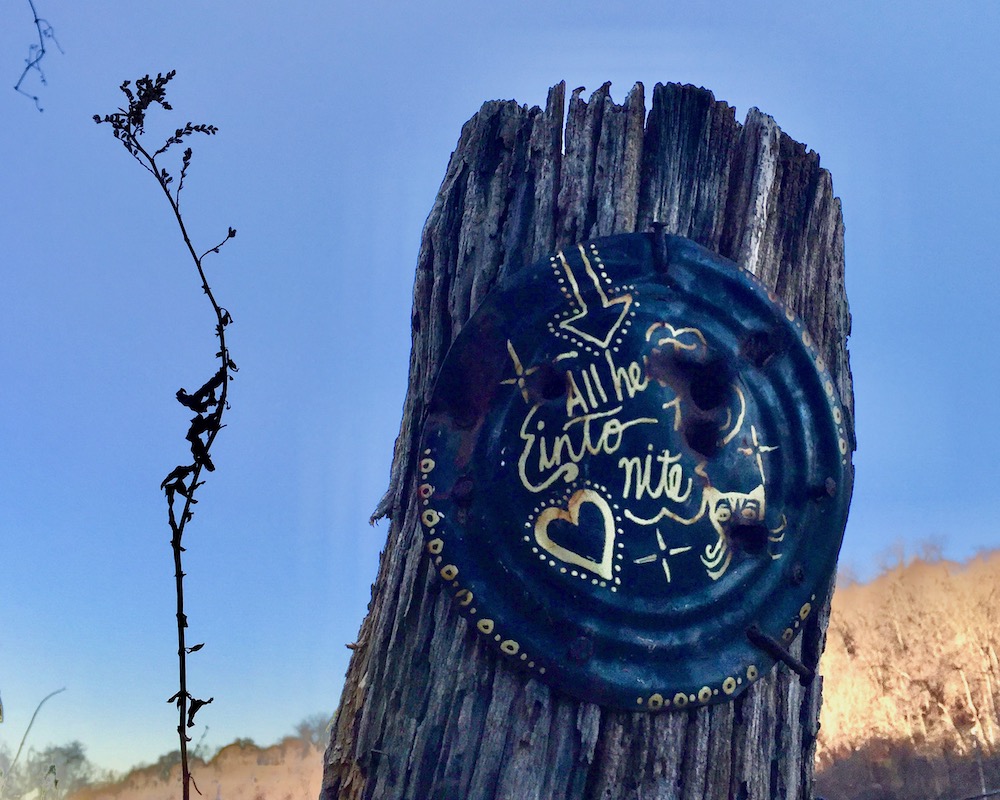
Elsewhere, there are instructions to Give yourself to the nite (sic.), a pair of unoccupied dinette seats, our favorite tin can pole artist’s tell-tale devils, martini glasses, hearts, and arrows. The artwork is made from recycled metal bits and bobs, a discarded cutting board, even the door from a standard-issue mailbox.

It is artwork from the trash bin, placed deeply out-of-sight–as if thrown into the void–and likely only ever experienced by fellow lost souls who hear the cryptic pieces whispering from cracks in the wood … or maybe that’s just the way it seems.

rusted painting on tin can nailed to utility pole
“Help me.” Ex-mailbox pole art.
painting on tin can nailed to utility pole
“All here (?) into the night.”

Skunk Hollow, the deep valley that separates Bloomfield from Polish Hill and North Oakland, won’t appear on any regional cultural guides; you’ll not find it featured in glossy magazines or listed among Pittsburgh’s next hottest neighborhoods. In fact, “The Hollow” doesn’t even show up on maps of the city (at least, not by that name). Its derisive title is merely a people’s collective dismissal of the out-of-sight/out-of-mind not-quite-a-real-neighborhood.

There are some good reasons for all this. Skunk Hollow hosts one of the more convenient spots in the city to illegally dump a La-Z-Boy recliner or an old television–plenty of people have chosen to do just that. The handful of businesses located along Neville Street are not what you’d call boutiques–they’re more of the rock-moving, general contracting, and looking-for-new-occupants varieties. Japanese knotweed has completely consumed the steep hillside and makes an effective trap for all of the blown-around street trash as it washes over Bloomfield’s banks.

rusted paintings on tin can nailed to utility pole
“And that nite, we raided the devils. Private stash needless to say.” / “We had a good ole time.”
collage of round-formatted street art attached to utility poles
Pole art in the round

So if the Convention and Visitors Bureau wants to pitch Skunk Hollow as a special place for out-of-towners to explore on their limited time in the ‘Burgh, they’ve got their work cut out for them.

But for those of us waking up ridiculously early, obsessively walking many mental health miles at daybreak, the Hollow is a welcome open air experimental art detour. Its randomly-curated works speak to the solitude of the early hour and themes of escaping into the night, tiny devils playing hell with our synapses, and you are not alone messaging make for a kind of communal balm for the disconnected.

paintings made from flattened tin cans nailed to a utility pole
“Life is good right now … thanks, Mom.”
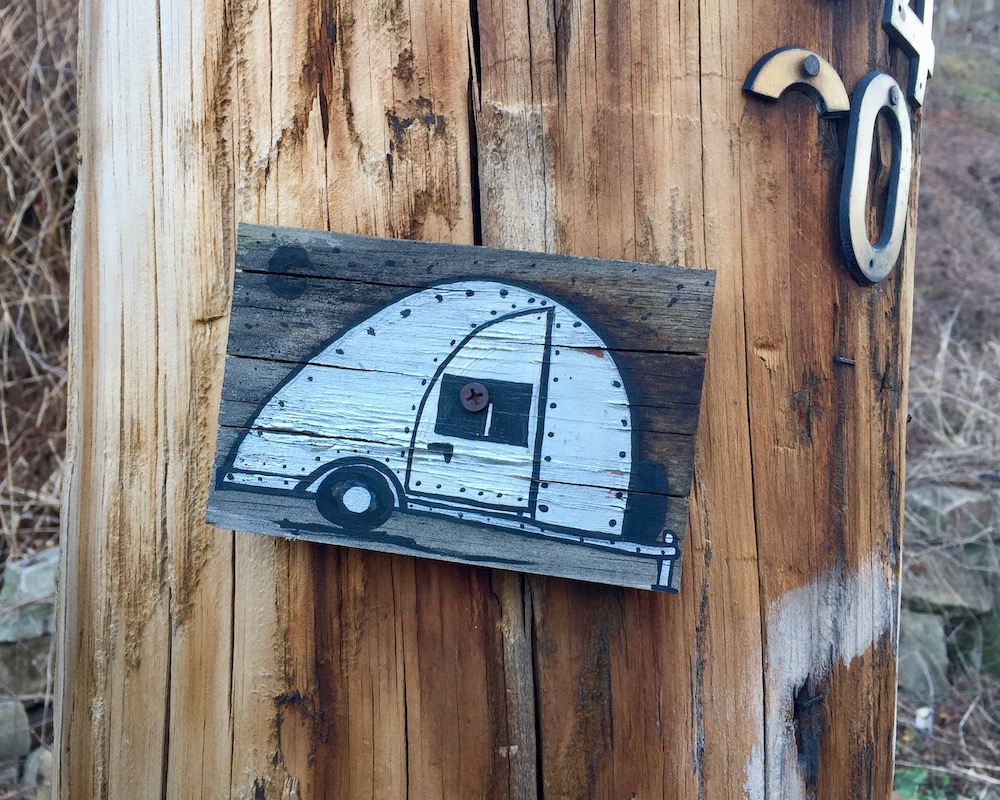
small painting of camper trailer on wood screwed to utility pole
Camper trailer painting

The Skunk Hollow Art Walk is not what you’d call accessible. There is one big hill, one Y-shaped flight of city steps (we’ll get to those), and a road surface with no accommodation for pedestrians. Worry not, though, it’s unlikely you’ll see any other human beings–with or without vehicles–during the length of your visit. Walking in the street tends to work out just fine when you’re the only one there.

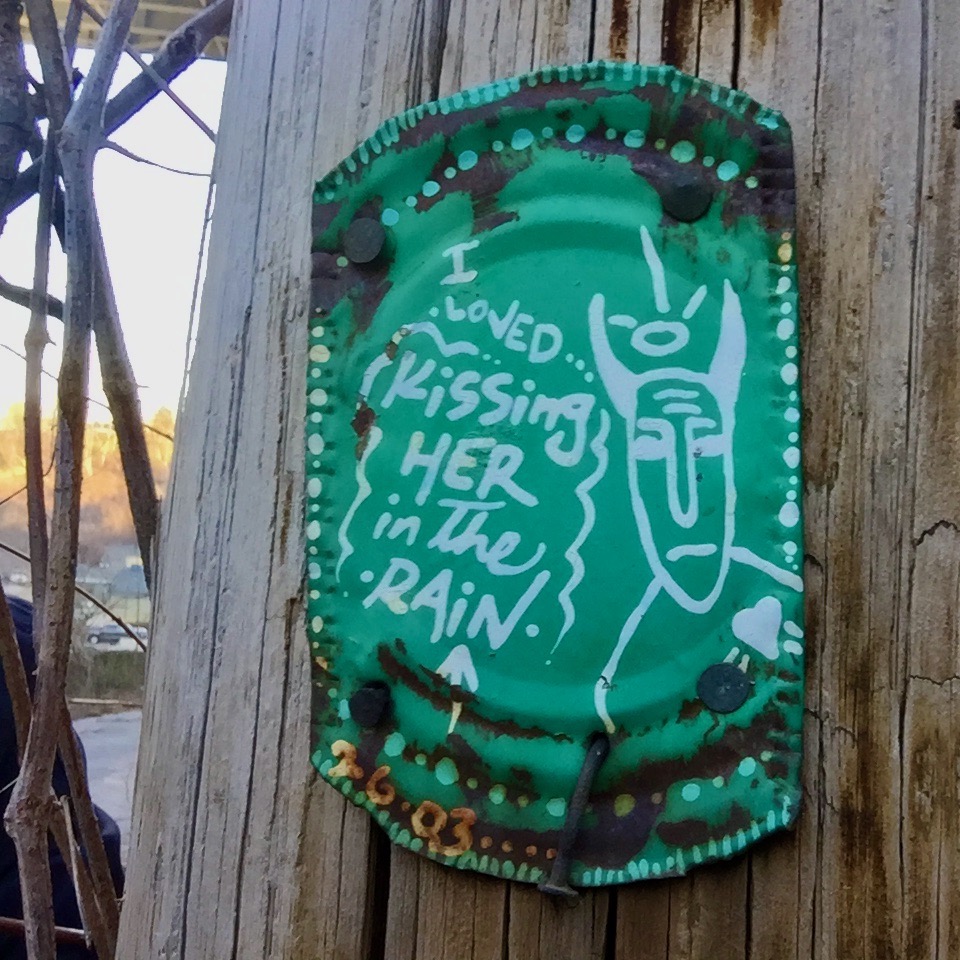
Viewing the environment on foot is an absolute requirement as all the little objets d’art are scaled for up-close examination and located in the kinds of niche spaces one must poke around thoroughly to see at all. One of the photos here (I loved kissing her in the rain, below) was achieved only by climbing up the hillside, bearhugging a utility pole with one arm, and then using the dumb selfie camera so I could get a photo of a tin can painting that I couldn’t actually see from my precarious position.

painting made from flattened tin cans nailed to a utility pole
“I loved kissing her in the rain.”
rusted painting on tin can nailed to utility pole
“Give yourself to the nite.”

For the directionally-challenged, don’t worry about getting lost in Skunk Hollow. There is only one road that traverses the short distance between Bloomfield’s backside and the old Iron City brewery. In typical Pittsburgh fashion, it goes by three different names–Lorigan, Neville, and Sassafras–in its approx. 3/4 mile run.

Most of the art is found along sloping Lorigan Street, from the Ella Street steps down to the bottom of the hill, so a greatest hits visitor could drop in for some tin can pole art and still make it to Tessaro’s for an early dinner. But really, why not go “full Hollow” and walk the length of it. It’s a little more spartan at the bottom, but by the end you’ll be rewarded with some great wheatpaste pieces on the old brewery.

City Steps with graffiti reading "Try" on every riser, Pittsburgh, PA
Ella Street (aka the “Try Try Try”) city steps
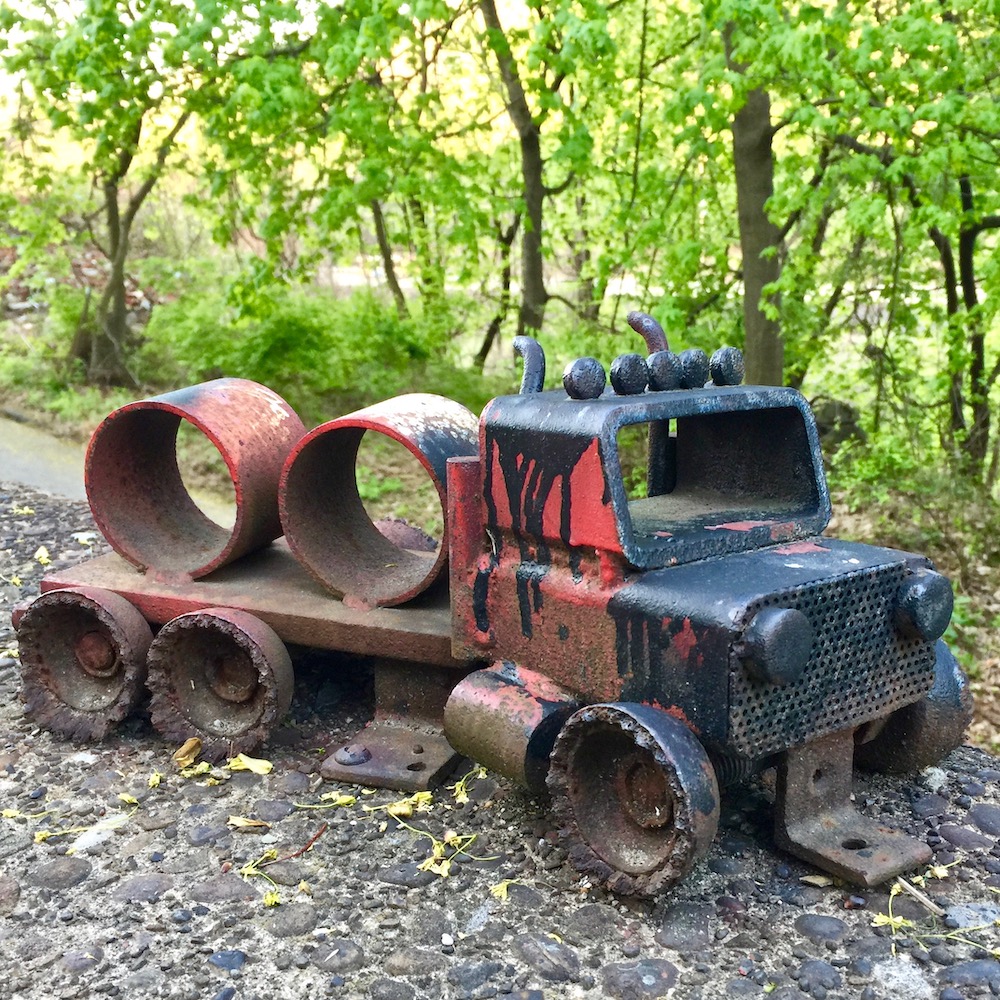
metal toy truck screwed into concrete steps
The “Try Try Try” steps metal truck

The last time The Orbit reported from Skunk Hollow we were on the step beat, there to check out the great Ella Street (aka the “Try Try Try”) city steps. We’ll not go over all that here, but this bit of you can do it self-affirmation infrastructure is totally of a piece with the collection of street art that surrounds it.

What’s been added to the steps (since that 2015 story) is its own terrific set of oddball ephemera. The bolted-on scrap parts truck (photo above) is thankfully still there, right at the lowest landing. It’s been joined by a tiny sculpture of simple chairs, placards, handrail ramblings, one repurposed wooden puppet-like thing, and a mystery mailbox.

sculpture of two chairs anchored into public steps
Tiny furniture, big steps
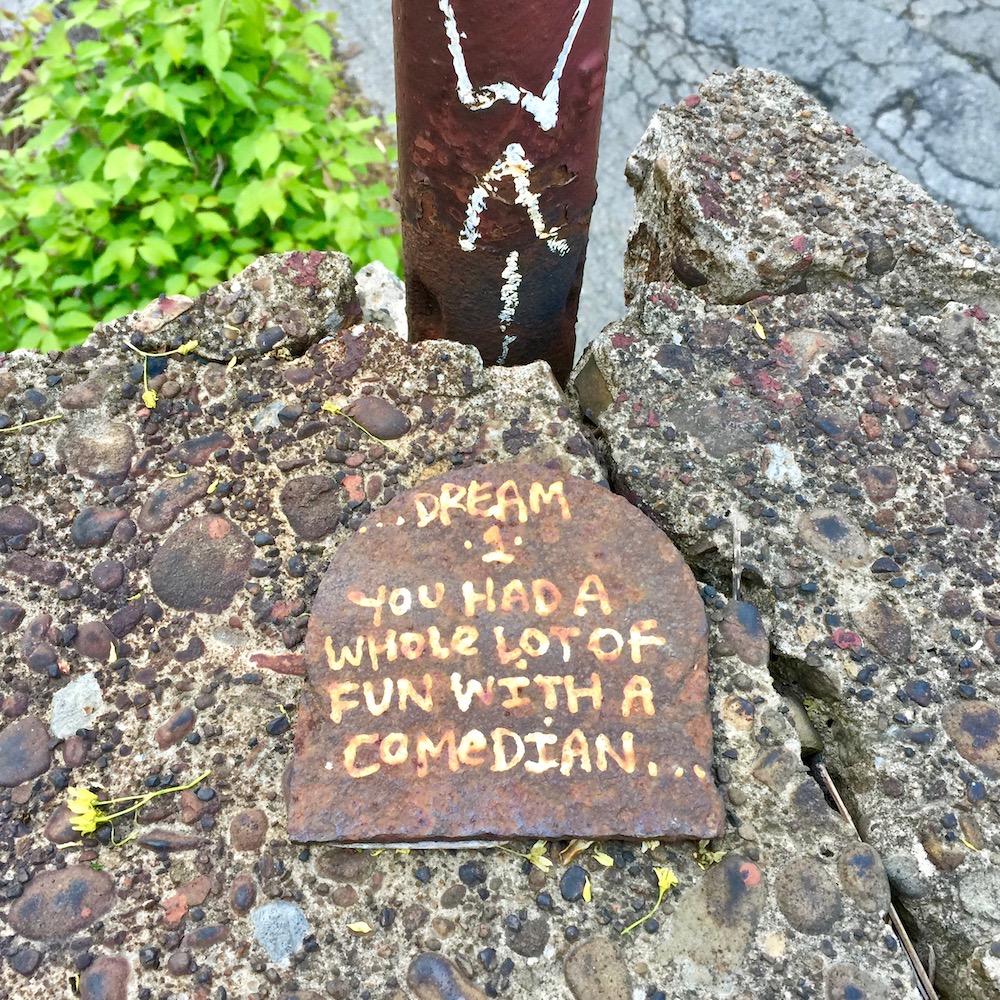
metal piece with text "Dream 1: You had a whole lot of fun with a comedian ..." attached to public steps
“Dream 1: You had a whole lot of fun with a comedian …” Steps koan
graffiti painted support on public steps of waving figure
Art on the “Try Try Try” steps

A fancy art museum, this ain’t–but then again, no one visiting The Carnegie gets to experience the thrill of risking both poison ivy and tetanus in their bloodthirsty pursuit of new tin can pole art. As combined art happening/aerobic workout, Skunk Hollow is hard to beat. Plus, the hours are great and the price is right.

Yes, attendees of the Skunk Hollow Art Walk will have to negotiate some broken glass and a few salty words committed in spray paint on the jersey barriers along the roadside–oh, there’s also that mystery odor. But, like poking through a thrift shop or digging through used records, a visit rewards the patience of the art lover willing to do a little work for a commensurate dose of oddball magic.

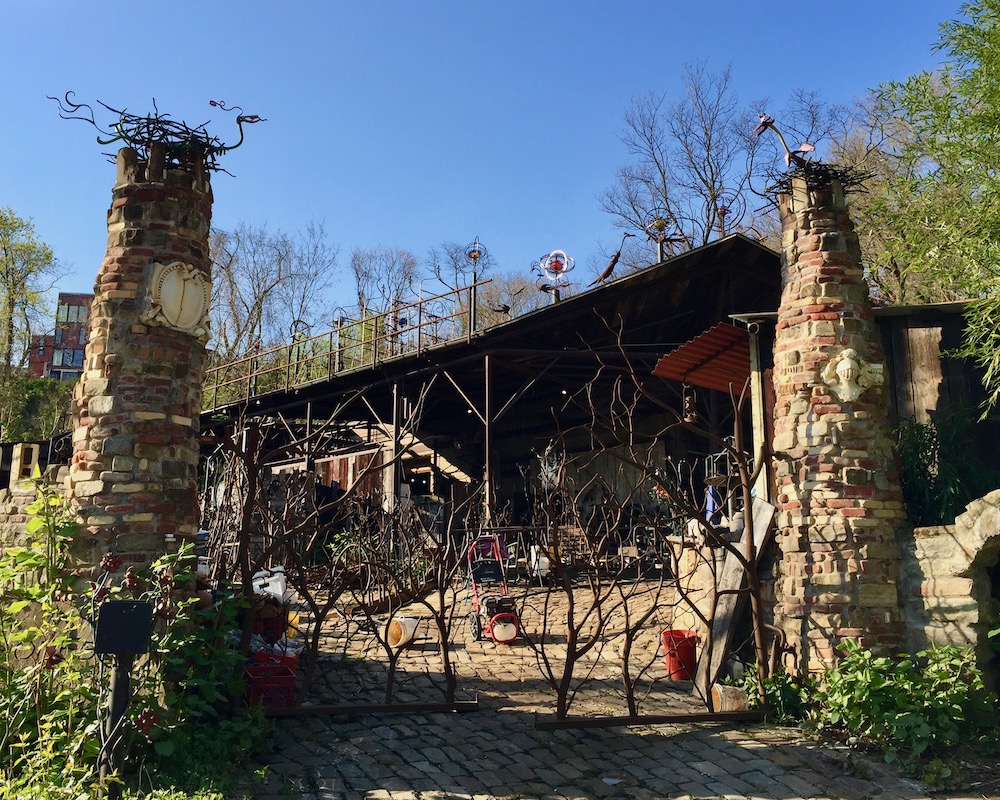
handmade masonry gates to Iron Eden, Pittsburgh
The Seussian gates of Iron Eden, Lorigan Street
wooden painted board that used to read "LOVE" with most of the middle section removed
Ouch! There is no middle ground in love. Vestigial cutting board art.
collage of protractors glued to various walls and signs
Yes, there are Pittsburgh protractors in The Hollow
graffiti on pink wall reading "Stuck in the rain for 20 minutes on a 1 year tour of the USA"
If JYK could make Skunk Hollow a part of his American tour, you can walk down the hill from Bloomfield.
metal piece with words "Rusty love" cut out nailed to utility pole
Rusty (and muddy) love

Row House Romance: Odd Couples Edition

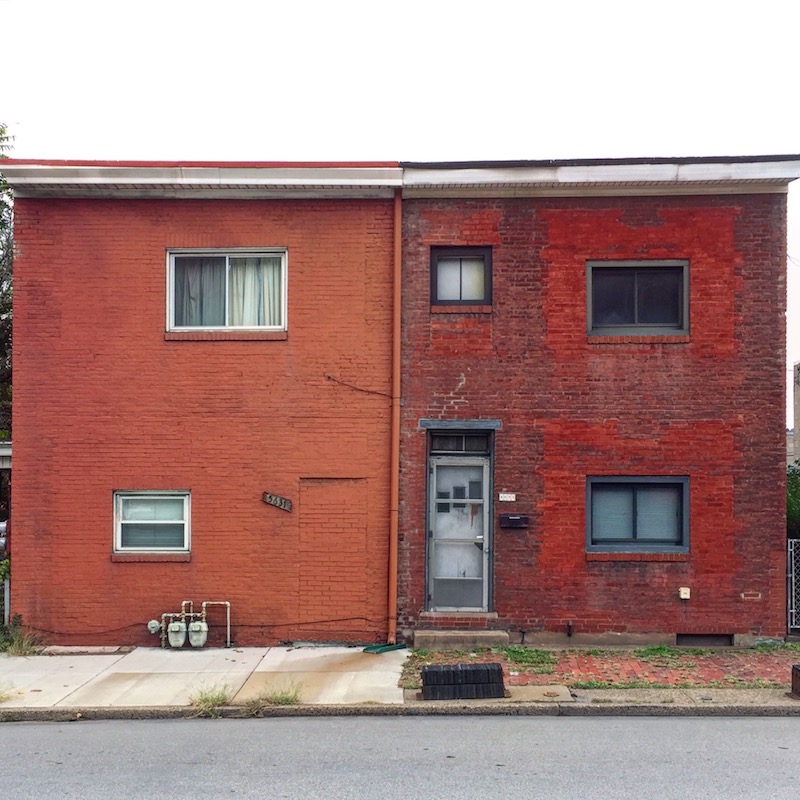
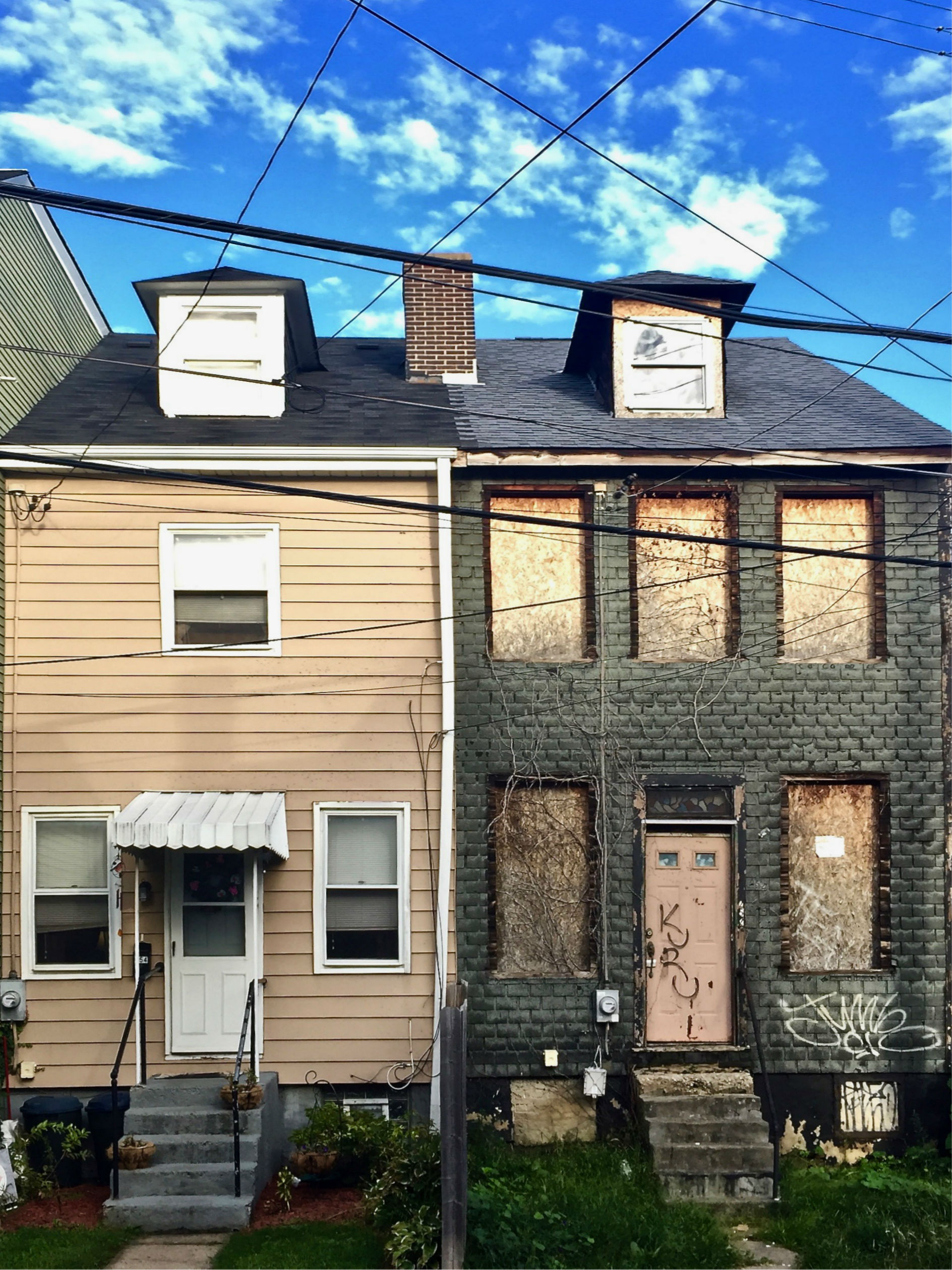
row houses of very different architectural designs, Pittsburgh, PA

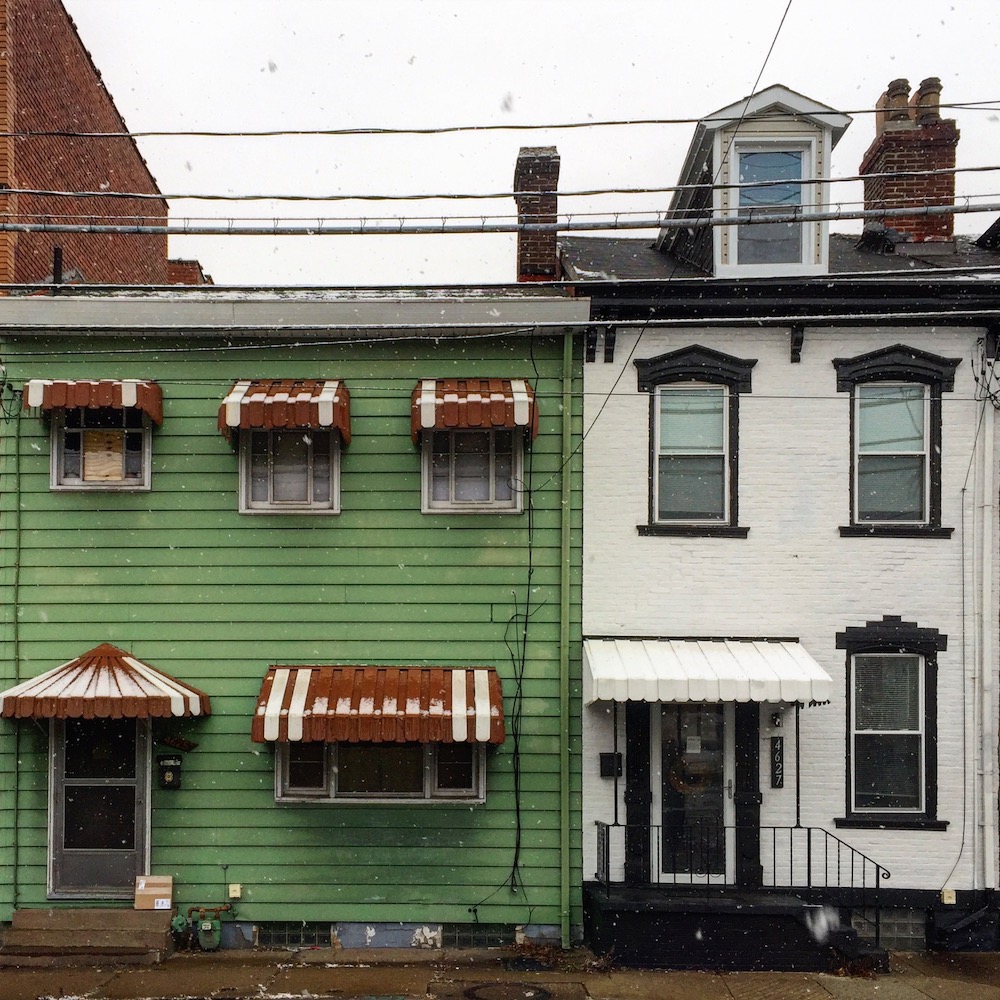
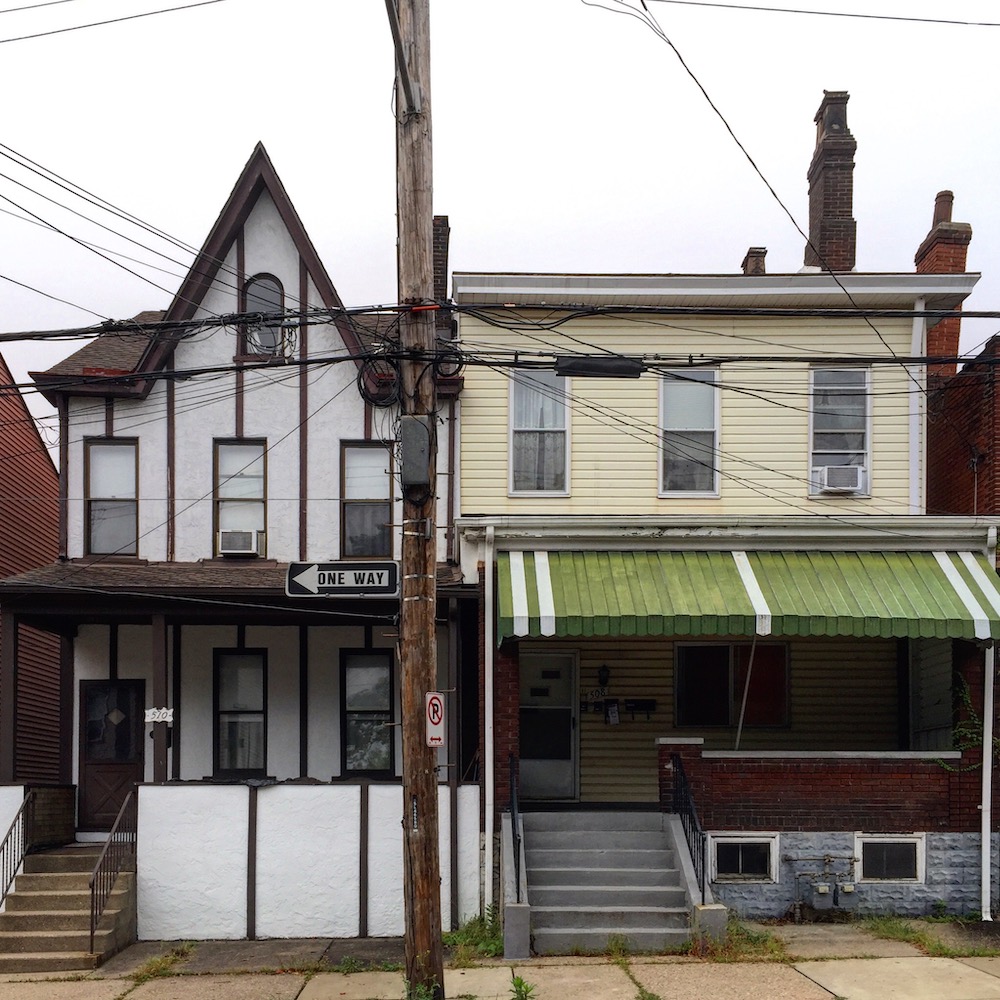
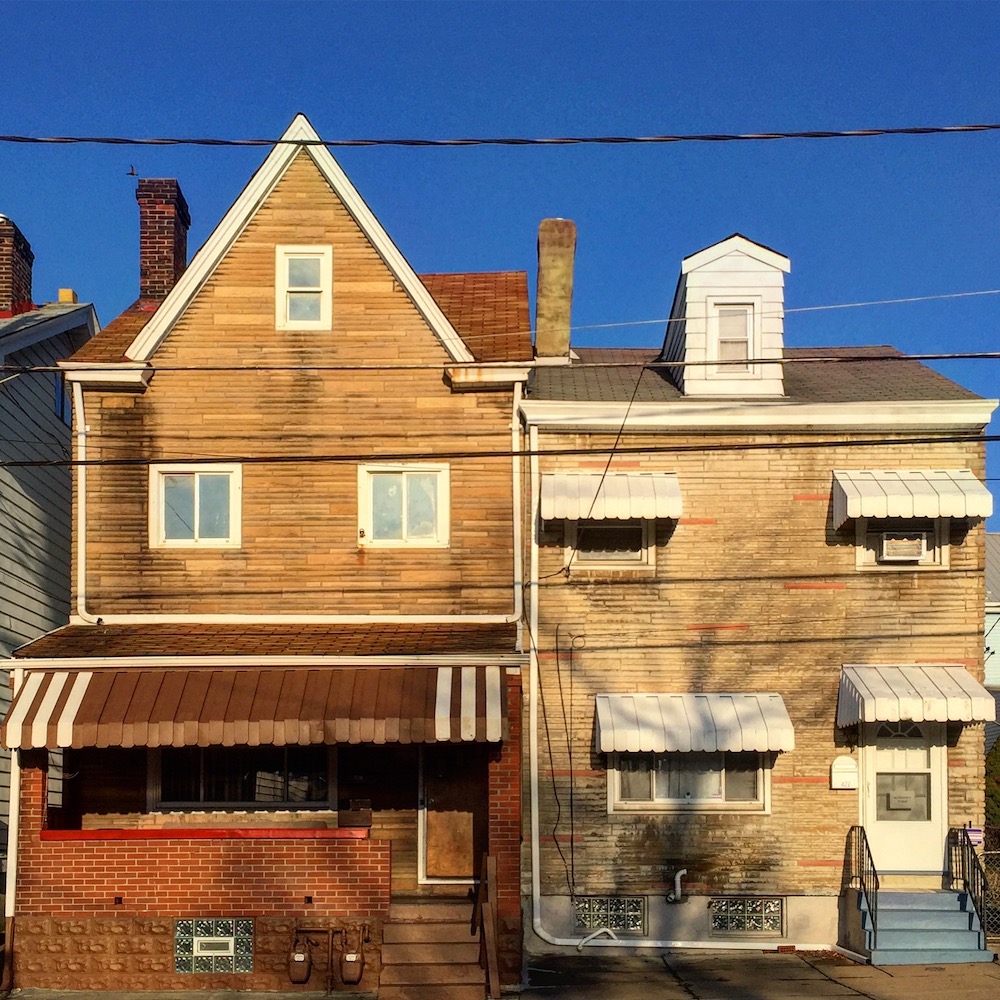
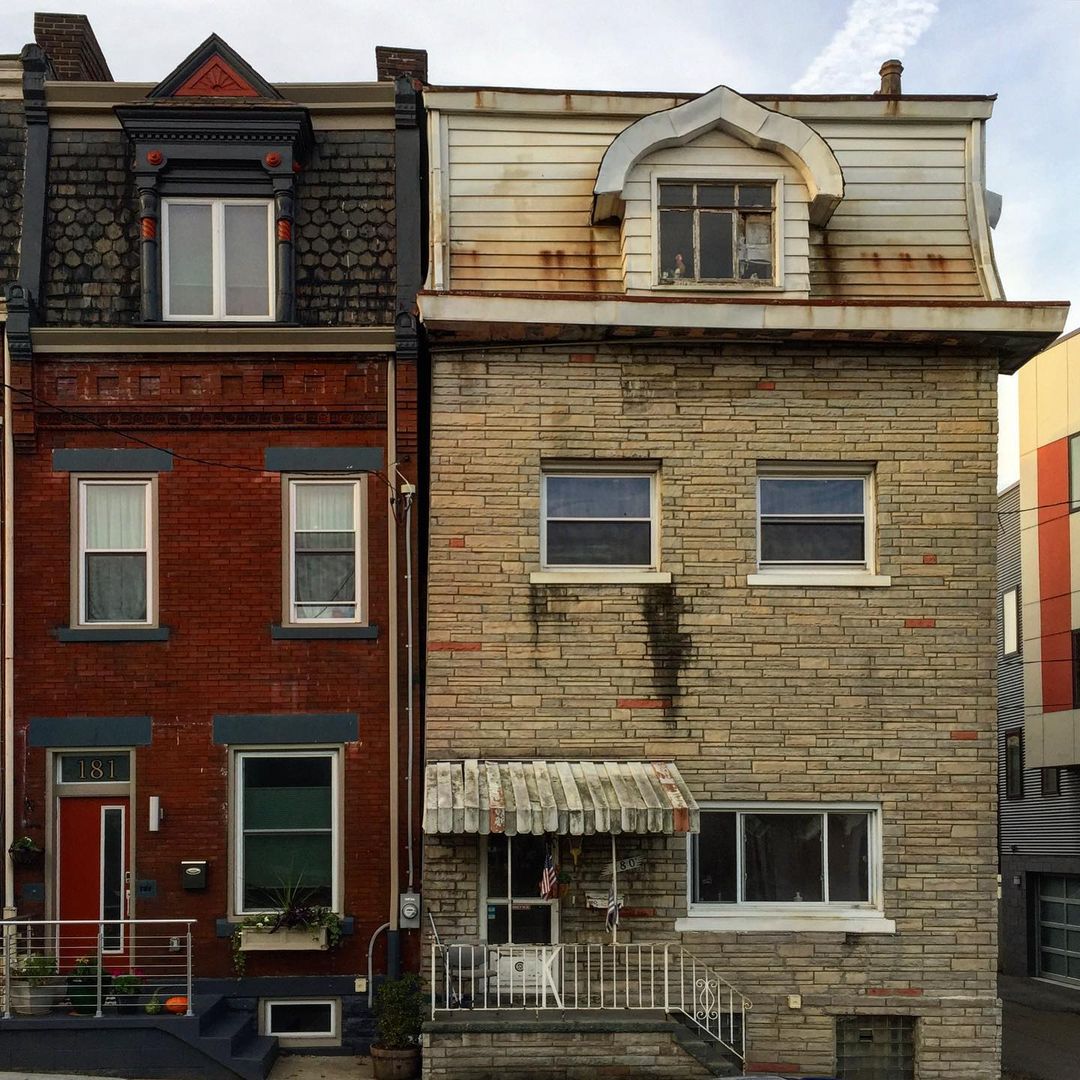
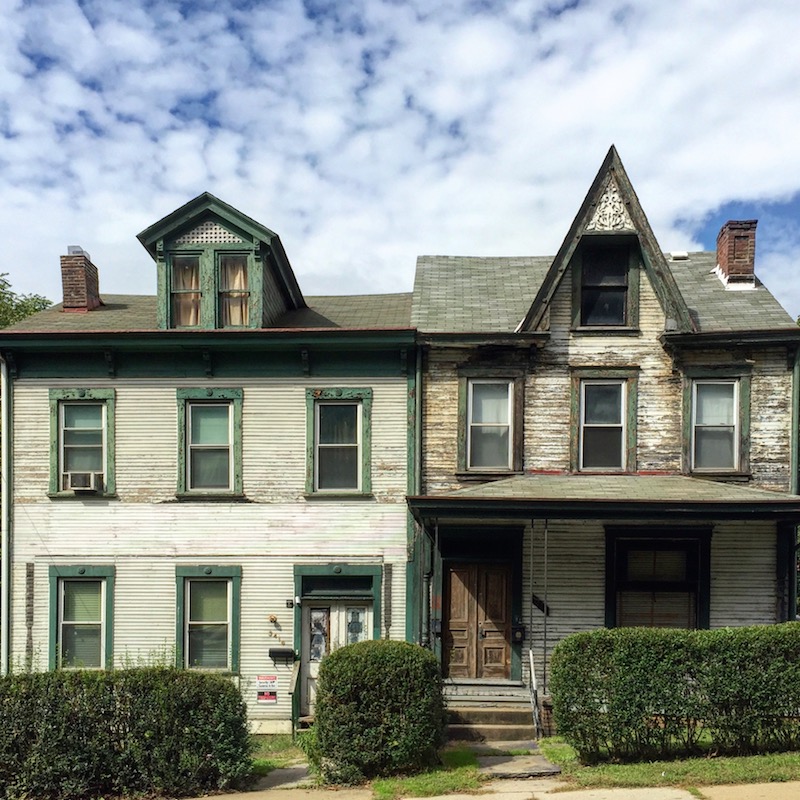
The holy grail! Side-by-side row houses of different width, height, design, color, and modernization, Bloomfield

If there is a high–the dragon, if you will–that the  hardcore romancer chases, it is this. A pair of stout row houses, butting right up against each other like books on a shelf, but otherwise as unrelated as chalk and cheese.

He with the faded green aluminum siding, splotched with decades of not-quite-matching touch-up paint; she with a prim new black-and-white scheme on her brick façade, ready for the town in never-going-out-of-style two-tone. He made the regrettable decision to turn his windows into port holes; she’s left the nice big double-hung two-paners intact, and has the afternoon sunlight to prove it. He’s still lugging around the same set of heavy-lidded awnings he picked up after high school; she’s newly trimmed her detail work–all clean lines, tight accents, and graceful ornament.

We could go on about how he’s put on a few pounds from all that sitting around, but that would just be cruel. No, we’re here to celebrate that great accident of residential architectural history–the side-by-side odd couple pairings one finds in Pittsburgh’s many row house blocks. Each evinces an anthropomorphic reaction to the unlikeliest of subjects: old-school worker housing.

There was enough commonality in some of these to group them into loose themes. Really though, this one’s all about the visuals, so we’ll quit yappin’. Whether you live in one (guilty!) or are just a drive-by wanna-be, happy row house romance to one and all!

To Peak or Not to Peak?

row houses of very different architectural designs, Pittsburgh, PA

Bloomfield

Bloomfield

row houses of very different architectural styles, Pittsburgh, PA

Bloomfield

row houses of very different architectural designs, Pittsburgh, PA

Bloomfield

row houses of very different architectural designs, Pittsburgh, PA

Bloomfield

Bloomfield

3-story brick townhouse adjoining 2-story frame row house, Pittsburgh, PA

Bloomfield

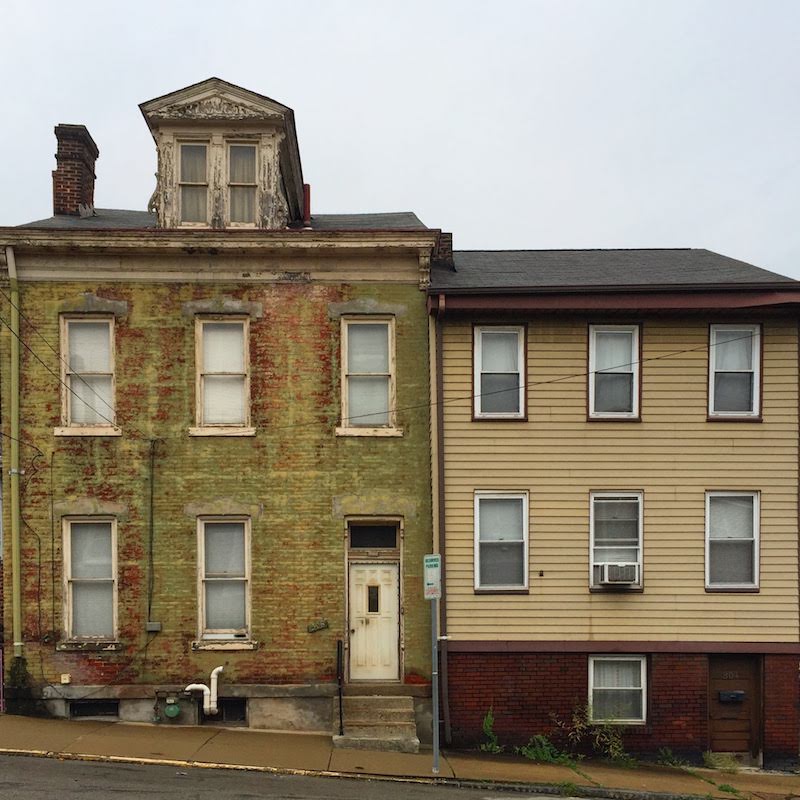
Big Buddy/Little Buddy

large brick row house next to small row house with aluminum siding, Pittsburgh, PA

South Side

pair of row houses of different architectural styles, Pittsburgh, PA

Lawrenceville

row houses of very different architectural designs, Pittsburgh, PA

Bloomfield

Bloomfield

row houses of very different architectural designs, Pittsburgh, PA

Lawrenceville

Bloomfield

side-by-side brick row houses, Pittsburgh, PA

Lawrenceville

Brothers From a Similar—but Definitely Other—Mother

row houses of very different architectural designs, Pittsburgh, PA

Bloomfield

side-by-side brick row houses, Pittsburgh, PA

Bloomfield

side-by-side brick and frame row houses in Pittsburgh, PA

Lawrenceville

exterior of wooden row houses, Pittsburgh, PA

Brighton Heights

Mixed-Media

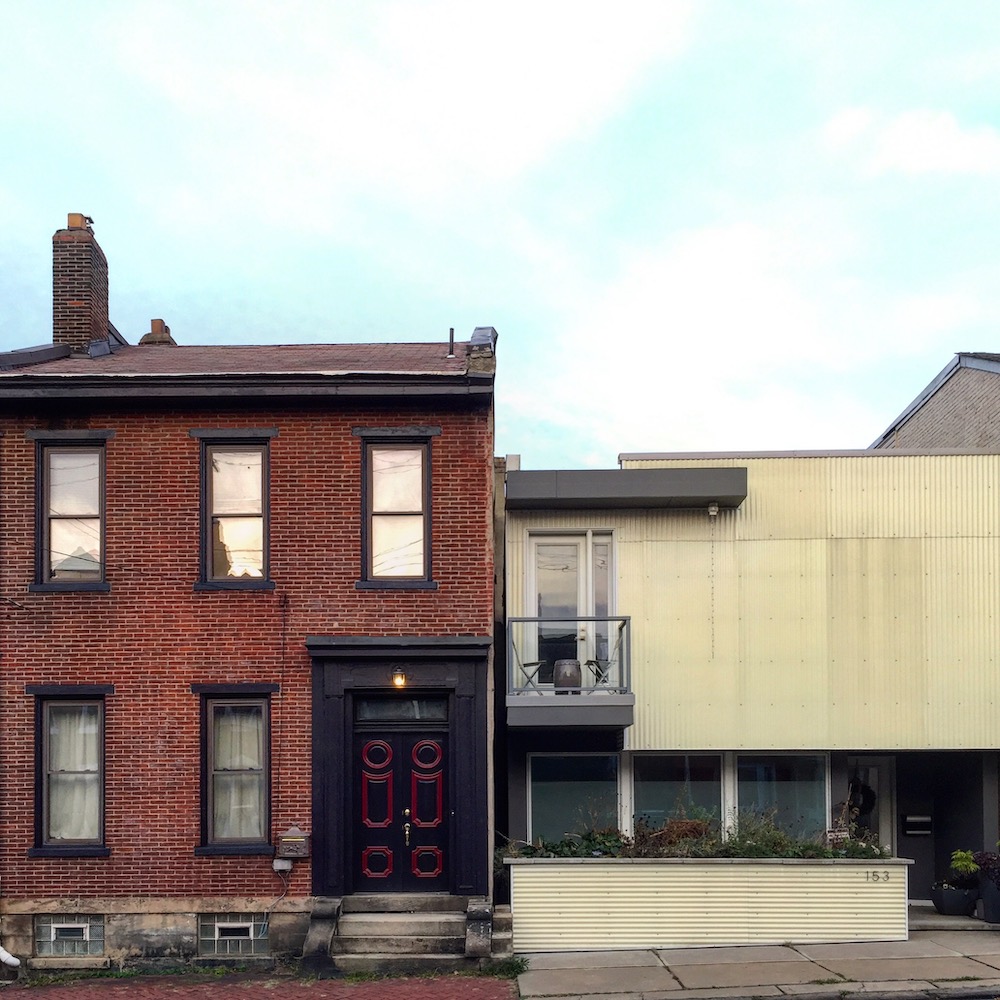
Victorian-era brick row house next to modern metal and glass row house, Pittsburgh, PA

Lawrenceville

older brick row house next to under-construction house, Pittsburgh, PA

Deutschtown

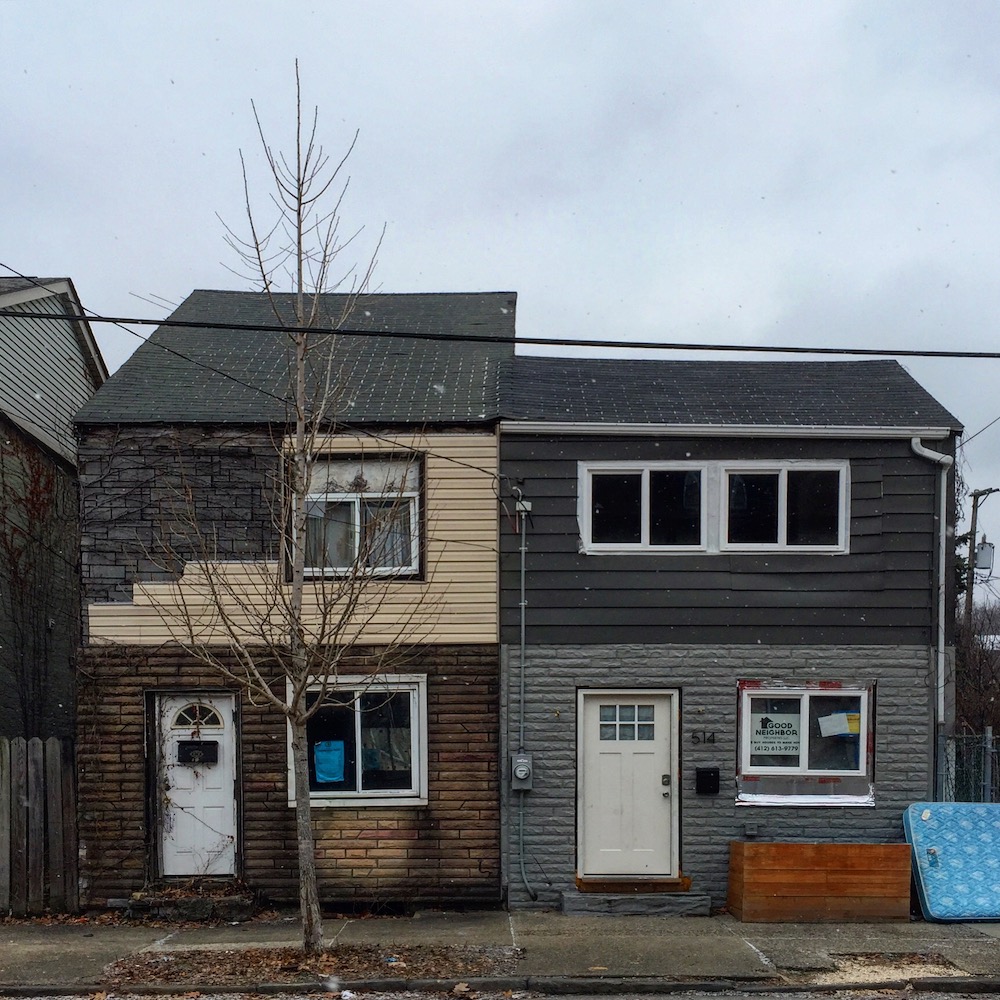
pair of row houses with very different siding treatments, Pittsburgh, PA

Deutschtown

brick row house with flat roof next to wooden row house with peaked roof, McKees Rocks, PA

McKees Rocks

row house with collapsed roof next to row house with new siding, Pittsburgh, PA

Marshall-Shadeland

ornate brick Victorian row house next to plain designed row house, Pittsburgh, PA

Mexican War Streets

Steps to Nowhere: The Thomasson of Essex Way

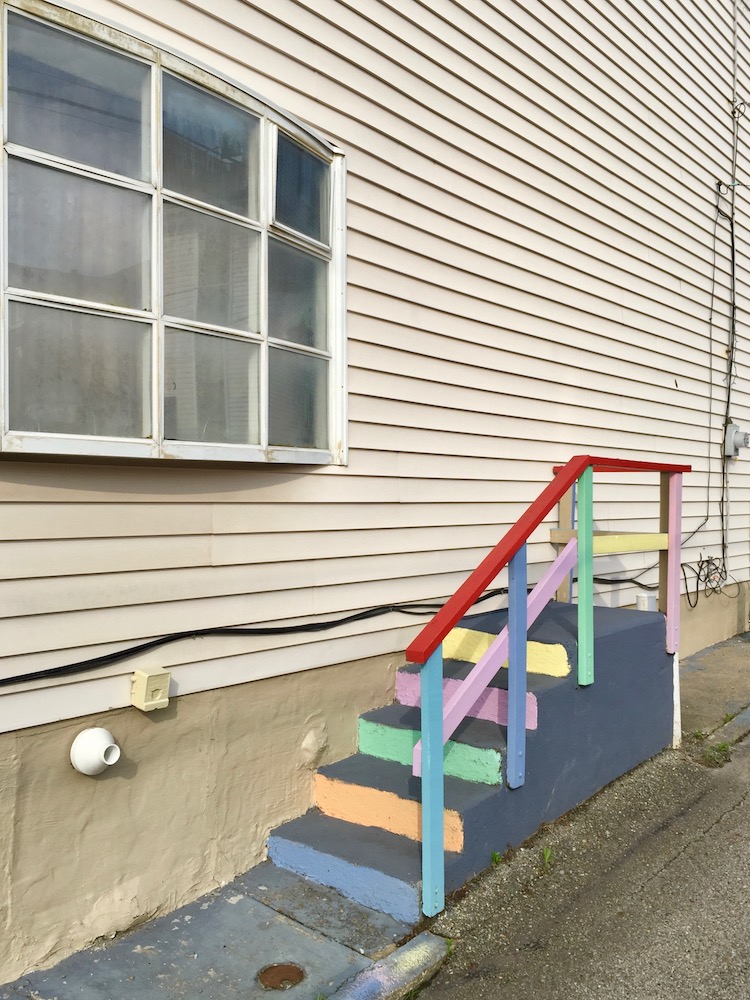
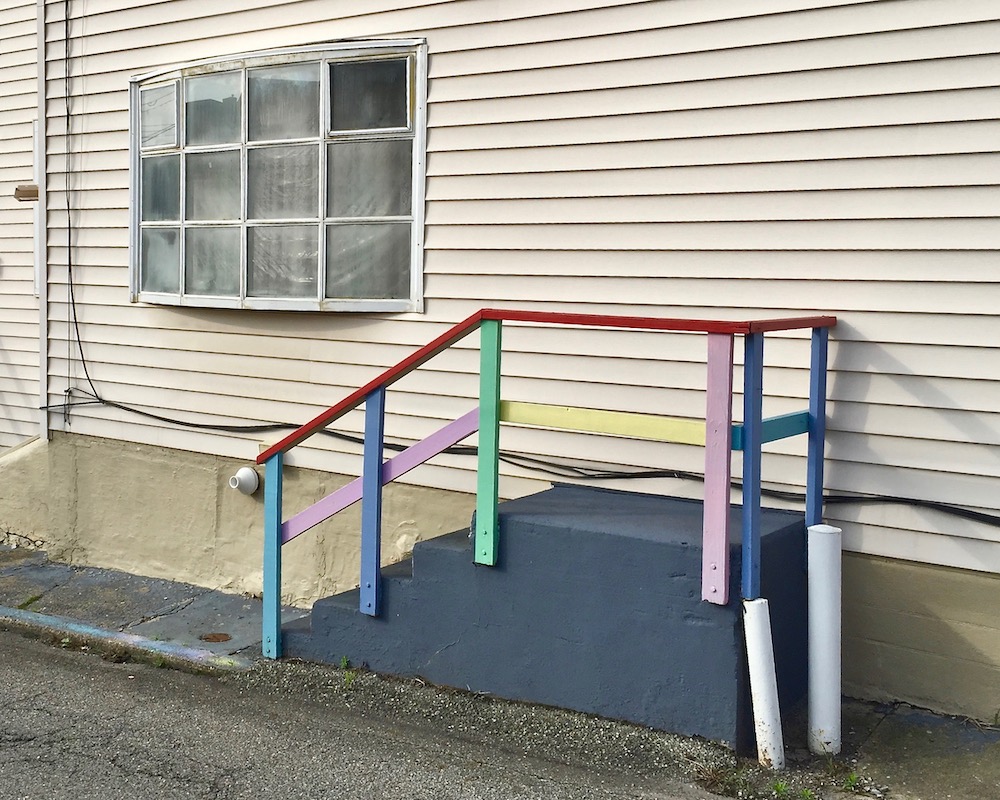
Steps to Nowhere: The Thomasson of Essex Way, Bloomfield

Well, it took long enough–three years and change.

It was that long ago, in this same electronic publication, where the author declared, “To Pittsburgh’s other Thomassons, hang in there: we’re coming for you!” (“A Thomasson!” Pittsburgh Orbit, March 16, 2016)

Rabid fans of architectural effluvia have been sitting on their hands for years now, waiting for a promised revival, but was the wait ever worth it! It’s not every day that a beaut’ like this comes along.

Five short steps form a poured concrete stoop along the alley side of a Bloomfield row house. They lead to a blank wall. The base has been freshly repainted in a deep slate blue with its risers and wooden railing accented in alternating colors of red, mauve, aqua green, yellow, orange, and a couple shades of blue. The whole construction pops from the otherwise nondescript off-white siding.

We’ll not go into the whole thing here, but a “Thomasson” is an artist-created name for an architectural or infrastructure relic that no longer serves any purpose but is still actively maintained. It’s that second clause that makes them so rare.

While Webster Hall’s former retail entrance (see the earlier story) is totally legit, it never felt quite right. The remaining two-step platform makes a pretty obvious nice long bench along the Fifth Avenue sidewalk bookended by a pair of planters. One could argue this is less Thomasson and more adaptive reuse. In reality, no one ever sits there; theoretically a person could.

In contrast, the Bloomfield side steps-to-nowhere are really textbook Thomasson. They clearly led to a door that’s no longer there, boxed in by after-market aluminum siding in a serious home renovation project. It’s expensive and/or labor-intensive to jackhammer out all that concrete–not to mention there’s a possible structural hazard for the home’s foundation. So one can imagine the very reasonable desire to just leave it be.

But by preserving the useless handrails and taking up the paint brush–in eight different colors, no less–the homeowners are working at some next-level Thomasson generation. It’s an oddball curio, discussion topic, and detour destination for a backstreet Bloomfield gambol.

Someone made the effort to redd up their Thomasson. We’re glad they did.

Going Postal: The Cap Man Returneth

Cap Man #13, East Liberty

It’s all there: the non-plussed selfie stare, the upturned ball cap, the all-contrast Sharpie-on-postal label execution. Super fans already know where this is going, but for everyone else, these are the tell-tale traits and hallmark style of one of the city’s more mysterious and elusive serial street artists.

Cap Man #14, Friendship [photo: Lee Floyd]

When last we reported on the mysterious Cap Man, in the fall of 2017, it was with the strong accusation that “he’s likely left Pittsburgh entirely.” That may have been true–the backsides of the East End’s street signage and utility poles remained remarkably free of the behatted one’s visage through all of last year.

Well, he’s back, emerging some time in the late winter/early spring–slapping his little original sticker artworks on city infrastructure throughout a contiguous swath of East Liberty, Friendship, and Bloomfield. And this time…well, he’s fooling around just as much as he ever did.

Cap Man #15, Bloomfield

One of the assumptions made in prior stories was that Cap Man (the artist) was the author of both the Cap Man (the subject) (self) portraits and the similarly-styled “rogue’s gallery” drawings of (in)famous celebrities, media notables, and true crime figures.

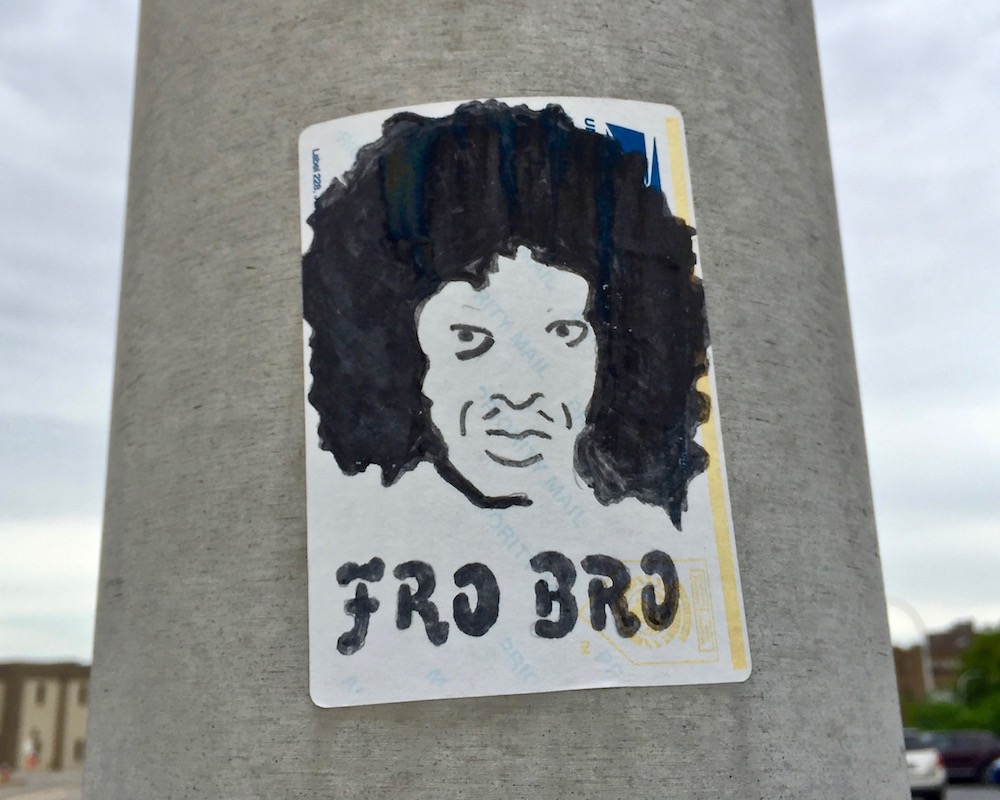
This theory is only bolstered by the simultaneous re-emergence of these types of drawings, inevitably committed by the same hand and distributed within the same vicinity as the Cap Man portraits. This time around, we can only positively ID slain rapper The Notorious B.I.G. aka Biggie Smalls, who arrived on a Bloomfield utility pole some time in the late winter or early spring. The recent offerings also include a dripping skull, a message of peace and love, and a couple renditions of one “Fro Bro.”

The Mysterious C.A.P. meets The Notorious B.I.G., Bloomfield

Bloomfield

Peace, Love, and a bunch of other stuff, Bloomfield

Fro Bro 1, East Liberty

Fro Bro 2, East Liberty

Finally, a legit street art miracle. Co-assistant to the mail room intern Lee Floyd spotted this loose, perhaps unfinished, drawing of a young woman on a Liberty Ave. pole after we’d snuck in one last Lenten fish fry on Good Friday. (See below.)

The figure’s head is turned to the right, her long hair unruly and wind-blown across her face. One eye is obscured, but the other stares with steely unease right back at you. It ain’t the Mona Lisa, but as much could be supposed on that head position, that glare as anything people read into Da Vinci’s masterpiece.

unknown woman, Bloomfield [photo: Lee Floyd]

So, imagine our surprise when mere days later the crew is on a rainy day stroll down Baum Blvd.–nearly a mile from the original light pole–and there she is again. Divorced from the steel pole and lying on a soaking wet sidewalk is … the same woman! Not just the same subject, but the same drawing!

unknown woman, East Liberty [photo: Lee Floyd]

Now, how that sticker came off one light pole completely undamaged and worked it’s way a mile down the road just to find the only two pair of people in the world who would care about it is something we have no explanation for–but it’s a doggone miracle!

If that’s not enough positive juju, coincidental mojo, and lightening striking twice for you, I don’t know what is. Most people have to steal their parent’s HBO password to get that kind of drama, but Cap Man is offering it to you for free, right here on the street.


Background on the continuing saga of Cap Man:

Row House Romance: Christmas Window Roundup

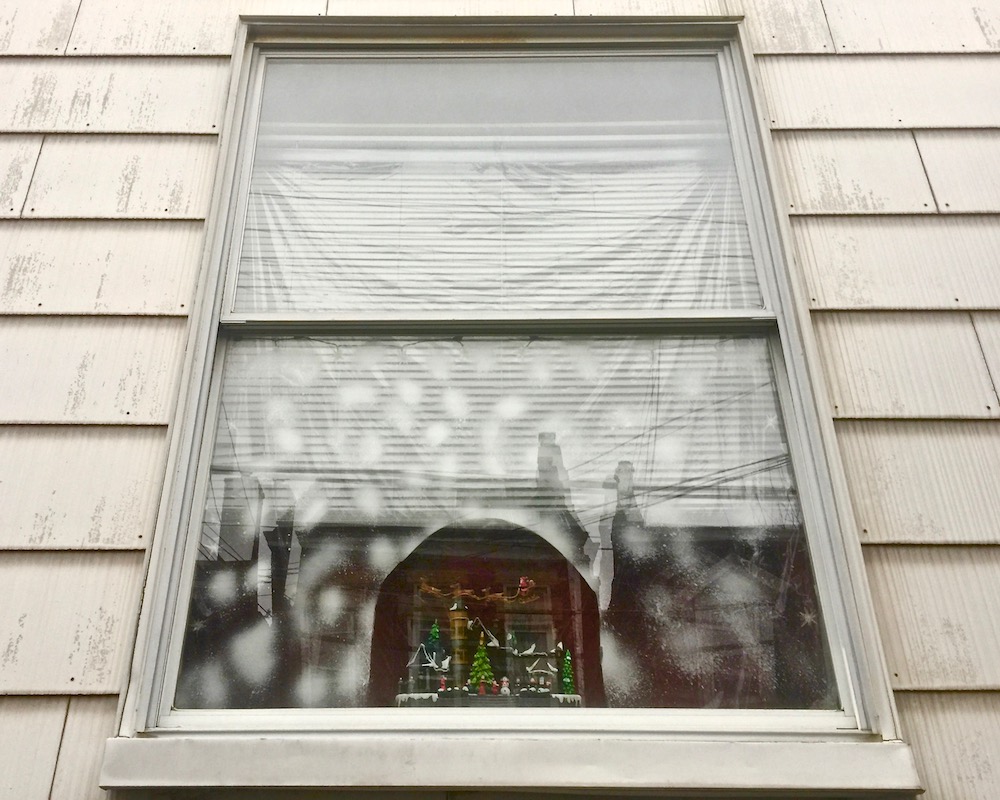
window decorated with many winter scene buildings, Pittsburgh, PA

winter scene diorama, Lawrenceville

Keep on truckin’. The ’60s-era catch phrase of hippie can-do optimism was popularized by R. Crumb’s iconic cartoon of an easy-striding, big-shoed dude. Here, a sticker that’s appropriated both the slogan and image decorates the side panel of a model 18-wheeler. The little big rig has been put on display in a street-level front window of an Upper Lawrenceville row house.

Though it doesn’t explicitly say Merry Christmas or Happy Holidays, with a backdrop of picturesque snow-covered small town buildings, circled by carolers and snow people, colored lights and a tiny train, it’s impossible not to read the truck’s red cab as a modern update to Santa’s sleigh–those 400 horses a well-deserved upgrade to yesteryear’s eight tiny reindeer. Forget that other Snowman, if anyone’s got a long way to go and a short time to get there, it’s Ol’ Saint Nick on his yearly delivery run.

detail of winter scene including "Keep on Trucking" 18-wheeler, Pittsburgh, PA

Keep on Trucking (sic.): winter scene diorama (detail), Lawrenceville

Christmas. For some, as the song goes, it’s the “most wonderful time of the year” full of decadent–if generally wholesome–holiday parties, comforting tradition, and good cheer. To others, Christmas is a loathsome six weeks of commercialized sentimentality, forced mirth, obligation, and disappointment.

Here at The Orbit, we fall somewhere in the middle. I’ll admit it: I like the smell of a real spruce tree and the warm glow of colored lights; time off to do jigsaw puzzles, visit with friends, and sleep late; the collective goofiness of stuffed antlers added to minivan rooftops, white elephant gift exchanges, and a full movie house crowd gleefully roaring at Hans Gruber’s entrance in Die Hard.

But then there’s the dark side. The first time those jing-jing-jingling tunes preempt Casey Kasem on oldies radio–absurdly starting before Thanksgiving–it invokes such crushing, foreboding dread that it makes the whole holiday almost not worth it. Almost.

cat sitting in window decorated for Christmas, Pittsburgh, PA

candles, snowflake, attack cat, Lawrenceville

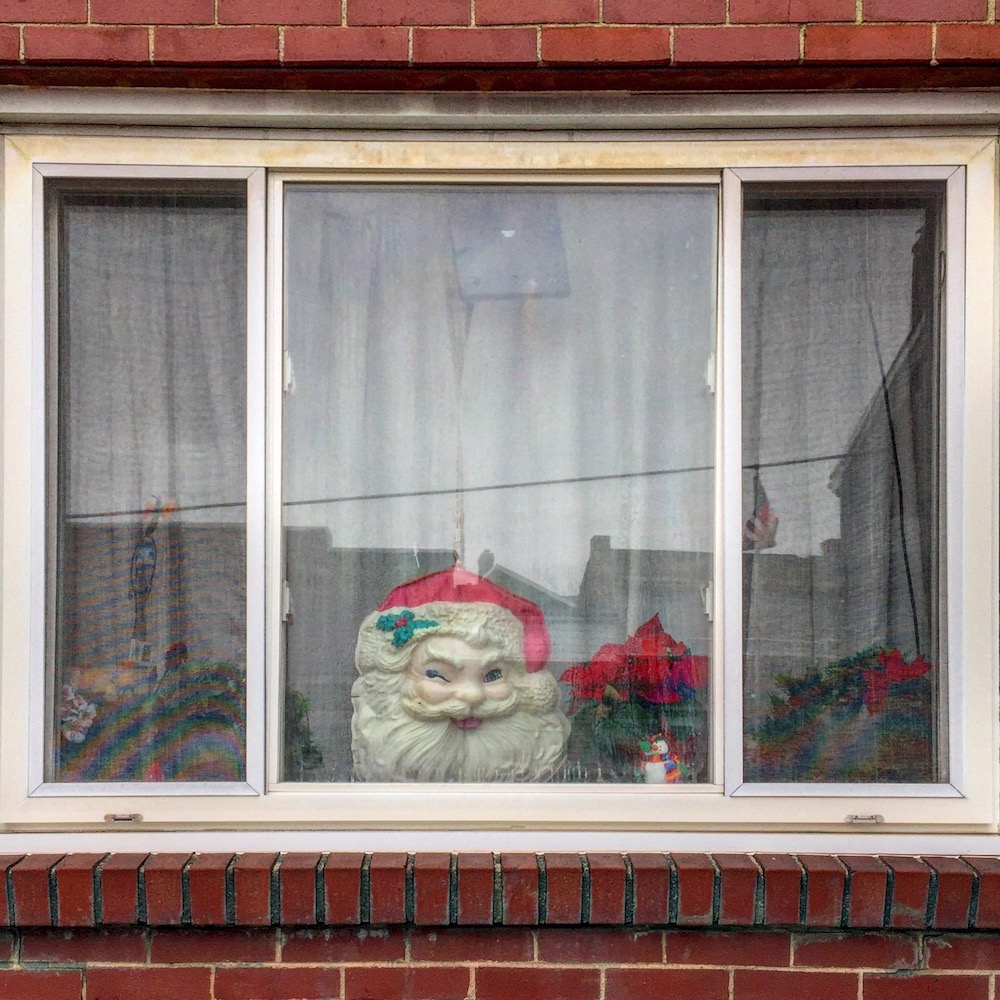
rowhouse window decorated for Christmas, Pittsburgh, PA

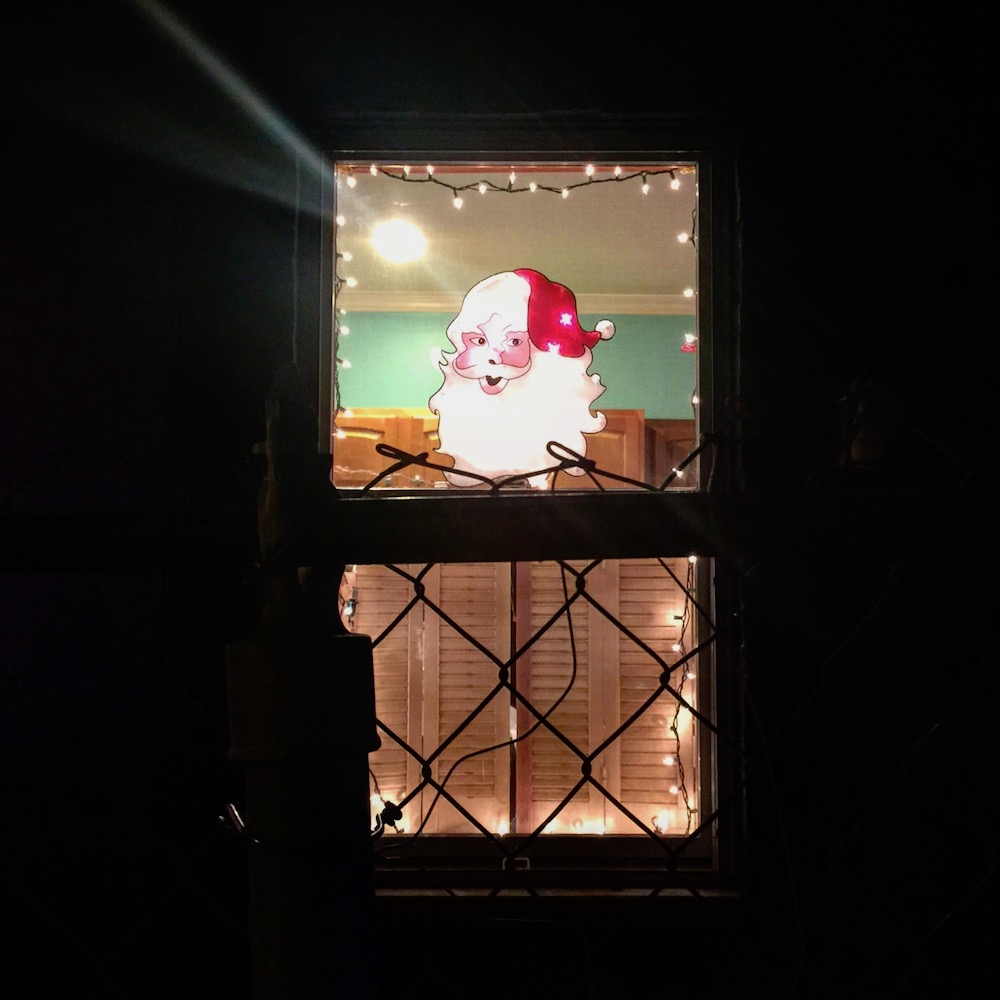
winking Santa, Lawrenceville

Love it or hate it, Christmas 2018 is over. But you wouldn’t know that from the residential streets in Lawrenceville. Say what you want about the neighborhood’s gentrification, but the Christmas display scene was (and still is) earnest and ample. Walk down any block and it can feel like every other house has got something up for the holiday: garlands on stoop railings, Santas on the front steps, and–most of all–decorations in the big front street-facing windows.

row house window decorated for Christmas, Pittsburgh, PA

Santa and Mrs. Claus, Lawrenceville

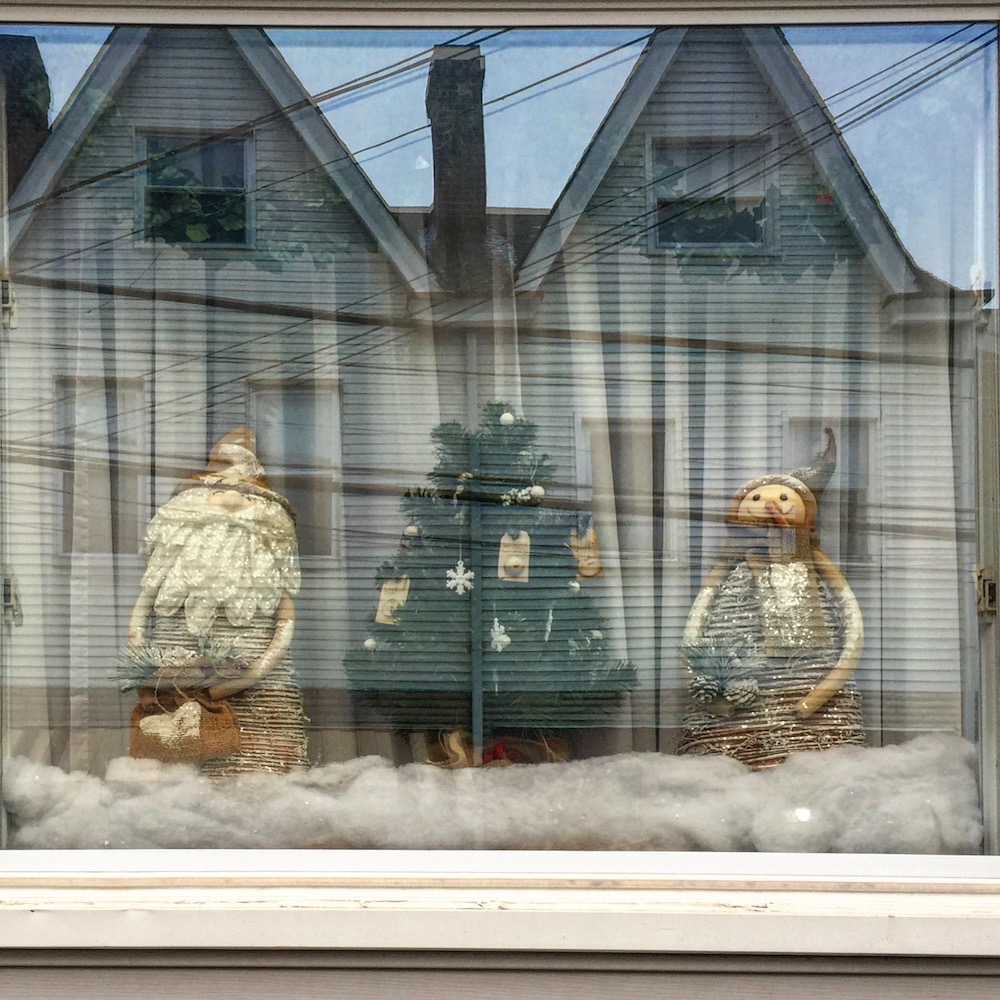
row house window decorated for Christmas, Pittsburgh, PA

two Santas, Bloomfield

When you live in a row house–and I’m speaking from a couple decades of experience here–you get used to people looking directly into your life. It’s not weird or creepy or nebby–pedestrians and neighbors just can’t help but look in when the sidewalk is mere feet–often inches–from the front of the house.

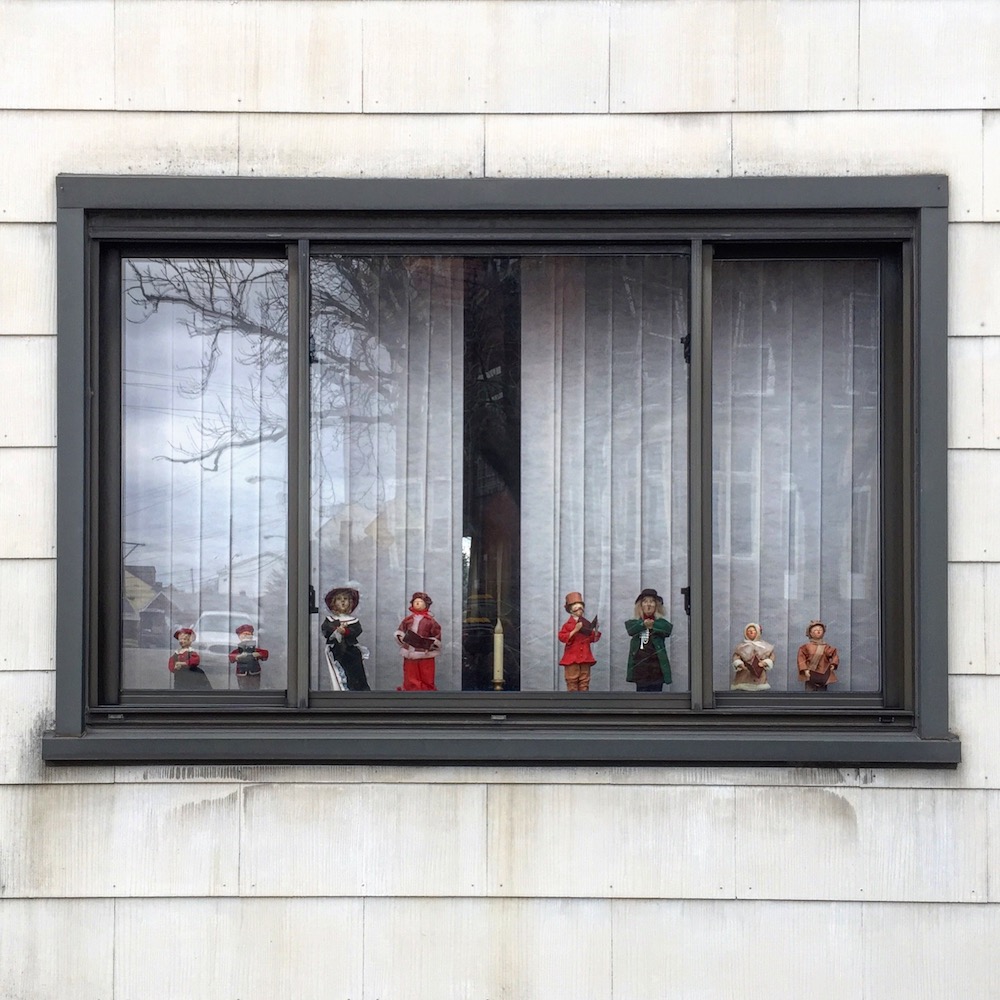
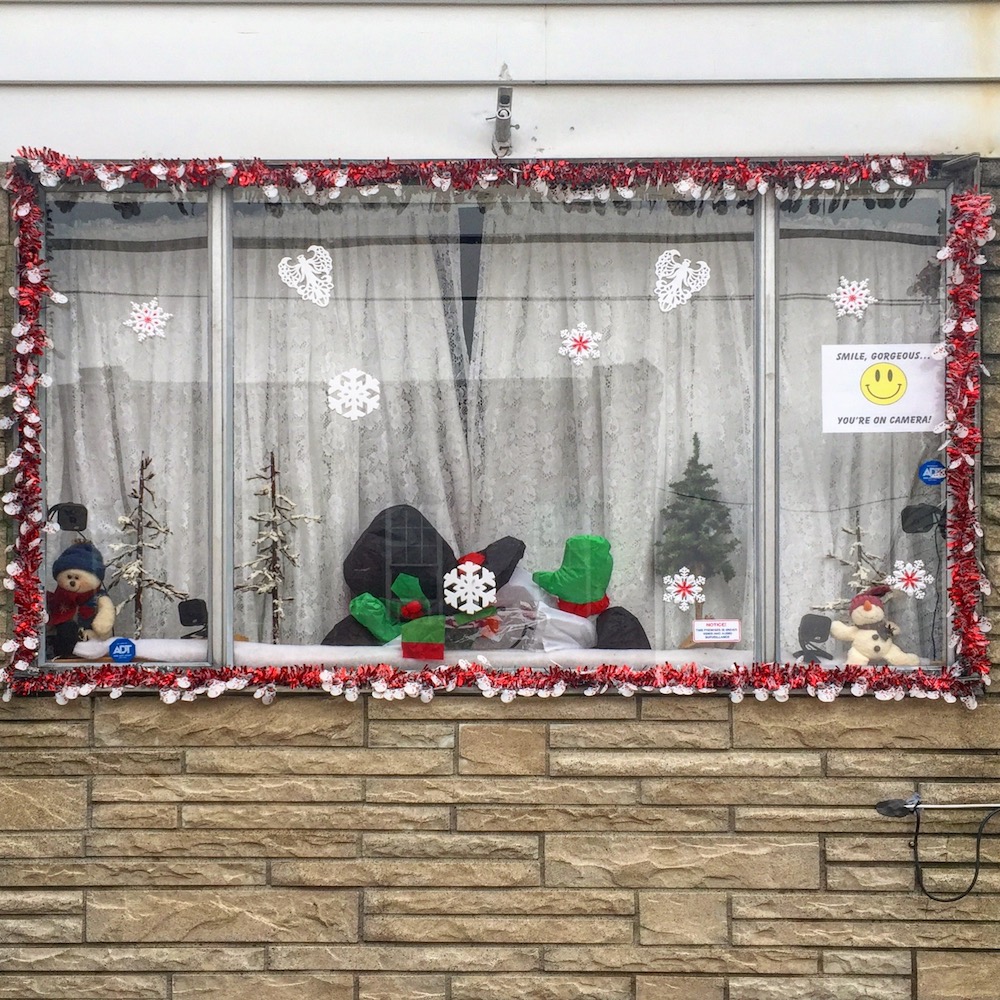
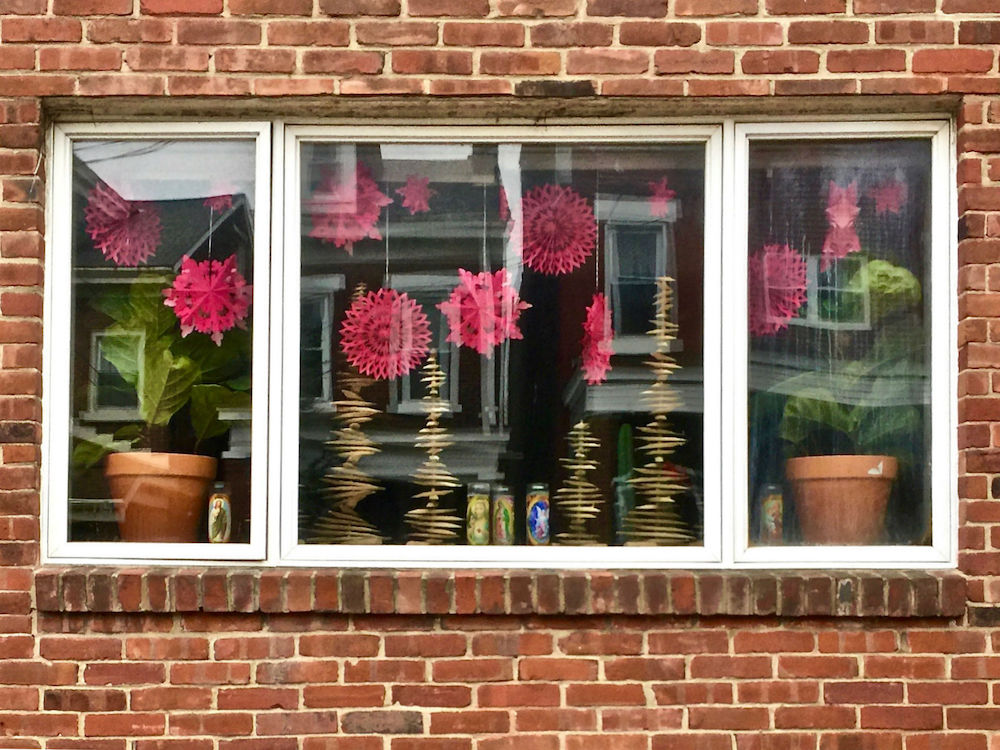
That so many people end up using their street-facing windows as makeshift display cases for curated collections of figurines and little artworks, sports fandom and tchotchkes is perhaps something we could expect. But when our friends and neighbors orient their collections outward–specifically for the enjoyment of the world passing by on the sidewalk–well, that’s a beautiful thing and one that should not be taken idly. [Side note: Kirsten Ervin wrote a whole piece on this subject for Pittsburgh Orbit back in 2015.]

Krampus holiday decorations in row house window, Pittsburgh, PA

Gruss vom Krampus! Lawrenceville

rowhouse window decorated for Christmas, Pittsburgh, PA

carolers, Troy Hill

One of the great pleasures of a daily constitutional around the neighborhood is getting to watch these window displays grow and evolve, get put away for the year and replaced in anticipation of the next turn of the calendar. Soon enough, the cotton-laden carolers and dangling snowflakes will be packed away to make room for Valentine’s Day hearts, St. Patrick’s clovers, Easter eggs and bunnies.

rowhouse window decorated for Christmas, Pittsburgh, PA

snow owl, Bloomfield

rowhouse window decorated for Christmas, Pittsburgh, PA

snow scene vignette, Bloomfield

If it’s not obvious, we went a little nutso with the Christmas window shopping this year–and, believe me, there are plenty more where these came from. This weekend is likely your last decent chance to catch any of these until the next Christmas season begins. Get out and walk around, take in what you can.

Anyway, Merry Christmas! (again)

windows decorated with Christmas stockings, Pittsburgh, PA

teddy bear stockings, Lawrenceville

window decorated with snow people and Christmas wreath, Pittsburgh, PA

snow people window, Lawrenceville

rowhouse window decorated for Christmas, Pittsburgh, PA

snow people, wreath, and candles, Lawrenceville

row house window decorated for Christmas, Pittsburgh, PA

snow people, Lawrenceville

row house window decorated for Christmas, Pittsburgh, PA

deflated snow person, Lawrenceville

row house window decorated for Christmas, Pittsburgh, PA

hot pink snow, Lawrenceville

row house window decorated for Christmas, Pittsburgh, PA

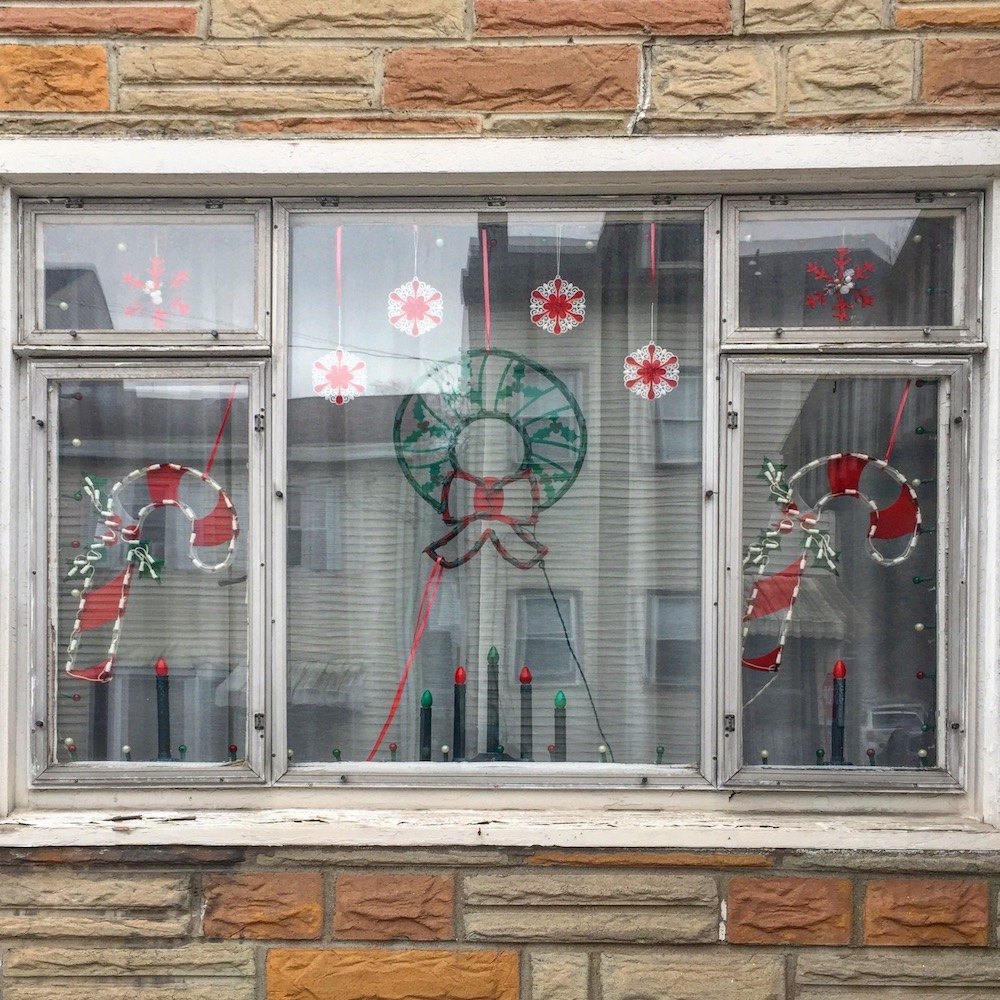
candy canes, snow flakes, wreath, and candles, Lawrenceville

bay window decorated for Christmas, Pittsburgh, PA

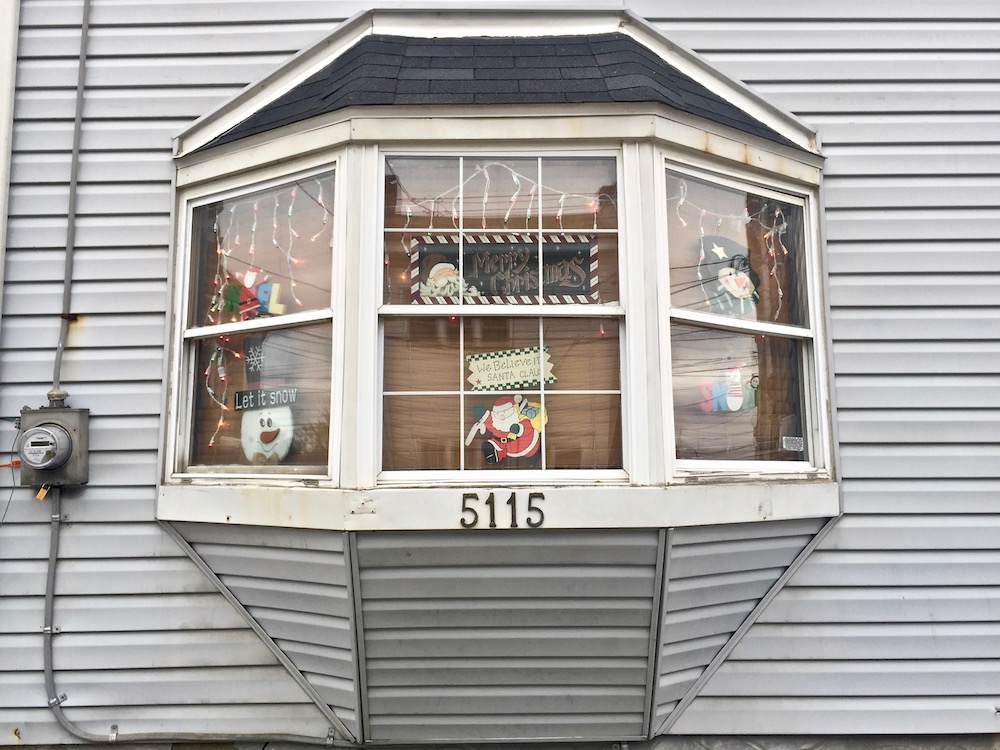
Christmas’ greatest hits, Lawrenceville

row house window decorated for Christmas, Pittsburgh, PA

manger scene, Lawrenceville

row house window decorated for Christmas, Pittsburgh, PA

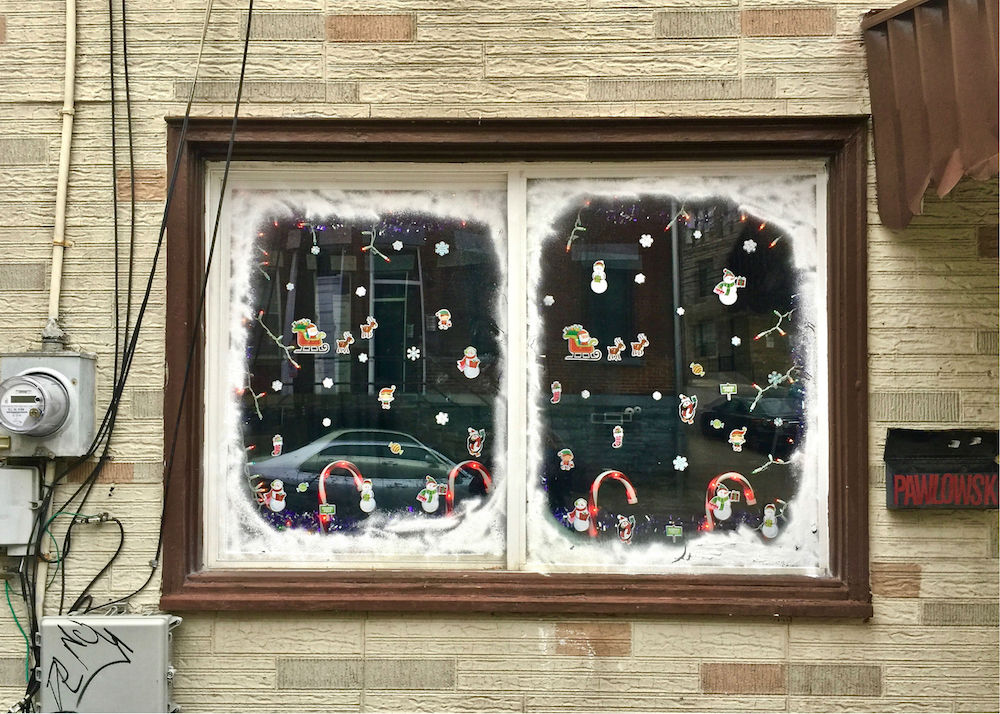
Christmas stickers, Lawrenceville

row house window decorated for Christmas, Pittsburgh, PA

bells, candles, Lawrenceville

row house window decorated for Christmas, Pittsburgh, PA

Claus family, Lawrenceville

bay window decorated with Christmas dolls, Pittsburgh, PA

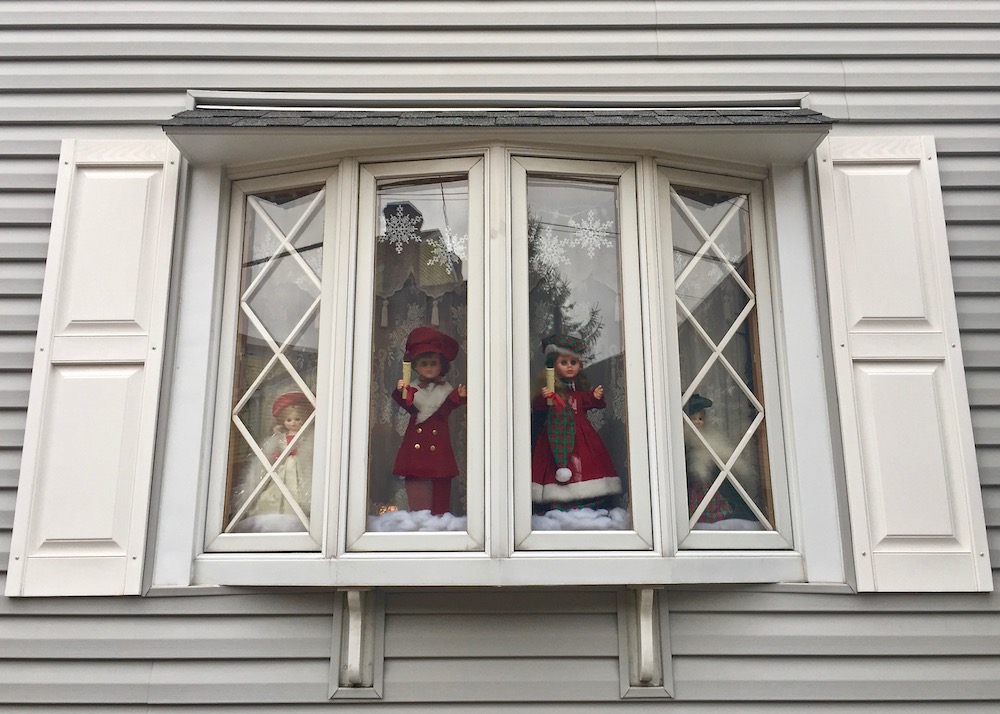
Christmas automatons, Lawrenceville

rowhouse window decorated for Christmas, Pittsburgh, PA

Santa window, Bloomfield

Row House Romance: Double the Fun OR Twins Gone Wild!

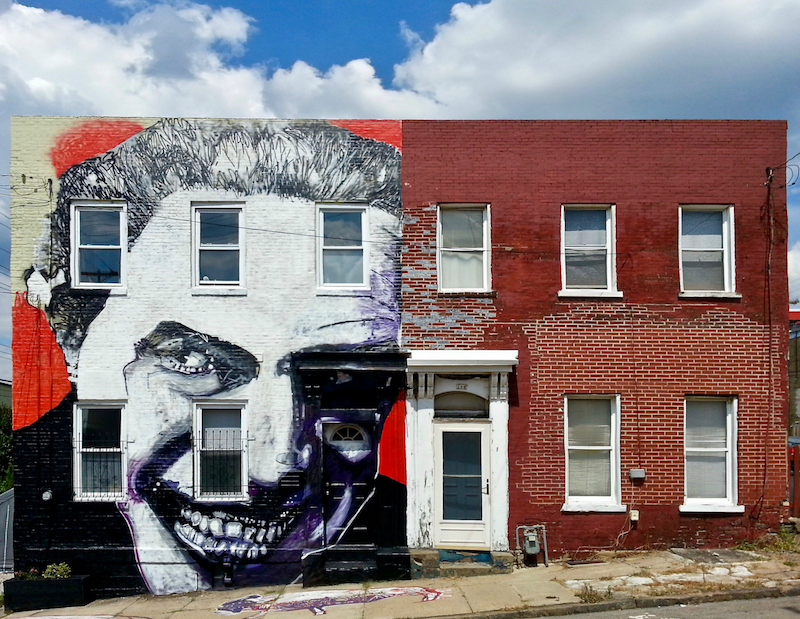
identical brick row houses, one with elaborate mural across the entire front, Pittsburgh, PA

Lawrenceville

Identical twins, born of the same womb. The exact face, height, and profile. Some are from the side-streets–tough, working-class, gritty, without pretension. Others, their high-brow peers; raised mere blocks away, but praised for their natural beauty, elegant stature, and enviable position in life. To the former, these may as well have been from the moon.

No matter how much each pair of siblings may appear as perfect duplicates at birth, time has a way of imprinting itself on every living creature in radically different ways: an unwise tattoo or regrettable fashion choice, the scar from a near-death collision or the catastrophe of an ugly divorce. Given a hundred and twenty years or so, a lot can happen.

pair of brick row houses painted aqua blue and olive green, Pittsburgh, PA

Lawrenceville

matched pair of row houses painted red and pink, Pittsburgh, PA

Lawrenceville

pair of matching row houses with many exterior alterations, Pittsburgh, PA

Lawrenceville

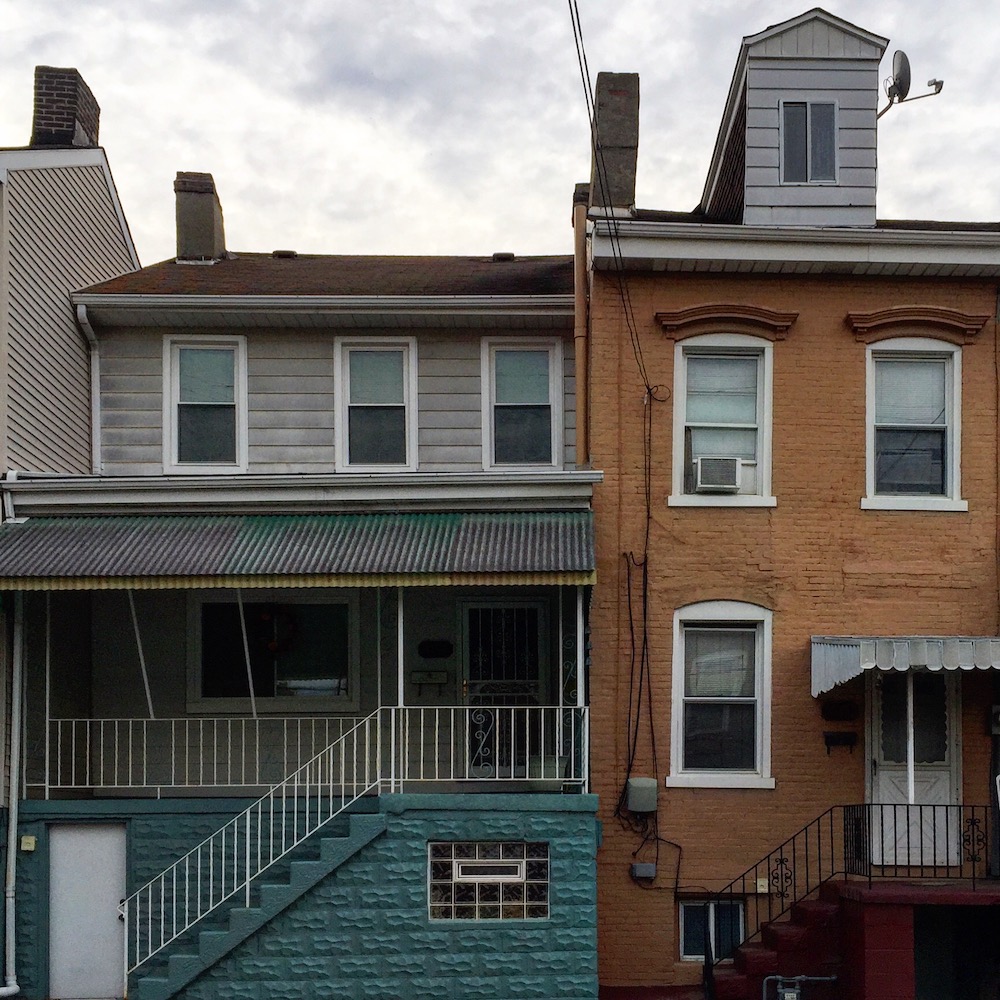
Consider the humble row house. Two up, two down; squat stoop; a single shared chimney stack; window-window, window-door. Some are boxy and flat-topped, but most have clean, peaked roofs–almost always with a dormer inserted right in the middle.

For the most part, Pittsburgh wasn’t built with the kind of block-long identical row houses you see filling entire neighborhoods of Baltimore or Philadelphia. More often, we ended up with pairs–mirror-image houses sharing a common wall. So much so, Pittsburgh has its own term for duplex: double house. Sometimes these twins are built into long blocks of other row houses in various designs; often, thin walkways separate the next-door neighbors.

exterior of brick row houses, Pittsburgh, PA

Lawrenceville

side-by-side brick row houses, Pittsburgh, PA

Bloomfield

pair of row houses with very different exteriors, Pittsburgh, PA

Bloomfield

What’s so interesting about these–and perhaps all–twins is the divergent paths their lives inevitably take. Different paint jobs, added siding, fake stone and tile. Historical markers: windows cut down during the energy crisis, consolidated into one central pane, or removed completely. Entire doorways bricked-over or made unusable by nonexistent steps.

In one house, a third-floor addition with an out-of-place mansard roof; another, a post-op porch rebuild–but only across half the façade. A set of tin-slatted awnings here, window boxes and gingerbread paint details there. An extant old-school TV aerial, never bothered to remove after cable was introduced in the ’80s.

side-by-side brick row houses, Pittsburgh, PA

Bloomfield

exterior of mirror-image row houses with many cosmetic differences, Pittsburgh, PA

Lawrenceville

side-by-side brick row houses, Pittsburgh, PA

Lawrenceville

side-by-side brick row houses, Pittsburgh, PA

Lawrenceville

Imagined as life-long companions–and also inevitable rivals–the pairs take on their own personalities. These two dress alike–only he prefers hot red, she a cool aqua green. That one’s in the process of some cosmetic surgery; this one just broke his leg–that big cast will be on for a while. Another always has to outdo her sister–fancier clothes, more refined tastes, newer technology.

brick row houses in Pittsburgh, PA

Lawrenceville

side-by-side brick row houses, Pittsburgh, PA

Lawrenceville

pair of brick row houses, both with many obvious alterations to brickwork and detail, Pittsburgh, PA

Lawrenceville

… and then there are those that just kept doing their thing. Maybe she got some window awnings back in the ’60s and he added an air conditioner to cool the front bedroom; she enlarged the stoop, he stopped using the front door. But they basically stayed together, no one putting on any fancy airs, as one family unit.

These aren’t rare, but they’re more exception than rule. The ability to get along with one’s neighbors is crucial in a tight, city neighborhood–even more so in one of these conjoined, paired double houses. But if you do it right, you end up with a better price on a re-roof, full house paint job, or new aluminum siding.

side-by-side row houses with dingy aluminum siding, Pittsburgh, PA

Bloomfield

matched pair of row houses with fake brick siding, Pittsburgh, PA

Bloomfield

exterior of dilapidated row houses in Sharpsburg, PA

Sharpsburg

In these polarized times, a picture of neighbor-working-with-neighbor cooperation feels like the kind of rosy-eyed, optimism that’s been banished from the earth–but it hasn’t. It’s still here in the compressed side streets and awkward alley houses all over the city. All it takes to find it is a little row house romance.


A note to the Orbit’s readers in the Mexican War Streets, Spring Garden, Southside flats, Hill District, and all the other row house neighborhoods and boroughs: we’ve neither forgotten nor forsaken thou. This topic deep and wide and we intend to explore it over time. We’ll get to you.

Tin Can Pole Art, Part 2: A Date with Some Little Devils

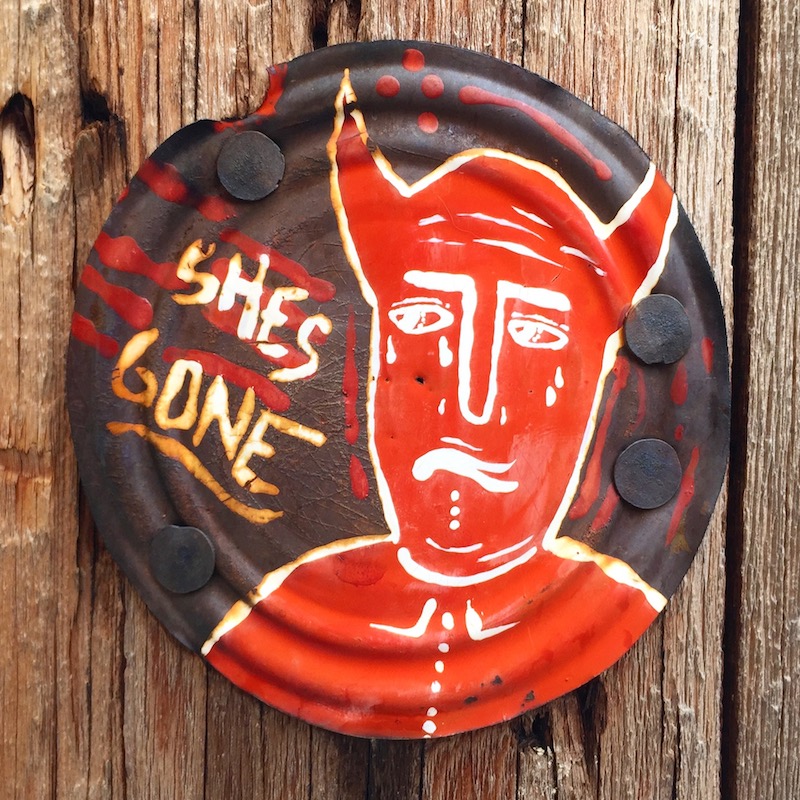
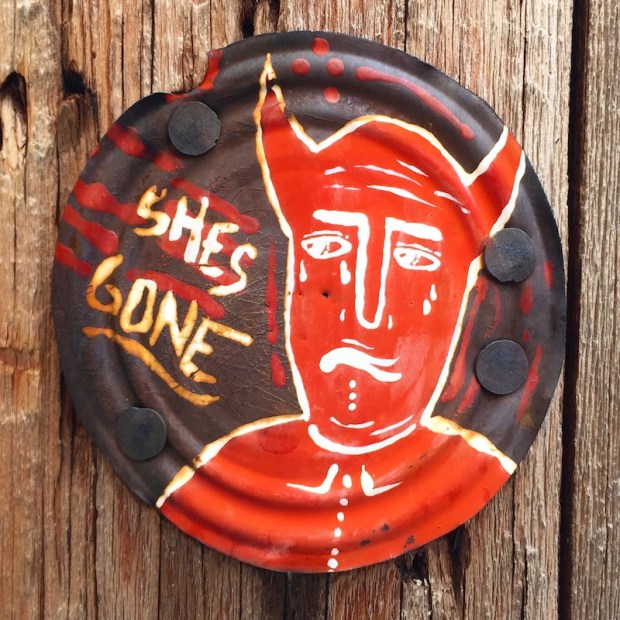
tin can lid painted with sad devil and the words "She's gone", Pittsburgh, PA

Hell & Oates[1]: “She’s Gone”, Bloomfield

Farewell to all these smiling angels….I’ve got a date with some little devils.

That auspicious message, artfully paint-penned to the cut lid of a large-size steel can, is nailed to a wooden utility pole on South Aiken Ave. in Friendship. Immediately above it appears one half of another can lid, cocked upright, suggesting a single bunny ear–its mate either removed after-the-fact or just never made it to the pole the first time.

However nutty this inscription might seem, little devils are absolutely on the loose in the greater East End. And while pious Christians worry about getting right with God or facing Lucifer’s pitchfork in the keister for all eternity, the city’s devils clearly have their own concerns to stress over. Indeed, the red one appears on a couple different poles both broken-hearted and teary-eyed.

steel can metal painted and nailed to utility pole, Pittsburgh, PA

“Farewell to all these smiling angels….I’ve got a date with some little devils,” Friendship

She’s gone were the only two words Messrs. Oates and Hall really needed as shorthand to heartbreak–that, and close falsetto harmony over a slinky Fender Rhodes groove. Here, the simple message is a clue to the devil’s distress (above).

A cat-like devil has an inverted pink heart for a nose and a topsy-turvy screwed-up mouth (below, top). Those sad eyes may say just as much with no words at all. There’s one more teary-eyed devil, this time with cupid’s arrows literally piercing his visible heart (below, middle).

steel can painted with sad devil and nailed to utility pole, Pittsburgh, PA

sad devil, Friendship

painting of devil with arrows piercing his chest, nailed to utility pole, Pittsburgh, PA

Friendship [photo: Susan Peake]

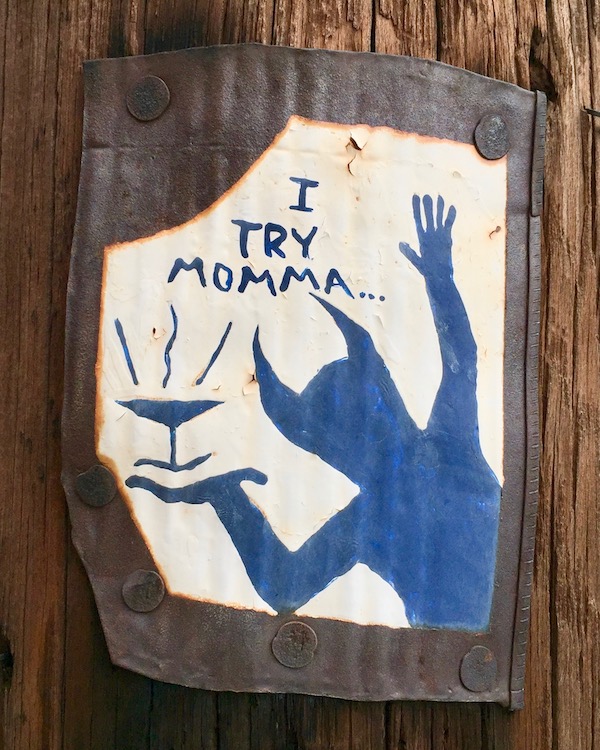
steel can metal painted and nailed to utility pole, Pittsburgh, PA

“I try momma…”, Friendship

I try momma… implores a blue devil, rendered in stark silhouette and levitating an electric martini with one hand, the other raised in salutation (above). A different pole devil clutches the circle-A anarchy flag while waving to friends (below)–no doubt shopping for bargain Clancy’s chips at the nearby Aldi.

This same common imagery of devils, hearts, anarchy, and martini glasses showed up a couple times in our first story on tin can pole art earlier this year. These were clearly no coincidence as the themes get even more of a workout this time around.
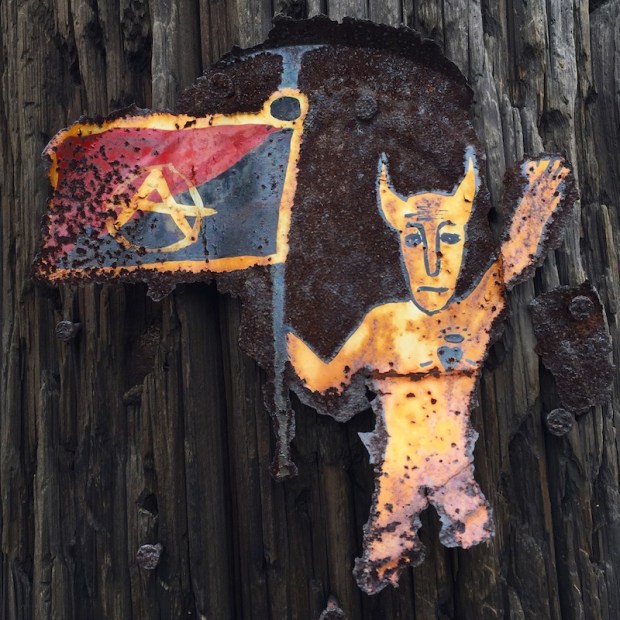
metal can lid painted with devil holding anarchy flag nailed to utility pole, Pittsburgh, PA

anarchy devil, Friendship

tin can lids painted and nailed to a utility pole, Pittsburgh, PA

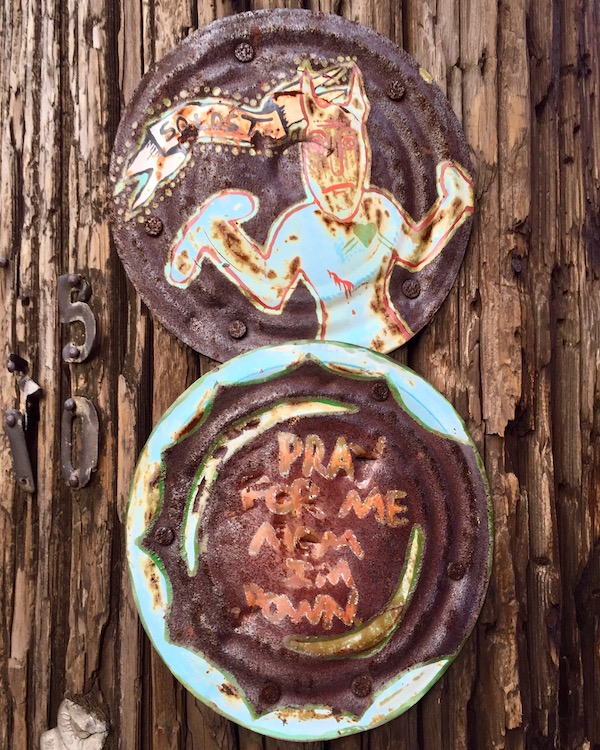
“So lost … pray for me, I’m down,” Garfield

Somebody needs to get this guy into therapy! Or maybe we all just need to be better friends to the devils we know. Whatever it is, she’s gone and the plea to appease momma aren’t the only cries for help on the city’s telephone poles.

So lost…pray for me, Mom, I’m down reads a Garfield alley two-fer (above); the simple message Struggle, along with a fire-dancing, heart-balancing devil, turns up on a nice, rust patina’d single-color piece in Shadyside (below).

small painting of devil with heart on tin can nailed to utility pole, Pittsburgh, PA

Struggle, Shadyside [photo: Lee Floyd]

While that’s a lot of devils clinging to East End telephone poles, they’re far from the only specimens in this tin can pole art roundup. We also spotted a number of other pieces with the same stylistic DNA as the devil-doer dealt–we’re talking about the tell-tale cryptic calligraphy, hearts, flowers, martinis, and anarchy.

BUT…[yes, there’s always a big but] there are some outliers in the collection, too. We’ve seen the swirling, psychedelic television/VCR combo scrawled on all sorts of walls and dumpsters, as well as turned into back-of-sign decals. But this nice, two-color paint can lid outside The Glitterbox Theater (below) feels like a giant leap forward–even if the perpetrator still can’t get his or her mind off the TV.

tin can lid painted with TV and nailed to utility pole, Pittsburgh, PA

North Oakland

steel can with painting nailed to utility pole, Pittsburgh, PA

“I try to stop…and smell the flowers (in life too),” East Liberty

steel can metal painted and nailed to utility pole, Pittsburgh, PA

“My worst enemy has always been time, 2001,” Friendship
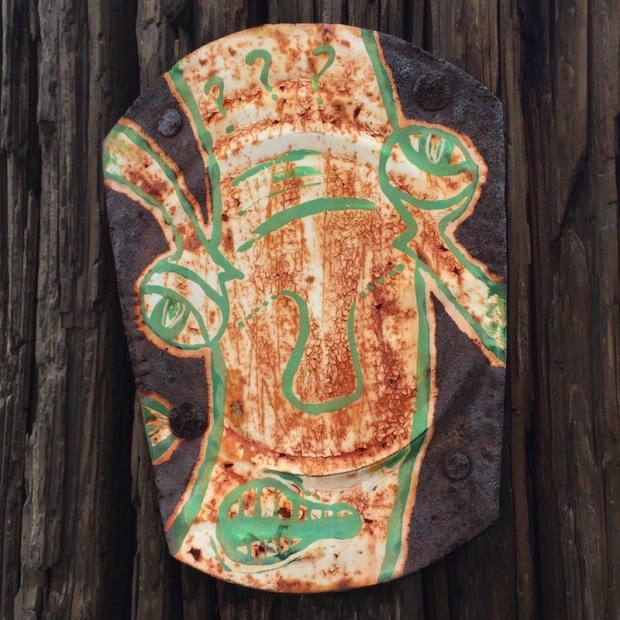
tin can lid painted with abstract face and nailed to telephone pole, Pittsburgh, PA

Garfield

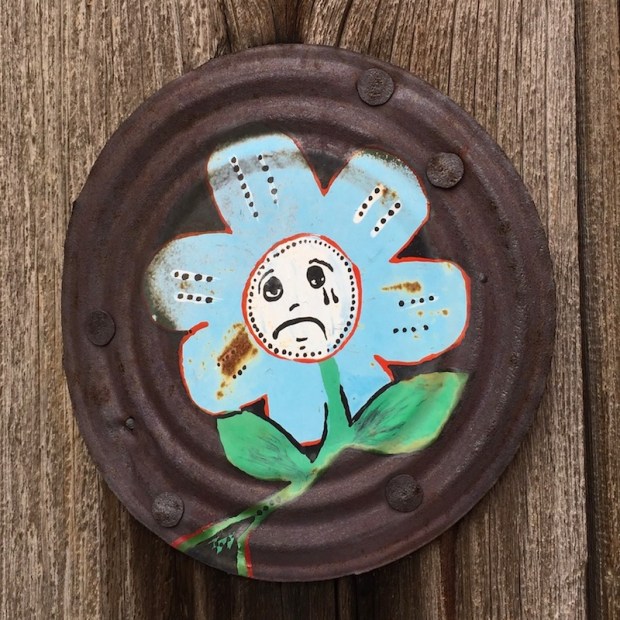
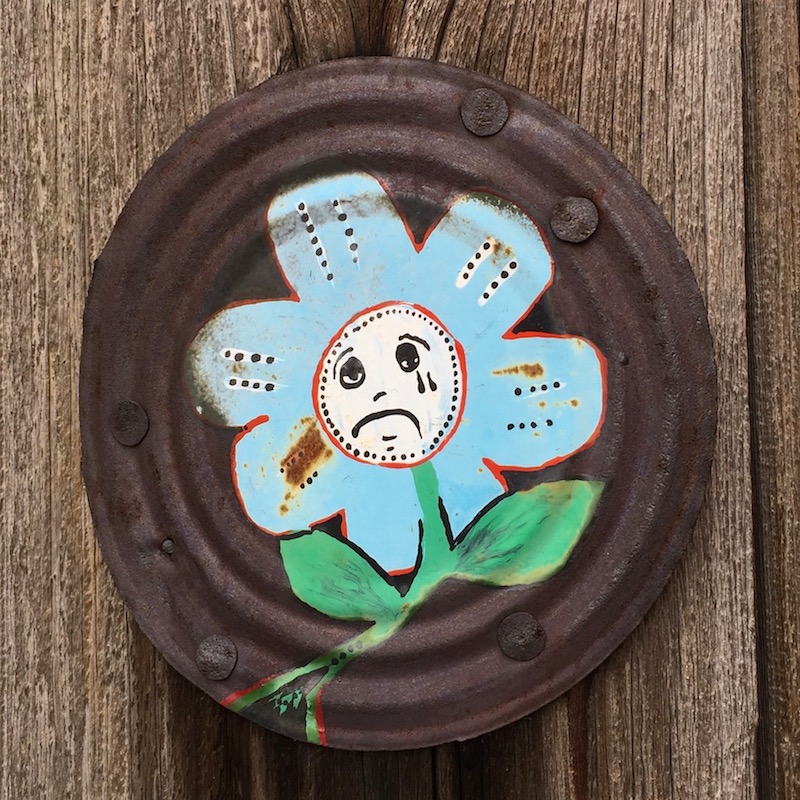
can lid painting of flower with crying face, Pittsburgh, PA

sad flower face, Bloomfield

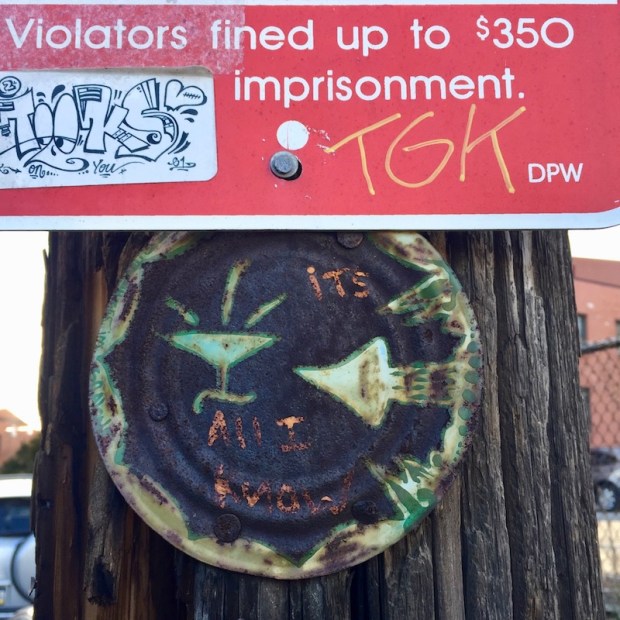
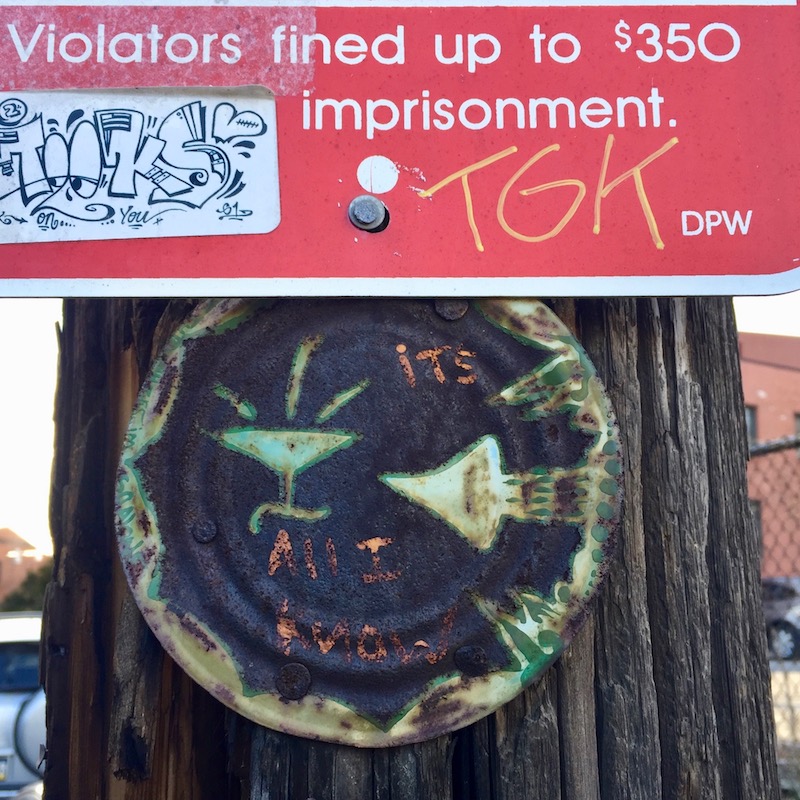
tin can lid painted with the message "It's all I know", Pittsburgh, PA

“It’s all I know,” Bloomfield

tin can lid painted with indecipherable image and nailed to utility pole, Pittsburgh, PA

Shadyside [photo: Lee Floyd]

tin can painted and nailed to utility pole, Pittsburgh, PA

Shadyside (partial) [photo: Lee Floyd]

While asking one’s mother for her prayers may or may not be common practice, doing so via painted kitchen tool on side-street telephone pole seems an especially unlikely way to share one’s feelings.

As if parenting weren’t difficult enough, kids are always coming up with new ways to communicate. First SnapChat, now GreatChee. “How’s our youth doing, honey?” We imagine a clueless Dad asking, “Why, not so good,” the response from Mom, “Haven’t you checked East Liberty for cheese graters?”
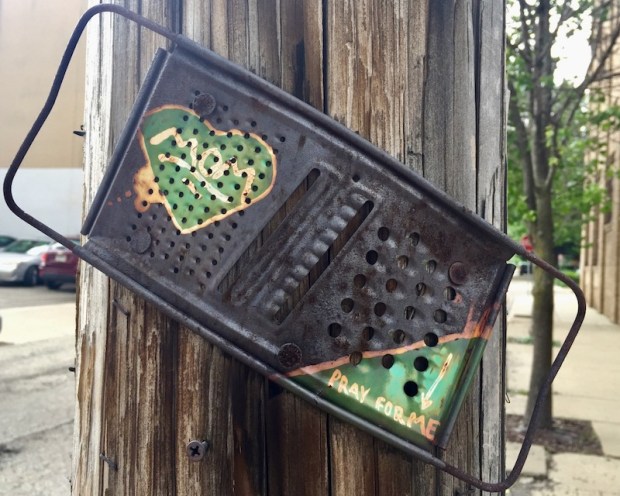
painted cheese grater nailed to utility pole, Pittsburgh, PA

cheese grater pole art! “Mom – pray for me”, East Liberty

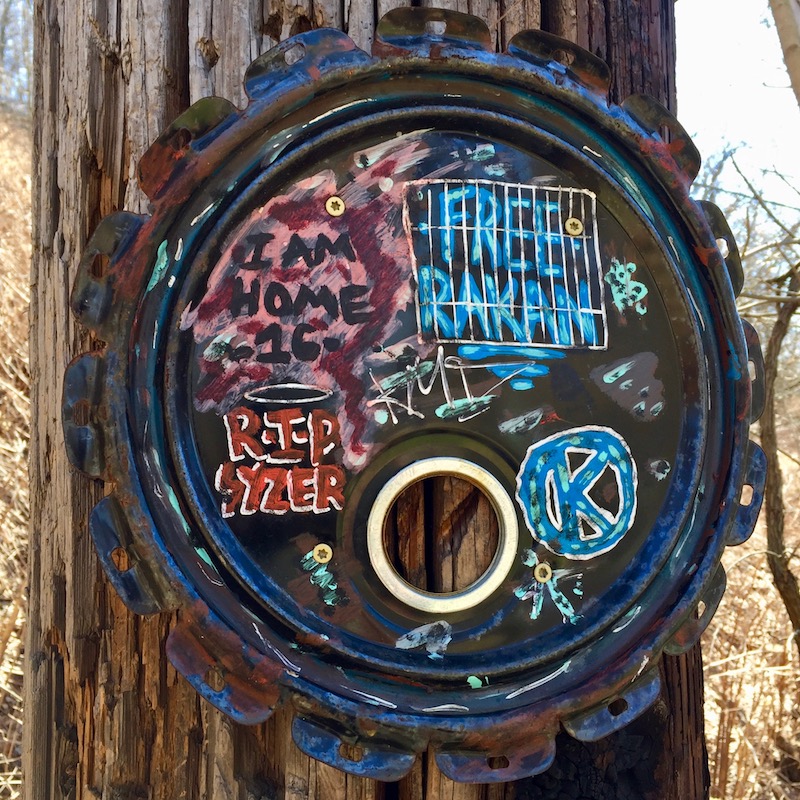
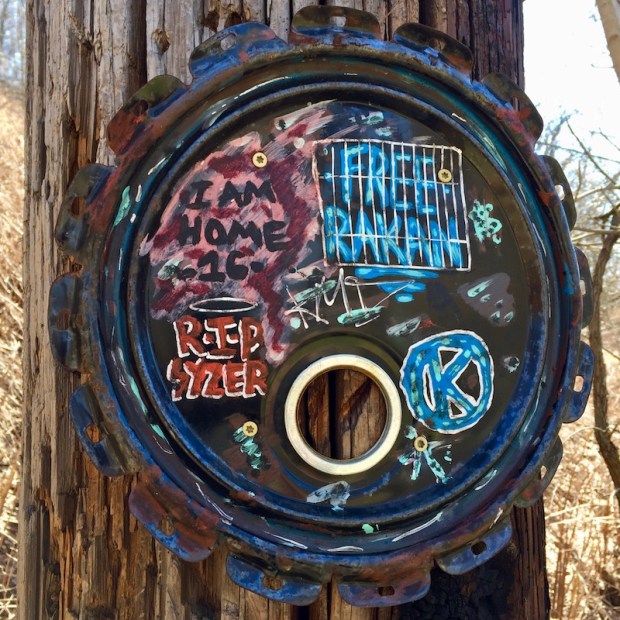
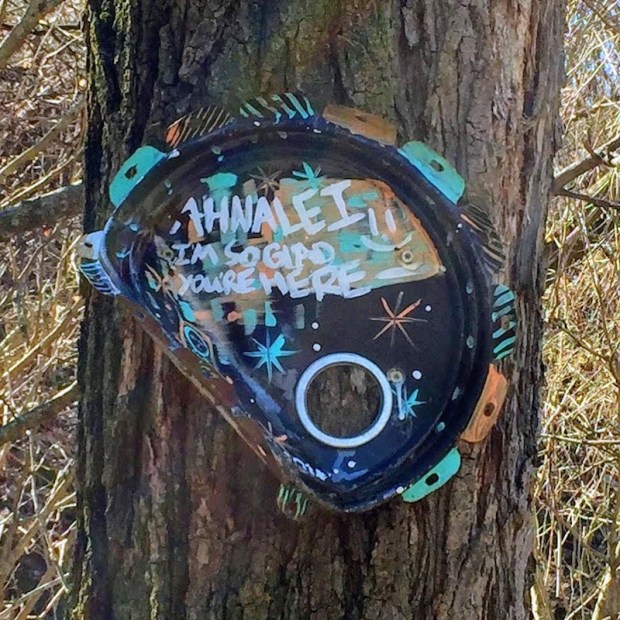
There are also a couple more of these giant, five-gallon driveway sealant drum lids, tagged-up and screwed-into poles/trees along Spring Hill city steps. The pair clearly begs for a deeper investigation of the neighborhood’s walkways as we’re guessing these aren’t the only two out there[2].
steel can lid painted and attached to utility pole, Pittsburgh, PA

“I am home 16” / “free Rakan” / “R.I.P. Syzer”, Spring Hill
large metal can lid painted and nailed to a tree, Pittsburgh, PA

“I’m so glad you’re here,” Basin Street steps, Spring Garden/Troy Hill

Finally, a couple pieces that are absolutely metal and pole art, but don’t have their material origin in discarded soup cans. They’re a little off-topic, but we’re not going to sit on these waiting for a collection of stray non-tin can-but-still-metal pole art.

The triptych of embossed blank verse into sheet metal that hangs on a Harriet Street utility pole (below, top) gets high marks for its innovation in the genre, but the execution feels a little, you know, “smoke a little dope, skip a little rope”… but maybe this blogger just doesn’t get it, man.

Similarly, A boy from Frankford… (below, bottom) really feels like somebody who doesn’t know what he’s trying to do. Then again, I guess he says it right there: like anyone in the tin can pole art game, this “boy” is just trying to find his way.

metal sheets stamped with words and painted, nailed to utility pole in Pittsburgh, PA

Friendship

metal sheet painted, lettered, and screwed to utility pole, Pittsburgh, PA

“a boy from Frankford … trying to find his way,” Spring Hill

Thanks to Susan Peake for tipping us off to a number of the Friendship pieces and co-assistant cub reporter Lee Floyd for his work in Shadyside.


[1] Thank you, Chris Caldwell.
[2] Greater Spring Hill: if you spot more of these, let us know!

An Orbit Obit: The Bloomfield Bridge Tavern

mural for Frankowski family with people holding giant pierogie, Bloomfield Bridge Tavern, Pittsburgh, PA

It takes a village to raise a pierogi. Frankowski family coat-of-arms.

This one’s personal.

Over at Orbit headquarters, we wailed into the night over the loss of Chiodo’s–it with its dusty, historic underwear hanging from the ceiling and the Mystery Sandwich haunting our dreams. We took it easy with the Casio beats and flared collars of The Casual Approach (R.I.P.) who defied gravity every weekend at Dormont’s Suburban Lounge (also R.I.P.). Letter-writing campaigns begged our congressmen to turn The Chart Room into a national monument and there should have been so many more piano sing-a-longs at Moré. The days of dollar pints and four-bit “lady drafts” at bygone Lawrenceville watering holes like Michalski’s, A.J.’s, and Salak’s feel like ancient history–but it wasn’t actually that long ago.

The loss of these iconic, convivial, rowdy barrelhouses are all just eyewash to the earthquake that music-making/beer-drinking/pierogi-eating/squirt-gun-shooting Pittsburgh felt last week. The “Polish party house in the heart of Little Italy,” has bled the grease from its deep friers, removed the ceramic stein collection, carved wooden stage bear, and pictures of the pope. They’ve powered down the spotty PA system and shooed out the last late-night booze hounds. The Bloomfield Bridge Tavern has closed forever.

gated front door for the Bloomfield Bridge Tavern, Pittsburgh, PA

Closed forever, sigh.

[Cue: shimmering soft focus and a one-two polka beat.]

The year was 1996–some time in November. Arriving from The South with its still-turning mid-fall leaves and pleasant, temperate climate, Pittsburgh was soaking in several inches of days-old dirty street slush as a steady freezing rain dripped from the unrelenting overcast gray-black sky. Needless to say, this blogger-to-be had found a new home.

By pure chance–we’re talking pre-Internet tourism here–The Bloomfield Bridge Tavern was the very first place he spent a nickel. It was on a Polish Platter, and I’m pretty sure it still cost just $5.95 at the time. Carbs are pretty cheap in The South–but they don’t come with names like golabki and kluski. Although my middle-aged metabolism can’t demolish a plate like it used to, the food was as delicious just a few weeks ago as it was all the way back in the ’90s.

plate of Polish food including pierogi, kielbasa, golabki, haluski, and kluski, Bloomfield Bridge Tavern, Pittsburgh, PA

Oh, how I will miss you. The Polish Platter (“Red”): pierogi, kielbasa, golabki, haluski, and kluski

For the next, gulp, twenty-one years the Bloomfield Bridge Tavern has been the most long-running, consistent presence in this transplant’s Pittsburgh experience. The doctor only prescribes Polish Platters a couple times a year [yes, I know: find a new doctor!] but it’s been rare to go more than a couple months without receiving an audio-visual screening from BBT’s musical stage.

Typically, these are administered by local bands. [Full disclosure: the author is sometimes playing in one of them.] But despite BBT’s tiny size, cramped quarters, and DIY show-running [bands were responsible for collecting at the door, setting up the PA system, and running their own sound], the bar has played host to amazing run of touring players too numerous to list here.

Weird Paul Rock Band performing at the Bloomfield Bridge Tavern, Pittsburgh, PA

Weird Paul Rock Band at BBT, August, 2017

You think that’d be it, right? It’s a tavern: there’s beer, bar food, and weekend rock-and-roll–what else do you need? Well, you may not need much more, but the BBT plays into a legacy of Pittsburgh culture so deep we may take years–decades, even–to dig out from the loss.

Back in the day, then-city councilman Jim Ferlo held an annual Pittsburgh Marathon party in BBT’s side parking lot, complete with polka bands, a hot dog buffet, and cold beer. A highlight of the event was seeing exhausted runners, just hitting “the wall” at the marathon’s 23-mile point, veer straight off Liberty Avenue and plunge into the soft welcoming foam of a free Iron City Beer. Every local politician made it a point to stop by the BBT’s temporary parking lot stage to dole out cash “prizes” for things like “best dancer” and “cutest puppy”. Across the street, Foodland’s electronic weekly specials sign would be programmed to read the jingoist message Go runners. Beat Kenyans.

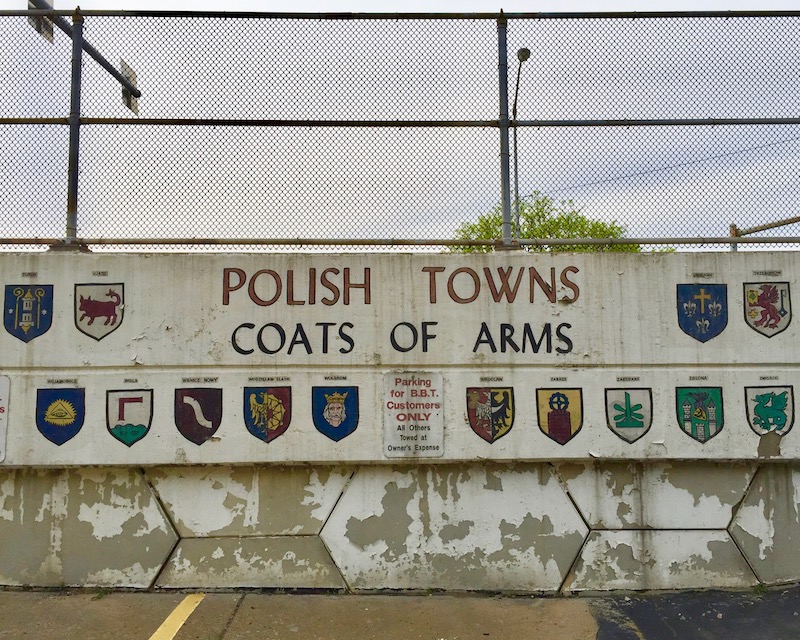
mural of Polish towns coats of arms painted on parking lot wall, Bloomfield Bridge Tavern, Pittsburgh, PA

Polish towns coats of arms, BBT parking lot

And then there are those murals. Dozens–maybe a hundred–different coats-of-arms of Polish towns you’ve probably never heard of. Crests with identifying names like Głowno, Szczecin, Gryfów Ślaski, and Żywiec ring the inside of BBT’s short concrete parking lot wall and come decorated in all manner of old world imagery–castles, bulls, red stags, and green griffins; kings, knights, mermaids, the sun & plow.

It’s gone now, but an earlier generation will forever associate the exterior of the bar with both the wonderful potted-flower Bloomfield mural/sign and [BBT founder/patriarch] Stan Frankowski’s wall-sized polemics attacking local politicians, anti-union foes, and corporate corruption. After Stan’s passing in 2005, his sons Steve and Karl took over the business. They kept up all the other traditions–including the annual day-after-Easter Dyngus Day party–but toned-down the see-it-from-the-suburbs politics. The updated red-and-white paint job, side screened porch/smoker’s lounge, and Polish falcons still look great.

coats of arms for Rodom and Radlin painted as murals on parking lot wall, Bloomfield Bridge Tavern, Pittsburgh, PA

Coats-of-arms from Rodom and Radlin

I didn’t make it out to the final night at the BBT–the body just wouldn’t let me. Luckily, Mike Shanley gave us all a pretty good scene report plus a slew of his own reminiscences in this week’s City Paper.

That said, news began to circulate about the (then-future) closing of the bar back in the late winter, so 2017 became a kind-of year-long living goodbye to venue. I played a last show there, saw a (different) last show there, and yes, ate a last Polish Platter. For the piece on his recent book of poetry, we interviewed Scott Silsbe over Strawb ambers in BBT’s breezy side porch on a lovely day in May.

mirrored wall behind the bar and patrons at Bloomfield Bridge Tavern, Pittsburgh, PA

BBT near the end: bevelled mirror bar, blood red ceiling, and big cats on TV.

As much as I’ll personally miss the place, I don’t fault the Frankowski brothers one bit for the decision to move on. Running a bar has got to be really tough work full of long, late hours dealing with no small amount of jerks, deadbeats, drunkards, and bodily fluids. Hats off to anyone who can put up with all that and still keep smiles on their faces the way Stan, Steve, Karl, and Sheila always did.

The Orbit certainly hopes the Frankowskis find a good new owner for the building and business so they can finally relax on the weekends without the sound of electric guitars ringing in their ears. Hopefully, the next tenants at 4412 Liberty Ave. will understand the legacy and history they’re dealing with–maybe they’ll even keep up the outside murals.

exterior of Bloomfield Bridge Tavern with Polish red and white flag and logo, Pittsburgh, PA

Hallowed ground. Bloomfield Bridge Tavern.

A final note. “New” Pittsburgh: if you’re out there listening and planning the next local, organic, hop-infused culinary venture, please–sweet Jesus–consider adding a Polish Platter to the menu. I’m sure I won’t be the only one pining for the taste and willing to pony up every chance I get–at least as much as the doctor allows.

metal window cover painted with message "The worst form of failure is the failure to try.", Bloomfield Bridge Tavern, Pittsburgh, PA