
New Chapel, where Jimmy “The Greek” is entombed, Union Cemetery, Steubenville, Ohio
SPOILER ALERT: There is no head stone to visit, no special directional signage like the “1812 Veteran” or the “Fighting McCooks” or the “Grandparents of Woodrow Wilson” get, and there’s not even a place to leave a tributary poker chip or tip sheet from the nearby Wheeling dog track. No, when you actually arrive at the final resting place for Jimmy “The Greek” Snyder, it’s on the very top row, well above even this tall blogger’s head height, inside a sterile mausoleum called the New Chapel, marked with a simple brass nameplate that’s barely legible standing on the floor in full daylight. The photo I took inside was so uninteresting I decided we’d just go with the exterior shot.
The Greek died of some combination of diabetes and coronary failure in 1996, the year after New Chapel was built at Union Cemetery in Steubenville, Ohio–Jimmy’s home town and an easy jaunt from Pittsburgh. Jimmy’s loved ones may have thought that having the latest and greatest in resting places for the family was practical (his sister Marika Berris died in 2009 and is entombed right next to Jimmy), but I’d guess that he was secluded high out of sight, out of mind, and–perhaps, most advantageously–out of reach from any malice that may have been directed his way in the afterlife.

Jimmy The Greek in livelier times
Jimmy The Greek’s rise and (epic) fall is legend to a generation that was paying attention to such things in the 1980s. He was a career sports bettor, television prognosticator, and outsize personality that injected street smart grit and spilled cigar ash on the sterile CBS studio where most of us first encountered him. Jimmy brought sports betting out of the bar and into post-church middle class living rooms by way of his weekly picks on The NFL Today.
Snyder was fired by CBS in 1988 for “racially insensitive comments” he made on camera at a banquet dinner. Whether Jimmy was actually a racist or just put his foot in his mouth on a topic he really didn’t have any business speaking on seems up for debate. Both his longtime NFL Today co-host Irv Cross (who is black) and Jessie Jackson defended Snyder and Jimmy famously spent the rest of his life apologizing for the incident, humbled and disgraced. The world largely turned its back on him, which is perhaps how he ended up nearly un-locatable in Steubenville.
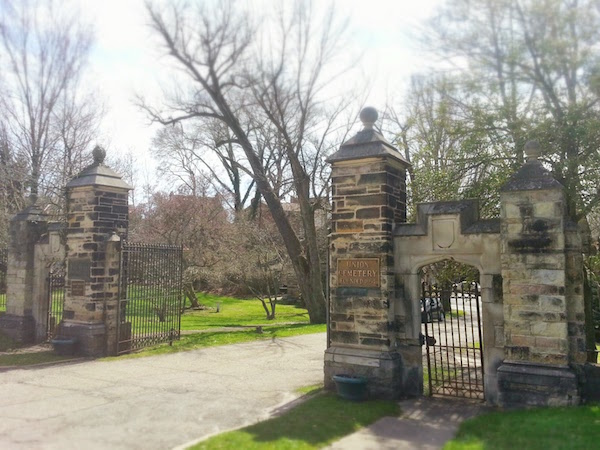
Union Cemetery entrance gate
The Greek’s surroundings in the New Chapel are particularly sad considering the phenomenal beauty of the rest of the park. He’s going to spend eternity in a mausoleum that looks like a Denny’s while the rest of the of his neighbors are ensconced in the tree-filled, lush rolling hills of this gorgeous circa-1845 cemetery.
Union Cemetery has the characteristic design of others from this era: non-linear paths that work around the topography and ancient trees that grow between–and sometimes up and over–the graves. The markers are notably more humble than those in Pittsburgh’s Allegheny or Homewood cemeteries, and have suffered a greater natural decay (cheaper material? harsher climate? less maintenance?). But taken as a whole, it has a similar level of natural beauty, solace, history, and nature-without-man chaos.

Statuary, Union Cemetery
Union Cemetery takes extra pride in their veterans. The (many) Civil War graves each have a special iron shield, many still painted red, white, and blue, marking them as “Union Soldier”. Veterans from Cuba, World Wars I and II, and Korea each got similar, if less ornate, treatment. Vietnam veterans have an entire section to themselves, sharing space with large mortar cannons.
I don’t know that I can recommend a trip to Steubenville just to visit Jimmy The Greek, but we found some other interesting things while we were there (more about that in some future dispatch). However, if you’re in the area, and it’s as beautiful a day as we got, The Orbit has its own tip for you: do yourself a favor and stop by to say hello to The Greek.


Union army grave markers, Union Cemetery
 Pittsburgh Orbit