Fairywood: The World Without Us

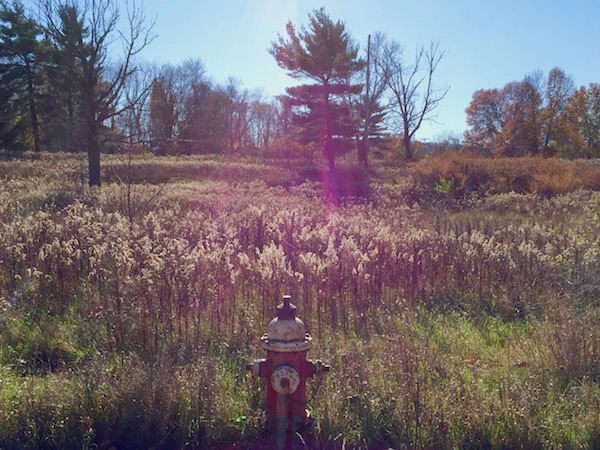
fire hydrant in field of tall weeds, Pittsburgh, PA

Former Broadhead Manor public housing project, Fairywood

Fairywood. Has any place as bucolic a name? One would assume it could only exist in fantasy–within Narnia or Neverland or, at least, New Zealand. Fairywood must be a land of eternal mist, riddle-spinning toadstools, magick staffs hewn from gnarled bentwood, spellcasting. It is where banshees live, and yes, they do live well. But one need not cross the Misty Mountains nor the darkest depths of Mordor[1]–it’s right here in the City of Pittsburgh.

If one were to set out for Fairywood, she or he might also optimistically hope to encounter pixies, gnomes, gremlins, griffins, or unicorns along the journey. Such other-worldly creatures simply must exist in the forest faerie realm. Alas, that was not this blogger’s experience.
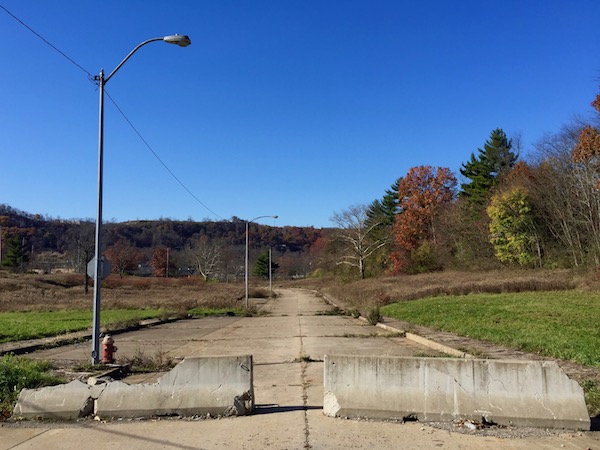
empty street with jersey barriers at entrance of former Broadhead Manor, Fairywood, Pittsburgh, PA

Entrance from Broadhead Fording Road

Look up Fairywood and you’ll likely come across some bad press. At this point, the peninsular neighborhood on Pittsburgh’s far southwestern border [it is surrounded on three sides by non-city boroughs] is mainly associated with two things: colossal ex-urban warehouses and off-the-charts crime.

The former is easy to see–along the south and west perimeters are huge distribution centers for UPS, ModCloth, Amazon, and Giant Eagle/OK Grocery. The hum of their idling 18-wheelers and beeps of reversing forklifts are omnipresent even from a great distance.

The latter is not so obvious. On a picture-perfect Saturday afternoon, we barely encountered a single living soul–and the ones we did meet were real nice! The sum of residential Fairywood is contained in four or five streets of pre-war frame houses and Baby Boom-era pill boxes and split-levels, plus one former project-turned-gated community. Only around a thousand people live here. Who’s committing all this crime?

cul-de-sac in former Broadhead Manor, Fairywood, Pittsburgh, PA

Cul-de-sac

Alan Weisman’s 2007 best-seller The World Without Us detailed the ways in which the built environment would inevitably deteriorate in the absence of human beings. I’ll confess I haven’t actually read the book, but Mrs. The Orbit did and relayed its projections of houses collapsing and cities overtaken by nature as I was suddenly getting much more aware of cracks in the plaster ceiling and loosening of our mortar joints.

By far, the most prominent feature of Fairywood today is the enormous negative space created by what was at one time the Broadhead Manor public housing project. In its absence is a massive plot of land–its footprint similar in size to a junior college campus or suburban shopping mall (including all the parking). The actual housing blocks have been razed and removed, but the infrastructure–several curling roads that terminate in dead-ends, street lights, sidewalks, fire hydrants, an absurd children at play road sign–all remain.

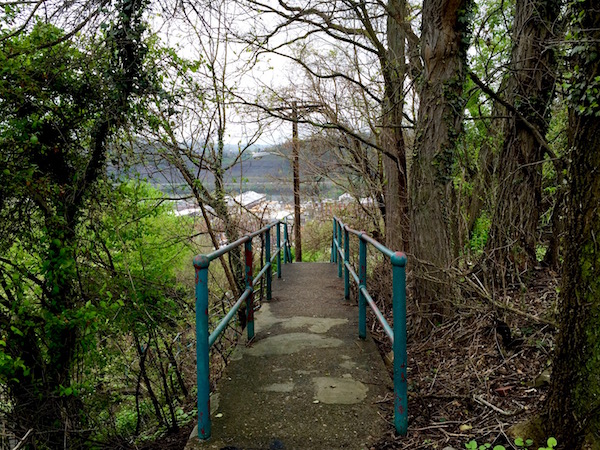
handrail and concrete sidewalk to urban prairie, former Broadhead Manor, Fairywood, Pittsburgh, PA

Handrail, sidewalks

Between these few remaining stretches of concrete, nature has come back hard and fast. It’s a very un-Pittsburgh landscape–almost completely flat (although you can see hills in the distance in any direction) and dominated not by trees, but instead with scrubby waist-high bushes, weeds, and wildflowers–much more midwestern than Appalachian. Nationally, these kinds of spaces have been coined urban prairies for a reason–they’re not quite nature without man, but they’re decidedly not city (as most tend to think of it) either.

That Broadhead Manor should or should not have been razed is a conversation for those who actually lived in and around it[2]. With no personal connection, it does strike me as a classic built-to-fail situation: warehousing people in closed-circle public projects at the most distant edge of the city in a neighborhood with neither business district nor many transportation options[3]. What could go wrong?

Man in winter clothes against chain link fence, Pittsburgh, PA

Mr. Ro Ro (note his wizard’s staff)

We met Mr. Ro Ro camped out on a folding chair, waiting for a bus on Prospect Avenue. A wizard’s staff was casually propped against the chain link fence. Mr. Ro Ro told us he’s lived in Fairywood for fifty years and said of Broadhead Manor, “Roosevelt built them after the war.” President Roosevelt’s connection is unknown, but Broadhead Manor was indeed former military housing, purchased by the city in 1946[4].

As the only human wandering through the strange dystopian landscape of an ex-neighborhood with all its buildings removed–now almost completely reclaimed by nature–the irony of the phrase “after the war” was ringing in the air. More than anything else, this huge section of Fairywood feels like what’s left after the nuclear winter has finally subsided and an entirely new form of nature begins again on the bones of the civilization that destroyed the old one. Let’s hope we get it right this time.

dead end street in former Broadhead Manor, Fairywood, Pittsburgh, PA

The end of the road


[1] It is telling that The Orbit‘s knowledge of Middle Earth comes more from Houses of the Holy than The Player’s Handbook.
[2] A post in the Abandoned, Old & Interesting Places – Western PA FaceBook group shows some of the housing after the residents had been moved but pre-demolition. It includes many comments–both positive and negative–including quite a few former residents who speak glowingly of their time at Broadhead Manor in the 1960s.
[3] Port Authority’s 27 bus route serves Fairywood and nearby neighborhoods with a link to downtown Pittsburgh.
[4] Fairywood Fact Sheet (date unknown) http://digitalcollections.library.cmu.edu/awweb/awarchive?type=file&item=550317

Get Out The Voegt: Finding the Spring Hill Spring

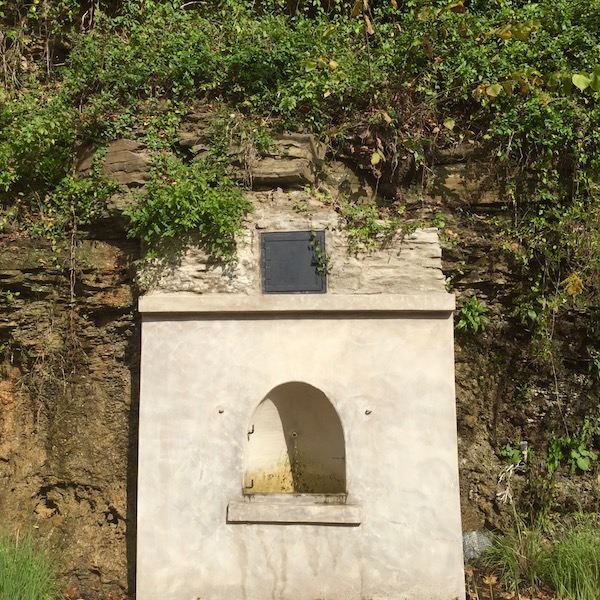
natural spring in concrete pedestal embedded in hillside, Pittsburgh, PA

Spring is sprung: Voegtly Spring, The Spring Hill spring

Ask a Spring Hill local how to get to the neighborhood’s newly-unearthed and re-opened natural spring and he or she will make it real easy for you: “It’s right by the boxing ring.” Me: “Oh, thank you very much, that helps a lot. Just one more question: where’s the boxing ring?”

From there, it just gets more confusing. The “boxing ring” is actually the Steel City Boxing Association and Google Maps puts it way down the hill from its true location. Assuming you do find the right place, the stonework is engraved Hook & Engine Co. 53 for its (former?) life as a fire hall and contains no after-market mention of the sweet science.

How about the Internet–a recently excavated and restored piece of local history should be front page news, right? Well, you try a web search for “Spring Hill spring”–it’s un-Googleable! Spring Hill’s Internet presence doesn’t assist at all–there’s nary a peep about the spring from the neighborhood associations or its wiki page. C’mon, guys–help a blogger out!

Rest assured, dear reader: if we achieve nothing else, The Orbit will get you to the Spring Hill spring.

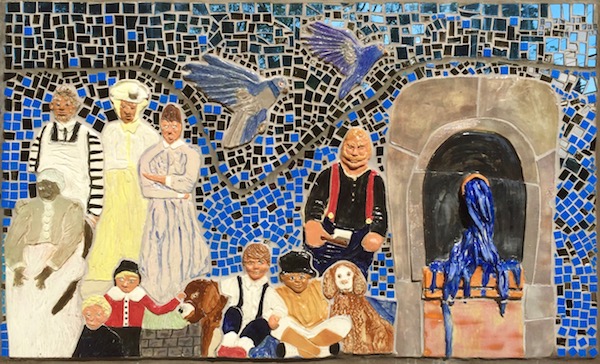
Detail from public mosaic "The German Settlers of Spring Hill" depicting the Spring Hill spring, Pittsburgh, PA

“The German Settlers of Spring Hill” (detail) mosaic depicting Voegtly Spring, Spring Hill

A large mosaic installation titled The German Settlers of Spring Hill welcomes visitors near the corner of Homer and Damas Streets*, one of just a few access points to the hilltop neighborhood. The final section of the four-panel piece features various community members in old world garb gathered around the image of the hearth-like Voegtly Spring, the natural water source that gave Spring Hill its name.

In that depiction, the spring is a flooding outpour overflowing its basin, its output equal to a dozen garden hoses. That’s not exactly what we found. The constant stream of water–there is no Off valve to a natural spring–is more of a dribble or a trickle than the gusher one might expect from the artwork mere feet away. That may have something to do with us visiting after a run of dry weather, so we’ll have to go back to verify after a decent stretch of rain.

masonry enclosure around pipe dribbling natural spring water, Pittsburgh, PA

The spring

Some background, from the Voegtly Spring historic nomination form**:

A stream ran down from the top of Spring Hill, ran through the intersection of Humboldt St. (now Homer St.) and an unnamed street (now Damas St.) and down into modern day Spring Garden (Fig. 4). In 1912 a rectangular stone and concrete structure was built into the shale hillside alongside Damas St. (formerly Robinson Road) to harness the flow of water beneath the ground to provide easy access to drinking water for the residents of the neighborhood and surrounding area.

The nomination form goes on to mention that “the spring water was tested and shut off sometime in the 1950s” and that house construction above the spring “may have contributed to [its] contamination”. Furthermore, “It is reported that during this time the spring water developed a distasteful odor and became a yellowish orange color.”

There’s no official word on whether the discoloration is still in effect, but it looked fine to my admittedly low standards. Despite the warning that “public works does not encourage its use because [the water] is not treated”, it’s certainly right there for the drinking and let’s face it: it’s cool to suck spring water right out of the hillside. Lesser journalists–speculative or otherwise–would turn toward home after snapping some pictures, but this blogger rushed in for a righteous century-in-the-making quaff.

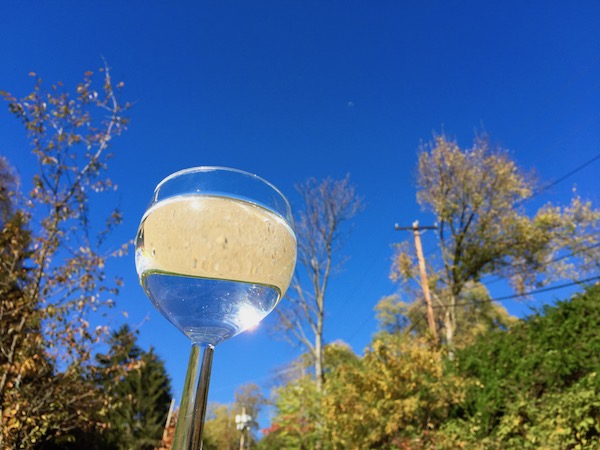
glass of water from Voegtly Spring, Pittsburgh, PA

No discoloration here. Voegtly Spring water.

So…what does Voegtly Spring’s water taste like? Well, it ain’t Perrier, that’s for sure. If it’s not too vague, we’ll describe it as earthy, or maybe minerally. Flavorful–but I wouldn’t describe that flavor as desirable. It’s maybe a little gritty–like a woodsy stream–surprisingly warm, and decidedly different from city tap water (for good or bad). That said, it doesn’t have the natural toe-tingling effervescence of more celebrated waters. I’ll go out on a limb to suggest it’s unlikely we’ll encounter Winnebagos parked on Damas Street with tourists filling five-gallon jugs like you regularly see down in Berkeley Springs.

I’ll be honest: there’s not a lot else to do at the spring. You can drink from it straight like a water fountain and you can fill up a jug. That’s pretty much it. As entertainment, a visit is pretty low rent compared to, say, Pac-Man or The Jumble. Regardless, it’s a neat little old world nugget to trip across if you find yourself hanging out by the boxing ring or, more practically, desperately need some hydration and can’t quite make it down to Penn Brewery.

Here, on this eve of an incredibly important national election, we can only recommend that Orbiteers first get out and vote. And then, if you’re still not satisfied, get out and Voegt.

masonry enclosure for natural spring in hillside, Pittsburgh, PA

Voegtly Spring, The Spring Hill spring

Getting there: Voegtly Spring is on Damas Street, just off Homer. When you see the old Hook & Ladder Company or the big public mosaic/garden, you’re real close. The easiest way to get there (especially on bicycle) is from Spring Garden Avenue, up the hill on Homer. We’ve also added a pin for the spring to our Map page.


CORRECTION: An earlier version of this story quoted an August, 2016 Post-Gazette piece on the re-opening of the spring that incorrectly lists Fred and Wilbert Bergman as the builders. The Bergmans took the earliest known photograph of the spring, but construction was done by the city Department of Public Works.


* The mosaic was constructed by a large group at the leadership of Linda Wallen, whose Yetta Street mosaics (also in Spring Hill) we profiled last year.
** A big thank-you to Spring Hill resident James Rizzo for helping to clarify the facts on ownership and construction of Voegtly Spring.

Day of the Dead: Susan Hicks, Uber Alles

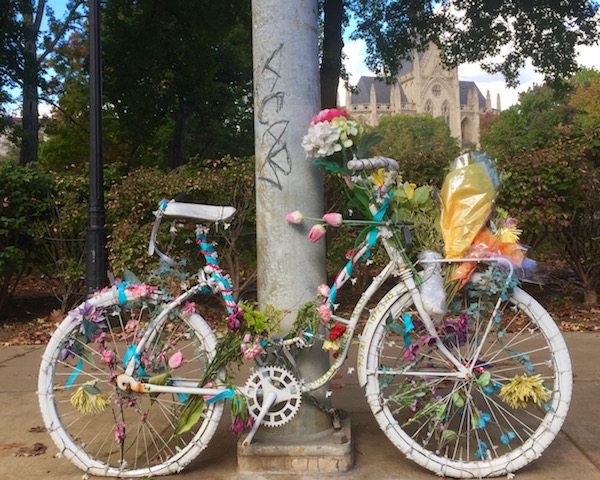
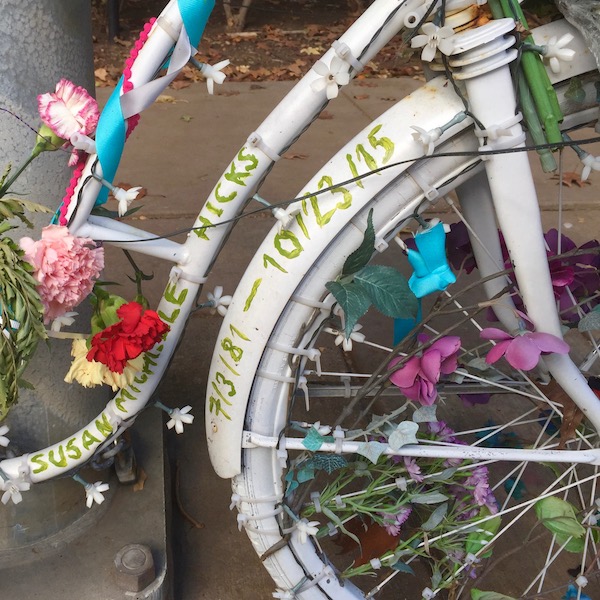
bicycle painted completely white and decorated with flowers and lights, Pittsburgh, PA

Ghost bike memorial for Susan Hicks, Oakland

Last week marked the one year anniversary of Susan Michelle Hicks death. This blogger didn’t know her personally, but Ms. Hicks was “friends of friends” who commuted–and was killed–riding her bicycle on a stretch of Forbes Avenue in Oakland where I ride all the time. Quite literally, it could have been me.

Very near the tragic spot where Ms. Hicks died, just across the street from Dippy the Dinosaur and the Carnegie Music Hall, is a so-called “ghost bike” memorial. Chained to the pole of a stout street lamp, it’s a decommissioned older bicycle, painted completely white, draped in flowers, ribbons, personal messages, and a strand of solar-powered lights. A felt-tipped pen left on the seat invites visitors to ink inscriptions to the fallen–many have done so.

The effect of seeing the Hicks ghost bike–or any other–is incredibly moving. It’s both beautiful and haunting, arresting, sombre, and reverent. It’s also encouraging that this obviously-un-sanctioned memorial has been allowed to remain intact; city works crews choosing to leave it alone–now, for over a year–in this very public, well-travelled spot instead of treating it as an act of litter or vandalism.

detail of ghost bike for Susan Hicks, Pittsburgh, PA

Statistically, Pittsburgh is among the very safest U.S. cities to be a bicycle rider/pedestrian. This is, perhaps, surprising given our severe infrastructure challenges, but according to some numbers collected by Bike PGH, the city’s rate of 1.8 fatalities per 10,000 commuters is way down the list of American cities. As comparison, the bottom of the collection contains Ft. Worth, Detroit, and Jacksonville, all with an average of 40 to 50 fatalities on the same scale.

That said, it’s sadly no surprise this particular tragedy happened in the heart of Oakland. Any Pittsburgh cyclist will tell you what a nightmare it is to navigate the neighborhood on two wheels. It’s nearly impossible to feel safe riding from, say, Neville to Atwood, or CMU to Pitt without either breaking some kind of law or going way out of your way–and this is a part of town with 40-some thousand college students! I get mad at the kids riding on sidewalks, but what alternative do they have?

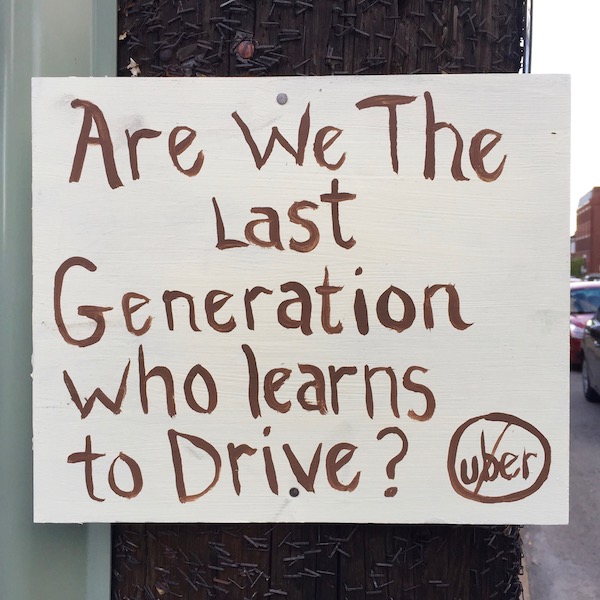
Handmade sign reading "Are we the last generation who learns to drive?", Pittsburgh, PA

Anti-Uber sign, Oakland

On a recent ride home from work, I came across a batch of wooden signs nailed to telephone poles. On each was a hand-scripted message: Are we the last generation who learns to drive? read one on Craig Street, and Humans crave community, not isolation another. The messages continued in Bloomfield:  Automation smothers natural beauty and awe and Deep in your humanness, your heart longs not to be mechanized.*

If you’ve spent any time in the East End over the last half year, you know where these are coming from. Uber self-driving cars are being tested all over the city–we see them every day**. It’s a technology that’s not without controversy, but surprisingly little considering the potential societal implications. Overall, opinion has felt more like a collective ho-hum.

collage of photos of Uber self-driving cars being tested on Pittsburgh city streets

Uber self-driving cars testing in Pittsburgh [photos, clockwise from top left: P. Worthington, M. Hertzman, A. Hoff, K. Barca]

The full point of these guerrilla signs is not entirely clear, but each contains Uber’s name in a crossed-out circle. We can assume the opposition to the ride-sharing company is the anonymous sign-poster’s major thesis, but there are also messages around community, beauty, and “humanness”.

Is Uber being accused of colossal corporate takeover? Or is the issue that they’re developing self-driving technology? Assuming the latter, how does changing the way a car navigates “smother natural beauty and awe”? [We did a pretty good job of this way before Uber came along.] Plenty of people drive alone every day–why do these vehicles create any more isolation than any other solo car trip?

If we’re worried about the number of Uber (and other) human drivers who may be put out of work by this technology, that’s legit. But let’s not assume that’s the only sociological possibility for self-driving vehicles. There is the very real likelihood that autonomous cars will be much safer on the road than humans. They certainly won’t drive drunk or fall asleep at the wheel. They won’t show off to impress the girls in the back seat and won’t take their eyes off the road when their phones light up. There are a whole lot of people with disabilities who can’t wait for an alternative to Access.

Handmade sign reading "Automation smothers natural beauty and awe", Pittsburgh, PA

Anti-Uber sign, Bloomfield

Bicycle riders are not saints. There are a lot of dangerous people out there, and we come across them every day–treating sidewalks as bicycle lanes, recklessly jack-rabbiting through traffic, ignoring traffic lights, signaling, and stop signs. Cyclists who take off without a helmet or foregoing lights in the dark are just plain foolish.

These are condemnable actions that frankly burn this biker’s breeches–you guys give us all a bad name! That said, it’s nothing compared to the regular behavior we see from drivers toward cyclists. I’ve never been hit by a vehicle driven by a computer; the same can’t be said for humans. In my years (ahem, decades) on two wheels, I’ve been spit on, had trash thrown at me, yelled-at, cat-called, and aggressively hip-greased more times than I can recall. Drivers routinely drift absent-mindedly, park in bicycle lanes, and wildly swing open their parked doors without first consulting their mirrors. While driving, they eat and drink, talk on the phone, apply lipstick in the rearview mirror, and, of course, are constantly texting.

Given all this, I’ll take my chances with the robots. If they’d been deployed to Oakland last year at this time, maybe Susan Hicks would still be with us and on the road today.

bicycle painted completely white and decorated with flowers and lights, Pittsburgh, PA

Ghost bike for Susan Hicks, Oakland


* If anyone has seen more of these, we’d love to know about them.
** So far, always with a human in the driver’s seat.

Step Beat: Anthony and Ivondale

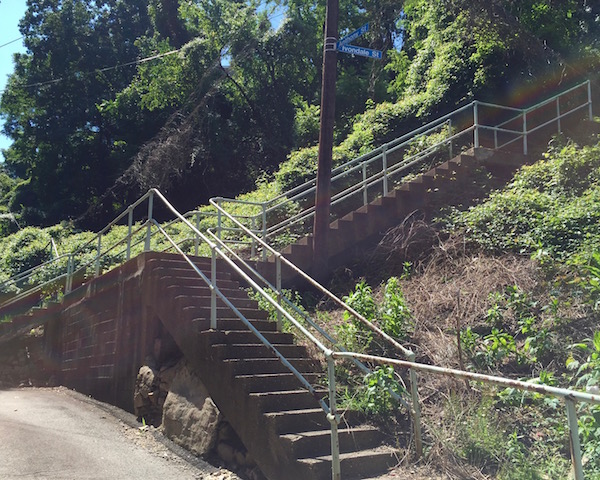
intersection of Anthony Street and Ivondale Street city steps, Pittsburgh, PA

Anthony and Ivondale streets, The Run

They’re not the longest or the prettiest. They’re not one of the great nature-in-the-city hikes, and there’s not much of a view. Heck, these steps don’t even fulfill the most basic purpose of infrastructure: you can’t go anywhere on them!

So why are we even reporting on the Anthony and Ivondale city steps? Well, this blogger will tell you. There’s a time for greatest hits and, as Buck Dharma so wisely reminds us, there’s a time to play B-sides. On the back of the platter, Anthony and Ivondale still earn the occasional spin, and it still sounds…er, walks pretty good.

The onion domes of St. John Chrysostom Byzantine from the Anthony/Ivondale intersection, Pittsburgh, PA

The onion domes of St. John Chrysostom Byzantine from the Anthony/Ivondale intersection

Last year we reported on the wonderful existence of the great Romeo & Frazier intersection in an overgrown hillside of South Oakland. That particular confluence of city steps is remarkable for a number of reasons, not the least of which is Pittsburgh’s commitment (at least, historically) to pedestrian thoroughfares as fully-accredited “streets.”

We see the same great treatment at the corner of Anthony and Ivondale, where the steps are given their own street light and signage. Only here, the whole enterprise is more absurd since there’s not really any chance of either walking these steps in the dark or needing directions to where they’re (not) going.

intersection of Anthony Street and Ivondale Street city steps, Pittsburgh, PA

Looking up Ivondale Street from behind St. John’s

The other obvious factor on any step-trekker’s noodle is that this particular pair of step-streets is almost surely on the endangered list. At one time, Anthony Street must have continued all the way up the hill to Greenfield*. That would have connected residents of The Run up to Greenfield’s commercial district and uphill parishioners down to the mighty St. John Chrysostom Byzantine Catholic Church.

But those aren’t really well-travelled routes any more–at least, not on foot. In fact, they’re so neglected that you can only walk a tiny minority of Anthony Street before you’re met by an ocean of out-of-control overgrowth that completely blocks passage on the through-way**.

city steps overgrown with weeds, Pittsburgh, PA

Pittsburgh Babylon: Anthony Street’s long, inaccessible climb up to Greenfield

Anthony & Ivondale will never be destination steps like Rising Main or Little Jewel Street or the “Try Try Try” steps. But if you find yourself in The Run for a large sandwich at Big Jim’s or just passing through en route between the Schenley Park and “Jail Trail” bicycle runs, it’s well worth the stop and poke-see. You won’t get lost; there’s nowhere to go.


* Looking at the map, it seems like Anthony probably terminated at tiny Raff Street, itself just an extension of Alger Street, a block off Greenfield Ave.
** Already on the list is going back in the winter when we can see what’s left when the knotweed has died off.

Step Beat: Climbs 57

looking up long set of city steps, Pittsburgh, PA

Looking up the lower section of the 57th Street steps

Has Pittsburgh fifty-seven varieties of city steps? Maybe.

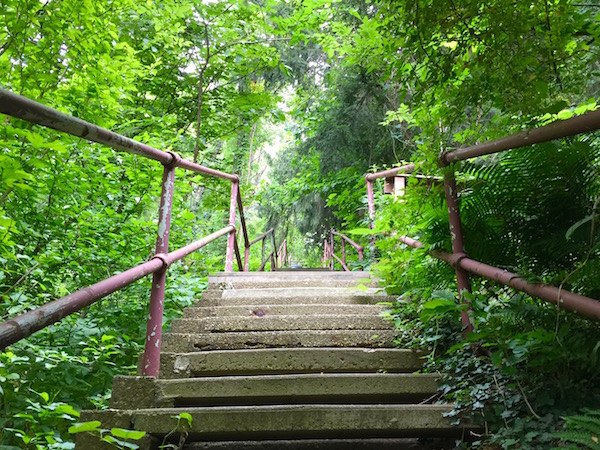
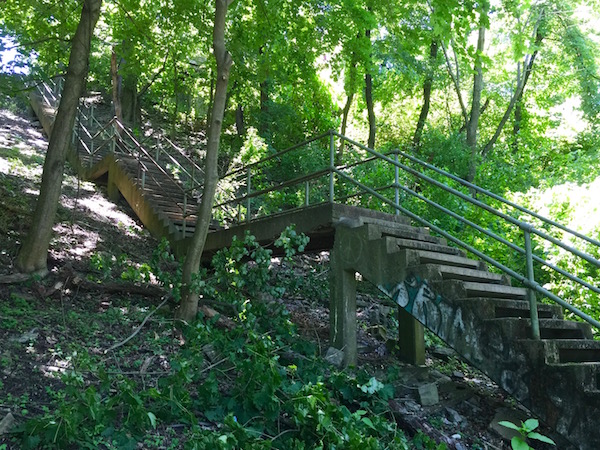
It’s an intriguing question. There are long and short sets of steps; steps on the side of the street and steps alone in the woods. There are steps of wood, metal, and concrete; steps in good repair and ones that are falling apart; open steps and ones permanently closed. Some have special bicycle ramps added; others just tell you to Try. There are steps with crazy turns and angles and steps that just go up one straight line. There are steps the whole neighborhood uses, step street intersections, and steps that no longer go anywhere.

It would probably take a significant imagination to keep this riff going all the way out to the magic number. However, we know Henry J. Heinz considered 57 to be a lucky number*, and if it’s good enough for the king of condiments, it’s good enough for Pittsburgh Orbit. We certainly felt lucky after a climb up the very fine 57th Street Steps in Lawrenceville.

city steps with older home, Pittsburgh, PA

Step-accessible (only) house at the bottom of the 57th Street steps

city steps at 57th and Duncan Streets, Pittsburgh, PA

The intersection at Duncan Street, mid-point in the 57th Street steps

The steps that make up the pedestrian section of 57th Street qualify as at least two of these varieties. The lower half, from where Christopher Street forks off 57th up to Duncan Street, is in immaculate shape. The treads and rails are all perfectly maintained, with easy clear passage. The surrounding foliage has been neatly trimmed and there was no litter the day we visited. There’s even one remaining house that is only accessible via the steps.

An the upper half? Well, that’s another story. In the middle of a lush Pittsburgh summer, dense knotweed has enveloped the majority of this stretch with just enough room for the city trekker to go full-on Indiana Jones. [Note to readers: bring a fedora, whip, and satchel.] It’s clear this batch is neither as well-loved nor as well-used as its downhill sibling. Still, it offers a great off-the-grid version of the step experience, which is just as much of what we’re after.

city steps nearly overgrown with knotweed, Pittsburgh, PA

Entrance to the upper section of 57th Street steps (at Duncan Street)

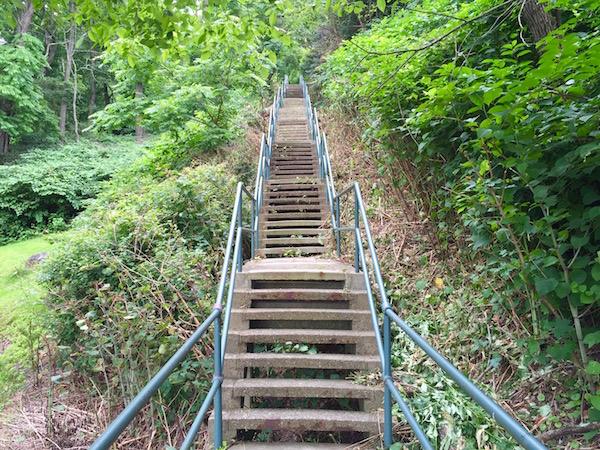
looking up city steps covered by trees, Pittsburgh, PA

Looking up the upper section of 57th Street steps

If there’s a bummer to the 57th Street steps, it’s that you’re stuck with a straight up-and-back trip–there’s no looping around for a more interesting walk/hike. Somewhere around half-way up the top stretch (above Duncan), you hit a pretty decisive end-of-the-line. The treads are gone, trees and weeds have overtaken what’s left, and a clear Steps Closed barrier has been placed across the route.

At this point, the red handrails continue, tantalizing us by disappearing into the hillside. The map shows that at one point the steps terminated up on Price Way in Stanton Heights, but that connection seems unlikely to be re-opened–at least until The Orbit gets put in charge of public works. Until then, pass the ketchup.

city steps missing treads with "Steps Closed" sign blocking the way, Pittsburgh, PA

End of the line: top of the 57th Street steps


* Heinz famously had way more than 57 different food products when the “57 Varieties” tag line was dreamed up and added to packaging.

Get the Gist: The 1917 Manchester Bridge Sculptures

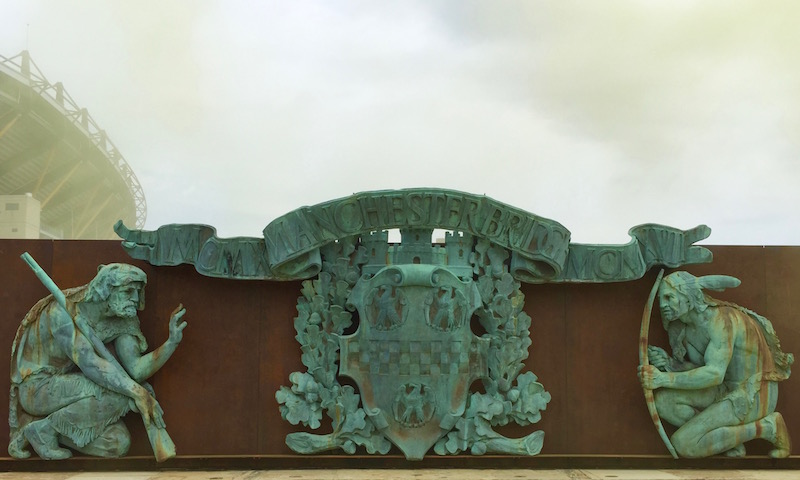
Preserved Manchester Bridge sculptures in their new location near Heinz Field, Pittsburgh, PA

The Manchester Bridge sculptures in the drifting yellow fog of the Color Run cleanup

Has anybody seen the bridge? Robert Plant asks on Led Zeppelin’s 1973 time-scuttling pseudo-funk jam “The Crunge,” Where’s that confounded bridge? It’s a preposterous rhetorical question–an inside joke, to be sure–but it wasn’t so funny when this blogger found himself in the very literal position of being unable to locate the bridge he was looking for.

To be fair, The Orbit was actually just trying to find some ornamentation–not, you know, an entire bridge. Still, we were on the hunt for three giant bronze sculptures that originally adorned the Manchester Bridge, and are now on display on the North Shore. We had only the most minimal of directions–“near Heinz Field”–but they couldn’t be that hard to find, right?

Well, it took wheeling around the entirety of the stadium, down along the riverfront, and then a befuddled dose of Googling to actually locate the new installation. [Readers: fear not, we’ll make it easier for you–see below.]

Black and white photo of Manchester Bridge in 1918, Pittsburgh, PA

Manchester Bridge as it looked in 1918, the year after the sculptures were added (photo: Wikipedia)

The story goes that the old Manchester Bridge–which spanned the river between the point and where Heinz Field is now–was erected between 1911 and 1915 and then had these sculptures added a couple years later in 1917. When the old bridge was replaced by the much larger Fort Duquesne Bridge in 1969 someone thankfully had the wisdom to put the big bronze decorative pieces in storage instead of the scrap yard.

It’s kind of amazing that now–forty-seven years later–the sculptures should finally move off the shelf to out on the street where everyone can see and enjoy them[1]. The location–in the literal shadow of Heinz Field–seems a little goofy. It’s really only convenient if you happen to already be walking in to a football game or urinating before a Kenny Chesney concert. However, it is within a stone’s throw of where the old Manchester Bridge touched down on the North Side, so in that way it makes pretty good sense.

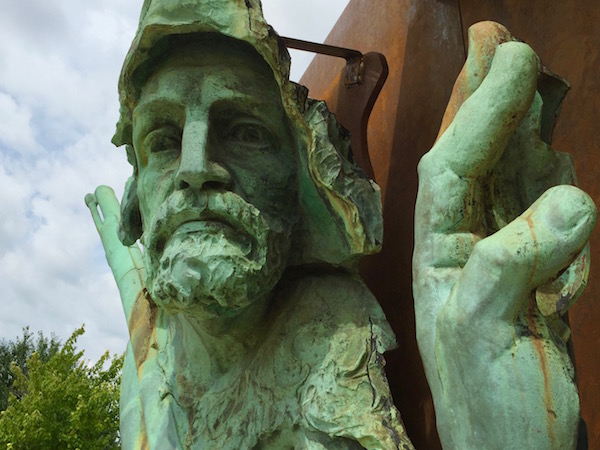
Detail of frontiersman Christopher Gist from the preserved Manchester Bridge sculptures, Pittsburgh, PA

Frontiersman Christopher Gist (detail)

And what of the sculptures? Well, on one side you’ve got Christopher Gist, the “frontiersman” who mapped the Ohio River valley in the 1750s crouching with musket, buckskin, and one very manly beard. Up close, there’s a deep, dazed look in his eyes and remarkable detail considering how high the piece was suspended above the bridge deck.

Opposite is the figure of Guyasuta, who was also involved in the colonial exploration of the Ohio[2]. The Seneca chief acted as local guide to one George Washington, in his pre-father of the country role as a young officer on a mission to survey what was then The West. Guyasuta’s posture is a near mirror image of Gist: hunkered down on one knee with a weapon at hand (in this case, bow and arrow), ready for action, but not yet drawn.

detail of Chief Guyasuta from the preserved Manchester Bridge sculpture, Pittsburgh, PA

Chief Guyasuta

Between these two figures is an enormous representation of an unfurled banner reading MCMXVII (1917) Manchester Bridge. Below it is a full-on 3-D version of the city crest and seal, complete with its checkerboard pattern (these are blue and white when they appear in color), “three bezants bearing eagles rising with wings displayed,” and “a triple-towered castle masoned Argent.” The seal is very much not the required black-and-gold[3]. Rather, the whole thing has turned the fabulous weird green of oxidized bronze, which looks pretty terrific.

Worth the trip? Certainly, at least if you’re already down on the North Shore walkway, at Heinz Field, or Stage AE for any reason. Or you can just pick up the twofer with the next Color Run cleanup, like we accidentally did. And if you see this wayward blogger gasping in the clouds of technicolor dust, maybe you can show him the way out, just like Gist and Guyasuta.

Manchester Bridge sculpture detail including a triple-towered castle masoned Argent from the seal of the City of Pittsburgh

Detail: the “triple-towered castle masoned Argent” of the seal of the City of Pittsburgh

Getting there: The newly-installed Manchester Bridge sculptures are indeed right by Heinz Field. They’re on North Shore Drive, just about where it meets Art Rooney Ave. (the little ring road around the stadium), in the small greenspace between the gates and Stage AE.


[1] The new installation only includes the sculptures from one end of the bridge. There is another set with different figures (including Joe Magarac!) that was also saved and is yet to be made public.
[2] Gist is presumably the namesake of the tiny cross street in Uptown. Guyasuta also has an un-remarkable eponymous residential road in suburban Fox Chapel. This seems like a bit of rip-off for both explorers when similar colonial-era players Forbes and Braddock got such prominent main drags.
[3] Between looking up Gist, Guyasuta, the Manchester Bridge, clarifying Led Zeppelin lyrics, the city flag and seal, and then definitions for “argent” and “bezant”, this post set some kind of Orbit record for its orgy of Googling obscure minutia[4].
[4] Note: no, we were not Googling “orgy”. That’s for later.

Step Beat: Basin Street Blues

Looking down the Basin Street city steps, Pittsburgh, PA

Looking down from near the top of the Basin Street steps, Troy Hill

If there are more stereotypically Pittsburgh names for a couple streets than Brabec and Voskamp, point this blogger to them. That these two short residential ways (in Troy Hill and Spring Garden, respectively), should be connected by a picture-perfect set of city steps is all the more apropos. Action, scene, cut, and print.

Top of the Basin Street city steps at Brabec Street, Pittsburgh, PA

Top of Basin Street at Brabec Street, Troy Hill

Tripping across a new set of city steps is no great feat–there are hundreds of them after all*. But randomly arriving at a stretch as spectacular as the Basin Street steps doesn’t happen every day. The couple hundred individual risers that connect these two near North Side neighborhoods have everything the step trekker and urban daydreamer could possibly hope for–theater, tranquility, history, and mystery.

View of Spring Garden and Spring Hill neighborhoods from the Basin Street steps, Pittsburgh, PA

View from the steps: Spring Garden (below) and Spring Hill (above)

Steps, by their altitude-adjusting nature, almost always offer something in the way of rewarding city vistas and Basin Street is no exception. The view from the very top (at Brabec Street) is shrouded in trees, but multiple points along the way offer terrific angles through the branches down to the Spring Garden bottoms below and up into the lush hillside of City View/Spring Hill above.

Thick tree cover and hand rail from city steps, Pittsburgh, PA

Hill view from the steps

Aside from the surround-sound bird chirping and song-singing–plus one indefatigable opossum loitering in a Voskamp Street back patio–not a creature was stirring in or around Basin Street on the day we visited. It is this gentle peace right in the center of the city that makes a great set of steps so special.

Basin Street has its requisite signs of humanity–foundations for long-gone homes off to the sides and no small amount of litter left by teen drinkers and hill campers–but it generally has more of the feeling of being way out in the woods. It’s fair to say that this particular wood still features the sounds of weed whackers, dudes working on cars, and distant classic rock wafting through branches–but a wood nonetheless.

Looking up the Basin Street city steps, Pittsburgh, PA

Looking up the Basin Street steps

Like Tolstoy’s happy families, each story of the city steps is in a sense the same: a wonderous artifact of urban infrastructure still exists, relaxing in repose on and under-visited city hillside. Nature, time, and tide reclaim as much as the Pittsburgh D.P.W. allows. The occasional pedestrian saunters through, but they exist mostly in a time of their own.

On the other hand, though, each passage of steps–at least the really glorious, long, secluded ones like Basin Street–offer their own unique experiences: different views, twists and turns, different high, lows, and end points. Rising Main, it ain’t, nor does it have the clusters of great steps like Fineview or the South Side Slopes, but this little backside of Troy Hill is well worth the trip. Big ups to the Basin.

View of the Spring Garden neighborhood from the Basin Street city steps, Pittsburgh, PA

Voskamp Street, Spring Garden, from near the bottom of Basin Street


* There is no official number, but the estimate is somewhere around 750 sets of public steps in Pittsburgh.

Step Beat: May the 54th Be With You

Top entrance to the 54th Street city steps, Pittsburgh, PA

There is a darkness. Upper entrance to the 54th Street steps at Camelia Street, Stanton Heights.

An unusually iridescent quality to the daylight–the result of diffuse, cloud-filtered sunbeams’ gentle descent to Earth. That, paired with recent showers and high spring reawakening, resulted in a glorious array of patchwork greens popping from every direction. Bright yellow-greens from first leaves and tangled weeds climbing through last year’s dead growth. Deep low greens darken ivy shadows and taller members’ undergrowth. Add one storybook passageway–literally full of twists and turns, hoots and birdsongs–and you’ve got a recipe for magic.

Right-angle turns at the top of the 54th Street city steps, Pittsburgh, PA

Zig zag wanderer: right-angle turns at the top of the 54th Street steps.

The 54th Street steps are a stretch that one can only assume is on the endangered species list. Several pedestrian walkways link the residential neighborhood of Stanton Heights (above) to 10th Ward/Upper Lawrenceville (below). At one time, there must have been significant demand for this kind of infrastructure, but with (most of) Lawrenceville’s big industry jobs long gone and automobile ownership more rule than exception, it’s hard to imagine many people needing to use these particular steps anymore. This blogger didn’t encounter a single other human on his recent visit.

Long middle section of the 54th Street city steps, Pittsburgh, PA

The long middle section of the 54th Street steps including wooden replacement handrail.

And that’s a shame…sort of. Pittsburgh has its share of great parks, trails, green spaces, etc. But it never ceases to amaze how simply walking around city neighborhoods offers so many everyday opportunities for nature, tranquility, solitude–you name it.

The 54th Street steps, as well as others up this way, are a prime example. The parks may have a greater bounty of trees, flowers, birds, and chipmunks, but they don’t supply the crazy catwalk gangways and cut-into-hillside stair climbs. You won’t see the same ghostly foundations of long-gone step-accessible (only) houses or burnt offerings to witchcraft. The entire length of 54th provides commanding bird’s eye views of Upper Lawrenceville and across the river to Millvale. The river trails are often crowded with Sunday cause-marchers and lollygagging strollers that can test the through-rider’s patience. The presence of humanity is no such problem up here.

Overgrown hillside view from the 54th Street city steps, Pittsburgh, PA

This is city living. View from the 54th Street steps.

The 54th Street steps are in quite good shape overall. There is some cracking to the concrete and there’s been obvious repair work including a fixed-up section of felled handrail with a jerry-rigged wooden replacement. But the treads are all sound and there’s no point where they feel like they’re falling apart. Any regular step-hiker will tell you this is no small achievement.

This is all pretty remarkable given the length and complexity of the operation. Fifty-fourth Street is definitely not the longest set of steps in the city (that’s the unbelievable Rising Main Way on the North Side), but with maybe 200 stairs* it’s probably up there. When you factor in the six right-angle turns and long flat stretches, it’s really a hidden jewel a in the city’s step crown. Get out there and try it on for size.

Bottom entrance to the 54th Street city steps, Pittsburgh, PA

Lower end of the 54th Street steps at Wickliff Street, Lawrenceville.

* Just guessing here–we didn’t count.

The Frankenstein Hillside of Woods Run

Hillside with embedded bricks and cinderblocks, Pittsburgh, PA

The Frankenstein hillside of Woods Run (detail)

This is about as Pittsburgh as it gets. A steep, nearly vertical, hillside forms a natural boundary between two distinct neighborhoods–Brighton Heights up above and Woods Run down below. Hillside erosion (or the threat thereof) has forced the hand of…someone (the city? industry? private property owners?) to infill cracks and fissures in the bare rock, but they’ve done it in the cheapest, most ramshackle way possible. It’s kind of like creating the goofy colored belt system instead of actually building any new highways–but to solve erosion issues instead of…directional? [The belts certainly do nothing for traffic.] In both cases, The Orbit applauds this philosophy of low-tech, minimally-destructive, infrastructure recycling.

Hillside with embedded bricks and cinderblocks, Pittsburgh, PA

Even with the bright morning sun shining on them, it’s a little hard to see what’s going on in these photos. The hill probably reaches fifty or sixty feet above street level at its highest and there are at least a handful of houses that back right up near the top edge. At the base is vacant land (today), but likely held row houses, retail, or small industry buildings back in the day.

Irregularly set into the rock face are a mortared collection of various masonry materials–bricks of all shapes, sizes, and colors, as well as cinderblocks, paving stones, and poured concrete. The overall effect is as if some bygone cheapskate public works director gave the order to “just fill the cracks with whatever you have laying around.”

Hillside with embedded bricks and cinderblocks, Pittsburgh, PA

The combination is beautiful, weird, and, yes, looks like the work of a mad scientist, or maybe a mad civil engineer. There’s the very awkward collision of nature and technology–like a brick and stone cyborg, only this one wants to keep loose rock from falling on you instead of hunting you down for crimes you’ll inevitably commit in the future. The spare parts and junk shop chic is something any crazy inventor with a bricklaying hobby would be proud of. The hill’s vertical face is rendered in wonderful 3-D, at points both smooth and jagged, metric and chock-a-block–it gives the whole enterprise this incredible depth and texture. Seeing these on a clear day, in the A.M. (when the eastern sun lights them up), will match any gallery experience. We guarantee it, just like Dr. Frankenstein did.

Hillside with embedded bricks and cinderblocks, Pittsburgh, PA

Getting there: The Frankenstein hillside runs along the dog-legged stretch of Woods Run Ave. between Eckert St. and McClure, right across the street from Mr. Jack’s Neighborhood Bar (“No guns. No knives.”)–just look up. Cyclists will be well aware of this particular patch of road as it’s the primary route from the very end of the river bike trail by the old jail to points west and north.

Weed and See: The “Adjutant” Murals and Riverwalk Cleanup

Adjutant mural, downtown Pittsburgh river walk

They leapt right out, wheels in full motion, from a bicycle seat all the way across the river. There, beneath the on-ramp to the Fort Duquesne Bridge, along the thick concrete barrier walls by Gateway Center, stretches a new(ish) blocks-long mural (or series of murals, whichever way you see it). Even from a significant distance and shaded by the ramp structure above, the painting reads as a great collection of wild flora. It begged for further investigation so we legged it up over the bridge, around the park, and down to the river’s edge.

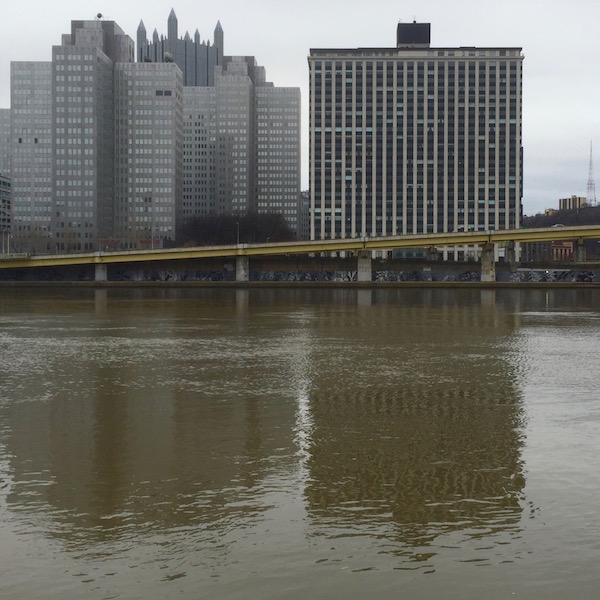
View of downtown Pittsburgh and the Allegheny River from the North Side with Adjutant murals visible under the Fort Duquesne Bridge ramp

In context: the new river walk murals, under the Fort Duquesne Bridge ramp, from the North Shore

Pittsburgh Orbit has spilled its share of virtual ink looking backwards. We’ve devoted an entire series of “Orbit obits” to things that aren’t there any more and when you fetishize ghost houses and ghost signs and graffiti as much as we do, well, you’re not really thinking about your future.

So we thought we’d start 2016 off right with a fresh-faced forward-looking story on something new to us and nearly brand new to Pittsburgh: this terrific blocks-long series of murals decorating the Allegheny side of the downtown riverwalk.

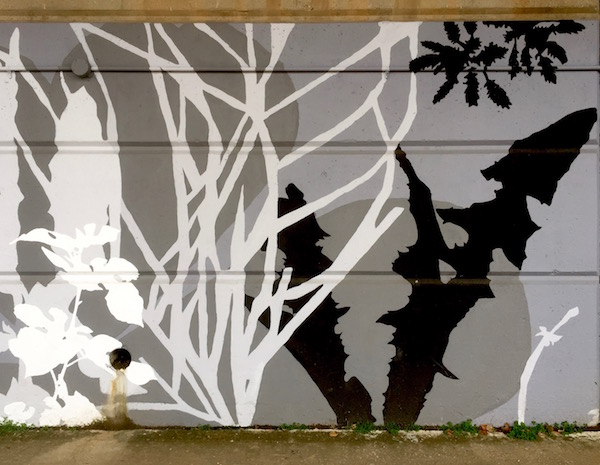
Adjutant mural detail, downtown Pittsburgh river walk

The murals are actually half a year old at this point, making this blogger wonder where the hell was I? Though he’s bragging about eagle-eying the paintings on this ride, he had to have been down this stretch of riverbank dozens of times without ever seeing them, nor did we catch any coverage in the local news last summer. So let this post be another reminder to get out there and keep the peepers scanning!

Though entirely uncredited at the site (as far as I could tell), The Orbit can Google with the best of them. The giant piece is the vision of artist Kim Beck and titled Adjutant (a fancy word pulled from a Henry David Thoreau quote). A team of some 150 volunteers organized by Riverlife Pittsburgh executed the work during the Three Rivers Arts Festival last June. Two blog posts on the Riverlife site give all the pertinent background and details [see links below].

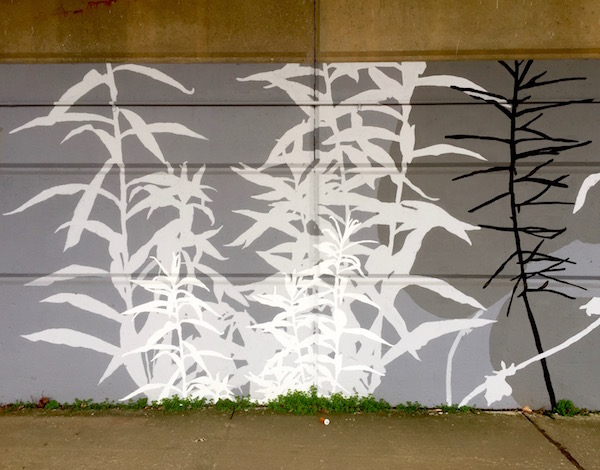
Adjutant mural, downtown Pittsburgh river walk

If you ever used this section of the riverwalk–the stretch that runs between the northeast corner of Point State Park and the slender Allegheny Riverfront Park that picks up around the Clemente (née Sixth Street) Bridge–you don’t likely remember it for its charms. The passageway was perfectly utile and never felt dangerous (at least in daylight), but walking or bicycling through always seemed like traveling where one wasn’t supposed to–fairly lawless and designed to dock giant barges, not facilitate pedestrian traffic. Corners under the bridge often contained the sleeping bags, tarps, and cardboard boxes of the population that lived down there. Discarded liquor bottles, beer cans, and snack wrappers pointed to late night boozers and early morning fishermen who hung out under its private, protected shelter.

So the project to create the 850-foot (approximately three to four city blocks) mural is both a very welcome beautification of an extremely cold, hard, and dark urban space and also seems to be a wholesale cleanup effort to make the passageway a truly inviting link between the parks on either end.

Adjutant mural of Canada thistle under Fort Duquesne Bridge ramp, Pittsburgh, PA

Not only was this stretch scrubbed for the mural’s creation during the arts festival, but it amazingly seems to have stayed that way some six months on. The pedestrian section of the walk is remarkably litter-free and either Pittsburgh’s taggers have decided to leave these walls alone or the city’s graffiti removal crew does spot-on repair work (I’d bank on the former).

That’s all great, but “cleaning up” part of a city is always a loaded term–especially when it involves human beings. As nice and inviting as the new space is, we can’t help but think about those who were displaced (we assume?) in its transition. We’ve noticed homeless camps pushing farther out from town in a way that suggests you have to go that far to not get hassled by the man. We inadvertently ran into one such group in the Christmas Under the Bridge piece a couple weeks back.

Adjutant mural, downtown Pittsburgh river walk

The murals are large-scale depictions of common weeds that appear along Pittsburgh’s riverbanks, rendered in the lean palette of black, white, and a couple shades of gray. Artist Kim Beck informed us that the palette was dictated by the commissioning agency. They look great, but we can’t help but think the addition of some real color would warm the space up considerably and “pop” dramatically against the drab surroundings. That said, we’ll take what we can get, and this is a big improvement on the visual space.

Pittsburgh Orbit’s Pennsylvania wildlife consultant and resident deep woodsman Tim Tomon came down from the trees long enough to identify dandelion, goldenrod, mulberry, pearly everlasting, thistle, wild peppergrass, and wood sorrel among the silhouetted weeds.

Beck’s re-casting of weeds as giant expressions of beauty is certainly an exciting and inviting vision for this just-recently prettified stretch of town. The bright green of the real weeds that peek out from the cracks between foot surface and retaining wall are the only elements of color one sees (save for the bright yellow bridge deck above). Both serve as sweet reminders that a “weed” is purely a situational notion. These all look pretty good to me.

Adjutant mural, downtown Pittsburgh river walk

Sources/more info: