Send In The Crones

street art sticker in shape of heart with word "Crone"
Love is for us old people, too. A “Crone” heart, Lawrenceville

Aging, your author’s bluntly-honest, not-entirely-tactful, and dearly-missed father-in-law used to say, ain’t for sissies. As someone with more yesterdays than tomorrows, I can attest to this firsthand. The body starts breaking down in all sorts of unexpected ways; the mind wanders off to Lulu land more frequently than we’d like to admit; young whippersnappers run rings around us in all ways that whippersnappers may run.

large hand-created sticker with words "Aging is Sexy"
Read the news: aging is sexy. Lawrenceville

… but I’m a dude—and that means it’s just easier for me. Older men are granted a kind of societal clout simply by virtue of their gender that women don’t enjoy. Graying men are often described as wise, established, and “silver fox” handsome. (Still crossing my fingers for that last one.) Women of the same age share no such common, stereotypical positives.

Far from it. American society is youth-obsessed, for sure, but it’s mainly obsessed with young women. Ms. Orbit—she of my same vintage—often describes the experience as one of “becoming invisible” and feeling “no longer relevant” to the outside world.

large hand-created sticker with word "Crone"
Crone crystal, Oakland

Just about one year ago, we spotted a small hand-written sticker attached to a residential parking sign post in Lawrenceville. The text was a simple double-entendre: Menopause is HOT. That got a snort-laugh out of yours truly and I bagged it for the road.

That little teaser was quickly followed by an array of more elaborate, hand-colored stickers spread on lamp posts and electrical boxes. They all contained simple messages proudly addressing the very uncommon subject—either in wider culture or here at the street level—of middle-aged women as real, present beings: Aging is Sexy; Crone; Menopause.

sticker on post reading "Menopause is hot"
Menopause is HOT, Lawrenceville

We don’t know who created these subtle, gently-subversive little works. None of the pieces we’ve found have any attribution and the Orbit hive mind was unable (or unwilling) to name names. We’re also left to interpret the artists’ message.

We do know the statements are attention-grabbing and hilariously out-of-context—seeing the word menopause bedazzled and glorified in the leftover spaces where taggers dwell is objectively funny.

large hand-created sticker with word "Crone"
Crimson crone crystal, Lawrenceville

Ms. Orbit and I have discussed the matter much in the course of our relationship, crossing into deep middle-age, and specifically with her experiences as a woman and an artist. For these reasons, I wanted to turn the rest of the story over to her:

large hand-created sticker with words "Aging is Sexy"
A(g)ing is Sexy, Bloomfield

Middle-aged women become invisible to a degree. But, rather than lamenting that fact, I’m enjoying the hell out of the invisibility, because it means a certain kind of freedom. It means the freedom of not having to matter to men, not worrying about being pretty, sexy, feminine enough, thin enough, demure enough, not too loud, not too opinionated. Men no longer care what I look like, sound like, say, etc. When I was younger, I often stepped outside the lines by being too loud, too bold, too feisty and was admonished by men and sometimes by other women. Now, those folks no longer care what I have to say or how I look and I feel the freedom to be fully myself, on my own terms.

large heart-shaped hand-created sticker with word "Crone"
Crone, Bloomfield

There are a lot of younger women now who are proudly and publicly themselves in a “give no fucks” way and I love it, admire it fully—Lizzo comes to mind. Of course, I have had my moments of feeling the negative side of aging and have grappled with thoughts that “I’m no longer relevant,” but the flip side is you can choose to matter to yourself and the important folks in your life. It’s beautiful to live without needing external validation. I wholeheartedly praise the artist or artists behind these stickers because it’s a way of shouting “We’re here! We exist! We matter!” and being proud of that. Ageism is real—just like racism and homophobia and sexism—but you counter that ugliness by fully owning and celebrating who you are.
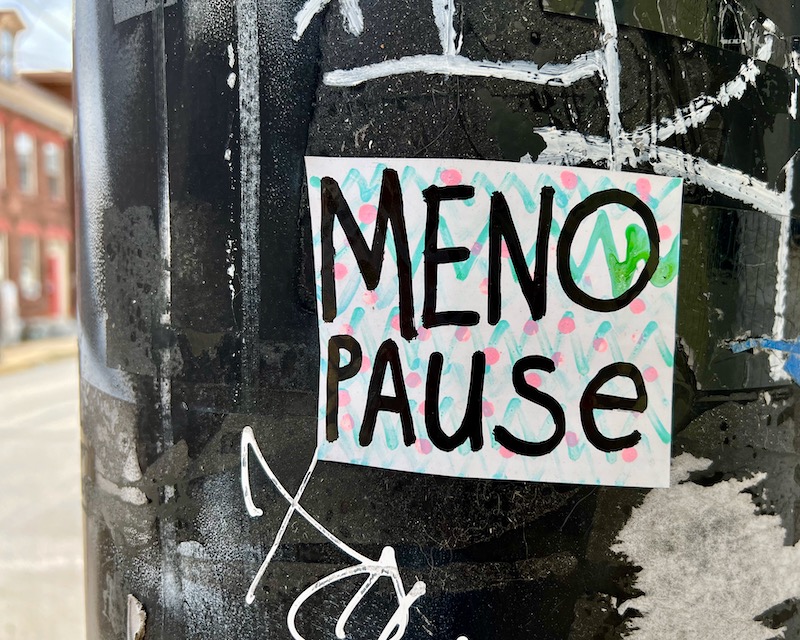
large hand-created sticker with word "Menopause"
Menopause, Bloomfield

When Suzanne Werder and I did the Drawn Together: A Coming of Middle Age Story in 62 Portraits show this past April, the reaction from women over 50 who came to see the show was intensely positive, almost incredulous—they felt seen. “You showed your wrinkles, and bags under your eyes!” Now, we didn’t set out to make a point of our flaws, but in just drawing each other everyday, we can’t escape our truth: that we are getting older and we are not supermodels, and we’re okay with that.
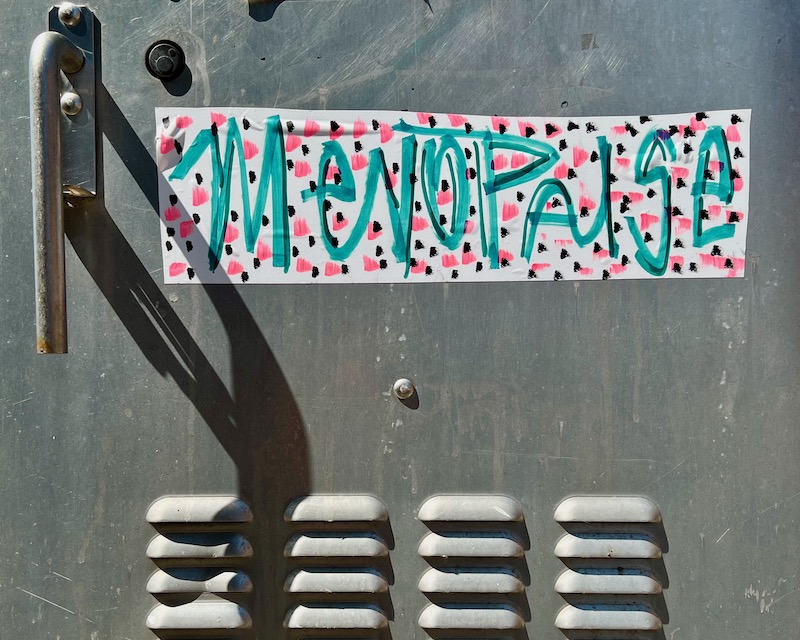
large hand-created sticker with word "Menopause"
Menopause, Deutschtown

That show did a lot to make me more comfortable in my own skin. There’s a lot of push back culturally against the notion that people are supposed to look or act a certain way, that our world is supposed to mirror the narrow scope of idealized bodies in traditional advertising. Now, it’s more common to see images of people of all sizes, colors, ages, abilities, and sexualities represented, and the power of that is huge. It makes us realize that we are all relevant and beautiful and always were.
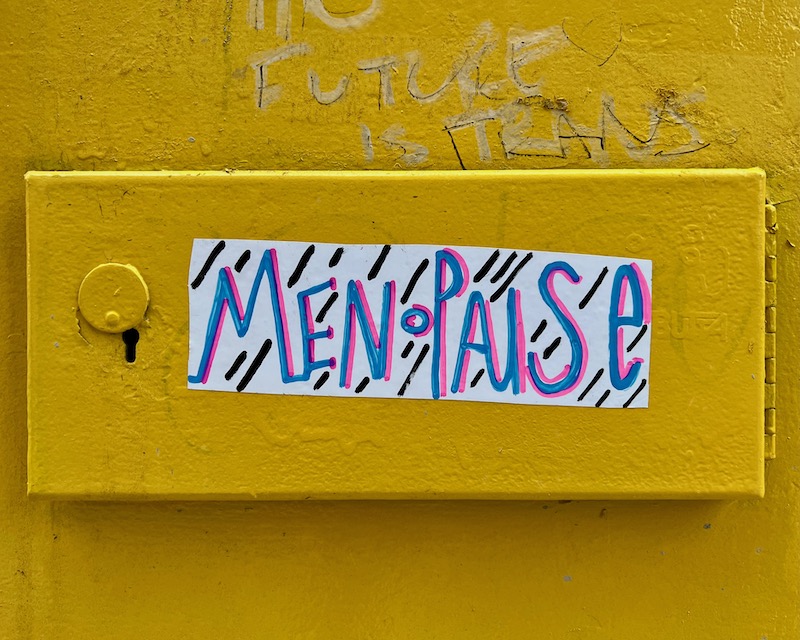
large hand-created sticker with word "Menopause"
Menopause, Bloomfield

Double Vision: An Orbit Day Trip to the Johnson/Shaw Stereoscopic Museum

stereoscope view card of zeppelin in flight
Zeppelin, baby! In stereo!! “The Maiden Flight of the ‘U.S.S. Akron.’ Sept. 23, 1931.” A stereoscopic view card with its characteristic double image and concave bend produced by the Keystone View Company of Meadville, PA

Meadville, Pa., New York, N.Y., Chicago, Ill., London, England. A hundred years ago, these four city names were printed on hundreds of thousands—maybe millions—of photographic view cards enjoyed the world over.

With apologies to the fine people of Crawford County, one of these cities is not like the rest. That said, Meadville—little Meadville, a town of 13,000 people an hour-and-a-half due north of Pittsburgh—was actually the ring leader in this particular group in one important context.

Home to the Keystone View Company from the 1890s to the 1960s, Meadville found itself as one of, if not the, largest manufacturers of stereoscopes and stereoscopic “views” during the medium’s heyday in the first half of the twentieth century. New York, Chicago, and London were but vassals selling and distributing the wares created and produced in Meadville.

hand-tinted stereoscope view card of woman in canoe in river
Canoe dig it? “Far from Gay Cities and the Ways of Men.” A hand-tinted color view card
stereoscope view cards of nature scenes
Egrets, I’ve had a few. “A Close View of American Egrets.” / spider’s web

If you’ve never had the pleasure—or just didn’t know what they were called—a stereoscope is a handheld device with two lenses that a person looks through. Stiff paper cards with specially-printed images are placed into a slider aligned with the viewer’s eye holes.

The two photos—they’re usually photos, but come in other media too—were taken with special cameras equipped with a pair of lenses spaced at roughly the distance between a person’s eyeballs. With each of the viewer’s eyes focused on a slightly different perspective of the same scene an illusion of three-dimensionality is created.

doll figure in easy chair holding a stereoscope
A tiny man with a tiny stereoscope in a tiny comfy chair

The history of both this unique, pre-television entertainment/educational/optical technology and, more specifically the Keystone View Company, is documented at the Johnson/Shaw Stereoscopic Museum in Meadville.

The museum houses thousands of view cards produced by Keystone in their seven-decade run. Travel photos, news and current events, teaching aids, children’s stories, optical illusions, and visual gags are all collected in banks of cards available for the visitor’s perusal. One could spend an entire visit riding the old-school 3-D wave from Lake Conneaut to distant Asia and everywhere in between.

humorous stereoscope view card of mother rabbit with babies holding tiny plates
Humor was simpler back then. “The Bunnies’ Breakfast Hour.”
stereoscope view card of cartoon characters climbing a telephone pole
… and so was physical fitness. “The Human Body is Strengthened by Proper Exercise—The Eyes are no Exception.”

Hard to capture in photos is the care the Johnson/Shaw has taken to showing the way Keystone created its products. Factory workers ground the lenses, hand-carved the wooden stereoscopes, assembled the parts, glued pictures to cards, and hand-tinted black-and-white photos into gloriously over-saturated color scenes that one imagines were the pride of any stereophile’s collection.

The museum includes examples of the desks and workstations, tinting tables and shipping molds for the full process, each step attended-to by a period-dressed mannequin.

hand-tinted stereoscope view card of oranges in tree
“Orange Blossoms and Fruit, Los Angeles, California.” A hand-tinted color view card
stereoscope view cards of humorous cartoon scenes
collection of humorous color view cards
mannequin with framed photographs
Mannequin fever, Meadville-style! One of several displays showing how view cards were created.

It will come as a surprise to no one—especially those who’ve never heard of stereoscopes—that the medium didn’t last. In a pre-Internet, pre-television era, stereo views were a solid way to armchair travel to places and events far from home. They could be borrowed, traded, and housed at libraries and museums for use by larger audiences, even if viewing a particular scene was a decidedly personal experience.

But—you know where this is going—by the time America got past the depression and World War II there were just a lot more options out there: a television right in the living room, movies in vibrant technicolor, glossy magazines full of frivolity, and bebop jazz and rock-and-roll’s daring thrill. Putting a view card in the slot of a stereoscope so you could see a still image have a little extra dimension must have felt hopelessly quaint by the mid-1950s.

woman with red/blue 3-D glasses
The world looks better through rose—and blue—colored glasses. A satisfied 3-D museum-goer at Johnson/Shaw

The concept didn’t die there, though, and all of us who grew up with View-Masters and their rotating slides and stories are living proof. [Side note: apparently these are still available brand new, but it’s hard to imagine today’s youths getting that excited about them.] Old school blue/red 3-D glasses used a different optical technology but were a similar attempt to bring the third dimension to photography and film. These updates to the world of stereoscopic entertainment are also covered by Johnson/Shaw’s collection.

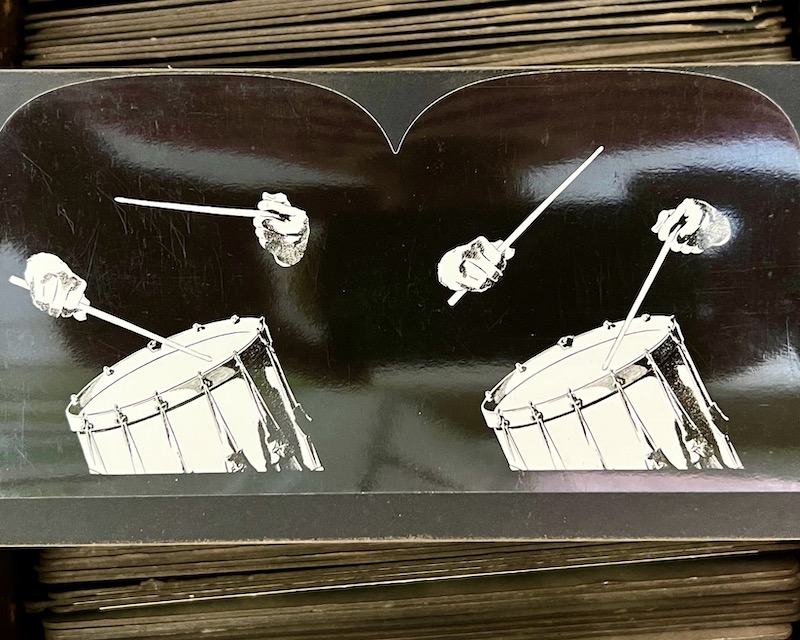
stereoscope view card of snare drum and drummer's hands and sticks
unlabeled view (snare drummer optical illusion)
stereoscope view card of childrens story
“The Three Bears”

That’s a lot, huh? … but there’s more!

The Johnson/Shaw also contains a unique array of glass milk bottles, each with seemingly a different size, shape, and/or graphic treatment. If you’re into the history of Western Pennsylvania dairies, The James August Roha Milk Bottle Collection is the place to be. This museum-within-a-museum has giant display cases full of silk-screened glassware memorializing extinct dairies from Erie to Uniontown. Each bears the beautiful simplicity of mid-century typography on crystalline, reusable glass and is well worth your time … if you can stop digging through the stereoscope views.

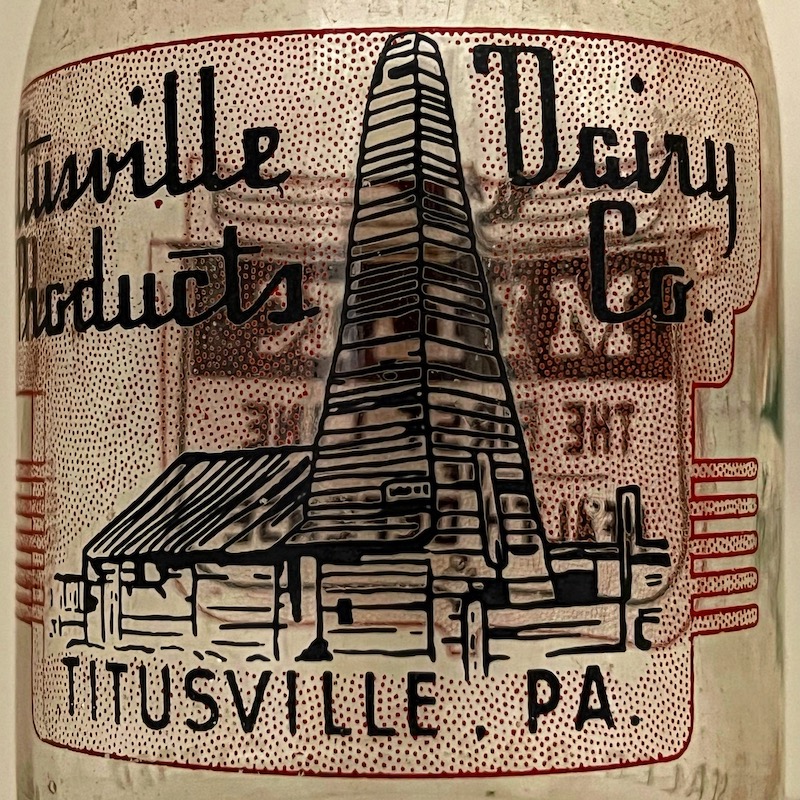
detail of milk bottle graphic
Art Deco meets oil extraction on Titusville Dairy’s milk bottle
old milk bottles from different Pennsylvania dairies in display case
A small portion of the James August Roha Milk Bottle Collection

Getting there: The Johnson/Shaw Stereoscopic Museum and James August Roha Milk Bottle Collection is located at 423 Chestnut St. in Meadville. It’s about an hour-and-a-half drive from Pittsburgh and is real near Conneaut and Pymatuning lakes, if you’re up that way. The museum’s only scheduled open hours are on Saturdays (10am – 4pm) but is also open by appointment on other dates (call 814-720-4306 to schedule).

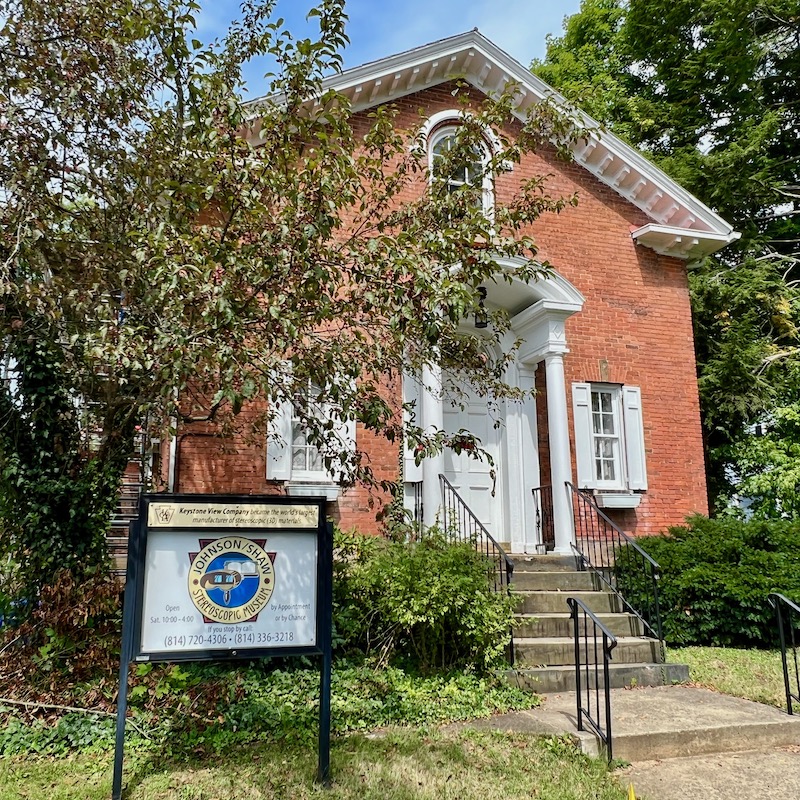
exterior of brick The Johnson/Shaw Stereoscopic Museum in Meadville, PA
The Johnson/Shaw Stereoscopic Museum and James August Roha Milk Bottle Collection, Meadville