Attend Me: Collage Dropout in Deutschtown

colorful collage of printed paper images layered on plywood covering vacant storefront
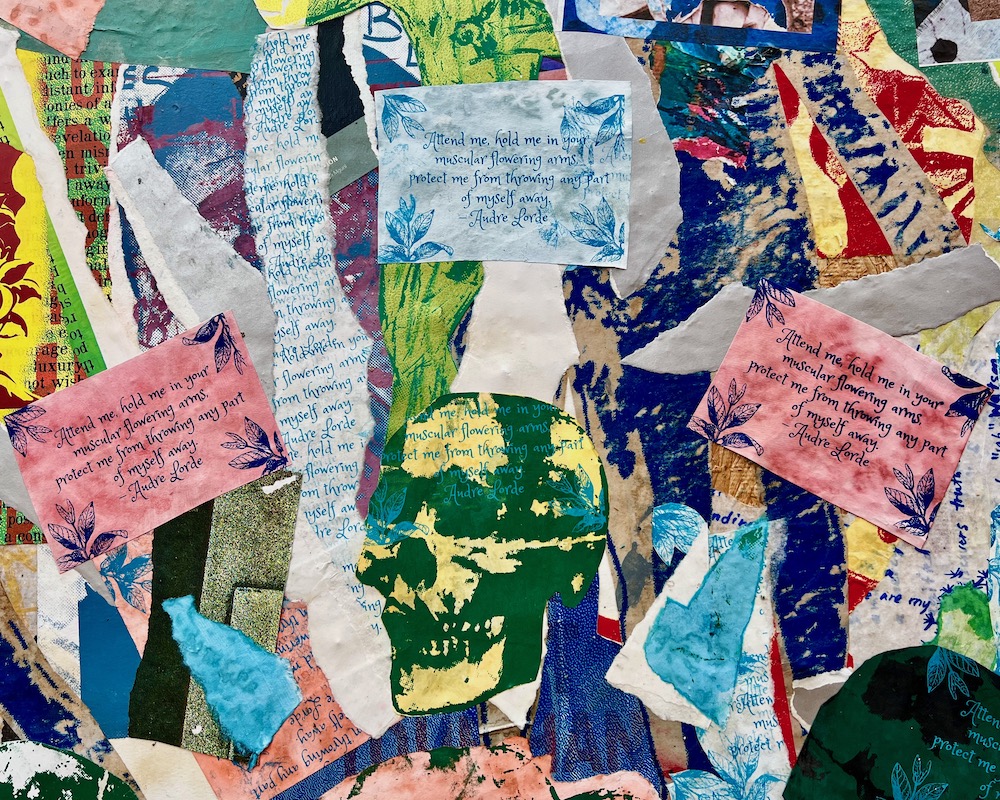
Detail from large collage installation on East Ohio Street, Deutschtown

Attend me, hold me in your muscular flowering arms,
protect me from throwing any part of myself away.

These words, from self-described “black, lesbian, mother, warrior, poet” Audre Lorde, are printed and duplicated—silk-screened, most likely—in an ornate, curlicue typeface and accented by fronds of unknown origin.

The cut-out text is layered atop a riot of dozens, hundreds maybe, of other screen-printed elements. Torn paper with the same couplet printed over and over again; images of skulls and boxers, eyeballs and ghostly figures; photographs cut from magazines bedazzled with after-market patterns and paint jobs.

They’re all part of a new(ish) installation on the North Side that, by its very nature, won’t be around for too long. Just like Ms. Lorde, attend it while you can.
colorful collage of printed paper images layered on plywood covering vacant storefront
Collage (detail) including Audre Lorde quotes, Moravian Way
colorful collage of printed paper images layered on plywood covering vacant storefront
Ghost boxer

The 400 block of East Ohio Street has seen its fair share of change, even in just the last few years. Google Streetview reminds us the retail storefront at 404 E. Ohio was Ike’s Barber Shop and then Mosley’s Barber Shop until going vacant in 2015. The larger building at the corner was the old Peanutz Bar & Grill, which closed by 2016. In between the two, Alex’s Ice Cream held on longer, but seems to have become a victim of the pandemic lockdown just two years ago.

The most recent time Google documented the street, in August, 2021, it included another interesting detail. 408-410 E. Ohio hosted a large, double-door-sized collage piece on the temporary plywood covering the entrance. This is unmistakably the work of the same artist(s).
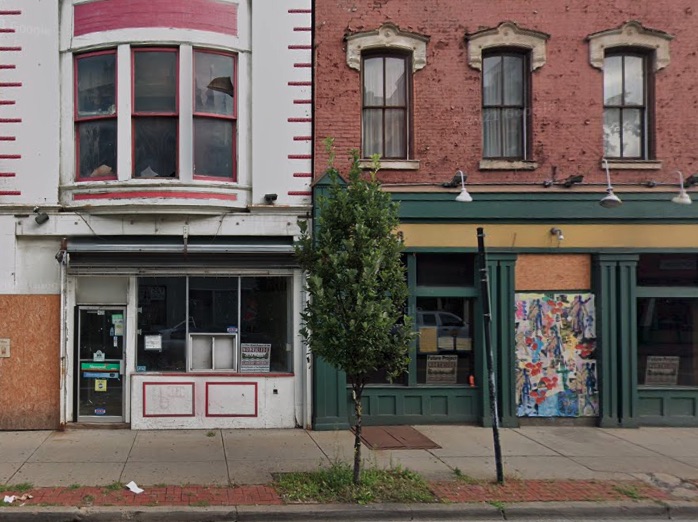
two vacant retail storefronts in disrepair
406-410 East Ohio Street, most recently Alex’s Ice Cream and Peanutz, in August, 2021 [photo: Google Streetview]

As observers, curiosity-seekers, speculators, we naturally look for meaning and theme when a piece this elaborate is exhibited—and there is plenty to work with here, if that’s your bag. Black icons Jack Johnson and Audre Lorde are an obvious entry point as are reverent photos of everyday folks and revolutionaries, updated with kente cloth, polka dots, and leopard skin patterns.

There’s also plenty of grim, foreboding imagery here. The repeated use of skulls, a menacing monster-like figure with its giant jaw agape, what may or may not be a nuclear blast, and the Virgin Mary in a hostage-taker’s ski mask.
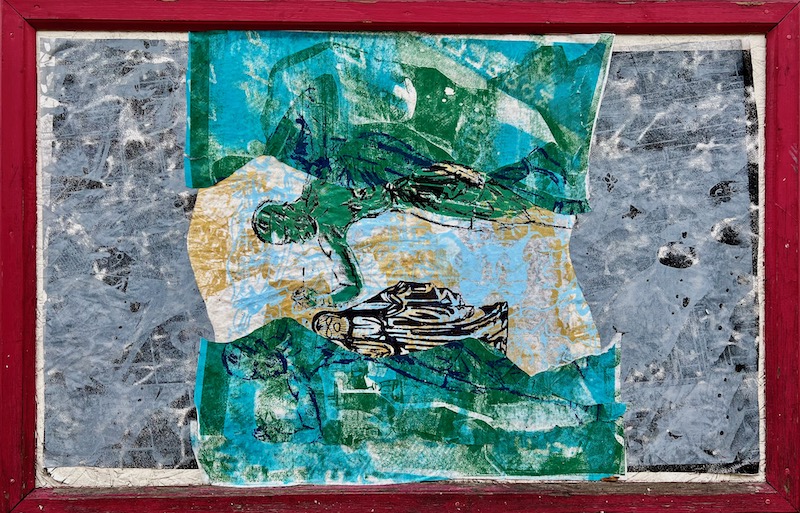
colorful collage of printed paper images layered on plywood covering vacant storefront

We’ll not make the mistake of assigning any specific message to the collection. The artist (or artists)—there is no attribution on any of the pieces that I could find—kept themselves anonymous (although, we have our suspicions). So there’s no one to go to for clarification, which is fine.

Update (March 19, 2022): Following initial publication of this story, Pittsburgh Orbit was informed that the artists involved are Quaishawn Whitlock, Bekezela Mguni, and Darrell Kinsel. The three have a current show called Alchemical, created as part of their residency at AIR: Artists Image Resource on nearby Foreland Street.

colorful collage of printed paper images layered on plywood covering vacant storefront
Collage (full), Moravian Way

Whether we’re supposed to think anything at all about a stirring work, heavy on the iconography, or just enjoy the blast of layered color from a voracious screen-printer cleaning out his or her workspace is missing the point.

Someone created this, and it’s beautiful. It’s also unexpected, fun, head-scratching and gets us out of our heads and into the world. It’ll also be gone before you know it. The wheatpasted paper is already peeling at the corners and between unpredictable Pittsburgh weather and a property manager trying to rent the spaces, the whole thing will disappear before you know it.

Protect me from throwing any part of myself away feels like it might be a way of life for whoever did this. Embrace the piece by holding its visage in your muscular flowering arms, err … thoughts, dreams, and travels.

colorful collage of printed paper images layered on plywood covering vacant storefront
The noses know this
colorful collage of printed paper images layered on plywood covering vacant storefront
Mind/blown
colorful collage of printed paper images layered on plywood covering vacant storefront
Mary Maskstillon
colorful collage of printed paper images layered on plywood covering vacant storefront
Collage installation at 406 East Ohio Street

Look Out Loretto, Part 3: Ovdje Počiva Zaboravljeno Groblje*

broken grave marker in untended cemetery
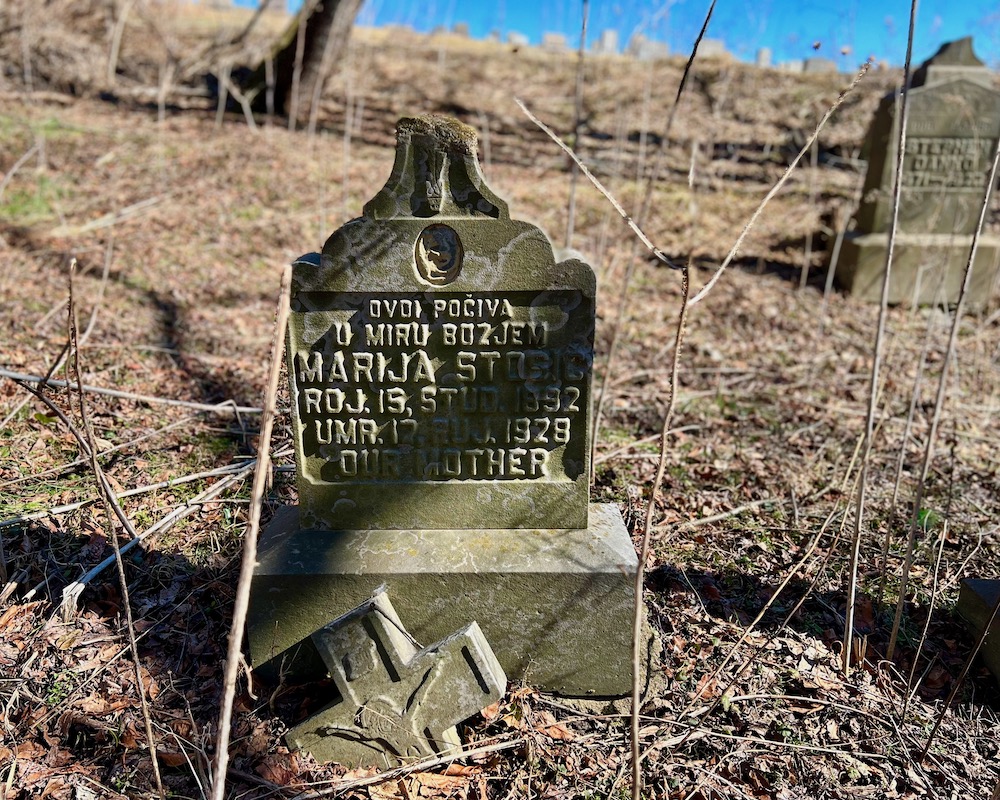
Crucified and cut in two. Marija Stosic’s grave marker is one of dozens in a no-longer-maintained section of Loretto Cemetery, Arlington

It’s a striking image. Marija Stosic’s grave marker has deep-chiseled text that casts stark shadows in the day’s bright sunlight. The minimal epitaph, Ovoi počiva u miru bozjem, is—if Google Translate is to be believed—Croatian for Rest in the peace of God. Above, we see the familiar empty oval cutout where a ceramic portrait of Ms. Stosic would have been inset when the stone marker was first installed.

The design of the monument features a carved cross at the top with an image of Jesus in relief. Sometime over the last 94 years, the top has broken off leaving the Beloved Son not only crucified but bisected at the waist. Marija Stosic’s tombstone rests with another couple dozen (at least) fellow graves in a plot that’s now overgrown with the kind of scrubby barbs that will make this place difficult to negotiate by the time spring returns.

grave marker covered by thick overgrowth
Elizabeth Floros

To be honest, we didn’t think Loretto Cemetery would produce another Orbit story. Our two-parter, from way back in 2016, on Loretto’s fine collection of pre-war photo graves and the ones that just about slipped away seemed like all we’d be able to squeeze out of such a small memorial park.

This time though, with a return trip on a lovely full sun midwinter day, we went all the way to the back and the bottom. The cemetery has an L-shaped extension that reaches down the hillside and runs out where the closely-clipped grass meets untamed snags and prickly bushes … but the cemetery doesn’t actually end there.

cemetery with clearly-defined sections where grounds are still tended vs. overgrown
Loretto’s lost cemetery below; still-tended cemetery above

Come springtime, it’s unlikely anyone would even have the sight lines into this extra, lost, forgotten—take your pick—section of the cemetery. We imagine the winter’s long grasses and denuded vinery will produce the same sort of thick greenery that envelopes every square inch of untended, asphalt-free Pittsburgh making this parcel all but invisible to Loretto’s visitors.

broken grave marker in untended cemetery
Mary Pavicič

The obvious question: why did this section of the cemetery—a plot maybe a few acres large, containing grave markers almost entirely with Croatian names, deceased in the 1920s and ’30s—stop receiving the care the rest of the park has? In lieu of any real journalism, we’re left to speculate.

grave marker knocked over by fallen tree
Mathilda Goralczyk

Theory 1: Cost savings for the cemetery. The geography of the hillside is just too severe and Loretto’s management decided they couldn’t justify the expense of sending their grounds crew into an untamable wild to tend a set of grave markers so old they rarely—if ever—receive family members.

Theory 2: This was never a part of Loretto and instead it was a separate, independent cemetery. We find these tiny cemeteries—often associated with a particular church, faith, or national origin—all over the place. They’re also often immediately adjacent to larger cemeteries. Perhaps the Hilltop’s Croatian community purchased or sub-leased this plot of land back in the 1920s with their own maintenance agreements that Loretto is not responsible for.

broken grave marker in untended cemetery
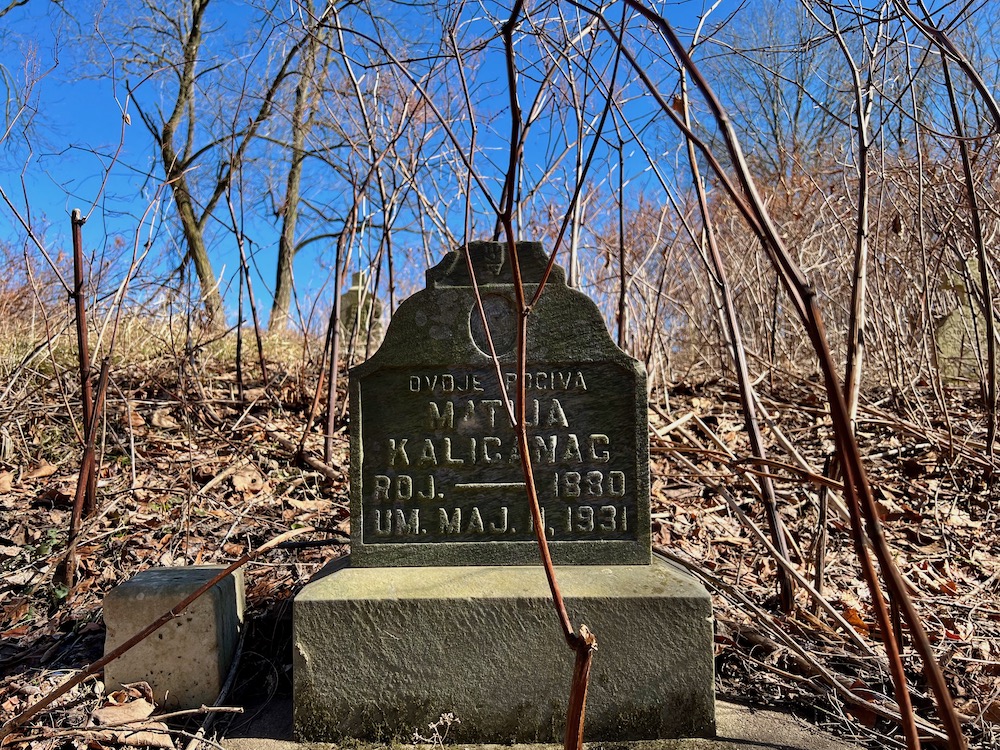
Matija Kalicanac

A wander through the cemetery—any cemetery—always brings up questions of permanence. Grave markers—cut from granite, weighing hundreds of pounds, placed on land with this specific purpose—carry the unrealistic expectation that they will exist in this state forever. But we know it ain’t going to play out like that.

In our previous story on Loretto’s photo graves we discuss the irony that some of the ceramic photos on grave markers have outlived the carved text, such that we don’t even know the names of people whose images we still have—and it’s been less than a hundred years.

Loretto’s forgotten cemetery takes that and says hold my beer. You’re not even guaranteed a reasonable way for visitors to access your plot—and it may have been that way for decades.

eroded grave marker in untended cemetery
Anna ? (Genz?)

You’re still reading this? The rambling rarely stops, but here we are.

If you do want to check out Loretto’s forgotten cemetery, we recommend doing it before the poison ivy, viney overgrowth, and legit jaggerbushes come back to life.

grave marker in untended cemetery
Otec Janko Sculac

* That should be something like Here rests the forgotten cemetery.