Lest We Forget: One Year On

large portrait of Holocaust survivor mounted on exterior display at the University of Pittsburgh campus as part of Luigi Toscano's "Lest We Forget" portrait series

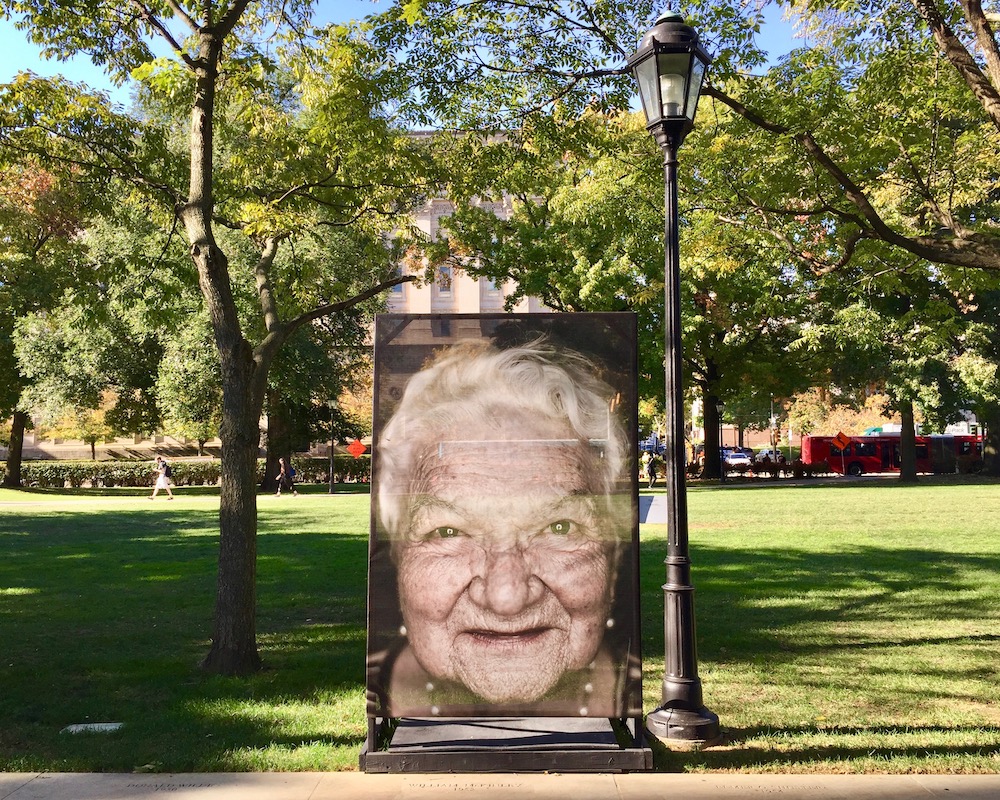
Portrait of Bronia Weiner (b. Romania, 1919). One of 60 large-scale photographs of Holocaust survivors in Luigi Toscano’s “Lest We Forget” project, Oakland

It is almost what you might call a Mona Lisa smile. The face on the canvas is warm, but contains a hundred years of ups and downs, tragedy, triumph, and vigor—at least, that’s what we’re seeing. The woman’s emerald green eyes stare straight back at you. Her white hair is cut short and styled—or maybe it just goes this way naturally—in a loose wave that would look fashionable on a woman a quarter her age.

But it is the upturned curl at the corner of the woman’s mouth that gives her away. This cheshire grin suggests no matter how much heartache she may have experienced, there is an indomitable human spirit alive, well, and ready to release an outrageous tall tale with joyous laughter.

Bronia Weiner is a Holocaust survivor and it is no accident that her portrait is on public display here in Pittsburgh, now.

Robert (Bob) Behr (b. Berlin, Germany, 1922)

A partnership between The Holocaust Center of Pittsburgh and the University of Pittsburgh has brought German-Italian photographer Luigi Toscano’s project Lest We Forget (or Gegen das Vergessen in the original German) to Oakland.

The installation features 60 large-scale color photo portraits mounted on semi-translucent screen. Designed for outside exhibition, the photos, stretched on big wooden frames, line the broad walkways between The Cathedral of Learning and Heinz Chapel. Additional portraits are indoors at The Carnegie Museum and Chatham University library.

large portrait of Holocaust survivor mounted on exterior display at the University of Pittsburgh campus as part of Luigi Toscano's "Lest We Forget" portrait series

Shulamit Bastacky (b. Vilnius, Lithuania, 1941)

Up close and in person, the photographs read as the kind of opaque, hiqh-quality prints that one might find on art gallery walls. From any distance, however—especially on a bright sunny day—the fine mesh of the media allows background elements to bleed through the images.

The lush green of the Cathedral lawn colors a sun-dappled face. Eyeballs pop out from university infrastructure. Cloud-like white hair disappears into arching tree limbs, autumn leaves, and blue sky.

large portrait of Holocaust survivor mounted on exterior display at the University of Pittsburgh campus as part of Luigi Toscano's "Lest We Forget" portrait series

Sofija Goljand (b. Perejaslaw-Chmelnyzkyj, Ukraine, 1924)

We have no idea if this was the intended artistic effect or just a simple accident of the medium. Either way, the result is a beautiful and haunting way to portray these elder survivors and simultaneously address the mortality all of us inevitably wrestle with.

Toscano’s subjects range in age from their late 70s to 100 years old. Their time here—like all of ours—is limited. As these rich, detailed photographs dissolve into the wider landscape, it’s impossible not to think of the dust-to-dust return to the earth that will claim us one way or another.

large portraits of Holocaust survivor mounted on exterior display at the University of Pittsburgh campus as part of Luigi Toscano's "Lest We Forget" portrait series

“Lest We Forget” portraits near Heinz Chapel

As of today, it’s been exactly one year since a gunman entered the Tree of Life synagogue and committed an act of hate-filled violence that will forever affect every Pittsburgher.

With the Lest We Forget portraits, it is impossible not to see the sad irony that the 60 individuals pictured here survived Nazi concentration camps—not to mention everything else life throws at a person over eight or nine decades—and yet eleven of our neighbors were murdered at a Shabbat prayer service in Squirrel Hill.

large portraits of Holocaust survivor mounted on exterior display at the University of Pittsburgh campus as part of Luigi Toscano's "Lest We Forget" portrait series

“Lest We Forget” portraits on Cathedral of Learning lawn

Whatever you end doing today—be it attending the Tree of Life vigil or just parked on the couch with a bowl of popcorn—please keep all of these folks in your mind. Better yet, take a walk over to the lovely Cathedral lawn to see the installation for yourself. This remarkable collection of faces, each containing more life experiences than we could possibly know, will help you remember just what you have—and what we all lost exactly one year ago.

large portrait of Holocaust survivor mounted on exterior display at the University of Pittsburgh campus as part of Luigi Toscano's "Lest We Forget" portrait series

Elena Anfimowa (b. Smolensk, Russia, 1923)

Swinging for DeBence’s: Pipe Dreams and Piano-Playing Robots at the Antique Music World

antique calliope at DeBence Antique Music World

These pipes are smokin’! A deluxe calliope at DeBence Antique Music World in Frankin, PA.

Close your eyes and imagine what a robot looks like. Chances are, you might conjure up a blocky sci-fi stereotype–all shiny metal, wires, and blinking lights, rolling around assisting space forces in a stilted computer voice. Others may envision the kinds of already-in-the-real-world robots currently zipping through assembly plants and fulfillment centers with lightning precision, or the pure artificial intelligence powering high-tech interactive devices everywhere.

Whatever you’re thinking of, it doesn’t look like this.

wooden piano attachment to mechanically play a standard piano at DeBence Antique Music World

80 (or so) fingered mechanical piano-playing robot

A large, handmade wooden cabinet–maybe six feet long, four feet high, and at least 18 inches deep–is placed directly in front of a full-size upright piano, rendering the instrument completely inaccessible to any human hands that might wish to tickle the ebony and/or ivory. The add-on unit takes input in the form of elaborate scrolls and translates the paper’s precisely-cut notches to the mechanical operation of eighty-some wooden fingers, one placed on each (almost) of the piano’s keys*.

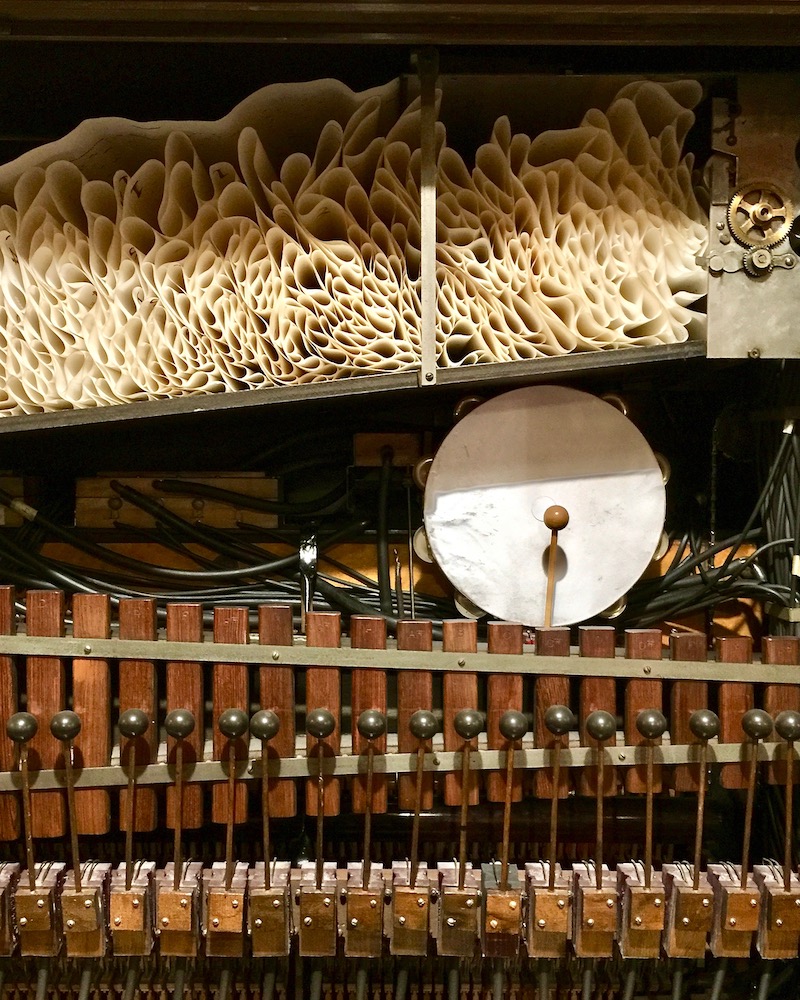
interior of nickelodeon music machine including player scroll, xylophone, and percussion at DeBence Antique Music World

interior of nickelodeon music machine including player scroll, xylophone, and percussion

DeBence Antique Music World has one of these piano-playing appliance-attachment-robots on display and ready to crank up for a mini concert on your next visit. DeBence’s collection also includes elaborate coin-operated mechanical music machines, calliopes, band organs, and more evolutions of disk-playing music boxes and phonographs than you ever knew existed.

The museum, located 80-some miles north of Pittsburgh in the über-quaint “Oil Country” town of Franklin, is a little out of our typical reach. But DeBence–and the region’s other many out-of-the-way attractions–are well worth the easy day trip from home.

metal musical disk on antique player at DeBence Antique Music World

Regina music disk and player

brass horns attached to elaborate band organ at DeBence Antique Music World

band organ horns

It’s probably safe to say musicians, record collectors, and those excited by domestic history and the development of America during its boom years will have an extra special interest in DeBence. The sheer volume of intricate, hand-cut music disks and elaborate, room-filling multi-instrument machinery is awe-inspiring and humbling to anyone who’s already dabbled in the media, fiddled with sound, or rocked the wheels of steel.

But you don’t have to be a music freak to appreciate DeBence. Just experiencing all the little gears clicking in metric time, wooden mallets tick-tocking stacked xylophone blocks, and the hair-blown-back blasts of dozens of brass pipes squonking in unison is a fascinating spectacle. The objects–polished metal disks, dark hardwood cabinetry, hand-painted decorative details–could stand alone in a design museum without ever hearing them play.

ornate disk player with dancing ballerinas display at DeBence Antique Music World

ornate disk player with dancing ballerinas display

painted detail on band organ frame at DeBence Antique Music World

painted detail on band organ frame

But, oh–you know where this is going–at DeBence, you do get to hear them perform. The collection is no mere array of historical objects entombed behind glass. No, they really don’t make them like they used to–and part of that means you can still hand crank the coil spring of a c. 1890s disk-playing music box and hear its metallic tines ting-ting-tingling out the popular music of the day. Try seeing if your 10-year-old Zune is still up to the task.

Our crew was fortunate enough to have an excellent volunteer guide who not only knew his stuff, but took us on the full tour even when we slipped in the door just before closing time. We don’t know how many of DeBence’s machines are still in working order, but an enormous number of them got cranked-up, switched-on, or otherwise sprung to life for the tour–each full of beans and with a song to sing.

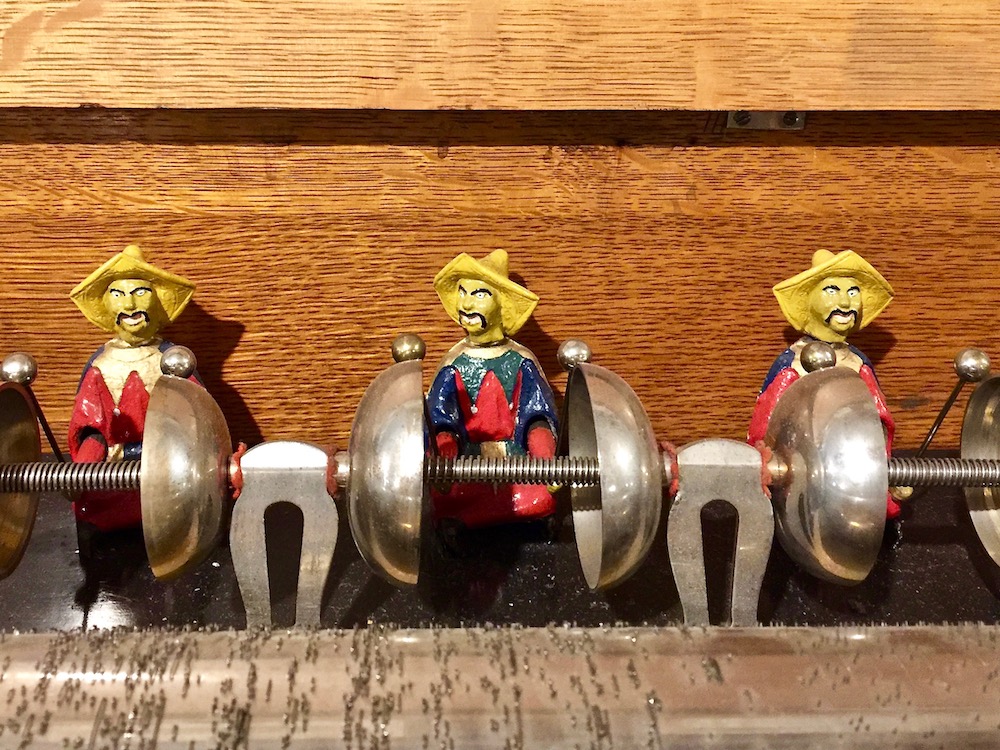
costumed figures playing bells inside Victorian music box at DeBence Antique Music World

Dumb bells. Jesters ready to strike in a 19th century music box.

gold-colored pipes of a home pipe organ at DeBence Antique Music World

organ pipes

It takes a whole lot of mind-bending technology to enable the history of recorded music to be beamed instantly through one’s digital device and straight into their psyche. That’s great and all, but there is an intangible loss in this convenience.

Maybe it’s an extreme rationalization from a part-time blogger and full time record collecting junkie, but something otherworldly happens when the black lacquer spins up, a tone arm adjusts over and drops down into place. There’s an electric moment of heightened sensation when we get just the barest static sizzle of a stylus in dead wax before the Side A, track 1 music kicks in. Sure: by any objective measure, it’s low-tech, obsolete, and patently nostalgic. But there’s a magic here you just don’t get with a Spotify stream.

wooden dancing puppet attached to spinning center of a Victrola at DeBence Antique Music World

handmade wooden Victrola dancer attachment

ceramic and textile dancing puppet attached to spinning center of a Victrola at DeBence Antique Music World

ceramic Victrola dancer attachment

If it seems like that today, imagine what the technology must have felt like to the Victorians–pre-radio, pre-motion picture, probably before most had ever talked on a telephone. Those early adopters, who first plunked-down an entire paycheck for a Victrola and then had to send off to Sears for a couple two-and-a-half-minute songs to play on them, must have lost their minds at the variety of voices and sounds coming to them from far, far away.

To see these old machines whir to life, sound spilling out–yes: creaking, wheezing, groaning, and, as Randy Jackson would say, “a little pitchy, dog,” at times–is a beautiful, transformative, and, yes, magical experience. I don’t know whether there’s a chance that gets your keister to dust off the phonograph and back in the record store [we’re rooting for you!] but it should at least get you up to Franklin.

Regardless, we can cross our fingers, hope the bellows push air, the paper score feeds the tickling digits, and the beautiful sound of magical music fills the air around you.

novelty decoration of real frog, stuffed with sawdust, holding a guitar at DeBence Antique Music World

Frog fantasy. Among DeBence’s novelties are many “real frogs stuffed with sawdust.”

exterior of DeBence Antique Music World, Franklin, PA

DeBence Antique Music World, downtown Franklin, PA

close-up of pump organ keyboard and stops

All the stops: Vox Humana, Gemshorn, Dulcissimo, etc.

Getting there: DeBence Antique Music World is located at 1261 Liberty Street in Franklin. It’s about an hour-and-a-half drive from downtown Pittsburgh. DeBence has regular hours through the warmer months, but slows down over winter, so check the museum’s web site to make sure you’ll be able to get in.


Almost. The unit doesn’t quite reach the full 88-key range of a standard piano keyboard. If you want to hit those super low notes, you’ll have to do that yourself.

Q: Who Can Take a Rainbow and Make the World Taste Good? A: The Randyland Can

elaborately painted former storefront, now Randyland, in Pittsburgh, PA

All the colors, all the time: Randyland, Arch Street, North Side

Even on one’s second, third, or fourth visit, there is still a lot left to take in. Dangling fruit and topiary flora; psychedelic pattern-over-pattern detail and wooden animals spinning their wings in the breeze; funhouse mirrors elongate space and disembodied mannequin heads make sure someone’s looking out for you at all times.

With all these competing attention-grabbers, what will stay with you most are the colors. The phrase “every crayon in the box” comes to mind–but it’s not quite accurate here. You’ll find no dour grays or bland beiges, nor any ugly browns or heavy black. The colors are more like an exploded rainbow dipped in a dream: big, bright, and bold, fully saturated with no restrictions on theme or palette.

wooden backyard arbor decorated with plastic fruit at Randyland

Arbor fruit and psychedelic stairs

By now, Randyland needs (almost) no introduction. The North Side house of many murals, its open-to-the-public garden art environment, decorated fences, adjoining buildings, and extending-to-the-street pole art have been featured in travel sites, airline magazines, city visitor guides, and a zillion Instragram selfies.

That level of publicity usually takes a location out of our purview … usually. But Randyland is also such a special place–so individual, fun, giving, personal, positive, and, yes, colorful that we also can’t not include it in The Orbit‘s broader map of Pittsburgh’s you need to see this cultural high points. Plus, we’ve been negligent on including a Mexican War Streets story and it’s high time we right that wrong.

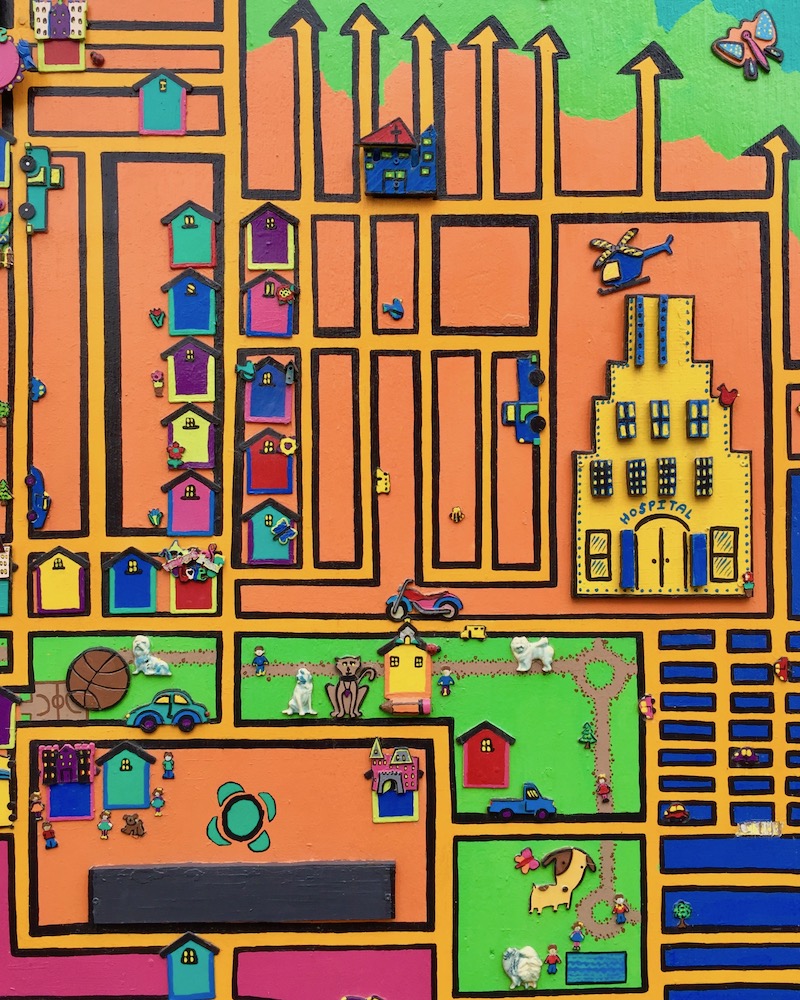
map of the North Side of Pittsburgh rendered as 3-D mural at Randyland

3-D Central North Side map (excerpt)

However it happened, Pittsburgh’s North Side ended up with an outsize share of the city’s big name cultural and tourist attractions. The Andy Warhol Museum, National Aviary, Children’s Museum, and Carnegie Science Center are all within (long) blocks of each other, as are the ball parks for both The Steelers and Pirates. The North Side also hosts slightly less name-brand amenities like The Mattress Factory, St. Anthony’s Reliquary, The Hazlett Theatre, Bicycle Heaven, and the newish (but terrificish) Alphabet City. It would be negligent to not mention that that the city’s only casino also ended up on the far “North Shore.” (Sigh.)

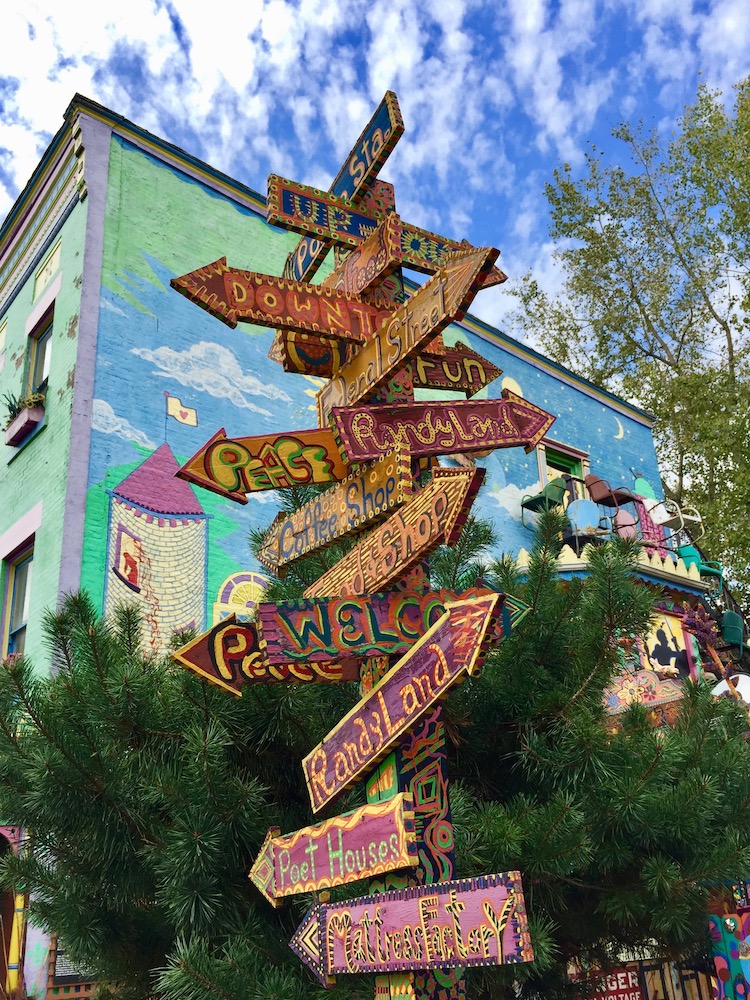
direction signs outside Randyland, Pittsburgh, PA

All roads lead to Randyland

So it is entirely fitting that Randyland is right here, on Arch Street, at the absolute geographical center of The North Side. This place–both visionary and as grass roots and down-to-earth as they come–seeks to be a welcome beacon to all of Pittsburgh’s disparate citizens, as well as all of her visitors. Those who come to our fair city and ignore the Land of Randy in favor of a roll on the slots or pre-game beers in a parking lot do so at their own peril. You’ve been warned.

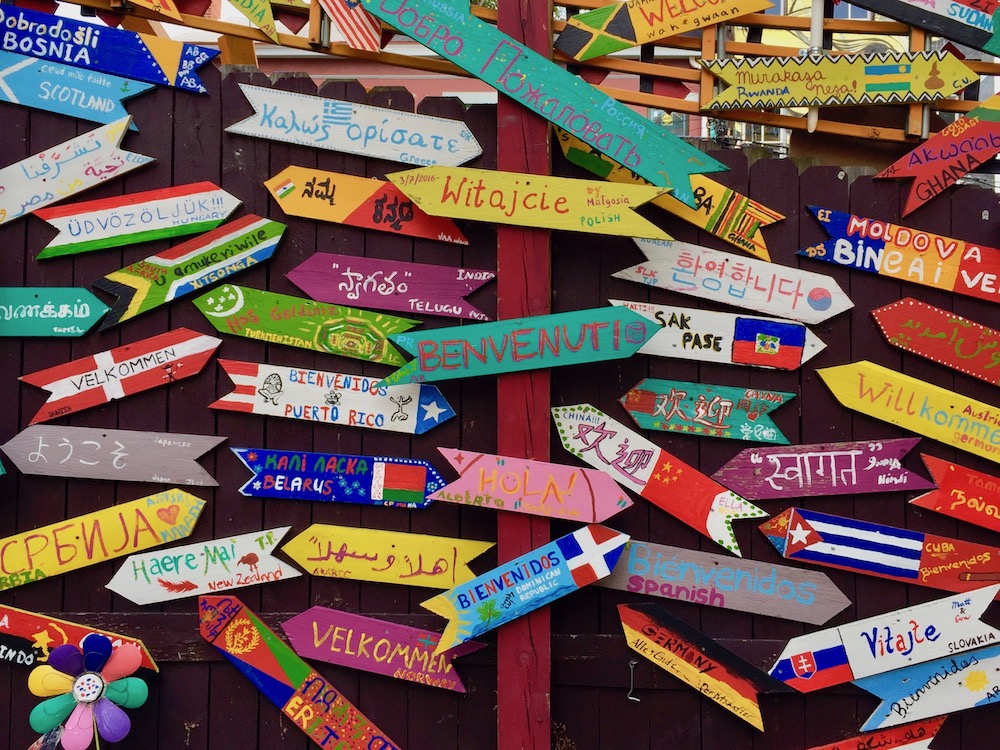
handmade welcome signs in many different languages at Randyland, Pittsburgh, PA

Section of “The largest international welcome wall in America”

Whether The largest international welcome wall in America can really claim that honor is probably up for debate. Regardless, Randyland has the interior of the Arch Street fence fully decked out with hand-painted arrows that bienvenidosmurakaza nezaüdvözöljük, and haere-mai visitors from around the world into Randy’s little corner of it.

The property’s side shed is well-stocked with shelves full of blanks ready for visitors to decorate with new welcome messages. A sign by the project mentions the creator’s welcome message  “must be your ancestry,” suggesting a United Nations-like visitor count has already made Randyland a stop on their American adventure.

wooden painted cutout of a musician playing a horn at Randyland, Pittsburgh, PA

Play, baby, play … and then dream big

Around the east and south sides of Randyland, facing Arch and Jacksonia Streets, are big sections of wooden picket fence. It’s likely the first thing you’ll see after the Randyland pseudo-storefront right on the corner. Like everything else on the property, these are decorated in multiple layers of swirling psychedelic bubbles, little round fish eye mirrors, and spinning whirligigs on off-kilter poles.

Atop all this are a series of life-size, 2-D wooden cutouts of musicians and dancers. Wearing fabulously groovy patterns, caught mid-stride and in full blown-out jam mode, they seem to all be at a swinging good-time party no one would want to miss. Among all the eccentric oddball entries scattered about Randyland, these painted cutout figures are a really incredible collection of work that would stand on its own in any environment.

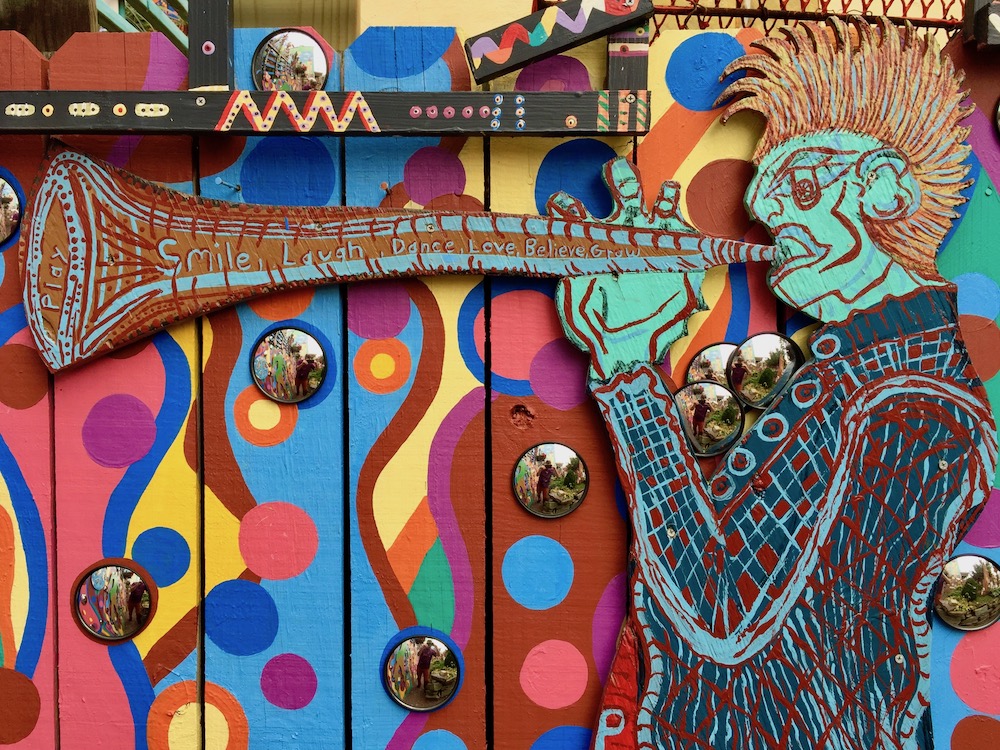
hand-painted cut-out of man playing long trumpet at Randyland, Pittsburgh, PA

Play, smile, laugh, dance, love, believe, grow

Messages painted directly on the figures’ body parts, clothes, and instruments are a not-too-subtle thesis for Randyland writ large. Dream Big, reads the bell of a saxophone; Believe U Can, the inscription on a dancer’s necktie. A cubist trumpeter with a punk rock hairdo implores us to Play, Smile, Laugh, Dance, Love, Believe, Grow. The message on a frenetic dancer’s long flowing dress is simply Be Happy.

metal letters spelling L-O-V-E in sand at Randyland

We IOVF Randyland! Love letters in the sand.

That kind of relentlessly earnest optimism and you-can-do-it positive encouragement is both a rare thing in this age of cynicism and easy to dismiss as hopelessly naive. It may also be a tough nut to swallow for those suffering from a blues that can make tossed-off statements like “be happy” feel like either an insufferably shallow temperature reading or an insurmountable obstacle to achieve in a real world outside the boundaries of Randyland.

art robot with outstretched arms

HUG-BOT 2.0

But…that’s why Randy created the HUG-BOT 2.0–and a garden’s worth of oversize art flowers, goofy takes on where to hang one’s lawn furniture, and how to look at the sky in its mirror opposite. If you can manage to visit Randyland, take your time speculating on the preposterous occasion of a suit of armor with a necktie, giant flies on telephone poles, mannequin heads in sunglasses and lip gloss and still not feel any better about the state of the world, well, you may just need to turn around, look at that wall of arrows one more time, and know that this is a place where you’re always welcome to try again.

collection of mannequin heads wearing sunglasses at Randyland

Here’s lookin’ at you! The future’s so bright, even the mannequins gotta wear shades.


Getting there: Randyland is located at 1501 Arch Street in the Mexican War Streets neighborhood of the North Side. It’s free and open to the public from 10 a.m. to dusk pretty much every day.